Conceptual PCQs
Summary
- Stress is the restoring force per unit area and strain is the fractional change in dimension. In general there are three types of stresses (a) tensile stress – longitudinal stress (associated with stretching) or compressive stress (associated with compression), (b) shearing stress, and (c) hydraulic stress (Hydraulic stress (or bulk/volume stress) is the internal restoring force per unit area generated within a body when it is compressed uniformly from all directions by an external fluid. It causes a change in the object’s volume (compressive strain) rather than its shape).
- For small deformations, stress is directly proportional to the strain for many materials. This is known as Hooke’s law. The constant of proportionality is called modulus of elasticity. Three elastic moduli viz., Young’s modulus, shear modulus and bulk modulus are used to describe the elastic behaviour of objects as they respond to deforming forces that act on them.
A class of solids called elastomers does not obey Hooke’s law. - When an object is under tension or compression, the Hooke’s law takes the form
\(
F / A=Y \Delta L / L
\)
where \(\Delta L / L\) is the tensile or compressive strain of the object, \(F\) is the magnitude of the applied force causing the strain, \(A\) is the cross-sectional area over which \(F\) is applied (perpendicular to \(A\) ) and \(Y\) is the Young’s modulus for the object. The stress is \(F / A\). - A pair of forces when applied parallel to the upper and lower faces, the solid deforms so that the upper face moves sideways with respect to the lower. The horizontal displacement \(\Delta L\) of the upper face is perpendicular to the vertical height \(L\). This type of deformation is called shear and the corresponding stress is the shearing stress. This type of stress is possible only in solids.
In this kind of deformation the Hooke’s law takes the form
\(
F / A=G \times \Delta L / L
\)
where \(\Delta L\) is the displacement of one end of object in the direction of the applied force \(F\), and \(G=\eta\) is the shear modulus. - When an object undergoes hydraulic compression due to a stress exerted by a surrounding fluid, the Hooke’s law takes the form
\(
p=B(\Delta V / V)
\)
where \(p\) is the pressure (hydraulic stress) on the object due to the fluid, \(\Delta V / V\) (the volume strain) is the absolute fractional change in the object’s volume due to that pressure and \(B\) is the bulk modulus of the object. - Poisson’s ratio is \(\sigma=\frac{\text { Lateral strain }}{\text { Longitudinal strain }}=\frac{-\Delta D / D}{\Delta L / L}\)
- There are four relations between \(Y, B, \eta\) and \(\sigma\), which can be given as follows
(1) \(B=\frac{Y}{3(1-2 \sigma)}\)
(2) \(\eta=\frac{Y}{2(1+\sigma)}\)
(3) \(\sigma=\frac{3 B-2 \eta}{2 \eta+6 B}\)
(4) \(\frac{9}{Y}=\frac{1}{B}+\frac{3}{\eta}\) - work done \((W)\) in stretching the wire from 0 to a total extension \(\Delta L\)
\(
W=\frac{1}{2} \frac{Y A(\Delta L)^2}{L}
\) - Elastic Potential Energy:
\(\begin{aligned} U & =\frac{1}{2} \times\left(\frac{F}{A}\right) \times\left(\frac{\Delta L}{L}\right) \times(A L) \\ U & =\frac{1}{2} \times \text { Stress × Strain × Volume }\end{aligned}\) Thermal Stress:
Using Young’s Modulus ( \(Y=\frac{\text { Stress }}{\text { Strain }}\) ), we can find the stress:
Thermal Stress \(=Y \times\) Thermal Strain
Thermal Stress \(=Y \alpha \Delta T\)Thermal Force:
The force exerted by the rod on the supports (or vice versa) is:
\(
\begin{gathered}
F=\text { Stress × Area } \\
F=Y A \alpha \Delta T
\end{gathered}
\)
Quiz Summary
0 of 30 Questions completed
Questions:
Information
You have already completed the quiz before. Hence you can not start it again.
Quiz is loading…
You must sign in or sign up to start the quiz.
You must first complete the following:
Results
Results
0 of 30 Questions answered correctly
Your time:
Time has elapsed
You have reached 0 of 0 point(s), (0)
Earned Point(s): 0 of 0, (0)
0 Essay(s) Pending (Possible Point(s): 0)
Categories
- Not categorized 0%
- 1
- 2
- 3
- 4
- 5
- 6
- 7
- 8
- 9
- 10
- 11
- 12
- 13
- 14
- 15
- 16
- 17
- 18
- 19
- 20
- 21
- 22
- 23
- 24
- 25
- 26
- 27
- 28
- 29
- 30
- Current
- Review
- Answered
- Correct
- Incorrect
- Question 1 of 30
1. Question
A rope 1 cm in diameter breaks if the tension in it exceeds 500 N. The maximum tension that may be given to a similar rope of diameter 2 cm is
CorrectIncorrectHint
(d) To find the maximum tension the second rope can withstand, we can use the relationship between the breaking tension of a rope and its physical dimensions.
Step 1: Understanding the Relationship
The breaking tension \((T)\) of a rope is the maximum force it can withstand before failing. This depends on the breaking stress \((\sigma)\) of the material, which is a constant property for ropes made of the same material. The relationship is defined as:
\(
T=\sigma \cdot A
\)
where \(A\) is the cross-sectional area of the rope.
Step 2: Area and Diameter
For a circular rope, the cross-sectional area (\(\boldsymbol{A}\)) is proportional to the square of its diameter (\(d\)):
\(
A=\pi\left(\frac{d}{2}\right)^2
\)
Therefore, the breaking tension is proportional to the square of the diameter:
\(
T \propto d^2
\)
Step 3: Calculation
Given the initial conditions for the first rope:
Diameter \(\left(d_1\right)=1 \mathrm{~cm}\)
Breaking Tension \(\left(T_1\right)=500 \mathrm{~N}\)
For the second similar rope:
Diameter \(\left(d_2\right)=2 \mathrm{~cm}\)
Breaking Tension \(\left(T_2\right)=\) ?
Using the proportionality ratio:
\(
\frac{T_2}{T_1}=\left(\frac{d_2}{d_1}\right)^2
\)
Substitute the known values:
\(
\frac{T_2}{500}=\left(\frac{2 \mathrm{~cm}}{1 \mathrm{~cm}}\right)^2
\)
\(
T_2=2000 \mathrm{~N}
\)
Conclusion: The maximum tension that may be given to the similar rope of diameter 2 cm is 2000 N. - Question 2 of 30
2. Question
The breaking stress of a wire depends on
CorrectIncorrectHint
(a) Understanding Breaking Stress
Breaking stress (also known as ultimate tensile strength) is an intensive property of a material. This means it is inherent to the substance itself and does not change based on the physical dimensions or geometry of the object.
Why the other options are incorrect:
Length (b): Increasing the length of a wire does not change the internal strength of the material. While a longer wire might have a higher probability of containing a structural defect (flaw), theoretically, the breaking stress remains constant.
Radius (c): As we saw in your previous question, the breaking force (tension) changes with the radius (or diameter), but the stress (Force/Area) remains the same because the area increases proportionally with the force.
Shape (d): Whether the cross-section is circular, square, or triangular, the stress required to rupture the molecular bonds of a specific material (like copper or steel) remains a constant value per unit area. - Question 3 of 30
3. Question
A wire can sustain the weight of 20 kg before breaking. If the wire is cut into two equal parts, each part can sustain a weight of
CorrectIncorrectHint
(b) The breaking strength of a wire is an intensive property of the material and the geometry of its cross-section. It is defined by the formula:
\(
\mathrm{F}=\sigma \cdot \mathrm{A}
\)
where:
\(\mathbf{F}\) is the breaking force (or maximum weight).
\(\sigma\) is the breaking stress (tensile strength), which is a constant property of the specific material.
\(A\) is the cross-sectional area of the wire.
When a wire is cut into two equal parts, the material remains the same and the crosssectional area does not change. Because the breaking strength is independent of the length of the wire, each individual segment will still break at the same maximum load as the original full-length wire. Thus, both pieces can still sustain 20 kg. - Question 4 of 30
4. Question
Two wires \(A\) and \(B\) are made of same material. The wire \(A\) has a length \(l\) and diameter \(r\) while the wire \(B\) has a length \(2 l\) and diameter \(r / 2\). If the two wires are stretched by the same force, the elongation in \(A\) divided by the elongation in \(B\) is
CorrectIncorrectHint
(a) To find the ratio of the elongation in wire \(A\) to the elongation in wire \(B\), we can use the formula for Young’s Modulus.
Step 1: The Elongation Formula
The Young’s Modulus (\(Y\)) of a material is defined as:
\(
Y=\frac{\text { Stress }}{\text { Strain }}=\frac{F / A}{\Delta L / L}
\)
Rearranging this formula to solve for the elongation (\(\Delta L\)):
\(
\Delta L=\frac{F \cdot L}{A \cdot Y}
\)
Since the cross-sectional area \(A\) of a wire with diameter \(d\) is \(A=\pi\left(\frac{d}{2}\right)^2=\frac{\pi d^2}{4}\), the elongation can be written as:
\(
\Delta L=\frac{4 F L}{\pi d^2 Y}
\)
Identify Given Values:
Both wires are made of the same material, so \(Y\) is constant. They are stretched by the same force \((F)\). Therefore, the elongation is proportional to the length and inversely proportional to the square of the diameter:
\(
\Delta L \propto \frac{L}{d^2}
\)
For Wire A:
Length \(\left(L_A\right)=l\)
Diameter \(\left(d_A\right)=r\)
\(
\Delta L_A \propto \frac{l}{r^2}
\)
For Wire B:
Length \(\left(L_B\right)=2 l\)
Diameter \(\left(d_B\right)=r / 2\)
\(
\Delta L_B \propto \frac{2 l}{(r / 2)^2}=\frac{2 l}{r^2 / 4}=\frac{8 l}{r^2}
\)
Calculate the Ratio:
Now, we find the ratio of the elongation in \(A\) to the elongation in \(B\) :
\(
\frac{\Delta L_A}{\Delta L_B}=\frac{l / r^2}{8 l / r^2}
\)
\(
\begin{aligned}
&\frac{\Delta L_A}{\Delta L_B}=\frac{1}{8}\\
&\text { Conclusion: The elongation in } A \text { divided by the elongation in } B \text { is } 1 / 8 \text {. }
\end{aligned}
\) - Question 5 of 30
5. Question
A wire elongates by 1.0 mm when a load \(W\) is hung from it. If this wire goes over a pulley and two weights \(W\) each are hung at the two ends, the elongation of the wire will be
CorrectIncorrectHint
(b) Step 1: Relate Elongation to Tension
The elongation \(\Delta L\) of a wire is governed by Young’s Modulus \(Y\), which is defined by the formula:
\(
\Delta L=\frac{F L}{A Y}
\)
where \(F\) is the tension (restoring force) in the wire, \(L\) is the original length, \(A\) is the cross-sectional area, and \(Y\) is the Young’s modulus of the material.
Step 2: Analyze Case 1
When the wire is fixed at one end and a load \(W\) is hung from the other, the tension \(T\) throughout the wire is equal to \(W\). According to the problem:
\(
\Delta L_1=\frac{W L}{A Y}=1.0 \mathrm{~mm}
\)
Step 3: Analyze Case 2
When the wire is passed over a pulley with two weights \(W\) at each end, the system is in equilibrium. The tension \(T\) at every point in the wire remains equal to \(W\) (the second weight effectively replaces the reaction force previously provided by the fixed ceiling).
Since the total length \(L\), area \(A\), and material \(Y\) remain unchanged, the total elongation is:
\(
\Delta L_2=\frac{W L}{A Y}
\)
Comparing this to Case 1, we find \(\Delta L_2=\Delta L_1=1.0 \mathrm{~mm}\). - Question 6 of 30
6. Question
A heavy uniform rod is hanging vertically from a fixed support. It is stretched by its own weight. The diameter of the rod is
CorrectIncorrectHint
(a) smallest at the top and gradually increases down the rod.
Explanation
Weight Distribution: For a heavy rod hanging vertically, the tension (force) at any cross-section is equal to the weight of the portion of the rod hanging below it.
Maximum Tension at the Top: The tension is maximum at the top support, where it must hold the entire weight of the rod, and decreases to zero at the free bottom end.
Longitudinal Strain: Since stress (force/area) is highest at the top, the longitudinal strain (stretching) is also maximum at the top.
Poisson’s Effect: According to the principle of lateral/transverse strain, when a material is stretched longitudinally, it contracts laterally (becomes thinner).
Resulting Diameter: Because the stretching (longitudinal strain) is greatest at the top, the lateral contraction is also greatest there, making the diameter smallest at the top and gradually larger toward the bottom.Why other options are incorrect
(b) largest at the top and gradually decreases down the rod: This would only be the design choice if the goal was to create a rod of “uniform strength” (tapering it to keep stress constant). In a uniform rod that is simply hanging and stretching, the physical deformation results in the top being the thinnest.
(c) uniform everywhere: This ignores the deformation caused by the rod’s own weight. While it started as a “uniform rod,” the stretching under gravity makes the diameter non-uniform.
(d) maximum in the middle: There is no physical mechanism in this scenario that would cause the diameter to be greatest in the center; the tension changes linearly from top to bottom. - Question 7 of 30
7. Question
When a metal wire is stretched by a load, the fractional change in its volume \(\Delta V / V\) is proportional to
CorrectIncorrectHint
(a) Step 1: Define Volume and Dimensions
The volume \(V\) of a cylindrical metal wire with length \(l\) and radius \(r\) is given by the formula:
\(
V=\pi r^2 l
\)
Step 2: Calculate the Fractional Change
To find the fractional change in volume, we take the natural logarithm of both sides and differentiate, or apply the product rule for small changes:
\(
\frac{\Delta V}{V}=\frac{\Delta l}{l}+2 \frac{\Delta r}{r}
\)
Here, \(\frac{\Delta l}{l}\) represents the longitudinal strain and \(\frac{\Delta r}{r}\) represents the lateral strain.
Step 3: Incorporate Poisson’s Ratio
Poisson’s ratio (\(\sigma\)) is defined as the ratio of lateral strain to longitudinal strain (with a negative sign indicating that the radius decreases as length increases):
\(
\sigma=-\frac{\Delta r / r}{\Delta l / l} \Longrightarrow \frac{\Delta r}{r}=-\sigma \frac{\Delta l}{l}
\)
Substituting this into the volume change equation:
\(
\frac{\Delta V}{V}=\frac{\Delta l}{l}+2\left(-\sigma \frac{\Delta l}{l}\right)
\)
\(
\frac{\Delta V}{V}=(1-2 \sigma) \frac{\Delta l}{l}
\)
Step 4: Determine Proportionality
Since the Poisson’s ratio \(\sigma\) is a constant property for a given metal wire within its elastic limit, the term \((1-2 \sigma)\) is a constant. Therefore, the fractional change in volume is directly proportional to the longitudinal strain:
\(
\frac{\Delta V}{V} \propto \frac{\Delta l}{l}
\) - Question 8 of 30
8. Question
A heavy mass is attached to a thin wire and is whirled in a vertical circle. The wire is most likely to break
CorrectIncorrectHint
(b) To understand why, we need to analyze the forces acting on the mass at different points in its circular path. The wire breaks when the tension (\(T\)) exceeds its maximum limit.
Step 1: Forces at Play
When a mass \(m\) moves in a vertical circle of radius \(R\) with velocity \(v\), two main forces determine the tension in the wire:
Gravity (\(m g\)): Pulls the mass downward.
Centripetal Force \(\left(m v^2 / R\right)\) : The net force required to keep the mass in a circular path.
Step 2: Comparing the Points
Let’s look at the tension at the two extreme positions:
At the Highest Point
At the top, both gravity and tension act downward toward the center.
\(
T_{t o p}+m g=\frac{m v_{t o p}^2}{R} \Longrightarrow T_{t o p}=\frac{m v_{t o p}^2}{R}-m g
\)
Gravity actually helps the tension provide the centripetal force here, so the wire doesn’t have to pull as hard.
At the Lowest Point
At the bottom, tension acts upward (toward the center) while gravity pulls downward (away from the center).
\(
T_{\text {bottom }}-m g=\frac{m v_{\text {bottom }}^2}{R} \Longrightarrow T_{\text {bottom }}=\frac{m v_{\text {bottom }}^2}{R}+m g
\)
Here, the tension has to work “overtime”-it must overcome gravity and provide the necessary centripetal force.
Step 3: The “Double Whammy” at the Bottom
The tension is highest at the bottom for two reasons:
Gravity: As shown in the formula, \(m g\) is added to the centripetal term rather than subtracted.
Velocity: Due to conservation of energy, the mass is moving at its maximum speed (\(v\) surf) at the lowest point. Since \(T\) depends on \(v^2\), the centripetal component is also at its peak.
\(
\begin{array}{lll}
\text { Position } & \text { Tension Formula } & \text { Relative Tension } \\
\text { Highest Point } & T=\frac{m v^2}{R}-m g & \text { Minimum } \\
\text { Horizontal } & T=\frac{m v^2}{R} & \text { Moderate } \\
\text { Lowest Point } & T=\frac{m v^2}{R}+m g & \text { Maximum }
\end{array}
\)
Because the tension is at its absolute peak at the bottom of the swing, that is where the wire is most likely to snap. - Question 9 of 30
9. Question
The length of a metal wire is \(l_1\) when the tension in it is \(T_1\) and is \(l_2\) when the tension is \(T_2\). The natural length of the wire is
CorrectIncorrectHint
(c) To find the natural length (\(L\)) of the wire, we use Hooke’s Law, which states that the extension of a wire is directly proportional to the tension applied to it.
Step 1: Setting up the Equations
Let \(L\) be the natural length of the wire. The extension (\(\Delta l\)) is the difference between the stretched length and the natural length.
For the first case: \(\Delta l_1=l_1-L\)
For the second case: \(\Delta l_2=l_2-L\)
According to Hooke’s Law:
\(
T \propto \Delta l \Longrightarrow T=k(l-L)
\)
where \(k\) is the force constant of the wire.
We can write two equations based on the given conditions:
\(T_1=k\left(l_1-L\right)\)
\(T_2=k\left(l_2-L\right)\)
Step 2: Solving for \(L\)
To eliminate the constant \(k\), we divide the two equations:
\(
\frac{T_1}{T_2}=\frac{l_1-L}{l_2-L}
\)
Now, cross-multiply to solve for \(L\) :
\(
\begin{aligned}
& T_1\left(l_2-L\right)=T_2\left(l_1-L\right) \\
& T_1 l_2-T_1 L=T_2 l_1-T_2 L
\end{aligned}
\)
Rearrange the terms to group all \(L\) terms on one side:
\(
\begin{aligned}
& T_2 L-T_1 L=T_2 l_1-T_1 l_2 \\
& L\left(T_2-T_1\right)=l_1 T_2-l_2 T_1
\end{aligned}
\)
Finally, isolate \(L\) :
\(
L=\frac{l_1 T_2-l_2 T_1}{T_2-T_1}
\) - Question 10 of 30
10. Question
When a metal wire elongates by hanging a load on it, the gravitational potential energy is decreased.
CorrectIncorrectHint
(d) This is a classic problem in elasticity that highlights the “Energy Paradox” in stretching a wire. To understand why none of the first three options are entirely correct, we have to look at the energy balance.
Step 1: The Energy Calculation
When a load of mass \(M\) (weight \(W=M g\)) is hung on a wire and it elongates by an amount \(\Delta l\) :
Loss in Gravitational Potential Energy \(\left(\Delta U_g\right)\) : The load moves down by \(\Delta l\).
\(
\Delta U_g=W \cdot \Delta l
\)
Gain in Elastic Potential Energy (\(U_e\)): The energy stored in the stretched wire is given by the area under the force-extension graph (which is a triangle).
\(
U_e=\frac{1}{2} \cdot \text { Force } \cdot \text { Extension }=\frac{1}{2} W \cdot \Delta l
\)
Step 2: The Missing Energy
If you compare the two values:
Energy lost by the load \(=W \Delta l\)
Energy stored in the wire \(=\frac{1}{2} W \Delta l\)
Only half of the lost gravitational potential energy is stored as elastic potential energy in the wire.
Step 3: Where does the other half go?
The remaining \(50 \%\) (\(\frac{1}{2} W \cdot \Delta l\)) is converted into heat due to internal friction (viscosity) as the molecules of the metal slide past each other, and into kinetic energy if the weight is bouncing. Even if the weight is lowered slowly by hand, that “missing” energy is actually work done by your hand to counteract gravity.
Why the other options are wrong:
(a): If the block is in equilibrium after stretching, its kinetic energy is zero. Even during the fall, only part of the energy is kinetic.
(b): As shown above, only \(50 \%\) appears as elastic potential energy, not “completely.”
(c): While heat is generated, it isn’t the only thing the energy turns into; half is stored as potential energy.
Summary: The energy is divided equally: \(50 \%\) becomes Elastic Potential Energy and \(50 \%\) is lost as Heat. - Question 11 of 30
11. Question
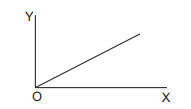
A student plots a graph from his readings on the determination of Young modulus of a metal wire but forgets to put the labels (figure below). The quantities on \(X\) and \(Y\)-axes may be respectively
 CorrectIncorrect
Hint
(all) Step 1: The Relationship
Young’s Modulus \((Y)\) is defined as the ratio of tensile stress \((\sigma)\) to tensile strain \((\epsilon)\) :
\(
Y=\frac{\text { Stress }}{\text { Strain }}=\frac{F / A}{\Delta l / l}
\)
Where:
\(F=\) Weight hung (Force)
\(A=\) Cross-sectional area
\(\Delta l=\) Elongation (length increased)
\(l=\) Original length
Rearranging this, we get:
\(
\Delta l=\left(\frac{l}{A Y}\right) F
\)
Step 2: Analyzing the Graph
The figure referred to in the question is a straight line passing through the origin. For a graph to be a straight line through the origin \((y=m x)\), the two quantities plotted must be directly proportional to each other.
(a) Weight hung \((F)\) and length increased \((\Delta l)\) : Since \(\Delta l \propto F\), plotting \(F\) on one axis and \(\Delta l\) on the other yields a straight line.
(b) Stress applied (\(\sigma\)) and length increased (\(\Delta l\)): Since \(\sigma=Y \cdot \frac{\Delta l}{l}\), stress is directly proportional to elongation (\(\sigma \propto \Delta l\)). This also results in a straight line.
(c) Stress applied (\(\sigma\)) and strain developed (\(\epsilon\)): By definition, \(\sigma=Y \epsilon\). Within the elastic limit, stress is directly proportional to strain, producing a straight line where the slope is Young’s Modulus.
(d) Length increased (\(\Delta l\)) and weight hung (\(F\)): This is simply the inverse of option (a). Since the relationship is linear, swapping the axes still results in a straight line.
Conclusion
Since all pairs of quantities listed have a linear (proportional) relationship within the elastic limit of the wire, any of them could be represented by the \(X\) and \(Y\) axes of a straight-line graph.
Correct Options: (a), (b), (c), and (d). - Question 12 of 30
12. Question
The maximum load, a wire can withstand without breaking, when its length is reduced to half of its original length, will [NCERT Exemplar]
CorrectIncorrectHint
(d) The maximum load (breaking force) a wire can withstand is independent of its length. It is determined by the formula:
\(
\text { Breaking Force }=\text { Breaking Stress } \text { × } \text { Cross-sectional Area }
\)Breaking Stress: This is a characteristic property of the material and does not change regardless of the wire’s length.
Cross-sectional Area: Cutting a wire to half its length does not change its thickness or cross-sectional area.
Since neither the breaking stress nor the cross-sectional area changes when the length is reduced, the maximum load the wire can withstand remains the same. - Question 13 of 30
13. Question
The temperature of a wire is doubled. The Young’s modulus of elasticity [NCERT Exemplar]
CorrectIncorrectHint
(d) will decrease.
This is because Young’s modulus is a measure of the stiffness of the material’s molecular bonds, and temperature significantly impacts those bonds.
Step 1: The Molecular Perspective
Young’s modulus \((Y)\) depends on the intermolecular forces holding the atoms of the metal together.
At lower temperatures: Atoms are packed tightly and vibrate with low amplitude. The “springs” (atomic bonds) connecting them are stiff and hard to pull apart.
At higher temperatures: The thermal energy of the atoms increases, causing them to vibrate more vigorously. This increases the average distance between the atoms (thermal expansion).
Step 2: The Relationship with Elasticity
As the interatomic distance increases due to heating:
1. The intermolecular strength effectively weakens.
2. It becomes easier to deform the material (it becomes more “plastic” and less “elastic”).
3. Since \(Y=\frac{\text { Stress }}{\text { Strain }}\), and a weakened material requires less stress to produce the same amount of strain, the value of \(Y\) decreases. - Question 14 of 30
14. Question
Consider two cylindrical rods of identical dimensions, one of rubber and the other of steel. Both the rods are fixed rigidly at one end to the roof. A mass \(M\) is attached to each of the free ends at the centre of the rods. Then, [NCERT Exemplar]
CorrectIncorrectHint
(d) the steel rod will elongate without any perceptible change in shape, but the rubber rod will elongate with the shape of the bottom edge tapered to a tip at the centre.
This question highlights the difference between small strain (steel) and large strain (rubber) materials, as well as the way forces are distributed when applied at a specific point.
Step 1: Steel: The Small Strain Case
Steel has a very high Young’s modulus \(\left(Y_{\text {steel }} \approx 2 \times 10^{11} \mathrm{~Pa}\right)\). When you hang a mass \(M\) from a steel rod:
The elongation is extremely small (microscopic).
Because the material is so stiff, the internal forces distribute almost uniformly across the cross-section.
Consequently, the rod maintains its cylindrical geometry, and the bottom edge remains flat to the naked eye.
Step 2: Rubber: The Large Strain Case
Rubber is a polymer with a much lower Young’s modulus \(\left(Y_{\text {rubber }} \approx 10^6\right.\) to \(\left.10^7 \mathrm{~Pa}\right)\). It can undergo significant deformation.
Point Load Effect: The mass \(M\) is attached to the center of the free end.
Stress Concentration: In a highly flexible material like rubber, the area immediately surrounding the attachment point experiences much higher stress than the outer edges of the cylinder’s base.
Tapering: Because the center is pulled down more forcefully than the perimeter, the flat bottom surface “sags” or stretches downward at the point of attachment. This causes the bottom edge to lose its flat shape and taper toward the center where the weight is concentrated.
\(
\begin{array}{llll}
\text { Material } & \text { Stiffness (Young’s Modulus) } & \text { Deformation Appearance } & \text { Bottom Edge Shape } \\
\text { Steel } & \text { Very High } & \text { Negligible / Uniform } & \text { Remains flat } \\
\text { Rubber } & \text { Low } & \text { Significant / Non-uniform } & \text { Tapers to a tip }
\end{array}
\) - Question 15 of 30
15. Question
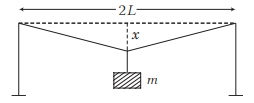
A mild steel wire of length \(2 L\) and cross-sectional area \(A\) is stretched, well within elastic limit, horizontally between two pillars (figure). A mass \(m\) is suspended from the mid-point of the wire. Strain in the wire is [NCERT Exemplar]
 CorrectIncorrect
Hint
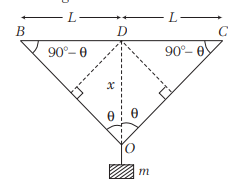
(a) Consider the diagram below

\(
\begin{aligned}
&\text { Hence, change in length, } \Delta L=B O+O C-(B D+D C)\\
&\begin{aligned}
& =2 B O-2 B D \quad(\because B O=O C, B D=D C) \\
& =2[B O-B D]=2\left[\left(x^2+L^2\right)^{1 / 2}-L\right] \\
& =2 L\left[\left(1+\frac{x^2}{L^2}\right)^{1 / 2}-1\right] \approx 2 L\left[1+\frac{1}{2} \frac{x^2}{L^2}-1\right]=\frac{x^2}{L}(\because x \ll L) \\
\therefore \quad & \text { Strain }=\frac{\Delta L}{2 L}=\frac{x^2 / L}{2 L}=\frac{x^2}{2 L^2}
\end{aligned}
\end{aligned}
\)Alternate: Step 1: Geometry of the Stretched Wire
The wire of original length \(2 L\) is stretched between two pillars. When a mass \(m\) is suspended at the midpoint, the wire sags by a distance \(x\). This creates two rightangled triangles with a horizontal base \(L\) and a vertical side \(x\). By the Pythagorean theorem, the new length of each half of the wire is:
\(
L^{\prime}=\sqrt{L^2+x^2}
\)
Step 2: Calculate the Change in Length
The total new length of the wire is \(2 L^{\prime}\), and the original length was \(2 L\). The total change in length (\(\Delta L\)) is:
\(
\Delta L=2 \sqrt{L^2+x^2}-2 L
\)
We can factor out \(2 L\) :
\(
\Delta L=2 L\left(1+\frac{x^2}{L^2}\right)^{1 / 2}-2 L
\)
Step 3: Apply Binomial Approximation
Since the stretching is within the elastic limit and the sag \(x\) is typically very small compared to \(L(x \ll L)\), we use the binomial expansion \((1+z)^n \approx 1+n z\) :
\(
\left(1+\frac{x^2}{L^2}\right)^{1 / 2} \approx 1+\frac{1}{2} \frac{x^2}{L^2}
\)
Substituting this back into the change in length equation:
\(
\Delta L \approx 2 L\left(1+\frac{x^2}{2 L^2}\right)-2 L=2 L+\frac{x^2}{L}-2 L=\frac{x^2}{L}
\)
Step 4: Determine the Longitudinal Strain
Strain is defined as the ratio of change in length to the original length:
\(
\begin{gathered}
\text { Strain }=\frac{\Delta L}{\text { Original Length }}=\frac{x^2 / L}{2 L} \\
\text { Strain }=\frac{x^2}{2 L^2}
\end{gathered}
\) - Question 16 of 30
16. Question
When a spiral spring is stretched by force, strain produced is
CorrectIncorrectHint
(d) When a spiral (helical) spring is stretched by a force, the wire of the spring undergoes twisting, which produces shear strain, while the overall spring elongates, which is considered a form of structural deformation that often includes longitudinal components (a). However, the, primary deformation mechanism in the wire is twisting, resulting in (c) shear strain.
- Question 17 of 30
17. Question
Two wires of same material and length but diameter in the ratio \(1: 2\) are stretched by the same force. The potential energy per unit volume for the two wires when stretched will be in the ratio
CorrectIncorrectHint
(a) Step 1: Identify the formula for energy density
The potential energy per unit volume (also known as elastic energy density, \(u\)) of a stretched wire is given by the formula:
\(
u=\frac{1}{2} \times \text { stress × strain }
\)
Since the material is the same, we use Young’s modulus (\(Y=\frac{\text { stress }}{\text { strain }}\)) to rewrite the expression in terms of the applied force \(F\) and cross-sectional area \(A\) :
\(
u=\frac{\text { stress }^2}{2 Y}=\frac{(F / A)^2}{2 Y}=\frac{F^2}{2 Y A^2}
\)
Step 2: Establish the relationship between energy density and diameter
The cross-sectional area of a wire is \(A=\frac{\pi d^2}{4}\), where \(d\) is the diameter. Substituting this into the energy density formula:
\(
u=\frac{F^2}{2 Y\left(\frac{\pi d^2}{4}\right)^2}=\frac{8 F^2}{Y \pi^2 d^4}
\)
Given that the stretching force \(F\) and the material (Young’s modulus \(Y\)) are the same for both wires, the energy density is inversely proportional to the fourth power of the diameter:
\(
u \propto \frac{1}{d^4}
\)
Step 3: Calculate the ratio
Let the diameters be \(d_1\) and \(d_2\). We are given the ratio \(d_1: d_2=1: 2\). The ratio of their potential energies per unit volume is:
\(
\frac{u_1}{u_2}=\left(\frac{d_2}{d_1}\right)^4
\)
Substituting the given values:
\(
\frac{u_1}{u_2}=\left(\frac{2}{1}\right)^4=16
\)
Thus, the ratio is \(16: 1\). - Question 18 of 30
18. Question
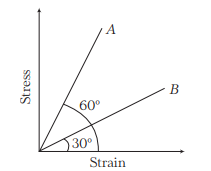
The stress versus strain graphs for wires of two materials \(A\) and \(B\) are as shown in the figure. If \(Y_A\) and \(Y_B\) are the Young’s moduli of the materials, then
 CorrectIncorrect
Hint
(d)
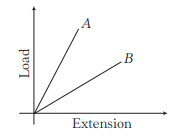
\(\begin{aligned} \frac{Y_A}{Y_B} & =\frac{\tan \theta_A}{\tan \theta_B}=\frac{\tan 60^{\circ}}{\tan 30^{\circ}} \\ & =\frac{\sqrt{3}}{1 / \sqrt{3}}=3 \Rightarrow Y_A=3 Y_B\end{aligned}\) - Question 19 of 30
19. Question
In the given figure, if the dimensions of the wires are the same and materials are different, Young’s modulus is more for
 CorrectIncorrect
Hint
(a) \(F=\left(\frac{Y A}{l}\right) \cdot \Delta l\), i.e. \(F-\Delta l\) graph is a straight line with slope \(\frac{Y A}{l}\), i.e. slope is proportional to \(Y\).
\(
\begin{array}{rlrl}
& & (\text { Slope })_A & >(\text { Slope })_B \\
\therefore & Y_A & >Y_B
\end{array}
\) - Question 20 of 30
20. Question
A stress of \(6 \times 10^6 \mathrm{Nm}^{-2}\) required for breaking a material. The density \(\rho\) of the material is \(3 \times 10^3 \mathrm{~kg} \mathrm{~m}^{-3}\). If the wire is to break under its own weight, the length of the wire made of that material should be (Take, \(g=10 \mathrm{~ms}^{-2}\))
CorrectIncorrectHint
(b) The minimum stress after which the wire breaks, i.e.
\(
\begin{aligned}
\text { Stress } & =\frac{\text { Force }}{\text { Area }}=\frac{m g}{A} \\
& =\frac{V \rho g}{A}=\frac{L A \rho g}{A}=L \rho g
\end{aligned}
\)
Given, stress \(=6 \times 10^6 \mathrm{Nm}^{-2}\),
\(
\begin{aligned}
\rho & =3 \times 10^3 \mathrm{kgm}^{-3} \text { and } g=10 \mathrm{~ms}^{-2} \\
\Rightarrow \quad L & =\frac{\text { Stress }}{\rho g}=\frac{6 \times 10^6}{3 \times 10^3 \times 10} \\
& =2 \times 10^2=200 \mathrm{~m}
\end{aligned}
\) - Question 21 of 30
21. Question
There is some change in length when a 33000 N tensile force is applied on a steel rod of area of cross-section \(10^{-3} \mathrm{~m}^{-2}\). The change of temperature required to produce the same elongation, if the steel rod is heated is (Take, modulus of elasticity is \(3 \times 10^{11} \mathrm{Nm}^{-2}\) and coefficient of linear expansion of steel is \(11 \times 10^{-5} /{ }^{\circ} \mathrm{C}\).)
CorrectIncorrectHint
(c)
\(
\begin{aligned}
\text { Modulus of elasticity } & =\frac{\text { Force }}{\text { Area }} \times \frac{l}{\Delta l} \\
3 \times 10^{11} & =\frac{33000}{10^{-3}} \times \frac{l}{\Delta l} \\
\frac{\Delta l}{l} & =\frac{33000}{10^{-3}} \times \frac{1}{3 \times 10^{11}} \\
& =11 \times 10^{-5}
\end{aligned}
\)
Change in length,
\(
\begin{aligned}
\mathrm{h}, \frac{\Delta l}{l} & =\alpha \Delta T \\
10^{-5} & =1.1 \times 10^{-5} \times \Delta T \\
\Delta T & =10^{\circ} \mathrm{C}
\end{aligned}
\) - Question 22 of 30
22. Question
Two block of masses of 1 kg and 2 kg are connected by a metal wire going over a smooth pulley. The breaking stress of metal is \(\frac{40}{3 \pi} \times 10^6 \mathrm{Nm}^{-2}\). What should be the minimum radius of wire used, if it should not break? (Take, \(g=10 \mathrm{~ms}^{-2}\)).
CorrectIncorrectHint
(c) Breaking stress \(=\frac{F}{A}=\frac{40}{3 \pi} \times 10^6 \mathrm{Nm}^{-2}\)
According to question,
\(
\begin{aligned}
\frac{40}{3 \pi} \times 10^6 & =\frac{3 \times 10}{\pi r^2} \\
\Rightarrow \quad r^2 & =\frac{9}{4 \times 10^6} \\
\Rightarrow \quad r & =1.5 \times 10^{-3} \mathrm{~m} \\
& =1.5 \mathrm{~mm}
\end{aligned}
\) - Question 23 of 30
23. Question
If to break a wire of 1 m length, minimum 40 kg -wt is required, then to break a wire of same material 6 m in length and double in radius, the breaking weight required will be
CorrectIncorrectHint
(c) Breaking force \(=\) Breaking stress × Area of cross-section of wire
∴ Breaking force \(\propto r^2\)
If radius becomes doubled, then breaking force becomes 4 times, i.e. \(40 \times 4=160 \mathrm{~kg}-\mathrm{wt}\) - Question 24 of 30
24. Question
If Poisson’s ratio \(\sigma\) for a material is \(-\frac{1}{2}\), then the material is
CorrectIncorrectHint
(b) We know that, compressibility, \(C=\frac{1}{|B|}\)
Also, \(\frac{d V}{V}=(1+2 \sigma) \frac{d L}{L}\)
Given, \(\quad \sigma=-\frac{1}{2}\), then
\(\frac{d V}{V}=0\), i.e. volume is constant.
or \(\quad B=\infty\), i.e. the material is incompressible.Note: When \(\sigma=-1 / 2\), the volumetric strain \(\frac{d V}{V}\) becomes 0 , which implies the material’s volume is constant. Consequently, the Bulk Modulus B is infinite (\(\infty\)), and the compressibility \(C\) is zero, characterizing the material as perfectly incompressible.
- Question 25 of 30
25. Question
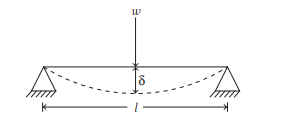
In designing, a beam for its use to support a load. The depression at centre is proportional to (where, \(Y\) is Young’s modulus).
CorrectIncorrectHint
(c) We have, \(\delta=\frac{w l}{4 Y b d^3}\) where, \(b\) and \(d\) are cross-sectional dimensions.

\(
\delta \propto \frac{1}{Y}
\) - Question 26 of 30
26. Question
The density of a metal at normal pressure is \(\rho\). Its density when it is subjected to an excess pressure \(p\) is \(\rho^{\prime}\). If \(B\) is the bulk modulus of the metal, then the ratio \(\rho^{\prime} / \rho\) is
CorrectIncorrectHint
(d) Definition of Bulk Modulus:
The Bulk Modulus (\(B\)) of a material describes its resistance to uniform compression. It is defined as the ratio of the infinitesimal pressure increase to the resulting relative decrease of the volume:
\(
B=-\frac{d p}{d V / V}
\)
For a finite excess pressure \(p\), this can be written as:
\(
B=\frac{p}{-\Delta V / V}
\)
Rearranging to find the fractional change in volume:
\(
\frac{-\Delta V}{V}=\frac{p}{B}
\)
Relationship Between Volume and Density:
The mass (\(m\)) of the metal remains constant. Density is defined as mass per unit volume (\(\rho= m / V\)). Let the initial volume be \(V\) and the new volume be \(V^{\prime}\).
\(
\rho=\frac{m}{V} \quad \text { and } \quad \rho^{\prime}=\frac{m}{V^{\prime}}
\)
The ratio of the densities is:
\(
\frac{\rho^{\prime}}{\rho}=\frac{m / V^{\prime}}{m / V}=\frac{V}{V^{\prime}}
\)
Calculating the Ratio:
The new volume \(V^{\prime}\) can be expressed in terms of the initial volume and the change in volume (\(\Delta V\)) :
\(
V^{\prime}=V+\Delta V
\)
From the Bulk Modulus formula, we know that \(\Delta V=-\frac{p V}{B}\). Substituting this:
\(
V^{\prime}=V-\frac{p V}{B}=V\left(1-\frac{p}{B}\right)
\)
Now, substitute \(V^{\prime}\) into the density ratio:
\(
\frac{\rho^{\prime}}{\rho}=\frac{V}{V(1-p / B)}=\frac{1}{1-\frac{p}{B}}
\) - Question 27 of 30
27. Question
The following four wires are made of the same material. Which of these will have the largest extension when the same tension is applied?
CorrectIncorrectHint
(a) \(\Delta L=\frac{F L}{A Y}\) or \(\Delta L \propto \frac{L}{d^2}\)
\(
\left(\because A=\frac{\pi d^2}{4}\right)
\)
Therefore, \(\Delta L\) will be maximum for that wire for which \(\frac{L}{d^2}\) is maximum. Here by checking options, we get option (a) has maximum extension. - Question 28 of 30
28. Question
Two wires of same length and same material but of radii \(r\) and \(2 r\) are stretched by forces \(F\) and \(f\) respectively to produce equal elongation. The ratio \(F\) to \(f\) is
CorrectIncorrectHint
(d) Given, \(r_1=r, r_2=2 r\)
Now, we know that, \(Y=\frac{F}{A} \cdot \frac{l}{\Delta l}=\frac{F}{\pi r^2} \cdot \frac{l}{\Delta l}\)
So, \(\quad \frac{F}{\pi r_1^2}=\frac{f}{\pi r_2^2} \quad(\because l, \Delta l\) and \(Y\) are same \()\)
\(
\frac{F}{f}=\frac{r_1^2}{r_2^2} \Rightarrow \frac{F}{f}=\frac{r^2}{4 r^2} \Rightarrow \frac{F}{f}=\frac{1}{4}
\) - Question 29 of 30
29. Question
The bulk modulus of a spherical object is \(B\). If it is subjected to uniform pressure \(p\), the fractional decrease in radius is
CorrectIncorrectHint
(d) The object is spherical and the bulk modulus is represented by \(B\). It is the ratio of normal stress to the volumetric strain.
Hence,
\(
B=\frac{F / A}{\Delta V / V}
\)
\(
\left(\because p=\frac{F}{A}\right)
\)
\(
\frac{\Delta V}{V}=\frac{p}{B} \Rightarrow\left|\frac{\Delta V}{V}\right|=\frac{p}{B}
\)
Here, \(p\) is applied pressure on the object and \(\frac{\Delta V}{V}\) is volume strain.
Fractional decrease in volume, \(\frac{\Delta V}{V}=3 \frac{\Delta R}{R} \quad\left(\because V=\frac{4}{3} \pi R^3\right)\)
Volume of the sphere decreases due to the decrease in its radius, hence
\(
\frac{\Delta V}{V}=\frac{3 \Delta R}{R}=\frac{p}{B} \Rightarrow \frac{\Delta R}{R}=\frac{p}{3 B}
\) - Question 30 of 30
30. Question
Two wires of same material having radius in ratio \(2: 1\) and lengths in ratio \(1: 2\). If same force is applied on them, then ratio of their change in length will be
CorrectIncorrectHint
(d) Given, ratio of radius of two wires, \(\frac{r_1}{r_2}=\frac{2}{1}\) and ratio in their lengths, \(\frac{l_1}{l_2}=\frac{1}{2}\)
We know that, Young’s modulus,
\(
\Rightarrow \quad \begin{array}{ll}
& Y=\frac{F l}{A \Delta l} \\
\Rightarrow & \Delta l=\frac{F l}{A Y} \\
\Delta l \propto \frac{l}{A}
\end{array}
\)
When same force is applied on them, then ratio of change in their lengths,
\(
\begin{aligned}
& \frac{\Delta l_1}{\Delta l_2} & =\frac{l_1}{A_1} / \frac{l_2}{A_2}=\frac{l_1 A_2}{l_2 A_1} \\
\Rightarrow & \frac{\Delta l_1}{\Delta l_2} & =\frac{l_1}{l_2} \cdot \frac{r_2^2}{r_1^2}=\frac{1}{2} \cdot\left(\frac{1}{2}\right)^2=\frac{1}{8}
\end{aligned}
\)