3.10 Uniform circular motion
When an object follows a circular path at a constant speed, the motion of the object is called uniform circular motion. The word “uniform” refers to the speed, which is uniform (constant) throughout the motion.
In circular motion, an object moves along the perimeter or circumference of a circle.
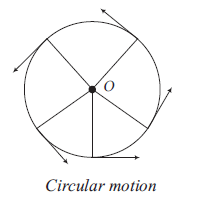
Circular motion can be categorised into two types as follows:
Uniform circular motion
If a particle moves along a circular path with a constant speed (i.e. it covers equal distances along the circumference of the circle in equal intervals of time), then its motion is said to be uniform circular motion.
e.g. (i) Motion of a point on the rim of a wheel rotating uniformly.
(ii) Motion of the tip of the second hand of a clock.
Non-uniform circular motion
If the speed of the particle in circular motion changes with respect to time, then its motion is said to be non-uniform circular motion. e.g. Motion of a stone tied to a string moving in vertical circle.
Kinematics of Circular Motion
For a particle in circular motion, following variables are needed to describe its motion
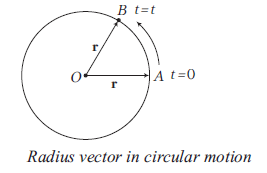
Radius vector ( \({r}\) )
When a particle moves on a circular path, its distance from the centre is fixed and it is equal to radius of the circle. If the centre of the circle is taken as origin, then the vector joining centre to the particle is called radius vector. It is directed from centre to the particle and its magnitude is same as radius.
Angular position \(\theta\)
Suppose a particle \(P\) is moving on a circular path of radius \(r\) and centre \(O\), as shown in figure.
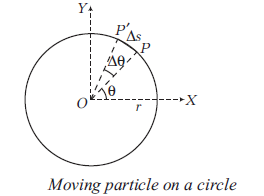
The position of the particle \(P\) at a given instant may be described by the angle \(\theta\) between \(O P\) and \(O X\). This angle \(\theta\) is called the angular position of the particle. As the particle moves on the circle, its angular position \(\boldsymbol{\theta}\) changes. Here, \(P\) and \(P^{\prime}\) are given as \(P(r, \theta)\) and \(P^{\prime}(r, \theta+\Delta \theta)\), respectively.
Angular displacement ( \(\Delta \theta\) )
The angle traced out by the radius vector at the centre of the circular path in the given time is called angular displacement. It is denoted by \(\Delta \theta\) and expressed in radians. In the Figure above, \(\mathbf{O P}\) is the initial and \(\mathbf{O P}^{\prime}\) is the final position vectors of the particle.
\(
\text { Angular displacement }=\frac{\text { Linear displacement between two positions }}{\text { Radius vector }}
\)
\(
\Delta \theta=\frac{\Delta s}{r}
\)
Small angular displacement is taken as a vector quantity and its SI unit is radian.
Direction of angular displacement
Direction of \(\Delta \theta\) is given by right handed (i.e. the direction, where screw advances) screw rule as shown in figure.
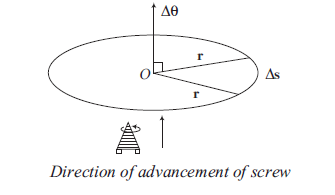
It is directed along a line passing through centre \((O)\) and perpendicular to the plane of circular motion, containing \(\mathbf{r}\) and \(\Delta \mathbf{s}\).
Note: If a particle makes \(N\) revolutions, its angular displacement is \(\theta=2 \pi N \mathrm{rad} \quad (1 \text { revolution }=2 \pi \mathrm{~rad})\)
Angular velocity \((\omega)\)
Rate of change of angular displacement of a particle performing circular motion is called angular velocity.
Angular velocity, \(\omega=\frac{\Delta \theta}{\Delta t}\)
Instantaneous angular velocity, \(\omega=\lim _{\Delta t \rightarrow 0} \frac{\Delta \theta}{\Delta t}=\frac{d \theta}{d t}\)
It is also a vector quantity. Its unit is \(\mathrm{rads}^{-1}, \mathrm{rpm}, \mathrm{rps}\), etc., and its dimensional formula is \(\left[\mathrm{M}^0 \mathrm{~L}^0 \mathrm{~T}^{-1}\right]\).
Direction of angular velocity
Direction of angular velocity is given in the same way as that of angular displacement.
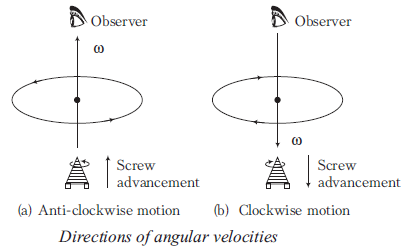
Let the particle rotates in anti-clockwise direction as seen by observer, angular velocity is along a line passing through the centre and perpendicular to the plane of the circle and towards the observer. This is along a direction, where screw advances as shown in figure. Similarly, when the particle rotates in clockwise direction as seen by the observer, angular velocity is away from the observer.
Important points regarding the angular velocity :
- If the particle performing circular motion completes one rotation around the circular path in \(T\) seconds, then Angular velocity, \(\omega=\frac{2 \pi}{T} \mathrm{rad} \mathrm{s}^{-1}\)
- If the particle performing circular motion makes \(n\) rotations per second around the circular path, then Angular velocity, \(\omega=2 \pi n \mathrm{~rad} \mathrm{s}^{-1}\)
- If two particles are moving on the same circle in the same direction with different constant angular speeds \(\omega_1\) and \(\omega_2\), then the angular speed of particle 2 with respect to 1 for an observer at centre will be
\(
\omega=\omega_2-\omega_1
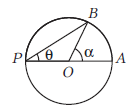
\) - Angular velocity depends on axis of rotation.
\(
\begin{aligned}
\omega_O & =\frac{\alpha}{t} \\
\omega_P & =\frac{\theta}{t}=\frac{\alpha / 2}{t}=\frac{\omega_o}{2}
\end{aligned}
\)
Example 1: Calculate the average angular velocity of the hour hand of a clock.
Solution: The hour hand completes one round in 12 h. One round makes an angular displacement \(2 \pi\).
\(\therefore\) Average angular velocity, \(\omega_{\mathrm{av}}=\frac{\Delta \theta}{\Delta t}=\frac{2 \pi \mathrm{rad}}{12 \mathrm{~h}}\)
\(
\begin{aligned}
& =\frac{2 \pi}{12 \times 3600} \mathrm{rad} \mathrm{~s}^{-1} \\
& =\frac{\pi}{21600} \mathrm{rad} \mathrm{~s}^{-1}
\end{aligned}
\)
Example 2: An object revolves uniformly in a circle of diameter 0.80 m and completes \(100 \mathrm{rev} \mathrm{min}{ }^{-1}\). Find its time period and angular velocity.
Solution: Here, diameter \(=0.80 \mathrm{~m}\)
\(\therefore\) Radius, \(r=\frac{\text { Diameter }}{2}=\frac{0.80}{2}=0.4 \mathrm{~m}\)
Frequency, \(n=100 \mathrm{rev} / \mathrm{min}=\frac{100}{60} \mathrm{rev} / \mathrm{s}\)
Therefore, time period, \(T=\frac{1}{n}=\frac{60}{100} \mathrm{~s}=0.6 \mathrm{~s}\)
\(\therefore\) Angular velocity, \(\omega=\frac{2 \pi}{T}=\frac{2 \times 3.14}{0.6} \mathrm{rad} / \mathrm{s}\)
\(
=10.467 \mathrm{rad} / \mathrm{s}
\)
Example 3: A threaded rod with 12 turns per cm and diameter 1.18 cm is mounted horizontally. A bar with a threaded hole to match the rod is screwed onto the rod. The bar spins at the rate of 216 rpm. Determine the velocity of the bar with which it will move the length of 1.50 cm along the rod. Also, find the time taken by it.
Solution: Given, frequency, \(n=216 \mathrm{rpm}=\frac{216}{60} \mathrm{rps}\)
Length of one turn \(=\frac{1}{12} \mathrm{~cm}\)
\(\therefore\) Number of rotations required to move a distance of 1.5 cm,
\(
N=\frac{\text { Distance }}{\text { Length of one turn }}=\frac{1.5}{1 / 12}=18
\)
Therefore, angular displacement, \(\theta=2 \pi N=2 \pi \times 18=36 \pi \mathrm{rad}\)
\(
\therefore \text { Angular velocity of the bar, } \begin{aligned}
\omega & =2 \pi n=2 \pi \times \frac{216}{60} \\
& =7.2 \pi \mathrm{rad} \mathrm{~s}^{-1}
\end{aligned}
\)
\(
\begin{aligned}
\therefore \text { Required time }(t) & =\frac{\text { Angular displacement }(\theta)}{\text { Angular velocity }(\omega)} \\
& =\frac{36 \pi}{7.2 \pi}=5 \mathrm{~s}
\end{aligned}
\)
Relation between linear velocity and angular velocity
A particle performing circular motion also has linear velocity (as it cover linear displacement along circular path) along with angular velocity. If linear velocity of particle performing circular motion is \(v\) and angular velocity is \(\omega\), then both of these velocities are related as
\(
v=r \omega
\)
where, \(v\) (linear velocity): This is the tangential speed of the object along its circular path.
\({r}\) (radius): This is the constant distance from the center of the circle to the object.
\({\omega}\) (angular velocity): This is the rate of change of the angle, measured in radians per second, or how fast the object is rotating.
In vector form,
\(
\mathbf{v}=\omega \times \mathbf{r}
\)
Proof: Concept: Linear velocity \(({v})\) : The time derivative of the position function.
\(
v=\frac{d s}{d t}
\)
Angular velocity \((\omega)\) : The time derivative of the angular position \((\theta)\).
\(
\omega=\frac{d \theta}{d t}
\)
Derivation steps:
Start with the relationship between arc length \((s)\), radius \((r)\), and angular position \((\theta\) ):
\(
s=r \theta
\)
Take the derivative of both sides with respect to time \((t)\). Since the radius \((r)\) is constant for circular motion, it can be pulled out of the derivative.
\(
\frac{d s}{d t}=\frac{d}{d t}(r \theta)=r \frac{d \theta}{d t}
\)
Substitute the definitions for linear velocity ( \(v=\frac{d s}{d t}\) ) and angular velocity ( \(\omega=\frac{d \theta}{d t}\) ):
\(
v=r \omega
\)
Note: Consider a circle with radius \({r}\) and a central angle \({\theta}\) (measured in radians) that subtends an arc of length \(s\).
The full circumference of the circle is \(2 \pi r\), and the full angle of a circle is \(2 \pi\) radians.
The ratio of the arc length to the circumference is equal to the ratio of the central angle to the full circle angle.
This gives the equation: \(\frac{s}{2 \pi r}=\frac{\theta}{2 \pi}\).
\(s=r \theta\)
Example 4: \(A\) particle moves in a circle of radius \(4 m\) with a linear velocity of \(20 \mathrm{~ms}^{-1}\). Find the angular velocity.
Solution: Given, linear velocity, \(v=20 \mathrm{~ms}^{-1}\)
Radius, \(r=4 \mathrm{~m}\)
As, linear velocity, \(v=r \omega\)
\(\Rightarrow\) Angular velocity, \(\omega=\frac{v}{r}=\frac{20}{4}=5 \mathrm{rad} \mathrm{s}^{-1}\)
Example 5: If the length of the second’s hand in a stop clock is 3 cm, find the angular velocity and linear velocity of the tip.
Solution: Given, radius, \(r=3 \mathrm{~cm}=3 \times 10^{-2} \mathrm{~m}\)
Time period of stop clock, \(T=60 \mathrm{~s}\)
Angular velocity, \(\omega=\frac{2 \pi}{T}=\frac{2 \pi}{60}=0.1047 \mathrm{rad} \mathrm{s}^{-1}\)
and linear velocity, \(v=\omega r=0.1047 \times 3 \times 10^{-2}\)
\(
=0.00314 \mathrm{~ms}^{-1}
\)
Angular acceleration ( \(\alpha\) )
The rate of change of angular velocity of a particle performing circular motion is called angular acceleration.
Angular acceleration, \(\alpha=\frac{\Delta \omega}{\Delta t}\)
Instantaneous angular acceleration,
\(
\alpha_{\mathrm{ins}}=\lim _{\Delta t \rightarrow 0} \frac{\Delta \omega}{\Delta t}=\frac{d \omega}{d t}=\frac{d^2 \theta}{d t^2}
\)
The SI unit of angular acceleration is \(\mathrm{rad} \mathrm{s}^{-2}\) and its dimensional formula is \(\left[\mathrm{M}^0 \mathrm{~L}^0 \mathrm{~T}^{-2}\right]\). If \(\alpha=0\), circular motion is said to uniform. It has same characteristics as that of angular velocity.
Note: Angular acceleration is an axial vector, when axis of rotation is fixed, angular acceleration and angular velocity vectors both lie along that axis.
Example 6: A point on the rim of a disc starts circular motion from rest and after time \(t\), it gains an angular acceleration which is given by \(\alpha=3 t-t^2\). Calculate the angular velocity after \(2 s\).
Solution: Angular acceleration, \(\alpha=\frac{d \omega}{d t}=3 t-t^2\)
\(
\begin{aligned}
& \Rightarrow \quad \int_0^\omega d \omega=\int_0^t\left(3 t-t^2\right) d t \Rightarrow \omega=\frac{3 t^2}{2}-\frac{t^3}{3} \\
& \text { At } t=2 \mathrm{~s}, \quad \omega=\frac{10}{3} \mathrm{rad} \mathrm{~s}^{-1}
\end{aligned}
\)
Kinematic equations of circular motion
If angular acceleration is constant, then we have kinematic equations of circular motion as follows:
- \(\theta=\omega_0 t+\frac{1}{2} \alpha t^2\)
- \(\omega=\omega_0+\alpha t\)
- \(\omega^2=\omega_0^2+2 \alpha \theta\)
- \(\theta_t=\omega_0+\frac{1}{2} \alpha(2 t-1)\)
- \(\theta=\left(\frac{\omega+\omega_0}{2}\right) t\)
Here, \(\omega_0\) and \(\omega\) are the angular velocities at time \(t=0\) and \(t ; \theta\) and \(\theta_t\) are the angular displacements in time \(t\) and \(t\)-th second, respectively.
Comparison of key Kinematics equations (Linear vs Circular motion)
\(
\begin{array}{|c|c|c|}
\hline \text { Linear Motion } & \text { Rotational or Circular Motion } \\
\hline \text { Linear Velocity: } v=\frac{\Delta s}{\Delta t} & \text { Angular Velocity: } \omega=\frac{\Delta \theta}{\Delta t} \\
\hline \text { Linear Displacement: } s=v t & \text { Angular displacement: } \theta=\omega t \\
\hline \text { Final Velocity: } v=v_0+a t & \text { Final Angular Velocity: } \omega=\omega_0+\alpha t; \quad \text { a constant } \alpha \text { constant } \\
\hline \text { Displacement: } s=v_0 t+\frac{1}{2} a t^2 & \text { Angular Displacement: } \theta=\omega_0 t+\frac{1}{2} \alpha t^2; \quad \text { a constant } \alpha \text { constant } \\
\hline \text { Final Velocity Squared: } v^2=v_0^2+2 a s & \text { Final Angular Velocity Squared: } \omega^2=\omega_0^2+2 \alpha \theta; \quad \text { a constant } \alpha \text { constant } \\
\hline
\end{array}
\)
Example 7: The wheel of a motor rotates with a constant acceleration of 4 rad \(\mathrm{s}^{-2}\). If the wheel starts from rest, how many revolutions will it make in the first \(20 s\) ?
Solution: The angular displacement in the first 20 s is given by
\(
\theta=\omega_0 t+\frac{1}{2} \alpha t^2=\frac{1}{2}\left(4 \mathrm{rads}^{-2}\right)(20 \mathrm{~s})^2 \text { ( } \because \text { Angular velocity, } \omega_0=0 \text { ) }
\)
\(
=800 \mathrm{rad}
\)
As, the wheel turns by \(2 \pi\) radian in each revolution, the number of revolutions in 20 s is \(N=\frac{\theta}{2 \pi}=\frac{800}{2 \pi}\)
\(
=127.38 \simeq 127
\)
Example 7: The wheel of a car accelerated uniformly from rest, rotates through 1.5 rad during the first second. Find the angle rotated during the next second.
Solution: As the angular acceleration is constant, we have
\(
\begin{array}{rlrl}
\theta=\omega_0 t+\frac{1}{2} \alpha t^2 & =\frac{1}{2} \alpha t^2 \quad\left(\because \text { Angular velocity, } \omega_0=0\right) \\
\therefore & 1.5 \mathrm{rad} =\frac{1}{2} \alpha(1)^2
\end{array}
\)
Angular acceleration, \(\alpha=3\) rads \(^{-2}\)
The angular displacement in first two second is given by
\(
\theta_1=\frac{1}{2} \times(3)(2)^2=6 \mathrm{rad}
\)
Thus, the angle rotated during the 2nd second
\(
=\theta_1-\theta=6 \mathrm{rad}-1.5 \mathrm{rad}=4.5 \mathrm{rad}
\)
Centripetal acceleration
When a particle is in uniform circular motion, it experiences a centripetal acceleration (It is also called radial acceleration) that is constant in magnitude but continuously changes direction, always pointing toward the center of the circle. This acceleration is what keeps the particle from moving in a straight line and is calculated using the formula
\(a_c=a_r=\frac{v^2}{r}\), where \(v\) is the particle’s speed and \(r\) is the radius of the circular path.
In terms of angular velocity \((\omega)\) : Centripetal acceleration can also be expressed as \(a_c=r \omega^2\quad ( \text { We know } v=r \omega)\).
Key characteristics:
Direction: The acceleration vector always points radially inward, toward the center of the circle. The term “centripetal” means “center-seeking”.
Magnitude: The magnitude of the acceleration is calculated using the formula
\(
a_c=a_r=\frac{v^2}{r}
\)
Constant speed, changing velocity: Even though the speed is constant in uniform circular motion, the velocity is not. This is because the direction of motion is constantly changing, resulting in an acceleration.
Perpendicular to velocity: The centripetal acceleration vector is always perpendicular to the velocity vector.
Example 8: Prove that \(a_c=a_r=\frac{v^2}{r}\)
Solution: Figure below shows an object moving in a circular path at constant speed. The direction of the instantaneous velocity is shown at two points along the path. Acceleration is in the direction of the change in velocity, which points directly toward the center of rotation (the center of the circular path). This pointing is shown with the vector diagram in the figure. We call the acceleration of an object moving in uniform circular motion (resulting from a net external force) the centripetal acceleration( \(a_c\) ); centripetal means “toward the center” or “center seeking.”
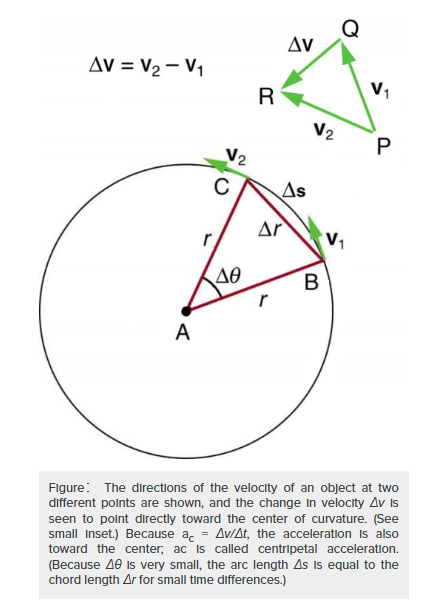
The direction of centripetal acceleration is toward the center of curvature, but what is its magnitude? Note that the triangle formed by the velocity vectors and the one formed by the radii \(r\) and \(\Delta s\) are similar. Both the triangles ABC and PQR are isosceles triangles (two equal sides). The two equal sides of the velocity vector triangle are the speeds \(v_1=v_2=v\). Using the properties of two similar triangles, we obtain
\(
\frac{\Delta v}{v}=\frac{\Delta s}{r}
\)
Acceleration is \(\frac{\Delta v}{\Delta t}\), and so we first solve this expression for \(\Delta v\).
\(
\Delta v=\frac{v}{r} \Delta s
\)
Then we divide this by \(\Delta t\), yielding
\(
\frac{\Delta v}{\Delta t}=\frac{v}{r} \times \frac{\Delta s}{\Delta t}
\)
Finally, noting that
\(
\frac{\Delta v}{\Delta t}=a_c
\)
and that \(\frac{\Delta s}{\Delta t}=v\), the linear or tangential speed, we see that the magnitude of the centripetal acceleration is
\(
a_c=\frac{v^2}{r}
\)
which is the acceleration of an object in a circle of radius \(r\) at a speed \(v\). So, centripetal acceleration is greater at high speeds and in sharp curves (smaller radius), as you have noticed when driving a car. But it is a bit surprising that \(a_{{c}}\) is proportional to speed squared, implying, for example, that it is four times as hard to take a curve at \(100 \mathrm{~km} / \mathrm{h}\) than at \(50 \mathrm{~km} / \mathrm{h}\). A sharp corner has a small radius, so that \(a_{{c}}\) is greater for tighter turns, as you have probably noticed.
It is also useful to express \(a_{c}\) in terms of angular velocity. Substituting \(v=r \omega\) into the above expression, we find
\(
a_c=\frac{(r \omega)^2}{r}=r \omega^2
\)
.We can express the magnitude of centripetal acceleration using either of two equations:
\(
a_c=\frac{v^2}{r} ; a_c=r \omega^2
\)
recall that the direction of \(a_c\) is toward the center.
Example 9: Determine the magnitude of centripetal acceleration of a particle on the tip of a fan blade, \(0.30 m\) in diameter, rotating at \(1200 \mathrm{rev} \mathrm{min}{ }^{-1}\).
Solution: Given, diameter \(=0.30 \mathrm{~m}\)
\(\therefore\) Radius, \(r=\frac{0.30}{2}=0.15 \mathrm{~m}\)
and frequency, \(n=1200 \mathrm{rev} \mathrm{min}^{-1}=\frac{1200}{60}=20 \mathrm{rps}\)
\(\therefore\) Angular velocity, \(\omega=2 \pi n=2 \pi \times 20=40 \pi \mathrm{rad} \mathrm{s}^{-1}\)
Therefore, centripetal acceleration, \(a_c=r \omega^2\)
\(
\Rightarrow \quad a_c=0.15 \times(40 \pi)^2 \Rightarrow a_c=2368.7 \mathrm{~ms}^{-2}
\)
Example 10: Find the acceleration of a particle placed on the surface of the earth at the equator, due to the earth’s rotation. The radius of earth is 6400 km and time period of revolution of the earth about its axis is \(24 h\).
Solution: Given, radius of earth, \(R_e=6400 \mathrm{~km}=6400 \times 10^3 \mathrm{~m}\)
Time period, \(T=24 \mathrm{~h}=24 \times 60 \times 60 \mathrm{~s}\)
Angular speed of the earth, \(\omega=\frac{2 \pi}{T}=\frac{2 \pi}{24 \times 60 \times 60} \mathrm{rad} \mathrm{s}^{-1}\)
Acceleration of the particle,
\(
a_c=\omega^2 R_e=\left(\frac{2 \pi}{24 \times 60 \times 60}\right)^2 \times\left(6400 \times 10^3\right)=0.034 \mathrm{~ms}^{-2}
\)
Example 11: Two particles \(A\) and \(B\) start at the origin \(O\) and travel in opposite directions along the circular path at constant speeds \(v_A=0.7 \mathrm{~ms}^{-1}\) and \(v_B=1.5 \mathrm{~ms}^{-1}\), respectively. Determine the time when they collide and the magnitude of the acceleration of \(B\) just before this happens.
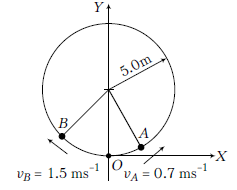
Solution: From the condition given in the question, it is clear that total distance ( \(=\) velocity \(\times\) time ) will be equal to the circumference of circular path,
i.e.
\(
\begin{aligned}
v_B t+v_A t & =\text { circumference of circular path } \\
1.5 t+0.7 t & =2 \pi R=10 \pi
\end{aligned}
\)
\(\therefore \quad\) Time, \(t=\frac{10 \pi}{2.2}=14.3 \mathrm{~s}\)
Hence, acceleration, \(a=\frac{v_B{ }^2}{R}=\frac{(1.5)^2}{5}=0.45 \mathrm{~ms}^{-2}\)
Acceleration of a particle in non-uniform circular motion
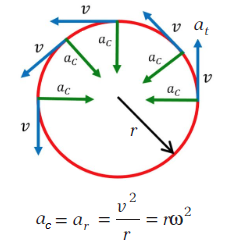
If a particle is in non-uniform circular motion, i.e. its speed is not constant, then the particle has both radial and tangential components of acceleration.
Radial component \(\left(a_r\right)\)
This component of acceleration is towards the centre. This is responsible for change in direction of velocity. This is equal to \(\frac{v^2}{r}\) or \(r \omega^2\).
Thus, \(a_r=a_c=\frac{v^2}{r}=r \omega^2\)
Note: The radial acceleration ( \(a_r\) ) is also sometimes called normal acceleration ( \(a_n\) ).
Tangential component \(\left(a_t\right)\)
This is the component of acceleration in the direction of velocity, which is responsible for change in speed of particle. It is also equal to rate of change of speed.
Hence, \(a_t=\) component of \(a\) along \(\mathbf{v}\)
\(
=\frac{d v}{d t}=\frac{d|\mathbf{v}|}{d t}
\)
\(
\Rightarrow \quad \mathbf{a}_t=\frac{d \omega}{d t} \times \mathbf{r} \quad(\because \mathbf{v}=\omega \times \mathbf{r})
\)
\(
\begin{aligned}
&\begin{array}{ll}
\Rightarrow & \mathbf{a}_t=\alpha \times \mathbf{r} \\
\Rightarrow & a_t=r \alpha
\end{array}\\
&\text { This component is tangential. }
\end{aligned}
\)
Example 12: A particle moves in a circle of radius \(0.5 m\) at a speed that uniformly increases. Find the angular acceleration of particle, if its speed changes from \(2 \mathrm{~ms}^{-1}\) to \(4 m s^{-1}\) in \(4 s\).
Solution: The tangential acceleration of the particle is
\(
a_t=\frac{d v}{d t}=\frac{4-2}{4}=0.5 \mathrm{~ms}^{-2}
\)
The angular acceleration, \(\alpha=\frac{a_t}{r}=\frac{0.5}{0.5}=1 \mathrm{rad} \mathrm{s}^{-2}\)
Net acceleration
Consider the particle moving on circular path in anti-clockwise direction with increasing speed as shown in figure.
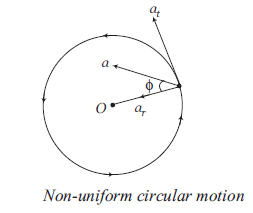
We know that, linear velocity, \(\mathbf{v}=\omega \times \mathbf{r}\)
Differentiating on both sides w.r.t. time \(t\), we get
Net acceleration, \(\frac{d \mathbf{v}}{d t}=\frac{d \omega}{d t} \times \mathbf{r}+\omega \times \frac{d \mathbf{r}}{d t}\)
\(
\begin{aligned}
&\text { Net acceleration, } \mathbf{a}=\alpha \times \mathbf{r}+\omega \times \mathbf{v} \Rightarrow \mathbf{a}=\mathbf{a}_t+\mathbf{a}_r\\
&\left(\because \mathbf{a}_t=\alpha \times \mathbf{r} \text { and } \mathbf{a}_r=\omega \times \mathbf{v}\right)
\end{aligned}
\)
Magnitude of net acceleration, \(a=\sqrt{a_r^2+a_t^2}\)
This resultant acceleration makes an angle \(\phi\) with the radius, where \(\quad \tan \phi=\frac{a_t}{a_r}\)
Note:
- In accelerated circular motion, \(d v / d t\) is positive and hence, tangential acceleration of the particle is parallel to velocity \(v\).
- In decelerated circular motion, \(d v / d t\) is negative and hence, tangential acceleration is anti-parallel to velocity \(v\).
Example 13: A car is travelling along a circular curve that has a radius of 50 m. If its speed is \(16 \mathrm{~ms}^{-1}\) and is increasing uniformly at \(8 \mathrm{~ms}^{-2}\), determine the magnitude of its acceleration at this instant.
Solution: Given, tangential acceleration \(a_t=8 \mathrm{~ms}^{-2}\)
Radius, \(R=50 \mathrm{~m}\), speed, \(v=16 \mathrm{~ms}^{-1}\)
\(\therefore\) Radial acceleration, \(a_r=\frac{v^2}{R}=\frac{(16)^2}{50}=\frac{256}{50} \mathrm{~ms}^{-2}\)
Magnitude of net acceleration of the car,
\(
a=\sqrt{a_t^2+a_r^2}=\sqrt{(8)^2+\left(\frac{256}{50}\right)^2}=9.5 \mathrm{~ms}^{-2}
\)
Example 14: The speed of a particle moving in a circle of radius \(r=2 m\) varies with time \(t\) as \(v=t^2\), where \(t\) is in second and \(v\) in \(m s^{-1}\). Find the radial, tangential and net acceleration at \(t=2 \mathrm{~s}\).
Solution: Given in the question, \(v=t^2\)
Linear speed of particle at \(t=2 \mathrm{~s}\) is \(v=(2)^2=4 \mathrm{~ms}^{-1}\)
\(\therefore \quad\) Radial acceleration, \(a_r=\frac{v^2}{r}=\frac{(4)^2}{2}=8 \mathrm{~ms}^{-2}\)
The tangential acceleration is \(a_t=\frac{d v}{d t}=\frac{d}{d t}\left(t^2\right)=2 t\)
\(\therefore\) Tangential acceleration at \(t=2 \mathrm{~s}\) is \(a_t=(2)(2)=4 \mathrm{~ms}^{-2}\)
\(\therefore\) Net acceleration of particle at \(t=2 \mathrm{~s}\) is
\(
a=\sqrt{\left(a_r\right)^2+\left(a_t\right)^2}=\sqrt{(8)^2+(4)^2}=\sqrt{64+16}
\)
\(
a=\sqrt{80} \mathrm{~ms}^{-2}
\)
Example 15: \(A\) particle moves in a circle of radius 2 cm at a speed given by \(v=4 t\), where \(v\) is in \(c m s^{-1}\) and \(t\) in second.
(i) Find the tangential acceleration at \(t=1 \mathrm{~s}\).
(ii) Find total acceleration at \(t=1 \mathrm{~s}\).
Solution: Given, \(v=4 t\)
Radial acceleration, \(a_r=\frac{v^2}{R}=\frac{(4 t)^2}{R}\) or \(a_r=\frac{16 t^2}{2}=8 t^2\)
At \(t=1 \mathrm{~s}\),
\(
a_r=8 \mathrm{cms}^{-2}
\)
(i) Tangential acceleration, \(a_t=\frac{d v}{d t}\) or \(a_t=\frac{d}{d t}(4 t)=4 \mathrm{cms}^{-2}\) i.e. \(a_t\) is constant or tangential acceleration at \(t=1 \mathrm{~s}\) is \(4 \mathrm{cms}^{-2}\).
(ii) Total acceleration, \(a=\sqrt{a_t^2+a_r^2}\)
\(
a=\sqrt{(4)^2+(8)^2}=\sqrt{80}=4 \sqrt{5} \mathrm{cms}^{-2}
\)
Example 16: A cyclist is riding with a speed of \(18 \mathrm{kmh}^{-1}\). As he approaches a circular turn on the road of radius \(25 \sqrt{2} m\), he applies brakes and reduces his speed at the constant rate of \(0.5 \mathrm{~ms}^{-1}\). Determine the magnitude and direction of the net acceleration of the cyclist on the circular turn.
Solution: Linear speed of the cyclist, \(v=18 \mathrm{~km} \mathrm{~h}^{-1}=18 \times \frac{5}{18}=5 \mathrm{~ms}^{-1}\) and centripetal acceleration of the cyclist,
\(
a_c=\frac{v^2}{R}=\frac{25}{25 \sqrt{2}}=\frac{1}{\sqrt{2}} \mathrm{~ms}^{-2}
\)
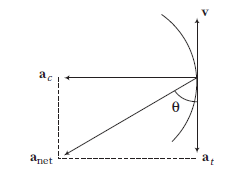
Tangential acceleration of the cyclist, \(a_t=\frac{d v}{d t}=\frac{1}{2} \mathrm{~ms}^{-2}\)
\(\therefore\) Net acceleration of the cyclist,
\(
\begin{aligned}
& a_{\mathrm{net}}=\sqrt{\left(\frac{1}{\sqrt{2}}\right)^2+\left(\frac{1}{2}\right)^2}=\frac{\sqrt{3}}{2}=0.86 \mathrm{~ms}^{-2} \\
& \tan \theta=\frac{a_c}{a_t}=\frac{1 / \sqrt{2}}{1 / 2}=\frac{2}{\sqrt{2}}=\sqrt{2}
\end{aligned}
\)
Angle made by resultant acceleration with tangential acceleration,
\(
\theta=\tan ^{-1}(\sqrt{2})
\)