4.8 Equilibrium of a particle
Forces in Equilibrium
Forces which have zero linear resultant will not cause any change in the motion of the object to which they are applied. Such forces (and the object) are said to be in equilibrium. For understanding the equilibrium of an object under two or more concurrent or coplanar forces, let us first discuss the resolution of force.
Resolution of a force
When a force is replaced by an equivalent set of components, it is said to be resolved. One of the most useful ways to resolve a force is to choose only two components (although a force may be resolved in three or more components also) which are at right angles also. The magnitude of these components can be very easily found using trigonometry.
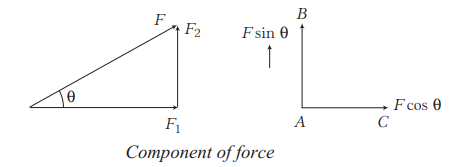
\(F_1=F \cos \theta=\) component of \(\mathbf{F}\) along \(A C\)
\(F_2=F \sin \theta=\) component of \(\mathbf{F}\) perpendicular to \(A C\) or along \(A B\)
Equilibrium of a Particle
Equilibrium of a particle in mechanics refers to the situation when the net external force on the particle is zero. According to the first law, this means that, the particle is either at rest or in uniform motion.
If two forces \(\mathbf{F}_1\) and \(\mathbf{F}_2\), act on a particle, equilibrium requires
\(
\mathbf{F}_1=-\mathbf{F}_2
\)
i.e. the two forces on the particle must be equal and opposite. Equilibrium under three concurrent forces \(\mathbf{F}_1, \mathbf{F}_2\) and \(\mathbf{F}_3\) requires that the vector sum of the three forces is zero.
\(
\mathbf{F}_1+\mathbf{F}_2+\mathbf{F}_3=0
\)
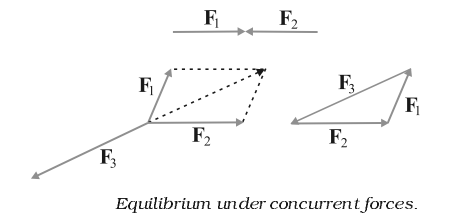
In other words, the resultant of any two forces say \(\mathbf{F}_1\) and \(\mathbf{F}_2\), obtained by the parallelogram law of forces must be equal and opposite to the third force, \(\mathbf{F}_3\). As seen in Figure above, the three forces in equilibrium can be represented by the sides of a triangle with the vector arrows taken in the same sense. The result can be generalised to any number of forces. A particle is in equilibrium under the action of forces \(\mathbf{F}_1\), \(\mathbf{F}_2, \ldots \mathbf{F}_{\mathrm{n}}\) if they can be represented by the sides of a closed \(n\)-sided polygon with arrows directed in the same sense.
Equation \(\mathbf{F}_1+\mathbf{F}_2+\mathbf{F}_3=0\) implies that
\(
\begin{aligned}
& F_{1 x}+F_{2 x}+F_{3 x}=0 \\
& F_{1 y}+F_{2 y}+F_{3 y}=0 \\
& F_{1 z}+F_{2 z}+F_{3 z}=0
\end{aligned}
\)
where \(F_{1 \mathrm{x}}, F_{1 \mathrm{y}}\) and \(F_{1 \mathrm{z}}\) are the components of \(F_1\) along \(x, y\) and \(z\) directions respectively.
Example 1: (See Figure below) A mass of 6 kg is suspended by a rope of length 2 m from the ceiling. A force of 50 N in the horizontal direction is applied at the midpoint P of the rope, as shown. What is the angle the rope makes with the vertical in equilibrium? (Take \(g=10 \mathrm{~m} \mathrm{~s}^{-2}\) ). Neglect the mass of the rope.
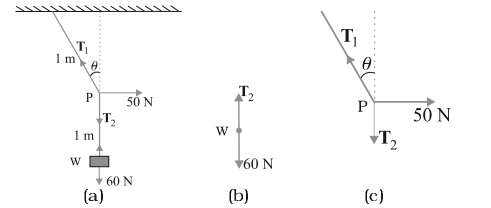
Solution: Figures (b) and (c) are known as free-body diagrams. Figure(b) is the free-body diagram of W and Figure(c) is the free-body diagram of point \(P\).
Consider the equilibrium of the weight W. Clearly, \(T_2=6 \times 10=60 \mathrm{~N}\).
Consider the equilibrium of the point P under the action of three forces – the tensions \(T_1\) and \(T_2\), and the horizontal force 50 N. The horizontal and vertical components of the resultant force must vanish separately :
\(
\begin{aligned}
& T_1 \cos \theta=T_2=60 \mathrm{~N} \\
& T_1 \sin \theta=50 \mathrm{~N}
\end{aligned}
\)
which gives that
\(
\tan \theta=\frac{5}{6} \text { or } \theta=\tan ^{-1}\left(\frac{5}{6}\right)=40^{\circ}
\)
Note the answer does not depend on the length of the rope (assumed massless) nor on the point at which the horizontal force is applied.
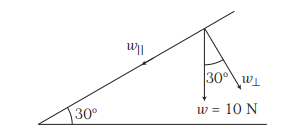
Example 2: Resolve a weight of \(10 N\) in two directions which are parallel and perpendicular to a slope inclined at \(30^{\circ}\) to the horizontal.
Solution: Component perpendicular to the plane,
\begin{aligned}
&w_{\perp}=w \cos 30^{\circ}=(10) \frac{\sqrt{3}}{2}=5 \sqrt{3} \mathrm{~N}\\
&\text { and component parallel to the plane, }\\
&w_{| |}=w \sin 30^{\circ}=(10)\left(\frac{1}{2}\right)=5 \mathrm{~N}
\end{aligned}
\)
Example 3: An object is in equilibrium under four concurrent forces in the directions shown in figure. Find the magnitude of \(\mathrm{F}_1\) and \(\mathrm{F}_2\).
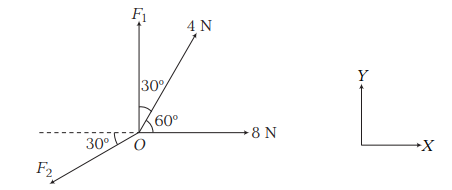
Solution: The object is in equilibrium.
\(
\begin{array}{lrl}
& \Sigma F_x & =0 \\
\therefore 8+4 \cos 60^{\circ}-F_2 \cos 30^{\circ} & =0 \\
\text { or } & 8+2-F_2 \frac{\sqrt{3}}{2} & =0 \\
\text { or } & F_2 & =\frac{20}{\sqrt{3}} \mathrm{~N} \\
\text { Similarly, } & \Sigma F_y & =0
\end{array}
\)
\(
\begin{aligned}
& \therefore F_1+4 \sin 60^{\circ}-F_2 \sin 30^{\circ}=0 \\
& \text { or } \quad F_1+\frac{4 \sqrt{3}}{2}-\frac{F_2}{2}=0 \\
& \text { or } \quad \begin{aligned}
F_1 & =\frac{F_2}{2}-2 \sqrt{3} \\
& =\frac{10}{\sqrt{3}}-2 \sqrt{3} \\
\text { or } & F_1=\frac{4}{\sqrt{3}} \mathrm{~N}
\end{aligned}
\end{aligned}
\)
Example 4: Determine the tensions \(T_1\) and \(T_2\) in the strings as shown in figure.
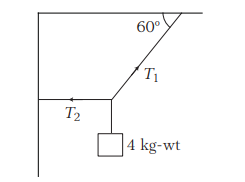
Solution:
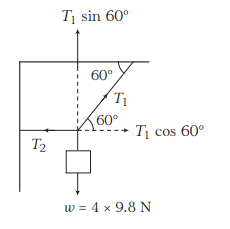
Resolving the tension \(T_1\) along horizontal and vertical directions. As the body is in equilibrium,
\(
\mathrm{T}_1 \sin 60^{\circ}=4 \times 9.8 \mathrm{~N} \dots(i)
\)
\(
\text { and } T_1 \cos 60^{\circ}=T_2 \dots(ii)
\)
From Eq. (i), we get
\(
T_1=\frac{4 \times 9.8}{\sin 60^{\circ}}=\frac{4 \times 9.8 \times 2}{\sqrt{3}}=45.26 \mathrm{~N}
\)
Putting this value in Eq. (ii), we get
\(
T_2=T_1 \cos 60^{\circ}=45.26 \times 0.5=22.63 \mathrm{~N}
\)
Note: Tension is a type of force produced in strings.
Lami’s theorem
It states that, “if three forces acting on a particle are in equilibrium, then each force is proportional to the sine of the angle between the other two forces.”
If an object \(O\) is in equilibrium under three concurrent coplanar forces \(\mathbf{F}_1, \mathbf{F}_2\) and \(\mathbf{F}_3\) as shown in figure below.
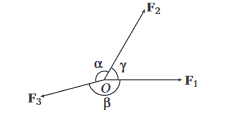
Then,
\(
\frac{F_1}{\sin \alpha}=\frac{F_2}{\sin \beta}=\frac{F_3}{\sin \gamma}
\)
If more than three forces are given in the problem, then solve the problem by using component approach. If three forces are in equilibrium, then the resultant of two forces is equal and opposite to the third.
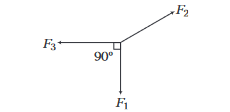
F_2=\sqrt{F_1^2+F_3^2}
\)
Example 5: One end of a string 0.5 m long is fixed to a point \(A\) and the other end is fastened to a small object of weight \(8 N\). The object is pulled aside by a horizontal force \(F\), until it is \(0.3 m\) from the vertical through \(A\). Find the magnitudes of the tension \(T\) in the string and the force \(F\).
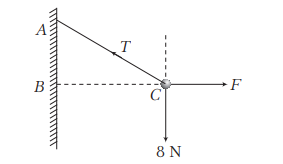
Solution:
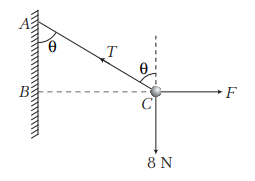
\(A C=0.5 \mathrm{~m}, B C=0.3 \mathrm{~m}\)
\(
\therefore A B=0.4 \mathrm{~m}
\)
and if \(\angle B A C=\theta\)
Then, \(\cos \theta=\frac{A B}{A C}=\frac{0.4}{0.5}=\frac{4}{5}\)
and \(\sin \theta=\frac{B C}{A C}=\frac{0.3}{0.5}=\frac{3}{5}\)
Here, the object is in equilibrium under three concurrent forces. So, we can apply Lami’s theorem,
\(
\frac{F}{\sin \left(180^{\circ}-\theta\right)}=\frac{8}{\sin \left(90^{\circ}+\theta\right)}=\frac{T}{\sin 90^{\circ}}
\)
\(
\begin{array}{ll}
\therefore & T=\frac{8}{\cos \theta} \\
& =\frac{8}{4 / 5}=10 \mathrm{~N}
\end{array}
\)
and
\(
\begin{aligned}
F & =\frac{8 \sin \theta}{\cos \theta} \\
& =\frac{(8)(3 / 5)}{(4 / 5)}=6 \mathrm{~N}
\end{aligned}
\)
Example 6: An iron block of mass 30 kg is hanging from the two supports, A and B, as shown in the diagram. Determine the tensions in both ropes. \(\text { (Take } \mathrm{g}=10 \mathrm{~m} / \mathrm{s} 2 \text { ) }\)
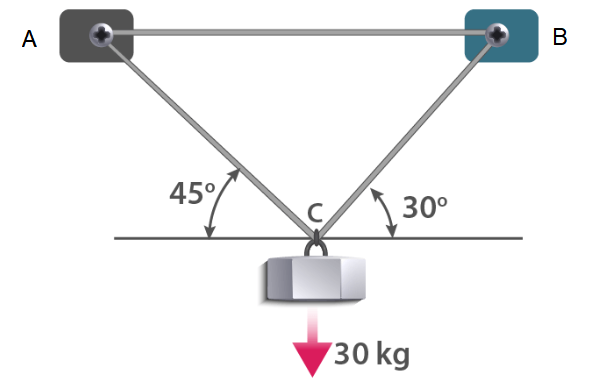
Solution:
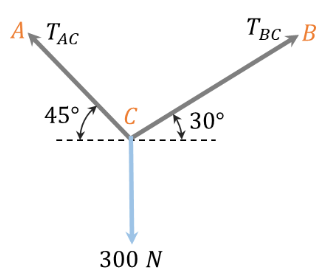
Given : Mass m=30 kg
Force due to gravity on the bell \(=30 \times 10=300 \mathrm{~N}\)
Now, drawing the free body diagram of the given situation taking bell at point \(\mathrm{C}\),
Using lami’s theorem
\(
\frac{A}{\sin \alpha}=\frac{B}{\sin \beta}=\frac{C}{\sin \gamma}
\)
Putting the values from diagram
\(
\frac{T_{A C}}{\sin (90+30)}=\frac{T_{B C}}{\sin (90+45)}=\frac{300}{\sin (180-30-45)}
\)
Taking first and third term,
\(
\begin{aligned}
\frac{T_{A C}}{\sin (90+30)} & =\frac{300}{\sin (180-30-45)} \\
T_{A C} & =268.97 \mathrm{~N}
\end{aligned}
\)
Taking the second and third term, Hence, the tensions in Strings are \(268.97 \mathrm{~N}\) and \(219.61 \mathrm{~N}\).
Example 7: Two persons A and B are drawing a bucket of water from a well using two ropes as shown in figure. In a given situation if person A is applying 30 N force. Find the Weight of the bucket.?
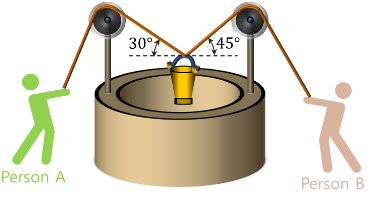
Solution: Given : \(F_A=30 \mathrm{~N}\)
Let the weight of water bucket \(=\mathrm{W}\)
Using lami’s theorem
\(
\frac{A}{\sin \alpha}=\frac{B}{\sin \beta}=\frac{C}{\sin \gamma}
\)
Putting the values from diagram
\(
\frac{F_A}{\sin (90+45)}=\frac{F_B}{\sin (90+30)}=\frac{W}{\sin (105)}
\)
Taking first and third term,
\(
\begin{aligned}
\frac{30 N}{\sin (90+30)} & =\frac{W}{\sin (180-30-45)} \\
W & =33.46 N
\end{aligned}
\)
Hence, the Weight of the bucket is \(33.46 \mathrm{~N}\).