Conceptual PCQs
SUMMARY
- The basic property of a fluid is that it can flow. The fluid does not have any resistance to change of its shape. Thus, the shape of a fluid is governed by the shape of its container.
- A liquid is incompressible and has a free surface of its own. A gas is compressible and it expands to occupy all the space available to it.
- If \(F\) is the normal force exerted by a fluid on an area \(A\) then the average pressure \(P_{\mathrm{av}}\) is defined as the ratio of the force to area
\(
P_{a v}=\frac{F}{A}
\) - The unit of the pressure is the pascal (Pa). It is the same as \(\mathrm{N} \mathrm{m}^{-2}\). Other common units of pressure are
\(
\begin{aligned}
& 1 \mathrm{~atm}=1.01 \times 10^5 \mathrm{~Pa} \\
& 1 \mathrm{bar}=10^5 \mathrm{~Pa} \\
& 1 \mathrm{torr}=133 \mathrm{~Pa}=0.133 \mathrm{kPa} \\
& 1 \mathrm{~mm} \text { of } \mathrm{Hg}=1 \text { torr }=133 \mathrm{~Pa}
\end{aligned}
\) - Pascal’s law states that: Pressure in a fluid at rest is same at all points which are at the same height. A change in pressure applied to an enclosed fluid is transmitted undiminished to every point of the fluid and the walls of the containing vessel.
- The pressure in a fluid varies with depth h according to the expression
\(
P=P_{\mathrm{a}}+\rho g h
\)
where \(\rho\) is the density of the fluid, assumed uniform. - The volume of an incompressible fluid passing any point every second in a pipe of non uniform cross section is the same in the steady flow.
\(v A=\) constant (\(v\) is the velocity and \(A\) is the area of cross section)
The equation is due to mass conservation in incompressible fluid flow. - Bernoulli’s principle states that as we move along a streamline, the sum of the pressure (\(P\)), the kinetic energy per unit volume (\(\rho v^2 / 2\)) and the potential energy per unit volume (\(\rho g y\)) remains a constant.
\(P+\rho v^2 / 2+\rho g y=\) constant
The equation is basically the conservation of energy applied to non viscuss fluid motion in steady state. There is no fluid which have zero viscosity, so the above statement is true only approximately. The viscosity is like friction and converts the kinetic energy to heat energy. - Though shear strain in a fluid does not require shear stress, when a shear stress is applied to a fluid, the motion is generated which causes a shear strain growing with time. The ratio of the shear stress to the time rate of shearing strain is known as coefficient of viscosity, \(\eta\). \(\eta=\frac{\text { shearing stress }}{\text { strain rate }}=\frac{F / A}{v / l}=\frac{F l}{v A}\)
where symbols have their usual meaning and are defined in the text. - Stokes’ law states that the viscous drag force \(\mathbf{F}\) on a sphere of radius a moving with velocity \(\mathbf{v}\) through a fluid of viscosity is, \(\mathbf{F}=6 \pi \eta a \mathbf{v}\).
- Surface tension is a force per unit length (or surface energy per unit area) acting in the plane of interface between the liquid and the bounding surface. It is the extra energy that the molecules at the interface have as compared to the interior.
- Terminal Velocity \(v_t=\frac{2}{9} \frac{r^2(\rho-\sigma) g}{\eta}\)
Quiz Summary
0 of 40 Questions completed
Questions:
Information
You have already completed the quiz before. Hence you can not start it again.
Quiz is loading…
You must sign in or sign up to start the quiz.
You must first complete the following:
Results
Results
0 of 40 Questions answered correctly
Your time:
Time has elapsed
You have reached 0 of 0 point(s), (0)
Earned Point(s): 0 of 0, (0)
0 Essay(s) Pending (Possible Point(s): 0)
Categories
- Not categorized 0%
- 1
- 2
- 3
- 4
- 5
- 6
- 7
- 8
- 9
- 10
- 11
- 12
- 13
- 14
- 15
- 16
- 17
- 18
- 19
- 20
- 21
- 22
- 23
- 24
- 25
- 26
- 27
- 28
- 29
- 30
- 31
- 32
- 33
- 34
- 35
- 36
- 37
- 38
- 39
- 40
- Current
- Review
- Answered
- Correct
- Incorrect
- Question 1 of 40
1. Question
A liquid can easily change its shape but a solid can not because
CorrectIncorrectHint
(b) the forces between the molecules is stronger in solid than in liquids.
Explanation:
Intermolecular Forces: In solids, the attractive forces between molecules (intermolecular forces) are very strong.
Particle Arrangement: These strong forces hold the particles in fixed, regular positions, allowing them only to vibrate in place rather than move past one another. This gives solids a definite shape and structural rigidity.
Liquid Behavior: In liquids, these intermolecular forces are comparatively weaker. This allows the molecules to slide and flow over one another, enabling the liquid to change its shape and take the form of its container while maintaining a constant volume. - Question 2 of 40
2. Question
Consider the equations
\(
P=\operatorname{Lim}_{\Delta A \rightarrow 0} \frac{F}{\Delta A} \text { and } P_1-P_2=\rho g h
\)
In an elevator accelerating upwardCorrectIncorrectHint
(b) Here is the breakdown of why one holds up while the other requires a “pseudo-force” adjustment.
The Definition of Pressure:
The first equation, \(P=\lim _{\Delta A \rightarrow 0} \frac{F}{\Delta A^{\prime}}\), is the fundamental definition of pressure at a point.
It describes pressure as the normal force exerted per unit area.
This definition is independent of the state of motion of the fluid container. Whether the elevator is stationary, accelerating upward, or in free fall, pressure is still defined by how much force is hitting a specific surface area.
Status: Valid.
The Hydrostatic Pressure Equation:
The second equation, \(P_1-P_2=\rho g h\), represents the pressure difference between two points in a fluid at rest under standard gravity (\(g\)).
When an elevator accelerates upward with an acceleration (\(a\)), every particle inside the fluid experiences an additional inertia-based pseudo-force acting downward.
In this non-inertial frame of reference, the “effective gravity” (\(g_{\text {eff }}\)) becomes \(g+a\).
The correct equation for the pressure difference in this scenario would be:
\(
P_1-P_2=\rho(g+a) h
\)
Since the original equation only accounts for \(g\) and ignores the acceleration of the frame, it fails to accurately describe the pressure gradient in the accelerating elevator.
Status: Invalid.\(
\begin{array}{lll}
\text { Equation } & \text { Meaning } & \text { Validity in Accelerating Frame } \\
P=\lim _{\Delta A \rightarrow 0} \frac{F}{\Delta A} & \text { Fundamental Definition } & \text { Valid (Definitions don’t change with motion) } \\
P_1-P_2=\rho g h & \text { Static Hydrostatic Law } & \text { Invalid (Requires } \left.g_{e f f}=g+a\right)
\end{array}
\) - Question 3 of 40
3. Question
The three vessels shown in figure (below) have same base area. Equal volumes of a liquid are poured in the three vessels. The force on the base will be
 CorrectIncorrect
Hint
(c) maximum in vessel \(\mathbf{C}\).
To understand why, we need to look at how the liquid distributes itself in each vessel based on its shape.
The Relationship Between Height and Volume:
The volume of a liquid is the same in all three vessels, and the base area (\(\boldsymbol{A}\)) is also identical. However, the shapes of the vessels differ:
Vessel A (Widening Top): The walls slope outward. As you pour liquid in, it spreads over a larger area as it rises. Therefore, for a fixed volume, the liquid level (\(h_A\)) will be the lowest.
Vessel B (Cylindrical): The walls are vertical. The height is simply \(h_B=\frac{\text { Volume }}{\text { Area }}\).
Vessel C (Narrowing Top): The walls slope inward. The liquid is “squeezed” into a smaller cross-section as it rises. Consequently, for the same volume, the liquid level (\(h_C\)) will be the highest.
Pressure and Force at the Base:
The pressure (\(P\)) at the bottom of a liquid column depends solely on the height (\(h\)) of the liquid, its density (\(\rho\)), and gravity (\(g\)):
\(
P=\rho g h
\)
The total force (\(F\)) exerted by the liquid on the base is the product of the pressure at the base and the base area (A):
\(
F=P \times A=(\rho g h) \times A
\)
Comparing the Vessels:
Since \(\rho, g\), and \(A\) are constant for all three vessels, the force is directly proportional to the height:
\(
F \propto h
\)
Because the height of the liquid is greatest in the narrowing vessel (Vessel C), the pressure at its base is the highest, leading to the maximum force on the base.\(
\begin{array}{|l|l|l|l|l|}
\hline \text { Vessel } & \text { Shape Type } & \text { Height }(\mathrm{h}) & \text { Pressure }(P) & \text { Force on Base }(F) \\
\hline \text { A } & \text { Widening } & \text { Lowest } & \text { Minimum } & \text { Minimum } \\
\hline \text { B } & \text { Uniform } & \text { Intermediate } & \text { Intermediate } & \text { Intermediate } \\
\hline \text { C } & \text { Narrowing } & \text { Highest } & \text { Maximum } & \text { Maximum } \\
\hline
\end{array}
\) - Question 4 of 40
4. Question
Equal mass of three liquids are kept in three identical cylindrical vessels \(A, B\) and \(C\). The densities are \(\rho_A, \rho_B, \rho_C\) with \(\rho_A<\rho_B<\rho_C\). The force on the base will be
CorrectIncorrectHint
(d) equal in all the vessels.
While it is tempting to think that density or height will change the outcome, the physics of weight and pressure lead to a very straightforward conclusion in this specific scenario.
Step 1: Analyze the Weight of the Liquid
The problem states that an equal mass (\(m\)) of three different liquids is poured into the vessels. Since weight is defined as mass multiplied by gravity (\(W=m g\)), and \(m\) and \(g\) are the same for all three:
The weight of the liquid in Vessel \(\mathrm{A}=\) Vessel \(\mathrm{B}=\) Vessel C.
Step 2: Relate Weight to Force on the Base
In a cylindrical vessel with vertical walls, the entire weight of the liquid is supported by the base. There are no slanting walls to “carry” part of the weight or push down extra force.
Therefore, the force \(F\) exerted by the liquid on the base is exactly equal to the weight (\(W\)) of the liquid.
\(F=m g\)
Step 3: Verify with the Pressure Formula
If you prefer to look at it through the lens of height and density (\(P=\rho g h\)):
Mass is constant: \(m=\rho \times V=\rho \times(A \times h)\).
Height varies: Since \(h=\frac{m}{\rho A}\), the liquid with the lowest density (\(\rho_A\)) will have the highest height, and the one with the highest density (\(\rho_C\)) will have the lowest height.
Force Calculation:
\(
F=P \times A=(\rho g h) \times A
\)
Substitute \(h=\frac{m}{\rho A}\) into the equation:
\(
F=\rho g\left(\frac{m}{\rho A}\right) A
\)
Simplify: Notice that \(\rho\) and \(A\) cancel out, leaving you with:
\(
F=m g
\)
Summary: Because the vessels are identical cylinders and the masses are equal, the differences in density and height perfectly cancel each other out. The base of each vessel simply “feels” the same total weight. - Question 5 of 40
5. Question
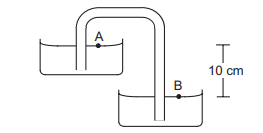
Figure (below) shows a siphon. The liquid shown is water. The pressure difference \(P_B-P_A\) between the points \(A\) and \(B\) is
 CorrectIncorrect
Hint
(d) The pressure difference \(P_B-P_A\) between the points \(A\) and \(B\) is zero.
In a standard siphon setup, both point \(\boldsymbol{A}\) (the surface of the liquid in the upper reservoir) and point \(\boldsymbol{B}\) (the exit point of the siphon tube) are open to the surrounding atmosphere. Because both points are in direct contact with the air, they both experience the same atmospheric pressure (\(P_{\text {atm }}\)).Explanation
Point A: This is typically at the surface of the liquid in the source container. Since it is exposed to the air, \(P_A=P_{a t m}\).
Point B: This is the discharge end of the siphon. As the liquid exits into the air, the pressure at the outlet is also equal to the ambient atmospheric pressure, so \(P_B=P_{a t m}\).
Calculation:
\(
P_B-P_A=P_{a t m}-P_{a t m}=0
\)
While there are internal pressure variations within the tube (the pressure is lowest at the highest point of the siphon), the difference between the specific entry and exit surfaces remains zero in a steady-state open system. - Question 6 of 40
6. Question
A beaker containing a liquid is kept inside a big closed jar. If the air inside the jar is continuously pumped out, the pressure in the liquid near the bottom of the liquid will
CorrectIncorrectHint
(b) decrease.
Explanation
The total pressure at any point in a liquid (especially at the bottom) is the sum of the atmospheric pressure (\(P_0\)) acting on the surface of the liquid and the hydrostatic pressure (\(hpg\)) exerted by the liquid column itself. This relationship is expressed as:
\(
P_{\text {total }}=P_0+h \rho g
\)
Decrease in External Pressure: When air is pumped out of the closed jar, the number of air molecules decreases, causing the external pressure (\(P_0\)) inside the jar to drop.
Transmission of Pressure: According to Pascal’s Principle, a change in pressure applied to an enclosed fluid is transmitted undiminished to every portion of the fluid.
Result: As \(P_0\) decreases, the total pressure (\(P_{\text {total }}\)) at the bottom of the beaker also decreases. - Question 7 of 40
7. Question
The pressure in a liquid at two points in the same horizontal plane are equal. Consider an elevator accelerating upward and a car accelerating on a horizontal road. The above statement is correct in
CorrectIncorrectHint
(b) the elevator only. In an upward-accelerating elevator, vertical acceleration increases effective gravity, but the liquid surface remains horizontal, keeping pressures equal at the same horizontal level. A horizontally accelerating car causes the liquid surface to tilt, creating a pressure difference (gradient).
Key Reasons:
Elevator: Pressure \(P\) at depth \(h\) is \(P_0+\rho(g+a) h\). Because \(h\) is the same for points on the same horizontal plane, pressure remains equal.
Car: The horizontal acceleration introduces a pseudo-force, tilting the fluid surface and breaking the horizontal equilibrium of pressure. - Question 8 of 40
8. Question
Suppose the pressure at the surface of mercury in a barometer tube is \(P_1\) and the pressure at the surface of mercury in the cup is \(P_2\).
CorrectIncorrectHint
(a) To understand why, let’s look at how a mercury barometer is constructed and how it functions.
How a Barometer Works
A mercury barometer consists of a long glass tube that has been filled with mercury and then inverted into a cup (or reservoir) of mercury.
At the top of the tube \(\left(P_1\right)\) : When the tube is inverted, the mercury column drops slightly, leaving a vacuum at the top. This is known as a Torricellian vacuum. Because it is a vacuum, there is no air to exert pressure, meaning the pressure \(P_1\) is effectively zero.
At the surface of the cup \(\left(P_2\right)\) : The mercury in the cup is open to the surrounding environment. Therefore, the air in the room pushes down on the surface of the liquid. This means the pressure \(P_2\) is equal to the atmospheric pressure.
The Balancing Act
The height of the mercury column in the tube is determined by the balance between the downward pressure of the mercury’s weight and the upward pressure from the atmosphere. Mathematically, this is expressed as:
\(
P_{a t m}=\rho g h
\)
Where:
\(P_{a t m}\) is the atmospheric pressure.
\(\rho\) is the density of mercury.
\(g\) is the acceleration due to gravity.
his the height of the mercury column.
If \(P_1\) were not zero (for example, if air leaked into the top), the mercury column would be pushed down, and the barometer would give an inaccurately low reading. - Question 9 of 40
9. Question
A barometer kept in an elevator reads 76 cm when it is at rest. If the elevator goes up with increasing speed, the reading will be
CorrectIncorrectHint
(c) less than 76 cm.
Here is the breakdown of why the mercury level changes when the elevator accelerates:
The Physics of Effective Gravity
When an elevator is at rest or moving at a constant speed, the only force acting on the mercury column (besides the air pressure holding it up) is standard gravity (\(g\)). However, when the elevator accelerates upward, every object inside experiences an additional “pseudo-force” acting downward.
This creates an effective gravity (\(g_{\text {eff }}\)), which is greater than standard gravity:
\(
g_{\mathrm{eff}}=g+a
\)
Why the Reading Drops?
The barometer works by balancing the weight of the mercury column against the atmospheric pressure. The relationship is:
\(
P_{a t m}=\rho \cdot g_{e f f} \cdot h
\)
Since the atmospheric pressure (\(P_{\text {atm }}\)) outside the tube remains constant, but the “weight” of the mercury increases because of the upward acceleration (\(g_{\text {eff }}\) increases), the height (\(h\)) must decrease to maintain the balance.
At Rest: \(h=\frac{P_{\text {atm }}}{\rho g}=76 \mathrm{~cm}\)
Accelerating Upward: \(h=\frac{P_{\text {atm }}}{\rho(g+a)}\)
Because the denominator is now larger, the value of \(h\) becomes smaller than 76 cm.\(
\begin{array}{|l|l|l|}
\hline \text { Elevator Motion } & \text { Effective Gravity }\left(g_{\text {eff }}\right) & \text { Barometer Reading }(\mathrm{h}) \\
\hline \text { At Rest / Constant Velocity } & \mathrm{g} & 76 \mathrm{~cm} \\
\hline \text { Accelerating Upward } & g+a & <76 \mathrm{~cm} \\
\hline \text { Accelerating Downward } & g-a & >76 \mathrm{~cm} \\
\hline
\end{array}
\) - Question 10 of 40
10. Question
A barometer kept in an elevator accelerating upward reads 76 cm. The air pressure in the elevator is
CorrectIncorrectHint
(c) Step 1: Determine the effective acceleration
In an elevator accelerating upward with an acceleration \(a\), objects inside experience a pseudo-force acting downward. The effective acceleration due to gravity \(g_{e f f}\) is the sum of the acceleration due to gravity \(g\) and the upward acceleration of the elevator \(a\).
\(
g_{e f f}=g+a
\)
Step 2: Relate pressure to column height
A barometer measures pressure \(\boldsymbol{P}\) by balancing the weight of a liquid column (mercury) against the atmospheric pressure. The formula for the pressure exerted by a liquid column of height \(h\) and density \(\rho\) in an accelerating frame is:
\(
P=\rho \cdot g_{e f f} \cdot h
\)
Substituting the effective gravity:
\(
P=\rho(g+a) h
\)
Step 3: Compare with standard pressure
The barometer reads \(h=76 \mathrm{~cm}\). In a stationary frame (\(a=0\)), a pressure of 76 cm of Hg is defined as:
\(
P_{\text {standard }}=\rho \cdot g \cdot 76
\)
In the accelerating elevator, the actual air pressure \(P\) is:
\(
P=\rho(g+a) \cdot 76
\)
Since the elevator is accelerating upward \((a>0)\), then \((g+a)>g\). Therefore:
\(
\rho(g+a) \cdot 76>\rho \cdot g \cdot 76
\)
This shows that the air pressure \(P\) must be greater than the standard pressure represented by a 76 cm column at rest.
Answer: The air pressure in the elevator is greater than \(\mathbf{7 6 ~ c m}\) of Hg. - Question 11 of 40
11. Question
To construct a barometer, a tube of length 1 m is filled completely with mercury and is inverted in a mercury cup. The barometer reading on a particular day is 76 cm. Suppose a 1 m tube is filled with mercury up to 76 cm and then closed by a cork. It is inverted in a mercury cup and the cork is removed. The height of mercury column in the tube over the surface in the cup will be
CorrectIncorrectHint
(d) Step 1: Identify Initial Conditions
When the \(1 \mathrm{~m}(100 \mathrm{~cm})\) tube is filled with 76 cm of mercury, the remaining 24 cm is occupied by air. Since the tube is open before being corked, this trapped air is at atmospheric pressure \(P_0=76 \mathrm{~cm} \mathrm{Hg}\).
Initial pressure: \(P_1=76 \mathrm{~cm} \mathrm{Hg}\)
Initial volume (length): \(L_1=24 \mathrm{~cm}\)
Step 2: Establish Equilibrium
After inversion, let the mercury column settle at height \(h\). The trapped air now occupies a length \(L_2=100-h\). For equilibrium at the cup’s mercury surface, the atmospheric pressure must balance the pressure of the trapped air plus the pressure of the mercury column:
\(
\begin{gathered}
P_{a t m}=P_{a i r}+h \\
76=P_{a i r}+h
\end{gathered}
\)
Step 3: Apply Boyle’s Law
Assuming constant temperature, we use \(P_1 L_1=P_{\text {air }} L_2\) :
\(
\begin{gathered}
76 \times 24=P_{\text {air }} \times(100-h) \\
P_{\text {air }}=\frac{1824}{100-h}
\end{gathered}
\)
Since the trapped air exerts a positive pressure (\(P_{\text {air }}>0\)), the equation \(h=76-P_{\text {air }}\) dictates that \(h\) must be strictly less than 76 cm. Numerically, solving the quadratic \(h^2-176 h+5776=0\) yields \(h \approx 43.7 \mathrm{~cm}\). - Question 12 of 40
12. Question
A 20 N metal block is suspended by a spring balance. A beaker containing some water is placed on a weighing machine which reads 40 N. The spring balance is now lowered so that the block gets immersed in the water. The spring balance now reads 16 N. The reading of the weighing machine will be
CorrectIncorrectHint
(c) Step 1: Calculate the buoyant force acting on the block
The spring balance measures the tension in the wire. When the block is immersed in water, it experiences an upward buoyant force \(\left(F_b\right)\). The relationship between the weight of the block (\(W_{\text {block }}\)), the tension (\(T\)), and the buoyant force is given by:
\(
T+F_b=W_{\text {block }}
\)
Given \(W_{\text {block }}=20 \mathrm{~N}\) and \(T=16 \mathrm{~N}\), we find \(F_b\) :
\(
F_b=20 \mathrm{~N}-16 \mathrm{~N}=4 \mathrm{~N}
\)
Step 2: Apply Newton’s Third Law to the water system
According to Newton’s Third Law, if the water exerts an upward buoyant force of 4 N on the metal block, the block exerts an equal and opposite downward force of 4 N on the water.
Step 3: Determine the new reading of the weighing machine
The weighing machine measures the total downward force exerted by the beaker and its contents. The new reading (\(R\)) is the sum of the initial weight of the beaker and water (\(W_{\text {system }}\)) and the downward reaction force from the block (\(F_b\)):
\(
\begin{gathered}
R=W_{\text {system }}+F_b \\
R=40 \mathrm{~N}+4 \mathrm{~N}=44 \mathrm{~N}
\end{gathered}
\)
The reading of the weighing machine will be 44 N. - Question 13 of 40
13. Question
A piece of wood is floating in water kept in a bottle. The bottle is connected to an air pump. Neglect the compressibility of water. When more air is pushed into the bottle from the pump, the piece of wood will float with
CorrectIncorrectHint
(c) The piece of wood will float with the (c) same part in the water. When more air is pumped into the bottle, the pressure increases uniformly on both the water surface and the top of the wood. Because water is incompressible and the weight of the wood remains unchanged, the buoyant force (Archimedes’ principle) needed to support the block remains the same.
Uniform Pressure: The increased air pressure acts equally on all surfaces, meaning it does not change the net vertical force or buoyancy.
Constant Density: As the water is incompressible, its density does not change, meaning the volume of water displaced to balance the weight of the wood remains constant.
Result: The submerged volume of the wood does not change. Thus, the object floats at the same level. - Question 14 of 40
14. Question
A metal cube is placed in an empty vessel. When water is filled in the vessel so that the cube is completely immersed in the water, the force on the bottom of the vessel in contact with the cube
CorrectIncorrectHint
(c) will remain the same.
Explanation
The force exerted by the metal cube on the bottom of the vessel depends on the pressure acting on its top and bottom surfaces:
Initial State: When the vessel is empty, the only force the cube exerts on the bottom is its weight (\(W\)).
Immersed State: When water is added, the water exerts a downward pressure on the top surface of the cube. However, since the cube is in direct contact with the bottom of the vessel, no water can get underneath it.
Absence of Buoyancy: Buoyant force (upthrust) is the result of the pressure difference between the top and bottom of an object. If no water is present between the cube and the vessel floor, there is no upward pressure from the liquid, and thus no buoyant force acts on the cube to lift it.
Net Force: If the water level is exactly at the top of the cube (“just immersed”), the weight of the cube remains the only downward force in that specific contact area. - Question 15 of 40
15. Question
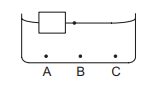
A wooden object floats in water kept in a beaker. The object is near a side of the beaker (figure below). Let \(P_1, P_2, P_3\) be the pressures at the three points \(A, B\) and \(C\) of the bottom as shown in the figure.
 CorrectIncorrect
Hint
(a) Even though there is a wooden object floating on the surface, the fundamental rule of fluid pressure applies: Pressure at a point in a static liquid depends only on the depth (\(h\)) below the free surface and the density of the liquid (\(\rho\)).
The Pressure Equation:
The pressure \(P\) at any point on the bottom of the beaker is given by:
\(
P=P_{a t m}+\rho g h
\)
Where:
\(P_{a t m}\) is the atmospheric pressure acting on the surface.
\(\rho\) is the density of the water.
\(g\) is the acceleration due to gravity.
\(h\) is the vertical distance from the point to the top surface of the liquid.
Comparing \(P_1, P_2\), and \(P_3\)
Uniform Surface Level: In a static liquid, the free surface remains horizontal and at the same level throughout the beaker.
Same Depth: Points \(A, B\), and \(C\) are all located at the bottom of the beaker. Therefore, they are all at the exact same vertical depth \(h\) from the surface of the water.
The “Object” Factor: You might wonder if the wood “pushes down” more on point \(B\) because it is directly underneath it. However, the wood stays afloat by displacing its own weight of water. The pressure at the bottom is determined by the total height of the water column (which includes the “rise” in level caused by the wood being added).
The Result
Since \(h\) is the same for all three points at the bottom:
\(
P_1=P_2=P_3
\)
Regardless of where the wooden block is positioned-whether it’s in the middle, near a side, or moving around-the pressure at all points on the horizontal base of the beaker will remain equal. - Question 16 of 40
16. Question
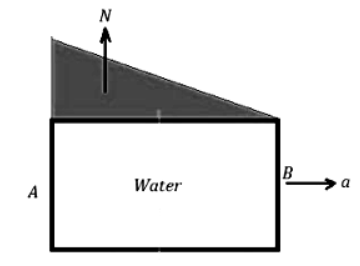
A closed cubical box is completely filled with water and is accelerated horizontally towards right with an acceleration \(a\). The resultant normal force by the water on the top of the box
CorrectIncorrectHint
(c) passes through a point to the left of the centre.

Explanation
When a closed cubical box filled with water accelerates horizontally to the right with acceleration \(a\) :
Pseudo Force: Every water molecule experiences a pseudo force directed towards the left \(\left(F_p=m a\right)\).
Pressure Gradient: This force creates a horizontal pressure gradient where pressure increases from the right side to the left side of the box.
Triangular Distribution: On the top surface, the pressure is lowest (zero relative to the surface if considering only horizontal effects) at the right edge and reaches its maximum at the left edge. This results in a linear, triangular distribution of force across the top.
Center of Pressure: The resultant normal force acts through the centroid of this triangular distribution, which is located at a distance of \(1 / 3\) of the width from the left side (or \(2 / 3\) from the right). Since \(1 / 3\) from the edge is past the halfway mark, the force passes through a point to the left of the centre. - Question 17 of 40
17. Question
Consider the situation of the previous problem. Let the water push the left wall by a force \(F_1\) and the right wall by a force \(F_2\).
CorrectIncorrectHint
(b) Step 1: Analyze the motion of the box
The problem describes a closed cubical box filled with water that is accelerating horizontally to the right with an acceleration \(a\). For the water inside to move with the same acceleration, there must be a net force acting on it in the direction of motion.
Step 2: Identify the horizontal forces
Two primary horizontal forces act on the water:
\(F_1\) : The force exerted by the left wall on the water (pushing it to the right).
\(F_2\) : The force exerted by the right wall on the water (pushing it to the left).
According to Newton’s second law (\(F_{\text {net }}=m a\)), the net force in the horizontal direction is:
\(
F_1-F_2=m a
\)
Step 3: Determine the relationship between \(F_1\) and \(F_2\)
Since the mass \(m\) of the water and the acceleration \(a\) are both positive values, the term ma must be greater than zero:
\(
\begin{gathered}
F_1-F_2>0 \\
F_1>F_2
\end{gathered}
\)
This occurs because a pressure gradient is established in the fluid to provide the necessary accelerating force. The pressure at the rear (left) wall becomes higher than the pressure at the front (right) wall, leading to a greater force on the left side. - Question 18 of 40
18. Question
Water enters through end \(A\) with a speed \(v_1\) and leaves through end \(B\) with a speed \(v_2\) of a cylindrical tube \(A B\). The tube is always completely filled with water. In case \(I\) the tube is horizontal, in case \(I I\) it is vertical with the end \(A\) upward and in case III it is vertical with the end \(B\) upward. We have \(v_1=v_2\) for
CorrectIncorrectHint
(d) Step 1: Applying the Equation of Continuity
For an incompressible fluid (like water) flowing through a closed conduit, the volume flow rate must remain constant at every cross-section to satisfy the conservation of mass. This is expressed by the equation of continuity:
\(
A_1 v_1=A_2 v_2
\)
Where \(A\) represents the cross-sectional area and \(v\) represents the flow velocity.
Step 2: Analyzing the Tube Geometry
The problem specifies a cylindrical tube. In a cylinder, the cross-sectional area is uniform throughout its entire length. Therefore, the area at the entrance (end \(A\)) is equal to the area at the exit (end \(\boldsymbol{B}\)):
\(
A_1=A_2
\)
Substituting this into the continuity equation:
\(
A_1 v_1=A_1 v_2 \Longrightarrow v_1=v_2
\)
Step 3: Evaluating the Cases
The orientation of the tube (horizontal or vertical) affects the fluid pressure due to gravity (as described by Bernoulli’s principle), but it does not change the flow speed as long as the tube remains completely filled and the cross-sectional area is constant.
Case I (Horizontal): Area is constant, so \(v_1=v_2\).
Case II (Vertical, A up): Area is constant, so \(v_1=v_2\).
Case III (Vertical, B up): Area is constant, so \(v_1=v_2\).
The velocity \(v_1\) is equal to \(v_2\) in each case. - Question 19 of 40
19. Question
Bernoulli theorem is based on conservation of
CorrectIncorrectHint
(c) Bernoulli’s theorem is based on the conservation of energy. It states that for an inviscid, incompressible, and steady flow, the total mechanical energy-comprising pressure energy, kinetic energy, and potential energy-remains constant along a streamline. This principle applies the conservation of energy to fluid flow.
Pressure Energy: \({P}\) (or \({P} {/} {\rho}\))
Kinetic Energy: \(\frac{1}{2} v^2\) (or \(\frac{1}{2} \rho v^2\))
Potential Energy: \(gh\) (or \(\rho gh\))
The formula \(\frac{P}{\rho}+\frac{v^2}{2}+g h=\) constant represents this conservation, where any increase in velocity (\(v\)) results in a decrease in pressure (\(P\)) or potential energy (\(h\)), ensuring the total energy remains unchanged. - Question 20 of 40
20. Question
Water is flowing through a long horizontal tube. Let \(P_A\) and \(P_B\) be the pressures at two points \(A\) and \(B\) of the tube.
CorrectIncorrectHint
(d) Step 1: Apply Bernoulli’s Principle
For a liquid flowing through a horizontal tube, the potential energy per unit volume (\(\rho g h)\) remains constant at all points since the height \(h\) does not change. According to Bernoulli’s theorem, the sum of pressure energy and kinetic energy per unit volume is constant:
\(
P_A+\frac{1}{2} \rho v_A^2=P_B+\frac{1}{2} \rho v_B^2
\)
Where \(P\) is pressure, \(\rho\) is the density of water, and \(v\) is the flow velocity.
Step 2: Use the Equation of Continuity
The Equation of Continuity states that for an incompressible fluid like water, the volume flow rate is constant:
\(
A_A v_A=A_B v_B
\)
This means the velocity \(v\) at any point depends entirely on the cross-sectional area \(A\) at that point.
Step 3: Relate Pressure and Area
From the Bernoulli equation, \(P_A=P_B\) only if \(v_A=v_B\). Based on the equation of continuity, \(\boldsymbol{v}_{\boldsymbol{A}}\) equals \(\boldsymbol{v}_{\boldsymbol{B}}\) if and only if the cross-sectional areas \(\boldsymbol{A}_{\boldsymbol{A}}\) and \(\boldsymbol{A}_{\boldsymbol{B}}\) are equal. If the areas differ, the velocities will differ, leading to a pressure difference between points \(A\) and \(B\).
\(P_A=P_B\) only if the cross-sectional area at \(A\) and \(B\) are equal. - Question 21 of 40
21. Question
Water and mercury are filled in two cylindrical vessels up to same height. Both vessels have a hole in the wall near the bottom. The velocity of water and mercury coming out of the holes are \(v_1\) and \(v_2\) respectively.
CorrectIncorrectHint
(a) Step 1: Apply Torricelli’s Law
The velocity of efflux \(v\) of an ideal fluid from an opening at a depth \(h\) below the free surface is given by Torricelli’s Law:
\(
v=\sqrt{2 g h}
\)
where \(g\) is the acceleration due to gravity and \(h\) is the height of the liquid column above the hole.
Step 2: Compare Velocities
According to the formula, the velocity of the liquid depends only on the height of the liquid column \(h\) and the gravitational constant \(g\). It is independent of the density \(\rho\) of the liquid. Since both vessels are filled to the same height \(h\) :
For water: \(v_1=\sqrt{2 g h}\)
For mercury: \(v_2=\sqrt{2 g h}\)
Comparing the two expressions, we find that \(v_1=v_2\).
The velocity of water and mercury coming out of the holes is the same because efflux velocity depends only on the height of the liquid column, not its density. Therefore, the correct option is (a) \(v_1=v_2\). - Question 22 of 40
22. Question
A large cylindrical tank has a hole of area \(A\) at its bottom. Water is poured in the tank by a tube of equal cross-sectional area \(A\) ejecting water at the speed \(v\).
CorrectIncorrectHint
(c) Step 1: Calculate the Inflow Rate
The volume flow rate of water entering the tank (\(Q_{\text {in }}\)) is determined by the crosssectional area of the tube and the velocity of the water. Given the area \(A\) and speed \(v\), the inflow is:
\(
Q_{i n}=A v
\)
Step 2: Determine the Outflow Rate
According to Torricelli’s Law, the speed of efflux (\(v_{\text {out }}\)) for water leaving a hole at the bottom of a tank at a depth \(h\) is given by \(v_{\text {out }}=\sqrt{2 g h}\). Since the hole has the same cross-sectional area \(A\), the volume flow rate out of the \(\operatorname{tank}\left(Q_{\text {out }}\right)\) is:
\(
Q_{\text {out }}=A \sqrt{2 g h}
\)
Step 3: Find the Equilibrium Height
The water level stops rising when the rate of water entering the tank equals the rate of water leaving the \(\operatorname{tank}\left(Q_{\text {in }}=Q_{\text {out }}\right)\). Setting the two equations equal:
\(
A v=A \sqrt{2 g h}
\)
Dividing both sides by \(\boldsymbol{A}\) and squaring the result:
\(
v^2=2 g h
\)
Solving for \(h\) :
\(
h=\frac{v^2}{2 g}
\)
At this height, the pressure head ensures the outflow matches the inflow, maintaining a constant level. - Question 23 of 40
23. Question
A solid floats in a liquid in a partially dipped position.
CorrectIncorrectHint
The Correct Options: (a), (b), and (c)
(b) is true (Equilibrium): For a solid to float, the net force on it must be zero. The downward force is its weight, and the upward force is buoyancy. Therefore, Buoyancy = Weight of the solid.
(c) is true (Archimedes’ Principle): Archimedes’ Principle states that the buoyant force is always equal to the weight of the displaced liquid. Combining this with point (b), it follows that Weight of displaced liquid = Weight of the solid.
(a) is true (Newton’s Third Law): If the liquid exerts an upward buoyant force on the solid, the solid must exert an equal and opposite downward force on the liquid. Since that buoyant force equals the solid’s weight, the force exerted on the liquid also equals the weight of the solid.Why (d) is Incorrect
(d) Weight of the dipped part = Weight of displaced liquid: This is the false statement. The “dipped part” is just a portion of the solid’s total volume. Its weight depends on the density of the solid. The displaced liquid has the same volume as that dipped part, but its weight depends on the density of the liquid. - Question 24 of 40
24. Question
The weight of an empty balloon on a spring balance is \(W_1\). The weight becomes \(W_2\) when the balloon is filled with air. Let the weight of the air itself be \(w\). Neglect the thickness of the balloon when it is filled with air. Also neglect the difference in the densities of air inside and outside the balloon.
CorrectIncorrectHint
(a, c) Step 1: Analyze the initial weight \(W_1\)
The weight \(W_1\) measured by the spring balance for the empty balloon is the gravitational force acting on the balloon material minus the buoyant force exerted by the surrounding air on the volume of the balloon material itself. Since we are told to neglect the thickness/volume of the material when filled, we can express the initial reading as the weight of the rubber:
\(
W_1=m_{\text {balloon }} g
\)
Step 2: Analyze the forces on the filled balloon
When the balloon is filled with air, the total gravitational force acting downward increases by the weight of the air inside, \(w\). However, the balloon now occupies a significantly larger volume \(V\), which generates an upward buoyant force \(B\). The new reading \(W_2\) is:
\(
W_2=\left(W_1+w\right)-B
\)
Step 3: Compare internal weight and buoyancy
According to Archimedes’ Principle, the buoyant force \(\boldsymbol{B}\) is equal to the weight of the air displaced by the balloon. Since the density of the air inside is equal to the density of the air outside (\(\rho_{\text {in }}=\rho_{\text {out }}\)), the weight of the air inside \(w\) is exactly equal to the buoyant force \(\boldsymbol{B}\) :
\(
w=V \rho_{\text {in }} g, \quad B=V \rho_{\text {out }} g \Longrightarrow w=B
\)
Step 4: Determine the relationship between \(W_2\) and \(W_1\)
Substituting \(B=w\) into the equation for \(W_2\) :
\(
W_2=W_1+w-w=W_1
\)
This confirms option (a). Additionally, since the weight of the air \(w\) is a positive value, if \(W_2=W_1\), then it must also be true that \(W_2<W_1+w\). This confirms option (c). - Question 25 of 40
25. Question
A solid is completely immersed in a liquid. The force exerted by the liquid on the solid will
CorrectIncorrectHint
(c) decrease if it is taken partially out of the liquid
(d) be in the vertically upward direction.Explanation
The force exerted by a liquid on an immersed solid is called the buoyant force (or upthrust). According to Archimedes’ Principle, the magnitude of this force is equal to the weight of the liquid displaced by the object (\(F_b=\rho \cdot V \cdot g\)).
(c) Decrease if it is taken partially out of the liquid: When a solid is taken partially out of the liquid, the volume of the displaced liquid (\(V\)) decreases. Since the buoyant force is directly proportional to the displaced volume, the force exerted by the liquid will decrease.
(d) Be in the vertically upward direction: Fluid pressure increases with depth, meaning the pressure on the bottom surface of an immersed object is greater than the pressure on its top surface. This pressure difference creates a net force that always acts in the vertically upward direction, opposing gravity. - Question 26 of 40
26. Question
A closed vessel is half filled with water. There is a hole near the top of the vessel and air is pumped out from this hole.
CorrectIncorrectHint
(b) The pressure at the surface of the water will decrease and \(\checkmark\) (c) The force by the water on the bottom of the vessel will decrease.
Explanation
Pressure at the Surface: When air is pumped out from the hole near the top of a closed vessel, the amount of air molecules above the water surface decreases. Since gas pressure is proportional to the concentration of gas molecules in a given volume, removing the air reduces the atmospheric pressure acting directly on the water’s surface.
Force on the Bottom: The total pressure at the bottom of the vessel is the sum of the pressure from the water column (\(P_{\text {water }}=\rho g h\)) and the pressure from the air above it (\(P_{\text {air }}\)). As \(P_{\text {air }}\) decreases due to the removal of air, the total pressure at the bottom (\(P_{\text {total }}=P_{\text {air }}+P_{\text {water }}\)) also decreases. Since force is the product of pressure and area \((F=P \times A)\), a decrease in total pressure results in a decrease in the force exerted by the water on the bottom of the vessel. - Question 27 of 40
27. Question
In a streamline flow,
CorrectIncorrectHint
(c) the kinetic energies of all the particles arriving at a given point are the same and (d) the moments (momenta) of all the particles arriving at a given point are the same.
Explanation
In a streamline flow (also known as steady flow), the velocity of fluid particles at any fixed point in space remains constant over time. This means every particle that reaches a specific point will have the exact same velocity (both magnitude and direction) as the particle that was there before it.
Kinetic Energy: Since kinetic energy is defined as \(\frac{1}{2} m v^2\), and every particle of mass \(m\) arriving at that point has the same velocity \(v\), their kinetic energies must be identical.
Momentum (Moments): Similarly, momentum is defined as \(m v\). Because mass and velocity are constant for every particle passing through that point, their momenta are also the same. - Question 28 of 40
28. Question
Water flows through two identical tubes \(A\) and \(B\). A volume \(V_0\) of water passes through the tube \(A\) and \(2 V_0\) through \(B\) in a given time. Which of the following may be correct?
CorrectIncorrectHint
The correct options are (a), (b), and (c).
Explanation
The nature of fluid flow (steady/laminar vs. turbulent) is determined by the Reynolds number (Re), which is directly proportional to the velocity of the fluid (\(v\)) through the relation \(R e=\frac{\rho v D}{\eta} \cdot \theta\)
Velocity Comparison: Since the tubes are identical (same diameter \(\boldsymbol{D}\)) and the time interval is the same, the volume flow rate \((Q=V / t)\) is directly proportional to the velocity. Since tube B passes \(2 V_0\) while tube A passes \(V_0\), the velocity in tube B is twice that of tube \(\mathrm{A}\left(v_B=2 v_A\right)\).
Possibilities:
(a) If \(v_B\) is still below the critical velocity for turbulence, both flows remain steady.
(b) If \(v_A\) is already above the critical velocity, both flows will be turbulent.
(c) If \(v_A\) is below the critical velocity but \(v_B\) (being twice as fast) exceeds it, flow is steady in A and turbulent in B. - Question 29 of 40
29. Question
Water is flowing in streamline motion through a tube with its axis horizontal. Consider two points \(A\) and \(B\) in the tube at the same horizontal level.
CorrectIncorrectHint
(c, d) Based on Bernoulli’s principle for streamline flow, the pressure at two points \(\boldsymbol{A}\) and \(\boldsymbol{B}\) in a horizontal tube depends on the velocity, which is determined by the crosssectional area (equation of continuity, \(\boldsymbol{A} \boldsymbol{v} \boldsymbol{=}\) constant). Therefore, the pressures are equal if the tube has a uniform cross-section, as velocity remains constant.
Correct options:
(c) The pressures are equal if the tube has a uniform cross section.
(d) The pressures may be equal even if the tube has a nonuniform cross section (if the cross-sectional area happens to be the same at both specific points).According to the Bernoulli equation \(\left(P+\frac{1}{2} \rho v^2+\rho g h=\right.\) constant \()\), for a horizontal pipe ( \(h\) is constant), \(P+\frac{1}{2} \rho v^2=\) constant. If the cross-section is uniform, velocity \(v\) is constant, making pressure \(\boldsymbol{P}\) constant. If the cross-section is non-uniform, the pressure may still be equal if the cross-sectional area is the same at those points.
- Question 30 of 40
30. Question
There is a small hole near the bottom of an open tank filled with a liquid. The speed of the water ejected does not depend on
CorrectIncorrectHint
(a) area of the hole and (b) density of the liquid.
According to Torricelli’s Law, the speed of efflux (\(v\)) of a liquid from a small hole in an open tank is given by the formula:
\(
v=\sqrt{2 g h}
\)
Explanation
\(h\) (Height of liquid): The speed depends directly on the vertical distance from the liquid surface to the hole.
\(\boldsymbol{g}\) (Acceleration due to gravity): The speed depends on the gravitational pull acting on the fluid column.
Area and Density: Neither the area of the hole nor the density of the liquid appears in the formula for velocity. Therefore, the speed of the ejected liquid remains the same regardless of the hole’s size (as long as it is small) or the type of liquid used.Why other options are incorrect
(c) height of the liquid from the hole: As seen in the formula \(v=\sqrt{2 g h}\), the speed is directly proportional to the square root of the height (\(h\)). Increasing the height increases the pressure and thus the ejection speed.
(d) acceleration due to gravity: The speed is directly proportional to the square root of \(g\). If the gravity were different (e.g., on the moon), the speed of the water ejected would change. - Question 31 of 40
31. Question
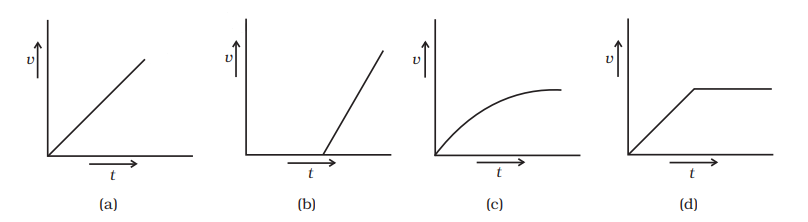
A tall cylinder is filled with viscous oil. A round pebble is dropped from the top with zero initial velocity. From the plot shown in Figure below, indicate the one that represents the velocity \((v)\) of the pebble as a function of time \((t)\).
 CorrectIncorrect
Hint
(c) Step 1: Initial Motion and Forces
When the pebble is dropped (\(t=0\)), its initial velocity \(v\) is zero. Gravity (\(m g\)) acts downward, causing the pebble to accelerate. As it enters the viscous oil, it experiences an upward buoyant force and a viscous drag force. According to Stokes’ Law, the viscous force \(F_v\) is:
\(
F_v=6 \pi \eta r v
\)
where \(\eta\) is the coefficient of viscosity, \(r\) is the radius, and \(v\) is the instantaneous velocity.
Step 2: Attainment of Terminal Velocity
As the pebble’s velocity increases, the opposing viscous drag force also increases. This causes the net downward force-and thus the acceleration-to decrease over time. Eventually, the sum of the upward forces (viscous drag and buoyancy) equals the downward gravitational force:
\(
m g=F_b+6 \pi \eta r v_t
\)
At this point, the net force becomes zero, acceleration becomes zero, and the pebble continues to fall at a constant terminal velocity \(\left(v_t\right)\).
Step 3: Graphical Representation
The \(v-t\) graph must satisfy these conditions:
It must start at the origin (\(v=0\) at \(t=0\)).
It must be a curve (not a straight line) because the acceleration is variable.
It must approach a horizontal asymptote, representing the constant terminal velocity.
The correct plot is (c). It accurately depicts the velocity increasing from zero and leveling off as the pebble reaches terminal velocity. - Question 32 of 40
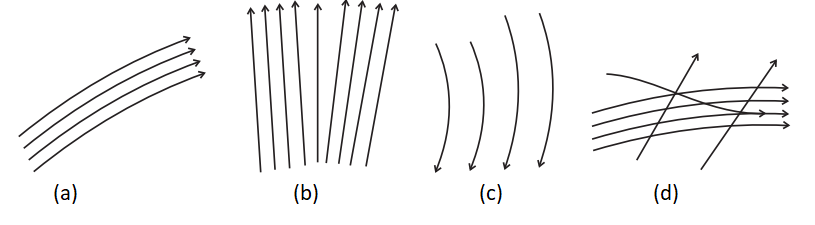
32. Question
Which of the following diagrams (Figure below) does not represent a streamline flow?
 CorrectIncorrect
Hint
(d) In a streamlined flow at any given point. the velocity of each passing fluid particle remains constant. If we consider a crosssectional area. then a point in the area cannot have different velocities at the same time, hence two streamlines of flow cannot cross each other.
Explanation
In fluid dynamics, a streamline flow (also known as laminar flow) is characterized by the steady movement of fluid particles where every particle passing through a specific point follows the same path as the preceding particles. A fundamental property of streamlines is that they can never intersect.If two streamlines were to cross, it would imply that at the point of intersection, a fluid particle has two different velocities (directions) at the same time, which is physically impossible in a steady flow. Diagram (d) shows streamlines intersecting each other, therefore it does not represent a streamline flow.
- Question 33 of 40
33. Question
Along a streamline
CorrectIncorrectHint
(b) the velocity of all fluid particles crossing a given position is constant.
Explanation
In fluid dynamics, a streamline represents a flow pattern where the velocity of the fluid at any fixed point in space remains constant over time (steady flow). This means that every fluid particle that arrives at a specific position will have the exact same velocity-meaning both the same speed and the same direction-as the particle that was there previously.While a single particle’s velocity may change as it moves from one position to another along the streamline (e.g., speeding up when a pipe narrows), the velocity observed at any fixed coordinate along that line does not change.
Why other options are incorrect
(a) the velocity of a fluid particle remains constant: As a fluid particle moves along a streamline, it may speed up or slow down depending on the path’s geometry (like passing through a constriction). Its velocity is constant at a fixed point, but not necessarily constant throughout its entire journey.
(c) the velocity of all fluid particles at a given instant is constant: Different particles located at different positions along a streamline at the same time can have different velocities based on their specific locations.
(d) the speed of a fluid particle remains constant: Similar to option (a), the speed of a particle can change as it travels along the streamline due to pressure or area changes in the flow field. - Question 34 of 40
34. Question
An ideal fluid flows through a pipe of circular cross-section made of two sections with diameters 2.5 cm and 3.75 cm. The ratio of the velocities in the two pipes is
CorrectIncorrectHint
(a) This problem is a straightforward application of the Equation of Continuity, which states that for an incompressible fluid, the volume flow rate must remain constant throughout the pipe.
The Continuity Equation:
Since the fluid is ideal and the pipe is continuous, the amount of fluid passing through the first section per second must equal the amount passing through the second section:
\(
A_1 v_1=A_2 v_2
\)
Rearranging to find the ratio of velocities:
\(
\frac{v_1}{v_2}=\frac{A_2}{A_1}
\)
The area of a circular cross-section is \(A=\pi r^2\) or \(A=\frac{\pi d^2}{4}\). Substituting this into our ratio:
\(
\frac{v_1}{v_2}=\frac{\frac{\pi d_2^2}{4}}{\frac{\pi d_1^2}{4}}=\frac{d_2^2}{d_1^2}=\left(\frac{d_2}{d_1}\right)^2
\)
Given diameters \(d_1=2.5 \mathrm{~cm}\) and \(d_2=3.75 \mathrm{~cm}\) :
\(
\frac{v_1}{v_2}=\left(\frac{3.75}{2.5}\right)^2
\)
To simplify the fraction 3.75/2.5:
\(3.75=1.25 \times 3\)
\(2.5=1.25 \times 2\)
So, \(\frac{3.75}{2.5}=\frac{3}{2}\)
Squaring the result:
\(
\frac{v_1}{v_2}=\left(\frac{3}{2}\right)^2=\frac{9}{4}
\) - Question 35 of 40
35. Question
The angle of contact at the interface of water-glass is \(0^{\circ}\), Ethylalcohol-glass is \(0^{\circ}\), Mercury-glass is \(140^{\circ}\) and Methyliodideglass is \(30^{\circ}\). A glass capillary is put in a trough containing one of these four liquids. It is observed that the meniscus is convex. The liquid in the trough is
CorrectIncorrectHint
(c) To determine the shape of the meniscus, we look at the angle of contact \((\theta)\) between the liquid and the solid (glass) surface.
The Shape of the Meniscus
The shape of the liquid surface in a capillary tube depends on the relationship between cohesive forces (molecules sticking to themselves) and adhesive forces (molecules sticking to the glass).
Concave Meniscus: Occurs when the liquid “wets” the glass. This happens for acute angles \(\left(0^{\circ} \leq \theta<90^{\circ}\right)\). The liquid climbs the walls because adhesive forces are stronger than cohesive forces.
Convex Meniscus: Occurs when the liquid does not wet the glass. This happens for obtuse angles \(\left(90^{\circ}<\theta \leq 180^{\circ}\right)\). The liquid pulls away from the walls because cohesive forces are stronger than adhesive forces.
Evaluating the Options
Based on the values provided in the question:
Water: \(0^{\circ}\) (Acute → Concave)
Ethyl alcohol: \(0^{\circ}\) (Acute → Concave)
Methyl iodide: \(30^{\circ}\) (Acute → Concave)
Mercury: \(140^{\circ}\) (Obtuse → Convex)
Since mercury is the only liquid in the list with an obtuse angle of contact, it is the only one that will form a convex meniscus and depress (sink) in the capillary tube rather than rise. - Question 36 of 40
36. Question
For a surface molecule
CorrectIncorrectHint
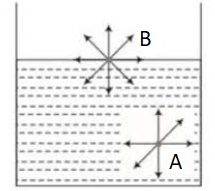
(b, d) Consider the diagram where two molecules of a liquid are shown. One is well inside the liquid and the other is on the surface. The molecule A which is well inside experiences equal forces from all directions, hence net force on it will be zero. And molecules on the liquid surface have some extra energy as it surrounded surround by only the lower half side of the liquid molecules.

Explanation:
For molecule A inside the liquid, the liquid molecules will exert force on molecule A from all sides. Hence the net force on molecule A will be zero.
But for the molecule at the surface, the net force will be downwards because for surface molecules the cohesive force between liquid and liquid molecules is more than the adhesive force between air and liquid molecules.
Also, the potential energy of the molecules on the surface is larger than the potential energy of the molecules inside the liquid.
- Question 37 of 40
37. Question
Pressure is a scalar quantity because
CorrectIncorrectHint
(b, c)
Why (b) is Correct
This is the definition of pressure in a fluid. Pressure is the magnitude of the force \((F)\) acting on a unit area (\(A\)).
A scalar is a quantity that has magnitude but no specific direction.
Since we are taking the magnitude of the force, the directional information of the vector is stripped away, leaving a scalar value.Why (c) is Correct (The “Physical” Reason)
This is the reason pressure acts as a scalar in fluid mechanics.
In a fluid at rest, the fluid cannot sustain “shear” (sideways) stress. It can only push normal (perpendicular) to a surface.
At any point \(P\) inside the fluid, if you place a tiny surface area \(d A\) at any orientation, the force \(d F\) will always be \(P \times d A\) in the direction normal to that surface.
Because the pressure value \(P\) itself is the same regardless of which way the surface is facing, it is a scalar. It describes the “state” of the fluid at that point, not a directional push. - Question 38 of 40
38. Question
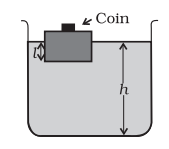
A wooden block with a coin placed on its top, floats in water as shown in Figure below. The distance \(l\) and \(h\) are shown in the figure. After some time the coin falls into the water. Then
 CorrectIncorrect
Hint
(a, b) Why \(l\) decreases (Option a)?
The distance \(l\) represents how deep the wooden block is pushed into the water.
Initial State: The buoyant force on the block must support both the weight of the block and the weight of the coin.
Final State: Once the coin falls into the water, the block only needs to support its own weight.
Since the total weight pushing the block down has decreased, the upward buoyant force required is also less. According to Archimedes’ Principle (\(F_b=\rho V g\)), a smaller buoyant force means a smaller volume of the block is submerged. Therefore, the block rises, and \(l\) decreases.
Why \(h\) decreases (Option b)?
The total height of the water \(h\) depends on the total volume of water displaced by both the block and the coin.
When the coin is on top: It is acting as a “floater.” To float, it must displace a volume of water equal to its weight. Since the coin is much denser than water, this volume is much larger than the coin’s actual physical volume.
When the coin is in the water: It is now a “sinker.” It no longer displaces water equal to its weight; it only displaces water equal to its own actual volume.
Because the coin displaces less water when it is submerged than it did when it was being supported by the block, the total volume of “displaced fluid” in the beaker drops.
Consequently, the water level \(h\) decreases. - Question 39 of 40
39. Question
With increase in temperature, the viscosity of
CorrectIncorrectHint
(c, d) In Liquids (Option d):
In liquids, viscosity is primarily caused by cohesive forces (the attractive forces between molecules).
When temperature increases, the kinetic energy of the molecules rises.
This helps the molecules overcome the attractive forces holding them together more easily.
As these cohesive forces weaken, the liquid flows more freely.
Result: Viscosity decreases as temperature increases (think of how honey becomes “runny” when heated).
In Gases (Option c):
In gases, molecules are far apart, so cohesive forces are negligible. Instead, viscosity is caused by the transfer of momentum between layers of gas as molecules move randomly back and forth.
When temperature increases, the molecules move much faster \((v \propto \sqrt{T})\).
This leads to a higher frequency of collisions and a more rapid exchange of momentum between layers of the gas.
This increased “molecular chaos” creates more resistance to the overall flow.
Result: Viscosity increases as temperature increases. - Question 40 of 40
40. Question
Streamline flow is more likely for liquids with
CorrectIncorrectHint
Why (b) and (c) are correct
Streamline flow occurs when the Reynolds Number is low (typically \(R_e<2000\)). Looking at the formula, to keep \(R_e\) small:
High Viscosity \((\eta)\) : Since viscosity is in the denominator, a higher viscosity results in a lower Reynolds Number. High viscosity acts like “internal friction,” dampening out the fluctuations that lead to turbulence.
Low Density (\(\rho\)): Since density is in the numerator, a lower density results in a lower Reynolds Number. Lower density means the fluid has less inertia, making it less likely to break into chaotic, turbulent eddies.Summary of Conditions for Streamline Flow:
Low velocity (\(v\))
Narrow tubes (\(D\))
Low density (\(\rho\))
High viscosity \((\eta)\)