3.9 Projectile motion
Projectile
When an object or body released into the space with some initial velocity, moves freely under the effect of gravity is known as projectile.
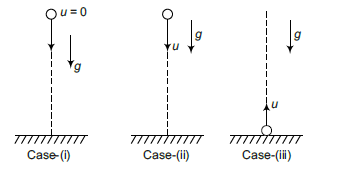
Motion of a particle under constant acceleration is either a straight line (one-dimensional) or parabolic (two-dimensional). Motion is one dimensional under following three conditions :
- Initial velocity of the particle is zero.
- Initial velocity of the particle is in the direction of constant acceleration (or parallel to it).
- Initial velocity of the particle is in the opposite direction of constant acceleration (or antiparallel to it).
For small heights acceleration due to gravity \((g)\) is almost constant. The three cases discussed about are as shown in the Figure below.
In all other cases when initial velocity is at some angle \(\left(\neq 0^{\circ}\right.\) or \(\left.180^{\circ}\right)\) with constant acceleration, motion is parabolic as shown below.
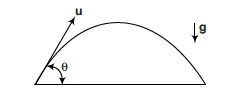
This motion under acceleration due to gravity is called projectile motion.
Projectile Motion
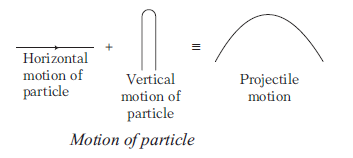
If a constant force (and hence, constant acceleration) acts on a particle at an angle \(\theta\left(\neq 0^{\circ}\right.\) or \(\left.180^{\circ}\right)\) with the direction of its initial velocity ( \(\neq\) zero), the path followed by the particle is parabolic and the motion of the particle is called projectile motion. It is a two dimensional motion, i.e. motion of the particle is constrained in a plane. In other words, if a particle moves in horizontal as well as vertical motion simultaneously, the motion of the particle is known as projectile motion.
Projectile motion is considered as two simultaneous motion in mutually perpendicular directions which are completely independent from each other i.e., horizontal motion and vertical motion
Note:
- If the angle between acceleration and velocity is \(\theta\) and where \(0^{\circ}<\theta<180^{\circ}\), then particle is executing projectile motion.
- In projectile motion, change in velocity of particle in magnitude and direction both act simultaneously.
When a particle is thrown obliquely near the earth’s surface, it moves in a parabolic path, provided that the particle remains close to the surface of earth and the air resistance is negligible. This is an example of projectile motion.
Parabolic Motion of Projectiles
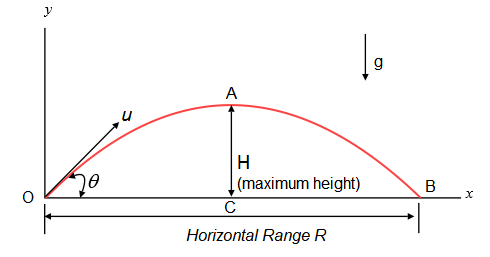
Let us consider a ball projected at an angle \(\theta\) with respect to the horizontal \(x\)-axis with the initial velocity \(u\) as shown below:
Let \(O X\) be a horizontal line on the ground, \(O Y\) be a vertical line perpendicular to the ground and \(O\) be the origin for \(X Y\)-axes on a plane. Suppose an object is projected from point \(O\) with velocity \((u)\), making an angle \((\theta)\) with the horizontal direction \(O X\), such that \(x_0=0\) and \(y_0=0\) when \(t=0\).
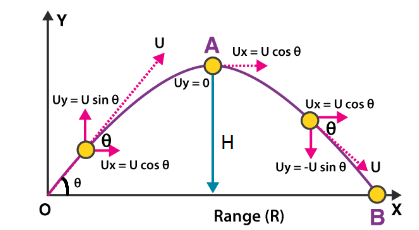
While resolving velocity \((u)\) into two components, we get
- \(u \cos \theta\) along \(O X\) and
- \(u \sin \theta\) along \(O Y\)
As there is no force acting in horizontal direction, so the horizontal component of velocity \((u \cos \theta\) ) remains constant throughout the entire motion, so there is no acceleration in the horizontal direction (if air resistance is assumed to be zero).
However, the vertical components of velocity \((u \sin \theta)\) decreases continuously with height from \(O\) to \(A\), due to downward force of gravity and becomes zero at highest point \(A\). At this point, the object attains maximum height, now it has only horizontal component of velocity. From point \(A\), the object starts to fall down and reaches at point \(B\) on the ground.
Equation of path of projectile
\(y\) is the vertical distance travelled by object in time \(t\).
Motion along horizontal direction
The velocity of the object in horizontal direction, i.e. along \(O X\) is constant, so the acceleration \(a_x\) in horizontal direction is zero.
\(\therefore\) Position of the object at time \(t\) along horizontal direction is given by, \(x=x_0+u_x t+\frac{1}{2} a_x t^2\)
But \(x_0=0, u_x=u \cos \theta, a_x=0\) and \(t=t\)
\(\therefore \quad x=u \cos \theta t\)
\(
\text { Time, } t=\frac{x}{u \cos \theta} \dots(i)
\)
Motion along vertical direction (Equation of trajectory of projectile)
The vertical component of velocity of the object is decreasing from \(O\) to \(A\) due to gravity, so acceleration \(a_y\) is \(-g\).
\(\therefore\) Position of the object at any time \(t\) along the vertical direction, i.e. along \(O Y\) is given by, \(y=y_0+u_y t+\frac{1}{2} a_y t^2\)
But \(\quad y_0=0, u_y=u \sin \theta, a_y=-g\) and \(t=t\)
So, \(y=u \sin \theta t+\frac{1}{2}(-g) t^2=u \sin \theta t-\frac{1}{2} g t^2 \dots(ii)\)
Substituting the value of \(t\) from Eq. (i) in Eq. (ii), we get
\(
\begin{aligned}
y & =u \sin \theta\left(\frac{x}{u \cos \theta}\right)-\frac{1}{2} g\left(\frac{x}{u \cos \theta}\right)^2 \\
& =x \tan \theta-\frac{g}{2}\left(\frac{x}{u \cos \theta}\right)^2
\end{aligned}
\)
Vertical displacement, \(y=x \tan \theta-\left(\frac{1}{2} \frac{g}{u^2 \cos ^2 \theta}\right) x^2=x \tan \theta-\frac{g x^2}{2 u^2} \sec ^2 \theta\)
\(
y=x \tan \theta-\frac{g x^2}{2 u^2}\left(1+\tan ^2 \theta\right)
\)
This equation is in the form of \(y=a x-b x^2\), which represents a parabola and it is known as equation of trajectory of a projectile.
These are the standard equations of trajectory of a projectile. The equation is quadratic in \(x\). This is why the path of a projectile is a parabola. The above equation can also be written in terms of range \((R)\) of projectile as:
\(
y=x\left(1-\frac{x}{R}\right) \tan \theta
\)
The coordinates and velocity components of the projectile at time \(t\) are
\(
\begin{array}{c}
x=s_x=u_x t=(u \cos \theta) t \\
y=s_y=u_y t+\frac{1}{2} a_y t^2 \\
=(u \sin \theta) t-\frac{1}{2} g t^2 \\
v_x=u_x=u \cos \theta \\
v_y=u_y+a_y t=u \sin \theta-g t
\end{array}
\)
Therefore, speed of projectile at time \(t\) is \(v=\sqrt{v_x^2+v_y^2}\) and the angle made by its velocity vector with positive \(x\)-axis is
\(
\theta=\tan ^{-1}\left(\frac{v_y}{v_x}\right)
\)
Example 1: \(\mathrm{A}\) body is projected with a velocity of \(20 \mathrm{~ms}^{-1}\) in a direction making an angle of \(60^{\circ}\) with the horizontal. Determine its (i) position after \(0.5 \mathrm{~s}\) and (ii) the velocity after \(0.5 \mathrm{~s}\).
Solution: Given, \(u=20 \mathrm{~ms}^{-1}, \theta=60^{\circ}, t=0.5 \mathrm{~s}\)
(i) Since, horizontal distance,
\(
x=(u \cos \theta) t=\left(20 \cos 60^{\circ}\right) \times 0.5=5 \mathrm{~m}
\)
Similarly, vertical distance,
\(
\begin{aligned}
y & =(u \sin \theta) t-\frac{1}{2} g t^2 \\
& =\left(20 \sin 60^{\circ}\right) \times 0.5-\frac{1}{2} \times 9.8 \times(0.5)^2 \Rightarrow y=7.43 \mathrm{~m}
\end{aligned}
\)
(ii) Velocity along horizontal direction,
\(
v_x=u \cos \theta=20 \cos 60^{\circ}=10 \mathrm{~ms}^{-1}
\)
Velocity along vertical direction,
\(
v_y=u \sin \theta-g t=20 \sin 60^{\circ}-9.8 \times 0.5=12.42 \mathrm{~ms}^{-1}
\)
Example 2: A stone is thrown with a speed of \(10 \mathrm{~ms}^{-1}\) at an angle of projection \(60^{\circ}\). Find its height above the point of projection when it is at a horizontal distance of \(3 \mathrm{~m}\) from the thrower? \(\left(\right.\) Take, \(\left.g=10 \mathrm{~ms}^{-2}\right)\).
Solution: Considering the equation of trajectory,
\(
y=\left(\tan \theta_0\right) x-\frac{g}{2\left(v_0^2 \cos ^2 \theta_0\right)} x^2
\)
Here, \(\theta_0=60^{\circ}, v_0=10 \mathrm{~ms}^{-1}, x=3 \mathrm{~m}\)
\(
\begin{aligned}
\therefore \quad y & =\left(\tan 60^{\circ}\right) \times 3-\frac{10}{2\left(100 \cos ^2 60^{\circ}\right)}(3)^2 \\
& =3 \sqrt{3}-\frac{9}{5}=\frac{15 \sqrt{3}-9}{5} \mathrm{~m}=3.396 \mathrm{~m}
\end{aligned}
\)
Time of Flight, Maximum Height and Horizontal Range of a Projectile
Figure below Shows a particle projected from the point \(O\) with an initial velocity \(u\) at an angle \(\theta\) with the horizontal. It goes through the highest point \(A\) and falls at \(B\) on the horizontal surface through \(O\). The point \(O\) is called the point of projection, the angle \(\theta\) is called the angle of projection, the distance \(O B\) is called the horizontal range \((\boldsymbol{R})\) or simply range and the vertical height \(A C\) is called the maximum height (H). The total time taken by the particle in describing the path \(O A B\) is called the time of flight \((T)\).
Time of flight of projectile [ T ]
It is defined as the total time for which projectile is in flight, i.e. time during the motion of projectile from \(O\) to \(B\). It is denoted by \(T\).
Time of flight consists of two parts such as
(i) Time taken by an object to go from point \(O\) to \(A\). It is also known as time of ascent \(\left(t_a\right)\).
(ii) Time taken by an object to go from point \(A\) to \(B\). It is also known as time of descent \(\left(t_d\right)\).
Total time can be expressed as
\(
T=t_a+t_d=2 t \quad \Rightarrow \quad t=T / 2 \quad\left(\because t_a=t_d=t\right)
\)
The vertical component of velocity of the projectile becomes zero at the highest point \(H\).
Let us consider vertical upward motion of the object from \(O\) to \(A\), we get
\(
u_y=u \sin \theta, a_y=-g, t=T / 2 \text { and } v_y=0
\)
Since, \(v_y=u_y+a_y t \Rightarrow 0=u \sin \theta-g \frac{T}{2}\)
\(\therefore \quad\) Time of flight, \(T=\frac{2 u \sin \theta}{g}\)
Example 3: A cricket ball is thrown at a speed of \(28 \mathrm{~ms}^{-1}\) in a direction \(30^{\circ}\) above the horizontal. Calculate the time taken by the ball to return to the same level.
Solution: Given, speed, \(u=28 \mathrm{~ms}^{-1}\) and \(\theta=30^{\circ}\)
\(\therefore\) The time taken by the ball to return the same level is
\(
T=\frac{2 u \sin \theta}{g}=\frac{2 \times 28 \times \sin 30^{\circ}}{9.8}=\frac{28}{9.8}=2.85 \simeq 2.9 \mathrm{~s}
\)
Maximum height of a projectile [ H ]
It is defined as the maximum vertical height attained by the projectile above the point of projection during its flight. It is denoted by \(H\).
Let us consider the vertical upward motion of the projectile from \(O\) to \(A\).
We have,
\(
\begin{array}{c}
u_y=u \sin \theta, a_y=-g, y_0=0, y=H, \\
t=\frac{T}{2}=\frac{u \sin \theta}{g}
\end{array}
\)
Using this relation, \(y=y_0+u_y t+\frac{1}{2} a_y t^2\)
We have, \(H=0+u \sin \theta\left(\frac{u \sin \theta}{g}\right)+\frac{1}{2}(-g)\left(\frac{u \sin \theta}{g}\right)^2\)
\(
=\frac{u^2}{g} \sin ^2 \theta-\frac{1}{2} \frac{u^2 \sin ^2 \theta}{g}
\)
Maximum height, \(H=\frac{u^2 \sin ^2 \theta}{2 g}\)
Example 4: Assume that a ball is kicked at an angle of \(60^{\circ}\) with the horizontal, so if the horizontal component of its velocity is \(19.6 \mathrm{~ms}^{-1}\), determine its maximum height.
Solution: Given,
\(
\theta=60^{\circ}
\)
Horizontal component of velocity \(=u \cos 60^{\circ}=19.6 \mathrm{~ms}^{-1}\)
\(
\therefore \quad u=\frac{19.6}{\cos 60^{\circ}}=\frac{19.6}{0.5}=39.2 \mathrm{~ms}^{-1}
\)
Therefore, maximum height,
\(
H=\frac{u^2 \sin ^2 60^{\circ}}{2 g}=\frac{(39.2)^2}{2 \times 9.8} \times\left(\frac{\sqrt{3}}{2}\right)^2=58.8 \mathrm{~m}
\)
Horizontal range of a projectile [ R ]
The horizontal range of a projectile is defined as the horizontal distance covered by the projectile during its time of flight. It is denoted by \(R\).
If the object having uniform velocity \(u \cos \theta\) (i.e. horizontal component) and the time of flight is \(T\), then the horizontal range covered by the projectile.
i.e. \(O B=R=u \cos \theta \times T=u \cos \theta \times 2 u \frac{\sin \theta}{g}\)
Horizontal range, \(R=\frac{u^2 \sin 2 \theta}{g} \quad(\because \sin 2 \theta=2 \sin \theta \cos \theta)\)
The horizontal range will be maximum, if angle of projection is \(45^{\circ}\).
\(\therefore\) Maximum horizontal range, \(R_{\max }=\frac{u^2}{g}\)
For same value of initial velocity, horizontal range of projectile is same for complementary angles.
So,
\(
R_{30^{\circ}}=R_{60^{\circ}} \text { or } R_{20^{\circ}}=R_{70^{\circ}}
\)
Important points about Projectile:
- A particle thrown in the space which moves under the effect of gravity only is called a projectile.
- Projectile motion is the combination of two motions.
- Projectile Motion = Horizontal Motion + Vertical Motion
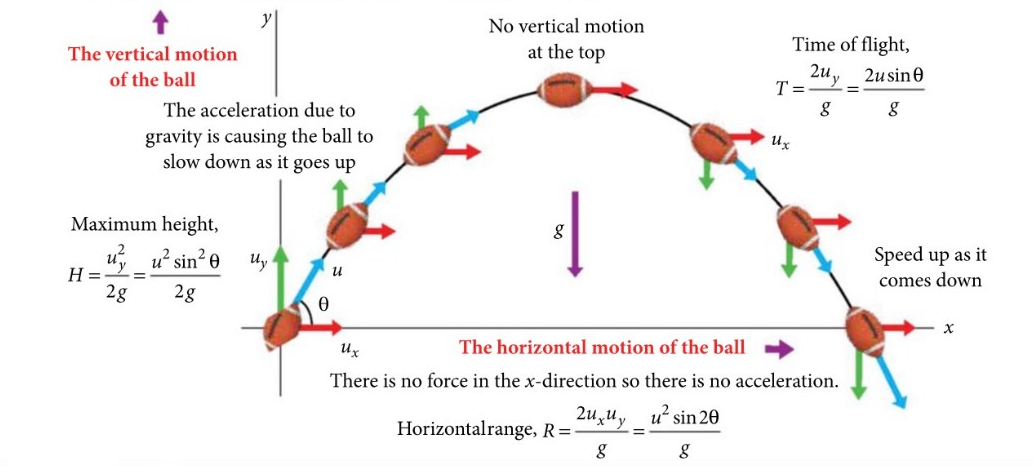
Some important points related to projectile motion
(i) Velocity of the projectile at any instant \(t\),
\(
\begin{aligned}
\mathbf{v} & =v_x \hat{\mathbf{i}}+v_y \hat{\mathbf{j}}=u \cos \theta \hat{\mathbf{i}}+(u \sin \theta-g t) \hat{\mathbf{j}} \\
|\mathbf{v}| & =\sqrt{u^2+g^2 t^2-2 u g t \sin \theta}
\end{aligned}
\)
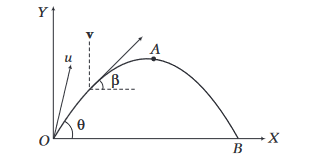
- This velocity makes an angle \(\beta\) with the horizontal given by
\(
\tan \beta=\frac{v_y}{v_x}=\frac{u \sin \theta-g t}{u \cos \theta} \dots(i)
\) - When the projectile reaches at point \(B\), substitute \(t=T\) in Eq. (i).
(ii) When a projectile is thrown upward, its kinetic energy decreases, potential energy increases but the total energy always remains constant.
(iii) Total energy of projectile \(=\) Kinetic energy + Potential energy
\(=\frac{1}{2} m v^2 \cos ^2 \theta+\frac{1}{2} m v^2 \sin ^2 \theta=\frac{1}{2} m v^2\)
(iv) In projectile motion, speed (and hence, kinetic energy) is minimum at highest point of its trajectory and given as
Speed \(=(\cos \theta)\) times the speed of projection and kinetic energy \(=\left(\cos ^2 \theta\right)\) times the initial kinetic energy.
Here, \(\theta=\) angle of projection.
(v) In projectile motion, it is sometimes better to write the equations of \(H, R\) and \(T\) in terms of \(u_x\) and \(u_y\) as
\(
\begin{aligned}
T & =\frac{2 u_y}{g}, H=\frac{u_y^2}{2 g} \\
\text { and } \quad R & =\frac{2 u_x u_y}{g}
\end{aligned}
\)
(vi) In projectile motion \(H=R\), when \(u_y=4 u_x\) or \(\tan \theta=4\)
(vii) Equation of trajectory can also be written as
\(
y=x\left(1-\frac{x}{R}\right) \tan \theta
\)
where, \(R\) is horizontal range.
(viii) All the above expressions for \(T, H\) and \(R\) are derived by neglecting air resistance. If air resistance is considered, then values may differ slightly.
(ix) Due to air resistance when a net speed of projectile decreases, then \(R\) decreases, \(T\) increases and \(H\) decreases. Reverse is the case when net speed increases.
Example 5: An object is projected with a velocity of \(30 \mathrm{~ms}^{-1}\) at an angle of \(60^{\circ}\) with the horizontal. Determine the horizontal range covered by the object.
Solution: Given, initial velocity, \(u=30 \mathrm{~ms}^{-1}\)
Angle of projection, \(\theta=60^{\circ}\)
Therefore, the horizontal range (or distance) covered by the object will be given as
\(
\begin{aligned}
R & =\frac{u^2 \sin 2 \theta}{g}=\frac{(30)^2 \sin 2\left(60^{\circ}\right)}{g} \\
& =\frac{(30)^2 2 \sin 60^{\circ} \cos 60^{\circ}}{9.8} \\
& =79.53 \mathrm{~m} \\
\Rightarrow \quad R & =79.53 \mathrm{~m}
\end{aligned}
\)
Example 6: A projectile has a range of \(40 \mathrm{~m}\) and reaches a maximum height of \(10 \mathrm{~m}\). Find the angle at which the projectile is fired.
Solution: Range of a projectile, \(R=\frac{u_0^2 \sin 2 \theta_0}{g}=40 \mathrm{~m} \dots(i)\)
\(
H=\frac{u_0^2 \sin ^2 \theta_0}{2 g}=10 \mathrm{~m} \dots(ii)
\)
On dividing Eq. (i) by Eq. (ii), we get
\(
\begin{aligned}
\frac{2\left(\sin 2 \theta_0\right)}{\sin ^2 \theta_0} & =4 \\
\frac{4 \sin \theta_0 \cos \theta_0}{\sin ^2 \theta_0} & =4
\end{aligned}
\)
\(
\begin{aligned}
\tan \theta_0 & =1 \\
\theta_0 & =45^{\circ}
\end{aligned}
\)
Example 7: Find the angle of projection of a projectile for which the horizontal range and maximum height are equal.
Solution: Given,
\(\therefore \quad \frac{u^2 \sin 2 \theta}{g}=\frac{u^2 \sin ^2 \theta}{2 g}\)
\(\quad 2 \sin \theta \cos \theta=\frac{\sin ^2 \theta}{2}\)
\(
\frac{\sin \theta}{\cos \theta}=4 \text { or } \tan \theta=4
\)
\(
\therefore \quad \theta=\tan ^{-1}(4)
\)
Example 8: There are two angles of projection for which the horizontal range is the same. Show that the sum of the maximum heights for these two angles is independent of the angle of projection.
Solution: Let the angles of projection be \(\alpha\) and \(90^{\circ}-\alpha\) for which the horizontal range \(R\) is same.
Now,
\(
H_1=\frac{u^2 \sin ^2 \theta}{2 g}
\)
and
\(
H_2=\frac{u^2 \sin ^2\left(90^{\circ}-\theta\right)}{2 g}=\frac{u^2 \cos ^2 \theta}{2 g}
\)
Therefore, \(H_1+H_2=\frac{u^2}{2 g}\left(\sin ^2 \theta+\cos ^2 \theta\right)=\frac{u^2}{2 g}\)
Clearly, the sum of the heights for the two angles of projection is independent of the values of projection angles.
Example 9: Prove that the maximum horizontal range is four times the maximum height attained by the projectile; when fired at an inclination so as to have maximum horizontal range.
Solution: For \(\theta=45^{\circ}\), the horizontal range is maximum and is given by
\(
R_{\max }=\frac{u^2}{g}
\)
Maximum height attained,
\(
H_{\max }=\frac{u^2 \sin ^2 45^{\circ}}{2 g}=\frac{u^2}{4 g}=\frac{R_{\max }}{4}
\)
\(
R_{\text {max }}=4 H_{\text {max }}
\)
Projectile fired at an angle with the vertical
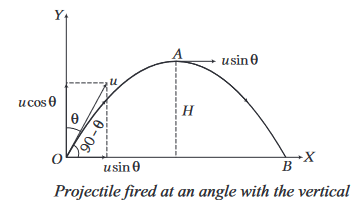
Let a particle be projected vertically with an angle \(\theta\) with vertical and it’s speed of projection is \(u\). Clearly, the angle made by the velocity of projectile at point of projection with horizontal is \(\left(90^{\circ}-\theta\right)\).
In this case
(i) Time of flight \(=\frac{2 u \sin \left(90^{\circ}-\theta\right)}{g}=\frac{2 u}{g} \cos \theta\)
(ii) Maximum height \(=\frac{u^2 \sin ^2\left(90^{\circ}-\theta\right)}{2 g}=\frac{u^2 \cos ^2 \theta}{2 g}\)
(iii) Horizontal range
\(
=\frac{u^2}{g} \sin 2\left(90^{\circ}-\theta\right)=\frac{u^2}{g} \sin \left(180^{\circ}-2 \theta\right)=\frac{u^2}{g} \sin 2 \theta
\)
(iv) Equation of path of projectile,
\(
\begin{aligned}
y & =x \tan \left(90^{\circ}-\theta\right)-\frac{1}{2} \frac{g x^2}{u^2 \cos ^2\left(90^{\circ}-\theta\right)} \\
& =x \cot \theta-\frac{g x^2}{2 u^2 \sin ^2 \theta}
\end{aligned}
\)
(v) Velocity at any time \(t\),
\(
\begin{aligned}
v & =\sqrt{u^2+g^2 t^2-2 u g t \sin \left(90^{\circ}-\theta\right)} \\
& =\sqrt{u^2+g^2 t^2-2 u g t \cos \theta}
\end{aligned}
\)
This velocity makes an angle \(\beta\) with the horizontal direction, then
\(
\tan \beta=\frac{u \sin \left(90^{\circ}-\theta\right)-g t}{u \cos \left(90^{\circ}-\theta\right)}=\frac{u \cos \theta-g t}{u \sin \theta}
\)
Example 10: A football is kicked at an angle of \(30^{\circ}\) with the vertical, so if the horizontal component of its velocity is \(20 \mathrm{~ms}^{-1}\), determine its maximum height.
Solution: Given, \(\theta=30^{\circ}\)
Horizontal component of velocity \(=u \sin 30^{\circ}=20 \mathrm{~ms}^{-1}\)
\(
\Rightarrow \quad u=\frac{20}{\sin 30^{\circ}}=\frac{20}{1 / 2}=40 \mathrm{~ms}^{-1}
\)
Therefore, maximum height,
\(
H=\frac{u^2 \cos ^2 30^{\circ}}{2 g}=\frac{(40)^2}{2 \times 9.8} \times\left(\frac{\sqrt{3}}{2}\right)^2=61.22 \mathrm{~m}
\)
Projectile from a Point Above the Ground
Projectile projected from a tower
When an object is at some height above the ground, then its projectile motion depends on the angle of projection.
Projectile projected horizontally from a tower
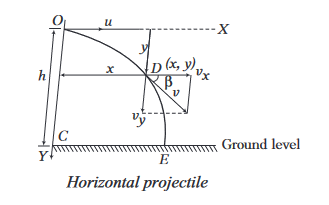
Assume that an object is thrown horizontally with some velocity \(u\) from point \(O\), on a tower of height \(h\) above the ground level and after time \(t\), it reaches ground at point E.
\begin{array}{cc}
\hline \text { Horizontal components } & \text { Vertical components } \\
\hline u_x=u & u_y=0 \\
\hline a_x=0\left(\because F_x=0\right) & a_y=-g \\
\hline
\end{array}
\)
Different terms related to this type of projectile motion are
(i) Equation of trajectory, \(y=\frac{1}{2}\left(\frac{g}{u^2}\right) x^2\)
(ii) Time of flight, \(T=\sqrt{\frac{2 h}{g}}\)
(iii) Horizontal range, \(R=u \sqrt{\frac{2 h}{g}}\)
(iv) Velocity of projectile at any instant,
\(
v=\sqrt{u^2+g^2 t^2}
\)
Example 11: A bomb is released from an aeroplane flying at a speed of \(720 \mathrm{kmh}^{-1}\) in the horizontal direction \(8000 \mathrm{~m}\) above the ground. At what horizontal distance from the initial position of aeroplane, it strikes the ground?
Solution:
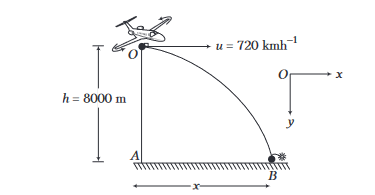
According to the figure, during motion of the bomb from \(O\) to \(B\),
\(
\begin{array}{rlrl}
& u =720 \times \frac{5}{18}=200 \mathrm{~ms}^{-1} \Rightarrow y=h=\frac{1}{2} g t^2 \\
\Rightarrow & 8000 =\frac{1}{2} \times 10 t^2 \Rightarrow t=40 \mathrm{~s} \\
\therefore & x =u t=200 \times 40=8000 \mathrm{~m}
\end{array}
\)
Example 12: A body is thrown horizontally from the top of a tower and strikes the ground after three seconds at an angle of \(45^{\circ}\) with the horizontal. Then, find
(i) the height of the tower.
(ii) the speed of projection of the body.
Solution: (i) Let \(H\) be the height of the tower.
The time of flight, \(T_f=\sqrt{\frac{2 H}{g}}=3 \mathrm{~s}\)
\(
\Rightarrow \quad H=\frac{g \times(3)^2}{2}=\frac{9.8 \times 9}{2}=44.1 \mathrm{~m}
\)
(ii) Let the speed of projection be \(v_0\).
Then, for horizontal projection,
\(
\begin{aligned}
v_x & =v_0 \Rightarrow v_y=-g t \\
\text { At } \quad t & =T_f=3 \mathrm{~s}, v_y=-9.8 \times 3=-29.4 \mathrm{~ms}^{-1}
\end{aligned}
\)
The angle which the final velocity makes with the horizontal \(=\boldsymbol{\theta}=45^{\circ}\)
(Given)
\(
\Rightarrow \quad \tan 45^{\circ}=\frac{-v_y}{v_x} \Rightarrow-v_y=v_x
\)
So,
\(
v_x=29.4 \mathrm{~ms}^{-1}
\)
Example 13: A projectile is fired horizontally with a velocity of \(98 \mathrm{~ms}^{-1}\) from the top of a hill \(490 \mathrm{~m}\) high. Find
(i) the time taken by the projectile to reach the ground,
(ii) the distance of the point, where the particle hits the ground from foot of the hill and
(iii) the velocity with which the projectile hits the ground. \(\left(\right.\) Take, \(g=9.8 \mathrm{~ms}^{-2}\) )
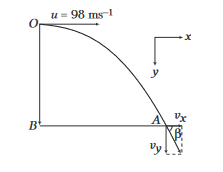
Solution: In this problem, we cannot apply the formulae of \(R, H\) and \(T\) directly. Here, it will be more convenient to choose \(x\) and \(y\) directions as shown in figure.
Here, \(u_x=98 \mathrm{~ms}^{-1}, a_x=0, u_y=0\) and \(a_y=g\).
(i) At \(A, s_y=490 \mathrm{~m}\). So, applying
\(
\begin{aligned}
& s_y=u_y t+\frac{1}{2} a_y t^2 \\
\Rightarrow \quad & 490=0+\frac{1}{2}(9.8) t^2 \quad \therefore t=10 \mathrm{~s}
\end{aligned}
\)
(ii) \(B A=s_x=u_x t+\frac{1}{2} a_x t^2\) or \(B A=(98)(10)+0\left(\because a_x=0\right)\) or \(B A=980 \mathrm{~m}\)
(ii) \(B A=s_x=u_x t+\frac{1}{2} a_x t^2\) or \(B A=(98)(10)+0\left(\because a_x=0\right)\) or \(B A=980 \mathrm{~m}\)
(iii) Horizontal velocity, \(v_x=u_x=98 \mathrm{~ms}^{-1}\)
Vertical velocity, \(v_y=u_y+a_y t=0+(9.8)(10)=98 \mathrm{~ms}^{-1}\)
\(\therefore\) Resultant velocity, \(v=\sqrt{v_x^2+v_y^2}=\sqrt{(98)^2+(98)^2}\)
\(
=98 \sqrt{2} \mathrm{~ms}^{-1}
\)
and \(\quad \tan \beta=\frac{v_y}{v_x}=\frac{98}{98}=1 \quad \therefore \beta=45^{\circ}\)
Thus, the projectile hits the ground with a velocity \(98 \sqrt{2} \mathrm{~ms}^{-1}\) at an angle of \(\beta=45^{\circ}\) with horizontal as shown in the given figure.
Projectile projected upward from a tower
Consider a projectile projected upward at an angle \((\boldsymbol{\theta})\) from point \(O\) which is situated on a tower at height \(h\) above the ground. Now, from the diagram, we have
\(
\begin{array}{l}
u_x=u \cos \theta, a_x=0 \\
u_y=u \sin \theta, a_y=-g
\end{array}
\)
(i) Equation of horizontal motion, \(x=u \cos \theta t \dots(i)\)
(ii) Equation of vertical motion,
\(
-h=u \sin \theta t-\frac{1}{2} g t^2 \dots(ii)
\)
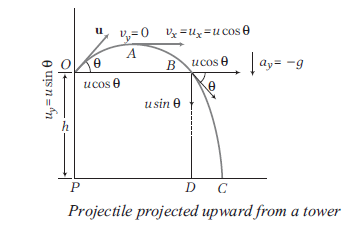
(iii) Time of flight, \(T=\frac{u \sin \theta}{g} \pm \sqrt{\frac{u^2 \sin ^2 \theta}{g^2}+\frac{2 h}{g}}\)
(iv) Horizontal distance covered (in time of flight T),
\(
P C=(u \cos \theta) T
\)
(v) Horizontal distance covered from the top of tower,
\(
O B=\frac{u^2 \sin 2 \theta}{g}
\)
In such case for range \(P C\) to become maximum, \(\theta\) should be \(45^{\circ}\).
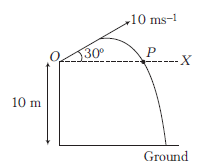
Example 14: A boy playing on the roof of a \(10 \mathrm{~m}\) high building throws a ball with a speed of \(10 \mathrm{~ms}^{-1}\) at an angle of \(30^{\circ}\) with the horizontal. How far from the throwing point will the ball be at the height of \(10 \mathrm{~m}\) from the ground?
Solution: The ball will be at point \(P\) when it is at a height of \(10 \mathrm{~m}\) from the ground. So, we have to find distance \(O P\), which can be calculated by direct considering it, as a projectile on a level \(O X\) at a height \(h\) from the horizontal level.
\(
\begin{array}{l}
O P=R=\frac{u^2 \sin 2 \theta}{g} \\
R=\frac{10^2 \times \sin \left(2 \times 30^{\circ}\right)}{10}=8.66 \mathrm{~m}
\end{array}
\)
Projectile projected downward from a tower
Consider a projectile projected downward at an angle \(\theta\) from point \(O\) which is on a tower of height \(h\) above the ground.
Now, from the diagram, we have
\(
\Rightarrow \quad \begin{array}{l}
u_x=u \cos \theta, a_x=0 \\
u_y=-u \sin \theta, a_y=-g
\end{array}
\)
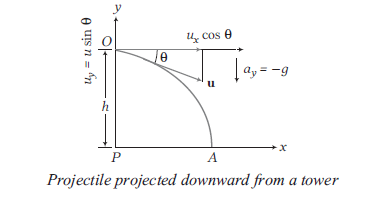
(i) Equation of motion, \(-h=(-u \sin \theta) t+\frac{1}{2}(-g) t^2\) or
\(
g t^2+(2 u \sin \theta) t-2 h=0
\)
(ii) Time of flight, \(T=\frac{-2 u \sin \theta}{2 g} \pm \frac{\sqrt{4 u^2 \sin ^2 \theta+8 g h}}{2 g}\)
(iii) Horizontal distance covered from the base of tower,
\(
P A=(u \cos \theta) T
\)
Example 15: A boy standing on the top of a tower \(36 \mathrm{~m}\) high has to throw a packet to his friend standing on the ground \(48 \mathrm{~m}\) horizontally away. If he throws a packet directly aiming the friend with a speed of \(10 \mathrm{~ms}^{-1}\), how short will the packet fall?
Solution: The packet will strike at point \(C\) instead of reaching to point \(B\) because the packet will move in a parabolic path instead of straight line.
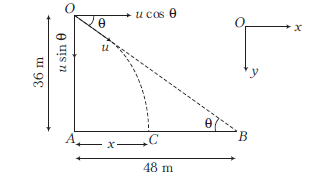
From geometry, \(\tan \theta=\frac{36}{48}=\frac{3}{4}\) \(\Rightarrow \quad \sin \theta=\frac{3}{5}, \cos \theta=\frac{4}{5}\)
For \(O\) to \(C, s_y=u \sin \theta t+\frac{1}{2} g t^2\)
\(
36=10 \times \frac{3}{5} t+\frac{1}{2} \times 10 t^2=6 t+5 t^2
\)
\(
\begin{aligned}
5 t^2+6 t & -36=0 \\
t & =2.15 \mathrm{~s}, \\
s_x & =u \cos \theta t=10 \times \frac{4}{5} \times 2.15 \\
& =17.2 \mathrm{~m}=A C \\
B C & =A B-A C=48-17.2=30.8 \mathrm{~m}
\end{aligned}
\)
The packet will fall at distance \(30.8 \mathrm{~m}\) in front of his friend.