JEE PYQs Integer Type
Summary
- Mechanical waves can exist in material media and are governed by Newton’s Laws.
- Transverse waves are waves in which the particles of the medium oscillate perpendicular to the direction of wave propagation.
- Longitudinal waves are waves in which the particles of the medium oscillate along the direction of wave propagation.
- Progressive wave is a wave that moves from one point of medium to another.
- The displacement in a sinusoidal wave propagating in the positive \(x\) direction is given by
\(
y(x, t)=a \sin (k x-\omega t+\phi)
\)
where \(a\) is the amplitude of the wave, \(k\) is the angular wave number, \(\omega\) is the angular frequency, (\(k x-\omega t+\phi\)) is the phase, and \(\phi\) is the phase constant or phase angle. - Wavelength \(\lambda\) of a progressive wave is the distance between two consecutive points of the same phase at a given time. In a stationary wave, it is twice the distance between two consecutive nodes or antinodes.
- Period \(T\) of oscillation of a wave is defined as the time any element of the medium takes to move through one complete oscillation. It is related to the angular frequency \(\omega\) through the relation
\(
T=\frac{2 \pi}{\omega}
\) - Frequency \(\nu\) of a wave is defined as \(1 / T\) and is related to angular frequency by
\(
\nu=\frac{\omega}{2 \pi}
\) - Speed of a progressive wave is given by \(v=\frac{\omega}{\mathrm{k}}=\frac{\lambda}{\mathrm{T}}=\lambda \nu\)
- The speed of a transverse wave on a stretched string is set by the properties of the string. The speed on a string with tension \(T\) and linear mass density \(\mu\) is
\(
v=\sqrt{\frac{T}{\mu}}
\) - Sound waves are longitudinal mechanical waves that can travel through solids, liquids, or gases. The speed \(v\) of sound wave in a fluid having bulk modulus \(B\) and density \(\rho\) is
\(
v=\sqrt{\frac{B}{\rho}}
\)
The speed of longitudinal waves in a metallic bar is
\(
v=\sqrt{\frac{Y}{\rho}}
\)
For gases, since \(B=\gamma P\), the speed of sound is
\(
v=\sqrt{\frac{\gamma P}{\rho}}
\) - When two or more waves traverse simultaneously in the same medium, the displacement of any element of the medium is the algebraic sum of the displacements due to each wave. This is known as the principle of superposition of waves
\(
y=\sum_{i=1}^n f_i(x-v t)
\) - Two sinusoidal waves on the same string exhibit interference, adding or cancelling according to the principle of superposition. If the two are travelling in the same direction and have the same amplitude \(a\) and frequency but differ in phase by a phase constant \(\phi\), the result is a single wave with the same frequency \(\omega\) :
\(
y(x, t)=\left[2 a \cos \frac{1}{2} \phi\right] \sin \left(k x-\omega t+\frac{1}{2} \phi\right)
\)
If \(\phi=0\) or an integral multiple of \(2 \pi\), the waves are exactly in phase and the interference is constructive; if \(\phi=\pi\), they are exactly out of phase and the interference is destructive. - A travelling wave, at a rigid boundary or a closed end, is reflected with a phase reversal but the reflection at an open boundary takes place without any phase change. For an incident wave
\(
y_i(x, t)=a \sin (k x-\omega t)
\)
the reflected wave at a rigid boundary is
\(
y_r(x, t)=-a \sin (k x+\omega t)
\)
For reflection at an open boundary
\(
y_r(x, t)=a \sin (k x+\omega t)
\) - The interference of two identical waves moving in opposite directions produces standing waves. For a string with fixed ends, the standing wave is given by
\(
y(x, t)=[2 a \sin k x] \cos \omega t
\)
Standing waves are characterised by fixed locations of zero displacement called nodes and fixed locations of maximum displacements called antinodes. The separation between two consecutive nodes or antinodes is \(\lambda / 2\).
A stretched string of length \(L\) fixed at both the ends vibrates with frequencies given by
\(
\nu=\frac{n v}{2 L}, \quad n=1,2,3, \ldots
\)
The set of frequencies given by the above relation are called the normal modes of oscillation of the system. The oscillation mode with lowest frequency is called the fundamental mode or the first harmonic. The second harmonic is the oscillation mode with \(n=2\) and so on.
A pipe of length \(L\) with one end closed and other end open (such as air columns) vibrates with frequencies given by
\(
\nu=(\mathrm{n}+1 / 2) \frac{v}{2 \mathrm{~L}}, \quad n=0,1,2,3, \ldots
\)
The set of frequencies represented by the above relation are the normal modes of oscillation of such a system. The lowest frequency given by \(v / 4 L\) is the fundamental mode or the first harmonic. - A string of length \(L\) fixed at both ends or an air column closed at one end and open at the other end or open at both the ends, vibrates with certain frequencies called their normal modes. Each of these frequencies is a resonant frequency of the system.
- Beats arise when two waves having slightly different frequencies, \(\nu_1\) and \(\nu_2\) and comparable amplitudes, are superposed. The beat frequency is
\(
\nu_{\text {beat }}=\nu_1 \sim \nu_2
\)
Quiz Summary
0 of 46 Questions completed
Questions:
Information
You have already completed the quiz before. Hence you can not start it again.
Quiz is loading…
You must sign in or sign up to start the quiz.
You must first complete the following:
Results
Results
0 of 46 Questions answered correctly
Your time:
Time has elapsed
You have reached 0 of 0 point(s), (0)
Earned Point(s): 0 of 0, (0)
0 Essay(s) Pending (Possible Point(s): 0)
Categories
- Not categorized 0%
- 1
- 2
- 3
- 4
- 5
- 6
- 7
- 8
- 9
- 10
- 11
- 12
- 13
- 14
- 15
- 16
- 17
- 18
- 19
- 20
- 21
- 22
- 23
- 24
- 25
- 26
- 27
- 28
- 29
- 30
- 31
- 32
- 33
- 34
- 35
- 36
- 37
- 38
- 39
- 40
- 41
- 42
- 43
- 44
- 45
- 46
- Current
- Review
- Answered
- Correct
- Incorrect
- Question 1 of 46
1. Question
Two tuning forks \(A\) and \(B\) are sounded together giving rise to 8 beats in 2 s. When fork \(A\) is loaded with wax, the beat frequency is reduced to 4 beats in 2 s. If the original frequency of tuning fork \(B\) is 380 Hz then original frequency of tuning fork \(A\) is ____ Hz. [JEE Main 2026 (Online) 28th January Evening Shift]
CorrectIncorrectHint
(d) Calculate Initial Beat Frequency:
Beats are produced by the difference in frequencies between two sound sources. The initial beat frequency (\(f_b\)) is:
\(
f_b=\frac{\text { Number of beats }}{\text { Time }}=\frac{8}{2}=4 \mathrm{~Hz}
\)
Since \(\left|f_A-f_B\right|=4 \mathrm{~Hz}\) and \(f_B=380 \mathrm{~Hz}\), there are two mathematical possibilities for the original frequency of \(\boldsymbol{A}\) :
Possibility 1: \(f_A=380+4=384 \mathrm{~Hz}\)
Possibility 2: \(f_A=380-4=376 \mathrm{~Hz}\)
Analyze the Effect of Loading Wax:
When a tuning fork is loaded with wax, its mass increases, which causes its vibration frequency to decrease.
Let’s look at the new beat frequency:
\(
f_{b \_n e w}=\frac{4}{2}=2 \mathrm{~Hz}
\)
Test the Possibilities:
Case 1: If \(f_A\) was \(384 \mathrm{~Hz}\left(f_A>f_B\right)\)
The difference is \(384-380=4 \mathrm{~Hz}\).
If we load \(A\) with wax, \(f_A\) decreases (e.g., it drops to 382 Hz).
The new difference would be \(382-380=2 \mathrm{~Hz}\).
This matches the problem statement (beat frequency reduced from 4 Hz to 2 Hz).
Case 2: If \(f_A\) was \(376 \mathrm{~Hz}\left(f_A<f_B\right)\)
The difference is \(380-376=4 \mathrm{~Hz}\).
If we load \(A\) with wax, \(f_A\) decreases (e.g., it drops to 374 Hz).
The new difference would be \(380-374=6 \mathrm{~Hz}\).
This contradicts the problem statement, as the beat frequency would increase.
Conclusion: Based on the reduction in beat frequency upon loading fork \(\boldsymbol{A}\), fork \(\boldsymbol{A}\) must have originally had a higher frequency than \(B\).
Original frequency of tuning fork A = 384 Hz. - Question 2 of 46
2. Question
The velocity of sound in air is doubled when the temperature is raised from \(0^{\circ} \mathrm{C}\) to \(\alpha^{\circ} \mathrm{C}\). The value of \(\alpha\) is ____. [JEE Main 2026 (Online) 23rd January Evening Shift]
CorrectIncorrectHint
(a) To find the value of \(\alpha\), we need to use the relationship between the velocity of sound and the temperature of the medium.
Step 1: The Physics Principle
The velocity of sound (\(v\)) in an ideal gas (like air) is directly proportional to the square root of its absolute temperature ( \(T\) in Kelvin). The formula is:
\(
v=\sqrt{\frac{\gamma R T}{M}}
\)
This gives us the proportionality:
\(
v \propto \sqrt{T} \quad \Longrightarrow \quad \frac{v_1}{v_2}=\sqrt{\frac{T_1}{T_2}}
\)
Step 2: Set Up the Calculation
Initial state \(\left(0^{\circ} \mathrm{C}\right)\) :
\(
\begin{aligned}
& T_1=0+273=273 \mathrm{~K} \\
& v_1=v
\end{aligned}
\)
Final state (\(\alpha^{\circ} \mathrm{C}\)):
\(
\begin{aligned}
& T_2=\alpha+273 \mathrm{~K} \\
& v_2=2 v(\text { velocity is doubled })
\end{aligned}
\)
Solve for \(\alpha\):
Using the ratio:
\(
\begin{aligned}
\frac{2 v}{v} & =\sqrt{\frac{\alpha+273}{273}} \\
2 & =\sqrt{\frac{\alpha+273}{273}}
\end{aligned}
\)
Square both sides to remove the square root:
\(
4=\frac{\alpha+273}{273}
\)
Rearrange to solve for \(\alpha\) :
\(
\begin{gathered}
\alpha+273=4 \times 273 \\
\alpha+273=1092
\end{gathered}
\)
\(
\begin{aligned}
&\alpha=1092-273\\
&\alpha=819
\end{aligned}
\) - Question 3 of 46
3. Question
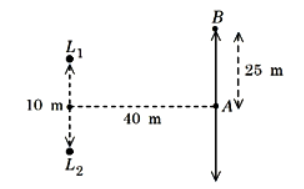
Two loudspeakers (\(L_1\) and \(L_2\)) are placed with a separation of 10 m , as shown in figure. Both speakers are fed with an audio input signal of same frequency with constant volume. A voice recorder, initially at point \(A\), at equidistance to both loud speakers, is moved by 25 m along the line \(A B\) while monitoring the audio signal. The measured signal was found to undergo 10 cycles of minima and maxima during the movement. The frequency of the input signal is ____ Hz (Speed of sound in air is \(324 \mathrm{~m} / \mathrm{s}\) and \(\sqrt{5}=2.23\)) [JEE Main 2026 (Online) 22nd January Morning Shift]
 CorrectIncorrect
Hint
(d)

When sound waves from two coherent sources (like the two loudspeakers) meet, they interfere with each other.
Constructive Interference (Maxima) occurs when the waves are in phase.
The path difference, \(\Delta \mathrm{x}\) is an integer multiple of the wavelength \((\lambda)\).
\(
\Delta \mathrm{x}=\mathrm{n} \lambda \ldots(\text { where } \mathrm{n}=0,1,2, \ldots)
\)
Destructive Interference (Minima) occurs when the waves are out of phase. This happens when the path difference is a half-integer multiple of the wavelength.
\(
\Delta \mathrm{x}=\left(\mathrm{n}+\frac{1}{2}\right) \lambda
\)
It is given that A is equidistant from both speakers \(\left(\mathrm{L}_{1 \mathrm{~A}}=\mathrm{L}_{2 \mathrm{~A}}\right)\). Therefore, the path difference at A is zero \(\left(\Delta \mathrm{x}_{\mathrm{A}}=0\right)\). This corresponds to the central maximum \((\mathrm{n}=0)\).
As the recorder moves towards \(B\), the distance to \(L_2\) increases more than the distance to \(L_1\), so the path difference (\(\Delta \mathrm{x}\)) steadily increases.
The signal undergoes 10 cycles of minima and maxima. One complete cycle means moving from one maximum to the next consecutive maximum, which corresponds to an increase in path difference by exactly one wavelength \((\lambda)\).
Since it goes through 10 full cycles starting from the central maximum, the path difference at point B must be exactly 10 wavelengths.
\(
\Delta \mathrm{x}_{\mathrm{B}}=10 \lambda
\)
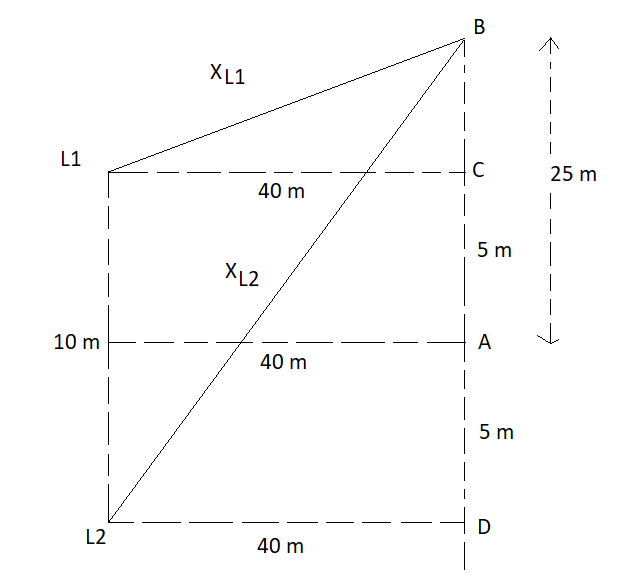
The path length from \(L_1\) to \(B\) is,
\(
\begin{aligned}
& \mathrm{x}_{\mathrm{L} 1}=\sqrt{40^2+(25-5)^2} \\
& \Rightarrow \mathrm{x}_{\mathrm{L} 1}=\sqrt{40^2+20^2}=\sqrt{2000} \\
& \Rightarrow \mathrm{x}_{\mathrm{L} 1}=20 \sqrt{5} \mathrm{~m}
\end{aligned}
\)
The path length from \(L_2\) to \(B\) is,
\(
\begin{aligned}
& \mathrm{x}_{\mathrm{L} 2}=\sqrt{(40)^2+(25+5)^2}=\sqrt{1600+900} \\
& \Rightarrow \mathrm{x}_{\mathrm{L} 2}=\sqrt{2500}=50 \mathrm{~m}
\end{aligned}
\)
So, the path difference is, (Since the recorder experienced 10 cycles of maxima and minima starting from the central maximum at point A (where \(\Delta x=0\)), the path difference at B must correspond to the 10 th order maximum:)
\(
\begin{aligned}
& \Delta \mathrm{x}_{\mathrm{B}}=\mathrm{x}_{\mathrm{L} 2}-\mathrm{x}_{\mathrm{L} 1} \\
& \Rightarrow \Delta \mathrm{x}_{\mathrm{B}}=50-20 \sqrt{5}
\end{aligned}
\)
We are given \(\sqrt{5}=2.23\).
\(
\begin{aligned}
& \Delta x_{\mathrm{B}}=50-20(2.23) \\
& \Rightarrow \Delta x_{\mathrm{B}}=50-44.6 \\
& \Rightarrow \Delta x_{\mathrm{B}}=5.4 \mathrm{~m} \\
& \Rightarrow 10 \lambda=\Delta x_{\mathrm{B}} \\
& \Rightarrow \lambda=0.54 \mathrm{~m}
\end{aligned}
\)
Using the relation between wave speed ([latexv[/latex]), frequency (\(f\)), and wavelength (\(\lambda\)):
\(
\mathrm{v}=\mathrm{f} \cdot \lambda
\)
We are given the speed of sound \(\mathrm{v}=324 \mathrm{~m} / \mathrm{s}\).
\(
\mathrm{f}=\frac{\mathrm{v}}{\lambda}=\frac{324}{0.54}=600 \mathrm{~Hz}
\)
Therefore, the frequency of the input signal is 600.Alternate: By calculating the two path lengths using the Pythagorean theorem, you found the change in path difference that occurred during that 25 m displacement.
Final Calculation Summary
Distance to \(L_2\) at point B: \(\sqrt{40^2+(25+5)^2}=\sqrt{1600+900}=50 \mathrm{~m}\)
Distance to \(L_1\) at point B: \(\sqrt{40^2+(25-5)^2}=\sqrt{1600+400}=\sqrt{2000} \approx 44.72 \mathrm{~m}\) (or 44.6 m using the given \(\sqrt{5}=2.23\))
Path Difference \((\Delta x): 50-44.6=5.4 \mathrm{~m}\)
Since the recorder experienced 10 cycles of maxima and minima starting from the central maximum at point A (where \(\Delta x=0\)), the path difference at B must correspond to the 10 th order maximum:
\(
\begin{aligned}
& 10 \lambda=5.4 \mathrm{~m} \\
& \lambda=0.54 \mathrm{~m}
\end{aligned}
\)
Finally, applying the wave speed formula:
\(
f=\frac{v}{\lambda}=\frac{324 \mathrm{~m} / \mathrm{s}}{0.54 \mathrm{~m}}=600 \mathrm{~Hz}
\)
The frequency of the input signal is 600 Hz. - Question 4 of 46
4. Question
A closed and an open organ pipe have same lengths. If the ratio of frequencies of their seventh overtones is \(\left(\frac{a-1}{a}\right)\) then the value of \(a\) is ____. [JEE Main 2024 (Online) 8th April Morning Shift]
CorrectIncorrectHint
(b) To solve for the value of \(a\), we need to define the frequencies of the seventh overtones for both a closed organ pipe and an open organ pipe of the same length \(L\).
Step 1: Frequencies in a Closed Organ Pipe
A pipe closed at one end produces only odd harmonics (1st, 3rd, 5th, . . .).
The frequency of the \(n^{\text {th }}\) harmonic is given by:
\(
f_c=\frac{(2 n-1) v}{4 L}
\)
In a closed pipe, the seventh overtone corresponds to the 15th harmonic (since the 1st overtone is the 3rd harmonic, the 2nd is the 5th, and so on, following the formula \(2 \times\) (overtone number) +1).
\(
f_{c 7}=\frac{(2 \times 7+1) v}{4 L}=\frac{15 v}{4 L}
\)
Step 2: Frequencies in an Open Organ Pipe
An open pipe produces all harmonics (1st, 2nd, 3rd, . . .).
The frequency of the \(n^{\text {th }}\) harmonic is given by:
\(
f_o=\frac{n v}{2 L}
\)
In an open pipe, the seventh overtone corresponds to the 8th harmonic (since the 1st overtone is the 2 nd harmonic, the formula is simply \(n=\) overtone number +1).
\(
f_{o 7}=\frac{(7+1) v}{2 L}=\frac{8 v}{2 L}=\frac{4 v}{L}
\)
Step 3: Calculate the Ratio
We are given that the ratio of the frequencies of their seventh overtones is \(\frac{a-1}{a}\) :
\(
\frac{f_{c 7}}{f_{o 7}}=\frac{a-1}{a}
\)
Substitute the expressions we found:
\(
\begin{aligned}
& \frac{\frac{15 v}{4 L}}{\frac{4 v}{L}}=\frac{a-1}{a} \\
& \frac{15}{16}=\frac{a-1}{a}
\end{aligned}
\)
Step 4: Solve for \(a\)
Cross-multiply to find the value of \(a\) :
\(
\begin{gathered}
15 a=16(a-1) \\
15 a=16 a-16 \\
16=16 a-15 a \\
a=16
\end{gathered}
\) - Question 5 of 46
5. Question
Two open organ pipes of lengths 60 cm and 90 cm resonate at \(6^{\text {th }}\) and \(5^{\text {th }}\) harmonics respectively. The difference of frequencies for the given modes is ____ Hz. (Velocity of sound in air \(=333 \mathrm{~m} / \mathrm{s}\)) [JEE Main 2024 (Online) 6th April Evening Shift]
CorrectIncorrectHint
(c) To find the difference in frequencies, we need to calculate the specific frequency for each pipe based on the given harmonics and lengths.
Step 1: General Formula for Open Organ Pipes
For an open organ pipe of length \(L\), the frequency of the \(n^{\text {th }}\) harmonic is given by:
\(
f_n=\frac{n v}{2 L}
\)
where:
\(n\) is the harmonic number.
\(v\) is the velocity of sound ( \(333 \mathrm{~m} / \mathrm{s}\)).
\(L\) is the length of the pipe (must be in meters).
Step 2: Frequency of the First Pipe (\(f_1\))
Length \(\left(L_1\right)\) : \(60 \mathrm{~cm}=0.6 \mathrm{~m}\)
Harmonic \(\left(n_1\right): 6^{\text {th }}\) harmonic
\(
\begin{gathered}
f_1=\frac{6 \times 333}{2 \times 0.6} \\
f_1=\frac{3 \times 333}{0.6}=\frac{999}{0.6} \\
f_1=1665 \mathrm{~Hz}
\end{gathered}
\)
Step 3: Frequency of the Second Pipe (\(f_2\))
Length \(\left(L_2\right): 90 \mathrm{~cm}=0.9 \mathrm{~m}\)
Harmonic \(\left(n_2\right): 5^{\text {th }}\) harmonic
\(
\begin{gathered}
f_2=\frac{5 \times 333}{2 \times 0.9} \\
f_2=\frac{1665}{1.8} \\
f_2=925 \mathrm{~Hz}
\end{gathered}
\)
Step 4: Calculation of the Difference
The difference in frequencies (\(\Delta f\)) is:
\(
\begin{gathered}
\Delta f=\left|f_1-f_2\right| \\
\Delta f=1665-925 \\
\Delta f=740 \mathrm{~Hz}
\end{gathered}
\)
The difference of frequencies for the given modes is \(\mathbf{7 4 0 ~ H z}\). - Question 6 of 46
6. Question
A sonometer wire of resonating length 90 cm has a fundamental frequency of 400 Hz when kept under some tension. The resonating length of the wire with fundamental frequency of 600 Hz under same tension ____ cm. [JEE Main 2024 (Online) 5th April Evening Shift]
CorrectIncorrectHint
(d) Step 1: Identify the Governing Principle
The fundamental frequency \((f)\) of a sonometer wire is determined by its length \((L)\), the tension \((T)\), and its linear mass density \((\mu)\). The relationship is given by:
\(
f=\frac{1}{2 L} \sqrt{\frac{T}{\mu}}
\)
Step 2: Establish the Proportionality
Since the tension \((T)\) and the wire itself \((\mu)\) remain unchanged in this problem, the frequency is inversely proportional to the resonating length:
\(
f \propto \frac{1}{L} \quad \text { or } \quad f_1 L_1=f_2 L_2
\)
Step 3: Substitute the Given Values
Plug the initial and final frequencies and the initial length into the ratio:
Initial frequency \(\left(f_1\right)=400 \mathrm{~Hz}\)
Initial length \(\left(L_1\right)=90 \mathrm{~cm}\)
Target frequency \(\left(f_2\right)=600 \mathrm{~Hz}\)
\(
400 \times 90=600 \times L_2
\)
Step 4: Solve for the New Length \(\left(L_2\right)\)
\(
\begin{gathered}
36,000=600 \times L_2 \\
L_2=\frac{36,000}{600} \\
L_2=60 \mathrm{~cm}
\end{gathered}
\)
The resonating length of the wire for a frequency of 600 Hz is 60 cm. - Question 7 of 46
7. Question
A tuning fork resonates with a sonometer wire of length 1 m stretched with a tension of 6 N. When the tension in the wire is changed to 54 N, the same tuning fork produces 12 beats per second with it. The frequency of the tuning fork is ____ Hz. [JEE Main 2024 (Online) 1st February Morning Shift]
CorrectIncorrectHint
(b) To find the frequency of the tuning fork, we will use the relationship between the tension in a sonometer wire and its vibration frequency.
Step 1: Identify the Governing Principle
The frequency (\(f\)) of a stretched string is directly proportional to the square root of the tension \((T)\), provided the length \((L)\) and linear mass density \((\mu)\) remain constant:
\(
f=\frac{1}{2 L} \sqrt{\frac{T}{\mu}} \Longrightarrow f \propto \sqrt{T}
\)
Step 2: Set up the Initial and Final Frequencies
Let the frequency of the tuning fork be \(f\). Initially, the wire is in resonance with the tuning fork, so the frequency of the wire \(\left(f_1\right)\) is equal to \(f\).
Initial Case ( \(T_1=6 \mathrm{~N}\)):
\(
f=k \sqrt{6} \quad-(\text { Equation } 1)
\)
(where \(k\) is a constant representing \(\frac{1}{2 L \sqrt{\mu}}\))
Final Case (\(T_2=54 \mathrm{~N}\)):
Let the new frequency of the wire be \(f_2\).
\(
f_2=k \sqrt{54}
\)
Since \(\sqrt{54}=\sqrt{9 \times 6}=3 \sqrt{6}\), we can see that:
\(
f_2=3 \times(k \sqrt{6})=3 f
\)
Step 3: Use the Beat Frequency Condition
When the tension is increased to 54 N, the wire produces 12 beats per second with the tuning fork. The beat frequency is the absolute difference between the two frequencies:
\(
\left|f_2-f\right|=12
\)
Substitute \(f_2=3 f\) into the equation:
\(
\begin{gathered}
|3 f-f|=12 \\
2 f=12
\end{gathered}
\)
Step 4: Solve for \(f\)
\(
f=\frac{12}{2}=6 \mathrm{~Hz}
\)
The frequency of the tuning fork is 6 Hz. - Question 8 of 46
8. Question
A point source is emitting sound waves of intensity \(16 \times 10^{-8} \mathrm{Wm}^{-2}\) at the origin. The difference in intensity (magnitude only) at two points located at a distances of \(2 m\) and \(4 m\) from the origin respectively will be ____ \(\times 10^{-8} \mathrm{Wm}^{-2}\). [JEE Main 2024 (Online) 30th January Evening Shift]
CorrectIncorrectHint
(c) Step 1: Identify the Governing Principle
For a point source emitting sound waves uniformly in all directions, the intensity (\(I\)) at a distance \((r)\) from the source is inversely proportional to the square of the distance:
\(
I=\frac{P}{4 \pi r^2} \Longrightarrow I \propto \frac{1}{r^2}
\)
where \(P\) is the power of the source.
Step 2: Determine the Intensity at the Given Points
The problem states the intensity at the origin is given, but typically in these JEE problems, the value \(16 \times 10^{-8} \mathrm{Wm}^{-2}\) refers to the intensity at a specific reference distance (usually 1 m if not specified) or is used to define the source’s power. Let’s calculate the intensities at \(r_1=\) 2 m and \(r_2=4 \mathrm{~m}\) based on the source’s characteristics.
Using the ratio method:
\(
\frac{I_1}{I_2}=\left(\frac{r_2}{r_1}\right)^2
\)
If we assume the given intensity \(I_0=16 \times 10^{-8} \mathrm{Wm}^{-2}\) is the intensity at \(r=1 \mathrm{~m}\) :
At \(r_1=2 \mathrm{~m}\) :
\(
I_1=I_0\left(\frac{1}{2}\right)^2=\frac{16 \times 10^{-8}}{4}=4 \times 10^{-8} \mathrm{Wm}^{-2}
\)
At \(r_2=4 \mathrm{~m}\) :
\(
I_2=I_0\left(\frac{1}{4}\right)^2=\frac{16 \times 10^{-8}}{16}=1 \times 10^{-8} \mathrm{Wm}^{-2}
\)
Step 3: Calculate the Difference
The magnitude of the difference in intensity (\(\Delta I\)) is:
\(
\begin{gathered}
\Delta I=\left|I_1-I_2\right| \\
\Delta I=\left(4 \times 10^{-8}\right)-\left(1 \times 10^{-8}\right) \\
\Delta I=3 \times 10^{-8} \mathrm{Wm}^{-2}
\end{gathered}
\) - Question 9 of 46
9. Question
In a closed organ pipe, the frequency of fundamental note is 30 Hz. A certain amount of water is now poured in the organ pipe so that the fundamental frequency is increased to 110 Hz. If the organ pipe has a cross-sectional area of \(2 \mathrm{~cm}^2\), the amount of water poured in the organ tube is ____ \(g\). (Take speed of sound in air is \(330 \mathrm{~m} / \mathrm{s}\)) [JEE Main 2024 (Online) 30th January Morning Shift]
CorrectIncorrectHint
(c)
\(
\begin{aligned}
&\begin{aligned}
& \frac{V}{4 \ell_1}=30 \Rightarrow \ell_1=\frac{11}{4} m \\
& \frac{V}{4 \ell_2}=110 \Rightarrow \ell_2=\frac{3}{4} m \\
& \Delta \ell=2 m
\end{aligned}\\
&\text { Change in volume }=A \Delta \ell=400 \mathrm{~cm}^3\\
&M=400 \mathrm{~g} ;\left(\because \rho=1 \mathrm{~g} / \mathrm{cm}^3\right)
\end{aligned}
\)Explanation:
To find the amount of water poured into the organ pipe, we need to calculate the change in the length of the air column. In a closed organ pipe, the fundamental frequency \(f\) is related to the length of the air column \(L\) by the formula:
\(
f=\frac{v}{4 L}
\)
Where:
\(v\) is the speed of sound \((330 \mathrm{~m} / \mathrm{s})\).
\(L\) is the length of the air column.
Step 1: Calculate the initial length (\(L_1\))
The initial fundamental frequency \(f_1\) is 30 Hz.
\(
\begin{gathered}
30=\frac{330}{4 L_1} \\
L_1=\frac{330}{4 \times 30}=\frac{11}{4}=2.75 \mathrm{~m}
\end{gathered}
\)
Step 2: Calculate the final length (\(L_2\))
After pouring water, the fundamental frequency \(f_2\) increases to 110 Hz.
\(
\begin{gathered}
110=\frac{330}{4 L_2} \\
L_2=\frac{330}{4 \times 110}=\frac{3}{4}=0.75 \mathrm{~m}
\end{gathered}
\)
Step 3: Determine the height of the water column (\(h\))
The water occupies the space previously held by air. The height of the water column is the difference between the two air column lengths:
\(
h=L_1-L_2=2.75 \mathrm{~m}-0.75 \mathrm{~m}=2.0 \mathrm{~m}
\)
Convert the height to centimeters for the volume calculation:
\(
h=200 \mathrm{~cm}
\)
Step 4: Calculate the mass of the water
The volume \(V\) of the water is the product of the cross-sectional area \(A\) and the height \(h\) :
\(
V=A \times h=2 \mathrm{~cm}^2 \times 200 \mathrm{~cm}=400 \mathrm{~cm}^3
\)
Since the density of water is approximately \(1 \mathrm{~g} / \mathrm{cm}^3\), the mass \(m\) is:
\(
m=\text { Density } \text { × } \text { Volume }=1 \mathrm{~g} / \mathrm{cm}^3 \times 400 \mathrm{~cm}^3=400 \mathrm{~g}
\)
The amount of water poured in the organ tube is \(\mathbf{4 0 0 ~ g}\). - Question 10 of 46
10. Question
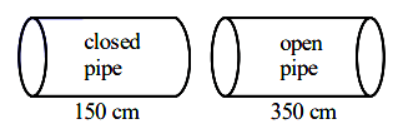
A closed organ pipe 150 cm long gives 7 beats per second with an open organ pipe of length 350 cm, both vibrating in fundamental mode. The velocity of sound is _____ \(\mathrm{m} / \mathrm{s}\). [JEE Main 2024 (Online) 27th January Evening Shift]
CorrectIncorrectHint
(d)

Step 1: Identify the fundamental frequency formulas
The fundamental frequency \(f\) depends on the type of pipe and its length \(L\) :
Closed Organ Pipe: \(f_c=\frac{v}{4 L_c}\) (where one end is closed)
Open Organ Pipe: \(f_o=\frac{v}{2 L_o}\) (where both ends are open)
Step 2: Convert units to SI (meters)
To ensure the velocity of sound is in \(\mathrm{m} / \mathrm{s}\), we convert the lengths from cm to m :
Length of closed pipe \(\left(L_c\right): 150 \mathrm{~cm}=1.5 \mathrm{~m}\)
Length of open pipe \(\left(L_o\right): 350 \mathrm{~cm}=3.5 \mathrm{~m}\)
Step 3: Express frequencies in terms of velocity (\(v\))
Substitute the lengths into the formulas:
\(f_c=\frac{v}{4(1.5)}=\frac{v}{6}\)
\(f_o=\frac{v}{2(3.5)}=\frac{v}{7}\)
Step 4: Set up the beat frequency equation
Beats are the difference between two frequencies \(\left(\left|f_1-f_2\right|\right)\). Since \(\frac{v}{6}\) is a larger value than \(\frac{v}{7}\), we subtract \(f_o\) from \(f_c\) :
\(
\frac{v}{6}-\frac{v}{7}=7
\)
Step 5: Solve for the velocity (\(v\))
Find a common denominator (42) to combine the fractions:
\(
\begin{gathered}
\frac{7 v-6 v}{42}=7 \\
\frac{v}{42}=7 \\
v=7 \times 42=294 \mathrm{~m} / \mathrm{s}
\end{gathered}
\)
Final Answer: The velocity of sound is \(294 \mathrm{~m} / \mathrm{s}\). - Question 11 of 46
11. Question
The fundamental frequency of vibration of a string stretched between two rigid support is 50 Hz. The mass of the string is 18 g and its linear mass density is \(20 \mathrm{~g} / \mathrm{m}\). The speed of the transverse waves so produced in the string is _____ \(\mathrm{ms}^{-1}\) [JEE Main 2023 (Online) 15th April Morning Shift]
CorrectIncorrectHint
(a) To solve this, we need to find the length of the string and then use the relationship between fundamental frequency, length, and wave speed.
Step 1: Calculate the length of the string (\(L\))
We are given the total mass (\(M\)) and the linear mass density (\(\mu\)). The linear mass density is defined as mass per unit length (\(\mu=M / L\)).
Mass of the string \((M)=18 \mathrm{~g}\)
Linear mass density \((\mu)=20 \mathrm{~g} / \mathrm{m}\)
\(
L=\frac{M}{\mu}=\frac{18 \mathrm{~g}}{20 \mathrm{~g} / \mathrm{m}}=0.9 \mathrm{~m}
\)
Step 2: Identify the fundamental frequency formula
For a string stretched between two rigid supports (fixed at both ends), the fundamental frequency \(f\) is given by:
\(
f=\frac{v}{2 L}
\)
Where:
\(v\) is the speed of the transverse wave.
\(L\) is the length of the string.
Step 3: Solve for the wave speed (\(v\))
We are given the fundamental frequency (\(f=50 \mathrm{~Hz}\)) and we just calculated the length (\(L=\) 0.9 m). Rearranging the formula to solve for \(v\) :
\(
\begin{gathered}
v=f \times 2 L \\
v=50 \times 2(0.9) \\
v=50 \times 1.8 \\
v=90 \mathrm{~m} / \mathrm{s}
\end{gathered}
\)
Final Answer: The speed of the transverse waves produced in the string is \(90 \mathrm{~ms}^{-1}\). - Question 12 of 46
12. Question
In an experiment with sonometer when a mass of 180 \(g\) is attached to the string, it vibrates with fundamental frequency of 30 Hz. When a mass \(m\) is attached, the string vibrates with fundamental frequency of 50 Hz. The value of \(m\) is ____ \(g\). [JEE Main 2023 (Online) 13th April Evening Shift]
CorrectIncorrectHint
(b) Step 1: Identify the fundamental frequency formula
For a sonometer wire of length \(L\) and linear mass density \(\mu\), the fundamental frequency \(f\) is given by:
\(
f=\frac{1}{2 L} \sqrt{\frac{T}{\mu}}
\)
In a sonometer, the tension \(T\) is provided by the suspended mass \(M\), so \(T=M g\). Since the length \(L\) and the wire’s linear mass density \(\mu\) remain constant throughout the experiment, we can see that:
\(
f \propto \sqrt{M}
\)
Step 2: Set up the ratio for the two cases
Let \(f_1\) be the frequency with mass \(M_1\), and \(f_2\) be the frequency with mass \(m\).
\(f_1=30 \mathrm{~Hz}, M_1=180 \mathrm{~g}\)
\(f_2=50 \mathrm{~Hz}, M_2=m\)
Using the proportionality \(f \propto \sqrt{M}\), we can write:
\(
\frac{f_2}{f_1}=\sqrt{\frac{m}{M_1}}
\)
Step 3: Solve for the unknown mass \(m\)
Substitute the given values into the ratio:
\(
\begin{aligned}
& \frac{50}{30}=\sqrt{\frac{m}{180}} \\
& \frac{5}{3}=\sqrt{\frac{m}{180}}
\end{aligned}
\)
Square both sides of the equation to remove the square root:
\(
\begin{gathered}
\left(\frac{5}{3}\right)^2=\frac{m}{180} \\
\frac{25}{9}=\frac{m}{180}
\end{gathered}
\)
Now, isolate \(m\) :
\(
\begin{gathered}
m=\frac{25}{9} \times 180 \\
m=25 \times 20 \\
m=500 \mathrm{~g}
\end{gathered}
\)
Final Answer: The value of \(m\) is \(\mathbf{5 0 0 ~ g}\). - Question 13 of 46
13. Question
For a certain organ pipe, the first three resonance frequencies are in the ratio of \(1: 3: 5\) respectively. If the frequency of fifth harmonic is 405 Hz and the speed of sound in air is \(324 \mathrm{~ms}^{-1}\) the length of the organ pipe is _____ m. [JEE Main 2023 (Online) 12th April Morning Shift]
CorrectIncorrectHint
(a) To find the length of the organ pipe, we first need to identify the type of pipe based on the given frequency ratio and then apply the correct formula.
Step 1: Identify the type of organ pipe
The problem states that the first three resonance frequencies are in the ratio \(1: 3: 5\).
In an open organ pipe, the frequencies follow the ratio \(1: 2: 3: 4\)… (all harmonics).
In a closed organ pipe, the frequencies follow the ratio \(1: 3: 5: 7\)… (only odd harmonics).
Since the ratio is \(1: 3: 5\), we are dealing with a closed organ pipe.
Step 2: Relate the fifth harmonic to the fundamental frequency
For a closed organ pipe, the \(n^{\text {th }}\) harmonic frequency is given by:
\(
f_n=n \cdot f_1
\)
where \(n\) must be an odd integer (\(1,3,5, \ldots\)).
The problem specifies the fifth harmonic (\(n=5\)):
\(
f_5=5 \cdot f_1=405 \mathrm{~Hz}
\)
Solving for the fundamental frequency \(\left(f_1\right)\) :
\(
f_1=\frac{405}{5}=81 \mathrm{~Hz}
\)
Step 3: Apply the fundamental frequency formula
The fundamental frequency for a closed organ pipe is:
\(
f_1=\frac{v}{4 L}
\)
Where:
\(v=324 \mathrm{~m} / \mathrm{s}\) (speed of sound)
\(L\) is the length of the pipe
\(f_1=81 \mathrm{~Hz}\)
Step 4: Solve for the length (\(L\))
Rearrange the formula to solve for \(L\) :
\(
\begin{aligned}
L & =\frac{v}{4 f_1} \\
L & =\frac{324}{4 \times 81} \\
L & =\frac{324}{324} \\
L & =1 \mathrm{~m}
\end{aligned}
\)
Final Answer: The length of the organ pipe is \(\mathbf{1} \mathbf{~ m}\). - Question 14 of 46
14. Question
The equation of wave is given by
\(
Y=10^{-2} \sin 2 \pi(160 t-0.5 x+\pi / 4)
\)
where \(x\) and \(Y\) are in m and t in \(s\). The speed of the wave is _____ \(\mathrm{km} \mathrm{h}^{-1}\). [JEE Main 2023 (Online) 11th April Morning Shift]CorrectIncorrectHint
(b) To find the speed of the wave, we first need to extract the angular frequency and the wave number from the given wave equation.
Step 1: Standardize the wave equation
The general form of a traveling wave equation is:
\(
Y=A \sin (\omega t-k x+\phi)
\)
The given equation is:
\(
Y=10^{-2} \sin 2 \pi(160 t-0.5 x+\pi / 4)
\)
To match the standard form, we multiply the \(2 \pi\) into the parentheses:
\(
\begin{gathered}
Y=10^{-2} \sin (2 \pi \cdot 160 t-2 \pi \cdot 0.5 x+2 \pi \cdot \pi / 4) \\
Y=10^{-2} \sin \left(320 \pi t-\pi x+\pi^2 / 2\right)
\end{gathered}
\)
Step 2: Identify \(\omega\) and \(k\)
By comparing the standardized equation to the general form:
Angular frequency \((\omega): 320 \pi \mathrm{rad} / \mathrm{s}\)
Wave number \((k): \pi \mathrm{m}^{-1}\)
Step 3: Calculate the speed in \(\mathrm{m} / \mathrm{s}\)
The wave speed \(v\) is given by the ratio of the angular frequency to the wave number:
\(
\begin{gathered}
v=\frac{\omega}{k} \\
v=\frac{320 \pi}{\pi}=320 \mathrm{~m} / \mathrm{s}
\end{gathered}
\)
Step 4: Convert units to \(\mathrm{km} / \mathrm{h}\)
The question asks for the speed in \(\mathrm{km} \mathrm{h}^{-1}\). To convert from \(\mathrm{m} / \mathrm{s}\) to \(\mathrm{km} / \mathrm{h}\), we multiply by \(\frac{18}{5}\) :
\(
\begin{gathered}
v_{\mathrm{km} / \mathrm{h}}=320 \times \frac{18}{5} \\
v_{\mathrm{km} / \mathrm{h}}=64 \times 18 \\
v_{\mathrm{km} / \mathrm{h}}=1152 \mathrm{~km} / \mathrm{h}
\end{gathered}
\)
Final Answer: The speed of the wave is \(1152 \mathrm{~km} \mathrm{~h}^{-1}\). - Question 15 of 46
15. Question
A transverse harmonic wave on a string is given by
\(
y(x, t)=5 \sin (6 t+0.003 x)
\)
where \(x\) and \(y\) are in cm and \(t\) in sec. The wave velocity is _____ \(\mathrm{ms}^{-1}\). [JEE Main 2023 (Online) 10th April Morning Shift]CorrectIncorrectHint
(d) To find the wave velocity, we compare the given wave equation to the standard form of a harmonic wave and extract the relevant parameters.
Step 1: Identify the standard wave equation
The general form of a traveling harmonic wave is:
\(
y(x, t)=A \sin (\omega t+k x+\phi)
\)
Where:
\(A\) is the amplitude.
\(\omega\) is the angular frequency.
\(k\) is the wave number \(\left(k=\frac{2 \pi}{\lambda}\right)\).
\(v=\frac{\omega}{k}\) is the wave velocity.
Step 2: Extract \(\omega\) and \(k\) from the given equation
The given equation is:
\(
y(x, t)=5 \sin (6 t+0.003 x)
\)
By comparing it to the standard form:
Angular frequency \((\omega): 6 \mathrm{rad} / \mathrm{s}\)
Wave number (k): \(0.003 \mathrm{~cm}^{-1}\) (Note: \(x\) is in cm)
Step 3: Calculate the wave velocity \(\mathrm{in} \mathrm{cm} / \mathrm{s}\)
Using the formula for wave speed \(v\) :
\(
\begin{gathered}
v=\frac{\omega}{k} \\
v=\frac{6}{0.003} \mathrm{~cm} / \mathrm{s} \\
v=\frac{6000}{3} \mathrm{~cm} / \mathrm{s} \\
v=2000 \mathrm{~cm} / \mathrm{s}
\end{gathered}
\)
Step 4: Convert the velocity to \(\mathrm{m} / \mathrm{s}\)
Since the question asks for the answer in \(\mathrm{m} / \mathrm{s}\), we convert from centimeters to meters:
\(
\begin{gathered}
v_{\mathrm{m} / \mathrm{s}}=\frac{2000}{100} \mathrm{~m} / \mathrm{s} \\
v_{\mathrm{m} / \mathrm{s}}=20 \mathrm{~m} / \mathrm{s}
\end{gathered}
\)
Final Answer: The wave velocity is \(20 \mathrm{~ms}^{-1}\). - Question 16 of 46
16. Question
A guitar string of length 90 cm vibrates with a fundamental frequency of 120 Hz . The length of the string producing a fundamental frequency of 180 Hz will be ____ cm. [JEE Main 2023 (Online) 8th April Evening Shift]
CorrectIncorrectHint
(c) To find the new length of the guitar string, we use the relationship between the fundamental frequency and the length of a stretched string.
Step 1: Identify the fundamental frequency formula
For a string fixed at both ends (like a guitar string), the fundamental frequency \(f\) is given by:
\(
f=\frac{v}{2 L}
\)
In this scenario, the tension in the string and the linear mass density remain constant, meaning the wave speed \(v\) is constant. Therefore, the frequency is inversely proportional to the length:
\(
f \propto \frac{1}{L} \quad \text { or } \quad f_1 L_1=f_2 L_2
\)
Step 2: Set up the ratio with given values
We are given:
Initial frequency \(\left(f_1\right)=120 \mathrm{~Hz}\)
Initial length \(\left(L_1\right)=90 \mathrm{~cm}\)
Final frequency \(\left(f_2\right)=180 \mathrm{~Hz}\)
Final length \(\left(L_2\right)=\) ?
Using the inverse relationship:
\(
120 \times 90=180 \times L_2
\)
Step 3: Solve for the new length \(\left(L_2\right)\)
Isolate \(L_2\) :
\(
L_2=\frac{120 \times 90}{180}
\)
Simplify the calculation:
\(
\begin{aligned}
L_2 & =\frac{120}{2} \\
L_2 & =60 \mathrm{~cm}
\end{aligned}
\)
Final Answer: The length of the string producing a fundamental frequency of 180 Hz will be \(60 \mathrm{~cm}\) - Question 17 of 46
17. Question
An organ pipe 40 cm long is open at both ends. The speed of sound in air is \(360 \mathrm{~ms}^{-1}\). The frequency of the second harmonic is ____ Hz. [JEE Main 2023 (Online) 8th April Morning Shift]
CorrectIncorrectHint
(a) To find the frequency of the second harmonic for an open organ pipe, we apply the general formula for harmonics in a pipe open at both ends.
Step 1: Identify the harmonic frequency formula
For an organ pipe open at both ends, the frequency of the \(n^{\text {th }}\) harmonic \(\left(f_n\right)\) is given by:
\(
f_n=n \frac{v}{2 L}
\)
Where:
\(n\) is the harmonic number \((1,2,3, \ldots)\).
\(v\) is the speed of sound.
\(L\) is the length of the pipe.
Step 2: Convert units to SI (meters)
The length of the pipe is given in centimeters, so we convert it to meters to match the speed of sound unit (\(\mathrm{m} / \mathrm{s}\)):
\(L=40 \mathrm{~cm}=0.4 \mathrm{~m}\)
Step 2: Convert units to SI (meters)
The length of the pipe is given in centimeters, so we convert it to meters to match the speed of sound unit (m/s):
\(L=40 \mathrm{~cm}=0.4 \mathrm{~m}\)
Step 3: Calculate the frequency of the second harmonic
For the second harmonic, we set \(n=2\) :
\(
f_2=2 \times \frac{v}{2 L}
\)
Notice that the 2 in the numerator and denominator cancels out, simplifying the formula to:
\(
f_2=\frac{v}{L}
\)
Substitute the given values (\(v=360 \mathrm{~m} / \mathrm{s}\) and \(L=0.4 \mathrm{~m}\)):
\(
\begin{aligned}
& f_2=\frac{360}{0.4} \\
& f_2=\frac{3600}{4} \\
& f_2=900 \mathrm{~Hz}
\end{aligned}
\)
Final Answer: The frequency of the second harmonic is 900 Hz. - Question 18 of 46
18. Question
A person driving car at a constant speed of \(15 \mathrm{~m} / \mathrm{s}\) is approaching a vertical wall. The person notices a change of 40 Hz in the frequency of his car’s horn upon reflection from the wall. The frequency of horn is ____ Hz. [JEE Main 2023 (Online) 6th April Morning Shift]
(Given: Speed of sound : \(330 \mathrm{~m} / \mathrm{s}\))CorrectIncorrectHint
(b) This is a classic Doppler Effect problem involving a moving source and a moving observer (the driver) receiving a reflected sound. We can break this down into two distinct stages.
Step 1: Frequency received by the wall
The wall acts as a stationary observer. Since the car (source) is approaching the wall, the frequency reaching the wall (\(f_w\)) is:
\(
f_w=f\left(\frac{v}{v-v_s}\right)
\)
Where:
\(f=\) frequency of the horn (source).
\(v=\) speed of sound \((330 \mathrm{~m} / \mathrm{s})\).
\(v_s=\) speed of the car (\(\mathbf{1 5 ~ m} / \mathrm{s}\)).
Step 2: Frequency of the reflection heard by the driver
The wall now acts as a stationary source emitting frequency \(\boldsymbol{f}_w\). The driver is now a moving observer approaching this source. The frequency heard by the driver \(\left(f^{\prime}\right)\) is:
\(
f^{\prime}=f_w\left(\frac{v+v_o}{v}\right)
\)
Where \(v_o\) is the speed of the driver (also \(15 \mathrm{~m} / \mathrm{s}\)). Substituting the expression for \(f_w\) from Step 1:
\(
f^{\prime}=f\left(\frac{v}{v-v_s}\right)\left(\frac{v+v_o}{v}\right)=f\left(\frac{v+v_c}{v-v_c}\right)
\)
(Since \(v_s=v_o=v_c=15 \mathrm{~m} / \mathrm{s}\))
Step 3: Set up the equation for the frequency change
The “change in frequency” is the difference between the reflected frequency heard (\(f^{\prime}\)) and the original frequency of the horn (\(f\)).
\(
\Delta f=f^{\prime}-f=40 \mathrm{~Hz}
\)
Substitute the formula for \(f^{\prime}\) :
\(
\begin{gathered}
f\left(\frac{v+v_c}{v-v_c}\right)-f=40 \\
f\left(\frac{v+v_c-\left(v-v_c\right)}{v-v_c}\right)=40 \\
f\left(\frac{2 v_c}{v-v_c}\right)=40
\end{gathered}
\)
Step 4: Solve for the frequency (\(f\))
Plug in the values \(v=330\) and \(v_c=15\) :
\(
\begin{aligned}
f\left(\frac{2 \times 15}{330-15}\right) & =40 \\
f\left(\frac{30}{315}\right) & =40
\end{aligned}
\)
Simplify the fraction:
\(
\begin{gathered}
f\left(\frac{2}{21}\right)=40 \\
2 f=40 \times 21 \\
2 f=840 \\
f=420 \mathrm{~Hz}
\end{gathered}
\)
Final Answer: The frequency of the horn is 420 Hz. - Question 19 of 46
19. Question
The displacement equations of two interfering waves are given by
\(
y_1=10 \sin \left(\omega t+\frac{\pi}{3}\right) \mathrm{cm}, y_2=5[\sin \omega t+\sqrt{3} \cos \omega t] \mathrm{cm} \text { respectively. }
\)
The amplitude of the resultant wave is ____ cm. [JEE Main 2023 (Online) 31st January Evening Shift]CorrectIncorrectHint
(d) Given, \(y_1=10 \sin \left(\omega t+\frac{\pi}{3}\right) \mathrm{cm}\) and
\(
\begin{aligned}
& y_2=5(\sin \omega t+\sqrt{3} \cos \omega t) \\
& =10 \sin \left(\omega t+\frac{\pi}{3}\right)
\end{aligned}
\)
Thus the phase difference between the waves is 0.
\(
\text { so } A=A_1+A_2=20 \mathrm{~cm}
\)Explanation: Why this works?
When two waves are in phase (phase difference \(\Delta \phi=0\)), they undergo perfect constructive interference. The resultant amplitude \(A\) is simply the algebraic sum of the individual amplitudes:
\(
\begin{gathered}
A=A_1+A_2 \\
A=10 \mathrm{~cm}+10 \mathrm{~cm}=20 \mathrm{~cm}
\end{gathered}
\)
If you were to use the general interference formula, it confirms your result:
\(
\begin{gathered}
A=\sqrt{A_1^2+A_2^2+2 A_1 A_2 \cos (0)} \\
A=\sqrt{10^2+10^2+2(10)(10)(1)}=\sqrt{400}=20 \mathrm{~cm}
\end{gathered}
\) - Question 20 of 46
20. Question
Two simple harmonic waves having equal amplitudes of 8 cm and equal frequency of 10 Hz are moving along the same direction. The resultant amplitude is also 8 cm. The phase difference between the individual waves is ____ degree. [JEE Main 2023 (Online) 29th January Morning Shift]
CorrectIncorrectHint
(c) To find the phase difference, we use the standard formula for the resultant amplitude of two interfering waves.
Step 1: Identify the Resultant Amplitude Formula
When two waves with amplitudes \(A_1\) and \(A_2\) and a phase difference \(\phi\) interfere, the resultant amplitude \(A_R\) is given by:
\(
A_R=\sqrt{A_1^2+A_2^2+2 A_1 A_2 \cos \phi}
\)
Step 2: Substitute the given values
The problem states that:
\(A_1=8 \mathrm{~cm}\)
\(A_2=8 \mathrm{~cm}\)
\(A_R=8 \mathrm{~cm}\)
Substitute these into the equation:
\(
8=\sqrt{8^2+8^2+2(8)(8) \cos \phi}
\)
\(
\cos \phi=-\frac{64}{128}=-\frac{1}{2}
\)
Step 4: Determine the phase difference in degrees
We need to find the angle \(\phi\) where the cosine is \(-1 / 2\) :
\(
\begin{gathered}
\phi=\cos ^{-1}\left(-\frac{1}{2}\right) \\
\phi=120^{\circ}
\end{gathered}
\)
Final Answer: The phase difference between the individual waves is \(\mathbf{1 2 0}\) degrees. - Question 21 of 46
21. Question
A train blowing a whistle of frequency 320 Hz approaches an observer standing on the platform at a speed of \(66 \mathrm{~m} / \mathrm{s}\). The frequency observed by the observer will be (given speed of sound \(=330 \mathrm{~ms}^{-1}\)) _____ Hz. [JEE Main 2023 (Online) 25th January Evening Shift]
CorrectIncorrectHint
(d)
\(
\begin{aligned}
& f=f_0\left(\frac{v}{v-v_s}\right) \\
& f=320\left(\frac{330}{330-66}\right) \\
& =320 \times \frac{330}{264} \\
& =400 \mathrm{~Hz}
\end{aligned}
\)Explanation:
To solve for the frequency heard by the observer, we use the Doppler Effect formula for a moving source and a stationary observer.
Step 1: Identify the Doppler Effect formula
When a source of sound moves toward a stationary observer, the observed frequency \(f^{\prime}\) is given by:
\(
f^{\prime}=f\left(\frac{v}{v-v_s}\right)
\)
Where:
\(f=\) original frequency of the whistle \((320 \mathrm{~Hz})\)
\(v=\) speed of sound \((330 \mathrm{~m} / \mathrm{s})\)
\(v_s=\) speed of the source/train \((66 \mathrm{~m} / \mathrm{s})\)
Step 2: Substitute the given values
Plug the values into the formula:
\(
f^{\prime}=320\left(\frac{330}{330-66}\right)
\)
Step 3: Perform the calculation
First, calculate the denominator:
\(
330-66=264
\)
Now, substitute this back into the equation:
\(
f^{\prime}=320\left(\frac{330}{264}\right)
\)
We can simplify the fraction by dividing both 330 and 264 by their common factors (both are divisible by 66):
\(330=66 \times 5\)
\(264=66 \times 4\)
So, the equation becomes:
\(
f^{\prime}=320\left(\frac{5}{4}\right)
\)
Now, multiply:
\(
f^{\prime}=80 \times 5=400 \mathrm{~Hz}
\)
Final Answer: The frequency observed by the observer will be \(\mathbf{4 0 0 ~ H z}\). - Question 22 of 46
22. Question
The distance between two consecutive points with phase difference of \(60^{\circ}\) in a wave of frequency 500 Hz is 6.0 m. The velocity with which wave is travelling is _____ \(\mathrm{km} / \mathrm{s}\) [JEE Main 2023 (Online) 25th January Morning Shift]
CorrectIncorrectHint
(b)
\(
\begin{aligned}
& \Delta x=\frac{\lambda}{2 \pi} \times\left(\frac{\pi}{3}\right)=\left(\frac{\lambda}{6}\right) \\
& \Rightarrow \quad \frac{\lambda}{6}=6 \mathrm{~m} \\
& \quad \lambda=36 \mathrm{~m} \\
& U=f \lambda=500 \mathrm{~Hz} \times 36 \\
& =18000 \mathrm{~m} / \mathrm{s} \\
& =18 \mathrm{~km} / \mathrm{s}
\end{aligned}
\)Explanation: To find the wave velocity, we need to determine the wavelength (\(\lambda\)) using the relationship between phase difference and path difference, then combine it with the given frequency.
Step 1: Relate Phase Difference to Path Difference
The phase difference \((\Delta \phi)\) between two points separated by a distance \((\Delta x)\) is given by the formula:
\(
\Delta \phi=\frac{2 \pi}{\lambda} \cdot \Delta x
\)
Given:
Phase difference \((\Delta \phi)=60^{\circ}\). In radians, this is \(\frac{\pi}{3}\).
Path difference \((\Delta x)=6.0 \mathrm{~m}\).
Substitute these into the formula:
\(
\frac{\pi}{3}=\frac{2 \pi}{\lambda} \cdot 6.0
\)
Step 2: Calculate the Wavelength (\(\lambda\))
Rearrange the equation to solve for \(\lambda\) :
\(
\begin{gathered}
\frac{1}{3}=\frac{2}{\lambda} \cdot 6.0 \\
\lambda=2 \times 6.0 \times 3 \\
\lambda=36 \mathrm{~m}
\end{gathered}
\)
Step 3: Calculate the Wave Velocity in \(\mathrm{m} / \mathrm{s}\)
Wave velocity \((v)\) is the product of frequency \((f)\) and wavelength \((\lambda)\) :
\(
v=f \cdot \lambda
\)
Given frequency \((f)=500 \mathrm{~Hz}\) :
\(
\begin{gathered}
v=500 \times 36 \\
v=18,000 \mathrm{~m} / \mathrm{s}=18 \mathrm{~km} / \mathrm{s}
\end{gathered}
\)
The velocity with which the wave is travelling is \(18 \mathrm{~km} / \mathrm{s}\). - Question 23 of 46
23. Question
The frequency of echo will be ____ Hz if the train blowing a whistle of frequency 320 Hz is moving with a velocity of \(36 \mathrm{~km} / \mathrm{h}\) towards a hill from which an echo is heard by the train driver. Velocity of sound in air is \(330 \mathrm{~m} / \mathrm{s}\). [JEE Main 2022 (Online) 28th July Morning Shift]
CorrectIncorrectHint
(a)
\(
\begin{aligned}
& v_s=36 \times \frac{5}{18}=10 \mathrm{~m} / \mathrm{sec} \\
& f=\frac{v+v_s}{v-v_s} f_0 \\
& =\frac{340}{320} \times 320 \\
& =340 \mathrm{~Hz}
\end{aligned}
\)Explanation: This problem involves a moving source (the train) and a moving observer (the driver) receiving a reflection from a stationary object (the hill). We can solve this in two steps using the Doppler Effect.
Step 1: Convert Units to SI
The speed of the train \(\left(v_t\right)\) is given in \(\mathrm{km} / \mathrm{h}\). We must convert it to \(\mathrm{m} / \mathrm{s}\) :
\(
v_t=36 \times \frac{5}{18}=10 \mathrm{~m} / \mathrm{s}
\)
Step 2: Frequency Received by the Hill (\(f_h\))
The hill acts as a stationary observer. Since the train (source) is approaching the hill:
\(
f_h=f\left(\frac{v}{v-v_t}\right)
\)
Where:
\(f=320 \mathrm{~Hz}\) (original frequency)
\(v=330 \mathrm{~m} / \mathrm{s}\) (speed of sound)
\(v_t=10 \mathrm{~m} / \mathrm{s}\) (speed of train)
\(
f_h=320\left(\frac{330}{330-10}\right)=320\left(\frac{330}{320}\right)=330 \mathrm{~Hz}
\)
Step 3: Frequency of Echo Heard by the Driver ( \(f_{\text {echo }}\))
The hill now acts as a stationary source emitting the frequency \(f_h=330 \mathrm{~Hz}\). The driver is a moving observer approaching this source at \(10 \mathrm{~m} / \mathrm{s}\) :
\(
f_{\text {echo }}=f_h\left(\frac{v+v_t}{v}\right)
\)
Substitute the value of \(f_h\) :
\(
\begin{gathered}
f_{\text {echo }}=330\left(\frac{330+10}{330}\right) \\
f_{\text {echo }}=330\left(\frac{340}{330}\right)
\end{gathered}
\)
Step 4: Solve for \(f_{\text {echo }}\)
The 330 in the numerator and denominator cancels out:
\(
f_{\text {echo }}=340 \mathrm{~Hz}
\)
Final Answer: The frequency of the echo heard by the train driver is \(\mathbf{3 4 0 ~ H z}\). - Question 24 of 46
24. Question
A wire of length 30 cm , stretched between rigid supports, has it’s \(\mathrm{n}^{\text {th }}\) and \((\mathrm{n}+1)^{\text {th }}\) harmonics at 400 Hz and 450 Hz, respectively. If tension in the string is 2700 N, it’s linear mass density is ____ \(\mathrm{kg} / \mathrm{m}\). [JEE Main 2022 (Online) 27th July Evening Shift]
CorrectIncorrectHint
(c)
\(
\begin{aligned}
& \frac{v}{2 l}=50 \mathrm{~Hz} \\
& \Rightarrow T=\left[100 \times\left(\frac{30}{100}\right)\right]^2 \times \mu \\
& \Rightarrow \mu=\frac{2700}{900}=3
\end{aligned}
\)Explanation: To find the linear mass density, we first need to determine the fundamental frequency of the string and then use the wave speed formula.
Step 1: Find the fundamental frequency (\(f_1\))
For a string fixed at both ends, the harmonics are integer multiples of the fundamental frequency \(\left(f_1, 2 f_1, 3 f_1, \ldots\right)\). The difference between any two consecutive harmonics is equal to the fundamental frequency:
\(
f_1=f_{n+1}-f_n
\)
Given:
\((n+1)^{\text {th }}\) harmonic \(=450 \mathrm{~Hz}\)
\(n^{\text {th }}\) harmonic \(=400 \mathrm{~Hz}\)
\(
f_1=450-400=50 \mathrm{~Hz}
\)
Step 2: Relate frequency to wave speed and length
The formula for the fundamental frequency of a stretched string is:
\(
f_1=\frac{v}{2 L}
\)
Where:
\(L=30 \mathrm{~cm}=0.3 \mathrm{~m}\)
\(v\) is the velocity of the transverse wave.
Rearranging to solve for \(v\) :
\(
\begin{gathered}
v=f_1 \times 2 L \\
v=50 \times 2(0.3)=50 \times 0.6=30 \mathrm{~m} / \mathrm{s}
\end{gathered}
\)
Step 3: Use the tension formula to find linear mass density (\(\mu\))
The velocity of a wave on a string is also given by:
\(
v=\sqrt{\frac{T}{\mu}}
\)
Where:
\(T=2700 \mathrm{~N}\) (Tension)
\(\mu\) is the linear mass density.
Square both sides to solve for \(\mu\) :
\(
v^2=\frac{T}{\mu} \Rightarrow \mu=\frac{T}{v^2}
\)
Substitute the values:
\(
\begin{aligned}
& \mu=\frac{2700}{(30)^2} \\
& \mu=\frac{2700}{900} \\
& \mu=3 \mathrm{~kg} / \mathrm{m}
\end{aligned}
\)
Final Answer: The linear mass density of the string is \(3 \mathrm{~kg} / \mathrm{m}\). - Question 25 of 46
25. Question
When a car is approaching the observer, the frequency of horn is 100 Hz . After passing the observer, it is 50 Hz. If the observer moves with the car, the frequency will be \(\frac{x}{3} \mathrm{~Hz}\) where \(x=\) ____. [JEE Main 2022 (Online) 26th July Morning Shift]
CorrectIncorrectHint
(b)
\(
\begin{aligned}
& 100=v_0 \frac{v}{v-v_c} \\
& 50=v_0 \frac{v}{v+v_c} \\
& 2=\frac{v+v_c}{v-v_c} \\
& 2 v-2 v_c=v+v_c \\
& v_c=\frac{v}{3} \\
& 100=v_0 \frac{v \times 3}{2 v} \Rightarrow v_0=\frac{200}{3}=\frac{x}{3} \\
& \Rightarrow x=200
\end{aligned}
\)Explanation: To solve for \(x\), we analyze the two scenarios using the Doppler Effect formula for a moving source and a stationary observer.
Step 1: Frequency of the approaching car (\(f_1\))
When the car (source) moves toward the stationary observer with velocity \(v_s\), the observed frequency is higher:
\(
f_1=f\left(\frac{v}{v-v_s}\right)=100 \mathrm{~Hz}
\)
Where:
\(f\) is the actual frequency of the horn.
\(v\) is the speed of sound.
\(v_s\) is the speed of the car.
Step 2: Frequency of the receding car (\(f_2\))
After passing the observer, the car moves away, and the observed frequency drops:
\(
f_2=f\left(\frac{v}{v+v_s}\right)=50 \mathrm{~Hz}
\)
Step 3: Solve for the actual frequency (\(f\))
By taking the ratio of the two equations, we can eliminate \(f\) and find the relationship between \(v_s\) and \(v\) :
\(
\begin{gathered}
\frac{f_1}{f_2}=\frac{100}{50}=2 \\
\frac{v+v_s}{v-v_s}=2 \\
v+v_s=2 v-2 v_s \Longrightarrow 3 v_s=v \Longrightarrow v_s=\frac{v}{3}
\end{gathered}
\)
Now, substitute \(v_s=\frac{v}{3}\) back into the equation for \(f_1\) :
\(
\begin{gathered}
100=f\left(\frac{v}{v-\frac{v}{3}}\right) \\
100=f\left(\frac{v}{\frac{2 v}{3}}\right) \\
100=f\left(\frac{3}{2}\right) \Longrightarrow f=\frac{200}{3} \mathrm{~Hz}
\end{gathered}
\)
Step 4: Determine the value of \(x\)
If the observer moves with the car, there is no relative motion between the source and the observer. The observed frequency is simply the true frequency of the horn (\(f\)):
\(
f_{\text {obs }}=f=\frac{200}{3} \mathrm{~Hz}
\)
Comparing this to the given form \(\frac{x}{3} \mathrm{~Hz}\) :
\(
\frac{x}{3}=\frac{200}{3} \Longrightarrow x=200
\) - Question 26 of 46
26. Question
Two waves executing simple harmonic motions travelling in the same direction with same amplitude and frequency are superimposed. The resultant amplitude is equal to the \(\sqrt{3}\) times of amplitude of individual motions. The phase difference between the two motions is ____(degree). [JEE Main 2022 (Online) 25th July Evening Shift]
CorrectIncorrectHint
(b)
\(
\begin{aligned}
& A_{n e t}=\sqrt{A_1^2+A_2^2+2 A_1 A_2 \cos \phi} \\
& \sqrt{3} A=\sqrt{A^2+A^2+2 A^2 \cos \phi} \\
& 3 A^2=2 A^2+2 A^2 \cos \phi \\
& \cos \phi=\frac{1}{2} \\
& \phi=60^{\circ}
\end{aligned}
\)Explanation: To find the phase difference, we use the standard formula for the resultant amplitude of two interfering waves.
Step 1: Identify the Resultant Amplitude Formula
When two waves with equal amplitudes \(A\) and a phase difference \(\phi\) interfere, the resultant amplitude \(A_R\) is given by:
\(
A_R=\sqrt{A^2+A^2+2 A^2 \cos \phi}
\)
Using the trigonometric identity \(1+\cos \phi=2 \cos ^2(\phi / 2)\), this simplifies to:
\(
A_R=2 A \cos \left(\frac{\phi}{2}\right)
\)
Step 2: Substitute the Given Values
The problem states that the resultant amplitude is \(\sqrt{3}\) times the individual amplitude:
\(\boldsymbol{A}_R=\sqrt{3} A\)
Substitute this into the simplified formula:
\(
\sqrt{3} A=2 A \cos \left(\frac{\phi}{2}\right)
\)
Step 3: Solve for the Phase Difference \((\phi)\)
Cancel \(\boldsymbol{A}\) from both sides:
\(
\begin{aligned}
& \sqrt{3}=2 \cos \left(\frac{\phi}{2}\right) \\
& \cos \left(\frac{\phi}{2}\right)=\frac{\sqrt{3}}{2}
\end{aligned}
\)
Now, determine the angle whose cosine is \(\frac{\sqrt{3}}{2}\) :
\(
\begin{aligned}
\frac{\phi}{2} & =30^{\circ} \\
\phi & =60^{\circ}
\end{aligned}
\)
Final Answer: The phase difference between the two motions is 60 degrees. - Question 27 of 46
27. Question
An observer is riding on a bicycle and moving towards a hill at \(18 \mathrm{kmh}^{-1}\). He hears a sound from a source at some distance behind him directly as well as after its reflection from the hill. If the original frequency of the sound as emitted by source is 640 Hz and velocity of the sound in air is \(320 \mathrm{~m} / \mathrm{s}\), the beat frequency between the two sounds heard by observer will be ____ Hz. [JEE Main 2022 (Online) 25th July Morning Shift]
CorrectIncorrectHint

\(
\begin{aligned}
& V_s=0, V_{o b}=5 \mathrm{~m} / \mathrm{s} \\
& f_{\text {direct }}=\left(\frac{320-5}{320}\right) 640=630 \mathrm{~Hz} \\
& f_{\text {reflected }}=\left(\frac{320+5}{320}\right) 640=650 \mathrm{~Hz} \\
& f_{\text {beat }}=650-630=20 \mathrm{~Hz}
\end{aligned}
\)Explanation: To solve for the beat frequency, we need to find the two different frequencies heard by the observer: the one coming directly from the source behind him (\(f_1\)) and the one reflected from the hill in front of him (\(f_2\)).
Step 1: Convert Units to SI
The velocity of the observer (bicycle) \(v_o\) is given in \(\mathrm{km} / \mathrm{h}\). Let’s convert it to \(\mathrm{m} / \mathrm{s}\) :
\(
v_o=18 \times \frac{5}{18}=5 \mathrm{~m} / \mathrm{s}
\)
Step 2: Calculate the Direct Frequency (\(f_1\))
The source is behind the observer. Since both are moving in the same direction (the observer is moving away from the source), and the source is stationary (\(v_s=0\)):
\(v=320 \mathrm{~m} / \mathrm{s}\) (speed of sound)
\(v_o=5 \mathrm{~m} / \mathrm{s}\) (observer moving away from source)
\(
\begin{aligned}
& f_1=f\left(\frac{v-v_o}{v}\right)=640\left(\frac{320-5}{320}\right) \\
& f_1=640\left(\frac{315}{320}\right)=2 \times 315=630 \mathrm{~Hz}
\end{aligned}
\)
Step 3: Calculate the Reflected Frequency (\(f_2\))
For the reflected sound, the hill acts as a stationary re-transmitter.
1. Frequency reaching the hill: Since the source and hill are both stationary, the frequency hitting the hill is the original 640 Hz .
2. Frequency heard by the observer: The observer is now moving towards the hill (the stationary source of the reflection).
\(
\begin{aligned}
& f_2=f\left(\frac{v+v_o}{v}\right)=640\left(\frac{320+5}{320}\right) \\
& f_2=640\left(\frac{325}{320}\right)=2 \times 325=650 \mathrm{~Hz}
\end{aligned}
\)
Step 4: Calculate the Beat Frequency
The beat frequency is the absolute difference between the two frequencies heard:
\(
\begin{gathered}
f_{\text {beat }}=\left|f_2-f_1\right| \\
f_{\text {beat }}=650 \mathrm{~Hz}-630 \mathrm{~Hz}=20 \mathrm{~Hz}
\end{gathered}
\)
Final Answer: The beat frequency heard by the observer is \(\mathbf{2 0 ~ H z}\). - Question 28 of 46
28. Question
An employee of a factory moving away from his workplace by a car listens to the siren of the factory. He drives the car at the speed of \(72 \mathrm{kmh}^{-1}\) in the direction of wind which is blowing at \(72 \mathrm{kmh}^{-1}\) speed. Frequency of siren is 720 Hz. The employee hears an apparent frequency of ____ Hz. [JEE Main 2022 (Online) 30th June Morning Shift] (Assume speed of sound to be \(340 \mathrm{~ms}^{-1}\))
CorrectIncorrectHint
(d)
\(
\begin{aligned}
&\text { Here, the apparent frequency is given by }\\
&\begin{aligned}
& f^{\prime}=f\left(\frac{V-V_0}{V+V_s}\right)=720\left(\frac{(340+20)-20}{(340+20)-0}\right) \\
& =\frac{720 \times 340}{360}=680 \mathrm{~Hz}
\end{aligned}
\end{aligned}
\)Explanation: To solve this problem, we use the Doppler Effect formula while accounting for the velocity of the medium (wind). When wind is blowing, the effective speed of sound changes.
Step 1: Convert units to SI (m/s)
Both the car speed (\(v_c\)) and the wind speed (\(v_w\)) are given as \(72 \mathrm{~km} / \mathrm{h}\).
\(
v_c=v_w=72 \times \frac{5}{18}=20 \mathrm{~m} / \mathrm{s}
\)
Step 2: Account for the wind speed
The wind is blowing in the direction of the car’s motion (away from the factory). Since the sound is also traveling from the factory to the car, the wind is moving in the same direction as the sound.
The effective speed of sound \(\left(v^{\prime}\right)\) becomes:
\(
v^{\prime}=v+v_w=340+20=360 \mathrm{~m} / \mathrm{s}
\)
Step 3: Identify the Doppler Effect formula
The factory (source) is stationary (\(v_s=0\)), and the employee (observer) is moving away from the source (\(v_o=20 \mathrm{~m} / \mathrm{s}\)). The formula for apparent frequency (\(f_{\text {app }}\)) is:
\(
f_{a p p}=f\left(\frac{v^{\prime}-v_o}{v^{\prime}}\right)
\)
Step 4: Calculate the apparent frequency
Substitute the values into the formula:
\(f=720 \mathrm{~Hz}\)
\(v^{\prime}=360 \mathrm{~m} / \mathrm{s}\)
\(v_o=20 \mathrm{~m} / \mathrm{s}\)
\(
\begin{gathered}
f_{a p p}=720\left(\frac{360-20}{360}\right) \\
f_{a p p}=720\left(\frac{340}{360}\right)
\end{gathered}
\)
Simplify the calculation:
\(
\begin{aligned}
& f_{a p p}=2 \times 340 \\
& f_{a p p}=680 \mathrm{~Hz}
\end{aligned}
\)
Final Answer: The employee hears an apparent frequency of \(\mathbf{6 8 0 ~ H z}\). - Question 29 of 46
29. Question
In an experiment to determine the velocity of sound in air at room temperature using a resonance tube, the first resonance is observed when the air column has a length of 20.0 cm for a tuning fork of frequency 400 Hz is used. The velocity of the sound at room temperature is \(336 \mathrm{~ms}^{-1}\). The third resonance is observed when the air column has a length of ____ cm . [JEE Main 2022 (Online) 29th June Evening Shift]
CorrectIncorrectHint
(c) To find the length of the third resonance, we must account for the end correction (\(e\)) of the resonance tube. A resonance tube acts as a closed organ pipe, but the antinode actually forms slightly above the open end.
Step 1: Calculate the effective length for the first resonance
The first resonance occurs at the fundamental frequency (\(n=1\)). For a closed pipe:
\(
L_1+e=\frac{\lambda}{4}
\)
Given:
\(L_1=20.0 \mathrm{~cm}=0.2 \mathrm{~m}\)
\(f=400 \mathrm{~Hz}\)
\(v=336 \mathrm{~m} / \mathrm{s}\)
First, find the wavelength (\(\lambda\)):
\(
\lambda=\frac{v}{f}=\frac{336}{400}=0.84 \mathrm{~m}=84 \mathrm{~cm}
\)
Now, find the end correction (\(e\)):
\(
20.0+e=\frac{84}{4}=21.0 \mathrm{~cm}
\)
\(
e=1.0 \mathrm{~cm}
\)
Step 2: Identify the condition for the third resonance
In a resonance tube (closed at one end), resonances occur at odd multiples of the quarterwavelength:
1st Resonance: \(L_1+e=\frac{\lambda}{4}\)
2nd Resonance: \(L_2+e=\frac{3 \lambda}{4}\)
3rd Resonance: \(L_3+e=\frac{5 \lambda}{4}\)
Step 3: Calculate the length for the third resonance (\(L_3\))
Using the relation for the third resonance:
\(
L_3+e=\frac{5 \lambda}{4}
\)
Substitute the known values (\(e=1.0 \mathrm{~cm}\) and \(\lambda=84 \mathrm{~cm}\)):
\(
L_3+1.0=5 \times\left(\frac{84}{4}\right)
\)
\(
\begin{aligned}
&L_3=105.0-1.0=104.0 \mathrm{~cm}\\
&\text { Final Answer: The third resonance is observed when the air column has a length of } 104.0 \mathrm{~cm} \text {. }
\end{aligned}
\) - Question 30 of 46
30. Question
A tunning fork of frequency 340 Hz resonates in the fundamental mode with an air column of length 125 cm in a cylindrical tube closed at one end. When water is slowly poured in it, the minimum height of water required for observing resonance once again is ____ cm. [JEE Main 2022 (Online) 28th June Evening Shift]
(Velocity of sound in air is \(340 \mathrm{~ms}^{-1}\))CorrectIncorrectHint
(d) Given \(340=\frac{n}{4 \times 125} v\)
\(
\Rightarrow n=5
\)
So \(\lambda=100 \mathrm{~cm}\)
So minimum height is \(\frac{\lambda}{2}=50 \mathrm{~cm}\)Explanation: To solve this, we first need to determine the wavelength of the sound and then identify the next resonance position as water is poured into the tube.
Step 1: Calculate the wavelength (\(\boldsymbol{\lambda}\))
Given:
Frequency \((f)=340 \mathrm{~Hz}\)
Velocity of sound \((v)=340 \mathrm{~m} / \mathrm{s}\)
The wavelength is calculated as:
\(
\lambda=\frac{v}{f}=\frac{340}{340}=1 \mathrm{~m}=100 \mathrm{~cm}
\)
Step 2: Analyze the initial state
The tube is closed at one end and initially resonates in the fundamental mode with an air column length \(L=125 \mathrm{~cm}\).
For a closed organ pipe, the resonance lengths are:
1st Resonance (Fundamental): \(L_1=\frac{\lambda}{4}=\frac{100}{4}=25 \mathrm{~cm}\)
2nd Resonance (1st Overtone): \(\boldsymbol{L}_{\mathbf{2}}=\frac{3 \lambda}{4}=\frac{300}{4}=75 \mathrm{~cm}\)
3rd Resonance (2nd Overtone): \(L_3=\frac{5 \lambda}{4}=\frac{500}{4}=125 \mathrm{~cm}\)
The problem states the pipe is currently resonating at \(\mathbf{1 2 5 ~ c m}\). While it calls it the “fundamental mode” relative to the current setup, mathematically, 125 cm corresponds to the third possible resonance position for this specific wavelength.
Step 3: Determine the next resonance length
As water is poured in, the air column length decreases from 125 cm . To observe resonance once again, the air column must reach the next available resonance length moving “upward” from the bottom.
The next shortest resonance length is:
\(
L_{n e w}=75 \mathrm{~cm}
\)
Step 4: Calculate the minimum height of water (\(h\))
The water replaces the air at the bottom of the tube. The height of the water required to change the air column from 125 cm to 75 cm is:
\(
\begin{gathered}
h=L_{\text {initial }}-L_{\text {new }} \\
h=125 \mathrm{~cm}-75 \mathrm{~cm}=50 \mathrm{~cm}
\end{gathered}
\)
Final Answer: The minimum height of water required for observing resonance once again is \(\mathbf{5 0}\) cm. - Question 31 of 46
31. Question
A set of 20 tuning forks is arranged in a series of increasing frequencies. If each fork gives 4 beats with respect to the preceding fork and the frequency of the last fork is twice the frequency of the first, then the frequency of last fork is ____ Hz. [JEE Main 2022 (Online) 26th June Evening Shift]
CorrectIncorrectHint
(c) Given \(v_{20}=2 v_1\)
Also \(v_{20}=4 \times 19+v_1\)
So \(v_{20}=152 \mathrm{~Hz}\)Explanation: To find the frequency of the last tuning fork, we can treat the series of frequencies as an Arithmetic Progression (A.P.).
Step 1: Understand the Arithmetic Progression
When tuning forks are arranged in a series where each fork gives a constant number of beats with the preceding one, their frequencies form an A.P.
Let the frequency of the first fork be \(f_1\).
Let the common difference (beat frequency) be \(\boldsymbol{d}=\mathbf{4 ~ H z}\).
The number of tuning forks is \(n=20\).
The frequency of the \(n^{\text {th }}\) fork is given by:
\(
f_n=f_1+(n-1) d
\)
Step 2: Set up the equations
Substitute the known values (\(n=20\) and \(d=4\)) into the A.P. formula:
\(
\begin{gathered}
f_{20}=f_1+(20-1) \times 4 \\
f_{20}=f_1+19 \times 4
\end{gathered}
\)
\(
f_{20}=f_1+76 \dots(1)
\)
The problem also states that the frequency of the last fork is twice the frequency of the first:
\(
f_{20}=2 f_1 \dots(2)
\)
Step 3: Solve for the first fork’s frequency (\(f_1\))
Equate Equation 1 and Equation 2:
\(
2 f_1=f_1+76
\)
Subtract \(\boldsymbol{f}_1\) from both sides:
\(
f_1=76 \mathrm{~Hz}
\)
Step 4: Calculate the frequency of the last fork (\(\mathbf{f}_{\mathbf{2 0}}\))
Using the relationship from Step 2:
\(
\begin{aligned}
& f_{20}=2 \times f_1 \\
& f_{20}=2 \times 76
\end{aligned}
\)
\(
\begin{aligned}
&f_{20}=152 \mathrm{~Hz}\\
&\text { Final Answer: The frequency of the last fork is } \mathbf{1 5 2 ~ H z} \text {. }
\end{aligned}
\) - Question 32 of 46
32. Question
The first overtone frequency of an open organ pipe is equal to the fundamental frequency of a closed organ pipe. If the length of the closed organ pipe is 20 cm. The length of the open organ pipe is ____ cm. [JEE Main 2022 (Online) 25th June Morning Shift]
CorrectIncorrectHint
(b)
\(
\begin{aligned}
& 2 \times\left(\frac{V}{2 L_0}\right)=\left(\frac{V}{4 L_c}\right) \\
& \Rightarrow L_0=4 L_c \\
& =4 \times 20 \\
& =80 \mathrm{~cm}
\end{aligned}
\)Explanation: To solve this, we compare the frequency formulas for both types of organ pipes based on the specific harmonics mentioned.
Step 1: Identify the frequency formulas
Open Organ Pipe (\(f_{\text {open }}\)): The \(n^{\text {th }}\) harmonic frequency is \(f_n=\frac{n v}{2 L_0}\).
The first overtone of an open pipe is the second harmonic \((n=2)\).
\(f_{\text {open }(1 \text { st overtone })}=\frac{2 v}{2 L_o}=\frac{v}{L_o}\)
Closed Organ Pipe (\(f_{\text {closed }}\)): The \(n^{\text {th }}\) harmonic frequency is \(f_n=\frac{n v}{4 L_c}\) (where \(n\) is odd).
The fundamental frequency is the first harmonic \((n=1)\).
\(f_{\text {closed }(\text { fundamental })}=\frac{v}{4 L_c}\)
Step 2: Set up the equality
The problem states that these two frequencies are equal:
\(
\begin{aligned}
f_{\text {open }(1 \text { st overtone })} & =f_{\text {closed }(\text { fundamental })} \\
\frac{v}{L_o} & =\frac{v}{4 L_c}
\end{aligned}
\)
Step 3: Solve for the length of the open pipe (\(L_o\))
Cancel the velocity of sound (\(v\)) from both sides and rearrange the equation:
\(
L_o=4 L_c
\)
Given the length of the closed organ pipe (\(L_c\)) is 20 cm:
\(
\begin{gathered}
L_o=4 \times 20 \mathrm{~cm} \\
L_o=80 \mathrm{~cm}
\end{gathered}
\)
Final Answer: The length of the open organ pipe is \(\mathbf{8 0 ~ c m}\). - Question 33 of 46
33. Question
Two travelling waves of equal amplitudes and equal frequencies move in opposite directions along a string. They interfere to produce a stationary wave whose equation is given by \(y=\left(10 \cos \pi x \sin \frac{2 \pi t}{T}\right) \mathrm{cm}\) The amplitude of the particle at \(x=\frac{4}{3} \mathrm{~cm}\) will be ____ cm. [JEE Main 2022 (Online) 24th June Evening Shift]
CorrectIncorrectHint
(d) To find the amplitude of a particle at a specific position in a stationary wave, we focus on the spatial part of the wave equation.
Step 1: Identify the amplitude function
A stationary (standing) wave equation is typically written in the form:
\(
y=A(x) \sin (\omega t)
\)
Where \(A(x)\) represents the amplitude of the particle at position \(x\).
From the given equation:
\(
y=\left(10 \cos \pi x \sin \frac{2 \pi t}{T}\right) \mathrm{cm}
\)
The amplitude function is:
\(
A(x)=|10 \cos \pi x|
\)
Step 2: Substitute the given value of \(x\)
The problem asks for the amplitude at \(x=\frac{4}{3} \mathrm{~cm}\). Plug this into the amplitude function:
\(
\begin{gathered}
A(4 / 3)=|10 \cos (\pi \cdot 4 / 3)| \\
A(4 / 3)=|10 \cos (4 \pi / 3)|
\end{gathered}
\)
Step 3: Calculate the trigonometric value
To find \(\cos (4 \pi / 3)\), we can use reference angles:
\(
\cos (4 \pi / 3)=\cos (\pi+\pi / 3)
\)
Since \(4 \pi / 3\) is in the third quadrant (where cosine is negative):
\(
\cos (4 \pi / 3)=-\cos (\pi / 3)=-1 / 2
\)
Step 4: Solve for the resultant amplitude
Now, substitute the value back into the amplitude expression:
\(
\begin{gathered}
A=|10 \cdot(-1 / 2)| \\
A=|-5| \\
A=5 \mathrm{~cm}
\end{gathered}
\)
Final Answer: The amplitude of the particle at \(x=\frac{4}{3} \mathrm{~cm}\) is 5 cm. - Question 34 of 46
34. Question
A wire having a linear mass density \(9.0 \times 10^{-4} \mathrm{~kg} / \mathrm{m}\) is stretched between two rigid supports with a tension of 900 N . The wire resonates at a frequency of 500 Hz. The next higher frequency at which the same wire resonates is 550 Hz. The length of the wire is _____ m. [JEE Main 2021 (Online) 31st August Morning Shift]
CorrectIncorrectHint
(b) To find the length of the wire, we first need to determine the fundamental frequency and the speed of the wave traveling through it.
Step 1: Calculate the Wave Speed
The speed of a transverse wave in a stretched string is given by the formula:
\(
v=\sqrt{\frac{T}{\mu}}
\)
Where:
\(T=\) Tension \((900 \mathrm{~N})\)
\(\mu=\) Linear mass density \(\left(9.0 \times 10^{-4} \mathrm{~kg} / \mathrm{m}\right)\)
\(
v=\sqrt{\frac{900}{9.0 \times 10^{-4}}}=\sqrt{\frac{900 \times 10^4}{9}}=\sqrt{100 \times 10^4}=10 \times 10^2=1000 \mathrm{~m} / \mathrm{s}
\)
Step 2: Determine the Fundamental Frequency
In a wire fixed at both ends, the resonance frequencies are integer multiples of the fundamental frequency \(\left(f_1\right)\). If \(f_n\) and \(f_{n+1}\) are two consecutive resonance frequencies, their difference is equal to the fundamental frequency:
\(
\begin{gathered}
f_1=f_{n+1}-f_n \\
f_1=550 \mathrm{~Hz}-500 \mathrm{~Hz}=50 \mathrm{~Hz}
\end{gathered}
\)
Step 3: Calculate the Length of the Wire
The formula for the fundamental frequency of a string fixed at both ends is:
\(
f_1=\frac{v}{2 L}
\)
Rearranging to solve for the length \((L)\) :
\(
L=\frac{v}{2 f_1}
\)
Substituting the values we found:
\(
\begin{gathered}
L=\frac{1000}{2 \times 50} \\
L=\frac{1000}{100}=10 \mathrm{~m}
\end{gathered}
\)
The length of the wire is 10 m. - Question 35 of 46
35. Question
A tuning fork is vibrating at 250 Hz. The length of the shortest closed organ pipe that will resonate with the tuning fork will be _____ cm. (Take speed of sound in air as \(340 \mathrm{~ms}^{-1}\)) [JEE Main 2021 (Online) 27th August Evening Shift]
CorrectIncorrectHint
(c)
\(
\begin{aligned}
& \frac{\lambda}{4}=\mathrm{l} \Rightarrow \lambda=4 \mathrm{l} \\
& \mathrm{f}=\frac{V}{\lambda}=\frac{V}{4 l} \\
& \Rightarrow 250=\frac{340}{4 l} \\
& \Rightarrow \mathrm{l}=\frac{34}{4 \times 25}=0.34 \mathrm{~m} \\
& \mathrm{l}=34 \mathrm{~cm}
\end{aligned}
\)Explanation:
To find the length of the shortest closed organ pipe that resonates with the tuning fork, we follow these steps:
Step 1: Identify the Resonance Condition
A closed organ pipe (closed at one end, open at the other) resonates when its length \(L\) allows for a displacement node at the closed end and an antinode at the open end. The shortest length corresponds to the fundamental frequency (\(n=1\)).
The relationship between the length \(L\) and the wavelength \(\lambda\) for the fundamental mode is:
\(
L=\frac{\lambda}{4}
\)
Step 2: Calculate the Wavelength (\(\lambda\))
We use the wave equation relating speed \((v)\), frequency \((f)\), and wavelength:
\(
v=f \lambda \Longrightarrow \lambda=\frac{v}{f}
\)
Given:
Frequency (\(f\)): 250 Hz
Speed of sound \((v): 340 \mathrm{~m} / \mathrm{s}\)
\(
\lambda=\frac{340}{250}=\frac{34}{25}=1.36 \mathrm{~m}
\)
Step 3: Calculate the Length of the Pipe (\(L\))
Now, substitute the wavelength into the resonance formula:
\(
\begin{aligned}
L & =\frac{1.36}{4} \\
L & =0.34 \mathrm{~m}
\end{aligned}
\)
To provide the answer in centimeters, multiply by 100:
\(
L=0.34 \times 100=34 \mathrm{~cm}
\)
The length of the shortest closed organ pipe is 34 cm. - Question 36 of 46
36. Question
Two cars \(X\) and \(Y\) are approaching each other with velocities \(36 \mathrm{~km} / \mathrm{h}\) and \(72 \mathrm{~km} / \mathrm{h}\) respectively. The frequency of a whistle sound as emitted by a passenger in car \(X\), heard by the passenger in car \(Y\) is 1320 Hz. If the velocity of sound in air is \(340 \mathrm{~m} / \mathrm{s}\), the actual frequency of the whistle sound produced is _____ Hz. [JEE Main 2021 (Online) 27th August Morning Shift]
CorrectIncorrectHint
(d) To find the actual frequency of the whistle, we can use the Doppler effect formula for a source and observer moving towards each other.
Step 1: Convert Velocities to \(\mathrm{m} / \mathrm{s}\)
First, we must convert the speeds of the cars from \(\mathrm{km} / \mathrm{h}\) to \(\mathrm{m} / \mathrm{s}\) using the conversion factor \(1 \mathrm{~km} / \mathrm{h}=\frac{5}{18} \mathrm{~m} / \mathrm{s}\).
Speed of Source(Car X): \(v_s=36 \times \frac{5}{18}=10 \mathrm{~m} / \mathrm{s}\)
Speed of Observer (Car \(Y\)): \(v_o=72 \times \frac{5}{18}=20 \mathrm{~m} / \mathrm{s}\)
Step 2: Apply the Doppler Effect Formula
When the source and the observer are approaching each other, the apparent frequency \(\left(f^{\prime}\right)\) is higher than the actual frequency \((f)\). The formula is:
\(
f^{\prime}=f\left(\frac{v+v_o}{v-v_s}\right)
\)
Where:
\(f^{\prime}=1320 \mathrm{~Hz}\) (Apparent frequency)
\(v=340 \mathrm{~m} / \mathrm{s}\) (Speed of sound)
\(v_o=20 \mathrm{~m} / \mathrm{s}\) (Speed of observer)
\(v_s=10 \mathrm{~m} / \mathrm{s}\) (Speed of source)
Substituting the values:
\(
\begin{gathered}
1320=f\left(\frac{340+20}{340-10}\right) \\
1320=f\left(\frac{360}{330}\right)
\end{gathered}
\)
Step 3: Calculate the Actual Frequency (\(f\))
Simplify the fraction and solve for \(f\) :
\(
\begin{aligned}
& 1320=f\left(\frac{36}{33}\right) \\
& 1320=f\left(\frac{12}{11}\right)
\end{aligned}
\)
Rearranging for \(f\) :
\(
\begin{aligned}
f & =\frac{1320 \times 11}{12} \\
f & =110 \times 11 \\
f & =1210 \mathrm{~Hz}
\end{aligned}
\)
The actual frequency of the whistle sound is \(\mathbf{1 2 1 0 ~ H z}\). - Question 37 of 46
37. Question
Two waves are simultaneously passing through a string and their equations are :
\(y_1=A_1 \sin k(x-v t), y_2=A_2 \sin k\left(x-v t+x_0\right)\). Given amplitudes \(A_1=12 \mathrm{~mm}\) and \(A_2=5 \mathrm{~mm}, x_0=3.5 \mathrm{~cm}\) and wave number \(\mathrm{k}=6.28 \mathrm{~cm}^{-1}\). The amplitude of resulting wave will be ____ mm. [JEE Main 2021 (Online) 26th August Evening Shift]CorrectIncorrectHint
(c) To find the amplitude of the resulting wave, we need to determine the phase difference between the two waves and then use the formula for the resultant amplitude of two interfering waves.
Step 1: Determine the Phase Difference (\(\phi\))
The equations for the two waves are:
\(
\begin{gathered}
y_1=A_1 \sin (k x-k v t) \\
y_2=A_2 \sin \left(k x-k v t+k x_0\right)
\end{gathered}
\)
By comparing the two equations, the phase difference \((\phi)\) is the additional term in the argument of the second wave:
\(
\phi=k x_0
\)
Given:
Wave number \((k)=6.28 \mathrm{~cm}^{-1}\) (Note: \(6.28 \approx 2 \pi\))
Path difference \(\left(x_0\right)=3.5 \mathrm{~cm}\)
\(
\begin{gathered}
\phi=6.28 \times 3.5 \\
\phi=2 \pi \times 3.5=7 \pi \mathrm{radians}
\end{gathered}
\)
Step 2: Simplify the Phase Difference
Since trigonometric functions are periodic, a phase difference of \(7 \pi\) is equivalent to a phase difference of \(\pi\) (or \(180^{\circ}\)), because:
\(
7 \pi=6 \pi+\pi
\)
Any even multiple of \(\pi\) represents a full cycle, so the effective phase difference is \(\pi\). This means the two waves are exactly out of phase (destructive interference).
Step 3: Calculate the Resultant Amplitude (\(\boldsymbol{A}_R\))
The formula for the resultant amplitude of two waves is:
\(
A_R=\sqrt{A_1^2+A_2^2+2 A_1 A_2 \cos \phi}
\)
Given:
\(A_1=12 \mathrm{~mm}\)
\(A_2=5 \mathrm{~mm}\)
\(\phi=\pi\) (so \(\cos \pi=-1\))
\(
\begin{gathered}
A_R=\sqrt{12^2+5^2+2(12)(5)(-1)} \\
A_R=\sqrt{144+25-120} \\
A_R=\sqrt{169-120} \\
A_R=\sqrt{49}=7 \mathrm{~mm}
\end{gathered}
\)
The amplitude of the resulting wave is 7 mm. - Question 38 of 46
38. Question
A source and a detector move away from each other in absence of wind with a speed of \(20 \mathrm{~m} / \mathrm{s}\) with respect to the ground. If the detector detects a frequency of 1800 Hz of the sound coming from the source, then the original frequency of source considering speed of sound in air \(340 \mathrm{~m} / \mathrm{s}\) will be ____ Hz. [JEE Main 2021 (Online) 26th August Morning Shift]
CorrectIncorrectHint
(b) To find the original frequency of the source, we apply the Doppler effect formula for a situation where both the source and the detector (observer) are moving away from each other.
Step 1: Identify the Doppler Formula
When the source and the detector move away from each other, the perceived frequency \(\left(f^{\prime}\right)\) is lower than the actual frequency \((f)\). The formula is:
\(
f^{\prime}=f\left(\frac{v-v_d}{v+v_s}\right)
\)
Where:
\(f^{\prime}=\) Detected frequency \((\mathbf{1 8 0 0 ~ H z})\)
\(v=\) Speed of sound \((340 \mathrm{~m} / \mathrm{s})\)
\(\boldsymbol{v}_{\boldsymbol{d}}=\) Speed of detector \((20 \mathrm{~m} / \mathrm{s})\)
\(v_s=\) Speed of source \((20 \mathrm{~m} / \mathrm{s})\)
Step 2: Substitute the Values
Plug the given values into the equation:
\(
1800=f\left(\frac{340-20}{340+20}\right)
\)
Simplify the terms inside the parentheses:
\(
1800=f\left(\frac{320}{360}\right)
\)
Step 3: Solve for the Original Frequency (\(f\))
Simplify the fraction:
\(
\begin{aligned}
& 1800=f\left(\frac{32}{36}\right) \\
& 1800=f\left(\frac{8}{9}\right)
\end{aligned}
\)
\(
\begin{aligned}
&f=2025 \mathrm{~Hz}\\
&\text { The original frequency of the source is } \mathbf{2 0 2 5 ~ H z} \text {. }
\end{aligned}
\) - Question 39 of 46
39. Question
Two travelling waves produces a standing wave represented by equation,
\(
y=1.0 \mathrm{~mm} \cos \left(1.57 \mathrm{~cm}^{-1}\right) \times \sin \left(78.5 \mathrm{~s}^{-1}\right) \mathrm{t}
\)
The node closest to the origin in the region \(\mathrm{x}>0\) will be at \(\mathrm{x}=\) ____ cm. [JEE Main 2021 (Online) 26th August Morning Shift]CorrectIncorrectHint
(a) To find the position of the first node, we need to analyze the spatial part of the standing wave equation.
Step 1: Identify the Spatial Component
The general equation for a standing wave is \(y=A_{s w} \cos (k x) \sin (\omega t)\) or \(y= \boldsymbol{A}_{s w} \sin (k x) \cos (\omega t)\).
In your given equation:
\(
y=1.0 \mathrm{~mm} \cos (1.57 x) \sin (78.5 t)
\)
The spatial part that determines the positions of nodes and antinodes is:
\(
\text { Amplitude factor }=\cos (1.57 x)
\)
Step 2: Define the Condition for a Node
A node is a point where the amplitude of the standing wave is always zero. For the displacement to be zero at all times \(t\), the spatial term must be zero:
\(
\cos (1.57 x)=0
\)
Step 3: Solve for the Smallest Positive \(x\)
The cosine function is zero when its argument is an odd multiple of \(\frac{\pi}{2}\) :
\(
1.57 x=\frac{\pi}{2}, \frac{3 \pi}{2}, \frac{5 \pi}{2}, \ldots
\)
To find the node closest to the origin in the region \(x>0\), we take the first value:
\(
1.57 x=\frac{\pi}{2}
\)
Given that \(\pi \approx 3.14\), we can see that:
\(
\frac{\pi}{2} \approx \frac{3.14}{2}=1.57
\)
So the equation becomes:
\(
\begin{gathered}
1.57 x=1.57 \\
x=1 \mathrm{~cm}
\end{gathered}
\)
The node closest to the origin in the region \(x>0\) is at \(x=1 \mathrm{~cm}\). - Question 40 of 46
40. Question
The frequency of a car horn encountered a change from 400 Hz to 500 Hz , when the car approaches a vertical wall. If the speed of sound is \(330 \mathrm{~m} / \mathrm{s}\). Then the speed of car is _____ km/h. [JEE Main 2021 (Online) 20th July Morning Shift]
CorrectIncorrectHint
(c) To find the speed of the car, we need to treat this as a two-step Doppler effect problem: first, the sound reflects off the wall, and second, the driver hears that reflected sound.
Step 1: Analyze the Frequency Change
In this scenario, the “vertical wall” acts like a stationary observer receiving the frequency, and then acts as a stationary source reflecting that same frequency back to the driver.
Initial frequency (f): 400 Hz (The horn)
Apparent frequency \(\left(f^{\prime}\right): 500 \mathrm{~Hz}\) (The echo heard by the driver)
Speed of sound (\(v\)): \(330 \mathrm{~m} / \mathrm{s}\)
Speed of car (\(v_c\)): To be determined
Step 2: Apply the Doppler Formula for Reflection
When a source moves toward a stationary reflector and the observer (driver) moves with the source, the formula for the frequency of the echo is:
\(
f^{\prime}=f\left(\frac{v+v_c}{v-v_c}\right)
\)
Substituting the given values:
\(
500=400\left(\frac{330+v_c}{330-v_c}\right)
\)
\(
\begin{gathered}
5\left(330-v_c\right)=4\left(330+v_c\right) \\
1650-5 v_c=1320+4 v_c \\
1650-1320=4 v_c+5 v_c \\
330=9 v_c \\
v_c=\frac{330}{9}=\frac{110}{3} \mathrm{~m} / \mathrm{s}
\end{gathered}
\)
Step 4: Convert to km/h
To convert from \(\mathrm{m} / \mathrm{s}\) to \(\mathrm{km} / \mathrm{h}\), multiply by \(\frac{18}{5}\) :
\(
\begin{gathered}
v_c=\left(\frac{110}{3}\right) \times\left(\frac{18}{5}\right) \\
v_c=\frac{110}{5} \times \frac{18}{3} \\
v_c=22 \times 6=132 \mathrm{~km} / \mathrm{h}
\end{gathered}
\)
The speed of the car is \(\mathbf{1 3 2 ~ k m} / \mathbf{h}\). - Question 41 of 46
41. Question
The amplitude of wave disturbance propagating in the positive x -direction is given by \(y=\frac{1}{(1+x)^2}\) at time \(\mathrm{t}=0\) and \(y=\frac{1}{1+(x-2)^2}\) at \(\mathrm{t}=1 \mathrm{~s}\), where x and y are in metres. The shape of wave does not change during the propagation. The velocity of the wave will be ____ \(\mathrm{m} / \mathrm{s}\). [JEE Main 2021 (Online) 20th July Morning Shift]
CorrectIncorrectHint
(b) To find the velocity of the wave, we use the property that a wave traveling without changing its shape is represented by a function of the form \(y(x, t)=f(x-v t)\) for propagation in the positive x-direction.
Step 1: Identify the Pulse Position at \(t=0\)
The shape of the wave at \(t=0\) is given by:
\(
y(x, 0)=\frac{1}{1+x^2}
\)
(Note: Although the text in the prompt appears as \(y=\frac{1}{(1+x)^2}\), the standard version of this JEE problem and the consistency of the “unchanging shape” requirement indicate that the base function is \(f(u)=\frac{1}{1+u^2}\).)
The pulse is centered at the point where the denominator is minimum. At \(t=0\) :
\(
x=0
\)
Step 2: Identify the Pulse Position at \(t=1 \mathrm{~s}\)
The shape of the wave at \(t=1 \mathrm{~s}\) is given by:
\(
y(x, 1)=\frac{1}{1+(x-2)^2}
\)
The center of the pulse has shifted to the position where the new denominator is minimum:
\(
x-2=0 \Longrightarrow x=2 \mathrm{~m}
\)
Step 3: Calculate the Wave Velocity (v)
The velocity is the displacement of the pulse divided by the time interval:
\(
v=\frac{\Delta x}{\Delta t}
\)
Displacement \((\Delta x): 2 \mathrm{~m}-0 \mathrm{~m}=2 \mathrm{~m}\)
Time Interval \((\Delta t): 1 \mathrm{~s}-0 \mathrm{~s}=1 \mathrm{~s}\)
\(
v=\frac{2 \mathrm{~m}}{1 \mathrm{~s}}=2 \mathrm{~m} / \mathrm{s}
\)
The velocity of the wave is \(2 \mathrm{~m} / \mathrm{s}\). - Question 42 of 46
42. Question
A closed organ pipe of length \(L\) and an open organ pipe contain gases of densities \(\rho_1\) and \(\rho_2\) respectively. The compressibility of gases are equal in both the pipes. Both the pipes are vibrating in their first overtone with same frequency. The length of the open pipe is \(\frac{x}{3} L \sqrt{\frac{\rho_1}{\rho_2}}\) where x is _____ . (Round off to the Nearest Integer) [JEE Main 2021 (Online) 16th March Evening Shift]
CorrectIncorrectHint
(d) To find the value of \(x\), we need to equate the frequencies of the first overtones for both pipes.
Step 1: Determine the Speed of Sound in the Gases
The speed of sound in a gas is given by \(v=\sqrt{\frac{B}{\rho}}\), where \(B\) is the bulk modulus and \(\rho\) is the density.
Since compressibility (\(C=1 / B\)) is equal for both gases, the bulk modulus \(B\) is also the same for both.
Speed in Closed Pipe \(\left(v_1\right): v_1=\sqrt{\frac{B}{\rho_1}}\)
Speed in Open Pipe \(\left(v_2\right): v_2=\sqrt{\frac{B}{\rho_2}}\)
Step 2: Identify the First Overtone Frequencies
We need the frequency formulas for the first overtone (not the fundamental) for each pipe:
Closed Organ Pipe (Length \(\boldsymbol{L}\)):
The first overtone is the 3rd harmonic.
\(
f_{c 1}=\frac{3 v_1}{4 L}=\frac{3}{4 L} \sqrt{\frac{B}{\rho_1}}
\)
Open Organ Pipe (Length \(L^{\prime}\)):
The first overtone is the 2nd harmonic.
\(
f_{o 1}=\frac{2 v_2}{2 L^{\prime}}=\frac{v_2}{L^{\prime}}=\frac{1}{L^{\prime}} \sqrt{\frac{B}{\rho_2}}
\)
Step 3: Equate the Frequencies and Solve for \(\boldsymbol{L}^{\prime}\)
Given that \(f_{c 1}=f_{o 1}\) :
\(
\frac{3}{4 L} \sqrt{\frac{B}{\rho_1}}=\frac{1}{L^{\prime}} \sqrt{\frac{B}{\rho_2}}
\)
Rearrange to solve for \(L^{\prime}\) (the length of the open pipe):
\(
\begin{aligned}
L^{\prime} & =\frac{4 L}{3} \frac{\sqrt{B / \rho_2}}{\sqrt{B / \rho_1}} \\
L^{\prime} & =\frac{4}{3} L \sqrt{\frac{\rho_1}{\rho_2}}
\end{aligned}
\)
Step 4: Compare with the Given Expression
The problem states the length is:
\(
L^{\prime}=\frac{x}{3} L \sqrt{\frac{\rho_1}{\rho_2}}
\)
By comparing the two expressions:
\(
\begin{aligned}
& \frac{x}{3}=\frac{4}{3} \\
& x=4
\end{aligned}
\)
The value of \(x\) is 4. - Question 43 of 46
43. Question
The mass per unit length of a uniform wire is \(0.135 \mathrm{~g} / \mathrm{cm}\). A transverse wave of the form \(\mathrm{y}=-0.21 \sin (\mathrm{x}+30 \mathrm{t})\) is produced in it, where x is in meter and \(t\) is in second. Then, the expected value of tension in the wire is \(x \times 10^{-2} N\). Value of \(x\) is ____. (Round off to the nearest integer) [JEE Main 2021 (Online) 26th February Morning Shift]
CorrectIncorrectHint
(c) To find the value of \(x\), we need to relate the wave parameters given in the equation to the physical properties of the wire.
Step 1: Convert Linear Mass Density \(\boldsymbol{(} \boldsymbol{\mu} \boldsymbol{)}\) to SI Units
The mass per unit length is given in \(\mathrm{g} / \mathrm{cm}\). We must convert it to \(\mathrm{kg} / \mathrm{m}\) for standard calculation.
\(
\begin{gathered}
\mu=0.135 \mathrm{~g} / \mathrm{cm}=0.135 \times \frac{10^{-3} \mathrm{~kg}}{10^{-2} \mathrm{~m}} \\
\mu=0.135 \times 10^{-1} \mathrm{~kg} / \mathrm{m}=0.0135 \mathrm{~kg} / \mathrm{m}
\end{gathered}
\)
Step 2: Determine Wave Speed (\(v\)) from the Wave Equation
The standard form of a traveling wave equation is \(y=A \sin (k x+\omega t)\). Comparing this to the given equation:
\(
y=-0.21 \sin (x+30 t)
\)
We can identify:
Wave number (\(k\)): \(1 \mathrm{~m}^{-1}\) (coefficient of \(x\) )
Angular frequency (\(\omega\)): \(30 \mathrm{rad} / \mathrm{s}\) (coefficient of \(t\) )
The wave speed \(v\) is calculated as:
\(
v=\frac{\omega}{k}=\frac{30}{1}=30 \mathrm{~m} / \mathrm{s}
\)
Step 3: Calculate the Tension (\(T\))
The speed of a transverse wave in a stretched wire is given by:
\(
v=\sqrt{\frac{T}{\mu}} \Longrightarrow T=\mu v^2
\)
Substituting the values:
\(
\begin{gathered}
T=0.0135 \times(30)^2 \\
T=0.0135 \times 900 \\
T=12.15 \mathrm{~N}
\end{gathered}
\)
Step 4: Find the Value of \(x\)
The problem states that the tension is expressed as \(x \times 10^{-2} \mathrm{~N}\).
Therefore:
\(
\begin{gathered}
12.15=x \times 10^{-2} \\
x=12.15 \times 10^2 \\
x=1215
\end{gathered}
\)
The value of \(x\) is 1215. - Question 44 of 46
44. Question
The percentage increase in the speed of transverse waves produced in a stretched string if the tension is increased by \(4 \%\), will be _____ \(\%\). [JEE Main 2021 (Online) 25th February Evening Shift]
CorrectIncorrectHint
(b) To find the percentage increase in the speed of the transverse wave, we can use the relationship between wave speed and tension in a string.
Step 1: Identify the Formula
The speed \(v\) of a transverse wave in a stretched string is given by:
\(
v=\sqrt{\frac{T}{\mu}}
\)
Where:
\(T\) is the tension in the string.
\(\mu\) is the linear mass density (mass per unit length), which remains constant here.
From this formula, we can see that:
\(
v \propto T^{1 / 2}
\)
Step 2: Relate the Percentage Changes
For small percentage changes (typically less than 10%), we can use the differential method to find the relationship between the relative change in speed and the relative change in tension:
\(
\frac{\Delta v}{v}=\frac{1}{2} \frac{\Delta T}{T}
\)
To express this as a percentage, multiply both sides by 100 :
\(
\left(\frac{\Delta v}{v} \times 100\right)=\frac{1}{2}\left(\frac{\Delta T}{T} \times 100\right)
\)
Step 3: Calculate the Result
Given that the tension is increased by \(4 \%\) :
\(
\frac{\Delta T}{T} \times 100=4 \%
\)
Substitute this value into our equation:
\(
\text { Percentage increase in speed }=\frac{1}{2} \times 4 \%
\)
Percentage increase in speed \(=2 \%\)
The percentage increase in the speed of the transverse waves will be \(2 \%\). - Question 45 of 46
45. Question
Two cars are approaching each other at an equal speed of \(7.2 \mathrm{~km} / \mathrm{hr}\). When they see each other, both blow horns having frequency of 676 Hz. The beat frequency heard by each driver will be ____ Hz. [Velocity of sound in air is \(340 \mathrm{~m} / \mathrm{s}\).] [JEE Main 2021 (Online) 24th February Evening Shift]
CorrectIncorrectHint
(d) To find the beat frequency heard by each driver, we need to determine the difference between the frequency of the driver’s own horn and the frequency of the other car’s horn as perceived due to the Doppler effect.
Step 1: Convert Velocities to SI Units
First, convert the speeds of the cars from \(\mathrm{km} / \mathrm{h}\) to \(\mathrm{m} / \mathrm{s}\) :
\(
v_s=v_o=7.2 \times \frac{5}{18}=2 \mathrm{~m} / \mathrm{s}
\)
Speed of sound (\(v\)): \(340 \mathrm{~m} / \mathrm{s}\)
Actual frequency (\(f\)): 676 Hz
Step 2: Calculate the Apparent Frequency (\(f^{\prime}\))
Each driver hears their own horn at 676 Hz . However, they hear the other car’s horn at a shifted frequency \(\left(f^{\prime}\right)\) because both the source and the observer are moving toward each other.
The Doppler formula for two objects approaching each other is:
\(
f^{\prime}=f\left(\frac{v+v_o}{v-v_s}\right)
\)
Substituting the values:
\(
f^{\prime}=676\left(\frac{340+2}{340-2}\right)
\)
\(
f^{\prime}=676\left(\frac{342}{338}\right)
\)
Step 3: Simplify and Solve for \(f^{\prime}\)
Notice the relationship between 338 and 676:
\(
676=2 \times 338
\)
So the calculation becomes:
\(
\begin{aligned}
& f^{\prime}=2 \times 342 \\
& f^{\prime}=684 \mathrm{~Hz}
\end{aligned}
\)
Step 4: Determine the Beat Frequency
The beat frequency \(\left(f_b\right)\) is the absolute difference between the two frequencies heard by the driver (their own horn and the approaching horn):
\(
\begin{gathered}
f_b=\left|f^{\prime}-f\right| \\
f_b=684-676 \\
f_b=8 \mathrm{~Hz}
\end{gathered}
\)
The beat frequency heard by each driver will be \(\mathbf{8 ~ H z}\). - Question 46 of 46
46. Question
A one metre long (both ends open) organ pipe is kept in a gas that has double the density of air at STP. Assuming the speed of sound in air at STP is \(300 \mathrm{~m} / \mathrm{s}\), the frequency difference between the fundamental and second harmonic of this pipe is _____ Hz. [JEE Main 2020 (Online) 8th January Morning]
CorrectIncorrectHint
(c) To find the frequency difference, we need to determine the speed of sound in the new gas and then apply the harmonic formulas for an open organ pipe.
Step 1: Calculate the Speed of Sound in the Gas
The speed of sound in a gas is given by \(v=\sqrt{\frac{\gamma P}{\rho}}\). Since the problem implies the gas is at STP (similar to the air) and doesn’t specify a change in the adiabatic index \((\gamma)\), we focus on the density change.
Given:
Speed of sound in air ( \(v_{\text {air }}\)): \(300 \mathrm{~m} / \mathrm{s}\)
Density of gas \(\left(\rho_g\right): 2 \times \rho_{\text {air }}\)
Since \(v \propto \frac{1}{\sqrt{\rho}}\), the speed of sound in the gas \(\left(v_g\right)\) is:
\(
\begin{gathered}
v_g=v_{\text {air }} \times \sqrt{\frac{\rho_{\text {air }}}{\rho_g}}=300 \times \sqrt{\frac{1}{2}} \\
v_g=\frac{300}{\sqrt{2}} \mathrm{~m} / \mathrm{s}
\end{gathered}
\)
Step 2: Identify the Harmonics for an Open Pipe
For an organ pipe open at both ends, the frequency of the \(n^{\text {th }}\) harmonic is:
\(
f_n=n \frac{v}{2 L}
\)
Length (\(L\)): 1 \(m\)
Fundamental frequency \((n=1)\) : \(f_1=\frac{v_g}{2 L}\)
Second harmonic \((n=2)\) : \(f_2=2 \frac{v_g}{2 L}=\frac{v_g}{L}\)
Step 3: Calculate the Frequency Difference
The difference between the second harmonic and the fundamental frequency is:
\(
\Delta f=f_2-f_1=\frac{v_g}{L}-\frac{v_g}{2 L}=\frac{v_g}{2 L}
\)
Substituting the values:
\(
\begin{gathered}
\Delta f=\frac{300 / \sqrt{2}}{2 \times 1} \\
\Delta f=\frac{150}{\sqrt{2}}
\end{gathered}
\)
Using \(\sqrt{2} \approx 1.414\) :
\(
\Delta f=150 \times 0.707 \approx 106 \mathrm{~Hz}
\)