2.1 Introduction
Motion is defined as the change in position of an object with time. When the object moves along a single axis, the motion is known as one dimensional motion or rectilinear motion and such a motion is along a straight line only, along a straight path that can be horizontal, vertical, or slanted. Key concepts to describe this motion are position, displacement, speed, velocity, and acceleration.
Types of motion
- Uniform linear motion: The object moves at a constant speed in a constant direction.
- Non-uniform linear motion: The object’s speed or direction changes, meaning there is a non-zero acceleration.
Key concepts
- Rectilinear motion: When an object moves along a straight line.
- Kinematics: The study of motion, which includes position, velocity, and acceleration, without considering the forces causing it.
- Particle: For simplicity, a moving object can be treated as a point-like object, or particle, for calculations.
- Inertia: The tendency of an object to resist changes in its state of motion, as described by Newton’s first law.
Frame of Reference
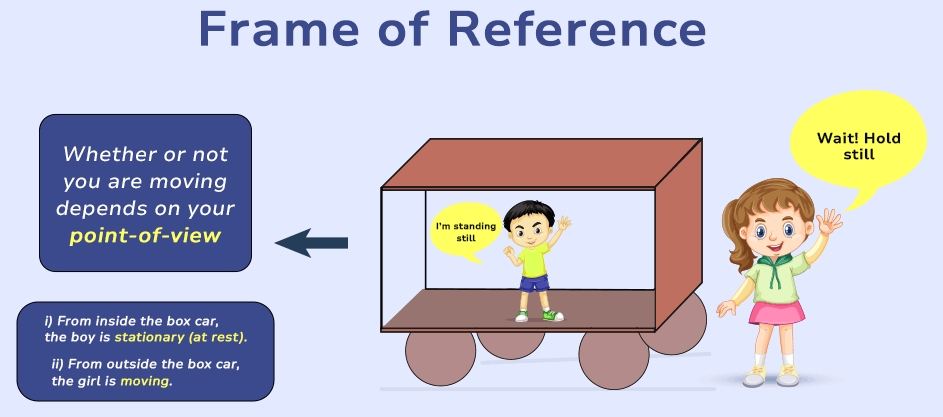
A frame of reference is a set of coordinates or a viewpoint that helps to measure and observe the position, motion, and behavior of objects. It acts like a coordinate system, helping us understand where things are and how they move. By using a frame of reference, we can describe motion accurately. It makes it clear if something is moving fast, slow, or at rest.
Frame of reference is an important concept because motion is relative. This means that how we see motion can change depending on where we are and how we are moving. For example, if you are sitting in a moving train and throw a ball up, it might seem to go straight up and down to you. However, to someone standing outside the train, the ball appears to follow a curved path. Both observations are correct but from different frames of reference.
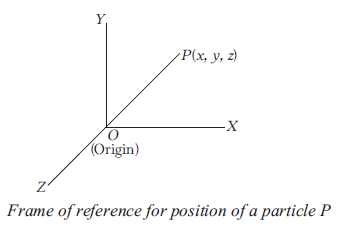
A system of coordinate axes which defines the position of a particle or an event in two or three dimensional space along with a clock constitutes a frame of reference. The simplest frame of reference is the cartesian system of coordinates, in which the position of the particle \((P)\) is specified by its three coordinates \(x, y\) and \(z\).
Frame of references are of two types
Inertial frame of reference
It is a frame of reference, where Newton’s law holds good. e.g. An object will remains at rest or in uniform motion unless acted by an external force. An inertial frame of reference is either at rest or moving with a constant velocity.
Example of Inertial Frame of Reference
For example, if you toss an apple straight up while sitting calmly in a park, it will come back down to your hand (ignoring air resistance and other forces). Here, the park and everything in it can be considered an inertial frame because there is no acceleration involved in the system.
Non-inertial frame of reference
An accelerating frame of reference is called a non-inertial frame of reference. In this reference frame, Newton’s law will not hold true.
A non-inertial frame of reference is one where the observer is undergoing acceleration. This can make objects appear to move in unusual ways due to the effects of the acceleration. This frame of reference is useful for analyzing situations where forces, like friction and gravity, interact in ways that cause acceleration.
Example of Non-Inertial Frame of Reference
A good example of non-inertial frame of reference is when you’re in a car that suddenly accelerates. If you have a balloon in the car, it will appear to move forward even if it is actually the car (and you) moving backward from the balloon.
Rest and Motion
If the position of an object does not change w.r.t. its surrounding with the passage of time, it is said to be at rest. e.g. Book lying on the table, a person sitting on a chair, etc. And if the position of an object is continuously changing w.r.t. its surrounding, then it is said to be in the state of motion. e.g. The walking man, crawling insects, water flowing down a dam, etc.
Rest and motion are relative terms
Rest and motion are always relative but never absolute. It means an object, can be at rest for an observer but the same object can be in motion when observed by other observer. e.g. A person sitting in his house is at rest w.r.t. earth but is in motion w.r.t. moon.
Classification of motion
On the basis of the number of coordinates required to specify the position of an object, the motion of the object can be classified as
One dimensional motion
The motion of an object is considered as one dimensional, if only one coordinate (\(x\)) is needed to specify the position of the object. In one dimensional motion, the object moves along a straight line. e.g. A boy running on a straight line, motion of freely falling body, etc.
Two dimensional motion
The motion of an object is considered as two dimensional, if two coordinates are needed to specify the position of the object. In two dimensional motion plane, the object moves in a plane (two co-ordinates \(x, y\) are used to to specify the position of the object). e.g. Motion of billiard ball.
Three dimensional motion
The motion of an object is considered as three dimensional, if all the three coordinates are needed to specify the position of the object. In three dimensional motion, the object moves in a space (three co-ordinates \(x, y\) and \(z\) are used to specify the position of the object). e.g. Butterfly flying in garden, the motion of water molecules, etc.