4.3 The law of inertia
Inertia
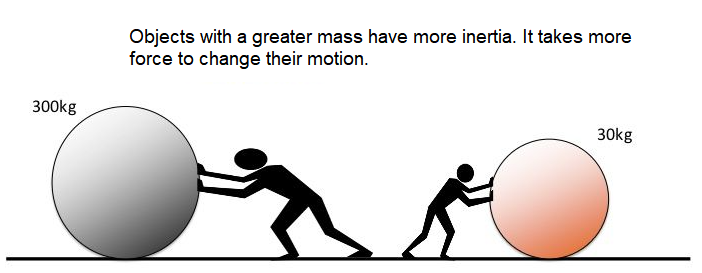
Inertia means ‘resistance to change‘. Inertia is the resistance of an object to changes in its state of motion, meaning an object at rest stays at rest, and an object in motion stays in motion with the same velocity unless acted upon by an external force. This property is directly related to an object’s mass: the greater the mass, the greater the inertia.
\(
\text { Inertia } \propto \text { mass }
\)
Basically, all objects have a tendency to resist the change in the state of motion or rest. This tendency is called inertia. All bodies do not have the same inertia. Inertia depends on the mass of a body. Mass of an object is the measure of its inertia.
Examples:
- When a car suddenly stops, your body continues to move forward due to inertia. Inertia is the tendency of an object to resist changes in its state of motion. Before the stop, your body was moving at the same speed as the car, and because no force directly acts on your body to stop it immediately, your body continues to move forward at that original speed while the car slows down.
- It is harder to push a heavy box than a light box because the heavy box has more mass and therefore more inertia.
- Once a ball is kicked, its inertia keeps it moving through the air until forces like air resistance and gravity slow it down.
Types of Inertia
There are three types of inertia
Inertia of rest:
It is defined as the tendency of a body to remain in its position of rest. i.e. A body at rest remains at rest and cannot start moving on its own. It is the resistance of a body to any change in its state of rest.
Example:
- When a car starts moving, you feel pushed backward because your body resists the change from being at rest to being in motion.
- When you shake a tree, the leaves and fruit fall down because they resist the change in their state of rest.
Inertia of motion:
It is defined as the tendency of a body to remain in its state of uniform motion along a straight line. i.e. A body in uniform motion can neither gets accelerated nor get retarded on its own, also it cannot stop on its own. It is the resistance of a body to any change in its state of uniform motion.
Example:
- When a moving bus suddenly stops, passengers continue to move forward due to inertia of motion.
- An athlete runs before jumping to utilize inertia of motion to help them jump further and higher.
Inertia of direction
It is defined as inability of a body to change by itself its direction of motion. It is the resistance of a body to any change in its direction of motion.
Example:
- When a car makes a sharp turn, you tend to lean to the side because your body resists changing direction.
- A thrown ball continues to move in a straight line unless a force like gravity changes its path.