JEE PYQs Integer Type
Summary
- Stress is the restoring force per unit area and strain is the fractional change in dimension. In general there are three types of stresses (a) tensile stress – longitudinal stress (associated with stretching) or compressive stress (associated with compression), (b) shearing stress, and (c) hydraulic stress (Hydraulic stress (or bulk/volume stress) is the internal restoring force per unit area generated within a body when it is compressed uniformly from all directions by an external fluid. It causes a change in the object’s volume (compressive strain) rather than its shape).
- For small deformations, stress is directly proportional to the strain for many materials. This is known as Hooke’s law. The constant of proportionality is called modulus of elasticity. Three elastic moduli viz., Young’s modulus, shear modulus and bulk modulus are used to describe the elastic behaviour of objects as they respond to deforming forces that act on them.
A class of solids called elastomers does not obey Hooke’s law. - When an object is under tension or compression, the Hooke’s law takes the form
\(
F / A=Y \Delta L / L
\)
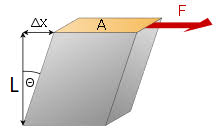
where \(\Delta L / L\) is the tensile or compressive strain of the object, \(F\) is the magnitude of the applied force causing the strain, \(A\) is the cross-sectional area over which \(F\) is applied (perpendicular to \(A\) ) and \(Y\) is the Young’s modulus for the object. The stress is \(F / A\). - A pair of forces when applied parallel to the upper and lower faces, the solid deforms so that the upper face moves sideways with respect to the lower. The horizontal displacement \(\Delta L\) of the upper face is perpendicular to the vertical height \(L\). This type of deformation is called shear and the corresponding stress is the shearing stress. This type of stress is possible only in solids.
In this kind of deformation the Hooke’s law takes the form
\(
F / A=G \times \Delta L / L
\)
where \(\Delta L\) is the displacement of one end of object in the direction of the applied force \(F\), and \(G=\eta\) is the shear modulus. - When an object undergoes hydraulic compression due to a stress exerted by a surrounding fluid, the Hooke’s law takes the form
\(
p=B(\Delta V / V)
\)
where \(p\) is the pressure (hydraulic stress) on the object due to the fluid, \(\Delta V / V\) (the volume strain) is the absolute fractional change in the object’s volume due to that pressure and \(B\) is the bulk modulus of the object. - Poisson’s ratio is \(\sigma=\frac{\text { Lateral strain }}{\text { Longitudinal strain }}=\frac{-\Delta D / D}{\Delta L / L}\)
- There are four relations between \(Y, B, \eta\) and \(\sigma\), which can be given as follows
(1) \(B=\frac{Y}{3(1-2 \sigma)}\)
(2) \(\eta=\frac{Y}{2(1+\sigma)}\)
(3) \(\sigma=\frac{3 B-2 \eta}{2 \eta+6 B}\)
(4) \(\frac{9}{Y}=\frac{1}{B}+\frac{3}{\eta}\) - work done \((W)\) in stretching the wire from 0 to a total extension \(\Delta L\)
\(
W=\frac{1}{2} \frac{Y A(\Delta L)^2}{L}
\) - Elastic Potential Energy:
\(\begin{aligned} U & =\frac{1}{2} \times\left(\frac{F}{A}\right) \times\left(\frac{\Delta L}{L}\right) \times(A L) \\ U & =\frac{1}{2} \times \text { Stress × Strain × Volume }\end{aligned}\) Thermal Stress:
Using Young’s Modulus ( \(Y=\frac{\text { Stress }}{\text { Strain }}\) ), we can find the stress:
Thermal Stress \(=Y \times\) Thermal Strain
Thermal Stress \(=Y \alpha \Delta T\)Thermal Force:
The force exerted by the rod on the supports (or vice versa) is:
\(
\begin{gathered}
F=\text { Stress × Area } \\
F=Y A \alpha \Delta T
\end{gathered}
\)
Quiz Summary
0 of 43 Questions completed
Questions:
Information
You have already completed the quiz before. Hence you can not start it again.
Quiz is loading…
You must sign in or sign up to start the quiz.
You must first complete the following:
Results
Results
0 of 43 Questions answered correctly
Your time:
Time has elapsed
You have reached 0 of 0 point(s), (0)
Earned Point(s): 0 of 0, (0)
0 Essay(s) Pending (Possible Point(s): 0)
Categories
- Not categorized 0%
- 1
- 2
- 3
- 4
- 5
- 6
- 7
- 8
- 9
- 10
- 11
- 12
- 13
- 14
- 15
- 16
- 17
- 18
- 19
- 20
- 21
- 22
- 23
- 24
- 25
- 26
- 27
- 28
- 29
- 30
- 31
- 32
- 33
- 34
- 35
- 36
- 37
- 38
- 39
- 40
- 41
- 42
- 43
- Current
- Review
- Answered
- Correct
- Incorrect
- Question 1 of 43
1. Question
A sample of a liquid is kept at 1 atm. It is compressed to 5 atm which leads to a change of volume of \(0.8 \mathrm{~cm}^3\). If the bulk modulus of the liquid is 2 GPa, the initial volume of the liquid was ____ litre. (Take \(1 \mathrm{~atm}=10^5 \mathrm{~Pa}\)) [JEE Main 2025 (Online) 8th April Evening Shift]
CorrectIncorrectHint
(d) To find the initial volume of the liquid, we use the definition of the Bulk Modulus, which relates the pressure applied to the fractional change in volume.
Step 1: Identify the Given Values and Convert Units
Initial pressure \(\left(P_1\right)=1 \mathrm{~atm}\)
Final pressure \(\left(P_2\right)=5 \mathrm{~atm}\)
Change in pressure \((\Delta P)=P_2-P_1=4 \mathrm{~atm}\)
Convert \(\Delta P\) to Pascals: \(4 \times 10^5 \mathrm{~Pa}\) (since \(1 \mathrm{~atm}=10^5 \mathrm{~Pa}\))
Change in volume \((\Delta V)=0.8 \mathrm{~cm}^3=0.8 \times 10^{-6} \mathrm{~m}^3\)
Bulk modulus \((B)=2 \mathrm{GPa}=2 \times 10^9 \mathrm{~Pa}\)
Step 2: Set up the Bulk Modulus Formula
The Bulk Modulus \((B)\) is given by:
\(
B=\frac{\Delta P}{\left(\frac{\Delta V}{V}\right)}
\)
Where \(V\) is the initial volume. Rearranging the formula to solve for \(V\) :
\(
V=\frac{B \cdot \Delta V}{\Delta P}
\)
Step 3: Calculate the Initial Volume
Substitute the values into the formula:
\(
\begin{gathered}
V=\frac{\left(2 \times 10^9 \mathrm{~Pa}\right) \times\left(0.8 \times 10^{-6} \mathrm{~m}^3\right)}{4 \times 10^5 \mathrm{~Pa}} \\
V=\frac{1.6 \times 10^3}{4 \times 10^5} \mathrm{~m}^3 \\
V=\frac{1600}{400,000} \mathrm{~m}^3 \\
V=0.004 \mathrm{~m}^3
\end{gathered}
\)
Step 4: Convert to Litres
Since \(1 \mathrm{~m}^3=1000\) litres:
\(
\begin{gathered}
V=0.004 \times 1000 \text { litres } \\
V=4 \text { litres }
\end{gathered}
\)
Final Answer: The initial volume of the liquid was \(\mathbf{4}\) litres. - Question 2 of 43
2. Question
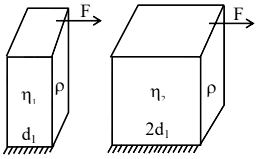
Two slabs with square cross section of different materials \((1,2)\) with equal sides \((l)\) and thickness \(d_1\) and \(d_2\) such that \(d_2=2 d_1\) and \(l>d_2\). Considering lower edges of these slabs are fixed to the floor, we apply equal shearing force on the narrow faces. The angle of deformation is \(\theta_2=2 \theta_1\). If the shear moduli of material 1 is \(4 \times 10^9 \mathrm{~N} / \mathrm{m}^2\), then shear moduli of material 2 is \(x \times 10^9 \mathrm{~N} / \mathrm{m}^2\), where value of \(x\) is ____. [JEE Main 2025 (Online) 4th April Morning Shift]
CorrectIncorrectHint
(a)

Step 1: Identify the Shear Modulus Formula
The shear modulus \((\eta)\) of a material is defined as the ratio of shear stress \((\tau)\) to shear strain (\(\theta\)). For a force \(F\) applied parallel to a face of area \(A\), the relationship is given by:
\(
\eta=\frac{\tau}{\theta}=\frac{F}{A \theta}
\)
Step 2: Determine the Relevant Areas
The problem states the slabs have a square cross-section with sides \(l\) and thicknesses \(d_1, d_2\). Since the force is applied to the narrow faces, and the thickness \(d\) is less than \(l\) , the area \(A\) of the narrow face is:
\(
A=l \times d
\)
Step 3: Establish the Ratio of Shear Moduli
Using the formula from Step 1 for both materials:
\(
\begin{aligned}
& \eta_1=\frac{F}{l d_1 \theta_1} \\
& \eta_2=\frac{F}{l d_2 \theta_2}
\end{aligned}
\)
Taking the ratio of \(\eta_2\) to \(\eta_1\) :
\(
\frac{\eta_2}{\eta_1}=\frac{F /\left(l d_2 \theta_2\right)}{F /\left(l d_1 \theta_1\right)}=\frac{d_1 \theta_1}{d_2 \theta_2}
\)
Step 4: Calculate the Final Value
Substitute the given conditions \(d_2=2 d_1\) and \(\theta_2=2 \theta_1\) into the ratio:
\(
\frac{n_2}{n_1}=\frac{d_1 \cdot \theta_1}{\left(2 d_1\right) \cdot\left(2 \theta_1\right)}=\frac{1}{4}
\)
Given \(\eta_1=4 \times 10^9 \mathrm{~N} / \mathrm{m}^2\) :
\(
\eta_2=\frac{1}{4} \times 4 \times 10^9=1 \times 10^9 \mathrm{~N} / \mathrm{m}^2
\)
Comparing this with the form \(x \times 10^9 \mathrm{~N} / \mathrm{m}^2\), we find \(x=1\). - Question 3 of 43
3. Question
The length of a light string is 1.4 m when the tension on it is 5 N. If the tension increases to 7 N, the length of the string is 1.56 m . The original length of the string is ____ m. [JEE Main 2025 (Online) 2nd April Evening Shift]
CorrectIncorrectHint
(a) To find the original (natural) length of the string, we use Hooke’s Law, which states that the extension of an elastic material is directly proportional to the tension applied to it.
Step 1: Set up the Linear Relationship
The stretched length (\(l\)) of a string is equal to its original length (\(L\)) plus the extension (\(\Delta L\)). According to Hooke’s Law:
\(
\Delta L=k \cdot T
\)
where \(k\) is a constant related to the material’s properties (\(L / A Y\)). Therefore:
\(
l=L+k T
\)
Step 2: Formulate Equations for Both Cases
We are given two states of tension and length:
For \(T_1=5 \mathrm{~N}\) and \(l_1=1.4 \mathrm{~m}\) :
\(
1.4=L+5 k \dots(1)
\)
For \(T_2=7 \mathrm{~N}\) and \(l_2=1.56 \mathrm{~m}\) :
\(
1.56=L+7 k \dots(2)
\)
Step 3: Solve for the Constant \(k\)
Subtract Equation 1 from Equation 2 to eliminate \(L\) :
\(
\begin{gathered}
(1.56-1.4)=(L+7 k)-(L+5 k) \\
0.16=2 k \\
k=\frac{0.16}{2}=0.08 \mathrm{~m} / \mathrm{N}
\end{gathered}
\)
Step 4: Calculate the Original Length \(L\)
Substitute the value of \(k\) back into Equation 1:
\(
\begin{gathered}
1.4=L+5(0.08) \\
1.4=L+0.40 \\
L=1.4-0.40 \\
L=1.0 \mathrm{~m}
\end{gathered}
\)
Final Answer: The original length of the string is \(\mathbf{1 . 0 ~ m}\). - Question 4 of 43
4. Question
A steel wire of length 2 m and Young’s modulus \(2.0 \times 10^{11} \mathrm{Nm}^{-2}\) is stretched by a force. If Poisson ratio and transverse strain for the wire are 0.2 and \(10^{-3}\) respectively, then the elastic potential energy density of the wire is ____ \(\times 10^5\) (in Sl units). [JEE Main 2025 (Online) 2nd April Morning Shift]
CorrectIncorrectHint
(c) To find the elastic potential energy density of the wire, we need to determine the longitudinal strain using the Poisson’s ratio and then apply the energy density formula.
Step 1: Calculate the Longitudinal Strain
The Poisson’s ratio \((\sigma)\) is defined as the ratio of the transverse strain \((\beta)\) to the longitudinal strain \((\alpha)\) :
\(
\sigma=\frac{\text { Transverse Strain }}{\text { Longitudinal Strain }}=\frac{\beta}{\alpha}
\)
Rearranging to solve for the longitudinal strain \((\alpha)\) :
\(
\alpha=\frac{\beta}{\sigma}
\)
Given:
Transverse strain \((\beta)=10^{-3}\)
Poisson’s ratio \((\sigma)=0.2\)
\(
\alpha=\frac{10^{-3}}{0.2}=5 \times 10^{-3}
\)
Step 2: Identify the Energy Density Formula
The elastic potential energy density (\(u\)), which is the energy stored per unit volume, is given by the formula:
\(
u=\frac{1}{2} \times \text { Stress } \text { × } \text { Strain }
\)
Since Stress \(=Y \times\) Strain, we can write:
\(
u=\frac{1}{2} \cdot Y \cdot \alpha^2
\)
Step 3: Calculation
Substitute the given values into the formula:
Young’s Modulus \((Y)=2.0 \times 10^{11} \mathrm{Nm}^{-2}\)
Longitudinal Strain \((\alpha)=5 \times 10^{-3}\)
\(
\begin{gathered}
u=\frac{1}{2} \times\left(2.0 \times 10^{11}\right) \times\left(5 \times 10^{-3}\right)^2 \\
u=\left(1.0 \times 10^{11}\right) \times\left(25 \times 10^{-6}\right) \\
u=25 \times 10^5 \mathrm{~J} / \mathrm{m}^3
\end{gathered}
\)
Final Answer: The elastic potential energy density of the wire is \(25 \times 10^5\) (in SI units). - Question 5 of 43
5. Question
The volume contraction of a solid copper cube of edge length 10 cm , when subjected to a hydraulic pressure of \(7 \times 10^6 \mathrm{~Pa}\), would be ____ \(\mathrm{mm}^3\). [JEE Main 2025 (Online) 28th January Evening Shift]
(Given bulk modulus of copper \(=1.4 \times 10^{11} \mathrm{Nm}^{-2}\))CorrectIncorrectHint
(d) To find the volume contraction of the copper cube, we use the definition of the Bulk Modulus, which relates the pressure applied to the fractional change in volume of the material.
Step 1: Identify the Given Values
Edge length of the cube \((L): 10 \mathrm{~cm}=0.1 \mathrm{~m}\)
Hydraulic pressure \((P): 7 \times 10^6 \mathrm{~Pa}\)
Bulk modulus (\(B\)): \(1.4 \times 10^{11} \mathrm{Nm}^{-2}\)
Step 2: Calculate the Initial Volume (\(V\))
The volume of a cube is given by \(V=L^3\) :
\(
V=(0.1 \mathrm{~m})^3=0.001 \mathrm{~m}^3=10^{-3} \mathrm{~m}^3
\)
Step 3: Apply the Bulk Modulus Formula
The Bulk Modulus (\(B\)) is defined as:
\(
B=\frac{P}{\left(\frac{\Delta V}{V}\right)}
\)
Rearranging the formula to solve for the volume contraction (\(\Delta V\)):
\(
\Delta V=\frac{P \cdot V}{B}
\)
Step 4: Calculate the Volume Contraction \(\mathrm{m}^3\)
Substitute the values into the equation:
\(
\begin{gathered}
\Delta V=\frac{\left(7 \times 10^6 \mathrm{~Pa}\right) \times\left(10^{-3} \mathrm{~m}^3\right)}{1.4 \times 10^{11} \mathrm{Nm}^{-2}} \\
\Delta V=\frac{7 \times 10^3}{1.4 \times 10^{11}} \\
\Delta V=5 \times 10^{-8} \mathrm{~m}^3
\end{gathered}
\)
Step 5: Convert the Result to \(\mathrm{mm}^3\)
Since \(1 \mathrm{~m}=10^3 \mathrm{~mm}\), then \(1 \mathrm{~m}^3=\left(10^3\right)^3 \mathrm{~mm}^3=10^9 \mathrm{~mm}^3\) :
\(
\begin{gathered}
\Delta V=\left(5 \times 10^{-8}\right) \times 10^9 \mathrm{~mm}^3 \\
\Delta V=5 \times 10^1 \mathrm{~mm}^3 \\
\Delta V=50 \mathrm{~mm}^3
\end{gathered}
\)
Final Answer: The volume contraction of the solid copper cube would be \(50 \mathrm{~mm}^3\). - Question 6 of 43
6. Question
In a measurement, it is asked to find modulus of elasticity per unit torque applied on the system. The measured quantity has dimension of \(\left[M^a L^b T^c\right]\). If \(b=3\), the value of \(c\) is ____. [JEE Main 2025 (Online) 28th January Morning Shift]
CorrectIncorrectHint
(a) To find the value of \(c\) in the dimensional formula \(\left[M^a L^b T^c\right]\), we need to determine the dimensions of the quantity “modulus of elasticity per unit torque.”
Step 1: Dimensions of Modulus of Elasticity (\(E\))
The modulus of elasticity (whether Young’s, Bulk, or Shear modulus) is defined as the ratio of stress to strain.
\(
\text { Modulus of Elasticity }(E)=\frac{\text { Stress }}{\text { Strain }}
\)
Stress is force per unit area: \(\left[M L^{-1} T^{-2}\right]\).
Strain is a dimensionless quantity (\(\left[M^0 L^0 T^0\right]\)). Therefore, the dimensions of \(E\) are:
\(
[E]=\left[M^1 L^{-1} T^{-2}\right]
\)
Step 2: Dimensions of Torque (\(\tau\))
Torque is defined as the product of force and the perpendicular distance (lever arm).
\(
\operatorname{Torque}(\tau)=\text { Force × Distance }
\)
\(
\operatorname{Torque}(\tau)=\left[M L T^{-2}\right] \times[L]=\left[M^1 L^2 T^{-2}\right]
\)
So, the dimensions of \(\tau\) are:
\(
[\tau]=\left[M^1 L^2 T^{-2}\right]
\)
Step 3: Dimensions of the Measured Quantity
The problem asks for the dimensions of the modulus of elasticity per unit torque \(\left(\frac{E}{\tau}\right)\) :
\(
\begin{gathered}
\text { Dimension }=\frac{[E]}{[\tau]}=\frac{\left[M^1 L^{-1} T^{-2}\right]}{\left[M^1 L^2 T^{-2}\right]} \\
=\left[M^{1-1} L^{-1-2} T^{-2-(-2)}\right] \\
=\left[M^0 L^{-3} T^0\right]
\end{gathered}
\)
Step 4: Comparing with \(\left[M^a L^b T^c\right]\)
The calculated dimensions are \(\left[M^0 L^{-3} T^0\right]\). Comparing this with the given form \(\left[M^a L^b T^c\right]\) :
\(a=0\)
\(b=-3\)
\(c=0\) - Question 7 of 43
7. Question
The increase in pressure required to decrease the volume of a water sample by \(0.2 \%\) is \(\mathrm{P} \times 10^5 \mathrm{Nm}^{-2}\). Bulk modulus of water is \(2.15 \times 10^9 \mathrm{Nm}^{-2}\). The value of \(P\) is ____. [JEE Main 2025 (Online) 24th January Evening Shift]
CorrectIncorrectHint
(c) To find the increase in pressure required, we use the definition of the Bulk Modulus, which relates the pressure applied to the fractional change in volume.
Step 1: Identify the Bulk Modulus Formula
The Bulk Modulus \((B)\) is defined as the ratio of the change in pressure \((\Delta P)\) to the fractional change in volume (volumetric strain):
\(
B=\frac{\Delta P}{\left|\frac{\Delta V}{V}\right|}
\)
Rearranging the formula to solve for the change in pressure \((\Delta P)\) :
\(
\Delta P=B \times\left|\frac{\Delta V}{V}\right|
\)
Step 2: Given Values
Bulk Modulus (B): \(2.15 \times 10^9 \mathrm{Nm}^{-2}\)
Percentage decrease in volume: \(0.2 \%\)
Fractional change in volume \(\left(\frac{\Delta V}{V}\right): \frac{0.2}{100}=0.002=2 \times 10^{-3}\)
Step 3: Calculation
Substitute the values into the formula:
\(
\begin{gathered}
\Delta P=\left(2.15 \times 10^9 \mathrm{Nm}^{-2}\right) \times\left(2 \times 10^{-3}\right) \\
\Delta P=4.3 \times 10^6 \mathrm{Nm}^{-2}
\end{gathered}
\)
Step 4: Express in the Required Form
The question asks for the pressure in the form \(P \times 10^5 \mathrm{Nm}^{-2}\). We can rewrite our result as:
\(
\Delta P=43 \times 10^5 \mathrm{Nm}^{-2}
\)
Comparing this with \(P \times 10^5 \mathrm{Nm}^{-2}\), we get:
\(
P=43
\) - Question 8 of 43
8. Question
Two persons pull a wire towards themselves. Each person exerts a force of 200 N on the wire. Young’s modulus of the material of wire is \(1 \times 10^{11} \mathrm{Nm}^{-2}\). Original length of the wire is 2 m and the area of cross section is \(2 \mathrm{~cm}^2\). The wire will extend in length by ____ \(\mu \mathrm{m}\). [JEE Main 2024 (Online) 9th April Morning Shift]
CorrectIncorrectHint
(b) To solve this, we must first determine the actual tension acting on the wire.
Step 1: Determine the Tension in the Wire
A common point of confusion in this type of problem is whether the forces “add up.”
When two people pull the ends of a wire with 200 N each in opposite directions, the wire is in equilibrium.
This is identical to one end being fixed to a wall and the other end being pulled with 200 N.
Therefore, the Tension (\(T\)) in the wire is 200 N , not 400 N .
Step 2: Identify the Given Values
Tension (\(F\)): 200 N
Original Length \((L): 2 \mathrm{~m}\)
Young’s Modulus \((Y): 1 \times 10^{11} \mathrm{Nm}^{-2}\)
Area \((A): 2 \mathrm{~cm}^2=2 \times\left(10^{-2} \mathrm{~m}\right)^2=2 \times 10^{-4} \mathrm{~m}^2\)
Step 3: Calculate the Extension (\(\boldsymbol{\Delta} \boldsymbol{L}\))
Using the formula for Young’s Modulus:
\(
Y=\frac{F \cdot L}{A \cdot \Delta L} \Longrightarrow \Delta L=\frac{F \cdot L}{A \cdot Y}
\)
Substitute the values:
\(
\begin{gathered}
\Delta L=\frac{200 \times 2}{\left(2 \times 10^{-4}\right) \times\left(1 \times 10^{11}\right)} \\
\Delta L=\frac{400}{2 \times 10^7} \\
\Delta L=200 \times 10^{-7} \mathrm{~m} \\
\Delta L=20 \times 10^{-6} \mathrm{~m}
\end{gathered}
\)
Step 4: Convert to Micrometers (\(\mu \mathrm{m}\))
Since \(1 \mu \mathrm{~m}=10^{-6} \mathrm{~m}\) :
\(
\Delta L=20 \mu \mathrm{~m}
\)
Final Answer: The wire will extend in length by \(20 \mu \mathrm{~m}\). - Question 9 of 43
9. Question
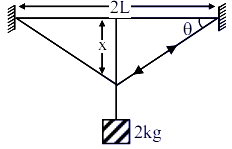
A wire of cross sectional area \(A\), modulus of elasticity \(2 \times 10^{11} \mathrm{Nm}^{-2}\) and length 2 m is stretched between two vertical rigid supports. When a mass of 2 kg is suspended at the middle it sags lower from its original position making angle \(\theta=\frac{1}{100}\) radian on the points of support. The value of A is ____ \(\times 10^{-4} \mathrm{~m}^2\) (consider \(x \ll \mathrm{~L}\)). [JEE Main 2024 (Online) 6th April Evening Shift]
(given : \(\mathrm{g}=10 \mathrm{~m} / \mathrm{s}^2\)) CorrectIncorrect
Hint
(a)

To find the cross-sectional area \(A\), we need to analyze the tension in the wire created by the suspended mass and relate that tension to the elastic stretching of the wire.
Step 1: Analyze the Equilibrium at the Center
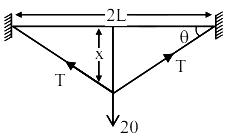
When the mass \(m\) is suspended at the midpoint, the wire sags. Let \(T\) be the tension in each half of the wire. The vertical components of the tension support the weight of the mass:
\(
2 T \sin \theta=m g
\)
Since \(\theta\) is very small (\(\theta=1 / 100 \mathrm{rad}\)), we can use the approximation \(\sin \theta \approx \theta\) :
\(
2 T \theta=m g \Longrightarrow T=\frac{m g}{2 \theta}
\)
Substituting the given values (\(m=2 \mathrm{~kg}, g=10 \mathrm{~m} / \mathrm{s}^2, \theta=0.01 \mathrm{rad}\)):
\(
T=\frac{2 \times 10}{2 \times 0.01}=\frac{20}{0.02}=1000 \mathrm{~N}
\)
Step 2: Determine the Longitudinal Strain
Let \(L\) be the original half-length of the wire \((1 \mathrm{~m})\) and \(L^{\prime}\) be the stretched half-length. From the geometry of the triangle formed by the sag:
\(
\cos \theta=\frac{L}{L^{\prime}} \Longrightarrow L^{\prime}=\frac{L}{\cos \theta}
\)
\(
\cos \theta=\frac{L}{L^{\prime}} \Longrightarrow L^{\prime}=\frac{L}{\cos \theta}
\)
The longitudinal strain \((\alpha)\) is:
\(
\alpha=\frac{L^{\prime}-L}{L}=\frac{\frac{L}{\cos \theta}-L}{L}=\frac{1}{\cos \theta}-1
\)
Using the small angle approximation \(\cos \theta \approx 1-\frac{\theta^2}{2}\) :
\(
\alpha \approx\left(1-\frac{\theta^2}{2}\right)^{-1}-1 \approx\left(1+\frac{\theta^2}{2}\right)-1=\frac{\theta^2}{2}
\)
Substituting \(\theta=0.01\) :
\(
\alpha=\frac{(0.01)^2}{2}=\frac{10^{-4}}{2}=5 \times 10^{-5}
\)
Step 3: Calculate the Area \(\boldsymbol{A}\)
Young’s Modulus (\(Y\)) is defined as:
\(
Y=\frac{\text { Stress }}{\text { Strain }}=\frac{T / A}{\alpha} \Longrightarrow A=\frac{T}{Y \alpha}
\)
Substitute the values \(\left(T=1000 \mathrm{~N}, Y=2 \times 10^{11} \mathrm{~N} / \mathrm{m}^2, \alpha=5 \times 10^{-5}\right)\) :
\(
\begin{gathered}
A=\frac{1000}{\left(2 \times 10^{11}\right) \times\left(5 \times 10^{-5}\right)} \\
A=\frac{10^3}{10 \times 10^6}=\frac{10^3}{10^7} \\
A=10^{-4} \mathrm{~m}^2
\end{gathered}
\)
Comparing this to the requested format \(A \times 10^{-4} \mathrm{~m}^2\). The value of \(A\) is 1. - Question 10 of 43
10. Question
The density and breaking stress of a wire are \(6 \times 10^4 \mathrm{~kg} / \mathrm{m}^3\) and \(1.2 \times 10^8 \mathrm{~N} / \mathrm{m}^2\) respectively. The wire is suspended from a rigid support on a planet where acceleration due to gravity is \(\frac{1}{3}^{\text {rd }}\) of the value on the surface of earth. The maximum length of the wire with breaking is ____ m (take, \(\mathrm{g}=10 \mathrm{~m} / \mathrm{s}^2\)). [JEE Main 2024 (Online) 5th April Morning Shift]
CorrectIncorrectHint
(c) To find the maximum length of a wire that can hang under its own weight without breaking, we must ensure that the maximum stress (occurring at the top of the wire) does not exceed the breaking stress of the material.
Step 1: Identify the Stress at the Support
For a wire hanging vertically, the maximum tension \(T\) is at the point of suspension, as it must support the entire weight of the wire.
\(
\begin{gathered}
T=\text { Mass of the wire } \text { × } g_{\text {planet }} \\
T=(\text { Area } \text { × } \text { Length } \text { × } \text { Density }) \times g_{\text {planet }}
\end{gathered}
\)
The maximum stress \(\sigma\) is defined as tension per unit area:
\(
\begin{gathered}
\sigma=\frac{T}{A}=\frac{A \cdot L \cdot \rho \cdot g_{\text {planet }}}{A} \\
\sigma=L \cdot \rho \cdot g_{\text {planet }}
\end{gathered}
\)
Step 2: Set the Condition for Maximum Length
The wire will break if the stress exceeds the breaking stress \(\left(\sigma_b\right)\). Therefore, the maximum length \(L\) is achieved when the stress equals the breaking stress:
\(
\sigma_b=L \cdot \rho \cdot g_{\text {planet }}
\)
\(
L=\frac{\sigma_b}{\rho \cdot g_{\text {planet }}}
\)
Step 3: Given Values
Breaking Stress \(\left(\sigma_b\right): 1.2 \times 10^8 \mathrm{~N} / \mathrm{m}^2\)
Density ( \(\rho\) ): \(6 \times 10^4 \mathrm{~kg} / \mathrm{m}^3\)
Gravity on Earth (\(g\)): \(10 \mathrm{~m} / \mathrm{s}^2\)
Gravity on Planet \(\left(g_{\text {planet }}\right): \frac{1}{3} \times 10=\frac{10}{3} \mathrm{~m} / \mathrm{s}^2\)
Step 4: Calculation
Substitute the values into the formula:
\(
\begin{gathered}
L=\frac{1.2 \times 10^8}{\left(6 \times 10^4\right) \times\left(\frac{10}{3}\right)} \\
L=\frac{1.2 \times 10^8}{2 \times 10^5} \\
L=0.6 \times 10^3 \\
L=600 \mathrm{~m}
\end{gathered}
\)
Final Answer: The maximum length of the wire without breaking is 600 m. - Question 11 of 43
11. Question
An elastic spring under tension of 3 N has a length \(a\). Its length is \(b\) under tension 2 N. For its length \((3 a-2 b)\), the value of tension will be _____ N. [JEE Main 2024 (Online) 4th April Morning Shift]
CorrectIncorrectHint
(c) To find the tension for the given length, we can use Hooke’s Law, which describes the relationship between the force (tension) applied to a spring and its extension.
The Formula:
Hooke’s Law is expressed as:
\(
F=k\left(L-L_0\right)
\)
Where:
\(F\) is the tension (force).
\(k\) is the spring constant.
\(L\) is the current length.
\(L_0\) is the natural (unstretched) length of the spring.
Step 1: Set up the equations
From the problem, we have two distinct conditions:
Under tension 3 N , length is \(a\) :
\(
3=k\left(a-L_0\right)-(\text { Eq. 1 })
\)
Under tension \(\mathbf{2} \mathbf{N}\), length is \(b\) :
\(
2=k\left(b-L_0\right)
\)
Step 2: Solve for \(k\) and \(L_0\)
Divide (Eq. 1) by (Eq. 2) to eliminate \(k\) :
\(
\begin{gathered}
\frac{3}{2}=\frac{a-L_0}{b-L_0} \\
3\left(b-L_0\right)=2\left(a-L_0\right) \\
3 b-3 L_0=2 a-2 L_0
\end{gathered}
\)
Now, substitute \(L_0\) back into (Eq. 1) to find \(k\) :
\(
\begin{gathered}
3=k(a-(3 b-2 a)) \\
3=k(3 a-3 b)
\end{gathered}
\)
\(
k=\frac{1}{a-b}
\)
Step 3: Find the tension for length (\(3 a-2 b\))
Let the required tension be \(F^{\prime}\). Using the formula \(F^{\prime}=k\left(L^{\prime}-L_0\right)\), where \(L^{\prime}=3 a-2 b\) :
\(
F^{\prime}=k[(3 a-2 b)-(3 b-2 a)]
\)
Substitute the value of \(k\) :
\(
\begin{gathered}
F^{\prime}=\frac{1}{a-b}[3 a-2 b-3 b+2 a] \\
F^{\prime}=\frac{1}{a-b}[5 a-5 b] \\
F^{\prime}=\frac{5(a-b)}{a-b}
\end{gathered}
\)
\(
F^{\prime}=5
\)
The value of tension for the length \((3 a-2 b)\) will be 5 N. - Question 12 of 43
12. Question
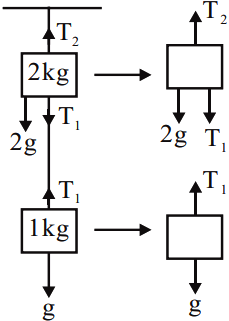
One end of a metal wire is fixed to a ceiling and a load of 2 kg hangs from the other end. A similar wire is attached to the bottom of the load and another load of 1 kg hangs from this lower wire. Then the ratio of longitudinal strain of upper wire to that of the lower wire will be ____. [JEE Main 2024 (Online) 1st February Evening Shift]
[Area of cross section of wire \(=0.005 \mathrm{~cm}^2, \mathrm{Y}=2 \times 10^{11} \mathrm{Nm}^{-2}\) and \(\mathrm{g}=10 \mathrm{~ms}^{-2}\)]CorrectIncorrectHint
(b)

To find the ratio of the longitudinal strain of the upper wire to that of the lower wire, we analyze the forces acting on each wire using the principles of elasticity.
Identify the Tension in each wire:
Lower Wire: This wire is attached to the 1 kg load. It only supports the weight of this load.
\(
T_1=M_2 \times g=1 \mathrm{~kg} \times 10 \mathrm{~m} / \mathrm{s}^2=10 \mathrm{~N}
\)
Upper Wire: This wire is attached to the ceiling and supports the 2 kg load, the lower wire, and the 1 kg load. Neglecting the mass of the wires, the total weight supported is the sum of both loads.
\(
T_2=\left(M_1+M_2\right) \times g=(2 \mathrm{~kg}+1 \mathrm{~kg}) \times 10 \mathrm{~m} / \mathrm{s}^2=30 \mathrm{~N}
\)
Longitudinal Strain Formula:
The longitudinal strain \((\epsilon)\) is defined as the change in length per unit original length. According to Young’s Modulus (\(Y\)):
\(
\begin{gathered}
Y=\frac{\text { Stress }}{\text { Strain }}=\frac{T / A}{\epsilon} \\
\epsilon=\frac{T}{A \cdot Y}
\end{gathered}
\)
Where:
\(T\) is the tension.
\(A\) is the area of cross-section \(\left(0.005 \mathrm{~cm}^2\right)\).
\(Y\) is the Young’s Modulus \(\left(2 \times 10^{11} \mathrm{Nm}^{-2}\right)\).
Calculate the Ratio:
Since both wires are “similar”, they have the same area of cross-section (\(\boldsymbol{A}\)) and the same Young’s Modulus (\(Y\)). Therefore, the strain is directly proportional to the tension:
\(
\epsilon \propto T
\)
The ratio of the strains is:
\(
\begin{gathered}
\frac{\epsilon_2}{\epsilon_1}=\frac{T_2}{T_1} \\
\frac{\epsilon_2}{\epsilon_2}=\frac{30 \mathrm{~N}}{10 \mathrm{~N}}=3
\end{gathered}
\)
Final Answer: The ratio of the longitudinal strain of the upper wire to that of the lower wire is 3. - Question 13 of 43
13. Question
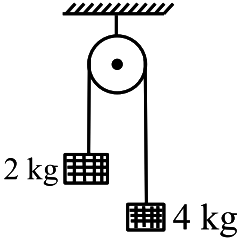
Two blocks of mass 2 kg and 4 kg are connected by a metal wire going over a smooth pulley as shown in figure. The radius of wire is \(4.0 \times 10^{-5} \mathrm{~m}\) and Young’s modulus of the metal is \(2.0 \times 10^{11} \mathrm{~N} / \mathrm{m}^2\). The longitudinal strain developed in the wire is \(\frac{1}{\alpha \pi}\). The value of \(\alpha\) is ____. [Use \(g=10 \mathrm{~m} / \mathrm{s}^2\)] [JEE Main 2024 (Online) 31st January Evening Shift]
 CorrectIncorrect
Hint
(b) Step 1: Calculate the Tension in the Wire
In an Atwood machine system where two masses \(m_1=2 \mathrm{~kg}\) and \(m_2=4 \mathrm{~kg}\) are connected over a smooth pulley, the tension \(T\) in the wire is given by the formula:
\(
T=\frac{2 m_1 m_2}{m_1+m_2} g
\)
Substituting the given values \(\left(\mathrm{g}=10 \mathrm{~m} / \mathrm{s}^2\right)\) :
\(
T=\frac{2 \times 2 \times 4}{2+4} \times 10=\frac{16}{6} \times 10=\frac{80}{3} \mathrm{~N}
\)
Step 2: Calculate the Longitudinal Strain
Longitudinal strain \(\epsilon\) is defined as the ratio of stress to Young’s modulus \(Y\). The stress is the tension \(T\) divided by the cross-sectional area \(A=\pi r^2\).
\(
\epsilon=\frac{\text { Stress }}{Y}=\frac{T}{A Y}=\frac{T}{\pi r^2 Y}
\)
Given \(r=4.0 \times 10^{-5} \mathrm{~m}\) and \(Y=2.0 \times 10^{11} \mathrm{~N} / \mathrm{m}^2\) :
\(
\begin{gathered}
\epsilon=\frac{80 / 3}{\pi\left(4.0 \times 10^{-5}\right)^2\left(2.0 \times 10^{11}\right)} \\
\epsilon=\frac{80}{3 \times \pi \times 16 \times 10^{-10} \times 2 \times 10^{11}} \\
\epsilon=\frac{80}{3 \times \pi \times 32 \times 10^1}=\frac{80}{960 \pi} \\
\epsilon=\frac{1}{12 \pi}
\end{gathered}
\)
Step 3: Determine the value of \(\alpha\)
Comparing the calculated strain to the given form \(\frac{1}{\alpha \pi}\) :
Step 3: Determine the value of \(\alpha\)
Comparing the calculated strain to the given form \(\frac{1}{\alpha \pi}\) :
\(
\begin{aligned}
\frac{1}{12 \pi} & =\frac{1}{\alpha \pi} \\
\alpha & =12
\end{aligned}
\) - Question 14 of 43
14. Question
The depth below the surface of sea to which a rubber ball be taken so as to decrease its volume by \(0.02 \%\) is _____ \(m\). (Take density of sea water \(=10^3 \mathrm{kgm}^{-3}\), Bulk modulus of rubber \(=9 \times 10^8 \mathrm{Nm}^{-2}\), and \(g=10 \mathrm{~ms}^{-2}\)) [JEE Main 2024 (Online) 31st January Morning Shift]
CorrectIncorrectHint
(d) Step 1: Calculate the change in pressure using Bulk Modulus
The Bulk Modulus \(\boldsymbol{B}\) is defined as the ratio of the change in pressure \(\boldsymbol{\Delta} \boldsymbol{P}\) to the fractional change in volume \(\frac{\Delta V}{V}\). The formula is given by:
\(
B=\frac{\Delta P}{\frac{\Delta V}{V}}
\)
Given the volume decrease is \(0.02 \%\), the fractional change is:
\(
\frac{\Delta V}{V}=\frac{0.02}{100}=2 \times 10^{-4}
\)
Substituting the given values \(B=9 \times 10^8 \mathrm{Nm}^{-2}\) :
\(
\Delta P=B \times \frac{\Delta V}{V}=\left(9 \times 10^8\right) \times\left(2 \times 10^{-4}\right)=1.8 \times 10^5 \mathrm{~Pa}
\)
Step 2: Determine the depth from the hydrostatic pressure
The change in pressure at a depth \(h\) in a fluid of density \(\rho\) is given by the hydrostatic pressure formula:
\(
\Delta P=\rho g h
\)
We are given \(\rho=10^3 \mathrm{kgm}^{-3}\) and \(g=10 \mathrm{~ms}^{-2}\). Rearranging to solve for \(h\) :
\(
h=\frac{\Delta P}{\rho g}
\)
Substituting the calculated \(\Delta P\).
\(
h=\frac{1.8 \times 10^5}{10^3 \times 10}=\frac{1.8 \times 10^5}{10^4}=18 \mathrm{~m}
\)
The rubber ball must be taken to a depth of 18 m. - Question 15 of 43
15. Question
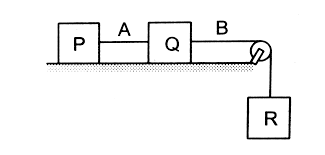
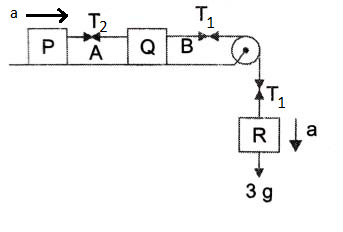
Each of three blocks \(\mathrm{P}, \mathrm{Q}\) and R shown in figure has a mass of 3 kg. Each of the wires A and B has cross-sectional area \(0.005 \mathrm{~cm}^2\) and Young’s modulus \(2 \times 10^{11} \mathrm{~N} \mathrm{~m}^{-2}\). Neglecting friction, the longitudinal strain on wire \(B\) is _____ \(\times 10^{-4}\). (Take \(\mathrm{g}=10 \mathrm{~m} / \mathrm{s}^2\)) [JEE Main 2024 (Online) 30th January Morning Shift]
 CorrectIncorrect
Hint
(b)

\(
\begin{aligned}
& 3 g-T_1=3 a \\
& T_1-T_2=3 a \\
& T_2=3 a \\
& =3 g=9 a
\end{aligned}
\)
\(
a=g / 3 \Rightarrow T_2=3 g / 3=g=10 \mathrm{~N}
\)
\(
T_1=3 a + T_2=g+T_2=20 \mathrm{~N}
\)
Calculate the longitudinal strain on wire \(\boldsymbol{B}\):
The longitudinal strain is given by the formula Strain \(=\frac{\text { Stress }}{Y}=\frac{T_1}{A \cdot Y}\).
Given values:
\(A=0.005 \mathrm{~cm}^2=0.005 \times 10^{-4} \mathrm{~m}^2=5 \times 10^{-7} \mathrm{~m}^2\).
\(Y=2 \times 10^{11} \mathrm{Nm}^{-2}\).
Calculation:
\(
\begin{gathered}
\text { Strain }=\frac{20}{\left(5 \times 10^{-7}\right) \times\left(2 \times 10^{11}\right)} \\
\text { Strain }=\frac{20}{10 \times 10^4}=\frac{20}{10^5}=2 \times 10^{-4}
\end{gathered}
\)
The longitudinal strain on wire \(B\) is \(2 \times 10^{-4}\). - Question 16 of 43
16. Question
Two metallic wires \(P\) and \(Q\) have same volume and are made up of same material. If their area of cross sections are in the ratio \(4: 1\) and force \(F_1\) is applied to \(P\), an extension of \(\Delta l\) is produced. The force which is required to produce same extension in \(Q\) is \(\mathrm{F}_2\).
The value of \(\frac{F_1}{F_2}\) is ____. [JEE Main 2024 (Online) 29th January Evening Shift]CorrectIncorrectHint
(b) To solve for the ratio of the forces \(\frac{F_1}{F_2}\), we need to use the relationship between Young’s Modulus, force, area, and length.
Step 1: The Core Formula
The Young’s Modulus (\(Y\)) is given by:
\(
Y=\frac{\text { Stress }}{\text { Strain }}=\frac{F / A}{\Delta l / l}=\frac{F l}{A \Delta l}
\)
Rearranging for Force \((F)\) :
\(
F=\frac{Y A \Delta l}{l}
\)
Step 2: Constraints from the Problem
Same Material: \(Y_P=Y_Q=Y\).
Same Volume \((V)\) : Since \(V=A \times l\), we can say \(l=\frac{V}{A}\).
Same Extension: \(\Delta l_P=\Delta l_Q=\Delta l\).
Area Ratio: \(\frac{A_p}{A_q}=\frac{4}{1}\).
Step 3: Expressing Force in terms of Area and Volume
Substitute \(l=\frac{V}{A}\) into the force equation:
\(
F=\frac{Y A \Delta l}{(V / A)}=\frac{Y A^2 \Delta l}{V}
\)
Since \(Y, \Delta l\), and \(V\) are constant for both wires in this specific scenario, we find that:
\(
F \propto A^2
\)
Step 4: Calculating the Ratio
Now, we can set up the ratio for \(F_1\) (force on \(P\)) and \(F_2\) (force on \(Q\)):
\(
\frac{F_1}{F_2}=\frac{A_P^2}{A_Q^2}=\left(\frac{A_P}{A_Q}\right)^2
\)
Given that \(\frac{A_p}{A_Q}=\frac{4}{1}\) :
\(
\frac{F_1}{F_2}=\left(\frac{4}{1}\right)^2=\frac{16}{1}
\) - Question 17 of 43
17. Question
If average depth of an ocean is 4000 m and the bulk modulus of water is \(2 \times 10^9 \mathrm{Nm}^{-2}\), then fractional compression \(\frac{\Delta V}{V}\) of water at the bottom of ocean is \(\alpha \times 10^{-2}\). The value of \(\alpha\) is ____ (Given, \(\mathrm{g}=10 \mathrm{~ms}^{-2}, \rho=1000 \mathrm{~kg} \mathrm{~m}^{-3}\)) [JEE Main 2024 (Online) 27th January Morning Shift]
CorrectIncorrectHint
(a) Step 1: Calculate the Pressure at the Bottom
The pressure change \(\Delta P\) at the bottom of the ocean, relative to the surface, is determined by the hydrostatic pressure formula \(\Delta P=\rho g h\).
\(
\Delta P=1000 \times 10 \times 4000=4 \times 10^7 \mathrm{Nm}^{-2}
\)
Step 2: Relate Pressure to Bulk Modulus
The Bulk Modulus (\(B\)) of a fluid relates the change in pressure to the fractional change in volume (compression). The formula for fractional compression is:
\(
\frac{\Delta V}{V}=\frac{\Delta P}{B}
\)
Step 3: Calculate the Fractional Compression
Substitute the known values into the equation to find the ratio:
\(
\frac{\Delta V}{V}=\frac{4 \times 10^7}{2 \times 10^9}=2 \times 10^{-2}
\)
Step 4: Determine the Value of \(\boldsymbol{\alpha}\)
The problem states that the fractional compression is expressed as \(\alpha \times 10^{-2}\). By comparing this to our calculated result:
\(
\begin{aligned}
\alpha \times 10^{-2} & =2 \times 10^{-2} \\
\alpha & =2
\end{aligned}
\) - Question 18 of 43
18. Question
The elastic potential energy stored in a steel wire of length 20 m stretched through 2 cm is 80 J. The cross sectional area of the wire is _____ \(\mathrm{mm}^2\). [JEE Main 2023 (Online) 13th April Morning Shift]
(Given, \(y=2.0 \times 10^{11} \mathrm{Nm}^{-2}\))CorrectIncorrectHint
(a) Step 1: Identify the formula for elastic potential energy
The elastic potential energy \(U\) stored in a stretched wire is related to its Young’s modulus \(Y\), cross-sectional area \(A\), original length \(L_{\text {, and extension }} \Delta L\) by the following expression:
\(
U=\frac{1}{2} \times \text { Stress } \text { × } \text { Strain } \text { × } \text { Volume }
\)
Since Stress \(=Y \times\) Strain and Strain \(=\frac{\Delta L}{L}\), we can rewrite the formula as:
\(
U=\frac{1}{2} \times Y \times\left(\frac{\Delta L}{L}\right)^2 \times(A \times L)
\)
Simplifying the expression for \(U\) :
\(
U=\frac{Y A(\Delta L)^2}{2 L}
\)
Step 2: Substitute the given values
We are given:
Length \(L=20 \mathrm{~m}\)
Extension \(\Delta L=2 \mathrm{~cm}=2 \times 10^{-2} \mathrm{~m}\)
Energy \(U=80 \mathrm{~J}\)
Young’s modulus \(Y=2.0 \times 10^{11} \mathrm{Nm}^{-2}\)
Rearrange the formula to solve for the cross-sectional area \(\boldsymbol{A}\) :
\(
A=\frac{2 U L}{Y(\Delta L)^2}
\)
Substitute the numerical values:
\(
\begin{gathered}
A=\frac{2 \times 80 \times 20}{2.0 \times 10^{11} \times\left(2 \times 10^{-2}\right)^2} \\
A=\frac{3200}{2.0 \times 10^{11} \times 4 \times 10^{-4}} \\
A=\frac{3200}{8 \times 10^7} \\
A=40 \times 10^{-6} \mathrm{~m}^2
\end{gathered}
\)
Step 3: Convert units to \(\mathrm{mm}^2\)
To convert the area from square meters (\(\mathrm{m}^2\)) to square millimeters (\(\mathrm{mm}^2\)), we use the conversion factor \(1 \mathrm{~m}^2=10^6 \mathrm{~mm}^2\) :
\(
\begin{gathered}
A=40 \times 10^{-6} \times 10^6 \mathrm{~mm}^2 \\
A=40 \mathrm{~mm}^2
\end{gathered}
\)
The cross sectional area of the wire is \(40 \mathrm{~mm}^2\). - Question 19 of 43
19. Question
A wire of density \(8 \times 10^3 \mathrm{~kg} / \mathrm{m}^3\) is stretched between two clamps 0.5 m apart. The extension developed in the wire is \(3.2 \times 10^{-4} \mathrm{~m}\). If \(Y=8 \times 10^{10} \mathrm{~N} / \mathrm{m}^2\), the fundamental frequency of vibration in the wire will be ____ Hz. [JEE Main 2023 (Online) 11th April Evening Shift]
CorrectIncorrectHint
(d) Step 1: Relating Tension and Young’s Modulus
The tension \(T\) in the wire can be derived from the formula for Young’s Modulus \(Y\) :
\(
Y=\frac{\text { Stress }}{\text { Strain }}=\frac{T / A}{\Delta L / L}
\)
Rearranging for tension \(T\), where \(A\) is the cross-sectional area, \(L\) is the original length, and \(\boldsymbol{\Delta} \boldsymbol{L}\) is the extension:
\(
T=\frac{Y A \Delta L}{L}
\)
Step 2: Determining Wave Velocity
The velocity \(v\) of a transverse wave in a stretched wire depends on the tension \(T\) and the linear mass density \(\mu\) :
\(
v=\sqrt{\frac{T}{\mu}}
\)
Since \(\mu=\) density × area \(=\rho A\), we substitute the expression for \(T\) :
\(
v=\sqrt{\frac{Y A \Delta L / L}{\rho A}}=\sqrt{\frac{Y \Delta L}{\rho L}}
\)
Step 3: Calculating Fundamental Frequency
The fundamental frequency \(f\) for a wire fixed at both ends is given by:
\(
f=\frac{v}{2 L}=\frac{1}{2 L} \sqrt{\frac{Y \Delta L}{\rho L}}
\)
Substitute the given values: \(Y=8 \times 10^{10} \mathrm{~N} / \mathrm{m}^2, \rho=8 \times 10^3 \mathrm{~kg} / \mathrm{m}^3, L=0.5 \mathrm{~m}\), and \(\Delta L=3.2 \times 10^{-4} \mathrm{~m}:\)
\(
f=\frac{1}{2(0.5)} \sqrt{\frac{\left(8 \times 10^{10}\right)\left(3.2 \times 10^{-4}\right)}{\left(8 \times 10^3\right)(0.5)}}
\)
\(
f=1 \times \sqrt{\frac{2.56 \times 10^7}{4000}}=\sqrt{6400}=80 \mathrm{~Hz}
\)
The fundamental frequency of vibration is 80 Hz. - Question 20 of 43
20. Question
The length of a wire becomes \(l_1\) and \(l_2\) when 100 N and 120 N tensions are applied respectively. If \(10 l_2=11 l_1\), the natural length of wire will be \(\frac{1}{x} l_1\). Here the value of \(x\) is ____. [JEE Main 2023 (Online) 11th April Morning Shift]
CorrectIncorrectHint
(b) To find the natural length of the wire, we can apply Hooke’s Law, which states that the extension of a wire is proportional to the tension applied.
Step 1: Set up the equations
Let \(L_0\) be the natural length of the wire and \(k\) be the force constant (stiffness) of the wire. The formula for length \(l\) under tension \(T\) is:
\(
T=k\left(l-L_0\right)
\)
We have two scenarios:
For tension 100 N , length is \(l_1\) :
\(
100=k\left(l_1-L_0\right) \dots(1)
\)
For tension \(\mathbf{1 2 0} \mathbf{N}\), length is \(\boldsymbol{l}_2\) :
\(
120=k\left(l_2-L_0\right) \dots(2)
\)
Step 2: Use the relationship between \(l_1\) and \(l_2\)
The problem states that \(10 l_2=11 l_1\), which means:
\(
l_2=\frac{11}{10} l_1
\)
Step 3: Solve for \(L_0\)
Divide (Eq. 1) by (Eq. 2) to eliminate \(k\) :
\(
\begin{gathered}
\frac{100}{120}=\frac{l_1-L_0}{l_2-L_0} \\
\frac{5}{6}=\frac{l_1-L_0}{l_2-L_0} \\
5\left(l_2-L_0\right)=6\left(l_1-L_0\right) \\
5 l_2-5 L_0=6 l_1-6 L_0 \\
L_0=6 l_1-5 l_2
\end{gathered}
\)
Now, substitute \(l_2=\frac{11}{10} l_1\) into the equation:
\(
\begin{gathered}
L_0=6 l_1-5\left(\frac{11}{10} l_1\right) \\
L_0=6 l_1-\frac{11}{2} l_1 \\
L_0=6 l_1-5.5 l_1 \\
L_0=0.5 l_1=\frac{1}{2} l_1
\end{gathered}
\)
Step 4: Determine the value of \(x\)
The problem gives the natural length as \(\frac{1}{x} l_1\). Comparing this to our result:
\(
\begin{aligned}
\frac{1}{x} l_1 & =\frac{1}{2} l_1 \\
x & =2
\end{aligned}
\) - Question 21 of 43
21. Question
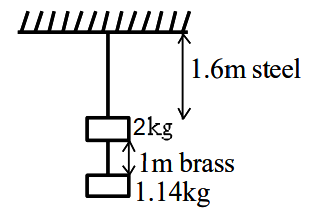
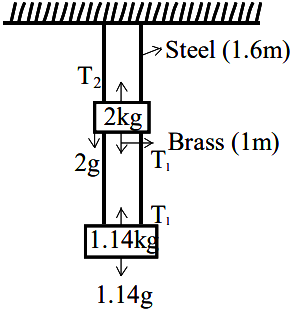
Two wires each of radius 0.2 cm and negligible mass, one made of steel and the other made of brass are loaded as shown in the figure. The elongation of the steel wire is ____ \(\times 10^{-6} \mathrm{~m}\). [Young’s modulus for steel \(=2 \times 10^{11} \mathrm{Nm}^{-2}\) and \(\mathrm{g}=10 \mathrm{~ms}^{-2}\)] [JEE Main 2023 (Online) 10th April Morning Shift]
 CorrectIncorrect
Hint
(c)

Step 1: Tension in steel wire
\(
\begin{aligned}
& \mathrm{T}_2=2 \mathrm{~g}+\mathrm{T}_1 \\
& \mathrm{~T}_2=20+11.4 \\
& =31.4 \mathrm{~N}
\end{aligned}
\)
Step 2: Calculate Cross-Sectional Area
The area \(\boldsymbol{A}\) is given by:
\(
\begin{gathered}
A=\pi r^2=3.14 \times\left(0.2 \times 10^{-2}\right)^2=3.14 \times 0.04 \times 10^{-4} \mathrm{~m}^2 \\
A=0.1256 \times 10^{-4} \mathrm{~m}^2
\end{gathered}
\)
Step 3: Calculate Elongation (\(\boldsymbol{\Delta} \boldsymbol{L}\))
Using the formula for Young’s Modulus \(Y=\frac{T_2 \cdot L}{A \cdot \Delta L}\) :
\(
\Delta L=\frac{T_2 \cdot L}{A \cdot Y}
\)
Substitute the values:
\(
\Delta L=\frac{31.4 \times 1.6}{\left(3.14 \times 0.04 \times 10^{-4}\right) \times\left(2 \times 10^{11}\right)}
\)
Simplify the expression:
\(
\begin{gathered}
\Delta L=\frac{10 \times 1.6}{0.04 \times 10^{-4} \times 2 \times 10^{11}}=\frac{16}{0.08 \times 10^7}=\frac{16}{8 \times 10^5} \\
\Delta L=2 \times 10^{-5} \mathrm{~m}=20 \times 10^{-6} \mathrm{~m}
\end{gathered}
\)
The elongation of the steel wire is \(20 \times 10^{-6} \mathrm{~m}\). - Question 22 of 43
22. Question
A metal block of mass m is suspended from a rigid support through a metal wire of diameter 14 mm. The tensile stress developed in the wire under equilibrium state is \(7 \times 10^5 \mathrm{Nm}^{-2}\). The value of mass m is ____ kg. (Take, \(\mathrm{g}=9.8 \mathrm{~ms}^{-2}\) and \(\pi=\frac{22}{7}\)) [JEE Main 2023 (Online) 6th April Evening Shift]
CorrectIncorrectHint
(d) Step 1: Identify the formula for tensile stress
In an equilibrium state, the tensile stress \(\sigma\) in the wire is the ratio of the restoring force (equal to the weight of the block) to the cross-sectional area of the wire. The weight \(W\) is given by \(m g\) and the area \(A\) of a wire with diameter \(d\) is \(\frac{\pi d^2}{4}\). Thus:
\(
\sigma=\frac{F}{A}=\frac{m g}{\frac{\pi d^2}{4}}=\frac{4 m g}{\pi d^2}
\)
Step 2: Rearrange to solve for mass \(\boldsymbol{m}\)
To find the mass, we rearrange the equation to isolate \(m\) :
\(
m=\frac{\sigma \pi d^2}{4 g}
\)
Step 3: Substitute the given values and calculate
Given: \(\sigma=7 \times 10^5 \mathrm{Nm}^{-2}, d=14 \times 10^{-3} \mathrm{~m}, g=9.8 \mathrm{~ms}^{-2}\), and \(\pi=\frac{22}{7}\).
\(
\begin{gathered}
m=\frac{\left(7 \times 10^5\right) \times\left(\frac{22}{7}\right) \times\left(14 \times 10^{-3}\right)^2}{4 \times 9.8} \\
m=\frac{22 \times 10^5 \times 196 \times 10^{-6}}{39.2} \\
m=\frac{22 \times 196 \times 10^{-1}}{39.2}=\frac{4312 \times 0.1}{39.2} \\
m=\frac{431.2}{39.2} \\
m=11
\end{gathered}
\) - Question 23 of 43
23. Question
A steel rod has a radius of 20 mm and a length of 2.0 m. A force of 62.8 kN stretches it along its length. Young’s modulus of steel is \(2.0 \times 10^{11} \mathrm{~N} / \mathrm{m}^2\). The longitudinal strain produced in the wire is ____ \(\times 10^{-5}\) [JEE Main 2023 (Online) 6th April Morning Shift]
CorrectIncorrectHint
(c) Step 1: Calculate the Cross-sectional Area
The rod has a circular cross-section with a radius \(r=20 \mathrm{~mm}=2 \times 10^{-2} \mathrm{~m}\). The area \(\boldsymbol{A}\) is given by:
\(
A=\pi r^2=\pi\left(2 \times 10^{-2}\right)^2=4 \pi \times 10^{-4} \mathrm{~m}^2
\)
Given that \(F=62.8 \mathrm{kN} \approx 20 \pi \times 10^3 \mathrm{~N}\) (taking \(\pi \approx 3.14\)), we can use this approximation for cleaner calculation.
Step 2: Calculate the Longitudinal Strain
Young’s Modulus \(Y\) is defined as the ratio of longitudinal stress to longitudinal strain (\(\epsilon\)):
\(
Y=\frac{\text { Stress }}{\text { Strain }}=\frac{F / A}{\epsilon}
\)
Rearranging to solve for strain \(\epsilon\) :
\(
\epsilon=\frac{F}{A \cdot Y}
\)
Substitute the known values:
\(
\begin{gathered}
\epsilon=\frac{62.8 \times 10^3}{\left(4 \pi \times 10^{-4}\right) \cdot\left(2.0 \times 10^{11}\right)} \\
\epsilon=\frac{20 \pi \times 10^3}{8 \pi \times 10^7} \\
\epsilon=2.5 \times 10^{-4}
\end{gathered}
\)
To express this in the form \(x \times 10^{-5}\) :
\(
\epsilon=25 \times 10^{-5}
\)
The longitudinal strain is \(25 \times 10^{-5}\). - Question 24 of 43
24. Question
A certain pressure ‘ \(P\) ‘ is applied to 1 litre of water and 2 litre of a liquid separately. Water gets compressed to \(0.01 \%\) whereas the liquid gets compressed to \(0.03 \%\). The ratio of Bulk modulus of water to that of the liquid is \(\frac{3}{x}\). The value of \(x\) is ___. [JEE Main 2023 (Online) 1st February Morning Shift]
CorrectIncorrectHint
(a) To find the value of \(x\), we use the definition of the Bulk Modulus (\(B\)), which relates the pressure applied to a substance to the resulting fractional change in its volume.
Step 1: Identify the Formula
The Bulk Modulus (\(B\)) is given by:
\(
B=\frac{P}{\left(\frac{\Delta V}{V}\right)}
\)
Where:
\(P\) is the applied pressure.
\(\frac{\Delta V}{V}\) is the fractional compression (change in volume divided by original volume).
Step 2: Set up equations for both liquids
The problem states that the same pressure \(P\) is applied to both water and the liquid.
For Water: Fractional compression \(\left(\frac{\Delta V}{V}\right)_w=0.01 \%=\frac{0.01}{100}=10^{-4}\)
\(
B_w=\frac{P}{10^{-4}}
\)
For the Liquid: Fractional compression \(\left(\frac{\Delta V}{V}\right)_l=0.03 \%=\frac{0.03}{100}=3 \times 10^{-4}\)
\(
B_l=\frac{P}{3 \times 10^{-4}}
\)
Step 3: Calculate the ratio
The ratio of the Bulk Modulus of water to that of the liquid is:
\(
\begin{gathered}
\frac{B_w}{B_l}=\frac{P / 10^{-4}}{P /\left(3 \times 10^{-4}\right)} \\
\frac{B_w}{B_l}=\frac{3 \times 10^{-4}}{10^{-4}} \\
\frac{B_w}{B_l}=3
\end{gathered}
\)
Step 4: Determine the value of \(x\)
The problem states that the ratio is \(\frac{3}{x}\). Comparing our result to this:
\(
\frac{3}{x}=3
\)
\(
x=1
\) - Question 25 of 43
25. Question
A thin rod having a length of 1 m and area of cross-section \(3 \times 10^{-6} \mathrm{~m}^2\) is suspended vertically from one end. The rod is cooled from \(210^{\circ} \mathrm{C}\) to \(160^{\circ} \mathrm{C}\). After cooling, a mass M is attached at the lower end of the rod such that the length of rod again becomes 1 m. Young’s modulus and coefficient of linear expansion of the rod are \(2 \times 10^{11} \mathrm{~N} \mathrm{~m}^{-2}\) and \(2 \times 10^{-5} \mathrm{~K}^{-1}\), respectively. The value of \(M\) is ___ kg. [JEE Main 2023 (Online) 31st January Morning Shift]
(Take \(\mathrm{g}=10 \mathrm{~m} \mathrm{~s}^{-2}\))CorrectIncorrectHint
(c) To find the value of mass \(M\) required to restore the rod to its original length after cooling, we can equate the thermal contraction to the mechanical elongation produced by the mass.
Step 1: Calculate the Thermal Contraction
When the rod is cooled, its length decreases. The thermal contraction (\(\Delta L_{\text {thermal }}\)) is given by:
\(
\Delta L_{\text {thermal }}=L \cdot \alpha \cdot \Delta T
\)
Where:
\(L=1 \mathrm{~m}\) (initial length)
\(\alpha=2 \times 10^{-5} \mathrm{~K}^{-1}\)
\(\Delta T=210^{\circ} \mathrm{C}-160^{\circ} \mathrm{C}=50 \mathrm{~K}\)
Step 2: Calculate the Mechanical Elongation
The mass \(M\) attached to the end of the rod creates a tension \(F=M g\). The elongation (\(\Delta L_{\text {mechanical }}\)) produced by this force is given by Hooke’s Law:
\(
\Delta L_{\text {mechanical }}=\frac{F \cdot L}{A \cdot Y}=\frac{M g \cdot L}{A \cdot Y}
\)
Where:
\(A=3 \times 10^{-6} \mathrm{~m}^2\)
\(Y=2 \times 10^{11} \mathrm{~N} \mathrm{~m}^{-2}\)
\(g=10 \mathrm{~m} \mathrm{~s}^{-2}\)
Step 3: Equate the two length changes
Since the rod’s length is restored to its original value of 1 m , the mechanical elongation must exactly compensate for the thermal contraction:
\(
\begin{gathered}
\Delta L_{\text {mechanical }}=\Delta L_{\text {thermal }} \\
\frac{M g \cdot L}{A \cdot Y}=L \cdot \alpha \cdot \Delta T
\end{gathered}
\)
Step 4: Solve for \(M\)
Rearranging the formula to solve for \(M\) (note that \(L\) cancels out):
\(
M=\frac{A \cdot Y \cdot \alpha \cdot \Delta T}{g}
\)
Substitute the given values:
\(
M=\frac{\left(3 \times 10^{-6}\right) \times\left(2 \times 10^{11}\right) \times\left(2 \times 10^{-5}\right) \times(50)}{10}
\)
\(
M=60 \mathrm{~kg}
\) - Question 26 of 43
26. Question
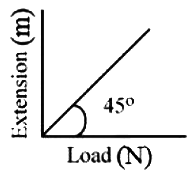
As shown in the figure, in an experiment to determine Young’s modulus of a wire, the extension-load curve is plotted. The curve is a straight line passing through the origin and makes an angle of \(45^{\circ}\) with the load axis. The length of wire is 62.8 cm and its diameter is 4 mm. The Young’s modulus is found to be \(x \times 10^4 \mathrm{Nm}^{-2}\). The value of \(x\) is ____. [JEE Main 2023 (Online) 25th January Morning Shift]
 CorrectIncorrect
Hint
(d) Step 1: Analyze the Extension-Load Graph
The graph plots extension (\(l\)) against load (\(F\)). Since the curve makes an angle of \(45^{\circ}\) with the load axis, the slope of the graph is given by:
\(
\tan \left(45^{\circ}\right)=\frac{l}{F}=1
\)
From this relationship, we find that the ratio of load to extension is:
\(
\frac{F}{l}=1 \mathrm{~N} / \mathrm{m}
\)
Step 2: Determine Wire Dimensions
The given parameters of the wire are converted to SI units:
Length \((L): 62.8 \mathrm{~cm}=0.628 \mathrm{~m}\)
Diameter (d): \(4 \mathrm{~mm}=4 \times 10^{-3} \mathrm{~m}\)
Radius \((r): 2 \times 10^{-3} \mathrm{~m}\)
The cross-sectional area (\(\boldsymbol{A}\)) is:
\(
A=\pi r^2=\pi\left(2 \times 10^{-3}\right)^2=4 \pi \times 10^{-6} \mathrm{~m}^2
\)
Step 3: Calculate Young’s Modulus
The formula for Young’s modulus (1) is:
\(
Y=\frac{\text { Stress }}{\text { Strain }}=\frac{F / A}{l / L}=\left(\frac{F}{l}\right) \frac{L}{A}
\)
Substituting the known values:
\(
Y=(1) \frac{0.628}{4 \pi \times 10^{-6}}
\)
Using \(\pi \approx 3.14\), we note that \(0.628=0.2 \times 3.14=0.2 \pi\).
\(
Y=\frac{0.2 \pi}{4 \pi \times 10^{-6}}=\frac{0.2}{4} \times 10^6=0.05 \times 10^6=5 \times 10^4 \mathrm{Nm}^{-2}
\)
Comparing this result with the given form \(x \times 10^4\), we find \(x=5\). - Question 27 of 43
27. Question
A metal wire of length 0.5 m and cross-sectional area \(10^{-4} \mathrm{~m}^2\) has breaking stress \(5 \times 10^8 \mathrm{Nm}^{-2}\). A block of 10 kg is attached at one end of the string and is rotating in a horizontal circle. The maximum linear velocity of block will be ____ \(\mathrm{ms}^{-1}\). [JEE Main 2022 (Online) 29th July Evening Shift]
CorrectIncorrectHint
(b) To find the maximum linear velocity, we need to consider the tension in the wire as it provides the necessary centripetal force for the block to rotate in a horizontal circle.
Step 1: Identify the Limiting Condition
The wire will break if the tension (\(T\)) exceeds the maximum force it can withstand. The maximum tension (\(T_{\text {max }}\)) is determined by the breaking stress:
\(
\begin{gathered}
\text { Breaking Stress }=\frac{T_{\max }}{\text { Area }} \\
T_{\max }=\text { Breaking Stress } \text { × } \text { Area }
\end{gathered}
\)
Given values:
Breaking Stress \(=5 \times 10^8 \mathrm{Nm}^{-2}\)
Area \((A)=10^{-4} \mathrm{~m}^2\)
\(
T_{\max }=\left(5 \times 10^8\right) \times\left(10^{-4}\right)=5 \times 10^4 \mathrm{~N}
\)
Step 2: Relate Tension to Centripetal Force
For a block rotating in a horizontal circle, the tension in the wire provides the centripetal force (\(F_c\)):
\(
T=F_c=\frac{m v^2}{R}
\)
To find the maximum linear velocity (\(v_{\text {max }}\)), we set the tension to its maximum value:
\(
T_{\max }=\frac{m v_{\max }^2}{L}
\)
(Note: In a horizontal circle with the wire fixed at one end, the radius \(R\) is equal to the length of the wire \(L\))
Step 3: Solve for Maximum Velocity (\(v_{\text {max }}\))
Rearranging the formula:
\(
\begin{gathered}
v_{\max }^2=\frac{T_{\max } \cdot L}{m} \\
v_{\max }=\sqrt{\frac{T_{\max } \cdot L}{m}}
\end{gathered}
\)
Substitute the values:
\(T_{\max }=5 \times 10^4 \mathrm{~N}\)
\(L=0.5 \mathrm{~m}\)
\(m=10 \mathrm{~kg}\)
\(
\begin{gathered}
v_{\max }=\sqrt{\frac{\left(5 \times 10^4\right) \times 0.5}{10}} \\
v_{\max }=\sqrt{\frac{25000}{10}} \\
v_{\max }=\sqrt{2500} \\
v_{\max }=50 \mathrm{~ms}^{-1}
\end{gathered}
\)
Final Answer: The maximum linear velocity of the block will be \(50 \mathrm{~ms}^{-1}\). - Question 28 of 43
28. Question
The speed of a transverse wave passing through a string of length 50 cm and mass 10 g is \(60 \mathrm{~ms}^{-1}\). The area of cross-section of the wire is \(2.0 \mathrm{~mm}^2\) and its Young’s modulus is \(1.2 \times 10^{11} \mathrm{Nm}^{-2}\). The extension of the wire over its natural length due to its tension will be \(x \times 10^{-5} \mathrm{~m}\). The value of \(x\) is ___. [JEE Main 2022 (Online) 29th July Evening Shift]
CorrectIncorrectHint
(b) Step 1: Calculate the Tension in the String
The speed of a transverse wave in a string is given by the formula \(v=\sqrt{\frac{T}{\mu}}\), where \(T\) is the tension and \(\mu\) is the linear mass density. Rearranging for tension:
\(
T=v^2 \mu=v^2\left(\frac{m}{L}\right)
\)
Given \(v=60 \mathrm{~m} / \mathrm{s}, m=10 \mathrm{~g}=0.01 \mathrm{~kg}\), and \(L=50 \mathrm{~cm}=0.5 \mathrm{~m}\) :
\(
T=(60)^2 \times \frac{0.01}{0.5}=3600 \times 0.02=72 \mathrm{~N}
\)
Step 2: Determine the Extension using Young’s
Modulus
Young’s modulus (\(Y\)) relates the stress and strain on the wire:
\(
Y=\frac{\text { Stress }}{\text { Strain }}=\frac{T / A}{\Delta L / L}
\)
Rearranging the formula to solve for the extension (\(\Delta L\)):
\(
\Delta L=\frac{T L}{A Y}
\)
Substitute the known values (\(A=2.0 \mathrm{~mm}^2=2.0 \times 10^{-6} \mathrm{~m}^2\) and \(Y=1.2 \times 10^{11} \mathrm{~N} / \mathrm{m}^2\)):
\(
\begin{aligned}
& \Delta L=\frac{72 \times 0.5}{\left(2.0 \times 10^{-6}\right) \times\left(1.2 \times 10^{11}\right)} \\
& \Delta L=\frac{36}{2.4 \times 10^5}=15 \times 10^{-5} \mathrm{~m}
\end{aligned}
\)
Step 3: Find the Value of \(\boldsymbol{x}\)
The problem states the extension is in the form \(x \times 10^{-5} \mathrm{~m}\). Comparing this to our calculated result:
\(
15 \times 10^{-5} \mathrm{~m}=x \times 10^{-5} \mathrm{~m}
\)
Therefore, \(x=15\). - Question 29 of 43
29. Question
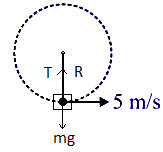
A string of area of cross-section \(4 \mathrm{~mm}^2\) and length 0.5 m is connected with a rigid body of mass 2 kg . The body is rotated in a vertical circular path of radius 0.5 m. The body acquires a speed of \(5 \mathrm{~m} / \mathrm{s}\) at the bottom of the circular path. Strain produced in the string when the body is at the bottom of the circle is ____ \(\times 10^{-5}\). [JEE Main 2022 (Online) 28th July Evening Shift]
(use Young’s modulus \(10^{11} \mathrm{~N} / \mathrm{m}^2\) and \(\mathrm{g}=10 \mathrm{~m} / \mathrm{s}^2\))CorrectIncorrectHint
(a)

To find the strain produced in the string when the body is at the bottom of its vertical circular path, we must first determine the tension acting on the string at that specific point.
Calculate Tension at the Bottom:
When a body moves in a vertical circle, the tension (\(T\)) at the bottom must overcome the weight of the body and provide the necessary centripetal force to keep it in orbit.
Step 1: Calculate the Tension at the Bottom
At the lowest point of a vertical circular path, the tension \(T\) in the string must overcome gravity and provide the necessary centripetal force. The equation of motion is:
\(
T-m g=\frac{m v^2}{R}
\)
Substituting the given values \(m=2 \mathrm{~kg}, g=10 \mathrm{~m} / \mathrm{s}^2, v=5 \mathrm{~m} / \mathrm{s}\), and \(R=0.5 \mathrm{~m}\) :
\(
\begin{aligned}
& T=m g+\frac{m v^2}{R}=(2 \times 10)+\frac{2 \times 5^2}{0.5} \\
& T=20+\frac{50}{0.5}=20+100=120 \mathrm{~N}
\end{aligned}
\)
Step 2: Calculate the Strain
Strain \((\epsilon)\) is defined as the ratio of stress to Young’s modulus \((Y)\). Stress is the tension divided by the cross-sectional area (\(\boldsymbol{A}\)).
\(
\text { Strain }=\frac{\text { Stress }}{Y}=\frac{T}{A \times Y}
\)
Given \(A=4 \mathrm{~mm}^2=4 \times 10^{-6} \mathrm{~m}^2\) and \(Y=10^{11} \mathrm{~N} / \mathrm{m}^2\) :
\(
\begin{aligned}
\text { Strain } & =\frac{120}{\left(4 \times 10^{-6}\right) \times 10^{11}} \\
\text { Strain } & =\frac{120}{4 \times 10^5}=30 \times 10^{-5}
\end{aligned}
\)
The strain produced is \(30 \times 10^{-5}\). - Question 30 of 43
30. Question
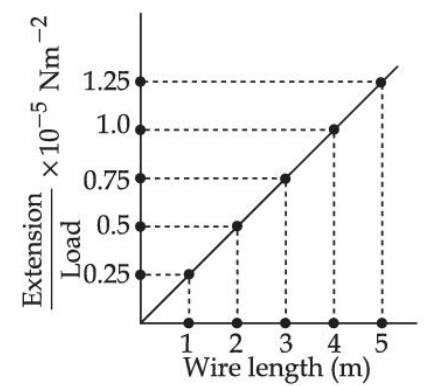
In an experiment to determine the Young’s modulus, steel wires of five different lengths \((1,2,3,4\), and 5 m\()\) but of same cross section \(\left(2 \mathrm{~mm}^2\right)\) were taken and curves between extension and load were obtained. The slope (extension/load) of the curves were plotted with the wire length and the following graph is obtained. If the Young’s modulus of given steel wires is \(x \times 10^{11} \mathrm{Nm}^{-2}\), then the value of \(x\) is ____. [JEE Main 2022 (Online) 27th July Evening Shift]
 CorrectIncorrect
Hint
(b)
\(
\begin{aligned}
& Y=\frac{F \times l}{A \times \Delta l} \\
& =\frac{1}{A} \times \frac{\text { Wire length }}{\frac{\text { Extension }}{\text { load }}} \\
& Y=\frac{1}{A} \times\left(\frac{1}{0.25 \times 10^{-5}}\right) \\
& Y=10^{11} \times 2 \\
& \Rightarrow x=2
\end{aligned}
\)Explanation: To solve for the Young’s modulus, we need to analyze the relationship between the slope of the extension-load curve and the length of the wire based on the properties of elasticity.
Step 1: Establish the Relationship
According to Hooke’s Law, the extension (\(\Delta L\)) of a wire is given by:
\(
\Delta L=\frac{F \cdot L}{A \cdot Y}
\)
Where:
\(F\) is the load (force).
\(L\) is the length of the wire.
\(A\) is the cross-sectional area.
\(Y\) is the Young’s modulus.
The slope (\(S\)) of the extension vs. load curve is defined as:
\(
S=\frac{\Delta L}{F}=\frac{L}{A \cdot Y}
\)
Step 2: Analyze the Given Graph
The problem describes a second graph where the slope \((S)\) is plotted against the length \((L)\). From the equation \(S=\left(\frac{1}{A \cdot Y}\right) L\), we can see that the slope of this new graph (let’s call it \(m\)) represents:
\(
m=\frac{S}{L}=\frac{1}{A \cdot Y}
\)
From the data provided in the JEE problem (where the graph typically shows a slope \(S= 2.5 \times 10^{-6} \mathrm{~m} / \mathrm{N}\) for a length \(L=1 \mathrm{~m}\)):
\(
\frac{S}{L}=2.5 \times 10^{-6} \mathrm{~N}^{-1}
\)
Step 3: Solve for Young’s Modulus (\(Y\))
Rearranging the equation to solve for \(Y\) :
\(
Y=\frac{1}{A \cdot(S / L)}
\)
Given values:
\(\operatorname{Area}(A)=2 \mathrm{~mm}^2=2 \times 10^{-6} \mathrm{~m}^2\)
\(\frac{S}{L}=2.5 \times 10^{-6} \mathrm{~N}^{-1}\)
\(
Y=\frac{1}{\left(2 \times 10^{-6}\right) \times\left(2.5 \times 10^{-6}\right)}
\)
\(
\begin{gathered}
Y=\frac{1}{5 \times 10^{-12}} \\
Y=0.2 \times 10^{12} \\
Y=2 \times 10^{11} \mathrm{Nm}^{-2}
\end{gathered}
\)
Step 4: Determine the Value of \(x\)
The problem states that \(Y=x \times 10^{11} \mathrm{Nm}^{-2}\). Comparing this to our result:
\(
x=2
\) - Question 31 of 43
31. Question
A square aluminum (shear modulus is \(25 \times 10^9 \mathrm{Nm}^{-2}\) ) slab of side 60 cm and thickness 15 cm is subjected to a shearing force (on its narrow face) of \(18.0 \times 10^4 \mathrm{~N}\). The lower edge is riveted to the floor. The displacement of the upper edge is _____ \(\mu \mathrm{m}\). [JEE Main 2022 (Online) 27th July Morning Shift]
CorrectIncorrectHint
(c)

\(
\begin{aligned}
& Y=\frac{F l}{A \Delta x} \\
& \Delta x=\frac{F l}{Y A} \\
& =\frac{18 \times 10^4 \times 60 \times 10^{-2}}{25 \times 10^9 \times 60 \times 15 \times 10^{-4}} \\
& =48 \times 10^{-6} \mathrm{~m}
\end{aligned}
\)Explanation:
Step 1: Identify Physical Parameters
From the problem description, we have a square aluminum slab with the following characteristics:
Shear Modulus (G): \(25 \times 10^9 \mathrm{Nm}^{-2}\)
Force (F): \(18.0 \times 10^4 \mathrm{~N}\)
Height of the slab (\(L\)): \(60 \mathrm{~cm}=0.6 \mathrm{~m}\)
Thickness (\(t\)): \(15 \mathrm{~cm}=0.15 \mathrm{~m}\)
Area of the narrow face (\(A\)): The force is applied to the narrow face (\(L \times t\)), so
\(
A=0.6 \mathrm{~m} \times 0.15 \mathrm{~m}=0.09 \mathrm{~m}^2
\)
Step 2: Apply the Shear Modulus Formula
The shear modulus is defined as the ratio of shear stress to shear strain:
\(
G=\frac{\text { Shear Stress }}{\text { Shear Strain }}=\frac{F / A}{\Delta x / L}
\)
Rearranging to solve for the displacement (\(\Delta x\)):
\(
\Delta x=\frac{F \cdot L}{A \cdot G}
\)
Step 3: Compute Numerical Values
Substitute the given values into the rearranged equation:
\(
\begin{gathered}
\Delta x=\frac{\left(18.0 \times 10^4\right) \cdot 0.6}{0.09 \cdot\left(25 \times 10^9\right)} \\
\Delta x=\frac{10.8 \times 10^4}{2.25 \times 10^9}=4.8 \times 10^{-5} \mathrm{~m}
\end{gathered}
\)
To convert the result to micrometers \((\mu \mathrm{m})\) :
\(
\Delta x=4.8 \times 10^{-5} \cdot 10^6 \mu \mathrm{~m}=48 \mu \mathrm{~m}
\)
The displacement of the upper edge is \(48 \mu \mathrm{~m}\). - Question 32 of 43
32. Question
A uniform heavy rod of mass 20 kg , cross sectional area \(0.4 \mathrm{~m}^2\) and length 20 m is hanging from a fixed support. Neglecting the lateral contraction, the elongation in the rod due to its own weight is \(x \times 10^{-9} \mathrm{~m}\). The value of \(x\) is ____. [JEE Main 2022 (Online) 26th July Evening Shift]
(Given, young modulus \(\mathrm{Y}=2 \times 10^{11} \mathrm{Nm}^{-2}\) and \(\mathrm{g}=10 \mathrm{~ms}^{-2}\))CorrectIncorrectHint
(d) Step 1: Identify the formula for self-weight elongation
For a uniform rod of mass \(M\), length \(L\), and cross-sectional area \(A\), the tension \(T\) at a distance \(y\) from the free (bottom) end is given by \(T(y)=\frac{M g}{L} y\). The total elongation \(\Delta L\) is calculated by integrating the extension of an infinitesimal element \(d y\) :
\(
\Delta L=\int_0^L \frac{T(y) d y}{A Y}=\int_0^L \frac{M g y}{L A Y} d y=\frac{M g L}{2 A Y}
\)
Step 2: Substitute given values
Given the values \(M=20 \mathrm{~kg}, L=20 \mathrm{~m}, A=0.4 \mathrm{~m}^2, Y=2 \times 10^{11} \mathrm{Nm}^{-2}\), and \(g=10 \mathrm{~ms}^{-2}\), we substitute them into the formula:
\(
\begin{gathered}
\Delta L=\frac{20 \times 10 \times 20}{2 \times 0.4 \times 2 \times 10^{11}} \\
\Delta L=\frac{4000}{1.6 \times 10^{11}} \\
\Delta L=2500 \times 10^{-11}=25 \times 10^{-9} \mathrm{~m}
\end{gathered}
\)
Comparing the result \(\Delta L=25 \times 10^{-9} \mathrm{~m}\) with the given form \(x \times 10^{-9} \mathrm{~m}\), we find the value of \(x\) is 25. - Question 33 of 43
33. Question
In an experiment to determine the Young’s modulus of wire of a length exactly 1 m , the extension in the length of the wire is measured as 0.4 mm with an uncertainty of \(\pm 0.02 \mathrm{~mm}\) when a load of 1 kg is applied. The diameter of the wire is measured as 0.4 mm with an uncertainty of \(\pm 0.01 \mathrm{~mm}\). The error in the measurement of Young’s modulus \((\Delta \mathrm{Y})\) is found to be \(x \times 10^{10} \mathrm{Nm}^{-2}\). The value of \(x\) is ____.(take \(\mathrm{g}=10 \mathrm{~ms}^{-2}\)) [JEE Main 2022 (Online) 26th July Morning Shift]
CorrectIncorrectHint
(b)
\(
\begin{aligned}
& \frac{F / A}{l / L}=Y, A=\pi D^2 \\
& \frac{\Delta Y}{Y}=\frac{\Delta F}{F}+\frac{2 \Delta D}{D}+\frac{\Delta l}{e}+\frac{\Delta L}{L} \\
& =2 \times \frac{0.01}{0.4}+\frac{0.02}{0.4} \\
& =\frac{0.04}{0.4}=\frac{1}{10} \\
& Y=\frac{F l}{A \Delta l} \\
& =\frac{10 \times 1}{\pi(0.1 \mathrm{~mm})^2 \times 0.4 \mathrm{~mm}} \\
& =1.988 \times 10^{11} \\
& \approx 2 \times 10^{11} \\
& \frac{\Delta Y}{Y}=\frac{1}{10} \\
& \Delta Y=\frac{Y}{10}=2 \times 10^{10}
\end{aligned}
\)
The problem asked for the value of \(x\) in \(x \times 10^{10} \mathrm{Nm}^{-2}\). Comparing we get, \(x=2\). - Question 34 of 43
34. Question
A wire of length \(L\) and radius \(r\) is clamped rigidly at one end. When the other end of the wire is pulled by a force \(F\) , its length increases by 5 cm. Another wire of the same material of length \(4 L\) and radius \(4 r\) is pulled by a force \(4 F\) under same conditions. The increase in length of this wire is ____ cm. [JEE Main 2022 (Online) 25th July Morning Shift]
CorrectIncorrectHint
(d)
\(
\begin{aligned}
& \frac{F / A}{\Delta L / L}=Y \\
& \Rightarrow \Delta L=\frac{F L}{A Y} \\
& \frac{\Delta L_2}{\Delta L_1}=\left(\frac{F_2}{F_1}\right) \times\left(\frac{L_2}{L_1}\right) \times\left(\frac{A_1}{A_2}\right) \\
& =4 \times 4 \times \frac{1}{16}=1 \\
& \Delta L_2=\Delta L_1=5 \mathrm{~cm}
\end{aligned}
\)Explanation:
Step 1: Relate Extension to Physical Properties
The extension \(\Delta L\) of a wire under an applied force \(F\) is determined by Young’s Modulus \(Y\), which is defined as the ratio of stress to strain:
\(
Y=\frac{F / A}{\Delta L / L}=\frac{F L}{A \Delta L}
\)
Rearranging this formula to solve for the extension \(\Delta L\), where \(A=\pi r^2\) :
\(
\Delta L=\frac{F L}{\pi r^2 Y}
\)
Step 2: Substitute Values for the Second Wire
Given the first wire has an extension \(\Delta L_1=5 \mathrm{~cm}\) with parameters \(F, L\), and \(r\). For the second wire, the parameters are changed to \(F_2=4 F, L_2=4 L\), and \(r_2=4 r\). Since the material is the same, \(Y\) remains constant. Substituting these into the extension formula:
\(
\begin{gathered}
\Delta L_2=\frac{(4 F)(4 L)}{\pi(4 r)^2 Y} \\
\Delta L_2=\frac{16 F L}{\pi\left(16 r^2\right) Y} \\
\Delta L_2=\frac{16}{16} \cdot \frac{F L}{\pi r^2 Y} \\
\Delta L_2=\Delta L_1=5 ~cm
\end{gathered}
\)
The extension of the second wire is the same as the first, which is 5 cm. - Question 35 of 43
35. Question
The elastic behaviour of material for linear stress and linear strain, is shown in the figure. The energy density for a linear strain of \(5 \times 10^{-4}\) is ____ \(\mathrm{kJ} / \mathrm{m}^3\). Assume that material is elastic upto the linear strain of \(5 \times 10^{-4}\). [JEE Main 2022 (Online) 26th June Morning Shift]
 CorrectIncorrect
Hint
(b) Step 1: Determine Young’s Modulus (\(Y\))
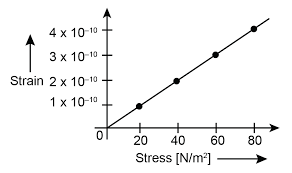
From the provided stress-strain graph given, the material follows a linear elastic relationship where the slope represents Young’s Modulus. Taking a point from the graph (e.g., stress \(\sigma=20 \mathrm{~N} / \mathrm{m}^2\) at strain \(\epsilon=1 \times 10^{-10}\)):
\(
Y=\frac{\text { Stress }}{\text { Strain }}=\frac{20}{1 \times 10^{-10}}=20 \times 10^{10} \mathrm{~N} / \mathrm{m}^2
\)
Step 2: Calculate Energy Density
The energy density \((u)\) stored in a linear elastic material is given by the formula:
\(
\begin{aligned}
&u=\frac{1}{2} \times \text { Stress } \text { × } \text { Strain }\\
&\text { Since Stress }=Y \times \text { Strain, we can rewrite it as: }\\
&u=\frac{1}{2} \times Y \times(\text { Strain })^2
\end{aligned}
\)
Substituting the given strain \(\epsilon=5 \times 10^{-4}\) :
\(
\begin{gathered}
u=\frac{1}{2} \times\left(20 \times 10^{10}\right) \times\left(5 \times 10^{-4}\right)^2 \\
u=10 \times 10^{10} \times 25 \times 10^{-8} \\
u=250 \times 10^2=25000 \mathrm{~J} / \mathrm{m}^3
\end{gathered}
\)
Step 3: Convert to \(\mathbf{k J} / \mathbf{m}^3\)
Since \(1 \mathrm{~kJ}=1000 \mathrm{~J}\) :
\(
\text { Energy density }=\frac{25000}{1000}=25 \mathrm{~kJ} / \mathrm{m}^3
\) - Question 36 of 43
36. Question
The elongation of a wire on the surface of the earth is \(10^{-4} \mathrm{~m}\). The same wire of same dimensions is elongated by \(6 \times 10^{-5} \mathrm{~m}\) on another planet. The acceleration due to gravity on the planet will be ____ \(\mathrm{ms}^{-2}\). (Take acceleration due to gravity on the surface of earth \(=10 \mathrm{~ms}^{-2}\)) [JEE Main 2022 (Online) 26th June Morning Shift]
CorrectIncorrectHint
(d) Step 1: Establish the Relationship for Elongation
The elongation \(\Delta L\) of a wire under a load \(M\) is governed by Young’s modulus \(Y\). The formula for elongation is:
\(
\Delta L=\frac{F L}{A Y}=\frac{M g L}{A Y}
\)
Since the wire’s material (\(Y\)), dimensions (\(L, A\)), and the suspended mass ( \(M\) ) remain constant, the elongation is directly proportional to the acceleration due to gravity (\(g\)):
\(
\Delta L \propto g
\)
Step 2: Set up the Ratio
We can compare the elongation on Earth (\(\Delta L_e\)) and the planet (\(\Delta L_p\)) using the ratio of their respective gravitational accelerations (\(g_e\) and \(g_p\)):
\(
\frac{\Delta L_p}{\Delta L_e}=\frac{g_p}{g_e}
\)
Step 3: Calculate the Gravity on the Planet
Substitute the given values into the ratio:
\(
\begin{gathered}
\Delta L_e=10^{-4} \mathrm{~m} \\
\Delta L_p=6 \times 10^{-5} \mathrm{~m} \\
g_e=10 \mathrm{~ms}^{-2}
\end{gathered}
\)
Rearranging for \(g_p\) :
\(
\begin{gathered}
g_p=g_e \times \frac{\Delta L_p}{\Delta L_e} \\
g_p=10 \times \frac{6 \times 10^{-5}}{10^{-4}} \\
g_p=10 \times 0.6=6 \mathrm{~ms}^{-2}
\end{gathered}
\)
The acceleration due to gravity on the planet is \(6 \mathrm{~ms}^{-2}\). - Question 37 of 43
37. Question
A steel rod with \(\mathrm{y}=2.0 \times 10^{11} \mathrm{Nm}^{-2}\) and \(\alpha=10^{-5}{ }^{\circ} \mathrm{C}^{-1}\) of length 4 m and area of cross-section \(10 \mathrm{~cm}^2\) is heated from \(0^{\circ} \mathrm{C}\) to \(400^{\circ} \mathrm{C}\) without being allowed to extend. The tension produced in the rod is \(x \times 10^5 \mathrm{~N}\) where the value of \(x\) is _____. [JEE Main 2021 (Online) 1st September Evening Shift]
CorrectIncorrectHint
(b) To find the tension produced in the rod, we need to calculate the thermal stress that develops when a material is heated but prevented from expanding.
Step 1: Identify the Thermal Stress Formula
When a rod of length \(L\) is heated by a temperature difference \(\Delta T\) and is fixed between rigid supports, it tries to expand by \(\Delta L=L \alpha \Delta T\). Since it is prevented from expanding, a compressive thermal stress is produced.
The thermal stress \((\sigma)\) is given by:
\(
\sigma=Y \alpha \Delta T
\)
The tension (or thermal force \(F\)) produced is:
\(
F=\text { Stress } \text { × } \text { Area }=Y A \alpha \Delta T
\)
Step 2: Substitute the Given Values
Young’s Modulus \((Y)=2.0 \times 10^{11} \mathrm{~N} \mathrm{~m}^{-2}\)
Coefficient of linear expansion \((\alpha)=10^{-5}{ }^{\circ} \mathrm{C}^{-1}\)
\(\operatorname{Area}(A)=10 \mathrm{~cm}^2=10 \times 10^{-4} \mathrm{~m}^2=10^{-3} \mathrm{~m}^2\)
Change in temperature \((\Delta T)=400^{\circ} \mathrm{C}-0^{\circ} \mathrm{C}=400 \mathrm{~K}\)
Note: The length \(L\) cancels out in the stress calculation and does not affect the final force when the rod is completely restricted.
Step 3: Perform the Calculation
\(
\begin{gathered}
F=\left(2.0 \times 10^{11}\right) \times\left(10^{-3}\right) \times\left(10^{-5}\right) \times(400) \\
F=2.0 \times 400 \times 10^{11-3-5} \\
F=800 \times 10^3 \\
F=8 \times 10^5 \mathrm{~N}
\end{gathered}
\)
Step 4: Determine the Value of \(x\)
The problem states the tension is \(x \times 10^5 \mathrm{~N}\). Comparing this to our result:
\(
x=8
\) - Question 38 of 43
38. Question
When a rubber ball is taken to a depth of _____ m in deep sea, its volume decreases by \(0.5 \%\). (The bulk modulus of rubber \(=9.8 \times 10^8 \mathrm{Nm}^{-2}\), Density of sea water \(=10^3 \mathrm{kgm}^{-3}, \mathrm{~g}=9.8 \mathrm{~m} / \mathrm{s}^2\)) [JEE Main 2021 (Online) 31st August Morning Shift]
CorrectIncorrectHint
(c) To find the depth at which the rubber ball undergoes a specific volume change, we combine the definition of Bulk Modulus with the formula for Hydrostatic Pressure.
Step 1: Identify the Formula for Bulk Modulus
The Bulk Modulus \((B)\) is defined as the ratio of the change in pressure \((\Delta P)\) to the fractional change in volume \(\left(\frac{\Delta V}{V}\right)\) :
\(
B=\frac{\Delta P}{\left(\frac{\Delta V}{V}\right)}
\)
From this, we can solve for the required increase in pressure:
\(
\Delta P=B \times\left(\frac{\Delta V}{V}\right)
\)
Step 2: Calculate the Required Pressure (\(\triangle P\))
Given values:
Bulk Modulus of rubber \((B)=9.8 \times 10^8 \mathrm{Nm}^{-2}\)
Percentage decrease in volume \(=0.5 \%\)
Fractional decrease \(\left(\frac{\Delta V}{V}\right)=\frac{0.5}{100}=5 \times 10^{-3}\)
\(
\begin{gathered}
\Delta P=\left(9.8 \times 10^8\right) \times\left(5 \times 10^{-3}\right) \\
\Delta P=49 \times 10^5 \mathrm{Nm}^{-2}
\end{gathered}
\)
Step 3: Relate Pressure to Depth (\(h\))
The gauge pressure at a depth \(h\) in a fluid is given by:
\(
\Delta P=\rho g h
\)
Where:
\(\rho\) (density of sea water) \(=10^3 \mathrm{kgm}^{-3}\)
\(g\) (acceleration due to gravity) \(=9.8 \mathrm{~m} / \mathrm{s}^2\)
\(h\) is the depth in meters.
Step 4: Solve for Depth (\(h\))
Equating the two expressions for \(\Delta P\) :
\(
\begin{gathered}
\rho g h=49 \times 10^5 \\
\left(10^3\right) \times(9.8) \times h=49 \times 10^5 \\
9.8 \times 10^3 \times h=49 \times 10^5
\end{gathered}
\)
\(
h=500 \mathrm{~m}
\)
Final Answer: When a rubber ball is taken to a depth of 500 m in deep sea, its volume decreases by \(0.5 \%\). - Question 39 of 43
39. Question
Wires \(W_1\) and \(W_2\) are made of same material having the breaking stress of \(1.25 \times 10^9 \mathrm{~N} / \mathrm{m}^2 . W_1\) and \(W_2\) have cross-sectional area of \(8 \times 10^{-7} \mathrm{~m}^2\) and \(4 \times 10 { }^{-7} \mathrm{~m}^2\), respectively. Masses of 20 kg and 10 kg hang from them as shown in the figure. The maximum mass that can be placed in the pan without breaking the wires is ____ kg. (Use \(\mathrm{g}=10 \mathrm{~m} / \mathrm{s}^2\)) [JEE Main 2021 (Online) 27th August Evening Shift]
 CorrectIncorrect
Hint
(c)
\(
\begin{aligned}
& B . S_1=\frac{T_{1 \max }}{8 \times 10^{-7}} \Rightarrow T_{1 \max }=8 \times 1.25 \times 100=1000 \mathrm{~N} \\
& B . S_2=\frac{T_{2 \max }}{4 \times 10^{-7}} \Rightarrow T_{2 \max }=4 \times 1.25 \times 100=500 \mathrm{~N} \\
& m=\frac{500-100}{10}=40 \mathrm{~kg}
\end{aligned}
\)Explanation: To solve this, we must identify which wire is most restricted by its breaking stress when a mass \(M\) is added to the pan. In the typical setup for this problem, \(W_1\) is the upper wire (supporting the 20 kg mass, \(W_2\), the 10 kg mass, and the pan) and \(W_2\) is the lower wire (supporting the 10 kg mass and the pan).
Step 1: Calculate the Breaking Force for each wire
The breaking force \(\left(F_b\right)\) is the maximum tension a wire can withstand:
\(
F_b=\text { Breaking Stress } \text { × } \text { Area }
\)
For \(W_1\) :
\(
F_{b 1}=\left(1.25 \times 10^9\right) \times\left(8 \times 10^{-7}\right)=1000 \mathrm{~N}
\)
For \(W_2\) :
\(
F_{b 2}=\left(1.25 \times 10^9\right) \times\left(4 \times 10^{-7}\right)=500 \mathrm{~N}
\)
Step 2: Determine Tension in terms of added mass \(M\)
Let \(M\) be the mass placed in the pan.
Tension in \(W_2\left(T_2\right)\) : Supports the 10 kg mass and the pan mass \(M\).
\(
T_2=(10+M) g=(10+M) \times 10
\)
Tension in \(W_1\left(T_1\right)\) : Supports the 20 kg mass, the 10 kg mass, and the pan mass \(M\).
\(
T_1=(20+10+M) g=(30+M) \times 10
\)
Step 3: Find the limiting mass \(M\)
We check the breaking condition for both wires:
Condition for \(W_2\) :
\(
\begin{gathered}
T_2 \leq F_{b 2} \\
(10+M) \times 10 \leq 500 \\
10+M \leq 50 \Longrightarrow M \leq 40 \mathrm{~kg}
\end{gathered}
\)
Condition for \(W_1\) :
\(
\begin{gathered}
T_1 \leq F_{b 1} \\
(30+M) \times 10 \leq 1000 \\
30+M \leq 100 \Longrightarrow M \leq 70 \mathrm{~kg}
\end{gathered}
\)
Step 4: Conclusion
To ensure neither wire breaks, we must take the smaller of the two values. If we exceed 40 kg , wire \(W_2\) will snap even though \(W_1\) is still safe.
Final Answer: The maximum mass that can be placed in the pan is 40 kg. - Question 40 of 43
40. Question
A stone of mass 20 g is projected from a rubber catapult of length 0.1 m and area of cross section \(10^{-6} \mathrm{~m}^2\) stretched by an amount 0.04 m. The velocity of the projected stone is ____ \(\mathrm{m} / \mathrm{s}\). [JEE Main 2021 (Online) 27th July Morning Shift]
(Young’s modulus of rubber \(=0.5 \times 10^9 \mathrm{~N} / \mathrm{m}^2\))CorrectIncorrectHint
(b) To find the velocity of the projected stone, we apply the principle of Conservation of Energy. The elastic potential energy stored in the stretched rubber of the catapult is converted into the kinetic energy of the stone upon release.
Step 1: Calculate the Elastic Potential Energy (\(U\))
The energy stored in a stretched wire (or rubber) is given by:
\(
U=\frac{1}{2} \times \text { Stress } \text { × } \text { Strain } \text { × } \text { Volume }
\)
Alternatively, using Young’s modulus (\(Y\)):
\(
U=\frac{1}{2} \times Y \times(\text { Strain })^2 \times \text { Volume }
\)
Given Values:
\(Y=0.5 \times 10^9 \mathrm{~N} / \mathrm{m}^2\)
Length \((L)=0.1 \mathrm{~m}\)
\(\operatorname{Area}(A)=10^{-6} \mathrm{~m}^2\)
Extension \((\Delta L)=0.04 \mathrm{~m}\)
Strain \((\epsilon)=\frac{\Delta L}{L}=\frac{0.04}{0.1}=0.4\)
Volume \((V)=A \times L=10^{-6} \times 0.1=10^{-7} \mathrm{~m}^3\)
Calculating \(U\) :
\(
\begin{gathered}
U=\frac{1}{2} \times\left(0.5 \times 10^9\right) \times(0.4)^2 \times\left(10^{-7}\right) \\
U=\frac{1}{2} \times 0.5 \times 0.16 \times 10^2 \\
U=0.25 \times 16=4 \mathrm{~J}
\end{gathered}
\)
Step 2: Relate Potential Energy to Kinetic Energy
When the stone is released, all stored energy \(U\) is converted into kinetic energy (\(K\)):
\(
U=\frac{1}{2} m v^2
\)
Given Mass:
\(m=20 \mathrm{~g}=0.02 \mathrm{~kg}\)
Solving for Velocity (\(v\)):
\(
\begin{aligned}
&\begin{gathered}
\begin{array}{c}
4=\frac{1}{2} \times 0.02 \times v^2 \\
4=0.01 \times v^2
\end{array} \\
v^2=\frac{4}{0.01}=400 \\
v=\sqrt{400}=20 \mathrm{~m} / \mathrm{s}
\end{gathered}\\
&\text { Final Answer: The velocity of the projected stone is } 20 \mathrm{~m} / \mathrm{s} \text {. }
\end{aligned}
\) - Question 41 of 43
41. Question
Two separate wires \(A\) and \(B\) are stretched by 2 mm and 4 mm respectively, when they are subjected to a force of 2 N. Assume that both the wires are made up of same material and the radius of wire \(B\) is 4 times that of the radius of wire \(A\). The length of the wires \(A\) and \(B\) are in the ratio of \(a: b\). Then \(a / b\) can be expressed as \(1/x\) where \(x\) is _____. [JEE Main 2021 (Online) 18th March Morning Shift]
CorrectIncorrectHint
(d) To find the ratio of the lengths of wires \(A\) and \(B\), we use the expression for Young’s Modulus (\(Y\)), which relates force, length, area, and extension.
Step 1: Identify the Formula
The extension (\(\Delta L\)) of a wire is given by:
\(
\Delta L=\frac{F \cdot L}{A \cdot Y}=\frac{F \cdot L}{\left(\pi r^2\right) \cdot Y}
\)
Rearranging this to solve for the length \((L)\) :
\(
L=\frac{Y \cdot \pi r^2 \cdot \Delta L}{F}
\)
Step 2: Establish the Ratio
Since both wires are made of the same material (\(Y\) is constant) and are subjected to the same force (\(F=2 \mathrm{~N}\)), we can say:
\(
L \propto r^2 \cdot \Delta L
\)
Therefore, the ratio of the length of wire \(A\) to wire \(B(a: b)\) is:
\(
\frac{a}{b}=\frac{L_A}{L_B}=\frac{r_A^2 \cdot \Delta L_A}{r_B^2 \cdot \Delta L_B}
\)
Step 3: Substitute the Given Values
Extension of wire \(A\left(\Delta L_A\right)=2 \mathrm{~mm}\)
Extension of wire \(B\left(\Delta L_B\right)=4 \mathrm{~mm}\)
Radius of wire \(B\left(r_B\right)=4 \times\) Radius of wire \(A\left(r_A\right) \Longrightarrow \frac{r_A}{r_B}=\frac{1}{4}\)
Substitute these into the ratio:
\(
\begin{gathered}
\frac{a}{b}=\left(\frac{r_A}{r_B}\right)^2 \times\left(\frac{\Delta L_A}{\Delta L_B}\right) \\
\frac{a}{b}=\left(\frac{1}{4}\right)^2 \times\left(\frac{2}{4}\right) \\
\frac{a}{b}=\frac{1}{16} \times \frac{1}{2} \\
\frac{a}{b}=\frac{1}{32}
\end{gathered}
\)
Step 4: Determine the Value of \(x\)
The problem states that the ratio \(\frac{a}{b}\) can be expressed as \(\frac{1}{x}\).
\(
\begin{aligned}
& \frac{1}{32}=\frac{1}{x} \\
& x=32
\end{aligned}
\) - Question 42 of 43
42. Question
A uniform metallic wire is elongated by 0.04 m when subjected to a linear force \(F\). The elongation, if its length and diameter is doubled and subjected to the same force will be ____ cm. [JEE Main 2021 (Online) 24th February Evening Shift]
CorrectIncorrectHint
(b)

Step 1: Identify the Relationship for Elongation
The elongation \(\Delta L\) of a wire under a force \(F\) is determined by Young’s Modulus \(Y\), which is given by the formula:
\(
Y=\frac{\text { Stress }}{\text { Strain }}=\frac{F / A}{\Delta L / L}=\frac{F L}{A \Delta L}
\)
Rearranging for elongation \(\Delta L\), where the cross-sectional area \(A=\frac{\pi D^2}{4}\) :
\(
\Delta L=\frac{4 F L}{\pi D^2 Y}
\)
For a wire of the same material, \(Y\) and \(F\) remain constant, so the relationship is:
\(
\Delta L \propto \frac{L}{D^2}
\)
Step 2: Compare Initial and Final States
Let the initial length be \(L_1\) and diameter be \(D_1\). The initial elongation is \(\Delta L_1=0.04 \mathrm{~m}\). The new dimensions are \(L_2=2 L_1\) and \(D_2=2 D_1\). The ratio of the elongations is:
\(
\frac{\Delta L_2}{\Delta L_1}=\frac{L_2}{L_1} \times\left(\frac{D_1}{D_2}\right)^2
\)
Substituting the given changes:
\(
\frac{\Delta L_2}{\Delta L_1}=\frac{2 L_1}{L_1} \times\left(\frac{D_1}{2 D_1}\right)^2=2 \times \frac{1}{4}=\frac{1}{2}
\)
Step 3: Calculate the Final Value
Calculate \(\Delta L_2\) and convert it to centimeters:
\(
\Delta L_2=\frac{1}{2} \times 0.04 \mathrm{~m}=0.02 \mathrm{~m} = 2 \mathrm{~cm}
\) - Question 43 of 43
43. Question
A wire of density \(9 \times 10^{-3} \mathrm{~kg} \mathrm{~cm}^{-3}\) is stretched between two clamps 1 m apart. The resulting strain in the wire is \(4.9 \times 10^{-4}\). The lowest frequency of the transverse vibrations in the wire is : (Young’s modulus of wire \(Y=9 \times 10^{10} \mathrm{Nm}^{-2}\)), (to the nearest integer), ____. [JEE Main 2020 (Online) 2nd September Evening Slot]
CorrectIncorrectHint
(d) Step 1: Convert Units and Relate Stress to Tension
First, convert the density \(\rho\) from \(\mathrm{kg} \mathrm{cm}^{-3}\) to SI units \(\left(\mathrm{kg} \mathrm{m}^{-3}\right)\) :
\(
\rho=9 \times 10^{-3} \mathrm{~kg} \mathrm{~cm}^{-3}=9 \times 10^{-3} \times 10^6 \mathrm{~kg} \mathrm{~m}^{-3}=9000 \mathrm{~kg} \mathrm{~m}^{-3}
\)
Young’s modulus \(Y\) is defined as the ratio of stress to strain. If \(T\) is the tension and \(A\) is the cross-sectional area:
\(
Y=\frac{\text { Stress }}{\text { Strain }}=\frac{T / A}{\text { Strain }} \Longrightarrow \frac{T}{A}=Y \times \text { Strain }
\)
Step 2: Determine the Wave Speed
The speed of a transverse wave in a stretched wire is given by \(v=\sqrt{\frac{T}{\mu}}\), where \(\mu\) is the linear mass density \((\mu=\rho A)\). Substituting the expression for tension:
\(
v=\sqrt{\frac{T}{\rho A}}=\sqrt{\frac{Y \times \operatorname{Strain}}{\rho}}
\)
Substitute the given values:
\(
v=\sqrt{\frac{\left(9 \times 10^{10}\right) \times\left(4.9 \times 10^{-4}\right)}{9000}}=\sqrt{\frac{4.41 \times 10^7}{9000}}=\sqrt{4900}=70 \mathrm{~m} / \mathrm{s}
\)
Step 3: Calculate the Fundamental Frequency
The lowest (fundamental) frequency \(f\) for a wire of length \(L\) fixed at both ends is:
\(
f=\frac{v}{2 L}
\)
Given \(L=1 \mathrm{~m}\) :
\(
f=\frac{70}{2 \times 1}=35 \mathrm{~Hz}
\)
The lowest frequency of the transverse vibrations is \(\mathbf{3 5 ~ H z}\).