1.2 The international system of units
System of units
A complete set of units which is used to measure all kinds of fundamental and derived quantities is called a system of units.
Some of the commonly used systems of units are as follows:
- CGS system: In this system, the units of length, mass and time are centimetre (cm), gram (g) and second (s), respectively. The unit of force in this system is dyne and that of work or energy is erg.
- FPS system: In this system, the units of length, mass and time are foot (ft), pound (lb) and second (s), respectively. The unit of force in this system is poundal.
- MKS system: In this system, the units of length, mass and time are metre (m), kilogram (kg) and second (s), respectively. The unit of force in this system is newton (N) and that of work or energy is joule (J).
- International system (SI): This system of units helps in revolutionary changes over the MKS system and is known as rationalised MKS system. It is helpful to obtain all the physical quantities in physics.
System of Units:
\(\begin{array}{|c|c|c|c|c|c|}\hline & \text { MKS } & \text { CGS } & \text { FPS } & \text { MKSQ } & \text { MKSA } \\
\hline \text { (i) } & \begin{array}{c}
\text { Length } \\
(\mathrm{m})
\end{array} & \begin{array}{c}
\text { Length } \\
(\mathrm{cm})
\end{array} & \begin{array}{c}
\text { Length } \\
(\mathrm{ft})
\end{array} & \begin{array}{c}
\text { Length } \\
(\mathrm{m})
\end{array} & \begin{array}{c}
\text { Length } \\
(\mathrm{m})
\end{array} \\
\hline \text { (ii) } & \begin{array}{c}
\text { Mass } \\
(\mathrm{kg})
\end{array} & \begin{array}{c}
\text { Mass } \\
(\mathrm{g})
\end{array} & \begin{array}{c}
\text { Mass } \\
(\text { pound })
\end{array} & \begin{array}{c}
\text { Mass } \\
(\mathrm{kg})
\end{array} & \begin{array}{c}
\text { Mass } \\
(\mathrm{kg})
\end{array} \\
\hline \text { (iii) } & \begin{array}{c}
\text { Time } \\
(\mathrm{s})
\end{array} & \begin{array}{c}
\text { Time } \\
(\mathrm{s})
\end{array} & \begin{array}{c}
\text { Time } \\
(\mathrm{s})
\end{array} & \begin{array}{c}
\text { Time } \\
(\mathrm{s})
\end{array} & \begin{array}{c}
\text { Time } \\
(\mathrm{s})
\end{array} \\
\hline \text { (iv) } & – & – & – & \begin{array}{c}
\text { Charge } \\
(\mathrm{Q})
\end{array} & \begin{array}{c}
\text { Current } \\
(\mathrm{A})
\end{array} \\
\hline
\end{array}\)
SI Prefixes:
| Power of 10 | Prefix | Symbol |
| 18 | exa | E |
| 15 | peta | p |
| 12 | tera | T |
| 9 | giga | G |
| 6 | mega | M |
| 3 | kilo | k |
| 2 | hecto | h |
| 1 | deca | da |
| -1 | deci | d |
| -2 | centi | c |
| -3 | milli | m |
| -6 | micro | μ |
| -9 | nano | n |
| -12 | pico | p |
| -15 | femto | f |
| -18 | atto | a |
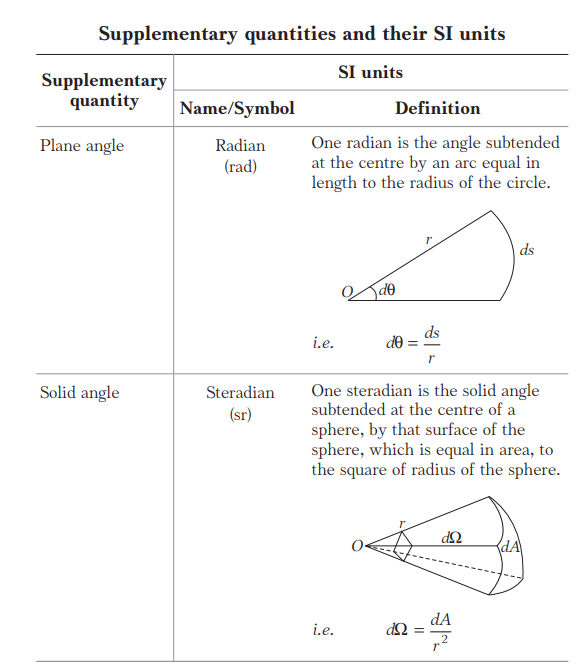
Supplementary quantities and supplementary units
Other than fundamental and derived quantities, there are two more quantities called as supplementary quantities. The units of these quantities are known as supplementary units.
Measurement of Length
You are already familiar with some direct methods for the measurement of length. For example, a metre scale is used for lengths from \(10^{-3} \mathrm{~m}\) to \(10^{2}\) m. A vernier callipers is used for lengths to an accuracy of \(10^{-4} \mathrm{~m}\). A screw gauge and a spherometer can be used to measure lengths as less as to \(10^{-5} \mathrm{~m}\). To measure lengths beyond these ranges, we make use of some special indirect methods.
Large distances such as the distance of a planet or a star from the earth cannot be measured directly with a metre scale. An important method in such cases is the parallax method.
To measure the distance \(D\) of a faraway planet \(S\) by the parallax method, we observe it from two different positions (observatories) A and \(\mathrm{B}\) on the Earth, separated by distance \(\mathrm{AB}=b\) at the same time as shown in Fig. 2.2. We measure the angle between the two directions along which the planet is viewed at these two points. The \(\angle\) ASB in Fig. 2.2 represented by the symbol \(\theta\) is called the parallax angle or parallactic angle.
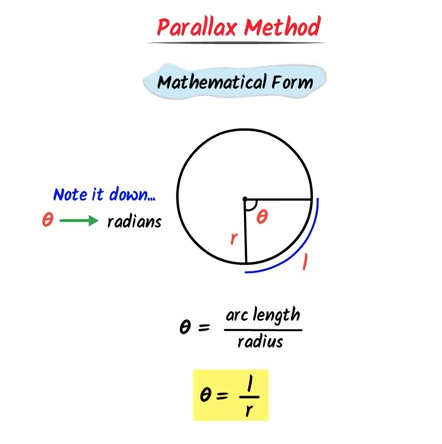
As the planet is very far away, \(\frac{b}{D}<<1\), and therefore, \(\theta\) is very small. Then we approximately take \(\mathrm{AB}\) as an arc of length \(b\) of \(\mathrm{a}\) circle with centre at \(\mathrm{S}\) and the distance \(D\) as the radius \(\mathrm{AS}=\mathrm{BS}\) so that \(\mathrm{AB}=b=D \theta\) where \(\theta\) is in radians.
\(D=\frac{b}{\theta}\)
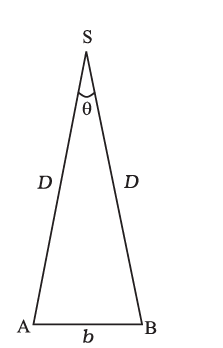
Figure 2.2 Parallax method
Having determined \(D\), we can employ a similar method to determine the size or angular diameter of the planet. If \(d\) is the diameter of the planet and \(\alpha\) the angular size of the planet (the angle subtended by \(d\) at the earth),we have \(\alpha=d / D\)
The angle \(\alpha\) can be measured from the same location on the earth. It is the angle between the two directions when two diametrically opposite points of the planet are viewed through the telescope. Since \(D\) is known, the diameter \(d\) of the planet can be determined using the equation \(\alpha=d / D\).
Example 1: A man wishes to estimate the distance of a nearby tower from him. He stands at a point A in front of the tower \(\mathrm{C}\) and spots a very distant object \(\mathrm{O}\) in line with AC. He then walks perpendicular to \(\mathrm{AC}\) up to \(\mathrm{B}\), a distance of \(100 \mathrm{~m}\), and looks at \(\mathrm{O}\) and \(\mathrm{C}\) again. Since \(\mathrm{O}\) is very distant, the direction \(\mathrm{BO}\) is practically the same as AO; but he finds the line of sight of C shifted from the original line of sight by an angle \(\theta\) \(=40^{\circ} \quad(\theta\) is known as ‘parallax’) estimate the distance of the tower \(\mathrm{C}\) from his original position A.
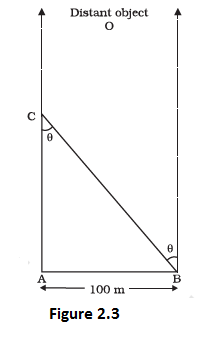
Solution: We have, parallax angle \(\theta=40^{\circ}\); From Fig. 2.3, AB \(=\mathrm{AC} \tan \theta\)
\(\mathrm{AC}=\mathrm{AB} / \tan \theta=100 \mathrm{~m} / \tan 40^{\circ}\)
\(=100 \mathrm{~m} / 0.8391=119 \mathrm{~m}\)
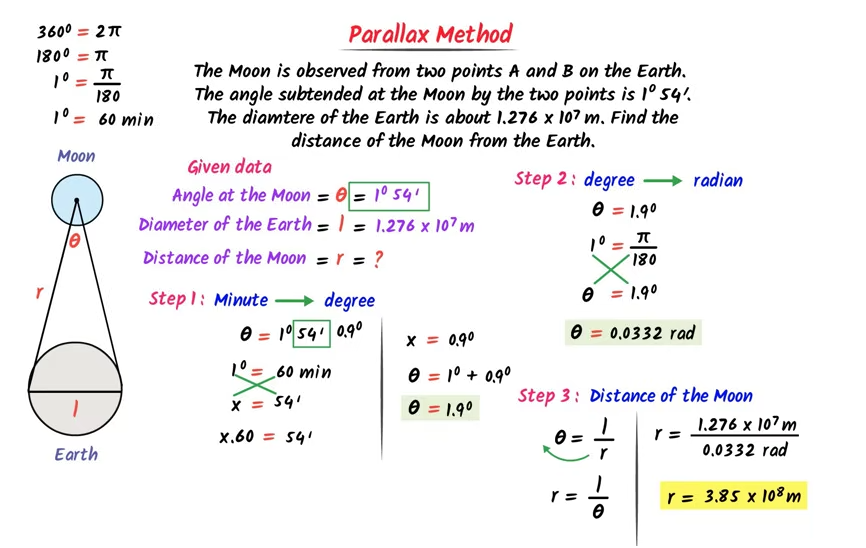
Example 2: The moon is observed from two diametrically opposite points A and B on Earth. The angle \(\theta\) subtended at the moon by the two directions of observation is \(1^{\circ} 54^{\prime}\). Given the diameter of the Earth to be about \(1.276 \times 10^{7} \mathrm{~m}\), compute the distance of the moon from the Earth.
Solution: We have \(\theta=1^{\circ} 54^{\prime}=114^{\prime}\)
\(=(114 \times 60)^{\prime \prime} \times\left(4.85 \times 10^{-6}\right)\) rad
\(
=3.32 \times 10^{-2} \text { rad, }
\)
since \(1^{\prime \prime}=4.85 \times 10^{-6}\) rad.
Also \(b=A B=1.276 \times 10^{7} \mathrm{~m}\)
Hence, from the following equation, we can calculate the Earth-Moon
distance, \(\quad D=b / \theta\)
\(
=\frac{1.276 \times 10^{7}}{3.32 \times 10^{-2}}=3.84 \times 10^{8} \mathrm{~m}
\)
Example 3:The Sun’s angular diameter is measured to be \(1920^{\prime \prime}\). The distance \(D\) of the Sun from the Earth is \(1.496 \times 10^{11} \mathrm{~m}\). What is the diameter of the Sun?
Solution: Sun’s angular diameter \(\alpha\)
\(
\begin{aligned}
&=1920^{\prime \prime} \\
&=1920 \times 4.85 \times 10^{-6} \mathrm{rad} \\
&=9.31 \times 10^{-3} \mathrm{rad}
\end{aligned}
\)
Sun’s diameter
\(
\begin{aligned}
d &=\alpha D \\
&=\left(9.31 \times 10^{-3}\right) \times\left(1.496 \times 10^{11}\right) \mathrm{m} \\
&=1.39 \times 10^{9} \mathrm{~m}
\end{aligned}
\)
Range of Lengths:
The sizes of the objects we come across in the universe vary over a very wide range. These may vary from the size of the order of \(10^{-14} \mathrm{~m}\) of the tiny nucleus of an atom to the size of the order of \(10^{26} \mathrm{~m}\) of the extent of the observable universe. Table \(2.2\) gives the range and order of lengths and sizes of some of these objects.
Table 1: Range and order of lengths
\(\begin{array}{|l|l|}\hline \text { Size of object or distance } & \text { Length (m) } \\
\hline \text { Size of a proton } & 10^{-15} \\
\hline \text { Size of atomic nucleus } & 10^{-14} \\
\hline \text { Size of hydrogen atom } & 10^{-10} \\
\hline \text { Length of typical virus } & 10^{-8} \\
\text { Wavelength of light } & 10^{-7} \\
\text { Size of red blood corpuscle } & 10^{-5} \\
\hline \text { Thickness of a paper } & 10^{-4} \\
\hline \text { Height of the Mount Everest above sea level } & 10^{4} \\
\hline \text { Radius of the Earth } & 10^{7} \\
\hline \text { Distance of moon from the Earth } & 10^{8} \\
\hline \text { Distance of the Sun from the Earth } & 10^{11} \\
\hline \text { Distance of Pluto from the Sun } & 10^{13} \\
\hline \text { Size of our galaxy } & 10^{21} \\
\hline \text { Distance to Andromeda galaxy } & 10^{23} \\
\hline \text { Distance to the boundary of observable universe } & 10^{26} \\
\hline
\end{array}\)
Measurement Of Mass
Mass is a basic property of matter. It does not depend on the temperature, pressure or location of the object in space. The SI unit of mass is kilogram (kg). It is defined by taking the fixed numerical value of the Plank Constant \(h\) to be \(6.62607015 \times 10^{-34}\) when expressed in the unit of Js which is equal to \(\mathrm{kg} \mathrm{} \mathrm{m}^{2} \mathrm{~s}^{-1}\), where the metre and the second are defined is terms of \(C\) and \(\Delta v \mathrm{cs}\).
\(\begin{aligned}&\text { Table 2 Range and order of masses }\\
&\begin{array}{|l|l|}
\hline \text { Object } & \text { Mass }(\text { kg }) \\
\hline \text { Electron } & 10^{-30} \\
\hline \text { Proton } & 10^{-27} \\
\hline \text { Uranium atom } & 10^{-25} \\
\hline \text { Red blood cell } & 10^{-13} \\
\hline \text { Dust particle } & 10^{-9} \\
\hline \text { Rain drop } & 10^{-6} \\
\hline \text { Mosquito } & 10^{-5} \\
\hline \text { Grape } & 10^{-3} \\
\hline \text { Human } & 10^{2} \\
\hline \text { Automobile } & 10^{3} \\
\hline \text { Boeing } 747 \text { aircraft } & 10^{-} \\
\hline \text { Moon } & 10^{23} \\
\hline \text { Earth } & 10^{25} \\
\hline \text { Sun } & 10^{30} \\
\hline \text { Milky way galaxy } & 10^{41} \\
\hline \text { Observable Universe } & 10^{55} \\
\hline
\end{array}
\end{aligned}\)
Measurement Of Time
To measure any time interval we need a clock. We now use an atomic standard of time, which is based on the periodic vibrations produced in a cesium atom. This is the basis of the caesium clock, sometimes called atomic clock, used in the national standards. Such standards are available in many laboratories. In the caesium atomic clock, the second is taken as the time needed for \(9,192,631,770\) vibrations of the radiation corresponding to the transition between the two hyperfine levels of the ground state of caesium-133 atom. The vibrations of the caesium atom regulate the rate of this caesium atomic clock just as the vibrations of a balance wheel regulate an ordinary wristwatch or the vibrations of a small quartz crystal regulate a quartz wristwatch.
\(\begin{aligned}&\text { Table } 3 \text { Range and order of time intervals }\\
&\begin{array}{|l|l|}
\hline \text { Event } & \text { time interval(s) } \\
\hline \text { Life-span of most unstable particle } & 10^{-24} \\
\hline \text { Period of x-rays } & 10^{-22} \\
\hline \text { Period of atomic vibrations } & 10^{-19} \\
\text { Period of light wave } & 10^{-15} \\
\hline \text { Life time of an excited state of an atom } & 10^{-15} \\
\text { Period of radio wave } & 10^{-8} \\
\text { Period of a sound wave } & 10^{-6} \\
\text { Wink of eye } & 10^{-3} \\
\text { Time between successive human heart beats } & 10^{-1} \\
\text { Travel time for light from moon to the Earth } & 10^{\circ} \\
\text { Travel time for light from the Sun to the Earth } & 10^{\circ} \\
\text { Time period of a satellite } & 10^{2} \\
\text { Rotation period of the Earth } & 10^{4} \\
\text { Rotation and revolution periods of the moon } & 10^{5} \\
\text { Revolution period of the Earth } & 10^{6} \\
\text { Travel time for light from nearest star } & 10^{7} \\
\text { Average human life-span } & 10^{8} \\
\text { Age of Egyptian pyramids } & 10^{9} \\
\text { Time since dinosaurs became extinct } & 10^{11} \\
\text { Age of the universe } & 10^{15} \\
\hline
\end{array}
\end{aligned}\)