JEE PYQs Integer Type (COM & Collision)
SUMMARY
- Ideally, a rigid body is one for which the distances between different particles of the body do not change, even though there are forces on them.
- A rigid body fixed at one point or along a line can have only rotational motion. A rigid body not fixed in some way can have either pure translational motion or a combination of translational and rotational motions.
- In rotation about a fixed axis, every particle of the rigid body moves in a circle which lies in a plane perpendicular to the axis and has its centre on the axis. Every Point in the rotating rigid body has the same angular velocity at any instant of time.
- In pure translation, every particle of the body moves with the same velocity at any instant of time.
- Angular velocity is a vector. Its magnitude is \(\omega=d \theta / d t\) and it is directed along the axis of rotation. For rotation about a fixed axis, this vector \(\omega\) has a fixed direction.
- The vector or cross product of two vector \(a\) and \(b\) is a vector written as \(a \times b\). The magnitude of this vector is \(a b \sin \theta\) and its direction is given by the right handed screw or the right hand rule.
- The linear velocity of a particle of a rigid body rotating about a fixed axis is given by \(v = \omega \times r\), where \(r\) is the position vector of the particle with respect to an origin along the fixed axis. The relation applies even to more general rotation of a rigid body with one point fixed. In that case \(r\) is the position vector of the particle with respect to the fixed point taken as the origin.
- The centre of mass of a system of \(n\) particles is defined as the point whose position vector is
\(
R =\frac{\sum m_i r _i}{M}
\) - Velocity of the centre of mass of a system of particles is given by \(V = P / M\), where \(P\) is the linear momentum of the system. The centre of mass moves as if all the mass of the system is concentrated at this point and all the external forces act at it. If the total external force on the system is zero, then the total linear momentum of the system is constant.
- The angular momentum of a system of \(n\) particles about the origin is
\(
L =\sum_{i=1}^n r _i \times p _i
\)
The torque or moment of force on a system of \(n\) particles about the origin is
\(
\tau =\sum_{i=1}^n r _i \times F _i
\)
The force \(F _i\) acting on the \(i^{\text {th }}\) particle includes the external as well as internal forces. Assuming Newton’s third law of motion and that forces between any two particles act along the line joining the particles, we can show \(\tau _{\text {int }}= 0\) and
\(
\frac{d L }{d t}= \tau _{e x t}
\) - A rigid body is in mechanical equilibrium if
(a) it is in translational equilibrium, i.e., the total external force on it is zero : \(\sum F _i= 0\), and
(b) it is in rotational equilibrium, i.e. the total external torque on it is zero :
\(
\sum \tau _i=\sum r _i \times F _i= 0
\) - The centre of gravity of an extended body is that point where the total gravitational torque on the body is zero.
- The moment of intertia of a rigid body about an axis is defined by the formula \(I=\sum m_i r_i^2\) where \(r_i\) is the perpendicular distance of the \(i\) th point of the body from the axis. The kinetic energy of rotation is \(K=\frac{1}{2} I \omega^2\).
- The theorem of parallel axes: \(I_z^{\prime}=I_z+M a^2\), allows us to determine the moment of intertia of a rigid body about an axis as the sum of the moment of inertia of the body about a parallel axis through its centre of mass and the product of mass and square of the perpendicular distance between these two axes.
- Rotation about a fixed axis is directly analogous to linear motion in respect of kinematics and dynamics.
- For a rigid body rotating about a fixed axis (say, \(z\)-axis) of rotation, \(L_{ z }=I \omega\), where \(I\) is the moment of inertia about \(z\)-axis. In general, the angular momentum \(L\) for such a body is not along the axis of rotation. Only if the body is symmetric about the axis of rotation, \(L\) is along the axis of rotation. In that case, \(| L |=L_z=I \omega\). The angular acceleration of a rigid body rotating about a fixed axis is given by \(I \alpha=\tau\). If the external torque \(\tau\) acting on the body is zero, the component of angular momentum about the fixed axis (say, \(z\)-axis), \(L_z(=I \omega)\) of such a rotating body is constant.
- For rolling motion without slipping \(v_{c m}=R \omega\), where \(v_{c m}\) is the velocity of translation (i.e. of the centre of mass), \(R\) is the radius and \(m\) is the mass of the body. The kinetic energy of such a rolling body is the sum of kinetic energies of translation and rotation:
\(
K=\frac{1}{2} m v_{c m}^2+\frac{1}{2} I \omega^2
\)
Quiz Summary
0 of 28 Questions completed
Questions:
Information
You have already completed the quiz before. Hence you can not start it again.
Quiz is loading…
You must sign in or sign up to start the quiz.
You must first complete the following:
Results
Results
0 of 28 Questions answered correctly
Your time:
Time has elapsed
You have reached 0 of 0 point(s), (0)
Earned Point(s): 0 of 0, (0)
0 Essay(s) Pending (Possible Point(s): 0)
Categories
- Not categorized 0%
- 1
- 2
- 3
- 4
- 5
- 6
- 7
- 8
- 9
- 10
- 11
- 12
- 13
- 14
- 15
- 16
- 17
- 18
- 19
- 20
- 21
- 22
- 23
- 24
- 25
- 26
- 27
- 28
- Current
- Review
- Answered
- Correct
- Incorrect
- Question 1 of 28
1. Question
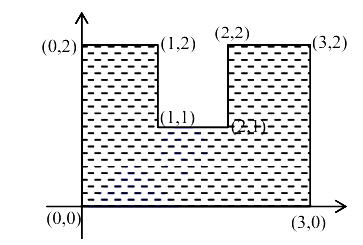
A uniform thin metal plate of mass 10 kg with dimensions is shown. The ratio of \(x\) and \(y\) coordinates of center of mass of plate in \(\frac{n}{9}\). The value of \(\)n\(\) is ____. [JEE Main 2024 (Online) 8th April Morning Shift]
 CorrectIncorrect
Hint
(c) Identify the Geometry:
The plate is shaped like an “inverted U ” or a \(3 \times 2\) rectangle with a \(1 \times 1\) square notch removed from the top center. We can divide the plate into three rectangular sections:
Part 1 (Left Pillar): Dimensions \(1 \times 2\). Centroid at ( \(0.5,1.0\) ).
Part 2 (Central Base): Dimensions \(1 \times 1\). Centroid at ( \(1.5,0.5\) ).
Part 3 (Right Pillar): Dimensions \(1 \times 2\). Centroid at ( \(2.5,1.0\) ).
Distribute the Mass:
Since the plate is uniform, the mass is proportional to the area.
Total Area \(A=(1 \times 2)+(1 \times 1)+(1 \times 2)=5\) units \({ }^2\).
Mass Density \(\sigma=\frac{\text { Total Mass }}{\text { Total Area }}=\frac{10 kg}{5 \text { units }^2}=2 kg /\) unit \(^2\).
Now, we calculate the mass ( \(m\) ) and distance (centroid coordinates) for each part:
\(m_1=\) Area \(_1 \times \sigma=2 \times 2=4 kg\) at \((0.5,1.0)\)
\(m_2=\) Area \(_2 \times \sigma=1 \times 2=2 kg\) at \((1.5,0.5)\)
\(m_3=\) Area \(_3 \times \sigma=2 \times 2=4 kg\) at \((2.5,1.0)\)
Calculate Center of Mass Coordinates:
Using the mass and distance formula: \(X_{c m}=\frac{\sum m_i x_i}{\sum m_i}\) and \(Y_{c m}=\frac{\sum m_i y_i}{\sum m_i}\)
For \(x\)-coordinate \(\left(X_{c m}\right)\) :
\(
X_{c m}=\frac{4(0.5)+2(1.5)+4(2.5)}{10}=\frac{2+3+10}{10}=\frac{15}{10}=1.5
\)
For \(y\)-coordinate \(\left(Y_{c m}\right)\) :
\(
Y_{c m}=\frac{4(1.0)+2(0.5)+4(1.0)}{10}=\frac{4+1+4}{10}=\frac{9}{10}=0.9
\)
Determine the Ratio
The problem defines the ratio of the \(x\) and \(y\) coordinates as \(\frac{n}{9}\).
\(
\text { Ratio }=\frac{X_{c m}}{Y_{c m}}=\frac{1.5}{0.9}=\frac{15}{9}=\frac{n}{9}
\)
The value of \(n\) is \(1 5\).Note: The centroid of a 2D square is its exact geometric centre, which is the point where its two diagonals intersect.
Alternate: Let’s assume the plate occupies a \(3 \times 2\) region with a \(1 \times 1\) square cut out from the top middle (from \(x=1\) to 2 and \(y=1\) to 2 ).
Identify the Parts:
We can treat the plate as a large rectangle with a smaller rectangle “subtracted” from it.
Large Rectangle \(\left(A_1\right)\) : Dimensions \(3 \times 2\). Area \(A_1=6\). Centroid \(\left(x_1, y_1\right)=(1.5,1.0)\).
Cut-out Square ( \(A_2\) ): Dimensions \(1 \times 1\). Area \(A_2=1\). Centroid \(\left(x_2, y_2\right)=(1.5,1.5)\).
Calculate Center of Mass: (Since the plate is uniform, the mass is proportional to the area.)
Since the plate is uniform, the center of mass coordinates are:
\(
\begin{gathered}
x_{c m}=\frac{A_1 x_1-A_2 x_2}{A_1-A_2} \\
y_{c m}=\frac{A_1 y_1-A_2 y_2}{A_1-A_2}
\end{gathered}
\)
For \(x_{c m}\) :
\(
x_{c m}=\frac{(6 \times 1.5)-(1 \times 1.5)}{6-1}=\frac{9-1.5}{5}=\frac{7.5}{5}=1.5
\)
For \(y_{c m}\) :
\(
y_{c m}=\frac{(6 \times 1.0)-(1 \times 1.5)}{6-1}=\frac{6-1.5}{5}=\frac{4.5}{5}=0.9
\)
Determine the Ratio:
The problem asks for the ratio of \(x\) and \(y\) coordinates:
\(
\text { Ratio }=\frac{x_{c m}}{y_{c m}}=\frac{1.5}{0.9}=\frac{15}{9}
\)
The problem states the ratio is \(\frac{n}{9}\). By comparing:
\(
\frac{n}{9}=\frac{15}{9}
\)
Thus, \(n=15\). - Question 2 of 28
2. Question
In a system two particles of masses \(m_1=3 kg\) and \(m_2=2 kg\) are placed at certain distance from each other. The particle of mass \(m_1\) is moved towards the center of mass of the system through a distance 2 cm . In order to keep the center of mass of the system at the original position, the particle of mass \(m_2\) should move towards the center of mass by the distance ______ cm. [JEE Main 2024 (Online) 4th April Evening Shift]
CorrectIncorrectHint
(b) To keep the center of mass (COM) of a system stationary, the net change in the “massweighted position” of the particles must be zero. This is based on the formula for the position of the center of mass:
\(
X_{c m}=\frac{m_1 x_1+m_2 x_2}{m_1+m_2}
\)
\(
\Delta X_{c m}=\frac{m_1 \Delta x_1+m_2 \Delta x_2}{m_1+m_2}
\)
For the center of mass to remain at its original position ( \(\Delta X_{c m}=0\) ), the condition is:
\(
m_1 \Delta x_1+m_2 \Delta x_2=0
\)
\(
\text { where } \Delta x_1=2 cm \text { (movement of } m_1 \text { ) and } \Delta x_2=-x cm \text { (movement of } m_2 \text { ). }
\)
\(
\begin{aligned}
&0=\frac{3 \times 2+2 \times(-x)}{3+2} .\\
&\begin{gathered}
6-2 x=0 \\
x=3 cm
\end{gathered}
\end{aligned}
\) - Question 3 of 28
3. Question
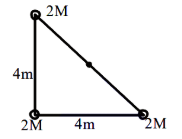
Three identical spheres each of mass 2 M are placed at the corners of a right angled triangle with mutually perpendicular sides equal to 4 m each. Taking point of intersection of these two sides as origin, the magnitude of position vector of the centre of mass of the system is \(\frac{4 \sqrt{2}}{x}\), where the value of \(x\) is _____. [JEE Main 2024 (Online) 1st February Morning Shift]
CorrectIncorrectHint
(a)

Step 1: Define Coordinates and Masses
Place the right-angled triangle’s perpendicular sides along the x and y axes, with the origin \((0,0)\) at their intersection. The three identical spheres, each of mass \(2 M\), are located at the coordinates \((0,0),(4 m, 0)\), and \((0,4 m)\).
Step 2: Calculate Center of Mass Position
The position vector of the center of mass \(\vec{R}_{C M}=\left(X_{C M}, Y_{C M}\right)\) is calculated using the formula \(\vec{R}_{C M}=\frac{\sum m_i \vec{r}_i}{\sum m_i}\). The total mass is \(M _{\text {total }}=3 \times 2 M =6 M\).
\(
\begin{gathered}
\vec{R}_{C M}=\frac{2 M(0 \hat{i}+0 \hat{j})+2 M(4 \hat{i}+0 \hat{j})+2 M(0 \hat{i}+4 \hat{j})}{6 M} \\
\vec{R}_{C M}=\frac{8 M \hat{i}+8 M \hat{j}}{6 M}=\frac{4}{3} \hat{i}+\frac{4}{3} \hat{j}
\end{gathered}
\)
Step 3: Calculate the Magnitude of the Position Vector
The magnitude of the center of mass position vector is found using the distance formula:
\(
\begin{gathered}
\left|\vec{R}_{C M}\right|=\sqrt{X_{C M}^2+Y_{C M}^2}=\sqrt{\left(\frac{4}{3}\right)^2+\left(\frac{4}{3}\right)^2} \\
\left|\vec{R}_{C M}\right|=\sqrt{\frac{16}{9}+\frac{16}{9}}=\sqrt{\frac{32}{9}}=\frac{4 \sqrt{2}}{3}
\end{gathered}
\)
Step 4: Determine the Value of \(x\)
Comparing the calculated magnitude \(\left|\vec{R}_{C M}\right|=\frac{4 \sqrt{2}}{3}\) with the given expression \(\frac{4 \sqrt{2}}{x}\), we determine that the value of \(x\) is 3. - Question 4 of 28
4. Question
A solid circular disc of mass 50 kg rolls along a horizontal floor so that its center of mass has a speed of \(0.4 m / s\). The absolute value of work done on the disc to stop it is _____ J. [JEE Main 2024 (Online) 31st January Morning Shift]
CorrectIncorrectHint
(d) Step 1: Determine the total kinetic energy
A solid circular disc rolling along a horizontal floor possesses both translational and rotational kinetic energy. The total kinetic energy ( \(K _{\text {total }}\) ) is the sum of these two components:
\(
K_{\text {total }}=K_{\text {trans }}+K_{\text {rot }}=\frac{1}{2} M v^2+\frac{1}{2} I \omega^2
\)
Step 2: Use moment of inertia and rolling conditions
For a solid circular disc, the moment of inertia about its center of mass is \(I =\frac{1}{2} M R ^2\).
For rolling without slipping, the angular velocity \(\omega\) is related to the center of mass velocity \(v\) by \(\omega=\frac{v}{ R }\). Substituting these into the total kinetic energy equation:
\(
\begin{gathered}
K_{\text {total }}=\frac{1}{2} M v^2+\frac{1}{2}\left(\frac{1}{2} M R^2\right)\left(\frac{v}{R}\right)^2 \\
K_{\text {total }}=\frac{1}{2} M v^2+\frac{1}{4} M v^2=\frac{3}{4} M v^2
\end{gathered}
\)
Step 3: Calculate the kinetic energy
Using the given values of mass ( \(M=50 kg\) ) and velocity ( \(v=0.4 m / s\) ):
\(
\begin{aligned}
& K_{\text {total }}=\frac{3}{4} \times 50 kg \times(0.4 m / s)^2 \\
& K_{\text {total }}=\frac{3}{4} \times 50 \times 0.16=6.0 J
\end{aligned}
\)
Step 4: Relate kinetic energy to work done
According to the work-energy theorem, the work ( \(W\) ) done to stop the disc is equal to the change in kinetic energy: \(W=K_{\text {final }}-K_{\text {initial }}=0-K_{\text {total }}\). The absolute value of the work done is \(| M |=\left|- K _{\text {total }}\right|= K _{\text {total }}=6.0 J\). - Question 5 of 28
5. Question
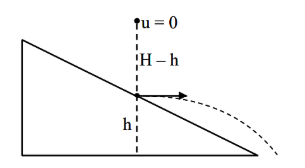
A body starts falling freely from height \(H\) hits an inclined plane in its path at height \(h\). As a result of this perfectly elastic impact, the direction of the velocity of the body becomes horizontal. The value of \(\frac{H}{h}\) for which the body will take the maximum time to reach the ground is _____. [JEE Main 2024 (Online) 31st January Morning Shift]
CorrectIncorrectHint
(b)

Motion Before Impact (Height \(H\) to \(h\) ):
The body falls freely from height \(H\) and hits the inclined plane at height \(h\). The distance fallen is \((H-h)\). Using the second equation of motion \(\left(s=u t+\frac{1}{2} g t^2\right.\) with \(\left.u=0\right)\) :
\(
(H-h)=\frac{1}{2} g t_1^2
\)
The time taken to reach the inclined plane is:
\(
t_1=\sqrt{\frac{2(H-h)}{g}}
\)
Motion After Impact (Height \(h\) to ground)
At height \(h\), the body undergoes a perfectly elastic impact. The problem states that the velocity becomes horizontal. In a horizontal projectile motion, the vertical component of the initial velocity is zero \(\left(u_y=0\right)\). The body now falls vertically from height \(h\) to the ground. Using the same equation of motion for the vertical distance \(h\) :
\(
h=\frac{1}{2} g t_2^2
\)
The time taken to reach the ground from the point of impact is:
\(
t_2=\sqrt{\frac{2 h}{g}}
\)
Total Time of Flight
The total time \(T\) is the sum of \(t_1\) and \(t_2\) :
\(
\begin{aligned}
T & =\sqrt{\frac{2(H-h)}{g}}+\sqrt{\frac{2 h}{g}} \\
T & =\sqrt{\frac{2}{g}}(\sqrt{H-h}+\sqrt{h})
\end{aligned}
\)
Maximizing the Total Time
To find the maximum time, we differentiate \(T\) with respect to \(h\) and set it to zero ( \(\frac{d T}{d h}=0\) ):
\(
\begin{gathered}
\frac{d}{d h}\left[(H-h)^{1 / 2}+h^{1 / 2}\right]=0 \\
\frac{1}{2}(H-h)^{-1 / 2}(-1)+\frac{1}{2}(h)^{-1 / 2}=0 \\
\frac{1}{2 \sqrt{h}}=\frac{1}{2 \sqrt{H-h}} \\
\sqrt{H-h}=\sqrt{h} \\
H-h=h \\
H=2 h
\end{gathered}
\)
The ratio required is:
\(
\frac{H}{h}=2
\) - Question 6 of 28
6. Question
The momentum of a body is increased by \(50 \%\). The percentage increase in the kinetic energy of the body is _____ %. [JEE Main 2023 (Online) 8th April Morning Shift]
CorrectIncorrectHint
(b) The Relationship Formula:
The kinetic energy of an object with mass \(m\) and velocity \(v\) is \(K=\frac{1}{2} m v^2\). Since momentum is \(p=m v\), we can rewrite the kinetic energy formula as:
\(
K=\frac{p^2}{2 m}
\)
From this, we see that kinetic energy is directly proportional to the square of the momentum ( \(K \propto p^2\) ) assuming mass remains constant.
Step-by-Step Calculation:
Step A: Define Initial and Final Momentum
Let the initial momentum be \(p_1\).
The momentum is increased by \(50 \%\), so the final momentum \(p_2\) is:
\(
p_2=p_1+0.50 p_1=1.5 p_1
\)
Step B: Calculate the Ratio of Kinetic Energies Using the proportionality \(K \propto p^2\) :
\(
\frac{K_2}{K_1}=\left(\frac{p_2}{p_1}\right)^2
\)
\(
\frac{K_2}{K_1}=\left(\frac{1.5 p_1}{p_1}\right)^2=(1.5)^2=2.25
\)
This means \(K_2=2.25 K_1\).
Step C: Find the Percentage Increase The percentage increase is calculated as:
\(
\text { Percentage Increase }=\left(\frac{K_2-K_1}{K_1}\right) \times 100
\)
\(
\text { Percentage Increase }=(2.25-1) \times 100=1.25 \times 100=125 \%
\)
The percentage increase in the kinetic energy of the body is \(125 \%\). - Question 7 of 28
7. Question
A ball is dropped from a height of 20 m. If the coefficient of restitution for the collision between ball and floor is 0.5, after hitting the floor, the ball rebounds to a height of ____ m. [JEE Main 2023 (Online) 31st January Evening Shift]
CorrectIncorrectHint
(d) The Core Formula:
The coefficient of restitution ( \(e\) ) is defined as the ratio of the relative speed of separation to the relative speed of approach. For a ball dropped from a height \(h_1\) and rebounding to a height \(h_2\), the relationship is:
\(
e=\sqrt{\frac{h_2}{h_1}}
\)
Squaring both sides gives us the formula for the rebound height:
\(
h_2=e^2 \times h_1
\)
Step-by-Step Calculation:
Given the values from the problem:
Initial height \(\left(h_1\right)=20 m\)
Coefficient of restitution \((e)=0.5\)
Substitute the values into the formula:
\(
\begin{gathered}
h_2=(0.5)^2 \times 20 \\
h_2=0.25 \times 20 \\
h_2=5 m
\end{gathered}
\)
After hitting the floor, the ball rebounds to a height of 5 m. - Question 8 of 28
8. Question
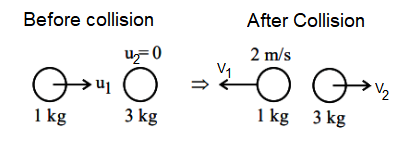
A body of mass 1 kg collides head on elastically with a stationary body of mass 3 kg . After collision, the smaller body reverses its direction of motion and moves with a speed of \(2 m / s\). The initial speed of the smaller body before collision is _____ \(ms ^{-1}\). [JEE Main 2023 (Online) 25th January Evening Shift]
CorrectIncorrectHint
(c)

Visualization of the Collision:
Before Collision:
Body 1: \(m_1=1 kg, u_1=u\) (initial speed we need to find)
Body 2: \(m_2=3 kg, u_2=0\) (stationary)
After Collision:
Body 1: \(v_1=-2 m / s\) (negative because it reverses direction)
Body 2: \(v_2=\) ? (velocity of the larger body)
Step-by-Step Calculation:
Method: Using the Elastic Collision Velocity Formula For an elastic collision where the second body is initially at rest ( \(u_2=0\) ), the final velocity of the first body is given by:
\(
v_1=\left(\frac{m_1-m_2}{m_1+m_2}\right) u_1
\)
Step A: Substitute the known values Given:
\(v_1=-2 m / s\)
\(m_1=1 kg\)
\(m_2=3 kg\)
\(
-2=\left(\frac{1-3}{1+3}\right) u
\)
\(
u=4 m / s
\) - Question 9 of 28
9. Question
The distance of centre of mass from end A of a one dimensional rod (AB) having mass density \(\rho=\rho_0\left(1-\frac{x^2}{L^2}\right) kg / m\) and length L (in meter) is \(\frac{3 L}{\alpha} m\). The value of \(\alpha\) is ____. (where \(x\) is the distance from end \(A\) ) [JEE Main 2022 (Online) 28th July Evening Shift]
CorrectIncorrectHint
(d) The Formula for Center of Mass:
For a one-dimensional rod of length \(L\) where the linear mass density \(\rho\) varies with distance \(x\), the distance of the center of mass ( \(x_{c m}\) ) from the origin (end A ) is given by:
\(
x_{c m}=\frac{\int_0^L x \cdot d m}{\int_0^L d m}=\frac{\int_0^L x \rho(x) d x}{\int_0^L \rho(x) d x}
\)
Step-by-Step Integration:
Step A: Calculate the total mass ( \(M=\int d m\) ) The mass of a small element \(d x\) is \(d m= \rho d x=\rho_0\left(1-\frac{x^2}{L^2}\right) d x\).
\(
\begin{aligned}
& M=\int_0^L \rho_0\left(1-\frac{x^2}{L^2}\right) d x=\rho_0\left[x-\frac{x^3}{3 L^2}\right]_0^L \\
& M=\rho_0\left(L-\frac{L^3}{3 L^2}\right)=\rho_0\left(L-\frac{L}{3}\right)=\frac{2}{3} \rho_0 L
\end{aligned}
\)
Step B: Calculate the moment of mass ( \(\int x \cdot d m\) )
\(
\begin{gathered}
\int_0^L x \rho_0\left(1-\frac{x^2}{L^2}\right) d x=\rho_0 \int_0^L\left(x-\frac{x^3}{L^2}\right) d x \\
\rho_0\left[\frac{x^2}{2}-\frac{x^4}{4 L^2}\right]_0^L=\rho_0\left(\frac{L^2}{2}-\frac{L^4}{4 L^2}\right) \\
\rho_0\left(\frac{L^2}{2}-\frac{L^2}{4}\right)=\frac{1}{4} \rho_0 L^2
\end{gathered}
\)
Step C: Find \(x_{c m}\)
\(
x_{c m}=\frac{\frac{1}{4} \rho_0 L^2}{\frac{2}{3} \rho_0 L}=\frac{1}{4} \times \frac{3}{2} L=\frac{3 L}{8}
\)
Finding the value of \(\alpha\):
The problem states that the center of mass is at \(\frac{3 L}{\alpha}\). Comparing our result with the given expression:
\(
\frac{3 L}{8}=\frac{3 L}{\alpha}
\)
By inspection:
\(
\alpha=8
\)
The value of \(\alpha\) is 8. - Question 10 of 28
10. Question
Three identical spheres each of mass M are placed at the corners of a right angled triangle with mutually perpendicular sides equal to 3 m each. Taking point of intersection of mutually perpendicular sides as origin, the magnitude of position vector of centre of mass of the system will be \(\sqrt{x} m\). The value of \(x\) is _____. [JEE Main 2022 (Online) 25th July Evening Shift]
CorrectIncorrectHint
(b) Setting Up the Coordinate System:
The problem describes a right-angled triangle with two sides of 3 m meeting at the origin \((0,0)\).
Mass \(1\left(M_1\right)\) : At the origin \((0,0)\).
Mass \(2\left(M_2\right)\) : Along the \(x\)-axis at \((3,0)\).
Mass \(3\left(M_3\right)\) : Along the \(y\)-axis at \((0,3)\).
Finding the Center of Mass Coordinates:
Since the masses are identical ( \(M_1=M_2=M_3=M\) ), we use the formula for the center of mass \((x_{cm}, y_{cm})\) :
For the \(x\)-coordinate:
\(
x_{cm}=\frac{M(0)+M(3)+M(0)}{M+M+M}=\frac{3 M}{3 M}=1 m
\)
For the \(y\)-coordinate:
\(
y_{cm}=\frac{M(0)+M(0)+M(3)}{M+M+M}=\frac{3 M}{3 M}=1 m
\)
The position vector of the center of mass is \(r_{c m}=1 \hat{i}+1 \hat{j}\).
Calculating the Magnitude:
The magnitude of the position vector \(\left|r_{c m}\right|\) is calculated using the Pythagorean theorem:
\(
\begin{gathered}
\left|r_{c m}\right|=\sqrt{x_{cm}^2+y_{cm}^2} \\
\left|r_{c m}\right|=\sqrt{1^2+1^2} \\
\left|r_{c m}\right|=\sqrt{2} m
\end{gathered}
\)
The problem states the magnitude is \(\sqrt{x} m\). Comparing this to our result:
\(
\begin{gathered}
\sqrt{x}=\sqrt{2} \\
x=2
\end{gathered}
\) - Question 11 of 28
11. Question
A man of 60 kg is running on the road and suddenly jumps into a stationary trolly car of mass 120 kg. Then, the trolly car starts moving with velocity \(2 ms^{-1}\). The velocity of the running man was ____ \(ms ^{-1}\), when he jumps into the car.
CorrectIncorrectHint
(a) To find the velocity of the running man, we can use the Principle of Conservation of Linear Momentum. Since no external horizontal force acts on the system (man + trolley), the total momentum before the jump must equal the total momentum after the jump.
Step 1: Apply the conservation of linear momentum principle
The total momentum of the system (man + trolley) before the man jumps into the car is equal to the total momentum after the man jumps into the car, as external forces are ignored. The formula for the conservation of linear momentum is:
\(
m_m u_m+m_t u_t=\left(m_m+m_t\right) v
\)
where \(m_m\) is the mass of the man, \(u_m\) is the initial velocity of the man, \(m_t\) is the mass of the trolley, \(u_t\) is the initial velocity of the trolley, and \(v\) is the final common velocity of the man and trolley.
Step 2: Substitute the known values and solve for the unknown velocity
We are given the following values:
Mass of the man, \(m_m=60 kg\)
Mass of the trolley, \(m_t=120 kg\)
Initial velocity of the stationary trolley, \(u_t=0 ms^{-1}\)
Final common velocity of the system, \(v=2 ms^{-1}\)
Substitute these values into the equation:
\(
\begin{gathered}
60 kg \times u_m+120 kg \times 0 ms^{-1}=(60 kg+120 kg) \times 2 ms^{-1} \\
60 u_m=180 \times 2 \\
60 u_m=360 \\
u_m=\frac{360}{60} \\
u_m=6 ms^{-1}
\end{gathered}
\)
The velocity of the running man was \(6 ms^{-1}\) when he jumped into the car. - Question 12 of 28
12. Question
A batsman hits back a ball of mass 0.4 kg straight in the direction of the bowler without changing its initial speed of \(15 ms^{-1}\). The impulse imparted to the ball is ____ Ns. [JEE Main 2022 (Online) 26th June Evening Shift]
CorrectIncorrectHint
(c) To solve for the impulse imparted to the ball, we use the Impulse-Momentum Theorem, which states that the impulse is equal to the change in momentum of the object.
Understanding the Vectors:
Impulse and momentum are vector quantities. Since the ball is hit straight back in the direction of the bowler, its direction is exactly reversed.
Initial direction: Towards the batsman (let’s define this as positive).
Final direction: Towards the bowler (this becomes negative).
Step-by-Step Calculation:
Step A: Define Initial and Final Velocities
Mass of the ball \((m)=0.4 kg\)
Initial velocity \((u)=+15 ms^{-1}\)
Final velocity \((v)=-15 ms^{-1}\) (speed is unchanged, but direction is reversed)
Step B: Use the Impulse Formula The impulse \((\vec{I})\) is the change in momentum \((\Delta \vec{p})\) :
\(\vec{I}=\Delta \vec{p}=m \vec{v}-m \vec{u}\).
\(
\begin{gathered}
\vec{I}=0.4 \times(-15-15) \\
\vec{I}=0.4 \times(-30) \\
\vec{I}=-12 Ns
\end{gathered}
\)
Since the question asks for the magnitude of the impulse imparted to the ball:
\(
|\vec{I}|=12 Ns
\)
The impulse imparted to the ball is \(1 2 ~ N s\). - Question 13 of 28
13. Question
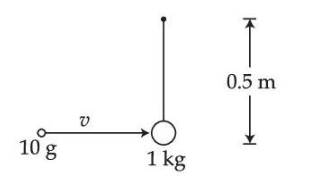
A bullet of 10 g , moving with velocity v , collides head-on with the stationary bob of a pendulum and recoils with velocity \(100 m / s\). The length of the pendulum is 0.5 m and mass of the bob is 1 kg . The minimum value of \(v =\) ____ \(m / s\) so that the pendulum describes a circle. (Assume the string to be inextensible and \(g =10 m / s ^2\) ) [JEE Main 2021 (Online) 27th August Evening Shift]
 CorrectIncorrect
Hint
(d) To solve for the minimum velocity \(v\) of the bullet, we must consider two distinct physical phases: the motion of the pendulum after the collision and the conservation of momentum during the collision.
Condition for the Pendulum to Describe a Circle:
For a bob attached to a string to complete a full vertical circle, the minimum velocity it must have at its lowest point ( \(v_{b o b}\) ) is given by the formula:
\(
v_{b o b}=\sqrt{5 g L}
\)
Given:
Length of pendulum \((L)=0.5 m\)
Acceleration due to gravity \((g)=10 m / s ^2\)
\(
v_{b o b}=\sqrt{5 \times 10 \times 0.5}=\sqrt{25}=5 m / s
\)
Conservation of Linear Momentum
We apply the principle of conservation of momentum just before and just after the collision between the bullet and the bob.
Before Collision:
Mass of bullet \((m)=10 g=0.01 kg\)
Velocity of bullet \(=v\)
Mass of \(\operatorname{bob}(M)=1 kg\)
Velocity of bob \(= 0\) (stationary)
After Collision:
Velocity of bullet \(\left(v_{\text {bullet }}\right)=-100 m / s\) (recoils means it moves in the opposite direction)
Velocity of bob \(\left(v_{b o b}\right)=5 m / s\) (minimum required velocity)
Momentum Equation:
\(
\begin{gathered}
m \cdot v+M \cdot 0=m \cdot v_{b u l l e t}+M \cdot v_{b o b} \\
(0.01) v=(0.01)(-100)+(1)(5)
\end{gathered}
\)
Solving for \(v\):
\(
\begin{gathered}
(0.01) v=-1+5 \\
(0.01) v=4 \\
v=\frac{4}{0.01} \\
v=400 m / s
\end{gathered}
\)
The minimum value of \(v\) is \(400 m / s\). - Question 14 of 28
14. Question
A body of mass 2 kg moving with a speed of \(4 m / s\). makes an elastic collision with another body at rest and continues to move in the original direction but with one fourth of its initial peed. The speed of the two body centre of mass is \(\frac{x}{10} m / s\). Then the value of \(x\) is ____ . [JEE Main 2021 (Online) 25th July Morning Shift]
CorrectIncorrectHint
(d) To solve this problem, we need to find the mass of the second body first and then calculate the velocity of the center of mass ( \(V_{c m}\) ) for the system.
Visualization of the Collision:
Before Collision:
Body 1: \(m_1=2 kg, u_1=4 m / s\)
Body 2: \(m_2=?, u_2=0 m / s\)
After Collision:
Body 1: \(v_1=\frac{1}{4} \times 4=1 m / s\) (continues in original direction)
Finding the Unknown Mass ( \(m_2\) ):
For an elastic collision where the second body is initially at rest, the final velocity of the first body is given by:
\(
v_1=\left(\frac{m_1-m_2}{m_1+m_2}\right) u_1
\)
Step A: Substitute the known values
\(
1=\left(\frac{2-m_2}{2+m_2}\right) 4
\)
Step B: Solve for \(m_2\)
\(
\begin{gathered}
\frac{1}{4}=\frac{2-m_2}{2+m_2} \\
2+m_2=4\left(2-m_2\right) \\
2+m_2=8-4 m_2 \\
5 m_2=6 \Longrightarrow m_2=1.2 kg
\end{gathered}
\)
Calculating the Velocity of Centre of Mass:
The velocity of the center of mass ( \(V_{c m}\) ) remains constant during a collision (as there are no external forces) and is calculated using the initial state:
\(
\begin{gathered}
V_{c m}=\frac{m_1 u_1+m_2 u_2}{m_1+m_2} \\
V_{c m}=\frac{(2 \times 4)+(1.2 \times 0)}{2+1.2} \\
V_{c m}=\frac{8}{3.2}=2.5 m / s
\end{gathered}
\)
Finding the value of \(x\):
The problem states the speed of the center of mass is \(\frac{x}{10} m / s\). Comparing our result:
\(
\begin{gathered}
\frac{x}{10}=2.5 \\
x=25
\end{gathered}
\) - Question 15 of 28
15. Question
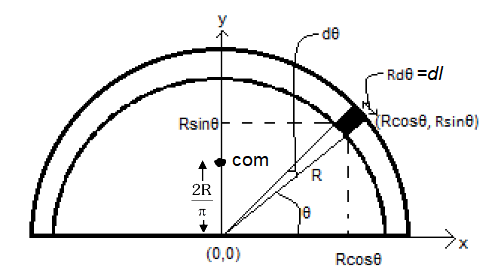
The position of the centre of mass of a uniform semi-circular wire of radius ‘ \(R\) ‘ placed in \(x-y\) plane with its centre at the origin and the line joining its ends as \(x\) -axis is given by \(\left(0, \frac{x R}{\pi}\right)\). Then, the value of \(| x |\) is ____. [JEE Main 2021 (Online) 22th July Evening Shift]
CorrectIncorrectHint
(b)

To find the center of mass of a uniform semi-circular wire, we use the method of integration for a continuous curved distribution of mass.
Visualization of the Setup:
The wire is placed in the \(x-y\) plane. Since the wire is uniform and symmetric about the \(y\) axis, the \(x\)-coordinate of the center of mass ( \(x_{c m}\) ) must be \(0\).
Derivation of the \(y\)-coordinate:
For a small element of length \(d l\) at an angle \(\theta\) with the \(x\)-axis:
Angle of element: \(d \theta\)
Length of element: \(d l=R d \theta\)
Mass of element: \(d m=\lambda d l=\lambda R d \theta\) (where \(\lambda\) is linear mass density)
\(y\)-coordinate of element: \(y=R \sin \theta\)
The formula for the \(y\)-coordinate of the center of mass is:
\(
y_{c m}=\frac{\int y d m}{\int d m}
\)
Step A: Integrate the numerator (Moment of mass) The limits for a semi-circle are from \(\theta=0\) to \(\theta=\pi\) :
\(
\begin{gathered}
\int_0^\pi(R \sin \theta)(\lambda R d \theta)=\lambda R^2 \int_0^\pi \sin \theta d \theta \\
\lambda R^2[-\cos \theta]_0^\pi=\lambda R^2[-(-1)-(-1)]=2 \lambda R^2
\end{gathered}
\)
Step B: Integrate the denominator (Total mass)
\(
\int_0^\pi \lambda R d \theta=\lambda R[\theta]_0^\pi=\pi \lambda R
\)
Step C: Final calculation for \(y_{c m}\)
\(
y_{c m}=\frac{2 \lambda R^2}{\pi \lambda R}=\frac{2 R}{\pi}
\)
Finding the value of \(|x|\):
The problem states the position of the center of mass is \(\left(0, \frac{x R}{\pi}\right)\). Comparing this to our derived result:
\(
\frac{x R}{\pi}=\frac{2 R}{\pi}
\)
By inspection:
\(
x=2
\)
Therefore, \(|x|=2\). - Question 16 of 28
16. Question
A rod of mass \(M\) and length \(L\) is lying on a horizontal frictionless surface. A particle of mass ‘ \(m\) ‘ travelling along the surface hits at one end of the rod with a velocity ‘ \(u\) ‘ in a direction perpendicular to the rod. The collision is completely elastic. After collision, particle comes to rest. The ratio of masses \(\left(\frac{m}{M}\right)\) is \(\frac{1}{x}\). The value of ‘ \(x\) ‘ will be _____ . [JEE Main 2021 (Online) 20th July Morning Shift]
CorrectIncorrectHint
(c) To solve this problem, we need to apply the conservation laws for a system where a particle strikes a rigid body. Since the surface is frictionless and the collision is elastic, we use:
a. Conservation of Linear Momentum
b. Conservation of Angular Momentum (about the center of mass of the rod)
c. Conservation of Kinetic Energy (or the Coefficient of Restitution)
Step 1: Conservation of Linear Momentum:
Initial momentum of the system is just the particle’s momentum. After the collision, the particle comes to rest, and the rod moves with a center of mass velocity \(v\).
\(
m u=M v \Longrightarrow v=\frac{m u}{M}
\)
Step 2: Conservation of Angular Momentum:
We take the angular momentum about the center of mass (CM) of the rod. The particle hits at one end, so the distance from the CM is \(L / 2\). After the collision, the rod rotates with angular velocity \(\omega\).
\(
\begin{gathered}
\text { Initial } L_{\text {angular }}=m u\left(\frac{L}{2}\right) \\
\text { Final } L_{\text {angular }}=I \omega=\left(\frac{M L^2}{12}\right) \omega
\end{gathered}
\)
Equating the two:
\(
m u \frac{L}{2}=\frac{M L^2}{12} \omega \Longrightarrow \omega=\frac{6 m u}{M L}
\)
Step 3: Elastic Collision (Coefficient of Restitution)
For an elastic collision ( \(e=1\) ), the relative velocity of separation equals the relative velocity of approach at the point of contact.
Velocity of approach \(=u\)
Velocity of separation \(=v_{\text {end }}\) (velocity of the end of the rod)
The velocity of the end of the rod is the sum of its translational velocity and its rotational velocity:
\(
v_{e n d}=v+\omega\left(\frac{L}{2}\right)
\)
Setting \(u=v_{\text {end }}\) :
\(
u=v+\omega\left(\frac{L}{2}\right)
\)
Substitute the expressions for \(v\) and \(\omega\) from steps 1 and 2:
\(
u=\left(\frac{m u}{M}\right)+\left(\frac{6 m u}{M L}\right)\left(\frac{L}{2}\right)
\)
\(
\begin{gathered}
u=\frac{m u}{M}+\frac{3 m u}{M} \\
u=\frac{4 m u}{M}
\end{gathered}
\)
Finding the Ratio and Value of \(x\)
Divide both sides by \(u\) :
\(
\begin{aligned}
& 1=\frac{4 m}{M} \\
& \frac{m}{M}=\frac{1}{4}
\end{aligned}
\)
Given that \(\frac{m}{M}=\frac{1}{x}\), we compare the two:
\(
x=4
\) - Question 17 of 28
17. Question
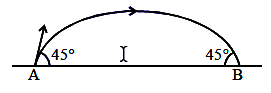
The projectile motion of a particle of mass 5 g is shown in the figure.

The initial velocity of the particle is \(5 \sqrt{2} ms^{-1}\) and the air resistance is assumed to be negligible. The magnitude of the change in momentum between the points \(A\) and \(B\) is \(x \times 10^{-2} kgms ^{-1}\). The value of \(x\), to the nearest integer, is _____ . [JEE Main 2021 (Online) 18th March Evening Shift]
CorrectIncorrectHint
(b) Step 1: Identify Initial and Final Velocities
The problem describes projectile motion with negligible air resistance, which means the speed of the particle at any specific height is constant. The search results indicate that the figure likely depicts a projectile launched at an angle of \(45^{\circ}\) from the horizontal, with points A and B being the initial and final points at the same horizontal level.
The initial velocity vector \(\vec{u}\) at point A has a magnitude \(u=5 \sqrt{2} m / s\) and an angle of \(45^{\circ}\) with the horizontal.
\(
\begin{gathered}
\vec{u}=u \cos \left(45^{\circ}\right) \hat{i}+u \sin \left(45^{\circ}\right) \hat{j} \\
\vec{u}=5 \sqrt{2}\left(\frac{1}{\sqrt{2}}\right) \hat{i}+5 \sqrt{2}\left(\frac{1}{\sqrt{2}}\right) \hat{j}=5 \hat{i}+5 \hat{j}
\end{gathered}
\)
The final velocity vector \(\vec{v}\) at point B (at the same horizontal level) has the same magnitude but an angle of \(-45^{\circ}\) with the horizontal (or \(45^{\circ}\) below the horizontal).
\(
\begin{gathered}
\vec{v}=v \cos \left(-45^{\circ}\right) \hat{i}+v \sin \left(-45^{\circ}\right) \hat{j} \\
\vec{v}=5 \sqrt{2}\left(\frac{1}{\sqrt{2}}\right) \hat{i}+5 \sqrt{2}\left(-\frac{1}{\sqrt{2}}\right) \hat{j}=5 \hat{i}-5 \hat{j}
\end{gathered}
\)
Step 2: Calculate the Change in Momentum
The mass of the particle is \(m=5 g=5 \times 10^{-3} kg\).
The change in momentum \(\Delta \vec{p}\) is given by:
\(
\Delta \vec{p}=\vec{p}_B-\vec{p}_A=m \vec{v}-m \vec{u}=m(\vec{v}-\vec{u})
\)
Substitute the velocity vectors:
\(
\begin{gathered}
\Delta \vec{p}=\left(5 \times 10^{-3}\right)((5 \hat{i}-5 \hat{j})-(5 \hat{i}+5 \hat{j})) \\
\Delta \vec{p}=\left(5 \times 10^{-3}\right)(-10 \hat{j})=-50 \times 10^{-3} \hat{j} kgms^{-1}
\end{gathered}
\)
Step 3: Determine the Magnitude of Change in Momentum
The magnitude of the change in momentum is:
\(
\begin{gathered}
\|\Delta \vec{p}\|=\sqrt{(0)^2+\left(-50 \times 10^{-3}\right)^2}=50 \times 10^{-3} kgms^{-1} \\
\|\Delta \vec{p}\|=5 \times 10^{-2} kgms^{-1}
\end{gathered}
\)
Step 4: Find the value of \(x\)
The problem states that the magnitude of the change in momentum is \(x \times 10^{-2} kgms ^{-1}\).
Comparing our result to the given expression:
\(
\begin{aligned}
5 \times 10^{-2} & =x \times 10^{-2} \\
x & =5
\end{aligned}
\) - Question 18 of 28
18. Question
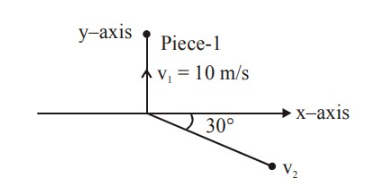
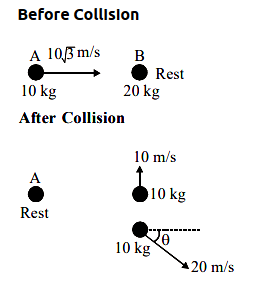
A ball of mass 10 kg moving with a velocity \(10 \sqrt{3} m / s\) along the \(x\)-axis, hits another ball of mass 20 kg which is at rest. After the collision, first ball comes to rest while the second ball disintegrates into two equal pieces. One piece starts moving along y-axis with a speed of \(10 m / s\). The second piece starts moving at an angle of \(30^{\circ}\) with respect to the \(x\)-axis. The velocity of the ball moving at \(30^{\circ}\) with \(x\)-axis is \(x m / s\). The configuration of pieces after collision is shown in the figure below. The value of \(x\) to the nearest integer is ____. [JEE Main 2021 (Online) 18th March Morning Shift]
 CorrectIncorrect
Hint
(a) To find the value of \(x\), we apply the Principle of Conservation of Linear Momentum in both the \(x\) and \(y\) directions.
Step 1: Initial State:
Ball 1: \(m_1=10 kg\), velocity \(v_1=10 \sqrt{3} \hat{\imath} m / s\)
Ball 2: \(m_2=20 kg\), velocity \(v_2=0\) (at rest)
Total Initial Momentum \(\left(P_i\right)\) :
\(
P_i=m_1 v_1+m_2 v_2=10(10 \sqrt{3} \hat{i})+0=100 \sqrt{3} \hat{i} kg \cdot m / s
\)
Step 2: Final State
Ball 1: Comes to rest \(\left(v_{1 f}=0\right)\).
Ball 2: Disintegrates into two equal pieces of mass 10 kg each ( \(m_a=10 kg\) and \(m_b=\) 10 kg ).
Piece A: Moves along the \(y\)-axis at \(10 m / s\).
\(
v_a=10 \hat{j} m / s
\)
Piece B: Moves at an angle of \(30^{\circ}\) with the \(x\)-axis at speed \(x\). Since Piece A has positive \(y\) -momentum, Piece B must move below the \(x\)-axis (at \(-30^{\circ}\) ) to conserve momentum.
\(
v_b=x \cos \left(30^{\circ}\right) \hat{i}-x \sin \left(30^{\circ}\right) \hat{j}
\)
Step 3: Conservation of Momentum
Along the \(x\)-axis:
Initial \(P_x=\) Final \(P_x\)
\(
\begin{gathered}
100 \sqrt{3}=m_1(0)+m_a(0)+m_b\left(x \cos 30^{\circ}\right) \\
100 \sqrt{3}=10 \cdot x \cdot \frac{\sqrt{3}}{2} \\
100 \sqrt{3}=5 \sqrt{3} x \\
x=\frac{100 \sqrt{3}}{5 \sqrt{3}}=20 m / s
\end{gathered}
\)
Along the \(y\)-axis (for verification):
\(
\begin{aligned}
&\text { Initial } P_y=\text { Final } P_y\\
&0=m_a(10)+m_b\left(-x \sin 30^{\circ}\right)\\
&0=100-10 \cdot x \cdot \frac{1}{2}\\
&5 x=100 \Longrightarrow x=20 m / s
\end{aligned}
\) - Question 19 of 28
19. Question
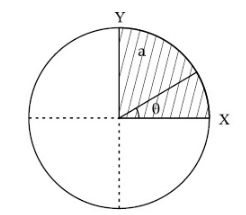
The disc of mass \(M\) with uniform surface mass density \(\sigma\) is shown in the figure. The centre of mass of the quarter disc (the shaded area) is at the position \(\frac{x}{3} \frac{a}{\pi}, \frac{x}{3} \frac{a}{\pi}\) where \(x\) is _____. (Round off to the Nearest Integer). [JEE Main 2021 (Online) 17th March Evening Shift]
[\(a\) is an area as shown in the figure] CorrectIncorrect
Hint
(c) To find the value of \(x\) for the center of mass of the quarter disc, we utilize the standard formula for a sector of a uniform disc.
Step 1: Understanding the Geometry
Based on the provided image, we have a quarter disc (the shaded area) located in the first quadrant.
The radius of the disc is indicated as \(a\) in the formula given in the problem statement.
The disc has a uniform surface mass density \(\sigma\).
Due to symmetry about the line \(y=x\), the \(x\) and \(y\) coordinates of the center of mass will be identical ( \(x_{c m}=y_{c m}\) ).
Step 2: Standard Formula for Center of Mass
For a uniform semi-circular disc of radius \(R[latex], the center of mass is at [latex]\frac{4 R}{3 \pi}\). For a quarter disc, the coordinates ( \(x_{c m}, y_{c m}\) ) relative to the center of the circle (origin) are:
\(
x_{c m}=\frac{4 a}{3 \pi}
\)
Percentage Change
\(
y_{c m}=\frac{4 a}{3 \pi}
\)
Step 3: Comparing with the Given Expression
The problem states that the position of the center of mass is:
\(
\left(\frac{x}{3} \frac{a}{\pi}, \frac{x}{3} \frac{a}{\pi}\right)
\)
By comparing the standard result with the given expression:
\(
\frac{4 a}{3 \pi}=\frac{x}{3} \frac{a}{\pi}
\)
Solving for \(x\) :
a. Cancel \(\frac{a}{\pi}\) from both sides: \(\frac{4}{3}=\frac{x}{3}\)
b. Multiply both sides by 3: \(x=4\)
Final Answer
The value of \(x\) is 4. - Question 20 of 28
20. Question
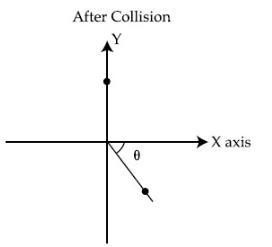
A ball of mass 10 kg moving with a velocity \(10 \sqrt{3} m s ^{-1}\) along \(X\)-axis, hits another ball of mass 20 kg which is at rest. After collision, the first ball comes to rest and the second one disintegrates into two equal pieces. One of the pieces starts moving along Y -axis at a speed of \(10 m / s\). The second piece starts moving at a speed of \(20 m / s\) at an angle \(\theta\) (degree) with respect to the X-axis. The configuration of pieces after collision is shown in the figure.

The value of \(\theta\) to the nearest integer is ____. [JEE Main 2021 (Online) 16th March Morning Shift]
CorrectIncorrectHint
(c)

To find the value of the angle \(\theta\), we apply the Principle of Conservation of Linear Momentum in both the \(X\) and \(Y\) directions.
Step 1: Initial Momentum of the System
Ball 1: Mass \(m_1=10 kg\), Velocity \(v_1=10 \sqrt{3} \hat{i} m / s\).
Ball 2: Mass \(m_2=20 kg\), Velocity \(v_2=0 m / s\) (at rest).
Total Initial Momentum \(\left(P_i\right)\) :
\(
P_i=(10 kg \times 10 \sqrt{3} \hat{i} m / s)+(20 kg \times 0)=100 \sqrt{3} \hat{i} kg \cdot m / s
\)
Step 2: Final Momentum of the System:
After the collision, Ball 1 is at rest, and Ball 2 splits into two equal pieces ( \(m_a=10 kg\) and \(m_b=10 kg\) ).
Piece A: Moves along the \(Y\)-axis at \(10 m / s\).
\(
p_a=m_a v_a=10 kg \times 10 \hat{j} m / s=100 \hat{j} kg \cdot m / s
\)
Piece B: Moves at a speed of \(20 m / s\) at an angle \(\theta\) with the \(X\)-axis. To balance the positive \(Y\)-momentum of Piece A, Piece B must move below the \(X\)-axis.
\(
p_b=m_b v_b=10 kg \times(20 \cos \theta \hat{i}-20 \sin \theta \hat{j})=200 \cos \theta \hat{i}-200 \sin \theta \hat{j}
\)
Step 3: Conservation Equations:
According to the conservation of momentum \(\left(P_{\text {initial }}=P_{\text {final }}\right)\) :
Along the \(X\)-axis:
\(
\begin{gathered}
P_{i x}=P_{a x}+P_{b x} \\
100 \sqrt{3}=0+200 \cos \theta \\
\cos \theta=\frac{100 \sqrt{3}}{200}=\frac{\sqrt{3}}{2} \\
\theta=\cos ^{-1}\left(\frac{\sqrt{3}}{2}\right)=30^{\circ}
\end{gathered}
\)
Along the \(Y\)-axis (Verification):
\(
\begin{gathered}
P_{i y}=P_{a y}+P_{b y} \\
0=100-200 \sin \theta
\end{gathered}
\)
Along the \(Y\)-axis (Verification):
\(
\begin{gathered}
P_{i y}=P_{a y}+P_{b y} \\
0=100-200 \sin \theta \\
200 \sin \theta=100 \\
\sin \theta=\frac{100}{200}=\frac{1}{2} \\
\theta=\sin ^{-1}\left(\frac{1}{2}\right)=30^{\circ}
\end{gathered}
\)
Both components confirm that the angle is \(30^{\circ}\). - Question 21 of 28
21. Question
Two particles having masses 4 g and 16 g respectively are moving with equal kinetic energies. The ratio of the magnitudes of their linear momentum is \(n: 2\). The value of \(n\) will be ___. [JEE Main 2021 (Online) 25th February Evening Shift]
CorrectIncorrectHint
(a) To find the value of \(n\), we use the mathematical relationship between kinetic energy ( \(K\) ) and linear momentum ( \(p\) ).
The Core Formula:
The kinetic energy of an object is given by \(K=\frac{1}{2} m v^2\). Using the definition of momentum ( \(p=m v)\), this formula can be rewritten as:
\(
K=\frac{p^2}{2 m} \quad \text { or } \quad p=\sqrt{2 m K}
\)
From this, we see that for a constant kinetic energy, the momentum is directly proportional to the square root of the mass ( \(p \propto \sqrt{m}\) ).
Step-by-Step Calculation:
Step A: Define the variables for the two particles
Particle 1: \(m_1=4 g\), Kinetic Energy \(=K_1\)
Particle 2: \(m_2=16 g\), Kinetic Energy \(=K_2\)
Given: \(K_1=K_2=K\)
Step B: Find the ratio of their momenta Using the proportionality \(p=\sqrt{2 m K}\) :
\(
\frac{p_1}{p_2}=\frac{\sqrt{2 m_1 K}}{\sqrt{2 m_2 K}}=\sqrt{\frac{m_1}{m_2}}
\)
Step C: Substitute the mass values
\(
\begin{gathered}
\frac{p_1}{p_2}=\sqrt{\frac{4}{16}} \\
\frac{p_1}{p_2}=\sqrt{\frac{1}{4}}=\frac{1}{2}
\end{gathered}
\)
Step D: Compare with the given ratio The problem states the ratio of their momenta is \(n: 2\).
\(
\frac{n}{2}=\frac{1}{2}
\)
By inspection:
\(
n=1
\) - Question 22 of 28
22. Question
Two solids \(A\) and \(B\) of mass 1 kg and 2 kg respectively are moving with equal linear momentum. The ratio of their kinetic energies (K.E.) \(A\) : \((\text { K.E. })_{ B }\) will be \(\frac{A}{1}\), so the value of A will be ____ . [JEE Main 2021 (Online) 24th February Evening Shift]
CorrectIncorrectHint
(b) To find the value of \(A\), we use the relationship between kinetic energy ( \(K\) ) and linear momentum (\(p\)).
The Core Formula:
The kinetic energy of a body of mass \(m\) moving with momentum \(p\) is given by:
\(
K=\frac{p^2}{2 m}
\)
From this formula, we can see that if the momentum \(p\) is constant, the kinetic energy is inversely proportional to the mass ( \(K \propto \frac{1}{m}\) ).
Step-by-Step Calculation:
Step A: Define the variables for both solids
Solid A: \(m_A=1 kg\), Kinetic Energy \(=(K . E .)_A\)
Solid B: \(m_B=2 kg\), Kinetic Energy \(=(K . E .)_B\)
Given: Momentum \(p_A=p_B=p\)
Step B: Find the ratio of their kinetic energies Using the inverse relationship \(K \propto \frac{1}{m}\) :
\(
\frac{(\text { K.E. })_A}{(\text { K.E. })_B}=\frac{m_B}{m_A}
\)
Step C: Substitute the mass values
\(
\frac{(K . E .)_A}{(K . E .)_B}=\frac{2 kg}{1 kg}=\frac{2}{1}
\)
Step D: Compare with the given ratio The problem states the ratio is \(\frac{A}{1}\).
\(
\frac{A}{1}=\frac{2}{1}
\)
By inspection:
\(
A=2
\) - Question 23 of 28
23. Question
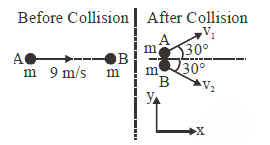
A ball with a speed of \(9 m / s\) collides with another identical ball at rest. After the collision, the direction of each ball makes an angle of 30 \({ }^{\circ}\) with the original direction. The ratio of velocities of the balls after collision is \(x: y\), where \(x\) is ____. [JEE Main 2021 (Online) 24th February Morning Shift]
CorrectIncorrectHint
(a)

To solve this problem, we apply the Principle of Conservation of Linear Momentum in two dimensions. Since the balls are identical, we let the mass of each ball be \(m\).
Step 1: Visualization of the Collision
Initially, Ball 1 moves along the \(x\)-axis while Ball 2 is at rest. After the collision, both balls move at an angle of \(30^{\circ}\) relative to the original \(x\)-axis. To conserve momentum in the \(y\)-direction (which was initially zero), one ball must move at \(+30^{\circ}\) and the other at \(-30^{\circ}\).
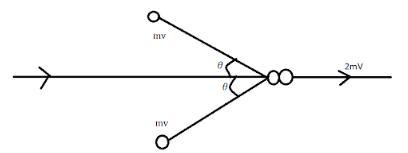
Initial State:
Ball 1: \(m_1=m, u_1=9 m / s\) (along \(x\)-axis)
Ball 2: \(m_2=m, u_2=0\)
Final State:
Ball 1: velocity \(v_1\) at \(\theta_1=30^{\circ}\)
Ball 2: velocity \(v_2\) at \(\theta_2=-30^{\circ}\)
Step 2: Conservation of Momentum Equations
Along the Y-axis: The initial momentum in the \(y\)-direction is zero. Therefore, the final \(y\) momenta of the two balls must cancel each other out.
\(
\begin{gathered}
0=m v_1 \sin \left(30^{\circ}\right)-m v_2 \sin \left(30^{\circ}\right) \\
m v_1 \sin \left(30^{\circ}\right)=m v_2 \sin \left(30^{\circ}\right)
\end{gathered}
\)
Since the masses and the sines of the angles are identical:
\(
v_1=v_2
\)
Step 3: Finding the Ratio \(x: y\)
Since the velocities after the collision are equal ( \(v_1=v_2\) ):
The ratio of the velocities is \(1: 1\).
Comparing this to the given ratio \(x: y\) :
\(
x=1, \quad y=1
\)
Step 4: Verification (X-axis Momentum)
While not required to find the ratio, we can verify the magnitudes:
\(
\begin{gathered}
m(9)=m v_1 \cos \left(30^{\circ}\right)+m v_2 \cos \left(30^{\circ}\right) \\
9=v_1 \frac{\sqrt{3}}{2}+v_1 \frac{\sqrt{3}}{2} \quad\left(\text { since } v_1=v_2\right) \\
9=v_1 \sqrt{3} \\
v_1=\frac{9}{\sqrt{3}}=3 \sqrt{3} m / s
\end{gathered}
\)
Thus, both balls move with a speed of \(3 \sqrt{3} m / s\), confirming the \(1: 1\) ratio.
The ratio of velocities is \(1: 1\), so the value of \(x\) is 1. - Question 24 of 28
24. Question
The centre of mass of solid hemisphere of radius 8 cm is \(x\) from the centre of the flat surface. Then value of \(x\) is ____. [JEE Main 2020 (Online) 6th September Evening Slot]
CorrectIncorrectHint
(c) To find the value of \(x\), we use the standard formula for the center of mass of a uniform solid hemisphere.
Step 1: The Standard Formula
For a uniform solid hemisphere of radius \(R\), the center of mass is located along the axis of symmetry at a specific distance from the center of the flat base.
The distance of the center of mass ( \(y_{c m}\) ) from the flat surface is given by:
\(
y_{c m}=\frac{3 R}{8}
\)
Step 2: Step-by-Step Calculation
Given the values from the problem:
Radius \((R)=8 cm\)
Distance from the flat surface \(=x\)
Substitute the radius into the formula:
\(
x=\frac{3 \times 8}{8}
\)
Simplify the expression:
\(
x=3 cm
\) - Question 25 of 28
25. Question
Two bodies of the same mass are moving with the same speed, but in different directions in a plane. They have a completely inelastic collision and move together thereafter with a final speed which is half of their initial speed. The angle between the initial velocities of the two bodies (in degree) is ____. [JEE Main 2020 (Online) 6th September Morning Slot]
CorrectIncorrectHint
(b)

Let the two bodies have \(m\) and velocity \(v\). Let the angle made by their initial velocities be \(\theta\) and let the final velocity be \(V\). Let us first draw a figure, that is representing the scenario given in question
Here it is given that
\(
V=\frac{v}{2}
\)
On applying conservation of momentum on \(x\) axis, we get
\(
m v \cos \theta+m v \cos \theta=2 m V \Rightarrow 2 m v \cos \theta=2 m \frac{v}{2} \Rightarrow \cos \theta=\frac{1}{2} \Rightarrow \theta=60^{\circ}
\)
The angle between initial velocities is
\(
2 \theta=2 \times 60=120^{\circ}
\)
Therefore the angle between initial velocities of two bodies is \(120^{\circ}\). - Question 26 of 28
26. Question
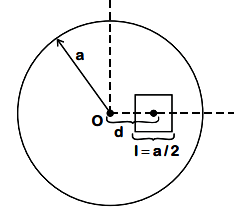
A square shaped hole of side \(l =\frac{a}{2}\) is carved out at a distance \(d =\frac{a}{2}\) from the centre ‘ O ‘ of a uniform circular disk of radius \(a\). If the distance of the centre of mass of the remaining portion form O is \(-\frac{a}{X}[latex], value of [latex]X\) (to the nearest integer) is : [JEE Main 2020 (Online) 2nd September Evening Slot]
 CorrectIncorrect
Hint
(d) To find the center of mass of the remaining portion of the disk, we use the concept of negative mass. We treat the system as a complete circular disk with a superimposed square of “negative mass” at the location of the hole.
Step 1: Visualization of the System
Let the center of the circular disk be the origin \(O(0,0)\).
Original Disk (Part 1): Radius \(R=a\). Center \(C_1=(0,0)\).
Square Hole (Part 2): Side \(l=a / 2\). Center \(C_2=(d, 0)=(a / 2,0)\).
Step 2: Mass and Area Calculations
Since the disk is uniform, mass is proportional to area ( \(m=\sigma A\) ).
Area of Disk \(\left(A_1\right): \pi a^2\)
Area of Square Hole \(\left(A_2\right): l^2=\left(\frac{a}{2}\right)^2=\frac{a^2}{4}\)
Step 3: Center of Mass Formula
The x-coordinate of the center of mass for a system with a removed part is:
\(
x_{c m}=\frac{A_1 x_1-A_2 x_2}{A_1-A_2}
\)
Substitute the values:
\(x_1=0\) (Center of the disk)
\(x_2=a / 2\) (Center of the square hole)
\(
\begin{gathered}
x_{c m}=\frac{\left(\pi a^2\right)(0)-\left(\frac{a^2}{4}\right)\left(\frac{a}{2}\right)}{\pi a^2-\frac{a^2}{4}} \\
x_{c m}=\frac{-\frac{a^3}{8}}{a^2\left(\pi-\frac{1}{4}\right)} \\
x_{c m}=\frac{-\frac{a}{8}}{\frac{4 \pi-1}{4}} \\
x_{c m}=-\frac{a}{8} \cdot \frac{4}{4 \pi-1}=-\frac{a}{2(4 \pi-1)}
\end{gathered}
\)
Step 4: Finding the value of \(X\)
The problem gives the position as \(-\frac{a}{\bar{X}}\). Therefore:
\(
\begin{aligned}
& \frac{a}{X}=\frac{a}{2(4 \pi-1)} \\
& X=2(4 \pi-1) \\
X \approx 23
\end{aligned}
\) - Question 27 of 28
27. Question
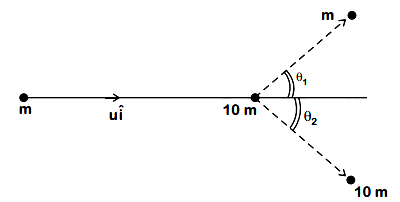
A particle of mass \(m\) is moving along the \(x\) -axis with initial velocity \(u \hat{i}\). It collides elastically with a particle of mass 10 m at rest and then moves with half its initial kinetic energy (see figure). If \(\sin \theta_1=\sqrt{n} \sin \theta_2\) then value of \(n\) is ____. [JEE Main 2020 (Online) 2nd September Evening Slot]
 CorrectIncorrect
Hint
(c) To find the value of \(n\), we need to apply the conservation of linear momentum in two dimensions and the conservation of kinetic energy for an elastic collision.
Step 1: Visualization of the Collision
Before Collision:
Particle 1: Mass \(m\), initial velocity \(u_1=u \hat{i}\), initial kinetic energy \(K_i=\frac{1}{2} m u^2\).
Particle 2: Mass 10 m , initial velocity \(u_2=0\).
After Collision:
Particle 1: Mass \(m\), final speed \(v_1\), angle \(\theta_1\).
Particle 2: Mass \(10 m\), final speed \(v_2\), angle \(\theta_2\).
Step 2: Kinetic Energy Analysis
The problem states that after the collision, the first particle moves with half its initial kinetic energy.
\(
\begin{gathered}
K_{1 f}=\frac{1}{2} K_i \\
\frac{1}{2} m v_1^2=\frac{1}{2}\left(\frac{1}{2} m u^2\right) \\
v_1^2=\frac{u^2}{2} \Longrightarrow v_1=\frac{u}{\sqrt{2}}
\end{gathered}
\)
Since the collision is elastic, total kinetic energy is conserved:
\(
\begin{gathered}
K_i+0=K_{1 f}+K_{2 f} \\
K_i=\frac{1}{2} K_i+K_{2 f} \Longrightarrow K_{2 f}=\frac{1}{2} K_i \\
\frac{1}{2}(10 m) v_2^2=\frac{1}{2}\left(\frac{1}{2} m u^2\right)
\end{gathered}
\)
\(
10 v_2^2=\frac{u^2}{2} \Longrightarrow v_2^2=\frac{u^2}{20} \Longrightarrow v_2=\frac{u}{\sqrt{20}}
\)
Step 3: Conservation of Momentum (Y-axis)
The initial momentum in the \(y\)-direction is zero. Therefore, the final \(y\)-momenta of the two particles must sum to zero:
\(
\begin{gathered}
m v_1 \sin \theta_1-10 m v_2 \sin \theta_2=0 \\
m v_1 \sin \theta_1=10 m v_2 \sin \theta_2
\end{gathered}
\)
Substitute the values of \(v_1\) and \(v_2\) :
\(
\begin{aligned}
m\left(\frac{u}{\sqrt{2}}\right) \sin \theta_1 & =10 m\left(\frac{u}{\sqrt{20}}\right) \sin \theta_2 \\
\frac{\sin \theta_1}{\sqrt{2}} & =\frac{10 \sin \theta_2}{\sqrt{20}}
\end{aligned}
\)
Step 4: Solving for \(n\)
Rearrange the equation to match the form \(\sin \theta_1=\sqrt{n} \sin \theta_2\) :
\(
\begin{gathered}
\sin \theta_1=\frac{10 \sqrt{2}}{\sqrt{20}} \sin \theta_2 \\
\sin \theta_1=\frac{10 \sqrt{2}}{\sqrt{10} \cdot \sqrt{2}} \sin \theta_2 \\
\sin \theta_1=\frac{10}{\sqrt{10}} \sin \theta_2 \\
\sin \theta_1=\sqrt{10} \sin \theta_2
\end{gathered}
\)
Comparing this with \(\sin \theta_1=\sqrt{n} \sin \theta_2\) :
\(
n=10
\) - Question 28 of 28
28. Question
A body \(A\), of mass \(m=0.1 kg\) has an initial velocity of \(3 \hat{i} ms^{-1}\). It collides elastically with another body, \(B\) of the same mass which has an initial velocity of \(5 \hat{j} ms^{-1}\). After collision, \(A\) moves with a velocity \(\vec{v}=4(\hat{i}+\hat{j})\). The energy of \(B\) after collision is written as \(\frac{x}{10}\). The value of \(x\) is _____. [JEE Main 2020 (Online) 8th January Morning Slot]
CorrectIncorrectHint
(a) To find the energy of body \(B\) after the collision, we can use the Principle of Conservation of Energy. Since the collision is elastic, the total kinetic energy of the system before the collision is equal to the total kinetic energy after the collision.
Step 1: Apply Conservation of Momentum
For an elastic collision, both momentum and kinetic energy are conserved. The total momentum before collision equals the total momentum after. Since the masses are equal ( \(m_A=m_B=m\) ), the equation simplifies to:
\(
\vec{u}_A+\vec{u}_B=\vec{v}_A+\vec{v}_B
\)
Substituting the given velocity vectors:
\(
(3 \hat{i})+(5 \hat{j})=(4 \hat{i}+4 \hat{j})+\vec{v}_B
\)
Step 2: Calculate the Final Velocity of Body B
Rearrange the equation to solve for the final velocity of body \(B , \vec{v}_B\) :
\(
\begin{gathered}
\vec{v}_B=(3 \hat{i}+5 \hat{j})-(4 \hat{i}+4 \hat{j})=(3-4) \hat{i}+(5-4) \hat{j} \\
\vec{v}_B=-\hat{i}+\hat{j} ~ m s ^{- 1 }
\end{gathered}
\)
Step 3: Calculate the Kinetic Energy of Body B
The kinetic energy (energy) of body B after collision is given by the formula \(K E _{ B }=\frac{1}{2} m _{ B }\left|\vec{v}_{ B }\right|^2\). The mass is \(m _{ B }=0.1 ~ k g\) and the magnitude squared of the velocity \(\left|\vec{v}_B\right|^2\) is:
\(
\left|\vec{v}_B\right|^2=(-1)^2+(1)^2=1+1=2 m ^2 s ^{-2}
\)
Now, calculate the kinetic energy:
\(
K E_B=\frac{1}{2} \times 0.1 \times 2=0.1 J
\)
Step 4: Determine the Value of \(x\)
The problem states that the energy of \(B\) after collision is \(\frac{x}{10}\). We set our calculated energy equal to this expression:
\(
\begin{gathered}
0.1=\frac{x}{10} \\
\frac{1}{10}=\frac{x}{10}
\end{gathered}
\)
Solving for \(x\) gives:
\(
x=1
\)