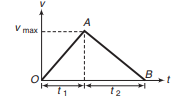
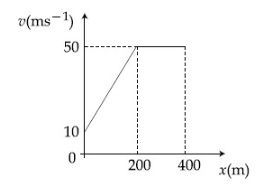
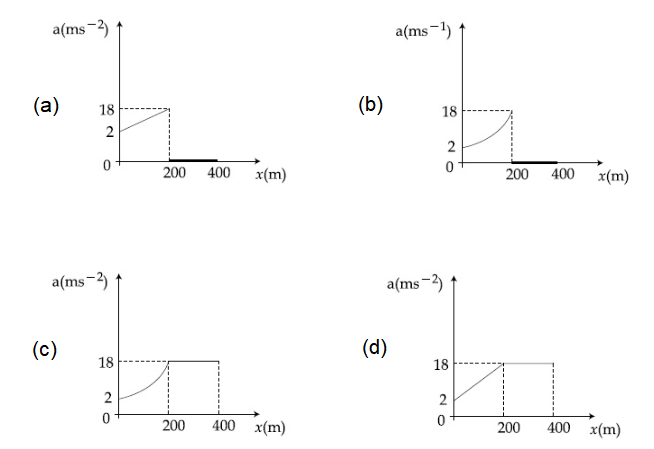
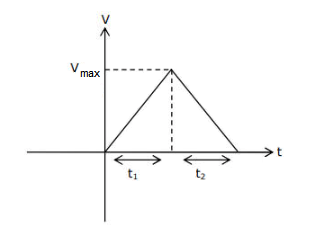
JEE PYQs MCQs
- An object is said to be in motion if its position changes with time. The position of the object can be specified with reference to a conveniently chosen origin. For motion in a straight line, position to the right of the origin is taken as positive and to the left as negative.
- Path length is defined as the total length of the path traversed by an object.
- Displacement is the change in position : \(\Delta x=x_2-x_1\). Path length is greater or equal to the magnitude of the displacement between the same points.
\(v-t\) curve area gives displacement: \(\left[\Delta {x}=\int {vdt}\right]\) - An object is said to be in uniform motion in a straight line if its displacement is equal in equal intervals of time. Otherwise, the motion is said to be non-uniform.
\(\text { Speed }(v)=\frac{\text { Distance travelled }}{\text { Time taken }}\)
\(\text { Average speed }=\frac{\text { Total distance travelled }}{\text { Total time taken }}\) - \(\text { Instantaneous speed }=\lim _{\Delta t \rightarrow 0} \frac{\Delta s}{\Delta t}=\frac{d x}{d t}\)
- \(\text { Velocity }=\frac{\text { Displacement }}{\text { Time }}\)
\(\text { Average velocity }=\frac{\text { Total displacement }(\Delta x)}{\text { Total time }(\Delta t)}\) - Instantaneous velocity =\(v=\lim _{\Delta t \rightarrow 0} \frac{\Delta x}{\Delta t}=\frac{d x}{d t}\) (Instantaneous velocity is the slope of position time curve)
- The time rate of change of velocity of a body is called acceleration.
\(
\therefore \quad \text { Acceleration }=\frac{\text { Change in velocity }(\Delta v)}{\text { Time interval }(\Delta t)}
\)
\(
\text { Average acceleration }=a_{avg}=\frac{\text { Total change in velocity }}{\text { Total time taken }}
\) - The acceleration of an object at a given instant of time or at a given point during the motion, is called its instantaneous acceleration. i.e.
\(
{a}=\lim _{\Delta t \rightarrow 0} \frac{\Delta {v}}{\Delta t}=\frac{d {v}}{d t}=\frac{d^2 {x}}{d t^2}
\)
\(a-t\) curve area gives change in velocity.
\(
\left[\Delta {v}=\int \text { adt }\right]
\) - The three equations of motion on a straight line are
(i) \(v=u+a t\)
(ii) \(s=u t+\frac{1}{2} a t^2\)
(iii) \(v^2-u^2=2 a s\) - The kinematic equation \(x(t)=x_0+v_0 t+\frac{1}{2} a t^2\)
\(x(t)\) : The final position of the object at a specific time \(t\).
\(x_0\) : The initial position of the object, or its starting point at time \(t=0\).
\(v_0\) : The initial velocity of the object, or its speed and direction at time \(t=0\).
\(a\) : The constant acceleration of the object. It can be positive, negative, or zero.
\(t\) : The time interval over which the motion occurs. - Distance travelled by a body in \(n\)th second,
\(
s_n=u+\frac{1}{2} a(2 n-1)
\) - Stopping distance \(s=\frac{u^2}{2 a}\)
- Equation for motion under gravity are given below
(i) If particle is thrown vertically upwards
\(
\begin{aligned}
v & =u-g t \\
h & =u t-\frac{1}{2} g t^2 \\
v^2 & =u^2-2 g h
\end{aligned}
\)
Time of ascent=\(t=\frac{u}{g}\)
Total flight time \((T)=\frac{2 u}{g}\)
(ii) If particle is thrown vertically downward with some velocity from some height.
\(
\begin{aligned}
v & =u+g t \\
h & =u t+\frac{1}{2} g t^2 \\
v^2 & =u^2+2 g h
\end{aligned}
\) - Maximum height attained by a particle, thrown upwards from ground: \(h_{max}=\frac{u^2}{2 g}\)
Velocity of particle at the time of striking the ground when released \((u=0)\) from a height \(h\) is
\(
v=\sqrt{2 g h}
\)
Time of collision of particle with ground,
\(
t=\sqrt{\frac{2 h}{g}}
\) - When acceleration of particle is not constant, motion is known as non-uniformly accelerated motion. In this case problems can be solved either by differentiation or integration (with some boundary conditions).
For one dimensional motion, above relations can be written as under
(i) \(v=\frac{d s}{d t}\)
(ii) \(a=\frac{d v}{d t}=v \frac{d v}{d s}\)
(iii) \(d s=v d t\) and
(iv) \(d v=a d t \quad\) or \(\quad v d v=a d s\) - The time rate of change of relative position of one object with respect to another is called relative velocity.
The displacement of \(B\) relative to \(A\),
\(
\mathbf{x}_{B A}=\mathbf{x}_B-\mathbf{x}_A
\)
Rate of change of relative displacement w.r.t. time is
\(
\begin{array}{ll}
& \frac{d\left(\mathbf{x}_{B A}\right)}{d t}=\frac{d}{d t}\left(\mathbf{x}_B-\mathbf{x}_A\right) \Rightarrow \frac{d \mathbf{x}_{B A}}{d t}=\frac{d \mathbf{x}_B}{d t}-\frac{d \mathbf{x}_A}{d t} \\
\therefore & \mathbf{v}_{B A}=\mathbf{v}_B-\mathbf{v}_A
\end{array}
\)
Similarly, relative acceleration of \(A\) with respect to \(B\) is
\(
\mathbf{a}_{A B}=\mathbf{a}_A-\mathbf{a}_B
\)
Further, we can see that \(\mathbf{v}_{A B}=-\mathbf{v}_{B A}\) or \(\mathbf{a}_{B A}=-\mathbf{a}_{A B}\) - So, in case of a one dimensional motion, the above equations can be written as
\(
\begin{aligned}
& v_{A B}=v_A-v_B \\
& a_{A B}=a_A-a_B
\end{aligned}
\)
Further, we can see that \({v}_{A B}=-{v}_{B A}\) or \({a}_{B A}=-{a}_{A B}\)
Quiz Summary
0 of 69 Questions completed
Questions:
Information
You have already completed the quiz before. Hence you can not start it again.
Quiz is loading…
You must sign in or sign up to start the quiz.
You must first complete the following:
Results
Results
0 of 69 Questions answered correctly
Your time:
Time has elapsed
You have reached 0 of 0 point(s), (0)
Earned Point(s): 0 of 0, (0)
0 Essay(s) Pending (Possible Point(s): 0)
Categories
- Not categorized 0%
- 1
- 2
- 3
- 4
- 5
- 6
- 7
- 8
- 9
- 10
- 11
- 12
- 13
- 14
- 15
- 16
- 17
- 18
- 19
- 20
- 21
- 22
- 23
- 24
- 25
- 26
- 27
- 28
- 29
- 30
- 31
- 32
- 33
- 34
- 35
- 36
- 37
- 38
- 39
- 40
- 41
- 42
- 43
- 44
- 45
- 46
- 47
- 48
- 49
- 50
- 51
- 52
- 53
- 54
- 55
- 56
- 57
- 58
- 59
- 60
- 61
- 62
- 63
- 64
- 65
- 66
- 67
- 68
- 69
- Current
- Review
- Answered
- Correct
- Incorrect
- Question 1 of 69
1. Question
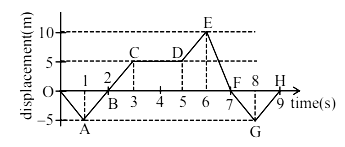
The displacement \(x\) versus time graph is shown below. [JEE Main 2025 (Online) 4th April Evening Shift]

(A) The average velocity during 0 to 3 s is \(10 \mathrm{~m} / \mathrm{s}\)
(B) The average velocity during 3 to 5 s is \(0 \mathrm{~m} / \mathrm{s}\)
(C) The instantaneous velocity at \(\mathrm{t}=2 \mathrm{~s}\) is \(5 \mathrm{~m} / \mathrm{s}\)
(D) The average velocity during 5 to 7 s and instantaneous velocity at \(\mathrm{t}=6.5 \mathrm{~s}\) are equal
(E) The average velocity from \(t=0\) to \(t=9 \mathrm{~s}\) is zero
Choose the correct answer from the options given below :CorrectIncorrectHint
(d)
(A) From 0 to 3 sec :
\(
\langle\vec{v}\rangle=\frac{5-0}{3}=\frac{5}{3} \mathrm{~m} / \mathrm{s}
\)
The statement that the average velocity is \(10 \mathrm{~m} / \mathrm{s}\) is incorrect based on our calculation.
(B) From 3 to 5 sec:
\(
\langle\vec{v}\rangle=\frac{5-5}{2}=0 \mathrm{~m} / \mathrm{s}
\)
The average velocity is indeed \(0 \mathrm{~m} / \mathrm{s}\).
(C) At \(t=2 \mathrm{sec}\) :
The slope of the tangent line at \(t=2\) indicates that \(\vec{v}=5 \mathrm{~m} / \mathrm{s}\). Therefore, this statement is correct.
(D) From 5 to 7 sec :
\(
\langle\vec{v}\rangle=\frac{0-5}{2}=-2.5 \mathrm{~m} / \mathrm{s}
\)
At \(t=6.5 \mathrm{sec}\), the graph’s slope shows that \(\vec{v}=10 \mathrm{~m} / \mathrm{s}\), hence the statement is incorrect as the values are not equal.
(E) From \(t=0\) to \(t=9 \mathrm{sec}\) :
\(
\langle\vec{v}\rangle=\frac{0-0}{9}=0 \mathrm{~m} / \mathrm{s}
\)
This statement is verified correct as the average velocity is zero over the entire period.
Based on the analysis, statements (B), (C), and (E) are correct. - Question 2 of 69
2. Question
A particle moves along the \(x\)-axis and has its displacement \(x\) varying with time t according to the equation: [JEE Main 2025 (Online) 3rd April Evening Shift]
\(
x=\mathrm{c}_0\left(\mathrm{t}^2-2\right)+\mathrm{c}(\mathrm{t}-2)^2
\)
where \(\mathbf{c}_0\) and \(\mathbf{c}\) are constants of appropriate dimensions.
Then, which of the following statements is correct?CorrectIncorrectHint
(a) To determine the acceleration of the particle, we start by differentiating the displacement function with respect to time \(t\).
The displacement of the particle is given by:
\(
x=c_0\left(t^2-2\right)+c(t-2)^2
\)
First, compute the velocity \(v\) by differentiating \(x\) with respect to \(t\) :
\(
v=\frac{d x}{d t}=\frac{d}{d t}\left[c_0\left(t^2-2\right)+c(t-2)^2\right]
\)
This gives:
\(
v=2 c_0 t+2 c(t-2)
\)
Next, determine the acceleration \(a\) by differentiating the velocity function with respect to time \(t\) :
\(
a=\frac{d v}{d t}=\frac{d}{d t}\left[2 c_0 t+2 c(t-2)\right]
\)
Calculating this gives:
\(
a=2 c_0+2 c
\)
Hence, the acceleration of the particle is \(2 c_0+2 c\). - Question 3 of 69
3. Question
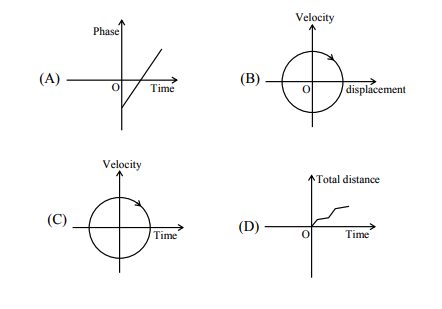
Which of the following curves possibly represent one-dimensional motion of a particle? [JEE Main 2025 (Online) 3rd April Morning Shift]

Choose the correct answer from the options given below :
CorrectIncorrectHint
(c) A. Phase increase with time in SHM
\(
\begin{aligned}
& \phi=\mathrm{kt}+\mathrm{C} \text { it can be } \mathrm{1-D} \text { motion } \\
& \mathrm{eg} \rightarrow \mathrm{x}=\mathrm{A} \sin \phi(\mathrm{SHM})
\end{aligned}
\)
Option (A) is correct.
B. Velocity and displacement are related in elliptical/circular relation
i.e. \(\frac{v^2}{v_0^2}+\frac{x^2}{x_0^2}=1\) which is constant, it can be one dimentional.
Option (B) is Correct
C. At same time particle can’t have two velocities
Option (C) Incorrect
D. Distance always increases with time
Option (D) is Correct - Question 4 of 69
4. Question
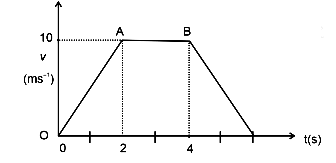
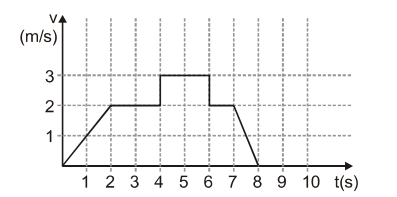
The velocity-time graph of an object moving along a straight line is shown in the figure. What is the distance covered by the object between \(t=0\) to \(t=4 s\)? [JEE Main 2025 (Online) 28th January Evening Shift]
 CorrectIncorrect
Hint
(b)
\(
\begin{aligned}
& \text { Distance }=\text { Area under v-t graph } \\
& \text { Distance }=\frac{1}{2} \times 2 \times 10+2 \times 10=30 \mathrm{~m}
\end{aligned}
\) - Question 5 of 69
5. Question
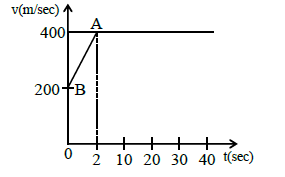
The motion of an airplane is represented by velocity-time graph as shown below. The distance covered by airplane in the first 30.5 second is ____ km. [JEE Main 2025 (Online) 23rd January Morning Shift]
 CorrectIncorrect
Hint
(a)
\(
\begin{aligned}
&\text { Total Area under velocity-time curve = displacement }\\
&s=\frac{1}{2} \times 2 \times 200+200 \times 2+(30.5-2) \times 400 \quad=12000 \mathrm{~m} \quad=12 \mathrm{~km}
\end{aligned}
\) - Question 6 of 69
6. Question
Two cars are travelling towards each other at speed of \(20 \mathrm{~m} \mathrm{~s}^{-1}\) each. When the cars are 300 m apart, both the drivers apply brakes and the cars retard at the rate of \(2 \mathrm{~m} \mathrm{~s}^{-2}\). The distance between them when they come to rest is : [JEE Main 2024 (Online) 9th April Evening Shift]
CorrectIncorrectHint
(b) Step 1: Calculate the stopping distance for one car
We can use the kinematic equation \(v^2=u^2+2 a s\) to find the distance one car travels before coming to rest.
Initial velocity, \(u=20 \mathrm{~m} \mathrm{~s}^{-1}\)
Final velocity, \(v=0 \mathrm{~m} \mathrm{~s}^{-1}\) (since the car comes to rest)
Retardation, \(a=-2 \mathrm{~m} \mathrm{~s}^{-2}\)
\(
\begin{gathered}
v^2=u^2+2 a s \\
0^2=(20)^2+2(-2) s \\
0=400-4 s \\
4 s=400 \\
s=100 \mathrm{~m}
\end{gathered}
\)
Each car travels a distance of 100 m before stopping.
Step 2: Calculate the total distance traveled by both cars
Since both cars have the same initial speed and retardation, they each travel 100 m. The total distance they travel towards each other is the sum of their individual stopping distances.
Total distance traveled \(=100 \mathrm{~m}+100 \mathrm{~m}=200 \mathrm{~m}\)
Step 3: Determine the final distance between the cars
The initial distance between the cars is 300 m. The final distance is the initial distance minus the total distance they traveled before coming to a halt.
Final distance = Initial distance – Total distance traveled
Final distance \(=300 \mathrm{~m}-200 \mathrm{~m}=100 \mathrm{~m}\) - Question 7 of 69
7. Question
A particle moving in a straight line covers half the distance with speed \(6 \mathrm{~m} / \mathrm{s}\). The other half is covered in two equal time intervals with speeds \(9 \mathrm{~m} / \mathrm{s}\) and \(15 \mathrm{~m} / \mathrm{s}\) respectively. The average speed of the particle during the motion is :[JEE Main 2024 (Online) 9th April Morning Shift]
CorrectIncorrectHint
(d) Step 1: Define total distance and time for each segment
Let the total distance of the motion be \(2 d\).
The first half of the distance is \(d\), and the second half is also \(d\).
Step 2: Calculate the time for the first half of the motion
The first half of the distance, \(d\), is covered with a constant speed of \(v_1=6 \mathrm{~m} / \mathrm{s}\). The time taken for this part, \(\boldsymbol{t}_1\), is given by:
\(
t_1=\frac{\text { distance }}{\text { speed }}=\frac{d}{6}
\)
Step 3: Analyze the second half of the motion
The second half of the distance, \(d\), is covered in two equal time intervals, let’s call each interval \(t_2\). The speeds during these intervals are \(v_2=9 \mathrm{~m} / \mathrm{s}\) and \(v_3=15 \mathrm{~m} / \mathrm{s}\). The total distance covered in the second half is the sum of the distances from each interval:
\(
\begin{gathered}
d=v_2 t_2+v_3 t_2 \\
d=(9+15) t_2 \\
d=24 t_2
\end{gathered}
\)
Solving for \(t_2\) in terms of \(d\) :
\(
t_2=\frac{d}{24}
\)
The total time for the second half of the motion, \(t_{\text {second half }}\), is the sum of the two equal time intervals:
\(
t_{\text {second half }}=t_2+t_2=2 t_2=2\left(\frac{d}{24}\right)=\frac{d}{12}
\)
Step 4: Calculate the total time and average speed
The total distance is \(2 d\). The total time, \(\boldsymbol{T}\), is the sum of the times for the two halves:
\(
T=t_1+t_{\text {second half }}=\frac{d}{6}+\frac{d}{12}=\frac{2 d+d}{12}=\frac{3 d}{12}=\frac{d}{4}
\)
The average speed is the total distance divided by the total time:
\(
\text { Average Speed }=\frac{2 d}{T}=\frac{2 d}{\frac{d}{4}}=2 d \cdot \frac{4}{d}=8 \mathrm{~m} / \mathrm{s}
\) - Question 8 of 69
8. Question
A body projected vertically upwards with a certain speed from the top of a tower reaches the ground in \(t_1\). If it is projected vertically downwards from the same point with the same speed, it reaches the ground in \(t_2\). Time required to reach the ground, if it is dropped from the top of the tower, is : [JEE Main 2024 (Online) 6th April Evening Shift]
CorrectIncorrectHint
(b) Step 1: Define the equations for each scenario
Let the height of the tower be \(\boldsymbol{H}\) and the initial speed be \(\boldsymbol{u}\). We will use the kinematic equation for displacement \(s=u t+\frac{1}{2} a t^2\). Let the downward direction be positive. The acceleration due to gravity is \(g\).
Case 1: Body projected upwards
The initial velocity is in the negative direction, so \(v_0=-u\). The displacement is in the positive direction, so \(s=\boldsymbol{H}\). The time is \(t_1\).
\(
H=(-u) t_1+\frac{1}{2} g t_1^2 \Longrightarrow H=\frac{1}{2} g t_1^2-u t_1 \dots(1)
\)
Case 2: Body projected downwards
The initial velocity is in the positive direction, so \(v_0=u\). The displacement is also positive, \(s=\boldsymbol{H}\). The time is \(\boldsymbol{t}_2\).
\(
H=u t_2+\frac{1}{2} g t_2^2 \dots(2)
\)
Step 2: Solve the system of equations for \(u\) and \(H\)
From equation (2), we can express \(\boldsymbol{u}\) in terms of \(\boldsymbol{H}, \boldsymbol{g}\), and \(\boldsymbol{t}_2\) :
\(
u t_2=H-\frac{1}{2} g t_2^2 \Longrightarrow u=\frac{H}{t_2}-\frac{1}{2} g t_2
\)
Now, substitute this expression for \(u\) into equation (1):
\(
\begin{aligned}
H & =\frac{1}{2} g t_1^2-\left(\frac{H}{t_2}-\frac{1}{2} g t_2\right) t_1 \\
H & =\frac{1}{2} g t_1^2-\frac{H t_1}{t_2}+\frac{1}{2} g t_1 t_2
\end{aligned}
\)
Group the terms with \(\boldsymbol{H}\) on one side:
\(
\begin{gathered}
H+\frac{H t_1}{t_2}=\frac{1}{2} g\left(t_1^2+t_1 t_2\right) \\
H\left(1+\frac{t_1}{t_2}\right)=\frac{1}{2} g\left(t_1^2+t_1 t_2\right) \\
H\left(\frac{t_2+t_1}{t_2}\right)=\frac{1}{2} g t_1\left(t_1+t_2\right) \\
H=\frac{1}{2} g t_1 t_2
\end{gathered}
\)
Step 3: Find the time for the body dropped from the tower
When the body is dropped, the initial velocity is \(\boldsymbol{u}=\mathbf{0}\). Let the time taken to reach the ground be \(\boldsymbol{T}\).
\(
\begin{gathered}
H=(0) T+\frac{1}{2} g T^2 \\
H=\frac{1}{2} g T^2
\end{gathered}
\)
Now, substitute the expression for \(\boldsymbol{H}\) we found in Step 2:
\(
\begin{gathered}
\frac{1}{2} g t_1 t_2=\frac{1}{2} g T^2 \\
T^2=t_1 t_2 \\
T=\sqrt{t_1 t_2}
\end{gathered}
\)
The time required to reach the ground if the body is dropped from the top of the tower is \( \sqrt{t_1 t_2}\). - Question 9 of 69
9. Question
A train starting from rest first accelerates uniformly up to a speed of \(80 \mathrm{~km} / \mathrm{h}\) for time \(t\), then it moves with a constant speed for time \(3 t\). The average speed of the train for this duration of journey will be (in \(\mathrm{km} / \mathrm{h}\) ) : [JEE Main 2024 (Online) 6th April Morning Shift]
CorrectIncorrectHint
(a) Step 1: Calculate the distance for the acceleration phase
The train starts from rest ( \(v_i=0\) ) and accelerates uniformly to a speed of \(v_f=80 \mathrm{~km} / \mathrm{h}\) in time \(t\). The distance \(\left(d_1\right)\) covered during this phase is the average velocity multiplied by the time. The average velocity for uniform acceleration is given by \(\frac{v_i+v_f}{2}\).
\(
d_1=\left(\frac{0+80}{2}\right) \times t=40 t
\)
Step 2: Calculate the distance for the constant speed phase
The train moves at a constant speed of \(80 \mathrm{~km} / \mathrm{h}\) for time \(3 t\). The distance \(\left(d_2\right)\) is the speed multiplied by the time.
\(
d_2=80 \times 3 t=240 t
\)
Step 3: Calculate the total distance and total time
The total distance ( \(\boldsymbol{D}_{\text {total }}\) ) is the sum of the distances from both phases.
\(
D_{\text {total }}=d_1+d_2=40 t+240 t=280 t
\)
The total time ( \(\boldsymbol{T}_{\text {total }}\) ) is the sum of the time intervals.
\(
T_{\text {total }}=t+3 t=4 t
\)
The average speed ( \(v_{\text {avg }}\) ) for the entire journey is the total distance divided by the total time.
\(
v_{\text {avg }}=\frac{D_{\text {total }}}{T_{\text {total }}}=\frac{280 t}{4 t}=70 \mathrm{~km} / \mathrm{h}
\) - Question 10 of 69
10. Question
A body travels 102.5 m in \(\mathrm{n}^{\text {th }}\) second and 115.0 m in \((\mathrm{n}+2)^{\text {th }}\) second. The acceleration is [JEE Main 2024 (Online) 4th April Morning Shift]
CorrectIncorrectHint
(a) Step 1: Set up equations for distance traveled in the \(n^{\text {th }}\) and \((n+2)^{\text {th }}\) seconds
The distance traveled in the \(n^{\text {th }}\) second is given by the formula \(S_n=u+\frac{a}{2}(2 n-1)\), where \(u\) is the initial velocity and \(a\) is the acceleration.
According to the problem statement, the distance traveled in the \(\boldsymbol{n}^{\text {th }}\) second is 102.5 m.
\(
102.5=u+\frac{a}{2}(2 n-1) \dots(1)
\)
The distance traveled in the \((n+2)^{\text {th }}\) second is 115.0 m.
\(
115.0=u+\frac{a}{2}(2(n+2)-1)
\)
Simplifying the term inside the parenthesis: \(2 n+4-1=2 n+3\).
\(
115.0=u+\frac{a}{2}(2 n+3) \dots(2)
\)
Step 2: Solve the system of equations for acceleration
To find the acceleration \(\boldsymbol{a}\), subtract Equation 1 from Equation 2.
\(
\begin{gathered}
(115.0)-(102.5)=\left(u+\frac{a}{2}(2 n+3)\right)-\left(u+\frac{a}{2}(2 n-1)\right) \\
12.5=\frac{a}{2}(2 n+3)-\frac{a}{2}(2 n-1) \\
12.5=\frac{a}{2}[(2 n+3)-(2 n-1)] \\
12.5=\frac{a}{2}[2 n+3-2 n+1] \\
12.5=\frac{a}{2}[4] \\
12.5=2 a \\
a=\frac{12.5}{2} \\
a=6.25
\end{gathered}
\)
\(
\text { The acceleration is } 6.25 \mathrm{~m} / \mathrm{s}^2
\) - Question 11 of 69
11. Question
Train \(A\) is moving along two parallel rail tracks towards north with speed \(72 \mathrm{~km} / \mathrm{h}\) and train \(B\) is moving towards south with speed \(108 \mathrm{~km} / \mathrm{h}\). Velocity of train \(B\) with respect to \(A\) and velocity of ground with respect to B are (in \(\mathrm{ms}^{-1}\) ): [JEE Main 2024 (Online) 1st February Evening Shift]
CorrectIncorrectHint
(b) Step 1: Convert speeds from \(\mathrm{km} / \mathrm{h}^{-1}\) to \(\mathrm{ms}^{-1}\)
The conversion from \(\mathrm{km} / \mathrm{h}^{-1} \mathrm{~ms}^{-1}\) is done by multiplying by \(\frac{5}{18}\).
Velocity of train \(\mathrm{A}\left(\boldsymbol{v}_{\boldsymbol{A}}\right)\) :
\(
v_A=72 \mathrm{~km} / \mathrm{h} \times \frac{5}{18}=20 \mathrm{~ms}^{-1}
\)
Velocity of train B ( \(v_B\) ):
\(
v_B=108 \mathrm{~km} / \mathrm{h} \times \frac{5}{18}=30 \mathrm{~ms}^{-1}
\)
Let’s assume the north direction is positive.
Train A is moving north, so its velocity is \(v_A=+20 \mathrm{~ms}^{-1}\).
Train B is moving south, so its velocity is \(v_B=-30 \mathrm{~ms}^{-1}\).
Step 2: Calculate the velocity of train \(B\) with respect to \(A\)
The relative velocity of train B with respect to A is given by the formula \(v_{B A}=v_B-v_A\).
\(
v_{B A}=\left(-30 \mathrm{~ms}^{-1}\right)-\left(20 \mathrm{~ms}^{-1}\right)=-50 \mathrm{~ms}^{-1}
\)
The negative sign indicates that the relative velocity is in the south direction.
Step 3: Calculate the velocity of the ground with respect to \(B\)
The velocity of the ground is \(v_{\text {ground }}=0 \mathrm{~ms}^{-1}\). The relative velocity of the ground with respect to B is given by the formula \(v_{\text {ground }, B}=v_{\text {ground }}-v_B\).
\(
v_{\text {ground }, B}=0 \mathrm{~ms}^{-1}-\left(-30 \mathrm{~ms}^{-1}\right)=30 \mathrm{~ms}^{-1}
\)
The positive sign indicates that the relative velocity is in the north direction.
The velocity of train \(B\) with respect to \(A\) is \(\mathbf{- 5 0} \mathrm{ms}^{-1}\), and the velocity of the ground with respect to B is \(\mathbf{3 0} \mathrm{ms}^{-1}\). - Question 12 of 69
12. Question
The relation between time ‘ \(t\) ‘ and distance ‘ \(x\) ‘ is \(t=\alpha x^2+\beta x\), where \(\alpha\) and \(\beta\) are constants. The relation between acceleration \((a)\) and velocity \((v)\) is : [JEE Main 2024 (Online) 31st January Morning Shift]
CorrectIncorrectHint
(c) Step 1: Differentiate the given relation to find velocity
The given relation is \(t=\alpha x^2+\beta x\).
To find the velocity, we differentiate this equation with respect to time \(\boldsymbol{t}\).
\(
\begin{aligned}
& \frac{d t}{d t}=\frac{d}{d t}\left(\alpha x^2+\beta x\right) \\
& 1=2 \alpha x \frac{d x}{d t}+\beta \frac{d x}{d t}
\end{aligned}
\)
Factoring out \(\frac{d x}{d t}\), which is the velocity \(v\), we get:
\(
1=(2 \alpha x+\beta) \frac{d x}{d t}=(2 \alpha x+\beta) v
\)
Solving for \(v\) :
\(
v=\frac{1}{2 \alpha x+\beta}
\)
Step 2: Differentiate velocity to find acceleration
Now, we differentiate the expression for velocity with respect to time \(t\) to find the acceleration \(a\).
\(
a=\frac{d v}{d t}=\frac{d}{d t}\left(\frac{1}{2 \alpha x+\beta}\right)
\)
Using the chain rule, \(\frac{d v}{d t}=\frac{d v}{d x} \frac{d x}{d t}=\frac{d v}{d x} v\).
First, find \(\frac{d v}{d x}\) :
\(
\frac{d v}{d x}=\frac{d}{d x}(2 \alpha x+\beta)^{-1}=-1(2 \alpha x+\beta)^{-2}(2 \alpha)=\frac{-2 \alpha}{(2 \alpha x+\beta)^2}
\)
Now, substitute this back into the acceleration equation:
\(
a=\frac{d v}{d x} v=\left(\frac{-2 \alpha}{(2 \alpha x+\beta)^2}\right) v
\)
Step 3: Express acceleration in terms of velocity
From Step 1, we know that \(v=\frac{1}{2 \alpha x+\beta}\). This means \((2 \alpha x+\beta)^2=\frac{1}{v^2}\).
Substitute this into the acceleration equation from Step 2:
\(
a=(-2 \alpha)\left(\frac{1}{(2 \alpha x+\beta)^2}\right) v=(-2 \alpha)\left(v^2\right) v=-2 \alpha v^3
\)
The final relation is \(a=-2 \alpha v^3\). - Question 13 of 69
13. Question
A particle is moving in a straight line. The variation of position ‘ \(x\) ‘ as a function of time ‘ \(t\) ‘ is given as \(x=\left(t^3-6 t^2+20 t+15\right) m\). The velocity of the body when its acceleration becomes zero is: [JEE Main 2024 (Online) 29th January Evening Shift]
CorrectIncorrectHint
(c) Step 1: Find the velocity and acceleration functions
The position function of the particle is given as \(x(t)=t^3-6 t^2+20 t+15\). The velocity \(v\) is the first derivative of the position with respect to time:
\(
v(t)=\frac{d x}{d t}=\frac{d}{d t}\left(t^3-6 t^2+20 t+15\right)=3 t^2-12 t+20
\)
The acceleration \(a\) is the first derivative of the velocity with respect to time:
\(
a(t)=\frac{d v}{d t}=\frac{d}{d t}\left(3 t^2-12 t+20\right)=6 t-12
\)
Step 2: Find the time when acceleration is zero
Set the acceleration function equal to zero and solve for \(t\) :
\(
\begin{gathered}
a(t)=6 t-12=0 \\
6 t=12 \\
t=2 \mathrm{~s}
\end{gathered}
\)
Step 3: Calculate the velocity at that time
Substitute the value of \(t=2 \mathrm{~s}\) into the velocity function:
\(
\begin{gathered}
v(2)=3(2)^2-12(2)+20 \\
v(2)=3(4)-24+20 \\
v(2)=12-24+20 \\
v(2)=8 \mathrm{~m} / \mathrm{s}
\end{gathered}
\) - Question 14 of 69
14. Question
A body starts moving from rest with constant acceleration covers displacement \(S_1\) in first \((p-1)\) seconds and \(\mathrm{S}_2\) in first \(p\) seconds. The displacement \(\mathrm{S}_1+\mathrm{S}_2\) will be made in time : [JEE Main 2024 (Online) 29th January Morning Shift]
CorrectIncorrectHint
(d) Step 1: Formulate the equations for displacement
Given that the body starts from rest, the initial velocity is \(u=0\). The displacement \(S\) under constant acceleration \(a\) for time \(t\) is given by the kinematic equation \(S=u t+\frac{1}{2} a t^2\). Since \(u=0\), the equation simplifies to \(S=\frac{1}{2} a t^2\).
From the problem, we have two displacements:
Displacement \(S_1\) is covered in time \(t_1=(p-1)\) seconds.
\(
S_1=\frac{1}{2} a(p-1)^2
\)
Displacement \(S_2\) is covered in time \(t_2=p\) seconds.
\(
S_2=\frac{1}{2} a p^2
\)
Step 2: Calculate the total displacement
The total displacement is \(S_1+S_2\).
\(
S_{\text {total }}=S_1+S_2=\frac{1}{2} a(p-1)^2+\frac{1}{2} a p^2
\)
Factor out \(\frac{1}{2} a\) :
\(
S_{\text {total }}=\frac{1}{2} a\left[(p-1)^2+p^2\right]
\)
Expand the term \((p-1)^2\) :
\(
S_{\text {total }}=\frac{1}{2} a\left[p^2-2 p+1+p^2\right]
\)
Simplify the expression inside the brackets:
\(
S_{\text {total }}=\frac{1}{2} a\left[2 p^2-2 p+1\right]
\)
Step 3: Find the time taken for the total displacement
Let \(t\) be the time taken to cover the total displacement \(S_{\text {total }}\). Using the same kinematic equation \(S=\frac{1}{2} a t^2\) :
\(
S_{\text {total }}=\frac{1}{2} a t^2
\)
Equate the two expressions for \(S_{\text {total }}\) from Step 2 and Step 3:
\(
\frac{1}{2} a t^2=\frac{1}{2} a\left[2 p^2-2 p+1\right]
\)
Cancel out the common term \(\frac{1}{2} a\) on both sides:
\(
t^2=2 p^2-2 p+1
\)
Solve for \(t\) by taking the square root:
\(
t=\sqrt{2 p^2-2 p+1}
\)
The time will be \(\sqrt{2 p^2-2 p+1}\) seconds.
The time taken for the displacement \(S_1+S_2\) is \(\sqrt{\mathbf{2 p}^{\mathbf{2}}-\mathbf{2 p}+\mathbf{1}} \mathbf{s}\). - Question 15 of 69
15. Question
The position of a particle related to time is given by \(x=\left(5 t^2-4 t+5\right) \mathrm{m}\). The magnitude of velocity of the particle at \(t=2 s\) will be : [JEE Main 2023 (Online) 15th April Morning Shift]
CorrectIncorrectHint
(b)
Step 1: Differentiate the position function to find the velocity function
The velocity \(v\) of a particle is the first derivative of its position \(x\) with respect to time \(t\). The given position function is \(x=\left(5 t^2-4 t+5\right) \mathrm{m}\).
Differentiating with respect to \(t\) :
\(
\begin{gathered}
v=\frac{d x}{d t}=\frac{d}{d t}\left(5 t^2-4 t+5\right) \\
v(t)=10 t-4
\end{gathered}
\)
Step 2: Substitute the given time into the velocity function
To find the velocity at \(t=2 s\), substitute \(t=2\) into the velocity function:
\(
\begin{gathered}
v(2)=10(2)-4 \\
v(2)=20-4 \\
v(2)=16
\end{gathered}
\)
The velocity at \(t=2 s\) is \(16 \mathrm{~ms}^{-1}\). Since the result is a positive value, its magnitude is the same.
The magnitude of the velocity of the particle at \(t=2 s\) will be \(16 \mathrm{~ms}^{-1}\). - Question 16 of 69
16. Question
The distance travelled by an object in time \(t\) is given by \(s=(2.5) t^2\). The instantaneous speed of the object at \(t=5 \mathrm{~s}\) will be: [JEE Main 2023 (Online) 13th April Evening Shift]
CorrectIncorrectHint
(d) Step 1: Differentiate the distance function to find the speed function
The distance function is given by \(s=(2.5) t^2\). Instantaneous speed is the derivative of the distance with respect to time, \(v=\frac{d s}{d t}\).
Applying the power rule for differentiation, \(\frac{d}{d t}\left(a t^n\right)=a n t^{n-1}\), where \(a=2.5\) and \(n=2\)
\(
v(t)=\frac{d}{d t}\left(2.5 t^2\right)=(2.5)(2) t^{2-1}=5 t
\)
Thus, the instantaneous speed function is \(v(t)=5 t\).
Step 2: Calculate the instantaneous speed at \(t=5 \mathrm{~s}\)
Substitute \(t=5 \mathrm{~s}\) into the speed function \(v(t)=5 t\) :
\(
v(5)=5(5)=25
\)
The unit for speed is meters per second \(\left(\mathrm{ms}^{-1}\right)\).
The instantaneous speed of the object at \(t=5 \mathrm{~s}\) will be \(25 \mathrm{~ms}^{-1}\). - Question 17 of 69
17. Question
A passenger sitting in a train A moving at \(90 \mathrm{~km} / \mathrm{h}\) observes another train B moving in the opposite direction for 8 s. If the velocity of the train \(B\) is \(54 \mathrm{~km} / \mathrm{h}\), then length of train \(B\) is: [JEE Main 2023 (Online) 13th April Evening Shift]
CorrectIncorrectHint
(d) Step 1: Convert velocities from \(\mathrm{km} / \mathrm{h}\) to \(\mathrm{m} / \mathrm{s}\)
The velocities of train \(A\) and train \(B\) are given in kilometers per hour ( \(\mathbf{k m} / \mathbf{h}\) ). To work with the time given in seconds (s), we must convert the velocities to meters per second \((\mathrm{m} / \mathrm{s})\).
Velocity of train \(A\):
\(
v_A=90 \frac{\mathrm{~km}}{\mathrm{~h}} \times \frac{1000 \mathrm{~m}}{1 \mathrm{~km}} \times \frac{1 \mathrm{~h}}{3600 \mathrm{~s}}=90 \times \frac{5}{18}=25 \frac{\mathrm{~m}}{\mathrm{~s}}
\)
Velocity of train \(B\):
\(
v_B=54 \frac{\mathrm{~km}}{\mathrm{~h}} \times \frac{1000 \mathrm{~m}}{1 \mathrm{~km}} \times \frac{1 \mathrm{~h}}{3600 \mathrm{~s}}=54 \times \frac{5}{18}=15 \frac{\mathrm{~m}}{\mathrm{~s}}
\)
Step 2: Calculate the relative velocity
Since the trains are moving in opposite directions, the relative velocity is the sum of their individual velocities.
\(
v_{\text {rel }}=v_A+v_B=25 \frac{\mathrm{~m}}{\mathrm{~s}}+15 \frac{\mathrm{~m}}{\mathrm{~s}}=40 \frac{\mathrm{~m}}{\mathrm{~s}}
\)
Step 3: Calculate the length of train \(B\)
The length of train \(B\) is the distance it travels relative to the passenger in train \(A\) during the 8 seconds of observation. We can use the formula:
\(
\begin{aligned}
& \text { Length }=\text { Relative Velocity } \times \text { Time } \\
& L_B=v_{r e l} \times t=40 \frac{\mathrm{~m}}{\mathrm{~s}} \times 8 \mathrm{~s}=320 \mathrm{~m}
\end{aligned}
\) - Question 18 of 69
18. Question
Two trains ‘ \(A\) ‘ and ‘ \(B\) ‘ of length ‘ \(l\) ‘ and ‘ \(4 l\) ‘ are travelling into a tunnel of length ‘ \(L\) ‘ in parallel tracks from opposite directions with velocities \(108 \mathrm{~km} / \mathrm{h}\) and \(72 \mathrm{~km} / \mathrm{h}\), respectively. If train ‘ \(A\) ‘ takes 35 s less time than train ‘ \(B\) ‘ to cross the tunnel then. length ‘ \(L\) ‘ of tunnel is : (Given \(\mathrm{L}=60 l\) ) [JEE Main 2023 (Online) 13th April Morning Shift]
CorrectIncorrectHint
(c) Step 1: Convert velocities and set up equations for time
First, convert the velocities of the trains from kilometers per hour to meters per second.
\(
\begin{gathered}
v_A=108 \mathrm{~km} / \mathrm{h}=108 \times \frac{5}{18} \mathrm{~m} / \mathrm{s}=30 \mathrm{~m} / \mathrm{s} \\
v_B=72 \mathrm{~km} / \mathrm{h}=72 \times \frac{5}{18} \mathrm{~m} / \mathrm{s}=20 \mathrm{~m} / \mathrm{s}
\end{gathered}
\)
The time taken for a train to cross a tunnel is the total distance it travels divided by its velocity. The total distance is the sum of the tunnel’s length and the train’s length.
The time for train \(\mathrm{A}\left(\boldsymbol{t}_{\boldsymbol{A}}\right)\) is given by:
\(
t_A=\frac{\text { Distance }_A}{\text { Velocity }_A}=\frac{L+l}{30}
\)
The time for train \(\mathrm{B}\left(\boldsymbol{t}_{\boldsymbol{B}}\right)\) is given by:
\(
t_B=\frac{\text { Distance }_B}{\text { Velocity }_B}=\frac{L+4 l}{20}
\)
Step 2: Use the given time difference to solve for ‘\(l\)‘
The problem states that train A takes 35 seconds less time than train B to cross the tunnel, so \(t_B-t_A=35\).
Substitute the expressions for \(\boldsymbol{t}_{\boldsymbol{A}}\) and \(\boldsymbol{t}_{\boldsymbol{B}}\) :
\(
35=\frac{L+4 l}{20}-\frac{L+l}{30}
\)
To solve for \(l\), we first need to substitute the given relationship \(L=60 l\) :
\(
\begin{gathered}
35=\frac{60 l+4 l}{20}-\frac{60 l+l}{30} \\
35=\frac{64 l}{20}-\frac{61 l}{30}
\end{gathered}
\)
Find a common denominator, which is 60 :
\(
\begin{gathered}
35=\frac{3 \times 64 l}{60}-\frac{2 \times 61 l}{60} \\
35=\frac{192 l-122 l}{60} \\
35=\frac{70 l}{60} \\
35=\frac{7 l}{6} \\
l=\frac{35 \times 6}{7}=5 \times 6=30 \mathrm{~m}
\end{gathered}
\)
Step 3: Calculate the length of the tunnel ‘ L ‘
Now that we have the value of \(l\), we can find the length of the tunnel \(L\) using the given relationship \(L=60 l\) :
\(
L=60 l=60 \times 30 \mathrm{~m}=1800 \mathrm{~m}
\) - Question 19 of 69
19. Question
A ball is thrown vertically upward with an initial velocity of \(150 \mathrm{~m} / \mathrm{s}\). The ratio of velocity after 3 s and 5 s is \(\frac{x+1}{x}\). The value of \(x\) is ____. \(\left\{\right.\) take, \(\left.g=10 \mathrm{~m} / \mathrm{s}^2\right\}\) [JEE Main 2023 (Online) 12th April Morning Shift]
CorrectIncorrectHint
(c) Step 1: Calculate the velocity after 3 seconds
The velocity of the ball at any time \(t\) is given by the equation \(v=u-g t\), where \(u\) is the initial velocity and \(g\) is the acceleration due to gravity.
For \(t=3 \mathrm{~s}\), the velocity \(v_1\) is:
\(
\begin{gathered}
v_1=150 \mathrm{~m} / \mathrm{s}-\left(10 \mathrm{~m} / \mathrm{s}^2\right)(3 \mathrm{~s}) \\
v_1=150-30 \\
v_1=120 \mathrm{~m} / \mathrm{s}
\end{gathered}
\)
Step 2: Calculate the velocity after 5 seconds
For \(t=5 \mathrm{~s}\), the velocity \(v_2\) is:
\(
\begin{gathered}
v_2=150 \mathrm{~m} / \mathrm{s}-\left(10 \mathrm{~m} / \mathrm{s}^2\right)(5 \mathrm{~s}) \\
v_2=150-50 \\
v_2=100 \mathrm{~m} / \mathrm{s}
\end{gathered}
\)
Step 3: Set up the ratio and solve for \(x\)
The ratio of the velocities is given as \(\frac{v_1}{v_2}=\frac{x+1}{x}\).
Using the calculated velocities, we have:
\(
\frac{120}{100}=\frac{x+1}{x}
\)
Simplify the fraction on the left side:
\(
\frac{6}{5}=\frac{x+1}{x}
\)
Cross-multiply to solve for \(x\) :
\(
\begin{gathered}
6 x=5(x+1) \\
6 x=5 x+5 \\
6 x-5 x=5 \\
x=5
\end{gathered}
\) - Question 20 of 69
20. Question
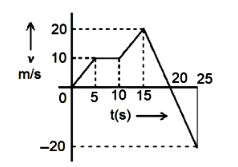
From the \(\mathrm{v}-t\) graph shown, the ratio of distance to displacement in 25 s of motion is: [JEE Main 2023 (Online) 11th April Morning Shift]
 CorrectIncorrect
Hint
(d) Displacement \((s)\) : The net area under the \(\mathrm{v}-\mathrm{t}\) graph.
\(
\begin{aligned}
& \text { Displacement }=\left(\frac{1}{2} \times 10 \times 5\right)+(10 \times 5)+\left(\frac{1}{2} \times 5 \times 30\right)+\left(\frac{1}{2} \times 5 \times 20\right)-\frac{1}{2}(5)(20) \\
& =25+50+75+50-50 \\
& =150 \mathrm{~m}
\end{aligned}
\)
Distance \((d)\): The sum of the absolute values of the areas under the \(v-t\) graph.
\(
\text { Distance }=25+50+75+50+50=250
\)
\(
\frac{\text { Distance }}{\text { Displacement }}=\frac{250}{150}=\frac{5}{3}
\) - Question 21 of 69
21. Question
A person travels \(x\) distance with velocity \(v_1\) and then \(x\) distance with velocity \(v_2\) in the same direction. The average velocity of the person is \(v\) , then the relation between \(v, v_1\) and \(v_2\) will be. [JEE Main 2023 (Online) 10th April Evening Shift]
CorrectIncorrectHint
(d) Step 1: Define average velocity
The average velocity is defined as the total distance traveled divided by the total time taken.
\(
v=\frac{\text { Total Distance }}{\text { Total Time }}
\)
Step 2: Calculate total distance and total time
The person travels a distance \(x\) with velocity \(v_1\) and another distance \(x\) with velocity \(v_2\).
The total distance is \(x+x=2 x\).
The time taken for the first part of the journey is \(t_1=\frac{x}{v_1}\).
The time taken for the second part of the journey is \(t_2=\frac{x}{v_2}\).
The total time is \(T_{\text {total }}=t_1+t_2=\frac{x}{v_1}+\frac{x}{v_2}\).
Step 3: Substitute and simplify
Substitute the total distance and total time into the average velocity formula.
\(
v=\frac{2 x}{\frac{x}{v_1}+\frac{x}{v_2}}
\)
Factor out \(x\) from the denominator:
\(
v=\frac{2 x}{x\left(\frac{1}{v_1}+\frac{1}{v_2}\right)}
\)
Cancel out \(x\) from the numerator and denominator:
\(
v=\frac{2}{\frac{1}{v_1}+\frac{1}{v_2}}
\)
To express the relationship in a different form, take the reciprocal of both sides:
\(
\frac{1}{v}=\frac{\frac{1}{v_1}+\frac{1}{v_2}}{2}
\)
Multiplying both sides by 2 gives:
\(
\frac{2}{v}=\frac{1}{v_1}+\frac{1}{v_2}
\) - Question 22 of 69
22. Question
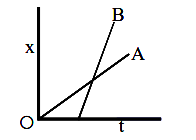
The position-time graphs for two students A and B returning from the school to their homes are shown in figure. [JEE Main 2023 (Online) 10th April Morning Shift]

(A) A lives closer to the school
(B) B lives closer to the school
(C) A takes lesser time to reach home
(D) A travels faster than B
(E) B travels faster than A
Choose the correct answer from the options given below :CorrectIncorrectHint
(b) From the given graphs, it can be seen
slope \(_{\mathrm{B}}>\) slope \(_{\mathrm{A}}\)
\(
v_{\mathrm{B}}>v_{\mathrm{A}}
\)
\(\therefore\) Statement (E) is correct.
Also, \(x_{\mathrm{A}}<x_{\mathrm{B}}\), A lives closer to school.
\(\therefore\) Statement (A) is correct. - Question 23 of 69
23. Question
Given below are two statements
Statement I: Area under velocity- time graph gives the distance travelled by the body in a given time.
Statement II: Area under acceleration- time graph is equal to the change in velocity- in the given time.
In the light of given statements, choose the correct answer from the options given below. [JEE Main 2023 (Online) 8th April Evening Shift]CorrectIncorrectHint
(c) Statement I is incorrect because the area under a velocity-time graph gives the displacement, not necessarily the distance traveled, as displacement can be negative while distance is always positive. Statement II is correct because the area under an acceleration-time graph represents the change in velocity. The relationship between acceleration \((a)\) and velocity \((v)\) is given by \(a=\frac{d v}{d t}\). Integrating both sides with respect to time gives the change in velocity, which corresponds to the area under the acceleration-time graph.
- Question 24 of 69
24. Question
A particle starts with an initial velocity of \(10.0 \mathrm{~ms}^{-1}\) along \(x\)-direction and accelerates uniformly at the rate of \(2.0 \mathrm{~ms}^{-2}\). The time taken by the particle to reach the velocity of \(60.0 \mathrm{~ms}^{-1}\) is ____. [JEE Main 2023 (Online) 6th April Evening Shift]
CorrectIncorrectHint
(d) Step 1: Identify the kinematic equation
The problem provides the initial velocity, final velocity, and uniform acceleration, and asks for the time. The appropriate kinematic equation relating these variables is:
\(
v=v_0+a t
\)
where \(v\) is the final velocity, \(v_0\) is the initial velocity, \(a\) is the acceleration, and \(t\) is the time.
Step 2: Solve for time
Rearrange the equation to solve for time \((t)\) :
\(
t=\frac{v-v_0}{a}
\)
Step 3: Substitute the given values and calculate
Substitute the given values into the rearranged equation:
Initial velocity \(\left(v_0\right)=10.0 \mathrm{~ms}^{-1}\)
Final velocity \((v)=60.0 \mathrm{~ms}^{-1}\)
Acceleration \((a)=2.0 \mathrm{~ms}^{-2}\)
\(
t=\frac{60.0 \mathrm{~ms}^{-1}-10.0 \mathrm{~ms}^{-1}}{2.0 \mathrm{~ms}^{-2}}=\frac{50.0 \mathrm{~ms}^{-1}}{2.0 \mathrm{~ms}^{-2}}=25.0 \mathrm{~s}
\)
The time taken by the particle to reach the velocity of \(60.0 \mathrm{~ms}^{-1}\) is 25 s. - Question 25 of 69
25. Question
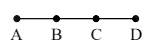
An object moves with speed \(v_1, v_2\) and \(v_3\) along a line segment \(\mathrm{AB}, \mathrm{BC}\) and CD respectively as shown in figure. Where \(A B=B C\) and \(A D=3 A B\), then average speed of the object will be: [JEE Main 2023 (Online) 1st February Morning Shift]
 CorrectIncorrect
Hint
(d)
\(
\begin{aligned}
A B=B C=C D & \\
\Rightarrow \text { Average speed } & =\frac{\text { Distance }}{\text { Time }} \\
& =\frac{A D}{\frac{A B}{v_1}+\frac{A B}{v_2}+\frac{A B}{v_3}} \quad (A D=3 A B) \\
& =\frac{3 v_1 v_2 v_3}{v_1 v_2+v_2 v_3+v_1 v_3}
\end{aligned}
\)Note: Determine the lengths of the segments
Let the length of segment AB be \(\boldsymbol{L}\).
According to the problem statement, \(\mathrm{AB}=\mathrm{BC}\), so the length of segment BC is also \(L\)
The total length of the path is \(\mathrm{AD}=3 \mathrm{AB}\), so the total distance is 3 L .
The total distance is also the sum of the individual segments: \(\mathrm{AD}=\mathrm{AB}+\mathrm{BC}+\mathrm{CD}\).
Substituting the known lengths: \(3 L=L+L+C D\).
Solving for CD: CD \(=3 L-2 L=L\).
So, the lengths of all three segments are equal: \(\mathrm{AB}=\mathrm{BC}=\mathrm{CD}=L\). - Question 26 of 69
26. Question
A vehicle travels 4 km with speed of \(3 \mathrm{~km} / \mathrm{h}\) and another 4 km with speed of \(5 \mathrm{~km} / \mathrm{h}\), then its average speed is [JEE Main 2023 (Online) 30th January Evening Shift]
CorrectIncorrectHint
(a)
\(
\begin{aligned}
& \text { Average speed } \\
& =\frac{\text { Total dis tance }}{\text { Total time }} \\
& =\frac{8}{\frac{4}{3}+\frac{4}{5}} \\
& =3.75 \mathrm{~km} / \mathrm{h}
\end{aligned}
\) - Question 27 of 69
27. Question
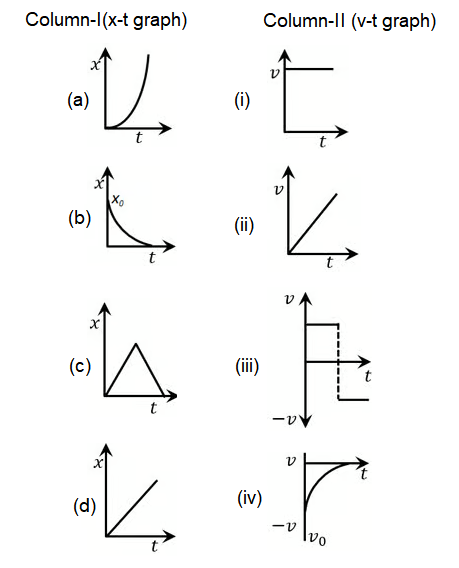
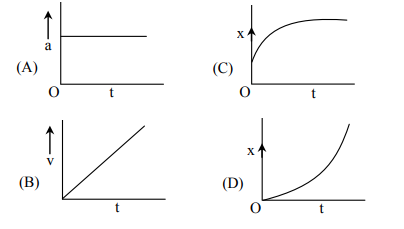
Match Column-I with Column-II : [JEE Main 2023 (Online) 30th January Morning Shift]

Choose the correct answer from the options given below:
CorrectIncorrectHint
(b)
\(
\begin{aligned}
& \frac{\mathrm{dx}}{\mathrm{dt}}=\text { slope } \geq 0 \text { always increasing } \\
& (\mathrm{A}-\mathrm{II})
\end{aligned}
\)
A. slope of \(x-t\) curve is increasing and positive and is zero at \(t=0\). So, velocity is positive and increasing starting with zero.\(
\begin{aligned}
&\frac{\mathrm{dx}}{\mathrm{dt}}<0 ; \text { and at } \mathrm{t} \rightarrow \infty \frac{\mathrm{dx}}{\mathrm{dt}} \rightarrow 0\\
&\text { (B – IV) }
\end{aligned}
\)
B. slope of \(x-t\) curve is negative initially and have larger slope and it becomes zero ultimately at \(\mathrm{t}=\) infinity. Hence, velocity is negative with larger magnitude, and it decreases with time and become zero after infinite time.\(
\begin{aligned}
&\frac{\mathrm{dx}}{\mathrm{dt}}>0 \text { for first half } \frac{\mathrm{dx}}{\mathrm{dt}}<0 \text { for second half. }\\
&\text { (C – III) }
\end{aligned}
\)
C. slope of \(x-t\) curve is constant and positive initially and then it is constant and negative later. So, initially velocity is positive constant and then at a instant its value become negative with constant magnitude.\(
\begin{aligned}
&\frac{\mathrm{dx}}{\mathrm{dt}}=\text { constant }\\
&(D-I)
\end{aligned}
\)
D. slope of x-t curve is positive and constant. So, the velocity is constant and positive. - Question 28 of 69
28. Question
The distance travelled by a particle is related to time t as \(x=4 \mathrm{t}^2\). The velocity of the particle at \(\mathrm{t}=5 \mathrm{~s}\) is : [JEE Main 2023 (Online) 25th January Evening Shift]
CorrectIncorrectHint
(d)
\(
\begin{aligned}
& x=4 t^2 \\
& v=\frac{d x}{d t}=8 t \\
& \text { At } \mathrm{t}=5 \mathrm{sec} \\
& {v}=8 \times 5=40 \mathrm{~m} / \mathrm{s}
\end{aligned}
\) - Question 29 of 69
29. Question
A car travels a distance of ‘ \(x\) ‘ with speed \(v_1\) and then same distance ‘ \(x\) ‘ with speed \(v_2\) in the same direction. The average speed of the car is : [JEE Main 2023 (Online) 25th January Morning Shift]
CorrectIncorrectHint
(b)
\(
\begin{aligned}
&\text { Average velocity }=\frac{\text { Total displacement }}{\text { Total time }}\\
&=\frac{{x}+{x}}{\frac{{x}}{{v}_1}+\frac{{x}}{{v}_2}}=\frac{2 {v}_1 {v}_2}{{v}_1+{v}_2}
\end{aligned}
\) - Question 30 of 69
30. Question
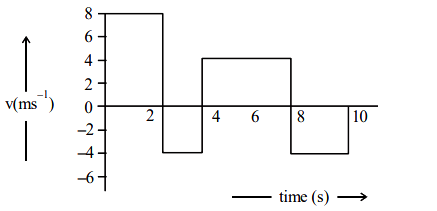
The velocity time graph of a body moving in a straight line is shown in the figure.

The ratio of displacement to distance travelled by the body in time 0 to 10 s is : [JEE Main 2023 (Online) 24th January Evening Shift]
CorrectIncorrectHint
(b) From \(v-t\) graph:
Displacement = Area under curve considering sign also.
Distance \(=\) Area under curve considering only magnitude
Displacement \(=\Sigma\) area \(=8 \times 2-4 \times 2+4 \times 4-2 \times 4=16 \mathrm{~m}\)
Distance \(=\Sigma \mid\) area \(\mid=48 \mathrm{~m}\)
Displacement : distance \(=1: 3\) - Question 31 of 69
31. Question
A juggler throws balls vertically upwards with same initial velocity in air. When the first ball reaches its highest position, he throws the next ball. Assuming the juggler throws \(n\) balls per second, the maximum height the balls can reach is [JEE Main 2022 (Online) 29th July Evening Shift]
CorrectIncorrectHint
(d) Determine the time interval: The juggler throws \(n\) balls per second, meaning the time between consecutive throws is \(t_{\text {throw }}=\frac{1}{n}\) seconds.
Relate time to height: The problem states that the next ball is thrown when the previous one reaches its highest point. This means the time taken for the ball to reach its maximum height is equal to the time interval between throws.
Use the kinematic equation: The formula for the height of a free-falling object is \(h=v_0 t+\frac{1}{2} a t^2\). Since the initial velocity \(\left(v_0\right)\) is zero at the highest point, the equation simplifies to \(h=\frac{1}{2} a t^2\).
In this case, the acceleration (a) is due to gravity (g), and the time \((t)\) is \(1 / n\).
Calculate the height: Substituting the values into the simplified equation:
\(h=\frac{1}{2} g\left(\frac{1}{n}\right)^2\)
\(h=\frac{1}{2} g\left(\frac{1}{n^2}\right)\)
\(h=\frac{g}{2 n^2}\) - Question 32 of 69
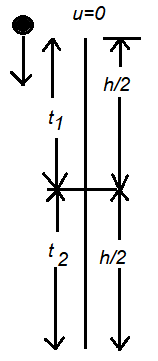
32. Question
A ball is released from a height \(h\). If \(t_1\) and \(t_2\) be the time required to complete first half and second half of the distance respectively. Then, choose the correct relation between \(t_1\) and \(t_2\) [JEE Main 2022 (Online) 29th July Evening Shift]
CorrectIncorrectHint
(d)

Step 1: Formulate equations for distance and time
The motion of the ball is governed by the equation for a falling object with an initial velocity of zero: \(s=\frac{1}{2} g t^2\), where \(s\) is the distance fallen, \(g\) is the acceleration due to gravity, and \(t\) is the time elapsed.
Step 2: Calculate the time for the first half of the distance
The first half of the distance is \(\frac{h}{2}\). The time taken is given as \(\boldsymbol{t}_1\). Using the formula from Step 1:
\(
\frac{h}{2}=\frac{1}{2} g t_1^2
\)
Solving for \(h\), we get:
\(
h=g t_1^2
\)
This gives us a relationship between \(t_1\) and \(h\) :
\(
t_1=\sqrt{\frac{h}{g}}
\)
Step 3: Calculate the total time to fall distance \(h\)
The total distance is \(\boldsymbol{h}\), and the total time is the sum of the times for the first and second halves, \(t_1+t_2\). Using the same formula:
\(
h=\frac{1}{2} g\left(t_1+t_2\right)^2
\)
Substitute the expression for \(h\) from Step 2 into this equation:
\(
\begin{gathered}
g t_1^2=\frac{1}{2} g\left(t_1+t_2\right)^2 \\
2 t_1^2=\left(t_1+t_2\right)^2
\end{gathered}
\)
Take the square root of both sides:
\(
\sqrt{2} t_1=t_1+t_2
\)
\(
t_2=(\sqrt{2}-1) t_1
\) - Question 33 of 69
33. Question
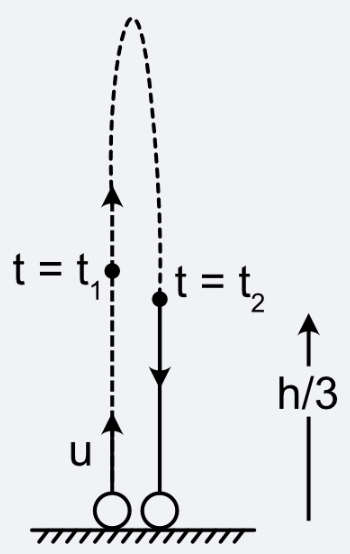
A ball is thrown up vertically with a certain velocity so that, it reaches a maximum height \(h\). Find the ratio of the times in which it is at height \(\frac{h}{3}\) while going up and coming down respectively. [JEE Main 2022 (Online) 29th July Morning Shift]
CorrectIncorrectHint
(b)

\(
\begin{gathered}
\text { Max. Hight }=\mathrm{h}=\frac{\mathrm{u}^2}{2 \mathrm{~g}} \\
\Rightarrow \mathrm{u}=\sqrt{2 \mathrm{gh}} \\
\mathrm{~S}=\mathrm{ut}+\frac{1}{2} \mathrm{at}^2 \\
\Rightarrow \frac{\mathrm{~h}}{3}=\sqrt{2 \mathrm{gh}} \mathrm{t}+\frac{1}{2}(-\mathrm{g}) \mathrm{t}^2 \\
\Rightarrow \frac{\mathrm{gt}^2}{2}-\sqrt{2 \mathrm{gh} \mathrm{t}}+\frac{\mathrm{h}}{3}=0
\end{gathered}
\)
Time taken while going up is \(t_1\)
Time taken while going down is \(t_2\) (Roots are \({t}_1 \& {t}_2\) )
\(
\frac{t_1}{t_2}=\frac{\sqrt{2 g h}-\sqrt{2 g h-4 \times \frac{g}{2} \times \frac{h}{3}}}{\sqrt{2 g h}+\sqrt{2 g h-4 \times \frac{g}{2} \times \frac{h}{3}}}=\frac{\sqrt{2 g h}-\sqrt{\frac{4 g h}{3}}}{\sqrt{2 g h}+\sqrt{\frac{4 g h}{3}}}=\frac{\sqrt{3}-\sqrt{2}}{\sqrt{3}+\sqrt{2}}
\) - Question 34 of 69
34. Question
If \(\mathrm{t}=\sqrt{x}+4\), then \(\left(\frac{\mathrm{d} x}{\mathrm{~d} t}\right)_{\mathrm{t}=4}\) is : [JEE Main 2022 (Online) 29th July Morning Shift]
CorrectIncorrectHint
(b) \(t=\sqrt{x}+4\), Squaring on both
\(
\begin{aligned}
& x=(t-4)^2=t^2-8 t+16 \\
& \frac{d x}{d t}=2 t-8
\end{aligned}
\)
at \(t=4\)
\(
\frac{d x}{d t}=8-8=0
\) - Question 35 of 69
35. Question
A NCC parade is going at a uniform speed of \(9 \mathrm{~km} / \mathrm{h}\) under a mango tree on which a monkey is sitting at a height of 19.6 m . At any particular instant, the monkey drops a mango. A cadet will receive the mango whose distance from the tree at time of drop is: (Given \(g=9.8 \mathrm{~m} / \mathrm{s}^2\) ) [JEE Main 2022 (Online) 28th July Morning Shift]
CorrectIncorrectHint
(a) Step 1: Calculate the time it takes for the mango to fall
The mango is dropped from a height of 19.6 m. The time it takes to fall can be calculated using the kinematic equation for free fall:
\(
h=v_0 t+\frac{1}{2} g t^2
\)
where:
\(h\) is the height, 19.6 m
\(v_0\) is the initial vertical velocity, which is \(0 \mathrm{~m} / \mathrm{s}\) since the mango is dropped
\(g\) is the acceleration due to gravity, \(9.8 \mathrm{~m} / \mathrm{s}^2\)
\(t\) is the time
Substituting the values, we get:
\(
\begin{gathered}
19.6=0 \cdot t+\frac{1}{2}(9.8) t^2 \\
19.6=4.9 t^2 \\
t^2=\frac{19.6}{4.9}=4 \\
t=\sqrt{4}=2 \mathrm{~s}
\end{gathered}
\)
Step 2: Convert the speed of the parade to meters per second
The speed of the parade is given as \(9 \mathrm{~km} / \mathrm{h}\). To be consistent with the other units, we convert this to \(\mathrm{m} / \mathrm{s}\) :
\(
\begin{gathered}
v=9 \frac{\mathrm{~km}}{\mathrm{~h}} \times \frac{1000 \mathrm{~m}}{1 \mathrm{~km}} \times \frac{1 \mathrm{~h}}{3600 \mathrm{~s}} \\
v=\frac{9 \times 1000}{3600} \mathrm{~m} / \mathrm{s}=2.5 \mathrm{~m} / \mathrm{s}
\end{gathered}
\)
Step 3: Calculate the required distance
For the cadet to catch the mango, they must travel the required distance in the same amount of time it takes for the mango to fall. The distance the cadet travels is given by the formula:
Distance \(=\) speed \(\times\) time
\(
\begin{gathered}
d=v \cdot t \\
d=(2.5 \mathrm{~m} / \mathrm{s}) \cdot(2 \mathrm{~s})=5 \mathrm{~m}
\end{gathered}
\)
The cadet will receive the mango if their distance from the tree at the time of the drop is 5 m. - Question 36 of 69
36. Question
The velocity of the bullet becomes one third after it penetrates 4 cm in a wooden block. Assuming that bullet is facing a constant resistance during its motion in the block. The bullet stops completely after travelling at \((4+{x}) \mathrm{cm}\) inside the block. The value of \(x\) is : [JEE Main 2022 (Online) 27th July Evening Shift]
CorrectIncorrectHint
(c) Step 1: Formulate equations for the motion
We can use the kinematic equation \(v^2=u^2+2 a s\) for this problem, where \(v\) is the final velocity, \(u\) is the initial velocity, \(a\) is the constant acceleration, and \(s\) is the distance. The problem can be divided into two parts: the first 4 cm of travel and the total travel distance until the bullet stops.
For the first 4 cm of travel:
Initial velocity: \(u_1=v_0\)
Final velocity: \(v_1=v_0 / 3\)
Distance: \(s_1=4 \mathrm{~cm}\)
The equation is:
\(
\begin{aligned}
& \left(v_0 / 3\right)^2=v_0^2+2 a(4) \\
& v_0^2 / 9=v_0^2+8 a \\
& -8 v_0^2 / 9=8 a \\
& a=-v_0^2 / 9
\end{aligned}
\)
For the total travel distance until the bullet stops:
Initial velocity: \(u_2=v_0\)
Final velocity: \(v_2=0\)
Distance: \(s_2=(4+x) \mathrm{cm}\)
The equation is:
\(
\begin{aligned}
& 0^2=v_0^2+2 a(4+x) \\
& -v_0^2=2 a(4+x)
\end{aligned}
\)
Substitute the expression for acceleration \(a=-v_0^2 / 9\) from the first part of the motion into the equation for the total distance.
\(
-v_0^2=2\left(-v_0^2 / 9\right)(4+x)
\)
\(
\begin{aligned}
&1=2 / 9(4+x)\\
&\begin{gathered}
9 / 2=4+x \\
4.5=4+x \\
x=4.5-4 \\
x=0.5
\end{gathered}
\end{aligned}
\) - Question 37 of 69
37. Question
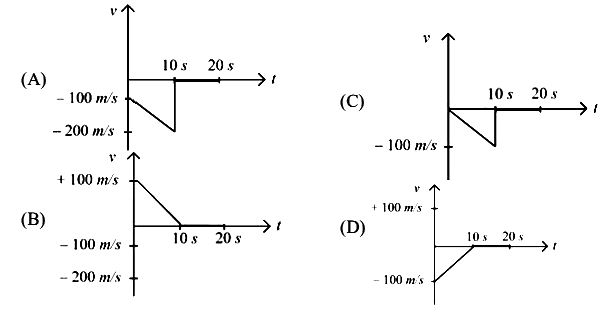
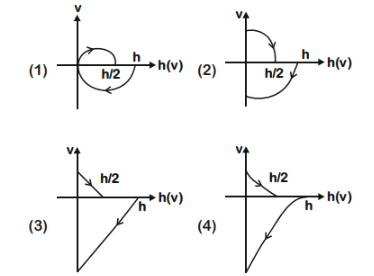
A bullet is shot vertically downwards with an initial velocity of \(100 \mathrm{~m} / \mathrm{s}\) from a certain height. Within 10 s, the bullet reaches the ground and instantaneously comes to rest due to the perfectly inelastic collision. The velocity-time curve for total time \(t=20 s\) will be: [JEE Main 2022 (Online) 27th July Morning Shift]
\(\left(\right.\) Take \(\left.\mathrm{g}=10 \mathrm{~m} / \mathrm{s}^2\right)\). CorrectIncorrect
Hint
(a) Explanation:
The bullet is shot vertically downwards with an initial velocity of \(100 \mathrm{~m} / \mathrm{s}\). The acceleration due to gravity is \(10 \mathrm{~m} / \mathrm{s}^2\). The bullet reaches the ground in 10 seconds, and due to a perfectly inelastic collision, it comes to rest instantaneously. We need to determine the velocity-time graph for the total time \(t=20 \mathrm{~s}\). Since the bullet is moving downwards, the velocity will keep increasing until it hits the ground. After the collision, the velocity will be zero for the remaining time.Step 1: Determine the initial conditions: Initial velocity \(u=100 \mathrm{~m} / \mathrm{s}\), acceleration \(a=10 \mathrm{~m} / \mathrm{s}^2\), and time to reach the ground \(t=10 \mathrm{~s}\).
Step 2: Calculate the final velocity just before the bullet hits the ground using the equation \(v=u+a t\).
Substituting the values, we get \(v=100 \mathrm{~m} / \mathrm{s}+\left(10 \mathrm{~m} / \mathrm{s}^2 \times 10 \mathrm{~s}\right)=200 \mathrm{~m} / \mathrm{s}\).Step 3: After hitting the ground, the bullet comes to rest instantaneously due to the perfectly inelastic collision. Therefore, the velocity becomes \(0 \mathrm{~m} / \mathrm{s}\) at \(t=10 \mathrm{~s}\) and remains \(0 \mathrm{~m} / \mathrm{s}\) for the remaining 10 seconds.
Step 4: Plot the velocity-time graph: The graph will show a linear increase in velocity from \(100 \mathrm{~m} / \mathrm{s}\) to \(200 \mathrm{~m} / \mathrm{s}\) over the first 10 seconds, followed by a sudden drop to \(0 \mathrm{~m} / \mathrm{s}\) at \(t=10 \mathrm{~s}\) and remaining at \(0 \mathrm{~m} / \mathrm{s}\) for the next 10 seconds.
- Question 38 of 69
38. Question
A small toy starts moving from the position of rest under a constant acceleration. If it travels a distance of 10 m in \(t\) s, the distance travelled by the toy in the next \(t\) s will be : [JEE Main 2022 (Online) 29th June Evening Shift]
CorrectIncorrectHint
(c) Step 1: Find the relationship between acceleration and distance for the first time interval
The kinematic equation for an object starting from rest with constant acceleration is \(s=\frac{1}{2} a t^2\).
For the first time interval \(\boldsymbol{t}\), the distance traveled is 10 m, so we can write:
\(
10=\frac{1}{2} a t^2
\)
This gives us a relationship between acceleration \(\boldsymbol{a}\) and time \(\boldsymbol{t}\). We can rearrange it to find \(a t^2=20\).
Step 2: Calculate the total distance traveled in \(2 t\) seconds
The total time elapsed is \(2 t\). Using the same kinematic equation, the total distance traveled from the start is:
\(
\begin{aligned}
s_{\text {total }} & =\frac{1}{2} a(2 t)^2 \\
s_{\text {total }} & =\frac{1}{2} a\left(4 t^2\right) \\
s_{\text {total }} & =2 a t^2
\end{aligned}
\)
Now, substitute the value of \(a t^2\) from Step 1 into this equation:
\(
\begin{aligned}
& s_{\text {total }}=2(20) \\
& s_{\text {total }}=40 \mathrm{~m}
\end{aligned}
\)
Step 3: Find the distance traveled in the next \(t\) seconds
The distance traveled in the next \(t\) seconds is the difference between the total distance traveled in \(2 t\) seconds and the distance traveled in the first \(t\) seconds.
\(
\begin{gathered}
s_{\text {next } t}=s_{\text {total }}-s_1 \\
s_{\text {next } t}=40-10 \\
s_{\text {next } t}=30 \mathrm{~m}
\end{gathered}
\) - Question 39 of 69
39. Question
Two balls A and B are placed at the top of 180 m tall tower. Ball A is released from the top at \(\mathrm{t}=0\) s. Ball B is thrown vertically down with an initial velocity ‘ u ‘ at \(\mathrm{t}=2 \mathrm{~s}\). After a certain time, both balls meet 100 m above the ground. Find the value of ‘ \(u\) ‘ in \(\mathrm{ms}^{-1}\). [use \(\mathrm{g}=10 \mathrm{~ms}^{-2}\) ]: [JEE Main 2022 (Online) 29th June Morning Shift]
CorrectIncorrectHint
(d) Step 1: Determine the time taken for ball A to reach the meeting point.
Let’s define the top of the tower as the origin ( \(y=0\) ) and the downward direction as positive. The height of the tower is 180 m. The meeting point is 100 m above the ground, which means it is \(180-100=80 \mathrm{~m}\) below the top of the tower.
Ball A is released from rest \(\left(v_{0 A}=0\right)\) at \(t=0 \mathrm{~s}\). We can use the equation of motion:
\(
y_A=v_{0 A} t_A+\frac{1}{2} g t_A^2
\)
where \(y_A=80 \mathrm{~m}\) and \(g=10 \mathrm{~ms}^{-2}\).
\(
\begin{gathered}
80=(0) t_A+\frac{1}{2}(10) t_A^2 \\
80=5 t_A^2 \\
t_A^2=16 \\
t_A=4 \mathrm{~s}
\end{gathered}
\)
Thus, ball A reaches the meeting point at \(t=4 \mathrm{~s}\).
Step 2: Calculate the time of travel for ball B.
Ball B is thrown vertically down at \(t=2 \mathrm{~s}\). Both balls meet at the same time, which we found to be \(t=4 \mathrm{~s}\). Therefore, the time of travel for ball \(\mathrm{B}, t_{B^{\prime}}\) is the difference between these times.
\(
t_B=4 \mathrm{~s}-2 \mathrm{~s}=2 \mathrm{~s}
\)
Step 3: Find the initial velocity ‘\(u\)‘ of ball B.
Ball B travels a distance of \(y_B=80 \mathrm{~m}\) in \(t_B=2 \mathrm{~s}\) with an initial velocity \(u\). We can use the same equation of motion:
\(
\begin{gathered}
y_B=v_{0 B} t_B+\frac{1}{2} g t_B^2 \\
80=(u)(2)+\frac{1}{2}(10)(2)^2 \\
80=2 u+5(4) \\
80=2 u+20 \\
60=2 u \\
u=30 \mathrm{~ms}^{-1}
\end{gathered}
\) - Question 40 of 69
40. Question
Two buses P and Q start from a point at the same time and move in a straight line and their positions are represented by \(X_P(t)=\alpha t+\beta t^2\) and \(X_Q(t)=f t-t^2\). At what time, both the buses have same velocity? [JEE Main 2022 (Online) 25th June Evening Shift]
CorrectIncorrectHint
(d) Step 1: Find the velocity of each bus
To find the velocity of each bus, we need to differentiate their position functions with respect to time \((t)\). The velocity \(v(t)\) is the derivative of the position \(X(t)\).
For bus P , the position is \(X_P(t)=\alpha t+\beta t^2\).
The velocity of bus P is \(v_P(t)=\frac{d}{d t}\left(X_P(t)\right)=\frac{d}{d t}\left(\alpha t+\beta t^2\right)=\alpha+2 \beta t\).
For bus \(Q\), the position is \(X_Q(t)=f t-t^2\).
The velocity of bus Q is \(v_Q(t)=\frac{d}{d t}\left(X_Q(t)\right)=\frac{d}{d t}\left(f t-t^2\right)=f-2 t\).
Step 2: Set the velocities equal to each other
We are looking for the time \((t)\) when the velocities of both buses are the same, which means \(v_P(t)=v_Q(t)\).
\(
\alpha+2 \beta t=f-2 t
\)
Step 3: Solve for t
Now, we rearrange the equation to solve for \(t\).
First, gather the terms containing \(t\) on one side of the equation:
\(
2 \beta t+2 t=f-\alpha
\)
Factor out \(t\) from the left side:
\(
t(2 \beta+2)=f-\alpha
\)
Finally, divide by \((2 \beta+2)\) to isolate \(t\) :
\(
\begin{aligned}
t & =\frac{f-\alpha}{2 \beta+2} \\
t & =\frac{f-\alpha}{2(1+\beta)}
\end{aligned}
\)
The time at which both buses have the same velocity is \(t=\frac{f-\alpha}{2(1+\beta)}\). - Question 41 of 69
41. Question
Water drops are falling from a nozzle of a shower onto the floor, from a height of 9.8 m. The drops fall at a regular interval of time. When the first drop strikes the floor, at that instant, the third drop begins to fall. Locate the position of second drop from the floor when the first drop strikes the floor. [JEE Main 2021 (Online) 27th August Evening Shift]
CorrectIncorrectHint
(d)

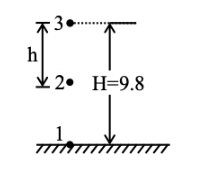
Step 1: Calculate the time for a drop to fall the full height
We can use the kinematic equation for free fall, \(s=u t+\frac{1}{2} g t^2\), where \(s\) is the distance, \(u\) is the initial velocity, \(t\) is the time, and \(g\) is the acceleration due to gravity. The initial velocity of the drops is \(0 \mathrm{~m} / \mathrm{s}\). The height is given as \(h=9.8 \mathrm{~m}\) and the acceleration due to gravity is \(g=9.8 \mathrm{~m} / \mathrm{s}^2\).
\(
\begin{gathered}
h=\frac{1}{2} g t^2 \\
9.8=\frac{1}{2}(9.8) t^2 \\
t^2=2 \\
t=\sqrt{2} \mathrm{~s}
\end{gathered}
\)
This is the total time it takes for a single drop to fall 9.8 m.
Step 2: Determine the time interval between drops
When the first drop hits the floor, the third drop begins to fall. This means the total time of flight for the first drop \((\sqrt{2} \mathrm{~s})\) is equal to two regular time intervals between drops. Let \(\Delta t\) be the time interval between successive drops.
\(
\begin{gathered}
t=2 \Delta t \\
\sqrt{2}=2 \Delta t \\
\Delta t=\frac{\sqrt{2}}{2} \mathrm{~s}
\end{gathered}
\)
This is the time elapsed between the release of the first drop and the second drop, and also between the second and third drop.
Step 3: Calculate the distance the second drop has fallen
When the first drop strikes the floor, the second drop has been falling for one time interval, \(\Delta t\). We use the same kinematic equation to find the distance fallen, \(s_2\).
\(
\begin{gathered}
s_2=\frac{1}{2} g(\Delta t)^2 \\
s_2=\frac{1}{2}(9.8)\left(\frac{\sqrt{2}}{2}\right)^2 \\
s_2=\frac{1}{2}(9.8)\left(\frac{2}{4}\right) \\
s_2=\frac{1}{2}(9.8)(0.5) \\
s_2=2.45 \mathrm{~m}
\end{gathered}
\)
Step 4: Find the position of the second drop from the floor
The position of the second drop from the floor, \(h_{\text {floor }}\), is the total height minus the distance it has fallen.
\(
\begin{gathered}
h_{\text {floor }}=h-s_2 \\
h_{\text {floor }}=9.8-2.45 \\
h_{\text {floor }}=7.35 \mathrm{~m}
\end{gathered}
\)
The position of the second drop from the floor when the first drop strikes the floor is 7.35 m. - Question 42 of 69
42. Question
A ball is thrown up with a certain velocity so that it reaches a height ‘ \(h\) ‘. Find the ratio of the two different times of the ball reaching \(\frac{h}{3}\) in both the directions. [JEE Main 2021 (Online) 27th July Morning Shift]
CorrectIncorrectHint
(c) Step 1: Relate initial velocity to maximum height
Let the initial upward velocity be \(\boldsymbol{u}\). At the maximum height \(\boldsymbol{h}\), the final velocity \(\boldsymbol{v}\) is 0. Using the kinematic equation \(v^2=u^2+2 a s\) with \(a=-g\) (taking the upward direction as positive), we get:
\(
\begin{gathered}
0^2=u^2+2(-g) h \\
u^2=2 g h \Longrightarrow u=\sqrt{2 g h}
\end{gathered}
\)
Step 2: Set up the equation for time to reach height \(\frac{h}{3}\)
\(
\begin{aligned}
& S=\frac{h}{3} \\
& \mathrm{a}=-\mathrm{g} \\
& S=u t+\frac{1}{2} a t^2 \\
& \frac{h}{3}=\sqrt{2 g h} t+\frac{1}{2}(-g) t^2 \\
& t^2\left(\frac{g}{2}\right)-\sqrt{2 g h} t+\frac{h}{3}=0
\end{aligned}
\)
From quadratic equation
\(
\begin{aligned}
& t_1, t_2=\frac{\sqrt{2 g h} \pm \sqrt{2 g h-\frac{4 g}{2} \frac{h}{3}}}{g} \\
& \frac{t_1}{t_2}=\frac{\sqrt{2 g h}-\sqrt{\frac{4 g h}{3}}}{\sqrt{2 g h}+\sqrt{\frac{4 g h}{3}}}=\frac{\sqrt{3}-\sqrt{2}}{\sqrt{3}+\sqrt{2}}
\end{aligned}
\) - Question 43 of 69
43. Question
The relation between time \(t\) and distance \(x\) for a moving body is given as \(t=m x^2+n x\), where \(m\) and \(n\) are constants. The retardation of the motion is : (When \(v\) stands for velocity) [JEE Main 2021 (Online) 25th July Evening Shift]
CorrectIncorrectHint
(a) Step 1: Find the velocity
The given relation between time \(t\) and distance \(x\) is \(t=m x^2+n x\). To find the velocity \(v=\frac{d x}{d t}\), we differentiate the given equation with respect to \(t\) :
\(
\begin{gathered}
\frac{d t}{d t}=\frac{d}{d t}\left(m x^2+n x\right) \\
1=2 m x \frac{d x}{d t}+n \frac{d x}{d t} \\
1=(2 m x+n) \frac{d x}{d t}
\end{gathered}
\)
Since \(v=\frac{d x}{d t}\), we can write the velocity as:
\(
v=\frac{1}{2 m x+n}
\)
Step 2: Find the acceleration
To find the acceleration \(a=\frac{d v}{d t}\), we differentiate the expression for velocity with respect to \(t\) using the chain rule, \(\frac{d v}{d t}=\frac{d v}{d x} \frac{d x}{d t}\) :
\(
\begin{gathered}
a=\frac{d}{d t}\left(\frac{1}{2 m x+n}\right)=\frac{d}{d x}\left((2 m x+n)^{-1}\right) \frac{d x}{d t} \\
a=-1(2 m x+n)^{-2}(2 m) \frac{d x}{d t}
\end{gathered}
\)
Substituting \(\frac{d x}{d t}=v\) :
\(
a=-2 m(2 m x+n)^{-2} v
\)
From Step 1, we know that \(v=\frac{1}{2 m x+n}\), which means \((2 m x+n)^{-1}=v\). Therefore, \((2 m x+n)^{-2}=v^2\). Substituting this into the acceleration equation:
\(
a=-2 m\left(v^2\right) v=-2 m v^3
\)
Step 3: Find the retardation
Retardation is the negative of the acceleration, so retardation is \(-a\).
\(
\text { Retardation }=-a=-\left(-2 m v^3\right)=2 m v^3
\)
The retardation of the motion is \(\mathbf{2} \boldsymbol{m} \boldsymbol{v}^{\mathbf{3}}\). - Question 44 of 69
44. Question
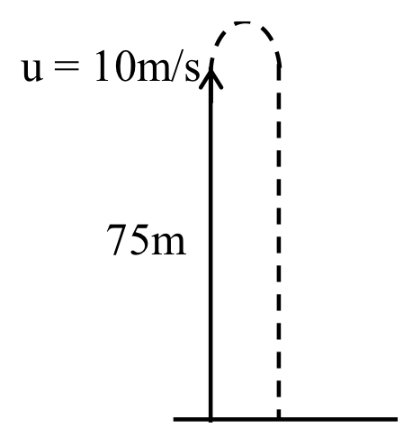
A balloon was moving upwards with a uniform velocity of \(10 \mathrm{~m} / \mathrm{s}\). An object of finite mass is dropped from the balloon when it was at a height of 75 m from the ground level. The height of the balloon from the ground when object strikes the ground was around: [JEE Main 2021 (Online) 25th July Evening Shift]
(takes the value of \(g\) as \(10 \mathrm{~m} / \mathrm{s}^2\) )CorrectIncorrectHint
(c)

Step 1: Calculate the time for the object to reach the ground
First, we need to determine how long it takes for the object to fall to the ground. We can use the equation of motion for constant acceleration:
\(
s=u t+\frac{1}{2} a t^2
\)
Here, \(s\) is the displacement, \(u\) is the initial velocity, \(t\) is the time, and \(a\) is the acceleration.
Let’s define the upward direction as positive.
The initial velocity of the object when dropped is the same as the balloon’s velocity, so \(u=+10 \mathrm{~m} / \mathrm{s}\).
The displacement of the object is its final height minus its initial height: \(s=0-75=-75 \mathrm{~m}\) (since it ends up 75 m lower).
The acceleration is due to gravity, acting downwards, so \(a=-g=-10 \mathrm{~m} / \mathrm{s}^2\).
Substituting these values into the equation, we get:
\(
\begin{gathered}
-75=10 t+\frac{1}{2}(-10) t^2 \\
-75=10 t-5 t^2
\end{gathered}
\)
\(
(t-5)(t+3)=0
\)
This gives two possible solutions for time: \(t=5\) or \(t=-3\). Since time cannot be negative, the correct value is \(t=5 \mathrm{~s}\).
Step 2: Calculate the balloon’s height after that amount of time
The balloon continues to move upwards with a uniform velocity while the object is in the air. The height of the balloon can be calculated using the formula:
\(
h=h_0+u t
\)
Here, \(h_0\) is the initial height of the balloon, \(u\) is the uniform velocity of the balloon, and \(t\) is the time we calculated in Step 1.
Initial height of the balloon: \(h_0=75 \mathrm{~m}\).
Uniform velocity of the balloon: \(u=10 \mathrm{~m} / \mathrm{s}\).
Time elapsed: \(t=5 \mathrm{~s}\).
Plugging in the values:
\(
\begin{gathered}
h=75+(10)(5) \\
h=75+50 \\
h=125 \mathrm{~m}
\end{gathered}
\)
The height of the balloon from the ground when the object strikes the ground was 125 m. - Question 45 of 69
45. Question
The instantaneous velocity of a particle moving in a straight line is given as \(V=\alpha t+\beta t^2\), where \(\alpha\) and \(\beta\) are constants. The distance travelled by the particle between 1 s and 2 s is : [JEE Main 2021 (Online) 25th July Evening Shift]
CorrectIncorrectHint
(b) Step 1: Set up the integral for distance
The velocity of the particle is given by \(V(t)=\alpha t+\beta t^2\). To find the distance traveled between two times, we integrate the velocity function over that time interval. The distance \(s\) traveled by the particle between \(t=1 \mathrm{~s}\) and \(t=2 \mathrm{~s}\) is given by the definite integral:
\(
s=\int_1^2 V(t) d t=\int_1^2\left(\alpha t+\beta t^2\right) d t
\)
Step 2: Integrate the velocity function
Integrate the function with respect to \(t\) :
\(
\int\left(\alpha t+\beta t^2\right) d t=\alpha \frac{t^2}{2}+\beta \frac{t^3}{3}+C
\)
Step 3: Evaluate the definite integral
Now, we evaluate the integral at the limits of integration, \(t=2\) and \(t=1\) :
\(
s=\left[\frac{\alpha t^2}{2}+\frac{\beta t^3}{3}\right]_1^2
\)
First, evaluate at the upper limit ( \(t=2\) ):
\(
\left(\frac{\alpha(2)^2}{2}+\frac{\beta(2)^3}{3}\right)=\frac{4 \alpha}{2}+\frac{8 \beta}{3}=2 \alpha+\frac{8}{3} \beta
\)
Next, evaluate at the lower limit ( \(t=1\) ):
\(
\left(\frac{\alpha(1)^2}{2}+\frac{\beta(1)^3}{3}\right)=\frac{\alpha}{2}+\frac{\beta}{3}
\)
Finally, subtract the value at the lower limit from the value at the upper limit:
\(
\begin{gathered}
s=\left(2 \alpha+\frac{8}{3} \beta\right)-\left(\frac{\alpha}{2}+\frac{\beta}{3}\right) \\
s=\left(2 \alpha-\frac{\alpha}{2}\right)+\left(\frac{8}{3} \beta-\frac{\beta}{3}\right) \\
s=\left(\frac{4 \alpha}{2}-\frac{\alpha}{2}\right)+\left(\frac{7}{3} \beta\right) \\
s=\frac{3}{2} \alpha+\frac{7}{3} \beta
\end{gathered}
\)
The distance traveled by the particle between 1 s and 2 s is \(\frac{\mathbf{3}}{\mathbf{2}} \boldsymbol{\alpha}+\frac{\mathbf{7}}{\mathbf{3}} \boldsymbol{\beta}\). - Question 46 of 69
46. Question
Water droplets are coming from an open tap at a particular rate. The spacing between a droplet observed at \(4^{\text {th }}\) second after its fall to the next droplet is 34.3 m. At what rate the droplets are coming from the tap ? (Take \(\mathrm{g}=9.8 \mathrm{~m} / \mathrm{s}^2\) ) [JEE Main 2021 (Online) 25th July Morning Shift]
CorrectIncorrectHint
(c) Step 1: Calculate the distance of the first droplet
The distance a droplet falls from rest is given by the equation \(y=\frac{1}{2} g t^2\).
For the first droplet, which has been falling for \(t_1=4\) seconds, the distance is:
\(
\begin{gathered}
y_1=\frac{1}{2}\left(9.8 \mathrm{~m} / \mathrm{s}^2\right)(4 \mathrm{~s})^2 \\
y_1=\frac{1}{2}(9.8)(16) \mathrm{m} \\
y_1=78.4 \mathrm{~m}
\end{gathered}
\)
Step 2: Calculate the distance of the second droplet
The problem states the spacing between the first droplet and the next one is 34.3 m. Since the first droplet has been falling for a longer time, it will have traveled a greater distance. The second droplet is still closer to the tap. Therefore, the distance of the second droplet is the distance of the first droplet minus the spacing.
\(
\begin{gathered}
y_2=y_1-34.3 \mathrm{~m} \\
y_2=78.4 \mathrm{~m}-34.3 \mathrm{~m} \\
y_2=44.1 \mathrm{~m}
\end{gathered}
\)
Step 3: Find the time the second droplet has been falling
Using the same kinematic equation, we can solve for the time the second droplet has been falling, \(t_2\).
\(
\begin{gathered}
y_2=\frac{1}{2} g t_2^2 \\
44.1 \mathrm{~m}=\frac{1}{2}\left(9.8 \mathrm{~m} / \mathrm{s}^2\right) t_2^2 \\
t_2^2=\frac{44.1 \times 2}{9.8} \mathrm{~s}^2 \\
t_2^2=\frac{88.2}{9.8} \mathrm{~s}^2 \\
t_2^2=9 \mathrm{~s}^2 \\
t_2=\sqrt{9} \mathrm{~s} \\
t_2=3 \mathrm{~s}
\end{gathered}
\)
Step 4: Determine the rate of the droplets
The time difference between the first and second droplet falling from the tap is \(\Delta t=t_1-t_2\). This time difference represents the time interval between successive drops.
\(
\begin{gathered}
\Delta t=4 \mathrm{~s}-3 \mathrm{~s} \\
\Delta t=1 \mathrm{~s}
\end{gathered}
\)
The rate of droplets is the reciprocal of this time interval, which is 1 drop per 1 second.
\(
\begin{gathered}
\text { Rate }=\frac{1 \text { drop }}{\Delta t} \\
\text { Rate }=\frac{1 \text { drop }}{1 \mathrm{~s}} \\
\text { Rate }=1 \text { drop } / \text { second }
\end{gathered}
\)
The rate at which the droplets are coming from the tap is \(\mathbf{1}\) drop/second. - Question 47 of 69
47. Question
A boy reaches the airport and finds that the escalator is not working. He walks up the stationary escalator in time \(t_1\). If he remains stationary on a moving escalator then the escalator takes him up in time \(t_2\). The time taken by him to walk up on the moving escalator will be : [JEE Main 2021 (Online) 20th July Evening Shift]
CorrectIncorrectHint
(c) Step 1: Define speeds based on given times
Let \(L\) be the length of the escalator.
When the boy walks up the stationary escalator in time \(t_1\), his walking speed \(v_b\) is given by the total length divided by the time taken.
\(
v_b=\frac{L}{t_1}
\)
When the boy stands still on the moving escalator, which takes time \(t_2\) to carry him up, the escalator’s speed \(v_e\) is given by the total length divided by the time taken.
\(
v_e=\frac{L}{t_2}
\)
Step 2: Calculate the combined speed
When the boy walks on the moving escalator, their speeds add up. The combined speed \(v_{\text {total }}\) is the sum of his walking speed and the escalator’s speed.
\(
v_{\text {total }}=v_b+v_e
\)
Substituting the expressions for \(v_b\) and \(v_e\) :
\(
\begin{gathered}
v_{\text {total }}=\frac{L}{t_1}+\frac{L}{t_2}=L\left(\frac{1}{t_1}+\frac{1}{t_2}\right) \\
v_{\text {total }}=L\left(\frac{t_2+t_1}{t_1 t_2}\right)
\end{gathered}
\)
Step 3: Calculate the time taken
The time taken for the boy to walk up the moving escalator is the total length divided by the combined speed. Let this time be \(t\).
\(
t=\frac{L}{v_{\text {total }}}
\)
Substituting the expression for \(v_{\text {total }}\) from the previous step:
\(
t=\frac{L}{L\left(\frac{t_1+t_2}{t_1 t_2}\right)}
\)
The term \(L\) cancels out, leaving:
\(
t=\frac{t_1 t_2}{t_1+t_2}
\) - Question 48 of 69
48. Question
The velocity – displacement graph of a particle is shown in the figure. [JEE Main 2021 (Online) 18th March Evening Shift]
 CorrectIncorrect
Hint
(c) \(\mathrm{a}=\mathrm{v}\left(\frac{\mathrm{dv}}{\mathrm{dx}}\right)\) (where \(\mathrm{dv} / \mathrm{dx}\) is negative)
\(v\) is decreasing
So, \(a\) will increase, hence correct option is (3).Explanation:
The slope of the given v versus x graph is \(m=-\frac{v_0}{x_0}\) and intercept is \(\mathrm{c}=+\mathrm{v}_0\). Hence, \(v\) varies with \(x\) as
\(
v=-\left(\frac{v_0}{x_0}\right) x+v_0 \dots(1)
\)
where \(v_0\) and \(x_0\) are constants of motion. Differentiating with respect to time \(t\), we have
\(
\begin{aligned}
& \frac{d v}{d t}=-\left(\frac{v_0}{x_0}\right) \frac{d x}{d t} \\
& \text { or } a=-\left(\frac{v_0}{x_0}\right) v \dots(2)
\end{aligned}
\)
Using Eq. (1) in Eq. (2), we get
\(
\begin{aligned}
& a=-\left(\frac{v_0}{x_0}\right)\left(-\frac{v_0}{x_0} x+v_0\right) \\
& a=\left(\frac{v_0}{x_0}\right)^2 x-\frac{v_0^2}{x_0}
\end{aligned}
\)
Thus the graph of \(a\) versus \(x\) is a straight line having a positive slope \(=\left(\frac{v_0}{x_0}\right)^2\) and negative intercept \(=-\frac{v_0^2}{x_0}\). Hence the correct choice is (3). - Question 49 of 69
49. Question
The position, velocity and acceleration of a particle moving with a constant acceleration can be represented by : [JEE Main 2021 (Online) 18th March Morning Shift]
 CorrectIncorrect
Hint
(2)
Option (2) represent correct graph for particle moving with constant acceleration, as for constant acceleration velocity time graph is straight line with positive slope and \(x-t\)graph should be an opening upward parabola.
Explanation:
Acceleration(\(a\)) is constant
\(\therefore \mathrm{v} \propto \mathrm{t}\) (straight line graph)
and \(x \propto t^2\) (parabolic graph) - Question 50 of 69
50. Question
The velocity of a particle is \(v=v_0+g t+F t^2\). Its position is \(\mathrm{x}=0\) at \({t}=0\); then its displacement after time ( \(t=1\) ) is : [JEE Main 2021 (Online) 17th March Evening Shift]
CorrectIncorrectHint
(b) Step 1: Find the position function by integrating the velocity function
The position of the particle, \(x(t)\), is the integral of its velocity, \(v(t)\), with respect to time. The given velocity function is \(v=v_0+g t+F t^2\).
\(
x(t)=\int v(t) d t=\int\left(v_0+g t+F t^2\right) d t
\)
Integrating term by term, we get:
\(
x(t)=v_0 t+\frac{1}{2} g t^2+\frac{1}{3} F t^3+C
\)
where \(\boldsymbol{C}\) is the constant of integration.
Step 2: Use the initial condition to find the constant of integration
The problem states that the position is \(x=0\) at \(t=0\). We can use this to solve for the constant C.
\(
\begin{gathered}
x(0)=v_0(0)+\frac{1}{2} g(0)^2+\frac{1}{3} F(0)^3+C=0 \\
0+0+0+C=0 \\
C=0
\end{gathered}
\)
So, the position function is:
\(
x(t)=v_0 t+\frac{1}{2} g t^2+\frac{1}{3} F t^3
\)
Step 3: Calculate the displacement at \(\mathrm{t}=1\)
The displacement after time \(t=1\) is the value of the position function at \(t=1\), since the initial position at \(t=0\) is zero.
\(
\begin{gathered}
x(1)=v_0(1)+\frac{1}{2} g(1)^2+\frac{1}{3} F(1)^3 \\
x(1)=v_0+\frac{g}{2}+\frac{F}{3}
\end{gathered}
\)
The displacement after time \(\boldsymbol{t}=1\) is \(\boldsymbol{v}_0+\frac{\boldsymbol{g}}{\mathbf{2}}+\frac{\boldsymbol{F}}{\mathbf{3}}\). - Question 51 of 69
51. Question
A rubber ball is released from a height of 5 m above the floor. It bounces back repeatedly, always rising to \(\frac{81}{100}\) of the height through which it falls. Find the average speed of the ball. (Take \(\mathrm{g}=10 \mathrm{ms}^{-2}\) ) [JEE Main 2021 (Online) 17th March Evening Shift]
CorrectIncorrectHint
(a) Step 1: Calculate the total distance traveled
The ball is released from a height of 5 m . Let’s denote the height of the first drop as \(h_0=5 \mathrm{~m}\). The distance traveled during the first fall is 5 m.
After the first bounce, the ball rises to a height of \(h_1=5 \times \frac{81}{100}\). It then falls back down from this height, so the distance for the first bounce cycle (up and down) is \(2 h_1\). The heights of subsequent bounces form a geometric series, where each height is \(\frac{81}{100}\) of the previous one. The total distance is the sum of the initial drop plus twice the sum of all subsequent bounce heights.
The total distance \(\boldsymbol{D}\) can be calculated as:
\(
\begin{gathered}
D=h_0+2\left(h_1+h_2+h_3+\ldots\right) \\
D=5+2\left(5 \cdot \frac{81}{100}+5 \cdot\left(\frac{81}{100}\right)^2+5 \cdot\left(\frac{81}{100}\right)^3+\ldots\right)
\end{gathered}
\)
The sum of an infinite geometric series is given by \(S=\frac{a}{1-r}\), where \(a\) is the first term and \(\boldsymbol{r}\) is the common ratio. In this case, the first term of the series of bounce heights is \(a=5 \times \frac{81}{100}\) and the ratio is \(r=\frac{81}{100}\).
The sum of the bounce heights is:
\(
S_{\text {bounces }}=\frac{5 \cdot \frac{81}{100}}{1-\frac{81}{100}}=\frac{5 \cdot 0.81}{1-0.81}=\frac{4.05}{0.19}=\frac{405}{19} \approx 21.316 \mathrm{~m}
\)
The total distance traveled is:
\(
D=5+2 \times S_{\text {bounces }}=5+2 \times \frac{405}{19}=5+\frac{810}{19}=\frac{95+810}{19}=\frac{905}{19} \mathrm{~m}
\)
Step 2: Calculate the total time taken
The time taken for the ball to fall from a height \(h[latex] is given by the kinematic equation [latex]h=\frac{1}{2} g t^2\), which can be rearranged to \(t=\sqrt{\frac{2 h}{g}}\).
The time for the initial drop from 5 m is \(t_0=\sqrt{\frac{2 \times 5}{10}}=\sqrt{1}=1 \mathrm{~s}\).
The time for each subsequent bounce cycle (up and down) is twice the time it takes to fall from that height. The time taken for the ball to rise and fall from a height \(h_n\) is \(t_n=2 \sqrt{\frac{2 h_n}{g}}\).
The total time \(\boldsymbol{T}\) is the sum of the initial fall time and the times for all subsequent bounces:
\(
\begin{gathered}
T=t_0+2 t_1+2 t_2+2 t_3+\ldots \\
T=\sqrt{\frac{2 h_0}{g}}+2 \sqrt{\frac{2 h_1}{g}}+2 \sqrt{\frac{2 h_2}{g}}+\ldots \\
T=\sqrt{\frac{2 \times 5}{10}}+2 \sqrt{\frac{2 \times 5 \times \frac{81}{100}}{10}}+2 \sqrt{\frac{2 \times 5 \times\left(\frac{81}{100}\right)^2}{10}}+\ldots \\
T=1+2 \sqrt{\frac{81}{100}}+2 \sqrt{\left(\frac{81}{100}\right)^2}+\ldots=1+2\left(\frac{9}{10}+\left(\frac{9}{10}\right)^2+\left(\frac{9}{10}\right)^3+\ldots\right)
\end{gathered}
\)
The sum of the geometric series within the parenthesis is \(S_{\text {time }}=\frac{a}{1-r}\), with \(a=\frac{9}{10}\) and \(r=\frac{9}{10}\).
\(
S_{\text {time }}=\frac{\frac{9}{10}}{1-\frac{9}{10}}=\frac{0.9}{0.1}=9 \mathrm{~s}
\)
The total time is:
\(
T=1+2 \times S_{\text {time }}=1+2 \times 9=19 \mathrm{~s}
\)
Step 3: Calculate the average speed
The average speed is the total distance divided by the total time.
Average speed \(v_{\text {avg }}=\frac{D}{T}=\frac{\frac{905}{19}}{19}=\frac{905}{19 \times 19}=\frac{905}{361} \approx 2.5069 \mathrm{~m} / \mathrm{s}\).
The average speed of the ball is approximately \(2.50 \mathrm{~ms}^{-1}\). - Question 52 of 69
52. Question
A car accelerates from rest at a constant rate \(\alpha\) for some time after which it decelerates at a constant rate \(\beta\) to come to rest. If the total time elapsed is t seconds, the total distance travelled is [JEE Main 2021 (Online) 17th March Morning Shift]
CorrectIncorrectHint
(c)

(a) Let the car accelerates for time \(t_1\) and decelerates for time \(t_2\). Then,
\(
t=t_1+t_2 \dots(i)
\)
and corresponding velocity-time graph will be as shown in Figure.
From the graph,
\(
\alpha=\text { slope of line } O A=\frac{v_{\max }}{t_1} \quad \text { or } \quad t_1=\frac{v_{\max }}{\alpha} \dots(ii)
\)
and \(\beta=-\) slope of line \(A B=\frac{v_{\max }}{t_2}\)
\(
t_2=\frac{v_{\max }}{\beta} \dots(iii)
\)
From Eqs. (i), (ii) and (iii), we get
\(
\frac{v_{\max }}{\alpha}+\frac{v_{\max }}{\beta}=t
\)
or \(v_{\text {max }}\left(\frac{\alpha+\beta}{\alpha \beta}\right)=t\)
or \(v_{\text {max }}=\frac{\alpha \beta t}{\alpha+\beta}\)
(b) Total distance \(=\) total displacement \(=\) area under \(v-t\) graph
\(
=\frac{1}{2} \times t \times v_{\max }
\)
\(
=\frac{1}{2} \times t \times \frac{\alpha \beta t}{\alpha+\beta}
\)
Distance \(=\frac{1}{2}\left(\frac{\alpha \beta t^2}{\alpha+\beta}\right)\) - Question 53 of 69
53. Question
The velocity-displacement graph describing the motion of bicycle is shown in the figure. [JEE Main 2021 (Online) 16th March Morning Shift]

The acceleration-displacement graph of the bicycle’s motion is best described by :
 CorrectIncorrect
Hint
(a) We know that, \(a=\frac{d v}{d x} \times \frac{d x}{d t} =v \frac{d v}{d x}\) as slope is constant, so a \(\propto v\) (from \(x=0\) to \(200 m\) )
Slope \(=0\), so a \(=0\) (from \(x=200\) to \(400 m\) ) - Question 54 of 69
54. Question
A scooter accelerates from rest for time \(t_1\) at constant rate \(a_1\) and then retards at constant rate \(a_2\) for time \(t_2\) and comes to rest. The correct value of \(\frac{t_1}{t_2}\) wil be : [JEE Main 2021 (Online) 26th February Evening Shift]
CorrectIncorrectHint
(c)

Step 1: Analyze the motion of the scooter
The scooter’s motion can be divided into two distinct phases:
Acceleration Phase: The scooter starts from rest ( \(u_1=0\) ) and accelerates at a constant rate \(a_1\) for a time \(t_1\). The final velocity at the end of this phase is \(v_{\text {max }} \cdot\) Using the kinematic equation \(v=u+a t\), we get:
\(
\begin{aligned}
& v_{\max }=0+a_1 t_1 \\
& v_{\max }=a_1 t_1
\end{aligned}
\)
Retardation Phase: The scooter starts with the velocity \(\boldsymbol{v}_{\text {max }}\) and retards (decelerates) at a constant rate \(a_2\) for a time \(t_2\) until it comes to rest ( \(v_2=0\) ). Using the same kinematic equation, but with the deceleration \(a=-a_2\), we get:
\(
\begin{aligned}
& 0=v_{\max }+\left(-a_2\right) t_2 \\
& 0=v_{\max }-a_2 t_2 \\
& v_{\max }=a_2 t_2
\end{aligned}
\)
Step 2: Calculate the ratio \(\frac{t_1}{t_2}\)
We now have two different expressions for the maximum velocity, \(\boldsymbol{v}_{\boldsymbol{\operatorname { m a x }}}\) :
\(v_{\text {max }}=a_1 t_1\)
\(v_{\text {max }}=a_2 t_2\)
Since both expressions are equal to \(v_{\text {max }}\), we can set them equal to each other:
\(
a_1 t_1=a_2 t_2
\)
To find the ratio \(\frac{t_1}{t_2}\), we can rearrange the equation by dividing both sides by \(t_2\) and \(a_1\) :
\(
\frac{t_1}{t_2}=\frac{a_2}{a_1}
\) - Question 55 of 69
55. Question
A stone is dropped from the top of a building. When it crosses a point 5 m below the top, another stone starts to fall from a point 25 m below the top. Both stones reach the bottom of building simultaneously. The height of the building is : [JEE Main 2021 (Online) 25th February Evening Shift]
CorrectIncorrectHint
(c)

Displacement can be calculated as: \({S}={ut}+(1 / 2) {at}^2\)
\(v^2=u^2+2gh\)
As initial velocity is \(u=0\)
The velocity of the particle \(v=\sqrt{2 g h}\)
Given: \(\mathrm{U}_1=\) velocity of the Particle (1) when it is at \({h}=5 \mathrm{~m}\) Using above equation we get,
\(
U_1=\sqrt{2 g h}=(2 \times 10 \times 5)^{1 / 2}=10 \mathrm{~m} / \mathrm{s}
\)
For particle (1)
\(
20+h=10 t+\frac{1}{2} g t^2 \ldots \ldots \text { (i) }
\)
For particle (2)
\(
h=\frac{1}{2} g t^2 \ldots . \text { (ii) }
\)
put equation (ii) in equation (i)
\(
\begin{aligned}
& 20+\frac{1}{2} g t^2=10 t+\frac{1}{2} g t^2 \\
& t=2 \text { sec. }
\end{aligned}
\)
Put in equation (ii)
\(
\begin{aligned}
& h=\frac{1}{2} g t^2 \\
& =\frac{1}{2} \times 10 \times 2^2 \\
& h=20 \mathrm{~m}
\end{aligned}
\)
The height of the building \(=25+20=45 \mathrm{~m}\) - Question 56 of 69
56. Question
An engine of a train, moving with uniform acceleration, passes the signal-post with velocity \(u\) and the last compartment with velocity \(v\). The velocity with which middle point of the train passes the signal post is : [JEE Main 2021 (Online) 25th February Morning Shift]
CorrectIncorrectHint
(d)

Let initial speed of train \(u\). When midpoint of the train reach the signal post it’s velocity becomes \(v_0\).
\(
\therefore v_0^2=u^2+2 a s \dots(1)
\)
When train passes the signal post completely it’s velocity becomes \(v\).
\(
\therefore v^2=v_0^2+2 a s \dots(2)
\)
\(
\begin{aligned}
&\text { Subtracting (1) from (2) we get, }\\
&\begin{aligned}
& v_0^2-v^2=u^2-v_0^2 \\
& \Rightarrow v_0^2+v_0^2=u^2+v^2 \\
& \Rightarrow v_0=\sqrt{\frac{u^2+v^2}{2}}
\end{aligned}
\end{aligned}
\) - Question 57 of 69
57. Question
If the velocity-time graph has the shape AMB, what would be the shape of the corresponding acceleration-time graph? [JEE Main 2021 (Online) 24th February Morning Shift]
 CorrectIncorrect
Hint
(b) From the graph for first line, the slope is negative and intercept is positive (A to M).
So, equation of line is
\(
\begin{aligned}
& v=-m t+c \\
& \Rightarrow a_1=\frac{d v}{d t}=-m
\end{aligned}
\)
Similarly, for second line, the slope is positive and intercept is negative (M to B), so equation of line is
\(
\begin{aligned}
& v=m t-c \\
& \Rightarrow a_2=\frac{d v}{d t}=m
\end{aligned}
\)
\(\therefore\) The corresponding acceleration-time graph as shown in Fig(2). - Question 58 of 69
58. Question
The velocity ( \(v\) ) and time ( \(t\) ) graph of a body in a straight line motion is shown in the figure. The point \(S\) is at 4.333 seconds. The total distance covered by the body in 6 s is : [JEE Main 2020 (Online) 5th September Evening Slot]
 CorrectIncorrect
Hint
(d)
\(
\begin{aligned}
& 4.333 \mathrm{sec}=\frac{13}{3} \mathrm{sec} \\
& \text { Distance = area under the v-t graph } \\
& =\text { Area of Parallelogram + Area of triangle } \\
& =\frac{1}{2}(4)\left(\frac{13}{3}+1\right)+\frac{1}{2}\left(6-\frac{13}{3}\right) \times 2 \\
& =\frac{37}{3} \mathrm{~m}
\end{aligned}
\) - Question 59 of 69
59. Question
A helicopter rises from rest on the ground vertically upwards with a constant acceleration \(g\). A food packet is dropped from the helicopter when it is at a height \(h\). The time taken by the packet to reach the ground is close to : [JEE Main 2020 (Online) 5th September Morning Slot]
[ \(g\) is the acceleration due to gravity]CorrectIncorrectHint
(a)

Step 1: Find the initial velocity of the food packet
The helicopter starts from rest and rises with a constant acceleration of \(g\). When the helicopter is at a height of \(h\), using the kinematics equation
\(
v^2=u^2+2 a s
\)
The initial velocity \(u=0\), acceleration \(a=g\), and displacement \(s=h\). So, the helicopter’s velocity \(v_h\) at height \(h\) is:
\(
\begin{gathered}
v_h^2=0^2+2(g)(h) \\
v_h=\sqrt{2 g h}
\end{gathered}
\)
When the food packet is dropped, it has the same initial upward velocity as the helicopter, so its initial velocity is \(u_{\text {packet }}=\sqrt{2 g h}\).
Step 2: Calculate the time taken for the packet to reach the ground
After the packet is dropped, its motion is governed by gravity. The acceleration is \(a=-g\) (downwards). The packet starts from height \(h\) and falls to the ground, so its total displacement is \(s=-\boldsymbol{h}\). We use the kinematic equation:
\(
s=u t+\frac{1}{2} a t^2
\)
Substituting the values:
\(
-h=(\sqrt{2 g h}) t+\frac{1}{2}(-g) t^2
\)
Rearranging the terms to form a quadratic equation for time \({t}\) :
\(
\frac{1}{2} g t^2-(\sqrt{2 g h}) t-h=0
\)
By applying the quadratic formula, we get,
\(
\begin{aligned}
& t=\frac{\sqrt{2 g h} \pm \sqrt{(-\sqrt{2 g h})^2-4 \times\left(\frac{1}{2} g\right)(-h)}}{g} \\
& \Rightarrow t=\frac{\sqrt{2 g h} \pm \sqrt{(2 g h)+(2 g h)}}{g} \\
& \Rightarrow t=\frac{\sqrt{2 g h} \pm \sqrt{4 g h}}{g} \\
& \Rightarrow t=\frac{\sqrt{2 g h} \pm 2 \sqrt{g h}}{g} \\
& \Rightarrow t=\sqrt{g h}\left(\frac{\sqrt{2} \pm 2}{g}\right)
\end{aligned}
\)
Here, we have two roots that are,
\(
t=\sqrt{g h}\left(\frac{\sqrt{2}+2}{g}\right) \text { and } t=\sqrt{g h}\left(\frac{\sqrt{2}-2}{g}\right)
\)
Since the second value was found to be negative, we consider the first value, then
\(
\begin{aligned}
& t=\sqrt{\frac{h}{g}}(\sqrt{2}+2) \\
& \Rightarrow t=\sqrt{\frac{h}{g}}(1.414+2) \\
& \therefore t=3.41 \sqrt{\frac{h}{g}}
\end{aligned}
\)
Therefore, the time taken by the packet to reach the ground is \(3.41 \sqrt{\frac{h}{g}}\). - Question 60 of 69
60. Question
A Tennis ball is released from a height \(h\) and after freely falling on a wooden floor it rebounds and reaches height \(\frac{h}{2}\). The velocity versus height of the ball during its motion may be represented graphically by : [JEE Main 2020 (Online) 4th September Morning Slot]
(graph are drawn schematically and on not to scale) CorrectIncorrect
Hint
(b) Explanation
When the tennis ball is released from height \(h\), it falls freely under the influence of gravity until it hits the wooden floor. Upon rebounding, it reaches a maximum height of \(h / 2\). The velocity of the ball will be positive when it is moving upwards and negative when it is falling downwards. The graph should reflect these changes in velocity with respect to height.
The ball will have maximum velocity just before it hits the ground (at height 0 ), and it will have zero velocity at the maximum height of \(h / 2\) after rebounding. The shape of the graph will be a curve that starts from the maximum height \(h\), goes down to 0 (with negative velocity), and then curves back up to \(h / 2\) (with positive velocity).
Falling Phase:
From height \(h\) to 0 , the velocity increases negatively (downwards).
At height \(h\), velocity \(v=0\).
At height 0 , velocity \(v=-\) max velocity (just before hitting the ground).
Rebounding Phase:
From height 0 to \(h / 2\), the velocity increases positively (upwards).
At height 0 , velocity \(v=-\) max velocity.
At height \(h / 2\), velocity \(v=0\).
The graph that represents this motion is best depicted in option (b), where the velocity is negative while falling and becomes positive while rising after the rebound. - Question 61 of 69
61. Question
Train A and train B are running on parallel tracks in the opposite directions with speeds of 36 \(\mathrm{km} /\) hour and \(72 \mathrm{~km}\) hour, respectively. A person is walking in train A in the direction opposite to its motion with a speed of \(1.8 \mathrm{~km} /\) hour. Speed (in \(\mathrm{ms}^{-1}\) ) of this person as observed from train B will be close to: [JEE Main 2020 (Online) 2nd September Morning Slot]
(take the distance between the tracks as negligible)CorrectIncorrectHint
(b) Step 1: Convert all speeds to meters per second (m/s)
The speeds are given in kilometers per hour (km/h), but the final answer is required in meters per second ( \(\mathrm{m} / \mathrm{s}\) ). To convert from \(\mathrm{km} / \mathrm{h}\) to \(\mathrm{m} / \mathrm{s}\), we use the conversion factor \(\frac{5}{18}\).
Speed of Train A \(\left(\boldsymbol{V}_{\boldsymbol{A}}\right)\) :
\(
V_A=36 \mathrm{~km} / \mathrm{h}=36 \times \frac{5}{18} \mathrm{~m} / \mathrm{s}=10 \mathrm{~m} / \mathrm{s}
\)
Speed of Train B ( \(\boldsymbol{V}_{\boldsymbol{B}}\) ):
\(
V_B=72 \mathrm{~km} / \mathrm{h}=72 \times \frac{5}{18} \mathrm{~m} / \mathrm{s}=20 \mathrm{~m} / \mathrm{s}
\)
Speed of the person with respect to Train A ( \(\boldsymbol{V}_{\boldsymbol{p} / \mathbf{A}}\) ):
\(
V_{p / A}=1.8 \mathrm{~km} / \mathrm{h}=1.8 \times \frac{5}{18} \mathrm{~m} / \mathrm{s}=0.5 \mathrm{~m} / \mathrm{s}
\)
Step 2: Determine the velocities in a common reference frame (ground)
Let’s assume the direction of motion of Train A is the positive direction. Since Train B is moving in the opposite direction, its velocity will be negative. The person is walking inside Train A in the direction opposite to its motion, so the person’s velocity relative to the train is also negative.
Velocity of Train A: \(V_A=+10 \mathrm{~m} / \mathrm{s}\)
Velocity of Train B: \(V_B=-20 \mathrm{~m} / \mathrm{s}\)
Velocity of the person relative to Train A: \(V_{p / A}=-0.5 \mathrm{~m} / \mathrm{s}\)
The velocity of the person with respect to the ground \(\left(\boldsymbol{V}_{\boldsymbol{p}}\right)\) is the sum of the velocity of Train A and the velocity of the person relative to Train A:
\(
V_p=V_A+V_{p / A}=10 \mathrm{~m} / \mathrm{s}+(-0.5 \mathrm{~m} / \mathrm{s})=9.5 \mathrm{~m} / \mathrm{s}
\)
Step 3: Calculate the speed of the person as observed from Train B
The velocity of the person as observed from Train B ( \(\boldsymbol{V}_{\boldsymbol{p} / \boldsymbol{B}}\) ) is the velocity of the person relative to the ground \(\left(\boldsymbol{V}_{\boldsymbol{p}}\right)\) minus the velocity of Train B relative to the ground \(\left(\boldsymbol{V}_{\boldsymbol{B}}\right)\).
\(
V_{p / B}=V_p-V_B=9.5 \mathrm{~m} / \mathrm{s}-(-20 \mathrm{~m} / \mathrm{s})=9.5 \mathrm{~m} / \mathrm{s}+20 \mathrm{~m} / \mathrm{s}=29.5 \mathrm{~m} / \mathrm{s}
\)
The speed is the magnitude of the velocity.
The speed of the person as observed from Train B will be \(\mathbf{2 9 . 5} \mathbf{~ m s}^{\mathbf{- 1}}\). - Question 62 of 69
62. Question
A particle is moving with speed \(\mathrm{v}=\mathrm{b} \sqrt{x}\) along positive x -axis. Calculate the speed of the particle at time \(\mathrm{t}=\tau\) (assume that the particle is at origin \(\mathrm{t}=0\) ) [JEE Main 2019 (Online) 12th April Evening Slot]
CorrectIncorrectHint
(c)
\(
\begin{aligned}
&\begin{aligned}
& \mathrm{v}=\mathrm{b} \sqrt{x} \\
& \Rightarrow \frac{d x}{d t}=\mathrm{b} \sqrt{x} \\
& \Rightarrow \int_0^x \frac{d x}{\sqrt{x}}=\int_0^t b d t \\
& \Rightarrow\left[\frac{x^{-\frac{1}{2}+1}}{-\frac{1}{2}+1}\right]_0^x=b[t]_0^t \\
& \Rightarrow x^{\frac{1}{2}}=\frac{b t}{2} \\
& \Rightarrow x=\frac{b^2 t^2}{4}
\end{aligned}\\
&\therefore \mathrm{v}=\frac{d x}{d t}=\frac{b^2}{4} \times 2 \mathrm{t}=\frac{b^2 t}{2}\\
&\text { When } \mathrm{t}=\tau \text { then speed } \mathrm{v}=\frac{b^2 \tau}{2}
\end{aligned}
\)Explanation: Step 1: Set up the differential equation
The speed of the particle is given as a function of its position, \(v=b \sqrt{x}\). We also know that speed is the rate of change of position with respect to time, \(v=\frac{d x}{d t}\). We can set these two expressions equal to each other to form a differential equation:
\(
\frac{d x}{d t}=b \sqrt{x}
\)
Step 2: Integrate to find position as a function of time
To solve for the position \(x\) as a function of time \(t\), we need to separate the variables and integrate.
\(
\frac{d x}{\sqrt{x}}=b d t
\)
The integral of \(\frac{1}{\sqrt{x}}\) is \(2 \sqrt{x}\), and the integral of \(b\) with respect to \(t\) is \(b t+C\). Applying the definite integrals with the initial condition that the particle is at the origin \((x=0)\) at \(t=0\) :
\(
\begin{gathered}
\int_0^x x^{-1 / 2} d x=\int_0^t b d t \\
{[2 \sqrt{x}]_0^x=[b t]_0^t} \\
2 \sqrt{x}-2 \sqrt{0}=b t-b(0) \\
2 \sqrt{x}=b t \\
\sqrt{x}=\frac{b t}{2} \\
x(t)=\left(\frac{b t}{2}\right)^2=\frac{b^2 t^2}{4}
\end{gathered}
\)
Step 3: Calculate the speed at time \(\mathrm{t}=\tau\)
The speed is given by \(v=b \sqrt{x}\). We can substitute the expression for \(\sqrt{x}\) from the previous step, which is \(\frac{b t}{2}\), into the speed equation.
\(
v(t)=b \sqrt{x(t)}=b\left(\frac{b t}{2}\right)=\frac{b^2 t}{2}
\)
Now, to find the speed at time \(t=\tau\), we substitute \(\tau\) into the equation for \(v(t)\) :
\(
v(\tau)=\frac{b^2 \tau}{2}
\)
The speed of the particle at time \(t=\tau\) is \(\frac{\mathbf{b}^{\mathbf{2}} \boldsymbol{\tau}}{\mathbf{2}}\). - Question 63 of 69
63. Question
The position of a particle as a function of time \(t\), is given by \(x(t)=a t+b t^2-c t^3\), where \(\mathrm{a}, \mathrm{b}\) and c are constants. When the particle attains zero acceleration, then its velocity will be : [JEE Main 2019 (Online) 9th April Evening Slot]
CorrectIncorrectHint
(c) Step 1: Find the velocity and acceleration functions
The position of the particle is given by the function \(x(t)=a t+b t^2-c t^3\). To find the velocity \(v(t)\) and acceleration \(a(t)\) as a function of time, we take the first and second derivatives of the position function with respect to time, respectively.
The velocity function is the first derivative of the position function:
\(
v(t)=\frac{d x}{d t}=\frac{d}{d t}\left(a t+b t^2-c t^3\right)=a+2 b t-3 c t^2
\)
The acceleration function is the first derivative of the velocity function:
\(
a(t)=\frac{d v}{d t}=\frac{d}{d t}\left(a+2 b t-3 c t^2\right)=2 b-6 c t
\)
Step 2: Find the time when acceleration is zero
To find the time \(t\) when the acceleration is zero, we set the acceleration function \(a(t)\) equal to zero and solve for \(t\) :
\(
\begin{gathered}
2 b-6 c t=0 \\
6 c t=2 b \\
t=\frac{2 b}{6 c}=\frac{b}{3 c}
\end{gathered}
\)
Step 3: Find the velocity at this time
Now, substitute this value of time, \(t=\frac{b}{3 c}\), back into the velocity function \(v(t)\) :
\(
\begin{gathered}
v\left(t=\frac{b}{3 c}\right)=a+2 b\left(\frac{b}{3 c}\right)-3 c\left(\frac{b}{3 c}\right)^2 \\
v=a+\frac{2 b^2}{3 c}-3 c\left(\frac{b^2}{9 c^2}\right) \\
v=a+\frac{2 b^2}{3 c}-\frac{3 c b^2}{9 c^2} \\
v=a+\frac{2 b^2}{3 c}-\frac{b^2}{3 c} \\
v=a+\frac{2 b^2-b^2}{3 c}=a+\frac{b^2}{3 c}
\end{gathered}
\)
The velocity of the particle when it attains zero acceleration is \(a+\frac{b^2}{3 c}\). - Question 64 of 69
64. Question
The position vector of a particle changes with time according to the relation \(\vec{r}(t)=15 t^2 \hat{i}+\left(4-20 t^2\right) \hat{j}\)
What is the magnitude of the acceleration at \(t=1\) ? [JEE Main 2019 (Online) 9th April Evening Slot]CorrectIncorrectHint
(a) The position vector is given by \(\vec{r}(t)=15 t^2 \hat{i}+\left(4-20 t^2\right) \hat{j}\). To find the velocity vector, we differentiate the position vector with respect to time.
\(
\begin{gathered}
\vec{v}(t)=\frac{d \vec{r}}{d t}=\frac{d}{d t}\left(15 t^2\right) \hat{i}+\frac{d}{d t}\left(4-20 t^2\right) \hat{j} \\
\vec{v}(t)=30 t \hat{i}-40 t \hat{j}
\end{gathered}
\)
To find the acceleration vector, we differentiate the velocity vector with respect to time.
\(
\begin{gathered}
\vec{a}(t)=\frac{d \vec{v}}{d t}=\frac{d}{d t}(30 t) \hat{i}-\frac{d}{d t}(40 t) \hat{j} \\
\vec{a}(t)=30 \hat{i}-40 \hat{j}
\end{gathered}
\)
\(
\begin{gathered}
|\vec{a}|=\sqrt{(30)^2+(-40)^2}=\sqrt{900+1600}=\sqrt{2500} \\
|\vec{a}|=50
\end{gathered}
\)
The magnitude of the acceleration at \(t=1\) is 50. - Question 65 of 69
65. Question
A particle starts from origin 0 from rest and moves with a uniform acceleration along the positive \(x\) axis. Identify all figures that correctly represent the motion qualitatively. ( \({a}=\) acceleration, \({v}=\) velocity, \({x}=\) displacement, \({t}=\) time) [JEE Main 2019 (Online) 8th April Evening Slot]
 CorrectIncorrect
Hint
(d) Given initial velocity \(u=0\) and acceleration is constant At time \(t\)
\(
\begin{aligned}
& {v}=0+{at} \\
& \Rightarrow {v}={at}
\end{aligned}
\)
Also \(x=0(t)+\frac{1}{2} a t^2\)
\(
\Rightarrow x=\frac{1}{2} a t^2
\)Explanation: Figure A (a-t graph): Should be a horizontal line parallel to the \(\boldsymbol{t}\)-axis and above it ( \(a>0\) ). This correctly represents uniform positive acceleration.
Figure B (v-t graph): Should be a straight line starting from the origin and sloping upwards. This correctly represents a linearly increasing velocity from rest.
Figure C (A graph showing displacement not increasing): A graph showing the particle stopping or returning to the origin would be incorrect. A correct graph for this motion would show displacement continuously increasing.
Figure D (x-t graph): Should be a parabola opening upwards, starting at the origin \((x=0, t=0)\). The increasing slope of the parabola corresponds to the increasing velocity.
- Question 66 of 69
66. Question
A passenger train of length 60 m travels at a speed of \(80 \mathrm{~km} / \mathrm{hr}\). Another freight train of length 120 m travels at a speed of \(30 \mathrm{~km} / \mathrm{hr}\). The ratio of times taken by the passenger train to completely cross the freight train when : (i) they are moving in the same direction, and (ii) in the opposite direction is : [JEE Main 2019 (Online) 12th January Morning Slot]
CorrectIncorrectHint
(c) Length of the passenger train \(=60 \mathrm{~m}\),
Speed of the passenger train \(=80 \mathrm{Km} / \mathrm{hr}\).
Length of the freight train \(=120 \mathrm{~m}\),
Speed of the freight train \(=30 \mathrm{Km} / \mathrm{hr}\).
Now according to the theory of relativity if two objects travel with different velocity towards each other than the relative speed is the sum of the individual speeds.
And if two objects travel with different velocity in the same direction with respect to each other then the relative speed is the magnitude of the difference of the individual speeds.
(i) When they are moving in the same direction
So the relative speed of the two trains is
\(
V_{r e l}^{\prime}=(80-30)=50 \mathrm{~km} / \mathrm{hr}
\)
Now let the time taken to completely cross the freight train by the passenger train be \(\mathrm{t}^{\prime} \mathrm{hr}\).
Now as we know the relation between time, speed and distance, as time taken is the ratio of the distance covered to the speed.
Let the length of the freight train be xkm .
\(
\Rightarrow t^{\prime}=\frac{x}{V_{\text {rel }}^{\prime}}=\frac{x}{50} h r \dots(1)
\)
(ii) When they are moving in the opposite direction
So the relative speed of the two trains this time is
\(
\Rightarrow V_{\text {rel }}=(80+30)=110 \mathrm{Km} / \mathrm{hr}
\)
Now let the time taken to completely cross the freight train by the passenger train be ( \(t\) ) hr.
\(
\Rightarrow t=\frac{x}{V_{\text {rel }}}=\frac{x}{110} h r \dots(2)
\)
Now we have to find the ratio of the times
So divide equation (1) from equation (2) we have,
\(
\Rightarrow \frac{t^{\prime}}{t}=\frac{\frac{x}{50}}{\frac{x}{110}}=\frac{110}{50}=\frac{11}{5}
\) - Question 67 of 69
67. Question
A particle moves from the point \((2.0 \hat{i}+4.0 \hat{j}) \mathrm{m}\), at \(\mathrm{t}=0\), with an initial velocity \((5.0 \hat{i}+4.0 \hat{j}) \mathrm{ms}^{-1}\). It is acted upon by a constant force which produces a constant acceleration \((4.0 \hat{i}+4.0 \hat{j}) \mathrm{ms}^{-2}\). What is the distance of the particle from the origin at time \(2 s\) ? [JEE Main 2019 (Online) 11th January Evening Slot]
CorrectIncorrectHint
(b) Step 1: Determine the final position vector
The position vector of a particle under constant acceleration is given by the equation
\(
\vec{r}(t)=\vec{r}_0+\vec{v}_0 t+\frac{1}{2} \vec{a} t^2
\)
Initial position vector: \(\vec{r}_0=(2.0 \hat{i}+4.0 \hat{j}) \mathrm{m}\)
Initial velocity vector: \(\vec{v}_0=(5.0 \hat{i}+4.0 \hat{j}) \mathrm{ms}^{-1}\)
Acceleration vector: \(\vec{a}=(4.0 \hat{i}+4.0 \hat{j}) \mathrm{ms}^{-2}\)
Time: \(t=2 \mathrm{~s}\)
Substitute these values into the equation to find the position vector at \(t=2 \mathrm{~s}\) :
\(
\begin{gathered}
\vec{r}(2)=(2.0 \hat{i}+4.0 \hat{j})+(5.0 \hat{i}+4.0 \hat{j})(2)+\frac{1}{2}(4.0 \hat{i}+4.0 \hat{j})(2)^2 \\
\vec{r}(2)=(2.0 \hat{i}+4.0 \hat{j})+(10.0 \hat{i}+8.0 \hat{j})+\frac{1}{2}(4.0 \hat{i}+4.0 \hat{j})(4) \\
\vec{r}(2)=(2.0 \hat{i}+4.0 \hat{j})+(10.0 \hat{i}+8.0 \hat{j})+(8.0 \hat{i}+8.0 \hat{j})
\end{gathered}
\)
Combine the components:
\(
\begin{gathered}
\vec{r}(2)=(2.0+10.0+8.0) \hat{i}+(4.0+8.0+8.0) \hat{j} \\
\vec{r}(2)=(20.0 \hat{i}+20.0 \hat{j}) \mathrm{m}
\end{gathered}
\)
Step 2: Calculate the distance from the origin
The distance of the particle from the origin is the magnitude of the position vector, which can be found using the Pythagorean theorem:
\(
d=|\vec{r}(2)|=\sqrt{x^2+y^2}
\)
Substitute the components of \(\vec{r}(2)\) :
\(
\begin{gathered}
d=\sqrt{(20.0)^2+(20.0)^2} \\
d=\sqrt{400+400}
\end{gathered}
\)
\(
\begin{gathered}
d=\sqrt{800} \\
d=\sqrt{400 \times 2}=20 \sqrt{2} \mathrm{~m}
\end{gathered}
\)
The distance of the particle from the origin at time \(2 s\) is \(\mathbf{2 0} \sqrt{2} \mathbf{~ m}\). - Question 68 of 69
68. Question
A particle starts from the origin at time \({t}=0\) and moves along the positive \(x\) -axis. The graph of velocity with respect to time is shown in figure. What is the position of the particle at time \(t=5 s\) ? [JEE Main 2019 (Online) 10th January Evening Slot]
 CorrectIncorrect
Hint
(b) Distance covered in 5 seconds = Area under \(v-t\). graph
\(
=1 / 2 \times 2 \times 2+2 \times 2+1 \times 3=9 \mathrm{~m}
\) - Question 69 of 69
69. Question
In a car race on straight road, car \(A\) takes a time \(t\) less than car \(B\) at the finish and passes finishing point with a speed ‘ \(v\) ‘ more than that of car B. Both the cars start from rest and travel with constant acceleration \({a}_1\) and \({a}_2\) respectively. Then ‘ \(v\) ‘ is equal to : [JEE Main 2019 (Online) 9th January Evening Slot]
CorrectIncorrectHint
(c) Step 1: Formulate equations for the motion of each car
The cars start from rest ( \(u=0\) ) and travel with constant acceleration. Let the distance of the race be \(S\).
For car A with acceleration \(a_1\) and time \(t_A\), the final velocity \(v_A\) and distance \(S\) are given by the kinematic equations:
\(
\begin{gathered}
v_A=a_1 t_A \\
S=\frac{1}{2} a_1 t_A^2
\end{gathered}
\)
For car B with acceleration \(\boldsymbol{a}_2\) and time \(\boldsymbol{t}_{\boldsymbol{B}}\), the final velocity \(\boldsymbol{v}_{\boldsymbol{B}}\) and distance \(\boldsymbol{S}\) are given by the kinematic equations:
\(
\begin{gathered}
v_B=a_2 t_B \\
S=\frac{1}{2} a_2 t_B^2
\end{gathered}
\)
Step 2: Use the given relations to find expressions for \(v_A\) and \(v_B\)
The problem states that car A takes a time \(t\) less than car B, which means:
\(
t_B-t_A=t \Longrightarrow t_B=t_A+t
\)
From the distance equations, we can express the times in terms of \(S\) and accelerations:
\(
\begin{aligned}
t_A & =\sqrt{\frac{2 S}{a_1}} \\
t_B & =\sqrt{\frac{2 S}{a_2}}
\end{aligned}
\)
Substituting these into the time difference equation gives:
\(
\begin{aligned}
& \sqrt{\frac{2 S}{a_2}}-\sqrt{\frac{2 S}{a_1}}=t \Longrightarrow \sqrt{2 S}\left(\frac{1}{\sqrt{a_2}}-\frac{1}{\sqrt{a_1}}\right)=t \\
& \sqrt{2 S}\left(\frac{\sqrt{a_1}-\sqrt{a_2}}{\sqrt{a_1} \sqrt{a_2}}\right)=t \Longrightarrow \sqrt{2 S}=t \frac{\sqrt{a_1} \sqrt{a_2}}{\sqrt{a_1}-\sqrt{a_2}}
\end{aligned}
\)
The problem also states that car A passes the finishing point with a speed \(v\) more than car B, which means:
\(
v_A-v_B=v
\)
We can express the final velocities in terms of \(S\) and accelerations using the equation \(v^2=u^2+2 a S\) :
\(
\begin{aligned}
& v_A^2=2 a_1 S \Longrightarrow v_A=\sqrt{2 a_1 S}=\sqrt{a_1} \sqrt{2 S} \\
& v_B^2=2 a_2 S \Longrightarrow v_B=\sqrt{2 a_2 S}=\sqrt{a_2} \sqrt{2 S}
\end{aligned}
\)
Step 3: Solve for ‘\(v\)‘
Substitute the expressions for \(v_A\) and \(v_B\) into the speed difference equation:
\(
v=v_A-v_B=\sqrt{a_1} \sqrt{2 S}-\sqrt{a_2} \sqrt{2 S}=\left(\sqrt{a_1}-\sqrt{a_2}\right) \sqrt{2 S}
\)
Now, substitute the expression for \(\sqrt{2 S}\) from Step 2 into this equation:
\(
\begin{gathered}
v=\left(\sqrt{a_1}-\sqrt{a_2}\right)\left(t \frac{\sqrt{a_1} \sqrt{a_2}}{\sqrt{a_1}-\sqrt{a_2}}\right) \\
v=t \sqrt{a_1} \sqrt{a_2}=t \sqrt{a_1 a_2}
\end{gathered}
\)