Conceptual PCQs
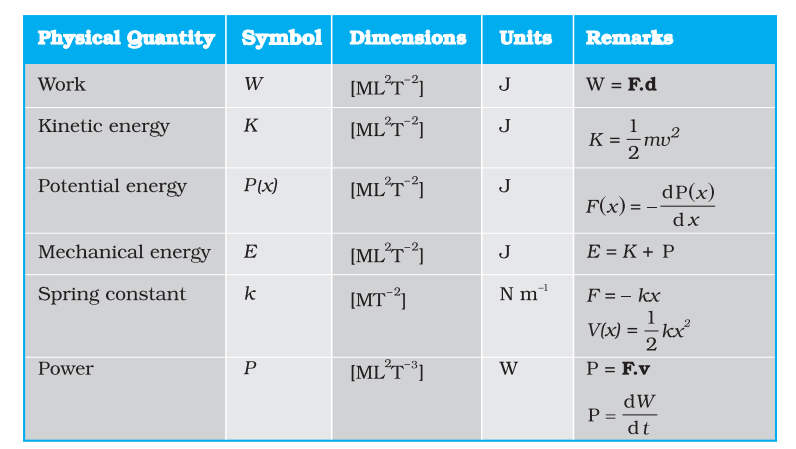
- Work done is a scalar or dot product of \(\mathbf{F}\) and \(\mathbf{s}\). \(W=(F \cos \theta)(s)\).
- The area under force-displacement curve gives work done.
- The work-energy theorem states that the change in kinetic energy of a body is the work done by the net force on the body.
\(
K_f-K_i=W_{n e t}
\) - A force is conservative if (i) work done by it on an object is path independent and depends only on the end points \(\left\{x_i, x_j\right\}\), or (ii) the work done by the force is zero for an arbitrary closed path taken by the object such that it returns to its initial position.
- For a conservative force in one dimension, we may define a potential energy function \(P(x)\) such that
\(
\begin{aligned}
& F(x)=-\frac{\mathrm{d} P(x)}{\mathrm{d} x} \\
& P_i-P_f=\int_{x_i}^{x_f} F(x) \mathrm{d} x
\end{aligned}
\) - The principle of conservation of mechanical energy states that the total mechanical energy of a body remains constant if the only forces that act on the body are conservative.
- The gravitational potential energy of a particle of mass \(m\) at a height \(x\) about the earth’s surface is
\(
P(x)=m g x
\)
where the variation of \(g\) with height is ignored. - The elastic potential energy of a spring of force constant \(k\) and extension \(x\) is
\(
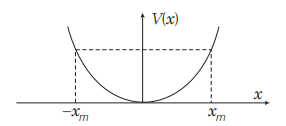
P(x)=U=\frac{1}{2} k x^2
\) - The work done in stretching the spring by external applied force, \(W=\frac{1}{2} k x^2\)
Work done by the spring, \(W=-\frac{1}{2} k x^2\) - The scalar or dot product of two vectors \(\mathbf{A}\) and \(\mathbf{B}\) is written as \(\mathbf{A} . \mathbf{B}\) and is a scalar quantity given by \(: \mathbf{A} \cdot \mathbf{B}=A B \cos \theta\), where \(\theta\) is the angle between \(\mathbf{A}\) and \(\mathbf{B}\). It can be positive, negative or zero depending upon the value of \(\theta\). The scalar product of two vectors can be interpreted as the product of magnitude of one vector and component of the other vector along the first vector. For unit vectors :
\(
\hat{\mathbf{i}} \cdot \hat{\mathbf{i}}=\hat{\mathbf{j}} \cdot \hat{\mathbf{j}}=\hat{\mathbf{k}} \cdot \hat{\mathbf{k}}=1 \text { and } \hat{\mathbf{i}} \cdot \hat{\mathbf{j}}=\hat{\mathbf{j}} \cdot \hat{\mathbf{k}}=\hat{\mathbf{k}} \cdot \hat{\mathbf{i}}=0
\)
Scalar products obey the commutative and the distributive laws. - The work done by a variable force
\(
W=\int_{r_1}^{r_2} \mathbf{F} \cdot d \mathbf{r}
\)
where, integration is performed along the path of particle and \(d \mathbf{r}\) is the position vector of the particle. - Work done by or against a conservative force in moving a body from one position to another depends only on the initial and final positions of the body. It does not depend upon the nature of the path followed by the body in going from initial position to the final position.
- Work done by or against a conservative force in moving a particle along a closed path (round trip) is zero.
- If the force is non-conservative, then \(W_1 \neq W_2 \neq W_3\).
Work done by a non-conservative force in a round trip is not zero. i.e. \(W_1+W_2 \neq 0\). - Linear momentum, \(p=\sqrt{2 m \mathrm{KE}}\).
- \(W_{\text {net }}=\Delta \mathrm{KE}=K_f-K_i\), \(W_{\mathrm{net}}=\frac{1}{2} m\left(v_f^2-v_i^2\right)\).
- Potential energy of a body or system is the negative of work done by the conservative forces in bringing it from infinity to the present position.
\(U=-\int_{\infty}^{\mathbf{r}} \mathbf{F} \cdot d \mathbf{r}=-W\). - If the forces acting on the object are conservative and it is in equilibrium, then \(F_{\text {net }}=0 \Rightarrow-\frac{d U}{d r}=0 \text { or } \frac{d U}{d r}=0\)
- Average power \(\left(P_{\mathrm{av}}\right)=\frac{\text { Work done }}{\text { Time taken }}=\frac{W}{t}\).
- The instantaneous power \(P=\mathbf{F} \cdot \frac{d \mathbf{r}}{d t}=\mathbf{F} \cdot \mathbf{v}=F v \cos \theta\).
POINTS TO PONDER
- The phrase ‘calculate the work done’ is incomplete. We should refer (or imply clearly by context) to the work done by a specific force or a group of forces on a given body over a certain displacement.
- Work done is a scalar quantity. It can be positive or negative unlike mass and kinetic energy which are positive scalar quantities. The work done by the friction or viscous force on a moving body is negative.
- For two bodies, the sum of the mutual forces exerted between them is zero from Newton’s Third Law,
\(
\mathbf{F}_{12}+\mathbf{F}_{21}=0
\)
But the sum of the work done by the two forces need not always cancel, i.e.
\(
W_{12}+W_{21} \neq 0
\)
However, it may sometimes be true.
- The work done by a force can be calculated sometimes even if the exact nature of the force is not known.
- The WE theorem is not independent of Newton’s Second Law. The WE theorem may be viewed as a scalar form of the Second Law. The principle of conservation of mechanical energy may be viewed as a consequence of the WE theorem for conservative forces.
- The WE theorem holds in all inertial frames. It can also be extended to noninertial frames provided we include the pseudoforces in the calculation of the net force acting on the body under consideration.
- The potential energy of a body subjected to a conservative force is always undetermined upto a constant. For example, the point where the potential energy is zero is a matter of choice. For the gravitational potential energy mgh, the zero of the potential energy is chosen to be the ground. For the spring potential energy \(k x^2 / 2\), the zero of the potential energy is the equilibrium position of the oscillating mass.
- Every force encountered in mechanics does not have an associated potential energy. For example, work done by friction over a closed path is not zero and no potential energy can be associated with friction.
- During a collision : (a) the total linear momentum is conserved at each instant of the collision ; (b) the kinetic energy conservation (even if the collision is elastic) applies after the collision is over and does not hold at every instant of the collision. In fact the two colliding objects are deformed and may be momentarily at rest with respect to each other.
Quiz Summary
0 of 81 Questions completed
Questions:
Information
You have already completed the quiz before. Hence you can not start it again.
Quiz is loading…
You must sign in or sign up to start the quiz.
You must first complete the following:
Results
Results
0 of 81 Questions answered correctly
Your time:
Time has elapsed
You have reached 0 of 0 point(s), (0)
Earned Point(s): 0 of 0, (0)
0 Essay(s) Pending (Possible Point(s): 0)
Categories
- Not categorized 0%
- 1
- 2
- 3
- 4
- 5
- 6
- 7
- 8
- 9
- 10
- 11
- 12
- 13
- 14
- 15
- 16
- 17
- 18
- 19
- 20
- 21
- 22
- 23
- 24
- 25
- 26
- 27
- 28
- 29
- 30
- 31
- 32
- 33
- 34
- 35
- 36
- 37
- 38
- 39
- 40
- 41
- 42
- 43
- 44
- 45
- 46
- 47
- 48
- 49
- 50
- 51
- 52
- 53
- 54
- 55
- 56
- 57
- 58
- 59
- 60
- 61
- 62
- 63
- 64
- 65
- 66
- 67
- 68
- 69
- 70
- 71
- 72
- 73
- 74
- 75
- 76
- 77
- 78
- 79
- 80
- 81
- Current
- Review
- Answered
- Correct
- Incorrect
- Question 1 of 81
1. Question
A heavy stone is thrown from a cliff of height \(h\) with a speed \(v\). The stone will hit the ground with maximum speed if it is thrown
CorrectIncorrectHint
(d) This conclusion is based on the principle of conservation of mechanical energy, assuming air resistance is negligible. The total mechanical energy ( \(E\) ) of the stone remains constant throughout its flight.
Initial Energy: The stone starts at height \(\boldsymbol{h}\) with initial speed \(\boldsymbol{v}\). Its initial energy is the sum of its initial kinetic energy ( \(\mathrm{KE}_i\) ) and initial potential energy ( \(\mathrm{PE}_i\) ):
\(
E_i=\mathrm{KE}_i+\mathrm{PE}_i=\frac{1}{2} m v^2+m g h
\)
The kinetic energy depends on the magnitude of the velocity squared \(\left(v^2\right)\), not the direction of the velocity vector.
Final Energy: Just before hitting the ground (height 0 ), the stone has a final speed \(V_f\). Its final energy is purely kinetic:
\(
E_f=\mathrm{KE}_f+\mathrm{PE}_f=\frac{1}{2} m V_f^2+0
\)
Conservation: By setting the initial energy equal to the final energy ( \(E_i=E_f\) ), we find the final speed:
\(
\begin{aligned}
& \frac{1}{2} m v^2+m g h=\frac{1}{2} m V_f^2 \\
& V_f^2=v^2+2 g h \\
& V_f=\sqrt{v^2+2 g h}
\end{aligned}
\)
The final speed \(V_f\) depends only on the initial speed \(v\), the height \(h\), and the acceleration due to gravity \(g\). Since none of these variables depend on the initial direction the stone was thrown, the final speed is the same whether thrown vertically down, vertically up, or horizontally. The time taken to reach the ground will differ, but the final speed magnitude will not. - Question 2 of 81
2. Question
Two springs \(A\) and \(B\left(k_A=2 k_B\right)\) are stretched by applying forces of equal magnitudes at the four ends. If the energy stored in \(A\) is \(E\), that in \(B\) is
CorrectIncorrectHint
(b) Step 1: Define physical laws and given information
We are given two springs, A and B , with spring constants \(k_A\) and \(k_B\), respectively, where \(k_A=2 k_B\). Both springs are stretched by equal forces, \(F_A=F_B=F\). The energy stored in A is \(E_A=E\). The relevant physical laws are Hooke’s Law \(F=k x\) and the formula for stored energy \(E=\frac{1}{2} k x^2\).
Step 2: Express energy in terms of force and spring constant We can express the extension \(x\) from Hooke’s Law as \(x=\frac{F}{k}\). Substituting this into the energy equation yields a formula for energy based on force and spring constant:
\(
E=\frac{F^2}{2 k}
\)
Step 3: Calculate the energy ratio
Using the derived formula, we write the energy for both springs:
\(
E_A=\frac{F^2}{2 k_A} \text { and } E_B=\frac{F^2}{2 k_B} .
\)
We know \(E_A=E\) and \(k_A=2 k_B\). Substituting these values:
\(
E=\frac{F^2}{2\left(2 k_B\right)}=\frac{F^2}{4 k_B}
\)
We can rearrange the expression for \(\boldsymbol{E}_{\boldsymbol{B}}\) to relate it to \(\boldsymbol{E}\) :
\(
E_B=\frac{F^2}{2 k_B}=2 \times \frac{F^2}{4 k_B}
\)
Therefore, \(E_B=2 E\). - Question 3 of 81
3. Question
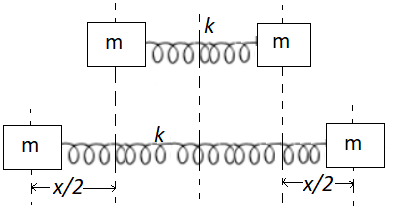
Two equal masses are attached to the two ends of a spring of spring constant \(k\). The masses are pulled out symmetrically to stretch the spring by a length \(x\) over its natural length. The work done by the spring on each mass is
CorrectIncorrectHint
(d)

Step 1: Define variables and system displacement
The system consists of two equal masses attached to a spring of spring constant \(k\). When the masses are pulled out symmetrically to stretch the spring by a total length \(x\), each mass undergoes a displacement of \(d=\frac{x}{2}\) from its equilibrium position.
Step 2: Determine the force and set up the work integral
As one mass moves from its equilibrium position (defined as \(y=0\) relative to the center) to the stretched position \(\left(y=\frac{x}{2}\right)\), the total extension of the spring at any intermediate position \(y\) (of one mass) is \(2 y\). The force exerted by the spring on one mass is directed opposite to the displacement and is given by \(F=-k(2 y)\). The work \(W\) done by the spring is calculated by integrating this force over the displacement:
\(
W=\int_0^{x / 2} F d y=\int_0^{x / 2}-2 k y d y
\)
Step 3: Integrate to find the work done on one mass
Solving the integral yields the work done by the spring on a single mass:
\(
\begin{gathered}
W=-2 k\left[\frac{y^2}{2}\right]_0^{x / 2}=-2 k\left(\frac{(x / 2)^2}{2}-0\right) \\
W=-2 k\left(\frac{x^2}{8}\right)=-\frac{1}{4} k x^2
\end{gathered}
\) - Question 4 of 81
4. Question
The negative of the work done by the conservative internal forces on a system equals the change in
CorrectIncorrectHint
(c) potential energy.
Explanation
The definition of a conservative force states that the work done by such a force ( \(W_c\) ) is equal to the negative of the change in potential energy ( \(\Delta U\) ) associated with that force:
\(
W_c=-\Delta U
\)
Rearranging this equation gives:
\(
-W_c=\Delta U
\)
Therefore, the negative of the work done by the conservative internal forces on a system equals the change in potential energy. This principle is fundamental to the conservation of mechanical energy in an isolated system subject only to conservative forces.
Why other options are incorrect
(a) total energy: The total energy of a closed system remains constant if all forces are conservative. Work done by individual internal forces results in energy conversion (e.g., potential to kinetic), not a change in the total energy of the system.
(b) kinetic energy: According to the work-energy theorem, the total work done by all forces (conservative and non-conservative) on a particle equals the change in its kinetic energy. The negative work done by only the conservative forces is not, in general, equal to the change in kinetic energy unless non-conservative forces are absent and the system is isolated.
(d) none of these: This option is incorrect because the negative work done by conservative forces is indeed equal to the change in potential energy. - Question 5 of 81
5. Question
The work done by the external forces on a system equals the change in
CorrectIncorrectHint
(a) total energy.
Explanation
The work done by external forces on a system equals the change in the system’s total energy (which includes both kinetic and potential energy, and potentially other forms like thermal energy). This is a consequence of the general law of conservation of energy. o
In a closed system with no other energy transfers (like heat), the work done by external forces specifically changes the total energy of that system.
If we define the system to include only the object and treat all other forces (like gravity) as external, then the work done by these external forces changes the total energy of the object.Why other options are incorrect
(b) kinetic energy: The work-energy theorem states that the work done by the net force (both external and internal) on an object equals the change in its kinetic energy. The work done by only the external forces is not necessarily equal to just the change in kinetic energy, as some work might change the potential energy or internal energy of the system.
(c) potential energy: The negative of the work done by a conservative internal force (like gravity, if it’s considered an internal force within the system) equals the change in potential energy. The work done by external forces is generally not equal to just the change in potential energy.
(d) none of these: Since option (a) is correct, this option is incorrect. - Question 6 of 81
6. Question
The work done by all the forces (external and internal) on a system equals the change in
CorrectIncorrectHint
(b) kinetic energy.
Explanation
According to the work-energy theorem, the total work done by all forces (both external and internal) acting on a system is equal to the change in the system’s kinetic energy. This principle applies universally, whether the forces involved are conservative or non-conservative.Why other options are incorrect
(a) total energy: The work done by external forces equals the change in the total energy of a system (which includes kinetic, potential, and internal energy). However, the total work (external + internal) specifically relates to the change in kinetic energy.
(c) potential energy: The negative of the work done by conservative internal forces equals the change in potential energy. This is not the total work done by all forces.
(d) none of these: This is incorrect because kinetic energy is the correct answer. - Question 7 of 81
7. Question
_______ of a two particle system depends only on the separation between the two particles. The most appropriate choice for the blank space in the above sentence is
CorrectIncorrectHint
(d) Potential energy.
Explanation
Potential energy is the energy a system possesses due to its configuration or the relative positions of its components (e.g., the separation distance between two particles in a gravitational or electrostatic field).
The potential energy function for conservative forces (like gravity or electrostatic force) is defined to depend only on the spatial coordinates or separation distance, not on the particles’ motion or path.Why other options are incorrect
(a) Kinetic energy depends on the velocity (motion) of the particles, not solely on their separation.
(b) Total mechanical energy is the sum of kinetic energy and potential energy. Since kinetic energy is involved, the total mechanical energy also depends on the velocities of the particles, not only on their separation.
(c) Total energy includes mechanical energy and other forms of energy (e.g., thermal), and its dependence is not solely on the separation between the particles, but also on their motion and potentially other internal states. - Question 8 of 81
8. Question
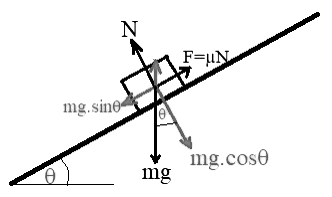
A small block of mass \(m\) is kept on a rough inclined surface of inclination \(\theta\) fixed in an elevator. The elevator goes up with a uniform velocity \(v\) and the block does not slide on the wedge. The work done by the force of friction on the block in time \(t\) will be
CorrectIncorrectHint
(c)

In time \(t\), vertical distance covered \(S=v t\)
Work done by this component \(W=\vec{F}.\vec{S}\)
\(
\begin{aligned}
& =\mathrm{F} \cdot \sin \theta \cdot \mathrm{vt} \\
& =\mu \mathrm{mg} \cdot \cos \theta \cdot \sin \theta \cdot \mathrm{vt} \\
& =(\sin \theta / \cos \theta) \mathrm{mgvt} \cdot \cos \theta \cdot \sin \theta \quad(\text { Since } \mu=\tan \theta) \\
& =\mathrm{mgvt} \cdot \sin ^2 \theta
\end{aligned}
\) - Question 9 of 81
9. Question
A block of mass \(m\) slides down a smooth vertical circular track. During the motion, the block is in
CorrectIncorrectHint
(d) none of these.
Explanation
During the motion along a smooth vertical circular track, the block is under the influence of gravity ( \(\vec{F}_g\) ) and the normal force ( \(\vec{F}_N\) ).
Vertical Equilibrium: The vertical forces are not balanced because the net vertical force is non-zero most of the time, causing vertical acceleration. The force of gravity is constant, but the vertical component of the normal force changes direction and magnitude.
Horizontal Equilibrium: The horizontal forces are also unbalanced. The normal force has a horizontal component that changes direction and magnitude, leading to horizontal acceleration as the block moves around the circle.
Radial Equilibrium: Radial equilibrium implies a net radial force of zero. However, for an object to move in a circular path, there must be a net force directed toward the center, known as the centripetal force \(\left(\vec{F}_c\right)\), which is responsible for the centripetal acceleration \(a_c=v^2 / r\). The net force is given by Newton’s second law, \(\sum \vec{F}=m \vec{a}\).Since the block is continuously accelerating (both in speed and direction), it is not in equilibrium in any direction.
- Question 10 of 81
10. Question
A particle is rotated in a vertical circle by connecting it to a string of length \(l\) and keeping the other end of the string fixed. The minimum speed of the particle when the string is horizontal for which the particle will complete the circle is
CorrectIncorrectHint
(a) Step 1: Minimum speed condition at the top
For the particle to successfully complete the vertical circle, it must maintain tension in the string or at least have zero tension at the very top of the circle while maintaining a minimum non-zero speed. The minimum speed at the highest point is determined by setting the tension \(T\) to zero, where the gravitational force provides the necessary centripetal force:
\(
m g=m \frac{v_t^2}{l}
\)
Solving for the minimum speed at the top \(\left(v_t\right)\) :
\(
v_t=\sqrt{g l}
\)
Step 2: Apply conservation of energy
Using the principle of conservation of energy between the horizontal position (height \(h=0\) ) and the top position (height \(h=l\) ), where \(v_h\) is the speed at the horizontal position:
\(
\frac{1}{2} m v_h^2+m g h_h=\frac{1}{2} m v_t^2+m g h_t
\)
\(
\begin{aligned}
&\text { Substituting } h_h=0 \text { and } h_t=l \text { : }\\
&\begin{aligned}
\frac{1}{2} m v_h^2 & =\frac{1}{2} m v_t^2+m g l \\
\frac{1}{2} v_h^2 & =\frac{1}{2} v_t^2+g l \\
v_h^2 & =v_t^2+2 g l
\end{aligned}
\end{aligned}
\)
Step 3: Calculate the minimum horizontal speed
Substitute the minimum speed at the top \(\left(v_t=\sqrt{g l}\right)\) into the energy conservation equation to find the minimum horizontal speed \(\left(v_h\right)\) :
\(
\begin{gathered}
v_h^2=(\sqrt{g l})^2+2 g l \\
v_h^2=g l+2 g l \\
v_h^2=3 g l \\
v_h=\sqrt{3 g l}
\end{gathered}
\)
The minimum speed of the particle when the string is horizontal is \(\sqrt{3 \mathrm{gl}}\). - Question 11 of 81
11. Question
A heavy stone is thrown from a cliff of height \(h\) in a given direction. The speed with which it hits the ground
CorrectIncorrectHint
(a, b) As the stone is falls under the gravitational force, which is a conservative force, the total energy of the stone remains the same at every point during its motion.
From the conservation of energy, we have:
Initial energy of the stone \(=\) final energy of the stone
\(
\begin{aligned}
& \text { i. e. },(\text { K. E. })_i+(\text { P. E. })_i=(\text { K. E. })_f+(\text { P. E. })_f \\
& \Rightarrow \frac{1}{2} m v^2+m g h=\frac{1}{2} m\left(v_{\max }\right)^2 \\
& \Rightarrow v_{\max }=\sqrt{v^2+2 g h}
\end{aligned}
\)
From the above expression, we can say that the maximum speed with which the stone hits the ground depends on the speed of projection and greater than it. - Question 12 of 81
12. Question
The total work done on a particle is equal to the change in its kinetic energy
CorrectIncorrectHint
(a) The total work done on a particle is always equal to the change in its kinetic energy. This is a direct statement of the work-energy theorem, which is universally valid regardless of the nature of the forces acting (conservative or non-conservative).
The mathematically work-energy theorem is given below.
\(
W_{n e t}=\Delta K E=K E_{\text {final }}-K E_{\text {initial }}
\)
Therefore, the work-energy theorem is valid for all types of forces acting on the body. - Question 13 of 81
13. Question
A particle is acted upon by a force of constant magnitude which is always perpendicular to the velocity of the particle. The motion of the particle takes place in a plane. It follows that
CorrectIncorrectHint
(c, d) Kinetic Energy is Constant: The force is always perpendicular to the velocity, meaning no work is done on the particle ( \(W=\vec{F} \cdot \vec{d}=0\) ). No work means no change in kinetic energy, so its magnitude (speed) remains constant.
Velocity is Not Constant: Velocity is a vector (magnitude and direction). Although the speed (magnitude) is constant, the direction of the velocity is continuously changing due to the applied force.
Acceleration is Not Constant: Acceleration is also a vector. It is directed towards the center of the circular path and its direction continuously changes as the particle moves, so the acceleration vector is not constant.
It Moves in a Circular Path: A force of constant magnitude always perpendicular to the velocity acts as a centripetal force, causing the particle to move in a circular path.
- Question 14 of 81
14. Question
Consider two observers moving with respect to each other at a speed \(v\) along a straight line. They observe a block of mass \(m\) moving a distance \(l\) on a rough surface. The following quantities will be same as observed by the two observers
CorrectIncorrectHint
(d) acceleration of the block.
Explanation
Acceleration Invariance
In classical mechanics, observers moving at a constant relative velocity (inertial reference frames) measure the same acceleration. The velocity of an object in frame \(S^{\prime}\) is related to the velocity in frame \(S\) by the Galilean transformation \(v^{\prime}=v-u\), where \(u\) is the constant relative velocity of the frames. Differentiating with respect to time \(t\) (which is invariant in classical physics) gives:
\(
d^{\prime}=\frac{d v^{\prime}}{d t}=\frac{d(v-u)}{d t}=\frac{d v}{d t}-\frac{d u}{d t}=a-0=a
\)
Thus, \(\mathrm{a}^{\prime}=\mathrm{a}\),
Frame-Dependent Quantities
Kinetic energy \(\left(K E=\frac{1}{2} m v^2\right)\) depends on the speed \(v\) measured in each specific frame and is therefore different for the two observers.
Work done by a force over a distance is generally not frame-invariant, as both velocity and displacement components can change between frames, affecting quantities like total work and work by friction.
Total work done is equal to the change in kinetic energy ( \(\triangle K E\) ), which is also different in each reference frame. - Question 15 of 81
15. Question
You lift a suitcase from the floor and keep it on a table. The work done by you on the suitcase does not depend on
CorrectIncorrectHint
(a, b, d) (a) the path taken by the suitcase, (b) the time taken by you in doing so, and (d) your weight.
The work done by you on the suitcase against gravity is calculated by the formula \(W=m g h\), where \(m\) is the mass of the suitcase, \(g\) is the acceleration due to gravity, and \(h\) is the vertical height the suitcase is lifted. This means the work done depends on the weight of the suitcase ( \(m g\) ) and the height of the table ( \(h\) ).
Explanation
The work done on the suitcase depends only on the vertical displacement and the force in the vertical direction (the weight of the suitcase).
The work done is a scalar quantity and is associated with a conservative force (gravity), making it independent of the specific path taken between the floor and the table.
The time taken relates to the power needed (Power = Work / Time), but not the total amount of work done.
Your weight is a property of you, the person doing the lifting, not a factor in the physical calculation of the work done on the suitcase itself.Why other options are incorrect
(c) the weight of the suitcase: This option describes a factor that the work done does depend on. A heavier suitcase requires more force to lift, thus more work is done. - Question 16 of 81
16. Question
No work is done by a force on an object if
CorrectIncorrectHint
(a), (c), and (d).
Explanation
Work is done by a force on an object only if there is a component of the force in the direction of the displacement of its point of application.
(a) the force is always perpendicular to its velocity: Work done is defined as the dot product of force \((\vec{F})\) and displacement \((\vec{d})\), or for an infinitesimal displacement, \(d W=\vec{F} \cdot d \vec{s}=F d s \cos \theta\). Velocity ( \(\vec{v}\) ) is always in the direction of the instantaneous displacement. If the force is always perpendicular to the velocity, the angle \(\theta\) is \(90^{\circ}\), and \(\cos \left(90^{\circ}\right)=0\), so no work is done. A classic example is the centripetal force in uniform circular motion.
(c) the object is stationary but the point of application of the force moves on the object: If the object is stationary, its displacement \((\vec{d})\) is zero. Work done is zero when total displacement is zero, as the definition of work on a body relates to the displacement of the body’s center of mass or overall motion, not internal deformation or relative motion of points within a stationary object. The point of application moving on a stationary object doesn’t result in work done on the object as a whole.
(d) the object moves in such a way that the point of application of the force remains fixed: If the point of application of the force remains fixed (e.g., the point of contact of a pure rolling sphere on a surface, where the static friction force acts), its displacement with respect to the ground is zero. Therefore, no work is done by that specific force (static friction in the rolling case).Why other options are incorrect
(b) the force is always perpendicular to its acceleration: According to Newton’s second law, \(\vec{F}=m \vec{a}\). Force and acceleration are always in the same direction (assuming constant mass). If a force is perpendicular to its acceleration, it implies a logical inconsistency, as the force causes the acceleration. Even if we consider net force, forces can be perpendicular to acceleration if other forces are involved, but it doesn’t automatically mean no work is done by that specific force, only that the net work is affected by all forces. - Question 17 of 81
17. Question
A particle of mass \(m\) is attached to a light string of length \(l\), the other end of which is fixed. Initially the string is kept horizontal and the particle is given an upward velocity \(v\). The particle is just able to complete a circle.
CorrectIncorrectHint
(a) and (d).
The string becomes slack when the particle reaches its highest point.
The particle again passes through the initial position.
Step 1: Determine conditions at the highest point
For a particle in vertical circular motion attached to a string, the condition for it to “just complete a circle” is that the tension in the string at the highest point is zero ( \(T=0\) ), and the particle has a non-zero minimum velocity ( \(v_{\text {top }}\) ). The centripetal force is provided solely by gravity:
\(
m g=\frac{m v_{t o p}^2}{l}
\)
This yields a minimum velocity at the top of \(v_{\text {top }}=\sqrt{g l}\). Therefore, statement (a) is correct, and statement (b) is incorrect.
Step 2: Apply conservation of energy
We use the principle of conservation of mechanical energy to relate the initial velocity \(\boldsymbol{v}\) (at the horizontal position) to the velocity at the highest point. Let the initial horizontal position be the reference level for potential energy ( \(h=0\) ). The highest point is a vertical distance \(l\) above the initial point (after traversing \(1 / 4\) of the circle, the particle reaches the top of the circle, which is \(2 l\) above the initial position if the initial position was at the bottom, but here it’s horizontal, so the highest point is \(l\) above the center, which is \(l\) above the initial point). Wait. The string is horizontal, and the particle is given an upward velocity. The fixed end is the center. Initial height \(\mathbf{= 0}\). The particle moves up towards the top of the circle, which is at a height of \(l\) above the center (initial position).
Initial energy:
\(
E_{\text {initial }}=K_{\text {initial }}+U_{\text {initial }}=\frac{1}{2} m v^2+0
\)
Energy at the highest point (top of the circle, height \(h=l\) relative to the start point which is also at \(\boldsymbol{h}=\mathbf{0}\) if the fixed end is origin, no, initial height is \(\mathbf{0}\). The top of the circle is \(l\) above the start point because the center is at the same height as the start point, which makes no sense. The string is horizontal. Let the fixed end be O. Initial position P. OP is horizontal. Velocity is upward. The highest point is Q, vertically above O. Height of Q relative to P is \(l\) ).
\(
E_{t o p}=K_{t o p}+U_{t o p}=\frac{1}{2} m v_{t o p}^2+m g l
\)
By conservation of energy:
\(
\begin{gathered}
E_{\text {initial }}=E_{\text {top }} \\
\frac{1}{2} m v^2=\frac{1}{2} m v_{\text {top }}^2+m g l
\end{gathered}
\)
Substitute the condition for \(v_{\text {top }}^2=g l\) :
\(
\begin{gathered}
\frac{1}{2} m v^2=\frac{1}{2} m(g l)+m g l \\
\frac{1}{2} m v^2=\frac{1}{2} m g l+m g l \\
\frac{1}{2} m v^2=\frac{3}{2} m g l \\
v^2=3 g l \\
v=\sqrt{3 g l}
\end{gathered}
\)
Statement (c) claims \(\frac{1}{2} m v^2=m g l\). This is incorrect, as the initial kinetic energy is \(\frac{3}{2} \mathrm{mgl}\).
Step 3: Determine if the particle returns to the initial position
Since the particle completes the circle, it will pass through all points in the circle, including its initial position. Therefore, statement (d) is correct.
The correct statements are (a) and (d). - Question 18 of 81
18. Question
The kinetic energy of a particle continuously increases with time.
CorrectIncorrectHint
(b, d) The magnitude of its linear momentum is increasing continuously, and the resultant force on the particle must be at an angle less than \(90^{\circ}\) all the time.
Step 1: Analyze the relationship between kinetic energy, force, and momentum
Kinetic Energy and Speed: The kinetic energy (KE) of a particle with mass \(m\) and speed \(v\) is given by \(K E=\frac{1}{2} m v^2\). If KE continuously increases, the speed \(v\) must also continuously increase.
Work-Energy Theorem: The work done by the resultant force \(\vec{F}\) equals the change in kinetic energy ( \(d W=d(K E)\) ). The work done over a small displacement \(d \vec{s}\) is \(d W=\vec{F} \cdot d \vec{s}=F d s \cos (\theta)\), where \(\theta\) is the angle between \(\vec{F}\) and \(d \vec{s}\) (which is in the direction of velocity \(\vec{v})\). For KE to increase, \(d W\) must be positive, which means \(\cos (\theta)>0\), so the angle \(\theta\) must be less than \(90^{\circ}\left(0 \leq \theta<90^{\circ}\right)\).
Momentum and Speed: Linear momentum is \(\vec{p}=m \vec{v}\). Its magnitude is \(p=m|\vec{v}|=m v\). Since the speed \(v\) is continuously increasing, the magnitude of the linear momentum \(p\) must also continuously increase.
Step 2: Evaluate the given options
(a) The resultant force on the particle must be parallel to the velocity at all instants. This is a special case \(\left(\theta=0^{\circ}\right)\). The force can be at any angle less than \(90^{\circ}\), so this is not a must condition.
(b) The resultant force on the particle must be at an angle less than \(90^{\circ}\) all the time. This is a necessary condition derived from the work-energy theorem for continuously increasing KE.
(c) Its height above the ground level must continuously decrease. The particle could be moving horizontally or upwards while accelerating (e.g., a rocket or a car on an incline). Height decrease is not a requirement.
(d) The magnitude of its linear momentum is increasing continuously. As established in Step 1, since speed \(\boldsymbol{v}\) increases, the magnitude of momentum \(\boldsymbol{p}\) must also increase.
Both options (b) and (d) are correct conclusions. The question asks to identify the correct statement among the options. In the context of the provided problem, either could be considered the intended answer depending on the source.The correct options are:
(b) The resultant force on the particle must be at an angle less than \(90^{\circ}\) all the time.
(d) The magnitude of its linear momentum is increasing continuously. - Question 19 of 81
19. Question
One end of a light spring of spring constant \(k\) is fixed to a wall and the other end is tied to a block placed on a smooth horizontal surface. In a displacement, the work done by the spring is \(\frac{1}{2} k x^2\). The possible cases are
CorrectIncorrectHint
(a, b) (a) the spring was initially compressed by a distance \(\boldsymbol{x}\) and was finally in its natural length, and (b) it was initially stretched by a distance \(x\) and finally was in its natural length.
Explanation of Work Done by a Spring
The work done by a conservative force like the spring force is equal to the negative change in potential energy, or the initial potential energy minus the final potential energy: \(W=U_{\text {initial }}-U_{\text {final }}\). The elastic potential energy of a spring displaced by a distance \(s\) from its natural length is given by \(U=\frac{1}{2} k s^2\).
Evaluation of Cases
The problem states that the work done by the spring is positive, specifically \(W=\frac{1}{2} k x^2\). This means the spring moved from a state of higher potential energy to a state of lower potential energy ( \(U_{\text {initial }}>U_{\text {final }}\) ).
For cases (a) and (b), the spring starts with an initial displacement of magnitude \(x\) and ends at natural length (displacement \(s=0\) ).
\(U_{\text {initial }}=\frac{1}{2} k x^2\) and \(U_{\text {final }}=0\).
The work done is \(W=\frac{1}{2} k x^2-0=\frac{1}{2} k x^2\).
Both cases yield the specified positive work value.
For cases (c) and (d), the spring starts at natural length ( \(s=0\) ) and ends with a displacement of magnitude \(\boldsymbol{x}\).
\(U_{\text {initial }}=0\) and \(U_{\text {final }}=\frac{1}{2} k x^2\).
The work done is \(W=0-\frac{1}{2} k x^2=-\frac{1}{2} k x^2\).
These cases result in negative work done by the spring, which does not match the given information. - Question 20 of 81
20. Question
A block of mass \(M\) is hanging over a smooth and light pulley through a light string. The other end of the string is pulled by a constant force \(F\). The kinetic energy of the block increases by 20 J in 1 s.
CorrectIncorrectHint
(b) Let us analyze each statement
(a) The tension in the string is \(\boldsymbol{M g}\).
This is incorrect. The tension would only be equal to \(\boldsymbol{M g}\) if the block were in equilibrium (at rest or moving at a constant velocity). Since the kinetic energy is increasing, the block is accelerating, meaning the net force is non-zero, so the tension \(\boldsymbol{T}\) must be different from \(\boldsymbol{M g}\).
(b) The tension in the string is F.
This is correct. The string is described as “light” and the pulley as “smooth and light”, which in physics implies that the string is massless and the pulley is frictionless. In an ideal, massless string, the tension is the same at all points along the string and is equal to the force applied at the end, \(F\).
(c) The work done by the tension on the block is 20 J in the above 1 s.
This is incorrect. The work-energy theorem states that the net work done by all forces on the block equals the change in its kinetic energy, which is 20 J. The forces acting on the block are tension ( \(T=F\), acting upwards) and gravity ( \(M g\), acting downwards). The net work done is \(W_{\text {net }}=W_T+W_g=20 \mathrm{~J}\). Since the block is accelerating, \(W_T\) and \(W_g\) are generally not equal in magnitude, so \(W_T\) is not simply 20 J.
(d) The work done by the force of gravity is “-20” J in the above 1 s.
This is incorrect. The work done by gravity is \(W_g=-M g d\), where \(d\) is the vertical distance the block moves upwards (negative because gravity opposes the upward displacement). The net work is \(W_{\text {net }}=W_T-M g d=20 \mathrm{~J}\). The value of \(W_g\) depends on the distance \(\boldsymbol{d}\) traveled in 1 second, and while it will be negative, it is not necessarily – 20 J. - Question 21 of 81
21. Question
A nucleus moving with a velocity \(\vec{v}\) emits an \(\alpha\)-particle. Let the velocities of the \(\alpha\)-particle and the remaining nucleus be \(\overrightarrow{v_1}\) and \(\overrightarrow{v_2}\) and their masses be \(m_1\) and \(m_2\).
CorrectIncorrectHint
(d) \(m_1 \overrightarrow{v_1}+m_2 \overrightarrow{v_2}\) must be parallel to \(\vec{v}\).
The correct option is (d) due to the principle of conservation of linear momentum. In the absence of external forces, the total momentum of the system before the decay must equal the total momentum after the decay.
The initial momentum ( \(\vec{P}_{\text {initial }}\) ) is the product of the total mass ( \(m_1+m_2\) ) and the initial velocity of the nucleus ( \(\vec{v}\) ):
\(
\vec{P}_{\text {initial }}=\left(m_1+m_2\right) \vec{v}
\)
The final momentum ( \(\vec{P}_{\text {final }}\) ) is the vector sum of the momenta of the alpha-particle and the remaining nucleus:
\(
\vec{P}_{\text {final }}=m_1 \overrightarrow{v_1}+m_2 \overrightarrow{v_2}
\)
By the conservation of momentum:
\(
\begin{gathered}
\vec{P}_{\text {initial }}=\vec{P}_{\text {final }} \\
\left(m_1+m_2\right) \vec{v}=m_1 \overrightarrow{v_1}+m_2 \overrightarrow{v_2}
\end{gathered}
\)
The expression \(m_1 \overrightarrow{v_1}+m_2 \overrightarrow{v_2}\) is equal to a scalar multiple of \(\overrightarrow{v_1}\), specifically \(\left(m_1+m_2\right)\) times \(\vec{v}\). Therefore, the resulting vector must have the same direction as \(\vec{v}\), meaning they are parallel. - Question 22 of 81
22. Question
A shell is fired from a cannon with a velocity \(V\) at an angle \(\theta\) with the horizontal direction. At the highest point in its path, it explodes into two pieces of equal masses. One of the pieces retraces its path to the cannon. The speed of the other piece immediately after the explosion is
CorrectIncorrectHint
(a) Step 1: Analyze Initial Momentum
At the highest point of its trajectory, the shell’s velocity is purely horizontal, with a magnitude of \(V \cos \theta\). The total momentum of the system just before the explosion is given by \(P_{\text {before }}=M V \cos \theta\), where \(M\) is the total mass of the shell.
Step 2: Apply Conservation of Momentum
Immediately after the explosion, the shell breaks into two equal pieces of mass \(M / 2\). One piece has a velocity \(v_1\) that retraces its path, meaning \(v_1=-V \cos \theta\) (opposite direction to the original momentum). We apply the conservation of linear momentum in the horizontal direction to find the speed \(v_2\) of the second piece:
\(
M V \cos \theta=\frac{M}{2} v_1+\frac{M}{2} v_2
\)
Substituting \(v_1=-V \cos \theta\) and solving for \(v_2\) gives:
\(
\begin{gathered}
M V \cos \theta=\frac{M}{2}(-V \cos \theta)+\frac{M}{2} v_2 \\
2 V \cos \theta=-V \cos \theta+v_2 \\
v_2=3 V \cos \theta
\end{gathered}
\)
The speed of the other piece immediately after the explosion is \(3 V \cos \theta\). - Question 23 of 81
23. Question
In an elastic collision
CorrectIncorrectHint
(a) the initial kinetic energy is equal to the final kinetic energy.
Explanation
In an elastic collision, the total kinetic energy of the system is conserved, meaning it is the same before the collision as it is after the collision.
The total momentum is also conserved in an elastic collision.
During the brief moment of contact in an ideal elastic collision, some kinetic energy is temporarily converted into elastic potential energy, but it is fully converted back into kinetic energy as the objects separate. The initial total kinetic energy and final total kinetic energy are equal.Why other options are incorrect
(b) the final kinetic energy is less than the initial kinetic energy: This statement describes an inelastic collision, where some kinetic energy is lost to other forms like heat, sound, or permanent deformation.
(c) the kinetic energy remains constant: While the total kinetic energy before and after the collision is the same, the kinetic energy may fluctuate during the collision itself as it’s temporarily stored as potential energy. Option (a) is more precise in describing the state before and after the event.
(d) the kinetic energy first increases then decreases: The kinetic energy generally decreases during the compression phase of the collision (converted to potential energy) and then increases again during the expansion phase, but it doesn’t first increase. The total kinetic energy before and after the collision is constant. - Question 24 of 81
24. Question
In an inelastic collision
CorrectIncorrectHint
(b) the final kinetic energy is less than the initial kinetic energy.
Explanation
In an inelastic collision, some of the initial kinetic energy is converted into other forms of energy, such as heat, sound, or the energy required for permanent deformation of the colliding objects. Because of this conversion, the total kinetic energy of the system after the collision is less than the total kinetic energy before the collision. Total energy and total momentum are still conserved in the overall system, but kinetic energy specifically is not.Why other options are incorrect
(a) the initial kinetic energy is equal to the final kinetic energy This statement describes an elastic collision, where kinetic energy is conserved.
(c) the kinetic energy remains the constant This is another way of stating option (a) and is incorrect for an inelastic collision. Kinetic energy is lost in an inelastic collision.
(d) the kinetic energy first increases then decreases The kinetic energy generally decreases throughout the interaction period of an inelastic collision as it is transformed into other energy forms; it does not increase. - Question 25 of 81
25. Question
A block moving in air breaks in two parts and the parts separate
CorrectIncorrectHint
(a, d) (a) the total momentum must be conserved and (d) the total kinetic energy must change.
Explanation
Momentum Conservation: The breaking of the block is an internal process. In the absence of external forces, the total momentum of the system (the original block and then its parts) must remain constant according to the law of conservation of momentum. Although gravity acts as an external force, in the short time frame of the break-up, the change in momentum due to gravity is often considered negligible, or the conservation is considered just before and just after the break.
Kinetic Energy Change: The process of breaking requires energy, which is often released from internal potential energy (like an explosion) or used up in creating new surfaces, producing sound, and generating heat. This means the total kinetic energy of the system will change (typically increase if it’s an explosion, or decrease if the energy is absorbed in the breaking process). Therefore, the kinetic energy is not conserved.Why other options are incorrect
(b) the total kinetic energy must be conserved: Kinetic energy is not conserved because the internal energy of the system changes during the breaking process. Energy is either released or absorbed.
(c) the total momentum must change: Momentum must be conserved, not change, because there are no significant external forces causing the net momentum to change just before and after the event. - Question 26 of 81
26. Question
In an elastic collision
CorrectIncorrectHint
(b), (c), and (d).
In an elastic collision:
(b) the linear momentum remains constant: The total linear momentum of a closed system is conserved in all collisions (elastic and inelastic).
(c) the final kinetic energy is equal to the initial kinetic energy: This is the defining characteristic of a perfectly elastic collision; no kinetic energy is lost to other forms like heat or sound.
(d) the final linear momentum is equal to the initial linear momentum: This statement is a restatement of the conservation of linear momentum.Why other options are incorrect
(a) the kinetic energy remains constant: This statement is generally considered incorrect because, during the very short time the objects are in contact and deforming, some kinetic energy is temporarily converted into elastic potential energy. The total kinetic energy is only equal before and after the collision (as stated in option c), not constant throughout the entire collision process. - Question 27 of 81
27. Question
A ball hits a floor and rebounds after an inelastic collision. In this case
CorrectIncorrectHint
(c, d) (c) the total momentum of the ball and the earth is conserved and (d) the total energy of the ball and the earth remains the same.
Explanation of the options
\(\boldsymbol{a}\) The momentum of the ball just after the collision is not the same as that just before the collision. The ball reverses direction and generally has a smaller speed, so its momentum changes in both magnitude and direction.
\(\boldsymbol{b}\) The mechanical energy of the ball is not conserved during an inelastic collision. Some of the mechanical energy is converted into other forms, such as heat and sound, due to internal friction and deformation.
\(\boldsymbol{c}\) The total momentum of the ball and the earth system is conserved. If we consider the ball and Earth together as an isolated system, the forces they exert on each other are internal forces. With no significant external forces acting on this combined system during the brief collision, the total momentum before and after the collision remains constant.
\(\boldsymbol{d}\) The total energy of the ball and Earth system remains the same. According to the principle of conservation of energy, total energy (including mechanical energy, heat, sound, etc.) is always conserved for an isolated system. The energy lost from the ball’s mechanical energy is gained by the system in other forms. - Question 28 of 81
28. Question
A body moving towards a finite body at rest collides with it. It is possible that
CorrectIncorrectHint
(b, c) (b) both the bodies move after collision and (c) the moving body comes to rest and the stationary body starts moving.
Explanation
The principle of conservation of linear momentum states that the total momentum before the collision must equal the total momentum after the collision in an isolated system. Before the collision, there is non-zero momentum because one body is moving and has a finite mass.
Option (b) is possible in many types of collisions (elastic or inelastic) where momentum is shared between the two bodies, and both move afterward.
Option (c) is possible, specifically in a one-dimensional, perfectly elastic collision where both bodies have equal masses. In this scenario, the moving body transfers all its momentum to the stationary body and stops, while the stationary body moves off with the initial velocity of the first body.Why other options are incorrect
Option (a) is incorrect because the total initial momentum of the system is nonzero. If both bodies came to rest, the final momentum would be zero, which violates the conservation of linear momentum.
Option (d) is incorrect because the stationary body must start moving after the impact (unless the moving body has zero mass, which is not the case as it’s a finite body). Momentum must be conserved, so some momentum must be transferred to the initially stationary body. - Question 29 of 81
29. Question
In a head-on elastic collision of two bodies of equal masses
CorrectIncorrectHint
(a, b, c, d) (a) the velocities are interchanged, (b) the speeds are interchanged, (c) the momenta are interchanged, and (d) the faster body slows down and the slower body speeds up. All options are correct in a head-on elastic collision of two bodies of equal masses.
Explanation
In a head-on, one-dimensional, perfectly elastic collision between two bodies of equal masses, let the initial velocities be \(u_1\) and \(u_2\), and the final velocities be \(v_1\) and \(v_2\). According to the principles of conservation of momentum and kinetic energy, the bodies exchange their velocities:
\(
\begin{aligned}
& v_1=u_2 \\
& v_2=u_1
\end{aligned}
\)
(a) the velocities are interchanged: This is the fundamental result of such a collision. If one body was at rest, the other comes to rest, and the initially stationary body moves off with the first body’s initial velocity.
(b) the speeds are interchanged: Since velocities are interchanged, and speed is the magnitude of velocity, the speeds are also interchanged.
(c) the momenta are interchanged: As momentum is mass times velocity ( \(p=m v\) ), and the masses are equal and velocities are interchanged, the momenta ( \(p_1=m u_1\) and \(p_2=m u_2\) ) are also interchanged ( \(p_{1, \text { final }}=m v_1=m u_2=p_2\) and \(p_{2, \text { final }}=m v_2=m u_1=p_1\) ).
(d) the faster body slows down and the slower body speeds up: If one body is initially faster than the other, after the collision, it will move with the slower initial velocity (slows down), and the slower body will move with the faster initial velocity (speeds up).Therefore, all of the described phenomena occur during a head-on elastic collision of two bodies of equal masses.
- Question 30 of 81
30. Question
The net work done by kinetic friction
CorrectIncorrectHint
(c) may be negative or positive.
Explanation
The work done by kinetic friction can be positive, negative, or zero depending on the specific situation and the chosen frame of reference.
Negative work: In most common scenarios, such as an object sliding to a stop on a rough floor, kinetic friction opposes the direction of the object’s motion, converting kinetic energy into heat (thermal energy), which means it does negative work.
Positive work: In some specific cases, kinetic friction can do positive work. For instance, if a package is dropped onto a moving conveyor belt, the kinetic friction acting on the package is in the same direction as the package’s overall displacement (relative to the ground frame of reference) as it speeds up, thus doing positive work. Similarly, in a two-block system where the top block slides while the bottom one accelerates, friction can do positive work on the top block.
Zero work: Work done by kinetic friction can be zero in an object’s own reference frame, as the displacement relative to itself is zero.Why other options are incorrect
(a) is always negative: This is a common misconception, as friction usually does negative work, but as explained above, it can be positive in specific scenarios like the conveyor belt or two-block system.
(b) is always zero: Work done is zero only if there is no displacement in the direction of the force, or in special cases like ideal rolling where work done in translation and rotation cancel out. For a general case of kinetic friction where relative motion occurs, work is typically done.
(d) is always positive: This is incorrect because friction generally opposes motion and removes energy from a system, typically resulting in negative work. - Question 31 of 81
31. Question
A man pushes a wall but fails to move it. He does
CorrectIncorrectHint
(d) As, work done, \(W=\mathbf{F} \cdot \mathbf{s}=F s \cos \theta\)
When a man pushes a wall but fails to move it, then displacement of wall, \(s=0\)
\(\therefore \quad\) Work done, \(W=F \times 0 \times \cos \theta=0\)
Therefore, man does no work at all. - Question 32 of 81
32. Question
How much work must be done by a force on 50 kg body in order to accelerate it in the direction of force from rest to \(20 \mathrm{~ms}^{-1}\) in 10 s ?
CorrectIncorrectHint
(b) From first equation of motion,
\(
\begin{aligned}
& v \\
\Rightarrow \quad & u+a t \Rightarrow 20=0+a \times 10 \\
\Rightarrow \quad & a=2 \mathrm{~m} / \mathrm{s}^2
\end{aligned}
\)
Now, distance, \(s=u t+\frac{1}{2} a t^2 \Rightarrow s=0+\frac{1}{2} \times 2 \times 10 \times 10\)
\(
\begin{aligned}
&s=100 \mathrm{~m}\\
&\text { Work done, } W=F \cdot s=m a s=50 \times 2 \times 100=10^4 \mathrm{~J}
\end{aligned}
\) - Question 33 of 81
33. Question
A horizontal force \(F\) pulls a 20 kg box at a constant speed along a rough horizontal floor. The coefficient of friction between the box and the floor is 0.25. The work done by force \(F\) on the block in displacing it by 2 m is
CorrectIncorrectHint
(b) Step 1: Calculate the normal force and friction force
The box moves at a constant speed along a horizontal floor, meaning the net horizontal force is zero, and the applied force \(F\) equals the kinetic friction force \(f_k\). The normal force \(N\) is equal to the weight of the box, \(W=m g\).
\(
N=m g=20 \mathrm{~kg} \times 9.8 \mathrm{~m} / \mathrm{s}^2=196 \mathrm{~N}
\)
The kinetic friction force is given by \(f_k=\mu_k N\).
\(
f_k=0.25 \times 196 \mathrm{~N}=49 \mathrm{~N}
\)
Since the speed is constant, the applied force \(F\) equals the friction force:
\(
F=f_k=49 \mathrm{~N}
\)
Step 2: Calculate the work done by force \(F\)
The work done by a constant force \(F\) over a distance \(d\) in the same direction is \(\mathbf{W}=F d\).
\(
W=49 \mathrm{~N} \times 2 \mathrm{~m}=98 \mathrm{~J}
\) - Question 34 of 81
34. Question
A force \(F=A y^2+B y+C\) acts on a body in the \(y\)-direction. The work done by this force during a displacement from \(y=-a\) to \(y=a\) is
CorrectIncorrectHint
\(
\text { (b) } W=\int_{-a}^{+a} F d y=\left[\frac{A y^3}{3}+\frac{B y^2}{2}+C y\right]_{-a}^{+a}=\frac{2 A a^3}{3}+2 C a
\) - Question 35 of 81
35. Question
A body constrained to move in the \(y\)-direction, is subjected to a force \(\mathbf{F}=(-2 \hat{\mathbf{i}}+15 \hat{\mathbf{j}}+6 \hat{\mathbf{k}}) \mathrm{N}\). What is the work done by this force in moving the body through a distance of 10 m along the \(Y\)-axis?
CorrectIncorrectHint
(b) Work done,
\(\begin{aligned} W= & (y \text {-component of force }) \\ & \times(\text { displacement along } Y \text {-axis }) \\ = & 15 \times 10=150 \mathrm{~J}\end{aligned}\)
- Question 36 of 81
36. Question
Force acting on a particle is \((2 \hat{\mathbf{i}}+3 \hat{\mathbf{j}}) \mathrm{N}\). Work done by this force is zero, when a particle is moved on the line \(3 y+k x=5\). Here, value of \(k\) is
CorrectIncorrectHint
(a) Given, force, \(\mathbf{F}=(2 \hat{\mathbf{i}}+3 \hat{\mathbf{j}}) \mathrm{N}\)
Displacement, \(d \mathbf{s}=d x \hat{\mathbf{i}}+d y \hat{\mathbf{j}}+d z \hat{\mathbf{k}}\)
Work done, \(W=\int \mathbf{F} \cdot d \mathbf{s}=\int(2 d x+3 d y)\)
Also, \(\quad 3 y+k x=5 \Rightarrow \frac{3 d y}{d x}+k=0\)
\(
\begin{array}{ll}
\Rightarrow & 3 d y=-k d x \Rightarrow W=\int(2 d x-k d x)=0 \\
\Rightarrow & 2 x=k x \Rightarrow k=2
\end{array}
\) - Question 37 of 81
37. Question
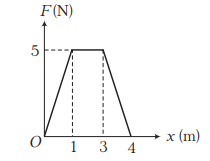
The force \(F\) is acting on a particle moving in a straight line as shown in figure. What is the work done by the force on the particle in the 4 m of the trajec tory?
 CorrectIncorrect
Hint
\(
\begin{aligned}
& \text { (c) } W=\text { Area under } F-x \text { graph } \\
& \therefore W=\text { Area of trapezium }=\frac{1}{2} \times(4+2) \times 5=15 \mathrm{~J}
\end{aligned}
\) - Question 38 of 81
38. Question
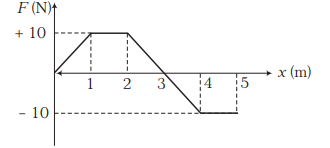
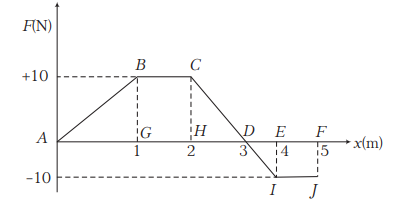
A position dependent force \(F\) is acting on a particle and its force-position curve is shown in the figure. Work done on the particle, when its displacement is from 0 to 5 m is
 CorrectIncorrect
Hint
(d)

\(
\begin{aligned}
& \text { Work done }=\text { Area under } F \text { – } x \text { graph } \\
& =\text { Area of } \triangle A B G+\text { Area of rectangle of } B G H C \\
& + \text { Area of } \triangle C D H+\text { Area of } \triangle D E I+\text { Area of rectangle } E F J I
\end{aligned}
\)
\(
\begin{array}{rlr}
& =\left(\frac{1}{2} \times 10 \times 1\right)+(10 \times 1)+\left(\frac{1}{2} \times 10 \times 1\right)+\left(\frac{1}{2}(-10) \times 1\right) \\
\Rightarrow W & =5 \mathrm{~J} & +(-10 \times 1)
\end{array}
\) - Question 39 of 81
39. Question
A porter with a suitcase of mass 20 kg on his head moves up a staircase upto a height of 4 m. The amounts of work done by the upward lifting force relative to him and relative to a person on the ground respectively, are
CorrectIncorrectHint
(a) Work done by the force relative to porter will be zero because displacement relative to porter is zero.
Now, work done by the force relative to a person on the ground, \(W_G=m g h=20 \times 10 \times 4=800 \mathrm{~J}\) - Question 40 of 81
40. Question
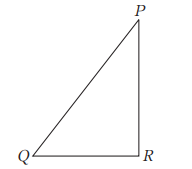
For the path \(P Q R\) in a conservative force field, the amounts of work done in carrying a body from \(P\) to \(Q\) and from \(Q\) to \(R\) are 5 J and 2 J, respectively. The work done in carrying the body from \(P\) to \(R\) will be
 CorrectIncorrect
Hint
(a) In a conservative force field, the total work done on a body moving from an initial point to a final point is path-independent. This means the total work can be calculated by summing the work done over consecutive segments of the path.
Sum the work components:
The total work \(W_{P R}\) is the sum of the work done from \(P\) to \(Q\left(W_{P Q}\right)\) and from \(Q\) to \(R\) ( \(\left.W_{Q R}\right)\). We apply the formula:
\(
W_{P R}=W_{P Q}+W_{Q R}
\)
Substituting the given values, \(W_{P Q}=5 \mathrm{~J}\) and \(W_{Q R}=2 \mathrm{~J}\), we get:
\(
W_{P R}=5 \mathrm{~J}+2 \mathrm{~J}=7 \mathrm{~J}
\)
The total work done in carrying the body from \(\boldsymbol{P}\) to \(\boldsymbol{R}\) is \(\mathbf{7 J}\). - Question 41 of 81
41. Question
Which of the following is a non-conservative force?
CorrectIncorrectHint
(b) Frictional force.
Explanation
Frictional force is a non-conservative force because the work done by it in moving an object between two points is dependent on the path taken.
Friction dissipates mechanical energy, usually in the form of heat and sound, which cannot be fully recovered as potential energy.Why other options are incorrect
(a) Spring force is a conservative force. The work done by a spring force depends only on the initial and final displacement from the equilibrium position and is independent of the path taken. This work is stored as elastic potential energy.
(c) Gravitational force is a conservative force. The work done by the gravitational force depends only on the change in vertical height (initial and final positions), not the path followed. This work is associated with gravitational potential energy.
(d) All of these is incorrect because both spring force and gravitational force are conservative forces. - Question 42 of 81
42. Question
If the force acting on a body is inversely proportional to its speed, the kinetic energy of the body is
CorrectIncorrectHint
\(
\begin{aligned}
&\text { (b) According to question, } F \propto \frac{1}{v}\\
&\begin{aligned}
& \Rightarrow \quad F=\frac{\lambda}{v} \text { where, } \lambda=\text { constant } \\
& m a=m \frac{d v}{d t}=\frac{\lambda}{v} \Rightarrow m \int_0^v v d v=\lambda \int_0^t d t \\
& m\left|\frac{v^2}{2}\right|_0^v=\lambda|t|_0^t \Rightarrow \frac{1}{2} m v^2=K=\lambda t \\
& K \propto t
\end{aligned}
\end{aligned}
\) - Question 43 of 81
43. Question
If the speed of a vehicle is increased by \(1 \mathrm{~ms}^{-1}\), its kinetic energy is doubled, then original speed of the vehicle is
CorrectIncorrectHint
\(
\begin{aligned}
&\text { (a) It is given that, } K_f=2 K_i\\
&\begin{aligned}
\text { or } & \frac{1}{2} m(v+1)^2 \\
\text { or } & =2\left(\frac{1}{2} m v^2\right) \text { or } v+1=\sqrt{2} v \\
v & =\frac{1}{\sqrt{2}-1}=(\sqrt{2}+1) \mathrm{ms}^{-1}
\end{aligned}
\end{aligned}
\) - Question 44 of 81
44. Question
A running man has half the kinetic energy that of a boy whose mass is half the mass of the man. The man speeds up by \(1 \mathrm{~ms}^{-1}\) and then has the same kinetic energy as that of boy. The original speeds of man and boy (in \(\mathrm{ms}^{-1}\) ) respectively, are
CorrectIncorrectHint
(b) According to the question, \(\frac{1}{2} m v_1^2=\frac{1}{2}\left[\frac{1}{2} \times \frac{m}{2} \times v_2^2\right]\) where, \(v_1=\) speed of man and \(v_2=\) speed of boy.
Now, \(\frac{1}{2} m\left(v_1+1\right)^2=\frac{1}{2} \times \frac{m}{2} \times v_2^2\)
Solving these two equations, we get
\(
v_1=(\sqrt{2}+1) \mathrm{ms}^{-1} \text { and } v_2=2(\sqrt{2}+1) \mathrm{ms}^{-1}
\) - Question 45 of 81
45. Question
Two bodies of masses \(m_1\) and \(m_2\) have same momentum. The ratio of their kinetic energy is
CorrectIncorrectHint
\(
\begin{aligned}
&\text { (d) Kinetic energy, } K=\frac{p^2}{2 m} \Rightarrow K_1=\frac{p^2}{2 m_1} \text { and } K_2=\frac{p^2}{2 m_2}\\
&\because \quad \frac{K_1}{K_2}=\frac{m_2}{m_1}
\end{aligned}
\) - Question 46 of 81
46. Question
If the linear momentum is increased by \(50 \%\), then kinetic energy will be increased by
CorrectIncorrectHint
\(
\begin{aligned}
& \text { (c) } K=\frac{p^2}{2 m}, K^{\prime}=\frac{(1.5 p)^2}{2 m}=2.25 \frac{p^2}{2 m}=2.25 K \\
& \therefore \% \text { increase in kinetic energy }=\frac{2.25 K-K}{K} \times 100=125 \% .
\end{aligned}
\) - Question 47 of 81
47. Question
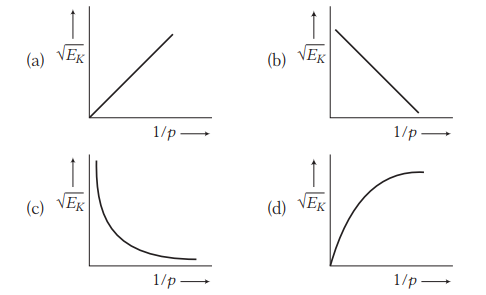
The graph between \(\sqrt{E_K}\) and \(1 / p\) is ( \(E_K=\) kinetic energy and \(p=\) momentum)
 CorrectIncorrect
Hint
(c) \(p=\sqrt{2 m E_K}\)
It is clear that \(p \propto \sqrt{E_K}\)
So, the graph between \(p\) and \(\sqrt{E_K}\) will be straight line but graph between \(1 / p\) and \(\sqrt{E_K}\) will be a hyperbola. - Question 48 of 81
48. Question
The kinetic energy acquired by a body of mass \(m\) in travelling a certain distance starting from rest under a constant force is
CorrectIncorrectHint
(d) Step 1: Apply the Work-Energy Theorem
The work done ( \(W\) ) by the constant force ( \(F\) ) over a distance ( \(d\) ) is given by \(W=F d\). According to the Work-Energy Theorem, the net work done on an object equals the change in its kinetic energy ( \(\Delta K=W\) ).
Step 2: Relate Work to Acquired Kinetic Energy
Since the body starts from rest, its initial kinetic energy is zero ( \(K_i=0\) ). The acquired kinetic energy ( \(K_f\) ) is equal to the work done:
\(
K_f=\Delta K=W=F d
\)
Step 3: Determine Dependence on Mass
The acquired kinetic energy \(\boldsymbol{K}_{\boldsymbol{f}}\) is determined solely by the constant force \(\boldsymbol{F}\) and the distance \(\boldsymbol{d}\) traveled, neither of which depends on the mass \(\boldsymbol{m}\). Therefore, the kinetic energy acquired is independent of the mass. - Question 49 of 81
49. Question
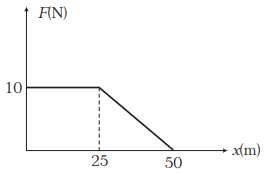
An object of mass 5 kg is acted upon by a force that varies with position of the object as shown in the figure. If the object starts out from rest at a point \(x=0\), what is its speed at \(x=50 \mathrm{~m}\) ?
 CorrectIncorrect
Hint
(a)
\(
\begin{aligned}
\text { Change in kinetic energy } & =\text { Work done } \\
& =\text { Area under } F-x \text { graph } \\
\frac{1}{2} \times 5 \times v^2=10 \times 25 & +\frac{1}{2} \times 25 \times 10=375 \\
v=12.2 \mathrm{~ms}^{-1} &
\end{aligned}
\) - Question 50 of 81
50. Question
A block of mass 20 kg is moving in \(x\)-direction with a constant speed of \(10 \mathrm{~ms}^{-1}\). It is subjected to a retarding force \(F=(-0.1 x) \mathrm{N}\) during its travel from \(x=20 \mathrm{~m}\) to \(x=30 \mathrm{~m}\). Its final kinetic energy will be
CorrectIncorrectHint
\(
\begin{aligned}
&\text { (a) Applying work-energy theorem, } K_f-K_i=W\\
&\begin{aligned}
\Rightarrow \quad K_f & =K_i+W=\frac{1}{2} \times 20 \times(10)^2+\int_{20}^{30}(-0.1 x) d x \\
& =1000-\frac{0.1}{2}\left(x^2\right)_{20}^{30}=1000-25=975 \mathrm{~J}
\end{aligned}
\end{aligned}
\) - Question 51 of 81
51. Question
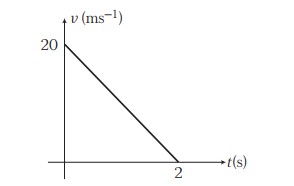
Velocity-time graph of a particle of mass 2 kg moving in a straight line as shown in figure. Work done by all the forces on the particle is
 CorrectIncorrect
Hint
\(
\begin{aligned}
&\text { (b) Work done by all forces }=\text { Change in kinetic energy }\\
&=\frac{1}{2} m\left(v_f^2-v_i^2\right)=\frac{1}{2} \times 2(0-400)=-400 \mathrm{~J}
\end{aligned}
\) - Question 52 of 81
52. Question
A body of mass 0.1 kg moving with a velocity of \(10 \mathrm{~ms}^{-1}\) hits a spring (fixed at the other end) of force constant \(1000 \mathrm{~N} \mathrm{~m}^{-1}\) and comes to rest after compressing the spring. The compression in the spring is
CorrectIncorrectHint
(b) Decrease in kinetic energy \(=\) Increase in elastic potential energy
\(
\begin{array}{rlrl}
\therefore & & \frac{1}{2} m v^2 & =\frac{1}{2} k x^2 \\
\text { or } & x & =\sqrt{\frac{m}{k}} \cdot v=\sqrt{\frac{0.1}{1000}} \times 10=0.1 \mathrm{~m}
\end{array}
\) - Question 53 of 81
53. Question
A mass of 2 kg falls from a height of 40 cm on a spring of a force constant \(1960 \mathrm{Nm}^{-1}\). The spring is compressed by (Take, \(g=9.8 \mathrm{~ms}^{-2}\) )
CorrectIncorrectHint
(a) Decrease in gravitational potential energy \(=\) Increase in elastic potential energy
or \(m g(h+x)=\frac{1}{2} k x^2\) or \(2 \times 9.8(0.4+x)=\frac{1}{2} \times 1960 \times x^2\)
Solving this equation, we get
\(
x=0.1 \mathrm{~m} \text { or } 10 \mathrm{~cm}
\)Note: The problem can be solved using the principle of conservation of energy. The total loss in gravitational potential energy of the mass is converted into elastic potential energy stored in the spring when it reaches maximum compression. The total height the mass falls is the initial height ( \(h\) ) plus the compression distance ( \(x\) ).
The equation for conservation of energy is:
\(
\frac{1}{2} k x^2=m g(h+x)
\) - Question 54 of 81
54. Question
The potential energy of a system increases, if work is done
CorrectIncorrectHint
(a) by the system against a conservative force.
Explanation
Potential energy is the energy stored in a system due to its configuration or position within a force field (like gravity or a spring).
-The change in potential energy \((\triangle P E)\) is the negative of the work done by a conservative force ( \(W_c\) ), i.e., \(\triangle P E=-W_c\).
When work is done by the system against a conservative force, it means an external force is working to change the system’s configuration to one of higher potential energy (e.g., lifting an object against gravity, compressing a spring). In this case, the work done by the conservative force is negative, so the potential energy increases ( \(\triangle P E=-\) (negative work) \(=\) positive increase). - Question 55 of 81
55. Question
The potential energy for a conservative force system is given by
\(
U=\frac{7}{2} x^2-3 x
\)
The potential energy at equilibrium isCorrectIncorrectHint
(b) For conservative force, \(F=-\frac{d U}{d x}=-(7 x-3)=3-7 x\)
At equilibrium, \(F=0\)
\(
\begin{aligned}
\Rightarrow & & 3-7 x=0 \Rightarrow x=\frac{3}{7} \\
\therefore & & U=\frac{7}{2}\left(\frac{3}{7}\right)^2-3\left(\frac{3}{7}\right)=\frac{9}{14}-\frac{9}{7}=-\frac{9}{14} \text { units }
\end{aligned}
\) - Question 56 of 81
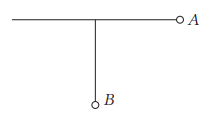
56. Question
A pendulum of length 2 m is left at \(A\). When it reaches \(B\), it loses 10% of its total energy due to air resistance. The velocity at \(B\) is
 CorrectIncorrect
Hint
\(
\begin{aligned}
&\text { (c) Gain in } \mathrm{KE}=\text { Loss in } \mathrm{PE}\\
&\begin{aligned}
\Rightarrow & & \frac{1}{2} m v^2 & =(0.1)(m g h) \\
& \therefore & v & =\sqrt{0.2 g h}=\sqrt{0.2 \times 10 \times 2}=2 \mathrm{~ms}^{-1}
\end{aligned}
\end{aligned}
\) - Question 57 of 81
57. Question
A body of mass \(m\) thrown vertically upwards attains a maximum height \(h\). At what height will its kinetic energy be \(75 \%\) of its initial value?
CorrectIncorrectHint
\(
\begin{aligned}
&\text { (c) From conservation of mechanical energy, we have }\\
&\begin{array}{cc}
\Rightarrow & \frac{1}{2} m v_i^2=m g h \\
\therefore & \frac{3}{4} m g h+m g h^{\prime}=m g h \Rightarrow h^{\prime}=\frac{h}{4}
\end{array}
\end{aligned}
\) - Question 58 of 81
58. Question
An engine develops 10 kW of power. How much time will it take to lift a mass of 200 kg to a height of 40 m ? (Take, \(g=10 \mathrm{~ms}^{-2}\) )
CorrectIncorrectHint
\(
\begin{aligned}
& \text { (c) Power, } P=\frac{\text { Work done by the engine }}{\text { Time taken }}=\frac{W}{t} \\
& \Rightarrow \quad t=\frac{W}{P}=\frac{m g h}{P}=\frac{200 \times 10 \times 40}{10 \times 10^3}=8 \mathrm{~s}
\end{aligned}
\) - Question 59 of 81
59. Question
Water falls from a height of 60 m at the rate of \(15 \mathrm{~kg} / \mathrm{s}\) to operate a turbine. The losses due to frictional forces are 10% of energy. How much power is generated by the turbine?
(Take, \(g=10 \mathrm{~ms}^{-2}\) )CorrectIncorrectHint
(c) Power given to turbine, \(P_{\text {in }}=\frac{m g h}{t}\)
\(
\begin{aligned}
& P_{\text {in }}=\left(\frac{m}{t}\right) \times g \times h \\
\Rightarrow & P_{\text {in }}=15 \times 10 \times 60 \Rightarrow P_{\text {in }}=9000 \mathrm{~W} \\
\Rightarrow & P_{\text {in }}=9 \mathrm{~kW}
\end{aligned}
\)
As efficiency of turbine is \(90 \%\), therefore power generated,
\(
\begin{aligned}
& P_{\text {out }}=90 \% \text { of } 9 \mathrm{~kW}=9 \times \frac{90}{100} \\
\Rightarrow & P_{\text {out }}=8.1 \mathrm{~kW}
\end{aligned}
\) - Question 60 of 81
60. Question
If the heart pushes 1 cc of blood in one second under pressure \(20000 \mathrm{Nm}^{-2}\), the power of heart is
CorrectIncorrectHint
\(
\begin{aligned}
\text { (a) Power } & =\frac{\text { Work done }}{\text { Time }}=\frac{\text { Pressure × Change in volume }}{\text { Time }} \\
& =\frac{20000 \times 1 \times 10^{-6}}{1} \\
& =2 \times 10^{-2}=0.02 \mathrm{~W}
\end{aligned}
\) - Question 61 of 81
61. Question
A body of mass 10 kg moves with a constant speed \(v\) of \(2 \mathrm{~ms}^{-1}\) along a circular path of radius 8 m. The power produced by the body will be
CorrectIncorrectHint
(d) Power is defined as the rate of change of energy in a system or the time rate of doing work.
\(
\Rightarrow \quad P=\frac{d E}{d t}=\frac{d W}{d t}
\)
Also, work, \(W=\) force × displacement \(=F \times d\)
Since, the displacement is zero.
\(
\therefore \quad P=\frac{d}{d t}(F \times d)=\frac{d}{d t} \times 0=0
\) - Question 62 of 81
62. Question
A force of \((2 \hat{\mathbf{i}}+3 \hat{\mathbf{j}}+4 \hat{\mathbf{k}}) \mathrm{N}\) acting on a body for 4 s, produces a displacement of \((3 \hat{\mathbf{i}}+4 \hat{\mathbf{j}}+5 \hat{\mathbf{k}}) \mathrm{m}\). The power used is
CorrectIncorrectHint
(a)
\(\begin{aligned} P=\mathbf{F} \cdot \mathbf{v}= & \frac{\mathbf{F} \cdot \mathbf{s}}{t}=\frac{(2 \hat{\mathbf{i}}+3 \hat{\mathbf{j}}+4 \hat{\mathbf{k}}) \cdot(3 \hat{\mathbf{i}}+4 \hat{\mathbf{j}}+5 \hat{\mathbf{k}})}{4} \\ & =\frac{38}{4}=9.5 \mathrm{~W}\end{aligned}\) - Question 63 of 81
63. Question
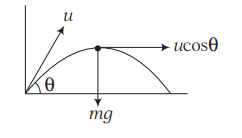
A body of mass 2 kg is projected at \(20 \mathrm{~ms}^{-1}\) at an angle \(60^{\circ}\) above the horizontal. Power due to the gravitational force at its highest point is
CorrectIncorrectHint
\(
\text { (d) } P=\mathbf{F} \cdot \mathbf{v}=m g(u \cos \theta) \cos 90^{\circ}=0
\)
- Question 64 of 81
64. Question
A body is falling freely under the action of gravity alone in vacuum. Which of the following quantities remain constant during the fall? [NCERT Exemplar]
CorrectIncorrectHint
(c) Total mechanical energy.
Explanation
Conservation of Mechanical Energy: In a vacuum, the only force acting on the body is gravity, which is a conservative force. In the absence of non-conservative forces like air resistance, the total mechanical energy (the sum of kinetic energy and potential energy) of the system remains constant throughout the fall. The decrease in potential energy is exactly balanced by the increase in kinetic energy.Why other options are incorrect
(a) Kinetic energy is incorrect because as the body falls, its velocity increases due to acceleration by gravity, so its kinetic energy ( \(\mathrm{KE}=1 / 2 \mathrm{mv}^2\) ) continuously increases.
(b) Potential energy is incorrect because as the body falls, its height above the ground decreases, so its potential energy (\(PE = mgh\)) continuously decreases.
(d) Total linear momentum is incorrect because the velocity of the body is continuously changing (increasing in magnitude), and momentum ( \(p=m v\) ) depends on velocity. Newton’s second law states that the net force (gravity in this case) equals the rate of change of momentum, so momentum is not constant. - Question 65 of 81
65. Question
An electron and a proton are moving under the influence of mutual forces. In calculating the change in the kinetic energy of the system during motion, one ignores the magnetic force of one on another. This is because [NCERT Exemplar]
CorrectIncorrectHint
(b) the magnetic forces do not work on each particle.
Explanation
Magnetic forces do no work: The work done by a magnetic force on a charged particle is always zero because the magnetic force is always perpendicular to the velocity of the particle ( \(\vec{F}_m=q(\vec{v} \times \vec{B})\) ).
Work-energy theorem: According to the work-energy theorem, the change in kinetic energy of a particle is equal to the net work done on it. Since the magnetic force does no work, it does not contribute to the change in the kinetic energy of either the electron or the proton.
Direction vs. Speed: The magnetic force changes the direction of the particle’s motion (acting as a centripetal force in a uniform field), but it does not change its speed, and therefore its kinetic energy remains constant with respect to the magnetic force alone. - Question 66 of 81
66. Question
A bicyclist comes to a skidding stop in 10 m. During this process, the force on the bicycle due to the road is 200 N and is directly opposed to the motion. The work done by the cycle on the road is [NCERT Exemplar]
CorrectIncorrectHint
(c) Work is defined as Force \(\times\) Displacement in the direction of the force.
The question asks for the work done by the cycle on the road.
According to Newton’s third law, the cycle exerts an equal and opposite force of 200 N on the road.
However, the road does not move; its displacement is zero.
Therefore, the work done by the cycle on the road is
\(
\text { Work }=\text { Force } \text { × } \text { Displacement }=200 \mathrm{~N} \times 0 \mathrm{~m}=0 \mathrm{~J} .
\) - Question 67 of 81
67. Question
A body of mass \(m\) was slowly pulled up the hill by a force \(F\) which at each point was directed along the tangent of the trajectory. All surfaces are smooth. Find the work performed by this force.
 CorrectIncorrect
Hint
The body is pulled “slowly,” which means its velocity is approximately constant, and thus the change in kinetic energy ( \(\Delta K\) ) is zero. The work-energy theorem states that the net work done by all forces equals the change in kinetic energy:
\(
W_{\text {net }}=\Delta K=0
\)
The forces acting on the body are the applied force \(\mathbf{F}\), gravity \(\mathbf{m g}\), and the normal force \(\mathbf{N}\).
\(
W_F+W_{m g}+W_N=0
\)
Calculate work done by individual forces
The normal force \(\mathbf{N}\) is always perpendicular to the displacement (tangent to the trajectory), so the work done by the normal force \(W_N\) is zero.
The work done by gravity \(W_{m g}\) is a conservative force and depends only on the change in vertical height. If the body is pulled up a height \(h\), the work done by gravity is \(-m g h\) (negative because gravity acts downwards, opposite to the upward vertical displacement).
Solve for the work performed by force \(F\)
Substituting the work values into the work-energy equation we get
\(
\begin{gathered}
W_F+(-m g h)+0=0 \\
W_F=m g h
\end{gathered}
\) - Question 68 of 81
68. Question
Which of the following diagrams most closely shows the variation in kinetic energy of the earth as it moves once around the sun in its elliptical orbit? [NCERT Exemplar]
 CorrectIncorrect
Hint
(d) When the earth is closest to the sun, speed of the earth is maximum, hence kinetic energy is maximum. When the earth is farthest from the sun, speed is minimum, hence kinetic energy is minimum but it will never be zero and negative.
This variation is correctly represented by option (d).Explanation:
Closest to the sun (perihelion): The Earth’s speed and kinetic energy (KE) are at their maximum due to the stronger gravitational pull.
Farthest from the sun (aphelion): The Earth’s speed and KE are at their minimum because the gravitational pull is weaker.
Energy values: Kinetic energy is defined as \(1 / 2 \times m v^2\), where mass \((\mathrm{m})\) and velocity squared \(\left(v^2\right)\) are always positive; thus, kinetic energy is always positive (never zero or negative) during the continuous motion of the orbit.Variation representation: Option (d) correctly depicts this oscillation between a maximum and minimum positive value.
- Question 69 of 81
69. Question
A body moves from rest with a constant acceleration. Which one of the following graphs represents the variation of its kinetic energy \(K\) with the distance travelled \(x\)?
 CorrectIncorrect
Hint
(c) The body starts from rest, so its initial kinetic energy is \(K_i=0\). It moves with constant acceleration, which implies a constant net force \(F=m a\). According to the work-energy theorem, the work done ( \(W\) ) by the net force is equal to the change in kinetic energy:
\(
W=\Delta K=K_f-K_i
\)
Since the force is constant and in the direction of motion, the work done over a distance \(x\) is \(W=F x\). Substituting this into the work-energy equation:
\(
F x=K_f-0
\)
Thus, the final kinetic energy \(\boldsymbol{K}\) after traveling distance \(\boldsymbol{x}\) is given by:
\(
K=F x
\)
Therefore, the \(K-x\) graph is a straight line that passes through the origin. - Question 70 of 81
70. Question
Which of the following diagrams represents variation of total mechanical energy of a pendulum oscillating in air as function of time? [NCERT Exemplar]
 CorrectIncorrect
Hint
(c) When a pendulum oscillates in the air, it continuously loses energy to overcome the resistance (drag force) offered by the air.
This energy loss causes the total mechanical energy of the pendulum system to decrease over time.
The rate of energy loss due to air resistance typically results in an exponential decrease in the total mechanical energy as a function of time.
The variation is correctly represented by curve (c). - Question 71 of 81
71. Question
A particle at rest on a frictionless table is acted upon by a horizontal force which is constant in magnitude and direction. A graph is plotted for the work done on the particle \(W\) against the speed of the particle \(v\). If there are no frictional forces acting on the particle,
the graph will look like CorrectIncorrect
Hint
(d) From work-energy theorem, \(W=\) Change in kinetic energy or \(W=\frac{1}{2} m v^2\)
\(\therefore W-v\) graph is a parabola. - Question 72 of 81
72. Question
A car moving with a speed of \(40 \mathrm{kmh}^{-1}\) can be stopped by applying brakes in 2 m. If the car is moving with a speed of \(80 \mathrm{kmh}^{-1}\), the minimum stopping distance under similar brakes will be
CorrectIncorrectHint
(a) The relationship between initial velocity ( \(u\) ), final velocity ( \(v=0\) ), constant acceleration ( \(a\) ), and stopping distance ( \(s\) ) is given by the kinematic equation \(v^2=u^2+2 a s\). Since the final velocity is zero, this simplifies to \(0=u^2+2 a s\), or \(u^2=-2 a s\).
The braking acceleration ( \(a\) ) is constant under “similar brakes”. The distance is therefore proportional to the square of the initial velocity: \(s \propto u^2\). We can write this as a ratio:
\(
\frac{s_2}{s_1}=\left(\frac{u_2}{u_1}\right)^2
\)
Using the given values \(\left(u_1=40 \mathrm{kmh}^{-1}, s_1=2 \mathrm{~m}, u_2=80 \mathrm{kmh}^{-1}\right)\), we substitute them into the ratio to find \(s_2\) :
\(
\begin{gathered}
s_2=s_1 \times\left(\frac{u_2}{u_1}\right)^2=2 \mathrm{~m} \times\left(\frac{80 \mathrm{kmh}^{-1}}{40 \mathrm{kmh}^{-1}}\right)^2 \\
s_2=2 \mathrm{~m} \times(2)^2=2 \mathrm{~m} \times 4 \\
s_2=8 \mathrm{~m}
\end{gathered}
\)
The minimum stopping distance is 8 m, which corresponds to option (a). - Question 73 of 81
73. Question
A long spring is stretched by 2 cm. Its potential energy is \(U\). If the spring is stretched by 10 cm, its potential energy would be
CorrectIncorrectHint
(d) Potential energy of the spring, \(U=\frac{1}{2} k x^2\) or \(U \propto x^2\)
Stretch is increased by 5 times. Therefore, stored potential energy will be increased by 25 times. - Question 74 of 81
74. Question
A body is falling under gravity. When it loses a gravitational potential energy by \(U\), its speed is \(v\). The mass of the body will be
CorrectIncorrectHint
(d) Step 1: Apply the Principle of Conservation of Energy
For a body falling under gravity, the conservation of energy principle dictates that the potential energy lost ( \(U\) ) is entirely converted into kinetic energy ( \(\Delta K\) ).
\(
U=\Delta K
\)
The kinetic energy gained by the body is given by the standard formula \(\Delta K=\frac{1}{2} m v^2\), where \(m\) is the mass and \(v\) is the speed gained.
Step 2: Solve for the Mass of the Body
Substitute the kinetic energy formula into the energy balance equation:
\(
U=\frac{1}{2} m v^2
\)
To isolate the mass ( \(m\) ), rearrange the equation algebraically:
\(
m=\frac{2 U}{v^2}
\) - Question 75 of 81
75. Question
How much mass is converted into energy per day in Tarapur nuclear power plant operated at \(10^7 \mathrm{~kW}\) ?
CorrectIncorrectHint
(a) Here, \(P=10^7 \mathrm{~kW}=10^{10} \mathrm{~W}=10^{10} \mathrm{Js}^{-1}\)
Time, \(t=1\) day \(=24 \times 60 \times 60 \mathrm{~s}\)
Energy produced per day,
\(
E=P t=10^{10} \times 24 \times 60 \times 60=864 \times 10^{12} \mathrm{~J}
\)
As, \(E=m c^2\)
\(
\begin{aligned}
m & =\frac{E}{c^2}=\frac{864 \times 10^{12} \mathrm{~J}}{\left(3 \times 10^8\right)^2 \mathrm{~ms}^{-1}} \\
& =9.6 \times 10^{-3} \mathrm{~kg}=9.6 \mathrm{~g}
\end{aligned}
\)
The mass converted into energy per day is 9.6 g. - Question 76 of 81
76. Question
A proton is kept at rest. A positively charged particle is released from rest at a distance \(d\) in its field. Consider two experiments: one in which the charged particle is also a proton and in another a positron. In the same time \(t\), the work done on the two moving charged particles is [NCERT Exemplar]
CorrectIncorrectHint
(c) Step 1: Analyze the forces
The force experienced by both the moving proton and the positron is the same at any given distance \(\boldsymbol{r}\) from the stationary proton because they both have the same charge ( \(+e\) ). Coulomb’s law describes this force:
\(
F=k_e \frac{q_1 q_2}{r^2}
\)
where \(q_1=q_2=+e\) in both cases.
Step 2: Compare motion over the same time \(\boldsymbol{t}\)
From Newton’s second law ( \(F=m a\) ), the acceleration is inversely proportional to the mass ( \(a=F / m\) ). Since the positron has a significantly smaller mass than the proton, it will have a much larger acceleration. As a result, in the same time interval \(t\), the positron will move a greater distance away from the stationary proton compared to the moving proton.
Step 3: Compare the work done
Work done is the integral of force over the distance moved ( \(W=\int F \cdot d s\) ). Since the force is the same at the same distance, but the positron travels a larger distance \(s\) in time \(t\), the work done ( \(W\) ) on the positron will be greater than the work done on the proton in the same time \(t\).
The correct option is (c) more for the case of a positron, as the positron moves away a larger distance. - Question 77 of 81
77. Question
The potential energy function for a particle executing linear SHM is given by \(V(x)=\frac{1}{2} k x^2\) where, \(k\) is the force constant of the oscillator (see figure). For \(k=0.5 \mathrm{Nm}^{-1}\), the graph of \(V(x)\) versus \(x\) is shown in the figure. A particle of total energy \(E\) turns back when it reaches \(x= \pm x_m\). If \(V\) and \(K\) indicate the PE and KE respectively of the particle at \(x=+x_m\), then which of the following is correct? [NCERT Exemplar]
 CorrectIncorrect
Hint
(b) Step 1: Understand the turning point condition
A particle in simple harmonic motion turns back when its velocity becomes zero. This happens at the maximum displacement, also known as the amplitude of oscillation, which is given as \(x= \pm x_m\) in this problem.
Step 2: Determine the kinetic energy
Kinetic energy \((K)\) is defined as \(K=\frac{1}{2} m v^2\), where \(m\) is the mass and \(v\) is the velocity. Since the velocity ( \(v\) ) of the particle at the turning point ( \(x=+x_m\) ) is zero, the kinetic energy at this point is also zero.
\(
K=0
\)
Step 3: Determine the potential energy
The total energy ( \(E\) ) of a particle executing SHM is conserved and is the sum of its potential energy ( \(V\) ) and kinetic energy ( \(K\) ) at any given point \(x\) :
\(
E=V(x)+K(x)
\)
At the turning point ( \(x=+x_m\) ), where \(K=0\), the total energy is entirely due to potential energy:
\(
\begin{gathered}
E=V\left(x_m\right)+0 \\
V=E
\end{gathered}
\)
The correct statement is that at \(\boldsymbol{x}=\boldsymbol{+} \boldsymbol{x}_{\boldsymbol{m}}\), the potential energy \(\boldsymbol{V}=\boldsymbol{E}\) and the kinetic energy \(\boldsymbol{K}=\mathbf{0}\). - Question 78 of 81
78. Question
A raindrop falling from a height \(h\) above ground, attains a near terminal velocity when it has fallen through a height \((3 / 4) h\). Which of the diagrams shown in figure correctly shows the change in kinetic and potential energy of the drop during its fall up to the ground? [NCERT Exemplar]
 CorrectIncorrect
Hint
(b) Step 1: Analyze Potential Energy (PE)
The potential energy of the raindrop at a height \(\boldsymbol{h}\) is given by the formula \(\mathrm{PE}=\boldsymbol{m} \boldsymbol{g}\), where \(m\) is the mass and \(g\) is the acceleration due to gravity. As the raindrop falls, its height ( \(h\) ) decreases continuously, so its potential energy must also decrease continuously from an initial maximum value of \(m g h\) at height \(h\) to zero at ground level ( \(h=0\) ).
Step 2: Analyze Kinetic Energy (KE)
The raindrop starts from rest (or near rest), so its initial kinetic energy is \(\mathbf{K E} \boldsymbol{=} \mathbf{0}\). As it falls, it accelerates due to gravity, and its velocity increases, which means its kinetic energy ( \(\mathrm{KE}=\frac{1}{2} m v^2\) ) increases. However, as the velocity increases, the air resistance (drag force) also increases. The problem states that the drop attains a near terminal velocity after falling through a height of \((3 / 4) h\). Once terminal velocity is reached, the net force becomes zero, and the velocity becomes constant. Therefore, the kinetic energy increases initially and then becomes constant for the remaining \((1 / 4) h\) of the fall.
Step 3: Identify the Correct Diagram
The correct diagram will show:
A continuously decreasing curve for potential energy (PE).
A curve for kinetic energy (KE) that increases from zero and then flattens out to a constant value after the raindrop has fallen through a height of (3/4)h.
The diagram that correctly shows the change in kinetic and potential energy of the drop during its fall is typically labeled as diagram (b), which depicts potential energy continuously decreasing and kinetic energy increasing before becoming constant (due to reaching terminal velocity). - Question 79 of 81
79. Question
In a shotput event, an athlete throws the shotput of mass 10 kg with an initial speed of \(1 \mathrm{~ms}^{-1}\) at \(45^{\circ}\) from a height 1.5 m above ground. Assuming air resistance to be negligible and acceleration due to gravity to be \(10 \mathrm{~ms}^{-2}\), the kinetic energy of the shotput when it just reaches the ground will be [NCERT Exemplar]
CorrectIncorrectHint
(d) Step 1: Apply the principle of conservation of mechanical energy
Since air resistance is negligible, the total mechanical energy of the shotput is conserved throughout its flight. The conservation principle is expressed as
\(
E_{\text {initial }}=E_{\text {final }} \text { or } K E_{\text {initial }}+P E_{\text {initial }}=K E_{\text {final }}+P E_{\text {final }} .
\)
Step 2: Calculate the initial kinetic and potential energies
The initial kinetic energy ( \(K E_{\text {initial }}\) ) is
\(K E_{\text {initial }}=\frac{1}{2} m u^2=\frac{1}{2} \times 10 \mathrm{~kg} \times(1 \mathrm{~m} / \mathrm{s})^2=5 \mathrm{~J}\). The initial potential energy \(\left(P E_{\text {initial }}\right.\) ) is \(P E_{\text {initial }}=m g h=10 \mathrm{~kg} \times 10 \mathrm{~m} / \mathrm{s}^2 \times 1.5 \mathrm{~m}=150 \mathrm{~J}\).
Step 3: Determine the final kinetic energy
The final potential energy ( \(P E_{\text {final }}\) ) at ground level ( \(h=0\) ) is 0 J. The final kinetic energy is calculated as
\(
K E_{\text {final }}=K E_{\text {initial }}+P E_{\text {initial }}-P E_{\text {final }}=5 \mathrm{~J}+150 \mathrm{~J}-0 \mathrm{~J}=155 \mathrm{~J}
\)
The kinetic energy of the shotput when it just reaches the ground will be \(\mathbf{1 5 5 ~ J}\). - Question 80 of 81
80. Question
A particle of mass 1 g executes an oscillatory motion on the concave surface of a spherical dish of radius 2 m placed on a horizontal plane. If the motion of the particle begins from a point on the dish at a height of 1 cm from the horizontal plane, the total distance covered by the particle before it comes to rest, is (Curved surface is smooth and \(\mu=0.01\) for horizontal surface)
CorrectIncorrectHint
(c)

Step 1: Identify the forces and energy
The particle starts from rest at a height \(\boldsymbol{h}\). Its initial potential energy is converted into work done against the force of friction as it oscillates and eventually comes to rest at the lowest point of the spherical dish. The principle of conservation of energy (accounting for work done by non-conservative forces) states that the change in potential energy equals the work done by friction: \(\triangle P E=W_f\).
Step 2: Formulate the energy and work equations
The change in potential energy is given by \(P E=m g h\).
The work done by friction over the total distance \(d\) is \(W_f=\int F_f d s\). The force of friction \(F_f=\mu N\), where \(N\) is the normal force. In this problem, the value of \(\mu(0.01)\) is used as an effective coefficient for the entire motion, and the problem can be simplified by assuming an average or effective friction force related to the weight of the particle. The problem is a standard one with a known answer, suggesting a simplification where work done is \(\mu \times m \times g \times d\) over the curved surface for the total distance \(d\) until it stops.
Step 3: Solve for the total distance
Equating the initial potential energy to the work done by friction:
\(
m g h=\mu m g d
\)
The mass \(m\) and acceleration due to gravity \(g\) cancel out, so the total distance \(d\) depends only on the initial height \(h\) and the coefficient of friction \(\mu\) :
\(
d=\frac{h}{\mu}
\)
Substitute the given values for \(h(1 \mathrm{~cm}=0.01 \mathrm{~m})\) and \(\mu(0.01)\) :
\(
d=\frac{0.01 \mathrm{~m}}{0.01}=1 \mathrm{~m}
\) - Question 81 of 81
81. Question
A body of mass 0.5 kg travels in a straight line with velocity \(v=a x^{3 / 2}\), where \(a=5 \mathrm{~m}^{-1 / 2} \mathrm{~s}^{-1}\). The work done by the net force during its displacement from \(x=0\) to \(x=2 \mathrm{~m}\) is [NCERT Exemplar]
CorrectIncorrectHint
(b) Step 1: Calculate Initial and Final Velocities
The initial velocity at \(x_i=0 \mathrm{~m}\) is \(v_i=a(0)^{3 / 2}=0 \mathrm{~m} / \mathrm{s}\).
The final velocity at \(x_f=2 \mathrm{~m}\) is \(v_f=a(2)^{3 / 2}=5(2 \sqrt{2}) \mathrm{m} / \mathrm{s}\).
Step 2: Apply the Work-Energy Theorem
The net work done ( \(W_{\text {net }}\) ) is equal to the change in kinetic energy ( \(\Delta K\) ):
\(
W_{n e t}=\Delta K=\frac{1}{2} m v_f^2-\frac{1}{2} m v_i^2
\)
Step 3: Calculate the Work Done
Substituting the given mass \(m=0.5 \mathrm{~kg}\) and the calculated velocities into the work-energy theorem:
\(
\begin{gathered}
W_{n e t}=\frac{1}{2}(0.5 \mathrm{~kg})(5 \times 2 \sqrt{2} \mathrm{~m} / \mathrm{s})^2-\frac{1}{2}(0.5 \mathrm{~kg})(0 \mathrm{~m} / \mathrm{s})^2 \\
W_{n e t}=\frac{1}{4}(25 \times 4 \times 2) \mathrm{J}=\frac{200}{4} \mathrm{~J}=50 \mathrm{~J}
\end{gathered}
\)
The work done by the net force during its displacement from \(x=0\) to \(x=2 \mathrm{~m}\) is 50 J.