1.3 Work
Work is said to be done when a force acts on a body in such a way that the body is displaced through some distance in the direction of force. We define the work done by a constant force on a body as the product of the force \(\vec{F}\) and the displacement \(\vec{d}\) through which the body is displaced in the direction of force. Then, the work done \(W\) is given by
\(W=\vec{F} \cdot \vec{d}=Fd \cos \theta= Fd, \quad \boldsymbol{\theta} \text { is } 0^{\circ} \text { (From the definition of dot product) }\)
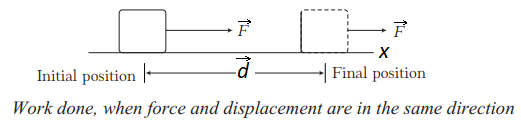
On the other hand, in a situation, when the constant force \(\vec{F}\) acting on the body makes angle \(\theta\) with the horizontal and body is displaced through a distance \(\vec{d}\).
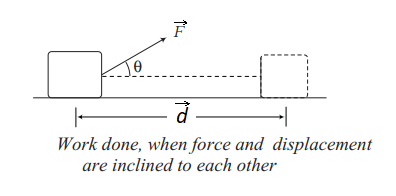
Then, \(\vec{F}\) can be resolved into two components
- \(F \cos \theta\) in the direction of displacement of body.
- \(F \sin \theta\) in the perpendicular direction of the displacement of body.
Thus, in this case, work done by a constant force \(\vec{F}\) is given by
\(
W=\text { (component of force along the displacement) } \times \text { (displacement) }
\)
or \(\quad W=(F \cos \theta)(d)\)
or \(\quad W=\vec{F} \cdot \vec{d} \quad\) (From the definition of dot product)
So, work done is a scalar or dot product of \(\vec{F}\) and \(\vec{d}\).
We see that if there is no displacement, there is no work done even if the force is large. Thus, when you push hard against a rigid brick wall, the force you exert on the wall does no work. \(\text { The SI unit of work is Joule }(\mathrm{J}) \text {, }\) and its \(\text { dimension is, }\left[\mathrm{ML}^{2} \mathrm{~T}^{-2}\right]\).
\(
1 \text { joule }=10^7 \text { erg }
\)
Gravitational unit of work done is \(\mathbf{~ k g – m}\).
\(
1 \mathrm{~kg}-\mathrm{m}=9.8 \mathrm{~J}
\)
Some other convenient units of work are eV (electron volt), MeV (mega electron volt) and kWh (kilowatt hour)
\(1 \mathrm{eV}=1.6 \times 10^{-19} \mathrm{~J}, 1 \mathrm{~J}=6.25 \times 10^{18} \mathrm{eV}\)
\(1 \mathrm{MeV}=1.6 \times 10^{-13} \mathrm{~J}, 1 \mathrm{~J}=6.25 \times 10^{12} \mathrm{MeV}\)
1 kilowatt hour \((\mathrm{kWh})=3.6 \times 10^6 \mathrm{~J}\)
Key facts:
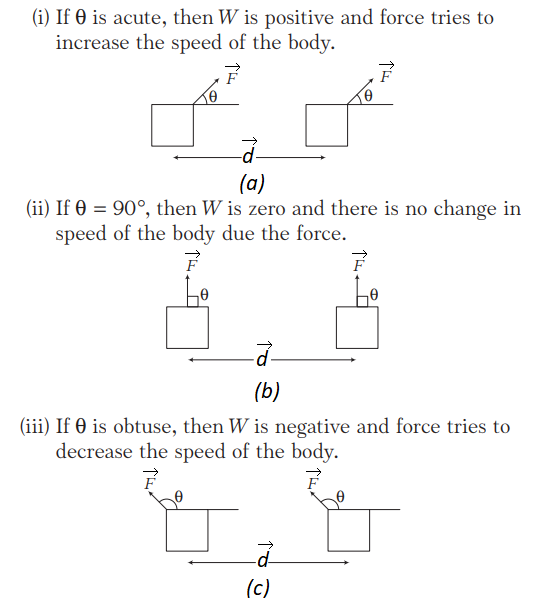
Positive Work: When force and displacement are in the same direction, the angle \(\boldsymbol{\theta}\) is \(0^{\circ}\). Since \(\cos \left(0^{\circ}\right)=1\), the work equation becomes \(W=F d\), a positive value. This adds energy to the object.
Negative Work: When force and displacement are in opposite directions, the angle \(\theta\) is \(180^{\circ}\). Since \(\cos \left(180^{\circ}\right)=-1\), the work equation becomes \(W=-F d\), a negative value. This removes energy from the object.
Zero Work (Perpendicular Force): When the force is perpendicular to the displacement, the angle \(\theta\) is \(90^{\circ}\). Since \(\cos \left(90^{\circ}\right)=0\), the work equation becomes \(W=F d \cdot 0=0\). Only the force component parallel to the motion does work.
Zero Work (No Displacement): If there is no displacement, the magnitude of displacement \(d\) is zero. The equation \(W=F d \cos (\theta)\) becomes \(W=F \cdot 0 \cdot \cos (\theta)=0\), regardless of the force applied or angle.
Nature of work in different situations :
Example 1: A lawn roller has been pushed by a gardener through a distance of 30 m. What will be the work done by him, if he applies a force of 30 kg -wt in the direction inclined at \(60^{\circ}\) to the ground?
Solution: Given, displacement, \(s=30 \mathrm{~m}\)
Force, \(F=30 \mathrm{~kg}-\mathrm{wt}=300 \mathrm{~N}\)
\(
\theta=60^{\circ}
\)
The work done by the gardener,
\(
\begin{aligned}
W & =\mathbf{F} \cdot \mathbf{s}=F s \cos \theta=300 \times 30 \times \cos 60^{\circ} \\
& =300 \times 30 \times \frac{1}{2} \Rightarrow W=4500 \mathrm{~J}
\end{aligned}
\)
Example 2: A body moves a distance of 10 m along a straight line under an action of \(5 N\) force. If work done is \(25 J\), then find the angle between the force and direction of motion of the body.
Solution: Work is measured by the product of the applied force and the displacement of the body in the direction of the force.
\(
\begin{array}{ll}
\therefore & \text { Work }=\text { Applied force × Displacement } \\
\text { Given, } & W=(F \cos \theta) \times s=F s \cos \theta \\
\therefore & W=25 \mathrm{~J}, F=5 \mathrm{~N}, s=10 \mathrm{~m} \\
\Rightarrow & \cos \theta=\frac{W}{F \cdot s}=\frac{25}{5 \times 10}=\frac{1}{2} \\
\Rightarrow & \theta=\cos ^{-1}\left(\frac{1}{2}\right)=60^{\circ}
\end{array}
\)
Hence, angle between the force and direction of motion of the body is \(60^{\circ}\).
Example 3: A block of mass \(m=2 \mathrm{~kg}\) is pulled by a force \(F=40 N\) upwards through a height \(h=2 m\). Find the work done on the block by the applied force \(F\) and its weight \(m g\). (Take, \(g=10 \mathrm{~ms}^{-2}\) )
Solution: Weight of the block, \(w=m g=(2)(10)=20 \mathrm{~N}\)
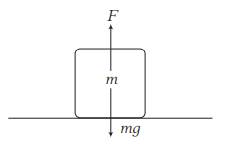
Work done by the applied force,
\(
W_F=F s \cos \theta=F h \cos 0^{\circ}
\)
(Here, \(s=h=2 \mathrm{~m}\) and the angle between force and displacement is \(0^{\circ}\) )
\(
W_F=(40)(2)(1)=80 \mathrm{~J}
\)
Similarly, work done by its weight,
\(
\begin{aligned}
& W_{m g}=(m g)(h) \cos 180^{\circ} \\
& W_{m g}=(20)(2)(-1)=-40 \mathrm{~J}
\end{aligned}
\)
Example 4: A 10 g block placed on a rough horizontal floor is being pulled by a constant force 50 N. Coefficient of kinetic friction between the block and the floor is 0.4. Find work done by each individual force acting on the block over displacement of 5 m.
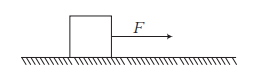
Solution: Given, mass, \(m=10 \mathrm{~g}\)
Constant force, \(F=50 \mathrm{~N}\)
Coefficient of kinetic friction, \(\mu_k=0.4\)
Displacement, \(s=5 \mathrm{~m}\)
Forces acting on the block are; its weight \((m g=100 \mathrm{~N})\), normal reaction \((N=100 \mathrm{~N})\) from the ground, force due to kinetic friction \(\left(f=\mu_k m g=40 \mathrm{~N}\right)\) and the applied force \((F=50 \mathrm{~N})\) which are shown in the given figure.
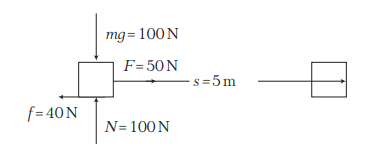
Work done by the gravity, i.e. weight of the block,
\(
W_g=0 \mathrm{~J} \quad(\because m g \perp \mathbf{s})
\)
Work done by the normal reaction,
\(
W_N=0 \mathrm{~J} \quad(\because \mathbf{N} \perp \mathbf{s})
\)
Work done by the applied force,
\(
\begin{array}{rlr}
W_F & =50 \times 5 \times \cos 0^{\circ} & (\because \mathbf{F} \| \mathbf{s}) \\
& =250 \mathrm{~J} &
\end{array}
\)
Work done by the force of kinetic friction,
\(
\begin{aligned}
& W_f=40 \times 5 \times \cos 180^{\circ} \\
& W_f=-200 \mathrm{~J} \quad(\because \mathbf{F} \text { and } \mathbf{s} \text { are anti-parallel })
\end{aligned}
\)
Example 5: A block of mass 2 kg is being brought down by a string. If the block acquires a speed \(1 \mathrm{~ms}^{-1}\) in dropping down 25 cm, find the work done by the string in the process.
Solution: Given, distance moved by block, \(s=25 \mathrm{~cm}=\frac{1}{4} \mathrm{~m}\)
Initial velocity of block, \(u=0\)
Final velocity of block, \(v=1 \mathrm{~ms}^{-1}\)
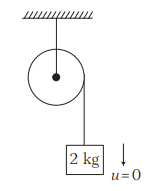
From the third equation of motion for block,
\(
v^2=u^2+2 a s \Rightarrow(1)^2=0+2 a \times \frac{1}{4} \Rightarrow a=2 \mathrm{~ms}^{-2}
\)
∴ Acceleration of the block, \(a=2 \mathrm{~ms}^{-2}\)
The free body diagram of the block is as shown below
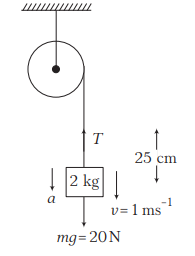
For the motion of 2 kg block in downward direction, applying Newton’s law, we get
\(
\begin{array}{rlrl}
m g-T & =m a \\
20-T & =2 a=2 \times 2 \\
\Rightarrow \quad T & & =16 \mathrm{~N}
\end{array}
\)
∴ Work done by the string, \(W=-T s=-16 \times \frac{1}{4}=-4 \mathrm{~J}\)
Negative sign indicates the opposite direction of tension and displacement of the block.
Example 6: Two unequal masses of 1 kg and 2 kg are attached at the two ends of a light inextensible string passing over a smooth pulley as shown in figure. If the system is released from rest, find the work done by string on both the blocks in 1 s. (Take, \(g=10 \mathrm{~ms}^{-2}\) )
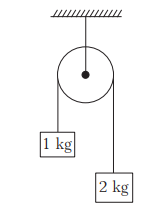
Solution: Net pulling force acting on the system,
\(
F_{\mathrm{net}}=2 g-1 g=20-10=10 \mathrm{~N}
\)
Total mass being pulled,
\(
m=(1+2)=3 \mathrm{~kg}
\)
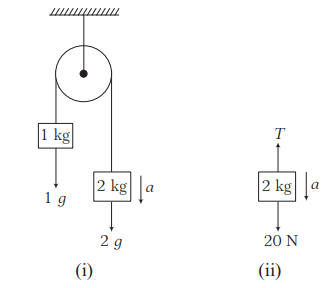
Therefore, acceleration of the system will be
\(
a=\frac{F_{\text {net }}}{m}=\frac{10}{3} \mathrm{~ms}^{-2}
\)
Displacement of both the blocks in 1 s is
\(
s=\frac{1}{2} a t^2=\frac{1}{2}\left(\frac{10}{3}\right)(1)^2=\frac{5}{3} \mathrm{~m}
\)
Free body diagram of 2 kg block is shown in Fig. (ii). Using \(\Sigma F=m a\), we get
\(
\begin{aligned}
20-T & =2 a=2\left(\frac{10}{3}\right) \\
T & =20-\frac{20}{3}=\frac{40}{3} \mathrm{~N}
\end{aligned}
\)
∴ Work done by string (tension) on 1 kg block in 1 s is
\(
W_1=(T)(s) \cos 0^{\circ}=\left(\frac{40}{3}\right)\left(\frac{5}{3}\right)(1)=\frac{200}{9} \mathrm{~J}
\)
Similarly, work done by string on 2 kg block in 1 s will be
\(
W_2=(T)(s)\left(\cos 180^{\circ}\right)=\left(\frac{40}{3}\right)\left(\frac{5}{3}\right)(-1)=-\frac{200}{9} \mathrm{~J}
\)
Example 7: A cyclist comes to a skidding stop in 10 m. During this process, the force on the cycle due to the road is 200 N and is directly opposed to the motion. (a) How much work does the road do on the cycle? (b) How much work does the cycle do on the road?
Solution: Work done on the cycle by the road is the work done by the stopping (frictional) force on the cycle due to the road.
(a) The stopping force and the displacement make an angle of \(180^{\circ}\) ( \(\pi\) rad) with each other. Thus, work done by the road,
\(
\begin{aligned}
W_{r} &=F d \cos \theta \\
&=200 \times 10 \times \cos \pi \\
&=-2000 \mathrm{~J}
\end{aligned}
\)
It is this negative work that brings the cycle to a halt in accordance with the Work-Energy theorem.
(b) From Newton’s Third Law an equal and opposite force acts on the road due to the cycle. Its magnitude is \(200 \mathrm{~N}\). However, the road undergoes no displacement. Thus, work done by cycle on the road is zero.
Work done on a particle moving in three dimensional space
Let a particle moves in space under the action of a constant force given by
\(
\mathbf{F}=F_x \hat{\mathbf{i}}+F_y \hat{\mathbf{j}}+F_z \hat{\mathbf{k}}
\)
Let initial position of the particle be
\(
\mathbf{s}_1=x_1 \hat{\mathbf{i}}+y_1 \hat{\mathbf{j}}+z_1 \hat{\mathbf{k}}
\)
and final position of the particle be
\(
\mathbf{s}_2=x_2 \hat{\mathbf{i}}+y_2 \hat{\mathbf{j}}+z_2 \hat{\mathbf{k}}
\)
Then, work done by the force \(\mathbf{F}\) given by
\(
\begin{gathered}
W=\mathbf{F} \cdot \mathbf{s}=\mathbf{F} \cdot\left(\mathbf{s}_2-\mathbf{s}_1\right) \\
=\left[F_x \hat{\mathbf{i}}+F_y \hat{\mathbf{j}}+F_z \hat{\mathbf{k}}\right] \cdot\left[\left(x_2-x_1\right) \hat{\mathbf{i}}\right. \\
\left.+\left(y_2-y_1\right) \hat{\mathbf{j}}+\left(z_2-z_1\right) \hat{\mathbf{k}}\right] \\
\Rightarrow \quad W=F_x\left(x_2-x_1\right)+F_y\left(y_2-y_1\right)+F_z\left(z_2-z_1\right)
\end{gathered}
\)
Example 8: \(A\) constant force \(\mathbf{F}=(\hat{\mathbf{i}}+3 \hat{\mathbf{j}}+4 \hat{\mathbf{k}}) N\) acts on a particle and displaces it from \((-1 m, 2 m, 1 m)\) to \((2 m,-3 m, 1 m)\). Find the work done by the force.
Solution: Given,
\(
\mathbf{F}=(\hat{\mathbf{i}}+3 \hat{\mathbf{j}}+4 \hat{\mathbf{k}}) \mathrm{N}
\)
Initial position of the particle is given by
\(
\mathbf{s}_1=(-\hat{\mathbf{i}}+2 \hat{\mathbf{j}}+\hat{\mathbf{k}}) \mathrm{m}
\)
Final position, \(s_2=(2 \hat{\mathbf{i}}-3 \hat{\mathbf{j}}+\hat{\mathbf{k}}) \mathrm{m}\)
Displacement of the particle,
\(
\begin{aligned}
& \mathbf{s}=\mathbf{s}_2-\mathbf{s}_1=(2 \hat{\mathbf{i}}-3 \hat{\mathbf{j}}+\mathbf{k})-(-\hat{\mathbf{i}}+2 \hat{\mathbf{j}}+\hat{\mathbf{k}}) \\
& =3 \hat{\mathbf{i}}-5 \hat{\mathbf{j}}+0 \hat{\mathbf{k}}=(3 \hat{\mathbf{i}}-5 \hat{\mathbf{j}}) \mathrm{m}
\end{aligned}
\)
Work done by the force \(\mathbf{F}\),
\(
W=\mathbf{F} \cdot \mathbf{s}=(\hat{\mathbf{i}}+3 \hat{\mathbf{j}}+4 \hat{\mathbf{k}}) \cdot(3 \hat{\mathbf{i}}-5 \hat{\mathbf{j}})=(3-15)=-12 \mathrm{~J}
\)
Example 9: A particle is shifted from point \((0,0,1 m)\) to \((1 m, 1 m, 2 m)\), under simultaneous action of several forces. Two of the forces are \(\mathbf{F}_1=(2 \hat{\mathbf{i}}+3 \hat{\mathbf{j}}-\hat{\mathbf{k}}) N\) and \(\mathbf{F}_2=(\hat{\mathbf{i}}-2 \hat{\mathbf{j}}+2 \hat{\mathbf{k}}) N\). Find work done by resultant of these two forces.
Solution: Work done by a constant force is equal to dot product of the force and displacement vectors.
i.e.
\(
W=\mathbf{F} \cdot \mathbf{s} \dots(i)
\)
Initial position of the particle, \(\mathbf{s}_1=\hat{\mathbf{k}}\) metre
Final position, \(\mathbf{s}_2=(\hat{\mathbf{i}}+\hat{\mathbf{j}}+2 \hat{\mathbf{k}}) \mathrm{m}\)
Displacement of the particle, \(\mathbf{s}=\mathbf{s}_2-\mathbf{s}_1=\hat{\mathbf{i}}+\hat{\mathbf{j}}+2 \hat{\mathbf{k}}-\hat{\mathbf{k}}\)
\(
\Rightarrow \quad \mathbf{s}=(\hat{\mathbf{i}}+\hat{\mathbf{j}}+\hat{\mathbf{k}}) \mathrm{m}
\)
and force,
\(
\begin{aligned}
\mathbf{F} & =\mathbf{F}_1+\mathbf{F}_2=2 \hat{\mathbf{i}}+3 \hat{\mathbf{j}}-\hat{\mathbf{k}}+\hat{\mathbf{i}}-2 \hat{\mathbf{j}}+2 \hat{\mathbf{k}} \\
& =(3 \hat{\mathbf{i}}+\hat{\mathbf{j}}+\hat{\mathbf{k}}) \mathrm{N}
\end{aligned}
\)
Substituting given values in Eq. (i), we get
\(
W=(3 \hat{\mathbf{i}}+\hat{\mathbf{j}}+\hat{\mathbf{k}}) \cdot(\hat{\mathbf{i}}+\hat{\mathbf{j}}+\hat{\mathbf{k}})=3+1+1=5 \mathrm{~J}
\)