JEE PYQs MCQs
SUMMARY
- The motion that repeats itself is called periodic motion.
- The period \(T\) is the time reequired for one complete oscillation, or cycle. It is related to the frequency v by,
\(
T=\frac{1}{f}
\)
The frequency \(v\) of periodic or oscillatory motion is the number of oscillations per unit time. In the SI, it is measured in hertz :
\(
1 \text { hertz }=1 \mathrm{~Hz}=1 \text { oscillation per } \text { second }=1 \mathrm{~s}^{-1}
\) - In simple harmonic motion (SHM), the displacement \(x(t)\) of a particle from its equilibrium position is given by,
\(
x(t)=A \cos (\omega t+\phi) \quad(\text { displacement }),
\)
in which \(A\) is the amplitude of the displacement, the quantity (\(\omega t+\phi\)) is the phase of the motion, and \(\phi\) is the phase constant. The angular frequency \(\omega\) is related to the period and frequency of the motion by,
\(
\omega=\frac{2 \pi}{T}=2 \pi f \quad \text { (angular frequency). }
\) - Simple harmonic motion can also be viewed as the projection of uniform circular motion on the diameter of the circle in which the latter motion occurs.
- The particle velocity and acceleration during SHM as functions of time are given by,
\(
\begin{aligned}
v(t) & =-\omega A \sin (\omega t+\phi) \text { (velocity), } \\
a(t) & =-\omega^2 A \cos (\omega t+\phi) \\
& =-\omega^2 X(t) \text { (acceleration), }
\end{aligned}
\) - The force acting in a simple harmonic motion is proportional to the displacement and is always directed towards the centre of motion.
- A particle executing simple harmonic motion has, at any time, kinetic energy \(K=1 / 2 m v^2\) and potential energy \(U=1 / 2 k x^2\). If no friction is present the mechanical energy of the system, \(E=K+U\) always remains constant even though \(K\) and \(U\) change with time.
- A particle of mass \(m\) oscillating under the influence of Hooke’s law restoring force given by \(F=-k x\) exhibits simple harmonic motion with
\(
\begin{aligned}
&\begin{array}{llr}
\omega=\sqrt{\frac{k}{m}} & & \text { (angular frequency) } \\
T=2 \pi \sqrt{\frac{m}{k}} & & \text { (period) }
\end{array}\\
&\text { Such a system is also called a linear oscillator. }
\end{aligned}
\) - The motion of a simple pendulum swinging through small angles is approximately simple harmonic. The period of oscillation is given by,
\(
T=2 \pi \sqrt{\frac{L}{g}}
\)
Quiz Summary
0 of 75 Questions completed
Questions:
Information
You have already completed the quiz before. Hence you can not start it again.
Quiz is loading…
You must sign in or sign up to start the quiz.
You must first complete the following:
Results
Results
0 of 75 Questions answered correctly
Your time:
Time has elapsed
You have reached 0 of 0 point(s), (0)
Earned Point(s): 0 of 0, (0)
0 Essay(s) Pending (Possible Point(s): 0)
Categories
- Not categorized 0%
- 1
- 2
- 3
- 4
- 5
- 6
- 7
- 8
- 9
- 10
- 11
- 12
- 13
- 14
- 15
- 16
- 17
- 18
- 19
- 20
- 21
- 22
- 23
- 24
- 25
- 26
- 27
- 28
- 29
- 30
- 31
- 32
- 33
- 34
- 35
- 36
- 37
- 38
- 39
- 40
- 41
- 42
- 43
- 44
- 45
- 46
- 47
- 48
- 49
- 50
- 51
- 52
- 53
- 54
- 55
- 56
- 57
- 58
- 59
- 60
- 61
- 62
- 63
- 64
- 65
- 66
- 67
- 68
- 69
- 70
- 71
- 72
- 73
- 74
- 75
- Current
- Review
- Answered
- Correct
- Incorrect
- Question 1 of 75
1. Question
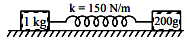
As shown in the figure, a spring is kept in a stretched position with some extension by holding the masses 1 kg and 0.2 kg with a separation more than spring natural length and are released. Assuming the horizontal surface to be frictionless, the angular frequency (in SI unit) of the system is : [JEE Main 2026 (Online) 28th January Evening Shift]
 CorrectIncorrect
Hint
(c) Step 1: Identify Given Values
First, we list the physical parameters provided in the problem, ensuring all units are in the SI system (kilograms and Newtons per meter):
Mass \(1\left(m_1\right): 1 \mathrm{~kg}\)
Mass \(2\left(m_2\right): 200 \mathrm{~g}=0.2 \mathrm{~kg}\)
Spring constant (\(k\)): \(150 \mathrm{~N} / \mathrm{m}\)
Step 2: Calculate the Reduced Mass (\(\mu\))
In a system where two masses are connected by a spring and free to move on a frictionless surface, they oscillate about their common center of mass. To simplify this into a single-body equivalent, we use the reduced mass (\(\mu\)):
\(
\mu=\frac{m_1 \cdot m_2}{m_1+m_2}
\)
Substituting the values:
\(
\mu=\frac{1 \cdot 0.2}{1+0.2}=\frac{0.2}{1.2}=\frac{1}{6} \mathrm{~kg}
\)
Step 3: Calculate the Angular Frequency (\(\omega\))
The angular frequency for a spring-mass system is determined by the ratio of the stiffness to the effective mass. Using the reduced mass calculated in Step 2:
\(
\omega=\sqrt{\frac{k}{\mu}}
\)
Plugging in the spring constant (\(k=150\)) and the reduced mass (\(\mu=1 / 6\)):
\(
\begin{aligned}
\omega & =\sqrt{\frac{150}{1 / 6}} \\
\omega & =\sqrt{150 \cdot 6} \\
\omega & =\sqrt{900} \\
\omega & =30 \mathrm{rad} / \mathrm{s}
\end{aligned}
\)
Final Answer: The angular frequency of the system is \(30 \mathrm{rad} / \mathrm{s}\).Derivation: Set up the Equations of Motion:
Let \(x_1\) and \(x_2\) be the positions of the two masses. The compression or extension of the spring is (\(x_2-x_1-L\)), where \(L\) is the natural length. For simplicity, we can ignore \(L\) by looking at the relative displacement \(x=x_2-x_1\).
According to Newton’s Second Law (\(F=m a\)), the forces acting on each mass due to the spring are:
For \(m_1\) : \(m_1 \frac{d^2 x_1}{d t^2}=k\left(x_2-x_1\right)\)
For \(m_2: m_2 \frac{d^2 x_2}{d t^2}=-k\left(x_2-x_1\right)\)
Isolate the Accelerations:
We rewrite these to solve for the acceleration of each mass:
\(
\begin{gathered}
\frac{d^2 x_1}{d t^2}=\frac{k}{m_1}\left(x_2-x_1\right) \\
\frac{d^2 x_2}{d t^2}=-\frac{k}{m_2}\left(x_2-x_1\right)
\end{gathered}
\)
Find the Relative Acceleration:
We want to find how the relative distance \(x=\left(x_2-x_1\right)\) changes over time. To do this, we subtract the acceleration of \(m_1\) from the acceleration of \(m_2\) :
\(
\frac{d^2 x_2}{d t^2}-\frac{d^2 x_1}{d t^2}=-\frac{k}{m_2}\left(x_2-x_1\right)-\frac{k}{m_1}\left(x_2-x_1\right)
\)
Let \(\frac{d^2 x}{d t^2}\) represent the relative acceleration:
\(
\frac{d^2 x}{d t^2}=-k\left(\frac{1}{m_2}+\frac{1}{m_1}\right)\left(x_2-x_1\right)
\)
Define Reduced Mass:
The standard equation for a simple harmonic oscillator is \(F=\mu a\), or \(a=-\frac{k}{\mu} x\). Comparing our result to this standard form:
\(
\frac{d^2 x}{d t^2}=-\frac{k}{\mu} x
\)
We can see that:
\(
\frac{1}{\mu}=\frac{1}{m_1}+\frac{1}{m_2}
\)
Final Algebraic Simplification:
To get \(\mu\) by itself, find a common denominator for the right side:
\(
\frac{1}{\mu}=\frac{m_2+m_1}{m_1 \cdot m_2}
\)
Inverting both sides gives us the final formula:
\(
\mu=\frac{m_1 \cdot m_2}{m_1+m_2}
\)
This effectively treats the two moving bodies as a single mass \(\mu\) attached to a fixed wall, oscillating with the same frequency. - Question 2 of 75
2. Question
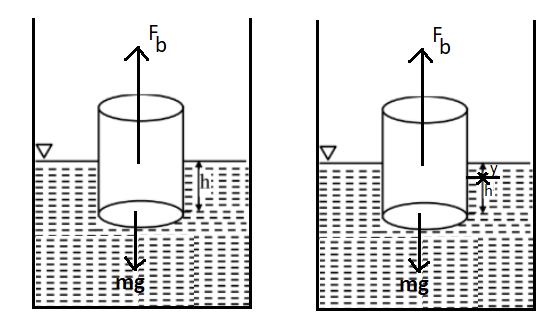
A cylindrical block of mass \(M\) and area of cross section \(A\) is floating in a liquid of density \(\rho\) and with its axis vertical. When depressed a little and released the block starts oscillating. The period of oscillation is ____. [JEE Main 2026 (Online) 24th January Morning Shift]
CorrectIncorrectHint
(c)

To find the period of oscillation for a floating cylindrical block, we look at the restoring force created when the block is displaced from its equilibrium position.
Step 1: Establish Equilibrium
When the block of mass \(M\) is floating at rest, it is in equilibrium. According to Archimedes’ Principle, the weight of the block acting downward is exactly balanced by the buoyant force (the weight of the displaced liquid) acting upward.
\(
M g=F_b
\)
At this stage, the block is submerged to a depth \(h\), where \(M g=\rho(A \cdot h) g\).
Step 2: Determine the Restoring Force
If the block is pushed down a further distance \(y\) from its equilibrium position, it displaces an additional volume of liquid equal to \(A \cdot y\). This results in an increase in the buoyant force.
The net force acting on the block now becomes a restoring force \(\left(F_r\right)\), which tries to push the block back to its original equilibrium position:
\(
\begin{gathered}
F_r=-(\text { Extra Buoyant Force }) \\
F_r=-(\text { Extra Volume } \cdot \text { Density } \cdot g) \\
F_r=-(\rho A g) y
\end{gathered}
\)
The negative sign indicates that the force is in the opposite direction of the displacement.
Step 3: Identify the SHM Constant
We compare this to the standard equation for Simple Harmonic Motion (SHM), which is F= \(-k y\), where \(k\) is the force constant. By comparison:
\(
k=\rho A g
\)
Step 4: Calculate the Time Period
The general formula for the time period \(T\) of an oscillating mass \(M\) is:
\(
T=2 \pi \sqrt{\frac{M}{k}}
\)
Substituting our specific value for \(k\) :
\(
T=2 \pi \sqrt{\frac{M}{\rho A g}}
\) - Question 3 of 75
3. Question
A spring of force constant \(15 \mathrm{~N} / \mathrm{m}\) is cut into two pieces. If the ratio of their length is \(1: 3\), then the force constant of smaller piece is _____ N/m. [JEE Main 2026 (Online) 24th January Morning Shift]
CorrectIncorrectHint
(c) To find the force constant of the smaller piece, we use the property that the stiffness of a spring is inversely proportional to its length.
Step 1: Understand the Relationship between \(k\) and \(L\)
For any given spring material, the product of the spring constant (\(k\)) and the natural length (\(L\)) remains constant. This is because a shorter spring has fewer coils to deform, making it “stiffer” or harder to stretch.
\(
k \cdot L=\text { constant }
\)
This means if you shorten a spring, its spring constant increases: \(k \propto \frac{1}{L}\).
Step 2: Determine the Length of the Smaller Piece
The spring is cut in a ratio of \(1: 3\). Let the original length be \(L\).
The length of the smaller piece \(\left(l_1\right)\) is \(\frac{1}{1+3} L=\frac{1}{4} L\).
The length of the larger piece \(\left(l_2\right)\) is \(\frac{3}{1+3} L=\frac{3}{4} L\).
Step 3: Calculate the New Force Constant
Using the inverse relationship (\(k_1 l_1=k L\)), we can find the force constant \(k_1\) for the smaller piece:
\(
k_1=\frac{k \cdot L}{l_1}
\)
Substitute the given values \(\left(k=15 \mathrm{~N} / \mathrm{m}\right.\) and \(\left.l_1=\frac{L}{4}\right)\) :
\(
\begin{aligned}
& k_1=\frac{15 \cdot L}{L / 4} \\
& k_1=15 \times 4 \\
& k_1=60 \mathrm{~N} / \mathrm{m}
\end{aligned}
\)
Final Answer: The force constant of the smaller piece is \(60 \mathrm{~N} / \mathrm{m}\). - Question 4 of 75
4. Question
A simple pendulum of string length 30 cm performs 20 oscillations in 10 s. The length of the string required for the pendulum to perform 40 oscillations in the same time duration is ______ cm. [Assume that the mass of the pendulum remains same.] [JEE Main 2026 (Online) 23rd January Morning Shift]
CorrectIncorrectHint
(b) To solve for the new length of the pendulum, we need to look at the relationship between the number of oscillations, the time duration, and the length of the string.
Step 1: Understand the Relationship
The time period \(T\) of a simple pendulum is the time taken for one oscillation. It is given by the formula:
\(
T=2 \pi \sqrt{\frac{L}{g}}
\)
If a pendulum performs \(n\) oscillations in a total time \(t\), then the time for one oscillation is \(T= \frac{t}{n}\). Substituting this into our formula:
\(
\frac{t}{n}=2 \pi \sqrt{\frac{L}{g}}
\)
Step 2: Relate Length and Number of Oscillations
From the equation above, if the total time \(t\) and gravity \(g\) remain constant, we can see that:
\(
\frac{1}{n} \propto \sqrt{L} \quad \text { or } \quad L \propto \frac{1}{n^2}
\)
This means the length of the string is inversely proportional to the square of the number of oscillations performed in a fixed amount of time.
Step 3: Set up the Ratio
We can compare the two cases (Initial and Final):
\(
\frac{L_2}{L_1}=\left(\frac{n_1}{n_2}\right)^2
\)
Where:
\(L_1=30 \mathrm{~cm}\)
\(n_1=20\) oscillations
\(n_2=40\) oscillations
\(L_2=\) ?
Step 4: Calculate the New Length
Plug the values into the ratio:
\(
\frac{L_2}{30}=\left(\frac{20}{40}\right)^2
\)
\(
L_2=7.5 \mathrm{~cm}
\)
Final Answer: The length of the string required is 7.5 cm. - Question 5 of 75
5. Question
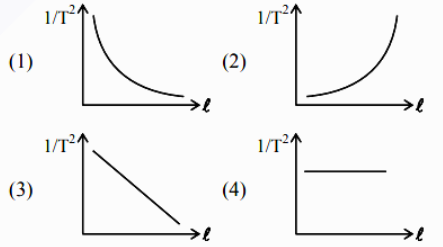
Using a simple pendulum experiment \(g\) is determind by measuring its time period \(T\). Which of the following plots represent the correct relation between the pendulum length \(L\) and time period \(T\) ? [JEE Main 2026 (Online) 22nd January Evening Shift]
 CorrectIncorrect
Hint
(a) To determine the correct plot, we need to analyze the mathematical relationship between the length \(L\) and the time period \(T\) of a simple pendulum.
Step 1: Start with the Time Period Formula
The time period \(T\) of a simple pendulum is given by:
\(
T=2 \pi \sqrt{\frac{L}{g}}
\)
Step 2: Relate \(1 / T^2\) to \(L\)
Since the graphs all plot \(1 / T^2\) on the y -axis and \(L\) (labeled as \(\ell\) in the image) on the \(x\) -axis, we need to rearrange the formula to match this format.
First, square both sides:
\(
T^2=4 \pi^2 \frac{L}{g}
\)
Next, take the reciprocal to get \(1 / T^2\) on one side:
\(
\frac{1}{T^2}=\left(\frac{g}{4 \pi^2}\right) \cdot \frac{1}{L}
\)
Step 3: Analyze the Mathematical Relationship
The equation \(\frac{1}{T^2}=\frac{\text { constant }}{L}\) is of the form \(y=\frac{m}{x}\).
In this relationship, \(y\left(1 / T^2\right)\) is inversely proportional to \(x(L)\).
As the length \(L\) increases, the value of \(1 / T^2\) must decrease.
This type of relationship results in a rectangular hyperbola curve that approaches the axes but never touches them.
Step 4: Compare with the Given Plots
Plot (1): Shows a curve where the value on the \(y\)-axis decreases as the \(x\)-axis increases. This represents an inverse relationship (\(y \propto 1 / x\)).
Plot (2): Shows an exponential/upward curve.
Plot (3): Shows a linear decrease, which would imply \(y=-m x+c\).
Plot (4): Shows a constant value, implying no relationship.
Conclusion: Based on the inverse proportionality \(\frac{1}{T^2} \propto \frac{1}{L}\), the correct representation is the hyperbolic curve. - Question 6 of 75
6. Question
The kinetic energy of a simple harmonic oscillator is oscillating with angular frequency of \(176 \mathrm{rad} / \mathrm{s}\). The frequency of this simple harmonic oscillator is ____ Hz. [take \(\pi=\frac{22}{7}\)] [JEE Main 2026 (Online) 21st January Evening Shift]
CorrectIncorrectHint
(b) To find the frequency of the simple harmonic oscillator, we need to understand the relationship between the frequency of the oscillator and the frequency at which its energy components change.
Step 1: Relation between Oscillator Frequency and Energy Frequency
In Simple Harmonic Motion (SHM), the displacement of the oscillator is given by:
\(
x(t)=A \sin (\omega t+\phi)
\)
where \(\omega\) is the angular frequency of the oscillator.
The velocity is \(v(t)=\frac{d x}{d t}=A \omega \cos (\omega t+\phi)\).
The Kinetic Energy (K.E.) is:
\(
K . E .=\frac{1}{2} m v^2=\frac{1}{2} m A^2 \omega^2 \cos ^2(\omega t+\phi)
\)
Using the trigonometric identity \(\cos ^2 \theta=\frac{1+\cos (2 \theta)}{2}\), we get:
\(
K . E .=\frac{1}{4} m A^2 \omega^2[1+\cos (2 \omega t+2 \phi)]
\)
From this equation, we can see that the kinetic energy oscillates at an angular frequency (\(\omega_{K E}\)) that is twice the angular frequency of the oscillator itself (\(\omega\)):
\(
\omega_{K E}=2 \omega
\)
Step 2: Calculate the Angular Frequency of the Oscillator
We are given the angular frequency of the kinetic energy:
\(
\omega_{K E}=176 \mathrm{rad} / \mathrm{s}
\)
Using the relation \(\omega_{K E}=2 \omega\) :
\(
\begin{gathered}
176=2 \omega \\
\omega=\frac{176}{2}=88 \mathrm{rad} / \mathrm{s}
\end{gathered}
\)
Step 3: Calculate the Linear Frequency (\(f\))
The relationship between angular frequency (\(\omega\)) and linear frequency (\(f\)) is:
\(
\omega=2 \pi f
\)
Substitute the values and use \(\pi=\frac{22}{7}\) :
\(
88=2 \times \frac{22}{7} \times f
\)
\(
f=14 \mathrm{~Hz}
\)
Final Answer: The frequency of the simple harmonic oscillator is \(\mathbf{1 4 ~ H z}\). - Question 7 of 75
7. Question
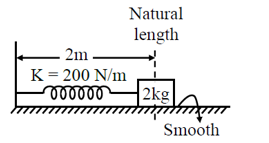
A block of mass 2 kg is attached to one end of a massless spring whose other end is fixed at a wall. The spring-mass system moves on a frictionless horizontal table. The spring’s natural length is 2 m and spring constant is \(200 \mathrm{~N} / \mathrm{m}\). The block is pushed such that the length of the spring becomes 1 m and then released. At distance \(x \mathrm{~m}(x<2)\) from the wall, the speed of the block will be [JEE Main 2025 (Online) 8th April Evening Shift]
CorrectIncorrectHint
(a)

Given, Natural length of spring \(=2 \mathrm{~m}\)
Initial compression in spring \(\left(x_i\right)=1 \mathrm{~m}\)
Final compression in spring \(\left(\mathrm{x}_{\mathrm{f}}\right)=(2-\mathrm{x}) \mathrm{m}\)
Using energy conservation
\(
\begin{aligned}
& \mathrm{K}_{\mathrm{i}}+\mathrm{U}_{\mathrm{i}}=\mathrm{K}_{\mathrm{f}}+\mathrm{U}_{\mathrm{f}} \\
& 0+\frac{1}{2} \mathrm{Kx}_{\mathrm{i}}^2=\frac{1}{2} \mathrm{mv}^2+\frac{1}{2} \mathrm{Kx}_{\mathrm{f}}^2 \\
& \frac{1}{2} \mathrm{mv}^2=\frac{1}{2} \mathrm{~K}\left(\mathrm{x}_{\mathrm{i}}^2-\mathrm{x}_{\mathrm{f}}^2\right) \\
& \frac{1}{2} \times 2 \times \mathrm{v}^2=\frac{1}{2} \times 200 \times\left(1^2-(2-\mathrm{x})^2\right) \\
& \mathrm{v}^2=100\left[1-(2-\mathrm{x})^2\right] \\
& \mathrm{v}=10\left[1-(2-\mathrm{x})^2\right]^{1 / 2}
\end{aligned}
\)Explanation:
To find the speed of the block at a specific distance from the wall, we use the Principle of Conservation of Mechanical Energy. Since the surface is frictionless, the sum of kinetic energy (K.E.) and potential energy (P.E.) remains constant.
Step 1: Identify Initial and Final States
Equilibrium position \(\left(x_0\right): 2 \mathrm{~m}\) (natural length).
Initial position \(\left(x_i\right): 1 \mathrm{~m}\) from the wall.
Initial compression \((A)\) : \(|2 \mathrm{~m}-1 \mathrm{~m}|=1 \mathrm{~m}\). Since the block is released from here, this is the amplitude.
Initial velocity \(\left(v_i\right): 0 \mathrm{~m} / \mathrm{s}\) (released from rest).
Target position (\(x\)): A point \(x\) meters from the wall (\(x<2\)).
Extension/Compression at \(x:|2-x|\).
Step 2: Set up the Energy Equation
The total energy at the release point (all potential) must equal the total energy at position \(x\) (kinetic + potential):
\(
\frac{1}{2} k A^2=\frac{1}{2} m v^2+\frac{1}{2} k(\Delta x)^2
\)
Where:
\(k=200 \mathrm{~N} / \mathrm{m}\)
\(m=2 \mathrm{~kg}\)
\(A=1 \mathrm{~m}\)
\(\Delta x=(2-x)\)
Step 3: Solve for Velocity (\(v\))
Substitute the values into the equation:
\(
\frac{1}{2}(200)(1)^2=\frac{1}{2}(2) v^2+\frac{1}{2}(200)(2-x)^2
\)
Simplify the terms:
\(
100=v^2+100(2-x)^2
\)
Isolate \(\boldsymbol{v}^{\mathbf{2}}\) :
\(
\begin{gathered}
v^2=100-100(2-x)^2 \\
v^2=100\left[1-(2-x)^2\right]
\end{gathered}
\)
\(
v=10\left[1-(2-x)^2\right]^{1 / 2} \mathrm{~m} / \mathrm{s}
\) - Question 8 of 75
8. Question
Two simple pendulums having lengths \(l_1\) and \(l_2\) with negligible string mass undergo angular displacements \(\theta_1\) and \(\theta_2\), from their mean positions, respectively. If the angular accelerations of both pendulums are same, then which expression is correct? [JEE Main 2025 (Online) 4th April Morning Shift]
CorrectIncorrectHint
(a) To find the correct relationship, we need to look at the equation of motion for a simple pendulum undergoing angular displacement.
Step 1: Determine the Angular Acceleration (\(\alpha\))
For a simple pendulum of length \(l\), the restoring torque \((\tau)\) when displaced by an angle \(\theta\) is:
\(
\tau=-m g l \sin \theta
\)
For small angles, \(\sin \theta \approx \theta\). Using the relationship \(\tau=I \alpha\), where \(I=m l^2\) (moment of inertia of the bob):
\(
m l^2 \alpha=-m g l \theta
\)
Solving for the magnitude of angular acceleration \((\alpha)\) :
\(
\alpha=\frac{g}{l} \theta
\)
Step 2: Set up the Equality
The problem states that the angular accelerations of both pendulums are the same (\(\alpha_1=\alpha_2\)).
Using our formula from Step 1:
\(
\frac{g}{l_1} \theta_1=\frac{g}{l_2} \theta_2
\)
Step 3: Simplify the Expression
Since \(g\) is a constant, it cancels out from both sides:
\(
\frac{\theta_1}{l_1}=\frac{\theta_2}{l_2}
\)
Cross-multiplying to rearrange the terms:
\(
\theta_1 l_2=\theta_2 l_1
\) - Question 9 of 75
9. Question
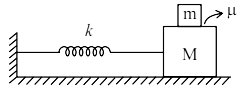
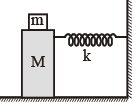
Two blocks of masses \(m\) and \(M,(M>m)\), are placed on a frictionless table as shown in figure. A massless spring with spring constant k is attached with the lower block. If the system is slightly displaced and released, then (\(\mu=\) coefficient of friction between the two blocks)
A. The time period of small oscillation of the two blocks is \(T=2 \pi \sqrt{\frac{(m+M)}{k}}\)
B. The acceleration of the blocks is \(a=-\frac{k x}{M+m}\) (\(x=\) displacement of the blocks from the mean position)
C. The magnitude of the frictional force on the upper block is \(\frac{m \mu|x|}{M+m}\)
D. The maximum amplitude of the upper block, if it does not slip, is \(\frac{\mu(M+m) g}{k}\)
E. Maximum frictional force can be \(\mu(\mathrm{M}+\mathrm{m}) \mathrm{g}\).
Choose the correct answer from the options given below : [JEE Main 2025 (Online) 3rd April Morning Shift] CorrectIncorrect
Hint
(c) To solve this problem, we need to analyze the motion of the two-block system oscillating under the influence of the spring while considering the friction between them.
Step 1: Analyze the System as a Single Unit
If the top block \(m\) does not slip on the bottom block \(M\), they move together as a single mass \(M_{\text {total }}=M+m\).
Restoring Force: \(F=-k x\)
Acceleration: \(a=\frac{F}{M_{\text {total }}}=-\frac{k x}{M+m}\)
Time Period: \(T=2 \pi \sqrt{\frac{M+m}{k}}\)
Statements A and B are therefore correct.
Step 2: Analyze the Frictional Force
The top block \(m\) stays with block \(M\) because of the static friction acting on it.
Required Force on \(m\) : To have acceleration \(a\), the force on the top block must be \(F_f= m \cdot a\).
Substituting a: \(F_f=m\left(\frac{k x}{M+m}\right)=\frac{m k x}{M+m}\)
Comparing this to statement \(\mathbf{C}\), we see statement \(\mathbf{C}\) is incorrect because it includes \(\mu\) in the expression for the required force, whereas friction only depends on displacement \(x\) and the mass ratio here.
Step 3: Determine the Maximum Amplitude (\(\boldsymbol{A}_{\text {max }}\))
The blocks will start to slip when the required frictional force exceeds the maximum possible static friction \(\left(f_{s, \max }=\mu m g\right)\).
To find the limit, we set the magnitude of the required force at maximum displacement (Amplitude \(\boldsymbol{A}\)) equal to the limiting friction:
\(
\frac{m k A}{M+m}=\mu m g
\)
Solving for \(A\) :
\(
\begin{aligned}
& k A=\mu(M+m) g \\
& A=\frac{\mu(M+m) g}{k}
\end{aligned}
\)
Statement D is correct.
Step 4: Evaluate Maximum Frictional Force
The maximum frictional force experienced by the top block before slipping is its limiting value:
\(
f_{s, \max }=\mu N=\mu m g
\)
Statement E suggests the maximum friction is \(\mu(M+m) g\), which is the normal force of the entire system on the floor multiplied by \(\mu\). This is incorrect as friction only acts between the two blocks.
Based on our analysis:
A is correct (Standard time period for combined mass).
B is correct (System acceleration).
D is correct (Derived condition for no slipping).
Correct Answer: A, B, and D only. - Question 10 of 75
10. Question
A particle is subjected to two simple harmonic motions as : \(x_1=\sqrt{7} \sin 5 \mathrm{tcm}\) and \(x_2=2 \sqrt{7} \sin \left(5 t+\frac{\pi}{3}\right) \mathrm{cm}\) where \(x\) is displacement and \(t\) is time in seconds. The maximum acceleration of the particle is \(x \times 10^{-2} \mathrm{~ms}^{-2}\). The value of \(x\) is : [JEE Main 2025 (Online) 2nd April Morning Shift]
CorrectIncorrectHint
(d) To solve for the maximum acceleration, we first need to find the resultant amplitude of the two combined simple harmonic motions (SHM).
Step 1: Find the Resultant Amplitude (\(\boldsymbol{A}_{\text {res }}\))
The two motions have the same angular frequency (\(\omega=5 \mathrm{rad} / \mathrm{s}\)). We can treat the amplitudes as vectors (phasors) to find their sum.
Amplitude \(1\left(\boldsymbol{A}_{\mathbf{1}}\right): \sqrt{\mathbf{7}} \mathrm{cm}\)
Amplitude \(2\left(A_2\right): 2 \sqrt{7} \mathrm{~cm}\)
Phase difference \((\phi)\) : \(\pi / 3\) (or \(60^{\circ}\))
The formula for the resultant amplitude is:
\(
A_{r e s}=\sqrt{A_1^2+A_2^2+2 A_1 A_2 \cos \phi}
\)
Substituting the values:
\(
\begin{gathered}
A_{r e s}=\sqrt{(\sqrt{7})^2+(2 \sqrt{7})^2+2(\sqrt{7})(2 \sqrt{7}) \cos \left(60^{\circ}\right)} \\
A_{r e s}=\sqrt{7+28+2(14)(1 / 2)} \\
A_{r e s}=\sqrt{7+28+14}=\sqrt{49}=7 \mathrm{~cm}
\end{gathered}
\)
Convert to meters: \(A_{\text {res }}=7 \times 10^{-2} \mathrm{~m}\)
Step 2: Calculate Maximum Acceleration (\(a_{\text {max }}\))
The maximum acceleration of a particle in SHM is given by:
\(
a_{\max }=\omega^2 A_{\mathrm{res}}
\)
Using \(\omega=5 \mathrm{rad} / \mathrm{s}\) and \(A_{\text {res }}=7 \times 10^{-2} \mathrm{~m}\) :
\(
\begin{gathered}
a_{\max }=(5)^2 \times\left(7 \times 10^{-2}\right) \\
a_{\max }=25 \times 7 \times 10^{-2} \\
a_{\max }=175 \times 10^{-2} \mathrm{~m} / \mathrm{s}^2
\end{gathered}
\)
Step 3: Find the value of \(x\)
The problem states that the maximum acceleration is \(x \times 10^{-2} \mathrm{~m} / \mathrm{s}^2\).
By comparing this to our result:
\(
\begin{gathered}
175 \times 10^{-2}=x \times 10^{-2} \\
x=175
\end{gathered}
\) - Question 11 of 75
11. Question
Two bodies \(A\) and \(B\) of equal mass are suspended from two massless springs of spring constant \(k_1\) and \(k_2\), respectively. If the bodies oscillate vertically such that their amplitudes are equal, the ratio of the maximum velocity of \(A\) to the maximum velocity of \(B\) is [JEE Main 2025 (Online) 29th January Evening Shift]
CorrectIncorrectHint
(b) To find the ratio of the maximum velocities, we need to look at the relationship between the spring constant, mass, and velocity in Simple Harmonic Motion (SHM).
Step 1: Identify the Formula for Maximum Velocity
For a body undergoing vertical oscillations on a spring, the maximum velocity (\(v_{\max }\)) occurs as it passes through the equilibrium position. It is given by the formula:
\(
v_{\max }=A \omega
\)
Where:
\(A\) is the amplitude of oscillation.
\(\omega\) is the angular frequency.
Step 2: Relate Angular Frequency to the Spring Constant
The angular frequency \(\omega\) for a mass \(m\) attached to a spring with constant \(k\) is:
\(
\omega=\sqrt{\frac{k}{m}}
\)
Substituting this into the velocity formula, we get:
\(
v_{\max }=A \sqrt{\frac{k}{m}}
\)
Step 3: Set up the Ratio for Bodies A and B
We are given the following conditions:
Equal masses: \(m_A=m_B=m\)
Equal amplitudes: \(A_A=A_B=A\)
Spring constants: \(k_1\) (for A) and \(k_2\) (for B)
Now, we write the ratio of their maximum velocities:
\(
\frac{v_A}{v_B}=\frac{A \sqrt{\frac{k_1}{m}}}{A \sqrt{\frac{k_2}{m}}}
\)
Step 4: Simplify the Expression
Since \(A\) and \(m\) are the same for both bodies, they cancel out:
\(
\frac{v_A}{v_B}=\frac{\sqrt{k_1}}{\sqrt{k_2}}=\sqrt{\frac{k_1}{k_2}}
\) - Question 12 of 75
12. Question
Given below are two statements: one is labelled as Assertion (A) and the other is labelled as Reason (R).
Assertion (A) : Time period of a simple pendulum is longer at the top of a mountain than that at the base of the mountain.
Reason (R) : Time period of a simple pendulum decreases with increasing value of acceleration due to gravity and vice-versa.
In the light of the above statements, choose the most appropriate answer from the options given below: [JEE Main 2025 (Online) 29th January Morning Shift]CorrectIncorrectHint
(c) The time period of a simple pendulum is \(T=2 \pi \sqrt{\frac{L}{g}}\). At the top of a mountain, \(g\) (acceleration due to gravity) decreases (\(g=\frac{g_0 R^2}{(R+h)^2}\))
Since \(T \propto \frac{1}{\sqrt{g}}\), a lower \(g\) increases the time period. Thus, the assertion is true, and the reason accurately explains this, as it explains \(T\) rises when \(g\) falls.Both (A) and (R) are true and (R) is the correct explanation of (A).
- Question 13 of 75
13. Question
Given below are two statements. One is labelled as Assertion (A) and the other is labelled as Reason (R).
Assertion (A) : Knowing initial position \(\mathrm{x}_0\) and initial momentum \(p_0\) is enough to determine the position and momentum at any time \(t\) for a simple harmonic motion with a given angular frequency \(\omega\).
Reason (R) : The amplitude and phase can be expressed in terms of \(x_0\) an \(p_0\).
In the light of the above statements, choose the correct answer from the options given below: [JEE Main 2025 (Online) 28th January Evening Shift]CorrectIncorrectHint
(d) To determine the correct option, let’s look at how the equations of Simple Harmonic Motion (SHM) are defined by initial conditions.
Step 1: Analyze the General Equation of SHM
The position \(x(t)\) of a particle in SHM is given by:
\(
x(t)=A \sin (\omega t+\phi)
\)
The momentum \(p(t)\) is \(m \cdot v(t)\) :
\(
p(t)=m \omega A \cos (\omega t+\phi)
\)
To find the state of the system at any time \(t\), we must know the constants Amplitude \((A)\) and Initial Phase \((\phi)\).
Step 2: Evaluate the Reason (R)
We can express the initial position (\(x_0\)) and initial momentum (\(p_0\)) at \(t=0\) as:
\(x_0=A \sin (\phi)\)
\(p_0=m \omega A \cos (\phi)\)
By squaring and adding these (after rearranging), we can find \(\boldsymbol{A}\) :
\(
A=\sqrt{x_0^2+\left(\frac{p_0}{m \omega}\right)^2}
\)
By dividing the two equations, we can find \(\phi\) :
\(
\tan (\phi)=\frac{x_0 m \omega}{p_0}
\)
Since \(A\) and \(\phi\) are entirely determined by \(x_0\) and \(p_0\), Reason ( R ) is true.
Step 3: Evaluate the Assertion (A)
Since we have established that \(x_0\) and \(p_0\) allow us to calculate the unique constants \(A\) and \(\phi\) for the system, we can plug those constants back into the general equations for \(x(t)\) and \(p(t)\). This means we can indeed predict the exact position and momentum for any future time \(t\). Therefore, Assertion (A) is true.
Step 4: Determine the Relationship
The reason we can determine the future state (Assertion) is specifically because the two fundamental parameters of the wave-amplitude and phase-are derived directly from those initial conditions (Reason). Thus, (R) is the correct explanation for (A).Conclusion: Both statements are correct, and the Reason explains why the Assertion holds true.
Correct Option: D (Both \((\mathrm{A})\) and \((\mathrm{R})\) are true and \((\mathrm{R})\) is the correct explanation of \((\mathrm{A})\)) - Question 14 of 75
14. Question
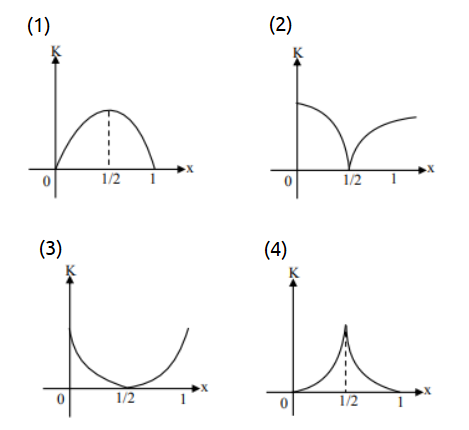
A particle oscillates along the \(x\)-axis according to the law, \(x(\mathrm{t})=x_0 \sin ^2\left(\frac{\mathrm{t}}{2}\right)\) where \(x_0=1 \mathrm{~m}\). The kinetic energy (\(K\)) of the particle as a function of \(x\) is correctly represented by the graph [JEE Main 2025 (Online) 24th January Evening Shift]
 CorrectIncorrect
Hint
(a) To find the relationship between kinetic energy (\(K\)) and position (\(x\)), we need to analyze the velocity of the particle derived from its displacement equation.
Step 1: Analyze the Displacement Equation
The given equation is:
\(
x(t)=x_0 \sin ^2\left(\frac{t}{2}\right)
\)
Using the trigonometric identity \(\sin ^2 \theta=\frac{1-\cos (2 \theta)}{2}\), we can rewrite \(x(t)\) as:
\(
x(t)=\frac{x_0}{2}[1-\cos (t)]
\)
This shows the particle oscillates between \(x=0\) and \(x=x_0\). The equilibrium position (center of oscillation) is at \(x=\frac{x_0}{2}\) with an amplitude \(A=\frac{x_0}{2}\).
Step 2: Determine the Velocity
Velocity \((v)\) is the first derivative of displacement with respect to time:
\(
\begin{gathered}
v=\frac{d x}{d t}=\frac{d}{d t}\left[\frac{x_0}{2}(1-\cos t)\right] \\
v=\frac{x_0}{2} \sin (t)
\end{gathered}
\)
Step 3: Express Kinetic Energy (\(K\)) in terms of \(x\)
The kinetic energy is \(K=\frac{1}{2} m v^2\). From Step 2:
\(
K=\frac{1}{2} m\left(\frac{x_0}{2} \sin t\right)^2=\frac{m x_0^2}{8} \sin ^2 t
\)
We know from our trigonometric identity in Step 1 that \(\sin ^2 t=1-\cos ^2 t\). We also know from the displacement equation that:
\(
\cos t=1-\frac{2 x}{x_0}
\)
Substituting this back into the expression for \(\sin ^2 t\) :
\(
\begin{gathered}
\sin ^2 t=1-\left(1-\frac{2 x}{x_0}\right)^2 \\
\sin ^2 t=1-\left(1+\frac{4 x^2}{x_0^2}-\frac{4 x}{x_0}\right) \\
\sin ^2 t=\frac{4 x}{x_0}-\frac{4 x^2}{x_0^2}=\frac{4}{x_0^2}\left(x_0 x-x^2\right)
\end{gathered}
\)
Now, substitute this into the Kinetic Energy formula:
\(
K=\frac{m x_0^2}{8} \cdot \frac{4}{x_0^2}\left(x_0 x-x^2\right)
\)
\(
K=\frac{m}{2}\left(x_0 x-x^2\right)
\)
Step 4: Identify the Graph
The equation \(K=\frac{m}{2}\left(x_0 x-x^2\right)\) is a quadratic equation in terms of \(x\).
Since the coefficient of \(x^2\) is negative (\(-\frac{m}{2}\)), the graph is an downward-opening parabola.
At \(x=0, K=0\).
At \(x=x_0, K=0\).
The maximum kinetic energy occurs at the midpoint (equilibrium), \(x=\frac{x_0}{2}\).
Conclusion: The correct graph is a parabola passing through the origin \((0,0)\) and the point \(\left(x_0, 0\right)\), with its peak at \(x=\frac{x_0}{2}\). - Question 15 of 75
15. Question
A particle is executing simple harmonic motion with time period 2 s and amplitude 1 cm . If D and d are the total distance and displacement covered by the particle in 12.5 s , then \(\frac{\mathrm{D}}{\mathrm{d}}\) is [JEE Main 2025 (Online) 24th January Morning Shift]
CorrectIncorrectHint
(c) To find the ratio \(\frac{D}{d}\), we need to calculate the total distance \((D)\) and the magnitude of the displacement (\(d\)) for the particle over the given time interval.
Given Parameters:
Time Period ( \(T\) ): 2 s
Amplitude ( \(\boldsymbol{A}\) ): 1 cm
Total Time \((t): 12.5 \mathrm{~s}\)
Calculating Total Distance (\(D\)):
In Simple Harmonic Motion (SHM), a particle covers a distance of \(4 A\) in one full time period (\(T\)).
First, let’s find the number of oscillations in 12.5 s :
\(
n=\frac{t}{T}=\frac{12.5}{2}=6.25 \text { oscillations }
\)
This can be broken down into 6 full oscillations and 0.25 (or 1/4) of an oscillation.
Distance in 6 full oscillations: \(6 \times 4 A=24 A\)
Distance in 0.25 oscillation: \(0.25 \times 4 A=1 A\)
Total Distance (D): \(24 A+1 A=25 A\)
Since \(A=1 \mathrm{~cm}, D=25 \mathrm{~cm}\).
Calculating Displacement (\(d\)):
Displacement depends only on the initial and final positions. Assuming the particle starts at the equilibrium position \((x=0)\) at \(t=0\) :
The equation of motion is \(x(t)=A \sin (\omega t)\), where \(\omega=\frac{2 \pi}{T}=\frac{2 \pi}{2}=\pi \mathrm{rad} / \mathrm{s}\).
At \(t=12.5 \mathrm{~s}\) :
\(
\begin{gathered}
x(12.5)=1 \cdot \sin (\pi \times 12.5)=\sin (12.5 \pi) \\
x(12.5)=\sin (12 \pi+0.5 \pi)=\sin \left(\frac{\pi}{2}\right)=1 \mathrm{~cm}
\end{gathered}
\)
Since the particle started at \(x=0\), the net displacement \(d=1 \mathrm{~cm}\).
Calculating the Ratio \(\frac{D}{d}\):
\(
\frac{D}{d}=\frac{25 \mathrm{~cm}}{1 \mathrm{~cm}}=25
\) - Question 16 of 75
16. Question
A light hollow cube of side length 10 cm and mass 10 g , is floating in water. It is pushed down and released to execute simple harmonic oscillations. The time period of oscillations is \(y \pi \times 10^{-2} \mathrm{~s}\), where the value of \(y\) is (Acceleration due to gravity, \(g=10 \mathrm{~m} / \mathrm{s}^2\), density of water \(=10^3 \mathrm{~kg} / \mathrm{m}^3\)) [JEE Main 2025 (Online) 23rd January Morning Shift]
CorrectIncorrectHint
(a) To find the value of \(y\), we need to determine the time period of the vertical oscillations of the floating cube. When a floating object is pushed down by a small distance \(x\), the additional buoyant force acts as a restoring force, leading to Simple Harmonic Motion (SHM).
The Restoring Force:
When the cube is pushed down by a distance \(x\), the extra volume of water displaced is \(\Delta V= A \cdot x\), where \(A\) is the area of the base of the cube.
The additional buoyant force (\(F_b\)) acting upwards is:
\(
F=-\rho \cdot g \cdot \Delta V=-(\rho A g) x
\)
Here:
\(\rho\) is the density of water \(\left(10^3 \mathrm{~kg} / \mathrm{m}^3\right)\)
\(A\) is the area of the base \(\left(0.1 \mathrm{~m} \times 0.1 \mathrm{~m}=0.01 \mathrm{~m}^2\right)\)
\(g\) is the acceleration due to gravity \(\left(10 \mathrm{~m} / \mathrm{s}^2\right)\)
Finding the Time Period (\(T\)):
The force follows the form \(F=-k x\), where the force constant \(k=\rho A g\). The time period for SHM is given by:
\(
T=2 \pi \sqrt{\frac{m}{k}}
\)
Substitute \(k=\rho A g\) :
\(
T=2 \pi \sqrt{\frac{m}{\rho A g}}
\)
Calculation:
Given values:
\(m=10 \mathrm{~g}=10 \times 10^{-3} \mathrm{~kg}=10^{-2} \mathrm{~kg}\)
\(A=10 \mathrm{~cm} \times 10 \mathrm{~cm}=100 \mathrm{~cm}^2=10^{-2} \mathrm{~m}^2\)
\(\rho=10^3 \mathrm{~kg} / \mathrm{m}^3\)
\(g=10 \mathrm{~m} / \mathrm{s}^2\)
Plug these into the formula:
\(
\begin{gathered}
T=2 \pi \sqrt{\frac{10^{-2}}{10^3 \times 10^{-2} \times 10}} \\
T=2 \pi \sqrt{\frac{10^{-2}}{10^2}}
\end{gathered}
\)
\(
T=2 \pi \times 10^{-2} \mathrm{~s}
\)
Comparison:
The problem states the time period is \(y \pi \times 10^{-2} \mathrm{~s}\). Comparing our result (\(2 \pi \times 10^{-2}\)) to the given form:
\(
y=2
\) - Question 17 of 75
17. Question
Given below are two statements. One is labelled as Assertion (A) and the other is labelled as Reason (R).
Assertion (A) : A simple pendulum is taken to a planet of mass and radius, 4 times and 2 times, respectively, than the Earth. The time period of the pendulum remains same on earth and the planet.
Reason (R) : The mass of the pendulum remains unchanged at Earth and the other planet.
In the light of the above statements, choose the correct answer from the options given below: [JEE Main 2025 (Online) 22nd January Evening Shift]CorrectIncorrectHint
(d) To determine the correct option, let’s analyze both the Assertion and the Reason using the physics of a simple pendulum.
Analysis of Assertion (A):
The time period \(T\) of a simple pendulum is given by the formula:
\(
T=2 \pi \sqrt{\frac{L}{g}}
\)
where \(L\) is the length of the pendulum and \(g\) is the acceleration due to gravity.
The acceleration due to gravity on a planet’s surface is \(g=\frac{G M}{R^2}\). Let’s compare \(g\) on Earth (\(g_e\)) and the planet \(\left(g_p\right)\) :
Planet Mass \(\left(M_p\right): 4 M_e\)
Planet Radius \(\left(R_p\right): 2 R_e\)
\(
g_p=\frac{G\left(4 M_e\right)}{\left(2 R_e\right)^2}=\frac{4 G M_e}{4 R_e^2}=\frac{G M_e}{R_e^2}=g_e
\)
Since \(g\) is the same on both the planet and Earth, and assuming the length \(L\) of the pendulum remains unchanged, the time period \(T\) remains the same.
Assertion (A) is True.
Analysis of Reason (R):
The statement says the mass of the pendulum (the bob) remains unchanged. In classical physics, mass is an intrinsic property and does not change regardless of location.
Reason \((\mathrm{R})\) is True.
Evaluating the Relationship:
Now we ask: Is (R) the correct explanation for (A)?
The time period of a simple pendulum is independent of the mass of the bob. Even if the mass did change, it wouldn’t affect the time period. The reason the time period remains the same in this specific scenario is that the ratio \(\frac{M}{R^2}\) (and thus \(g\)) is identical for both planets.
Therefore, while both statements are factually true, the mass remaining constant is not why the time period stays the same.
Conclusion: Both (A) and (R) are true, but (R) is not the correct explanation of (A). - Question 18 of 75
18. Question
A simple pendulum doing small oscillations at a place \(R\) height above earth surface has time period of \(T_1=4 \mathrm{~s} . \mathrm{T}_2\) would be it’s time period if it is brought to a point which is at a height \(2 R\) from earth surface. Choose the correct relation \([R=\) radius of earth \(]\) : [JEE Main 2024 (Online) 5th April Morning Shift]
CorrectIncorrectHint
(a) The time period of a simple pendulum is given by the formula:
\(
T=2 \pi \sqrt{\frac{l}{g}}
\)
where \(T\) is the time period, \(l\) is the length of the pendulum, and \(g\) is the acceleration due to gravity at the location of the pendulum.
The acceleration due to gravity changes with height above the Earth’s surface. The acceleration due to gravity at a height \(h\) above the Earth’s surface can be expressed as:
\(
g^{\prime}=g\left(\frac{R}{R+h}\right)^2
\)
where \(g\) is the acceleration due to gravity at the surface of the Earth, \(R\) is the radius of the Earth, and \(h\) is the height above the Earth’s surface. Since the time period of the pendulum depends on the square root of the inverse of the acceleration due to gravity, any change in \(g\) due to a change in height will affect the time period.
Given that the time period of the pendulum at a height \(R\) above Earth’s surface is \(T_1\), and we’re to find the time period \(T_2\) at a height of \(2 R\), we can use the formula for acceleration due to gravity at different heights to express the relationship between \(T_1\) and \(T_2\).
For the initial case at height \(R\) :
\(
g_1=g\left(\frac{R}{R+R}\right)^2=g\left(\frac{R}{2 R}\right)^2=\frac{g}{4}
\)
For the new case at height \(2 R\) :
\(
g_2=g\left(\frac{R}{R+2 R}\right)^2=g\left(\frac{R}{3 R}\right)^2=\frac{g}{9}
\)
The time period is proportional to the square root of the inverse of \(g\), so:
\(
\frac{T_1}{T_2}=\sqrt{\frac{g_2}{g_1}}=\sqrt{\frac{\frac{g}{9}}{\frac{g}{4}}}=\sqrt{\frac{4}{9}}=\frac{2}{3}
\)
Therefore:
\(
T_1=\frac{2}{3} T_2
\)
Rearranging this equation:
\(
3 T_1=2 T_2
\) - Question 19 of 75
19. Question
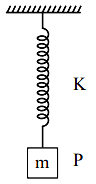
In simple harmonic motion, the total mechanical energy of given system is \(E\). If mass of oscillating particle \(P\) is doubled then the new energy of the system for same amplitude is: [JEE Main 2024 (Online) 4th April Evening Shift]
 CorrectIncorrect
Hint
(d) To find the new energy of the system, we need to look at the formula for the total mechanical energy in Simple Harmonic Motion (SHM).
Step 1: Identify the Energy Formula
The total mechanical energy (\(E\)) of a particle performing SHM is the sum of its kinetic and potential energy. At the maximum displacement (the amplitude, A), all the energy is potential. The formula is:
\(
E=\frac{1}{2} k A^2
\)
Where:
\(k\) is the force constant (spring constant).
\(A\) is the amplitude of oscillation.
Step 2: Analyze the Variables
In this specific problem, we are told:
The amplitude (\(A\)) remains the same.
The mass (\(m\)) of the particle is doubled.
Looking at the formula \(E=\frac{1}{2} k A^2\), we can see that the total energy depends strictly on the force constant (\(k\)) and the amplitude (\(A\)).
Step 3: Determine the Effect of Mass
While the mass (\(m\)) affects the frequency and period of the oscillation (\(\omega=\sqrt{k / m}\)), it does not appear in the formula for total mechanical energy if the amplitude and the force constant remain unchanged.
Since \(k\) is a property of the system (like the stiffness of a spring) and \(A\) is kept constant, the total energy \(E\) remains independent of the mass.
Conclusion: Because the energy depends only on the square of the amplitude and the force constant:
The new energy of the system is still \(E\). - Question 20 of 75
20. Question
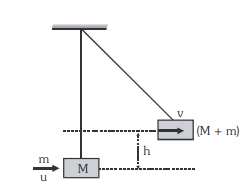
A simple pendulum of length 1 m has a wooden bob of mass 1 kg . It is struck by a bullet of mass \(10^{-2} \mathrm{~kg}\) moving with a speed of \(2 \times 10^2 \mathrm{~ms}^{-1}\). The bullet gets embedded into the bob. The height to which the bob rises before swinging back is. (use \(g=10 \mathrm{~m} / \mathrm{s}^2\)) [JEE Main 2024 (Online) 1st February Morning Shift]
CorrectIncorrectHint
(a)

To solve this, we split the problem into two parts: the collision (momentum) and the swing (energy).
Step 1: Conservation of Momentum
When the bullet hits the wooden bob and gets embedded, the collision is perfectly inelastic. We use the Principle of Conservation of Linear Momentum to find the common velocity (\(V\)) of the bob and bullet immediately after the strike.
Mass of bullet \((m)=10^{-2} \mathrm{~kg}=0.01 \mathrm{~kg}\)
Velocity of bullet \((u)=2 \times 10^2 \mathrm{~ms}^{-1}=200 \mathrm{~ms}^{-1}\)
Mass of bob \((M)=1 \mathrm{~kg}\)
Initial velocity of bob \(=0\)
\(
\begin{gathered}
m u+M(0)=(m+M) V \\
(0.01 \times 200)=(0.01+1) V \\
2=1.01 V \\
V=\frac{2}{1.01} \approx 1.98 \mathrm{~ms}^{-1}
\end{gathered}
\)
Step 2: Conservation of Energy
After the collision, the kinetic energy of the combined system at the lowest point is converted into gravitational potential energy at the maximum height (h).
\(
\frac{1}{2}(m+M) V^2=(m+M) g h
\)
Notice that the mass \((m+M)\) cancels out from both sides:
\(
\begin{gathered}
\frac{1}{2} V^2=g h \\
h=\frac{V^2}{2 g}
\end{gathered}
\)
Step 3: Final Calculation
Substitute the values into the height formula:
\(
\begin{array}{r}
h=\frac{\left(\frac{2}{1.01}\right)^2}{2 \times 10} \\
h=\frac{4}{(1.01)^2 \times 20}\approx 0.2 \mathrm{~m}
\end{array}
\) - Question 21 of 75
21. Question
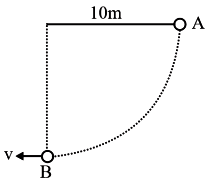
The bob of a pendulum was released from a horizontal position. The length of the pendulum is 10 m. If it dissipates \(10 \%\) of its initial energy against air resistance, the speed with which the bob arrives at the lowest point is: [Use, \(\mathrm{g}: 10 \mathrm{~ms}^{-2}\)] [JEE Main 2024 (Online) 29th January Evening Shift]
CorrectIncorrectHint
(d)

Step 1: Identify Initial Energy
The pendulum bob is released from a horizontal position. At this height, its energy is entirely gravitational potential energy (\(U\)). Taking the lowest point of the swing as the reference level (\(h=0\)), the initial height is equal to the length of the pendulum (\(L\)).
\(
U_i=m g L
\)
Given: \(L=10 \mathrm{~m}\) and \(g=10 \mathrm{~m} / \mathrm{s}^2\).
\(
U_i=m(10)(10)=100 \mathrm{~m} \mathrm{~J}
\)
Step 2: Account for Energy Dissipation
The problem states that 10\% of the initial energy is dissipated due to air resistance. Therefore, the mechanical energy remaining at the lowest point (\(E_f\)) is \(90 \%\) of the initial energy.
\(
\begin{gathered}
E_f=0.90 \times U_i \\
E_f=0.90 \times 100 \mathrm{~m}=90 \mathrm{~mJ}
\end{gathered}
\)
Step 3: Calculate Final Velocity
At the lowest point, the potential energy is zero, so all remaining mechanical energy is kinetic energy (\(K\)).
\(
K_f=\frac{1}{2} m v^2
\)
Equating the remaining energy to the kinetic energy:
\(
90 m=\frac{1}{2} m v^2
\)
The mass \(m\) cancels out:
\(
\begin{aligned}
& 180=v^2 \\
& v=\sqrt{180}
\end{aligned}
\)
Step 4: Simplify the Radical
Simplify \(\sqrt{180}\) to match the provided options:
\(
\begin{aligned}
& v=\sqrt{36 \times 5} \\
& v=6 \sqrt{5} \mathrm{~m} / \mathrm{s}
\end{aligned}
\) - Question 22 of 75
22. Question
In a linear Simple Harmonic Motion (SHM)
(A) Restoring force is directly proportional to the displacement.
(B) The acceleration and displacement are opposite in direction.
(C) The velocity is maximum at mean position.
(D) The acceleration is minimum at extreme points.
Choose the correct answer from the options given below: [JEE Main 2023 (Online) 15th April Morning Shift]CorrectIncorrectHint
(c) To find the correct answer, let’s evaluate each statement based on the fundamental properties of Simple Harmonic Motion (SHM).
Statement Analysis:
(A) Restoring force is directly proportional to the displacement:
True. By definition, the restoring force \(F\) in SHM is given by \(F=-k x\), where \(k\) is the force constant and \(x\) is the displacement from the mean position.
(B) The acceleration and displacement are opposite in direction:
True. Since \(F=m a\), we have \(m a=-k x\), or \(a=-\omega^2 x\). The negative sign mathematically indicates that the acceleration vector is always directed toward the mean position, opposite to the displacement vector.
(C) The velocity is maximum at mean position:
True. In SHM, velocity \(v\) is given by \(v=\omega \sqrt{A^2-x^2}\). At the mean position (\(x=0\)), the velocity reaches its maximum value, \(v_{\text {max }}=A \omega\).
(D) The acceleration is minimum at extreme points:
False. Acceleration \(a=-\omega^2 x\) is proportional to displacement. At the extreme points (\(x=A\)), the displacement is at its maximum, so the magnitude of acceleration is also at its maximum (\(|a|=\omega^2 A\)). Acceleration is actually minimum (zero) at the mean position.Conclusion: Statements (A), (B), and (C) are correct, while (D) is incorrect.
- Question 23 of 75
23. Question
A particle executes SHM of amplitude A. The distance from the mean position when its’s kinetic energy becomes equal to its potential energy is : [JEE Main 2023 (Online) 13th April Evening Shift]
CorrectIncorrectHint
(a) To find the point where the energy is split exactly in half, we can set the equations for kinetic and potential energy equal to each other.
Step 1: Recall the Energy Formulas
In Simple Harmonic Motion (SHM), for a particle at a displacement \(x\) from the mean position:
Potential Energy (PE): \(\frac{1}{2} k x^2\)
Kinetic Energy \((K E): \frac{1}{2} k\left(A^2-x^2\right)\)
Step 2: Set the Energies Equal
The problem states that \(K E=P E\). So, we set the two expressions equal:
\(
\frac{1}{2} k\left(A^2-x^2\right)=\frac{1}{2} k x^2
\)
Step 3: Solve for Displacement (\(x\))
First, cancel the common term \(\frac{1}{2} k\) from both sides:
\(
A^2-x^2=x^2
\)
Now, move \(x^2\) to the right side:
\(
\begin{aligned}
& A^2=2 x^2 \\
& \frac{A^2}{2}=x^2
\end{aligned}
\)
Finally, take the square root of both sides:
\(
x=\frac{A}{\sqrt{2}}
\)
Conclusion: The distance from the mean position where the energy is half-kinetic and half-potential is \(\frac{A}{\sqrt{2}}\). - Question 24 of 75
24. Question
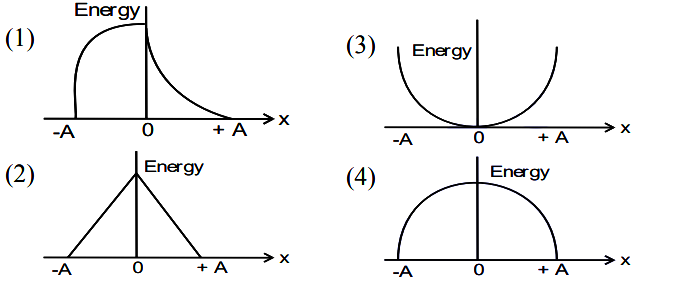
Which graph represents the difference between total energy and potential energy of a particle executing SHM vs it’s distance from mean position? [JEE Main 2023 (Online) 13th April Morning Shift]
 CorrectIncorrect
Hint
(d) The graph representing the difference between total energy (\(E\)) and potential energy (PE) of a particle in SHM versus its distance (\(x\)) from the mean position is a downward-opening parabola. This difference represents kinetic energy, which is max at \(x=0(E)\) and zero at maximum displacement \((x= \pm A)\).
Total Energy (\(E\)): Constant, \(\frac{1}{2} k A^2\).
Potential Energy (PE): Parabolic, \(\frac{1}{2} k x^2\).
Difference \((E-P E)\) : Kinetic Energy \(\left(K E=\frac{1}{2} k\left(A^2-x^2\right)\right)\).
Graph Features: The curve is a parabola opening downwards, with a peak value of \(\frac{1}{2} k A^2\) at the center ( \(x=0\) ) and zero at the extreme positions (\(x= \pm A\))
Therefore, the graph that looks like a downward-opening parabola symmetric around the \(x=0\) axis is the correct answer. - Question 25 of 75
25. Question
A particle is executing simple harmonic motion (SHM). The ratio of potential energy and kinetic energy of the particle when its displacement is half of its amplitude will be [JEE Main 2023 (Online) 12th April Morning Shift]
CorrectIncorrectHint
(d)
\(
\begin{aligned}
& \mathrm{x}=\frac{\mathrm{A}}{2}, \text { P.E. }=\frac{1}{2} \mathrm{kx}^2 \\
& \text { K.E. }=\frac{1}{2} \mathrm{kA}^2-\frac{1}{2} \mathrm{kx}^2 \\
& \frac{\text { P.E }}{\text { K.E }}=\frac{\mathrm{x}^2}{\mathrm{~A}^2-\mathrm{x}^2} \\
& =\frac{\mathrm{A}^2}{4\left(\frac{3 \mathrm{~A}^2}{4}\right)}=\frac{1}{3}
\end{aligned}
\)Explanation: To find the ratio of potential energy to kinetic energy at a specific displacement, we can use the standard energy equations for Simple Harmonic Motion (SHM).
Step 1: Identify the Energy Formulas
For a particle of mass \(m\) executing SHM with amplitude \(A\) and force constant \(k\), the energies at any displacement \(x\) from the mean position are:
Potential Energy (\(U\)): \(U=\frac{1}{2} k x^2\)
Kinetic Energy \((K): K=\frac{1}{2} k\left(A^2-x^2\right)\)
Step 2: Substitute the Given Displacement
We are told that the displacement is half of its amplitude:
\(
x=\frac{A}{2}
\)
Now, let’s find the values for \(U\) and \(K\) at this point:
Potential Energy (\(U\)):
\(
U=\frac{1}{2} k\left(\frac{A}{2}\right)^2=\frac{1}{2} k \frac{A^2}{4}=\frac{1}{8} k A^2
\)
Kinetic Energy (\(K\)):
\(
\begin{gathered}
K=\frac{1}{2} k\left(A^2-\left(\frac{A}{2}\right)^2\right)=\frac{1}{2} k\left(A^2-\frac{A^2}{4}\right) \\
K=\frac{1}{2} k\left(\frac{3 A^2}{4}\right)=\frac{3}{8} k A^2
\end{gathered}
\)
Step 3: Calculate the Ratio
The ratio of potential energy (\(U\)) to kinetic energy (\(K\)) is:
\(
\frac{U}{K}=\frac{\frac{1}{8} k A^2}{\frac{3}{8} k A^2}
\)
Canceling the common terms \(\left(\frac{1}{8} k A^2\right)\) :
\(
\frac{U}{K}=\frac{1}{3}
\)
Conclusion: The ratio of potential energy to kinetic energy when the displacement is half the amplitude is 1 : 3. - Question 26 of 75
26. Question
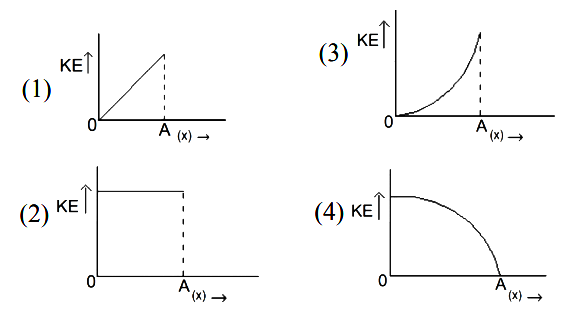
The variation of kinetic energy (KE) of a particle executing simple harmonic motion with the displacement (\(x\)) starting from mean position to extreme position (A) is given by [JEE Main 2023 (Online) 11th April Morning Shift]
 CorrectIncorrect
Hint
(d) To represent the variation of Kinetic Energy (\(K E\)) with displacement (\(x\)) in Simple Harmonic Motion (SHM), we look at the relationship between the particle’s velocity and its position.
Step 1: Identify the Velocity Equation
In SHM, the velocity \(v\) of a particle at any displacement \(x\) from the mean position is given by:
\(
v=\omega \sqrt{A^2-x^2}
\)
Where:
\(\omega\) is the angular frequency.
\(A\) is the amplitude.
Step 2: Formulate the Kinetic Energy
The kinetic energy \((K E)\) is defined as \(\frac{1}{2} m v^2\). Substituting the velocity equation:
\(
\begin{gathered}
K E=\frac{1}{2} m\left(\omega \sqrt{A^2-x^2}\right)^2 \\
K E=\frac{1}{2} m \omega^2\left(A^2-x^2\right)
\end{gathered}
\)
Since \(k=m \omega^2\) (the force constant), we can write:
\(
K E=\frac{1}{2} k\left(A^2-x^2\right)
\)
Step 3: Analyze the Graph Characteristics
By looking at the equation \(K E=\frac{1}{2} k A^2-\frac{1}{2} k x^2\), we can determine the shape and key points of the graph:
Shape: Because the equation is a quadratic involving \(-x^2\), the graph is an inverted parabola (concave downwards).
At the Mean Position \((x=0)\) : \(K E\) is at its maximum value: \(K E_{\text {max }}=\frac{1}{2} k A^2\).
At the Extreme Position \((x=A)\) : \(K E\) becomes zero: \(K E=\frac{1}{2} k\left(A^2-A^2\right)=0\).
Conclusion: The graph starts at a maximum value on the vertical axis (representing the mean position) and follows a downward parabolic curve until it touches the horizontal axis at \(x=A\) (the extreme position). - Question 27 of 75
27. Question
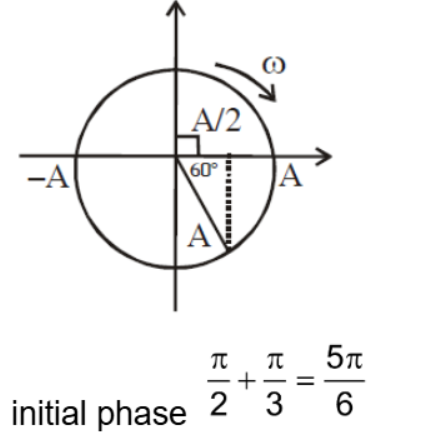
A particle executes S.H.M. of amplitude \(A\) along \(x\) -axis. At \(\mathrm{t}=0\), the position of the particle is \(x=\frac{A}{2}\) and it moves along positive \(x\) -axis. The displacement of particle in time \(t\) is \(x=A \sin (w t+\delta)\), then the value of \(\delta\) will be [JEE Main 2023 (Online) 10th April Morning Shift]
CorrectIncorrectHint
(d) To find the value of the phase constant \(\delta\), we use the initial conditions provided for the particle’s motion.
Step 1: Use the Initial Position
The general equation for the displacement is given as:
\(
x=A \sin (\omega t+\delta)
\)
At \(t=0\), the position is \(x=\frac{A}{2}\). Substituting these values into the equation:
\(
\begin{gathered}
\frac{A}{2}=A \sin (\omega(0)+\delta) \\
\frac{1}{2}=\sin (\delta)
\end{gathered}
\)
Step 2: Determine Possible Values for \(\delta\)
The sine function is equal to \(1 / 2\) at two primary positions within one cycle:
1. \(\delta=\frac{\pi}{6}\left(30^{\circ}\right)\)
2. \(\delta=\frac{5 \pi}{6}\left(150^{\circ}\right)\)
Step 3: Use the Initial Velocity to Confirm
We are told the particle is moving along the positive \(\mathbf{x}\)-axis at \(t=0\). This means the velocity \(v\) must be positive \((v>0)\).
The velocity equation is the derivative of displacement:
\(
v=\frac{d x}{d t}=A \omega \cos (\omega t+\delta)
\)
At \(t=0\) :
\(
v=A \omega \cos (\delta)
\)
Now we check our two possible values for \(\delta\) :
If \(\delta=\frac{\pi}{6}: \cos \left(\frac{\pi}{6}\right)=\frac{\sqrt{3}}{2}\), which is positive. This matches the condition.
If \(\delta=\frac{5 \pi}{6}: \cos \left(\frac{5 \pi}{6}\right)=-\frac{\sqrt{3}}{2}\), which is negative. This would mean the particle is moving toward the mean position (negative \(x\)-axis).
Conclusion: The value of \(\delta\) that satisfies both the initial position and the positive direction of motion is \(\frac{\pi}{6}\). - Question 28 of 75
28. Question
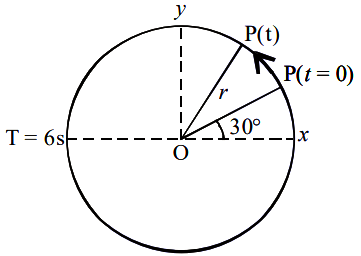
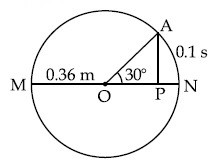
For particle \(P\) revolving round the centre O with radius of circular path r and angular velocity \(\omega\), as shown in below figure, the projection of OP on the \(x\)-axis at time \(t\) is [JEE Main 2023 (Online) 8th April Evening Shift]
 CorrectIncorrect
Hint
(c) Based on the figure you’ve provided, we can derive the specific equation for the projection on the \(x\) -axis by following these steps:
Step 1: Identify the Initial Phase (\(\phi\))
The figure shows that at \(t=0\), the particle is at position \(P(t=0)\), which is at an angle of \(30^{\circ}\) above the positive \(x\) -axis.
To use the equation in radians: \(30^{\circ}=\frac{\pi}{6}\) rad.
Therefore, the initial phase \(\phi=\frac{\pi}{6}\).
Step 2: Determine the Angular Velocity (\(\omega\))
The figure specifies the time period \(T=6 \mathrm{~s}\). We use the relationship between angular velocity and time period:
\(
\begin{gathered}
\omega=\frac{2 \pi}{T} \\
\omega=\frac{2 \pi}{6}=\frac{\pi}{3} \mathrm{rad} / \mathrm{s}
\end{gathered}
\)
Step 3: Formulate the Projection Equation
The projection of the radius vector \(r\) on the \(x\) -axis is given by the cosine of the total angle:
\(
x(t)=r \cos \left(\theta_{\text {total }}\right)
\)
\(
x(t)=r \cos (\omega t+\phi)
\)
Final Substitution:
Plugging in our specific values for \(\omega\) and \(\phi\) :
\(
x(t)=r \cos (\omega t+\frac{\pi}{6})
\) - Question 29 of 75
29. Question
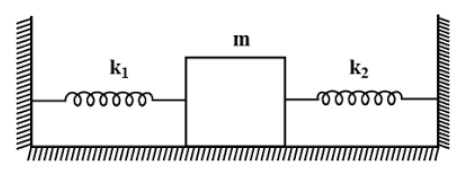
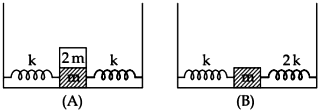
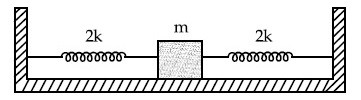
A mass \(m\) is attached to two strings as shown in figure. The spring constants of two springs are \({K}_1\) and \({K}_2\). For the frictionless surface, the time period of oscillation of mass \(m\) is : [JEE Main 2023 (Online) 6th April Morning Shift]
 CorrectIncorrect
Hint
(a) To determine the time period of the oscillation, we first need to identify whether the springs are connected in series or in parallel.
Step 1: Analyze the Configuration
In the figure for this JEE problem (typically showing a mass \(m\) placed between two springs attached to rigid walls), if you displace the mass to the right by a distance \(x\) :
Spring \(1\left(K_1\right)\) is stretched by \(x\), creating a restoring force \(F_1=-K_1 x\) to the left.
Spring \(2\left(K_2\right)\) is compressed by \(x\), creating a restoring force \(F_2=-K_2 x\) also to the left.
Since both springs exert a force in the same direction to oppose the displacement, the total restoring force is:
\(
F_{\text {total }}=-\left(K_1+K_2\right) x
\)
Step 2: Determine the Equivalent Spring Constant
When the forces add up like this, the system behaves as if the springs are in parallel. The equivalent spring constant (\(K_{\text {eq }}\)) is the sum of the individual constants:
\(
K_{e q}=K_1+K_2
\)
Step 3: Calculate the Time Period
The general formula for the time period \(T\) of a mass-spring system is:
\(
T=2 \pi \sqrt{\frac{m}{K_{e q}}}
\)
Substituting the value of \(K_{\text {eq }}\) into the formula, we get:
\(
T=2 \pi \sqrt{\frac{m}{K_1+K_2}}
\) - Question 30 of 75
30. Question
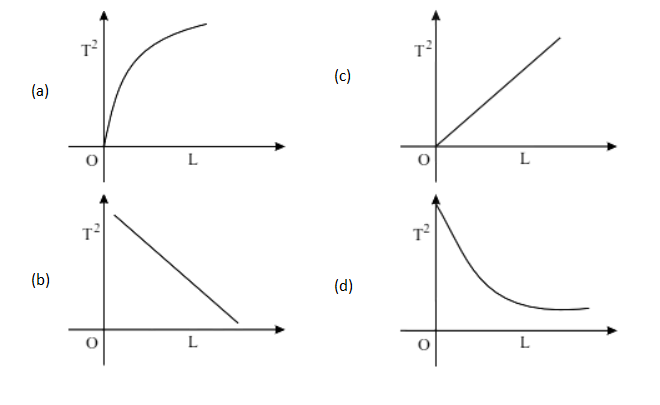
Choose the correct length \((\mathrm{L})\) versus square of the time period \(\left(\mathrm{T}^2\right)\) graph for a simple pendulum executing simple harmonic motion. [JEE Main 2023 (Online) 1st February Evening Shift]
 CorrectIncorrect
Hint
(c) Identify the Governing Equation:
The time period \(T\) of a simple pendulum is given by the formula:
\(
T=2 \pi \sqrt{\frac{L}{g}}
\)
To find the relationship between \(L\) and \(T^2\), we square both sides of the equation:
\(
T^2=\frac{4 \pi^2}{g} \cdot L
\)
If the graph is \(L\) vs \(T^2\), it is a straight line with a positive slope. - Question 31 of 75
31. Question
The maximum potential energy of a block executing simple harmonic motion is 25 J. A is amplitude of oscillation. At \(\mathrm{A} / 2\), the kinetic energy of the block is [JEE Main 2023 (Online) 31st January Morning Shift]
CorrectIncorrectHint
(c) To solve this, we need to use the principle of conservation of energy in Simple Harmonic Motion (SHM).
Step 1: Identify Total Energy
In SHM, the maximum potential energy occurs at the amplitude (\(x=A\)), where the kinetic energy is zero. Therefore, the maximum potential energy is equal to the Total Mechanical Energy (\(E\)) of the system.
\(E=25 \mathrm{~J}\)
Step 2: Calculate Potential Energy at \(A / 2\)
The potential energy (\(U\)) at any displacement \(x\) is given by \(U=\frac{1}{2} k x^2\).
We know that at the amplitude \((x=A), U_{\text {max }}=\frac{1}{2} k A^2=25 \mathrm{~J}\).
Now, let’s find the potential energy at \(x=A / 2\) :
\(
\begin{gathered}
U_{A / 2}=\frac{1}{2} k\left(\frac{A}{2}\right)^2 \\
U_{A / 2}=\frac{1}{2} k \frac{A^2}{4} \\
U_{A / 2}=\frac{1}{4}\left(\frac{1}{2} k A^2\right)
\end{gathered}
\)
Substituting the value of total energy (25 J):
\(
U_{A / 2}=\frac{25}{4}=6.25 \mathrm{~J}
\)
Step 3: Calculate Kinetic Energy at \(\boldsymbol{A} / \mathbf{2}\)
The total energy is the sum of kinetic energy (\(K\)) and potential energy (\(U\)):
\(
\begin{aligned}
E & =K+U \\
25 \mathrm{~J} & =K+6.25 \mathrm{~J}
\end{aligned}
\)
Solving for \(K\) :
\(
\begin{gathered}
K=25-6.25 \\
K=18.75 \mathrm{~J}
\end{gathered}
\) - Question 32 of 75
32. Question
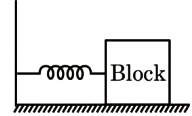
For a simple harmonic motion in a mass spring system shown, the surface is frictionless. When the mass of the block is 1 kg, the angular frequency is \(\omega_1\). When the mass block is 2 kg the angular frequency is \(\omega_2\). The ratio \(\omega_2 / \omega_1\) is [JEE Main 2023 (Online) 30th January Evening Shift]
 CorrectIncorrect
Hint
(a) To find the ratio of the angular frequencies, we look at the relationship between mass and frequency in a mass-spring system.
Step 1: The Angular Frequency Formula
For a mass-spring system, the angular frequency \((\omega)\) is determined by the spring constant \((k)\) and the mass (\(m\)) of the block. The formula is:
\(
\omega=\sqrt{\frac{k}{m}}
\)
Since the spring constant \(k\) remains the same in both cases (it is the same system), we can see that:
\(
\omega \propto \frac{1}{\sqrt{m}}
\)
Step 2: Set up the Ratio
We are given two cases with different masses:
Case 1: Mass \(m_1=1 \mathrm{~kg}\), Angular frequency \(=\omega_1\)
Case 2: Mass \(m_2=2 \mathrm{~kg}\), Angular frequency \(=\omega_2\)
The ratio of the angular frequencies is:
\(
\frac{\omega_2}{\omega_1}=\frac{\sqrt{\frac{k}{m_2}}}{\sqrt{\frac{k}{m_1}}}
\)
This simplifies to:
\(
\frac{\omega_2}{\omega_1}=\sqrt{\frac{m_1}{m_2}}
\)
Step 3: Calculate the Value
Substitute the given masses into the ratio:
\(
\begin{aligned}
& \frac{\omega_2}{\omega_1}=\sqrt{\frac{1}{2}} \\
& \frac{\omega_2}{\omega_1}=\frac{1}{\sqrt{2}}
\end{aligned}
\) - Question 33 of 75
33. Question
A particle executes simple harmonic motion between \(x=-A\) and \(x=+A\). If time taken by particle to go from \(x=0\) to \(\frac{A}{2}\) is 2 s; then time taken by particle in going from \(x=\frac{A}{2}\) to A is [JEE Main 2023 (Online) 25th January Evening Shift]
CorrectIncorrectHint
(a) To solve this, we need to look at the angular displacement of the particle. In SHM, the particle does not move at a constant speed, so equal distances do not result in equal times.
Step 1: Use the Standard Equation of Motion
For a particle starting from the mean position (\(x=0\)) at \(t=0\), the displacement is given by:
\(
x=A \sin (\omega t)
\)
Step 2: Calculate the Time to reach \(A / 2\)
We are given that it takes \(t_1=2 \mathrm{~s}\) to reach \(x=A / 2\).
\(
\begin{gathered}
\frac{A}{2}=A \sin \left(\omega t_1\right) \\
\sin \left(\omega t_1\right)=\frac{1}{2} \\
\omega t_1=\frac{\pi}{6}
\end{gathered}
\)
Since \(t_1=2 \mathrm{~s}\), we can find \(\omega\) :
\(
\omega(2)=\frac{\pi}{6} \Longrightarrow \omega=\frac{\pi}{12} \mathrm{rad} / \mathrm{s}
\)
Step 3: Calculate the Total Time to reach \(A\)
Now, let’s find the total time (\(t_{\text {total }}\)) it takes to go from the mean position (\(x=0\)) to the extreme position \((x=A)\) :
\(
\begin{gathered}
A=A \sin \left(\omega t_{\text {total }}\right) \\
\sin \left(\omega t_{\text {total }}\right)=1 \\
\omega t_{\text {total }}=\frac{\pi}{2}
\end{gathered}
\)
Substituting \(\omega=\frac{\pi}{12}\) :
\(
\begin{aligned}
& \left(\frac{\pi}{12}\right) t_{\text {total }}=\frac{\pi}{2} \\
& t_{\text {total }}=\frac{12}{2}=6 \mathrm{~s}
\end{aligned}
\)
Step 4: Find the Time Interval for the Second Half
The time taken to go from \(x=A / 2\) to \(x=A\) is the difference between the total time and the time taken for the first segment:
\(
\begin{gathered}
\Delta t=t_{\text {total }}-t_1 \\
\Delta t=6 \mathrm{~s}-2 \mathrm{~s} \\
\Delta t=4 \mathrm{~s}
\end{gathered}
\)
Conclusion: It takes 4 seconds for the particle to go from \(x=A / 2\) to \(x=A\). This makes sense physically because the particle slows down as it approaches the extreme position, thus taking more time to cover the same distance. - Question 34 of 75
34. Question
\(T\) is the time period of simple pendulum on the earth’s surface. Its time period becomes \(x \mathrm{~T}\) when taken to a height R (equal to earth’s radius) above the earth’s surface. Then, the value of \(x\) will be : [JEE Main 2023 (Online) 25th January Morning Shift]
CorrectIncorrectHint
(c) To find the value of \(x\), we look at how the time period of a simple pendulum relates to its distance from the center of the Earth.
Step 1: The Time Period Formula
The time period \(T\) of a simple pendulum is given by:
\(
T=2 \pi \sqrt{\frac{L}{g_{e f f}}}
\)
Since the length \(L\) of the pendulum remains constant, we have the proportionality:
\(
T \propto \frac{1}{\sqrt{g_{\mathrm{eff}}}}
\)
Step 2: Gravity at Height \(h\)
The acceleration due to gravity at a height \(h\) from the surface is:
\(
g_h=\frac{G M}{(R+h)^2}
\)
Therefore, \(g_h \propto \frac{1}{(R+h)^2}\). Substituting this back into our time period proportionality:
\(
T \propto \sqrt{(R+h)^2} \Longrightarrow T \propto(R+h)
\)
Step 3: Compare the Two Scenarios
We are comparing the time period on the surface to the time period at height \(R\) :
On the surface (\(h=0\)):
The distance from the center is \(R\). The time period is \(T\).
At height \(R(h=R)\) :
The distance from the center is \(R+R=2 R\). The time period is \(x T\).
Using the ratio:
\(
\begin{aligned}
\frac{T_{\text {new }}}{T_{\text {old }}} & =\frac{R+h_{\text {new }}}{R+h_{\text {old }}} \\
\frac{x T}{T} & =\frac{R+R}{R+0} \\
x & =\frac{2 R}{R} \\
x & =2
\end{aligned}
\)
Conclusion: The time period doubles when the pendulum is taken to a height equal to the Earth’s radius because the acceleration due to gravity drops to one-fourth of its surface value. - Question 35 of 75
35. Question
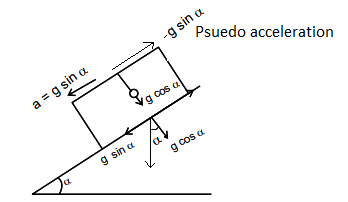
The time period of oscillation of a simple pendulum of length \(L\) suspended from the roof of a vehicle, which moves without friction down an inclined plane of inclination \(\alpha\), is given by : [JEE Main 2022 (Online) 29th July Morning Shift]
CorrectIncorrectHint
(a)

To find the time period, we must determine the effective acceleration due to gravity (\(g_{e f f}\)) acting on the pendulum bob in the frame of the moving vehicle.
Step 1: Analyze the vehicle’s acceleration
A vehicle sliding down a frictionless incline of angle \(\alpha\) has an acceleration \(a=g \sin \alpha\) directed along the plane.
Step 2: Determine effective gravity in the vehicle’s frame
In the non-inertial frame of the vehicle, the pendulum bob experiences two main accelerations:
1. The real gravitational acceleration \(g\), which has components gsin \(\alpha\) (parallel to the incline) and gcos \(\alpha\) (perpendicular to the incline).
2. A pseudo-acceleration \(a_p=-g \sin \alpha\) directed up the incline.
Step 3: Calculate \(g_{\text {eff }}\)
The effective acceleration is the vector sum of these components:
1. Parallel to incline: \(g_{\|}=g \sin \alpha-g \sin \alpha=0\).
2. Perpendicular to incline: \(g_{\perp}=g \cos \alpha\).
Thus, \(g_{\text {eff }}=\sqrt{0^2+(g \cos \alpha)^2}=g \cos \alpha\).
Step 4: Apply the time period formula
The time period for a simple pendulum is \(T=2 \pi \sqrt{\frac{L}{g_{e f f}}}\). Substituting \(g_{e f f}=g \cos \alpha\) gives the final result.
The time period of oscillation is \(\boldsymbol{T}=2 \pi \sqrt{\frac{\boldsymbol{L}}{\boldsymbol{g} \cos \boldsymbol{\alpha}}}\). - Question 36 of 75
36. Question
Assume there are two identical simple pendulum clocks. Clock – 1 is placed on the earth and Clock – 2 is placed on a space station located at a height h above the earth surface. Clock – 1 and Clock – 2 operate at time periods \(4 s\) and \(6 s\) respectively. Then the value of \(h\) is (consider radius of earth \(R_E=6400 \mathrm{~km}\) and g on earth \(10 \mathrm{~m} / \mathrm{s}^2\)) [JEE Main 2022 (Online) 28th July Evening Shift]
CorrectIncorrectHint
(c) To find the height of the space station, we use the relationship between the time period of a pendulum and the acceleration due to gravity at different altitudes.
Step 1: Establish the Relationship
The time period \(T\) of a simple pendulum is \(T=2 \pi \sqrt{\frac{L}{g}}\). Since the clocks are identical (same length \(L\)), the time period is inversely proportional to the square root of gravity:
\(
T \propto \frac{1}{\sqrt{g}}
\)
Step 2: Relate Gravity to Height
The acceleration due to gravity at a height \(h\) above the Earth’s surface \(\left(g_h\right)\) is related to gravity at the surface (\(g\)) by:
\(
g_h=\frac{G M}{\left(R_E+h\right)^2}
\)
Since \(g \propto \frac{1}{\left(R_E+h\right)^2}\), we can substitute this into our time period proportionality:
\(
T \propto \sqrt{\left(R_E+h\right)^2} \Longrightarrow T \propto\left(R_E+h\right)
\)
Step 3: Set up the Ratio
We compare Clock-1 (on the surface, \(h=0\) ) and Clock-2 (at height \(h\)):
Clock-1: \(T_1=4 \mathrm{~s}\), distance \(=R_E\)
Clock-2: \(T_2=6 \mathrm{~s}\), distance \(=R_E+h\)
\(
\frac{T_2}{T_1}=\frac{R_E+h}{R_E}
\)
Step 4: Solve for \(h\)
Substitute the given time periods:
\(
\begin{aligned}
& \frac{6}{4}=\frac{R_E+h}{R_E} \\
& \frac{3}{2}=1+\frac{h}{R_E}
\end{aligned}
\)
\(
h=\frac{R_E}{2}
\)
Given \(R_E=6400 \mathrm{~km}\) :
\(
h=\frac{6400}{2}=3200 \mathrm{~km}
\) - Question 37 of 75
37. Question
When a particle executes Simple Hormonic Motion, the nature of graph of velocity as a function of displacement will be : [JEE Main 2022 (Online) 26th July Morning Shift]
CorrectIncorrectHint
(b) To determine the nature of the velocity-displacement graph, we need to look at the mathematical relationship between \(v\) and \(x\) in Simple Harmonic Motion (SHM).
Step 1: Identify the Velocity Equation
In SHM, the velocity \(v\) of a particle at a displacement \(x\) from the mean position is given by:
\(
v= \pm \omega \sqrt{A^2-x^2}
\)
Where:
\(\omega\) is the angular frequency.
\(A\) is the amplitude.
Step 2: Transform into a Standard Geometric Form
To see the shape of the graph, let’s square both sides:
\(
v^2=\omega^2\left(A^2-x^2\right)
\)
Now, divide by \(\omega^2\) :
\(
\frac{v^2}{\omega^2}=A^2-x^2
\)
Rearrange the terms to put \(v\) and \(x\) on the same side:
\(
x^2+\frac{v^2}{\omega^2}=A^2
\)
Finally, divide the entire equation by \(\boldsymbol{A}^2\) :
\(
\frac{x^2}{A^2}+\frac{v^2}{(A \omega)^2}=1
\)
Step 3: Analyze the Equation
The resulting equation is in the form:
\(
\frac{x^2}{a^2}+\frac{y^2}{b^2}=1
\)
This is the standard equation for an ellipse, where the semi-major and semi-minor axes are \(A\) and \(A \omega\).
(Note: If \(\omega=1\), the graph would be a circle, but in a general SHM case where \(\omega \neq 1\), it is an ellipse.)
Conclusion: The nature of the graph of velocity as a function of displacement is elliptical. - Question 38 of 75
38. Question
In figure (A), mass ‘ \(2 m\) ‘ is fixed on mass ‘ \(m\) ‘ which is attached to two springs of spring constant \(k\) . In figure (B), mass ‘ \(m\) ‘ is attached to two springs of spring constant ‘ \(k\) ‘ and ‘ \(2 {k}^{\prime}\). If mass ‘ \(m\) ‘ in (A) and in (B) are displaced by distance ‘ \(x\) ‘ horizontally and then released, then time period \(\mathrm{T}_1\) and \(\mathrm{T}_2\) corresponding to \((A)\) and \((B)\) respectively follow the relation. [JEE Main 2022 (Online) 25th July Morning Shift]
 CorrectIncorrect
Hint
(a) To solve for the relation between \(T_1\) and \(T_2\), we need to find the equivalent spring constant and the total oscillating mass for each system.
Step 1: Analyze Figure (A)
In Figure (A), a mass \(2 m\) is fixed on top of mass \(m\), and they are connected to two springs of constant \(k\).
Total Mass (\(M_1\)): Since the masses move together, \(M_1=m+2 m=3 m\).
Equivalent Spring Constant \(\left(K_{\text {eq1 }}\right)\) : In this configuration (mass between two springs), the springs are in parallel.
\(
K_{e q 1}=k+k=2 k
\)
Time Period \(\left(T_1\right)\) :
\(
T_1=2 \pi \sqrt{\frac{M_1}{K_{e q 1}}}=2 \pi \sqrt{\frac{3 m}{2 k}}
\)
Step 2: Analyze Figure (B)
In Figure (B), a single mass \(m\) is attached to two springs with constants \(k\) and \(2 k\).
Total Mass (\(M_2\)): Only the single mass is oscillating, so \(M_2=m\).
Equivalent Spring Constant (\(K_{\text {eq2 }}\)): Again, these springs act in parallel.
\(
K_{e q 2}=k+2 k=3 k
\)
Time Period \(\left(T_2\right)\) :
\(
T_2=2 \pi \sqrt{\frac{M_2}{K_{e q 2}}}=2 \pi \sqrt{\frac{m}{3 k}}
\)
Step 3: Find the Relation
To find the relation, we take the ratio of \(T_1\) to \(T_2\) :
\(
\frac{T_1}{T_2}=\frac{2 \pi \sqrt{\frac{3 m}{2 k}}}{2 \pi \sqrt{\frac{m}{3 k}}}
\)
Cancel out the common terms \((2 \pi, m, k)\) :
\(
\begin{gathered}
\frac{T_1}{T_2}=\sqrt{\frac{3 / 2}{1 / 3}}=\sqrt{\frac{3}{2} \times \frac{3}{1}}=\sqrt{\frac{9}{2}} \\
\frac{T_1}{T_2}=\frac{3}{\sqrt{2}}
\end{gathered}
\) - Question 39 of 75
39. Question
The motion of a simple pendulum executing S.H.M. is represented by the following equation. \(y=A \sin (\pi t+\phi)\), where time is measured in second. The length of pendulum is [JEE Main 2022 (Online) 29th June Evening Shift]
CorrectIncorrectHint
(c) To find the length of the pendulum, we need to compare the given equation of motion with the standard SHM equation to extract the angular frequency (\(\omega\)).
Step 1: Extract Angular Frequency (\(\boldsymbol{\omega}\))
The given equation is:
\(
y=A \sin (\pi t+\phi)
\)
The general equation for SHM is:
\(
y=A \sin (\omega t+\phi)
\)
By comparing the two, we can see that:
\(
\omega=\pi \mathrm{rad} / \mathrm{s}
\)
Step 2: Use the Relationship Between \(\omega\) and Length \((L)\)
For a simple pendulum, the angular frequency is related to the length \(L\) and acceleration due to gravity \(g\) by the formula:
\(
\omega=\sqrt{\frac{g}{L}}
\)
Squaring both sides gives:
\(
\omega^2=\frac{g}{L} \Longrightarrow L=\frac{g}{\omega^2}
\)
Step 3: Calculate the Length
Using \(g \approx 9.8 \mathrm{~m} / \mathrm{s}^2\) (or more precisely \(\pi^2 \approx 9.869 \mathrm{~m} / \mathrm{s}^2\) since \(\omega=\pi\)):
\(
L=\frac{9.8}{\pi^2}
\)
Since \(\pi^2\) is approximately 9.87 , the calculation simplifies significantly:
\(
L \approx \frac{9.87}{9.87} \approx 1 \text { meter }
\)
Step 4: Convert to Centimeters
\(
1 \mathrm{~m}=100 \mathrm{~cm}
\)
Looking at the options, the value closest to 100 cm (using the standard \(g=9.8 \mathrm{~m} / \mathrm{s}^2\) or \(980 \mathrm{~cm} / \mathrm{s}^2\)) is:
\(
L=\frac{980}{\pi^2} \approx \frac{980}{9.8596} \approx 99.4 \mathrm{~cm}
\) - Question 40 of 75
40. Question
Motion of a particle in x -y plane is described by a set of following equations \(x=4 \sin \left(\frac{\pi}{2}-\omega t\right) m\) and \(y=4 \sin (\omega t) m\). The path of the particle will be : [JEE Main 2022 (Online) 28th June Morning Shift]
CorrectIncorrectHint
(a) To find the path of the particle, we need to find the relationship between the \(x\) and \(y\) coordinates by eliminating the time variable \((t)\).
Step 1: Simplify the Equations
First, let’s look at the given equations:
1. For \(x: x=4 \sin \left(\frac{\pi}{2}-\omega t\right)\)
Using the trigonometric identity \(\sin \left(\frac{\pi}{2}-\theta\right)=\cos \theta\), we get:
\(
x=4 \cos (\omega t)
\)
2. For \(y\) :
\(
y=4 \sin (\omega t)
\)
Step 2: Eliminate Time (\(t\))
To find the equation of the path, we square both equations and add them together. This allows us to use the fundamental identity \(\sin ^2 \theta+\cos ^2 \theta=1\).
\(x^2=(4 \cos \omega t)^2=16 \cos ^2 \omega t\)
\(y^2=(4 \sin \omega t)^2=16 \sin ^2 \omega t\)
Adding them:
\(
\begin{gathered}
x^2+y^2=16 \cos ^2 \omega t+16 \sin ^2 \omega t \\
x^2+y^2=16\left(\cos ^2 \omega t+\sin ^2 \omega t\right) \\
x^2+y^2=16(1) \\
x^2+y^2=4^2
\end{gathered}
\)
Step 3: Identify the Shape
The equation \(x^2+y^2=r^2\) is the standard equation of a circle centered at the origin \((0,0)\) with a radius \(r\).
In this case, the radius is 4 meters.
Conclusion: Since the coordinates satisfy the equation of a circle, the path of the particle is circular. - Question 41 of 75
41. Question
The equation of a particle executing simple harmonic motion is given by \(x=\sin \pi\left(t+\frac{1}{3}\right) m\). At \(t=1 \mathrm{~s}\), the speed of particle will be (Given : \(\pi=3.14\)) [JEE Main 2022 (Online) 27th June Evening Shift]
CorrectIncorrectHint
(b) To find the speed of the particle at a specific time, we need to find the first derivative of the displacement equation with respect to time.
Step 1: Identify the Velocity Equation
The displacement \(x\) is given by:
\(
x=\sin \left(\pi t+\frac{\pi}{3}\right)
\)
The velocity \(v\) is the rate of change of displacement:
\(
v=\frac{d x}{d t}=\frac{d}{d t}\left[\sin \left(\pi t+\frac{\pi}{3}\right)\right]
\)
Using the chain rule, we get:
\(
v=\pi \cos \left(\pi t+\frac{\pi}{3}\right) \mathrm{m} / \mathrm{s}
\)
Step 2: Substitute the Time (\(t=1 \mathrm{~s}\))
Now, we plug in the value for \(t\) to find the velocity at that specific instant:
\(
v=\pi \cos \left(\pi(1)+\frac{\pi}{3}\right)
\)
\(
v=\pi \cos \left(\pi+\frac{\pi}{3}\right)
\)
Using the trigonometric identity \(\cos (\pi+\theta)=-\cos \theta\) :
\(
\begin{gathered}
v=\pi\left(-\cos \frac{\pi}{3}\right) \\
v=\pi\left(-\frac{1}{2}\right) \\
v=-1.57 \mathrm{~m} / \mathrm{s}
\end{gathered}
\)
Step 3: Convert to \(\mathrm{cm} / \mathrm{s}\) and Find Magnitude
Since speed is the magnitude of velocity (it is always positive):
\(
\text { Speed }=|v|=1.57 \mathrm{~m} / \mathrm{s}
\)
To convert meters to centimeters (\(1 \mathrm{~m}=100 \mathrm{~cm}\)):
\(
\text { Speed }=1.57 \times 100=157 \mathrm{~cm} / \mathrm{s}
\) - Question 42 of 75
42. Question
The displacement of simple harmonic oscillator after 3 seconds starting from its mean position is equal to half of its amplitude. The time period of harmonic motion is : [JEE Main 2022 (Online) 27th June Morning Shift]
CorrectIncorrectHint
(d) To find the time period of the harmonic motion, we can use the standard equation for displacement in Simple Harmonic Motion (SHM).
Step 1: Identify the SHM Equation
Since the particle starts from its mean position at \(t=0\), the displacement \(x\) is given by the sine function:
\(
x=A \sin (\omega t)
\)
Where:
\(A\) is the amplitude.
\(\omega\) is the angular frequency, defined as \(\omega=\frac{2 \pi}{T}\).
\(T\) is the time period.
Step 2: Substitute the Given Values
The problem states that at \(t=3 \mathrm{~s}\), the displacement \(x\) is half of the amplitude \(\left(x=\frac{A}{2}\right)\).
Substituting these into the equation:
\(
\frac{A}{2}=A \sin (\omega \cdot 3)
\)
Dividing both sides by \(\boldsymbol{A}\) :
\(
\frac{1}{2}=\sin (3 \omega)
\)
Step 3: Solve for \(\omega\)
We know that \(\sin \left(\frac{\pi}{6}\right)=\frac{1}{2}\). Therefore:
\(
\begin{aligned}
3 \omega & =\frac{\pi}{6} \\
\omega & =\frac{\pi}{18}
\end{aligned}
\)
Step 4: Calculate the Time Period (\(T\))
Using the relationship between angular frequency and the time period:
\(
\begin{aligned}
\omega & =\frac{2 \pi}{T} \\
\frac{\pi}{18} & =\frac{2 \pi}{T}
\end{aligned}
\)
By canceling \(\pi\) from both sides and cross-multiplying:
\(
\begin{gathered}
T=18 \times 2 \\
T=36 \mathrm{~s}
\end{gathered}
\)
Conclusion: The time period of the harmonic motion is 36 s. - Question 43 of 75
43. Question
Time period of a simple pendulum in a stationary lift is ‘ \(T\) ‘. If the lift accelerates with \(\frac{g}{6}\) vertically upwards then the time period will be : [JEE Main 2022 (Online) 26th June Morning Shift]
(Where \(\mathrm{g}=\) acceleration due to gravity)CorrectIncorrectHint
(c) To solve this, we need to look at how the effective acceleration due to gravity \(\left(g_{e f f}\right)\) changes when the reference frame (the lift) is accelerating.
Step 1: Identify the Formula for Time Period
The time period \(T\) of a simple pendulum is given by:
\(
T=2 \pi \sqrt{\frac{l}{g_{e f f}}}
\)
In a stationary lift, the only acceleration acting on the bob is gravity (\(g\)), so:
\(
T=2 \pi \sqrt{\frac{l}{g}}
\)
Step 2: Determine Effective Gravity (\(g_{\text {eff }}\))
When the lift accelerates vertically upwards with an acceleration \(a=\frac{g}{6}\), an inertial observer inside the lift experiences an additional “pseudo force” acting downwards. Therefore, the effective acceleration becomes the sum of the two:
\(
\begin{gathered}
g_{e f f}=g+a \\
g_{e f f}=g+\frac{g}{6} \\
g_{e f f}=\frac{7 g}{6}
\end{gathered}
\)
Step 3: Calculate the New Time Period (\(T^{\prime}\))
Substitute the new effective gravity into the time period formula:
\(
\begin{gathered}
T^{\prime}=2 \pi \sqrt{\frac{l}{g_{e f f}}}=2 \pi \sqrt{\frac{l}{\frac{7 g}{6}}} \\
T^{\prime}=2 \pi \sqrt{\frac{6 l}{7 g}}
\end{gathered}
\)
Step 4: Express \(T^{\prime}\) in terms of \(T\)
We can rewrite the equation to isolate the original time period \(T\) :
\(
\begin{gathered}
T^{\prime}=\sqrt{\frac{6}{7}} \times\left(2 \pi \sqrt{\frac{l}{g}}\right) \\
T^{\prime}=\sqrt{\frac{6}{7}} T
\end{gathered}
\)
Conclusion: The new time period will be \(\sqrt{\frac{6}{7}} T\), which corresponds to option (C). - Question 44 of 75
44. Question
Two massless springs with spring constants 2 k and 9 k , carry 50 g and 100 g masses at their free ends. These two masses oscillate vertically such that their maximum velocities are equal. Then, the ratio of their respective amplitudes will be : [JEE Main 2022 (Online) 24th June Evening Shift]
CorrectIncorrectHint
(b)
\(
\begin{aligned}
& \omega_1 A_1=\omega_2 A_2 \\
& \Rightarrow \frac{A_1}{A_2}=\frac{\omega_2}{\omega_1} \\
& =\sqrt{\frac{k_2}{m_2}} \times \sqrt{\frac{m_1}{k_1}}=\sqrt{\frac{9 k}{100} \times \frac{50}{2 k}}=\frac{3}{2}
\end{aligned}
\)Explanation:
To find the ratio of the amplitudes, we need to relate the maximum velocity of a simple harmonic oscillator to its spring constant, mass, and amplitude.
Step 1: Identify the Formula for Maximum Velocity
For a mass-spring system, the maximum velocity (\(v_{\text {max }}\)) is given by:
\(
v_{\max }=A \omega
\)
Where:
\(A\) is the amplitude.
\(\omega\) is the angular frequency, defined as \(\omega=\sqrt{\frac{k}{m}}\).
Substituting \(\omega\) into the velocity equation:
\(
v_{\max }=A \sqrt{\frac{k}{m}}
\)
Step 2: Set up the Equality
The problem states that the maximum velocities of the two systems are equal (\(v_{\max 1}=v_{\max 2}\))
Let’s denote the two systems with subscripts 1 and 2:
\(
A_1 \sqrt{\frac{k_1}{m_1}}=A_2 \sqrt{\frac{k_2}{m_2}}
\)
We are looking for the ratio of their amplitudes, \(\frac{A_1}{A_2}\) :
\(
\frac{A_1}{A_2}=\sqrt{\frac{k_2}{m_2}} \cdot \sqrt{\frac{m_1}{k_1}}=\sqrt{\frac{k_2}{k_1} \cdot \frac{m_1}{m_2}}
\)
Step 3: Substitute the Given Values
From the problem, we have:
\(k_1=2 k, \quad m_1=50 \mathrm{~g}\)
\(k_2=9 k, m_2=100 \mathrm{~g}\)
Plugging these into our ratio equation:
\(
\begin{gathered}
\frac{A_1}{A_2}=\sqrt{\frac{9 k}{2 k} \cdot \frac{50}{100}} \\
\frac{A_1}{A_2}=\sqrt{\frac{9}{2} \cdot \frac{1}{2}} \\
\frac{A_1}{A_2}=\sqrt{\frac{9}{4}}=\frac{3}{2}
\end{gathered}
\) - Question 45 of 75
45. Question
A mass of 5 kg is connected to a spring. The potential energy curve of the simple harmonic motion executed by the system is shown in the figure. A simple pendulum of length 4 m has the same period of oscillation as the spring system. What is the value of acceleration due to gravity on the planet where these experiments are performed? [JEE Main 2021 (Online) 1st September Evening Shift]
 CorrectIncorrect
Hint
(c) To solve this problem, we need to extract the spring constant from the potential energy curve, find the time period of the spring-mass system, and then equate it to the time period of the simple pendulum.
Step 1: Analyze the Potential Energy Curve
The potential energy (\(U\)) of a spring-mass system is given by the formula:
\(
U=\frac{1}{2} k x^2
\)
From the provided graph (assuming the standard JEE problem data where the curve shows \(U=10 \mathrm{~J}\) at a displacement \(x=2 \mathrm{~m}\)):
\(
\begin{gathered}
10=\frac{1}{2} \cdot k \cdot(2)^2 \\
10=2 k \Longrightarrow k=5 \mathrm{~N} / \mathrm{m}
\end{gathered}
\)
Step 2: Find the Time Period of the Spring-Mass System (\(T_s\))
The time period for a mass \(m\) attached to a spring with constant \(k\) is:
\(
T_s=2 \pi \sqrt{\frac{m}{k}}
\)
Given \(m=5 \mathrm{~kg}\) and \(k=5 \mathrm{~N} / \mathrm{m}\) :
\(
\begin{gathered}
T_s=2 \pi \sqrt{\frac{5}{5}} \\
T_s=2 \pi \mathrm{~s}
\end{gathered}
\)
Step 3: Equate to the Simple Pendulum Time Period (\(T_p\))
The time period of a simple pendulum is:
\(
T_p=2 \pi \sqrt{\frac{L}{g}}
\)
The problem states that the periods are equal (\(T_s=T_p\)), so:
\(
2 \pi=2 \pi \sqrt{\frac{L}{g}}
\)
Step 4: Solve for \(g\)
Given the length of the pendulum \(L=4 \mathrm{~m}\) :
\(
\begin{gathered}
1=\sqrt{\frac{4}{g}} \\
1=\frac{4}{g} \\
g=4 \mathrm{~m} / \mathrm{s}^2
\end{gathered}
\)
Conclusion: The value of acceleration due to gravity on the planet is \(4 \mathrm{~m} / \mathrm{s}^2\). - Question 46 of 75
46. Question
A bob of mass ‘ \(m\) ‘ suspended by a thread of length I undergoes simple harmonic oscillations with time period \(T\). If the bob is immersed in a liquid that has density \(\frac{1}{4}\) times that of the bob and the length of the thread is increased by \(1 / 3^{\text {rd }}\) of the original length, then the time period of the simple harmonic oscillations will be : [JEE Main 2021 (Online) 31st August Evening Shift]
CorrectIncorrectHint
(d) To solve this, we need to account for two changes: the change in the effective acceleration due to gravity (\(g_{e f f}\)) caused by buoyancy and the change in the length of the pendulum.
Step 1: Analyze the Original Condition
The original time period \(T\) of the simple pendulum in air is:
\(
T=2 \pi \sqrt{\frac{l}{g}}
\)
Step 2: Calculate the New Effective Gravity (\(g^{\prime}\))
When the bob is immersed in a liquid, it experiences an upward buoyant force. The net downward force (effective weight) is:
\(
\begin{gathered}
F_{n e t}=W e i g h t-\text { Buoyancy } \\
m g^{\prime}=m g-V \rho_{l i q u i d} g
\end{gathered}
\)
Since Density \((\rho)=\frac{\text { Mass }}{\text { Volume }}\), we can write \(V=\frac{m}{\rho_{\text {bob }}}\). Given \(\rho_{\text {liquid }}=\frac{1}{4} \rho_{\text {bob }}\) :
\(
m g^{\prime}=m g-\left(\frac{m}{\rho_{b o b}}\right)\left(\frac{1}{4} \rho_{b o b}\right) g
\)
\(
\begin{gathered}
m g^{\prime}=m g-\frac{1}{4} m g=\frac{3}{4} m g \\
g^{\prime}=\frac{3}{4} g
\end{gathered}
\)
Step 3: Identify the New Length (\(l^{\prime}\))
The problem states the length is increased by \(1 / 3\) rd of the original length:
\(
l^{\prime}=l+\frac{1}{3} l=\frac{4}{3} l
\)
Step 4: Calculate the New Time Period (\(T^{\prime}\))
Substitute the new length \(l^{\prime}\) and the new effective gravity \(g^{\prime}\) into the time period formula:
\(
\begin{gathered}
T^{\prime}=2 \pi \sqrt{\frac{l}{g^{\prime}}} \\
T^{\prime}=2 \pi \sqrt{\frac{\frac{4}{3} l}{\frac{3}{4} g}} \\
T^{\prime}=2 \pi \sqrt{\frac{4}{3} \cdot \frac{4}{3} \cdot \frac{l}{g}}
\end{gathered}
\)
Step 5: Express \(T^{\prime}\) in terms of \(T\)
Pull the constant out of the square root:
\(
\begin{gathered}
T^{\prime}=\frac{4}{3}\left(2 \pi \sqrt{\frac{l}{g}}\right) \\
T^{\prime}=\frac{4}{3} T
\end{gathered}
\)
Conclusion: The new time period of the oscillations is \(\frac{4}{3} T\). - Question 47 of 75
47. Question
For a body executing S.H.M. :
(1) Potential energy is always equal to its K.E.
(2) Average potential and kinetic energy over any given time interval are always equal.
(3) Sum of the kinetic and potential energy at any point of time is constant.
(4) Average K.E. in one time period is equal to average potential energy in one time period.
Choose the most appropriate option from the options given below : [JEE Main 2021 (Online) 31st August Evening Shift]CorrectIncorrectHint
(a) Step 1: Evaluate Statement (1)
“Potential energy is always equal to its K.E.”
This is incorrect. In SHM, energy constantly oscillates between kinetic and potential forms. At the mean position, K.E. is maximum and P.E. is zero. At the extreme positions, P.E. is maximum and K.E. is zero. They are only equal at specific points (\(x= \pm \frac{A}{\sqrt{2}}\)).
Step 2: Evaluate Statement (2)
“Average potential and kinetic energy over any given time interval are always equal.” This is incorrect. While they are equal when averaged over a full cycle or a half-cycle, they are not necessarily equal over any arbitrary time interval (e.g., a very small interval near the extreme position would show much higher average P.E. than K.E.).
Step 3: Evaluate Statement (3)
“Sum of the kinetic and potential energy at any point of time is constant.”
This is correct. According to the law of conservation of energy, the total mechanical energy (\(E\)) in SHM remains constant if there is no friction/damping:
\(
E=K . E .+P . E .=\frac{1}{2} k A^2
\)
Step 4: Evaluate Statement (4)
“Average K.E. in one time period is equal to average potential energy in one time period.” This is correct. For a full oscillation, the average value of both kinetic and potential energy is exactly half of the total energy:
\(
\langle\text { K.E. }\rangle=\langle\text { P.E. }\rangle=\frac{1}{4} k A^2
\)
Conclusion: Since statements (3) and (4) are both correct, the most appropriate option is: - Question 48 of 75
48. Question
The variation of displacement with time of a particle executing free simple harmonic motion is shown in the figure. [JEE Main 2021 (Online) 27th August Morning Shift]

The potential energy \(U(x)\) versus time ( \(t\) ) plot of the particle is correctly shown in the above figure is ___.
CorrectIncorrectHint
(d) To identify the correct potential energy (\(U\)) vs. time (\(t\)) graph, we need to look at the relationship between displacement (\(x\)) and potential energy in Simple Harmonic Motion.
Step 1: The Potential Energy Formula
The potential energy of a particle in SHM is given by:
\(
U(x)=\frac{1}{2} k x^2
\)
This formula tells us two critical things:
1. \(U\) is never negative: Since both \(k\) and \(x^2\) are positive (or zero), the graph of \(U(x)\) must stay on or above the time axis.
2. \(U\) is proportional to \(x^2\) : When displacement \(x\) is at its maximum (either positive or negative), \(U\) is at its maximum. When \(x=0\) (mean position), \(U=0\).
Step 2: Analyze the Displacement Graph
Looking at the provided \(x-t\) graph:
At \(t=0, x=0\). Therefore, \(U\) must be 0.
At the first peak (between \(O\) and \(A\)), \(x\) is at its positive maximum. Therefore, \(U\) must be at its maximum.
At point \(A, x=0\). Therefore, \(U\) must return to 0 .
At the first trough (between \(A\) and \(B\)), \(x\) is at its negative maximum. However, because \(x\) is squared \(\left(x^2\right), U\) must be at its maximum again.
Step 3: Evaluate the Options
(a) and (b): These show \(U\) going into negative values. Potential energy in this system cannot be negative. Incorrect.
(c): This shows \(U\) being entirely negative. Incorrect.
(d): This shows \(U\) starting at 0 , reaching a maximum when \(x\) is maximum, returning to 0 at point \(A\), and reaching a maximum again when \(x\) is at its negative peak. The curve is always positive and oscillates at twice the frequency of the displacement. Correct. - Question 49 of 75
49. Question
An object of mass 0.5 kg is executing simple harmonic motion. It amplitude is 5 cm and time period (\(T\)) is 0.2 s . What will be the potential energy of the object at an instant \(t=\frac{T}{4} s\) starting from mean position. Assume that the initial phase of the oscillation is zero. [JEE Main 2021 (Online) 27th July Evening Shift]
CorrectIncorrectHint
(a) To find the potential energy, we need to determine the displacement of the object at the given time and then use the potential energy formula for a spring-mass system.
Step 1: Find the Displacement (\(x\))
The object starts from the mean position with an initial phase of zero, so its displacement equation is:
\(
x=A \sin (\omega t)
\)
We are asked for the potential energy at \(t=\frac{T}{4}\). Substituting this into the equation:
\(
\begin{gathered}
x=A \sin \left(\frac{2 \pi}{T} \cdot \frac{T}{4}\right) \\
x=A \sin \left(\frac{\pi}{2}\right) \\
x=A
\end{gathered}
\)
At \(t=\frac{T}{4}\), the object is at its maximum amplitude.
Given \(A=5 \mathrm{~cm}=0.05 \mathrm{~m}\).
Step 2: Calculate the Angular Frequency (\(\omega\))
The time period \(T\) is 0.2 s.
\(
\omega=\frac{2 \pi}{T}=\frac{2 \pi}{0.2}=10 \pi \mathrm{rad} / \mathrm{s}
\)
Step 3: Calculate the Potential Energy (\(U\))
The formula for potential energy in SHM is:
\(
U=\frac{1}{2} m \omega^2 x^2
\)
Since \(x=A\) at this instant:
\(
U=\frac{1}{2} m \omega^2 A^2
\)
Substituting the values (\(m=0.5 \mathrm{~kg}, \omega=10 \pi, A=0.05 \mathrm{~m}\)):
\(
\begin{gathered}
U=\frac{1}{2}(0.5)(10 \pi)^2(0.05)^2 \\
U=0.25 \cdot\left(100 \pi^2\right) \cdot(0.0025)
\end{gathered}
\)
Using the approximation \(\pi^2 \approx 10\)
\(
\begin{gathered}
U=0.25 \cdot 1000 \cdot 0.0025 \\
U=250 \cdot 0.0025 \\
U=0.62 \mathrm{~J}
\end{gathered}
\) - Question 50 of 75
50. Question
A particle starts executing simple harmonic motion (SHM) of amplitude ‘ \(a\) ‘ and total energy \(E\). At any instant, its kinetic energy is \(\frac{3 E}{4}\) then its displacement ‘ \(y\) ‘ is given by : [JEE Main 2021 (Online) 27th July Morning Shift]
CorrectIncorrectHint
(d) Total Energy (\(E\)): You started with the standard formula for total mechanical energy in a spring-mass system:
\(
E=\frac{1}{2} K a^2
\)
(Where \(K\) is the spring constant and \(a\) is the amplitude.)
The Energy Ratio: Your second line, \(\frac{3 E}{4}=\frac{1}{2} K\left(a^2-y^2\right)\), represents the Kinetic Energy (K.E.) at a specific displacement \(y\).
Since TotalEnergy \(=\) P.E. + K.E., if K.E. \(=\frac{3}{4} E\), then the Potential Energy must be:
\(
U=\frac{1}{4} E
\)
Solving for Displacement (\(y\)):
By substituting \(E\) and cancelling out the constants \(\frac{1}{2} K\), you correctly found that:
\(
\begin{gathered}
y^2=a^2-\frac{3}{4} a^2=\frac{1}{4} a^2 \\
\Rightarrow y=\frac{a}{2}
\end{gathered}
\) - Question 51 of 75
51. Question
In a simple harmonic oscillation, what fraction of total mechanical energy is in the form of kinetic energy, when the particle is midway between mean and extreme position. [JEE Main 2021 (Online) 25th July Evening Shift]
CorrectIncorrectHint
(b) To find the fraction of total energy that is kinetic at a specific point, we can use the energy conservation principles of Simple Harmonic Motion (SHM).
Step 1: Define the “Midway” Position
The “midway” point between the mean position \((x=0)\) and the extreme position \((x=A)\) is:
\(
x=\frac{A}{2}
\)
Step 2: Identify the Total Energy (\(E\))
The total mechanical energy in SHM is constant and is given by:
\(
E=\frac{1}{2} k A^2
\)
Step 3: Calculate the Potential Energy \((U)\) at \(x=\frac{A}{2}\)
The potential energy at any displacement \(x\) is \(U=\frac{1}{2} k x^2\). Substituting our value:
\(
\begin{aligned}
U & =\frac{1}{2} k\left(\frac{A}{2}\right)^2 \\
U & =\frac{1}{2} k\left(\frac{A^2}{4}\right) \\
U & =\frac{1}{4}\left(\frac{1}{2} k A^2\right)
\end{aligned}
\)
\(
U=\frac{E}{4}
\)
Step 4: Calculate the Kinetic Energy (\(K\))
Since \(E=K+U\), we can find the kinetic energy by subtracting:
\(
\begin{gathered}
K=E-U \\
K=E-\frac{E}{4} \\
K=\frac{3 E}{4}
\end{gathered}
\)
Step 5: Determine the Fraction
The fraction of total energy that is kinetic is \(\frac{K}{E}\) :
\(
\text { Fraction }=\frac{\frac{3 E}{4}}{E}=\frac{3}{4}
\)
Conclusion: At the midway point, \(3 / 4\) (or \(75 \%\) ) of the total mechanical energy is in the form of kinetic energy. - Question 52 of 75
52. Question
\(T_0\) is the time period of a simple pendulum at a place. if the length of the pendulum is reduced to \(\frac{1}{16}\) times of its initial value, the modified time period is : [JEE Main 2021 (Online) 22th July Evening Shift]
CorrectIncorrectHint
(b) To find the modified time period, we use the proportional relationship between the length of a pendulum and its period of oscillation.
Step 1: Identify the Time Period Formula
The time period \(T\) of a simple pendulum is given by the formula:
\(
T=2 \pi \sqrt{\frac{l}{g}}
\)
From this equation, we can see that the time period is directly proportional to the square root of the length \((T \propto \sqrt{l})\), assuming gravity \((g)\) remains constant.
Step 2: Set up the Ratio
Let \(l_0\) be the initial length and \(T_0\) be the initial time period. The new length \(l^{\prime}\) is given as:
\(
l^{\prime}=\frac{1}{16} l_0
\)
We can express the ratio of the new time period (\(T^{\prime}\)) to the original time period (\(T_0\)) as:
\(
\frac{T^{\prime}}{T_0}=\frac{\sqrt{l^{\prime}}}{\sqrt{l_0}}
\)
Step 3: Substitute and Solve
Substitute the value of \(l^{\prime}\) into the ratio:
\(
\begin{gathered}
\frac{T^{\prime}}{T_0}=\sqrt{\frac{\frac{1}{16} l_0}{l_0}} \\
\frac{T^{\prime}}{T_0}=\sqrt{\frac{1}{16}} \\
\frac{T^{\prime}}{T_0}=\frac{1}{4}
\end{gathered}
\)
Step 4: Find the Modified Time Period
Multiplying both sides by \(T_0\) :
\(
T^{\prime}=\frac{1}{4} T_0
\) - Question 53 of 75
53. Question
A particle is making simple harmonic motion along the \(X\)-axis. If at a distances \(X_1\) and \(X_2\) from the mean position the velocities of the particle are \(v_1\) and \(v_2\) respectively. The time period of its oscillation is given as: [JEE Main 2021 (Online) 20th July Evening Shift]
CorrectIncorrectHint
(d) To find the time period, we need to use the relationship between velocity and displacement for a particle in Simple Harmonic Motion (SHM).
Step 1: Use the Velocity-Displacement Equation
The velocity \(v\) of a particle in SHM at a displacement \(x\) from the mean position is given by:
\(
v=\omega \sqrt{A^2-x^2}
\)
Squaring both sides gives:
\(
v^2=\omega^2\left(A^2-x^2\right)
\)
Step 2: Set up equations for the two points
We are given two sets of values: (\(x_1, v_1\)) and (\(x_2, v_2\)).
1. For the first point: \(v_1^2=\omega^2\left(A^2-x_1^2\right) \Longrightarrow \frac{v_1^2}{\omega^2}=A^2-x_1^2\)
2. For the second point: \(v_2^2=\omega^2\left(A^2-x_2^2\right) \Longrightarrow \frac{v_2^2}{\omega^2}=A^2-x_2^2\)
Step 3: Eliminate Amplitude (\(A\))
To eliminate \(A\), subtract the second equation from the first:
\(
\begin{gathered}
\frac{v_1^2}{\omega^2}-\frac{v_2^2}{\omega^2}=\left(A^2-x_1^2\right)-\left(A^2-x_2^2\right) \\
\frac{v_1^2-v_2^2}{\omega^2}=x_2^2-x_1^2
\end{gathered}
\)
Step 4: Solve for Angular Frequency (\(\omega\))
Rearranging the equation to isolate \(\omega\) :
\(
\begin{aligned}
& \omega^2=\frac{v_1^2-v_2^2}{x_2^2-x_1^2} \\
& \omega=\sqrt{\frac{v_1^2-v_2^2}{x_2^2-x_1^2}}
\end{aligned}
\)
Step 5: Calculate the Time Period (\(T\))
The relationship between the time period and angular frequency is \(T=\frac{2 \pi}{\omega}\). Substituting the value of \(\omega\) :
\(
\begin{gathered}
T=\frac{2 \pi}{\sqrt{\frac{v_1^2-v_2^2}{x_2^2-x_1^2}}} \\
T=2 \pi \sqrt{\frac{x_2^2-x_1^2}{v_1^2-v_2^2}}
\end{gathered}
\) - Question 54 of 75
54. Question
The function of time representing a simple harmonic motion with a period of \(\frac{\pi}{\omega}\) is : [JEE Main 2021 (Online) 18th March Evening Shift]
CorrectIncorrectHint
(d) To identify which function represents simple harmonic motion (SHM) with a period of \(T=\frac{\pi}{\omega}\), we need to examine the angular frequency of each option.
In SHM, the standard form is \(y=A \sin \left(\omega^{\prime} t+\phi\right)\) or \(y=A \cos \left(\omega^{\prime} t+\phi\right)\), where the period is \(T=\frac{2 \pi}{\omega^{\prime}}\).
Step 1: Determine the required angular frequency (\(\omega^{\prime}\))
If the target period is \(T=\frac{\pi}{\omega}\), we can solve for the necessary angular frequency \(\omega^{\prime}\) :
\(
\begin{aligned}
& \frac{\pi}{\omega}=\frac{2 \pi}{\omega^{\prime}} \\
& \omega^{\prime}=2 \omega
\end{aligned}
\)
We are looking for a function that represents a single sine or cosine wave with an angular frequency of \(2 \omega\).
Step 2: Evaluate the Options
(A) \(\cos (\omega t)+\cos (2 \omega t)+\cos (3 \omega t)\) : This is a superposition of three different frequencies. While it is periodic, it is not simple harmonic motion because SHM must consist of a single frequency.
(B) \(\sin ^2(\omega t)\) : Using the trigonometric identity \(\sin ^2 \theta=\frac{1-\cos (2 \theta)}{2}\), we can rewrite this as:
\(
y=\frac{1}{2}-\frac{1}{2} \cos (2 \omega t)
\)
This represents SHM oscillating about a mean position of \(1 / 2\) with an angular frequency of \(2 \omega\). However, it is often viewed as a shifted oscillation. Let’s check the other options first.
(C) \(\sin (\omega t)+\cos (\omega t)\) : This can be combined into a single sine wave: \(\sqrt{2} \sin \left(\omega t+\frac{\pi}{4}\right)\). The angular frequency is \(\omega\), so the period is \(\frac{2 \pi}{\omega}\). This does not match our requirement.
(D) \(3 \cos \left(\frac{\pi}{4}-2 \omega t\right)\) : This is in the standard form \(A \cos \left(\phi-\omega^{\prime} t\right)\). The angular frequency here is exactly \(\omega^{\prime}=2 \omega\).
Step 3: Compare (B) and (D)
While (B) technically results in a frequency of \(2 \omega\), it is a squared function that shifts the equilibrium. Option (D) is a “pure” simple harmonic motion function already in the linear \(A \cos \left(\omega^{\prime} t+\phi\right)\) format with the correct frequency.
Conclusion: The function representing SHM with a period of \(\frac{\pi}{\omega}\) is (D) \(3 \cos \left(\frac{\pi}{4}-2 \omega t\right)\). - Question 55 of 75
55. Question
The time period of a simple pendulum is given by \(T=2 \pi \sqrt{\frac{l}{g}}\). The measured value of the length of pendulum is 10 cm known to a 1 mm accuracy. The time for 200 oscillations of the pendulum is found to be 100 second using a clock of 1 s resolution. The percentage accuracy in the determination of ‘ \(g\) ‘ using this pendulum is ‘ \(x\) ‘. The value of ‘ \(x\) ‘ to be nearest integer is : [JEE Main 2021 (Online) 18th March Morning Shift]
CorrectIncorrectHint
(b)
\(
\begin{aligned}
& T=2 \pi \sqrt{\frac{l}{g}} \\
& T^2=2 \pi\left(\frac{l}{g}\right) \\
& g=2 \pi \frac{l}{T^2} \\
& \frac{\Delta g}{g}=\frac{\Delta l}{l}+\frac{2 \Delta T}{T} \\
& \frac{\Delta g}{g}=\frac{1 \times 10^{-3}}{1 \times 10^{-2}}+\frac{2 \times 1}{100} \\
& \frac{\Delta g}{g}=0.02+0.01=0.03 \\
& 100 \times \frac{\Delta g}{g}=0.03 \times 100=3 \% \\
& \frac{\Delta g}{g} \times 100=3 \%
\end{aligned}
\) - Question 56 of 75
56. Question
Two particles \(A\) and \(B\) of equal masses are suspended from two massless springs of spring constants \(K_1\) and \(K_2\) respectively. If the maximum velocities during oscillations are equal, the ratio of the amplitude of \(A\) and \(B\) is [JEE Main 2021 (Online) 17th March Evening Shift]
CorrectIncorrectHint
(d) The maximum velocity (\(v_{\max }\)) of a particle executing simple harmonic motion is given by:
\(
v_{\max }=A \omega
\)
Where:
\(A\) is the amplitude.
\(\omega\) is the angular frequency, which for a spring-mass system is \(\omega=\sqrt{\frac{K}{m}}\).
Given, \(\omega_1 A_1=\omega_2 A_2\)
We know that \(\omega=\sqrt{\frac{K}{m}}\)
\(
\begin{aligned}
& \therefore \sqrt{\frac{k_1}{m}} A_1=\sqrt{\frac{k_2}{m}} A_2 \\
& \Rightarrow \frac{A_1}{A_2}=\sqrt{\frac{k_2}{k_1}}
\end{aligned}
\) - Question 57 of 75
57. Question
For what value of displacement the kinetic energy and potential energy of a simple harmonic oscillation become equal? [JEE Main 2021 (Online) 17th March Morning Shift]
CorrectIncorrectHint
(c) To find the displacement where the kinetic energy (\(K\)) and potential energy (\(U\)) are equal, we use the energy conservation principle for Simple Harmonic Motion.
Step 1: Write the Energy Equations
For a particle with amplitude \(\boldsymbol{A}\) at displacement \(\boldsymbol{x}\) :
Potential Energy: \(U=\frac{1}{2} k x^2\)
Kinetic Energy: \(K=\frac{1}{2} k\left(A^2-x^2\right)\)
Step 2: Set the Energies Equal
According to the problem, we need to find \(x\) such that \(K=U\) :
\(
\frac{1}{2} k\left(A^2-x^2\right)=\frac{1}{2} k x^2
\)
Step 3: Solve for \(x\)
Cancel the common term \(\frac{1}{2} k\) from both sides:
\(
\begin{gathered}
A^2-x^2=x^2 \\
A^2=2 x^2 \\
x^2=\frac{A^2}{2}
\end{gathered}
\)
\(
x= \pm \frac{A}{\sqrt{2}}
\)
Conclusion: The kinetic and potential energies are equal when the displacement is \(\pm \frac{A}{\sqrt{2}}\). - Question 58 of 75
58. Question
Time period of a simple pendulum is T inside a lift when the lift is stationary. If the lift moves upwards with an acceleration \(\mathrm{g} / 2\), the time period of pendulum will be : [JEE Main 2021 (Online) 16th March Morning Shift]
CorrectIncorrectHint
(b) To find the new time period, we need to determine the effective acceleration due to gravity (\(g_{\text {eff }}\)) inside the accelerating lift.
Step 1: Identify the Formula for Time Period
The time period \(T\) of a simple pendulum is given by:
\(
T=2 \pi \sqrt{\frac{l}{g_{e f f}}}
\)
When the lift is stationary, the effective gravity is just \(g\) :
\(
T=2 \pi \sqrt{\frac{l}{g}}
\)
Step 2: Determine Effective Gravity (\(g_{\text {eff }}\))
When the lift accelerates upwards with acceleration \(a=g / 2\), the bob experiences a downward pseudo force. This adds to the existing force of gravity:
\(
g_{e f f}=g+a
\)
\(
g_{e f f}=g+\frac{g}{2}=\frac{3 g}{2}
\)
Step 3: Calculate the New Time Period (\(T^{\prime}\))
Substitute the new effective gravity into the time period formula:
\(
\begin{gathered}
T^{\prime}=2 \pi \sqrt{\frac{l}{g_{e f f}}}=2 \pi \sqrt{\frac{l}{\frac{3 g}{2}}} \\
T^{\prime}=2 \pi \sqrt{\frac{2 l}{3 g}}
\end{gathered}
\)
Step 4: Express \(T^{\prime}\) in terms of \(T\)
We can separate the constants to relate \(T^{\prime}\) back to the original \(T\) :
\(
\begin{gathered}
T^{\prime}=\sqrt{\frac{2}{3}} \times\left(2 \pi \sqrt{\frac{l}{g}}\right) \\
T^{\prime}=\sqrt{\frac{2}{3}} T
\end{gathered}
\) - Question 59 of 75
59. Question
A particle executes S.H.M., the graph of velocity as a function of displacement is : [JEE Main 2021 (Online) 26th February Evening Shift]
CorrectIncorrectHint
(c) To determine the shape of the velocity-displacement graph, we look at the fundamental relationship between these two variables in Simple Harmonic Motion (SHM).
Step 1: Use the Velocity-Displacement Equation
For a particle executing SHM with amplitude \(A\) and angular frequency \(\omega\), the velocity \(v\) at any displacement \(x\) is:
\(
v= \pm \omega \sqrt{A^2-x^2}
\)
Step 2: Rearrange into a Standard Geometric Form
To see the shape clearly, let’s square both sides:
\(
v^2=\omega^2\left(A^2-x^2\right)
\)
Now, divide by \(\omega^2\) :
\(
\frac{v^2}{\omega^2}=A^2-x^2
\)
Rearrange the terms so that the variables \(x\) and \(v\) are on the same side:
\(
x^2+\frac{v^2}{\omega^2}=A^2
\)
Finally, divide the entire equation by \(\boldsymbol{A}^2\) :
\(
\frac{x^2}{A^2}+\frac{v^2}{(A \omega)^2}=1
\)
Step 3: Identify the Shape
The equation above follows the standard mathematical form for an ellipse:
\(
\frac{x^2}{a^2}+\frac{y^2}{b^2}=1
\)
In this case:
The semi-major/minor axes are \(A\) (amplitude) and \(A \omega\) (maximum velocity).
If \(\omega=1\), the graph would be a circle, but since \(\omega\) is generally not 1 , the general shape is an ellipse.
Conclusion: The graph of velocity as a function of displacement is an ellipse. - Question 60 of 75
60. Question
Given below are two statements :
Statement I : A second’s pendulum has a time period of 1 second.
Statement II: It takes precisely one second to move between the two extreme positions.
In the light of the above statements, choose the correct answer from the options given below: [JEE Main 2021 (Online) 26th February Evening Shift]CorrectIncorrectHint
(b) To determine the accuracy of these statements, we need to look at the definition of a seconds pendulum and how time is measured in a full oscillation.
Step 1: Evaluate Statement I
“A second’s pendulum has a time period of 1 second.”
This is false. By definition, a seconds pendulum is a pendulum whose period is precisely 2 seconds. One second is for the swing in one direction, and the second “second” is for the return swing.
Step 2: Evaluate Statement II
“It takes precisely one second to move between the two extreme positions.”
This is true. In a seconds pendulum, the “tick” occurs at each extreme. The time taken to go from the left extreme to the right extreme is half of the total time period (\(T / 2\)).
Since the total time period \(T\) is 2 seconds:
\(
\text { Time between extremes }=\frac{2 \mathrm{~s}}{2}=1 \text { second }
\)
Conclusion:
Statement I is false (The period is 2s, not 1s).
Statement II is true (It takes 1 s to travel from one side to the other).
The correct option is (b) Statement I is false but Statement II is true. - Question 61 of 75
61. Question
Assume that a tunnel is dug along a chord of the earth, at a perpendicular distance (\(R / 2\)) from the earth’s centre, where ‘ \(R\) ‘ is the radius of the Earth. The wall of the tunnel is frictionless. If a particle is released in this tunnel, it will execute a simple harmonic motion with a time period : [JEE Main 2021 (Online) 26th February Morning Shift]
CorrectIncorrectHint
(a)

To solve this, we need to find the restoring force acting on the particle inside the Earth and determine its acceleration to find the time period.
Step 1: Find the Gravitational Force inside the Farth
At a distance \(r\) from the center of the Earth (\(r \leq R\)), the gravitational acceleration \(g^{\prime}\) is given by:
\(
g^{\prime}=\frac{g \cdot r}{R}
\)
The gravitational force acting on a particle of mass \(m\) is \(F_g=m \cdot g^{\prime}\). This force is directed toward the center of the Earth.
Step 2: Resolve the Restoring Force
Let \(x\) be the displacement of the particle from the center of the chord (the equilibrium position). At any point, the distance from the Earth’s center is \(r=\sqrt{x^2+(R / 2)^2}\). The restoring force \(F\) is the component of the gravitational force acting along the tunnel:
\(
\begin{gathered}
F=-F_g \sin \theta=-m\left(\frac{g \cdot r}{R}\right)\left(\frac{x}{r}\right) \\
F=-\left(\frac{m g}{R}\right) x
\end{gathered}
\)
Step 3: Identify the SHM Equation
Since the force is proportional to the negative of the displacement (\(F=-k x\)), the motion is Simple Harmonic. The effective spring constant \(k\) is:
\(
k=\frac{m g}{R}
\)
The angular frequency \(\omega\) is defined as \(\sqrt{k / m}\) :
\(
\omega=\sqrt{\frac{m g / R}{m}}=\sqrt{\frac{g}{R}}
\)
Step 4: Calculate the Time Period ( \(T\) )
The time period is given by \(T=\frac{2 \pi}{\omega}\) :
\(
T=2 \pi \sqrt{\frac{R}{g}}
\)
Conclusion: Interestingly, the time period is independent of the perpendicular distance of the tunnel from the center. It would be the same even if the tunnel passed through the center of the Earth. - Question 62 of 75
62. Question
If two similar springs each of spring constant \({K}_1\) are joined in series, the new spring constant and time period would be changed by a factor: [JEE Main 2021 (Online) 26th February Morning Shift]
CorrectIncorrectHint
(c) To find how the spring constant and time period change, we need to analyze the properties of springs in a series combination.
Step 1: Calculate the New Spring Constant (\(\boldsymbol{K}_{\text {eq }}\))
When two springs with spring constants \(k_1\) and \(k_2\) are connected in series, the reciprocal of the equivalent spring constant is the sum of the reciprocals:
\(
\begin{gathered}
\frac{1}{K_{e q}}=\frac{1}{K_1}+\frac{1}{K_1} \\
\frac{1}{K_{e q}}=\frac{2}{K_1} \Longrightarrow K_{e q}=\frac{K_1}{2}
\end{gathered}
\)
Step 2: Determine the Factor of Change for the Spring Constant
The spring constant has changed from \(K_1\) to \(\frac{1}{2} K_1\).
\(
\text { Factor }=\frac{K_{\text {new }}}{K_{\text {old }}}=\frac{\frac{1}{2} K_1}{K_1}=\frac{1}{2}
\)
Step 3: Identify the Time Period Relationship
The time period \(T\) of a mass-spring system is given by:
\(
T=2 \pi \sqrt{\frac{m}{K}}
\)
This shows that the time period is inversely proportional to the square root of the spring constant \(\left(T \propto \frac{1}{\sqrt{K}}\right)\).
Step 4: Calculate the Factor of Change for the Time Period (\(T\))
Let \(T\) be the original time period and \(T^{\prime}\) be the new time period:
\(
\begin{gathered}
\frac{T^{\prime}}{T}=\sqrt{\frac{K_{\text {old }}}{K_{\text {new }}}} \\
\frac{T^{\prime}}{T}=\sqrt{\frac{K_1}{\frac{1}{2} K_1}}=\sqrt{2} \\
T^{\prime}=\sqrt{2} T
\end{gathered}
\)
The time period changes by a factor of \(\sqrt{2}\). - Question 63 of 75
63. Question
\(\mathrm{Y}=\mathrm{A} \sin \left(\omega \mathrm{t}+\phi_0\right)\) is the time-displacement equation of a SHM. At \(\mathrm{t}=0\) the displacement of the particle is \(Y=\frac{A}{2}\) and it is moving along negative \(x\) -direction. Then the initial phase angle \(\phi_0\) will be: [JEE Main 2021 (Online) 25th February Evening Shift]
CorrectIncorrectHint
(a)

To find the initial phase angle \(\phi_0\), we need to use both the given displacement and the direction of velocity at \(t=0\).
Step 1: Use the Displacement Condition
The equation for displacement is:
\(
Y=A \sin \left(\omega t+\phi_0\right)
\)
At \(t=0\), the displacement is \(Y=\frac{A}{2}\). Substituting these values:
\(
\begin{gathered}
\frac{A}{2}=A \sin \left(\omega(0)+\phi_0\right) \\
\sin \phi_0=\frac{1}{2}
\end{gathered}
\)
The sine function is positive in the first quadrant \(\left(\frac{\pi}{6}\right)\) and the second quadrant \(\left(\pi-\frac{\pi}{6}=\frac{5 \pi}{6}\right.\)). We must determine which one is correct based on the velocity.
Step 2: Use the Velocity Condition
The velocity \(v\) is the derivative of displacement:
\(
v=\frac{d Y}{d t}=A \omega \cos \left(\omega t+\phi_0\right)
\)
At \(t=0\) :
\(
v=A \omega \cos \phi_0
\)
The problem states the particle is moving along the negative \(\mathbf{x}\)-direction (negative velocity).
Therefore:
\(
\cos \phi_0<0
\)
Step 3: Select the Correct Quadrant
If \(\phi_0=\frac{\pi}{6}\) (1st Quadrant), then \(\cos \frac{\pi}{6}=\frac{\sqrt{3}}{2}\), which is positive.
If \(\phi_0=\frac{5 \pi}{6}\) (2nd Quadrant), then \(\cos \frac{5 \pi}{6}=-\frac{\sqrt{3}}{2}\), which is negative.
Since the particle is moving in the negative direction, the initial phase must be in the second quadrant.
Conclusion: The initial phase angle \(\phi_0\) is \(\frac{5 \pi}{6}\), which corresponds to option (a). - Question 64 of 75
64. Question
Two identical springs of spring constant ‘ \(2 k\) ‘ are attached to a block of mass \(m\) and to fixed support (see figure). When the mass is displaced from equilibrium position on either side, it executes simple harmonic motion. The time period of oscillations of this system is : [JEE Main 2021 (Online) 25th February Evening Shift]
 CorrectIncorrect
Hint
(b)
\(
\begin{aligned}
&\text { Due to parallel combination } K_{\text {eff }}=2 k+2 k=4 k\\
&\begin{aligned}
& \because T=2 \pi \sqrt{\frac{m}{k_{\text {eff }}}} \\
& =2 \pi \sqrt{\frac{m}{4 k}} \\
& T=\pi \sqrt{\frac{m}{k}}
\end{aligned}
\end{aligned}
\)Explanation:
To find the time period of this system, we first need to determine the equivalent spring constant (\(k_{\text {eq }}\)) based on how the springs are connected to the mass.
Step 1: Identify the Spring Combination
In the configuration described (a mass connected between two fixed supports by two springs), the springs act in parallel.
Even though they are on opposite sides of the block, if you displace the mass to the right by a distance \(x\) :
The left spring is stretched by \(x\), pulling the mass to the left with force \(F_1=(2 k) x\).
The right spring is compressed by \(x\), pushing the mass to the left with force \(F_2=(2 k) x\).
Since both forces act in the same direction to restore the mass to equilibrium, the total restoring force is:
\(
F_{\text {total }}=F_1+F_2=2 k x+2 k x=4 k x
\)
Step 2: Calculate the Equivalent Spring Constant (\(k_{\text {eq }}\))
For springs in parallel, the equivalent spring constant is the sum of the individual constants:
\(
\begin{gathered}
k_{e q}=k_1+k_2 \\
k_{e q}=2 k+2 k=4 k
\end{gathered}
\)
Step 3: Calculate the Time Period (\(T\))
The standard formula for the time period of a mass-spring system is:
\(
T=2 \pi \sqrt{\frac{m}{k_{e q}}}
\)
Substituting our value for \(k_{e q}\) :
\(
T=2 \pi \sqrt{\frac{m}{4 k}}=\pi \sqrt{\frac{m}{k}}
\) - Question 65 of 75
65. Question
The point \(A\) moves with a uniform speed along the circumference of a circle of radius \(0.36 m\) and covers \(30^{\circ}\) in 0.1 s. The perpendicular projection ‘ \(P\) ‘ from ‘ \(A\) ‘ on the diameter MN represents the simple harmonic motion of ‘ \(P\) ‘. The restoration force per unit mass when \(P\) touches \(M\) will be : [JEE Main 2021 (Online) 25th February Evening Shift]
 CorrectIncorrect
Hint
(a) To solve this problem, we need to relate the circular motion of point \(A\) to the Simple Harmonic Motion (SHM) of its projection \(P\). The “restoration force per unit mass” is simply the magnitude of the acceleration of the particle in SHM.
Step 1: Calculate the Angular Velocity (\(\omega\))
Point \(A\) moves along the circle and covers \(30^{\circ}\) in 0.1 s. First, we convert the angle to radians:
\(
\theta=30^{\circ}=\frac{\pi}{6} \mathrm{rad}
\)
Now, find the angular velocity:
\(
\omega=\frac{\theta}{t}=\frac{\pi / 6}{0.1}=\frac{\pi}{0.6}=\frac{10 \pi}{6}=\frac{5 \pi}{3} \mathrm{rad} / \mathrm{s}
\)
Step 2: Identify the Acceleration at Point \(M\)
The projection \(P\) moves along the diameter \(M N\). The points \(M\) and \(N\) represent the extreme positions of the SHM (where the displacement is equal to the radius of the circle).
Radius \(R=A=0.36 \mathrm{~m}\)
In SHM, the magnitude of acceleration \(a\) at any displacement \(x\) is:
\(
a=\omega^2 x
\)
When \(P\) touches \(M\), it is at the maximum displacement \((x=R)\) :
\(
a_{\max }=\omega^2 R
\)
Step 3: Calculate the Restoration Force per Unit Mass
The restoration force is \(F=m a\). Therefore, the force per unit mass is:
\(
\frac{F}{m}=a_{\max }=\omega^2 R
\)
Substituting our values:
\(
\begin{aligned}
& \frac{F}{m}=\left(\frac{5 \pi}{3}\right)^2 \times 0.36 \\
& \frac{F}{m}=\left(\frac{25 \pi^2}{9}\right) \times 0.36
\end{aligned}
\)
Since \(0.36 / 9=0.04\) :
\(
\begin{gathered}
\frac{F}{m}=25 \pi^2 \times 0.04 \\
\frac{F}{m}=1 \cdot \pi^2=\pi^2 \mathrm{~N} / \mathrm{kg}
\end{gathered}
\)
Using the approximation \(\pi^2 \approx 9.87\)
\(
\frac{F}{m} \approx 9.87 \mathrm{~N} / \mathrm{kg}\left(\text { or } \mathrm{m} / \mathrm{s}^2\right)
\)
Conclusion: The restoration force per unit mass when \(P\) touches \(M\) is \(\pi^2\) (approximately \(9.87 \mathrm{~N} / \mathrm{kg}\)). - Question 66 of 75
66. Question
If the time period of a two meter long simple pendulum is 2 s, the acceleration due to gravity at the place where pendulum is executing S.H.M. is : [JEE Main 2021 (Online) 25th February Morning Shift]
CorrectIncorrectHint
(b) To find the acceleration due to gravity (\(g\)) at this location, we use the standard formula for the time period of a simple pendulum.
Step 1: Identify the Time Period Formula
The time period \(T\) of a simple pendulum is given by:
\(
T=2 \pi \sqrt{\frac{l}{g}}
\)
Where:
\(T\) is the time period.
\(l\) is the length of the pendulum.
\(g\) is the acceleration due to gravity.
Step 2: Rearrange the Formula for \(g\)
To isolate \(g\), we first square both sides of the equation:
\(
T^2=4 \pi^2\left(\frac{l}{g}\right)
\)
Now, rearrange to solve for \(g\) :
\(
g=\frac{4 \pi^2 l}{T^2}
\)
Step 3: Substitute the Given Values
From the problem, we have:
\(l=2 \mathrm{~m}\)
\(T=2 \mathrm{~s}\)
Plugging these into our rearranged equation:
\(
\begin{gathered}
g=\frac{4 \pi^2(2)}{(2)^2} \\
g=\frac{8 \pi^2}{4} \\
g=2 \pi^2 \mathrm{~m} / \mathrm{s}^2
\end{gathered}
\)
Conclusion: The acceleration due to gravity at that location is \(2 \pi^2 \mathrm{~m} / \mathrm{s}^2\). - Question 67 of 75
67. Question
In the given figure, a body of mass \(M\) is held between two massless springs, on a smooth inclined plane. The free ends of the springs are attached to firm supports. If each spring has spring constant \(k\) , the frequency of oscillation of given body is : [JEE Main 2021 (Online) 24th February Evening Shift]
 CorrectIncorrect
Hint
(c) To understand why, we need to look at how the mass \(M\) behaves when it is displaced from its equilibrium position on the inclined plane.
Step 1: The Effective Spring Constant (\(k_{\text {eq }}\))
Even though the mass is on an inclined plane, the frequency of oscillation depends on the restoring force acting back towards the equilibrium position. When the mass is displaced by a distance \(x\) along the plane:
One spring is compressed by \(x\), pushing the mass back with a force \(F_1=k x\).
The other spring is stretched by \(x\), pulling the mass back with a force \(F_2=k x\).
Since both forces act in the same direction (towards the equilibrium point), the total restoring force is:
\(
F_{n e t}=-(k x+k x)=-2 k x
\)
This configuration is a parallel arrangement, meaning the effective spring constant is:
\(
k_{e q}=k+k=2 k
\)
Step 2: Calculating Frequency
The frequency of a simple harmonic oscillator is given by the formula:
\(
f=\frac{1}{2 \pi} \sqrt{\frac{k_{\text {eq }}}{M}}
\)
Substituting \(k_{\text {eq }}=2 k\) into the equation:
\(
f=\frac{1}{2 \pi} \sqrt{\frac{2 k}{M}}
\)
Why the Inclined Plane Doesn’t Change the Frequency?
It is a common “trap” in physics problems to assume the angle of the incline (\(\alpha\)) or gravity (\(g\)) affects the frequency.
Gravity and the incline only determine the equilibrium position (where the mass sits at rest).
The restoring force (the “springiness” of the system) remains independent of gravity.
In simple harmonic motion, the period and frequency are determined solely by the mass and the stiffness of the system, not the constant external forces like gravity. - Question 68 of 75
68. Question
When a particle executes SHM, the nature of graphical representation of velocity as a function of displacement is: [JEE Main 2021 (Online) 24th February Evening Shift]
CorrectIncorrectHint
(d) To understand why the relationship between velocity (\(v\)) and displacement (\(x\)) forms an ellipse, we can look at the fundamental equations of Simple Harmonic Motion (SHM).
Step 1: Write the standard equations for displacement and velocity
For a particle in SHM, the displacement \(x\) and velocity \(v\) at any time \(t\) are given by:
Displacement: \(x=A \sin (\omega t)\)
Velocity: \(v=A \omega \cos (\omega t)\)
Where \(A\) is the amplitude and \(\omega\) is the angular frequency.
Step 2: Isolate the trigonometric terms
To eliminate time \((t)\) and find the relationship between \(v\) and \(x\), we rewrite the equations as:
\(\frac{x}{A}=\sin (\omega t)\)
\(\frac{v}{A \omega}=\cos (\omega t)\)
Step 3: Use the trigonometric identity
We know that \(\sin ^2 \theta+\cos ^2 \theta=1\). Squaring and adding our two equations gives:
\(
\left(\frac{x}{A}\right)^2+\left(\frac{v}{A \omega}\right)^2=\sin ^2(\omega t)+\cos ^2(\omega t)
\)
Which simplifies to:
\(
\frac{x^2}{A^2}+\frac{v^2}{(A \omega)^2}=1
\)
Step 4: Identify the graph type
The equation \(\frac{x^2}{a^2}+\frac{y^2}{b^2}=1\) is the standard mathematical form of an ellipse.
The semi-major/minor axes are defined by the amplitude \(A\) and the maximum velocity
\(
v_{\max }=A \omega .
\)
If \(\omega=1\), the graph would be a circle, but since \(\omega\) is generally not 1 , the path is an ellipse. - Question 69 of 75
69. Question
The period of oscillation of a simple pendulum is \(T=2 \pi \sqrt{\frac{L}{g}}\). Measured value of ‘\(L\)’ is 1.0 m from meter scale having a minimum division of 1 mm and time of one complete oscillation is 1.95 s measured from stopwatch of 0.01 s resolution. The percentage error in the determination of ‘ \(g\) ‘ will be : [JEE Main 2021 (Online) 24th February Evening Shift]
CorrectIncorrectHint
(c) Step 1: Express \(g\) in terms of \(L\) and \(T\)
The formula for the period of oscillation is:
\(
T=2 \pi \sqrt{\frac{L}{g}}
\)
Squaring both sides, we get:
\(
T^2=4 \pi^2 \frac{L}{g}
\)
Rearranging for \(g\) :
\(
g=4 \pi^2 \frac{L}{T^2}
\)
Step 2: Formulate the relative error in \(g\)
For a quantity calculated using a formula \(g=\) constant \(\times \frac{L}{T^2}\), the maximum relative error is the sum of the relative errors of the individual measurements (multiplied by their respective powers):
\(
\frac{\Delta g}{g}=\frac{\Delta L}{L}+2 \frac{\Delta T}{T}
\)
Step 3: Identify the given values and their uncertainties
Length L: 1.0 m
Uncertainty in \(L(\Delta L)\) : Since the meter scale has a minimum division (least count) of 1 \(\mathrm{mm}, \Delta L=1 \mathrm{~mm}=0.001 \mathrm{~m}\).
Time period T: 1.95 s
Uncertainty in \(T(\Delta T)\) : The resolution of the stopwatch is 0.01 s , so \(\Delta T=0.01 \mathrm{~s}\).
Step 4: Calculate the percentage error
Substitute the values into the relative error equation:
\(
\frac{\Delta g}{g}=\frac{0.001}{1.0}+2 \times \frac{0.01}{1.95}
\)
Now, multiply by 100 to get the percentage error:
Percentage Error in \(g=\left(\frac{0.001}{1.0}+2 \times \frac{0.01}{1.95}\right) \times 100\)
Percentage Error in \(g=(0.001+0.010256 \ldots) \times 100\)
Percentage Error in \(g=0.011256 \ldots \times 100 \approx 1.1256 \%\)
Rounding to two decimal places gives:
Percentage Error \(\approx 1.13 \%\) - Question 70 of 75
70. Question
In the given figure, a mass \(M\) is attached to a horizontal spring which is fixed on one side to a rigid support. The spring constant of the spring is \(k\). The mass oscillates on a frictionless surface with time period \(T\) and amplitude \(A\). When the mass is in equilibrium position, as shown in the figure, another mass m is gently fixed upon it. The new amplitude of oscillations will be : [JEE Main 2021 (Online) 24th February Morning Shift]
 CorrectIncorrect
Hint
(d) Given, initial amplitude \(=\mathrm{A}\)
Velocity at mean position, \(\mathrm{v}=\mathrm{A} \omega\)
Applying conservation of momentum at mean position, we get
\(
\begin{aligned}
& M_1 v_1=M_2 v_2 \\
& M A \omega=(M+m) v^{\prime}
\end{aligned}
\)
\(
\Rightarrow v^{\prime}=\frac{M A \omega}{M+m}=\frac{M A \sqrt{\frac{k}{M}}}{M+m}
\)
\(
\begin{aligned}
& \therefore v^{\prime}=A^{\prime} \omega^{\prime}=A^{\prime} \sqrt{\frac{k}{M+m}} \\
& \Rightarrow A^{\prime}=\frac{M A \sqrt{\frac{k}{M}}}{M+m} \times \sqrt{\frac{M+m}{k}} \\
& A^{\prime}=\sqrt{\frac{M}{M+m}} A
\end{aligned}
\)
Explanation: To find the new amplitude of the oscillations, we need to apply the principles of Conservation of Linear Momentum and Conservation of Energy.
Step 1: Find the Velocity at the Equilibrium Position
When the mass \(M\) is at the equilibrium position, it has its maximum velocity (\(v_{\max }\)). For a mass-spring system with amplitude \(A\) and angular frequency \(\omega=\sqrt{\frac{k}{M}}\) :
\(
v_{\max }=\omega A=A \sqrt{\frac{k}{M}}
\)
Step 2: Apply Conservation of Momentum
When the second mass \(m\) is “gently fixed” onto \(M\) at the equilibrium position, the collision is perfectly inelastic. Since there are no external horizontal forces at the instant of placement, momentum is conserved:
\(
M v_{\max }=(M+m) v^{\prime}
\)
Substituting the value of \(v_{\text {max }}\) :
\(
M\left(A \sqrt{\frac{k}{M}}\right)=(M+m) v^{\prime}
\)
Solving for the new velocity (\(v^{\prime}\)):
\(
v^{\prime}=\frac{M A \sqrt{\frac{k}{M}}}{M+m}
\)
Step 3: Find the New Amplitude (\(\boldsymbol{A}^{\boldsymbol{\prime}}\))
After the mass \(m\) is added, the system has a new total mass \(M+m\), but the spring constant \(k\) remains the same. The energy of the system at the equilibrium position is entirely kinetic. At the maximum displacement (the new amplitude \(A^{\prime}\)), this energy is entirely potential.
\(
\frac{1}{2}(M+m)\left(v^{\prime}\right)^2=\frac{1}{2} k\left(A^{\prime}\right)^2
\)
Substitute the expression for \(v^{\prime}\) from Step 2:
\(
\begin{gathered}
(M+m)\left(\frac{M A \sqrt{\frac{k}{M}}}{M+m}\right)^2=k\left(A^{\prime}\right)^2 \\
(M+m) \frac{M^2 A^2 \frac{k}{M}}{(M+m)^2}=k\left(A^{\prime}\right)^2
\end{gathered}
\)
Step 4: Simplify the Expression
Cancel \(k\) from both sides and simplify the mass terms:
\(
\frac{M A^2}{M+m}=\left(A^{\prime}\right)^2
\)
Taking the square root of both sides gives the new amplitude:
\(
A^{\prime}=A \sqrt{\frac{M}{M+m}}
\)
Summary: The addition of mass increases the total inertia of the system without adding energy, which results in a reduction of the amplitude. The new amplitude is \(A \sqrt{\frac{M}{M+m}}\). - Question 71 of 75
71. Question
When a particle of mass \(m\) is attached to a vertical spring of spring constant \(k\) and released, its motion is described by \(y(t)=y_0 \sin ^2 \omega t\), where ‘ \(y\) ‘ is measured from the lower end of unstretched spring. Then \(\omega\) is: [JEE Main 2020 (Online) 6th September Evening Slot]
CorrectIncorrectHint
(d)

\(
\begin{aligned}
&y=y_0 \sin ^2 \omega t\\
&\begin{array}{ll}
y=\frac{y_0}{2}(1-\cos 2 \omega t) & \\
\text { At } t=0, y=0 & \text { extreme } \\
\text { At } \omega t=\frac{\pi}{2}, y=y_0 & \text { extreme } \\
\text { At } \omega t=\frac{\pi}{4}, y=\frac{y_0}{2} & \text { mean }
\end{array}
\end{aligned}
\)
\(
\therefore \mathrm{y}_1=\frac{\mathrm{y}_0}{2}, \text { at equilibrium } \mathrm{mg}=\mathrm{ky}_1=\frac{\mathrm{ky}_0}{2}
\)
\(
\begin{aligned}
& \frac{\mathrm{k}}{\mathrm{~m}}=\frac{2 \mathrm{~g}}{\mathrm{y}_0} \\
& 2 \omega=\sqrt{\frac{\mathrm{k}}{\mathrm{~m}}}=\sqrt{\frac{2 \mathrm{~g}}{\mathrm{y}_0}} \\
& \omega=\frac{1}{2} \sqrt{\frac{2 \mathrm{~g}}{\mathrm{y}_0}}=\sqrt{\frac{\mathrm{g}}{2 \mathrm{y}_0}}
\end{aligned}
\)Explanation: To find the value of \(\omega\), we can analyze the motion using the given displacement equation and the physics of a vertical spring system.
Step 1: Analyze the Displacement Equation
The problem states the displacement from the unstretched position is:
\(
y(t)=y_0 \sin ^2 \omega t
\)
Using the trigonometric identity \(\sin ^2 \theta=\frac{1-\cos 2 \theta}{2}\), we can rewrite this as:
\(
\begin{aligned}
& y(t)=\frac{y_0}{2}(1-\cos 2 \omega t) \\
& y(t)=\frac{y_0}{2}-\frac{y_0}{2} \cos (2 \omega t)
\end{aligned}
\)
In Simple Harmonic Motion (SHM), the displacement from the equilibrium position follows the form \(A \cos (\Omega t+\phi)\). Here, the “effective” angular frequency of the oscillation is \(\Omega=2 \omega\).
Step 2: Identify the Equilibrium Position
From the rewritten equation, the mass oscillates between \(y=0\) (unstretched) and \(y=y_0\) (maximum extension). The equilibrium position (\(y_{e q}\)) is the midpoint of the motion:
\(
y_{e q}=\frac{y_0}{2}
\)
Step 3: Relate Equilibrium to Physical Constants
At the equilibrium position of a vertical spring, the downward gravitational force is balanced by the upward spring force:
\(
m g=k \cdot y_{e q}
\)
Substituting \(y_{e q}=\frac{y_0}{2}\) :
\(
m g=k\left(\frac{y_0}{2}\right) \Longrightarrow \frac{k}{m}=\frac{2 g}{y_0}
\)
Step 4: Calculate \(\omega\)
The actual angular frequency of a mass-spring system is \(\Omega=\sqrt{\frac{k}{m}}\).
From our expansion in Step 1, we know that the term inside the cosine is \(2 \omega\). Therefore:
\(
\begin{aligned}
2 \omega & =\Omega \\
2 \omega & =\sqrt{\frac{k}{m}}
\end{aligned}
\)
Substitute the value of \(\frac{k}{m}\) from Step 3:
\(
\begin{gathered}
2 \omega=\sqrt{\frac{2 g}{y_0}} \\
\omega=\frac{1}{2} \sqrt{\frac{2 g}{y_0}} \\
\omega=\sqrt{\frac{2 g}{4 y_0}}=\sqrt{\frac{g}{2 y_0}}
\end{gathered}
\) - Question 72 of 75
72. Question
A block of mass \(m\) attached to a massless spring is performing oscillatory motion of amplitude ‘ \(A\) ‘ on a frictionless horizontal plane. If half of the mass of the block breaks off when it is passing through its equilibrium point, the amplitude of oscillation for the remaining system become \(f A\). The value of \(f\) is : [JEE Main 2020 (Online) 3rd September Evening Slot]
CorrectIncorrectHint
(d) To find the new amplitude, we apply the principles of Conservation of Momentum and Conservation of Energy.
Step 1: Velocity at the Equilibrium Point
Before the mass breaks, the block of mass \(m\) has its maximum velocity (\(v_{\text {max }}\)) as it passes through the equilibrium point. For a mass-spring system:
\(
v_{\max }=\omega A=\sqrt{\frac{k}{m}} A
\)
Step 2: Conservation of Momentum
When half of the mass ( \(m / 2\) ) breaks off, the remaining part continues to move. Since the break happens “at” the equilibrium point and we are looking at the mass that stays attached to the spring, the velocity of the remaining mass (\(m / 2\)) immediately after the break remains the same as it was just before the break. This is because the “breaking off” occurs as a separation of parts moving at the same velocity, and there are no external horizontal forces acting on the remaining mass during the split.
Note: Because the mass is “breaking off” (not colliding or being added), the velocity of the part still attached to the spring does not change instantaneously. Thus, the new velocity \(v^{\prime}=v_{\text {max }}\).
Step 3: Energy of the New System
Now we have a new system with mass \(m^{\prime}=m / 2\) and the same spring constant \(k\). At the equilibrium position, the total energy is purely kinetic. At the new maximum displacement (new amplitude \(A^{\prime}\)), the energy is purely potential.
\(
\frac{1}{2} m^{\prime}\left(v^{\prime}\right)^2=\frac{1}{2} k\left(A^{\prime}\right)^2
\)
Substitute \(m^{\prime}=m / 2\) and \(v^{\prime}=\sqrt{\frac{k}{m}} A\) :
\(
\frac{1}{2}\left(\frac{m}{2}\right)\left(\sqrt{\frac{k}{m}} A\right)^2=\frac{1}{2} k\left(A^{\prime}\right)^2
\)
Step 4: Solve for the new amplitude \(A^{\prime}\)
Simplify the equation:
\(
\begin{gathered}
\frac{m}{4} \cdot \frac{k}{m} \cdot A^2=\frac{1}{2} k\left(A^{\prime}\right)^2 \\
\frac{k A^2}{4}=\frac{k\left(A^{\prime}\right)^2}{2}
\end{gathered}
\)
\(
A^{\prime}=\frac{A}{\sqrt{2}}
\)
Step 5: Identify the value of \(f\)
The problem states the new amplitude is \(f A\). Comparing \(A^{\prime}=\frac{1}{\sqrt{2}} A\) to \(f A\) :
\(
f=\frac{1}{\sqrt{2}}
\) - Question 73 of 75
73. Question
The displacement time graph of a particle executing S.H.M is given in figure : (sketch is schematic and not to scale) [JEE Main 2020 (Online) 2nd September Evening Slot]

Which of the following statements is/are true for this motion?
(A) The force is zero at \(\mathrm{t}=\frac{3 T}{4}\)
(B) The acceleration is maximum at \(\mathrm{t}=\mathrm{T}\)
(C) The speed is maximum at \(\mathrm{t}=\frac{T}{4}\)
(D) The P.E. is equal to K.E. of the oscillation at \(\mathrm{t}=\frac{T}{2}\)CorrectIncorrectHint
(b) To determine which statements are true, we must analyze the standard equations of motion for a particle in Simple Harmonic Motion (SHM). We assume the motion starts from the equilibrium position \((x=0)\) at \(t=0\).
Step 1: Define the SHM Equations
Displacement: \(x(t)=A \sin (\omega t)=A \sin \left(\frac{2 \pi}{T} t\right)\)
Velocity (Speed): \(v(t)=A \omega \cos \left(\frac{2 \pi}{T} t\right)\)
Acceleration: \(a(t)=-\omega^2 x=-A \omega^2 \sin \left(\frac{2 \pi}{T} t\right)\)
Force: \(F(t)=m a(t)=-m \omega^2 A \sin \left(\frac{2 \pi}{T} t\right)\)
Step 2: Evaluate the Statements
Statement (A): The force is zero at \(t=\frac{3 T}{4}\)
At \(t=\frac{3 T}{4}\), the displacement is \(x=A \sin \left(\frac{2 \pi}{T} \cdot \frac{3 T}{4}\right)=A \sin \left(\frac{3 \pi}{2}\right)=-A\).
The force \(F=-k x\). Since \(x\) is at its maximum (negative) amplitude, the force is at its maximum, not zero.
Status: False
Statement (B): The acceleration is maximum at \(t=T\)
At \(t=T\), the displacement is \(x=A \sin (2 \pi)=0\).
Acceleration \(a=-\omega^2 x\). Since \(x=0\) (equilibrium), the acceleration is zero.
Status: False
Statement (C): The speed is maximum at \(t=\frac{T}{4}\)
At \(t=\frac{T}{4}\), the displacement is \(x=A \sin \left(\frac{\pi}{2}\right)=A\) (extreme position).
At the extreme position, the particle momentarily stops to change direction. Therefore, speed is zero.
Status: False
Statement (D): The P.E. is equal to K.E. at \(t=\frac{T}{2}\)
At \(t=\frac{T}{2}\), the displacement is \(x=A \sin (\pi)=0\).
At the equilibrium position \((x=0)\) :
Potential Energy (\(U=\frac{1}{2} k x^2\)) is zero.
Kinetic Energy (\(K=\frac{1}{2} m v^2\)) is maximum.
Status: False
Re-evaluating the Initial Conditions
If the question implies the motion starts from the extreme position (\(x=A\) at \(t=0\)), the equations change to:
\(x(t)=A \cos \left(\frac{2 \pi}{T} t\right)\) and \(v(t)=-A \omega \sin \left(\frac{2 \pi}{T} t\right)\).
1. At \(t=\frac{3 T}{4}: x=A \cos \left(\frac{3 \pi}{2}\right)=0\). Since \(x=0, F=0\). (True)
2. At \(t=T: x=A \cos (2 \pi)=A\). Since \(x\) is max, acceleration is max. (True)
3. At \(t=\frac{T}{4}: x=A \cos \left(\frac{\pi}{2}\right)=0\). At equilibrium, speed is max. (True)
4. At \(t=\frac{T}{2}: x=A \cos (\pi)=-A\). At extreme, P.E. is max and K.E. is zero. (False)
Based on these results, (A), (B), and (C) are true if the motion starts from the extreme position. - Question 74 of 75
74. Question
A spring mass system (mass \(m\) , spring constant \(k\) and natural length \(l\)) rest in equilibrium on a horizontal disc. The free end of the spring is fixed at the centre of the disc. If the disc together with spring mass system, rotates about it’s axis with an angular velocity \(\omega,\left(\mathrm{k} \gg m \omega^2\right)\) the relative change in the length of the spring is best given by the option : [JEE Main 2020 (Online) 9th January Evening Slot]
CorrectIncorrectHint
(b)

Step 1: Identify the forces in the rotating frame
When the disc rotates with angular velocity \(\omega\), the mass \(m\) moves outward from the center due to the centrifugal force. Let the new length of the spring be \(l^{\prime}\), and the extension in the spring be \(\Delta l\).
Spring Force (Restoring): \(F_s=k \Delta l\) (acting toward the center)
Centrifugal Force: \(F_c=m \omega^2 r\) (acting away from the center)
Here, the distance from the center \(r\) is the new length of the spring: \(r=l+\Delta l\).
Step 2: Set up the equilibrium equation
In the rotating frame, the mass will reach a new equilibrium position where the spring force balances the centrifugal force:
\(
k \Delta l=m \omega^2(l+\Delta l)
\)
Step 3: Solve for the extension (\(\Delta l\))
Expand the right side of the equation:
\(
k \Delta l=m \omega^2 l+m \omega^2 \Delta l
\)
Rearrange the terms to group \(\Delta l\) on one side:
\(
\begin{gathered}
k \Delta l-m \omega^2 \Delta l=m \omega^2 l \\
\Delta l\left(k-m \omega^2\right)=m \omega^2 l \\
\Delta l=\frac{m \omega^2 l}{k-m \omega^2}
\end{gathered}
\)
Step 4: Apply the given approximation
The problem states that \(k \gg m \omega^2\). This means that in the denominator, the term \(m \omega^2\) is negligible compared to \(k\) :
\(
k-m \omega^2 \approx k
\)
So, the extension simplifies to:
\(
\Delta l \approx \frac{m \omega^2 l}{k}
\)
Step 5: Calculate the relative change in length
The relative change in length is defined as the ratio of the extension to the original length \(\left(\frac{\Delta l}{l}\right)\) :
\(
\frac{\Delta l}{l}=\frac{m \omega^2}{k}
\)
The relative change in length is \(\frac{m \omega^2}{k}\). - Question 75 of 75
75. Question
A simple pendulum is being used to determine th value of gravitational acceleration \(g\) at a certain place. Th length of the pendulum is 25.0 cm and a stop watch with 1 s resolution measures the time taken for 40 oscillations to be 50 s. The accuracy in g is : [JEE Main 2020 (Online) 8th January Evening Slot]
CorrectIncorrectHint
(a)
\(
\begin{aligned}
& \mathrm{T}=2 \pi \sqrt{\frac{l}{g}} \\
& \Rightarrow g=\frac{4 \pi^2 l}{T^2} \\
& \Rightarrow \frac{\Delta g}{g}=\frac{\Delta l}{l}+2 \frac{\Delta T}{T} \\
& =\frac{0.1}{25}+2 \frac{1}{50}=\frac{11}{250} \\
& \therefore \% \text { accuracy }=\frac{11}{250} \times 100 \%=4.40 \%
\end{aligned}
\)