JEE PYQs Integer Type
Summary
- Newton’s law of universal gravitation states that the gravitational force of attraction between any two particles of masses \(m_1\) and \(m_2\) separated by a distance \(r\) has the magnitude
\(
F=G \frac{m_1 m_2}{r^2}
\) - If we have to find the resultant gravitational force acting on the particle \(m\) due to a number of masses \(M_1, M_2, \ldots . M_n\) etc. we use the principle of superposition. Let \(F_1, F_2, \ldots . F_n\) be the individual forces due to \(M_l, M_2, \ldots . M_{n .}\) each given by the law of gravitation. From the principle of superposition each force acts independently and uninfluenced by the other bodies. The resultant force \(F_R\) is then found by vector addition
\(
F_R=F_1+F_2+\ldots \ldots+F_n=\sum_{i=1}^n F_i
\) - Kepler’s laws of planetary motion state that
(a) All planets move in elliptical orbits with the Sun at one of the focal points
(b) The radius vector drawn from the Sun to a planet sweeps out equal areas in equal time intervals. This follows from the fact that the force of gravitation on the planet is central and hence angular momentum is conserved.
(c) The square of the orbital period of a planet is proportional to the cube of the semi-major axis of the elliptical orbit of the planet
The period \(T\) and radius \(R\) of the circular orbit of a planet about the Sun are related by
\(
T^2=\left(\frac{4 \pi^2}{G M_s}\right) R^3
\)
where \(M_s\) is the mass of the Sun. Most planets have nearly circular orbits about the Sun. For elliptical orbits, the above equation is valid if \(R\) is replaced by the semi-major axis, \(a\). - The acceleration due to gravity.
(a) at a height \(h\) above the earth’s surface
\(
\begin{aligned}
& g(h)=\frac{G M_E}{\left(R_E+h\right)^2} \\
& \approx \frac{G M_E}{R_E^2}\left(1-\frac{2 h}{R_E}\right) \text { for } h \ll R_E
\end{aligned}
\)
\(
\begin{aligned}
&g(h)=g(0)\left(1-\frac{2 h}{R_E}\right) \text { where } g(0)=\frac{G M_E}{R_E^2}\\
&\text { (b) at depth } d \text { below the earth’s surface is }\\
&g(d)=\frac{G M_E}{R_E^2}\left(1-\frac{d}{R_E}\right)=g(0)\left(1-\frac{d}{R_E}\right)
\end{aligned}
\) - The gravitational force is a conservative force, and therefore a potential energy function can be defined. The gravitational potential energy associated with two particles separated by a distance \(r\) is given by
\(
V=-\frac{G m_1 m_2}{r}
\)
where \(V\) is taken to be zero at \(r \rightarrow \infty\). The total potential energy for a system of particles is the sum of energies for all pairs of particles, with each pair represented by a term of the form given by above equation. This prescription follows from the principle of superposition. - If an isolated system consists of a particle of mass \(m\) moving with a speed \(v\) in the vicinity of a massive body of mass \(M\), the total mechanical energy of the particle is given by
\(
E=\frac{1}{2} m v^2-\frac{G M m}{r}
\)
That is, the total mechanical energy is the sum of the kinetic and potential energies. The total energy is a constant of motion. - If \(m\) moves in a circular orbit of radius a about \(M\), where \(M \gg m\), the total energy of the system is
\(
E=-\frac{G M m}{2 a}
\)
with the choice of the arbitrary constant in the potential energy given in the point 5., above. The total energy is negative for any bound system, that is, one in which the orbit is closed, such as an elliptical orbit. The kinetic and potential energies are
\(
\begin{aligned}
K & =\frac{G M m}{2 a} \\
V & =-\frac{G M m}{a}
\end{aligned}
\) - The escape speed from the surface of the earth is
\(
v_e=\sqrt{\frac{2 G M_E}{R_E}}=\sqrt{2 g R_E}
\)
and has a value of \(11.2 \mathrm{~km} \mathrm{~s}^{-1}\). - If a particle is outside a uniform spherical shell or solid sphere with a spherically symmetric internal mass distribution, the sphere attracts the particle as though the mass of the sphere or shell were concentrated at the centre of the sphere.
- If a particle is inside a uniform spherical shell, the gravitational force on the particle is zero. If a particle is inside a homogeneous solid sphere, the force on the particle acts toward the centre of the sphere. This force is exerted by the spherical mass interior to the particle.
Quiz Summary
0 of 19 Questions completed
Questions:
Information
You have already completed the quiz before. Hence you can not start it again.
Quiz is loading…
You must sign in or sign up to start the quiz.
You must first complete the following:
Results
Results
0 of 19 Questions answered correctly
Your time:
Time has elapsed
You have reached 0 of 0 point(s), (0)
Earned Point(s): 0 of 0, (0)
0 Essay(s) Pending (Possible Point(s): 0)
Categories
- Not categorized 0%
- 1
- 2
- 3
- 4
- 5
- 6
- 7
- 8
- 9
- 10
- 11
- 12
- 13
- 14
- 15
- 16
- 17
- 18
- 19
- Current
- Review
- Answered
- Correct
- Incorrect
- Question 1 of 19
1. Question
Three identical spheres of mass m, are placed at the vertices of an equilateral triangle of length \(a\). When released, they interact only through gravitational force and collide after a time \(\mathrm{T}=4\) seconds. If the sides of the triangle are increased to length \(2 a\) and also the masses of the spheres are made 2 m, then they will collide after _____ seconds. [JEE Main 2025 (Online) 3rd April Morning Shift]
CorrectIncorrectHint
(d) Step 1: Establish the scaling relationship
The time \(\boldsymbol{T}\) for three identical spheres initially at rest at the vertices of an equilateral triangle to collapse and collide under their mutual gravitational force scales with the initial side length \(a\) and mass \(m\) as \(T \propto \frac{a^{3 / 2}}{\sqrt{m}}\). This can be expressed as:
\(
\frac{T_2}{T_1}=\frac{a_2^{3 / 2} / \sqrt{m_2}}{a_1^{3 / 2} / \sqrt{m_1}}
\)
Step 2: Substitute the given values
We are given the initial time \(T_1=4 \mathrm{~s}\), initial side length \(a_1=a\), and initial mass \(m_1=m\) . The new parameters are \(a_2=2 a\) and \(m_2=2 m\). Substituting these into the ratio:
\(
\frac{T_2}{4 \mathrm{~s}}=\frac{(2 a)^{3 / 2} / \sqrt{2 m}}{a^{3 / 2} / \sqrt{m}}
\)
Step 3: Simplify and calculate the new time
Simplify the expression:
\(
\frac{T_2}{4 \mathrm{~s}}=\frac{2^{3 / 2} a^{3 / 2} /(\sqrt{2} \sqrt{m})}{a^{3 / 2} / \sqrt{m}}=\frac{2^{3 / 2}}{\sqrt{2}}=\frac{2 \sqrt{2}}{\sqrt{2}}=2
\)
So, \(\frac{T_2}{4 \mathrm{~s}}=2\).
Solving for \(T_2\) :
\(
T_2=2 \times 4 \mathrm{~s}=8 \mathrm{~s}
\)Explanation: Dimensional Analysis (The Intuitive Way):
The time \(T\) it takes for the spheres to collide depends on three physical quantities:
1. The initial distance (\(a\)).
2. The mass of the spheres ( \(m\) ).
3. The Gravitational Constant \((G)\), which dictates the strength of the force.
We can say \(T=k \cdot a^x \cdot m^y \cdot G^z\). By matching the dimensions of time ( \(\left[M^0 L^0 T^1\right]\) ) on both sides:
\([G]=M^{-1} L^3 T^{-2}\)
\([m]=M\)
\([a]=L\)
If you solve for the exponents, you find that to get “Time” on the right side, the relationship must be:
\(
T \propto \sqrt{\frac{a^3}{G m}}
\)
Equation of Motion (The Rigorous Way):
If you look at one sphere, the net gravitational force \(F\) pulling it toward the center of the triangle is the vector sum of the forces from the other two spheres.
The magnitude of force from one sphere is \(F_g=\frac{G m m}{a^2}\). The component of this force directed toward the center of the equilateral triangle results in an acceleration:
\(
a_{\text {accel }}=\frac{F_{\text {net }}}{m} \propto \frac{G m}{a^2}
\)
From basic kinematics, we know that distance is roughly proportional to acceleration multiplied by time squared \(\left(s \approx \frac{1}{2} a t^2\right)\). Substituting our variables:
\(
a \propto\left(\frac{G m}{a^2}\right) T^2
\)
Rearranging for \(T^2\) :
\(
\begin{aligned}
T^2 & \propto \frac{a^3}{G m} \\
T & \propto \sqrt{\frac{a^3}{G m}}
\end{aligned}
\)
In your specific problem, \(G\) is a constant, so we simplify the proportionality to:
\(
T \propto \sqrt{\frac{a^3}{m}}
\) - Question 2 of 19
2. Question
A satellite of mass 1000 kg is launched to revolve around the earth in an orbit at a height of 270 km from the earth’s surface. Kinetic energy of the satellite in this orbit is ____ \(\times 10^{10} \mathrm{~J}\). \(\text { (Mass of earth }=6 \times 10^{24} \mathrm{~kg} \text {, Radius of earth }=6.4 \times 10^6 \mathrm{~m} \text {, Gravitational constant }=6.67 \times 10^{-11} \mathrm{Nm}^2 \mathrm{~kg}^{-2} \text { ) }\) [JEE Main 2025 (Online) 2nd April Evening Shift]
CorrectIncorrectHint
(c) To find the kinetic energy ( \(K E\) ) of a satellite in a stable circular orbit, we use the relationship between gravitational force and centripetal force.
The Formula:
For a satellite of mass \(m\) orbiting a planet of mass \(M\) at a distance \(r\) from the center, the orbital velocity \(v\) is given by:
\(
v=\sqrt{\frac{G M}{r}}
\)
The formula for Kinetic Energy is \(K E=\frac{1}{2} m v^2\). Substituting the orbital velocity, we get:
\(
K E=\frac{G M m}{2 r}
\)
Identify the Variables:
Mass of Earth (M): \(6 \times 10^{24} \mathrm{~kg}\)
Mass of Satellite (\(m\)): 1000 kg (or \(10^3 \mathrm{~kg}\) )
Gravitational Constant (\(G\)): \(6.67 \times 10^{-11} \mathrm{Nm}^2 \mathrm{~kg}^{-2}\)
Radius of Earth \((R)\) : \(6.4 \times 10^6 \mathrm{~m}\)
Height (h): \(270 \mathrm{~km}=0.27 \times 10^6 \mathrm{~m}\)
Orbital Radius \((r): R+h=6.4 \times 10^6+0.27 \times 10^6=6.67 \times 10^6 \mathrm{~m}\)
Calculation:
Plug the values into the \(K E\) formula:
\(
K E=\frac{\left(6.67 \times 10^{-11}\right) \times\left(6 \times 10^{24}\right) \times\left(10^3\right)}{2 \times\left(6.67 \times 10^6\right)}
\)
Notice that the value 6.67 appears in both the numerator and the denominator, so they cancel out nicely:
\(
\begin{gathered}
K E=\frac{6 \times 10^{-11+24+3}}{2 \times 10^6} \\
K E=\frac{6 \times 10^{16}}{2 \times 10^6} \\
K E=3 \times 10^{10} \mathrm{~J}
\end{gathered}
\)
The kinetic energy of the satellite is \(3 \times 10^{10} \mathrm{~J}\). - Question 3 of 19
3. Question
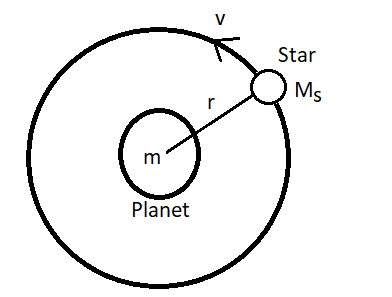
Two planets, \(A\) and \(B\) are orbiting a common star in circular orbits of radii \(R_A\) and \(R_B\), respectively, with \(R_B=2 R_A\). The planet \(B\) is \(4 \sqrt{2}\) times more massive than planet \(A\). The ratio \(\left(\frac{\mathrm{L}_{\mathrm{B}}}{\mathrm{L}_{\mathrm{A}}}\right)\) of angular momentum \(\left(L_B\right)\) of planet \(B\) to that of planet \(A\left(L_A\right)\) is closest to integer _____. [JEE Main 2025 (Online) 29th January Evening Shift]
CorrectIncorrectHint
(b)

The Formula for Angular Momentum:
For a planet of mass \(m\) moving in a circular orbit of radius \(r\) with orbital velocity \(v\), the angular momentum \(L\) is:
\(
L=m v r
\)
Orbital velocity:
The angular momentum \(L\) of a planet with mass \(m\) in a circular orbit of radius \(r\) is given by \(L=m v r\), where \(v\) is the orbital speed. The orbital speed is determined by balancing the gravitational force and the centripetal force:
\(
\frac{m v^2}{r}=G \frac{{M_s} m}{r^2}
\)
Solving for \(v\), we get:
\(
v=\sqrt{\frac{G M_s}{r}}
\)
Substituting this into the angular momentum formula:
\(
\begin{gathered}
L=m\left(\sqrt{\frac{G M_s}{r}}\right) r \\
L=m \sqrt{G M_s r}
\end{gathered}
\)
Since \(G\) and \(M_s\) (the mass of the star) are constant for both planets, we find the proportionality:
\(
L \propto m \sqrt{r}
\)
Setting up the Ratio:
We are given the following relationships between Planet B and Planet A:
Mass: \(m_B=4 \sqrt{2} m_A\)
Radius: \(R_B=2 R_A\)
Now, we calculate the ratio \(\frac{L_B}{L_A}\) :
\(
\frac{L_B}{L_A}=\left(\frac{m_B}{m_A}\right) \sqrt{\frac{R_B}{R_A}}
\)
Substitute the given values:
\(
\frac{L_B}{L_A}=(4 \sqrt{2}) \times \sqrt{2}
\)
Simplify the expression:
\(
\begin{gathered}
\frac{L_B}{L_A}=4 \times(\sqrt{2} \times \sqrt{2}) \\
\frac{L_B}{L_A}=4 \times 2 \\
\frac{L_B}{L_A}=8
\end{gathered}
\)
The ratio of the angular momentum of planet \(B\) to that of planet \(A\) is 8. - Question 4 of 19
4. Question
Acceleration due to gravity on the surface of earth is ‘ \(g\) ‘. If the diameter of earth is reduced to one third of its original value and mass remains unchanged, then the acceleration due to gravity on the surface of the earth is ____ \(g\). [JEE Main 2025 (Online) 24th January Evening Shift]
CorrectIncorrectHint
(a) To find the new acceleration due to gravity, we need to look at the relationship between gravity, mass, and radius.
Step 1: The Formula
The acceleration due to gravity ( \(g\) ) on the surface of a planet is given by the formula:
\(
g=\frac{G M}{R^2}
\)
Where:
\(G\) is the Gravitational Constant.
\(M\) is the mass of the planet.
\(R\) is the radius of the planet.
Step 2: The Relationship
Since the mass \(M\) remains unchanged and \(G\) is a constant, we can see that:
\(
g \propto \frac{1}{R^2}
\)
Step 3: Change in Radius
The problem states that the diameter is reduced to one-third of its original value. Since \(R= \frac{D}{2}\), if the diameter is reduced to \(1 / 3\), the radius is also reduced to \(1 / 3\) :
\(
R^{\prime}=\frac{R}{3}
\)
Step 4: Calculation of New Gravity ( \(g^{\prime}\) )
Substitute the new radius into our proportionality:
\(
g^{\prime}=\frac{G M}{\left(R^{\prime}\right)^2}=\frac{G M}{(R / 3)^2}
\)
Simplify the denominator:
\(
\begin{gathered}
g^{\prime}=\frac{G M}{R^2 / 9} \\
g^{\prime}=9\left(\frac{G M}{R^2}\right) \\
g^{\prime}=9 g
\end{gathered}
\)
The acceleration due to gravity will become \(9 g\). - Question 5 of 19
5. Question
A satellite of mass \(\frac{M}{2}\) is revolving around earth in a circular orbit at a height of \(\frac{R}{3}\) from earth surface. The angular momentum of the satellite is \(\mathrm{M} \sqrt{\frac{\mathrm{GMR}}{x}}\). The value of \(x\) is ____ , where \(M\) and \(R\) are the mass and radius of earth, respectively. ( \(G\) is the gravitational constant) [JEE Main 2025 (Online) 23rd January Evening Shift]
CorrectIncorrectHint
(c) Step 1: Determine orbital radius and speed
The satellite revolves at a height \(h=\frac{R}{3}\) from the Earth’s surface. The orbital radius \(r\) is the sum of the Earth’s radius and the height:
\(
r=R+h=R+\frac{R}{3}=\frac{4 R}{3}
\)
The orbital speed \(\boldsymbol{v}\) for a satellite in a circular orbit around Earth (mass \(\boldsymbol{M}\) ) at radius \(\boldsymbol{r}\) is given by:
\(
v=\sqrt{\frac{G M}{r}}=\sqrt{\frac{G M}{4 R / 3}}=\sqrt{\frac{3 G M}{4 R}}
\)
Step 2: Calculate the angular momentum
The angular momentum \(L\) of the satellite (mass \(m=\frac{M}{2}\) ) is given by \(L=m v r\) :
\(
\begin{gathered}
L=\left(\frac{M}{2}\right) \times\left(\sqrt{\frac{3 G M}{4 R}}\right) \times\left(\frac{4 R}{3}\right) \\
L=\frac{M \times 4 R}{2 \times 3} \times \sqrt{\frac{3 G M}{4 R}}=\frac{2 M R}{3} \sqrt{\frac{3 G M}{4 R}}
\end{gathered}
\)
Step 3: Compare with the given expression
To compare the derived \(\boldsymbol{L}\) with the given expression \(\boldsymbol{L}=\boldsymbol{M} \sqrt{\frac{\boldsymbol{G} \boldsymbol{M R}}{\boldsymbol{x}}}\), we move terms into the square root:
\(
L=\sqrt{\left(\frac{2 M R}{3}\right)^2 \times \frac{3 G M}{4 R}}
\)
\(
\begin{aligned}
L & =\sqrt{\frac{4 M^2 R^2}{9}} \times \frac{3 G M}{4 R} \\
L & =\sqrt{\frac{12 G M^3 R^2}{36 R}}=\sqrt{\frac{G M^3 R}{3}}
\end{aligned}
\)
We can factor out \(\boldsymbol{M}\) from the square root to match the format:
\(
L=\sqrt{M^2 \times \frac{G M R}{3}}=M \sqrt{\frac{G M R}{3}}
\)
Comparing \(M \sqrt{\frac{G M R}{3}}\) with \(M \sqrt{\frac{G M R}{x}}\), we find \(x=3\). - Question 6 of 19
6. Question
If the radius of earth is reduced to three-fourth of its present value without change in its mass then value of duration of the day of earth will be ____ hours 30 minutes. [JEE Main 2024 (Online) 6th April Morning Shift]
CorrectIncorrectHint
(b) Step 1: Apply Conservation of Angular Momentum
We assume the Earth is a solid sphere and its mass remains constant. When the radius changes, the angular momentum \(L\) is conserved, so the initial angular momentum \(L_1\) equals the final angular momentum \(L_2\), as no external torque acts on the system:
\(
L_1=L_2
\)
Step 2: Use Moment of Inertia and Angular Velocity Formulas
The angular momentum \(L\) is the product of moment of inertia \(I\) and angular velocity \(\omega (L=I \omega)\). For a solid sphere, \(I=\frac{2}{5} M R^2\), and \(\omega=\frac{2 \pi}{T}\), where \(T\) is the time period (duration of the day).
\(
\begin{aligned}
I_1 \omega_1 & =I_2 \omega_2 \\
\frac{2}{5} M R_1^2 \frac{2 \pi}{T_1} & =\frac{2}{5} M R_2^2 \frac{2 \pi}{T_2}
\end{aligned}
\)
Step 3: Solve for the Final Time Period ( \(\boldsymbol{T}_{\mathbf{2}}\) )
Canceling the constant terms, we get \(\frac{R_1^2}{T_1}=\frac{R_2^2}{T_2}\). Rearranging for \(T_2\) gives:
\(
T_2=T_1\left(\frac{R_2}{R_1}\right)^2
\)
Given \(T_1=24\) hours and \(R_2=\frac{3}{4} R_1\) :
\(
T_2=24 \text { hours } \times\left(\frac{3}{4}\right)^2=24 \times \frac{9}{16}=13.5 \text { hours }
\)
The duration of the day will be 13 hours and 30 minutes. - Question 7 of 19
7. Question
A simple pendulum is placed at a place where its distance from the earth’s surface is equal to the radius of the earth. If the length of the string is \(4 m\), then the time period of small oscillations will be ____ s. [take \(g=\pi^2 m s^{-2}\) ] [JEE Main 2024 (Online) 30th January Evening Shift]
CorrectIncorrectHint
(c) Step 1: Calculate gravity at height
The acceleration due to gravity ( \(g^{\prime}\) ) at a height \(h\) from the Earth’s surface, where \(R_e\) is the radius of Earth, is given by the formula \(g^{\prime}=g_0\left(\frac{R_e}{R_e+h}\right)^2\). Given that \(h\) is equal to the radius of the earth (\(h=R_e\)) and the surface gravity is \(g_0=\pi^2 \mathrm{~m} / \mathrm{s}^{-2}\), we can calculate \(g^{\prime}\) :
\(
g^{\prime}=\pi^2\left(\frac{R_e}{R_e+R_e}\right)^2=\pi^2\left(\frac{R_e}{2 R_e}\right)^2=\pi^2\left(\frac{1}{2}\right)^2=\frac{\pi^2}{4} \mathrm{~m} / \mathrm{s}^{-2}
\)
Step 2: Calculate the time period
The time period ( \(T\) ) of a simple pendulum with length \(L\) at this location is calculated using the formula \(T=2 \pi \sqrt{\frac{L}{g^{\prime}}}\). Using the given length \(L=4 \mathrm{~m}\) and the calculated \(g^{\prime}\)
\(
T=2 \pi \sqrt{\frac{4}{\frac{\pi^2}{4}}}=2 \pi \sqrt{\frac{16}{\pi^2}}=2 \pi\left(\frac{4}{\pi}\right)=8 \mathrm{~s}
\)
The time period of small oscillations will be 8 s. - Question 8 of 19
8. Question
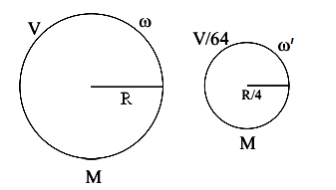
If the earth suddenly shrinks to \(\frac{1}{64}\) th of its original volume with its mass remaining the same, the period of rotation of earth becomes \(\frac{24}{x} \mathrm{~h}\). The value of \(x\) is ____. [JEE Main 2023 (Online) 10th April Morning Shift]
CorrectIncorrectHint
(d)

Step 1: Relate the change in volume to the change in radius
Assuming the Earth is a uniform sphere, its volume \(V\) is given by \(V=\frac{4}{3} \pi R^3\). The problem states the new volume \(V^{\prime}\) is \(\frac{1}{64}\) th of the original volume \(V\).
\(
\frac{4}{3} \pi R^3=\frac{1}{64}\left(\frac{4}{3} \pi R^3\right)
\)
Solving for the new radius \(R^{\prime}\), we find \(R^{\prime}=\frac{R}{4}\).
Step 2: Apply the conservation of angular momentum
Since no external torque acts on the Earth during this change, the angular momentum \(L\) is conserved ( \(L=L^{\prime}\) ). Angular momentum is \(L=I \omega\), where \(I\) is the moment of inertia and \(\omega\) is the angular velocity. For a uniform sphere, the moment of inertia is \(I=\frac{2}{5} M R^2\), and angular velocity is \(\omega=\frac{2 \pi}{T}\).
\(
\begin{aligned}
I \omega & =I^{\prime} \omega^{\prime} \\
\left(\frac{2}{5} M R^2\right)\left(\frac{2 \pi}{T}\right) & =\left(\frac{2}{5} M^{\prime} R^2\right)\left(\frac{2 \pi}{T^{\prime}}\right)
\end{aligned}
\)
The mass \(M\) remains the same \(\left(M^{\prime}=M\right)\). Substituting \(R^{\prime}=\frac{R}{4}\) and simplifying the equation:
\(
\begin{aligned}
\frac{R^2}{T} & =\frac{(R / 4)^2}{T^{\prime}} \\
\frac{1}{T} & =\frac{1}{16 T^{\prime}} \\
T^{\prime} & =\frac{T}{16}
\end{aligned}
\)
Step 3: Determine the value of \(\mathbf{x}\)
The original period \(T\) is 24 h. The new period is \(T^{\prime}=\frac{24}{x} \mathrm{~h}\).
\(
T^{\prime}=\frac{24 \mathrm{~h}}{16}=\frac{24}{x} \mathrm{~h}
\)
Comparing the expressions, we get \(x=16\). - Question 9 of 19
9. Question
If the acceleration due to gravity experienced by a point mass at a height \(h\) above the surface of earth is same as that of the acceleration due to gravity at a depth \(\alpha \mathrm{h}\left(\mathrm{h} \ll \mathrm{R}_{\mathrm{e}}\right)\) from the earth surface. The value of \(\alpha\) will be ______. (use \(\mathrm{R}_{\mathrm{e}}=6400 \mathrm{~km}\)) [JEE Main 2022 (Online) 29th July Morning Shift]
CorrectIncorrectHint
(b) To solve for \(\alpha\), we need to use the approximation formulas for the acceleration due to gravity above and below the Earth’s surface, specifically for cases where the distance \(h\) is much smaller than the Earth’s radius \(R_e\).
Step 1: Gravity at a Height ( \(h \ll R_e\) )
The acceleration due to gravity \(g_h\) at a height \(h\) above the surface is given by the formula:
\(
g_h=g\left(1+\frac{h}{R_e}\right)^{-2}
\)
Using the binomial expansion for \(h \ll R_e\), this approximates to:
\(
g_h \approx g\left(1-\frac{2 h}{R_e}\right)
\)
Step 2: Gravity at a Depth (\(d\))
The acceleration due to gravity \(g_d\) at a depth \(d\) below the surface is given by:
\(
g_d=g\left(1-\frac{d}{R_e}\right)
\)
In this problem, the depth is given as \(d=\alpha h\). Substituting this:
\(
g_d=g\left(1-\frac{\alpha h}{R_e}\right)
\)
Step 3: Equating the Two Expressions
The problem states that the acceleration at height \(h\) is equal to the acceleration at depth \(\alpha h\) (\(g_h=g_d):\)
\(
g\left(1-\frac{2 h}{R_e}\right)=g\left(1-\frac{\alpha h}{R_e}\right)
\)
Solving we get, \(\alpha=2\) - Question 10 of 19
10. Question
Two satellites \(S_1\) and \(S_2\) are revolving in circular orbits around a planet with radius \(R_1=3200 \mathrm{~km}\) and \(R_2=800 \mathrm{~km}\) respectively. The ratio of speed of satellite \(S_1\) to be speed of satellite \(S_2\) in their respective orbits would be \(\frac{1}{x}\) where \({x}=\) ____. [JEE Main 2022 (Online) 25th June Evening Shift]
CorrectIncorrectHint
(a) Step 1: Determine the orbital speed formula
The orbital speed \((v)\) of a satellite in a circular orbit around a planet with mass \(M\) and orbital radius \(R\) is given by the formula:
\(
v=\sqrt{\frac{G M}{R}}
\)
where \(\boldsymbol{G}\) is the universal gravitational constant.
Step 2: Form the ratio of speeds
The ratio of the speed of satellite \(S_1\left(v_1\right)\) to the speed of satellite \(S_2\left(v_2\right)\) is:
\(
\frac{v_1}{v_2}=\frac{\sqrt{\frac{G M}{R_1}}}{\sqrt{\frac{G M}{R_2}}}=\sqrt{\frac{R_2}{R_1}}
\)
Step 3: Substitute values and calculate the ratio
Given radii are \(R_1=3200 \mathrm{~km}\) and \(R_2=800 \mathrm{~km}\). Substituting these values into the ratio formula:
\(
\frac{v_1}{v_2}=\sqrt{\frac{800 \mathrm{~km}}{3200 \mathrm{~km}}}=\sqrt{\frac{1}{4}}=\frac{1}{2}
\)
Step 4: Determine the value of \(x\)
The problem states that the ratio \(\frac{v_1}{v_2}\) is equal to \(\frac{1}{x}\).
\(
\frac{1}{x}=\frac{1}{2}
\)
Therefore, \(\mathrm{x}=2\). - Question 11 of 19
11. Question
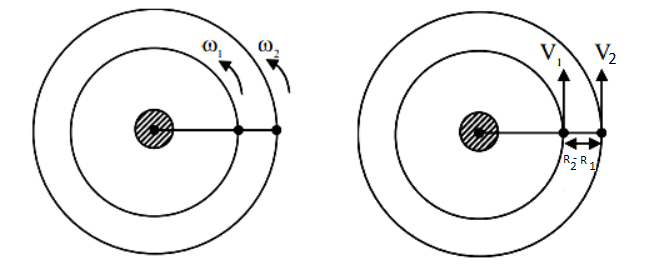
Two satellites revolve around a planet in coplanar circular orbits in anticlockwise direction. Their period of revolutions are 1 hour and 8 hours respectively. The radius of the orbit of nearer satellite is \(2 \times 10^3 \mathrm{~km}\). The angular speed of the farther satellite as observed from the nearer satellite at the instant when both the satellites are closest is \(\frac{\pi}{x} r a d h^{-1}\) where \(x\) is ____. [JEE Main 2021 (Online) 1st September Evening Shift]
CorrectIncorrectHint
(c)

To find the angular speed of the farther satellite as observed from the nearer one, we need to determine their relative velocity and their distance at the moment of closest approach.
Step 1: Determine the Orbital Radius of the Farther Satellite
According to Kepler’s Third Law, the square of the time period is proportional to the cube of the orbital radius (\(T^2 \propto R^3\)):
\(
\frac{R_2^3}{R_1^3}=\frac{T_2^2}{T_1^2}
\)
Given:
\(T_1=1 \mathrm{~h}, R_1=2 \times 10^3 \mathrm{~km}\)
\(T_2=8 \mathrm{~h}\)
\(
\begin{gathered}
\left(\frac{R_2}{R_1}\right)^3=\left(\frac{8}{1}\right)^2=64 \\
\frac{R_2}{R_1}=\sqrt[3]{64}=4 \\
R_2=4 \times R_1=8 \times 10^3 \mathrm{~km}
\end{gathered}
\)
Step 1: Calculate Angular and Linear Velocities
The angular velocity \(\omega\) of each satellite relative to the planet is \(\omega=\frac{2 \pi}{T}\).
For \(S_1: \omega_1=\frac{2 \pi}{1}=2 \pi \mathrm{rad} / \mathrm{h}\)
For \(S_2: \omega_2=\frac{2 \pi}{8}=\frac{\pi}{4} \mathrm{rad} / \mathrm{h}\)
The linear orbital velocity is \(v=\omega R\) :
\(v_1=(2 \pi) \times\left(2 \times 10^3\right)=4 \pi \times 10^3 \mathrm{~km} / \mathrm{h}\)
\(v_2=\left(\frac{\pi}{4}\right) \times\left(8 \times 10^3\right)=2 \pi \times 10^3 \mathrm{~km} / \mathrm{h}\)
Step 3: Relative Angular Velocity at Closest Approach
When the satellites are closest, they lie on the same radial line from the planet. Since they move in the same direction (anticlockwise), their relative velocity \(v_{\text {rel }}\) is:
\(
v_{r e l}=v_1-v_2=4 \pi \times 10^3-2 \pi \times 10^3=2 \pi \times 10^3 \mathrm{~km} / \mathrm{h}
\)
The distance between them at this instant is:
\(
r_{r e l}=R_2-R_1=8 \times 10^3-2 \times 10^3=6 \times 10^3 \mathrm{~km}
\)
The angular speed of \(S_2\) as observed from \(S_1\) is given by the formula for relative angular velocity:
\(
\begin{gathered}
\omega_{o b s}=\frac{v_{r e l}}{r_{r e l}} \\
\omega_{o b s}=\frac{2 \pi \times 10^3}{6 \times 10^3}=\frac{2 \pi}{6}=\frac{\pi}{3} \mathrm{rad} / \mathrm{h}
\end{gathered}
\)
Step 4: Solve for \({x}\)
Comparing \(\frac{\pi}{3}\) with the given form \(\frac{\pi}{x}\) :
\(
x=3
\) - Question 12 of 19
12. Question
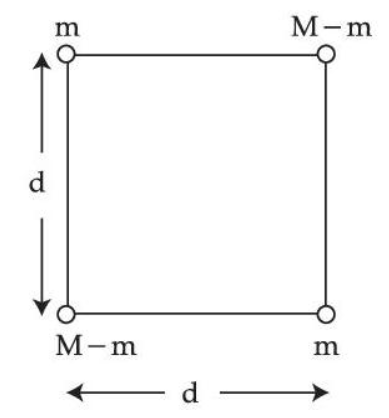
A body of mass \((2 M)\) splits into four masses \((m, M-m, m, M-m\}\), which are rearranged to form a square as shown in the figure. The ratio of \(\frac{M}{m}\) for which, the gravitational potential energy of the system becomes maximum is \(x\) : 1. The value of \(x\) is _____. [JEE Main 2021 (Online) 27th August Morning Shift]
 CorrectIncorrect
Hint
(b) To find the value of \(x\) for which the gravitational potential energy of the system is maximum, we need to analyze the total potential energy based on the arrangement of the four masses at the vertices of a square.
Step 1: Identify the Potential Energy Components
Let the side length of the square be \(a\). The four masses placed at the vertices are:
\(m_1=m\)
\(m_2=M-m\)
\(m_3=m\)
\(m_4=M-m\)
In a square, there are 6 pairs of interactions:
4 Side pairs (distance \(a\) ): \(\left(m_1, m_2\right),\left(m_2, m_3\right),\left(m_3, m_4\right)\), and \(\left(m_4, m_1\right)\).
2 Diagonal pairs (distance \(\sqrt{2} a\) ): (\(m_1, m_3\) ) and ( \(m_2, m_4\)).
Step 2: Formulate the Total Potential Energy (\(U\))
The formula for gravitational potential energy is \(U=-\frac{G m_1 m_2}{r}\). The total energy \(U\) is:
\(
U=-G\left[\frac{m(M-m)+(M-m) m+m(M-m)+(M-m) m}{a}+\right.\left.\frac{m \cdot m+(M-m)(M-m)}{\sqrt{2} a}\right]
\)
Simplifying the side terms \((4 \times m(M-m))\) :
\(
U=-\frac{G}{a}\left[4 m(M-m)+\frac{m^2+(M-m)^2}{\sqrt{2}}\right]
\)
Step 3: Maximize the Energy
For \(U\) to be maximum, the term inside the brackets (let’s call it \(f(m)\)) must be minimized, because the overall expression is negative.
Note: Gravitational potential energy is always negative. A “maximum” value means the least negative value (closest to zero).
\(
\begin{gathered}
f(m)=4 m M-4 m^2+\frac{m^2+M^2-2 m M+m^2}{\sqrt{2}} \\
f(m)=4 m M-4 m^2+\frac{2 m^2-2 m M+M^2}{\sqrt{2}}
\end{gathered}
\)
To find the extremum, we differentiate \(f(m)\) with respect to \(m\) and set it to zero \(\left(\frac{d f}{d m}=0\right)\) :
\(
\frac{d f}{d m}=4 M-8 m+\frac{4 m-2 M}{\sqrt{2}}=0
\)
Multiply by \(\sqrt{2}\) to clear the fraction:
\(
\begin{gathered}
4 \sqrt{2} M-8 \sqrt{2} m+4 m-2 M=0 \\
M(4 \sqrt{2}-2)=m(8 \sqrt{2}-4)
\end{gathered}
\)
Step 4: Solve for the Ratio \(M / m\)
\(
\frac{M}{m}=\frac{8 \sqrt{2}-4}{4 \sqrt{2}-2}
\)
Factor out a 2 from the numerator:
\(
\begin{gathered}
\frac{M}{m}=\frac{2(4 \sqrt{2}-2)}{4 \sqrt{2}-2} \\
\frac{M}{m}=2
\end{gathered}
\)
The ratio \(M / m\) is \(2: 1\), so the value of \(x\) is 2. - Question 13 of 19
13. Question
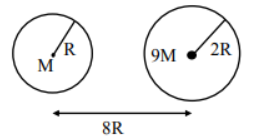
Suppose two planets (spherical in shape) in radii \(R\) and \(2 R\), but mass \(M\) and \(9 M\) respectively have a centre to centre separation \(8 R\) as shown in the figure. \(A\) satellite of mass ‘ \(m\) ‘ is projected from the surface of the planet of mass ‘ \(M\) ‘ directly towards the centre of the second planet. The minimum speed ‘ \(v\) ‘ required for the satellite to reach the surface of the second planet is \(\sqrt{\frac{a}{7} \frac{G M}{R}}\) then the value of ‘ \(a\) ‘ is ____. [JEE Main 2021 (Online) 27th July Morning Shift] [Given : The two planets are fixed in their position]
 CorrectIncorrect
Hint
(c)

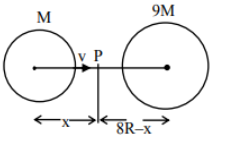
To solve this, we need to find the “Neutral Point” between the two planets. The satellite only needs enough energy to reach this point; once it crosses it, the gravitational pull of the second planet will naturally pull it to its surface.
Step 1: Locate the Neutral Point ( \(P\) )
At the neutral point, the gravitational forces from both planets are equal and opposite. Let \(x\) be the distance of point \(P\) from the center of the first planet (mass \(M\)). The distance from the center of the second planet (mass \(9 M\)) will be \(8 R-x\).
Equating the gravitational fields:
\(
\frac{G M}{x^2}=\frac{G(9 M)}{(8 R-x)^2}
\)
Taking the square root of both sides:
\(
\begin{gathered}
\frac{1}{x}=\frac{3}{8 R-x} \\
8 R-x=3 x \Longrightarrow 4 x=8 R \Longrightarrow x=2 R
\end{gathered}
\)
The neutral point is at a distance of \(2 R\) from the center of planet 1 and \(6 R\) from the center of planet 2.
Step 2: Apply Conservation of Energy
The minimum speed \(v\) is required to take the satellite from the surface of planet \(1(r=R)\) to the neutral point \((r=2 R)\).
Initial Energy (\(E_{\hat{i}}\)):
\(
\begin{gathered}
E_i=K E+P E_1+P E_2 \\
E_i=\frac{1}{2} m v^2-\frac{G M m}{R}-\frac{9 G M m}{7 R}
\end{gathered}
\)
(Note: At the surface of planet 1 , the distance to planet 2 is \(8 R-R=7 R\))
Energy at Neutral Point (\(E_P\)): At minimum speed, the satellite’s velocity at \(P\) is essentially zero.
\(
\begin{gathered}
E_P=0-\frac{G M m}{2 R}-\frac{9 G M m}{6 R} \\
E_P=-\frac{G M m}{2 R}-\frac{3 G M m}{2 R}=-\frac{4 G M m}{2 R}=-\frac{2 G M m}{R}
\end{gathered}
\)
Step 3: Solving for \(v\)
Set \(E_i=E_P\) :
\(
\begin{gathered}
\frac{1}{2} m v^2-\frac{G M m}{R}-\frac{9 G M m}{7 R}=-\frac{2 G M m}{R} \\
\frac{1}{2} v^2=\frac{G M}{R}+\frac{9 G M}{7 R}-\frac{2 G M}{R} \\
\frac{1}{2} v^2=\frac{9 G M}{7 R}-\frac{G M}{R} \\
\frac{1}{2} v^2=\frac{9 G M-7 G M}{7 R}=\frac{2 G M}{7 R} \\
v^2=\frac{4 G M}{7 R} \Longrightarrow v=\sqrt{\frac{4}{7}} \frac{G M}{R}
\end{gathered}
\)
Step 4: Comparison
Comparing this with the given form \(v=\sqrt{\frac{a}{7} \frac{G M}{R}}\) :
\(
a=4
\) - Question 14 of 19
14. Question
The radius in kilometer to which the present radius of earth \((R=6400 \mathrm{~km})\) to be compressed so that the escape velocity is increased 10 times is ____. [JEE Main 2021 (Online) 17th March Morning Shift]
CorrectIncorrectHint
(a) To find the new radius of the Earth after compression, we use the formula for escape velocity and examine how it scales with the radius when the mass remains constant.
Step 1: The Formula for Escape Velocity
The escape velocity ( \(v_e\) ) from the surface of a planet is given by:
\(
v_e=\sqrt{\frac{2 G M}{R}}
\)
Where:
\(G\) is the Gravitational Constant.
\(M\) is the mass of the Earth (which remains unchanged during compression).
R is the radius of the Earth.
Step 2: Establishing the Relationship
Since \(G\) and \(M\) are constant, the escape velocity is inversely proportional to the square root of the radius:
\(
v_e \propto \frac{1}{\sqrt{R}}
\)
This can be written as a ratio between the initial state (1) and the compressed state (2):
\(
\frac{v_{e 2}}{v_{e 1}}=\sqrt{\frac{R_1}{R_2}}
\)
Step 3: Step-by-Step Calculation
We are given:
Initial radius \(\left(R_1\right)=6400 \mathrm{~km}\)
The escape velocity increases 10 times, so \(\frac{v_{c 2}}{v_{e 1}}=10\)
Substitute these into the ratio:
\(
10=\sqrt{\frac{6400}{R_2}}
\)
Square both sides to remove the square root:
\(
100=\frac{6400}{R_2}
\)
Solve for \(R_2\) :
\(
\begin{aligned}
& R_2=\frac{6400}{100} \\
& R_2=64 \mathrm{~km}
\end{aligned}
\)
The radius of the Earth must be compressed to \(\mathbf{6 4 ~ k m}\). - Question 15 of 19
15. Question
If one wants to remove all the mass of the earth to infinity in order to break it up completely. The amount of energy that needs to be supplied will be \(\frac{x}{5} \frac{G M^2}{R}\) where \(x\) is ____ (Round off to the Nearest Integer) ( \(M\) is the mass of earth, \(R\) is the radius of earth, \(G\) is the gravitational constant) [JEE Main 2021 (Online) 16th March Evening Shift]
CorrectIncorrectHint
(c) Step 1: Recall the gravitational binding energy formula
The gravitational binding energy of a uniform sphere (like the Earth, as approximated in this problem) is a standard formula that describes the total potential energy stored in the sphere due to its own gravity. The formula for this energy is:
\(
U=-\frac{3}{5} \frac{G M^2}{R}
\)
Step 2: Determine the energy required to disassemble the sphere
The energy required to completely break up the Earth and move all its mass to infinity is equal to the negative of its gravitational binding energy. This is because at infinite separation, the final potential energy is zero.
The energy \(\boldsymbol{E}\) needed is:
\(
E=0-U=-U=-\left(-\frac{3}{5} \frac{G M^2}{R}\right)=\frac{3}{5} \frac{G M^2}{R}
\)
Step 3: Compare with the given expression
The problem states that the amount of energy needed is given by the expression \(\frac{x}{5} \frac{G M^2}{R}\). Comparing this to our derived value:
\(
\frac{x}{5} \frac{G M^2}{R}=\frac{3}{5} \frac{G M^2}{R}
\)
By comparing the coefficients, we find that \(x=3\).Note: Step-by-Step Derivation (Brief)
If you have a sphere of radius \(r\), its mass is \(m=\rho\left(\frac{4}{3} \pi r^3\right)\). If you bring an additional shell of mass \(d m=\rho\left(4 \pi r^2 d r\right)\) from infinity, the work done \(d U\) is:
\(
d U=-\frac{G m d m}{r}
\)
Substituting \(m\) and \(d m\) in terms of density \(\rho\) and integrating from \(r=0\) to \(r=R\) yields the \(\frac{3}{5}\) coefficient. - Question 16 of 19
16. Question
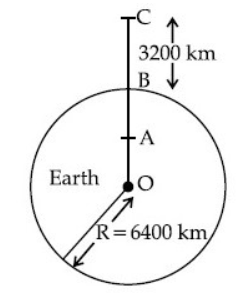
In the reported figure of earth, the value of acceleration due to gravity is same at point \(A\) and \(C\) but it is smaller than that of its value at point \(B\) (surface of the earth). The value of \(O A\) : \(A B\) will be \(x: y\). The value of \(x\) is ____. [JEE Main 2021 (Online) 26th February Evening Shift]
 CorrectIncorrect
Hint
(d) Step 1: Define acceleration due to gravity formulas
We use the standard formulas for acceleration due to gravity (g) at a height \(h\) above the surface and a depth \(d\) below the surface, where \(R\) is the radius of the Earth and \(g\) is the acceleration at the surface (point B ):
At point C (height \(h\)): \(g_C=g \frac{\boldsymbol{R}^2}{(\boldsymbol{R}+\boldsymbol{h})^2}\)
At point A (depth \(d\) ): \(g_A=g\left(1-\frac{d}{R}\right)\)
Step 2: Use the given information and equate the accelerations
The problem states that \(g_A=g_C\). Context from the exam paper (implied in search results) suggests that point C is at a height \(h=R / 2=3200 \mathrm{~km}\) from the surface (or distance \(1.5 R\) from the center).
Equating \(g_A\) and \(g_C\) :
\(
g\left(1-\frac{d}{R}\right)=g \frac{R^2}{(R+h)^2}
\)
Substituting \(h=R / 2\) :
\(
\begin{gathered}
1-\frac{d}{R}=\frac{R^2}{(R+R / 2)^2} \\
1-\frac{d}{R}=\frac{R^2}{(3 R / 2)^2} \\
1-\frac{d}{R}=\frac{R^2}{9 R^2 / 4} \\
1-\frac{d}{R}=\frac{4}{9}
\end{gathered}
\)
Step 3: Solve for the depth (AB) and distance from center (OA)
From the above equation:
\(
\begin{gathered}
\frac{d}{R}=1-\frac{4}{9} \\
\frac{d}{R}=\frac{5}{9}
\end{gathered}
\)
So, the depth \(d\) (which is the distance \(A B\) ) is \(A B=\frac{5 R}{9}\).
The distance of point A from the center O is \(\boldsymbol{O A}=\boldsymbol{R}-\boldsymbol{d}\) :
\(
\begin{gathered}
O A=R-\frac{5 R}{9} \\
O A=\frac{4 R}{9}
\end{gathered}
\)
The ratio \(O A: A B\) is \(\frac{4 R}{9}: \frac{5 R}{9}\), which simplifies to \(4: 5\).
The value of \(O A: A B\) is \(4: 5\). Given the ratio is \(x: y\), the value of \(x\) is 4. - Question 17 of 19
17. Question
The initial velocity \(v_i\) required to project a body vertically upward from the surface of the earth to reach a height of \(10R\), where \(R\) is the radius of the earth, may be described in terms of escape velocity \(\mathrm{v}_{\mathrm{e}}\) such that \(v_i=\sqrt{\frac{x}{y}} \times v_e\). The value of \(x\) will be _____. [JEE Main 2021 (Online) 25th February Evening Shift]
CorrectIncorrectHint
(b) To solve this, we use the Law of Conservation of Energy. For a body to reach a specific height, the total mechanical energy at the surface must equal the total mechanical energy at the maximum height.
Step 1: Energy at the Surface (Initial)
At the surface of the Earth \((r=R)\), the body has both kinetic energy and gravitational potential energy:
\(
E_i=\frac{1}{2} m v_i^2-\frac{G M m}{R}
\)
Step 2: Energy at Maximum Height (Final)
At the maximum height \(h=10 R\), the distance from the center of the Earth is \(r=R+ 10 R=11 R\). At this point, the velocity is zero:
\(
E_f=0-\frac{G M m}{11 R}
\)
Step 3: Conservation of Energy
Equating \(E_i\) and \(E_f\) :
\(
\begin{gathered}
\frac{1}{2} m v_i^2-\frac{G M m}{R}=-\frac{G M m}{11 R} \\
\frac{1}{2} v_i^2=\frac{G M}{R}-\frac{G M}{11 R} \\
\frac{1}{2} v_i^2=\frac{G M}{R}\left(1-\frac{1}{11}\right)=\frac{G M}{R}\left(\frac{10}{11}\right) \\
v_i^2=\frac{20}{11} \frac{G M}{R}
\end{gathered}
\)
Step 4: Expressing in terms of Escape Velocity
The escape velocity \(v_e\) is defined as \(v_e=\sqrt{\frac{2 G M}{R}}\), which means \(v_e^2=\frac{2 G M}{R}\). We can rewrite our expression for \(v_i^2\) to include this:
\(
\begin{gathered}
v_i^2=\frac{10}{11}\left(\frac{2 G M}{R}\right) \\
v_i^2=\frac{10}{11} v_e^2
\end{gathered}
\)
\(
v_i=\sqrt{\frac{10}{11}} v_e
\)
Step 5: Comparison
Comparing this with the given form \(v_i=\sqrt{\frac{x}{y}} v_e\) :
\(x=10\)
\(y=11\) - Question 18 of 19
18. Question
An asteroid is moving directly towards the centre of the earth. When at a distance of \(10 R\) (\(R\) is the radius of the earth) from the earths centre, it has a speed of \(12 \mathrm{~km} / \mathrm{s}\). Neglecting the effect of earths atmosphere, what will be the speed of the asteroid when it hits the surface of the earth (escape velocity from the earth is \(11.2 \mathrm{~km} / \mathrm{s}\)) ? Give your answer to the nearest integer in kilometer/s _____. [JEE Main 2020 (Online) 8th January Evening Slot]
CorrectIncorrectHint
(d) Step 1: Apply the Law of Conservation of Energy
The total mechanical energy (kinetic plus potential) of the asteroid is conserved as it moves through the Earth’s gravitational field.
The initial total energy (\(E_i\)) at distance \(r_i=10 R\) equals the final total energy (\(E_f\)) at distance \(\boldsymbol{r}_{\boldsymbol{f}} \boldsymbol{=} \boldsymbol{R}\) (the Earth’s surface):
\(
\begin{aligned}
E_i & =E_f \\
\frac{1}{2} m v_i^2-\frac{G M m}{r_i} & =\frac{1}{2} m v_f^2-\frac{G M m}{r_f}
\end{aligned}
\)
where \(m\) is the asteroid’s mass, \(M\) is the Earth’s mass, \(G\) is the gravitational constant, \(v_i\) is the initial speed, and \(v_f\) is the final speed.
Step 2: Relate GM to Escape Velocity
The escape velocity from the Earth’s surface is given by the formula \(v_{e s c}=\sqrt{\frac{2 G M}{R}}\).
We can rearrange this to express the term \(G M\) in terms of \(v_{\text {esc }}\) and \(R\) :
\(
G M=\frac{v_{e s c}^2 R}{2}
\)
Step 3: Solve for the Final Speed
Substitute the distances \(\left(r_i=10 R, r_f=R\right)\) and the expression for \(G M\) into the energy conservation equation. After canceling the mass \(m\) of the asteroid, we get:
\(
\frac{1}{2} v_i^2-\frac{G M}{10 R}=\frac{1}{2} v_f^2-\frac{G M}{R}
\)
Rearranging to solve for \(v_f^2\) yields:
\(
\begin{gathered}
v_f^2=v_i^2+\frac{2 G M}{R}\left(1-\frac{1}{10}\right) \\
v_f^2=v_i^2+\frac{2 G M}{R}\left(\frac{9}{10}\right)
\end{gathered}
\)
Substituting \(G M=\frac{v_{\text {esc }}^2 R}{2}\) into the equation:
\(
\begin{gathered}
v_f^2=v_i^2+\frac{2}{R}\left(\frac{v_{e s c}^2 R}{2}\right)\left(\frac{9}{10}\right) \\
v_f^2=v_i^2+\frac{9 v_{e s c}^2}{10}
\end{gathered}
\)
Step 4: Calculate the Final Speed
Using the given values \(v_i=12 \mathrm{~km} / \mathrm{s}\) and \(v_{\text {esc }}=11.2 \mathrm{~km} / \mathrm{s}\) :
\(
\begin{gathered}
v_f^2=(12 \mathrm{~km} / \mathrm{s})^2+\frac{9 \times(11.2 \mathrm{~km} / \mathrm{s})^2}{10} \\
v_f^2=144(\mathrm{~km} / \mathrm{s})^2+\frac{9 \times 125.44(\mathrm{~km} / \mathrm{s})^2}{10} \\
v_f^2=144(\mathrm{~km} / \mathrm{s})^2+112.896(\mathrm{~km} / \mathrm{s})^2 \\
v_f^2=256.896(\mathrm{~km} / \mathrm{s})^2 \\
v_f=\sqrt{256.896(\mathrm{~km} / \mathrm{s})^2} \approx 16.028 \mathrm{~km} / \mathrm{s}
\end{gathered}
\)
Rounding to the nearest integer, the speed is \(16 \mathrm{~km} / \mathrm{s}\).
The speed of the asteroid when it hits the surface of the earth will be approximately 16 \(\mathrm{km} / \mathrm{s}\). - Question 19 of 19
19. Question
A ball is dropped from the top of a 100 m high tower on a planet. In the last \(\frac{1}{2} s\) before hitting the ground, it covers a distance of 19 m. Acceleration due to gravity (in \(\mathrm{ms}^{-2}\)) near the surface on that planet is _____. [JEE Main 2020 (Online) 8th January Evening Slot]
CorrectIncorrectHint
(c) Step 1: Define variables and total motion
Let \(\boldsymbol{H}\) be the total height, \(\boldsymbol{t}\) the total time to hit the ground, and \(\boldsymbol{g}\) the acceleration due to gravity. The initial velocity \(u\) is \(0 \mathrm{~m} / \mathrm{s}\) since the ball is dropped. Using the equation of motion \(s=u t+\frac{1}{2} g t^2\) for the entire 100 m fall:
\(
\begin{gathered}
100=0 \times t+\frac{1}{2} g t^2 \Rightarrow t^2=\frac{200}{g} \\
t=\sqrt{\frac{200}{g}}
\end{gathered}
\)
Step 2: Analyze motion before the last 0.5 s
The ball travels 19 m in the last \(\frac{1}{2} \mathrm{~s}\), which means it travels \(100 \mathrm{~m}-19 \mathrm{~m}=81 \mathrm{~m}\) in the time \(\left(t-\frac{1}{2}\right) \mathrm{s}\).
\(
\begin{gathered}
81=0 \times\left(t-\frac{1}{2}\right)+\frac{1}{2} g\left(t-\frac{1}{2}\right)^2 \\
81=\frac{1}{2} g\left(t-\frac{1}{2}\right)^2 \Rightarrow\left(t-\frac{1}{2}\right)^2=\frac{162}{g} \Rightarrow t-\frac{1}{2}=\sqrt{\frac{162}{g}}
\end{gathered}
\)
Step 3: Solve for the acceleration due to gravity (g)
Subtract the equation for \(\left(t-\frac{1}{2}\right)\) from the equation for \(t\) to eliminate \(t\) :
\(
\begin{gathered}
t-\left(t-\frac{1}{2}\right)=\sqrt{\frac{200}{g}}-\sqrt{\frac{162}{g}} \\
\frac{1}{2}=\frac{\sqrt{200}-\sqrt{162}}{\sqrt{g}}
\end{gathered}
\)
Simplify the square roots: \(\sqrt{200}=\sqrt{100 \times 2}=10 \sqrt{2}\) and \(\sqrt{162}=\sqrt{81 \times 2}=9 \sqrt{2}\).
\(
\begin{gathered}
\frac{1}{2}=\frac{10 \sqrt{2}-9 \sqrt{2}}{\sqrt{g}} \\
\frac{1}{2}=\frac{\sqrt{2}}{\sqrt{g}}
\end{gathered}
\)
Square both sides to solve for \(g\) :
\(
\begin{gathered}
\left(\frac{1}{2}\right)^2=\left(\frac{\sqrt{2}}{\sqrt{g}}\right)^2 \\
\frac{1}{4}=\frac{2}{g} \\
g=4 \times 2=8 \mathrm{~ms}^{-2}
\end{gathered}
\)
The acceleration due to gravity near the surface on that planet is \(8 \mathrm{~ms}^{-2}\).