4.5 Newton’s second law of motion
FORCE
A push or pull that one object exerts on another. It is defined as an agency (a push or pull) which changes or tends to change the state of rest or of uniform motion or the direction of motion of a body.
Balanced and Unbalanced Forces
When balanced forces are applied to an object, there will be no net effective force acting on the object. Balanced forces do not cause a change in motion.
- \(a=0 \mathrm{~m} \mathrm{~s}^{-2}\)
- Object at rest \(\left(v=0 \mathrm{~m} \mathrm{~s}^{-1}\right)\)
- Object Stays at rest.
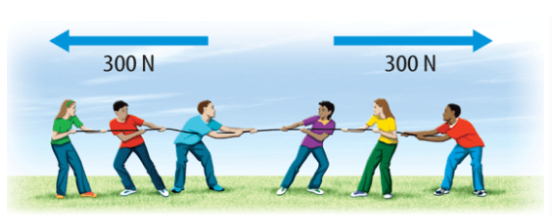
Unbalanced forces acting on an object change its speed and/or direction of motion. It moves in the direction of the force with the highest magnitude.
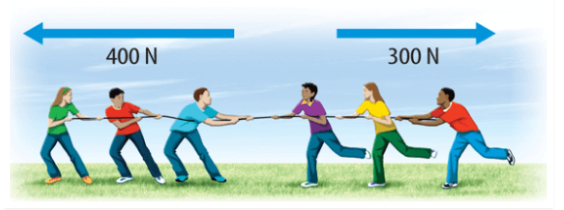
- There is an acceleration.
- The acceleration depends directly upon the net force.
- The acceleration depends inversely upon the mass of the object.
Newton’s Second Law of Motion
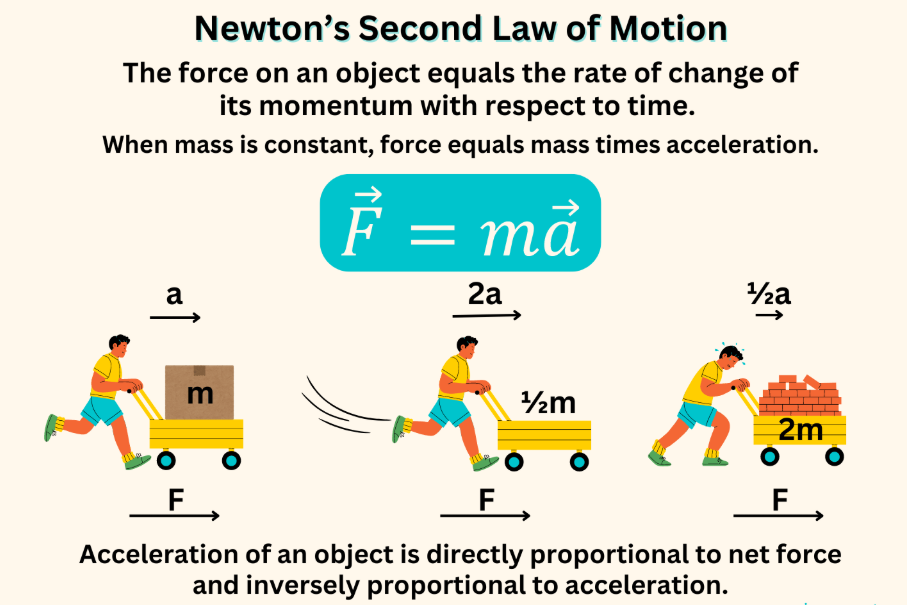
- “The acceleration of an object is directly proportional to the net force acting on it and inversely proportional to its mass. The direction of the acceleration is in the direction of the applied net force.”
- The formula for this law is \(F_{net}=F=m a\).
We may also state Newton’s second law of motion as “If the unbalanced external force (net force) acts on a body, the body accelerates. The direction of acceleration is the same as the direction of the net force.”
Since force is a vector, Newton’s second law can be written as
\(
\vec{F}=m \vec{a}
\)
Example:
- It takes more force to push a heavy box ( \(F\) increases) to accelerate it at the same rate as a light box.
- Newton’s second law of motion can be observed by comparing the acceleration produced in a car and a truck after applying an equal magnitude of force to both. It is easy to notice that after pushing a car and a truck with the same intensity, the car accelerates more than the truck. This is because the mass of the car is less than the mass of the truck.
Units of Force
- In SI system, absolute unit of force is newton.
One newton is defined as that much force which produces an acceleration of \(1 \mathrm{~ms}^{-2}\) in a body of mass \(1 \mathrm{~kg}\).
\(
\begin{array}{l}
1 \mathrm{~N}=1 \mathrm{~kg} \times 1 \mathrm{~ms}^{-2} \\
1 \mathrm{~N}=1 \mathrm{~kg} \mathrm{~ms}^{-2}
\end{array}
\) - In CGS system, absolute unit of force is dyne.
One dyne is that much of force which produces an acceleration of \(1 \mathrm{~cms}^{-2}\) in a body of mass \(1 \mathrm{~g}\).
\(
\begin{array}{l}
1 \text { dyne }=1 \mathrm{~g} \times 1 \mathrm{cms}^{-2} \\
1 \text { dyne }=1 \mathrm{~g} \mathrm{cms}^{-2}
\end{array}
\) - In MKS system, gravitational unit of force is kilogram weight ( \(\mathrm{kg}-\mathrm{wt})\). One \(\mathrm{kg}\)-wt is that much of force which produces an acceleration of \(9.80 \mathrm{~ms}^{-2}\) in a body of mass 1 kg. It is also known as kilogram-force (kgf).
\(
1 \mathrm{~kg}-\mathrm{wt}=1 \mathrm{kgf}=9.8 \mathrm{~N}
\) - In CGS system, gravitational unit of force is gram weight ( \(\mathrm{g-}\mathrm{wt})\) or gram force (gf). It is defined as that force which produces an acceleration of \(980 \mathrm{~cms}^{-2}\) in a body of mass \(1 \mathrm{~g}\).
\(
1 \mathrm{~g-}\mathrm{wt}=1 \mathrm{gf}=980 \mathrm{~g} \mathrm{~cm} \mathrm{~s}^{-2} \text { or } 1 \mathrm{~gf}=980 \text { dyne }
\)
Momentum
Momentum of a body is the quantity of motion possessed by a moving body. It is measured as the product of mass and velocity of a body. It is represented by \(p\).
i.e. \(\quad \operatorname{Momentum}(p)=\) Mass \((m) \times \operatorname{Velocity}(v)\)
SI unit of momentum is \(\mathrm{kg}-\mathrm{ms}^{-1}\) and CGS unit of momentum is \(\mathrm{g}-\mathrm{cms}^{-1}\).
The dimensional formula of momentum is \(\left[\mathrm{MLT}^{-1}\right]\).
Momentum is a vector quantity. In vector form we write \(\vec{p}=m \vec{v}\)
We can also state the Newton’s second law as, “the rate of change of momentum of a body is directly proportional to the external force applied on the body and the change takes place in the direction of the applied force.”
Calculating force with the help of Newton’s 2nd law
The rate of change of momentum of a body is directly proportional to the applied force and takes place in the direction in which the force acts.
Thus, if under the action of a force \(\mathbf{F}\) for time interval \(\Delta t\), the velocity of a body of mass \(m\) changes from \(\mathbf{v}\) to \(\mathbf{v}+\Delta \mathbf{v}\) i.e. its initial momentum \(\boldsymbol{p}=m \mathbf{v}\) changes by \(\Delta \boldsymbol{p}=m \Delta \boldsymbol{v}\). According to the Second Law,
\(
\mathbf{F} \propto \frac{\Delta \mathbf{p}}{\Delta t} \quad \text { or } \quad \mathbf{F}=k \frac{\Delta \mathbf{p}}{\Delta t}
\)
where \(k\) is a constant of proportionality. Taking the limit \(\Delta t \rightarrow 0\), the term \(\frac{\Delta \mathbf{p}}{\Delta t}\) becomes the derivative or differential co-efficient of \(\mathbf{p}\) with respect to \(t\), denoted by \(\frac{\mathbf{d} \mathbf{p}}{\mathbf{d} t}\). Thus
\(
\mathbf{F}=k \frac{\mathrm{~d} \mathbf{p}}{\mathrm{~d} t}
\)
For a body of fixed mass \(m\),
\(
\frac{\mathrm{d} \mathbf{p}}{\mathrm{~d} t}=\frac{\mathrm{d}}{\mathrm{~d} t}(m \mathbf{v})=m \frac{\mathrm{~d} \mathbf{v}}{\mathrm{~d} t}=m \mathbf{a}
\)
i.e the Second Law can also be written as
\(
\mathbf{F}=k m \mathbf{a} \dots(1)
\)
which shows that force is proportional to the product of mass \(m\) and acceleration \(\mathbf{a}\).
The unit of force has not been defined so far. In fact, we use Eqn. (1) to define the unit of force. We, therefore, have the liberty to choose any constant value for \(k\). For simplicity, we choose \(k=1\). The Second Law then is
\(
\mathbf{F}=\frac{\mathrm{d} \mathbf{p}}{\mathrm{~d} t}=m \mathbf{a} \dots(2)
\)
In SI unit force is one that causes an acceleration of \(1 \mathrm{~m} \mathrm{~s}^{-2}\) to a mass of 1 kg . This unit is known as newton : \(1 \mathrm{~N}=1 \mathrm{~kg} \mathrm{~m} \mathrm{~s}^{-2}\).
Note: The slope of momentum-time graph is equal to force on the particle.
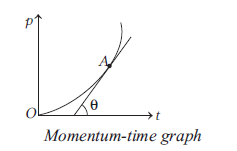
At point \(A, F=\frac{d p}{d t}=\) slope \(=\tan \theta\)
This graph depicts the motion of a body on which increasing force is acting.
Let us note at this stage some important points about the second law :
- In the second law, \(\mathbf{F}=0\) implies \(\mathbf{a}=0\). The second Law is obviously consistent with the first law.
- The second law of motion is a vector law. It is equivalent to three equations, one for each component of the vectors:
\(
\begin{aligned}
& F_x=\frac{\mathrm{d} p_x}{\mathrm{~d} t}=m a_x \\
& F_y=\frac{\mathrm{d} p_y}{\mathrm{~d} t}=m a_y \\
& F_z=\frac{\mathrm{d} p_z}{\mathrm{~d} t}=m a_z
\end{aligned}
\)
This means that if a force is not parallel to the velocity of the body, but makes some angle with it, it changes only the component of velocity along the direction of force. The component of velocity normal to the force remains unchanged. For example, in the motion of a projectile under the vertical gravitational force, the horizontal component of velocity remains unchanged (Figure below). - The second law of motion given by Eqn. (2) is applicable to a single point particle. The force
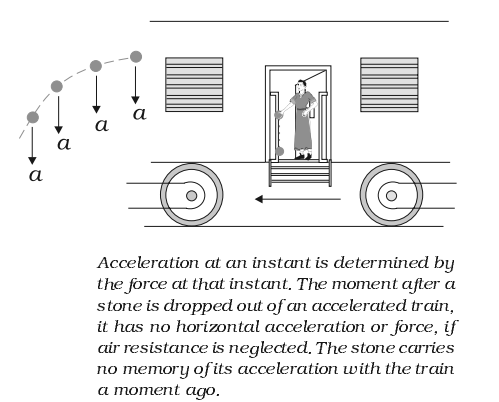
\(\mathbf{F}\) in the law stands for the net external force on the particle and \(\mathbf{a}\) stands for acceleration of the particle. It turns out, however, that the law in the same form applies to a rigid body or, even more generally, to a system of particles. In that case, \(\mathbf{F}\) refers to the total external force on the system and a refers to the acceleration of the system as a whole. More precisely, \(\mathbf{a}\) is the acceleration of the centre of mass of the system. Any internal forces in the system are not to be included in \(\mathbf{F}\). - The second law of motion is a local relation which means that force \(\mathbf{F}\) at a point in space (location of the particle) at a certain instant of time is related to \(\mathbf{a}\) at that point at that instant. Acceleration here and now is determined by the force here and now, not by any history of the motion of the particle (See Figure below).
Example 1: If there is a block of mass \(2 \mathrm{~kg}\), and a force of \(30 \mathrm{~N}\) is acting on it in the positive \(\mathrm{x}\) direction, and a force of \(40 \mathrm{~N}\) in the negative \(\mathrm{x}\)-direction, then what would be its acceleration?
Solution:
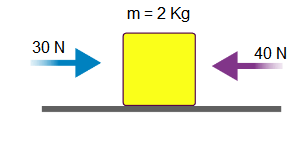
We first have to calculate the net force acting on it to calculate its acceleration.
\(
\begin{aligned}
& F_{n e t}=30 N-40 N=-10 N \\
& \text { Mass }=2 \mathrm{~kg}
\end{aligned}
\)
\(a=\frac{F_{\text {net }}}{m}\)
\(
\text { Acceleration }=\frac{-10 \mathrm{~N}}{2 \mathrm{~kg}}=-5 \mathrm{~m} / \mathrm{s}^2
\)
The negative acceleration indicates that the block is slowing and its acceleration vector is moving in an opposite direction directed opposite to the direction of motion.
Example 2: How much horizontal net force is required to accelerate a \(2000 \mathrm{~kg}\) car at \(4 \mathrm{~m} / \mathrm{s}^2\)?
Solution: Newton’s 2nd Law relates an object’s mass, the net force on it, and its acceleration:
Therefore, we can find the force as follows:
\(
\mathrm{F}_{\mathrm{net}}=\mathrm{ma}
\)
Substituting the values, we get
\(
2000 \mathrm{~kg} \times 4 \mathrm{~m} / \mathrm{s}^2=8000 \mathrm{~N}
\)
Therefore, the horizontal net force is required to accelerate a \(2000 \mathrm{~kg}\) car at \(4 \mathrm{~m} / \mathrm{s}^{2}\) is \(8000 \mathrm{~N}\).
Impulse
When a large force acts on a body for very small time, then product of the average of total force for that small time period and the time period itself is called impulse.
\(
\text { Impulse }=\text { Average force } \times \text { Time }
\)
I=F \Delta t \quad \text { or } \quad \mathbf{I}=\int_{t_1}^{t_2} \mathbf{F} d t
\)
It is a vector quantity and its direction is same as that of force. Dimensional formula of impulse is same as that of momentum, i.e. \(\left[\mathrm{MLT}^{-1}\right]\).
SI unit of impulse is \(\mathrm{N}\)-s or \(\mathrm{kg} \mathrm{ms}^{-1}\) and CGS unit of it is \(\mathrm{g}-\mathrm{cms}^{-1}\).
- Impulse = Change in momentum
- The integral of a force over a certain period of time.
- The value of the force is needed in order for it to be calculated.
- Takes into account the effects of both the force acting on the system and the duration of time for which it acts.
Example 3: A batsman hits back a ball of mass \(0.4 \mathrm{~kg}\) straight in the direction of the bowler without changing its initial speed of \(15 \mathrm{~ms}^{-1}\). Calculate the impulse imparted to the ball in N-s.
Solution: Impulse imparted on a ball:
\(
\begin{array}{l}
I=m \Delta v \\
I=m\left(v_2-v_1\right) \\
I=0.4 \times(15-(-15)) \\
=0.4 \times 2 \times 15=12 \mathrm{~N}-\mathrm{s}
\end{array}
\)
Example 4: A golfer hits a ball of mass \(45 \mathrm{~g}\) at a speed of \(40 \mathrm{~m} / \mathrm{s}\). The golf club is in contact with the ball for \(3 \mathrm{~s}\). Compute the average force applied by the club on the ball?
Solution:
\(\begin{array}{l}
\mathrm{m}(\text { Mass })=0.045 \mathrm{~kg}, \\
{v}_i (\text { Initial Velocity })=0, \\
{v}_f(\text { Final Velocity })=40 \mathrm{~m} / \mathrm{s}, \\
\text { Impulse force } \mathrm{F}=\mathrm{ma}= m \frac{v_f-v_i}{t} =0.045 \times \frac{40}{0.003} =600 \mathrm{~N}
\end{array}
\)
Example 5: A bullet of mass 0.06 kg moving with a speed of \(90 \mathrm{~ms}^{-1}\) enters a heavy wooden block and is stopped after a distance of 60 cm. What is the average resistive force exerted by the block on the bullet?
Solution: The retardation \(a\) of the bullet is given by
\(
\begin{array}{r}
a=-\frac{u^2}{2 s}=\frac{-90 \times 90}{2 \times 0.6} \quad\left(\text { From, } v^2=u^2+2 a s, v=0\right) \\
\left(\because \text { Given, } s=60 \mathrm{~cm}=0.6 \mathrm{~m}, u=90 \mathrm{~ms}^{-1}\right)
\end{array}
\)
\(
\Rightarrow \quad a=-6750 \mathrm{~ms}^{-2}
\)
From second law of motion, Retarding force, \(F=m a=0.06 \times -6750\)
\(
\Rightarrow \quad F=-405 \mathrm{~N}
\)
The negative sign indicates that the resistive force is in the opposite direction of the bullet’s motion. The magnitude of the average resistive force is 405 N.
Example 6: A stone of mass 1 kg is thrown with a velocity of \(20 \mathrm{~ms}^{-1}\) across the frozen surface of a lake and it comes to rest after travelling a distance of 50 m. What is the magnitude of the force opposing the motion of the stone?
Solution: Given, \(u=20 \mathrm{~ms}^{-1}, v=0, s=50 \mathrm{~m}\) and \(m=1 \mathrm{~kg}\)
To calculate force, we have the formula \(F=m a\), but we have to first calculate acceleration \(a\).
Using the third equation of motion, i.e.
\(
\begin{aligned}
& & v^2 & =u^2+2 a s \\
& & (0)^2 & =(20)^2+2 \times a \times 50 \\
\Rightarrow & & 100 a & =-400 \\
\Rightarrow & & a & =-4 \mathrm{~ms}^{-2}
\end{aligned}
\)
Acceleration \(a=-4 \mathrm{~ms}^{-2}\) (- ve sign shows that speed of the stone decreases, i.e. retardation)
Now,
\(
\begin{aligned}
F & =m a=(1 \mathrm{~kg}) \times\left(-4 \mathrm{~ms}^{-2}\right) \\
& =-4 \mathrm{~kg}-\mathrm{ms}^{-2}=-4 \mathrm{~N}
\end{aligned}
\)
Thus, force of opposition between the stone and the ice is -4 N. The negative value of force shows that the opposing force acts in a direction opposite to the direction of motion.
Example 7: A block of 5 kg is resting on a frictionless plane. It is struck by a jet releasing water at a rate of \(3 \mathrm{kgs}^{-1}\) at a speed of \(4 \mathrm{~ms}^{-1}\). Calculate the acceleration of the block.
Solution: The force exerted by a water jet on a block is equal to the rate of change of the water’s momentum. This can be calculated using the formula:
\(
F=\frac{d m}{d t} v
\)
where \(\frac{d m}{d t}\) is the mass flow rate of the water and \(v\) is the velocity of the water.
Force exerting on block, \(F=v \frac{d m}{d t}=4 \times 3=12 \mathrm{~N}\)
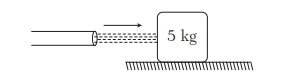
So, acceleration of the block, \(a=\frac{F}{m}=\frac{12}{5}=2.4 \mathrm{~ms}^{-2}\)
Relation between momentum and impulse
Suppose \(\mathbf{F}\) is the value of force during impact at any time and \(p\) is the momentum of the body at that time, then according to Newton’s IInd law of motion,
\(
\mathbf{F}=\frac{d \mathbf{p}}{d t} \text { or } \mathbf{F} \cdot d t=d \mathbf{p} \dots(i)
\)
Suppose that the impact lasts for a small time \(t\) and during this time, the momentum of the body changes from \(p_1\) to \(p_2\). Then, integrating the above equation, we get
\(
\int_0^t \mathbf{F} d t=\int_{p_1}^{p_2} d \mathbf{p}=|\mathbf{p}|_{p_1}^{p_2} \Rightarrow \underbrace{\int_0^t \mathbf{F} d t}_{\text {Impulse }}=p_2-p_1
\)
From this equation, we found that impulse is equal to change in momentum of the body.
Also, if \(\mathbf{F}_{\mathrm{av}}\) is the average force (constant) during the impact, then
Impulse, \(\mathbf{I}=\int_0^t \mathbf{F}_{\mathrm{av}} d t=\mathbf{F}_{\mathrm{av}} \int_0^t d t=\mathbf{p}_2-\mathbf{p}_1\)
or \(\quad \mathbf{I}=\mathbf{F}_{\mathrm{av}} \cdot t=\mathbf{p}_2-\mathbf{p}_1=\Delta p\)
Thus, impulse is also equal to total change in momentum.
This is known as impulse-momentum theorem.
Example 8: A baseball player hits back the ball straight in the direction of the bowler without changing its initial speed of \(12 \mathrm{~ms}^{-1}\). If the mass of the ball is 0.15 kg, then find the impulse imparted to the ball. (Consider the ball in linear motion)
Solution: Given, \(m=0.15 \mathrm{~kg}, v=12 \mathrm{~ms}^{-1}\) and \(u=-12 \mathrm{~ms}^{-1}\)
Change in momentum,
Impulse,
\(
\begin{aligned}
& p_2-p_1=m(v-u)=0.15[12-(-12)]=0.15 \times 24 \\
& p_2-p_1=3.60 \mathrm{~kg}-\mathrm{ms}^{-1}
\end{aligned}
\)
\(
I=p_2-p_1 \Rightarrow I=3.6 \mathrm{~N}-\mathrm{s}
\)
Example 9: A hammer of mass 1 kg moving with a speed of \(6 \mathrm{~ms}^{-1}\) strikes a wall and comes to rest in 0.1 s. Calculate
(i) impulse of the force,
(ii) average retarding force that stops the hammer
(iii) and average retardation of the hammer.
Solution: (i) Impulse \(=F \times t=m(v-u)=1(0-6)=-6 \mathrm{~N}-\mathrm{s}\)
(ii) Average retarding force that stops the hammer,
\(
F=\frac{\text { Impulse }}{\text { Time }}=\frac{6}{0.1}=60 \mathrm{~N}
\)
(iii) Average retardation, \(a=\frac{F}{m}=\frac{60}{1}=60 \mathrm{~ms}^{-2}\)
Example 10: A cricket ball of mass \(150 g\) is moving with a velocity of \(12 \mathrm{~ms}^{-1}\) and is hit by a bat, so that the ball is turned back with a velocity of \(20 \mathrm{~ms}^{-1}\). If the duration of contact between the ball and bat is 0.01 s, find the impulse and the average force exerted on the ball by the bat.
Solution: According to given question, change in momentum of the ball,
\(
\Delta p=p_f-p_i=m(v-u)=150 \times 10^{-3}[20-(-12)]=4.8 \mathrm{~N}-\mathrm{s}
\)
So, by impulse-momentum theorem, impulse, \(I=\Delta p=4.8 \mathrm{~N}-\mathrm{s}\) and by time averaged definition of force in case of impulse
\(
\Rightarrow \quad F_{\mathrm{av}}=\frac{I}{\Delta t}=\frac{\Delta p}{\Delta t}=\frac{4.80}{0.01}=480 \mathrm{~N}
\)
Example 11: Figure shows an estimated force-time graph for a baseball struck by a bat.
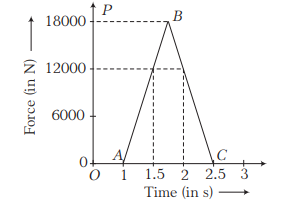
From this curve, determine
(i) impulse delivered to the ball
(ii) and average force exerted on the ball.
Solution: (i) Impulse \(=\) Area under \(F\) – \(t\) curve
\(
\begin{aligned}
& =\text { Area of } \triangle A B C=\frac{1}{2} \times O P \times A C=\frac{1}{2} \times 18000 \times(2.5-1) \\
& =1.35 \times 10^4 \mathrm{~kg}-\mathrm{ms}^{-1} \text { or } \mathrm{N}-\mathrm{s}
\end{aligned}
\)
(ii) Average force \(=\frac{\text { Impulse }}{\text { Time }}=\frac{1.35 \times 10^4}{(2.5-1)}=9000 \mathrm{~N}\)
Calculation of impulse: graphical method
Case-I: When applied force is constant, then the graph, between this force and the time of application of this force is a straight line parallel to time axis.
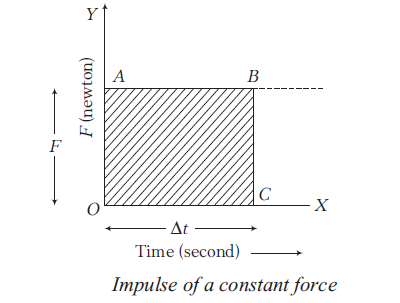
Here, impulse is given by the area covered by the graph.
i.e. \(I=F \times \Delta t\)
where, \(F=O A, \Delta t=O C\)
\(\therefore \quad I=O A \times O C=\) Area of rectangle \(O A B C\).
Case-II: When applied force is variable for the time of application \((\Delta t)\), then graph between force and time will be a curve as given in the figure below
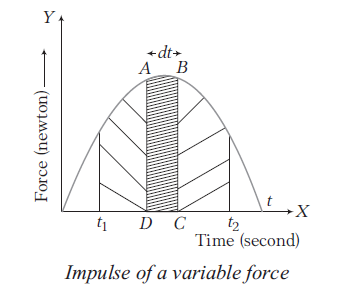
Here,
\(
\begin{aligned}
\text { impulse } & =\text { force } \times \text { time } \\
& =F \times d t \\
& =\text { Area of shaded region }
\end{aligned}
\)
Total impulse for the force applied during period from \(t_1\) to \(t_2\)
\(
\begin{array}{l}
=\int_{t_1}^{t_2} F \cdot d t \\
=\text { Area under } F \text { – } t \text { curve from } t_1 \text { to } t_2
\end{array}
\)
Total impulse for the force applied
\(=\) Area covered between the curve and time-axis.
Resultant Force (Net force)
When two or more forces act on a body simultaneously, then the single force which produces the same effect as produced by all the forces acting together is known as the resultant force ( net force).
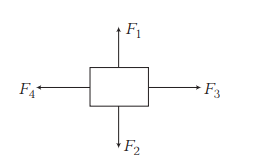
Resultant force, \(\quad \mathbf{F}=\mathbf{F}_1+\mathbf{F}_2+\mathbf{F}_3+\mathbf{F}_4\)
For Example: If \(\mathrm{N}\) is the number of forces acting on a body, the net force formula is given by,
\(
\mathrm{F}_{\mathrm{Net}}=\mathrm{F}_1+\mathrm{F}_2+\mathrm{F}_3 \ldots+\mathrm{FN}
\)
Where,
\(\mathrm{F}_1, \mathrm{~F}_2, \mathrm{~F}_3 \ldots \mathrm{FN}\) is the force acting on a body.
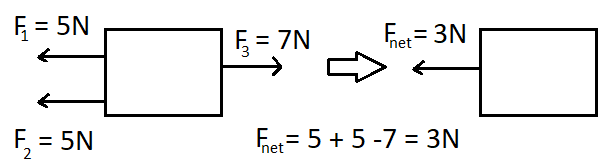
Example 12: Let us consider two forces \(F_1\) and \(F_2\) acting on a body of mass 2 kg as shown in the figure. \(F_1=10 \mathrm{~N}\), \(F_2=2 N\), what will be the acceleration?
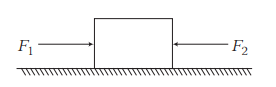
Solution: Unbalanced external force, \(F=F_1-F_2=10-2=8 \mathrm{~N}\)
\(
\begin{array}{ll}
\text { So, } & F=m a \\
\Rightarrow \text { Acceleration, } & a=\frac{F}{m}=\frac{8}{2}=4 \mathrm{~ms}^{-2}
\end{array}
\)
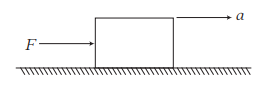
The body moves in direction of \(F_1\).
Forces in nature
There are four fundamental forces in nature :
- Gravitational force
- Electromagnetic force
- Strong nuclear force
- Weak force
Types of forces on macroscopic objects
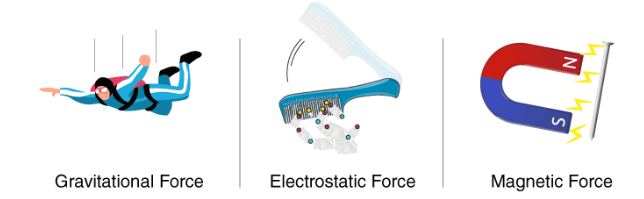
Field Forces or Range Forces (non-Contact Forces):
These are the forces in which contact between two objects is not necessary. Examples are
- Gravitational force between two bodies.
- Electrostatic force between two charges.
- Magnetic force between two objects.
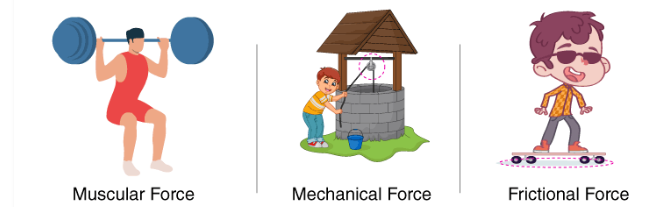
Contact Forces : Contact forces exist only as long as the objects are touching each other. Examples are
- Normal force
- Frictional force
Attachment to Another Body :
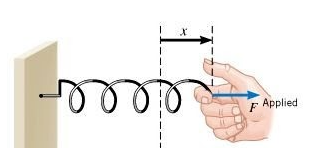
Tension \((\mathrm{T})\) in a string and spring force \(({F}={-kx})\) comes in this group. The spring force, described by Hooke’s Law, is a restoring force exerted by an ideal spring that is proportional to its displacement from its equilibrium position. It always acts in the opposite direction to the displacement, attempting to return the spring to its original shape. The force is calculated using the formula \(F=-k x\), where \(F\) is the spring force, \(k\) is the spring constant (a measure of stiffness), and \(x\) is the displacement from the equilibrium position.
Unit of Force
- In the centimeter gram second system of unit (CGS unit) force is expressed in dyne.
- In the standard international system of unit (SI unit) it is expressed in Newton (N).
Resolution of force into different components
If the force applied, imparts acceleration \(a\) to a body, then its components in \(X, Y\) and \(Z\)-axis are \(a=a_x \hat{\mathbf{i}}+a_y \hat{\mathbf{j}}+a_z \hat{\mathbf{k}}\). Components of force will be \(F_x, F_y\) and \(F_z\)
As, \(F=m a\)
\(
\Rightarrow \quad F_x \hat{\mathbf{i}}+F_y \hat{\mathbf{j}}+F_z \hat{\mathbf{k}}=m\left(a_x \hat{\mathbf{i}}+a_y \hat{\mathbf{j}}+a_z \hat{\mathbf{k}}\right)
\)
Thus,
\(
\begin{array}{l}
F_x=m a_x=m \frac{d v_x}{d t}=m \frac{d^2 x}{d t^2}=\frac{d p_x}{d t} \\
F_y=m a_y=m \frac{d v_y}{d t}=m \frac{d^2 y}{d t^2}=\frac{d p_y}{d t}
\end{array}
\)
\(
F_z=m a_z=m \frac{d v_z}{d t}=m \frac{d^2 z}{d t^2}=\frac{d p_z}{d t}
\)
The component form of Newton’s second law tells that if the applied force makes some angle with the velocity of the body, it changes the component of velocity along the direction of force. The component of velocity normal to the force remains unchanged.
Example 13: A force \(\mathbf{F}=(6 \hat{\mathbf{i}}-8 \hat{\mathbf{j}}+10 \hat{\mathbf{k}}) N\) produces acceleration of \(\sqrt{2} \mathrm{~ms}^{-2}\) in a body. Calculate the mass of the body.
Solution: \(\because\) Acceleration, \(a=\frac{|\mathrm{F}|}{m}\)
\(
\Rightarrow \text { Mass, } m=\frac{|\mathbf{F}|}{a}=\frac{\sqrt{6^2+8^2+10^2}}{\sqrt{2}}=10 \mathrm{~kg}
\)
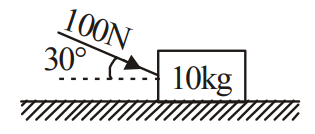
Example 14: A force of \(100 \mathrm{~N}\) acts in the direction as shown in figure on a block of mass \(10 \mathrm{~kg}\) resting on a smooth horizontal table. The speed acquired by the block after it has .moved a distance of \(10 \mathrm{~m}\), will be
\(
\left(\mathrm{g}=10 \mathrm{~m} / \mathrm{sec}^2\right)
\)
Solution:
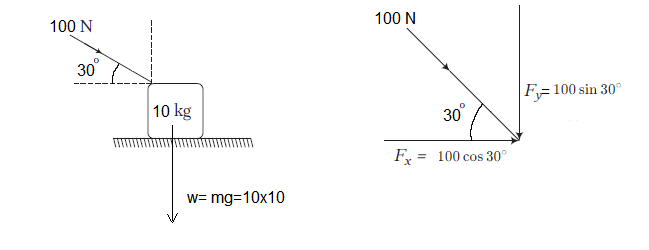
The force of \(100 \mathrm{~N}\) has
Horizontal component of the force \(=100 \cos 30^{\circ}=50 \sqrt{3} \mathrm{~N}\) and
Vertical component of the force \(=100 \sin 30^{\circ}=50 \mathrm{~N}\)
Since the block is always in contact with the table, the net vertical force(Resultant)
\(
\mathrm{F_r}=\mathrm{mg}+\mathrm{F} \sin \theta=(10 \times 10+50) \mathrm{N}=150 \mathrm{~N}
\)
\(
\text { Work }=\text { Force } \mathbf{x} \text { Displacement }
\)
When the block moves along the table, work is done by the horizontal component of the force. Since the distance moves is \(10 \mathrm{~m}\), the work done is
\(50 \sqrt{3} \times 10=500 \sqrt{3}\) Joule.
If \(v\) is the speed acquired by the block, the work done must be equal to the kinetic energy of the block. Therefore, we have
\(500 \sqrt{3}=\frac{1}{2} \times 10 \times {v}^2 \Rightarrow {v}^2=100 \sqrt{3} \Rightarrow \mathrm{v}=13.17 \mathrm{~m} / \mathrm{sec}\)
Example 15: \(A\) force \(\mathbf{F}=\left(2 t \hat{\mathbf{i}}+3 t^2 \hat{\mathbf{j}}\right) N\) acts on an object moving in XY-plane. Find magnitude of change in momentum of the object in time interval \(t=0\) to \(t=2 \mathrm{~s}\).
Solution: Given, \(\mathbf{F}=\left(2 t \hat{\mathbf{i}}+3 t^2 \hat{\mathbf{j}}\right) N \Rightarrow \frac{d \mathbf{p}}{d t}=2 t \hat{\mathbf{i}}+3 t^2 \hat{\mathbf{j}}\)
\(
d \mathbf{p}=2 t d t \hat{\mathbf{i}}+3 t^2 d t \hat{\mathbf{j}}
\)
\(
\begin{aligned}
\int d \mathbf{p} & =2 \int_0^2 t d t \hat{\mathbf{i}}+3 \int_0^2 t^2 d \hat{\mathbf{j}} \\
\Delta \mathbf{p} & =\left[t^2\right]_0^2 \hat{\mathbf{i}}+\left[t^3\right]_0^2 \hat{\mathbf{j}} \\
\Delta \mathbf{p} & =4 \hat{\mathbf{i}}+8 \hat{\mathbf{j}} \\
|\Delta \mathbf{p}| & =\sqrt{16+64}=\sqrt{80} \approx 9 \mathrm{~kg} \mathrm{~ms}^{-1}
\end{aligned}
\)