Conceptual PCQs
- Scalar quantities are quantities with magnitudes only. Examples are distance, speed, mass and temperature.
- Vector quantities are quantities with magnitude and direction both. Examples are displacement, velocity and acceleration. They obey special rules of vector algebra.
- A vector \(\mathbf{A}\) multiplied by a real number \(\lambda\) is also a vector, whose magnitude is \(\lambda\) times the magnitude of the vector \(\mathbf{A}\) and whose direction is the same or opposite depending upon whether \(\lambda\) is positive or negative.
- Two vectors \(\mathbf{A}\) and \(\mathbf{B}\) may be added graphically using head-to-tail method or parallelogram method.
- Vector addition is commutative :
\(
\mathbf{A}+\mathbf{B}=\mathbf{B}+\mathbf{A}
\)
It also obeys the associative law:
\(
(\mathbf{A}+\mathbf{B})+\mathbf{C}=\mathbf{A}+(\mathbf{B}+\mathbf{C})
\) - A null or zero vector is a vector with zero magnitude. Since the magnitude is zero, we don’t have to specify its direction. It has the properties :
\(
\begin{aligned}
\mathbf{A}+\mathbf{0} & =\mathbf{A} \\
\lambda \mathbf{~0} & =\mathbf{0} \\
0 \mathbf{~A} & =\mathbf{0}
\end{aligned}
\) - The subtraction of vector \(\mathbf{B}\) from \(\mathbf{A}\) is defined as the sum of \(\mathbf{A}\) and \(-\mathbf{B}\) :
\(
\mathbf{A}-\mathbf{B}=\mathbf{A}+(-\mathbf{B})
\) - A vector \(\mathbf{A}\) can be resolved into component along two given vectors \(\mathbf{a}\) and \(\mathbf{b}\) lying in the same plane :
\(
\mathbf{A}=\lambda \mathbf{a}+\mu \mathbf{b}
\)
where \(\lambda\) and \(\mu\) are real numbers. - A unit vector associated with a vector \(\mathbf{A}\) has magnitude 1 and is along the vector \(\mathbf{A}\) :
\(
\hat{\mathbf{n}}=\frac{\mathbf{A}}{|\mathbf{A}|}
\)
The unit vectors \(\hat{\mathbf{i}}, \hat{\mathbf{j}}, \hat{\mathbf{k}}\) are vectors of unit magnitude and point in the direction of - A vector A can be expressed as
\(
\mathbf{A}=A_x \hat{\mathbf{i}}+A_y \hat{\mathbf{j}}
\)
where \(A_x, A_y\) are its components along \(x\)-, and \(y\)-axes. If vector \(\mathbf{A}\) makes an angle \(\theta\) with the \(x\)-axis, then \(A_x=A \cos \theta, A_y=A \sin \theta\) and \(A=|\mathbf{A}|=\sqrt{A_x^2+A_y^2}, \tan \theta=\frac{A_y}{A_x}\). - Vectors can be conveniently added using analytical method. If sum of two vectors \(\mathbf{A}\) and \(\mathbf{B}\), that lie in \(x-y\) plane, is \(\mathbf{R}\), then :
\(\mathbf{R}=R_x \hat{\mathbf{i}}+R_y \hat{\mathbf{j}}\), where, \(R_x=A_x+B_x\), and \(R_y=A_y+B_y\) - The position vector of an object in \(x-y\) plane is given by \(\mathbf{r}=x \hat{\mathbf{i}}+y \hat{\mathbf{j}}\) and the displacement from position \(\mathbf{r}\) to position \(\mathbf{r}^{\prime}\) is given by
\(
\begin{aligned}
& \Delta \mathbf{r}=\mathbf{r}^{\prime}-\mathbf{r} \\
& =\left(x^{\prime}-x\right) \hat{\mathbf{i}}+\left(y^{\prime}-y\right) \hat{\mathbf{j}} \\
& =\Delta x \hat{\mathbf{i}}+\Delta y \hat{\mathbf{j}}
\end{aligned}
\) - If an object undergoes a displacement \(\Delta \mathbf{r}\) in time \(\Delta t\), its average velocity is given by \(\overline{\mathbf{v}}=\frac{\Delta \mathbf{r}}{\Delta t}\). The velocity of an object at time \(t\) is the limiting value of the average velocity as \(\Delta t\) tends to zero :
\(\mathbf{v}=\lim _{\Delta \mathrm{t} \rightarrow 0} \frac{\Delta \mathbf{r}}{\Delta t}=\frac{\mathrm{d} \mathbf{r}}{\mathrm{d} t}\). It can be written in unit vector notation as :
\(\mathbf{v}=v_x \hat{\mathbf{i}}+v_y \hat{\mathbf{j}}+v_z \hat{\mathbf{k}} \quad\) where \(\quad v_x=\frac{\mathrm{d} x}{\mathrm{~d} t}, v_y=\frac{\mathrm{d} y}{\mathrm{~d} t}, v_z=\frac{\mathrm{d} z}{\mathrm{~d} t}\)
When position of an object is plotted on a coordinate system, \(\mathbf{v}\) is always tangent to the curve representing the path of the object.
14. If the velocity of an object changes from \(\mathbf{v}\) to \(\mathbf{v}^{\prime}\) in time \(\Delta t\), then its average acceleration is given by: \(\overline{\mathbf{a}}=\frac{\mathbf{v}-\mathbf{v}^{\prime}}{\Delta t}=\frac{\Delta \mathbf{v}}{\Delta t}\)
The acceleration \(\mathbf{a}\) at any time \(t\) is the limiting value of \(\overline{\mathbf{a}}\) as \(\Delta t \rightarrow 0\) :
\(
\mathbf{a}=\lim _{\Delta t \rightarrow 0} \frac{\Delta \mathbf{v}}{\Delta t}=\frac{\mathrm{d} \mathbf{v}}{\mathrm{~d} t}
\)
In component form, we have : \(\mathbf{a}=a_x \hat{\mathbf{i}}+a_y \hat{\mathbf{j}}+a_z \hat{\mathbf{k}}\) where, \(a_x=\frac{d v_x}{d t}, a_y=\frac{d v_y}{d t}, a_z=\frac{d v_z}{d t}\) - If an object is moving in a plane with constant acceleration \(a=|\mathbf{a}|=\sqrt{a_x^2+a_y^2}\) and its position vector at time \(t=0\) is \(\mathbf{I}_{\mathrm{o}}\), then at any other time \(t\), it will be at a point given by:
\(
\mathbf{r}=\mathbf{r}_{\mathrm{o}}+\mathbf{v}_{\mathrm{o}} t+\frac{1}{2} \mathbf{a} t^2
\)
and its velocity is given by :
\(
\mathbf{v}=\mathbf{v}_0+\mathbf{a} t
\)
where \(\mathbf{v}_{\mathrm{o}}\) is the velocity at time \(t=0\)
In component form :
\(
\begin{aligned}
& x=x_o+v_{o x} t+\frac{1}{2} a_x t^2 \\
& y=y_o+v_{o y} t+\frac{1}{2} a_y t^2 \\
& v_x=v_{o x}+a_x t \\
& v_y=v_{o y}+a_y t
\end{aligned}
\)
Motion in a plane can be treated as superposition of two separate simultaneous onedimensional motions along two perpendicular directions - An object that is in flight after being projected is called a projectile. If an object is projected with initial velocity \(\mathbf{v}_{\mathrm{o}}\) making an angle \(\theta_{\mathrm{o}}\) with \(x\)-axis and if we assume its initial position to coincide with the origin of the coordinate system, then the position and velocity of the projectile at time \(t\) are given by :
\(
\begin{gathered}
\text { Horizontal displacement } x=\left(v_o \cos \theta_o\right) t \\
y=\left(v_o \sin \theta_o\right) t-(1 / 2) g t^2 \\
v_x=v_{o x}=v_o \cos \theta_o \\
v_y=v_o \sin \theta_o-g t
\end{gathered}
\)
The path of a projectile is parabolic and is given by (vertical displacement):
\(
y=\left(\tan \theta_0\right) x-\frac{g x^2}{2\left(v_o \cos \theta_o\right)^2}
\)
The maximum height that a projectile attains is :
\(
h_m=\frac{\left(v_o \sin \theta_o\right)^2}{2 g}
\)
The time taken to reach maximum height is :
\(
t_m=\frac{v_o \sin \theta_o}{g}
\)
Time of flight, \(T=\frac{2 v_0 \sin \theta_o}{g}\)
The horizontal distance travelled by a projectile from its initial position to the position it passes \(y=0\) during its fall is called the range, \(R\) of the projectile. It is :
\(
R=\frac{v_o^2}{g} \sin 2 \theta_o
\) - When an object follows a circular path at constant speed, the motion of the object is called uniform circular motion. The magnitude of its acceleration is \(a_c=v^2 / R\). The direction of \(a_c\) is always towards the centre of the circle.
The angular speed \(\omega\), is the rate of change of angular distance. It is related to velocity \(v\) by \(v=\omega R\). The acceleration is \(a_c=\omega^2 R\).
If \(T\) is the time period of revolution of the object in circular motion and \(f\) is its frequency, we have \(\omega=2 \pi f, v=2 \pi f R, a_c=4 \pi^2 f^2 R\)
Quiz Summary
0 of 37 Questions completed
Questions:
Information
You have already completed the quiz before. Hence you can not start it again.
Quiz is loading…
You must sign in or sign up to start the quiz.
You must first complete the following:
Results
Results
0 of 37 Questions answered correctly
Your time:
Time has elapsed
You have reached 0 of 0 point(s), (0)
Earned Point(s): 0 of 0, (0)
0 Essay(s) Pending (Possible Point(s): 0)
Categories
- Not categorized 0%
- 1
- 2
- 3
- 4
- 5
- 6
- 7
- 8
- 9
- 10
- 11
- 12
- 13
- 14
- 15
- 16
- 17
- 18
- 19
- 20
- 21
- 22
- 23
- 24
- 25
- 26
- 27
- 28
- 29
- 30
- 31
- 32
- 33
- 34
- 35
- 36
- 37
- Current
- Review
- Answered
- Correct
- Incorrect
- Question 1 of 37
1. Question
A driver takes 0.20 s to apply the brakes after he sees a need for it. This is called the reaction time of the driver. If he is driving a car at a speed of \(54 \mathrm{~km} / \mathrm{h}\) and the brakes cause a deceleration of \(6.0 \mathrm{~m} / \mathrm{s}^2\), find the distance travelled by the car after he sees the need to put the brakes on.
CorrectIncorrectHint
(d) Step 1: Convert the speed to the correct units
The initial speed is given in kilometers per hour ( \(54 \mathrm{~km} / \mathrm{h}\) ), but the deceleration is in meters per second squared. To keep the units consistent, convert the speed from km/h to \(\mathrm{m} / \mathrm{s}\).
The conversion factor is \(1 \mathrm{~km}=1000 \mathrm{~m}\) and \(1 \mathrm{~h}=3600 \mathrm{~s}\).
\(
v=54 \frac{\mathrm{~km}}{\mathrm{~h}} \times \frac{1000 \mathrm{~m}}{1 \mathrm{~km}} \times \frac{1 \mathrm{~h}}{3600 \mathrm{~s}}=15 \mathrm{~m} / \mathrm{s}
\)
Step 2: Calculate the distance traveled during reaction time
During the reaction time ( 0.20 s ), the car travels at a constant speed of \(15 \mathrm{~m} / \mathrm{s}\) before the brakes are applied. The distance traveled during this time is calculated using the formula \(d=v \times t\).
\(
d_{\text {reaction }}=(15 \mathrm{~m} / \mathrm{s}) \times(0.20 \mathrm{~s})=3.0 \mathrm{~m}
\)
Step 3: Calculate the distance traveled while braking
Once the brakes are applied, the car decelerates from an initial speed of \(15 \mathrm{~m} / \mathrm{s}\) to a final speed of \(0 \mathrm{~m} / \mathrm{s}\). The deceleration is given as \(6.0 \mathrm{~m} / \mathrm{s}^2\), which means the acceleration is \(-6.0 \mathrm{~m} / \mathrm{s}^2\). The distance traveled while braking can be found using the kinematic equation \(v_f^2=v_i^2+2 a d\).
\(
\begin{gathered}
0^2=(15 \mathrm{~m} / \mathrm{s})^2+2\left(-6.0 \mathrm{~m} / \mathrm{s}^2\right) d_{\text {braking }} \\
0=225 \mathrm{~m}^2 / \mathrm{s}^2-\left(12.0 \mathrm{~m} / \mathrm{s}^2\right) d_{\text {braking }} \\
\left(12.0 \mathrm{~m} / \mathrm{s}^2\right) d_{\text {braking }}=225 \mathrm{~m}^2 / \mathrm{s}^2 \\
d_{\text {braking }}=\frac{225 \mathrm{~m}^2 / \mathrm{s}^2}{12.0 \mathrm{~m} / \mathrm{s}^2}=18.75 \mathrm{~m}
\end{gathered}
\)
The total distance traveled is the sum of the distance traveled during the reaction time and the distance traveled while braking.
\(
\begin{gathered}
d_{\text {total }}=d_{\text {reaction }}+d_{\text {braking }} \\
d_{\text {total }}=3.0 \mathrm{~m}+18.75 \mathrm{~m}=21.75 \mathrm{~m}
\end{gathered}
\)
The total distance traveled by the car after the driver sees the need to put the brakes on is \(\mathbf{2 1 . 7 5 ~ m}\). - Question 2 of 37
2. Question
A police jeep is chasing a culprit going on a motorbike. The motorbike crosses a turning at a speed of \(72 \mathrm{~km} / \mathrm{h}\). The jeep follows it at a speed of \(90 \mathrm{~km} / \mathrm{h}\), crossing the turning ten seconds later than the bike. Assuming that they travel at constant speeds, how far from the turning will the jeep catch up with the bike?
CorrectIncorrectHint
(a) Step 1: Convert speeds to meters per second
First, convert the speeds of the motorbike and the jeep from kilometers per hour (km/h) to meters per second \((\mathrm{m} / \mathrm{s})\) for consistent units. The conversion factor is \(\frac{5}{18}\).
Motorbike speed \(\left(v_b\right)\) :
\(
v_b=72 \mathrm{~km} / \mathrm{h} \times \frac{5}{18} \mathrm{~m} / \mathrm{s}=20 \mathrm{~m} / \mathrm{s}
\)
Jeep speed ( \(v_j\) ):
\(
v_j=90 \mathrm{~km} / \mathrm{h} \times \frac{5}{18} \mathrm{~m} / \mathrm{s}=25 \mathrm{~m} / \mathrm{s}
\)
Step 2: Set up the equations for distance and time
Let \(t_j\) be the time (in seconds) the jeep travels from the turning point until it catches the bike. The motorbike crossed the turning 10 seconds earlier, so the time the motorbike has been traveling is \(\boldsymbol{t}_{\boldsymbol{b}}=\boldsymbol{t}_{\boldsymbol{j}}+10\).
The distance from the turning point for both vehicles can be expressed using the formula \(d=v \times t\). When the jeep catches the bike, they will have traveled the same distance ( \(d\) ).
Distance traveled by the jeep: \(d=v_j \times t_j=25 t_j\)
Distance traveled by the motorbike: \(d=v_b \times t_b=20\left(t_j+10\right)\)
Step 3: Solve for the time and distance
Set the two distance equations equal to each other to find the time \(\left(t_j\right)\) it takes for the jeep to catch the bike.
\(
\begin{gathered}
25 t_j=20\left(t_j+10\right) \\
25 t_j=20 t_j+200 \\
5 t_j=200 \\
t_j=40 \mathrm{~s}
\end{gathered}
\)
Now, use this time to find the distance ( \(d\) ) from the turning point.
\(
d=25 \mathrm{~m} / \mathrm{s} \times 40 \mathrm{~s}=1000 \mathrm{~m}
\)
To express the answer in kilometers, divide by 1000.
\(
d=1000 \mathrm{~m}=1 \mathrm{~km}
\)
The jeep will catch up with the bike at a distance of \(\mathbf{1} \mathbf{~ k m}\) from the turning. - Question 3 of 37
3. Question
A car travelling at \(60 \mathrm{~km} / \mathrm{h}\) overtakes another car travelling at \(42 \mathrm{~km} / \mathrm{h}\). Assuming each car to be 5.0 m long, find the time taken during the overtake and the total road distance used for the overtake.
CorrectIncorrectHint
(c) Step 1: Convert speeds to consistent units
The speeds are given in kilometers per hour (km/h), and the length of the cars is in meters (m). To perform the calculations, we convert the speeds to meters per second ( \(\mathrm{m} / \mathrm{s}\) ).
Speed of the overtaking car (Car A) ( \(v_1\) ):
\(
v_1=60 \mathrm{~km} / \mathrm{h}=60 \times \frac{1000 \mathrm{~m}}{3600 \mathrm{~s}}=\frac{60 \times 5}{18} \mathrm{~m} / \mathrm{s}=\frac{50}{3} \mathrm{~m} / \mathrm{s} \approx 16.67 \mathrm{~m} / \mathrm{s}
\)
Speed of the overtaken car (Car B) ( \(v_2\) ):
\(
v_2=42 \mathrm{~km} / \mathrm{h}=42 \times \frac{1000 \mathrm{~m}}{3600 \mathrm{~s}}=\frac{42 \times 5}{18} \mathrm{~m} / \mathrm{s}=\frac{35}{3} \mathrm{~m} / \mathrm{s} \approx 11.67 \mathrm{~m} / \mathrm{s}
\)
Step 2: Calculate the time taken for the overtake
The time taken for the overtake depends on the relative speed of the two cars and the total distance that needs to be covered to complete the maneuver. The total distance for the overtake is the sum of the lengths of the two cars, as the overtaking car must travel its own length plus the length of the other car to completely pass it.
Relative speed ( \(v_{\text {rel }}\) ):
\(
v_{\text {rel }}=v_1-v_2=\frac{50}{3} \mathrm{~m} / \mathrm{s}-\frac{35}{3} \mathrm{~m} / \mathrm{s}=\frac{15}{3} \mathrm{~m} / \mathrm{s}=5.0 \mathrm{~m} / \mathrm{s}
\)
Total distance to cover ( \(d_{\text {rel }}\) )
\(
d_{r e l}=\text { length of car } 1+\text { length of car } 2=5.0 \mathrm{~m}+5.0 \mathrm{~m}=10.0 \mathrm{~m}
\)
Time taken ( \(t\) ):
\(
t=\frac{d_{\mathrm{rel}}}{v_{\mathrm{rel}}}=\frac{10.0 \mathrm{~m}}{5.0 \mathrm{~m} / \mathrm{s}}=2.0 \mathrm{~s}
\)
Step 3: Calculate the total road distance used for the overtake
The total road distance used for the overtake is the distance the faster car travels during the time calculated in the previous step.
Distance traveled by the overtaking car ( \(d_{\text {total }}\) ):
\(
d_{\text {total }}=v_1 \times t=\frac{50}{3} \mathrm{~m} / \mathrm{s} \times 2.0 \mathrm{~s}=\frac{100}{3} \mathrm{~m} \approx 33.3 \mathrm{~m}
\)
The time taken during the overtake is \(\mathbf{2 . 0 ~ s}\) and the total road distance used for the overtake is \(\mathbf{3 3 . 3 ~ m}\).
Now, the Distance travelled while overtaking= distance travelled in 2 seconds by car A + length of car B.
\(
\frac{100}{3}+5 \Rightarrow 33.3+5 \therefore 38.33 \mathrm{~m}
\) - Question 4 of 37
4. Question
A person sitting on the top of a tall building is dropping balls at regular intervals of one second. Find the positions of the 3rd, 4th and 5th ball when the 6th ball is being dropped.
CorrectIncorrectHint
(b) Newton’s equation of motion to find the distance traveled by an object is given by
\(
s=u t+\frac{1}{2} a t^2
\)
Here, \(u\) is the initial velocity, \(t\) is the time taken to attain the final velocity, or it can also be defined as the time taken to travel the distance \(s\) and \(a\) is the acceleration due to gravity.
In this case, as the ball is being dropped and the ball falls under gravity, the acceleration will be the acceleration due to gravity. Substituting that into the equation gives us
\(
s=u t+\frac{1}{2} g t^2
\)
As the body is dropped, the initial velocity is always zero. Therefore,
\(
s=\frac{1}{2} g t^2
\)
By the time the sixth ball is dropped, six seconds have already passed. So the time passed when the sixth ball has been dropped for the third ball will be 3 sec , for the fourth ball will be 2 sec and for the fifth ball will be 1 sec.
Therefore, the position of the third ball will be computed with time \(t=3 \mathrm{sec}\).
\(
\begin{aligned}
& s_3=\frac{1}{2} \times 9.8 \times 3^2 \\
& \Rightarrow s_3=44.1 \mathrm{~m}
\end{aligned}
\)
The position of the fourth ball will be computed with time \(t=2 \mathrm{sec}\).
\(
\begin{aligned}
& s_4=\frac{1}{2} \times 9.8 \times 2^2 \\
& \Rightarrow s_4=19.6 \mathrm{~m}
\end{aligned}
\)
The position of the fifth ball will be computed with time \(t=1 \mathrm{sec}\).
\(
\begin{aligned}
& s_5=\frac{1}{2} \times 9.8 \times 1^2 \\
& \Rightarrow s_5=4.9 \mathrm{~m}
\end{aligned}
\)
Therefore, the distance traveled by the third, the fourth, and the fifth ball by the time the sixth ball is dropped is \(44.1 m, 19.6 m\), and \(4.9 m\) respectively. - Question 5 of 37
5. Question
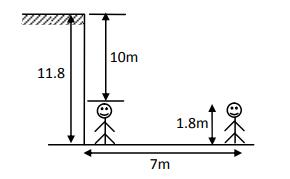
A healthy youngman standing at a distance of 7 m from a 11.8 m high building sees a kid slipping from the top floor. With what speed (assumed uniform) should he run to catch the kid at the arms height \((1.8 \mathrm{~m})\) ?
CorrectIncorrectHint
(b)

Step 1: Calculate the time it takes for the kid to fall
The kid falls a vertical distance equal to the height of the building minus the height at which the kid is caught. The initial velocity of the kid is 0 . We can use the kinematic equation for free fall to find the time of descent, \(t\). We will use the standard value for the acceleration due to gravity, \(g=9.8 \mathrm{~m} / \mathrm{s}^2\).
The distance the kid falls is:
\(
d=11.8 \mathrm{~m}-1.8 \mathrm{~m}=10 \mathrm{~m}
\)
The kinematic equation is:
\(
d=v_0 t+\frac{1}{2} g t^2
\)
Since \(v_0=0\), the equation simplifies to:
\(
d=\frac{1}{2} g t^2
\)
Now we solve for \(t\) :
\(
\begin{gathered}
10=\frac{1}{2}(9.8) t^2 \\
10=4.9 t^2 \\
t^2=\frac{10}{4.9} \approx 2.0408 \\
t=\sqrt{2.0408} \approx 1.428 \mathrm{~s}
\end{gathered}
\)
Step 2: Calculate the uniform speed of the young man
The young man needs to run a horizontal distance of 7 m in the same amount of time it takes for the kid to fall. Using the formula for uniform speed:
\(
v=\frac{\text { distance }}{\text { time }}
\)
We plug in the values for distance and time:
\(
v=\frac{7 \mathrm{~m}}{1.428 \mathrm{~s}} \approx 4.9 \mathrm{~m} / \mathrm{s}
\)
The young man should run with a uniform speed of approximately \(4.9 \mathrm{~m} / \mathrm{s}\) to catch the kid. - Question 6 of 37
6. Question
An NCC parade is going at a uniform speed of \(6 \mathrm{~km} / \mathrm{h}\) through a place under a berry tree on which a bird is sitting at a height of 12.1 m. At a particular instant the bird drops a berry. Which cadet (give the distance from the tree at the instant) will receive the berry on his uniform?
CorrectIncorrectHint
(c) Step 1: Calculate the time for the berry to fall
The berry is dropped from rest, so its initial vertical velocity ( \(v_0\) ) is \(0 \mathrm{~m} / \mathrm{s}\). The acceleration is due to gravity \((g)\), which is approximately \(9.8 \mathrm{~m} / \mathrm{s}^2\). The height \((h)\) is 12.1 m.
Using the kinematic equation for free fall: \(h=v_0 t+\frac{1}{2} g t^2\).
Since \(v_0=0\) :
\(
\begin{gathered}
h=\frac{1}{2} g t^2 \\
12.1 \mathrm{~m}=\frac{1}{2}\left(9.8 \mathrm{~m} / \mathrm{s}^2\right) t^2 \\
12.1=4.9 t^2 \\
t^2=\frac{12.1}{4.9} \approx 2.469 \mathrm{~s}^2 \\
t=\sqrt{2.469} \approx 1.571 \mathrm{~s}
\end{gathered}
\)
Step 2: Convert the parade’s speed
The speed of the NCC parade is given as \(6 \mathrm{~km} / \mathrm{h}\). To be consistent with the units used for gravity and height, we convert this to meters per second.
\(
v=6 \mathrm{~km} / \mathrm{h} \times \frac{1000 \mathrm{~m}}{1 \mathrm{~km}} \times \frac{1 \mathrm{~h}}{3600 \mathrm{~s}}=\frac{6000}{3600} \mathrm{~m} / \mathrm{s}=\frac{5}{3} \mathrm{~m} / \mathrm{s} \approx 1.667 \mathrm{~m} / \mathrm{s}
\)
Step 3: Calculate the distance the parade moves
The cadet who receives the berry will be the one who is directly under the tree when the berry lands. The distance traveled by the parade in the time it takes for the berry to fall is given by:
Distance \(=\) speed \(\times\) time
Distance \(=v \times t\)
Distance \(\approx 1.667 \mathrm{~m} / \mathrm{s} \times 1.571 \mathrm{~s}\)
Distance \(\approx 2.619 \mathrm{~m}\)
The cadet who receives the berry will be approximately 2.62 meters from the base of the tree at the instant the berry is dropped. - Question 7 of 37
7. Question
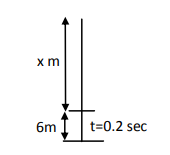
A ball is dropped from a height. If it takes 0.200 s to cross the last 6.00 m before hitting the ground, find the height from which it was dropped. Take \(g=10 \mathrm{~m} / \mathrm{s}^2\).
CorrectIncorrectHint
(d)

Step 1: Find the velocity at the start of the last 6.00 m
We can use the kinematic equation for displacement to find the initial velocity \(\left(v_i\right)\) for the last 6.00 m of the fall. The variables are:
Displacement, \(h=6.00 \mathrm{~m}\)
Time, \(t=0.200 \mathrm{~s}\)
Acceleration, \(g=10 \mathrm{~m} / \mathrm{s}^2\)
The equation is \(h=v_i t+\frac{1}{2} g t^2\). Rearranging to solve for \(v_i\) :
\(
v_i=\frac{h-\frac{1}{2} g t^2}{t}
\)
Substitute the values:
\(
v_i=\frac{6.00-\frac{1}{2}(10)(0.200)^2}{0.200}=\frac{6.00-5(0.0400)}{0.200}=\frac{6.00-0.200}{0.200}=\frac{5.80}{0.200}=29.0 \mathrm{~m}/ \mathrm{s}
\)
This is the velocity of the ball when it has 6.00 m left to fall.
Step 2: Find the total height from which the ball was dropped
Now we can consider the entire fall from the initial height (H). The initial velocity is 0 , and the final velocity is the velocity we just calculated ( \(v_i=29.0 \mathrm{~m} / \mathrm{s}\) ) at a height of 6.00 m above the ground.
We can use the kinematic equation \(v_f^2=v_0^2+2 g H\). In this case, \(v_0=0\). The final velocity is \(29.0 \mathrm{~m} / \mathrm{s}\), but this is the velocity at the beginning of the last 6.00 m. So we can calculate the height from which the ball was dropped to reach that velocity.
The equation is \(\boldsymbol{v}^2=2 g(\boldsymbol{H}-6.00)\). Rearranging for \(\boldsymbol{H}\) :
\(
H=6.00+\frac{v^2}{2 g}
\)
Substitute the values:
\(
H=6.00+\frac{(29.0)^2}{2(10)}=6.00+\frac{841}{20}=6.00+42.05=48.05 \mathrm{~m}
\)
The height from which the ball was dropped is \(\mathbf{4 8 . 0 5 ~ m}\). - Question 8 of 37
8. Question
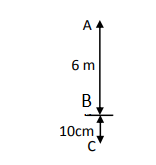
A ball is dropped from a height of 5 m onto a sandy floor and penetrates the sand up to 10 cm before coming to rest. Find the retardation of the ball in sand assuming it to be uniform.
CorrectIncorrectHint
(a)

Step 1: Find the velocity of the ball just before it hits the sand
First, we need to determine the velocity of the ball after it has fallen a height of 5 m. We can use the third equation of motion, assuming an initial velocity of \(0 \mathrm{~m} / \mathrm{s}\) and acceleration due to gravity, \(g=9.8 \mathrm{~m} / \mathrm{s}^2\).
Using the formula \(v^2=u^2+2 a s\) :
\(
v_1^2=u_1^2+2 g s_1
\)
Here, \(u_1=0 \mathrm{~m} / \mathrm{s}, g=9.8 \mathrm{~m} / \mathrm{s}^2\), and \(s_1=5 \mathrm{~m}\).
\(
\begin{gathered}
v_1^2=0^2+2(9.8)(5) \\
v_1^2=98
\end{gathered}
\)
The velocity just before hitting the sand is \(v_1=\sqrt{98} \mathrm{~m} / \mathrm{s}\).
Step 2: Find the retardation of the ball inside the sand
Now, we use the velocity from the previous step as the initial velocity for the ball’s motion inside the sand. The ball penetrates a distance of 10 cm, which is 0.10 m , and comes to rest, so the final velocity is \(\mathbf{0}\). We can use the same kinematic equation to find the acceleration (retardation) inside the sand.
Using the formula \(v^2=u^2+2 a s\) :
\(
v_2^2=u_2^2+2 a_2 s_2
\)
Here, \(v_2=0 \mathrm{~m} / \mathrm{s}, u_2=v_1=\sqrt{98} \mathrm{~m} / \mathrm{s}\), and \(s_2=0.10 \mathrm{~m}\).
\(
\begin{gathered}
0^2=(\sqrt{98})^2+2\left(a_2\right)(0.10) \\
0=98+0.20 a_2 \\
-98=0.20 a_2 \\
a_2=\frac{-98}{0.20} \\
a_2=-490 \mathrm{~m} / \mathrm{s}^2
\end{gathered}
\)
The negative sign indicates that the acceleration is in the opposite direction of motion, which is retardation.
The retardation of the ball in the sand is \(490 \mathrm{~m} / \mathrm{s}^2\). - Question 9 of 37
9. Question
An elevator is descending with uniform acceleration. To measure the acceleration, a person in the elevator drops a coin at the moment the elevator starts. The coin is 6 ft above the floor of the elevator at the time it is dropped. The person observes that the coin strikes the floor in 1 second. Calculate from these data the acceleration of the elevator.
CorrectIncorrectHint
(c) Step 1: Set up the equations of motion
Let’s define a coordinate system where the positive direction is downwards and the origin is at the point where the coin is dropped. The acceleration due to gravity is approximately \(g=32.2 \mathrm{ft} / \mathrm{s}^2\). The elevator starts from rest, so its initial velocity is 0. The coin is also dropped from rest relative to the elevator, so its initial velocity is also 0.
The position of the coin at time \(t\) is given by:
\(
y_{\text {coin }}(t)=\frac{1}{2} g t^2
\)
The position of the elevator floor at time \(\boldsymbol{t}\) is given by its initial position ( 6 ft below the drop point) plus its displacement:
\(
y_{\text {floor }}(t)=6+\frac{1}{2} a_e t^2
\)
where \(a_e\) is the downward acceleration of the elevator.
Step 2: Solve for the acceleration of the elevator
The coin hits the floor when their positions are equal, which occurs at \(t=1\) second. We can set the two position equations equal to each other at this time:
\(
\begin{gathered}
y_{\text {coin }}(1)=y_{\text {floor }}(1) \\
\frac{1}{2} g(1)^2=6+\frac{1}{2} a_e(1)^2
\end{gathered}
\)
Substitute the value of \(g\) :
\(
\begin{gathered}
\frac{1}{2}(32.2)=6+\frac{1}{2} a_e \\
16.1=6+\frac{1}{2} a_e
\end{gathered}
\)
Subtract 6 from both sides:
\(
10.1=\frac{1}{2} a_e
\)
Multiply by 2 to solve for \(a_e\) :
\(
a_e=20.2 \mathrm{ft} / \mathrm{s}^2
\)
The acceleration of the elevator is \(20.2 \mathrm{ft} / \mathrm{s}^2\). - Question 10 of 37
10. Question
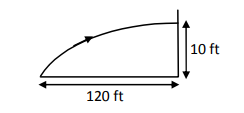
In a soccer practice session the football is kept at the centre of the field 40 yards from the 10 ft high goalposts. A goal is attempted by kicking the football at a speed of \(64 \mathrm{ft} / \mathrm{s}\) at an angle of \(45^{\circ}\) to the horizontal. Will the ball reach the goal post?
CorrectIncorrectHint
(a)

\(\mathrm{g}=9.8 \mathrm{~m} / \mathrm{s}^2, 32.2 \mathrm{ft} / \mathrm{s}^2 ; 40 \mathrm{yd}=120 \mathrm{ft}\).
Horizontal range \(\mathrm{x}=120 \mathrm{ft}, \mathrm{u}=64 \mathrm{ft} / \mathrm{s}, \theta=45^{\circ}\) We know that horizontal range \(\mathrm{X}=\mathrm{u} \cos \theta \mathrm{t} \Rightarrow \mathrm{t}=\frac{\mathrm{x}}{\mathrm{u} \cos \theta}=\frac{120}{64 \cos 45^{\circ}}=2.65 \mathrm{sec}\).
\(
y=u \sin \theta(t)-1 / 2 g t^2=64 \frac{1}{\sqrt{2}(2.65)}-\frac{1}{2}(32.2)(2.65)^2
\)
\(=7.08 \mathrm{ft}\) which is less than the height of goal post.
In time 2.65, the ball travels horizontal distance \(120 \mathrm{ft}(40 \mathrm{yd})\) and vertical height 7.08 ft which is less than 10 ft . The ball will reach the goal post. - Question 11 of 37
11. Question
A popular game in Indian villages is goli which is played with small glass balls called golis. The goli of one player is situated at a distance of 2.0 m from the goli of the second player. This second player has to project his goli by keeping the thumb of the left hand at the place of his goli, holding the goli between his two middle fingers and making the throw. If the projected goli hits the goli of the first player, the second player wins. If the height from which the goli is projected is 19.6 cm from the ground and the goli is to be projected horizontally, with what speed should it be projected so that it directly hits the stationary goli without falling on the ground earlier?
CorrectIncorrectHint
(b) Step 1: Convert height to meters
The height ( \(h\) ) is given as 19.6 cm.
\(h=19.6 \mathrm{~cm}=0.196 \mathrm{~m}\).
Step 2: Calculate the time of flight
The goli is projected horizontally, so its initial vertical velocity is zero.
Use the formula for free fall under gravity: \(h=\frac{1}{2} g t^2\), where \(g\) is the acceleration due to gravity \(\left(9.8 \mathrm{~m} / \mathrm{s}^2\right)\).
\(t=\sqrt{\frac{2 h}{g}}=\sqrt{\frac{2 \times 0.196 \mathrm{~m}}{9.8 \mathrm{~m} / \mathrm{s}^2}}=\sqrt{0.04 \mathrm{~s}^2}=0.2 \mathrm{~s}\).
Step 3: Calculate the required horizontal speed
The horizontal distance ( \(x\) ) the goli needs to travel is 2.0 m.
The relationship between horizontal distance, speed ( \(v\) ), and time ( \(t\) ) is \(x=v t\).
Therefore, the required speed is \(v=\frac{x}{t}\).
\(v=\frac{2.0 \mathrm{~m}}{0.2 \mathrm{~s}}=10 \mathrm{~m} / \mathrm{s}\). - Question 12 of 37
12. Question
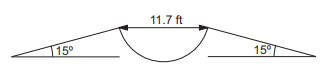
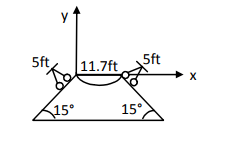
Figure below shows a 11.7 ft wide ditch with the approach roads at an angle of \(15^{\circ}\) with the horizontal. With what minimum speed should a motorbike be moving on the road so that it safely crosses the ditch ? Assume that the length of the bike is 5 ft, and it leaves the road when the front part runs out of the approach road.
 CorrectIncorrect
Hint
(d)

Determine the horizontal distance to be crossed:
The ditch is 11.7 ft wide. The motorbike has a length of 5 ft . For the entire bike to safely cross the ditch, the rear of the motorbike must land on the other side. This means the total horizontal distance the center of mass of the bike must travel is the width of the ditch plus the length of the bike.
\(
\begin{gathered}
x=\text { width of ditch + length of bike } \\
x=11.7 \mathrm{ft}+5 \mathrm{ft}=16.7 \mathrm{ft}
\end{gathered}
\)
\(
\begin{aligned}
&\begin{aligned}
& g=9.8 \mathrm{~m} / \mathrm{s}^2=32.2 \mathrm{ft} / \mathrm{s}^2 . \\
& y=x \tan \theta-\frac{g x^2 \sec ^2 \theta}{2 u^2}
\end{aligned}\\
&\text { To find, minimum speed for just crossing, the ditch }
\end{aligned}
\)
Here, \(g=32.2 \mathrm{ft} / \mathrm{s}^2\). The ditch is at the same elevation, so the vertical displacement \((y)\) is 0.
\(
\begin{aligned}
& \Rightarrow x \tan \theta=\frac{g x^2 \sec ^2 \theta}{2 u^2} \Rightarrow u^2=\frac{g x^2 \sec ^2 \theta}{2 x \tan \theta}=\frac{g x}{2 \sin \theta \cos \theta}=\frac{g x}{\sin 2 \theta} \\
& \Rightarrow u=\sqrt{\frac{(32.2)(16.7)}{1 / 2}}\left(\text { because } \sin 30^{\circ}=1 / 2\right) \\
& \Rightarrow u=32.8 \mathrm{ft} / \mathrm{s}
\end{aligned}
\) - Question 13 of 37
13. Question
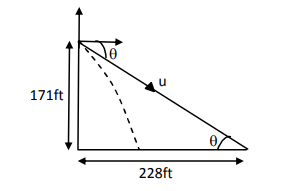
A person standing on the top of a cliff 171 ft high has to throw a packet to his friend standing on the ground 228 ft horizontally away. If he throws the packet directly aiming at the friend with a speed of \(15 \cdot 0 \mathrm{ft} / \mathrm{s}\), how short will the packet fall?
CorrectIncorrectHint
(a)

Step 1: Find the initial velocity components
The packet is thrown directly at the friend, so the initial velocity vector forms a rightangled triangle with the horizontal and vertical distances to the friend. The horizontal distance is \(x_{\text {friend }}=228 \mathrm{ft}\) and the vertical drop is \(y_{\text {drop }}=171 \mathrm{ft}\). The initial speed is \(v_0=15 \mathrm{ft} / \mathrm{s}\).
Let \(\theta\) be the angle of depression below the horizontal. We can find the components of the initial velocity, \(v_{0 x}\) and \(v_{0 y}\), using the geometry of the throw.
First, we can find the angle \(\boldsymbol{\theta}\) using the tangent function:
\(
\tan (\theta)=\frac{y_{\text {drop }}}{x_{\text {friend }}}=\frac{171}{228}=0.75
\)
We can also find the hypotenuse of the triangle formed by the cliff height and the horizontal distance:
\(
\text { hypotenuse }=\sqrt{(171)^2+(228)^2}=\sqrt{29241+51984}=\sqrt{81225}=285 \mathrm{ft}
\)
Now we can find the sine and cosine of the angle \(\boldsymbol{\theta}\) :
\(
\begin{aligned}
& \sin (\theta)=\frac{171}{285}=0.6 \\
& \cos (\theta)=\frac{228}{285}=0.8
\end{aligned}
\)
Finally, we can find the initial velocity components:
\(
\begin{gathered}
v_{0 x}=v_0 \cos (\theta)=(15 \mathrm{ft} / \mathrm{s})(0.8)=12 \mathrm{ft} / \mathrm{s} \\
v_{0 y}=-v_0 \sin (\theta)=-(15 \mathrm{ft} / \mathrm{s})(0.6)=-9 \mathrm{ft} / \mathrm{s}
\end{gathered}
\)
(The vertical component is negative because the initial velocity is directed downwards).
Step 2: Calculate the time of flight
To find the time the packet is in the air, we use the vertical motion equation. Let the cliff top be at \(y=171 \mathrm{ft}\) and the ground be at \(y=0 \mathrm{ft}\). The acceleration due to gravity is \(g=32.2 \mathrm{ft} / \mathrm{s}^2\).
\(
\begin{gathered}
y=y_0+v_{0 y} t+\frac{1}{2} a t^2 \\
0=171+(-9) t+\frac{1}{2}(-32.2) t^2 \\
0=171-9 t-16.1 t^2
\end{gathered}
\)
Rearranging into a quadratic equation form \(\left(a t^2+b t+c=0\right)\) :
\(
16.1 t^2+9 t-171=0
\)
Using the quadratic formula to solve for \(t\) :
\(
\begin{gathered}
t=\frac{-b \pm \sqrt{b^2-4 a c}}{2 a} \\
t=\frac{-9 \pm \sqrt{9^2-4(16.1)(-171)}}{2(16.1)}
\end{gathered}
\)
\(
\begin{aligned}
&\text { Since time cannot be negative, we take the positive root: }\\
&t=\frac{-9+105.27}{32.2}=\frac{96.27}{32.2} \approx 2.99 \mathrm{~s}
\end{aligned}
\)
Step 3: Calculate the horizontal distance the packet travels
Now we can use the time of flight to find the actual horizontal distance, \(x\), the packet travels. There is no horizontal acceleration, so the horizontal motion equation is:
\(
\begin{gathered}
x=x_0+v_{0 x} t \\
x=0+(12 \mathrm{ft} / \mathrm{s})(2.99 \mathrm{~s}) \\
x \approx 35.88 \mathrm{ft}
\end{gathered}
\)
Step 4: Find the difference
The packet’s horizontal travel distance is approximately 35.88 ft, while the friend is 228 ft away. The packet falls short by the difference:
\(
\text { Shortfall }=228 \mathrm{ft}-35.88 \mathrm{ft}=192.12 \mathrm{ft}
\)
The packet will fall short by approximately 192.12 ft. - Question 14 of 37
14. Question
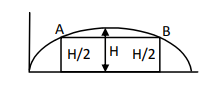
Find the average velocity of a projectile between the instants it crosses half the maximum height. It is projected with a speed \(u\) at an angle \(\theta\) with the horizontal.
CorrectIncorrectHint
(b)

\(
\begin{aligned}
& \text { Total of flight } T=\frac{2 u \sin \theta}{g} \\
& \text { Average velocity }=\frac{\text { change in displacement }}{\text { time }}
\end{aligned}
\)
From the figure, it can be said \(A B\) is horizontal. So there is no effect of vertical component of the velocity during this displacement.
So because the body moves at a constant speed of ‘ \(u \cos \theta\) ‘ in horizontal direction.
The average velocity during this displacement will be \(u \cos \theta\) in the horizontal direction. - Question 15 of 37
15. Question
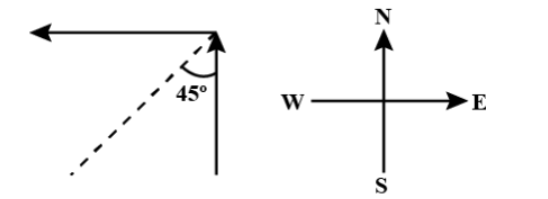
A motor car is going due north at a speed of \(50 \mathrm{~km} / \mathrm{h}\). It makes a \(90^{\circ}\) left turn without changing the speed. The change in the velocity of the car is about
CorrectIncorrectHint
(b)

The initial velocity of the car is due north at a speed of \(50 \mathrm{~km} / \mathrm{h}\). In vector form, this can be represented as \(\vec{v}_i=50 \hat{j}\).
After making a \(90^{\circ}\) left turn without changing speed, the car is traveling due west at a speed of \(50 \mathrm{~km} / \mathrm{h}\). The final velocity vector is \(\vec{v}_f=-50 \hat{i}\).
The change in velocity ( \(\Delta \vec{v}\) ) is the final velocity minus the initial velocity.
\(
\begin{gathered}
\Delta \vec{v}=\vec{v}_f-\vec{v}_i \\
\Delta \vec{v}=(-50 \hat{i})-(50 \hat{j}) \\
\Delta \vec{v}=-50 \hat{i}-50 \hat{j}
\end{gathered}
\)
The magnitude of the change in velocity is calculated using the Pythagorean theorem:
\(
\begin{gathered}
|\Delta \vec{v}|=\sqrt{(-50)^2+(-50)^2} \\
|\Delta \vec{v}|=\sqrt{2500+2500} \\
|\Delta \vec{v}|=\sqrt{5000} \\
|\Delta \vec{v}|=50 \sqrt{2} \approx 70.71 \mathrm{~km} / \mathrm{h}
\end{gathered}
\)
The direction is determined by the components of the vector. Since the west component is \(-50 \hat{i}\) and the south component is \(-50 \hat{j}\), the direction is towards the south-west.
The change in the velocity of the car is about \(70 \mathrm{~km} / \mathrm{h}\) towards south-west. - Question 16 of 37
16. Question
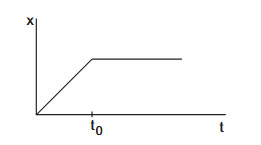
Figure below shows the displacement-time graph of a particle moving on the \(X\)-axis.
 CorrectIncorrect
Hint
(d) The slope of the \(x-t\) graph gives the velocity. In the graph, the slope is constant from \(t=0\) to \(t=t_0\), so the velocity is constant. After \(\mathrm{t}=\mathrm{t}_0\), the displacement is constant i.e., the particle stops (slope becomes 0, means velocity becomes 0, implying that the particle has come to a stop).
- Question 17 of 37
17. Question
A particle has a velocity \(u\) towards east at \(t=0\). Its acceleration is towards west and is constant. Let \(x_{\mathrm{A}}\) and \(x_{\mathrm{B}}\) be the magnitude of displacements in the first 10 seconds and the next 10 seconds
CorrectIncorrectHint
(d) As velocity and acceleration are in opposite directions, velocity will become zero after some time \((t)\) and the particle will return.
\(
\begin{aligned}
& \therefore 0=u-a t \\
& \Rightarrow t=\frac{u}{a}
\end{aligned}
\)
Because the value of acceleration is not given, we cannot say that the particle will return after/before 10 seconds. - Question 18 of 37
18. Question
A person travelling on a straight line moves with a uniform velocity \(v_1\) for some time and with uniform velocity \(v_2\) for the next equal time. The average velocity \(v\) is given by
CorrectIncorrectHint
(a) Let the time for which the person travels with velocity \(v_1\) be \(t\). Since the person travels with velocity \(v_2\) for the “next equal time,” the time for this segment is also \(t\).
Displacement for the first part: \(s_1=v_1 t\)
Displacement for the second part: \(s_2=v_2 t\)
Calculate total displacement and total time
Total displacement: \(s=s_1+s_2=v_1 t+v_2 t=\left(v_1+v_2\right) t\)
Total time: \(T=t+t=2 t\)
Average velocity \(v\) is the total displacement divided by the total time.
\(
v=\frac{S}{T}=\frac{\left(v_1+v_2\right) t}{2 t}
\)
The variable \(t\) cancels out from the numerator and denominator, leaving:
\(
v=\frac{v_1+v_2}{2}
\)
This is the arithmetic mean of the two velocities.
The average velocity \(v\) is given by (a) \(v=\frac{v_1+v_2}{2}\). - Question 19 of 37
19. Question
A person travelling on a straight line moves with a uniform velocity \(v_1\) for a distance \(x\) and with a uniform velocity \(v_2\) for the next equal distance. The average velocity \(v\) is given by
CorrectIncorrectHint
(c) Analyze the provided formulas
(a) \(v=\frac{v_1+v_2}{2}\) : This is the formula for the arithmetic mean, which is the sum of the values divided by the number of values.
(b) \(v=\sqrt{v_1 v_2}\) : This is the formula for the geometric mean, which is the \(n\)-th root of the product of \(n\) values.
(c) \(\frac{2}{v}=\frac{1}{v_1}+\frac{1}{v_2}\) : This can be rearranged to solve for \(v\), giving \(v=\frac{2}{\frac{1}{v_1}+\frac{1}{v_2}}\), which is the formula for the harmonic mean. The harmonic mean is the reciprocal of the arithmetic mean of the reciprocals.
(d) \(\frac{1}{v}=\frac{1}{v_1}+\frac{1}{v_2}\) : This is not a standard mean formula. It is often used in physics to calculate the equivalent resistance of two resistors in a parallel circuit or the equivalent focal length of two thin lenses in contact.
The formula for the harmonic mean is (c) \(\frac{2}{v}=\frac{1}{v_1}+\frac{1}{v_2}\). - Question 20 of 37
20. Question
A stone is released from an elevator going up with an acceleration \(a\). The acceleration of the stone after the release is
CorrectIncorrectHint
(d) The correct answer is \(\boldsymbol{g}\) downward. Once the stone is released, the only force acting on it is gravity, so its acceleration is solely determined by the acceleration due to gravity (\(\boldsymbol{g}\)), which is always directed downward. The elevator’s upward acceleration becomes irrelevant to the stone’s motion after it is no longer in contact with the elevator.
- Question 21 of 37
21. Question
A person standing near the edge of the top of a building throws two balls \(A\) and \(B\). The ball \(A\) is thrown vertically upward and \(B\) is thrown vertically downward with the same speed. The ball \(A\) hits the ground with a speed \(v_{\mathrm{A}}\) and the ball \(B\) hits the ground with a speed \(v_{\mathrm{B}}\). We have
CorrectIncorrectHint
(c) \(\boldsymbol{v}_{\mathrm{A}}=\boldsymbol{v}_{\mathrm{B}}\). This is because both balls, starting from the same height and initial speed, will have the same final speed upon hitting the ground due to the conservation of energy, assuming no air resistance.
Total energy of any particle \(=\frac{1}{2} m v^2+m g h\)
Both the particles were at the same height and thrown with equal initial velocities, so their initial total energies are equal. By the law of conservation of energy, their final energies are equal.
At the ground, they are at the same height. So, their P.E. are also equal; this implies that their K.E. should also be equal. In other words, their final velocities are equal.Conservation of Energy: Alternatively, using the conservation of energy, the initial total energy (kinetic energy + potential energy) for both balls is the same. Since the final potential energy (at ground level) is also the same for both, their final kinetic energies must be equal, which means their final speeds are equal.
- Question 22 of 37
22. Question
In a projectile motion the velocity
CorrectIncorrectHint
(c) is perpendicular to the acceleration for one instant only. In projectile motion, the velocity is perpendicular to the acceleration at the single instant when the projectile reaches its highest point, at which point the velocity is purely horizontal and the acceleration is purely vertical.
At the highest point: The vertical component of the velocity is momentarily zero. Since the acceleration due to gravity is always vertical and downward, the velocity (which is horizontal) is perpendicular to the acceleration.
Other points in the trajectory: At all other times, the velocity has both a horizontal and a vertical component, so it cannot be perpendicular to the constant downward acceleration. For example, at launch and landing, the velocity is at an angle to the vertical acceleration. - Question 23 of 37
23. Question
Two bullets are fired simultaneously, horizontally and with different speeds from the same place. Which bullet will hit the ground first?
CorrectIncorrectHint
(c) The time it takes for a bullet to hit the ground depends solely on the vertical distance it falls, not its horizontal speed. Since both bullets are fired from the same height, they will both experience the same gravitational acceleration and reach the ground at the same time, regardless of their initial horizontal velocities.
Why other options are incorrect:
(a) the faster one: The faster bullet’s horizontal speed has no effect on its vertical motion.
(b) the slower one: Same as (a), the slower bullet’s horizontal speed doesn’t affect its vertical fall.
(d) depends on the masses: The mass of the bullets also doesn’t affect their vertical acceleration due to gravity. If you consider air resistance, then the heavier bullet might fall slightly faster due to its greater ability to overcome air resistance, but in a typical physics problem where air resistance is neglected, mass has no impact. - Question 24 of 37
24. Question
The range of a projectile fired at an angle of \(15^{\circ}\) is 50 m. If it is fired with the same speed at an angle of \(45^{\circ}\), its range will be
CorrectIncorrectHint
(d) Given :
The angle of projection of the first projectile, \(\theta_1=15^{\circ}\)
The horizontal distance covered by the first projectile, \(\mathrm{R}_1=50 \mathrm{~m}\)
The angle of projection of the first projectile, \(\theta_2=45^{\circ}\)
We know,
\(
\begin{aligned}
& \mathrm{R}_1=\frac{u^2 \sin \left(2 \theta_1\right)}{g} \\
& \Rightarrow \mathrm{R}_1=\frac{u^2 \sin (2 \times 15)}{g} \\
& \Rightarrow \mathrm{R}_1=\frac{u^2 \sin (30)}{g} \\
& \Rightarrow \mathrm{R}_1=\frac{u^2}{2 g} \dots(1)
\end{aligned}
\)
Similarly,
\(
\begin{aligned}
& \mathrm{R}_2=\frac{u^2 \sin \left(2 \theta_2\right)}{g} \\
& \Rightarrow \mathrm{R}_2=\frac{u^2 \sin (2 \times 45)}{g} \\
& \Rightarrow \mathrm{R}_2=\frac{u^2 \sin (90)}{g} \\
& \Rightarrow \mathrm{R}_2=\frac{u^2}{g} \dots(2)
\end{aligned}
\)
Divide equation (1) & (2)
\(
\begin{aligned}
& \frac{R_1}{R_2}=\frac{u^2}{2 g} \frac{g}{u^2} \\
& \therefore \frac{R_1}{R_2}=\frac{1}{2} \\
& \therefore \mathrm{R}_2=2 \mathrm{H}_1 \\
& \therefore \mathrm{R}_2=2 \times 50 \\
& \mathrm{R}_2=100 \mathrm{~m}
\end{aligned}
\) - Question 25 of 37
25. Question
Two projectiles \(A\) and \(B\) are projected with angle of projection \(15^{\circ}\) for the projectile \(A\) and \(45^{\circ}\) for the projectile \(B\). If \(R_A\) and \(R_B\) be the horizontal range for the two projectiles, then
CorrectIncorrectHint
(d) Horizontal range for the projectile, \(R=\frac{u^2 \sin (2 \theta)}{g}\). Information of the initial velocity is not given in the question.
- Question 26 of 37
26. Question
A river is flowing from west to east at a speed of 5 metres per minute. A man on the south bank of the river, capable of swimming at 10 metres per minute in still water, wants to swim across the river in the shortest time. He should swim in a direction
CorrectIncorrectHint
(a) Step 1: Analyze the goal for the shortest crossing time
To cross a river in the shortest possible time, a swimmer must maximize their velocity component perpendicular to the river’s flow. The time it takes to cross the river is independent of the river’s speed and is determined solely by the swimmer’s speed in the direction perpendicular to the flow.Step 2: Determine the optimal swimming direction
The river is flowing from west to east. The direction perpendicular to the flow is north-south. Since the man is on the south bank and wants to cross to the north bank, his swimming direction must be aimed directly across the river, which is due north, to maximize his perpendicular velocity component. The river’s current will carry him downstream, but this will not affect the time it takes to reach the other side. The correct direction for the man to swim to cross the river in the shortest time is due north. - Question 27 of 37
27. Question
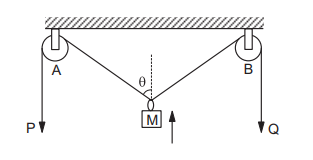
In the arrangement shown in figure below, the ends \(P\) and \(Q\) of an inextensible string move downwards with uniform speed \(u\). Pulleys \(A\) and \(B\) are fixed. The mass \(M\) moves upwards with a speed
 CorrectIncorrect
Hint
(b) Along the string, the velocity of each object is the same.
\(
\begin{aligned}
& 2 v \cos \theta=2 u \\
& v=\frac{u}{\cos \theta}
\end{aligned}
\) - Question 28 of 37
28. Question
Consider the motion of the tip of the minute hand of a clock. In one hour
CorrectIncorrectHint
(a, d) The tip of the minute hand travels a circular path in one hour. While it covers a distance equal to the circumference of the circle, its net displacement is zero because it returns to its initial position. Since velocity is the change in displacement over time, the average velocity is also zero for the entire hour.
Displacement is zero because the initial and final positions are the same.
Average velocity \(=\frac{\text { Displacement }}{\text { Total time }}=0\)Note: Distance covered \(=2 \pi r \neq 0\)
Average speed \(=\frac{\text { Distance travelled }}{\text { Total time taken }} \neq 0\) - Question 29 of 37
29. Question
A particle moves along the \(X\)-axis as \(x=u(t-2 \mathrm{~s})+a(t-2 \mathrm{~s})^2 .\)
CorrectIncorrectHint
(c, d)
\(
\begin{aligned}
& \text { Initial velocity }=\left|\frac{d x}{d t}\right|_{t=0} \\
& \frac{d x}{d t}=u+2 a(t-2 s) \\
& \left|\frac{d x}{d t}\right|_{t=0}=u-4 \text { as } \neq u \\
& \text { Acceleration }=\frac{d^2 x}{d t^2}=2 a \\
& \text { At } \mathrm{t}=2 \mathrm{~s}, \\
& \mathrm{x}=\mathrm{u}(2 \mathrm{~s}-2 \mathrm{~s})+\mathrm{a}(2 \mathrm{~s}-2 \mathrm{~s})^2=0 \text { (origin) }
\end{aligned}
\) - Question 30 of 37
30. Question
Pick the correct statements :
CorrectIncorrectHint
(a, b, c) (a) Average speed of a particle in a given time is never less than the magnitude of the average velocity.
Correct. Average speed is defined as (total distance traveled) / (total time), while the magnitude of average velocity is (magnitude of displacement) / (total time). Since the total distance traveled is always greater than or equal to the magnitude of the displacement (the shortest path between two points), the average speed is always greater than or equal to the magnitude of the average velocity.
(b) It is possible to have a situation in which \(\left|\frac{d \vec{v}}{d t}\right| \neq 0\) but \(\frac{d}{d t}|\vec{v}|=0\).
Correct. \(\left|\frac{d \vec{v}}{d t}\right|\) is the magnitude of acceleration, and \(\frac{d}{d t}|\vec{v}|\) is the rate of change of speed. This situation describes motion where the direction of velocity is changing, but the magnitude of velocity (speed) is constant. A classic example is uniform circular motion, where the acceleration is always directed towards the center (non-zero magnitude) but the speed is constant (rate of change of speed is zero).
(c) The average velocity of a particle is zero in a time interval. It is possible that the instantaneous velocity is never zero in the interval.
Correct. Average velocity is zero if the particle returns to its starting position (net displacement is zero). This can happen in a smooth continuous motion, such as an object moving in a circle or a figure-eight path. The instantaneous velocity vector continuously changes direction and never becomes zero, but the final position is the same as the initial position.
(d) The average velocity of a particle moving on a straight line is zero in a time interval. It is possible that the instantaneous velocity is never zero in the interval. (Infinite accelerations are not allowed.)
Incorrect. For a particle moving strictly on a straight line, if the average velocity is zero, the particle must return to its starting point. To change direction on a straight line, its velocity must pass through zero at some instant (assuming continuous motion without infinite accelerations). By the Intermediate Value Theorem (or Rolle’s Theorem in calculus), there must be a point in the interval where the instantaneous velocity is exactly zero. - Question 31 of 37
31. Question
An object may have
CorrectIncorrectHint
(b. d) The correct options are (b) varying velocity without having varying speed and (d) nonzero acceleration without having varying speed. An object in uniform circular motion has a constant speed but a changing velocity (due to changing direction) and therefore a nonzero acceleration.
(b) Varying velocity without having varying speed: This is correct. An object in uniform circular motion maintains a constant speed, but its velocity is constantly changing because its direction is continuously changing.
(d) Nonzero acceleration without having varying speed: This is correct. In uniform circular motion, the object has a centripetal acceleration that is always directed toward the center of the circle, causing the change in direction of velocity. This occurs even though the speed remains constant.Here is why the other options are incorrect:
(a) Varying speed without having varying velocity: This is incorrect. Velocity is a vector quantity, meaning it has both magnitude (speed) and direction. If the speed (magnitude) is varying, then the velocity must also be varying.
(c) Nonzero acceleration without having varying velocity: This is incorrect. Acceleration is defined as the rate of change of velocity. Therefore, if there is any acceleration (zero or nonzero), the velocity must be changing. - Question 32 of 37
32. Question
Mark the correct statements for a particle going on a straight line :
CorrectIncorrectHint
(a, b, d)
\(
\begin{aligned}
&\text { (a) Acceleration is given by }\\
&\begin{aligned}
& -a=\frac{d v}{d t} \\
& -a<0 \\
& \Rightarrow \frac{d v}{d t}<0 \\
& \Rightarrow V_{\text {final }}<V_{\text {initial }}
\end{aligned}
\end{aligned}
\)
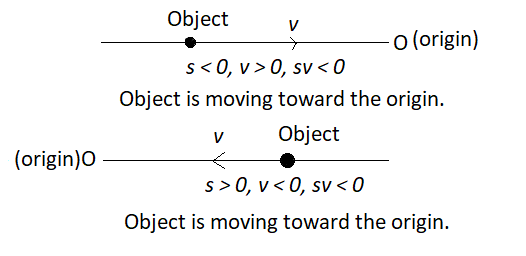
(b) If the position and velocity have opposite signs, the particle moves towards the origin. It can be explained by following figure:
(c) If the velocity is zero in a certain time interval, then the change in the velocity in that time interval will also be zero. As acceleration is rate of change of velocity, it will also be zero at an instant in that time interval. Consider the case of a particle thrown vertically upward. At its highest point the velocity is zero but acceleration is not zero. Acceleration is defined as rate of change of velocity. If in a time interval velocity is zero, it means in this interval velocity does not change. So acceleration at any instant in this time interval is zero.
(d) If the velocity is zero in a certain time interval, then the change in the velocity in that time interval will also be zero. As acceleration is rate of change of velocity, it will also be zero at an instant in that time interval. - Question 33 of 37
33. Question
The velocity of a particle is zero at \(t=0\).
CorrectIncorrectHint
(b, c, d)
(a) is not true. Consider the case of a particle dropped vertically downward, its velocity at \(\mathrm{t}=0\) is zero but acceleration is not zero. A particle’s velocity being zero at a specific instant, \(t=0\), does not require its acceleration to be zero at that same instant. Acceleration is the rate of change of velocity.
A particle can have zero velocity but a non-zero acceleration, such as a ball at the peak of its flight where its instantaneous velocity is zero, but its acceleration due to gravity is non-zero.(b) is true because we do not have information about the velocity in next instants. If in next instants the velocity still remains zero, the acceleration will be zero.
(c) is true because, if acceleration is zero that means there is no change in velocity. The velocity remains zero in this interval.
(d) is true because if the speed remains zero from \(t=0\) to \(t=10 s\), that means the particle is at rest in this interval, so the acceleration is also zero in this interval. - Question 34 of 37
34. Question
Mark the correct statements :
CorrectIncorrectHint
(a)
Option (A): Speed is distance travelled in a given time and velocity is distance travelled along a direction in a given time. So, velocity without direction is equal to speed. Therefore, the magnitude of velocity of a particle is equal to its speed. Thus, option (A) is correct.
Option (B): Average velocity in an interval can be defined as the total displacement of a body in a given time interval, while average speed is defined as total distance travelled by a body in a given time interval. Total distance might not be equal to total displacement of a body, for example if a body after travelling for a while, comes back to its initial position then its total displacement is zero but total distance will not be zero. So, we cannot say that the magnitude of average velocity in an interval is equal to its average speed in that interval. Therefore, option (B) is incorrect.
Option (c) : It is possible that for some instant or time the speed may be zero or we can say the particle is rest but for other instant the particle is moving, but if the speed of the particle is always zero then its average speed will also be zero as no distance will be travelled by the particle. Therefore, it is not possible to have a situation where the speed of the particle is zero and average speed is not zero, so option (c) is incorrect.
Option (D): If the speed of the particle is never zero, then there will be some distance travelled by the particle and total distance will not be zero. As, average speed is total distance travelled divided by the time interval, so, there will be some average speed. Therefore, it is not possible to have a situation in which the speed of the particle is never zero but the average speed in an interval is zero. Option (D) is incorrect.
- Question 35 of 37
35. Question
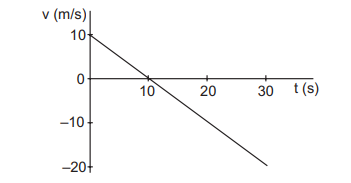
The velocity-time plot for a particle moving on a straight line is shown in the figure below.
 CorrectIncorrect
Hint
(a, d) (a) The slope of the \(\mathrm{v}-\mathrm{t}\) graph gives the acceleration. For the given graph, the slope is constant. So, acceleration is constant.
(b) From 0 to 10 seconds, velocity is in positive direction and then in negative direction. This means that the particle turns around at \(\mathrm{t}=10 \mathrm{~s}\).
(c) Area in the \(\mathrm{v}-\mathrm{t}\) curve gives the distance travelled by the particle.
Distance travelled in positive direction \(\neq\) Distance travelled in negative direction
\(\therefore\) Displacement \(\neq\) Zero
(d) The area of the \(\mathrm{v}-\mathrm{t}\) graph from \(\mathrm{t}=0 \mathrm{~s}\) to \(\mathrm{t}=10 \mathrm{~s}\) is the same as that from \(\mathrm{t}=10 \mathrm{~s}\) to \(\mathrm{t}=20 \mathrm{~s}\). So, the distance covered is the same. Hence, the average speed is the same. - Question 36 of 37
36. Question
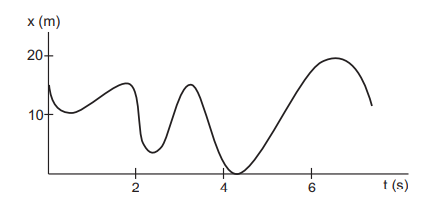
Figure below shows the position of a particle moving on the \(X\)-axis as a function of time.
 CorrectIncorrect
Hint
(a)
(a) The slope of the \(\mathrm{x}-\mathrm{t}\) graph gives the velocity. Here, 6 times the slope is zero. So, the particle has come to rest 6 times. Option (a) is Corect.
(b) As the slope is not maximum at \(\mathrm{t}=6 \mathrm{~s}\), the maximum speed is not at \(\mathrm{t}=6 \mathrm{~s}\). Option (b) is incorrect.
(c) As the slope is not positive from \(t=0 s\) to \(t=6 s\), the velocity does not remain positive. Option (c) is incorrect.
(d) Average velocity \(=\frac{\text { Total displacement }}{\text { Total time taken }}=\frac{x_{\text {final }}-x_{\text {initial }}}{t}\). Option (d) is incorrect.
For the shown time \((t=6 \mathrm{~s})\), the displacement of the particle is positive. Therefore, the average velocity is positive. - Question 37 of 37
37. Question
The accelerations of a particle as seen from two frames \(S_1\) and \(S_2\) have equal magnitude \(4 \mathrm{~m} / \mathrm{s}^2\).
CorrectIncorrectHint
(d) Based on the principles of relative acceleration, the relationship between the acceleration of a particle in two different frames, \(S_1\) and \(S_2\), is given by the vector equation:
\(
\mathbf{a}_1=\mathbf{a}_2+\mathbf{a}_{21}
\)
where \(\mathbf{a}_{\mathbf{1}}\) is the acceleration of the particle as measured in frame \(S_1, \mathbf{a}_2\) is the acceleration of the particle as measured in frame \(S_2\), and \(\mathbf{a}_{21}\) is the acceleration of frame \(S_2\) with respect to frame \(S_1\).
We are given that the magnitudes of the particle’s acceleration in both frames are equal, \(\left|a_1\right|=\left|a_2\right|=4 \mathrm{~m} / \mathrm{s}^2\). We can rearrange the equation to solve for the acceleration of the frames:
\(
a_{21}=a_1-a_2
\)
The magnitude of \(\mathbf{a}_{21}\) depends on the angle \(\boldsymbol{\theta}\) between the vectors \(\mathbf{a}_1\) and \(\mathbf{a}_2\). Using the law of cosines, the magnitude is:
\(
\left|a_{21}\right|^2=\left|a_1\right|^2+\left|a_2\right|^2-2\left|a_1\right|\left|a_2\right| \cos \theta
\)
Substituting the given magnitudes:
\(
\begin{aligned}
& \left|a_{21}\right|^2=4^2+4^2-2(4)(4) \cos \theta \\
& \left|a_{21}\right|^2=32-32 \cos \theta=32(1-\cos \theta)
\end{aligned}
\)
The value of \(\cos \theta\) can range from -1 to 1 .
Maximum magnitude: The maximum value of \(\left|a_{21}\right|^2\) occurs when \(\cos \theta=-1\) (the vectors \(\mathbf{a}_1\) and \(\mathbf{a}_2\) are in opposite directions):
\(
\left|a_{21}\right|^2=32(1-(-1))=64 \Longrightarrow\left|a_{21}\right|=8 \mathrm{~m} / \mathrm{s}^2 .
\)
Minimum magnitude: The minimum value of \(\left|\mathbf{a}_{21}\right|^2\) occurs when \(\cos \theta=1\) (the vectors \(\mathbf{a}_1\) and \(\mathbf{a}_2\) are in the same direction):
\(
\left|a_{21}\right|^2=32(1-1)=0 \Longrightarrow\left|a_{21}\right|=0 \mathrm{~m} / \mathrm{s}^2 .
\)
Since the value of \(\cos \theta\) can be any value between -1 and 1 , the magnitude of the acceleration of \(S_2\) with respect to \(S_1,\left|a_{21}\right|\), can be any value between zero and \(8 \mathrm{~m} / \mathrm{s}^2\)