Conceptual PCQs
Summary
- Newton’s law of universal gravitation states that the gravitational force of attraction between any two particles of masses \(m_1\) and \(m_2\) separated by a distance \(r\) has the magnitude
\(
F=G \frac{m_1 m_2}{r^2}
\) - If we have to find the resultant gravitational force acting on the particle \(m\) due to a number of masses \(M_1, M_2, \ldots . M_n\) etc. we use the principle of superposition. Let \(F_1, F_2, \ldots . F_n\) be the individual forces due to \(M_l, M_2, \ldots . M_{n .}\) each given by the law of gravitation. From the principle of superposition each force acts independently and uninfluenced by the other bodies. The resultant force \(F_R\) is then found by vector addition
\(
F_R=F_1+F_2+\ldots \ldots+F_n=\sum_{i=1}^n F_i
\) - Kepler’s laws of planetary motion state that
(a) All planets move in elliptical orbits with the Sun at one of the focal points
(b) The radius vector drawn from the Sun to a planet sweeps out equal areas in equal time intervals. This follows from the fact that the force of gravitation on the planet is central and hence angular momentum is conserved.
(c) The square of the orbital period of a planet is proportional to the cube of the semi-major axis of the elliptical orbit of the planet
The period \(T\) and radius \(R\) of the circular orbit of a planet about the Sun are related by
\(
T^2=\left(\frac{4 \pi^2}{G M_s}\right) R^3
\)
where \(M_s\) is the mass of the Sun. Most planets have nearly circular orbits about the Sun. For elliptical orbits, the above equation is valid if \(R\) is replaced by the semi-major axis, \(a\). - The acceleration due to gravity.
(a) at a height \(h\) above the earth’s surface
\(
\begin{aligned}
& g(h)=\frac{G M_E}{\left(R_E+h\right)^2} \\
& \approx \frac{G M_E}{R_E^2}\left(1-\frac{2 h}{R_E}\right) \text { for } h \ll R_E
\end{aligned}
\)
\(
\begin{aligned}
&g(h)=g(0)\left(1-\frac{2 h}{R_E}\right) \text { where } g(0)=\frac{G M_E}{R_E^2}\\
&\text { (b) at depth } d \text { below the earth’s surface is }\\
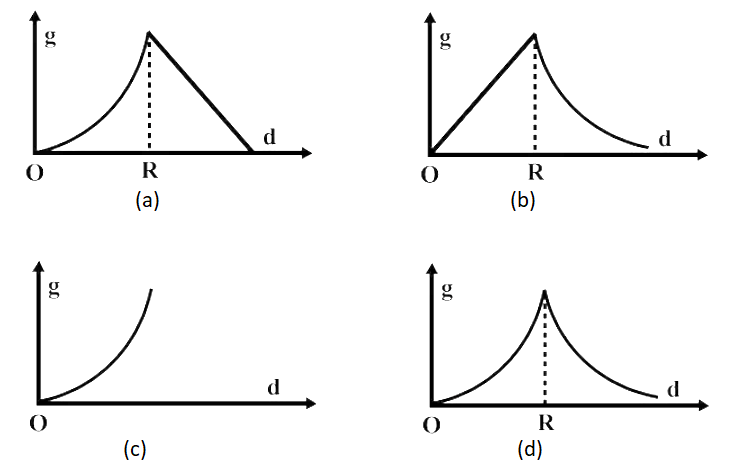
&g(d)=\frac{G M_E}{R_E^2}\left(1-\frac{d}{R_E}\right)=g(0)\left(1-\frac{d}{R_E}\right)
\end{aligned}
\) - The gravitational force is a conservative force, and therefore a potential energy function can be defined. The gravitational potential energy associated with two particles separated by a distance \(r\) is given by
\(
V=-\frac{G m_1 m_2}{r}
\)
where \(V\) is taken to be zero at \(r \rightarrow \infty\). The total potential energy for a system of particles is the sum of energies for all pairs of particles, with each pair represented by a term of the form given by above equation. This prescription follows from the principle of superposition. - If an isolated system consists of a particle of mass \(m\) moving with a speed \(v\) in the vicinity of a massive body of mass \(M\), the total mechanical energy of the particle is given by
\(
E=\frac{1}{2} m v^2-\frac{G M m}{r}
\)
That is, the total mechanical energy is the sum of the kinetic and potential energies. The total energy is a constant of motion. - If \(m\) moves in a circular orbit of radius a about \(M\), where \(M \gg m\), the total energy of the system is
\(
E=-\frac{G M m}{2 a}
\)
with the choice of the arbitrary constant in the potential energy given in the point 5., above. The total energy is negative for any bound system, that is, one in which the orbit is closed, such as an elliptical orbit. The kinetic and potential energies are
\(
\begin{aligned}
K & =\frac{G M m}{2 a} \\
V & =-\frac{G M m}{a}
\end{aligned}
\) - The escape speed from the surface of the earth is
\(
v_e=\sqrt{\frac{2 G M_E}{R_E}}=\sqrt{2 g R_E}
\)
and has a value of \(11.2 \mathrm{~km} \mathrm{~s}^{-1}\). - If a particle is outside a uniform spherical shell or solid sphere with a spherically symmetric internal mass distribution, the sphere attracts the particle as though the mass of the sphere or shell were concentrated at the centre of the sphere.
- If a particle is inside a uniform spherical shell, the gravitational force on the particle is zero. If a particle is inside a homogeneous solid sphere, the force on the particle acts toward the centre of the sphere. This force is exerted by the spherical mass interior to the particle.
Quiz Summary
0 of 62 Questions completed
Questions:
Information
You have already completed the quiz before. Hence you can not start it again.
Quiz is loading…
You must sign in or sign up to start the quiz.
You must first complete the following:
Results
Results
0 of 62 Questions answered correctly
Your time:
Time has elapsed
You have reached 0 of 0 point(s), (0)
Earned Point(s): 0 of 0, (0)
0 Essay(s) Pending (Possible Point(s): 0)
Categories
- Not categorized 0%
- 1
- 2
- 3
- 4
- 5
- 6
- 7
- 8
- 9
- 10
- 11
- 12
- 13
- 14
- 15
- 16
- 17
- 18
- 19
- 20
- 21
- 22
- 23
- 24
- 25
- 26
- 27
- 28
- 29
- 30
- 31
- 32
- 33
- 34
- 35
- 36
- 37
- 38
- 39
- 40
- 41
- 42
- 43
- 44
- 45
- 46
- 47
- 48
- 49
- 50
- 51
- 52
- 53
- 54
- 55
- 56
- 57
- 58
- 59
- 60
- 61
- 62
- Current
- Review
- Answered
- Correct
- Incorrect
- Question 1 of 62
1. Question
The acceleration of moon with respect to earth is \(0.0027 \mathrm{~m} \mathrm{~s}^{-2}\) and the acceleration of an apple falling on earth’s surface is about \(10 \mathrm{~m} \mathrm{~s}^{-2}\). Assume that the radius of the moon is one fourth of the earth’s radius. If the moon is stopped for an instant and then released, it will fall towards the earth. The initial acceleration of the moon towards the earth will be
CorrectIncorrectHint
(b) When the moon orbits the Earth, it is in a constant state of free-fall. The acceleration mentioned \(\left(0.0027 \mathrm{~m} \mathrm{~s}^{-2}\right)\) is its centripetal acceleration, which is caused entirely by the Earth’s gravitational pull at that specific distance.
Here is why the value remains the same:
Gravitational Source: The acceleration of any object towards the Earth depends only on the mass of the Earth \((M)\) and the distance from the center of the Earth \((r)\). This is expressed by the formula:
\(
g^{\prime}=\frac{G M}{r^2}
\)
State of Motion: Whether the moon is moving in a circular path or is momentarily “stopped,” the gravitational force acting on it at that specific location in space does not change.
The Apple vs. The Moon: The apple accelerates at \(10 \mathrm{~m} \mathrm{~s}^{-2}\) because it is very close to the Earth’s center (\(r \approx 6,400 \mathrm{~km}\)). The moon is much further away (\(\approx 384,000 \mathrm{~km}\)), so the Earth’s gravity is much weaker there, resulting in the lower acceleration of \(0.0027 \mathrm{~m} \mathrm{~s}^{-2}\).Explanation: Step 1: The Relationship
The gravitational acceleration \((g)\) at a distance \((r)\) from the center of the Earth is calculated by:
\(
g=\frac{G M}{r^2}
\)
Since \(G\) (gravitational constant) and \(M\) (mass of Earth) are constant, we can say that acceleration is inversely proportional to the square of the distance:
\(
g \propto \frac{1}{r^2}
\)
Step 2: The Data
Distance of Apple (\(R_e\)): The apple is on the surface, so it is 1 Earth radius away from the center.
Distance of Moon \(\left(R_m\right)\) : The moon is approximately \(\mathbf{6 0}\) times further away from the center of the Earth than the surface is (\(R_m \approx 60 R_e\)).
Acceleration of Apple \(\left(g_{\text {apple }}\right): 9.8 \mathrm{~m} \mathrm{~s}^{-2}\) (often rounded to \(10 \mathrm{~m} \mathrm{~s}^{-2}\) for simplicity).
Step 3: The Calculation
To find the moon’s acceleration (\(g_{\text {moon }}\)), we compare it to the apple’s acceleration using the ratio of their distances:
\(
\frac{g_{\text {moon }}}{g_{\text {apple }}}=\left(\frac{R_e}{R_{\text {moon }}}\right)^2
\)
Substitute the value \(R_{\text {moon }}=60 R_e\) :
\(
\begin{gathered}
\frac{g_{\text {moon }}}{10}=\left(\frac{R_e}{60 R_e}\right)^2 \\
\frac{g_{\text {moon }}}{10}=\left(\frac{1}{60}\right)^2 \\
\frac{g_{\text {moon }}}{10}=\frac{1}{3600}
\end{gathered}
\)
Now, solve for \(g_{\text {moon }}\) :
\(
g_{m o o n}=\frac{10}{3600} \approx 0.0027 \mathrm{~m} \mathrm{~s}^{-2}
\) - Question 2 of 62
2. Question
The acceleration of the moon just before it strikes the earth in the previous question is
CorrectIncorrectHint
(c) Step 1: Identify the final distance
When the moon “strikes” the Earth, they are in physical contact. However, gravity acts between the centers of mass of the two objects.
The distance \((r)\) : It is the sum of the Earth’s radius \(\left(R_e\right)\) and the Moon’s radius \(\left(R_m\right)\).
Step 2: Express the distance in terms of Earth’s radius
The problem states that the moon’s radius is one-fourth of the Earth’s radius:
Moon’s radius: \(R_m=\frac{1}{4} R_e=0.25 R_e\)
Total distance \((r): R_e+0.25 R_e=1.25 R_e\)
Step 3: Apply the Inverse Square Law
Gravitational acceleration (\(g\)) is inversely proportional to the square of the distance from the center \(\left(g \propto \frac{1}{r^2}\right)\). We compare the acceleration at the surface \(\left(g_s=10 \mathrm{~m} \mathrm{~s}^{-2}\right)\) to the acceleration at impact \(\left(g_i\right)\) :
The Ratio: \(\frac{g_i}{g_s}=\frac{R_e^2}{r^2}\)
Step 4: Substitute the values
Insert the total distance \(\left(1.25 R_e\right)\) into the ratio equation:
Setup: \(\frac{g_i}{10}=\frac{R_e^2}{\left(1.25 R_e\right)^2}\)
Simplify: \(\frac{g_i}{10}=\frac{1}{(1.25)^2}\)
Step 5: Calculate the final result
Solve the math using fractions or decimals:
Square the denominator: \((1.25)^2=1.5625\)
Divide: \(\frac{1}{1.5625}=0.64\)
Final Calculation: \(g_i=10 \times 0.64=6.4 \mathrm{~m} \mathrm{~s}^{-2}\)
Summary: Because the moon is large, its center is still 1.25 Earth-radii away from Earth’s center at the moment of impact, which is why the acceleration is 6.4 instead of 10. - Question 3 of 62
3. Question
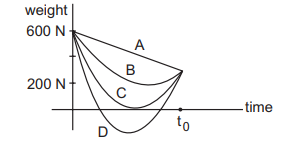
Suppose, the acceleration due to gravity at the earth’s surface is \(10 \mathrm{~m} \mathrm{~s}^{-2}\) and at the surface of Mars it is \(4.0 \mathrm{~m} \mathrm{~s}^{-2}\). A 60 kg passenger goes from the earth to the Mars in a spaceship moving with a constant velocity. Neglect all other objects in the sky. Which part of figure (below) best represents the weight (net gravitational force) of the passenger as a function of time?
 CorrectIncorrect
Hint
(c) At one point between the Earth and Mars, the gravitational field intensity is zero. So, at that point, the weight of the passenger is zero. The curve C indicates that the weight of the passenger is zero at a point between the Earth and Mars.
Explanation: Based on the physics of gravitational fields, the weight of the passenger ( 60 kg ) will be:
step 1: On Earth’s surface: \(W_{\text {Earth }}=m \times g_{\text {Earth }}=60 \mathrm{~kg} \times 10 \mathrm{~m} / \mathrm{s}^2=600 \mathrm{~N}\).
Step 2: During the journey: As the spaceship moves away from Earth towards Mars, the Earth’s gravitational pull decreases, and the Mars gravitational pull increases. At a specific point between the two, the forces will balance, and the net gravitational force (weight) will become zero.
Step 3: On Mars’ surface: \(W_{\text {Mars }}=m \times g_{\text {Mars }}=60 \mathrm{~kg} \times 4.0 \mathrm{~m} / \mathrm{s}^2=240 \mathrm{~N}\).
The graph must start at 600 N (Earth), drop to 0 N somewhere in the middle of the trip, and rise to 240 N (Mars) upon arrival.
The graph labeled C typically represents this behavior: starting at a high value, dipping to zero, and ending at a lower, non-zero value.
Conclusion: The graph C best represents the weight. - Question 4 of 62
4. Question
Consider a planet in some solar system which has a mass double the mass of the earth and density equal to the average density of the earth. An object weighing \(W\) on the earth will weigh
CorrectIncorrectHint
(d) To find the weight of an object on another planet, we need to determine how the planet’s mass and radius differ from Earth’s. Weight is simply the gravitational force: \(W=m g\), where \(g= \frac{G M}{R^2}\).
Step 1: Find the Radius of the Planet
We are told the density (\(\rho\)) is the same as Earth’s. Density is mass divided by volume ( \(V= \left.\frac{4}{3} \pi R^3\right)\) :
Density Formula: \(\rho=\frac{M}{V}=\frac{M}{\frac{4}{3} \pi R^3}\)
Since density is constant, \(M\) is proportional to \(R^3\left(M \propto R^3\right)\).
If the new planet has mass \(M_p=2 M_e\), then:
\(
\begin{gathered}
R_p^3=2 R_e^3 \\
R_p=2^{1 / 3} R_e
\end{gathered}
\)
Step 2: Compare Gravitational Acceleration (\(g\))
Now we compare the acceleration due to gravity on the planet \(\left(g_p\right)\) to that on Earth \(\left(g_e\right)\) :
Earth: \(g_e=\frac{G M_e}{R_e^2}\)
Planet: \(g_p=\frac{G\left(2 M_e\right)}{\left(2^{1 / 3} R_e\right)^2}\)
Step 3: Simplify the Ratio
Let’s simplify the planet’s gravity equation:
Square the denominator: \(\left(2^{1 / 3}\right)^2=2^{2 / 3}\).
The equation becomes: \(g_p=\frac{2}{2^{2 / 3}} \times \frac{G M_e}{R_e^2}\)
Using laws of exponents \(\left(\frac{2^1}{2^{2 / 3}}=2^{1-2 / 3}=2^{1 / 3}\right)\) :
\(
g_p=2^{1 / 3} g_e
\)
Final Result
Since weight is \(W=m g\) :
\(W_p=m \times\left(2^{1 / 3} g_e\right)\)
\(W_p=2^{1 / 3} \mathrm{~W}\)
Summary: Even though the planet has double the mass, its larger size (due to the same density) spreads that mass out. This results in an increase in weight by a factor of the cube root of 2, rather than a simple doubling. - Question 5 of 62
5. Question
If the acceleration due to gravity at the surface of the earth is \(g\), the work done in slowly lifting a body of mass \(m\) from the earth’s surface to a height \(R\) equal to the radius of the earth is
CorrectIncorrectHint
(a) When moving an object to heights comparable to the Earth’s radius, we cannot use the simple formula \(W=m g h\) because gravity is not constant over that distance. Instead, we must use the change in Gravitational Potential Energy.
Step-by-Step Derivation
Step 1: Define Potential Energy (\(U\)): The gravitational potential energy of a mass \(m\) at a distance \(r\) from the center of the Earth is:
\(
U=-\frac{G M m}{r}
\)
Step 2: Identify the Initial and Final Positions:
Initial ( \(r_1\) ): At the surface of the Earth, \(r_1=R\).
Final ( \(r_2\) ): At a height \(R\) above the surface, the distance from the center is \(r_2=R+ R=2 R\).
Step 3: Calculate the Work Done (\(\Delta U\)): Work done is the difference between the final and initial potential energy:
\(
\begin{gathered}
W=U_{\text {final }}-U_{\text {initial }} \\
W=\left(-\frac{G M m}{2 R}\right)-\left(-\frac{G M m}{R}\right)
\end{gathered}
\)
\(
W=\frac{G M m}{R}-\frac{G M m}{2 R}=\frac{G M m}{2 R}
\)
Step 4: Substitute \(g\) into the equation: We know that acceleration due to gravity at the surface is \(g=\frac{G M}{R^2}\), which means \(G M=g R^2\). Substituting this into our work equation:
\(
\begin{aligned}
W & =\frac{\left(g R^2\right) m}{2 R} \\
W & =\frac{1}{2} m g R
\end{aligned}
\)
Why is it not \(m g R\)?
The formula \(W=m g h\) (which would give \(m g R\) here) only works near the surface where gravity is a constant \(10 \mathrm{~m} \mathrm{~s}^{-2}\). As you lift the object to a height of \(R\), gravity gets weaker. Because the “pull” is decreasing as you go up, you actually do less work than you would have if gravity stayed at its full surface strength. - Question 6 of 62
6. Question
A person brings a mass of 1 kg from infinity to a point A. Initially the mass was at rest but it moves at a speed of \(2 \mathrm{~m} \mathrm{~s}^{-1}\) as it reaches \(A\). The work done by the person on the mass is -3 J. The potential at \(A\) is
CorrectIncorrectHint
(c) To find the gravitational potential at point A, we use the Work-Energy Theorem, which states that the total work done on an object is equal to its change in total mechanical energy.
Step 1: The Work-Energy Relationship
When a person moves a mass, the work done by that person (\(W_{\text {ext }}\)) goes into changing both the potential energy (\(U\)) and the kinetic energy (\(K\)) of the mass:
\(
W_{e x t}=\Delta K+\Delta U
\)
Step 2: Breakdown of the Energies
Change in Kinetic Energy (\(\Delta K\)): The mass starts at rest (\(u=0\)) and reaches a speed of \(v=2 \mathrm{~m} \mathrm{~s}^{-1}\).
\(
\Delta K=\frac{1}{2} m v^2-0=\frac{1}{2}(1 \mathrm{~kg})(2 \mathrm{~m} / \mathrm{s})^2=2 \mathrm{~J}
\)
Change in Potential Energy (\(\Delta U\)): Potential energy is defined as mass (\(m\)) times potential (\(V\)). Since the mass comes from infinity (where potential is zero), the change is:
\(
\Delta U=m\left(V_A-V_{\infty}\right)=1 \mathrm{~kg} \times\left(V_A-0\right)=V_A
\)
Step 3: Solving for Potential (\(V_A\))
Now, substitute the values into the work equation:
\(W_{\text {ext }}=-3 \mathrm{~J}\)
\(\Delta K=2 \mathrm{~J}\)
\(\Delta U=V_A\)
\(
\begin{gathered}
-3=2+V_A \\
V_A=-3-2 \\
V_A=-5 \mathrm{~J} \mathrm{~kg}^{-1}
\end{gathered}
\)
Why is the work negative?
The negative work done by the person \((-3 \mathrm{~J})\) indicates that the conservative gravitational field did more work to speed up the mass than the person did to restrain it. If the person had moved the mass “slowly” (without changing its kinetic energy), the work done would have been equal to the potential energy change itself. - Question 7 of 62
7. Question
Let \(V\) and \(E\) be the gravitational potential and gravitational field at a distance \(r\) from the centre of a uniform spherical shell. Consider the following two statements :
(A) The plot of \(V\) against \(r\) is discontinuous.
(B) The plot of \(E\) against \(r\) is discontinuous.CorrectIncorrectHint
(c) \(B\) is correct but \(A\) is wrong.
To understand why, we need to look at how gravitational potential (\(V\)) and gravitational field (\(E\)) behave inside and outside a uniform spherical shell of radius \(R\).
Step 1: Gravitational Potential (\(V\))
Gravitational potential is a continuous function.
Inside the shell (\(r<R\)): The potential is constant and equal to the value at the surface: \(V=-\frac{G M}{R}\).
Outside the shell \((r \geq R)\) : The potential follows the standard formula: \(V=-\frac{G M}{r}\).
At the surface \((r=R)\) : Both formulas yield \(-\frac{G M}{R}\). There is no “jump” or break in the graph; it is a smooth transition from a flat line to a curve.
Step 2: Gravitational Field (\(E\))
The gravitational field is discontinuous at the surface of the shell.
Inside the shell (\(r<R\)): The gravitational field is zero because the mass of the shell pulls equally in all directions, canceling itself out.
Outside the shell \((r \geq R)\) : The shell acts like a point mass at the center: \(E=\frac{G M}{r^2}\).
At the boundary: As you move from just inside the shell to just outside, the field “jumps” instantly from 0 to \(\frac{G M}{R^2}\). This sudden vertical leap makes the plot discontinuous.
Analysis of Statements:
(A) is wrong: The potential \(V\) stays connected and continuous throughout.
(B) is correct: The field \(E\) has a sharp break or “step” at \(r=R\). - Question 8 of 62
8. Question
Let \(V\) and \(E\) represent the gravitational potential and field at a distance \(r\) from the centre of a uniform solid sphere. Consider the two statements:
(A) the plot of \(V\) against \(r\) is discontinuous.
(B) The plot of \(E\) against \(r\) is discontinuous.CorrectIncorrectHint
(d) Both A and B are wrong.
Unlike the hollow shell where the gravitational field “jumps” from zero to a specific value at the surface, a uniform solid sphere provides a smooth transition for both potential and field.Analysis of Gravitational Field (\(E\))
The gravitational field represents the force per unit mass. For a solid sphere:
Inside \((r<R)\) : The field increases linearly with distance from the center: \(E=\frac{G M r}{R^3}\).
Outside \((r \geq R)\) : The field follow the inverse square law: \(E=\frac{G M}{r^2}\).
At the surface \((r=R)\) : Both formulas yield the exact same value \(\left(E=\frac{G M}{R^2}\right)\). Because the values meet perfectly at the boundary, the plot is continuous.
Analysis of Gravitational Potential (\(V\))
The gravitational potential represents the work done per unit mass. For a solid sphere:
Inside \((r<R)\) : The potential follows a parabolic curve: \(V=-\frac{G M}{2 R^3}\left(3 R^2-r^2\right)\).
Outside \((r \geq R)\) : The potential follows a standard curve: \(V=-\frac{G M}{r}\).
At the surface \((r=R)\) : Substituting \(r=R\) into either equation gives \(V=-\frac{G M}{R}\). Since there is no “break” or “step” in the value at the boundary, the plot is continuous. - Question 9 of 62
9. Question
Take the effect of bulging of earth and its rotation in account. Consider the following statements:
(A) There are points outside the earth where the value of \(g\) is equal to its value at the equator.
(B) There are points outside the earth where the value of \(g\) is equal to its value at the poles.CorrectIncorrectHint
(b) To evaluate these statements, we have to look at how the effective gravitational acceleration \(g\) is influenced by two main factors: the equatorial bulge (Earth’s shape) and centrifugal force (Earth’s rotation).
The Variables at Play:
The effective gravity \(g\) at any point is determined by:
The Inverse Square Law: Gravity gets weaker as you move further from the center of mass \(\left(g \propto 1 / r^2\right)\).
Earth’s Oblate Shape: Earth is not a perfect sphere; the radius at the equator (\(R_e\)) is about 21 km larger than the radius at the poles \(\left(R_p\right)\).
Centrifugal Force: At the equator, rotation creates an outward “push” that reduces the effective weight of an object. This effect is zero at the poles.
Because of these factors, the value of \(g\) is lowest at the equator (approx. \(9.78 \mathrm{~m} / \mathrm{s}^2\)) and highest at the poles (approx. \(9.83 \mathrm{~m} / \mathrm{s}^2\)).
Analyzing the Statements
(A) Points outside Earth where \(g=g_{\text {equator }}\)
True. Since \(g\) at the poles is significantly higher than \(g\) at the equator, you can start at a pole and move vertically upward into space. As you increase your altitude, the value of \(g\) will steadily decrease due to the inverse square law.
Eventually, at a specific height above the pole, the gravitational pull will drop until it exactly matches the value of \(g\) measured at the Earth’s surface at the equator.
(B) Points outside Earth where \(g=g_{\text {poles }}\)
False.
The poles are the points on the Earth’s surface where \(g\) is at its absolute maximum. This is because you are at the minimum possible distance from the Earth’s center of mass and there is zero centrifugal force.
Once you move “outside” the Earth (increase your distance \(r\) from the center), the value of \(g\) will immediately begin to decrease. There is no place further away from the center of the Earth than the poles where the gravity could be equal to or greater than the polar surface gravity. - Question 10 of 62
10. Question
The time period of an earth-satellite in circular orbit is independent of
CorrectIncorrectHint
(a) To determine which factors affect the time period of a satellite, we look at the orbital mechanics derived from Newton’s Law of Universal Gravitation and centripetal force.
Step-by-Step Analysis
Step 1: Identify the Orbital Formula. The time period \(T\) of a satellite in a circular orbit is given by the formula:
\(
T=2 \pi \sqrt{\frac{r^3}{G M}}
\)
Where:
\(r\) is the radius of the orbit (distance from the center of the Earth).
\(G\) is the gravitational constant.
\(M\) is the mass of the Earth (the central body).
Step 2: Check for Satellite Mass. Looking at the formula, you’ll notice that the mass of the satellite (\(m\)) does not appear anywhere. This means that whether the satellite is a small cubesat or a massive space station, as long as they are at the same altitude, they will have the same time period.
Step 3: Check for Orbital Radius. The formula shows that \(T \propto \sqrt{r^3}\) (Kepler’s Third Law). Therefore, the time period is strictly dependent on the radius of the orbit. If you change the radius, the time period must change.
Conclusion: The time period is independent of the mass of the satellite, but dependent on the radius of the orbit. - Question 11 of 62
11. Question
The magnitude of gravitational potential energy of the moon-earth system is \(U\) with zero potential energy at infinite separation. The kinetic energy of the moon with respect to the earth is \(K\).
CorrectIncorrectHint
(b) To determine the relationship between the magnitude of gravitational potential energy and kinetic energy, we look at the mechanics of a stable circular orbit.
Step-by-Step Analysis:
Step 1: Define the Energy Equations. For a satellite (the Moon) of mass \(m\) orbiting a central body (the Earth) of mass \(M\) at a distance \(r\), the energies are defined as:
Kinetic Energy \((K): K=\frac{1}{2} m v^2\)
Gravitational Potential Energy \(\left(U_{\text {grav }}\right)\) : \(U_{\text {grav }}=-\frac{G M m}{r}\) (Note: The problem asks for the magnitude \(U\), so \(U=\frac{G M m}{r}\)).
Step 2: Relate Velocity to Gravity. For the Moon to stay in a circular orbit, the gravitational force must provide the necessary centripetal force:
\(
\frac{m v^2}{r}=\frac{G M m}{r^2}
\)
If we simplify this to solve for \(m v^2\), we get:
\(
m v^2=\frac{G M m}{r}
\)
Step 3: Compare \(K\) and \(U\). Now, substitute the expression for \(m v^2\) back into the Kinetic Energy formula:
\(
K=\frac{1}{2}\left(\frac{G M m}{r}\right)
\)
Since we know from Step 1 that the magnitude of potential energy \(U=\frac{G M m}{r}\), we can see that:
\(
K=\frac{1}{2} U \quad \text { or } \quad U=2 K
\)
Conclusion: Since \(U\) is exactly twice the value of \(K\), the magnitude of the potential energy is greater than the kinetic energy.
The correct option is (b) \(U>K\). - Question 12 of 62
12. Question
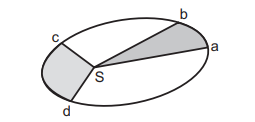
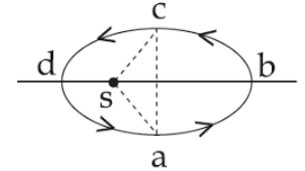
Figure (below) shows the elliptical path of a planet about the sun. The two shaded parts have equal area. If \(t_1\) and \(t_2\) be the time taken by the planet to go from \(a\) to \(b\) and from \(c\) to \(d\) respectively,
 CorrectIncorrect
Hint
(b) To solve this, we rely on Kepler’s Second Law of Planetary Motion, also known as the Law of Equal Areas.
Step-by-Step Analysis:
Step 1: Recall Kepler’s Second Law. The law states that a line segment joining a planet and the Sun sweeps out equal areas during equal intervals of time. Mathematically, the areal velocity (\(d A / d t\)) is constant for any given planet.
Step 2: Apply the law to the given areas. The problem specifies that the two shaded parts (the area swept from \(a\) to \(b\) and the area swept from \(c\) to \(d\)) have equal area.
Step 3: Relate Area to Time. Since the areas are equal, and we know that the rate at which area is swept is constant:
\(
\text { Area }_1=\text { Area }_2 \Longrightarrow t_1=t_2
\)
Conclusion: Because the areas are equal, the time taken to sweep those areas must be identical, regardless of where the planet is in its elliptical orbit (even though the planet moves faster when it is closer to the sun).
The correct option is (b) \(t_1=t_2\). - Question 13 of 62
13. Question
A person sitting in a chair in a satellite feels weightless because
CorrectIncorrectHint
(c) Understanding Weightlessness in Orbit
Step 1: Analyze the Earth’s attraction. It is a common misconception that gravity is zero in space. In reality, the Earth’s gravitational pull is what keeps the satellite in orbit. Without it, the satellite would fly off in a straight line. Therefore, statement (a) is incorrect.
Step 2: Evaluate the state of motion. A satellite and everything inside it are in a state of free fall. They are constantly accelerating toward the center of the Earth. Since the person is accelerating, statement (d) is incorrect.
Step 3: Examine the Normal Force. “Weight” as we feel it is actually the Normal Force ( \(N\) )the push-back from a floor or chair. In a satellite, both the chair and the person are falling toward Earth with the same acceleration (\(g\) at that altitude). Because they are falling together at the same rate, the chair does not “push” against the person.
Step 4: Determine the result. Since the chair and the person do not press against each other, the Normal Force (\(N\)) becomes zero. This lack of contact force is what creates the sensation of weightlessness.
Conclusion: The sensation of weightlessness occurs because the person and the satellite are falling at the same rate, meaning there is no support force acting on the body.
The correct statement is (c) the normal force is zero.The Mathematical Proof:
Step 1: Set up the Force Equation. According to Newton’s Second Law (\(F_{\text {net }}=m a\)), the forces acting on the person are gravity (\(m g^{\prime}\)) acting downward and the normal force (\(N\)) from the chair acting upward:
\(
m g^{\prime}-N=m a
\)
(Note: \(g^{\prime}\) is the acceleration due to gravity at the satellite’s specific altitude.)
Step 2: Identify the Acceleration. In a stable circular orbit, the only acceleration the person experiences is the acceleration due to gravity. Therefore, the person’s acceleration \(a\) is exactly equal to \(g^{\prime}\) :
\(
a=g^{\prime}
\)
Step 3: Solve for the Normal Force. Substitute \(g^{\prime}\) for \(a\) in the first equation:
\(
\begin{gathered}
m g^{\prime}-N=m g^{\prime} \\
-N=m g^{\prime}-m g^{\prime} \\
N=0
\end{gathered}
\) - Question 14 of 62
14. Question
A body is suspended from a spring balance kept in a satellite. The reading of the balance is \(W_1\) when the satellite goes in an orbit of radius \(R\) and is \(W_2\) when it goes in an orbit of radius \(2 R\).
CorrectIncorrectHint
(a) This question is a clever follow-up to our discussion on the normal force. It tests whether you can distinguish between gravitational pull and the reading on a scale.
Step-by-Step Analysis:
Step 1: Identify what a spring balance measures. A spring balance does not directly measure the gravitational force (\(F_g=\frac{G M m}{r^2}\)). Instead, it measures the tension in the spring, which is the force required to support the object against its surroundings (similar to the normal force \(N\) ).
Step 2: Apply the physics of a satellite orbit. As we proved in the previous question, any object inside a satellite is in a state of free fall. Both the satellite and the spring balance are accelerating toward the Earth at the same rate as the suspended body (\(a=g^{\prime}\)).
Step 3: Calculate the tension (reading). Using the same logic as the chair example:
\(
m g^{\prime}-T=m a
\)
Since the body is in orbit, its acceleration \(a\) is equal to the local gravity \(g^{\prime}\).
\(
m g^{\prime}-T=m g^{\prime}
\)
\(
T=0
\)
Step 4: Compare the two orbits. In the orbit of radius \(R\), the reading \(W_1\) is \(\mathbf{0}\).
In the orbit of radius \(2 R\), the reading \(W_2\) is 0.
Conclusion: Even though the actual gravitational pull of the Earth is weaker at \(2 R\) than at \(R\), the spring balance will show a reading of zero in both cases because the entire system is in free fall.
The correct option is (a) \(W_1=W_2\). - Question 15 of 62
15. Question
The kinetic energy needed to project a body of mass \(m\) from the earth’s surface to infinity is
CorrectIncorrectHint
(c) To find the kinetic energy required to project an object to infinity, we look at the concept of Escape Velocity and the Law of Conservation of Energy.
Step-by-Step Analysis:
Step 1: Establish the goal. To project a body to “infinity,” the total energy at infinity must be at least zero. Since potential energy at infinity is defined as zero, we need to provide enough kinetic energy at the surface to overcome the Earth’s gravitational binding energy.
Step 2: Identify the Potential Energy at the surface. The gravitational potential energy (\(U\)) of a mass \(m\) at the Earth’s surface (radius \(R\)) is:
\(
U=-\frac{G M m}{R}
\)
Step 3: Relate \(G M\) to \(g\). We know that the acceleration due to gravity at the surface is \(g= \frac{G M}{R^2}\). Rearranging this, we get:
\(
G M=g R^2
\)
Substituting this into our potential energy equation:
\(
U=-\frac{\left(g R^2\right) m}{R}=-m g R
\)
Step 4: Calculate the required Kinetic Energy (\(K\)). For the body to just reach infinity, its total energy (\(K+U\)) must be zero:
\(
\begin{gathered}
K+(-m g R)=0 \\
K=m g R
\end{gathered}
\)
Conclusion:
The kinetic energy needed to escape Earth’s gravity entirely is equal to the magnitude of the potential energy at the surface.
The correct option is (c) \(m g R\). - Question 16 of 62
16. Question
A particle is kept at rest at a distance \(R\) (earth’s radius) above the earth’s surface. The minimum speed with which it should be projected so that it does not return is
CorrectIncorrectHint
(c) To solve for the projection speed required for the particle to “not return,” we are essentially calculating the escape velocity from a specific starting point-in this case, at a height \(R\) above the surface.
Step-by-Step Analysis:
Step 1: Determine the initial distance. The particle is at a distance \(R\) above the surface. Since the surface is already \(R\) distance from the center, the total initial distance \((r)\) from the center of the Earth is:
\(
r=R+R=2 R
\)
Step 2: Apply the Conservation of Energy. To escape to infinity and not return, the total energy (\(E\)) must be at least zero.
\(
\begin{gathered}
E_{\text {initial }}=E_{\text {final }} \\
K_i+U_i=0
\end{gathered}
\)
Step 3: Substitute the energy formulas. Let \(v\) be the projection speed and \(m\) be the mass of the particle:
\(
\frac{1}{2} m v^2+\left(-\frac{G M m}{r}\right)=0
\)
Substitute \(r=2 R\) :
\(
\frac{1}{2} m v^2=\frac{G M m}{2 R}
\)
Step 4: Solve for \(v\). Cancel the mass \(m\) from both sides and multiply by 2 :
\(
\begin{aligned}
& v^2=\frac{2 G M}{2 R} \\
& v^2=\frac{G M}{R} \\
& v=\sqrt{\frac{G M}{R}}
\end{aligned}
\)
Conclusion: The speed required to escape from a height equal to the Earth’s radius is lower than the escape speed from the surface because the gravitational “well” is shallower at that distance.
The correct option is (c) \(\sqrt{\frac{G M}{R}}\). - Question 17 of 62
17. Question
A satellite is orbiting the earth close to its surface. A particle is to be projected from the satellite to just escape from the earth. The escape speed from the earth is \(v_e\). Its speed with respect to the satellite
CorrectIncorrectHint
(d) This question explores the difference between absolute velocity (relative to Earth’s center) and relative velocity (relative to the moving satellite).
Step-by-Step Analysis:
Step 1: Identify the Required Absolute Speed. To escape Earth’s gravity from a point near the surface, an object must reach an absolute speed of \(v_e \approx \sqrt{2} v_o\) (where \(v_o\) is the orbital speed). This \(v_e\) is the speed relative to the center of the Earth.
Step 2: Identify the Satellite’s Speed. The satellite is already moving at an orbital speed (\(v_o\)) relative to the Earth. For a satellite close to the surface, \(v_o=\frac{v_e}{\sqrt{2}} \approx 0.707 v_e\).
Step 3: Consider the Direction of Projection. Since the particle is being projected from the satellite, its final speed relative to Earth depends on whether it is thrown in the same direction as the satellite’s motion, opposite to it, or at an angle.
Step 4: Evaluate the Relative Speed (\(v_{\text {rel }}\)).
Case 1 (Pro-grade): If projected in the direction of the satellite’s motion, the satellite’s existing speed \(v_o\) helps. The required “boost” is only \(v_e-v_o\), which is less than \(v_e\).
Case 2 (Retro-grade): If projected opposite to the satellite’s motion, the particle must first cancel out the satellite’s speed and then reach \(v_e\) in the other direction. The required speed would be \(v_e+v_o\), which is more than \(v_e\).
Case 3 (Perpendicular): If projected radially outward, the relative speed required would be \(\sqrt{v_e^2-v_o^2}\), which is also less than \(v_e\) but different from Case 1.
Conclusion: Because the satellite is already moving, the extra speed you need to add to reach the escape threshold depends entirely on which way you point your launcher.
The correct option is (d) will depend on direction of projection. - Question 18 of 62
18. Question
Let \(V\) and \(E\) denote the gravitational potential and gravitational field at a point. It is possible to have
CorrectIncorrectHint
All are correct.
All four conditions (a), (b), (c), and (d) are generally considered possible in the context of typical physics problems when the zero of potential is arbitrary or specific configurations are considered.
(a) \(V=0\) and \(E=0\) : This occurs at a point infinitely far away from all masses, where by convention the potential is set to zero, and the field is also zero.
(b) \(V=0\) and \(E \neq 0\) : This is possible if we choose a specific reference point for the potential or have a specific non-physical mass distribution. For a general physical system with only attractive gravity (no negative mass), this is generally considered impossible if \(V=0\) is defined at infinity, as \(V\) will always be negative when a nonzero field is present. However, in the context of a multiple-choice question, it is often included as possible by assuming an arbitrary zero potential reference or complex mass distribution.
(c) \(V \neq 0\) and \(E=0\) : This occurs inside a uniform spherical shell, where the field is zero, but the potential is constant and non-zero (specifically, \(V=-\frac{G M}{R}\) where \(R\) is the radius).
(d) \(V \neq 0\) and \(E \neq 0\) : This is the general case for any point at a finite distance from a mass distribution, such as a point near the Earth’s surface.Answer: The possible options are (a), (c), and (d) for standard gravitational theory with mass as the only source and \(V=0\) at infinity. Option (b) is generally considered impossible under these standard conditions. If the zero of potential can be arbitrarily set, then all options may be considered possible.
- Question 19 of 62
19. Question
Inside a uniform spherical shell
CorrectIncorrectHint
(b, c, d) To analyze the conditions inside a uniform spherical shell, we look at the properties of gravity as defined by the Shell Theorem.
Step-by-Step Analysis:
Step 1: Examine the Gravitational Field (\(E\)). According to the Shell Theorem, the net gravitational force exerted by a uniform shell on any object located inside it is zero. This is because the gravitational pulls from all the different parts of the shell cancel each other out perfectly at every interior point.
Therefore, (b) is correct.
Step 2: Determine if the Field is “Same Everywhere”. Since the field is 0 at every single point inside the shell, the field is technically uniform (constant).
Therefore, (d) is also correct.
Step 3: Examine the Gravitational Potential (\(V\)). The relationship between the field and potential is \(E=-d V / d r\). If the field \(E\) is zero, then the derivative of the potential is zero (\(d V / d r=0)\). In calculus, a function with a zero derivative is a constant.
This means the potential does not change as you move around inside the shell.
Therefore, (c) is correct.
Step 4: Check for Zero Potential. While the potential is constant inside the shell, it is not zero. It is equal to the potential at the surface of the shell, which is \(V=-G M / R\). Work must still be done to move a mass from infinity to the surface of the shell; once inside, no additional work is required to move it further.
Therefore, (a) is incorrect.Conclusion: Inside a uniform spherical shell, the gravitational field is zero everywhere, which simultaneously means the field is “the same” (zero) and the potential is “the same” (constant).
The correct options are (b), (c), and (d). - Question 20 of 62
20. Question
A uniform spherical shell gradually shrinks maintaining its shape. The gravitational potential at the centre
CorrectIncorrectHint
(b) To determine how the gravitational potential at the center changes as the shell shrinks, we need to look at the formula for potential inside a hollow sphere.
Step-by-Step Analysis:
Step 1: Identify the formula for potential. As we established in the previous problem, the gravitational potential \(V\) is constant everywhere inside a uniform spherical shell. This constant value is equal to the potential at the surface:
\(
V=-\frac{G M}{R}
\)
Where \(G\) is the gravitational constant, \(M\) is the mass of the shell, and \(R\) is its radius.
Step 2: Analyze the variables. In this scenario, the mass \(M\) of the shell remains constant because it is only “shrinking,” not losing material. The only variable changing is the radius \(R\).
Step 3: Evaluate the change in magnitude. As the shell shrinks, the radius \(R\) decreases. In the fraction \(G M / R\), as the denominator (\(R\)) gets smaller, the overall value of the fraction (\(G M / R)\) increases.
Step 4: Account for the negative sign. Since gravitational potential is a negative quantity:
The magnitude \(G M / R\) is getting larger.
Therefore, the value \(V\) is becoming more negative (e.g., moving from -10 to -20 ).
Step 5: Define “increase” vs “decrease”. In physics and mathematics, a value becoming more negative is described as a decrease.
Conclusion: As the shell shrinks, the potential at the center becomes more negative, which means the gravitational potential decreases.
The correct option is (b) decreases. - Question 21 of 62
21. Question
Consider a planet moving in an elliptical orbit round the sun. The work done on the planet by the gravitational force of the sun
CorrectIncorrectHint
(b, c) To determine where and when the work done by gravity is zero, we look at the relationship between the force vector and the displacement vector.
Step-by-Step Analysis:
Step 1: Recall the definition of Work. Work (\(W\)) is defined as the dot product of the force (\(F\)) and the displacement \((d s)\) :
\(
W=\int F \cdot d s=\int F \cos \theta d s
\)
Where \(\theta\) is the angle between the gravitational force (pointing toward the Sun) and the direction of the planet’s motion.
Step 2: Analyze specific points in the orbit (Statement b). In an elliptical orbit, there are two specific points-the perihelion (closest point) and the aphelion (farthest point)-where the planet’s velocity is exactly perpendicular to the gravitational force \(\left(\theta=90^{\circ}\right)\). At these precise moments, \(\cos 90^{\circ}=0\), so the instantaneous work done is zero.
Therefore, (b) is correct.
Step 3: Analyze a complete revolution (Statement c). Gravity is a conservative force. This means the work done by gravity depends only on the initial and final positions of the planet. In one complete revolution, the planet returns to the exact same starting point (\(r_{\text {initial }}=r_{\text {final }}\)). The total change in kinetic energy is zero, and the total work done by the gravitational field is zero.
Therefore, (c) is correct.
Step 4: Evaluate Statement (d). Since we found points (perihelion and aphelion) where the work is zero, the claim that work is zero in “no part of the motion” is incorrect.
Evaluate Statement (a): Define Work for a small displacement. For a very small part of the orbit (\(d s\)), the work done (\(d W\)) is:
\(
d W=F \cdot d s=F d s \cos \theta
\)
Where \(\theta\) is the angle between the gravitational force (pointing toward the Sun) and the instantaneous direction of motion (tangent to the ellipse).
Analyze the angle \(\theta\). In a circular orbit, the force is always perpendicular to the motion \(\left(\theta=90^{\circ}\right)\), so the work is zero in every small part. However, in an elliptical orbit, the distance from the Sun is constantly changing.
Moving toward the Sun: The planet is “falling” inward, so the angle \(\theta\) is less than \(90^{\circ}\). Gravity does positive work, and the planet speeds up.
Moving away from the Sun: The planet is moving “upward” against gravity, so the angle \(\theta\) is greater than \(90^{\circ}\). Gravity does negative work, and the planet slows down.
Identify the exceptions. As mentioned previously, the work is only zero at the two specific points where the motion is momentarily perpendicular to the radius: the perihelion and aphelion.
Because gravity does work (either positive or negative) in almost every segment of an elliptical path to change the planet’s speed, the statement that work is zero in any (meaning every/all) small part is incorrect.
(a) is incorrect. Work is being done in nearly every small segment of an elliptical orbit to facilitate the exchange between potential and kinetic energy.
Summary: During most of the orbit: Gravity does work. It does positive work as the planet moves from aphelion to perihelion (speeding up) and negative work as it moves from perihelion back to aphelion (slowing down). - Question 22 of 62
22. Question
Two satellites \(A\) and \(B\) move round the earth in the same orbit. The mass of \(B\) is twice the mass of \(A\).
CorrectIncorrectHint
(a) To determine which statements are correct, we look at the physics of satellites in the same circular orbit. Let \(M\) be the mass of the Earth, \(r\) the radius of the orbit, and \(m\) the mass of the satellite.
Step-by-Step Analysis
Step 1: Analyze the Orbital Speed. For a satellite to stay in a stable circular orbit, the gravitational force must provide the centripetal force:
\(
\frac{m v^2}{r}=\frac{G M m}{r^2} \Longrightarrow v=\sqrt{\frac{G M}{r}}
\)
Notice that the mass of the satellite \((m)\) cancels out. Since \(A\) and \(B\) are in the same orbit (same \(r\)), their speeds must be identical.
(a) is correct.
Step 2: Analyze the Potential Energy ( \(U\)). The gravitational potential energy of the system is:
\(
U=-\frac{G M m}{r}
\)
Because the mass of \(B\) is twice the mass of \(A\left(m_B=2 m_A\right)\), the potential energy of the Earth-B system is twice that of the Earth-A system.
(b) is incorrect.
Step 3: Analyze the Kinetic Energy ( \(K\) ). Kinetic energy is given by \(K=\frac{1}{2} m v^2\). Since we established they have the same \(v\), but \(B\) has twice the mass:
\(
K_B=\frac{1}{2}\left(2 m_A\right) v^2=2 K_A
\)
The kinetic energy of \(B\) is twice that of \(A\).
(c) is incorrect.
Step 4: Analyze the Total Energy (\(E\)). Total energy is the sum of kinetic and potential energy:
\(
E=K+U=-\frac{G M m}{2 r}
\)
Again, because \(E\) is directly proportional to the mass of the satellite (\(m\)), the total energy of the systems will be different.
(d) is incorrect.Conclusion: The only property that is independent of the satellite’s mass in this scenario is the orbital speed.
The correct option is (a) Speeds of A and B are equal. - Question 23 of 62
23. Question
Which of the following quantities remain constant in a planetary motion (consider elliptical orbits) as seen from the sun?
CorrectIncorrectHint
(d) To determine which quantities remain constant in an elliptical orbit, we must look at the nature of the gravitational force exerted by the Sun.
Step-by-Step Analysis:
Step 1: Analyze Speed and Kinetic Energy. In an elliptical orbit, the distance \(r\) from the Sun is constantly changing. According to the conservation of mechanical energy, as the planet gets closer to the Sun (decreasing potential energy), it must move faster to increase its kinetic energy.
Since the speed changes throughout the orbit, (a) Speed and (c) Kinetic Energy are not constant.
Step 2: Analyze Angular Speed (\(\omega\)). Angular speed is the rate at which the angle changes ( \(d \theta / d t)\). Because the planet moves faster when it is closer to the Sun and slower when it is farther away, the angle is swept out at a non-uniform rate.
Therefore, (b) Angular speed is not constant.
Step 3: Analyze Angular Momentum (\(L\)). Angular momentum is defined as \(L=r \times p\). The rate of change of angular momentum is equal to the torque \((\tau)\) acting on the planet:
\(
\frac{d L}{d t}=\tau=r \times F
\)
In planetary motion, the gravitational force \(F\) is a central force, meaning it always acts along the line joining the planet and the Sun (the radial vector \(r\)).
Step 4: Evaluate the Torque. Since \(r\) and \(F\) are parallel (or anti-parallel), their cross product is zero:
\(
\tau=r \times F=0
\)
When the torque is zero, the angular momentum must remain constant in both magnitude and direction. This is also the physical basis for Kepler’s Second Law (equal areas in equal times).
Therefore, (d) is constant.
Conclusion: In an elliptical orbit, while the planet’s speed and distance are constantly fluctuating, the “rotational momentum” stays perfectly steady because the Sun’s pull doesn’t twist the planetit only pulls it toward the center.
The correct option is (d) Angular momentum. - Question 24 of 62
24. Question
In our solar system, the inter-planetary region has chunks of matter (much smaller in size compared to planets) called asteroids. They [NCERT Exemplar]
CorrectIncorrectHint
(d) will move in orbits like planets and obey Kepler’s laws.
Why this is the case:
Gravitational Influence: Even though asteroids have much smaller masses than planets, they are still under the gravitational pull of the Sun. According to Newton’s law of universal gravitation, any mass in space will be attracted to a larger mass.
Kepler’s Laws are Universal: Kepler’s laws of planetary motion are not mass-dependent for the orbiting body. They apply to any object orbiting a much larger central body due to gravity-this includes planets, comets, and asteroids.
The Physics: An asteroid’s orbital period and path are determined by its distance from the Sun and the Sun’s mass, not by the asteroid’s own mass. Therefore, they follow elliptical orbits, sweep out equal areas in equal times, and maintain the ratio of \(T^2 \propto r^3\).
Quick Debunking of the other options:
(a) and (b): Small mass does not mean an object escapes gravity or moves “irregularly.” If that were true, the Moon (which is smaller than Earth) wouldn’t have a stable orbit.
(c): There is no physical reason for asteroids to “defy” Kepler’s laws while still being governed by the same gravitational force that moves the planets. - Question 25 of 62
25. Question
The earth is an approximate sphere. If the interior contained matter which is not of the same density everywhere, then on the surface of the earth, the acceleration due to gravity [NCERT Exemplar]
CorrectIncorrectHint
(d) cannot be zero at any point.
To understand why (d) is the only definitive truth here, let’s break down how gravity behaves when density is non-uniform:
Magnitude and Direction: The acceleration due to gravity (\(g\)) at any point on the surface is the vector sum of the gravitational pulls from every bit of matter inside the Earth.
The Effect of Non-uniform Density: If the interior matter is distributed unevenly (e.g., a heavy concentration of ore in one hemisphere and light gas pockets in another), the “pull” will not necessarily point directly toward the geometric center. This rules out (a) and (c), as the direction would likely be skewed toward the denser regions.
The “Same Everywhere” Myth: Because the density varies, different points on the surface will be closer to (or further from) denser concentrations of mass. This means the magnitude of \(g\) will fluctuate. This rules out (b).Why (d) is correct:
For the acceleration due to gravity to be zero at the surface, the gravitational pull from one part of the Earth would have to perfectly cancel out the pull from all other parts. Given that the Earth is a massive, roughly spherical body, there is no physical distribution of internal matter that could cause the total gravitational field to completely vanish at any point on its surface. Gravity is always attractive; you will always have a net pull toward the mass of the planet. - Question 26 of 62
26. Question
Satellites orbiting the earth have a finite life and sometimes debris of satellites fall to the earth. This is because [NCERT Exemplar]
CorrectIncorrectHint
(c) of viscous forces causing the speed of satellite and hence, height to gradually decrease.
The Science Behind the “Orbital Decay”
While space is often described as a vacuum, the Earth’s atmosphere doesn’t just “end” abruptly. It thins out gradually.
Atmospheric Drag: Satellites in Low Earth Orbit (LEO) still encounter very thin traces of air molecules. As the satellite moves at high speeds, these molecules create viscous forces (air resistance or drag).
Loss of Energy: This drag acts against the motion of the satellite, causing it to lose kinetic energy. In the counter-intuitive world of orbital mechanics, as a satellite loses energy to friction, it cannot maintain its altitude and begins to “fall” into a lower orbit.
The Spiral Effect: As it moves into lower, denser layers of the atmosphere, the drag increases further. This creates a feedback loop where the satellite eventually spirals inward and re-enters the denser atmosphere, where most of it burns up due to intense heat from friction.
Why the other options are incorrect:
(a): While batteries and solar cells do fail, this only makes the satellite “dead” or nonfunctional. It doesn’t physically pull the satellite down to Earth; a dead satellite would stay in orbit forever if there were no drag.
(b): The laws of gravitation (like Newton’s or Kepler’s) actually predict stable closed orbits (ellipses or circles) in a perfect vacuum. Gravity alone doesn’t cause a “spiral” unless there is an external resistive force like drag.
(d): While “space junk” collisions are a serious concern, they are not the primary reason every satellite has a finite lifespan. Most debris falls due to the gradual decay described in option (c). - Question 27 of 62
27. Question
Both the earth and the moon are subject to the gravitational force of the sun. As observed from the sun, the orbit of the moon [NCERT Exemplar]
CorrectIncorrectHint
(b) will not be strictly elliptical because the total gravitational force on it is not central.
Why the Moon’s Orbit is “Wobbly”?
To understand this, we have to look at the forces acting on the Moon from the perspective of the Sun:
The Central Force Requirement: For an orbit to be a perfect ellipse (as described by Kepler’s First Law), the object must be influenced by a single central force-a pull coming from one fixed point.
Two Masters: From the Sun’s point of view, the Moon is being pulled by two massive bodies at the same time: the Sun and the Earth.
The Resulting Path: Because the Moon is constantly revolving around the Earth while both move around the Sun, the “net” gravitational force on the Moon is constantly shifting its direction. It doesn’t point to a single fixed center.Visualizing the Motion
If you were standing on the Sun watching the Moon, it wouldn’t look like a simple circle or ellipse. Instead, it would look like a wavy, slightly perturbed circle.
When the Moon is between the Earth and the Sun, the Earth’s gravity pulls it slightly away from the Sun.
When the Moon is on the far side of the Earth, the Earth’s gravity pulls it slightly toward the Sun.
This constant “tug-of-war” prevents the orbit from being a mathematically perfect ellipse.Breaking Down the Other Options
(a): This is only true if we ignore the Earth’s gravity entirely, which we can’t do since the Earth is very close to the Moon.
(c): While it looks like it repeats, orbits in space are rarely “necessarily” closed curves over long periods due to the complex gravitational dance of the whole solar system (precession).
(d): While other planets (like Jupiter) do have a gravitational effect, their influence is negligible compared to the massive influence the Earth has on the Moon’s path. - Question 28 of 62
28. Question
As observed from the earth, the sun appears to move in an approximate circular orbit. For the motion of another planet like mercury as observed from the earth, this would [NCERT Exemplar]
CorrectIncorrectHint
(c) not be true because the major gravitational force on mercury is due to the sun.
The “Apparent” vs. “Actual” Motion:
To understand this, we have to look at the perspective (the frame of reference) from which we are observing.
Sun as seen from Earth: Because Earth orbits the Sun, from our grounded perspective, it looks like the Sun is moving around us in a relatively smooth, circular path.
Mercury as seen from Earth: Mercury orbits the Sun, not the Earth. Furthermore, it orbits the Sun much faster than we do. When you try to track Mercury’s position from a moving platform (Earth), its path looks incredibly complex. It doesn’t look like a circle; it often appears to speed up, slow down, and even move backward (a phenomenon called retrograde motion).Why (c) is the scientific explanation:
The Dominant Pull: The motion of Mercury is governed almost entirely by the Sun’s gravity. It follows an elliptical path around the Sun.
Relative Motion: Because both Earth and Mercury are orbiting the Sun at different speeds and distances, their relative positions are constantly shifting. If Mercury were orbiting the Earth, it might look circular, but because its “heart” belongs to the Sun, its path relative to us is a complex loop-the-loop.Why the other options don’t work:
(a): Observationally, it’s just not true. Mercury’s path in our night sky is one of the most erratic to track.
(b): The gravitational force between Earth and Mercury is still governed by the inverse square law \(\left(F \propto 1 / r^2\right)\). The law doesn’t change; it’s just that the Earth’s pull on Mercury is very weak compared to the Sun’s.
(d): Gravity is the only significant force at play here. Mercury isn’t being pushed around by “other” non-gravitational forces (like magnetism or solar winds) in a way that dictates its primary orbit.A Quick Visualization:
Imagine you are on a merry-go-round (Earth) looking at someone on a different, faster merry-go-round (Mercury) nearby. From your perspective, that person isn’t moving in a simple circle around you; they are zigzagging toward and away from you as your relative speeds change. - Question 29 of 62
29. Question
Different points in the earth are at slightly different distances from the sun and hence, experience different forces due to gravitation. For a rigid body, we know that, if various forces act at various points in it, the resultant motion is as if a net force acts on the CM (centre of mass) causing translation and a net torque at the CM causing rotation around an axis through the CM . For the earth-sun system (approximating the earth as a uniform density sphere) [NCERT Exemplar]
CorrectIncorrectHint
(a) the torque is zero.
This question tests your understanding of how forces distribute across a symmetric body. Let’s break down why the torque ends up being zero under the given conditions:
Symmetry of the Sphere: The problem asks us to approximate the Earth as a uniform density sphere. In such a body, the Centre of Mass (CM) is located at the exact geometric center.
Central Force Nature: Gravitational force is a central force. According to Newton’s law of gravitation, the force between two spherical masses acts along the line joining their centers.
The Line of Action: While it is true that different points on Earth experience slightly different pulls (the side closer to the Sun feels a stronger pull than the far side), the resultant (net) gravitational force from the Sun acts precisely through the Earth’s Centre of Mass.
Torque Definition: Torque \((\tau)\) is defined as the product of the force and the perpendicular distance from the axis of rotation (the “lever arm”).
\(
\tau=r \times F
\)
If the line of action of the net force passes directly through the Centre of Mass, the lever arm is zero. No lever arm means zero torque.
Why the other options are incorrect:
(b) The torque causes the earth to spin: This is a common misconception. The Earth’s rotation (spin) is a result of the initial angular momentum it gained during the formation of the solar system, not because the Sun is “twisting” it.
(c) The rigid body result is not applicable: While the Earth has oceans and a molten core, in the context of celestial mechanics, treating it as a rigid body is a standard and highly accurate approximation.
(d) The torque causes the earth to move around the sun: This confuses force with torque. The gravitational force (linear) provides the centripetal acceleration that keeps the Earth in orbit. Torque relates only to the rotational motion about the Earth’s own axis. - Question 30 of 62
30. Question
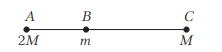
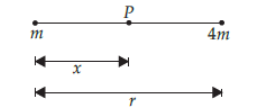
Particles of masses \(2 M, m\) and \(M\) are respectively at points \(A, B\) and \(C\) with \(A B=1 / 2(B C)\). \(m\) is much-much smaller than \(M\) and at time \(t=0\), they are all at rest as given in figure.

At subsequent times before any collision takes place [NCERT Exemplar]
CorrectIncorrectHint
(c) To solve this, we need to look at the gravitational forces acting on the small mass \(m\) at point \(B\) from the larger masses \(2 M\) and \(M\).
Step 1: Defining the Distances
Let the distance \(A B=r\). According to the problem, \(A B=\frac{1}{2}(B C)\), which means \(B C=2 r\).
Step 2: Calculating the Forces on \(m\)
The gravitational force is given by the formula \(F=\frac{G M_1 M_2}{d^2}\).
Force from \(A\left(F_A\right)\) : This force pulls mass \(m\) toward the left.
\(
F_A=\frac{G(2 M) m}{r^2}=\frac{2 G M m}{r^2}
\)
Force from \(C\left(F_C\right)\) : This force pulls mass \(m\) toward the right.
\(
F_C=\frac{G(M) m}{(2 r)^2}=\frac{G M m}{4 r^2}
\)
Step 3: Comparing the Magnitudes
Now, let’s compare \(F_A\) and \(F_C\) :
\(F_A=\frac{2 G M m}{r^2}\)
\(F_C=0.25 \frac{G M m}{r^2}\)It is clear that \(F_A>F_C\). In fact, the pull from mass \(2 M\) is 8 times stronger than the pull from mass \(M\) because \(A\) is both more massive and much closer to \(B\).
Conclusion: Since the net force on \(m\) is directed toward the left (toward point \(A\)), the mass \(m\) will begin to accelerate in that direction. - Question 31 of 62
31. Question
Energy required to move a body of mass \(m\) from an orbit of radius \(2 R\) to \(3 R\) is
CorrectIncorrectHint
(d) Step 1: Calculate the initial and final potential energy
The gravitational potential energy of a body of mass \(m\) at a distance \(r\) from a body of mass \(M\) is given by the formula \(U=-\frac{G M m}{r}\).
The initial potential energy at radius \(r_1=2 R\) is \(U_1=-\frac{G M m}{2 R}\).
The final potential energy at radius \(r_2=3 R\) is \(U_2=-\frac{G M m}{3 R}\).
Step 2: Calculate the change in potential energy
The energy required to move the body is the change in potential energy,
\(
\Delta U=U_2-U_1
\)
\(\Delta U=-\frac{G M m}{3 R}-\left(-\frac{G M m}{2 R}\right)\)
\(\Delta U=-\frac{G M m}{3 R}+\frac{G M m}{2 R}\)
To combine these, find a common denominator, which is \(6 R\) :
\(
\begin{gathered}
\Delta U=\frac{-2 G M m+3 G M m}{6 R} \\
\Delta U=\frac{G M m}{6 R}
\end{gathered}
\)
The energy required to move the body from an orbit of radius \(2 R\) to \(3 R\) is \(\frac{\mathbf{G M m}}{\mathbf{6 R}}\). - Question 32 of 62
32. Question
The escape velocity of a body depends upon mass as
CorrectIncorrectHint
(a) The correct answer is \(\mathbf{a}\left(m^0\right)\).
In physics, the notation \(m^0\) indicates that a value is independent of mass (since any non-zero number raised to the power of 0 equals 1 ).The Mathematical Proof:
The escape velocity \(\left(v_e\right)\) is the minimum speed needed for an object to break free from the gravitational pull of a massive body (like a planet) without further propulsion. It is derived by equating the kinetic energy of the object to its gravitational potential energy.
In this expression the mass of the body (\(m\)) is not present. The escape velocity is independent of the mass \(m\) or it depends on \(m^0\). - Question 33 of 62
33. Question
The kinetic energy needed to project a body of mass \(m\) from the earth surface (radius \(R\)) to infinity is
CorrectIncorrectHint
(c) The required velocity is called escape velocity \(\left(v_e\right)\) to leave the earth surface of a body.
\(
v_e=\text { escape velocity }=\sqrt{2 g R}
\)
Kinetic Energy \(K . E=\frac{1}{2} m v_e^2\)
\(
\therefore K . E=\frac{1}{2} m \times 2 g R=m g R
\) - Question 34 of 62
34. Question
If suddenly the gravitational force of attraction between Earth and a satellite revolving around it becomes zero, then the satellite will
CorrectIncorrectHint
(b) move tangentially to the original orbit with the same velocity.
Why this happens (Newton’s First Law)?
This is a classic application of Newton’s First Law of Motion (the Law of Inertia). To understand the result, we have to look at what keeps a satellite in orbit in the first place:
The Centripetal Force: Gravitational attraction acts as a “string,” constantly pulling the satellite toward the Earth. This force changes the direction of the satellite’s velocity, forcing it into a curve rather than a straight line.
Instantaneous Velocity: At any single point in time, the satellite’s actual direction of motion is tangent to the circle.
The “Snap”: If gravity suddenly vanishes, there is no longer a force to “bend” the satellite’s path. According to the Law of Inertia, an object in motion will continue to move in a straight line at a constant speed unless acted upon by another force.Since the velocity was tangent to the orbit at the moment gravity disappeared, the satellite will simply fly off along that straight tangential line.
Why the other options are incorrect?
(a): An orbit requires a constant inward pull. Without gravity, a circular path is physically impossible.
(c): Things in space don’t just “stop” unless something hits them. The satellite already has a high orbital velocity (about \(7.8 \mathrm{~km} / \mathrm{s}\) for Low Earth Orbit), and it will keep that speed.
(d): There is no longer any force pulling it toward the Earth, so it has no reason to move in that direction. - Question 35 of 62
35. Question
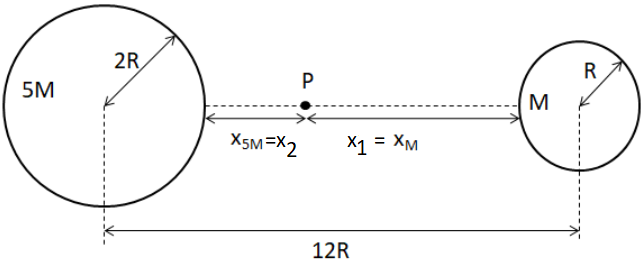
Two spherical bodies of mass \(M\) and \(5 M\) & radii \(R \& 2 R\) respectively are released in free space with initial separation between their centers equal to \(12 R\). If they attract each other due to gravitational force only, then the distance covered by the smaller body just before collision is
CorrectIncorrectHint
(c)

To solve this, we use the concept of the Centre of Mass (CM). Since the two bodies are in “free space” and the only force acting on them is their internal gravitational attraction, there is no external force. Therefore, the position of the Centre of Mass remains stationary.
Step 1: Identify the Distance to be Covered
The bodies will collide when their surfaces touch. At the moment of collision, the distance between their centers ( \(d_{\text {final }}\) ) will be the sum of their radii:
\(
d_{\text {final }}=R+2 R=3 R
\)
The total distance the two bodies must collectively cover to close the gap is the initial separation minus the final separation:
Total Gap to Close \(=12 R-3 R=9 R\)
Step 2: Use the Centre of Mass Property
In a two-body system with no external forces, the distance moved by each body is inversely proportional to its mass (\(m_1 x_1=m_2 x_2\)). This means the lighter body moves further than the heavier one.
Let \(x_1\) be the distance covered by the smaller body \((M)\) and \(x_2\) be the distance covered by the larger body \((5 M)\).
\(x_1+x_2=9 R\) (Total distance covered)
\(M x_1=5 M x_2 \Longrightarrow x_1=5 x_2\)
Solve for \(x_1\)
Substitute \(x_2=\frac{x_1}{5}\) into the first equation:
\(
\begin{gathered}
x_1+\frac{x_1}{5}=9 R \\
\frac{6 x_1}{5}=9 R \\
6 x_1=45 R \\
x_1=\frac{45 R}{6}=7.5 R
\end{gathered}
\) - Question 36 of 62
36. Question
The time period of satellite of earth is 5 hours. If the separation between the earth and the satellite is increased to 4 times the previous value, the new time period will become
CorrectIncorrectHint
(c) The Formula:
Kepler’s Third Law states that the square of the time period ( \(T\) ) of a satellite is directly proportional to the cube of the radius (\(R\)) of its orbit:
\(
T^2 \propto R^3
\)
Or, as a ratio:
\(
\frac{T_2^2}{T_1^2}=\frac{R_2^3}{R_1^3} \Longrightarrow\left(\frac{T_2}{T_1}\right)^2=\left(\frac{R_2}{R_1}\right)^3
\)
Step-by-Step Calculation
Step 1:Identify the given values:
Initial Time Period \(\left(T_1\right)=5\) hours
Initial separation \(\left(R_1\right)=R\)
New separation \(\left(R_2\right)=4 R\) (since it is increased to 4 times the previous value)
Step 2: Set up the ratio:
\(
\begin{gathered}
\left(\frac{T_2}{5}\right)^2=\left(\frac{4 R}{R}\right)^3 \\
\left(\frac{T_2}{5}\right)^2=(4)^3
\end{gathered}
\)
\(T_2=40\) hours - Question 37 of 62
37. Question
The escape velocity for a body projected vertically upwards from the surface of earth is \(11 \mathrm{~km} / \mathrm{s}\). If the body is projected at an angle of \(45^{\circ}\) with the vertical, the escape velocity will be
CorrectIncorrectHint
(c) We know, Escape velocity, \(v_e=\sqrt{2 g R}\).
So the escape velocity is independent of the angle at which the body is projected, hence it will remain same as \(11 \mathrm{~km} / \mathrm{s}\). - Question 38 of 62
38. Question
Suppose the gravitational force varies inversely as the \(\mathrm{n}^{\text {th }}\) power of distance. Then the time period of a planet in circular orbit of radius \(R\) around the sun will be proportional to
CorrectIncorrectHint
(c) To solve this, we balance the gravitational force with the centripetal force required for a circular orbit.
Step 1: Setting up the Force Equation
The problem states that the gravitational force (\(F_g\)) varies inversely as the \(n^{\text {th }}\) power of distance:
\(
F_g \propto \frac{1}{R^n}
\)
For a planet of mass \(m\) moving in a circular orbit of radius \(R\) with constant angular velocity \(\omega\), the centripetal force (\(F_c\)) is:
\(
F_c=m R \omega^2
\)
Since the gravitational force provides the necessary centripetal force, we equate them:
\(
m R \omega^2 \propto \frac{1}{R^n}
\)
Step 2: Relating Angular Velocity to Time Period
We know that the relationship between angular velocity (\(\omega\)) and the time period (\(T\)) is:
\(
\omega=\frac{2 \pi}{T}
\)
Substituting this into our force equation:
\(
\begin{gathered}
m R\left(\frac{2 \pi}{T}\right)^2 \propto \frac{1}{R^n} \\
\frac{R}{T^2} \propto \frac{1}{R^n}
\end{gathered}
\)
Step 3: Solving for \(T\)
Now, we rearrange the equation to isolate \(T\) :
\(
\begin{aligned}
& T^2 \propto R \cdot R^n \\
& T^2 \propto R^{n+1}
\end{aligned}
\)
To find \(T\), take the square root of both sides:
\(
\begin{aligned}
T & \propto \sqrt{R^{n+1}} \\
T & \propto R^{\frac{n+1}{2}}
\end{aligned}
\) - Question 39 of 62
39. Question
The time period of an earth satellite in circular orbit is independent of
CorrectIncorrectHint
(c) the mass of the satellite.
The Mathematical Proof:
To see why this is true, we look at the formula for the time period \((T)\) of a satellite. The time period is derived by equating the gravitational force to the centripetal force:
\(
\frac{G M m}{r^2}=m \frac{v^2}{r}
\)
Where:
\(G\) is the gravitational constant.
\(M\) is the mass of the Earth (the central body).
\(m\) is the mass of the satellite.
\(r\) is the radius of the orbit.
When you solve for the orbital velocity \((v)\) and then find the time period \(\left(T=\frac{2 \pi r}{v}\right)\), the formula becomes:
\(
T=2 \pi \sqrt{\frac{r^3}{G M}}
\)
Key Takeaways
1. Independent of \(m\) : Notice that the mass of the satellite (\(m\)) cancels out during the derivation. Whether it’s a tiny bolt or a massive space station, if they are at the same altitude, they will have the same time period.
2. Dependent on \(M\) : The time period does depend on the mass of the planet being orbited.
3. Dependent on \(r\) : As seen in Kepler’s Third Law \(\left(T^2 \propto r^3\right)\), the radius of the orbit significantly changes how long it takes to complete one revolution. - Question 40 of 62
40. Question
A satellite of mass \(m\) revolves around the earth of radius \(R\) at a height \(x\) from its surface. If \(g\) is the acceleration due to gravity on the surface of the earth, the orbital speed of the satellite is
CorrectIncorrectHint
(d) \(\left(\frac{g R^2}{R+x}\right)^{1 / 2}\).
To find the orbital speed, we look at the balance of forces that keeps the satellite in its circular path.
Step 1: The Force Balance
For a satellite to stay in a circular orbit, the gravitational force provided by the Earth must act as the centripetal force.
\(
F_c=F_g
\)
Substituting the formulas for a satellite of mass \(m\) at a distance \(r\) from the center of the Earth:
\(
m \frac{v^2}{r}=\frac{G M m}{r^2}
\)
Where:
\(v\) is the orbital speed.
\(r\) is the orbital radius (distance from the center of the Earth).
\(M\) is the mass of the Earth.
Step 2: Defining the Radius
The satellite is at a height \(x\) from the surface, so the total distance from the Earth’s center is:
\(
r=R+x
\)
Substituting this into the velocity equation (after canceling \(m\) and one \(r\)):
\(
v^2=\frac{G M}{R+x} \Longrightarrow v=\sqrt{\frac{G M}{R+x}}
\)
Step 3: Converting to \(g\)
We need to express the answer in terms of \(g\) (acceleration due to gravity at the surface). We know that:
\(
g=\frac{G M}{R^2} \Longrightarrow G M=g R^2
\)
Now, substitute \(g R^2\) for \(G M\) in our velocity formula:
\(
v=\sqrt{\frac{g R^2}{R+x}}
\)
Which is the same as:
\(
v=\left(\frac{g R^2}{R+x}\right)^{1 / 2}
\) - Question 41 of 62
41. Question
If \(g\) is the acceleration due to gravity on the earth’s surface, the gain in the potential energy of an object of mass \(m\) raised from the surface of the earth to a height equal to the radius \(R\) of the earth is
CorrectIncorrectHint
(C) \(\frac{1}{2} m g R\).
To find the gain in potential energy, we calculate the difference between the gravitational potential energy at the Earth’s surface and at the new height.
Step 1: The Potential Energy Formula
The gravitational potential energy (\(U\)) of a mass \(m\) at a distance \(r\) from the center of the Earth is:
\(
U=-\frac{G M m}{r}
\)
Step 2: Step-by-Step Calculation
Initial State (At the surface): The distance from the center is \(r_1=R\).
\(
U_1=-\frac{G M m}{R}
\)
Final State (At height \(R\) from the surface): The distance from the center is \(r_2=R+R= 2 R\).
\(
U_2=-\frac{G M m}{2 R}
\)
Gain in Potential Energy (\(\triangle U\)):
\(
\begin{gathered}
\Delta U=U_2-U_1 \\
\Delta U=\left(-\frac{G M m}{2 R}\right)-\left(-\frac{G M m}{R}\right) \\
\Delta U=\frac{G M m}{R}-\frac{G M m}{2 R} \\
\Delta U=\frac{G M m}{2 R}
\end{gathered}
\)
Step 3: Substituting \(g\)
We know that the acceleration due to gravity at the surface is \(g=\frac{G M}{R^2}\), which gives us \(G M=g R^2\). Substitute this into our result:
\(
\begin{aligned}
& \Delta U=\frac{\left(g R^2\right) m}{2 R} \\
& \Delta U=\frac{1}{2} m g R
\end{aligned}
\) - Question 42 of 62
42. Question
A particle of mass 10 g is kept on the surface of a uniform sphere of mass 100 kg and radius 10 cm. Find the work to be done against the gravitational force between them to take the particle far away from the sphere (you may take \(G=6.67 \times 10^{-11} \mathrm{Nm}^2 / \mathrm{kg}^2\))
CorrectIncorrectHint
(C) \(6.67 \times 10^{-10} \mathrm{~J}\).
To find the work done to move the particle “far away” (which in physics means to infinity), we need to calculate the change in gravitational potential energy.
Step 1: Understanding the Physics
The work done against gravitational force is equal to the increase in the potential energy of the system.
Initial Potential Energy \(\left(U_i\right)\) : When the particle is on the surface.
Final Potential Energy (\(U_f\)): When the particle is at infinity (defined as 0).
The formula for work done (\(W\)) is:
\(
W=U_f-U_i=0-\left(-\frac{G M m}{R}\right)=\frac{G M m}{R}
\)
Step 2: Given Data (Converted to SI Units)
Mass of sphere \((M)=100 \mathrm{~kg}\)
Mass of particle \((m)=10 \mathrm{~g}=0.01 \mathrm{~kg}\)
Radius of sphere \((R)=10 \mathrm{~cm}=0.1 \mathrm{~m}\)
\(G=6.67 \times 10^{-11} \mathrm{Nm}^2 / \mathrm{kg}^2\)
Step 3: Step-by-Step Calculation
Substitute the values into the work formula:
\(
W=\frac{\left(6.67 \times 10^{-11}\right) \times 100 \times 0.01}{0.1}
\)
Simplify the numerator:
\(
100 \times 0.01=1
\)
So,\(W=\frac{6.67 \times 10^{-11}}{0.1}\)
Dividing by 0.1 is the same as multiplying by 10 :
\(
W=6.67 \times 10^{-11} \times 10=6.67 \times 10^{-10} \mathrm{~J}
\) - Question 43 of 62
43. Question
Average density of the earth
CorrectIncorrectHint
(d) is directly proportional to \(g\).
The Derivation:
To see the relationship between average density (\(\rho\)) and the acceleration due to gravity (\(g\)), we combine the formula for \(g\) with the formula for the density of a sphere.
Step 1: Formula for \(g\) : The acceleration due to gravity at the surface is:
\(
g=\frac{G M}{R^2}
\)
Step 2: Mass in terms of Density: Assuming Earth is a sphere of radius \(R\), its mass (\(M\)) is:
\(
M=\text { Volume × Density }=\left(\frac{4}{3} \pi R^3\right) \rho
\)
Step 3: Substitution: Plug the expression for \(M\) into the formula for \(g\) :
\(
\begin{gathered}
g=\frac{G\left(\frac{4}{3} \pi R^3 \rho\right)}{R^2} \\
g=\frac{4}{3} \pi G R \rho
\end{gathered}
\)
The Proportionality:
From the resulting equation \(g=\left(\frac{4 \pi G R}{3}\right) \rho\), we can see that since \(G, R\), and \(\pi\) are constants:
\(g \propto \rho\) (Gravity is directly proportional to density)
\(\rho \propto g\) (Density is directly proportional to gravity) - Question 44 of 62
44. Question
The change in the value of \(g\) at a height \(h\) above the surface of the earth is the same as at a depth \(d\) below the surface of earth. When both \(d\) and \(h\) are much smaller than the radius of earth, then which one of the following is correct?
CorrectIncorrectHint
(d) \(d=2 h\).
The Mathematical Proof:
When \(h\) and \(d\) are much smaller than the radius of the Earth \((R)\), we use approximation formulas derived from the binomial expansion.
Step 1: Variation of \(g\) with Height (\(h\))
The acceleration due to gravity at a height \(h\) is given by:
\(
g_h=g\left(1-\frac{2 h}{R}\right)
\)
The change in value (\(\Delta g_h\)) is:
\(
\Delta g_h=g-g_h=g\left(\frac{2 h}{R}\right)
\)
Step 2: Variation of \(g\) with Depth (\(d\))
The acceleration due to gravity at a depth \(d\) is given by:
\(
g_d=g\left(1-\frac{d}{R}\right)
\)
The change in value (\(\Delta g_d\)) is:
\(
\Delta g_d=g-g_d=g\left(\frac{d}{R}\right)
\)
Step 3: Equating the Changes
The problem states that the change in the value of \(g\) is the same for both cases:
\(
\begin{aligned}
\Delta g_h & =\Delta g_d \\
g\left(\frac{2 h}{R}\right) & =g\left(\frac{d}{R}\right)
\end{aligned}
\)
By canceling out \(g\) and \(R\) from both sides, we get:
\(
2 h=d
\)
\(d=2 h\) - Question 45 of 62
45. Question
If \(g_E\) and \(g_M\) are the accelerations due to gravity on the surfaces of the earth and the moon respectively and if Millikan’s oil drop experiment could be performed on the two surfaces, one will find the ratio \(\frac{\text { electro charge } \text { on the moon }}{\text { electronic charge } \text { on the earth }}\) to be
CorrectIncorrectHint
(b) The Reasoning:
This question is a classic test of your ability to distinguish between fundamental constants and variables that depend on local conditions.
Millikan’s Oil Drop Experiment: This experiment is used to measure the elementary charge (\(e\)) of an electron. It balances the downward force of gravity (\(m g\)) against the upward electric force (\(q E\)) on a tiny charged oil droplet.
Fundamental Constant: The electronic charge (\(e\)) is a universal physical constant. It is an intrinsic property of the electron itself, much like its spin.
Independence from Gravity: While the apparatus would need to be adjusted on the Moon (because the gravitational pull \(g_M\) is weaker, you would need less electric field strength \(E\) to hover the drop), the actual value of the charge \(e\) being measured does not change.
Why the ratio is \(1: 1\)
Regardless of whether you are on Earth, the Moon, or floating in deep space, the charge of a single electron remains exactly:
\(
e \approx 1.602 \times 10^{-19} \mathrm{C}
\)
Therefore:
\(
\frac{e_{\text {moon }}}{e_{\text {earth }}}=\frac{1.602 \times 10^{-19}}{1.602 \times 10^{-19}}=1
\) - Question 46 of 62
46. Question
A planet in a distant solar system is 10 times more massive than the earth and its radius is 10 times smaller. Given that the escape velocity from the earth is \(11 \mathrm{~km} \mathrm{~s}^{-1}\), the escape velocity from the surface of the planet would be
CorrectIncorrectHint
(c) The Mathematical Breakdown:
The escape velocity \(\left(v_e\right)\) from a spherical body is determined by the formula:
\(
v_e=\sqrt{\frac{2 G M}{R}}
\)
Where:
\(G\) is the universal gravitational constant.
\(M\) is the mass of the body.
\(R\) is the radius of the body.
Step-by-Step Calculation
Step 1: Identify the Ratios Let \(M_e\) and \(R_e\) be the mass and radius of the Earth. According to the problem:
Mass of the planet \(\left(M_p\right)=10 M_e\)
Radius of the planet \(\left(R_p\right)=\frac{R_{e x}}{10}\) (or \(0.1 R_e\))
Step 2: Set up the Ratio of Escape Velocities We can compare the escape velocity of the planet (\(v_p\)) to that of the Earth (\(v_e\)) by plugging the new values into the formula:
\(
\frac{v_p}{v_e}=\sqrt{\frac{M_p}{R_p} \cdot \frac{R_e}{M_e}}
\)
Substitute the given ratios:
\(
\begin{aligned}
&\begin{gathered}
\frac{v_p}{v_e}=\sqrt{\frac{10 M_e}{R_e / 10} \cdot \frac{R_e}{M_e}} \\
\frac{v_p}{v_e}=\sqrt{10 \times 10} \\
\frac{v_p}{v_e}=\sqrt{100}=10
\end{gathered}\\
&\text { 3. Solve for Final Velocity Since the escape velocity of the planet is } 10 \text { times that of the Earth: }\\
&v_p=10 \times 11 \mathrm{~km} / \mathrm{s}=110 \mathrm{~km} / \mathrm{s}
\end{aligned}
\)
Summary
Because the planet is much more massive and significantly more compact (smaller radius), its surface gravity is immense. The increase in mass makes the “gravity well” deeper, while the smaller radius brings you much closer to the center of mass where the pull is strongest. - Question 47 of 62
47. Question
This question contains Statement-1 and Statement-2. of the four choices given after the statements, choose the one that best describes the two statements.
Statement-1: For a mass \(M\) kept at the center of a cube of side ‘ \(a\) ‘, the flux of gravitational field passing through its sides \(4 \pi G M\).
Statement-2: If the direction of a field due to a point source is radial and its dependence on the distance ‘ \(r\) ‘ from the source is given as \(\frac{1}{r^2}\), its flux through a closed surface depends only on the strength of the source enclosed by the surface and not on the size or shape of the surface.CorrectIncorrectHint
(b) Analysis of the Statements:
Statement-2: The General Principle (Gauss’s Law for Gravitation)
Statement-2 describes the core requirement for Gauss’s Law. Any field that follows an inverse-square law (\(E \propto 1 / r^2\)) and is radially directed possesses a unique property: the total flux through any closed surface is proportional only to the source strength (mass) enclosed.
This is because as the surface area increases (\(\propto r^2\)), the field strength decreases at the exact same rate (\(\propto 1 / r^2\)), keeping the product (flux) constant regardless of the shape or size of the container.
Statement-1: The Specific Application
To find the gravitational flux \(\phi_g\) for a mass \(M\), we use the gravitational version of Gauss’s Law. The gravitational field intensity \(I\) due to a point mass is:
\(
I=\frac{G M}{r^2}
\)
The total flux through a closed surface is defined as:
\(
\phi_g=\oint I \cdot d A=4 \pi G M_{\text {enclosed }}
\)
Since the cube is a closed surface enclosing the mass \(M\), the total flux passing through all its sides is indeed \(4 \pi G M\).
Why (B) is the best choice:
Statement- 1 is true: The calculation follows directly from the integral of the field over the cube’s surface.
Statement-2 is true: It accurately defines the mathematical behavior of flux for inversesquare fields.
Correct Explanation: Statement-1 is only true because of the principles laid out in Statement-2. If the field didn’t depend on \(1 / r^2\), the flux through a cube would depend on the side length ‘ \(a\) ‘, which it does not. - Question 48 of 62
48. Question
The height at which the acceleration due to gravity becomes \(\frac{g}{9}\) (where \(g=\) the acceleration due to gravity on the surface of the earth) in terms of \(R\), the radius of the earth, is:
CorrectIncorrectHint
(d) \(2 R\).
To find the height at which the acceleration due to gravity reduces to a specific fraction, we use the general formula for \(g\) at an altitude \(h\).
Step 1: The Formula for \(g\) at Height \(h\)
The acceleration due to gravity at a height \(h\) from the Earth’s surface \(\left(g_h\right)\) is given by:
\(
g_h=\frac{G M}{(R+h)^2}
\)
We also know that the acceleration at the surface (\(g\)) is:
\(
g=\frac{G M}{R^2}
\)
By dividing \(g_h\) by \(g\), we get the ratio:
\(
\frac{g_h}{g}=\frac{R^2}{(R+h)^2}
\)
Step 2: Step-by-Step Calculation
According to the problem, the gravity at height \(h\) is one-ninth of the gravity at the surface:
\(
g_h=\frac{g}{9} \Longrightarrow \frac{g_h}{g}=\frac{1}{9}
\)
\(
g_h=\frac{g}{9} \Longrightarrow \frac{g_h}{g}=\frac{1}{9}
\)
Now, substitute this into our ratio formula:
\(
\frac{1}{9}=\frac{R^2}{(R+h)^2}
\)
To solve for \(h\), take the square root of both sides:
\(
\begin{gathered}
\sqrt{\frac{1}{9}}=\sqrt{\frac{R^2}{(R+h)^2}} \\
\frac{1}{3}=\frac{R}{R+h}
\end{gathered}
\)
Step 3: Solving for \(h\)
Cross-multiply to isolate \(h\) :
\(
\begin{gathered}
R+h=3 R \\
h=3 R-R \\
h=2 R
\end{gathered}
\)
Summary: At a height of \(2 R\) (which is two times the radius of the Earth above the surface, or \(3 R\) from the center), the force of gravity is \(1 / 3^2\) (or \(1 / 9\)) of its surface value. - Question 49 of 62
49. Question
Two bodies of masses \(m\) and \(4 m\) are placed at a distance \(r\). The gravitational potential at a point on the line joining them where the gravitational field is zero is:
CorrectIncorrectHint
(c)

To solve this, we first need to find the specific point where the gravitational field is zero (the “null point”) and then calculate the gravitational potential at that exact location.
Step 1: Finding the Null Point (Field = 0)
Let the point \(P\) be at a distance \(x\) from the mass \(m\). Therefore, its distance from the mass \(4 m\) will be (\(r-x\)). At this point, the gravitational fields (\(E\)) from both masses must be equal and opposite.
\(
\begin{gathered}
E_1=E_2 \\
\frac{G m}{x^2}=\frac{G(4 m)}{(r-x)^2}
\end{gathered}
\)
Take the square root of both sides:
\(
\begin{gathered}
\frac{1}{x}=\frac{2}{r-x} \\
r-x=2 x \\
r=3 x \Longrightarrow x=\frac{r}{3}
\end{gathered}
\)
So, the null point is at a distance \(\frac{r}{3}\) from \(m\) and \(\frac{2 r}{3}\) from \(4 m\).
Step 2: Calculating Gravitational Potential (\(V\))
Gravitational potential is a scalar quantity, so we simply add the potentials created by both masses at point \(P\). The formula for potential is \(V=-\frac{G M}{d}\).
\(
\begin{gathered}
V_{\text {total }}=V_1+V_2 \\
V_{\text {total }}=-\frac{G m}{x}-\frac{G(4 m)}{r-x}
\end{gathered}
\)
Now, substitute \(x=\frac{r}{3}\) and \((r-x)=\frac{2 r}{3}\) :
\(
\begin{gathered}
V_{\text {total }}=-\frac{G m}{r / 3}-\frac{4 G m}{2 r / 3} \\
V_{\text {total }}=-\frac{3 G m}{r}-\frac{3 \times 4 G m}{2 r} \\
V_{\text {total }}=-\frac{3 G m}{r}-\frac{6 G m}{r} \\
V_{\text {total }}=-\frac{9 G m}{r}
\end{gathered}
\)
Summary of the Concept:
Gravitational Field is a vector; it is zero where the pulls cancel out.
Gravitational Potential is a scalar; it represents the “depth” of the gravitational well. Even if the forces cancel out, you are still deep within the potential wells of both masses, which is why the value is a significant negative number rather than zero. - Question 50 of 62
50. Question
The mass of a spaceship is 1000 kg . It is to be launched from the earth’s surface out into free space. The value of \(g\) and \(R\) (radius of earth) are \(10 \mathrm{~m} / \mathrm{s}^2\) and 6400 km respectively. The required energy for this work will be:
CorrectIncorrectHint
(d) \(6.4 \times 10^{10}\) Joules.
The Physics Principle:
To launch an object from the surface of a planet into “free space” (which means an infinite distance away), we must provide enough energy to overcome the Earth’s Gravitational
Potential Energy.
The energy required is equal to the work done against gravity, which is the difference between the potential energy at infinity and the potential energy at the Earth’s surface.
Step-by-Step Calculation
Step 1: Identify the Energy Formula The work required (\(W\)) to move a mass \(m\) from the surface (\(R\)) to infinity (\(\infty\)) is:
\(
\begin{gathered}
W=\Delta U=U_{\infty}-U_{\text {surface }} \\
W=0-\left(-\frac{G M m}{R}\right)=\frac{G M m}{R}
\end{gathered}
\)
Step 2: Convert to \(g\) and \(R\) Since we are given \(g\) (acceleration due to gravity at the surface) and \(R\), we use the relation \(g=\frac{G M}{R^2}\), which gives us \(G M=g R^2\).
Substituting this into the work formula:
\(
W=\frac{\left(g R^2\right) m}{R}=m g R
\)
Step 3: Plug in the Values (using SI units)
Mass \((m)=1000 \mathrm{~kg}\)
Gravity \((g)=10 \mathrm{~m} / \mathrm{s}^2\)
Radius \((R)=6400 \mathrm{~km}=6.4 \times 10^6 \mathrm{~m}\)
\(
\begin{gathered}
W=1000 \times 10 \times\left(6.4 \times 10^6\right) \\
W=10^4 \times\left(6.4 \times 10^6\right) \\
W=6.4 \times 10^{10} \text { Joules }
\end{gathered}
\) - Question 51 of 62
51. Question
What is the minimum energy required to launch a satellite of mass \(m\) from the surface of a planet of mass \(M\) and radius \(R\) in a circular orbit at an altitude of \(2 R\)?
CorrectIncorrectHint
(a) \(\frac{5 G m M}{6 R}\).
To find the minimum energy required, we need to calculate the difference between the Total Mechanical Energy of the satellite in its final orbit and its Initial Energy while resting on the planet’s surface.
Step 1: Initial Energy (\(E_i\))
At the surface of the planet, the satellite is at rest. Therefore, its kinetic energy is zero, and it only possesses gravitational potential energy.
Distance from center \(\left(r_1\right): R\)
Initial Energy \(\left(E_i\right): U_s=-\frac{G M m}{R}\)
Step 2: Final Energy in Orbit (\(E_f\))
When the satellite is in a stable circular orbit at an altitude of \(2 R\), its total distance from the center is \(r_2=R+2 R=3 R\).
In a circular orbit, the total energy ( \(E\) ) is half of the potential energy ( \(U\)), or simply \(E= -\frac{G M m}{2 r}\).
Total Orbital Energy \(\left(E_f\right):-\frac{G M m}{2(3 R)}=-\frac{G M m}{6 R}\)
Step 3: Energy Required ( \(\Delta E\) )
The energy required is the work done to move the satellite from the surface into that specific orbital state:
\(
\begin{gathered}
\Delta E=E_f-E_i \\
\Delta E=\left(-\frac{G M m}{6 R}\right)-\left(-\frac{G M m}{R}\right) \\
\Delta E=\frac{G M m}{R}-\frac{G M m}{6 R}
\end{gathered}
\)
To subtract these, use a common denominator of \(6 R\) :
\(
\Delta E=\frac{6 G M m}{6 R}-\frac{G M m}{6 R}=\frac{5 G M m}{6 R}
\) - Question 52 of 62
52. Question
Four particles, each of mass \(M\) and equidistant from each other, move along a circle of radius \(R\) under the action of their mutual gravitational attraction. The speed of each particle is :
 CorrectIncorrect
Hint
(d)

First, we resolve the 2 forces \(F_{21} \& F_{23}\) by component method. Let the resultant of \(F_{21} \& F_{23}\) is \(F^1\). So, \(F^1\) is given as by diagram
\(
F^1=F_{21} \cos 45^{\circ}+F_{23} \cos 45^{\circ} \dots(1)
\)
Because sine components of \(F_{21} \& F_{23}\) cancel out to each other because \(F_{21} \& F_{23}\) having same magnitude but direction are opposite. So, the combined force of \(F_{21} \& F_{23}\) on 2 is only due to their cosine components.
We know that gravitational force is given by
\(
F_g=\frac{G m_1 m_2}{r^2}
\)
Here \(\mathrm{r}=\) distance between mass \(m_1\) and \(m_2\).
So, \(F_{21}=\frac{G m_1 m_2}{r^2}\)
Here r is distance between \(m_1\) and \(m_2\)
\(
r=\sqrt{2} R \text { and } m_1=m_2=M
\)
\(
\text { So, } F_{21}=\frac{G M^2}{(\sqrt{2} R)^2}=\frac{G M^2}{2 R^2} \dots(2)
\)
\(
\text { And } F_{23}=\frac{G m_2 m_3}{r^2}
\)
Here \(\mathrm{r}=\) distance between \(m_2 \& m_3\) which is \(\sqrt{2} R\).
and \(m_3=m_2=M\)
\(
F_{23}=\frac{G M^2}{(\sqrt{2} R)^2}=\frac{G M^2}{2 R^2} \dots(3)
\)
From equation 1, 2 and 3
\(
\begin{aligned}
& F^1=2\left(\frac{G M^2}{2 R^2}\right) \cos 45^{\circ} \\
& \because \cos 45^{\circ}=\frac{1}{\sqrt{2}} \\
& F^1=\frac{G M^2}{\sqrt{2} R^2} \dots(4)
\end{aligned}
\)
In diagram, we can easily see that the direction of \(F^1\) and \(F_{24}\) is same i.e., –\(x\)
So, the net force on particle 2 is
\(
F_2=F^1+F_{24} \dots(5)
\)
Now, \(F_{24}=\frac{G m_2 m_4}{r^2}\)
Here \(\mathrm{r}=\) distance between \(m_2\) and \(m_4\)
And \(m_2=m_4=M\)
So, \(F_{24}=\frac{G M^2}{(2 R)^2}=\frac{G M^2}{4 R^2} \dots(6)\)
From equation 4, 5 and 6
\(
\begin{aligned}
& F_2=\frac{G M^2}{\sqrt{2} R^2}+\frac{G M^2}{4 R^2} \\
& F_2=\frac{G M^2}{R^2}\left(\frac{1}{4}+\frac{1}{\sqrt{2}}\right) \dots(7)
\end{aligned}
\)
This net force on 2 is balanced by centripetal force because the particle is moving with velocity \(u\) in circular orbit of radius \(R\).
\(
\begin{aligned}
&\text { So, } F_2=\frac{M u^2}{R} \dots(8)\\
&\text { From equation } 7 \text { & } 8\\
&\begin{aligned}
& \frac{M u^2}{R}=\frac{G M^2}{R^2}\left(\frac{1}{4}+\frac{1}{\sqrt{2}}\right) \\
& =\frac{G M}{R}\left(\frac{\sqrt{2}+4}{4 \sqrt{2}}\right) \\
& \Longrightarrow u^2=\frac{1}{4} \frac{G M}{R}(1+2 \sqrt{2}) \\
& \Longrightarrow u=\sqrt{\frac{G M}{4 R}(1+2 \sqrt{2})} \\
& \therefore u=\frac{1}{2} \sqrt{\frac{G M}{R}(1+2 \sqrt{2})}
\end{aligned}
\end{aligned}
\) - Question 53 of 62
53. Question
From a solid sphere of mass \(M\) and radius \(R\), a spherical portion of radius \(R / 2\) is removed, as shown in the figure. Taking gravitational potential \(V=0\) at \(r=\infty\), the potential at the center of the cavity thus formed is: \((G=\) gravitational constant \()\)
 CorrectIncorrect
Hint
(d) To solve this, we use the principle of superposition. The gravitational potential of the sphere with a cavity is equal to the potential of the original solid sphere minus the potential that would have been created by the removed mass.
Step 1: Identify the Masses
Original Sphere (Mass M): Radius is R.
Removed Sphere (Mass \(m\)): Radius is \(r=R / 2\).
Since mass is proportional to volume (\(V \propto R^3\)), we calculate \(m\) :
\(
m=M \times\left(\frac{R / 2}{R}\right)^3=\frac{M}{8}
\)
Step 2: Identify the Point of Interest
We need the potential at the center of the cavity (let’s call it point \(P\)).
Point \(P\) is at a distance \(r=R / 2\) from the center of the original solid sphere.
Point \(P\) is at the center of the removed sphere.
Step 3: Calculate Potential from the Original Sphere (\(V_{\text {solid }}\))
Point \(P\) is inside the original solid sphere. The formula for potential at a distance \(r\) inside a solid sphere is:
\(
V_{i n}=-\frac{G M}{2 R^3}\left(3 R^2-r^2\right)
\)
Substituting \(r=R / 2\) :
\(
\begin{gathered}
V_{s o l i d}=-\frac{G M}{2 R^3}\left(3 R^2-\left(\frac{R}{2}\right)^2\right)=-\frac{G M}{2 R^3}\left(3 R^2-\frac{R^2}{4}\right) \\
V_{s o l i d}=-\frac{G M}{2 R^3}\left(\frac{11 R^2}{4}\right)=-\frac{11 G M}{8 R}
\end{gathered}
\)
Step 4: Calculate Potential from the Removed Mass (\(V_{\text {removed }}\))
Point \(P\) is at the center of the removed mass. The potential at the center of a solid sphere of mass \(m\) and radius \(r\) is:
\(
V_{\text {center }}=-\frac{3 G m}{2 r}
\)
Substituting \(m=M / 8\) and \(r=R / 2\) :
\(
V_{\text {removed }}=-\frac{3 G(M / 8)}{2(R / 2)}=-\frac{3 G M}{8 R}
\)
Step 5: Final Potential (\(V_{\text {net }}\))
Applying superposition:
\(
\begin{gathered}
V_{\text {net }}=V_{\text {solid }}-V_{\text {removed }} \\
V_{\text {net }}=\left(-\frac{11 G M}{8 R}\right)-\left(-\frac{3 G M}{8 R}\right) \\
V_{\text {net }}=-\frac{11 G M}{8 R}+\frac{3 G M}{8 R}=-\frac{8 G M}{8 R} \\
V_{\text {net }}=-\frac{G M}{R}
\end{gathered}
\)
Summary: The gravitational potential at the center of the cavity is \(-G M / R\). - Question 54 of 62
54. Question
A satellite is revolving in a circular orbit at a height ‘ \(h\) ‘ from the earth’s surface (radius of earth \(R ; h \ll R\) ). The minimum increase in its orbital velocity required, so that the satellite could escape from the earth’s gravitational field, is close to : (Neglect the effect of atmosphere.)
CorrectIncorrectHint
(d) To solve this, we need to find the difference between the velocity the satellite already has (orbital velocity) and the velocity it needs to achieve to break free (escape velocity).
Step 1: The Orbital Velocity (\(v_o\))
For a satellite in a circular orbit at a height \(h\), the orbital velocity is:
\(
v_o=\sqrt{\frac{G M}{R+h}}
\)
Since the problem states \(h \ll R\), we can approximate \(R+h \approx R\). Thus:
\(
v_o \approx \sqrt{\frac{G M}{R}}
\)
Using the relation \(g=\frac{G M}{R^2}\) (so \(G M=g R^2\)), we get:
\(
v_o=\sqrt{\frac{g R^2}{R}}=\sqrt{g R}
\)
Step 2: The Escape Velocity (\(v_e\))
The escape velocity from a distance \(r\) from the center of the Earth is the speed required for the total energy to become zero. At a height \(h \ll R\), the distance is essentially \(R\) :
\(
v_e=\sqrt{\frac{2 G M}{R}}
\)
Again, substituting \(G M=g R^2\) :
\(
v_e=\sqrt{2 g R}
\)
Step 3: The Minimum Increase Required (\(\boldsymbol{\Delta} \boldsymbol{v}\))
The “increase required” is the difference between where the satellite is now and the “finish line” of escape:
\(
\begin{gathered}
\Delta v=v_e-v_o \\
\Delta v=\sqrt{2 g R}-\sqrt{g R}
\end{gathered}
\)
We can factor out \(\sqrt{g R}\) to match the format of the options:
\(
\Delta v=\sqrt{g R}(\sqrt{2}-1)
\) - Question 55 of 62
55. Question
Figure shows elliptical path abcd of a planet around the sun S such that the area of triangle csa is \(\frac{1}{4}\) the area of the ellipse. (See figure) With db as the semimajor axis, and ca as the semiminor axis. If \(t_1\) is the time taken for planet to go over path abc and \(t_2\) for path taken over cda then :
 CorrectIncorrect
Hint
(c) To solve this problem, we use Kepler’s Second Law of Planetary Motion (the Law of Areas), which states that a planet sweeps out equal areas in equal intervals of time.
This means that the time taken to travel along a certain path is directly proportional to the area swept out by the radius vector joining the planet to the Sun (\(S\)).
Step 1: Analyzing the Areas
Let the total area of the ellipse be \(A\). According to the problem:
The area of the triangle \(\triangle C S A\) is \(\frac{1}{4}\) of the total area of the ellipse: Area \((\triangle C S A)=\frac{1}{4} A\)
The axes \(d b\) and ca divide the ellipse into four quadrants. However, because the Sun ( \(S\) ) is at a focus and not the center, the areas of the sectors created by the axes are not equal.
Step 2: Calculating Area for Path \(a b c\left(t_1\right)\)
The path \(a b c\) corresponds to the area bounded by the arc \(a b c\) and the focus \(S\). Looking at the geometry:
The area for path \(a b c\) is the sum of the half-ellipse \(a b c\) (centered at the intersection of the axes) plus the area of the triangle \(\triangle C S A\).
Wait-strictly speaking, if we look at the segment \(a b c\) relative to the focus \(S\), we are looking at the area of the semi-ellipse plus/minus the displacement of the focus.
Given Area \((\triangle C S A)=\frac{1}{4} A\) :
The area swept by path \(a b c\) is: Area \((S a b c)=\) Area(Semi-ellipse) + Area(\(\triangle C S A\)).
\(\operatorname{Area}(S a b c)=\frac{1}{2} A+\frac{1}{4} A=\frac{3}{4} A\).
Step 3: Calculating Area for Path cda (\(t_2\))
The path cda corresponds to the remaining area of the ellipse:
Area \((S c d a)=\) Total Area – Area \((S a b c)\)
\(\operatorname{Area}(S c d a)=A-\frac{3}{4} A=\frac{1}{4} A\).
Step 4: Finding the Relationship between \(t_1\) and \(t_2\)
Since \(t \propto\) Area:
\(t_1 \propto \frac{3}{4} A\)
\(t_2 \propto \frac{1}{4} A\)
Taking the ratio:
\(
\begin{gathered}
\frac{t_1}{t_2}=\frac{3 / 4}{1 / 4}=3 \\
\therefore t_1=3 t_2
\end{gathered}
\) - Question 56 of 62
56. Question
The variation of acceleration due to gravity \(g\) with distance d from centre of the earth is best represented by (\(\mathrm{R}=\) Earth’s radius):
 CorrectIncorrect
Hint
(b) The variation of acceleration due to gravity (\(g\)) with distance (\(d\)) from the center of the Earth is a two-part relationship. To understand the best representation (usually a graph), we look at what happens inside the Earth versus outside the Earth.
Step 1: Inside the Earth ( \(d<R\) )
Assuming the Earth has a uniform density, the mass that exerts a net gravitational pull on you is only the mass contained within a sphere of radius \(d\). The formula is:
\(
g_{i n}=\frac{G M d}{R^3}
\)
Since \(G, M\), and \(R\) are constants, \(g \propto d\).
Graph: This is a straight line passing through the origin. As you move from the center ( \(d=0\) ) to the surface (\(d=R\)), gravity increases linearly.
Step 2: Outside the Earth ( \(d \geq R\) )
Once you are outside the Earth’s surface, the Earth acts like a point mass concentrated at the center. The formula is:
\(
g_{o u t}=\frac{G M}{d^2}
\)
Here, \(g \propto \frac{1}{d^2}\).
Graph: This is a hyperbolic curve. As you move away from the surface toward infinity, gravity decreases rapidly according to the inverse-square law.
Step 3: At the Surface (\(d=R\))
The acceleration due to gravity reaches its maximum value at the surface:
\(
g_s=\frac{G M}{R^2} \approx 9.8 \mathrm{~m} / \mathrm{s}^2
\) - Question 57 of 62
57. Question
If the Earth has no rotational motion, the weight of a person on the equator is \(W\). Determine the speed with which the earth would have to rotate about its axis so that the person at the equator will weigh \(\frac{3}{4}W\). Radius of the Earth is 6400 km and \(\mathrm{g}=10 \mathrm{~m} / \mathrm{s}^2\).
CorrectIncorrectHint
(c) Step 1: Define initial and final weights
The initial weight of the person with no rotation is \(W=m g\).
The new weight with the required rotation is \(\mathrm{W}^{\prime}=\frac{3}{4} \mathrm{~W}=\frac{3}{4} \mathrm{mg}\).
Step 2: Relate weight to apparent gravity
The new apparent weight is also given by \(W^{\prime}=m g^{\prime}\), where \(g^{\prime}\) is the new apparent acceleration due to gravity at the equator. This leads to the relationship \(g^{\prime}=\frac{3}{4} g\).
Step 3: Apply the formula for apparent gravity at the equator
The acceleration due to gravity at the equator when the Earth rotates with angular velocity \(\omega\) is given by the formula \(g^{\prime}=g-\omega^2 R \cos ^2(\theta)\). At the equator, the latitude \(\theta=0^{\circ}\), so \(\cos (\theta)=1\). The formula becomes:
\(
g^{\prime}=g-\omega^2 R
\)
Step 4: Solve for angular velocity \(\omega\)
Substitute \(g^{\prime}\) with \(\frac{3}{4} g\) into the equation:
\(
\frac{3}{4} g=g-\omega^2 R
\)
Rearrange the equation to solve for \(\omega^2 R\) :
\(
\begin{gathered}
\omega^2 R=g-\frac{3}{4} g \\
\omega^2 R=\frac{1}{4} g
\end{gathered}
\)
Solve for \(\omega\) :
\(
\omega=\sqrt{\frac{g}{4 R}}
\)
Step 5: Substitute numerical values and calculate
Given \(g=10 \mathrm{~m} / \mathrm{s}^2\) and \(R=6400 \mathrm{~km}=6.4 \times 10^6 \mathrm{~m}\).
\(
\omega=\sqrt{\frac{10}{4 \times 6.4 \times 10^6}}\approx 0.000625 \mathrm{rad} / \mathrm{s}
\)
This can be expressed in scientific notation as \(\mathbf{0 . 6 2 5} \times \mathbf{1 0}^{-\mathbf{3}} \mathbf{r a d} / \mathbf{s}\), which is approximately \(\mathbf{0 . 6 3} \times \mathbf{1 0}^{-\mathbf{3}} \mathbf{r a d} / \mathrm{s}\) as presented in the options. - Question 58 of 62
58. Question
The mass density of a spherical body is given by \(\rho(\mathrm{r})=\frac{k}{r}\) for \(\mathrm{r} \leq \mathrm{R}\) and \(\rho(\mathrm{r})=0\) for \(\mathrm{r}>\mathrm{R}\), where \(r\) is the distance from the centre.

The correct graph that describes qualitatively the acceleration, \(a\), of a test particle as a function of \(r\) is :
CorrectIncorrectHint
(a) To solve this, we need to find how the gravitational acceleration \(a\) (or field \(g\)) behaves both inside and outside a sphere with a non-uniform density \(\rho(r)=\frac{k}{r}\).
Step 1: Inside the Sphere (\(r \leq R\))
The acceleration at a distance \(r\) from the center depends only on the mass \(M_r\) enclosed within a sphere of that radius. We calculate \(\boldsymbol{M}_{\boldsymbol{r}}\) by integrating the density:
\(
\begin{gathered}
M_r=\int_0^r \rho\left(r^{\prime}\right) \cdot 4 \pi r^{\prime 2} d r^{\prime} \\
M_r=\int_0^r \frac{k}{r^{\prime}} \cdot 4 \pi r^{\prime 2} d r^{\prime}=4 \pi k \int_0^r r^{\prime} d r^{\prime} \\
M_r=4 \pi k\left[\frac{r^{\prime 2}}{2}\right]_0^r=2 \pi k r^2
\end{gathered}
\)
Now, we use the formula for gravitational acceleration:
\(
a=\frac{G M_r}{r^2}=\frac{G\left(2 \pi k r^2\right)}{r^2}
\)
\(
a=2 \pi G k
\)
Observation: Inside the sphere, the acceleration \(a\) is constant. It does not depend on \(r\). On a graph, this is represented by a horizontal straight line.
Step 2: Outside the Sphere (\(r>R\))
Once the test particle is outside the sphere, the entire mass \(M\) of the sphere acts as if it were concentrated at the center. The total mass \(M\) is found by setting \(r=R\) in our previous mass equation:
\(
M=2 \pi k R^2
\)
The acceleration outside is:
\(
\begin{gathered}
a=\frac{G M}{r^2}=\frac{G\left(2 \pi k R^2\right)}{r^2} \\
a \propto \frac{1}{r^2}
\end{gathered}
\)
Observation: Outside the sphere, the acceleration follows the inverse-square law. On a graph, this is represented by a rectangular hyperbola dropping toward zero.
The Correct Graph:
The qualitative graph will show:
1. From 0 to \(R\) : A flat, horizontal line at a constant value \(a=2 \pi G k\).
2. At \(r=R\) : The line remains continuous.
3. For \(r>R\) : A curve that decreases proportionally to \(1 / r^2\). - Question 59 of 62
59. Question
Suppose that the angular velocity of rotation of earth is increased. Then, as a consequence :
CorrectIncorrectHint
(d) Except at poles, weight of the object on the earth will decrease.
To understand why, we have to look at how the Earth’s rotation creates an “apparent” change in gravity due to centrifugal force.
Step 1: The Effective Gravity Formula
The effective acceleration due to gravity (\(g^{\prime}\)) at any latitude \(\phi\) on a rotating Earth is given by:
\(
g^{\prime}=g-R \omega^2 \cos ^2 \phi
\)
Where:
\(g\) is the acceleration due to gravity if the Earth were stationary.
\(R\) is the radius of the Earth.
\(\omega\) is the angular velocity of Earth’s rotation.
\(\phi\) is the latitude (\(0^{\circ}\) at the equator, \(90^{\circ}\) at the poles).
Step 2: Why the Weight Decreases
The term \(R \omega^2 \cos ^2 \phi\) represents the centrifugal acceleration acting outward, away from the Earth’s axis.
As the angular velocity \(\omega\) increases, the value of this subtracted term increases.
Since you are subtracting a larger number from \(g\), the resulting effective gravity \(g^{\prime}\) decreases.
Because Weight (\(W=m g^{\prime}\)), the weight of the object decreases.
Step 3: The Special Case: The Poles
At the poles, the latitude \(\phi=90^{\circ}\). Since \(\cos 90^{\circ}=0\), the formula becomes:
\(
g^{\prime}=g-R \omega^2(0)=g
\)
At the poles, an object is sitting directly on the axis of rotation. There is no circular “swing” creating centrifugal force. Therefore, no matter how fast the Earth spins, the weight at the poles remains unchanged.
Summary of Effects
At the Equator: The effect is maximum \(\left(\cos 0^{\circ}=1\right)\). This is where you would lose the most weight if the Earth sped up.
At the Poles: The effect is zero. Your scale reading stays exactly the same.
Everywhere else: Weight decreases by an amount depending on how far you are from the equator. - Question 60 of 62
60. Question
A particle is moving with a uniform speed in a circular orbit of radius \(R\) in a central force inversely proportional to the \(n^{\text {th }}\) power of \(R\). If the period of rotation of the particle is \(T\), then :
CorrectIncorrectHint
(d) \(T \propto R^{(n+1) / 2}\).
To find the relationship between the time period \(T\) and the radius \(R\), we balance the central force with the centripetal force required for circular motion.
Step 1: The Force Balance
The problem states that the central force \(F\) is inversely proportional to the \(n^{\text {th }}\) power of \(R\) :
\(
F \propto \frac{1}{R^n} \Longrightarrow F=\frac{k}{R^n}
\)
For a particle of mass \(m\) moving in a circle of radius \(R\) with speed \(v\), this force must provide the necessary centripetal force:
\(
\frac{m v^2}{R}=\frac{k}{R^n}
\)
Step 2: Relating Velocity to Radius
Rearranging the equation above to solve for \(v^2\) :
\(
v^2 \propto \frac{R}{R^n} \Longrightarrow v^2 \propto \frac{1}{R^{n-1}}
\)
Taking the square root:
\(
v \propto \frac{1}{R^{(n-1) / 2}}
\)
Step 3: Introducing the Time Period (\(T\))
The time period \(T\) for one complete revolution is the circumference divided by the speed:
\(
T=\frac{2 \pi R}{v}
\)
Since \(2 \pi\) is a constant:
\(
T \propto \frac{R}{v}
\)
Now, substitute the relationship for \(v\) derived in step 2:
\(
\begin{aligned}
& T \propto \frac{R}{1 / R^{(n-1) / 2}} \\
& T \propto R \cdot R^{(n-1) / 2}
\end{aligned}
\)
Step 4: Final Proportionality
Using the laws of exponents \(\left(R^1 \cdot R^{(n-1) / 2}=R^{1+(n-1) / 2}\right)\) :
\(
\begin{aligned}
T & \propto R^{(2+n-1) / 2} \\
T & \propto R^{(n+1) / 2}
\end{aligned}
\) - Question 61 of 62
61. Question
Take the mean distance of the moon and the sun from the earth to be \(0.4 \times 10^6 \mathrm{~km}\) and \(150 \times 10^6 \mathrm{~km}\) respectively. Their masses are \(8 \times 10^{22} \mathrm{~kg}\) and \(2 \times 10^{30} \mathrm{~kg}\) respectively. The radius of the earth is 6400 km . Let \(\Delta F_1\) be the difference in the forces exerted by the moon at the nearest and farthest points on the earth and \(\Delta F_2\) be the difference in the force exerted by the sun at the nearest and farthest points on the earth. Then, the number closest to \(\frac{\Delta F_1}{\Delta F_2}\) is :
CorrectIncorrectHint
(a) To find the ratio \(\frac{\Delta F_1}{\Delta F_2}\), we first derive the expression for the difference in gravitational forces at the nearest and farthest points.
Step 1: The Physics Principle: Tidal Force
The difference in gravitational force exerted by a celestial body (like the Moon or Sun) on the opposite sides of the Earth is known as the tidal force.
The gravitational force \(F\) on a mass \(m\) at a distance \(r\) is:
\(
F=\frac{G M m}{r^2}
\)
Let \(d\) be the mean distance from the Earth’s center to the celestial body and \(R\) be the radius of the Earth.
Distance to the nearest point: \(r_{\text {near }}=d-R\)
Distance to the farthest point: \(r_{\text {far }}=d+R\)
The difference in force \(\Delta F\) is:
\(
\Delta F=F_{n e a r}-F_{f a r}=G M m\left[\frac{1}{(d-R)^2}-\frac{1}{(d+R)^2}\right]
\)
Since \(R \ll d\), we can use the binomial approximation or the derivative \(d F \approx \frac{d F}{d r} \Delta r\) :
\(
\Delta F \approx\left|\frac{d}{d r}\left(\frac{G M m}{r^2}\right)\right| \cdot(2 R)=\frac{2 G M m}{d^3} \cdot 2 R=\frac{4 G M m R}{d^3}
\)
Step 2: Setting up the Ratio
We want to find the ratio of these differences for the Moon (\(\Delta F_1\)) and the Sun (\(\Delta F_2\)):
\(
\frac{\Delta F_1}{\Delta F_2}=\frac{\frac{4 G M_m m R}{d_m^3}}{\frac{4 G M_s m R}{d_s^3}}
\)
By canceling the common terms (\(4, G, m, R\)), we get:
\(
\frac{\Delta F_1}{\Delta F_2}=\frac{M_m}{M_s} \times\left(\frac{d_s}{d_m}\right)^3
\)
Step 3: Calculation with Given Data
Masses: \(M_m=8 \times 10^{22} \mathrm{~kg}, M_s=2 \times 10^{30} \mathrm{~kg}\)
Distances: \(d_m=0.4 \times 10^6 \mathrm{~km}, d_s=150 \times 10^6 \mathrm{~km}\)
Substitute the values:
\(
\frac{\Delta F_1}{\Delta F_2}=\left(\frac{8 \times 10^{22}}{2 \times 10^{30}}\right) \times\left(\frac{150 \times 10^6}{0.4 \times 10^6}\right)^3
\)
The number closest to \(\frac{\Delta F_1}{\Delta F_2}\) is 2.
This result explains why the Moon has a greater influence on Earth’s tides than the Sun, despite the Sun being much more massive. Because tidal forces depend on the inverse cube of the distance \(\left(1 / d^3\right)\), the Moon’s proximity makes its gravitational “stretch” about twice as strong as the Sun’s. - Question 62 of 62
62. Question
A body of mass \(m\) is moving in a circular orbit of radius \(R\) about a planet of mass \(M\). At some instant, it splits into two equal masses. The first mass moves in a circular orbit of radius \(\frac{R}{2}\), and the other mass, in a circular orbit of radius \(\frac{3 R}{2}\). The difference between the final and initial total energies is :
CorrectIncorrectHint
(d) To solve this, we need to calculate the Total Mechanical Energy of the system before and after the split. For a body of mass \(m\) in a circular orbit of radius \(r\) around a planet of mass \(M\), the total energy is given by the formula:
\(
E=-\frac{G M m}{2 r}
\)
Step 1: Initial Total Energy ( \(E_i\) )
Before the split, the mass \(m\) is in a circular orbit of radius \(R\).
\(
E_i=-\frac{G M m}{2 R}
\)
Step 2: Final Total Energy (\(E_f\))
After the split, the body becomes two masses, each of mass \(\frac{m}{2}\).
Mass 1: Moves in an orbit of radius \(r_1=\frac{R}{2}\).
\(
E_1=-\frac{G M(m / 2)}{2(R / 2)}=-\frac{G M m}{2 R}
\)
Mass 2: Moves in an orbit of radius \(r_2=\frac{3 R}{2}\).
\(
E_2=-\frac{G M(m / 2)}{2(3 R / 2)}=-\frac{G M m}{6 R}
\)
The final total energy is the sum of these two energies:
\(
\begin{gathered}
E_f=E_1+E_2 \\
E_f=-\frac{G M m}{2 R}-\frac{G M m}{6 R}
\end{gathered}
\)
To combine these, use a common denominator of \(6 R\) :
\(
E_f=-\frac{3 G M m}{6 R}-\frac{G M m}{6 R}=-\frac{4 G M m}{6 R}=-\frac{2 G M m}{3 R}
\)
Step 3: Change in Energy (\(\Delta E\))
The difference between the final and initial total energies is:
\(
\begin{gathered}
\Delta E=E_f-E_i \\
\Delta E=\left(-\frac{2 G M m}{3 R}\right)-\left(-\frac{G M m}{2 R}\right) \\
\Delta E=\frac{G M m}{2 R}-\frac{2 G M m}{3 R}
\end{gathered}
\)
\(
\begin{aligned}
&\text { Using a common denominator of } 6 R \text { : }\\
&\begin{gathered}
\Delta E=\frac{3 G M m}{6 R}-\frac{4 G M m}{6 R} \\
\Delta E=-\frac{G M m}{6 R}
\end{gathered}
\end{aligned}
\)
The negative result indicates that the total energy of the system decreased during this split and reconfiguration. In a real-world scenario, this energy would likely be released as kinetic energy or heat during the splitting process.