13.8 Entrance Corner
Example 1: The equation of a particle executing simple harmonic motion is \(x=(5 \mathrm{~m}) \sin \left[\left(\pi \mathrm{s}^{-1}\right) t+\frac{\pi}{3}\right]\). Write down the amplitude, time period and maximum speed. Also find the velocity at \(t=1 \mathrm{~s}\).
Solution: Comparing with equation \(x=A \sin (\omega t+\delta)\), we see that the amplitude \(=5 \mathrm{~m}\), and time period \(=\frac{2 \pi}{\omega}=\frac{2 \pi}{\pi \mathrm{~s}^{-1}}=2 \mathrm{~s}\).
The maximum speed \(=A \omega=5 \mathrm{~m} \times \pi \mathrm{s}^{-1}=5 \pi \mathrm{~m} \mathrm{~s}^{-1}\).
The velocity at time \(t=\frac{d x}{d t}=A \omega \cos (\omega t+\delta)\).
At \(\quad t=1 \mathrm{~s}\),
\(
v=(5 \mathrm{~m})\left(\pi \mathrm{s}^{-1}\right) \cos \left(\pi+\frac{\pi}{3}\right)=-\frac{5 \pi}{2} \mathrm{~m} \mathrm{~s}^{-1} .
\)
Example 2: A block of mass 5 kg executes simple harmonic motion under the restoring force of a spring. The amplitude and the time period of the motion are 0.1 m and 3.14 s respectively. Find the maximum force exerted by the spring on the block.
Solution: The maximum force exerted on the block is \(k A\) when the block is at the extreme position.
The angular frequency \(\omega=\frac{2 \pi}{T}=2 \mathrm{~s}^{-1}\).
The spring constant \(\quad=k=m \omega^2\)
\(
=(5 \mathrm{~kg})\left(4 \mathrm{~s}^{-2}\right)=20 \mathrm{~N} \mathrm{~m}^{-1} .
\)
Maximum force \(=k A=\left(20 \mathrm{~N} \mathrm{~m}^{-1}\right)(0 \cdot 1 \mathrm{~m})=2 \mathrm{~N}\).
Example 3: A particle executing simple harmonic motion has angular frequency \(6.28 \mathrm{~s}^{-1}\) and amplitude 10 cm. Find (a) the time period, (b) the maximum speed, (c) the maximum acceleration, (d) the speed when the displacement is 6 cm from the mean position, (\(e\)) the speed at \(t=1 / 6 \mathrm{~s}\) assuming that the motion starts from rest at \(t=0\).
Solution: (a) Time period \(=\frac{2 \pi}{\omega}=\frac{2 \pi}{6 \cdot 28} \mathrm{~s}=1 \mathrm{~s}\).
(b)
\(
\begin{aligned}
\text { Maximum speed } & =A \omega=(0.1 \mathrm{~m})\left(6.28 \mathrm{~s}^{-1}\right) \\
& =0.628 \mathrm{~m} \mathrm{~s}^{-1}
\end{aligned}
\)
(c)
\(
\begin{aligned}
\text { Maximum acceleration } & =A \omega^2 \\
& =(0.1 \mathrm{~m})\left(6.28 \mathrm{~s}^{-1}\right)^2 \\
& =4 \mathrm{~m} \mathrm{~s}^{-2} .
\end{aligned}
\)
(d)
\(
\begin{aligned}
v=\omega \sqrt{A^2-x^2} & =\left(6.28 \mathrm{~s}^{-1}\right) \sqrt{(10 \mathrm{~cm})^2-(6 \mathrm{~cm})^2} \\
& =50 \cdot 2 \mathrm{~cm} \mathrm{~s}^{-1}
\end{aligned}
\)
(e) At \(t=0\), the velocity is zero, i.e., the particle is at an extreme. The equation for displacement may be written as
\(
x=A \cos \omega t
\)
The velocity is \(v=-A \omega \sin \omega t\).
\(
\text { At } t=\frac{1}{6} \mathrm{~s}, \quad \begin{aligned}
v & =-(0.1 \mathrm{~m})\left(6.28 \mathrm{~s}^{-1}\right) \sin \left(\frac{6.28}{6}\right) \\
& =\left(-0.628 \mathrm{~m} \mathrm{~s}^{-1}\right) \sin \frac{\pi}{3} \\
& =-54.4 \mathrm{~cm} \mathrm{~s}^{-1}
\end{aligned}
\)
Example 4: A particle executes a simple harmonic motion of time period \(T\). Find the time taken by the particle to go directly from its mean position to half the amplitude.
Solution: Let the equation of motion be \(x=A \sin \omega t\).
At \(t=0, x=0\) and hence the particle is at its mean position. Its velocity is
\([latex]
v=A \omega \cos \omega t=A \omega
\)
which is positive. So it is going towards \(x=A / 2\).
The particle will be at \(x=A / 2\), at a time \(t\), where
\(
\frac{A}{2}=A \sin \omega t
\)
or, \(\sin \omega t=1 / 2\)
or, \(\omega t=\pi / 6\)
Here minimum positive value of \(\omega t\) is chosen because we are interested in finding the time taken by the particle to directly go from \(x=0\) to \(x=A / 2\).
Thus, \(t=\frac{\pi}{6 \omega}=\frac{\pi}{6(2 \pi / T)}=\frac{T}{12}\).
Example 5: A block of mass \(m\) hangs from a vertical spring of spring constant \(k\). If it is displaced from its equilibrium position, find the time period of oscillations.
Solution: Suppose the length of the spring is stretched by a length \(\Delta l\). The tension in the spring is \(k \Delta l\) and this is the force by the spring on the block. The other force on the block is \(m g\) due to gravity. For equilibrium, \(m g=k \Delta l\) or \(\Delta l=m g / k\). Take this position of the block as \(x=0\). If the block is further displaced by \(x\), the resultant force is \(k\left(\frac{m g}{k}+x\right)-m g=k x\).
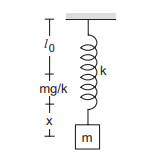
Thus, the resultant force is proportional to the displacement. The motion is simple harmonic with a time period \(T=2 \pi \sqrt{\frac{m}{k}}\).
We see that in vertical oscillations, gravity has no effect on time period. The only effect it has is to shift the equilibrium position by a distance \(m g / k\) as if the natural length is increased (or decreased if the lower end of the spring is fixed) by \(m g / k\).
Example 6: A particle suspended from a vertical spring oscillates 10 times per second. At the highest point of oscillation the spring becomes unstretched. (a) Find the maximum speed of the block. (b) Find the speed when the spring is stretched by 0.20 cm. Take \(g=\pi^2 \mathrm{~m} \mathrm{~s}^{-2}\).
Solution: (a) The mean position of the particle during vertical oscillations is \(m g / k\) distance away from its position when the spring is unstretched. At the highest point, i.e., at an extreme position, the spring is unstretched.
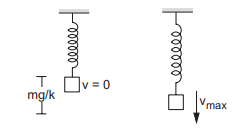
Hence the amplitude is
\(
A=\frac{m g}{k} \dots(i)
\)
The angular frequency is
\(
\omega=\sqrt{\frac{k}{m}}=2 \pi \nu=(20 \pi) \mathrm{s}^{-1} \dots(ii)
\)
or, \(\quad \frac{m}{k}=\frac{1}{400 \pi^2} \mathrm{~s}^2\).
Putting in (i), the amplitude is
\(
\begin{aligned}
A & =\left(\frac{1}{400 \pi^2} \mathrm{~s}^2\right)\left(\pi^2 \frac{\mathrm{~m}}{\mathrm{~s}^2}\right) \\
& =\frac{1}{400} \mathrm{~m}=0.25 \mathrm{~cm} .
\end{aligned}
\)
The maximum speed \(=A \omega\)
\(
=(0 \cdot 25 \mathrm{~cm})\left(20 \pi \mathrm{~s}^{-1}\right)=5 \pi \mathrm{~cm} \mathrm{~s}^{-1} .
\)
(b) When the spring is stretched by 0.20 cm, the block is \(0.25 \mathrm{~cm}-0.20 \mathrm{~cm}=0.05 \mathrm{~cm}\) above the mean position. The speed at this position will be
\(
\begin{aligned}
v & =\omega \sqrt{A^2-x^2} \\
& =\left(20 \pi \mathrm{~s}^{-1}\right) \sqrt{(0.25 \mathrm{~cm})^2-(0.05 \mathrm{~cm})^2} \\
& \cong 15.4 \mathrm{~cm} \mathrm{~s}^{-1}
\end{aligned}
\)
Example 7: The pulley shown in figure below has a moment of inertia \(I\) about its axis and mass \(m\). Find the time period of vertical oscillation of its centre of mass. The spring has spring constant \(k\) and the string does not slip over the pulley.
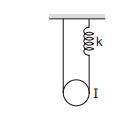
Solution: Let us first find the equilibrium position. For rotational equilibrium of the pulley, the tensions in the two strings should be equal. Only then the torque on the pulley will be zero. Let this tension be \(T\). The extension of the spring will be \(y=T / k\), as the tension in the spring will be the same as the tension in the string. For translational equilibrium of the pulley,
\(
2 T=m g \text { or, } 2 k y=m g \quad \text { or, } \quad y=\frac{m g}{2 k} .
\)
The spring is extended by a distance \(\frac{m g}{2 k}\) when the pulley is in equilibrium.
Now suppose, the centre of the pulley goes down further by a distance \(x\). The total increase in the length of the string plus the spring is \(2 x\) ( \(x\) on the left of the pulley and \(x\) on the right). As the string has a constant length, the extension of the spring is \(2 x\). The energy of the system is
\(
U=\frac{1}{2} I \omega^2+\frac{1}{2} m v^2-m g x+\frac{1}{2} k\left(\frac{m g}{2 k}+2 x\right)^2
\)
\(
=\frac{1}{2}\left(\frac{I}{r^2}+m\right) v^2+\frac{m^2 g^2}{8 k}+2 k x^2
\)
As the system is conservative, \(\frac{d U}{d t}=0\), giving \(\quad 0=\left(\frac{I}{r^2}+m\right) v \frac{d v}{d t}+4 k x v\)
or, \(\frac{d v}{d t}=-\frac{4 k x}{\left(\frac{I}{r^2}+m\right)}\)
or, \(\quad a=-\omega^2 x\), where \(\omega^2=\frac{4 k}{\left(\frac{I}{r^2}+m\right)}\).
Thus, the centre of mass of the pulley executes a simple harmonic motion with time period
\(
T=2 \pi \sqrt{\left(\frac{I}{r^2}+m\right) /(4 k)}
\)
Example 8: The friction coefficient between the two blocks shown in figure (below is \(\mu\) and the horizontal plane is smooth. (a) If the system is slightly displaced and released, find the time period. (b) Find the magnitude of the frictional force between the blocks when the displacement from the mean position is \(x\). (c) What can be the maximum amplitude if the upper block does not slip relative to the lower block?
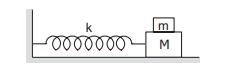
Solution: (a) For small amplitude, the two blocks oscillate together. The angular frequency is
\(
\omega=\sqrt{\frac{k}{M+m}}
\)
and so the time period \(T=2 \pi \sqrt{\frac{M+m}{k}}\).
(b) The acceleration of the blocks at displacement \(x\) from the mean position is
\(
a=-\omega^2 x=\frac{-k x}{M+m}
\)
The resultant force on the upper block is, therefore,
\(
m a=\frac{-m k x}{M+m}
\)
This force is provided by the friction of the lower block. Hence, the magnitude of the frictional force is \(\frac{m k|x|}{M+m}\).
(c) Maximum force of friction required for simple harmonic motion of the upper block is \(\frac{m k A}{M+m}\) at the
extreme positions. But the maximum frictional force can only be \(\mu m g\). Hence
\(
\frac{m k A}{M+m}=\mu m g \text { or, } A=\frac{\mu(M+m) g}{k} .
\)
Example 9: The left block in figure below collides inelastically with the right block and sticks to it. Find the amplitude of the resulting simple harmonic motion.
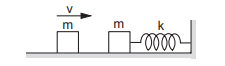
Solution: Assuming the collision to last for a small interval only, we can apply the principle of conservation of momentum. The common velocity after the collision is \(\frac{v}{2}\). The kinetic energy \(=\frac{1}{2}(2 m)\left(\frac{v}{2}\right)^2=\frac{1}{4} m v^2\).
This is also the total energy of vibration as the spring is unstretched at this moment. If the amplitude is \(A\), the total energy can also be written as \(\frac{1}{2} k A^2\). Thus
\(
\frac{1}{2} k A^2=\frac{1}{4} m v^2, \text { giving } A=\sqrt{\frac{m}{2 k}} v .
\)
Example 10: Describe the motion of the mass \(m\) shown in figure below. The walls and the block are elastic.
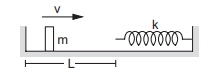
Solution: The block reaches the spring with a speed \(v\). It now compresses the spring. The block is decelerated due to the spring force, comes to rest when \(\frac{1}{2} m v^2=\frac{1}{2} k x^2\) and returns back. It is accelerated due to the spring force till the spring acquires its natural length. The contact of the block with the spring is now broken. At this instant it has regained its speed \(v\) (towards left) as the spring is unstretched and no potential energy is stored. This process takes half the period of oscillation, i.e., \(\pi \sqrt{m / k}\). The block strikes the left wall after a time \(L / v\) and as the collision is elastic, it rebounds with the same speed \(v\). After a time \(L / v\), it again reaches the spring and the process is repeated. The block thus undergoes periodic motion with time period \(\pi \sqrt{m / k}+\frac{2 L}{v}\).
Example 11: A block of mass \(m\) is suspended from the ceiling of a stationary standing elevator through a spring of spring constant \(k\). Suddenly, the cable breaks and the elevator starts falling freely. Show that the block now executes a simple harmonic motion of amplitude \(m g / k\) in the elevator.
Solution: When the elevator is stationary, the spring is stretched to support the block. If the extension is \(x\), the tension is \(k x\) which should balance the weight of the block.
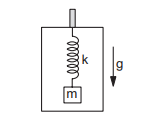
Thus, \(x=m g / k\). As the cable breaks, the elevator starts falling with acceleration ‘ \(g\) ‘. We shall work in the frame of reference of the elevator. Then we have to use a pseudo force \(m g\) upward on the block. This force will ‘balance’ the weight. Thus, the block is subjected to a net force \(k x\) by the spring when it is at a distance \(x\) from the position of unstretched spring. Hence, its motion in the elevator is simple harmonic with its mean position corresponding to the unstretched spring. Initially, the spring is stretched by \(x=m g / k\), where the velocity of the block (with respect to the elevator) is zero. Thus, the amplitude of the resulting simple harmonic motion is \(m g / k\).
Example 12: The spring shown in figure below is kept in a stretched position with extension \(x_0\) when the system is released. Assuming the horizontal surface to be frictionless, find the frequency of oscillation.

Solution: Considering “the two blocks plus the spring” as a system, there is no external resultant force on the system. Hence the centre of mass of the system will remain at rest. The mean positions of the two simple harmonic motions occur when the spring becomes unstretched. If the mass \(m\) moves towards right through a distance \(x\) and the mass \(M\) moves towards left through a distance \(X\) before the spring acquires natural length,
\(
x+X=x_0 \dots(i)
\)
\(x\) and \(X\) will be the amplitudes of the two blocks \(m\) and \(M\) respectively. As the centre of mass should not change during the motion, we should also have
\(
m x=M X \dots(ii)
\)
From (i) and (ii), \(x=\frac{M x_0}{M+m}\) and \(X=\frac{m x_0}{M+m}\).
Hence, the left block is \(x=\frac{M x_0}{M+m}\) distance away from its
mean position in the beginning of the motion. The force by the spring on this block at this instant is equal to the tension of spring, i.e., \(T=k x_0\).
Now \(x=\frac{M x_0}{M+m}\) or, \(x_0=\frac{M+m}{M} x\)
Thus, \(T=\frac{k(M+m)}{M} x\) or, \(a=\frac{T}{m}=\frac{k(M+m)}{M m} x\).
The angular frequency is, therefore, \(\omega=\sqrt{\frac{k(M+m)}{M m}}\) and the frequency is \(f=\frac{\omega}{2 \pi}=\frac{1}{2 \pi} \sqrt{\frac{k(M+m)}{M m}}\).
Example 13: Assume that a narrow tunnel is dug between two diametrically opposite points of the earth. Treat the earth as a solid sphere of uniform density. Show that if a particle is released in this tunnel, it will execute a simple harmonic motion. Calculate the time period of this motion.
Solution:
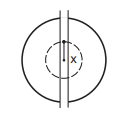
Consider the situation shown in figure above. Suppose at an instant \(t\) the particle in the tunnel is at a distance \(x\) from the centre of the earth. Let us draw a sphere of radius \(x\) with its centre at the centre of the earth. Only the part of the earth within this sphere will exert a net attraction on the particle. Mass of this part is
\(
M^{\prime}=\frac{\frac{4}{3} \pi x^3}{\frac{4}{3} \pi R^3} M=\frac{x^3}{R^3} M .
\)
The force of attraction is, therefore,
\(
F=\frac{G\left(x^3 / R^3\right) M m}{x^2}=\frac{G M m}{R^3} x .
\)
This force acts towards the centre of the earth. Thus, the resultant force on the particle is opposite to the displacement from the centre of the earth and is proportional to it. The particle, therefore, executes a simple harmonic motion in the tunnel with the centre of the earth as the mean position.
The force constant is \(k=\frac{G M m}{R^3}\), so that the time period is
\(
T=2 \pi \sqrt{\frac{m}{k}}=2 \pi \sqrt{\frac{R^3}{G M}} .
\)
Example 14: A simple pendulum of length 40 cm oscillates with an angular amplitude of 0.04 rad. Find (a) the time period, (b) the linear amplitude of the bob, (c) the speed of the bob when the string makes 0.02 rad with the vertical and (d) the angular acceleration when the bob is in momentary rest. Take \(g=10 \mathrm{~m} \mathrm{~s}^{-2}\).
Solution: (a) The angular frequency is
\(
\omega=\sqrt{g / l}=\sqrt{\frac{10 \mathrm{~m} \mathrm{~s}^{-2}}{0.4 \mathrm{~m}}}=5 \mathrm{~s}^{-1} .
\)
The time period is
\(
\frac{2 \pi}{\omega}=\frac{2 \pi}{5 \mathrm{~s}^{-1}}=1.26 \mathrm{~s} .
\)
(b) Linear amplitude \(=40 \mathrm{~cm} \times 0.04=1.6 \mathrm{~cm}\).
(c) Angular speed at displacement 0.02 rad is
\(
\Omega=\left(5 \mathrm{~s}^{-1}\right) \sqrt{(0.04)^2-(0.02)^2} \mathrm{rad}=0.17 \mathrm{rad} \mathrm{~s}^{-1} .
\)
Linear speed of the bob at this instant
\(
=(40 \mathrm{~cm}) \times 0.17 \mathrm{~s}^{-1}=6.8 \mathrm{~cm} \mathrm{~s}^{-1} .
\)
(d) At momentary rest, the bob is in extreme position. Thus, the angular acceleration
\(
\alpha=(0.04 \mathrm{rad})\left(25 \mathrm{~s}^{-2}\right)=1 \mathrm{rad} \mathrm{~s}^{-2} .
\)
Example 15: A simple pendulum having a bob of mass \(m\) undergoes small oscillations with amplitude \(\theta_0\). Find the tension in the string as a function of the angle made by the string with the vertical. When is this tension maximum, and when is it minimum ?
Solution: Suppose the speed of the bob at angle \(\theta\) is \(v\). Using conservation of energy between the extreme position and the position with angle \(\theta\),
\(
\frac{1}{2} m v^2=m g l\left(\cos \theta-\cos \theta_0\right) \dots(i)
\)
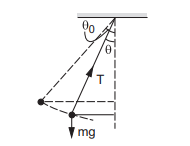
As the bob moves in a circular path, the force towards the centre should be equal to \(m v^2 / l\). Thus,
\(
T-m g \cos \theta=m v^2 / l .
\)
Using (i),
\(
T-m g \cos \theta=2 m g\left(\cos \theta-\cos \theta_0\right)
\)
or, \(T=3 m g \cos \theta-2 m g \cos \theta_0 .\)
Now \(\cos \theta\) is maximum at \(\theta=0\) and decreases as \(|\theta|\) increases (for \(|\theta|<90^{\circ}\)).
Thus, the tension is maximum when \(\theta=0\), i.e., at the mean position and is minimum when \(\theta= \pm \theta_0\), i.e., at extreme positions.
Example 16: A simple pendulum is taken at a place where its separation from the earth’s surface is equal to the radius of the earth. Calculate the time period of small oscillations if the length of the string is 1.0 m . Take \(g=\pi^2 \mathrm{~m} \mathrm{~s}^{-2}\) at the surface of the earth.
Solution: At a height \(R\) (radius of the earth) the acceleration due to gravity is
\(
g^{\prime}=\frac{G M}{(R+R)^2}=\frac{1}{4} \frac{G M}{R^2}=g / 4 .
\)
The time period of small oscillations of the simple pendulum is
\(
T=2 \pi \sqrt{l / g^{\prime}}=2 \pi \sqrt{\frac{1.0 \mathrm{~m}}{\frac{1}{4} \times \pi^2 \mathrm{~m} \mathrm{~s}^{-2}}}=2 \pi\left(\frac{2}{\pi} \mathrm{~s}\right)=4 \mathrm{~s} .
\)
Example 17: A simple pendulum is suspended from the ceiling of a car accelerating uniformly on a horizontal road. If the acceleration is \(a_0\) and the length of the pendulum is \(l\), find the time period of small oscillations about the mean position.
Solution: We shall work in the car frame. As it is accelerated with respect to the road, we shall have to apply a pseudo force \(m a_0\) on the bob of mass m. For mean position, the acceleration of the bob with respect to the car should be zero. If \(\theta\) be the angle made by the string with the vertical, the tension, weight and the pseudo force will add to zero in this position.
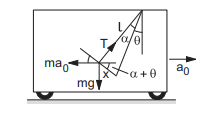
Suppose, at some instant during oscillation, the string is further deflected by an angle \(\alpha\) so that the displacement of the bob is \(x\). Taking the components perpendicular to the string,
component of \(T=0\),
component of \(m g=m g \sin (\alpha+\theta)\) and
component of \(m a_0=-m a_0 \cos (\alpha+\theta)\).
Thus, the resultant component \(F\)
\(
=m\left[g \sin (\alpha+\theta)-a_0 \cos (\alpha+\theta)\right] .
\)
Expanding the sine and cosine and putting \(\cos \alpha \approx 1\), \(\sin \alpha \approx \alpha=x / l\), we get
\(
F=m\left[g \sin \theta-a_0 \cos \theta+\left(g \cos \theta+a_0 \sin \theta\right) \frac{x}{l}\right] \dots(i)
\)
At \(x=0\), the force \(F\) on the bob should be zero, as this is the mean position. Thus by (i),
\(
0=m\left[g \sin \theta-a_0 \cos \theta\right] \dots(ii)
\)
giving
\(
\tan \theta=\frac{a_0}{g}
\)
Thus,
\(
\begin{aligned}
& \sin \theta=\frac{a_0}{\sqrt{a_0^2+g^2}} \dots(iii)\\
& \cos \theta=\frac{g}{\sqrt{a_0^2+g^2}} \dots(iv)
\end{aligned}
\)
Putting (ii), (iii) and (iv) in (i), \(F=m \sqrt{g^2+a_0^2} \frac{x}{l}\) or, \(\quad F=m \omega^2 x\), where \(\omega^2=\frac{\sqrt{g^2+a_0^2}}{l}\).
This is an equation of simple harmonic motion with time period
\(
t=\frac{2 \pi}{\omega}=2 \pi \frac{\sqrt{ } l}{\left(g^2+a_0^2\right)^{1 / 4}}
\)
An easy working rule may be found out as follows. In the mean position, the tension, the weight and the pseudo force balance.
From figure below, the tension is
\(
T=\sqrt{\left(m a_0\right)^2+(m g)^2}
\)
or, \(\frac{T}{m}=\sqrt{a_0^2+g^2}\)
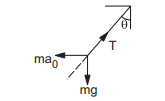
This plays the role of effective ‘ \(g\) ‘. Thus the time period is
\(
t=2 \pi \sqrt{\frac{l}{T / m}}=2 \pi \frac{\sqrt{ } l}{\left[g^2+a_0^2\right]^{1 / 4}} .
\)
Example 18: A uniform meter stick is suspended through a small pin hole at the 10 cm mark. Find the time period of small oscillation about the point of suspension.
Solution: Let the mass of the stick be \(m\). The moment of inertia of the stick about the axis of rotation through the point of suspension is
\(
I=\frac{m l^2}{12}+m d^2
\)
where \(l=1 \mathrm{~m}\) and \(d=40 \mathrm{~cm}\).
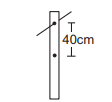
The separation between the centre of mass of the stick and the point of suspension is \(d=40 \mathrm{~cm}\). The time period of this physical pendulum is
\(
\begin{aligned}
T & =2 \pi \sqrt{\frac{I}{m g d}} \\
& =2 \pi \sqrt{\left(\frac{m l^2}{12}+m d^2\right) /(m g d)} \\
& =2 \pi\left[\sqrt{\left(\frac{1}{12}+0 \cdot 16\right) / 4} \mathrm{~s}=1.55 \mathrm{~s} .\right.
\end{aligned}
\)
Example 19: The moment of inertia of the disc used in a torsional pendulum about the suspension wire is \(0.2 \mathrm{~kg}-\mathrm{m}^2\). It oscillates with a period of 2 s. Another disc is placed over the first one and the time period of the system becomes 2.5 s. Find the moment of inertia of the second disc about the wire.
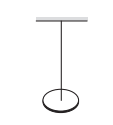
Solution: Let the torsional constant of the wire be \(k\). The moment of inertia of the first disc about the wire is \(0.2 \mathrm{~kg}-\mathrm{m}^2\). Hence, the time period is
\(
\begin{aligned}
2 \mathrm{~s} & =2 \pi \sqrt{\frac{I}{K}} \\
& =2 \pi \sqrt{\frac{0 \cdot 2 \mathrm{~kg}-\mathrm{m}^2}{k}} \dots(i)
\end{aligned}
\)
When the second disc having moment of inertia \(I_1\) about the wire is added, the time period is
\(
2 \cdot 5 \mathrm{~s}=2 \pi \sqrt{\frac{0 \cdot 2 \mathrm{~kg}-\mathrm{m}^2+I_1}{k}} \dots(ii)
\)
From (i) and (ii), \(\frac{6 \cdot 25}{4}=\frac{0 \cdot 2 \mathrm{~kg}-\mathrm{m}^2+I_1}{0 \cdot 2 \mathrm{~kg}-\mathrm{m}^2}\).
This gives \(I_1 \approx 0.11 \mathrm{~kg}-\mathrm{m}^2\).
Example 20: A uniform rod of mass \(m\) and length \(l\) is suspended through a light wire of length \(l\) and torsional constant \(k\) as shown in figure below. Find the time period if the system makes (a) small oscillations in the vertical plane about the suspension point and (b) angular oscillations in the horizontal plane about the centre of the rod.
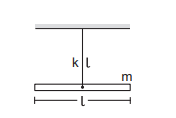
Solution: (a) The oscillations take place about the horizontal line through the point of suspension and perpendicular to the plane of the figure. The moment of inertia of the rod about this line is
\(
\frac{m l^2}{12}+m l^2=\frac{13}{12} m l^2 .
\)
\(
\begin{aligned}
\text { The time period } & =2 \pi \sqrt{\frac{I}{m g l}}=2 \pi \sqrt{\frac{13 m l^2}{12 m g l}} \\
& =2 \pi \sqrt{\frac{13 l}{12 g}}
\end{aligned}
\)
(b) The angular oscillations take place about the suspension wire. The moment of inertia about this line is \(m l^2 / 12\). The time period is
\(
2 \pi \sqrt{\frac{I}{k}}=2 \pi \sqrt{\frac{m l^2}{12 k}} .
\)
Example 21: A particle is subjected to two simple harmonic motions
\(
\begin{aligned}
& x_1=A_1 \sin \omega t \\
& x_2=A_2 \sin (\omega t+\pi / 3)
\end{aligned}
\)
and Find (a) the displacement at \(t=0\), (b) the maximum speed of the particle and (c) the maximum acceleration of the particle.
Solution: (a) At \(t=0, \quad x_1=A_1 \sin \omega t=0\)
and \(x_2=A_2 \sin (\omega t+\pi / 3)\)
\(
=A_2 \sin (\pi / 3)=\frac{A_2 \sqrt{ } 3}{2} .
\)
Thus, the resultant displacement at \(t=0\) is
\(
x=x_1+x_2=\frac{A_2 \sqrt{3}}{2} .
\)
(b) The resultant of the two motions is a simple harmonic motion of the same angular frequency \(\omega\). The amplitude of the resultant motion is
\(
\begin{aligned}
A & =\sqrt{A_1^2+A_2^2+2 A_1 A_2 \cos (\pi / 3)} \\
& =\sqrt{A_1^2+A_2^2+A_1 A_2}
\end{aligned}
\)
The maximum speed is
\(
v_{\max }=A \omega=\omega \sqrt{A_1^2+A_2^2+A_1 A_2} .
\)
(c) The maximum acceleration is
\(
a_{\max }=A \omega^2=\omega^2 \sqrt{A_1^2+A_2^2+A_1 A_2} .
\)
Example 22: A particle is subjected to two simple harmonic motions in the same direction having equal amplitudes and equal frequency. If the resultant amplitude is equal to the amplitude of the individual motions, find the phase difference between the individual motions.
Solution: Let the amplitudes of the individual motions be \(A\) each. The resultant amplitude is also \(A\). If the phase difference between the two motions is \(\delta\),
\(
\begin{aligned}
A & =\sqrt{A^2+A^2+2 A \cdot A \cdot \cos \delta} \\
& =A \sqrt{2(1+\cos \delta)}=2 A \cos \frac{\delta}{2}
\end{aligned}
\)
or,\(\cos \frac{\delta}{2}=\frac{1}{2}\)
or, \(\delta=2 \pi / 3\)
Q23: A simple harmonic motion is represented by : [JEE Main 2019]
\(
y=5(\sin 3 \pi t+\sqrt{3} \cos 3 \pi t) \mathrm{cm}
\)
The amplitude and time period of the motion are :
(a) \(10 \mathrm{~cm}, \frac{3}{2} \mathrm{~s}\)
(b) \(5 \mathrm{~cm}, \frac{2}{3} \mathrm{~s}\)
(c) \(5 \mathrm{~cm}, \frac{3}{2} \mathrm{~s}\)
(d) \(10 \mathrm{~cm}, \frac{2}{3} \mathrm{~s}\)
Solution: Step 1: Simplify the SHM Equation
The given equation is \(y=5(\sin 3 \pi t+\sqrt{3} \cos 3 \pi t)\). We can use the method of combining trigonometric terms: \(A \sin \theta+B \cos \theta=\sqrt{A^2+B^2} \sin (\theta+\phi)\).
Here, \(A=1\) and \(B=\sqrt{3}\) (inside the parentheses).
The resultant coefficient is:
\(
\sqrt{1^2+(\sqrt{3})^2}=\sqrt{1+3}=2
\)
Multiply and divide the expression inside the parentheses by 2:
\(
\begin{aligned}
& y=5 \times 2\left(\frac{1}{2} \sin 3 \pi t+\frac{\sqrt{3}}{2} \cos 3 \pi t\right) \\
& y=10\left(\cos \frac{\pi}{3} \sin 3 \pi t+\sin \frac{\pi}{3} \cos 3 \pi t\right)
\end{aligned}
\)
Using the identity \(\sin (A+B)=\sin A \cos B+\cos A \sin B\), we get:
\(
y=10 \sin \left(3 \pi t+\frac{\pi}{3}\right)
\)
Step 2: Determine the Amplitude
The standard form of SHM is \(y=R \sin (\omega t+\phi)\), where \(R\) is the amplitude.
By comparing the equations:
Amplitude \((R)=10 \mathrm{~cm}\)
Step 3: Determine the Time Period
From the equation, the angular frequency \(\omega\) is the coefficient of \(t\) :
\(
\omega=3 \pi
\)
We know that the relationship between the time period (\(T\)) and angular frequency is \(T=\frac{2 \pi}{\omega}\). Substituting the value of \(\omega\) :
\(
T=\frac{2 \pi}{3 \pi}=\frac{2}{3} \mathrm{~s}
\)
Q24. Two light identical springs of spring constant \(k\) are attached horizontally at the two ends of a uniform horizontal rod AB of length \(\ell\) and mass \(m\). The rod is pivoted at its centre ‘ \(O\) ‘ and can rotate freely in horizontal plane. The other ends of the two springs are fixed to rigid supports as shown in figure. The rod is gently pushed through a small angle and released. The frequency of resulting oscillation is : [JEE Main 2019]
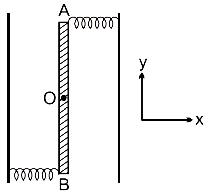
Solution: (b)
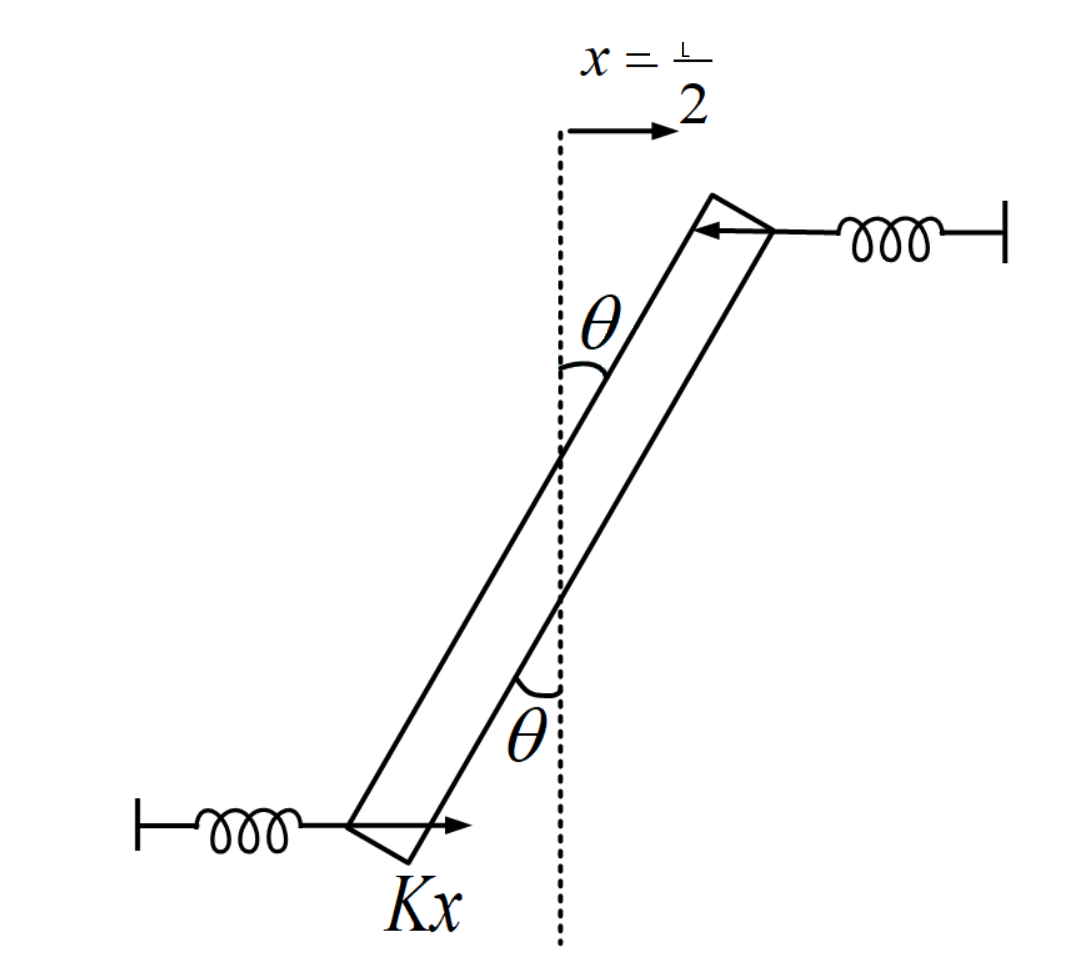
\begin{aligned}
& \tau=-2 k x \frac{\ell}{2} \cos \theta \\
& \Rightarrow \tau=\left(\frac{K \ell^2}{2}\right) \theta=-C \theta \\
& \Rightarrow f=\frac{1}{2 \pi} \sqrt{\frac{C}{1}}=\frac{1}{2 \pi} \sqrt{\frac{\frac{K \ell^2}{2}}{\frac{M \ell^2}{12}}} \\
& \Rightarrow f=\frac{1}{2 \pi} \sqrt{\frac{6 K}{M}}
\end{aligned}
\)
Alternate: Step 1: Identify the Restoring Torque
When the rod of length \(\ell\) is rotated by a small angle \(\theta\) about its center \(O\), the ends of the rod move a linear distance \(x\). For a small angle \(\theta\) :
\(
x=\left(\frac{\ell}{2}\right) \theta
\)
Each spring is either compressed or extended by this distance \(x\), creating a restoring force \(F=k x\). Since there are two springs acting at a distance of \(\ell / 2\) from the pivot, the total restoring torque \((\tau)\) is:
\(
\begin{gathered}
\tau=-2 \times(F \times \text { distance })=-2\left(k \cdot \frac{\ell}{2} \theta\right) \frac{\ell}{2} \\
\tau=-\left(\frac{k \ell^2}{2}\right) \theta
\end{gathered}
\)
Step 2: Use the Angular SHM Equation
The relationship between torque and angular acceleration \((\alpha)\) is \(\tau=I \alpha\), where \(I\) is the moment of inertia. For a uniform rod pivoted at its center:
\(
I=\frac{m \ell^2}{12}
\)
Equating the two expressions for torque:
\(
\begin{gathered}
I \alpha=-\left(\frac{k \ell^2}{2}\right) \theta \\
\left(\frac{m \ell^2}{12}\right) \alpha=-\left(\frac{k \ell^2}{2}\right) \theta
\end{gathered}
\)
Step 3: Solve for Angular Frequency (\(\omega\))
Isolate \(\alpha\) to find the form \(\alpha=-\omega^2 \theta\) :
\(
\begin{gathered}
\alpha=-\left(\frac{k \ell^2}{2} \cdot \frac{12}{m \ell^2}\right) \theta \\
\alpha=-\left(\frac{6 k}{m}\right) \theta
\end{gathered}
\)
Comparing this to the standard SHM equation \(\alpha=-\omega^2 \theta\), we find:
\(
\omega=\sqrt{\frac{6 k}{m}}
\)
Step 4: Calculate the Frequency (\(f\))
Frequency is related to angular frequency by \(f=\frac{\omega}{2 \pi}\) :
\(
f=\frac{1}{2 \pi} \sqrt{\frac{6 k}{m}}
\)
Q25. The mass and the diameter of a planet are three times the respective values for the Earth. The period of oscillation of simple pendulum on the Earth is 2 s . The period of oscillation of the same pendulum on the planet would be : [JEE Main 2019]
Solution: To find the period of oscillation on the new planet, we need to determine how the acceleration due to gravity (\(g\)) changes.
Step 1: Find the Gravitational Acceleration of the Planet (\(g_p\))
The acceleration due to gravity on a planet’s surface is given by the formula:
\(
g=\frac{G M}{R^2}
\)
where \(M\) is the mass and \(R\) is the radius (half of the diameter \(D\)).
For the new planet:
Mass \(M_p=3 M_e\)
Diameter \(D_p=3 D_e \Longrightarrow\) Radius \(R_p=3 R_e\)
Substitute these into the gravity formula for the planet:
\(
\begin{gathered}
g_p=\frac{G\left(3 M_e\right)}{\left(3 R_e\right)^2}=\frac{3 G M_e}{9 R_e^2}=\frac{1}{3}\left(\frac{G M_e}{R_e^2}\right) \\
g_p=\frac{g_e}{3}
\end{gathered}
\)
Step 2: Relate Gravity to the Period of Oscillation
The time period of a simple pendulum is:
\(
T=2 \pi \sqrt{\frac{L}{g}}
\)
Since the length \(L\) of the pendulum remains the same, the period is inversely proportional to the square root of \(g\left(T \propto \frac{1}{\sqrt{g}}\right)\).
We can set up a ratio between the planet and Earth:
\(
\frac{T_p}{T_e}=\sqrt{\frac{g_e}{g_p}}
\)
Step 3: Calculate the New Period
Substitute \(g_p=\frac{g_e}{3}\) into the ratio:
\(
\frac{T_p}{T_e}=\sqrt{\frac{g_e}{g_e / 3}}=\sqrt{3}
\)
Given that the period on Earth (\(T_e\)) is 2 s :
\(
T_p=2 \times \sqrt{3} \mathrm{~s}
\)
Q26. A pendulum is executing simple harmonic motion and its maximum kinetic energy is \(\mathrm{K}_1\). If the length of the pendulum is doubled and it performs simple harmonic motion with the same amplitude as in the first case, its maximum kinetic energy is \(\mathrm{K}_2\). Then : [JEE Main 2019]
Solution: Step 1: Maximum Kinetic Energy Formula
For a pendulum of mass \(m\), length \(L\), and amplitude \(A\), the maximum kinetic energy (\(K_{\text {max }}\)) is equal to the total mechanical energy of the system. In the small-angle approximation of SHM:
\(
K_{\max }=\frac{1}{2} m \omega^2 A^2
\)
Step 2: Relate \(\omega\) to the Length \(L\)
The angular frequency \(\omega\) of a simple pendulum is given by:
\(
\omega=\sqrt{\frac{g}{L}}
\)
Substituting this into the energy formula:
\(
K_{\max }=\frac{1}{2} m\left(\sqrt{\frac{g}{L}}\right)^2 A^2=\frac{m g A^2}{2 L}
\)
Step 3: Compare Case 1 and Case 2
In both cases, the mass (\(m\)), gravitational acceleration (\(g\)), and amplitude (\(A\)) remain the same. Only the length changes.
Case 1: Length is \(L\).
\(
K_1=\frac{m g A^2}{2 L}
\)
Case 2: Length is doubled (\(2 L\)).
\(
K_2=\frac{m g A^2}{2(2 L)}=\frac{m g A^2}{4 L}
\)
Step 4: Find the Relationship
By comparing the two expressions:
\(
\begin{gathered}
K_2=\frac{1}{2}\left(\frac{m g A^2}{2 L}\right) \\
K_2=\frac{K_1}{2}
\end{gathered}
\)
Q27. A particle undergoing simple harmonic motion has time dependent displacement given by \(x(t)=A \sin \frac{\pi t}{90}\). The ratio of kinetic to potential energy of this particle at \(t=210 \mathrm{~s}\) will be: [JEE Main 2019]
Solution: To find the ratio of kinetic energy (\(K\)) to potential energy (\(U\)), we first need to determine the position of the particle at the given time.
Step 1: Find the displacement at \(t=210 \mathrm{~s}\)
The displacement equation is:
\(
x(t)=A \sin \left(\frac{\pi t}{90}\right)
\)
Substitute \(t=210\) :
\(
x(210)=A \sin \left(\frac{\pi \cdot 210}{90}\right)=A \sin \left(\frac{21 \pi}{9}\right)=A \sin \left(\frac{7 \pi}{3}\right)
\)
We can simplify the angle:
\(
\frac{7 \pi}{3}=2 \pi+\frac{\pi}{3}
\)
Since \(\sin (2 \pi+\theta)=\sin \theta\) :
\(
x=A \sin \left(\frac{\pi}{3}\right)=A\left(\frac{\sqrt{3}}{2}\right)
\)
Step 2: Express Potential Energy (\(U\))
The potential energy in SHM is given by:
\(
U=\frac{1}{2} k x^2
\)
Substituting \(x=\frac{\sqrt{3}}{2} A\) :
\(
U=\frac{1}{2} k\left(\frac{\sqrt{3}}{2} A\right)^2=\frac{1}{2} k A^2\left(\frac{3}{4}\right)
\)
Step 3: Express Kinetic Energy (\(K\))
The total energy (\(E_{\text {total }}\)) is constant and equal to the maximum potential energy:
\(
E_{\text {total }}=\frac{1}{2} k A^2
\)
Kinetic energy is the difference between total energy and potential energy:
\(
\begin{gathered}
K=E_{\text {total }}-U \\
K=\frac{1}{2} k A^2-\frac{1}{2} k A^2\left(\frac{3}{4}\right)=\frac{1}{2} k A^2\left(1-\frac{3}{4}\right)=\frac{1}{2} k A^2\left(\frac{1}{4}\right)
\end{gathered}
\)
Step 4: Calculate the Ratio
Now, we find the ratio \(\frac{K}{U}\) :
\(
\begin{aligned}
& \frac{K}{U}=\frac{\frac{1}{2} k \cdot A^2\left(\frac{1}{4}\right)}{\frac{1}{2} k \cdot A^2\left(\frac{3}{4}\right)} \\
& \frac{K}{U}=\frac{1 / 4}{3 / 4}=\frac{1}{3}
\end{aligned}
\)
Q28. A particle executes simple harmonic motion with an amplitude of 5 cm . When the particle is at 4 cm from the mean position, the magnitude of its units is equal to that of its acceleration. Then, its periodic time in seconds is [JEE Main 2019]
Solution: To find the periodic time, we need to use the standard equations for velocity and acceleration in Simple Harmonic Motion (SHM) and set their magnitudes equal at the given displacement.
Step 1: Write the equations for Velocity and Acceleration
For a particle in SHM with angular frequency \(\omega\) and amplitude \(A\) :
Velocity (\(v\)): \(v=\omega \sqrt{A^2-x^2}\)
Acceleration (\(a\)): \(a=\omega^2 x\) (magnitude)
Step 2: Set the magnitudes equal
The problem states that at a displacement \(x=4 \mathrm{~cm}\), the magnitude of velocity is equal to the magnitude of acceleration:
\(
\omega \sqrt{A^2-x^2}=\omega^2 x
\)
Step 3: Solve for Angular Frequency (\(\omega\))
We can cancel one \(\omega\) from both sides (since \(\omega \neq 0\)):
\(
\sqrt{A^2-x^2}=\omega x
\)
Now, substitute the given values: \(A=5 \mathrm{~cm}\) and \(x=4 \mathrm{~cm}\).
\(
\begin{gathered}
\sqrt{5^2-4^2}=\omega(4) \\
\sqrt{25-16}=4 \omega \\
\sqrt{9}=4 \omega \\
3=4 \omega \Longrightarrow \omega=\frac{3}{4} \mathrm{rad} / \mathrm{s}
\end{gathered}
\)
Step 4: Calculate the Periodic Time (\(T\))
The relationship between the time period and angular frequency is \(T=\frac{2 \pi}{\omega}\).
\(
\begin{aligned}
& T=\frac{2 \pi}{3 / 4} \\
& T=\frac{8 \pi}{3} \mathrm{~s}
\end{aligned}
\)
Q29. A cylindrical plastic bottle of negligible mass is filled with 310 ml of water and left floating in a pond with still water. If pressed downward slightly and released, it starts performing simple harmonic motion at angular frequency \(\omega\). If the radius of the bottle is 2.5 cm then \(\omega\) is close to (density of water \(=10^3 \mathrm{~kg} / \mathrm{m}^3\)). [JEE Main 2019]
Solution: To find the angular frequency \(\omega\) of the floating bottle, we analyze the restoring force that occurs when the bottle is displaced from its equilibrium position.
Step 1: Identify the Restoring Force
When a floating object is pushed down by a small distance \(x\), it displaces an additional volume of water. According to Archimedes’ Principle, this creates an upward buoyant force (restoring force) trying to push the bottle back up.
The additional volume of water displaced is:
\(
\Delta V=\text { Area of cross-section } \text { × } \text { displacement }=\pi r^2 x
\)
The restoring force \(F\) is the weight of this extra displaced water:
\(
F=-\left(\Delta V \cdot \rho_w \cdot g\right)=-\left(\pi r^2 \rho_w g\right) x
\)
Step 2: Relate to the SHM Equation
In Simple Harmonic Motion, the restoring force is \(F=-k x\). By comparing the equations, the “effective spring constant” \(k\) for this floating system is:
\(
k=\pi r^2 \rho_w g
\)
Step 3: Determine the Mass of the System
The problem states the bottle has negligible mass but is filled with 310 ml of water. Since the density of water is \(10^3 \mathrm{~kg} / \mathrm{m}^3(1 \mathrm{~g} / \mathrm{ml})\) :
\(
m=310 \mathrm{~g}=0.31 \mathrm{~kg}
\)
Step 4: Calculate Angular Frequency (\(\boldsymbol{\omega}\))
The formula for angular frequency is \(\omega=\sqrt{\frac{k}{m}}\).
Substituting the values:
\(r=2.5 \mathrm{~cm}=0.025 \mathrm{~m}\)
\(\rho_w=1000 \mathrm{~kg} / \mathrm{m}^3\)
\(g=9.8 \mathrm{~m} / \mathrm{s}^2\) (or \(10 \mathrm{~m} / \mathrm{s}^2\) for approximation)
\(m=0.31 \mathrm{~kg}\)
\(
\omega=\sqrt{\frac{\pi \cdot(0.025)^2 \cdot 1000 \cdot 9.8}{0.31}}
\)
\(
\omega \approx 7.9 \mathrm{rad} / \mathrm{s}
\)
Q30. A rod of mass ‘ \(M\) ‘ and length ‘ \(2 L\) ‘ is suspended at its middle by a wire. It exhibits torsional oscillations; If two masses each of ‘ \(m\) ‘ are attached at distance ‘ \(\mathrm{L} / 2\) ‘ from its centre on both sides, it reduces the oscillation frequency by \(20 \%\). The value of radio \(\mathrm{m} / \mathrm{M}\) is close to : [JEE Main 2019]
Solution: To solve for the ratio \(m / M\), we use the physics of torsional oscillations.
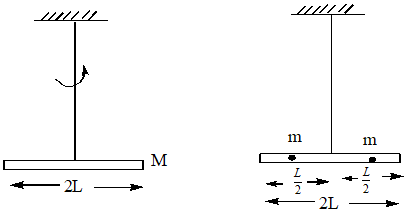
Step 1: Formula for Torsional Frequency
The frequency of a torsional pendulum is given by:
\(
f=\frac{1}{2 \pi} \sqrt{\frac{C}{I}}
\)
Where \(C\) is the torsional constant of the wire and \(I\) is the moment of inertia of the system about the axis of rotation. Since the wire remains the same, \(C\) is constant, and we can say:
\(
f \propto \frac{1}{\sqrt{I}}
\)
Step 2: Moments of Inertia
Case 1: Initial (Only the rod)
The rod has mass \(M\) and length \(2 L\) (total length). The moment of inertia about its center is:
\(
I_1=\frac{M(2 L)^2}{12}=\frac{4 M L^2}{12}=\frac{M L^2}{3}
\)
Case 2: Final (Rod + two masses)
Two masses \(m\) are added at a distance \(L / 2\) from the center. The new moment of inertia is:
\(
\begin{gathered}
I_2=I_1+2 \times m\left(\frac{L}{2}\right)^2 \\
I_2=\frac{M L^2}{3}+2 m \frac{L^2}{4}=\frac{M L^2}{3}+\frac{m L^2}{2}
\end{gathered}
\)
Step 3: Apply the Frequency Change
The problem states the frequency reduces by \(20 \%\). This means the new frequency \(f_2\) is \(80 \%\) of the original frequency \(f_1\) :
\(
f_2=0.8 f_1 \Longrightarrow \frac{f_1}{f_2}=\frac{1}{0.8}=\frac{5}{4}
\)
Since \(f \propto 1 / \sqrt{I}\), then \(\frac{f_1}{f_2}=\sqrt{\frac{I_2}{I_1}}\). Squaring both sides:
\(
\frac{I_2}{I_1}=\left(\frac{5}{4}\right)^2=\frac{25}{16}
\)
Step 4: Solve for \(m / M\)
Substitute the expressions for \(I_1\) and \(I_2\) :
\(
\frac{\frac{M L^2}{3}+\frac{m L^2}{2}}{\frac{M L^2}{3}}=\frac{25}{16}
\)
\(
\frac{m}{M}=\frac{3}{8}=0.37
\)
Q31. A particle is executing simple harmonic motion (SHM) of amplitude \(A\) , along the \(x\) -axis, about \(\mathrm{x}=0\). When its potential Energy (PE) equals kinetic energy (KE), the position of the particle will be : [JEE Main 2019]
Solution: To find the position where the Potential Energy \((P E)\) equals the Kinetic Energy \((K E)\), we use the energy conservation equations for a particle in Simple Harmonic Motion.
Step 1: Write the Energy Equations
For a particle of mass \(m\) and amplitude \(A\) at a displacement \(x\) :
Potential Energy (PE): \(U=\frac{1}{2} k x^2\)
Kinetic Energy \((K E): K=\frac{1}{2} k\left(A^2-x^2\right)\)
Step 2: Equate \(P E\) and \(K E\)
According to the problem, \(P E=K E\) :
\(
\frac{1}{2} k x^2=\frac{1}{2} k\left(A^2-x^2\right)
\)
Step 3: Solve for \(x\)
We can cancel the \(\frac{1}{2} k\) from both sides:
\(
x^2=A^2-x^2
\)
\(
x= \pm \frac{A}{\sqrt{2}}
\)
The position of the particle when \(P E=K E\) is \(x= \pm \frac{A}{\sqrt{2}}\).
Q32. An oscillator of mass \(M\) is at rest in its equilibrium position in a potential \(V=\frac{1}{2} k(x-X)^2\). A particle of mass \(m[latex] comes from right with speed [latex]u\) and collides completely inelastically with \(M\) and sticks to it. This process repeats every time the oscillator crosses its equilibrium position. The amplitude of oscillations after 13 collisions is : (\(M=10, m=5, u=1, k=1\)) [JEE Main 2018]
Solution: Step 1: Sketch a figure describing the system under consideration and list its given parameters. The below figure depicts the system under consideration before collision.
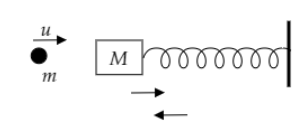
The mass of the oscillator is given to be \(M=10\).
The mass and speed of the colliding particle are given to be \(m=5\) and \(u=1\).
Initial the velocity of the oscillator is zero.
The spring constant of the spring is given to be \(k=1\).
Step 2: Apply the conservation of linear momentum before and after the first collision.
Let \(v_1\) be the velocity of the system (oscillator and particle) after the first collision.
The linear momentum of the system before collision will be \(m u+M \times 0=m u\).
The linear momentum of the system after collision will be \((M+1 m) v_1\).
The conservation of linear momentum states that the linear momentum of the system before collision will be equal to its linear momentum after collision.
Thus we have \(m u=(M+1 m) v_1\)
\(
\Rightarrow v_1=\frac{m u}{M+1 m}
\)
Similarly, the velocity of the system after 13 collisions will be \(v_{13}=\frac{m u}{M+13 m} \dots(1)\)
Substituting for \(M=10, m=5\) and \(u=1\) in equation (1) we get,
\(
v_{13}=\frac{5 \times 1}{10+(13 \times 5)}=\frac{5}{75}=\frac{1}{15}
\)
Thus the velocity of the system after 13 collisions is obtained as \(v_{13}=\frac{1}{15}\).
Step 3: Express the kinetic energy of the system and that of the spring after 13 collisions.
The kinetic energy of the system after 13 collisions can be expressed as
\(K E_{\text {system }}=\frac{1}{2}(M+13 m) v_{13}^2 \dots(2)\)
Substituting for \(M=10, m=5\) and \(v_{13}=\frac{1}{15}\) in equation (2) we get,
\(
K E_{\text {system }}=\frac{1}{2}[10+(13 \times 5)]\left(\frac{1}{15}\right)^2=\frac{1}{6}
\)
Thus the kinetic energy of the system is obtained as \(K E_{\text {system }}=\frac{1}{6}\).
Now the kinetic energy of the spring is expressed as \(K E_{\text {spring }}=\frac{1}{2} k A^2 \dots(3)\)
Substituting for \(k=1\) in equation (3) we get, \(K E_{\text {spring }}=\frac{1}{2} \times 1 \times A^2=\frac{A^2}{2}\)
Now the kinetic energy of the system and that of the spring after 13 collisions will be the same.
i.e., \(K E_{\text {spring }}=K E_{\text {system }} \dots(4)\)
Substituting for \(K E_{\text {system }}=\frac{1}{6}\) and \(K E_{\text {spring }}=\frac{A^2}{2}\) in equation (4) we get, \(\frac{A^2}{2}=\frac{1}{6} \Rightarrow A=\sqrt{\frac{2}{6}}=\frac{1}{\sqrt{3}}\)
Thus the amplitude of the spring is obtained as \(A=\frac{1}{\sqrt{3}}\).
Q33. A particle executes simple harmonic motion and is located at \(x=a, b\) and \(c\) at times \(t_0, 2 t_0\) and \(3 t_0\) respectively. The freqquency of the oscillation is : [JEE Main 2018]
(a) \(\frac{1}{2 \pi t_0} \cos ^{-1}\left(\frac{a+c}{2 b}\right)\)
(b) \(\frac{1}{2 \pi t_0} \cos ^{-1}\left(\frac{a+b}{2 c}\right)\)
(c) \(\frac{1}{2 \pi t_0} \cos ^{-1}\left(\frac{2 a+3 c}{b}\right)\)
(d) \(\frac{1}{2 \pi t_0} \cos ^{-1}\left(\frac{a+2 b}{3 c}\right)\)
Solution: (a) To find the frequency of oscillation, we use the general displacement equation for Simple Harmonic Motion (SHM) and the relationship between the positions at equal time intervals.
Step 1: Write the Displacement Equations
The displacement of a particle in SHM is given by \(x(t)=A \cos (\omega t+\phi)\). Let \(\theta=\omega t_0\). The positions at \(t_0, 2 t_0\), and \(3 t_0\) are:
\(a=A \cos (\theta+\phi)\)
\(b=A \cos (2 \theta+\phi)\)
\(c=A \cos (3 \theta+\phi)\)
Step 2: Relate \(a, b\), and \(c\)
We use the trigonometric identity: \(\cos (x-y)+\cos (x+y)=2 \cos x \cos y\).
Let \(x=2 \theta+\phi\) and \(y=\theta\). Then:
\(x-y=\theta+\phi\) (which corresponds to position \(a\))
\(x+y=3 \theta+\phi\) (which corresponds to position \(c\))
Substituting these into the identity:
\(
\cos (\theta+\phi)+\cos (3 \theta+\phi)=2 \cos (2 \theta+\phi) \cos \theta
\)
Using our position variables \(a, b\), and \(c\) :
\(
a+c=2 b \cos \theta
\)
Step 3: Solve for Angular Frequency (\(\omega\))
Isolate \(\cos \theta\) :
\(
\begin{gathered}
\cos \theta=\frac{a+c}{2 b} \\
\theta=\cos ^{-1}\left(\frac{a+c}{2 b}\right)
\end{gathered}
\)
Since we defined \(\theta=\omega t_0\) :
\(
\begin{aligned}
& \omega t_0=\cos ^{-1}\left(\frac{a+c}{2 b}\right) \\
& \omega=\frac{1}{t_0} \cos ^{-1}\left(\frac{a+c}{2 b}\right)
\end{aligned}
\)
Step 4: Calculate Frequency (\(f\))
The relationship between frequency and angular frequency is \(f=\frac{\omega}{2 \pi}\).
Substituting the expression for \(\omega\) :
\(
f=\frac{1}{2 \pi t_0} \cos ^{-1}\left(\frac{a+c}{2 b}\right)
\)
Q34. A silver atom in a solid oscillates in simple harmonic motion in some direction with a frequency of \(10 \frac{12}{3} \mathrm{sec}\). What is the force constant of the bonds connecting one atom with the other? (Mole wt. of silver \(=108\) and Avogadro number \(=6.02 \times 10^{23} \mathrm{gm} \mathrm{mole}^{-1}\)) [JEE Main 2018]
Solution: To find the force constant (\(k\)) of the bonds, we use the relationship between frequency, mass, and the spring constant in Simple Harmonic Motion (SHM).
Step 1: Calculate the mass of a single silver atom (\(m\))
The molar mass of silver is \(108 \mathrm{~g} / \mathrm{mol}\). To find the mass of one atom, we divide the molar mass by Avogadro’s number (\(N_A\)) and convert it to kilograms (\(k g\)).
\(
\begin{gathered}
m=\frac{\text { Molar Mass }}{N_A}=\frac{108}{6.02 \times 10^{23}} \mathrm{~g} / \text { atom } \\
m \approx 1.79 \times 10^{-22} \mathrm{~g}=1.79 \times 10^{-25} \mathrm{~kg}
\end{gathered}
\)
Step 2: Identify the Frequency (\(f\))
The problem provides the frequency as \(10^{12} \mathrm{~Hz}\) (assuming the notation \(10^{12}\) based on standard JEE problems for atomic oscillations, as \(10 \frac{12}{3}\) appears to be a transcription error for \(10^{12}\)).
\(
f=10^{12} \mathrm{~s}^{-1}
\)
Step 3: Relate Frequency to the Force Constant (\(k\))
The formula for the frequency of a harmonic oscillator is:
\(
f=\frac{1}{2 \pi} \sqrt{\frac{k}{m}}
\)
Squaring both sides to solve for \(k\) :
\(
\begin{aligned}
& f^2=\frac{1}{4 \pi^2} \frac{k}{m} \\
& k=4 \pi^2 f^2 m
\end{aligned}
\)
Step 4: Final Calculation
Substitute the values (\(\pi^2 \approx 10\) is a common approximation in JEE):
\(
k=4 \times 10 \times\left(10^{12}\right)^2 \times\left(1.79 \times 10^{-25}\right)=7.1 \mathrm{~N} / \mathrm{m}
\)
Q35. Two simple harmonic motions, as shown below, are at right angles. They are combined to form Lissajous figures.
\(
\begin{aligned}
& x(t)=A \sin (a t+\delta) \\
& y(t)=B \sin (b t)
\end{aligned}
\)
Identify the correct match below. [JEE Main 2018]
(a) Parameters \(\mathrm{A} \neq \mathrm{B}, \mathrm{a}=\mathrm{b} ; \delta=0\); Curve Parabola
(b) Parameters \(\mathrm{A}=\mathrm{B}, \mathrm{a}=\mathrm{b} ; \delta=\pi / 2\); Curve Line
(c) Parameters \(\mathrm{A} \neq \mathrm{B}, \mathrm{a}=\mathrm{b} ; \delta=\pi / 2\); Curve Ellipse
(d) Parameters \(\mathrm{A}=\mathrm{B}, \mathrm{a}=2 \mathrm{~b} ; \delta=\pi / 2\); Curve Circle
Solution: (c) We need to analyze the relationship between \(x(t)\) and \(y(t)\) based on the given parameters. The standard equations are:
\(
\begin{gathered}
x=A \sin (a t+\delta) \\
y=B \sin (b t)
\end{gathered}
\)
Step 1: Analyze the case where \(a=b\) (Same Frequency)
When the frequencies are equal (\(a=b\)), the resulting figure is generally an ellipse. The specific shape depends on the phase difference \(\delta\) :
If \(\delta=0\) or \(\pi\) : The equations become \(x=A \sin (a t)\) and \(y=B \sin (a t)\). Dividing them gives \(y=\frac{B}{A} x\), which is a straight line.
If \(\delta=\pi / 2\) : The equations become \(x=A \cos (a t)\) and \(y=B \sin (a t)\).
Squaring and adding them:
\(
\frac{x^2}{A^2}+\frac{y^2}{B^2}=\cos ^2(a t)+\sin ^2(a t)=1
\)
This is the equation of an ellipse.
Step 2: Evaluate the Options
(a) \(A \neq B, a=b, \delta=0\) : As shown in Step 1, this results in a straight line, not a parabola.
(b) \(A=B, a=b, \delta=\pi / 2\) : Plugging these into the ellipse equation gives \(x^2+y^2= A^2\), which is a circle, not a line.
(c) \(A \neq B, a=b, \delta=\pi / 2\) : This perfectly matches the derivation for an ellipse \(\left(\frac{x^2}{A^2}+\frac{y^2}{B^2}=1\right)\). This is correct.
(d) \(A=B, a=2 b, \delta=\pi / 2\) : When the frequency ratio is \(2: 1\), the figure is typically a parabola or a “figure-eight” shape, not a circle.
Q36. A 1 kg block attached to a spring vibrates with a frequency of 1 Hz on a frictionless horizontal table. Two springs identical to the original spring are attached in parallel to an 8 kg block placed on the same table. So, the frequency of vibration of the 8 kg block is : [JEE Main 2017]
Solution: To solve for the new frequency, we need to compare the two systems using the standard formula for the frequency of a mass-spring system.
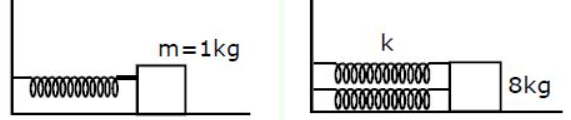
Step 1: Analyze the first system
For a mass \(m_1\) attached to a spring with constant \(k\), the frequency \(f_1\) is given by:
\(
f_1=\frac{1}{2 \pi} \sqrt{\frac{k}{m_1}}
\)
Given:
\(m_1=1 \mathrm{~kg}\)
\(f_1=1 \mathrm{~Hz}\)
Substituting these into the formula:
\(
1=\frac{1}{2 \pi} \sqrt{\frac{k}{1}} \Longrightarrow \sqrt{k}=2 \pi
\)
Step 2: Analyze the second system
In the second case, an 8 kg block is attached to two identical springs in parallel.
New Mass \(\left(m_2\right): 8 \mathrm{~kg}\)
Effective Spring Constant (\(k_{\text {eq }}\)): For springs in parallel, \(k_{\text {eq }}=k+k=2 k\).
Step 3: Calculate the new frequency (\(\boldsymbol{f}_{\mathbf{2}}\))
Using the frequency formula for the second system:
\(
\begin{aligned}
& f_2=\frac{1}{2 \pi} \sqrt{\frac{k_{e q}}{m_2}} \\
& f_2=\frac{1}{2 \pi} \sqrt{\frac{2 k}{8}}
\end{aligned}
\)
Simplify the fraction inside the square root:
\(
f_2=\frac{1}{2 \pi} \sqrt{\frac{k}{4}}=\frac{1}{2 \pi} \cdot \frac{\sqrt{k}}{2}
\)
Step 4: Substitute the known value of \(k\)
From Step 1, we know \(\frac{\sqrt{k}}{2 \pi}=f_1=1 \mathrm{~Hz}\).
Therefore:
\(
f_2=\frac{1}{2}\left(\frac{1}{2 \pi} \sqrt{k}\right)=\frac{1}{2} \times 1=0.5 \mathrm{~Hz}
\)
The frequency of vibration of the 8 kg block is \(\mathbf{0 . 5 ~ H z}\).
Q37. The ratio of maximum acceleration to maximum velocity in a simple harmonic motion is \(10 \mathrm{~s}^{-1}\). At, \(\mathrm{t}=0\) the displacement is 5 m . What is the maximum acceleration ? The initial phase is \(\frac{\pi}{4}\). [JEE Main 2017]
Solution: To find the maximum acceleration, we need to determine the angular frequency (\(\omega\)) and the amplitude \((A)\) of the motion.
Step 1: Find the Angular Frequency (\(\boldsymbol{\omega}\))
In Simple Harmonic Motion (SHM), the formulas for maximum velocity (\(v_{\text {max }}\)) and maximum acceleration (\(a_{\text {max }}\)) are:
\(v_{\max }=\omega A\)
\(a_{\text {max }}=\omega^2 A\)
The problem states that the ratio of \(a_{\text {max }}\) to \(v_{\text {max }}\) is \(10 \mathrm{~s}^{-1}\) :
\(
\begin{gathered}
\frac{a_{\max }}{v_{\max }}=\frac{\omega^2 A}{\omega A}=\omega \\
\omega=10 \mathrm{rad} / \mathrm{s}
\end{gathered}
\)
Step 2: Determine the Amplitude (\(A\))
The general equation for displacement in SHM is:
\(
x(t)=A \sin (\omega t+\phi)
\)
We are given the following conditions at \(t=0\) :
Displacement \(x=5 \mathrm{~m}\)
Initial phase \(\phi=\frac{\pi}{4}\)
Substitute these into the displacement equation:
\(
5=A \sin \left(10(0)+\frac{\pi}{4}\right)=5 \sqrt{2} \mathrm{~m}
\)
Step 3: Calculate Maximum Acceleration (\(a_{\text {max }}\))
Now, use the formula for maximum acceleration with the values we found:
\(
\begin{gathered}
a_{\max }=\omega^2 A \\
a_{\max }=(10)^2 \times 5 \sqrt{2} \\
a_{\max }=100 \times 5 \sqrt{2} \\
a_{\max }=500 \sqrt{2} \mathrm{~m} / \mathrm{s}^2
\end{gathered}
\)
Q38. A particle is executing simple harmonic motion with a time period \(T\). At time \(\mathrm{t}=0\), it is at its position of equilibrium. The kinetic energy – time graph of the particle will look like: [JEE Main 2017]
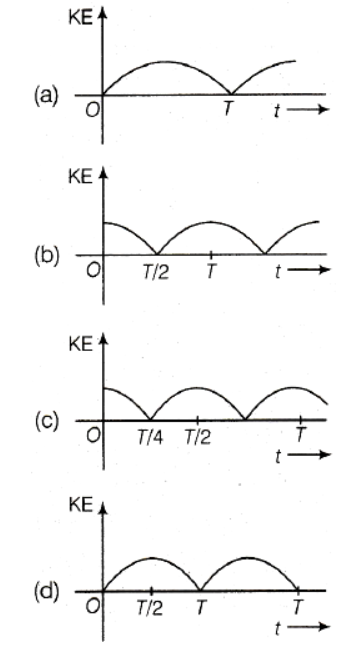
Solution: (c) For a particle executing SHM
At mean position; \(\mathrm{t}=0, \omega t=0, \mathrm{y}=0, \mathrm{~V}=\mathrm{V}_{\text {max }}=\mathrm{a} \omega\)
\(
\therefore \mathrm{K} . \mathrm{E}=\mathrm{K} . \mathrm{E}_{\max }=\frac{1}{2} m \omega^2 a^2
\)
At extreme position : \(\mathrm{t}=\frac{T}{4}, \omega \mathrm{t}=\frac{\pi}{2}, \mathrm{y}=\mathrm{A}, \mathrm{V}=\mathrm{V}_{\text {min }}=0\)
\(
\therefore \mathrm{K} \cdot \mathrm{E}=\mathrm{K} \cdot \mathrm{E}_{\min }=0
\)
Hence graph (c) correctly represents kinetic energy – time graph.
Q39. In an engine the piston undergoes vertical simple harmonic motion with amplitude 7 cm. A washer rests on top of the piston and moves with it. The motor speed is slowly increased. The frequency of the piston at which the washer no longer stays in contact with the piston, is close to : [JEE Main 2016]
Solution: Here, Amplitude, \(\mathrm{A}=7 \mathrm{~cm}=0.07 \mathrm{~m}\)
When washer is no longer stays in contact with the piston, then the normal force on the washer is \(=0\)
∴ Maximum acceleration of the washer,
\(
\begin{aligned}
& \mathrm{a}_{\max }=\omega^2 \mathrm{~A}=\mathrm{g} \\
& \Rightarrow \omega=\sqrt{\frac{g}{A}}=\sqrt{\frac{10}{0.07}}=\sqrt{\frac{1000}{7}}
\end{aligned}
\)
∴ Frequency of the piston,
\(
\mathrm{f}=\frac{\omega}{2 \pi}=\frac{1}{2 \pi} \sqrt{\frac{1000}{7}}=1.9 \mathrm{~Hz}
\)
Q40. Two particles are performing simple harmonic motion in a straight line about the same equilibrium point. The amplitude and time period for both particles are same and equal to A and \(I\), respectively. At time \(\mathrm{t}=0\) one particle has displacement A while the other one has displacement \(\frac{-A}{2}\) and they are moving towards each other. If they cross each other at time \(t\), then \(t\) is : [JEE Main 2016]
Solution: To solve for the time \(t\) when the particles cross, it is easiest to use the Phasor Method (representing SHM as a uniform circular motion).
Step 1: Identify Initial Phases (\(\phi\))
Let the displacement of the particles be \(x=A \cos (\omega t+\phi)\). Since the time period is \(T\), the angular frequency is \(\omega=\frac{2 \pi}{T}\).
Particle 1: At \(t=0, x_1=A\).
\(
A=A \cos \left(\phi_1\right) \Rightarrow \cos \left(\phi_1\right)=1 \Rightarrow \phi_1=0
\)
Particle 2: At \(t=0, x_2=-A / 2\) and it is moving towards the equilibrium point (moving “right” or in the positive direction to meet Particle 1).
\(
-A / 2=A \cos \left(\phi_2\right) \Rightarrow \cos \left(\phi_2\right)=-1 / 2
\)
Since it is moving towards the center from the negative side, its phase \(\phi_2\) must be in the 3rd quadrant (or \(-2 \pi / 3\)). However, in the standard phasor circle where \(x=A \sin (\omega t+ \phi\)), it is often clearer to see it this way:
\(\phi_2=\pi+\frac{\pi}{6}=\frac{7 \pi}{6}\) (or \(210^{\circ}\)) if using sine, or simply \(\frac{4 \pi}{3}\) ( \(240^{\circ}\)) if using the cosine convention.
Step 2: Condition for Crossing
The particles cross when their displacements are equal: \(x_1(t)=x_2(t)\).
\(
\begin{gathered}
A \cos \left(\omega t+\phi_1\right)=A \cos \left(\omega t+\phi_2\right) \\
\cos (\omega t+0)=\cos \left(\omega t+\frac{4 \pi}{3}\right)
\end{gathered}
\)
Using the property \(\cos \theta=\cos \alpha \Rightarrow \theta=2 n \pi \pm \alpha\) :
\(
\omega t=-\left(\omega t+\frac{4 \pi}{3}\right)+2 \pi
\)
(We take the negative sign because they are moving towards each other, meaning their phases are approaching a meeting point from opposite directions).
\(
\begin{gathered}
2 \omega t=2 \pi-\frac{4 \pi}{3} \\
2 \omega t=\frac{2 \pi}{3}
\end{gathered}
\)
\(
\omega t=\frac{\pi}{3}
\)
Step 3: Solve for \(t\)
Substitute \(\omega=\frac{2 \pi}{T}\) :
\(
\begin{gathered}
\left(\frac{2 \pi}{T}\right) t=\frac{\pi}{3} \\
t=\frac{T}{6}
\end{gathered}
\)
The particles will cross each other at time \(t=\frac{T}{6}\).
Q41. A particle performs simple harmonic motion with amplitude \(A\). Its speed is trebled at the instant that it is at a distance \(\frac{2 A}{3}\) from equilibrium position. The new amplitude of the motion is: [JEE Main 2016]
Solution: We know that \(V=\omega \sqrt{A^2-x^2}\)
Initially \(v=\omega \sqrt{A^2-\left(\frac{2 A}{3}\right)^2}\)
Finally \(3 v=\omega \sqrt{A_{\text {new }}^2-\left(\frac{2 A}{3}\right)^2}\)
where \(A_{\text {new }}=\) final amplitude (Given at \(x=\frac{2 A}{3}\), velocity to trebled)
On dividing we get \(\frac{3}{1}=\frac{\sqrt{A_{\text {new }}^2-\left(\frac{2 A}{3}\right)^2}}{\sqrt{A^2-\left(\frac{2 A}{3}\right)^2}}\)
\(
\begin{aligned}
& 9\left[A^2-\frac{4 A^2}{9}\right]=A_{n e w}^2-\frac{4 A^2}{9} \\
& \therefore A_{n e w}=\frac{7 A}{3}
\end{aligned}
\)
Q42. A pendulum made of a uniform wire of cross sectional area \(A\) has time period \(T\). When an additional mass \(M\) is added to its bob, the time period changes to \(T_M\). If the Young’s modulus of the material of the wire is \(Y\) then \(\frac{1}{Y}\) is equal to : [JEE Main 2015]
(\(g=\) gravitational acceleration)
(a) \(\left[1-\left(\frac{T_M}{T}\right)^2\right] \frac{A}{M g}\)
(b) \(\left[1-\left(\frac{T}{T_M}\right)^2\right] \frac{A}{M g}\)
(c) \(\left[\left(\frac{T_M}{T}\right)^2-1\right] \frac{A}{M g}\)
(d) \(\left[\left(\frac{T_M}{T}\right)^2-1\right] \frac{M g}{A}\)
Solution: To solve this, we connect the physics of Simple Harmonic Motion with the Elasticity of the wire.
Step 1: Initial State of the Pendulum
The time period \(T\) of a simple pendulum with initial length \(L\) is given by:
\(
T=2 \pi \sqrt{\frac{L}{g}} \Longrightarrow T^2=\frac{4 \pi^2 L}{g}
\)
Step 2: Final State with Additional Mass
When a mass \(M\) is added, the wire stretches by an amount \(\Delta L\) due to the additional weight \(M g\). The new length becomes \(L^{\prime}=L+\Delta L\), and the new time period \(T_M\) is:
\(
T_M=2 \pi \sqrt{\frac{L+\Delta L}{g}} \Longrightarrow T_M^2=\frac{4 \pi^2(L+\Delta L)}{g}
\)
Step 3: Apply Young’s Modulus
Young’s Modulus (\(Y\)) relates the stress and strain of the wire:
\(
Y=\frac{\text { Stress }}{\text { Strain }}=\frac{M g / A}{\Delta L / L}
\)
Rearranging this to find the ratio of extension to original length:
\(
\frac{\Delta L}{L}=\frac{M g}{A Y}
\)
Step 4: Combine the Equations
Now, take the ratio of the squares of the two time periods:
\(
\begin{gathered}
\frac{T_M^2}{T^2}=\frac{\frac{4 \pi^2(L+\Delta L)}{g}}{\frac{4 \pi^2 L}{g}}=\frac{L+\Delta L}{L} \\
\frac{T_M^2}{T^2}=1+\frac{\Delta L}{L}
\end{gathered}
\)
Substitute the expression for \(\frac{\Delta L}{L}\) from Step 3:
\(
\left(\frac{T_M}{T}\right)^2=1+\frac{M g}{A Y}
\)
Step 5: Solve for \(\frac{1}{Y}\)
Isolate the term containing \(Y\) :
\(
\left(\frac{T_M}{T}\right)^2-1=\frac{M g}{A Y}
\)
\(
\frac{1}{Y}=\left[\left(\frac{T_M}{T}\right)^2-1\right] \frac{A}{M g}
\)
Q43. The period of oscillation of a simple pendulum is \(T=2 \pi \sqrt{\frac{L}{g}}\). Measured value of L is 20.0 cm known to 1 mm accuracy and time for 100 oscillations of the pendulum is found to be 90 s using wrist watch of 1 s resolution. The accuracy in the determination of \(g\) is: [JEE Main 2015]
Solution: Given \(T=2 \pi \sqrt{\frac{L}{g}}\)
\(
\begin{aligned}
& \Rightarrow g=\frac{4 \pi^2 L}{T^2} \\
& \Rightarrow g=\frac{4 \pi^2 L n^2}{t^2} \\
& {\left[\text { as } T=\frac{t}{n}\right]}
\end{aligned}
\)
So, percentage error in \(g=\)
\(
\begin{aligned}
& \frac{\Delta g}{g} \times 100=\frac{\Delta L}{L} \times 100+2 \frac{\Delta t}{t} \times 100 \\
& =\frac{0.1}{20.0} \times 100+2 \times \frac{1}{90} \times 100 \\
& =2.72 \%=3 \%
\end{aligned}
\)
Q44. For a simple pendulum, a graph is plotted between its kinetic energy (\(K E\)) and potential energy (\(P E\)) against its displacement \(d\). Which one of the following represents these correctly? [JEE Main 2015]
(graphs are schematic and not drawn to scale)
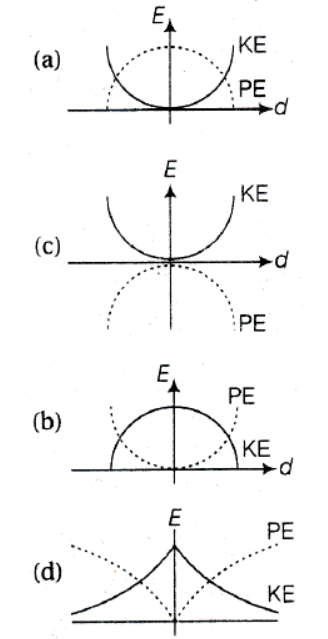
Solution: (a) To find the correct energy-displacement graph for a simple pendulum, we need to analyze how Kinetic Energy (\(K E\)) and Potential Energy (\(P E\)) vary with displacement (\(d\)).
Potential Energy (PE):
For a simple pendulum performing small oscillations, the Potential Energy is proportional to the square of the displacement from the equilibrium position (\(d=0\)):
\(
P E=\frac{1}{2} k d^2
\)
At the equilibrium position \((d=0), P E=0\).
At the extreme positions \((d= \pm A), P E\) is maximum.
The graph of \(P E\) vs \(d\) is a parabola opening upwards, passing through the origin.
Kinetic Energy (KE):
The Total Mechanical Energy (\(E\)) of the system remains constant. Therefore, \(K E=E-P E\) :
\(
K E=\frac{1}{2} k\left(A^2-d^2\right)
\)
At the equilibrium position \((d=0), K E\) is maximum \((K E=E)\).
At the extreme positions \((d= \pm A)\), the velocity is zero, so \(K E=0\).
The graph of \(K E\) vs \(d\) is an inverted parabola (opening downwards).
Evaluating the Options:
Looking at the provided image:
Graph (a): Shows PE as an upward-opening parabola starting at the origin and KE as an inverted parabola that is maximum at the origin. This matches our derivation perfectly.
Graph (b): Swaps the labels (shows PE as inverted, which is incorrect).
Graph (c): Shows PE as a negative value, but energy (especially squared terms) in this context is positive.
Graph (d): Shows linear relationships, which would only happen if the restoring force was constant (like friction), not proportional to displacement.