JEE PYQs MCQs
Summary
- Stress is the restoring force per unit area and strain is the fractional change in dimension. In general there are three types of stresses (a) tensile stress – longitudinal stress (associated with stretching) or compressive stress (associated with compression), (b) shearing stress, and (c) hydraulic stress (Hydraulic stress (or bulk/volume stress) is the internal restoring force per unit area generated within a body when it is compressed uniformly from all directions by an external fluid. It causes a change in the object’s volume (compressive strain) rather than its shape).
- For small deformations, stress is directly proportional to the strain for many materials. This is known as Hooke’s law. The constant of proportionality is called modulus of elasticity. Three elastic moduli viz., Young’s modulus, shear modulus and bulk modulus are used to describe the elastic behaviour of objects as they respond to deforming forces that act on them.
A class of solids called elastomers does not obey Hooke’s law. - When an object is under tension or compression, the Hooke’s law takes the form
\(
F / A=Y \Delta L / L
\)
where \(\Delta L / L\) is the tensile or compressive strain of the object, \(F\) is the magnitude of the applied force causing the strain, \(A\) is the cross-sectional area over which \(F\) is applied (perpendicular to \(A\) ) and \(Y\) is the Young’s modulus for the object. The stress is \(F / A\). - A pair of forces when applied parallel to the upper and lower faces, the solid deforms so that the upper face moves sideways with respect to the lower. The horizontal displacement \(\Delta L\) of the upper face is perpendicular to the vertical height \(L\). This type of deformation is called shear and the corresponding stress is the shearing stress. This type of stress is possible only in solids.
In this kind of deformation the Hooke’s law takes the form
\(
F / A=G \times \Delta L / L
\)
where \(\Delta L\) is the displacement of one end of object in the direction of the applied force \(F\), and \(G=\eta\) is the shear modulus. - When an object undergoes hydraulic compression due to a stress exerted by a surrounding fluid, the Hooke’s law takes the form
\(
p=B(\Delta V / V)
\)
where \(p\) is the pressure (hydraulic stress) on the object due to the fluid, \(\Delta V / V\) (the volume strain) is the absolute fractional change in the object’s volume due to that pressure and \(B\) is the bulk modulus of the object. - Poisson’s ratio is \(\sigma=\frac{\text { Lateral strain }}{\text { Longitudinal strain }}=\frac{-\Delta D / D}{\Delta L / L}\)
- There are four relations between \(Y, B, \eta\) and \(\sigma\), which can be given as follows
(1) \(B=\frac{Y}{3(1-2 \sigma)}\)
(2) \(\eta=\frac{Y}{2(1+\sigma)}\)
(3) \(\sigma=\frac{3 B-2 \eta}{2 \eta+6 B}\)
(4) \(\frac{9}{Y}=\frac{1}{B}+\frac{3}{\eta}\) - work done \((W)\) in stretching the wire from 0 to a total extension \(\Delta L\)
\(
W=\frac{1}{2} \frac{Y A(\Delta L)^2}{L}
\) - Elastic Potential Energy:
\(\begin{aligned} U & =\frac{1}{2} \times\left(\frac{F}{A}\right) \times\left(\frac{\Delta L}{L}\right) \times(A L) \\ U & =\frac{1}{2} \times \text { Stress × Strain × Volume }\end{aligned}\) Thermal Stress:
Using Young’s Modulus ( \(Y=\frac{\text { Stress }}{\text { Strain }}\) ), we can find the stress:
Thermal Stress \(=Y \times\) Thermal Strain
Thermal Stress \(=Y \alpha \Delta T\)Thermal Force:
The force exerted by the rod on the supports (or vice versa) is:
\(
\begin{gathered}
F=\text { Stress × Area } \\
F=Y A \alpha \Delta T
\end{gathered}
\)
Quiz Summary
0 of 44 Questions completed
Questions:
Information
You have already completed the quiz before. Hence you can not start it again.
Quiz is loading…
You must sign in or sign up to start the quiz.
You must first complete the following:
Results
Results
0 of 44 Questions answered correctly
Your time:
Time has elapsed
You have reached 0 of 0 point(s), (0)
Earned Point(s): 0 of 0, (0)
0 Essay(s) Pending (Possible Point(s): 0)
Categories
- Not categorized 0%
- 1
- 2
- 3
- 4
- 5
- 6
- 7
- 8
- 9
- 10
- 11
- 12
- 13
- 14
- 15
- 16
- 17
- 18
- 19
- 20
- 21
- 22
- 23
- 24
- 25
- 26
- 27
- 28
- 29
- 30
- 31
- 32
- 33
- 34
- 35
- 36
- 37
- 38
- 39
- 40
- 41
- 42
- 43
- 44
- Current
- Review
- Answered
- Correct
- Incorrect
- Question 1 of 44
1. Question
A brass wire of length 2 m and radius 1 mm at \(27^{\circ} \mathrm{C}\) is held taut between two rigid supports. Initially it was cooled to a temperature of \(-43^{\circ} \mathrm{C}\) creating a tension \(T\) in the wire. The temperature to which the wire has to be cooled in order to increase the tension in it to \(1.4 T\), is _____ \({ }^{\circ} \mathrm{C}\). [JEE Main 2026 (Online) 24th January Morning Shift]
CorrectIncorrectHint
(a) The Physics Principles:
When a wire is fixed between two rigid supports and cooled, it tries to contract. Since the supports prevent this, a thermal stress is created, leading to tension. The formula for thermal tension \(T\) is:
\(
T=Y A \alpha \Delta t
\)
Where:
\(Y\) is Young’s modulus of the material.
\(A\) is the cross-sectional area.
\(\alpha\) is the coefficient of linear expansion.
\(\Delta t\) is the change in temperature \(\left(T_{\text {initial }}-T_{\text {final }}\right)\).
Step 1: Analyze the initial state (Tension \(T\)): The wire is cooled from \(27^{\circ} \mathrm{C}\) to \(-43^{\circ} \mathrm{C}\).
\(
\Delta t_1=27-(-43)=70^{\circ} \mathrm{C}
\)
The initial tension is:
\(
T=Y A \alpha(70)
\)
Step 2: Analyze the second state (Tension \(1.4 T\)): Let the new temperature be \(t\). The total temperature drop from the original state \(\left(27^{\circ} \mathrm{C}\right)\) is \(\Delta t_2=27-t\). The new tension is:
\(
1.4 T=Y A \alpha(27-t)
\)
Step 3: Set up the ratio: Since \(Y, A\), and \(\alpha\) are constants for the same wire, we can divide the second equation by the first:
\(
\begin{gathered}
\frac{1.4 T}{T}=\frac{Y A \alpha(27-t)}{Y A \alpha(70)} \\
1.4=\frac{27-t}{70}
\end{gathered}
\)
\(
t=-71^{\circ} \mathrm{C}
\)
The temperature to which the wire has to be cooled is \(-71^{\circ} \mathrm{C}\). - Question 2 of 44
2. Question
Two wires \(A\) and \(B\) made of different materials of lengths 6.0 cm and 5.4 cm , respectively and area of cross sections \(3.0 \times 10^{-5} \mathrm{~m}^2\) and \(4.5 \times 10^{-5} \mathrm{~m}^2\), respectively are stretched by the same magnitude under a given load. The ratio of the Young’s modulus of \(A\) to that of \(B\) is \(x: 3\). The value of \(x\) is ____. [JEE Main 2026 (Online) 28th January Morning Shift]
CorrectIncorrectHint
(d) Step 1: Identify the Young’s Modulus Formula
Young’s Modulus \((Y)\) is defined as the ratio of tensile stress to tensile strain:
\(
Y=\frac{F / A}{\Delta L / L}=\frac{F \cdot L}{A \cdot \Delta L}
\)
Where \(F\) is the applied force, \(L\) is the original length, \(A\) is the cross-sectional area, and \(\Delta L\) is the elongation.
Step 2: Set Up the Ratio for Wires A and B
Given that both wires are stretched by the same magnitude (\(\Delta L_A=\Delta L_B\)) under the same load \(\left(F_A=F_B\right)\), we can express the ratio of their Young’s moduli as:
\(
\frac{Y_A}{Y_B}=\frac{\frac{F \cdot L_A}{A_A \cdot \Delta L}}{\frac{F \cdot L_B}{A_B \cdot \Delta L}}=\frac{L_A}{A_A} \cdot \frac{A_B}{L_B}
\)
Step 3: Substitute Given Values
Substitute the values: \(L_A=6.0 \mathrm{~cm}, L_B=5.4 \mathrm{~cm}, A_A=3.0 \times 10^{-5} \mathrm{~m}^2\), and \(\boldsymbol{A}_{\boldsymbol{B}}=4.5 \times 10^{-5} \mathrm{~m}^2\) :
\(
\begin{aligned}
\frac{Y_A}{Y_B} & =\frac{6.0}{3.0 \times 10^{-5}} \cdot \frac{4.5 \times 10^{-5}}{5.4} \\
\frac{Y_A}{Y_B} & =\frac{6.0}{3.0} \cdot \frac{4.5}{5.4}=2 \cdot \frac{5}{6}=\frac{5}{3}
\end{aligned}
\)
Step 4: Solve for \(\mathbf{x}\)
The problem states the ratio is \(x: 3\). Comparing this to our calculated ratio:
\(
\begin{aligned}
\frac{x}{3} & =\frac{5}{3} \\
x & =5
\end{aligned}
\) - Question 3 of 44
3. Question
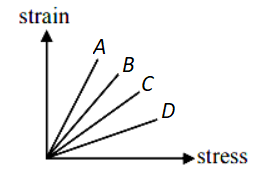
The strain-stress plot for materials \(A, B, C\) and \(D\) is shown in the figure. Which material has the largest Young’s modulus? [JEE Main 2026 (Online) 23rd January Morning Shift]
 CorrectIncorrect
Hint
(a) Step 1: Understand the Relationship
Young’s modulus \((Y)\) is defined as the ratio of tensile stress \((\sigma)\) to tensile strain \((\epsilon)\) :
\(
Y=\frac{\text { Stress }}{\text { Strain }}
\)
In a stress-strain plot where stress is on the \(y\)-axis and strain is on the \(x\)-axis:
\(
\text { Slope }=\frac{\Delta \text { Stress }}{\Delta \text { Strain }}
\)
Therefore, the slope of the line is equal to the Young’s modulus.
Step 2: Compare the Slopes
To find the material with the largest Young’s modulus, we simply identify the material whose line has the steepest gradient (the largest angle with the strain axis).
A steeper slope indicates that a large amount of stress is required to produce a small amount of strain, signifying a stiffer material.
A shallower slope indicates that the material is more easily deformed.
Step 3: Identify the Material
By observing the plot provided in your exam paper:
Material A typically has the steepest line.
Material B has a moderate slope.
Materials C and D usually have much lower slopes.
Since the Young’s modulus is directly proportional to the slope:
\(
\text { Slope }_A>\text { Slope }_B>\text { Slope }_C>\text { Slope }_D
\)
Final Answer: Material D has the largest Young’s modulus. - Question 4 of 44
4. Question
An aluminium and steel rods having same lengths and cross-sections are joined to make total length of 120 cm at \(30^{\circ} \mathrm{C}\). The coefficient of linear expansion of aluminium and steel are \(24 \times 10^{-6} /{ }^{\circ} \mathrm{C}\) and \(1.2 \times 10^{-5} /{ }^{\circ} \mathrm{C}\), respectively. The length of this composite rod when its temperature is raised to \(100^{\circ} \mathrm{C}\), is _____ cm. [JEE Main 2026 (Online) 21st January Morning Shift]
CorrectIncorrectHint
(c) Step 1: Identify initial lengths and parameters
The total length of the composite rod at \(30^{\circ} \mathrm{C}\) is 120 cm . Since the aluminium and steel rods have the same lengths initially, each rod has an initial length \(\left(L_0\right)\) of:
\(
L_{A l}=L_{\text {Steel }}=\frac{120}{2}=60 \mathrm{~cm}
\)
Initial temperature: \(T_i=30^{\circ} \mathrm{C}\)
Final temperature: \(T_f=100^{\circ} \mathrm{C}\)
Temperature change: \(\Delta T=100-30=70^{\circ} \mathrm{C}\)
Linear expansion coefficients: \(\alpha_{A l}=24 \times 10^{-6} /{ }^{\circ} \mathrm{C}\) and
\(
\alpha_{\text {Steel }}=1.2 \times 10^{-5} / \mathrm{C}=12 \times 10^{-6} / \mathrm{PC}
\)
Step 2: Calculate the change in length for each rod
Using the formula for linear expansion \(\Delta L=L_0 \alpha \Delta T\).
For aluminium: \(\Delta L_{A l}=60 \times 24 \times 10^{-6} \times 70=0.1008 \mathrm{~cm}\)
For steel: \(\Delta L_{\text {Steel }}=60 \times 12 \times 10^{-6} \times 70=0.0504 \mathrm{~cm}\)
Step 3: Calculate the final total length
The final length \(\left(L_f\right)\) of the composite rod is the sum of the initial total length and the individual changes in length:
\(
\begin{gathered}
L_{\text {total }}=L_{\text {initial }}+\Delta L_{A l}+\Delta L_{\text {Steel }} \\
L_{\text {total }}=120+0.1008+0.0504=120.1512 \mathrm{~cm}
\end{gathered}
\)
The final length of the composite rod is \(\mathbf{1 2 0 . 1 5 1 2 ~ c m}\). - Question 5 of 44
5. Question
A 3 m long wire of radius 3 mm shows an extension of 0.1 mm when loaded vertically by a mass of 50 kg in an experiment to determine Young’s modulus. The value of Young’s modulus of the wire as per this experiment is \(P \times 10^{11} \mathrm{Nm}^{-2}\), where the value of \(P\) is: (Take \(g=3 \pi \mathrm{~m} / \mathrm{s}^2\)) [JEE Main 2025 (Online) 8th April Evening Shift]
CorrectIncorrectHint
(d) Step 1: Identify Given Values and Formula
The Young’s modulus \(Y\) of a wire is defined as the ratio of tensile stress to tensile strain:
\(
Y=\frac{F \cdot L}{A \cdot \Delta L}
\)
Where:
Original length \(L=3 \mathrm{~m}\)
Radius \(r=3 \mathrm{~mm}=3 \times 10^{-3} \mathrm{~m}\)
Extension \(\Delta L=0.1 \mathrm{~mm}=10^{-4} \mathrm{~m}\)
Mass \(m=50 \mathrm{~kg}\)
Gravity \(g=3 \pi \mathrm{~m} / \mathrm{s}^2\)
Step 2: Calculate Force and Area
First, determine the force applied (weight) and the cross-sectional area of the wire:
Force \((F): F=m g=50 \times 3 \pi=150 \pi \mathrm{~N}\)
Area \((A): A=\pi r^2=\pi \times\left(3 \times 10^{-3}\right)^2=9 \pi \times 10^{-6} \mathrm{~m}^2\)
Step 3: Substitute Values into the Young’s Modulus Equation
Substitute the values into the formula:
\(
\begin{gathered}
Y=\frac{150 \pi \times 3}{\left(9 \pi \times 10^{-6}\right) \times 10^{-4}} \\
Y=\frac{450 \pi}{9 \pi \times 10^{-10}} \\
Y=\frac{450}{9} \times 10^{10} \\
Y=50 \times 10^{10}=5 \times 10^{11} \mathrm{Nm}^{-2}
\end{gathered}
\)
Step 4: Determine the Value of \(\boldsymbol{P}\)
Comparing the calculated result with the given form \(P \times 10^{11} \mathrm{Nm}^{-2}\) :
\(
5 \times 10^{11}=P \times 10^{11}
\)
Therefore, \(\boldsymbol{P = 5}\). - Question 6 of 44
6. Question
Two wires A and B are made of same material having ratio of lengths \(\frac{L_A}{L_B}=\frac{1}{3}\) and their diameters ratio \(\frac{d_A}{d_B}=2\). If both the wires are stretched using same force, what would be the ratio of their respective elongations? [JEE Main 2025 (Online) 7th April Morning Shift]
CorrectIncorrectHint
(b) Step 1: Relate Elongation to Material Properties
The elongation \(\Delta L\) of a wire under a force \(F\) is derived from Young’s Modulus \(Y=\frac{\text { Stress }}{\text { Strain }}=\frac{F / A}{\Delta L / L}\). Solving for \(\Delta L\), we get:
\(
\Delta L=\frac{F L}{A Y}
\)
Since the area of a circular wire is \(A=\frac{\pi d^2}{4}\), where \(d\) is the diameter, the formula becomes:
\(
\Delta L=\frac{4 F L}{\pi d^2 Y}
\)
Step 2: Establish the Ratio
Since both wires are made of the same material (\(Y_A=Y_B\)) and subjected to the same force (\(F_A=F_B\)), the elongation is directly proportional to the length and inversely proportional to the square of the diameter:
\(
\Delta L \propto \frac{L}{d^2} \Longrightarrow \frac{\Delta L_A}{\Delta L_B}=\left(\frac{L_A}{L_B}\right) \times\left(\frac{d_B}{d_A}\right)^2
\)
Step 3: Calculate the Final Ratio
Substitute the given ratios \(\frac{L_A}{L_B}=\frac{1}{3}\) and \(\frac{d_A}{d_B}=2\) (which implies \(\frac{d_B}{d_A}=\frac{1}{2}\)):
\(
\begin{aligned}
& \frac{\Delta L_A}{\Delta L_B}=\left(\frac{1}{3}\right) \times\left(\frac{1}{2}\right)^2 \\
& \frac{\Delta L_A}{\Delta L_B}=\frac{1}{3} \times \frac{1}{4}=\frac{1}{12}
\end{aligned}
\) - Question 7 of 44
7. Question
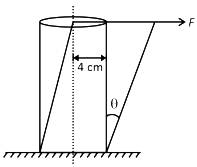
A cylindrical rod of length 1 m and radius 4 cm is mounted vertically. It is subjected to a shear force of \(10^5 \mathrm{~N}\) at the top. Considering infinitesimally small displacement in the upper edge, the angular displacement \(\theta\) of the rod axis from its original position would be : (shear moduli, \(G=10^{10} \mathrm{~N} / \mathrm{m}^2\)) [JEE Main 2025 (Online) 4th April Evening Shift]
CorrectIncorrectHint
(a)

Step 1: Identify Given Parameters
The rod is a cylinder with the following properties:
Length \(L=1 \mathrm{~m}\)
Radius \(\boldsymbol{r}=4 \mathrm{~cm}=0.04 \mathrm{~m}\)
Shear Force \(F=10^5 \mathrm{~N}\)
Shear Modulus \(G=10^{10} \mathrm{~N} / \mathrm{m}^2\)
Step 2: Calculate the Cross-sectional Area
The shear force is applied across the top surface area \(A\) of the cylinder:
\(
A=\pi r^2=\pi(0.04)^2=\pi\left(16 \times 10^{-4}\right) \mathrm{m}^2=1.6 \pi \times 10^{-3} \mathrm{~m}^2
\)
Step 3: Relate Shear Modulus to Angular Displacement
Shear modulus \(\boldsymbol{G}\) is defined as the ratio of shear stress to shear strain. For small displacements, the shear strain is equal to the angular displacement \(\theta\) :
\(
G=\frac{\text { Shear Stress }}{\text { Shear Strain }}=\frac{F / A}{\theta}
\)
Rearranging for \(\theta\) :
\(
\theta=\frac{F}{A \cdot G}
\)
Step 4: Compute the Numerical Value
Substitute the known values into the equation:
\(
\begin{aligned}
& \theta=\frac{10^5}{\left(1.6 \pi \times 10^{-3}\right) \cdot 10^{10}} \\
& \theta=\frac{10^5}{1.6 \pi \times 10^7} \\
& \theta=\frac{1}{1.6 \pi \times 10^2}=\frac{1}{160 \pi}
\end{aligned}
\) - Question 8 of 44
8. Question
The fractional compression \(\left(\frac{\Delta V}{V}\right)\) of water at the depth of 2.5 km below the sea level is _____ %. Given, the Bulk modulus of water \(=2 \times 10^9 \mathrm{~N} \mathrm{~m}^{-2}\), density of water \(=10^3 \mathrm{~kg} \mathrm{~m}^{-3}\), acceleration due to gravity \(g=10 \mathrm{~m} \mathrm{~s}^{-2}\). [JEE Main 2025 (Online) 29th January Morning Shift]
CorrectIncorrectHint
(b) Step 1: Calculate the Pressure at Depth
The pressure \(\boldsymbol{P}\) exerted by a fluid at depth \(h\) is given by the hydrostatic pressure formula:
\(
P=\rho g h
\)
Given values:
Density \(\rho=10^3 \mathrm{~kg} \mathrm{~m}^{-3}\)
Gravity \(\mathrm{g}=10 \mathrm{~m} \mathrm{~s}^{-2}\)
Depth \(h=2.5 \mathrm{~km}=2500 \mathrm{~m}\)
Substituting the values:
\(
P=10^3 \times 10 \times 2500=2.5 \times 10^7 \mathrm{~N} \mathrm{~m}^{-2}
\)
Step 2: Determine Fractional Compression
The Bulk modulus \(B\) is defined as the ratio of the change in pressure to the fractional change in volume:
\(
B=\frac{P}{\left(\frac{\Delta V}{V}\right)}
\)
Rearranging to solve for the fractional compression:
\(
\frac{\Delta V}{V}=\frac{P}{B}
\)
Given \(B=2 \times 10^9 \mathrm{~N} \mathrm{~m}^{-2}\) :
\(
\frac{\Delta V}{V}=\frac{2.5 \times 10^7}{2 \times 10^9}=1.25 \times 10^{-2}
\)
Step 3: Convert to Percentage
To express the fractional compression as a percentage, multiply the result by 100:
\(
\begin{gathered}
\text { Percentage }=\left(\frac{\Delta V}{V}\right) \times 100 \% \\
\text { Percentage }=1.25 \times 10^{-2} \times 100=1.25 \%
\end{gathered}
\)
The fractional compression of water is \(1.25 \%\). - Question 9 of 44
9. Question
A massless spring gets elongated by amount \(x_1\) under a tension of 5 N. Its elongation is \(x_2\) under the tension of 7 N. For the elongation of \(\left(5 x_1-2 x_2\right)\), the tension in the spring will be, [JEE Main 2025 (Online) 23rd January Evening Shift]
CorrectIncorrectHint
(c) To find the tension for the specified elongation, we use Hooke’s Law, which describes the linear relationship between the force applied to a spring and its extension.
Step 1: Identify the Governing Principle
According to Hooke’s Law, the tension \((F)\) in a spring is directly proportional to its elongation (\(x\)):
\(
F=k x
\)
Where \(k\) is the spring constant (stiffness of the spring).
Step 2: Set up the Equations for Given Conditions
From the problem, we have two scenarios:
Under a tension of 5 N , the elongation is \(x_1\) :
\(
5=k x_1 \Longrightarrow x_1=\frac{5}{k}
\)
Under a tension of 7 N , the elongation is \(x_2\) :
\(
7=k x_2 \Longrightarrow x_2=\frac{7}{k}
\)
Step 3: Calculate the Target Elongation
The problem asks for the tension when the elongation is \(\left(5 x_1-2 x_2\right)\). Let’s substitute the expressions for \(x_1\) and \(x_2\) from Step 2 into this expression:
\(
\begin{gathered}
\text { New Elongation }(X)=5\left(\frac{5}{k}\right)-2\left(\frac{7}{k}\right) \\
X=\frac{25}{k}-\frac{14}{k} \\
X=\frac{11}{k}
\end{gathered}
\)
Step 4: Solve for the New Tension
Now, apply Hooke’s Law (\(F=k X\)) using the new elongation:
\(
F_{n e w}=k \times\left(\frac{11}{k}\right)
\)
The spring constant \(k\) cancels out:
\(
F_{n e w}=11 \mathrm{~N}
\)
Final Answer: The tension in the spring will be 11 N. - Question 10 of 44
10. Question
Young’s modulus is determined by the equation given by \(\mathrm{Y}=49000 \frac{\mathrm{~m}}{\ell} \frac{\text { dyne }}{\mathrm{cm}^2}\) where \(M\) is the mass and \(l\) is the extension of wire used in the experiment. Now error in Young modules \((Y)\) is estimated by taking data from \(M-l\) plot in graph paper. The smallest scale divisions are 5 g and 0.02 cm along load axis and extension axis respectively. If the value of \(M\) and \(l\) are 500 g and 2 cm respectively then percentage error of \(Y\) is : [JEE Main 2024 (Online) 8th April Morning Shift]
CorrectIncorrectHint
(a) Step 1: Identify Given Values and Absolute Errors
The Young’s modulus is given by the expression \(Y=49000 \frac{M}{l}\). The variables and their associated errors (determined by the smallest scale divisions of the graph axes)
are:
Mass (\(M\)): 500 g
Smallest division in mass (\(\boldsymbol{\Delta} \boldsymbol{M}\)): \(\mathbf{5 ~ g}\)
Extension (\(l\)): 2 cm
Smallest division in extension (\(\Delta l\)): \(0.02 \mathrm{~cm}\)
Step 2: Apply the Error Propagation Formula
For a quantity calculated via multiplication or division, such as \(Y=k \frac{M}{l}\), the relative error is the sum of the relative errors of the individual components. The percentage error is expressed as:
\(
\frac{\Delta Y}{Y} \times 100=\left(\frac{\Delta M}{M}+\frac{\Delta l}{l}\right) \times 100
\)
Step 3: Calculate the Percentage Error
Substitute the given values into the error equation:
\(
\begin{gathered}
\frac{\Delta Y}{Y} \times 100=\left(\frac{5}{500}+\frac{0.02}{2}\right) \times 100 \\
\frac{\Delta Y}{Y} \times 100=(0.01+0.01) \times 100 \\
\frac{\Delta Y}{Y} \times 100=0.02 \times 100=2 \%
\end{gathered}
\) - Question 11 of 44
11. Question
Match List I with List II :
\(
\begin{array}{|l|l|l|l|}
\hline & \text { List-I } & \text { List-II } \\
\hline \text { A. } & \begin{array}{l}
\text { A force that restores an elastic body of unit area to its } \\
\text { original state }
\end{array} & \text { I. } & \begin{array}{l}
\text { Bulk } \\
\text { modulus }
\end{array} \\
\hline \text { B. } & \text { Two equal and opposite forces parallel to opposite faces } & \text { II. } & \begin{array}{l}
\text { Young’s } \\
\text { modulus }
\end{array} \\
\hline \text { C. } & \begin{array}{l}
\text { Forces perpendicular everywhere to the surface per unit } \\
\text { area same everywhere }
\end{array} & \text { III. } & \text { Stress } \\
\hline \text { D. } & \begin{array}{l}
\text { Two equal and opposite forces perpendicular to opposite } \\
\text { faces Choose the correct answer from the options given } \\
\text { below : }
\end{array} & \text { IV. } & \begin{array}{l}
\text { Shear } \\
\text { modulus }
\end{array} \\
\hline
\end{array}
\)
Choose the correct answer from the options given below : [JEE Main 2024 (Online) 5th April Evening Shift]CorrectIncorrectHint
(b)

Step 1: Analyze List-I Definitions
A. A force that restores an elastic body of unit area to its original state: This is the general definition of Restoring Stress. Stress is mathematically defined as internal restoring force per unit area.
Matches with III (Stress).
B. Two equal and opposite forces parallel to opposite faces: When forces are applied parallel to the surface, they cause a shape deformation (tangential strain). The ratio of this stress to strain is governed by the Shear modulus (also known as Modulus of Rigidity).
Matches with IV (Shear modulus).
C. Forces perpendicular everywhere to the surface per unit area same everywhere: This describes hydraulic pressure or volume stress, where the force acts uniformly on all sides. This type of deformation is governed by the Bulk modulus.
Matches with I (Bulk modulus).
D. Two equal and opposite forces perpendicular to opposite faces: This describes longitudinal (tensile or compressive) stress applied to a rod or wire. The ratio of this stress to longitudinal strain is the Young’s modulus. - Question 12 of 44
12. Question
With rise in temperature, the Young’s modulus of elasticity : [JEE Main 2024 (Online) 1st February Morning Shift]
CorrectIncorrectHint
(c) Step 1: Understand Young’s Modulus
Young’s modulus (\(Y\)) is a measure of the stiffness of a solid material. It is defined as the ratio of tensile stress to tensile strain. On a microscopic level, it depends on the strength of the interatomic forces holding the atoms of the material together.
Step 2: Analyze the Effect of Temperature
When the temperature of a material increases, the thermal energy of its atoms also increases. This leads to several changes:
Increased Vibration: Atoms vibrate with larger amplitudes about their equilibrium positions.
Increased Interatomic Distance: Due to the asymmetry of the interatomic potential energy curve, the average distance between atoms increases (thermal expansion).
Step 3: Relate Interatomic Distance to Elasticity
As the atoms move further apart due to thermal expansion:
The interatomic bonding forces become weaker.
It becomes easier to deform the material (stretch the bonds) with a smaller amount of external force.
Since the material becomes less “stiff,” the value of Young’s modulus (\(Y\)) decreases.
Final Answer: With a rise in temperature, the Young’s modulus of elasticity decreases. - Question 13 of 44
13. Question
Young’s modules of material of a wire of length ‘ \(L\) ‘ and cross-sectional area \(A\) is \(Y\). If the length of the wire is doubled and cross-sectional area is halved then Young’s modules will be : [JEE Main 2024 (Online) 30th January Morning Shift]
CorrectIncorrectHint
(d) Step 1: Define Young’s Modulus
Young’s modulus \((Y)\) is defined by the formula:
\(
Y=\frac{\text { Stress }}{\text { Strain }}=\frac{F / A}{\Delta L / L}
\)
However, it is crucial to distinguish between a variable and a property.
Step 2: Distinguish Material Property vs. Dimensions
Young’s modulus is an intrinsic property of the material (like density or resistivity). It depends strictly on:
The nature of the material (e.g., steel, copper, aluminum).
Temperature.
It does not depend on the geometric dimensions of the wire, such as its length \((L)\) or its crosssectional area (A).
Final Answer: Since the material has not changed, the Young’s modulus remains \(Y\). The - Question 14 of 44
14. Question
A wire of length \(L\) and radius \(r\) is clamped at one end. If its other end is pulled by a force \(F\), its length increases by \(l\). If the radius of the wire and the applied force both are reduced to half of their original values keeping original length constant, the increase in length will become: [JEE Main 2024 (Online) 29th January Evening Shift]
CorrectIncorrectHint
(b) Step 1: Identify the Formula for Elongation
Young’s Modulus (\(Y\)) is given by:
\(
Y=\frac{\text { Stress }}{\text { Strain }}=\frac{F / A}{l / L}=\frac{F L}{A l}
\)
Rearranging this to solve for the elongation (\(l\)):
\(
l=\frac{F L}{A Y}=\frac{F L}{\left(\pi r^2\right) Y}
\)
Where:
\(F\) : Applied force
\(L\): Original length
\(r\) : Radius of the wire
\(Y\) : Young’s Modulus (constant for the same material)
Step 2: Analyze the Initial and New Conditions
Let the initial elongation be \(l_1\) and the new elongation be \(l_2\).
Initial Condition:
\(
l_1=\frac{F L}{\pi r^2 Y}
\)
New Condition:
Force is reduced to half: \(F^{\prime}=F / 2\)
Radius is reduced to half: \(r^{\prime}=r / 2\)
Length \(L\) and material \(Y\) remain constant.
Step 3: Substitute New Values into the Formula
\(
\begin{gathered}
l_2=\frac{(F / 2) L}{\pi(r / 2)^2 Y} \\
l_2=\frac{\frac{F L}{2}}{\pi \frac{r^2}{4} Y}
\end{gathered}
\)
Simplify the fraction:
\(
\begin{aligned}
& l_2=\frac{F L}{2} \times \frac{4}{\pi r^2 Y} \\
& l_2=2 \times\left(\frac{F L}{\pi r^2 Y}\right)
\end{aligned}
\)
Step 4: Compare with Initial Elongation
Since \(l_1=\frac{F L}{\pi r^2 Y}\), we can see that:
\(
l_2=2 l_1
\)
Final Answer: The increase in length will become \(2 l\). - Question 15 of 44
15. Question
Given below are two statements: one is labelled as Assertion (A) and the other is labelled as Reason (R).
Assertion (A) : The property of body, by virtue of which it tends to regain its original shape when the external force is removed, is Elasticity.
Reason (R) : The restoring force depends upon the bonded inter atomic and inter molecular force of solid.
In the light of the above statements, choose the correct answer from the options given below: [JEE Main 2024 (Online) 27th January Evening Shift]CorrectIncorrectHint
(c) Step 1: Analyze the Assertion (A)
Assertion (A): The property of a body, by virtue of which it tends to regain its original shape when the external force is removed, is Elasticity.
Fact Check: This is the standard physical definition of elasticity. When a material is deformed by an external load, it stores potential energy. If the material is elastic, it uses this energy to return to its original configuration once the load is gone.
Conclusion: Assertion (A) is True.Step 2: Analyze the Reason (R)
Reason (R): The restoring force depends upon the bonded inter-atomic and inter-molecular forces of a solid.
Fact Check: In solids, atoms are held in equilibrium positions by inter-atomic bonds. When an external force stretches or compresses the solid, it displaces these atoms from their equilibrium positions. This creates an internal restoring force (stress) that tries to pull the atoms back. This microscopic behavior is exactly what manifests macroscopically as elasticity.
Conclusion: Reason \(({R})\) is True.
Step 3: Determine the Relationship
Now we ask: Why does a body tend to regain its original shape (A)? It does so because the displaced atoms are being pulled back by the internal inter-atomic and inter-molecular forces (R).Since the microscopic mechanism described in \(({R})\) is the fundamental cause of the macroscopic property described in \((A),(R)\) is the correct explanation for \((A)\).
Final Answer: The correct option is (C): Both (A) and (R) are true and (R) is the correct explanation of (A). - Question 16 of 44
16. Question
A wire of length ‘ \(L\) ‘ and radius ‘ \(r\) ‘ is clamped rigidly at one end. When the other end of the wire is pulled by a force \(f\), its length increases by ‘ \(l\) ‘. Another wire of same material of length ‘ \(2 L\) ‘ and radius ‘ \(2 r^{\prime}\) ‘ is pulled by a force ‘ \(2 f^{\prime}\). Then the increase in its length will be : [JEE Main 2023 (Online) 15th April Morning Shift]
CorrectIncorrectHint
(c) Step 1: Identify the formula for Young’s Modulus
The extension (\(\Delta L\)) of a wire under an applied force is derived from Young’s Modulus \((Y)\), which is defined as:
\(
Y=\frac{\text { Stress }}{\text { Strain }}=\frac{F / A}{\Delta L / L}
\)
Rearranging for the increase in length \((\Delta L)\) :
\(
\Delta L=\frac{F L}{A Y}=\frac{F L}{\pi r^2 Y}
\)
where \(F\) is the force, \(L\) is the original length, \(r\) is the radius, and \(Y\) is the material constant.
Step 2: Define parameters for the first wire
For the first wire, the extension is given as \(l\). Substituting the given values:
\(
l=\frac{f L}{\pi r^2 Y}
\)
Step 3: Calculate parameters for the second wire
For the second wire, the length is \(2 L\), the radius is \(2 r\), and the force is \(2 f\). Let the new extension be \(l^{\prime}\). Since the material is the same, \(Y\) remains constant:
\(
\begin{gathered}
l^{\prime}=\frac{(2 f)(2 L)}{\pi(2 r)^2 Y} \\
l^{\prime}=\frac{4 f L}{\pi\left(4 r^2\right) Y} \\
l^{\prime}=\frac{f L}{\pi r^2 Y}
\end{gathered}
\)
Step 4: Compare the results
By comparing the expressions from Step 2 and Step 3, we find:
\(
l^{\prime}=l
\)
The extension remains unchanged because the doubling of the length and force is exactly compensated by the fourfold increase in the cross-sectional area. - Question 17 of 44
17. Question
Under isothermal condition, the pressure of a gas is given by \(\mathrm{P}=a \mathrm{~V}^{-3}\), where \(a\) is a constant and \(V\) is the volume of the gas. The bulk modulus at constant temperature is equal to [JEE Main 2023 (Online) 13th April Morning Shift]
CorrectIncorrectHint
(c) Step 1: Define the Bulk Modulus
The isothermal bulk modulus (\(B\)) is defined as the ratio of the infinitesimal increase in pressure to the resulting relative decrease in volume at a constant temperature. The mathematical formula is:
\(
B=-V \frac{d P}{d V}
\)
Step 2: Differentiate the Pressure Equation
The given equation for the pressure of the gas is \(P=a V^{-3}\). To find \(\frac{d P}{d V}\), we differentiate \(P\) with respect to \(V^{\prime}\).
\(
\frac{d P}{d V}=\frac{d}{d V}\left(a V^{-3}\right)=-3 a V^{-4}
\)
Step 3: Calculate the Bulk Modulus
Substitute the derivative back into the formula for the bulk modulus:
\(
\begin{gathered}
B=-V\left(-3 a V^{-4}\right) \\
B=3 a V^{-3}
\end{gathered}
\)
Since the original equation states that \(P=a V^{-3}\), we can substitute \(P\) into the expression for \(\boldsymbol{B}\) :
\(
B=3 P
\)
The bulk modulus at constant temperature is equal to \(\mathbf{3 P}\). - Question 18 of 44
18. Question
Young’s moduli of the material of wires \(A\) and \(B\) are in the ratio of \(1: 4\), while its area of cross sections are in the ratio of \(1: 3\). If the same amount of load is applied to both the wires, the amount of elongation produced in the wires \(A\) and \(B\) will be in the ratio of [JEE Main 2023 (Online) 10th April Evening Shift]
[Assume length of wires \(A\) and \(B\) are same]CorrectIncorrectHint
(c) Step 1: Identify the Elongation Formula
The relationship between Young’s modulus \((Y)\), force \((F)\), length \((L)\), area \((A)\), and elongation \((\Delta L)\) is given by the formula:
\(
Y=\frac{F \cdot L}{A \cdot \Delta L}
\)
Rearranging the formula to solve for elongation (\(\boldsymbol{\Delta L}\)):
\(
\Delta L=\frac{F \cdot L}{A \cdot Y}
\)
Step 2: Establish the Ratio Equation
Since the applied load \((F)\) and the initial length \((L)\) are the same for both wires \(A\) and \(\boldsymbol{B}\), elongation is inversely proportional to the product of the cross-sectional area and Young’s modulus (\(\Delta L \propto \frac{1}{A \cdot Y}\)). We can set up the ratio as follows:
\(
\frac{\Delta L_A}{\Delta L_B}=\frac{A_B \cdot Y_B}{A_A \cdot Y_A}
\)
Step 3: Substitute the Given Values
From the problem description, we have the following ratios:
Young’s Moduli: \(\frac{Y_A}{Y_B}=\frac{1}{4} \Longrightarrow \frac{Y_B}{Y_A}=4\)
Area of Cross Sections: \(\frac{A_A}{A_B}=\frac{1}{3} \Longrightarrow \frac{A_B}{A_A}=3\)
Substituting these values into the ratio equation:
\(
\frac{\Delta L_A}{\Delta L_B}=\left(\frac{A_B}{A_A}\right) \cdot\left(\frac{Y_B}{Y_A}\right)=3 \cdot 4=12
\)
The ratio of elongation in wire \(A\) to wire \(B\) is \(12: 1\). - Question 19 of 44
19. Question
An aluminium rod with Young’s modulus \(Y=7.0 \times 10^{10} \mathrm{~N} / \mathrm{m}^2\) undergoes elastic strain of \(0.04 \%\). The energy per unit volume stored in the rod in SI unit is: [JEE Main 2023 (Online) 8th April Morning Shift]
CorrectIncorrectHint
(a) Step 1: Identify and Convert Given Values
Identify the Young’s modulus \((Y)\) and the strain \((\epsilon)\) from the problem. The strain must be converted from a percentage to a dimensionless decimal value for use in the formula.
Young’s modulus \((Y): 7.0 \times 10^{10} \mathrm{~N} / \mathrm{m}^2\)
Strain \((\epsilon): 0.04 \%=\frac{0.04}{100}=4 \times 10^{-4}\)
Step 2: Apply the Energy Density Formula
The energy per unit volume (\(u\)), also known as elastic potential energy density, is defined by the relationship between stress and strain. Since stress \(=Y \times \epsilon\), the formula is:
\(
u=\frac{1}{2} \times \text { stress } \text { × } \text { strain }=\frac{1}{2} Y \epsilon^2
\)
Step 3: Perform the Calculation
Substitute the given values into the formula and solve:
\(
\begin{gathered}
u=\frac{1}{2}\left(7.0 \times 10^{10}\right)\left(4 \times 10^{-4}\right)^2 \\
u=0.5 \times\left(7.0 \times 10^{10}\right) \times\left(16 \times 10^{-8}\right) \\
u=3.5 \times 16 \times 10^2 \\
u=56 \times 10^2=5600 \mathrm{~J} / \mathrm{m}^3
\end{gathered}
\) - Question 20 of 44
20. Question
The Young’s modulus of a steel wire of length 6 m and cross-sectional area \(3 \mathrm{~mm}^2\), is \(2 \times 10^{11} \mathrm{~N} / \mathrm{m}^2\). The wire is suspended from its support on a given planet. A block of mass 4 kg is attached to the free end of the wire. The acceleration due to gravity on the planet is \(\frac{1}{4}\) of its value on the earth. The elongation of wire is (Take \(g\) on the earth \(=10 \mathrm{~m} / \mathrm{s}^2\)): [JEE Main 2023 (Online) 1st February Evening Shift]
CorrectIncorrectHint
(c) Step 1: Calculate Gravity and Weight on the Planet
The acceleration due to gravity on the planet (\(g_p\)) is one-fourth of the gravity on Earth \(\left(g_e\right)\).
\(
g_p=\frac{1}{4} \times g_e=\frac{1}{4} \times 10=2.5 \mathrm{~m} / \mathrm{s}^2
\)
The force (\(F\)) acting on the wire is the weight of the block:
\(
F=M \times g_p=4 \times 2.5=10 \mathrm{~N}
\)
Step 2: Convert Units to SI
To ensure consistency in the calculation, convert the cross-sectional area (\(\boldsymbol{A}\)) from \(\mathrm{mm}^2\) to \(\mathrm{m}^2\) :
\(
A=3 \mathrm{~mm}^2=3 \times 10^{-6} \mathrm{~m}^2
\)
Step 3: Calculate Elongation using Young’s Modulus
Young’s modulus \((Y)\) is defined as the ratio of tensile stress to tensile strain:
\(
Y=\frac{F / A}{\Delta L / L}
\)
Rearranging the formula to solve for the elongation \((\Delta L)\) :
\(
\Delta L=\frac{F L}{A Y}
\)
Substitute the known values into the equation:
\(
\begin{gathered}
\Delta L=\frac{10 \times 6}{\left(3 \times 10^{-6}\right) \times\left(2 \times 10^{11}\right)} \\
\Delta L=\frac{60}{6 \times 10^5} \\
\Delta L=10 \times 10^{-5}=10^{-4} \mathrm{~m}
\end{gathered}
\)
To express this in millimeters:
\(
\Delta L=10^{-4} \times 10^3=0.1 \mathrm{~mm}
\)
The elongation of the wire is \(\mathbf{0 . 1 ~ m m}\). - Question 21 of 44
21. Question
For a solid rod, the Young’s modulus of elasticity is \(3.2 \times 10^{11} \mathrm{Nm}^{-2}\) and density is \(8 \times 10^3 \mathrm{~kg} \mathrm{~m}^{-3}\). The velocity of longitudinal wave in the rod will be. [JEE Main 2023 (Online) 31st January Evening Shift]
CorrectIncorrectHint
(b) Step 1: Identify given values and formula
The velocity of a longitudinal wave in a thin solid rod is determined by the material’s Young’s modulus and its density. The formula is:
\(
v=\sqrt{\frac{Y}{\rho}}
\)
Given:
Young’s modulus \((Y)=3.2 \times 10^{11} \mathrm{Nm}^{-2}\)
Density \((\rho)=8 \times 10^3 \mathrm{~kg} \mathrm{~m}^{-3}\)
Step 2: Calculate the velocity
Substitute the given values into the formula:
\(
v=\sqrt{\frac{3.2 \times 10^{11}}{8 \times 10^3}}
\)
Simplify the expression under the square root:
\(
\begin{aligned}
& v=\sqrt{0.4 \times 10^8} \\
& v=\sqrt{40 \times 10^6}
\end{aligned}
\)
Taking the square root:
\(
v \approx 6.324 \times 10^3 \mathrm{~ms}^{-1}
\) - Question 22 of 44
22. Question
Under the same load, wire \(A\) having length 5.0 m and cross section \(2.5 \times 10^{-5} \mathrm{~m}^2\) stretches uniformly by the same amount as another wire \(B\) of length 6.0 m and a cross section of \(3.0 \times 10^{-5} \mathrm{~m}^2\) stretches. The ratio of the Young’s modulus of wire A to that of wire \(B\) will be : [JEE Main 2023 (Online) 31st January Evening Shift]
CorrectIncorrectHint
(c) The Formula
The Young’s modulus (\(Y\)) is defined by the formula:
\(
Y=\frac{\text { Stress }}{\text { Strain }}=\frac{F / A}{\Delta L / L}=\frac{F \cdot L}{A \cdot \Delta L}
\)
Where:
\(F=\) Force (Load)
\(L=\) Original length
\(\boldsymbol{A}=\) Cross-sectional area
\(\Delta L=\) Change in length (Elongation)
Given Data: The problem states that both wires are under the same load \(\left(F_A=F_B\right)\) and experience the same elongation (\(\Delta L_A=\Delta L_B\)).
Since \(F\) and \(\Delta L\) are constant for both wires, we can see from the formula that \(Y \propto \frac{L}{A}\). Therefore, the ratio of Young’s modulus \(Y_A\) to \(Y_B\) is:
\(
\frac{Y_A}{Y_B}=\frac{L_A / A_A}{L_B / A_B}
\)
Substituting the values:
\(
\frac{Y_A}{Y_B}=\frac{5.0 /\left(2.5 \times 10^{-5}\right)}{6.0 /\left(3.0 \times 10^{-5}\right)}
\)
Simplify the terms:
For Wire A: \(\frac{5.0}{2.5}=2\)
For Wire B: \(\frac{6.0}{3.0}=2\)
\(
\frac{Y_A}{Y_B}=\frac{2 \times 10^5}{2 \times 10^5}=1
\)
The ratio of the Young’s modulus of wire \(A\) to wire \(B\) is \(1: 1\). - Question 23 of 44
23. Question
A force is applied to a steel wire ‘ \(A\) ‘, rigidly clamped at one end. As a result elongation in the wire is 0.2 mm . If same force is applied to another steel wire ‘ \(B\) ‘ of double the length and a diameter 2.4 times that of the wire ‘ \(A\) ‘, the elongation in the wire ‘ \(B\) ‘ will be (wires having uniform circular cross sections) [JEE Main 2023 (Online) 30th January Evening Shift]
CorrectIncorrectHint
(a) Since both wires are made of steel, they share the same Young’s modulus (\(Y\)). We can find the elongation of wire \(B\) by comparing it to the known elongation of wire \(A\).
The Formula for Elongation
Starting with the Young’s modulus formula \(Y=\frac{F \cdot L}{A \cdot \Delta L}[latex], we rearrange it to solve for elongation ([latex]\boldsymbol{\Delta} \boldsymbol{L} \boldsymbol{)}\) :
\(
\Delta L=\frac{F \cdot L}{A \cdot Y}
\)
For a wire with a circular cross-section, the area \(A=\pi\left(\frac{d}{2}\right)^2\), which means \(A \propto d^2\). Substituting this into our elongation formula, we get:
\(
\Delta L \propto \frac{L}{d^2}
\)
Step 1: Establish the Relationship
Let the properties of wire A be \(L_A\) and \(d_A\), and for wire B be \(L_B\) and \(d_B\). From the problem:
\(L_B=2 L_A\) (Double the length)
\(d_B=2.4 d_A\) (2.4 times the diameter)
\(F\) and \(Y\) are constant for both.
The ratio of elongation for wire B to wire A is:
\(
\frac{\Delta L_B}{\Delta L_A}=\left(\frac{L_B}{L_A}\right) \cdot\left(\frac{d_A}{d_B}\right)^2
\)
Step 2: Calculate the Ratio
Substitute the given relationships into the ratio:
\(
\begin{gathered}
\frac{\Delta L_B}{\Delta L_A}=(2) \cdot\left(\frac{1}{2.4}\right)^2 \\
\frac{\Delta L_B}{\Delta L_A}=\frac{2}{5.76}
\end{gathered}
\)
Step 3: Solve for \(\boldsymbol{\Delta} \boldsymbol{L}_{\boldsymbol{B}}\)
Given that \(\Delta L_A=0.2 \mathrm{~mm}\) :
\(
\begin{gathered}
\Delta L_B=0.2 \times \frac{2}{5.76} \\
\Delta L_B=\frac{0.4}{5.76}
\end{gathered}
\)
\(
\Delta L_B \approx 0.0694 \mathrm{~mm}
\)
Converting to scientific notation to match the options:
\(
\Delta L_B \approx 6.94 \times 10^{-2} \mathrm{~mm}
\) - Question 24 of 44
24. Question
Choose the correct relationship between Poisson ratio \((\sigma)\), bulk modulus \((\mathrm{K})\) and modulus of rigidity \((\eta)\) of a given solid object : [JEE Main 2023 (Online) 30th January Morning Shift]
CorrectIncorrectHint
(b) Step 1: Relating Elastic Constants to Young’s Modulus
The elastic constants of an isotropic solid are interconnected through Young’s modulus \((\mathrm{Y})\). The relationship between Young’s modulus, bulk modulus (\(\boldsymbol{K}\)), and Poisson’s ratio \((\sigma)\) is given by:
\(
Y=3 K(1-2 \sigma)
\)
Similarly, the relationship between Young’s modulus, modulus of rigidity \((\eta)\), and Poisson’s ratio is:
\(
Y=2 \eta(1+\sigma)
\)
Step 2: Equating the Expressions
Since both expressions represent the same Young’s modulus (\({Y}\)) for the material, we can set them equal to each other:
\(
3 K(1-2 \sigma)=2 \eta(1+\sigma)
\)
Step 3: Solving for Poisson’s Ratio \((\sigma)\)
To isolate \(\sigma\), we expand the brackets and rearrange the terms:
\(
3 K-6 K \sigma=2 \eta+2 \eta \sigma
\)
Move all terms involving \(\sigma\) to one side and constants to the other:
\(
3 K-2 \eta=6 K \sigma+2 \eta \sigma
\)
Factor out \(\sigma\) from the right side:
\(
3 K-2 \eta=\sigma(6 K+2 \eta)
\)
\(
\begin{aligned}
&3 K-2 \eta=\sigma(6 K+2 \eta)\\
&\text { Finally, solve for } \sigma \text { : }\\
&\sigma=\frac{3 K-2 \eta}{6 K+2 \eta}
\end{aligned}
\) - Question 25 of 44
25. Question
Given below are two statements: one is labelled as Assertion A and the other is labelled as Reason R
Assertion A : Steel is used in the construction of buildings and bridges.
Reason R : Steel is more elastic and its elastic limit is high.
In the light of above statements, choose the most appropriate answer from the options given below [JEE Main 2023 (Online) 24th January Evening Shift]CorrectIncorrectHint
(a) Breaking Down the Statements
Assertion A: Steel is used in the construction of buildings and bridges. This is correct. Steel’s high tensile strength and durability make it the primary choice for large-scale structural engineering.Reason R: Steel is more elastic and its elastic limit is high. This is also correct. In physics, “more elastic” doesn’t mean “stretcher” (like a rubber band); it means the material requires more force to produce a deformation and returns to its original shape more accurately once the force is removed.
Young’s Modulus: Steel has a much higher Young’s Modulus than materials like rubber, meaning it resists deformation better.
Elastic Limit: Steel can withstand significant stress before it undergoes permanent (plastic) deformation.
Analysis of the Relationship
The reason we use steel in bridges and buildings is precisely because of these elastic properties. We want structures that can handle heavy loads (high stress) without warping or permanently bending. Because steel has a high elastic limit and high elasticity (it resists strain), it ensures the safety and integrity of the construction.Final Answer: The correct answer is (A): Both A and R are correct and R is the correct explanation of A .
- Question 26 of 44
26. Question
A 100 m long wire having cross-sectional area \(6.25 \times 10^{-4} \mathrm{~m}^2\) and Young’s modulus is \(10^{10} \mathrm{Nm}^{-2}\) is subjected to a load of 250 N , then the elongation in the wire will be : [JEE Main 2023 (Online) 24th January Morning Shift]
CorrectIncorrectHint
(b) To find the elongation of the wire, we use the standard formula derived from the definition of Young’s Modulus (\(Y\)):
\(
Y=\frac{\text { Stress }}{\text { Strain }}=\frac{F / A}{\Delta L / L}
\)
Rearranging this to solve for the elongation \((\Delta L)\) :
\(
\Delta L=\frac{F \cdot L}{A \cdot Y}
\)
Step 1: Identify the Given Values
Load (F): 250 N
Original Length \((L): 100 \mathrm{~m}\)
Cross-sectional Area (A): \(6.25 \times 10^{-4} \mathrm{~m}^2\)
Young’s Modulus \((Y): 10^{10} \mathrm{~N} / \mathrm{m}^2\)
Step 2: Substitution and Calculation
Substitute the values into the formula:
\(
\Delta L=\frac{250 \times 100}{\left(6.25 \times 10^{-4}\right) \times 10^{10}}
\)
\(
\Delta L=4 \times 10^{-3} \mathrm{~m}
\)
The elongation in the wire is \(4 \times 10^{-3} \mathrm{~m}\). - Question 27 of 44
27. Question
If the length of a wire is made double and radius is halved of its respective values. Then, the Young’s modulus of the material of the wire will : [JEE Main 2022 (Online) 29th July Morning Shift]
CorrectIncorrectHint
(a) Young’s modulus of matter depends on material of wire and is independent of the dimensions of the wire. As the material remains same so Young’s modulus also remain same.
The Mathematical Perspective:
While we use the formula \(Y=\frac{F L}{A \Delta L}\) to calculate the value, the ratio \(\frac{L}{A \Delta L}\) remains constant for a specific material under a given stress. If you double the length and halve the radius, the elongation (\(\Delta L\)) and the stiffness of the wire will change significantly, but the constant \(Y\) remains the same because the material itself has not changed.Summary of Changes:
Length \((L)\) : Becomes \(2 L\)
Radius (\(r\)): Becomes \(r / 2\) (Area becomes \(A / 4\))
Young’s Modulus (\(Y\)): Constant - Question 28 of 44
28. Question
The force required to stretch a wire of cross-section \(1 \mathrm{~cm}^2\) to double its length will be : (Given Yong’s modulus of the wire \(=2 \times 10^{11} \mathrm{~N} / \mathrm{m}^2\)) [JEE Main 2022 (Online) 28th July Morning Shift]
CorrectIncorrectHint
(c)
\(
Y=\frac{\text { Stress }}{\text { Strain }}=\frac{F / A}{\Delta L / L}
\)
Since the strain is 1 , the equation simplifies to:
\(
\begin{gathered}
Y=\frac{F}{A} \\
F=Y \times A
\end{gathered}
\)
Substitute the numerical values:
\(
\begin{gathered}
F=\left(2 \times 10^{11} \mathrm{~N} / \mathrm{m}^2\right) \times\left(10^{-4} \mathrm{~m}^2\right) \\
F=2 \times 10^{11-4} \mathrm{~N} \\
F=2 \times 10^7 \mathrm{~N}
\end{gathered}
\) - Question 29 of 44
29. Question
A steel wire of length \(3.2 \mathrm{~m}\left(\mathrm{Y}_{\mathrm{s}}=2.0 \times 10^{11} \mathrm{Nm}^{-2}\right)\) and a copper wire of length \(4.4 \mathrm{~m}\left(\mathrm{Y}_{\mathrm{c}}=1.1 \times 10^{11} \mathrm{Nm}^{-2}\right)\), both of radius 1.4 mm are connected end to end. When stretched by a load, the net elongation is found to be 1.4 mm . The load applied, in Newton, will be: (Given \(\pi=\frac{22}{7}\)) [JEE Main 2022 (Online) 27th July Evening Shift]
CorrectIncorrectHint
(d) Step 1: Calculate the cross-sectional area
Since both wires have the same radius \(r=1.4 \mathrm{~mm}=1.4 \times 10^{-3} \mathrm{~m}\) and \(\pi=\frac{22}{7}\), the cross-sectional area \(A\) is:
\(
A=\pi r^2=\frac{22}{7} \times\left(1.4 \times 10^{-3}\right)^2=\frac{22}{7} \times 1.96 \times 10^{-6}=6.16 \times 10^{-6} \mathrm{~m}^2
\)
Step 2: Set up the total elongation equation
When wires are connected end-to-end (in series), the tension (load \(F\)) is the same in both. The total elongation \(\Delta L_{\text {total }}\) is the sum of the elongations of the steel wire (\(\Delta L_s\)) and the copper wire \(\left(\Delta L_c\right)\) :
\(
\Delta L_{\text {total }}=\Delta L_s+\Delta L_c=\frac{F L_s}{A Y_s}+\frac{F L_c}{A Y_c}
\)
Factoring out common terms:
\(
\Delta L_{\text {total }}=\frac{F}{A}\left(\frac{L_s}{Y_s}+\frac{L_c}{Y_c}\right)
\)
Step 3: Substitute known values and solve for \(F\)
Given \(\Delta L_{\text {total }}=1.4 \times 10^{-3} \mathrm{~m}, L_s=3.2 \mathrm{~m}, Y_s=2.0 \times 10^{11} \mathrm{~N} / \mathrm{m}^2, L_c=4.4 \mathrm{~m}\), and \(Y_c=1.1 \times 10^{11} \mathrm{~N} / \mathrm{m}^2\) :
\(
1.4 \times 10^{-3}=\frac{F}{6.16 \times 10^{-6}}\left(\frac{3.2}{2.0 \times 10^{11}}+\frac{4.4}{1.1 \times 10^{11}}\right)
\)
Calculate the terms inside the parentheses:
\(
\frac{3.2}{2.0 \times 10^{11}}=1.6 \times 10^{-11}, \quad \frac{4.4}{1.1 \times 10^{11}}=4.0 \times 10^{-11}
\)
Sum of terms \(=5.6 \times 10^{-11}\). Now solve for \(F\).
\(
\begin{gathered}
1.4 \times 10^{-3}=\frac{F \times 5.6 \times 10^{-11}}{6.16 \times 10^{-6}} \\
F=\frac{1.4 \times 10^{-3} \times 6.16 \times 10^{-6}}{5.6 \times 10^{-11}}=\frac{8.624 \times 10^{-9}}{5.6 \times 10^{-11}}=1.54 \times 10^2=154
\end{gathered}
\) - Question 30 of 44
30. Question
The area of cross section of the rope used to lift a load by a crane is \(2.5 \times 10^{-4} \mathrm{~m}^2\). The maximum lifting capacity of the crane is 10 metric tons. To increase the lifting capacity of the crane to 25 metric tons, the required area of cross section of the rope should be : [JEE Main 2022 (Online) 26th July Evening Shift]
\(\text { (take } g=10 m s^{-2} \text { ) }\)CorrectIncorrectHint
(a) To find the required area of cross-section of the rope, we can use the principle that the stress in the rope should not exceed its maximum allowable value (the elastic limit or breaking stress of the material).
Step 1: Identify the relationship between Mass and Area
The stress \((\sigma)\) on a rope is defined as the force applied divided by the cross-sectional area:
\(
\sigma=\frac{\text { Force }}{\text { Area }}=\frac{F}{A}
\)
When lifting a load, the force is the weight (\(W=m \cdot g\)):
\(
\sigma=\frac{m \cdot g}{A}
\)
Since the material of the rope remains the same, the maximum allowable stress (\(\sigma_{\text {max }}\)) remains constant. Therefore, the ratio of the load to the area of cross-section must be constant:
\(
\frac{m_1 \cdot g}{A_1}=\frac{m_2 \cdot g}{A_2}
\)
Which simplifies to:
\(
\frac{m_1}{A_1}=\frac{m_2}{A_2} \quad \text { or } \quad A_2=A_1 \times \frac{m_2}{m_1}
\)
Step 2: Given Values
Initial mass \(\left(m_1\right)=10\) metric tons
Initial area \(\left(A_1\right)=2.5 \times 10^{-4} \mathrm{~m}^2\)
Target mass \(\left(m_2\right)=25\) metric tons
Step 3: Calculation
Substitute the values into the formula:
\(
\begin{gathered}
A_2=\left(2.5 \times 10^{-4} \mathrm{~m}^2\right) \times \frac{25 \text { tons }}{10 \text { tons }} \\
A_2=\left(2.5 \times 10^{-4}\right) \times 2.5 \\
A_2=6.25 \times 10^{-4} \mathrm{~m}^2
\end{gathered}
\) - Question 31 of 44
31. Question
A wire of length \(L\) is hanging from a fixed support. The length changes to \(L_1\) and \(L_2\) when masses 1 kg and 2 kg are suspended respectively from its free end. Then the value of \(L\) is equal to : [JEE Main 2022 (Online) 29th June Morning Shift]
CorrectIncorrectHint
(c) Step 1: Apply Hooke’s Law
According to Hooke’s Law, the extension in a wire is proportional to the applied force (weight). If \(k\) is the force constant of the wire, the extension \(\Delta L\) is given by \(\Delta L=\frac{F}{k}\). We can set up equations for both cases:
For a mass of \(1 \mathrm{~kg}: L_1-L=\frac{1 \cdot g}{k} \dots(1)\)
For a mass of \(2 \mathrm{~kg}: L_2-L=\frac{2 \cdot g}{k} \dots(2)\)
Step 2: Solve for \(\boldsymbol{L}\)
To eliminate the unknown constant \(k\), divide Equation 2 by Equation 1:
\(
\begin{gathered}
\frac{L_2-L}{L_1-L}=\frac{2 g / k}{1 g / k} \\
\frac{L_2-L}{L_1-L}=2
\end{gathered}
\)
Now, cross-multiply and solve for \(L\) :
\(
\begin{aligned}
& L_2-L=2\left(L_1-L\right) \\
& L_2-L=2 L_1-2 L
\end{aligned}
\)
Rearrange the terms to isolate \(L\) :
\(
\begin{gathered}
2 L-L=2 L_1-L_2 \\
L=2 L_1-L_2
\end{gathered}
\) - Question 32 of 44
32. Question
The bulk modulus of a liquid is \(3 \times 10^{10} \mathrm{Nm}^{-2}\). The pressure required to reduce the volume of liquid by \(2 \%\) is : [JEE Main 2022 (Online) 24th June Morning Shift]
CorrectIncorrectHint
(c) Step 1: Identify Given Values and Formula
The Bulk Modulus (\(B\)) relates the change in pressure (\(\Delta P\)) to the fractional change in volume \(\left(\frac{\Delta V}{V}\right)\). The formula is given by:
\(
B=\frac{\Delta P}{-\frac{\Delta V}{V}}
\)
From the problem, we have:
Bulk Modulus \(\boldsymbol{B}=3 \times 10^{10} \mathrm{Nm}^{-2}\)
Percentage reduction in volume \(=2 \%\)
Fractional change in volume \(\frac{\Delta V}{V}=-\frac{2}{100}=-0.02\)
Step 2: Calculate the Required Pressure
Rearrange the formula to solve for the change in pressure (\(\Delta P\)):
\(
\Delta P=B \times\left|\frac{\Delta V}{V}\right|
\)
Substitute the known values into the equation:
\(
\begin{gathered}
\Delta P=\left(3 \times 10^{10} \mathrm{Nm}^{-2}\right) \times(0.02) \\
\Delta P=3 \times 10^{10} \times 2 \times 10^{-2} \mathrm{Nm}^{-2} \\
\Delta P=6 \times 10^8 \mathrm{Nm}^{-2}
\end{gathered}
\) - Question 33 of 44
33. Question
Four identical hollow cylindrical columns of mild steel support a big structure of mass \(50 \times 10^3 \mathrm{~kg}\). The inner and outer radii of each column are 50 cm and 100 cm respectively. Assuming uniform local distribution, calculate the compression strain of each column. [Use \(\mathrm{Y}=2.0 \times 10^{11} \mathrm{~Pa}, \mathrm{~g}=9.8 \mathrm{~m} / \mathrm{s}^2\)] [JEE Main 2021 (Online) 31st August Evening Shift]
CorrectIncorrectHint
(b) Step 1: Calculate the force acting on each column
The total weight of the structure is distributed equally among the four columns. The force \(F\) on a single column is given by the total weight divided by the number of columns \(n\) :
\(
F=\frac{M \cdot g}{n}
\)
Given \(M=50 \times 10^3 \mathrm{~kg}, g=9.8 \mathrm{~m} / \mathrm{s}^2\), and \(n=4\) :
\(
F=\frac{50 \times 10^3 \times 9.8}{4}=1.225 \times 10^5 \mathrm{~N}
\)
Step 2: Calculate the cross-sectional area of a column
Each column is a hollow cylinder. The cross-sectional area \(A\) is the difference between the areas of the outer and inner circles. Convert radii from cm to m : \(r_1=0.5 \mathrm{~m}\) and \(r_2=1.0 \mathrm{~m}\).
\(
\begin{gathered}
A=\pi\left(r_2^2-r_1^2\right) \\
A=\pi\left(1.0^2-0.5^2\right)=\pi(1-0.25)=0.75 \pi \mathrm{~m}^2
\end{gathered}
\)
Step 3: Calculate the compression strain
Young’s Modulus \(Y\) is defined as the ratio of stress to strain: \(Y=\frac{F / A}{\epsilon}\). Rearranging for strain \(\epsilon\) :
\(
\epsilon=\frac{F}{A \cdot Y}
\)
Substitute the known values \(\left(Y=2.0 \times 10^{11} \mathrm{~Pa}\right)\) :
\(
\begin{gathered}
\epsilon=\frac{1.225 \times 10^5}{0.75 \pi \times 2.0 \times 10^{11}} \\
\epsilon=\frac{1.225 \times 10^5}{1.5 \pi \times 10^{11}} \approx 2.6 \times 10^{-7}
\end{gathered}
\) - Question 34 of 44
34. Question
A uniform heavy rod of weight \(10 \mathrm{~kg} \mathrm{~ms}^{-2}\), cross-sectional area \(100 \mathrm{~cm}^2\) and length 20 cm is hanging from a fixed support. Young modulus of the material of the rod is \(2 \times 10^{11} \mathrm{Nm}^{-2}\). Neglecting the lateral contraction, find the elongation of rod due to its own weight. [JEE Main 2021 (Online) 31st August Morning Shift]
CorrectIncorrectHint
(d) Step 1: Identify the formula for elongation due to selfweight
For a uniform rod of weight \(W\), length \(L\), cross-sectional area \(A\), and Young’s modulus \(Y\), the tension varies linearly from zero at the bottom to \(W\) at the support. The total elongation \(\Delta L\) is calculated by integrating the strain over the length:
\(
\Delta L=\frac{W L}{2 A Y}
\)
Step 2: Convert given values to SI units
Weight (\(W\)): \(10 \mathrm{~kg} \cdot \mathrm{~m} \cdot \mathrm{~s}^{-2}=10 \mathrm{~N}\)
Length (\(L\)): \(20 \mathrm{~cm}=0.2 \mathrm{~m}\)
Area (\(A\)): \(100 \mathrm{~cm}^2=100 \times\left(10^{-2} \mathrm{~m}\right)^2=10^{-2} \mathrm{~m}^2\)
Young’s Modulus (\(Y\)): \(2 \times 10^{11} \mathrm{~N} \cdot \mathrm{~m}^{-2}\)
Step 3: Calculate the elongation
Substitute the values into the formula:
\(
\begin{gathered}
\Delta L=\frac{10 \times 0.2}{2 \times 10^{-2} \times 2 \times 10^{11}} \\
\Delta L=\frac{2}{4 \times 10^9} \\
\Delta L=0.5 \times 10^{-9} \mathrm{~m} \\
\Delta L=5 \times 10^{-10} \mathrm{~m}
\end{gathered}
\) - Question 35 of 44
35. Question
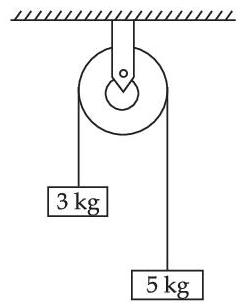
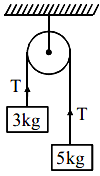
Two blocks of masses 3 kg and 5 kg are connected by a metal wire going over a smooth pulley. The breaking stress of the metal is \(\frac{24}{\pi} \times 10^2 \mathrm{Nm}^{-2}\). What is the minimum radius of the wire? \(\left(\right.\) Take \(\left.\mathrm{g}=10 \mathrm{~ms}^{-2}\right)\) [JEE Main 2021 (Online) 26th August Evening Shift]
 CorrectIncorrect
Hint
(c)

Step 1: Calculate the Tension in the Wire
The system is an Atwood machine. The tension \(T\) in the wire connecting two masses \(m_1\) and \(m_2\) passing over a smooth pulley is calculated using the formula:
\(
T=\frac{2 m_1 m_2}{m_1+m_2} g
\)
Given \(m_1=3 \mathrm{~kg}, m_2=5 \mathrm{~kg}\), and \(g=10 \mathrm{~ms}^{-2}\) :
\(
T=\frac{2 \times 3 \times 5}{3+5} \times 10=\frac{30}{8} \times 10=37.5 \mathrm{~N}
\)
Step 2: Relate Breaking Stress and Tension
Stress is defined as the restoring force (tension) per unit cross-sectional area. To find the minimum radius, we set the actual stress equal to the breaking stress \(\left(\sigma_b\right)\) :
\(
\sigma_b=\frac{T}{A}=\frac{T}{\pi r^2}
\)
Substituting the given value \(\sigma_b=\frac{24}{\pi} \times 10^2 \mathrm{Nm}^{-2}\) :
\(
\frac{24 \times 10^2}{\pi}=\frac{37.5}{\pi r^2}
\)
Step 3: Solve for the Radius
Rearrange the equation to solve for \(r^2\) :
\(
\begin{gathered}
r^2=\frac{37.5 \times \pi}{2400 \times \pi} \\
r^2=\frac{37.5}{2400}=0.015625
\end{gathered}
\)
Taking the square root to find \(r\) :
\(
r=\sqrt{0.015625}=0.125 \mathrm{~m}
\)
The minimum radius of the wire required to prevent breaking is 12.5 cm. - Question 36 of 44
36. Question
Two wires of same length and radius are joined end to end and loaded. The Young’s modulii of the materials of the two wires are \(Y_1\) and \(Y_2\). The combination behaves as a single wire then its Young’s modulus is : [JEE Main 2021 (Online) 25th July Morning Shift]
CorrectIncorrectHint
(b) To find the equivalent Young’s modulus of two wires joined end-to-end (in series), we consider how the total extension relates to the individual extensions.
Step 1: Understand the Series Combination
When two wires are joined end-to-end and a load \(F\) is applied:
The Tension (Force) is the same in both wires: \(F_1=F_2=F\).
The Cross-sectional Area is the same for both: \(A_1=A_2=A\).
The Lengths are the same: \(L_1=L_2=L\).
The Total Extension is the sum of individual extensions: \(\Delta L_{\text {total }}=\Delta L_1+\Delta L_2\).
Step 2: Express Individual Extensions
From the definition of Young’s Modulus \(Y=\frac{F L}{A \Delta L}\), we can write the extension as \(\Delta L=\frac{F L}{A Y}\).
For wire 1: \(\Delta L_1=\frac{F L}{A Y_1}\)
For wire 2: \(\Delta L_2=\frac{F L}{A Y_2}\)
Step 3: Define the Equivalent Wire
If the combination behaves as a single wire of length \(2 L\) (since \(L+L=2 L\)) and Young’s modulus \(Y_{\text {eq }}\), its extension is:
\(
\Delta L_{\text {total }}=\frac{F(2 L)}{A Y_{e q}}
\)
Step 4: Solve for \(Y_{e q}\)
Equating the total extension to the sum of the parts:
\(
\frac{2 F L}{A Y_{e q}}=\frac{F L}{A Y_1}+\frac{F L}{A Y_2}
\)
Cancel the common terms (\(F, L, A\)) from both sides:
\(
\begin{gathered}
\frac{2}{Y_{e q}}=\frac{1}{Y_1}+\frac{1}{Y_2} \\
\frac{2}{Y_{e q}}=\frac{Y_2+Y_1}{Y_1 Y_2}
\end{gathered}
\)
Inverting the equation to find \(Y_{e q}\) :
\(
Y_{e q}=\frac{2 Y_1 Y_2}{Y_1+Y_2}
\) - Question 37 of 44
37. Question
The length of a metal wire is \(\mathrm{l}_1\), when the tension in it is \(\mathrm{T}_1\) and is \(\mathrm{l}_2\) when the tension is \(\mathrm{T}_2\). The natural length of the wire is : [JEE Main 2021 (Online) 20th July Evening Shift]
CorrectIncorrectHint
(b) To find the natural length \((L)\) of the wire, we use Hooke’s Law, which relates the tension applied to the extension produced.
Step 1: Set up the Hooke’s Law equation
The extension (\(\Delta l\)) is defined as the stretched length minus the natural length (\(L\)). According to Hooke’s Law:
\(
\Delta l=\frac{T \cdot L}{A \cdot Y}
\)
Since the original length \(L\), cross-sectional area \(A\), and Young’s modulus \(Y\) are constants for the same wire, we can say that the extension is proportional to the tension:
\(
\Delta l=k \cdot T
\)
where \(k\) is a constant.
Step 2: Create equations for both cases
For the first case with tension \(T_1\) :
\(
l_1-L=k \cdot T_1 \dots(1)
\)
For the second case with tension \(T_2\) :
\(
l_2-L=k \cdot T_2 \dots(2)
\)
Step 3: Solve for \(L\)
To eliminate the constant \(k\), we divide Equation 1 by Equation 2:
\(
\frac{l_1-L}{l_2-L}=\frac{T_1}{T_2}
\)
Now, cross-multiply:
\(
\begin{aligned}
& T_2\left(l_1-L\right)=T_1\left(l_2-L\right) \\
& l_1 T_2-L T_2=l_2 T_1-L T_1
\end{aligned}
\)
Rearrange the terms to group \(L\) on one side:
\(
\begin{aligned}
& L T_1-L T_2=l_2 T_1-l_1 T_2 \\
& L\left(T_1-T_2\right)=l_2 T_1-l_1 T_2
\end{aligned}
\)
To match the standard format of the options, we can multiply both sides by -1 :
\(
\begin{gathered}
L\left(T_2-T_1\right)=l_1 T_2-l_2 T_1 \\
L=\frac{l_1 T_2-l_2 T_1}{T_2-T_1}
\end{gathered}
\) - Question 38 of 44
38. Question
The value of tension in a long thin metal wire has been changed from \(T_1\) to \(T_2\). The lengths of the metal wire at two different values of tension \(T_1\) and \(T_2\) are \(l_1\) and \(l_2\) respectively. The actual length of the metal wire is : [JEE Main 2021 (Online) 20th July Morning Shift]
CorrectIncorrectHint
(c) To find the original (natural) length \(L\) of the wire, we use the relationship between tension and extension defined by Hooke’s Law.
Step 1: Set up the Hooke’s Law equations
For a wire with natural length \(L\), cross-sectional area \(A\), and Young’s modulus \(Y\), the extension \(\Delta l\) is given by:
\(
\Delta l=\frac{T \cdot L}{A \cdot Y}
\)
Since \(L, A\), and \(Y\) are constant for the same wire, we can simplify this to:
\(
l-L=k \cdot T
\)
(where \(l\) is the stretched length and \(k=\frac{L}{A Y}\) is a constant).
Step 2: Formulate equations for the two states
We have two different tensions and their corresponding lengths:
1. For tension \(T_1: l_1-L=k \cdot T_1 \dots(1)\)
2. For tension \(T_2: l_2-L=k \cdot T_2 \dots(2)\)
Step 3: Solve for the natural length \(L\)
To eliminate the constant \(k\), we divide Equation 1 by Equation 2:
\(
\frac{l_1-L}{l_2-L}=\frac{T_1}{T_2}
\)
Now, cross-multiply:
\(
\begin{aligned}
& T_2\left(l_1-L\right)=T_1\left(l_2-L\right) \\
& T_2 l_1-T_2 L=T_1 l_2-T_1 L
\end{aligned}
\)
Rearrange the equation to group all terms containing \(L\) on one side:
\(
\begin{aligned}
& T_1 L-T_2 L=T_1 l_2-T_2 l_1 \\
& L\left(T_1-T_2\right)=T_1 l_2-T_2 l_1
\end{aligned}
\)
Finally, solve for \(L\) :
\(
L=\frac{T_1 l_2-T_2 l_1}{T_1-T_2}
\) - Question 39 of 44
39. Question
An object is located at 2 km beneath the surface of the water. If the fractional compression \(\frac{\Delta V}{V}\) is \(1.36 \%\), the ratio of hydraulic stress to the corresponding hydraulic strain will be ____. [Given : density of water is \(1000 \mathrm{kgm}^{-3}\) and \(\mathrm{g}=9.8 \mathrm{~ms}^{-2}\)] [JEE Main 2021 (Online) 17th March Evening Shift]
CorrectIncorrectHint
(b) Step 1: Calculate the Hydraulic Stress
Hydraulic stress is equivalent to the gauge pressure exerted by the water at a specific depth. The pressure \(P\) at a depth \(h\) is given by the formula:
\(
P=\rho g h
\)
Given:
\(\rho=1000 \mathrm{kgm}^{-3}\)
\(\mathrm{g}=9.8 \mathrm{~ms}^{-2}\)
\(h=2 \mathrm{~km}=2000 \mathrm{~m}\)
\(
P=1000 \times 9.8 \times 2000=1.96 \times 10^7 \mathrm{Nm}^{-2}
\)
Step 2: Determine the Hydraulic Strain
Hydraulic strain is the fractional change in volume \(\left(\frac{\Delta V}{V}\right)\). The problem provides the fractional compression as a percentage:
\(
\text { Strain }=\frac{\Delta V}{V}=1.36 \%=\frac{1.36}{100}=0.0136
\)
Step 3: Calculate the Ratio (Bulk Modulus)
The ratio of hydraulic stress to hydraulic strain is defined as the Bulk Modulus (\(B\)):
\(
\begin{gathered}
B=\frac{\text { Hydraulic Stress }}{\text { Hydraulic Strain }}=\frac{P}{\Delta V V} \\
B=\frac{1.96 \times 10^7}{0.0136} \\
B \approx 1.4411 \times 10^9 \mathrm{Nm}^{-2}
\end{gathered}
\) - Question 40 of 44
40. Question
The normal density of a material is \(\rho\) and its bulk modulus of elasticity is \(K\). The magnitude of increase in density of material, when a pressure \(P\) is applied uniformly on all sides, will be : [JEE Main 2021 (Online) 26th February Morning Shift]
CorrectIncorrectHint
(c) To find the increase in density of the material, we need to relate the change in volume to the change in density using the definition of Bulk Modulus.
Step 1: Relate Density and Volume
The density (\(\rho\)) of a substance is given by the ratio of its mass (\(m\)) to its volume (\(V\)):
\(
\rho=\frac{m}{V}
\)
Since the mass \(m\) of the material remains constant when pressure is applied, any change in volume results in a change in density. By differentiating the density equation:
\(
\begin{gathered}
\frac{d \rho}{d V}=-\frac{m}{V^2}=-\frac{\rho}{V} \\
\frac{\Delta \rho}{\rho}=-\frac{\Delta V}{V}
\end{gathered}
\)
This shows that the fractional increase in density is equal to the fractional decrease in volume.
Step 2: Use the Bulk Modulus Formula
The Bulk Modulus \((K)\) is defined as the ratio of the applied pressure \((P)\) to the fractional change in volume (volumetric strain):
\(
K=\frac{P}{-\frac{\Delta V}{V}}
\)
Step 3: Calculate the Increase in Density
From Step 1, we know that \(-\frac{\Delta V}{V}=\frac{\Delta \rho}{\rho}\). Substituting this into the Bulk Modulus formula:
\(
K=\frac{P}{\frac{\Delta \rho}{\rho}}
\)
Now, rearrange the equation to solve for the magnitude of increase in density (\(\Delta \rho\)):
\(
\begin{aligned}
& K=\frac{P \cdot \rho}{\Delta \rho} \\
& \Delta \rho=\frac{\rho P}{K}
\end{aligned}
\) - Question 41 of 44
41. Question
If \(\mathrm{Y}, \mathrm{K}\) and \(\eta\) are the values of Young’s modulus, bulk modulus and modulus of rigidity of any material respectively. Choose the correct relation for these parameters. [JEE Main 2021 (Online) 24th February Morning Shift]
CorrectIncorrectHint
(d) Step 1: Establish the Fundamental Relations
The relationship between Young’s modulus \((Y)\), Bulk modulus \((K)\), Modulus of rigidity \((\eta\)), and Poisson’s ratio (\(\sigma\)) is defined by two primary equations:
\(Y=3 K(1-2 \sigma) \dots(1)\)
\(Y=2 \eta(1+\sigma) \dots(2)\)
Step 2: Eliminate Poisson’s Ratio
To find the relation between \(Y, K\), and \(\eta\), we must eliminate \(\sigma\). From equation (2), we express \(\sigma\) as:
\(
1+\sigma=\frac{Y}{2 \eta} \Longrightarrow \sigma=\frac{Y}{2 \eta}-1
\)
Substituting this into equation (1):
\(
\begin{gathered}
Y=3 K\left(1-2\left(\frac{Y}{2 \eta}-1\right)\right) \\
Y=3 K\left(1-\frac{Y}{\eta}+2\right) \\
Y=3 K\left(3-\frac{Y}{\eta}\right)
\end{gathered}
\)
Step 3: Rearrange to Solve for \(\boldsymbol{K}\)
Distribute \(3 K\) and group the terms:
\(
Y=9 K-\frac{3 K Y}{\eta}
\)
Multiply the entire equation by \(\eta\) to clear the fraction:
\(
Y \eta=9 K \eta-3 K Y
\)
Factor out \(K\) from the right side:
\(
Y \eta=K(9 \eta-3 Y)
\)
Finally, solve for \(\boldsymbol{K}\) :
\(
K=\frac{Y \eta}{9 \eta-3 Y}\mathrm{N} / \mathrm{m}^2
\) - Question 42 of 44
42. Question
An object of mass \(m\) is suspended at the end of a massless wire of length \(L\) and area of crosssection \(A\). Young modulus of the material of the wire is \(Y\). If the mass is pulled down slightly its frequency of oscillation along the vertical direction is: [JEE Main 2020 (Online) 6th September Morning Slot]
CorrectIncorrectHint
(a) To find the frequency of oscillation, we need to treat the wire as an elastic spring and determine its effective force constant (spring constant).
Step 1: Find the Force Constant (\(k\)) of the wire
According to the definition of Young’s Modulus (\(Y\)):
\(
Y=\frac{\text { Stress }}{\text { Strain }}=\frac{F / A}{\Delta L / L}
\)
Rearranging this to solve for the force \(F\) :
\(
F=\left(\frac{Y A}{L}\right) \Delta L
\)
In physics, a spring follows Hooke’s Law: \(F=k \cdot x\). By comparing the two equations (where \(x=\Delta L\) ), we find the equivalent spring constant \(k\) of the wire:
\(
k=\frac{Y A}{L}
\)
Step 2: Determine the Frequency of Oscillation
The mass \(m\) suspended from this “spring” will undergo Simple Harmonic Motion (SHM). The angular frequency (\(\omega\)) for a mass-spring system is:
\(
\omega=\sqrt{\frac{k}{m}}
\)
Substitute the value of \(k\) from Step 1:
\(
\omega=\sqrt{\frac{Y A}{m L}}
\)
Step 3: Convert to Linear Frequency (\(f\))
The relationship between linear frequency and angular frequency is \(f=\frac{\omega}{2 \pi}\) :
\(
f=\frac{1}{2 \pi} \sqrt{\frac{Y A}{m L}}
\) - Question 43 of 44
43. Question
A cube of metal is subjected to a hydrostatic pressure of \(4 GPa\). The percentage change in the length of the side of the cube is close to : (Given bulk modulus of metal, \(\mathrm{B}=8 \times 10^{10} \mathrm{~Pa}\)) [JEE Main 2020 (Online) 4th September Evening Slot]
CorrectIncorrectHint
(c) Step 1: Calculate the Volumetric Strain
The Bulk Modulus (\(B\)) relates the hydrostatic pressure (\(P\)) to the fractional change in volume \(\left(\frac{\Delta V}{V}\right)\). It is defined by the formula:
\(
B=\frac{P}{\frac{\Delta V}{V}}
\)
Rearranging to find the volumetric strain:
\(
\frac{\Delta V}{V}=\frac{P}{B}
\)
Given \(P=4 \mathrm{GPa}=4 \times 10^9 \mathrm{~Pa}\) and \(B=8 \times 10^{10} \mathrm{~Pa}\) :
\(
\frac{\Delta V}{V}=\frac{4 \times 10^9}{8 \times 10^{10}}=\frac{1}{20}=0.05
\)
Step 2: Relate Volumetric Strain to Linear Strain
For a cube with side length \(L\), the volume is \(V=L^3\). For small changes, the fractional change in volume is approximately three times the fractional change in length:
\(
\frac{\Delta V}{V} \approx 3 \frac{\Delta L}{L}
\)
Substitute the value of volumetric strain calculated in Step 1:
\(
\begin{gathered}
0.05=3 \frac{\Delta L}{L} \\
\frac{\Delta L}{L}=\frac{0.05}{3} \approx 0.01667
\end{gathered}
\)
Step 3: Determine the Percentage Change
To find the percentage change in the side length, multiply the linear strain by 100 :
\(
\text { Percentage change }=\frac{\Delta L}{L} \times 100=0.01667 \times 100=1.667 \%
\)
Rounding to two decimal places, we get 1.67%.
The percentage change in the length of the side of the cube is \(1.67 \%\). - Question 44 of 44
44. Question
Two steel wires having same length are suspended from a ceiling under the same load. If the ratio of their energy stored per unit volume is \(1: 4\), the ratio of their diameters is: [JEE Main 2020 (Online) 9th January Evening Slot]
CorrectIncorrectHint
(d) To find the ratio of the diameters, we need to relate the energy stored per unit volume (energy density) to the physical dimensions of the wires.
Step 1: Identify the formula for Energy Density
The energy stored per unit volume (\(u\)) in a stretched wire is given by:
\(
u=\frac{1}{2} \times \text { Stress × Strain }
\)
Since both wires are made of steel, they have the same Young’s Modulus (\(Y\)). We can rewrite the formula using only stress (\(\sigma\)) and \(Y\) :
\(
u=\frac{1}{2} \frac{\sigma^2}{Y}
\)
Step 2: Relate Stress to Diameter
Stress is defined as the force (\(F\)) divided by the cross-sectional area (\(A\)). For a wire with diameter \(d\), the area is \(A=\frac{\pi d^2}{4}\).
\(
\sigma=\frac{F}{A}=\frac{4 F}{\pi d^2}
\)
Substituting this back into the energy density formula:
\(
\begin{gathered}
u=\frac{1}{2 Y}\left(\frac{4 F}{\pi d^2}\right)^2 \\
u \propto \frac{1}{d^4}
\end{gathered}
\)
(Note: \(F, L\), and \(Y\) are constant for both wires according to the problem.)
Step 3: Set up the ratio
Let \(u_1\) and \(u_2\) be the energy densities, and \(d_1\) and \(d_2\) be the diameters of the two wires.
\(
\frac{u_1}{u_2}=\left(\frac{d_2}{d_1}\right)^4
\)
Given the ratio of energy stored per unit volume is \(1: 4\) :
\(
\frac{1}{4}=\left(\frac{d_2}{d_1}\right)^4
\)
Step 4: Calculate the ratio of diameters
Taking the fourth root of both sides:
\(
\frac{d_2}{d_1}=\sqrt[4]{\frac{1}{4}}
\)
\(
\begin{aligned}
&\frac{d_2}{d_1}=\left(\frac{1}{2^2}\right)^{1 / 4}=\frac{1}{2^{2 / 4}}=\frac{1}{\sqrt{2}}\\
&\text { To find the ratio of } d_1: d_2 \text {, we invert the result: }\\
&\frac{d_1}{d_2}=\frac{\sqrt{2}}{1}
\end{aligned}
\)