14.2 Transverse and longitudinal waves
Mechanical Wave
- A mechanical wave is a wave that is an oscillation of matter and is responsible for the transfer of energy through a medium.
- The distance of the wave’s propagation is limited by the medium of transmission. In this case, the oscillating material moves about a fixed point, and there is very little translational motion. One intriguing property of mechanical waves is the way they are measured, which is given by displacement divided by the wavelength. When this dimensionless factor is 1 , it generates harmonic effects; for example, waves break on the beach when this factor exceeds 1, resulting in turbulence.
There are two types of mechanical waves:
Longitudinal waves: In this type of wave, the movement of the particles is parallel to the motion of the energy, i.e. the displacement of the medium is in the same direction in which the wave is moving. Example – Sound Waves, Pressure Waves.
Transverse waves: When the movement of the particles is at right angles or perpendicular to the motion of the energy, then this type of wave is known as a transverse wave. Light is an example of a transverse wave.
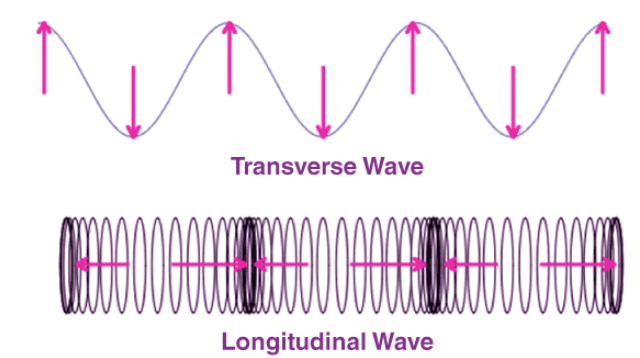
Mechanical waves can be categorised as longitudinal or transverse, depending on the orientation of their oscillations relative to the direction of energy transfer.
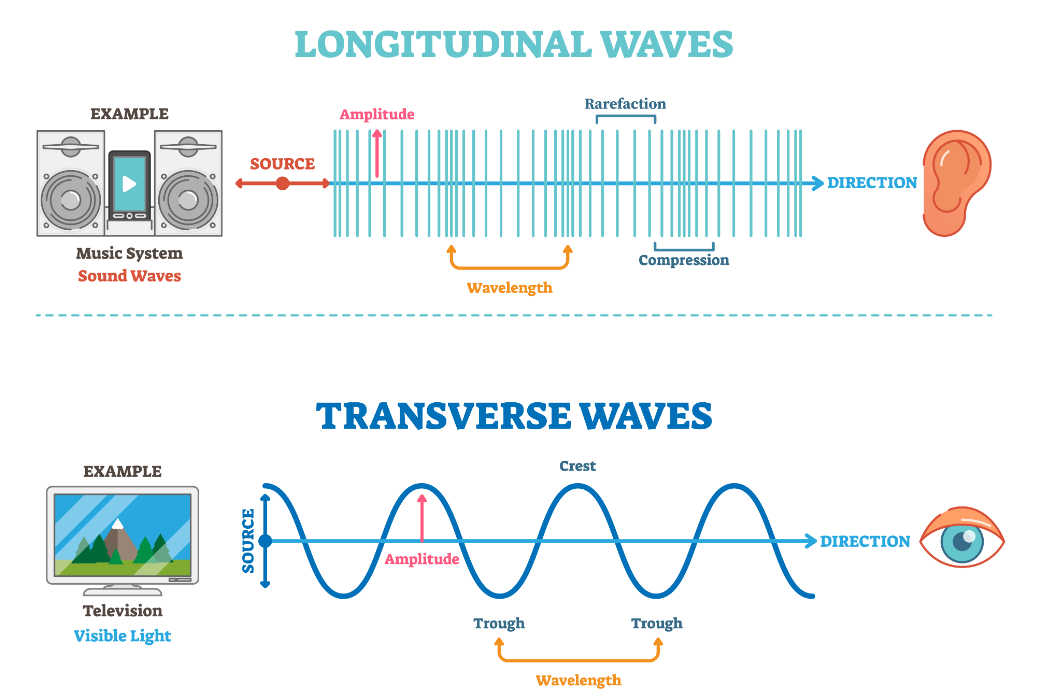
A longitudinal wave has oscillations that travel parallel to the direction of wave propagation and energy transfer. These waves consist of alternating compressions (regions where particles are close together) and rarefactions (regions where particles are spread apart). Sound waves in air are a common example.
A transverse wave has oscillations that travel perpendicular to the direction of wave propagation and energy transfer. Light is an example of a transverse wave, and this is the type that will be the focus of this section.
Transverse Waves
A simple wave consists of a periodic disturbance that propagates from one place to another. The wave in Figure 3 propagates in the horizontal direction while the surface is disturbed in the vertical direction. Such a wave is called a transverse wave or shear wave; in such a wave, the disturbance is perpendicular to the direction of propagation.

Examples are :
Waves on a String: When you pluck a guitar string or shake a jump rope, the pulse travels down the length of the string, but the string fibers themselves move up and down (or side to side).
Observation: If you tie a red ribbon to the middle of the jump rope, the ribbon stays in the middle-it just moves up and down as the wave passes through.
Surface Water Waves: While water waves are actually a complex mix of longitudinal and transverse motion (circular), the most visible part is the transverse component where the water surface rises and falls as the “swell” moves toward the shore.
Longitudinal Waves
In a longitudinal wave or compressional wave, the disturbance is parallel to the direction of propagation. Figure 4 shows an example of a longitudinal wave. The size of the disturbance is its amplitude \(X\) and is completely independent of the speed of propagation \(v_{\mathrm{w}}\).

The most common example is Sound Waves (in Air, Water, or Solids):
When a speaker cone moves forward, it pushes air molecules together (compression); when it moves back, it creates a space for them to spread out (rarefaction).
Mechanism: The “pulse” of high and low pressure moves through the air to your ear.
Classification Based on Motion of Wave in Space
The waves are classified into three types based on the motion of wave in a space. They are as follows:
- One-Dimensional waves
- Two-Dimensional waves
- Three-Dimensional waves
\begin{array}{|c|c|c|}
\hline \text { Wave Type } & \text { Definition } & \text { Example } \\
\hline \begin{array}{c}
\text { One- } \\
\text { Dimensional } \\
\text { waves }
\end{array} & \begin{array}{c}
\text { The wave that moves } \\
\text { along one dimension only } \\
\text { is called a one- } \\
\text { dimensional wave. }
\end{array} & \begin{array}{c}
\text { Waves produced } \\
\text { in a string. }
\end{array} \\
\hline \begin{array}{c}
\text { Two- } \\
\text { Dimensional } \\
\text { waves }
\end{array} & \begin{array}{c}
\text { The wave that moves in a } \\
\text { plane is called a two- } \\
\text { dimensional wave. }
\end{array} & \text { Ripple in water. } \\
\hline \begin{array}{c}
\text { Three- } \\
\text { Dimensional } \\
\text { waves }
\end{array} & \begin{array}{c}
\text { The wave that moves in a } \\
\text { three-dimensional space } \\
\text { is called a three- } \\
\text { dimensional wave. }
\end{array} & \begin{array}{c}
\text { Propagation of } \\
\text { light and sound } \\
\text { waves. }
\end{array} \\
\hline
\end{array}
\)
Types of waves
There are mainly three types of waves
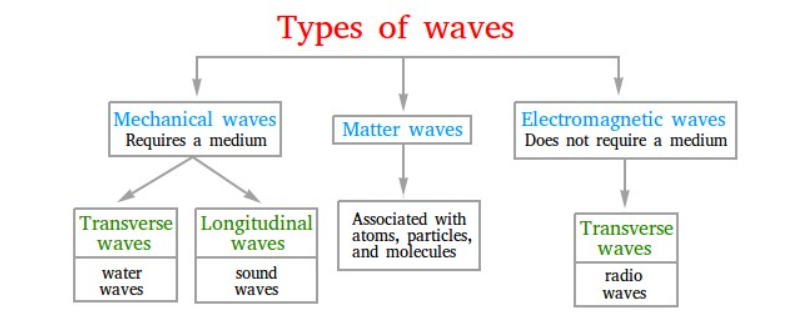
- Mechanical waves: Mechanical waves are those waves that require a medium for their propagation. They cannot travel through vacuum. e.g. Sound waves, water waves, etc. They are governed by Newton’s laws, and they can exist only within a material medium.
- Electromagnetic waves: Electromagnetic waves are those waves that do not require a medium for their propagation. These waves travel in the form of oscillating electric and magnetic fields. e.g. X-rays, radio waves, etc. Light waves from stars, for example, travel through the vacuum of space to reach us. All electromagnetic waves travel through a vacuum at the same speed \(c=299792458 \mathrm{~m} / \mathrm{s}\).
- Matter waves: Moving microscopic particles such as electrons, protons, neutrons, atoms, molecules, etc., sometimes behave like waves. These are called matter waves. molecules. We commonly think of these particles as constituting matter, such waves are called matter waves.
Definitions related to the wave motion
A wave travels in the form of a sine wave as shown below. Amplitude, crest, trough, and wavelength are a part of the wave.

Amplitude: The maximum displacement suffered by the particles of the medium from their mean position is called amplitude. It is denoted by \(A\).
Time period: The time taken for one complete cycle of a wave to pass a given point is called the period. It is the reciprocal of frequency. It is denoted by \(T\). It is the reciprocal of frequency.
Frequency: The number of waves produced per unit time in the given medium is known as frequency of a wave. It is denoted by \(f=1/T\). It is measured in Hertz (Hz).
Wavelength: The distance covered by a wave during the time in which a particle of medium completes one vibration about its mean position is known as the wavelength of a wave. It is denoted by \(\lambda\).
Wave Number: The number of waves present in a unit distance along the direction of propagation is known as wave number. It is equal to the reciprocal of wavelength \((\lambda)\). It is denoted by \(\bar{\nu}\).
\(
\therefore \quad \bar{\nu}=\frac{1}{\lambda}
\)
The SI unit of wave number is \(\mathrm{m}^{-1}\).
Phase: The position of a point in time on a waveform is known as the phase of a wave. Phase can also be expressed as relative displacement between two corresponding peaks of a waveform.
The two waves shown above (A versus B) are of the same amplitude and frequency, but they are out of step with each other. In technical terms, this is called a phase shift.

A sampling of different phase shifts is given in the following graphs to better illustrate this concept: Figure below

Path Difference: The difference in the path traversed by the two waves measured in terms of the wavelength of the associated waves is called path difference.
In Figures 6 and 7 you can see that at the different points on the screen the waves from \(\mathrm{S}_1\) have travelled a different distance from those from \(S_2\). In Figure 6 the path difference is zero, in Figure 7 it is half a wavelength.

Speed of a Wave: The speed of a wave is the measure of how fast the wave travels. It is calculated as the ratio of how far a wave travels to the time taken by the wave to travel that distance.
\(
\text { speed }=\frac{\text { distance }}{\text { time }}
\)
Wave Pulse: It is a short wave produced in a medium when the disturbance is created for a short time. If we give an upward jerk to one end of a long rope whose opposite end is fixed, a single wave pulse is formed as shown in the figure and it travels along the rope with a fixed speed.

Relation between frequency, speed and wavelength
When a particle of the medium completes one oscillation about its mean position in periodic time \((T)\), then the wave travels a distance equal to the wavelength ( \(\lambda\) ). So,
\(
\begin{array}{ll}
& \text { Wave speed }=\frac{\text { Distance }}{\text { Time }} \\
\Rightarrow & v=\frac{\lambda}{T} \Rightarrow v=f \times \lambda \left(\because f=\frac{1}{T}\right) \\
\text { i.e. } & \text { Wave speed }=\text { Frequency } \times \text { Wavelength }
\end{array}
\)
Example 1: The speed of a wave in a medium is \(960 \mathrm{~ms}^{-1}\). If 3600 waves pass through a point in the medium in 1 minute, then determine its wavelength.
Solution: Given, the speed of the wave, \(v=960 \mathrm{~ms}^{-1}\)
Frequency of the wave, \(f=3600 \mathrm{~min}^{-1}\)
\(
=\frac{3600}{60}=60 \mathrm{~s}^{-1}
\)
\(\therefore\) Wavelength, \(\lambda=\frac{v}{f}=\frac{960}{60}=16 \mathrm{~m} \Rightarrow \lambda=16 \mathrm{~m}\)