1.8 Entrance Corner
Q1. The distance covered by a particle in time \(t\) is given by \(x=a+b t+c t^2+d t^3\); find the dimensions of \(a, b, c\) and \(d\).
Solution: The equation contains five terms. All of them should have the same dimensions. Since \([x]=\) length, each of the remaining four must have the dimension of length.
Thus, \([a]=\) length \(=\mathrm{L}\)
\(
\begin{aligned}
{[b t] } & =\mathrm{L}, & \text { or, }[b] & =\mathrm{LT}^{-1} \\
{\left[c t^2\right] } & =\mathrm{L}, & \text { or, }[c] & =\mathrm{LT}^{-2} \\
\text { and }\left[d t^3\right] & =\mathrm{L}, & \text { or, }[d]=\mathrm{LT}^{-3}
\end{aligned}
\)
Q2. If the centripetal force is of the form \(m^a v^b r^c\), find the values of \(a, b\) and \(c\).
Solution: Dimensionally,
\(
\text { Force }=(\text { Mass })^a \times(\text { velocity })^b \times(\text { length })^c
\)
or, \(\quad \mathrm{MLT}^{-2}=\mathrm{M}^a\left(\mathrm{~L}^b \mathrm{~T}^{-b}\right) \mathrm{L}^c=\mathrm{M}^a \mathrm{~L}^{b+c} \mathrm{~T}^{-b}\)
Equating the exponents of similar quantities,
\(
a=1, b+c=1,-b=-2
\)
or, \(\quad a=1, b=2, c=-1 \quad\) or, \(F=\frac{m v^2}{r}\).
Q3. When a solid sphere moves through a liquid, the liquid opposes the motion with a force \(F\). The magnitude of \(F\) depends on the coefficient of viscosity \(\eta\) of the liquid, the radius \(r\) of the sphere and the speed \(v\) of the sphere. Assuming that \(F\) is proportional to different powers of these quantities, guess a formula for \(F\) using the method of dimensions.
Solution: Suppose the formula is \(F=k \eta^a r^b v^c\).
Then,
\(
\begin{aligned}
\mathrm{MLT}^{-2} & =\left[\mathrm{ML}^{-1} \mathrm{~T}^{-1}\right]^a \mathrm{~L}^b\left(\frac{\mathrm{~L}}{\mathrm{~T}}\right)^c \\
& =\mathrm{M}^a \mathrm{~L}^{-a+b+c} \mathrm{~T}^{-a-c} .
\end{aligned}
\)
Equating the exponents of \(\mathrm{M}, \mathrm{L}\) and \(T\) from both sides,
\(
\begin{aligned}
a & =1 \\
-a+b+c & =1 \\
-a-c & =-2
\end{aligned}
\)
Solving these, \(a=1, b=1\), and \(c=1\).
Thus, the formula for \(F\) is \(F=k \eta r v\).
Q5. The heat produced in a wire carrying an electric current depends on the current, the resistance and the time. Assuming that the dependence is of the product of powers type, guess an equation between these quantities using dimensional analysis. The dimensional formula of resistance is \(\mathrm{ML}^2 \mathrm{I}^{-2} \mathrm{~T}^{-3}\) and heat is a form of energy.
Solution: Let the heat produced be \(H\), the current through the wire be \(I\), the resistance be \(R\) and the time be \(t\). Since heat is a form of energy, its dimensional formula is \(\mathrm{ML}^2 \mathrm{~T}^{-2}\).
Let us assume that the required equation is
\(
H=k I^a R^b t^c,
\)
where \(k\) is a dimensionless constant.
Writing dimensions of both sides,
\(
\begin{aligned}
\mathrm{ML}^2 \mathrm{~T}^{-2} & =\mathrm{I}^a\left(\mathrm{ML}^2 \mathrm{I}^{-2} \mathrm{~T}^{-3}\right)^b \mathrm{~T}^c \\
& =\mathrm{M}^b \mathrm{~L}^{2 b} \mathrm{~T}^{-3 b+c} \mathrm{I}^{a-2 b}
\end{aligned}
\)
Equating the exponents,
\(
\begin{aligned}
b & =1 \\
2 b & =2 \\
-3 b+c & =-2 \\
a-2 b & =0
\end{aligned}
\)
Solving these, we get, \(a=2, b=1\) and \(c=1\).
Thus, the required equation is \(H=k I^2 R t\).
Q6. Given below are two statements: One is labelled as Assertion (A) and other is labelled as Reason (R).
Assertion (A) : Time period of oscillation of a liquid drop depends on surface tension (S), if density of the liquid is \(\rho\) and radius of the drop is \(r\), then \(\mathrm{T}=\mathrm{K} \sqrt{\rho \mathrm{r}^3 / \mathrm{S}^{3 / 2}}\) is dimensionally correct, where K is dimensionless.
Reason (R) : Using dimensional analysis we get R.H.S. having different dimension than that of time period.
In the light of above statements, choose the correct answer from the options given below. [JEE 2022]
(a) Both (A) and (R) are true and (R) is the correct explanation of (A)
(b) Both (A) and (R) are true but (R) is not the correct explanation of (A)
(c) (A) is true but (R) is false
(d) (A) is false but (R) is true
Solution: (d) We know,
\(
\begin{aligned}
& {[S]=\left[\mathrm{MT}^{-2}\right]} \\
& {[\rho]=\left[\mathrm{ML}^{-3}\right]} \\
& {[r]=[\mathrm{L}]} \\
& \begin{aligned}
\therefore \text { Dimension of RHS } & =\frac{\left[\mathrm{M}^{\frac{1}{2}} \mathrm{~L}^{-\frac{3}{2}}\right]\left[\mathrm{L}^{\frac{3}{2}}\right]}{\left[\mathrm{MT}^{-2}\right]^{\frac{3}{4}}} \\
& =\left[\mathrm{M}^{\left(\frac{1}{2}-\frac{3}{4}\right)} \mathrm{L}^{\left(-\frac{3}{2}+\frac{3}{2}\right)} \mathrm{T}^{\frac{6}{4}}\right]=\mathrm{M}^{-\frac{1}{4}} \mathrm{~L}^0 \mathrm{~T}^{\frac{3}{2}}
\end{aligned} \\
& \text { dimension of L.H.S. }=[\mathrm{T}] \\
& \therefore \text { Dimension of LHS } \neq \text { Dimension of RHS. }
\end{aligned}
\)
Q7. A travelling microscope has 20 divisions per cm on the main scale while its vernier scale has total 50 divisions and 25 vernier scale divisions are equal to 24 main scale divisions, what is the least count of the travelling microscope? [JEE 2022]
(a) 0.001 cm
(b) 0.002 mm
(c) 0.002 cm
(d) 0.005 cm
Solution: (c)
\(
\begin{aligned}
& 1 \mathrm{MSD}=\frac{1}{20} \mathrm{~cm} \\
& 1 \mathrm{VSD}=\frac{24}{25} \times \frac{1}{20} \mathrm{~cm} \\
& \therefore \text { Least count }=1 \mathrm{MSD}-1 \mathrm{VSD} \\
& =\frac{1}{20}\left(1-\frac{24}{25}\right) \mathrm{cm} \\
& =\frac{1}{20} \times \frac{1}{25} \mathrm{~cm} \\
& =0.002 \mathrm{~cm}
\end{aligned}
\)
Q8. In an experiment to find out the diameter of wire using screw gauge, the following observations were noted: [JEE 2022]
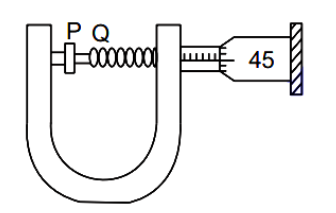
(A) Screw moves 0.5 mm on main scale in one complete rotation
(B) Total divisions on circular scale \(=50\)
(C) Main scale reading is 2.5 mm
(D) \(45^{\text {th }}\) division of circular scale is in the pitch line
(E) Instrument has 0.03 mm negative error
Then the diameter of wire is :
(a) 2.92 mm
(b) 2.54 mm
(c) 2.98 mm
(d) 3.45 mm
Solution: (c) The least count of the screw gauge is calculated using the formula:
\(
\mathrm{LC}=\frac{\text { Pitch }}{\text { Total divisions on circular scale }}
\)
\(
\mathrm{LC}=\frac{0.5 \mathrm{~mm}}{50}=0.01 \mathrm{~mm}
\)
The observed diameter is the sum of the main scale reading and the product of the circular scale reading and the least count:
\(
\text { Observed Reading }=\mathbf{M S R}+(\mathbf{C S R} \times \mathbf{L C})
\)
Observed Reading \(=2.5 \mathrm{~mm}+(45 \times 0.01 \mathrm{~mm})=2.5 \mathrm{~mm}+0.45 \mathrm{~mm}=2.95 \mathrm{~mm}\)
The true diameter is obtained by subtracting the zero error from the observed reading. A negative zero error means a positive correction is applied (subtracting a negative value):
True Diameter = Observed Reading – Zero Error
True Diameter \(=2.95 \mathrm{~mm}-(-0.03 \mathrm{~mm})=2.95 \mathrm{~mm}+0.03 \mathrm{~mm}=2.98 \mathrm{~mm}\)
Q9. Consider the efficiency of carnot’s engine is given by \(\eta=\frac{\alpha \beta}{\sin \theta} \log _e \frac{\beta x}{k T}\), where \(\alpha\) and \(\beta\) are constants. If T is temperature, k is Boltzmann constant, \(\theta\) is angular displacement and \(x\) has the dimensions of length. Then, choose the incorrect option : [JEE 2022]
(a) Dimensions of \(\beta\) is same as that of force.
(b) Dimensions of \(\alpha^{-1} x\) is same as that of energy.
(c) Dimensions of \(\eta^{-1} \sin \theta\) is same as that of \(\alpha \beta\).
(d) Dimensions of \(\alpha\) is same as that of \(\beta\).
Solution: (d) Since, dimensions trigonometric function and logarithmic function are dimensionless quantities.
\(
\therefore[\eta]=\left[\mathrm{M}^0 \mathrm{~L}^0 \mathrm{~T}^0\right]
\)
Also, dimensions of temperature, \([T]=\left[\mathrm{M}^0 \mathrm{~L}^0 \mathrm{~T}^0 \mathrm{~K}\right]\)
Dimensions of Boltzmann constant, \([k]=\left[\mathrm{ML}^2 \mathrm{~T}^{-2} \mathrm{~K}^{-1}\right]\)
Dimension of \(x=\left[\mathrm{M}^0 \mathrm{LT}^0\right]\)
(a) \([\beta]=\left[\frac{k T}{x}\right]=\left[\frac{E}{x}\right]=\left[M L T^{-2}\right]=[F]\)
(b) \([\alpha \beta]=\left[M^0 L^0 T^0\right]\)
\([\alpha]^{-1}=[\beta]=\left[\frac{k T}{x}\right]\)
So \([\alpha]^{-1}[x]=[k T]=\left[M L^2 T^{-2}\right]\)
(c) \(\eta \sin \theta=\alpha \beta\)
So \([\eta \sin \theta]=[\alpha \beta]\)
\([\eta]=\left[M^0 L^0 T^0\right]\) it is dimensionless quantity
(d) \([\alpha] \neq[\beta]\)
Q10. The dimensions of \(\left(\frac{\mathrm{B}^2}{\mu_0}\right)\) will be : [JEE 2022]
(if \(\mu_0:\) permeability of free space and \(B:\) magnetic field)
(a) \(\left[\mathrm{ML}^2 \mathrm{~T}^{-2}\right]\)
(b) \(\left[\mathrm{ML} \mathrm{T}^{-2}\right]\)
(c) \(\left[\mathrm{ML}^{-1} \mathrm{~T}^{-2}\right]\)
(d) \(\left[\mathrm{ML}^2 \mathrm{~T}^{-2} \mathrm{~A}^{-1}\right]\)
Solution: (c)
\(
\begin{aligned}
& {\left[\frac{B^2}{\mu_0}\right]=\text { [Energy density] }} \\
& =\frac{M L^2 T^{-2}}{L^3}=M L^{-1} T^{-2}
\end{aligned}
\)
Q11. An expression of energy density is given by \(u=\frac{\alpha}{\beta} \sin \left(\frac{\alpha x}{k t}\right)\), where \(\alpha, \beta\) are constants, \(x\) is displacement, \(k\) is Boltzmann constant and \(t\) is the temperature. The dimensions of \(\beta\) will be : [JEE 2022]
(A) \(\left[\mathrm{ML}^2 \mathrm{~T}^{-2} \theta^{-1}\right]\)
(B) \(\left[\mathrm{M}^0 \mathrm{~L}^2 \mathrm{~T}^{-2}\right]\)
(c) \(\left[\mathrm{M}^0 \mathrm{~L}^0 \mathrm{~T}^0\right]\)
(D) \(\left[\mathrm{M}^0 \mathrm{~L}^2 \mathrm{~T}^0\right]\)
Solution: (d)
\(
\begin{aligned}
& u=\frac{\alpha}{\beta} \sin \left(\frac{\alpha x}{k t}\right) \\
& {[\alpha]=\left[\frac{k t}{x}\right]=\frac{[\text { Energy }]}{[\text { Distance }]}} \\
& {[\beta]=\frac{[\alpha]}{[u]}} \\
& =\frac{[\text { Energy }] /[\text { Dis } \tan c e]}{[\text { Energy }] /[\text { Volume }]} \\
& =\left[L^2\right]
\end{aligned}
\)
Q12. A torque meter is calibrated to reference standards of mass, length and time each with \(5 \%\) accuracy. After calibration, the measured torque with this torque meter will have net accuracy of : [JEE 2022]
(a) \(15 \%\)
(b) \(25 \%\)
(c) \(75 \%\)
(d) \(5 \%\)
Solution: (b) We know that, torque applied on a rotating body,
\(
\begin{aligned}
& \tau=\text { Force × Perpendicular distance } \\
\Rightarrow \quad & {[\tau]=\left[\mathrm{MLT}^{-2}\right][\mathrm{L}] \Rightarrow[\tau]=\left[\mathrm{ML}^2 \mathrm{~T}^{-2}\right] } \\
\Rightarrow & \frac{\Delta \tau}{\tau}=\frac{\Delta M}{M}+2 \frac{\Delta L}{L}+2 \frac{\Delta T}{T} \\
= & 5 \times 5 \%=25 \%
\end{aligned}
\)
Q13. In a Vernier Calipers, 10 divisions of Vernier scale is equal to the 9 divisions of main scale. When both jaws of Vernier calipers touch each other, the zero of the Vernier scale is shifted to the left of zero of the main scale and \(4^{\text {th }}\) Vernier scale division exactly coincides with the main scale reading. One main scale division is equal to 1 mm. While measuring diameter of a spherical body, the body is held between two jaws. It is now observed that zero of the Vernier scale lies between 30 and 31 divisions of main scale reading and \(6^{\text {th }}\) Vernier scale division exactly coincides with the main scale reading. The diameter of the spherical body will be : [JEE 2022]
(a) 3.02 cm
(b) 3.06 cm
(c) 3.10 cm
(d) 3.20 cm
Solution: (c) Given, In Vernier calipers, \(10 \mathrm{VSD}=9 \mathrm{MSD}\)
\(
\Rightarrow \quad 1 \mathrm{VSD}=\frac{9}{10} \mathrm{MSD}
\)
∴ Least count of vernier scale,
\(
\begin{aligned}
\mathrm{LC} & =1 \mathrm{MSD}-1 \mathrm{VSD} \\
& =1 \mathrm{MSD}-\frac{9}{10} \mathrm{MSD}=\mathrm{MSD}\left(1-\frac{9}{10}\right) \\
& =\frac{\mathrm{MSD}}{10}=\frac{1 \mathrm{~mm}}{10} \quad[\because 1 \mathrm{MSD}=1 \mathrm{~mm}] \\
& =0.1 \mathrm{~mm}=0.01 \mathrm{~cm}
\end{aligned}
\)
According to given situation,
Negative error \(=\) Main scale reading – Least count × Number of coinciding main scale division
\(
=0.1-0.01 \times 4=0.1-0.04=0.06 \mathrm{~cm}
\)
∴ Diameter of spherical body
\(
\begin{aligned}
& =30 \times 0.1+6 \times 0.01+0.06 \\
& =3.0+0.06+0.06=3.12 \mathrm{~cm}
\end{aligned}
\)
Which is closest to 3.10 cm.
Q14. A screw gauge of pitch 0.5 mm is used to measure the diameter of uniform wire of length 6.8 cm, the main scale reading is 1.5 mm and circular scale reading is 7. The calculated curved surface area of wire to appropriate significant figures is : [JEE 2022]
[Screw gauge has 50 divisions on its circular scale]
(a) \(6.8 \mathrm{~cm}^2\)
(b) \(3.4 \mathrm{~cm}^2\)
(c) \(3.9 \mathrm{~cm}^2\)
(d) \(2.4 \mathrm{~cm}^2\)
Solution: (b) Step 1: Calculate the Least Count and Diameter
The least count (LC) is calculated using the formula LC \(=\frac{\text { Pitch }}{\text { Number of divisions }}\). The diameter (D) is calculated using the formula \(\mathbf{D = M S R + ~} \boldsymbol{( C S R \times L C )}\).
\(
\mathrm{LC}=\frac{0.5 \mathrm{~mm}}{50}=0.01 \mathrm{~mm}
\)
The diameter of the wire is:
\(
\mathrm{D}=1.5 \mathrm{~mm}+(7 \times 0.01 \mathrm{~mm})=1.5 \mathrm{~mm}+0.07 \mathrm{~mm}=1.57 \mathrm{~mm}=0.157 \mathrm{~cm}
\)
Step 2: Calculate the Curved Surface Area
The curved surface area (CSA) of a wire (cylinder) is calculated using the formula CSA \(=\pi \times \mathrm{D} \times \mathrm{L}\), where L is the length of the wire.
\(
\mathrm{CSA}=\pi \times 0.157 \mathrm{~cm} \times 6.8 \mathrm{~cm} \approx 3.354 \mathrm{~cm}^2
\)
Step 3: Apply Significant Figure Rules
The length \(\boldsymbol{L} \boldsymbol{=} \mathbf{6 . 8 ~ c m}\) has two significant figures, and the diameter \(\boldsymbol{D} \boldsymbol{=} \mathbf{0 . 1 5 7 ~ c m}\) has three significant figures. The result of the multiplication must be limited to the least number of significant figures, which is two.
Rounding \(3.354 \mathrm{~cm}^2\) to two significant figures gives \(3.4 \mathrm{~cm}^2\).
Q15. The maximum error in the measurement of resistance, current and time for which current flows in an electrical circuit are \(1 \%, 2 \%\) and \(3 \%\) respectively. The maximum percentage error in the detection of the dissipated heat will be : [JEE 2022]
Solution: Given, \(\frac{\Delta R}{R} \times 100=1 \%\)
\(
\frac{\Delta F}{F} \times 100=2 \% \text { and } \frac{\Delta t}{t} \times 100=3 \%
\)
We know that, heat produced due to current flowing through a resistor \(R\).
\(
\begin{aligned}
& H=I^2 R t \\
& \Rightarrow \frac{\Delta H}{H}=\frac{2 \Delta I}{I}+\frac{\Delta R}{R}+\frac{\Delta t}{t} \\
& \Rightarrow \frac{\Delta H}{H} \times 100=2\left(\frac{\Delta I}{I} \times 100\right)+\frac{\Delta R}{R} \times 100+\frac{\Delta t}{t} \times 100 \\
& =2 \times 2 \%+1 \%+3 \%=8 \%
\end{aligned}
\)
Q16. If momentum \([P]\), area \([A]\) and time \([T]\) are taken as fundamental quantities, then the dimensional formula for coefficient of viscosity is :
(a) \(\left[\mathrm{P} \mathrm{A}^{-1} \mathrm{~T}^0\right]\)
(b) \(\left[\mathrm{P} \mathrm{A} \mathrm{T}^{-1}\right]\)
(c) \(\left[\mathrm{P} \mathrm{A}^{-1} \mathrm{~T}\right]\)
(d) \(\left[\mathrm{P} \mathrm{A}^{-1} \mathrm{~T}^{-1}\right]\)
Solution: (a)
\(
\begin{aligned}
& {[\eta]=\left[M L^{-1} T^{-1}\right]} \\
& \text { Now if }[\eta]=[P]^a[A]^b[T]^c \\
& \Rightarrow\left[M L^{-1} T^{-1}\right]=\left[M L^1 T^{-1}\right]^a\left[L^2\right]^b[T]^c \\
& \Rightarrow a=1, a+2 b=-1,-a+c=-1 \\
& \Rightarrow a=1, b=-1, c=0 \\
& \Rightarrow[\eta]=[P][A]^{-1}[T]^0 \\
& =\left[P A^{-1} T^0\right]
\end{aligned}
\)
Q17. If \(n\) main scale divisions coincide with \((n+1)\) vernier scale divisions. The least count of vernier callipers, when each centimetre on the main scale is divided into five equal parts, will be : [JEE 2022]
(a) \(\frac{2}{n+1} \mathrm{~mm}\)
(b) \(\frac{5}{n+1} \mathrm{~mm}\)
(c) \(\frac{1}{2 n} \mathrm{~mm}\)
(d) \(\frac{1}{5 n} \mathrm{~mm}\)
Solution: (a) Step 1: Determine the value of one Main Scale Division (MSD)
The main scale has 1 centimeter divided into five equal parts. Since \(1 \mathrm{~cm}=10 \mathrm{~mm}\), the value of one main scale division is calculated as:
\(
\mathrm{MSD}=\frac{10 \mathrm{~mm}}{5}=2 \mathrm{~mm}
\)
Step 2: Relate Main Scale Divisions (MSD) to Vernier Scale Divisions (VSD)
The problem states that \(n\) main scale divisions coincide with ( \(n+1\) ) vernier scale divisions. This relationship can be expressed as:
\(
n \times \mathrm{MSD}=(n+1) \times \mathrm{VSD}
\)
We can express the value of one VSD in terms of MSD:
\(
\mathrm{VSD}=\frac{n}{n+1} \times \mathrm{MSD}
\)
Step 3: Calculate the Least Count (LC)
The least count of a vernier caliper is the difference between one main scale division and one vernier scale division:
\(
\mathrm{LC}=\mathrm{MSD}-\mathrm{VSD}
\)
Substitute the expression for VSD from Step 2:
\(
\mathrm{LC}=\mathrm{MSD}-\frac{n}{n+1} \times \mathrm{MSD}
\)
Factor out the MSD value and simplify the expression:
\(
\begin{aligned}
\mathrm{LC} & =\mathrm{MSD} \times\left(1-\frac{n}{n+1}\right) \\
\mathrm{LC} & =\mathrm{MSD} \times\left(\frac{n+1-n}{n+1}\right) \\
\mathrm{LC} & =\mathrm{MSD} \times\left(\frac{1}{n+1}\right)
\end{aligned}
\)
Substitute the value of \(\mathrm{MSD}=2 \mathrm{~mm}\) from Step 1:
\(
\begin{gathered}
\mathrm{LC}=2 \mathrm{~mm} \times\left(\frac{1}{n+1}\right) \\
\mathrm{LC}=\frac{2}{n+1} \mathrm{~mm}
\end{gathered}
\)
Q18. Velocity (v) and acceleration (a) in two systems of units 1 and 2 are related as \(v_2=\frac{n}{m^2} v_1\) and \(a_2=\frac{a_1}{m n}\) respectively. Here m and n are constants. The relations for distance and time in two systems respectively are : [JEE 2022]
(a) \(\frac{n^3}{m^3} L_1=L_2\) and \(\frac{n^2}{m} T_1=T_2\)
(b) \(L_1=\frac{n^4}{m^2} L_2\) and \(T_1=\frac{n^2}{m} T_2\)
(c) \(L_1=\frac{n^2}{m} L_2\) and \(T_1=\frac{n^4}{m^2} T_2\)
(d) \(\frac{n^2}{m} L_1=L_2\) and \(\frac{n^4}{m^2} T_1=T_2\)
Solution: (a)
\(v_2=\frac{n}{m^2} v_1 \Longrightarrow \frac{L_2}{T_2}=\frac{n}{m^2} \frac{L_1}{T_1}\).
\(a_2=\frac{a_1}{m n} \Longrightarrow \frac{L_2}{T_2^2}=\frac{1}{m n} \frac{L_1}{T_1^2}\).
Solving these simultaneous equations by dividing the velocity relation by the acceleration relation yields the time relation: \(T_2=\frac{n^2}{m} T_1\).
Substituting the time relation back into the velocity relation yields the distance relation: \(L_2=\frac{n^3}{m^3} L_1\).
This corresponds to option (a): \(\frac{n^3}{m^3} L_1=L_2\) and \(\frac{n^2}{m} T_1=T_2\).
Q19. The SI unit of a physical quantity is pascal-second. The dimensional formula of this quantity will be : [JEE 2012]
(a) \(\left[\mathrm{ML}^{-1} \mathrm{~T}^{-1}\right]\)
(b) \(\left[\mathrm{ML}^{-1} \mathrm{~T}^{-2}\right]\)
(c) \(\left[\mathrm{ML}^2 \mathrm{~T}^{-1}\right]\)
(d) \(\left[\mathrm{M}^{-1} \mathrm{~L}^3 \mathrm{~T}^0\right]\)
Solution: (a)
\(
\begin{aligned}
& \text { [pascal-second] }=\frac{M L T^{-2}}{L^2} \times T \\
& =M L^{-1} T^{-1}
\end{aligned}
\)
Q20. A silver wire has a mass \((0.6 \pm 0.006) \mathrm{g}\), radius \((0.5 \pm 0.005) \mathrm{mm}\) and length \((4 \pm 0.04) \mathrm{cm}\). The maximum percentage error in the measurement of its density will be : [JEE 2022]
(a) \(4 \%\)
(b) \(3 \%\)
(c) \(6 \%\)
(d) \(7 \%\)
Solution: (a)
\(
\begin{aligned}
& \rho=\frac{m}{V}=\frac{m}{\pi r^2 \times l} \\
& \therefore \% \text { error in } \rho=\left(\frac{0.006}{0.6}+2 \times \frac{0.005}{0.5}+\frac{0.04}{4}\right) \times 100 \\
& =4 \%
\end{aligned}
\)
Q21. The dimension of mutual inductance is : [JEE 2022]
(a) \(\left[M L^2 T^{-2} A^{-1}\right]\)
(b) \(\left[M L^2 T^{-3} A^{-1}\right]\)
(c) \(\left[M L^2 T^{-2} A^{-2}\right]\)
(d) \(\left[M L^2 T^{-3} A^{-2}\right]\)
Solution: (c) Formula: \(E=-M \frac{d I}{d t}\), where \(E\) is induced emf (voltage), \(M\) is mutual inductance, \(I\) is current, and \(t\) is time.
Rearranging for \(\mathrm{M}: ~ M=\frac{E}{d I / d t}\).
Emf (Voltage) \([\mathrm{V}]\) : \(\left[\mathrm{M} \mathrm{L}^2 \mathrm{~T}^{-3} \mathrm{~A}^{-1}\right]\) (derived from energy per unit charge, \(\left[\mathrm{M} \mathrm{L}^2 \mathrm{~T}^{-2}\right] /[\mathrm{A\text { T]) }}\)
Rate of change of current [dl/dt]: [ \(\mathrm{A} \mathrm{T}^{-1}\) ].
Dimension of \(\mathrm{M}: \frac{\left[M L^2 T^{-3} A^{-1}\right]}{\left[A T^{-1}\right]}=\left[M L^2 T^{-2} A^{-2}\right]\).
Q22. An expression for a dimensionless quantity P is given by \(P=\frac{\alpha}{\beta} \log _e\left(\frac{k t}{\beta x}\right)\); where \(\alpha\) and \(\beta\) are constants, \(x\) is distance; k is Boltzmann constant and t is the temperature. Then the dimensions of \(\alpha\) will be : [JEE 2022]
(a) \(\left[\mathrm{M}^0 \mathrm{~L}^{-1} \mathrm{~T}^0\right]\)
(b) \(\left[\mathrm{M} \mathrm{L}^0 \mathrm{~T}^{-2}\right]\)
(c) \(\left[\mathrm{ML} \mathrm{T}^{-2}\right]\)
(d) \(\left[\mathrm{M} \mathrm{L}^2 \mathrm{~T}^{-2}\right]\)
Solution: (c) The quantity inside a logarithm must be dimensionless. Therefore, the dimensions of \(\frac{k t}{\beta x}\) must be \(\left[\mathrm{M}^0 \mathrm{~L}^0 \mathrm{~T}^0\right]\). We know the dimensions of \(x\) (distance) are \([\mathrm{L}]\), and the product \(k t\) (Boltzmann constant × temperature) has dimensions of energy, which are \(\left[\mathrm{ML}^2 \mathrm{~T}^{-2}\right]\).
\(
\left[\frac{k t}{\beta x}\right]=\frac{\left[\mathrm{ML}^2 \mathrm{~T}^{-2}\right]}{[\beta][\mathrm{L}]}=\left[\mathrm{M}^0 \mathrm{~L}^0 \mathrm{~T}^0\right]
\)
From the dimensionless requirement in Step 1, we can solve for the dimensions of \(\boldsymbol{\beta}\)
\(
[\beta]=\frac{\left[\mathrm{ML}^2 \mathrm{~T}^{-2}\right]}{[\mathrm{L}]}=\left[\mathrm{MLT}^{-2}\right]
\)
The quantity \(\boldsymbol{P}\) is given as dimensionless. The logarithm term is also dimensionless. Therefore, the ratio \(\frac{\alpha}{\beta}\) must be dimensionless.
\(
\begin{gathered}
{[P]=\left[\frac{\alpha}{\beta}\right] \times\left[\log _e(\ldots)\right]} \\
{\left[\mathrm{M}^0 \mathrm{~L}^0 \mathrm{~T}^0\right]=\frac{[\alpha]}{[\beta]} \times\left[\mathrm{M}^0 \mathrm{~L}^0 \mathrm{~T}^0\right]}
\end{gathered}
\)
From the requirement in Step 3, the dimensions of \(\alpha\) must be equal to the dimensions of \(\boldsymbol{\beta}\).
\(
\begin{gathered}
{[\alpha]=[\beta]} \\
{[\alpha]=\left[\mathrm{MLT}^{-2}\right]}
\end{gathered}
\)
Q23. If \(Z=\frac{A^2 B^3}{C^4}\), then the relative error in \(Z\) will be : [JEE 2022]
(a) \(\frac{\Delta A}{A}+\frac{\Delta B}{B}+\frac{\Delta C}{C}\)
(b) \(\frac{2 \Delta A}{A}+\frac{3 \Delta B}{B}-\frac{4 \Delta C}{C}\)
(c) \(\frac{2 \Delta A}{A}+\frac{3 \Delta B}{B}+\frac{4 \Delta C}{C}\)
(d) \(\frac{\Delta A}{A}+\frac{\Delta B}{B}-\frac{\Delta C}{C}\)
Solution: (c)
\(
\begin{aligned}
& Z=\frac{A^2 B^3}{C^4} \\
& \therefore \frac{\Delta Z}{Z}=\frac{2 \Delta A}{A}+3 \times \frac{\Delta B}{B}+\frac{4 \Delta C}{C}
\end{aligned}
\)
Q24. Identify the pair of physical quantities that have same dimensions: [JEE 2022]
(a) velocity gradient and decay constant
(b) Wien’s constant and Stefan constant
(c) angular frequency and angular momentum
(d) wave number and Avogadro number
Solution: (a) Velocity gradient: Defined as the change in velocity per unit distance, its dimensions are \(\frac{\text { velocity }}{\text { distance }}=\frac{\mathrm{LT}^{-1}}{\mathrm{~L}}=\mathrm{T}^{-1}\).
Decay constant ( \(\lambda\) ): Defined as the probability of decay per unit time, its dimensions are \(\frac{1}{\text { time }}=\mathrm{T}^{-1}\).
(a) Velocity gradient and decay constant: Both have the dimension of \(\mathrm{T}^{-1}\).
(b) Wien’s constant and Stefan constant: Wien’s constant has dimensions of \(L \Theta\) (length × temperature), while the Stefan constant has dimensions of \(\mathbf{M T}^{-3} \Theta^{-4}\).
(c) Angular frequency and angular momentum: Angular frequency has dimensions of \(\mathrm{T}^{-1}\), while angular momentum has dimensions of \(\mathrm{ML}^2 \mathrm{~T}^{-1}\).
(d) Wave number and Avogadro number: Wave number has dimensions of \(\mathrm{L}^{-1}\), while the Avogadro number is a dimensionless quantity (a count).
Q25. Identify the pair of physical quantities which have different dimensions: [JEE 2022]
(a) Wave number and Rydberg’s constant
(b) Stress and Coefficient of elasticity
(c) Coercivity and Magnetisation
(d) Specific heat capacity and Latent heat
Solution: (d) Specific heat capacity ( \(c\) ) is the amount of heat ( \(Q\) ) required to raise the temperature of a unit mass \((m)\) by one degree \((\Delta T)\). Its dimensional formula is:
\(
[c]=\frac{[Q]}{[m][\Delta T]}=\frac{\left[M L^2 T^{-2}\right]}{[M][K]}=\left[L^2 T^{-2} K^{-1}\right]
\)
Latent heat ( \(L\) ) is the amount of heat ( \(Q\) ) required to change the state of a unit mass ( \(m\) ) without changing its temperature. Its dimensional formula is:
\(
[L]=\frac{[Q]}{[m]}=\frac{\left[M L^2 T^{-2}\right]}{[M]}=\left[L^2 T^{-2}\right]
\)
Since the dimension of specific heat capacity includes a temperature unit (Kelvin) in the denominator, while latent heat does not, they have different dimensions.
Q26. A student determined Young’s Modulus of elasticity using the formula \(Y=\frac{M g L^3}{4 b d^3 \delta}\). The value of \(g\) is taken to be \(9.8 \mathrm{~m} / \mathrm{s}^2\), without any significant error, his observation are as following. [JEE 2021]
\(
\begin{array}{|l|l|l|}
\hline \text { Physical Quantity } & \text { Least count of the Equipment } & \text { Observed Value } \\
\hline \text { Mass }(\text { M }) & 1 \mathrm{~g} & 2 \mathrm{~kg} \\
\hline \text { Length of bar(L) } & 1 \mathrm{~mm} & 1 \mathrm{~m} \\
\hline \text { Breadth of bar(b) } & 0.1 \mathrm{~mm} & 4 \mathrm{~cm} \\
\hline \text { Thickness of bar(d) } & 0.01 \mathrm{~mm} & 0.4 \mathrm{~cm} \\
\hline \text { Depression }(\delta) & 0.01 \mathrm{~mm} & 5 \mathrm{~mm} \\
\hline
\end{array}
\)
Then the fractional error in the measurement of \(Y\) is:
(a) 0.0083
(b) 0.0155
(c) 0.155
(d) 0.083
Solution: (b)
\(
\begin{aligned}
& y=\frac{M g L^3}{4 b d^3 \delta} \\
& \frac{\Delta y}{y}=\frac{\Delta M}{M}+\frac{3 \Delta L}{L}+\frac{\Delta b}{b}+\frac{3 \Delta d}{d}+\frac{\Delta \delta}{\delta} \\
& \frac{\Delta y}{y}=\frac{10^{-3}}{2}+\frac{3 \times 10^{-3}}{1}+\frac{10^{-2}}{4}+\frac{3 \times 10^{-2}}{4}+\frac{10^{-2}}{5} \\
& =10^{-3}[0.5+3+2.5+7.5+2]=0.0155
\end{aligned}
\)
Q27. If velocity \([\mathrm{V}]\), time \([\mathrm{T}]\) and force \([\mathrm{F}]\) are chosen as the base quantities, the dimensions of the mass will be : [JEE 2021]
(a) \(\left[\mathrm{FT}^{-1} \mathrm{~V}^{-1}\right]\)
(b) \(\left[\mathrm{FTV}^{-1}\right]\)
(c) \(\left[\mathrm{FT}^2 \mathrm{~V}\right]\)
(d) \(\left[\mathrm{FVT}^{-1}\right]\)
Solution: (b) Force (F) is defined by Newton’s second law as mass (M) times acceleration (a).
\(
F=M \cdot a
\)
In terms of dimensions, this relationship is:
\(
[\mathrm{F}]=[\mathrm{M}] \cdot[\mathrm{a}]
\)
Acceleration (a) is the rate of change of velocity (V) with respect to time (T).
\(
a=\frac{V}{T}
\)
The dimensions are therefore:
\(
[\mathrm{a}]=[\mathrm{V}][\mathrm{T}]^{-1}
\)
Substitute the dimensions of acceleration into the force dimension equation, we get:
\(
[\mathrm{F}]=[\mathrm{M}] \cdot[\mathrm{V}][\mathrm{T}]^{-1}
\)
Rearrange the equation to solve for the dimensions of mass, [M]:
\(
\begin{gathered}
{[\mathrm{M}]=[\mathrm{F}] \cdot[\mathrm{V}]^{-1} \cdot[\mathrm{~T}]} \\
{[\mathrm{M}]=[\mathrm{F}][\mathrm{T}][\mathrm{V}]^{-1}}
\end{gathered}
\)
This expression can also be written as \(\left[\mathrm{FTV}^{-1}\right]\).
Q28. Match List – I with List – II.
\(
\begin{array}{ll}
\text { List-I } & \text { List-II } \\
\text { a) Torque } & \text { i) } M L T^{-1} \\
\text { b) Impulse } & \text { ii) } M T^{-1} \\
\text { c) Tension } & \text { iii) } M L^2 T^{-2} \\
\text { d) Surface Tension } & \text { iv) } M L T^{-2}
\end{array}
\)
Choose the most appropriate answer from the option given below: [JEE 2021]
Solution: torque \(\tau \rightarrow \mathrm{ML}^2 \mathrm{~T}^{-2}\) (iii)
Impulse \(I\) ⇒ \(\mathrm{MLT}^{-1}\) (i)
Tension force \(\Rightarrow \mathrm{MLT}^{-2}\) (iv)
Surface tension \(\Rightarrow \mathrm{MT}^{-2}\) (ii)
\(
\text { (a)-(iii), (b)-(i), (c)-(iv), (d)-(ii) }
\)
Q29. Which of the following equations is dimensionally incorrect?
Where \(\mathrm{t}=\) time, \(\mathrm{h}=\) height, \(\mathrm{s}=\) surface tension, \(\theta=\) angle, \(\rho=\) density, \(\mathrm{a}, \mathrm{r}=\) radius, \(\mathrm{g}=\) acceleration due to gravity, \(\mathrm{v}=\) volume, \(\mathrm{p}=\) pressure, \(\mathrm{W}=\) work done, \(\mathrm{T}=\) torque, \(\in=\) permittivity, \(\mathrm{E}=\) electric field, \(\mathrm{J}=\) current density, \(\mathrm{L}=\) length. [JEE 2021]
(a) \(v=\frac{\pi p a^4}{8 \eta L}\)
(b) \(h=\frac{2 s \cos \theta}{\rho r g}\)
(c) \(J=\in \frac{\partial E}{\partial t}\)
(d) \(W=\Gamma \theta\)
Solution: (a) Left-hand side (LHS): \(V\) is defined as volume, so its dimension is \(\left[L^3\right]\).
Right-hand side (RHS): The term \(\frac{\pi p a^4}{8 \eta L}\) represents the volumetric flow rate (volume per unit time), where \(\boldsymbol{\eta}\) is the coefficient of viscosity.
The dimension of RHS is \(\left[\boldsymbol{L}^3 \boldsymbol{T}^{-1}\right]\).
Since the dimensions of the LHS ( \(\left[L^3\right]\) ) and the RHS ( \(\left[L^3 T^{-1}\right]\) ) do not match, the equation is dimensionally incorrect.
Q30. Match List – I with List – II.
\(
\begin{array}{|l|l|}
\hline \text { List-I } & \text { List-II } \\
\hline \text { (a) } \text { RH (Rydberg constant) } & \text { (i) } \mathrm{kg} \mathrm{~m}^{-1} \mathrm{~s}^{-1} \\
\hline \text { (b) } \mathrm{h} \text { (Planck’s constant) } & \text { (ii) } \mathrm{kg} \mathrm{~m}^2 \mathrm{~s}^{-1} \\
\hline \text { (c) } \mu_{\mathrm{B}} \text { (Magnetic field energy density) } & \text { (iii) } \mathrm{m}^{-1} \\
\hline \text { (d) } \eta \text { (coefficient of viscocity) } & \text { (iv) } \mathrm{kg} \mathrm{~m}^{-1} \mathrm{~s}^{-2} \\
\hline
\end{array}
\)
Choose the most appropriate answer from the options given below : [JEE 2021]
(1) (a)-(ii), (b)-(iii), (c)-(iv), (d)-(i)
(2) (a)-(iii), (b)-(ii), (c)-(iv), (d)-(i)
(3) (a)-(iv), (b)-(ii), (c)-(i), (d)-(iii)
(4) (a)-(iii), (b)-(ii), (c)-(i), (d)-(iv)
Solution: (2) SI unit of Rydberg const. \(=\mathrm{m}^{-1}\)
SI unit of Plank’s const. \(=\mathrm{kg} \mathrm{m}^2 \mathrm{~s}^{-1}\)
SI unit of Magnetic field energy density \(=\mathrm{kg} \mathrm{m}^{-1} \mathrm{~s}^{-2}\)
SI unit of coeff. of viscosity \(=\mathrm{kg} \mathrm{m}^{-1} \mathrm{~s}^{-1}\)
Q31. If force \((F)\), length \((L)\) and time \((T)\) are taken as the fundamental quantities. Then what will be the dimension of density : [JEE 2021]
(a) \(\left[\mathrm{FL}^{-4} \mathrm{~T}^2\right]\)
(b) \(\left[\mathrm{FL}^{-3} \mathrm{~T}^2\right]\)
(c) \(\left[\mathrm{FL}^{-5} \mathrm{~T}^2\right]\)
(d) \(\left[\mathrm{FL}^{-3} \mathrm{~T}^3\right]\)
Solution: (a) Density \(=\left[F^a L^b T^c\right]\)
\(
\left[\mathrm{ML}^{-3}\right]=\left[\mathrm{M}^{\mathrm{a}} \mathrm{~L}^{\mathrm{a}+\mathrm{b}} \mathrm{~T}^{-2 \mathrm{a}} \mathrm{~L}^{\mathrm{b}} \mathrm{~T}^{\mathrm{c}}\right]
\)
\(
\left[M^1 L^{-3}\right]=\left[M^a L^{a+b} T^{-2 a+c}\right]
\)
\(
a=1 \quad ;
\)
\(
a+b=-3
\)
\(
-2 a+c=0
\)
\(
b=-4
\)
So, density \(=\left[\mathrm{F}^1 \mathrm{~L}^{-4} \mathrm{~T}^2\right]\)
Q32. Which of the following is not a dimensionless quantity? [JEE 2021]
(a) Relative magnetic permeability ( \(\mu_{\mathrm{r}}\) )
(b) Power factor
(c) Permeability of free space ( \(\mu_0\) )
(d) Quality factor
Solution: (c)
\(
\left[\mu_{\mathrm{r}}\right]=1 \text { as } \mu_{\mathrm{r}}=\frac{\mu}{\mu_m}
\)
[power factor \((\cos \phi)]=1\)
\(\mu_0=\frac{B_0}{H}\) (unit \(=\mathrm{NA}^{-2}\) ): Not dimensionless
\(\left[\mu_0\right]=\left[\mathrm{MLT}^{-2} \mathrm{~A}^{-2}\right]\)
quality factor \((Q)=\frac{\text { Energy stored }}{\text { Energy dissipated per cycle }}\)
So \(Q\) is unitless & dimensionless.
Q33. If \(E\) and \(H\) represents the intensity of electric field and magnetising field respectively, then the unit of \(\mathrm{E} / \mathrm{H}\) will be : [JEE 2021]
(a) ohm
(b) mho
(c) joule
(d) newton
Solution: (a) Unit of \(\frac{E}{H}\) is \(\frac{\text { volt } / \text { metre }}{\text { Ampere } / \text { metre }}=\frac{\text { volt }}{\text { Ampere }}=\) ohm
Q34. Match List – I with List – II
\(
\begin{array}{|l|l|l|l|}
\hline \text { } & \text { List-I } & \text { } & \text { List-II } \\
\hline \text { (a) } & \text { Magnetic Induction } & \text { (i) } & \mathrm{ML}^2 \mathrm{~T}^{-2} \mathrm{~A}^{-1} \\
\hline \text { (b) } & \text { Magnetic Flux } & \text { (ii) } & \mathrm{M}^0 \mathrm{~L}^{-1} \mathrm{~A} \\
\hline \text { (c) } & \begin{array}{l}
\text { Magnetic } \\
\text { Permeability }
\end{array} & \text { (iii) } & \mathrm{MT}^{-2} \mathrm{~A}^{-1} \\
\hline \text { (d) } & \text { Magnetization } & \text { (iv) } & \mathrm{MLT}^{-2} \mathrm{~A}^{-2} \\
\hline
\end{array}
\)
Choose the most appropriate answer from the options given below : [JEE 2021]
(a) (a)-(ii), (b)-(iv), (c)-(i), (d)-(iii)
(b) (a)-(ii), (b)-(i), (c)-(iv), (d)-(iii)
(c) (a)-(iii), (b)-(ii), (c)-(iv), (d)-(i)
(d) (a)-(iii), (b)-(i), (c)-(iv), (d)-(ii)
Solution: (d) (a) Magnetic Induction \(=M T^{-2} A^{-1}\)
(b) Magnetic Flux \(=M L^2 T^{-2} A^{-1}\)
(c) Magnetic Permeability \(=\mathrm{MLT}^{-2} \mathrm{~A}^{-2}\)
(d) Magnetization \(=\mathrm{M}^0 \mathrm{~L}^{-1} \mathrm{~A}\)
Q35. If the length of the pendulum in pendulum clock increases by \(0.1 \%\), then the error in time per day is: [JEE 2021]
(a) 86.4 s
(b) 4.32 s
(c) 43.2 s
(d) 8.64 s
Solution: (c)
\(
\begin{aligned}
& T=2 \pi \sqrt{\frac{l}{g}} \\
& \frac{\Delta T}{T}=\frac{1}{2} \frac{\Delta l}{l} \\
& \Delta T=\frac{1}{2} \times \frac{0.1}{100} \times 24 \times 3600 \\
& \Delta T=43.2
\end{aligned}
\)
Q36. In a Screw Gauge, fifth division of the circular scale coincides with the reference line when the ratchet is closed. There are 50 divisions on the circular scale, and the main scale moves by 0.5 mm on a complete rotation. For a particular observation the reading on the main scale is 5 mm and the \(20^{\text {th }}\) division of the circular scale coincides with reference line. Calculate the true reading. [JEE 2021]
(a) 5.00 mm
(b) 5.25 mm
(c) 5.15 mm
(d) 5.20 mm
Solution: (c) Least count \(=\frac{0.5}{50}\)
In this case, the fifth division coincides with the reference line.
This is a positive zero error case because zero error is always subtracted from the observed reading to get the actual reading
True Reading \(=\) Observed – Zero Error
\(
\begin{aligned}
& \text { Observed Reading }=5+\text { L.C. } \times 20-\text { L.C } \times 5 \\
& =5+\frac{0.5}{50} \times 20-\frac{0.5}{50} \times 5 \\
& =5.15 \mathrm{~mm}
\end{aligned}
\)
Q37. If \(\mathrm{E}, \mathrm{L}, \mathrm{M}\) and G denote the quantities as energy, angular momentum, mass and constant of gravitation respectively, then the dimensions of \(P\) in the formula \(\mathrm{P}= \mathrm{EL}^2 \mathrm{M}^{-5} \mathrm{G}^{-2}\) are : [JEE 2021]
(a) \(\left[M^0 L^1 T^0\right]\)
(b) \(\left[\mathrm{M}^{-1} \mathrm{~L}^{-1} \mathrm{~T}^2\right]\)
(c) \(\left[\mathrm{M}^1 \mathrm{~L}^1 \mathrm{~T}^{-2}\right]\)
(d) \(\left[\mathrm{M}^0 \mathrm{~L}^0 \mathrm{~T}^0\right]\)
Solution: (d)
\(
\begin{aligned}
& \mathrm{E}=\mathrm{ML}^2 \mathrm{~T}^{-2} \\
& \mathrm{~L}=\mathrm{ML}^2 \mathrm{~T}^{-1} \\
& \mathrm{~m}=\mathrm{M} \\
& \mathrm{G}=\mathrm{M}^{-1} \mathrm{~L}^{+3} \mathrm{~T}^{-2} \\
& \mathrm{P}=\frac{E L^2}{M^5 G^2} \\
& {[\mathrm{P}]=\frac{\left(M L^2 T^{-2}\right)\left(M^2 L^4 T^{-2}\right)}{M^5\left(M^{-2} L^6 T^{-4}\right)}=M^0 L^0 T^0}
\end{aligned}
\)
Q38. A physical quantity ‘ \(y\) ‘ is represented by the formula \(y=m^2 r^{-4} g^x l^{-\frac{3}{2}}\)
If the percentage errors found in \(\mathrm{y}, \mathrm{m}, \mathrm{r}, \mathrm{l}\) and g are \(18,1,0.5,4\) and p respectively, then find the value of \(x\) and \(p\). [JEE 2021]
(a) 5 and \(\pm 2\)
(b) 4 and \(\pm 3\)
(c) \(\frac{16}{3}\) and \(\pm \frac{3}{2}\)
(d) 8 and \(\pm 2\)
Solution: (c)
\(
\begin{aligned}
&\begin{aligned}
& \frac{\Delta y}{y}=\frac{2 \Delta m}{m}+\frac{4 \Delta r}{r}+\frac{x \Delta g}{g}+\frac{3}{2} \frac{\Delta l}{l} \\
& 18=2(1)+4(0.5)+x p+\frac{3}{2}(4) \\
& \Rightarrow 8=\mathrm{xp}
\end{aligned}\\
&\text { By checking from options. }\\
&x=\frac{16}{3}, p= \pm \frac{3}{2}
\end{aligned}
\)
Q39. Assertion A: If in five complete rotations of the circular scale, the distance travelled on main scale of the screw gauge is 5 mm and there are 50 total divisions on circular scale, then least count is 0.001 cm.
Reason R : Least Count \(=\frac{\text { Pitch }}{\text { Total divisions on circular scale }}\)
In the light of the above statements, choose the most appropriate answer from the options given below : [JEE 2021]
(a) A is not correct but R is correct.
(b) Both A and R are correct and R is the correct explanation of A .
(c) A is correct but R is not correct.
(d) Both A and R are correct and R is NOT the correct explanation of A.
Solution: (a) Pitch = Distance travelled / Number of rotations = 5 mm/5=1 mm.
Least Count \(=\) Pitch \(/\) Total divisions \(=1 \mathrm{~mm} / 50=0.02 \mathrm{~mm}\).
Convert to cm: \(0.02 \mathrm{~mm}=0.002 \mathrm{~cm}\).
Reason R is the correct formula for the least count of a screw gauge: Least Count = Pitch / Total divisions on circular scale.
Assertion A is incorrect because the calculated least count is 0.002 cm , not 0.001 cm.
Q40. The force is given in terms of time \(t\) and displacement \(x\) by the equation
\(\mathrm{F}=\mathrm{A} \cos \mathrm{Bx}+\mathrm{C} \sin \mathrm{Dt}\)
The dimensional formula of \(\frac{A D}{B}\) is : [JEE 2021]
(a) \(\left[M^0 L T^{-1}\right]\)
(b) \(\left[M L^2 T^{-3}\right]\)
(c) \(\left[M^1 L^1 T^{-2}\right]\)
(d) \(\left[M^2 L^2 T^{-3}\right]\)
Solution: (b)
\(
\begin{aligned}
& {[A]=\left[M L T^{-2}\right]} \\
& {[B]=\left[L^{-1}\right]} \\
& {[D]=\left[T^{-1}\right]} \\
& {\left[\frac{A D}{B}\right]=\frac{\left[M L T^{-2}\right]\left[T^{-1}\right]}{\left[L^{-1}\right]}} \\
& {\left[\frac{A D}{B}\right]=\left[M L^2 T^{-3}\right]}
\end{aligned}
\)
Q41. If time \((t)\), velocity \((v)\), and angular momentum \((l)\) are taken as the fundamental units. Then the dimension of mass \((m)\) in terms of \(t\), \(v\) and \(l\) is : [JEE 2021]
(A) \(\left[t^{-1} v^1 l^{-2}\right]\)
(B) \(\left[t^1 v^2 l^{-1}\right]\)
(C) \(\left[t^{-2} v^{-1} l^1\right]\)
(D) \(\left[t^{-1} v^{-2} l^1\right]\)
Solution: (d)
\(
\begin{aligned}
&\begin{aligned}
& m \propto t^a v^b l^c \\
& m \propto[T]^a\left[L T^{-1}\right]^b\left[M L^2 T^{-1}\right]^c \\
& M^1 L^0 T^0=M^c L^{b+2 c} T^{a-b-c}
\end{aligned}\\
&\text { comparing powers }\\
&\begin{aligned}
& \mathrm{c}=1, \mathrm{~b}=-2, \mathrm{a}=-1 \\
& m \propto t^{-1} v^{-2} l^1
\end{aligned}
\end{aligned}
\)
Q42. The vernier scale used for measurement has a positive zero error of 0.2 mm. If while taking a measurement it was noted that ‘ 0 ‘ on the vernier scale lies between 8.5 cm and 8.6 cm, vernier coincidence is 6, then the correct value of measurement is ____ cm. (least count = 0.01 cm ) [JEE 2021]
(a) 8.58 cm
(b) 8.54 cm
(c) 8.56 cm
(d) 8.36 cm
Solution: (b) The observed reading (OR) is determined by the main scale reading (MSR) and the vernier coincidence (VC) multiplied by the least count (LC). The MSR is the reading immediately before the zero mark of the vernier scale, which is 8.5 cm.
\(
O R=M S R+(V C \times L C)
\)
Substituting the given values:
\(
O R=8.5 \mathrm{~cm}+(6 \times 0.01 \mathrm{~cm})=8.5 \mathrm{~cm}+0.06 \mathrm{~cm}=8.56 \mathrm{~cm}
\)
The positive zero error (ZE) is given in millimeters ( 0.2 mm ), which needs conversion to centimeters for consistency with other units.
\(
Z E=0.2 \mathrm{~mm} \times \frac{1 \mathrm{~cm}}{10 \mathrm{~mm}}=0.02 \mathrm{~cm}
\)
The correct, or actual, reading (AR) is calculated by subtracting the positive zero error from the observed reading using the formula \(\mathrm{AR}=\mathrm{OR}-\mathrm{ZE}\).
\(
A R=8.56 \mathrm{~cm}-0.02 \mathrm{~cm}=8.54 \mathrm{~cm}
\)
Q43. In order to determine the Young’s Modulus of a wire of radius 0.2 cm (measured using a scale of least count \(=0.001 \mathrm{~cm}\) ) and length 1 m (measured using a scale of least count \(=1 \mathrm{~mm}\) ), a weight of mass 1 kg (measured using a scale of least count \(=1 \mathrm{~g}\) ) was hanged to get the elongation of 0.5 cm (measured using a scale of least count 0.001 cm ). What will be the fractional error in the value of Young’s Modulus determined by this experiment? [JEE 2021]
(a) \(0.14 \%\)
(b) \(9 \%\)
(c) \(1.4 \%\)
(d) \(0.9 \%\)
Solution: (c)
\(
\begin{aligned}
& \frac{\Delta Y}{Y}=\left(\frac{\Delta m}{m}\right)+\left(\frac{\Delta g}{g}\right)+\left(\frac{\Delta A}{A}\right)+\left(\frac{\Delta l}{l}\right)+\left(\frac{\Delta L}{L}\right) \\
& =\left(\frac{1 g}{1 k g}\right)+0+2\left(\frac{\Delta r}{r}\right)+\left(\frac{\Delta l}{l}\right)+\left(\frac{\Delta L}{L}\right) \\
& =\left(\frac{1 g}{1 k g}\right)+2\left(\frac{0.001 \mathrm{~cm}}{0.2 c m}\right)+\left(\frac{0.001 \mathrm{~cm}}{0.5 c m}\right)+\left(\frac{0.001 \mathrm{~m}}{1 \mathrm{~m}}\right) \\
& =\left(\frac{1}{1000}\right)+2\left(\frac{1 \times 10}{2 \times 10^3}\right)+\left(\frac{1}{5} \times \frac{10^2}{10^3}\right)+\left(\frac{1}{10^3}\right) \\
& =\frac{1}{1000}+\frac{1}{100}+\frac{2}{10^3}+\frac{1}{10^3} \\
& =\frac{1+10+2+1}{1000}=\frac{14}{1000} \times 100 \% \\
& =1.4 \%
\end{aligned}
\)
Q44. One main scale division of a vernier callipers is ‘ \(a\) ‘ cm and \(n^{\text {th }}\) division of the vernier scale coincide with \((n-1)^{\text {th }}\) division of the main scale. The least count of the callipers in mm is : [JEE 2021]
(a) \(\frac{10 a}{n}\)
(b) \(\frac{10 n a}{(n-1)}\)
(c) \(\left(\frac{n-1}{10 n}\right) a\)
(d) \(\frac{10 a}{(n-1)}\)
Solution: (a) The relationship between main scale divisions (MSD) and vernier scale divisions (VSD) is \(n \times\) VSD \(=(n-1) \times\) MSD.
One MSD is \(\boldsymbol{a}\) cm.
The Least Count (LC) is defined as
\(
1 \times M S D-1 \times V S D=1 \times M S D-\frac{n-1}{n} \times M S D=\frac{1}{n} \times M S D.
\)
Substituting the value of MSD, \(L C=\frac{a}{n} \mathrm{~cm}\).
To convert to millimeters, multiply by 10 : \(L C=\frac{10 a}{n} \mathrm{~mm}\).
Q45. If ‘ C ‘ and ‘ V ‘ represent capacity and voltage respectively then what are the dimensions of \(\lambda\) where \(\mathrm{C} / \mathrm{V}=\lambda\) ? [JEE 2021]
(A) \(\left[M^{-3} L^{-4} I^3 T^7\right]\)
(B) \(\left[M^{-2} L^{-3} I^2 T^6\right]\)
(c) \(\left[M^{-2} L^{-4} I^3 T^7\right]\)
(D) \(\left[M^{-1} L^{-3} I^{-2} T^{-7}\right]\)
Solution: (c)
\(
\begin{aligned}
& \lambda=\frac{C}{V}=\frac{Q / V}{V}=\frac{Q}{V^2} \\
& V=\frac{\text { work }}{Q} \\
& \lambda=\frac{Q^3}{(\text { work })^2}=\frac{(I t)^3}{(F . s)^2} \\
& =\frac{\left[I^3 T^3\right]}{\left[M L^2 T^{-2}\right]^2}=\left[M^{-2} L^{-4} I^3 T^7\right]
\end{aligned}
\)
Q46. In a typical combustion engine the work done by a gas molecule is given by \(W=\alpha^2 \beta e^{\frac{-\beta x^2}{k T}}\), where \(x\) is the displacement, \(k\) is the Boltzmann constant and \(T\) is the temperature. If \(\alpha\) and \(\beta\) are constants, dimensions of \(\alpha\) will be : [JEE 2021]
(a) \(\left[M^0 L T^0\right]\)
(b) \(\left[M L T^{-1}\right]\)
(c) \(\left[M L T^{-2}\right]\)
(d) \(\left[M^2 L T^{-2}\right]\)
Solution: (a) \(kT\) has dimension of energy \(\frac{\beta x^2}{k T}\) is dimensionless
\(
\begin{aligned}
& {[\beta]\left[L^2\right]=\left[M L^2 T^{-2}\right]} \\
& {[\beta]=\left[M T^{-2}\right]}
\end{aligned}
\)
\(\alpha^2 \beta\) has dimensions of work
\(
\left[\alpha^2\right]\left[M T^{-2}\right]=\left[M L^2 T^{-2}\right]
\)
\(
[\alpha]=\left[M^0 L T^0\right]
\)
Q47. If \(e\) is the electronic charge, \(c\) is the speed of light in free space and \(h\) is Planck’s constant, the quantity \(\frac{1}{4 \pi \varepsilon_0} \frac{|e|^2}{h c}\) has dimensions of: [JEE 2021]
(A) \(\left[M L T^{-1}\right]\)
(B) \(\left[M L T^0\right]\)
(C) \(\left[M^0 L^0 T^0\right]\)
(D) \(\left[L C^{-1}\right]\)
Solution: (c) Speed of light \(c:\left[L T^{-1}\right]\)
Planck’s constant \(h:\left[M L^2 T^{-1}\right]\) (from \(E=h \nu\) )
The term \(\frac{|e|^2}{4 \pi \varepsilon_0}\) has the same dimensions as force times distance squared, \(F r^2\).
Force \(F:\left[\mathbf{M L T}^{-2}\right]\)
Thus, \(\frac{|e|^2}{4 \pi \varepsilon_0}:\left[M L^3 T^{-2}\right]\)
We can substitute these into the given expression to find the overall dimensions:
\(
\begin{gathered}
{\left[\frac{1}{4 \pi \varepsilon_0} \frac{|e|^2}{h c}\right]=\frac{\left[\frac{|e|^2}{4 \pi \varepsilon_0}\right]}{[h][c]}=\frac{\left[M L^3 T^{-2}\right]}{\left[M L^2 T^{-1}\right]\left[L T^{-1}\right]}} \\
=\frac{\left[M L^3 T^{-2}\right]}{\left[M L^3 T^{-2}\right]}=\left[M^0 L^0 T^0\right]
\end{gathered}
\)
The quantity is dimensionless.
Q48. Match List – I with List – II :
\(
\begin{array}{|c|c|c|c|}
\hline \text { } & \text { List-I } & \text { } & \text { List-II } \\
\hline \text { a } & \text { h (Planck’s constant) } & \text { (i) } & {\left[M L T^{-1}\right]} \\
\hline \text { b } & \text { E (kinetic energy) } & \text { (ii) } & {\left[M L^2 T^{-1}\right]} \\
\hline \text { c } & \text { V (electric potential) } & \text { (iii) } & {\left[M L^2 T^{-2}\right]} \\
\hline \text { d } & \text { P (linear momentum) } & \text { (iv) } & {\left[M L^2 I^{-1} T^{-3}\right]} \\
\hline
\end{array}
\)
Choose the correct answer from the options given below : [JEE 2021]
(1) (a) → (ii), (b) → (iii), (c) → (iv), (d) → (i)
(2) (a) → (i), (b) → (ii), (c) → (iv), (d) → (iii)
(3) (a) → (iii), (b) → (ii), (c) → (iv), (d) → (i)
(4) (a) → (iii), (b) → (iv), (c) → (ii), (d) → (i)
Solution: (a) Kinetic Energy,
\(
\frac{1}{2} m v^2=\left[M L^2 T^{-2}\right]
\)
Momentum,
\(
m v=\left[M L T^{-1}\right]
\)
Plank constant :
\(
\begin{aligned}
& E=h \nu \\
& \Rightarrow M L^2 T^{-2}=h \times \frac{1}{T} \\
& \Rightarrow h=\left[M L^2 T^{-1}\right]
\end{aligned}
\)
Also, \(E=q V\)
\(
\Rightarrow V=\frac{\left[M L^2 T^{-2}\right]}{[C]}=\left[M L^2 T^{-2} C^{-1}\right]
\)
Q49. The pitch of the screw gauge is 1 mm and there are 100 divisions on the circular scale. When nothing is put in between the jaws, the zero of the circular scale lies 8 divisions below the reference line. When a wire is placed between the jaws, the first linear scale division is clearly visible while \(72^{\text {nd }}\) division on circular scale coincides with the reference line. The radius of the wire is : [JEE 2021]
(a) 1.80 mm
(b) 0.90 mm
(c) 0.82 mm
(d) 1.64 mm
Solution: (c) Least Count (LC): LC = Pitch / Number of divisions on circular scale = 1 mm / 100 = 0.01 mm.
Zero Error (ZE): Since the zero of the circular scale lies 8 divisions below the reference line, it’s a positive zero error. ZE \(=+(8 \times \mathrm{LC})=+(8 \times 0.01 \mathrm{~mm})=+0.08\) mm.
Observed Diameter Reading: The first linear scale division ( 1 mm ) is visible, and the 72 nd circular scale division coincides.
Main Scale Reading \((M S R)=1 \mathrm{~mm}\).
Circular Scale Reading \((\) CSR \()=72 \times\) LC \(=72 \times 0.01 \mathrm{~mm}=0.72 \mathrm{~mm}\).
Observed Diameter \(=\mathrm{MSR}+\mathrm{CSR}=1 \mathrm{~mm}+0.72 \mathrm{~mm}=1.72 \mathrm{~mm}\).
Corrected Diameter: True Reading = Observed Reading – Zero Error (or Observed Reading + Zero Correction).
Corrected Diameter \(=1.72 \mathrm{~mm}-0.08 \mathrm{~mm}=1.64 \mathrm{~mm}\).
Radius: Radius \(=\) Diameter \(/ 2\).
Radius = 1.64 mm / \(2=0.82 \mathrm{~mm}\).
Q50. The work done by a gas molecule in an isolated system is
given by, \(W=\alpha \beta^2 e^{-\frac{x^2}{\alpha k T}}\), where \(x\) is the displacement, \(k\) is the Boltzmann constant and \(T\) is the temperature. \(\alpha\) and \(\beta\) are constants. Then the dimensions of \(\beta\) will be : [JEE 2021]
(a) \(\left[M^0 L T^0\right]\)
(b) \(\left[M L^2 T^{-2}\right]\)
(c) \(\left[M L T^{-2}\right]\)
(d) \(\left[M^2 L T^2\right]\)
Solution: (c) The exponent in the equation, \(\frac{x^2}{\alpha k T}\), must be dimensionless.
Dimensions of physical quantities:
Work, \(W:\left[\mathrm{ML}^2 \mathrm{~T}^{-2}\right]\)
Displacement, \(x\) : [L]
Boltzmann constant, \(k:\left[\mathrm{ML}^2 \mathrm{~T}^{-2} \mathrm{~K}^{-1}\right]\) (same as energy per unit temperature)
Temperature, T: [K]
From the dimensionless exponent:
\(\left[\frac{x^2}{\alpha k T}\right]=\left[\mathrm{M}^0 \mathrm{~L}^0 \mathrm{~T}^0\right]\)
\(\frac{\left[\mathrm{L}^2\right]}{[\alpha]\left[\mathrm{ML}^2 \mathrm{~T}^{-2} \mathrm{~K}^{-1}\right][\mathrm{K}]}=1\)
\(\frac{\left[\mathrm{L}^2\right]}{[\alpha]\left[\mathrm{ML}^2 \mathrm{~T}^{-2}\right]}=1\)
\(\circ[\alpha]=\left[\mathrm{M}^{-1} \mathrm{~T}^2\right]\)
From the main equation \(W=\alpha \beta^2 e^{-\frac{x^2}{\alpha k T}}\) :
Since the exponential term is dimensionless, \([W]=[\alpha]\left[\beta^2\right]\)
\(\left[\mathrm{ML}^2 \mathrm{~T}^{-2}\right]=\left[\mathrm{M}^{-1} \mathrm{~T}^2\right]\left[\beta^2\right]\)
\(\left[\beta^2\right]=\frac{\left[\mathrm{ML}^2 \mathrm{~T}^{-2}\right]}{\left[\mathrm{M}^{-1} \mathrm{~T}^2\right]}=\left[\mathrm{M}^2 \mathrm{~L}^2 \mathrm{~T}^{-4}\right]\)
\([\beta]=\left[\mathrm{MLT}^{-2}\right]\)
Q51. A student measuring the diameter of a pencil of circular cross-section with the help of a vernier scale records the following four readings \(5.50 \mathrm{~mm}, 5.55 \mathrm{~mm}\), \(5.45 \mathrm{~mm}, 5.65 \mathrm{~mm}\). The average of these four readings is 5.5375 mm and the standard deviation of the data is 0.07395 mm. The average diameter of the pencil should therefore be recorded as : [JEE 2020]
(a) \((5.54 \pm 0.07) \mathrm{mm}\)
(b) \((5.5375 \pm 0.0740) \mathrm{mm}\)
(c) \((5.5375 \pm 0.0739) \mathrm{mm}\)
(d) \((5.538 \pm 0.074) \mathrm{mm}\)
Solution: (a) Step 1: Round the standard deviation
The calculated standard deviation is 0.07395 mm . In scientific reporting, the uncertainty is typically rounded to one significant figure. The first significant digit is 7. Rounding 0.07395 mm to one significant figure gives a value of 0.07 mm .
Step 2: Round the average value
The average value is 5.5375 mm . The average value must be rounded to the same number of decimal places as the rounded uncertainty. The rounded uncertainty, 0.07 mm, has two decimal places. Rounding the average value 5.5375 mm to two decimal places gives a value of 5.54 mm.
Step 3: Record the result
The average diameter is recorded in the format (average ± uncertainty). Combining the rounded values gives \((5.54 \pm 0.07) \mathrm{mm}\).
Q52. A screw gauge has 50 divisions on its circular scale. The circular scale is 4 units ahead of the pitch scale marking, prior to use. Upon one complete rotation of the circular scale, a displacement of 0.5 mm is noticed on the pitch scale. The nature of zero error involved and the least count of the screw gauge, are respectively : [JEE 2020]
(a) Positive, 0.1 mm
(b) Positive, \(0.1 \mu \mathrm{~m}\)
(c) Positive, \(10 \mu \mathrm{~m}\)
(d) Negative, \(2 \mu \mathrm{~m}\)
Solution: (c) The nature of the zero error is positive, and the least count of the screw gauge is \(10 \mu \mathrm{~m}\).
Nature of Zero Error: When the circular scale is ahead of the pitch scale marking (meaning its zero mark is below the main scale’s index line when the jaws are closed), it indicates a positive zero error because the instrument shows a reading greater than zero at actual zero.
Least Count: The least count (LC) is calculated by the formula:
\(
\mathrm{LC}=\frac{\text { Pitch }}{\text { Number of divisions on circular scale }}
\)
Given Pitch = \(\mathbf{0 . 5 ~ m m}\) and Number of divisions = 50.
\(
\mathrm{LC}=\frac{0.5 \mathrm{~mm}}{50}=0.01 \mathrm{~mm}
\)
Conversion: Converting to micrometers \((\mu \mathrm{m})\) :
\(
\mathrm{LC}=0.01 \mathrm{~mm} \times 1000 \frac{\mu \mathrm{~m}}{\mathrm{~mm}}=10 \mu \mathrm{~m}
\)
Q53.The quantities \(\mathrm{x}=\frac{1}{\sqrt{\mu_0 \varepsilon_0}}, \mathrm{y}=\frac{E}{B}\) and \(\mathrm{z}=\frac{l}{C R}\) are defined where C-capacitance, \(R\)-Resistance, \(l\)-length, \(E\)-Electric field, \(B\)-magnetic field and \(\varepsilon_0, \mu_0\), – free space permittivity and permeability respectively. Then : [JEE 2020]
(a) Only \(y\) and \(z\) have the same dimension
(b) \(x, y\) and \(z\) have the same dimension
(c) Only \(x\) and \(y\) have the same dimension
(d) Only \(x\) and \(z\) have the same dimension
Solution: (b) Step 1: Determine the dimension of \(\boldsymbol{x}\)
The quantity \(x=\frac{1}{\sqrt{\mu_0 \varepsilon_0}}\) is the formula for the speed of light in a vacuum, \(c\).
The dimension of \(x\) is that of velocity:
\(
[x]=\left[L^1 T^{-1}\right]
\)
Step 2: Determine the dimension of \(y\)
The quantity \(y=\frac{\boldsymbol{E}}{\boldsymbol{B}}\) can be analyzed using the Lorentz force equation,
\(
F=q(\mathbf{E}+\mathbf{v} \times \mathbf{B}) \text {. Dimensionally, the electric and magnetic forces must be consistent, }
\)
so \([q E]=[q v B]\). This implies \([E]=[v B]\), or \(\left[\frac{E}{B}\right]=[v]\).
The dimension of \(y\) is also that of velocity:
\(
[y]=\left[L^1 T^{-1}\right]
\)
Step 3: Determine the dimension of \(z\)
The quantity \(\mathrm{z}=\frac{l}{C R}\) involves capacitance ( \(C\) ) and resistance ( \(R\) ). The product \(C R\) is the time constant ( \(\tau\) ) of an RC circuit, which has the dimension of time [T]. The dimension of z is length ( \(l)\) divided by time (CR):
\(
[z]=\left[\frac{l}{\tau}\right]=\left[\frac{L^1}{T^1}\right]=\left[L^1 T^{-1}\right]
\)
Q54. A physical quantity \(z\) depends on four observables \(a, b, c\) and \(d\), as \(z=\frac{a^2 b^{\frac{2}{3}}}{\sqrt{c} d^3}\). The percentages of error in the measurement of \(a, b, c\) and \(d\) are \(2 \%, 1.5 \%, 4 \%\) and \(2.5 \%\) respectively. The percentage of error in \(z\) is : [JEE 2020]
(a) \(13.5 \%\)
(b) \(14.5 \%\)
(c) \(16.5 \%\)
(d) \(12.25 \%\)
Solution: (b)
\(
\begin{aligned}
&\begin{aligned}
& \mathrm{Z}=\frac{a^2 b^{\frac{2}{3}}}{\sqrt{c} d^3} \\
& \Rightarrow \frac{d z}{z} \times 100=\left(2 \frac{d a}{a}+\frac{2}{3} \frac{d b}{b}+\frac{1}{2} \frac{d c}{c}+3 \frac{d(d)}{d}\right) \times 100
\end{aligned}\\
&\text { % error in z }\\
&\begin{aligned}
& =\left(2 \times 2+\frac{2}{3} \times 1.5+\frac{1}{2} \times 4+3 \times 2.5\right) \% \\
& =(4+1+2+7.5) \% \\
& =14.5 \%
\end{aligned}
\end{aligned}
\)
Q55. A quantity \(x\) is given by \(\left(\frac{I F v^2}{W L^4}\right)\) in terms of moment of inertia \(I\), force \(F\), velocity \(v\), work \(W\) and Length \(L\). The dimensional formula for \(x\) is same as that of : [JEE 2020]
(a) Coefficient of viscosity
(b) Force constant
(c) Energy density
(d) Planck’s constant
Solution: (c)
\(
\begin{aligned}
& \mathrm{x}=\left(\frac{I F v^2}{W L^4}\right) \\
& \therefore[\mathrm{x}]=\frac{\left[M L^2\right]\left[M L T^{-2}\right]\left[L T^{-1}\right]^2}{\left[M L^2 T^{-2}\right][L]^4} \\
& =\left[\mathrm{ML}^{-1} \mathrm{~T}^{-2}\right] \\
& =[\text { Energy density }]
\end{aligned}
\)
Q56. Dimensional formula for thermal conductivity is (here \(K\) denotes the temperature): [JEE 2020]
(a) \(\mathrm{MLT}^{-3} \mathrm{~K}^{-1}\)
(b) \(\mathrm{MLT}^{-2} \mathrm{~K}^{-2}\)
(c) \(\mathrm{MLT}^{-2} \mathrm{~K}\)
(d) \(\mathrm{MLT}^{-3} \mathrm{~K}\)
Solution: (a)
\(
\begin{aligned}
& \therefore \frac{d \theta}{d t}=k A \frac{d T}{d x} \\
& \Rightarrow \mathrm{k}=\frac{\left(\frac{d \theta}{d t}\right)}{A\left(\frac{d T}{d x}\right)} \\
& \Rightarrow[\mathrm{k}]=\frac{\left[M L^2 T^{-3}\right]}{\left[L^2\right]\left[K L^{-1}\right]} \\
& =\left[\mathrm{MLT}^{-3} \mathrm{~K}^{-1}\right]
\end{aligned}
\)
Q57. Amount of solar energy received on the earth’s surface per unit area per unit time is defined a solar constant. Dimension of solar constant is : [JEE 2020]
(A) \(\mathrm{MLT^{-2}}\)
(B) \(\mathrm{ML}^0 \mathrm{~T}^{-3}\)
(c) \(\mathrm{M}^2 \mathrm{~L}^0 \mathrm{~T}^{-1}\)
(D) \(\mathrm{ML}^2 \mathrm{~T}^{-2}\)
Solution: (b) Power has dimensions of energy per unit time, \(\mathrm{ML}^2 \mathrm{~T}^{-2} / \mathrm{T}=\mathrm{ML}^2 \mathrm{~T}^{-3}\).
Area has dimensions of \(\mathrm{L}^2\).
Power per unit area: \(\mathrm{ML}^2 \mathrm{~T}^{-3} / \mathrm{L}^2=\mathrm{MT}^{-3}\) or \(\mathrm{ML}^0 \mathrm{~T}^{-3}\).
Alternate: Solar constant \(=\frac{E}{A T}\)
\(
\begin{aligned}
& =\frac{\left[M^1 L^2 T^{-2}\right]}{\left[L^2 T\right]} \\
& =\left[\mathrm{ML}^0 \mathrm{~T}^{-3}\right]
\end{aligned}
\)
Q58. Using screw gauge of pitch 0.1 cm and 50 divisions on its circular scale, the thickness of an object is measured. It should correctly be recorded as [JEE 2020]
(a) 2.123 cm
(b) 2.124 cm
(c) 2.125 cm
(d) 2.121 cm
Solution: (b) Using a screw gauge of pitch 0.1 cm and 50 divisions on its circular scale, the thickness of an object is measured as:
Measurement \(=(\) Main scale reading \()+(\) Circular scale reading × Least count \()\)
where the least count is calculated as the pitch of the screw gauge divided by the number of divisions on the circular scale:
Least count = (Pitch of screw gauge) / (Number of circular scale divisions)
Least count \(=\frac{0.1}{50}=0.002 \mathrm{~cm}\)
Now if we multiply division of circular scale with least count then we get \(0^{\text {th }}\) digit of fraction part even.
Here only option b has \(0^{\text {th }}\) digit of fraction part even.
Q59. If momentum \((P)\), area \((A)\) and time \((T)\) are taken to be the fundamental quantities then the dimensional formula for energy is [JEE 2020]
(a) \(\left[\mathrm{P}^2 \mathrm{AT}^{-2}\right]\)
(b) \(\left[P^{\frac{1}{2}} A T^{-1}\right]\)
(c) \(\left[P A^{\frac{1}{2}} T^{-1}\right]\)
(d) \(\left[\mathrm{PA}^{-1} \mathrm{~T}^{-2}\right]\)
Solution: (c) The dimensions of energy ( \(E\) ), momentum ( \(P\) ), area ( \(A\) ), and time ( \(T\) ) in the standard mass, length, and time system are:
Energy \([E]=\left[M L^2 T^{-2}\right]\)
Momentum \([P]=\left[M L T^{-1}\right]\)
Area \([\boldsymbol{A}]=\left[\boldsymbol{L}^2\right]\)
Time \([T]=[T]\)
We assume the dimensional formula for energy in terms of momentum, area, and time is:
\(
[E]=\left[P^a A^b T^c\right]
\)
Substituting the standard dimensions into this equation:
\(
\begin{gathered}
{\left[M L^2 T^{-2}\right]=\left[M L T^{-1}\right]^a\left[L^2\right]^b[T]^c} \\
{\left[M L^2 T^{-2}\right]=\left[M^a L^{a+2 b} T^{-a+c}\right]}
\end{gathered}
\)
By equating the exponents of \(M, L\), and \(T\) on both sides of the equation:
For \(M: a=1\)
For \(L: a+2 b=2\)
For \(T:-a+c=-2\)
Substituting \(a=1\) into the second equation gives \(1+2 b=2\), which means \(b=1 / 2\).
Substituting \(a=1\) into the third equation gives \(-1+c=-2\), which means \(c=-1\).
The exponents are \(a=1, b=1 / 2\), and \(c=-1\). Therefore, the dimensional formula for energy is \(\left[P^1 A^{1 / 2} T^{-1}\right]\), or \(\left[P A^{\frac{1}{2}} T^{-1}\right]\).
Q60. If speed \(V\), area \(A\) and force \(F\) are chosen as fundamental units, then the dimension of Young’s modulus will be [JEE 2020]
(a) \({FA}^{-1} {~V}^0\)
(b) \(F A^2 V^{-1}\)
(c) \(F A^2 V^{-2}\)
(d) \(F A^2 V^{-3}\)
Solution: (a) Stress: Stress is defined as force per unit area. Its dimension is \([\sigma]=[F][A]^{-1}\).
Strain: Strain is defined as the ratio of change in length to original length, \(\epsilon=\frac{\Delta L}{L}\). As it is a ratio of two lengths, strain is a dimensionless quantity, meaning \([\epsilon]=[L]^0\).
Young’s Modulus: The dimension of Young’s modulus is the same as the dimension of stress since strain is dimensionless:
\(
[Y]=\frac{[\sigma]}{[\epsilon]}=\frac{[F][A]^{-1}}{[L]^0}=[F][A]^{-1}
\)
When using force ( \(F\) ), area ( \(A\) ), and speed ( \(V\) ) as fundamental units, the dimension of speed is not required for Young’s modulus, so its exponent is zero.
The dimension of Young’s modulus in terms of fundamental units \(\boldsymbol{F}, \boldsymbol{A}\), and \(\boldsymbol{V}\) is \(F A^{-1} V^{-0}\).
Q61. The least count of the main scale of a vernier callipers is 1 mm. Its vernier scale is divided into 10 divisions and coincide with 9 divisions of the main scale. When jaws are touching each other, the \(7^{\text {th }}\) division of vernier scale coincides with a division of main scale and the zero of vernier scale is lying right side of the zero of main scale. When this vernier is used to measure length of a cylinder the zero of the vernier scale between 3.1 cm and 3.2 cm and \(4^{\text {th }}\) VSD coincides with a main scale division. The length of the cylinder is : (VSD is vernier scale division) [JEE 2020]
(a) 3.21 cm
(b) 2.99 cm
(c) 3.07 cm
(d) 3.2 cm
Solution: (c) Step 1: Calculate the Least Count and Zero Error
The least count of the main scale (MSLC) is 1 mm or 0.1 cm. The number of divisions on the vernier scale is \(N=10\), which coincide with 9 main scale divisions. The least count (LC) of the vernier callipers is calculated using the formula:
\(
\begin{gathered}
\mathrm{LC}=\frac{\mathrm{MSLC}}{N} \\
\mathrm{LC}=\frac{1 \mathrm{~mm}}{10}=0.1 \mathrm{~mm}=0.01 \mathrm{~cm}
\end{gathered}
\)
Step 2: Determine the Measurement Readings
The zero of the vernier scale is to the right of the main scale zero when the jaws are touching, so there is a positive zero error (ZE). The \(7^{\text {th }}\) vernier scale division coincides with a main scale division.
\(
\begin{gathered}
\mathrm{ZE}=+(\text { Coinciding VSD for zero error } \times \mathrm{LC}) \\
\mathrm{ZE}=+(7 \times 0.01 \mathrm{~cm})=+0.07 \mathrm{~cm}
\end{gathered}
\)
When measuring the cylinder, the main scale reading (MSR) is 3.1 cm (the reading just before the vernier zero). The \(4^{\text {th }}\) vernier scale division (VSD) coincides with a main scale division.
The vernier scale reading (VSR) is:
\(
\begin{aligned}
&\text { VSR }=(\text { Coinciding VSD for measurement } \text { × } \text { LC })\\
&\mathrm{VSR}=(4 \times 0.01 \mathrm{~cm})=0.04 \mathrm{~cm}
\end{aligned}
\)
Step 3: Calculate the True Length
The true length (TR) of the cylinder is calculated using the formula:
\(
\begin{gathered}
\mathrm{TR}=\mathrm{MSR}+\mathrm{VSR}-\mathrm{ZE} \\
\mathrm{TR}=3.1 \mathrm{~cm}+0.04 \mathrm{~cm}-0.07 \mathrm{~cm} \\
\mathrm{TR}=3.1 \mathrm{~cm}-0.03 \mathrm{~cm} \\
\mathrm{TR}=3.07 \mathrm{~cm}
\end{gathered}
\)
Q62. For the four sets of three measured physical quantities as given below. Which of the following options is correct? [JEE 2020]
(i) \(\mathrm{A}_1=24.36, \mathrm{~B}_1=0.0724, \mathrm{C}_1=256.2\)
(ii) \(\mathrm{A}_2=24.44, \mathrm{~B}_2=16.082, \mathrm{C}_2=240.2\)
(iii) \(\mathrm{A}_3=25.2, \mathrm{~B}_3=19.2812, \mathrm{C}_3=236.183\)
(iv) \(\mathrm{A}_4=25, \mathrm{~B}_4=236.191, \mathrm{C}_4=19.5\)
(a) \(\mathrm{A}_1+\mathrm{B}_1+\mathrm{C}_1=\mathrm{A}_2+\mathrm{B}_2+\mathrm{C}_2=\mathrm{A}_3+\mathrm{B}_3+\mathrm{C}_3=\mathrm{A}_4+\mathrm{B}_4+\mathrm{C}_4\)
(b) \(\mathrm{A}_4+\mathrm{B}_4+\mathrm{C}_4<\mathrm{A}_1+\mathrm{B}_1+\mathrm{C}_1<\mathrm{A}_3+\mathrm{B}_3+\mathrm{C}_3<\mathrm{A}_2+\mathrm{B}_2+\mathrm{C}_2\)
(c) \(\mathrm{A}_4+\mathrm{B}_4+\mathrm{C}_4<\mathrm{A}_1+\mathrm{B}_1+\mathrm{C}_1=\mathrm{A}_2+\mathrm{B}_2+\mathrm{C}_2=\mathrm{A}_3+\mathrm{B}_3+\mathrm{C}_3\)
(d) \(\mathrm{A}_4+\mathrm{B}_4+\mathrm{C}_4>\mathrm{A}_3+\mathrm{B}_3+\mathrm{C}_3=\mathrm{A}_2+\mathrm{B}_2+\mathrm{C}_2>\mathrm{A}_1+\mathrm{B}_1+\mathrm{C}_1\)
Solution: (d) The question requires calculating the sum of the quantities in each set and applying the rules of significant figures for addition. The result of an addition should be rounded to the same number of decimal places as the quantity with the fewest decimal places.
Set (i): \(\mathrm{A}_1+\mathrm{B}_1+\mathrm{C}_1=24.36+0.0724+256.2=280.6324\).
The term with the fewest decimal places is 256.2 (one decimal place).
Rounding the sum to one decimal place gives 280.6.
Set (ii): \(\mathrm{A}_2+\mathrm{B}_2+\mathrm{C}_2=24.44+16.082+240.2=280.722\).
The term with the fewest decimal places is 240.2 (one decimal place).
Rounding the sum to one decimal place gives 280.7.
Set (iii): \(\mathrm{A}_3+\mathrm{B}_3+\mathrm{C}_3=25.2+19.2812+236.183=280.6642\).
The term with the fewest decimal places is 25.2 (one decimal place).
Rounding the sum to one decimal place gives 280.7.
Set (iv): \(\mathrm{A}_4+\mathrm{B}_4+\mathrm{C}_4=25+236.191+19.5=280.691\).
The term with the fewest decimal places is 25 (zero decimal places).
Rounding the sum to zero decimal places gives 281.
Comparing the rounded sums:
Sum \((i) \approx 280.6\)
Sum (ii) \(\approx 280.7\)
Sum (iii) \(\approx 280.7\)
Sum (iv) \(\approx 281\)
Based on these rounded values, the relationship is:
Sum (i) < Sum (ii) = Sum (iii) < Sum (iv)
\(
A_1+B_1+C_1<A_2+B_2+C_2=A_3+B_3+C_3<A_4+B_4+C_4
[latex]
Q63. A quantity f is given by [latex]f=\sqrt{\frac{h c^5}{G}}\) where \(c\) is speed of light, \(G\) universal gravitational constant and \(h\) is the Planck’s constant. Dimension of \(f\) is that of : [JEE 2020]
(a) Energy
(b) Momentum
(c) Area
(d) Volume
Solution: (a) Dimensions of Planck’s constant, \(h:\left[\mathrm{M}^1 \mathrm{~L}^2 \mathrm{~T}^{-1}\right]\)
Dimensions of speed of light, \(c:\left[\mathrm{L}^1 \mathrm{~T}^{-1}\right]\)
Dimensions of universal gravitational constant, \(G:\left[\mathrm{M}^{-1} \mathrm{~L}^3 \mathrm{~T}^{-2}\right]\)
\(
[f]=\sqrt{\frac{\left[\mathrm{ML}^2 \mathrm{~T}^{-1}\right] \cdot\left[\mathrm{LT}^{-1}\right]^5}{\left[\mathrm{M}^{-1} \mathrm{~L}^3 \mathrm{~T}^{-2}\right]}}=\sqrt{\frac{\left[\mathrm{ML}^2 \mathrm{~T}^{-1}\right] \cdot\left[\mathrm{L}^5 \mathrm{~T}^{-5}\right]}{\left[\mathrm{M}^{-1} \mathrm{~L}^3 \mathrm{~T}^{-2}\right]}}=\sqrt{\left[\mathrm{M}^2 \mathrm{~L}^4 \mathrm{~T}^{-4}\right]}
\)
\(
[f]=\left[\mathrm{M}^1 \mathrm{~L}^2 \mathrm{~T}^{-2}\right]
\)
Q64. If the screw on a screw-gauge is given six rotations, it moves by 3 mm on the main scale. If there are 50 divisions on the circular scale the least count of the screw gauge is : [JEE 2020]
(a) 0.001 mm
(b) 0.01 cm
(c) 0.02 mm
(d) 0.001 cm
Solution: (d) The pitch is the linear distance moved by the screw for one complete rotation of the circular scale. It is calculated using the given information:
\(
\text { Pitch }=\frac{\text { Distance moved }}{\text { Number of rotations }}=\frac{3 \mathrm{~mm}}{6}=0.5 \mathrm{~mm}
\)
The least count is the minimum measurement that can be made using the screw gauge. It is the ratio of the pitch to the total number of divisions on the circular scale.
\(
\text { Least Count }=\frac{\text { Pitch }}{\text { Number of circular scale divisions }}=\frac{0.5 \mathrm{~mm}}{50}=0.01 \mathrm{~mm}
\)
This value can also be expressed in centimeters:
\(
\text { Least Count }=0.01 \mathrm{~mm} \times \frac{1 \mathrm{~cm}}{10 \mathrm{~mm}}=0.001 \mathrm{~cm}
\)
Q65. The dimension of stopping potential \(V_0\) in photoelectric effect in units of Planck’s constant ‘ \(h\) ‘, speed of light ‘ \(c\) ‘ and Gravitational constant ‘ \(G\) ‘ and ampere \(A\) is : [JEE 2020]
(a) \(h^{1 / 3} G^{2 / 3} c^{1 / 3} A^{-1}\)
(b) \(\mathrm{h}^0 \mathrm{c}^5 \mathrm{G}^{-1} \mathrm{~A}^{-1}\)
(c) \(\mathrm{h}^{2 / 3} \mathrm{C}^{5 / 3} \mathrm{G}^{1 / 3} \mathrm{~A}^{-1}\)
(d) \(\mathrm{h}^2 \mathrm{G}^{3 / 2} \mathrm{c}^{1 / 3} \mathrm{~A}^{-1}\)
Solution: (b) The dimensions of the relevant physical quantities in base units of Mass (M), Length (L), Time (T), and Ampere (A) are:
Stopping Potential \(\left[V_0\right]=\left[M L^2 T^{-3} A^{-1}\right]\)
Planck’s constant \([h]=\left[M L^2 T^{-1}\right]\)
Speed of light \([c]=\left[L T^{-1}\right]\)
Gravitational constant \([G]=\left[M^{-1} L^3 T^{-2}\right]\)
Ampere \([\boldsymbol{A}]=[\boldsymbol{A}]\)
To find the required dimension, we equate the dimensions of \(V_0\) to a product of the other quantities raised to unknown exponents \(\boldsymbol{x}, \boldsymbol{y}, \boldsymbol{z}, \boldsymbol{w}\) :
\(
\left[V_0\right]=[h]^x[c]^y[G]^z[A]^w
\)
Substituting the base dimensions:
\(
\begin{gathered}
{\left[M L^2 T^{-3} A^{-1}\right]=\left(\left[M L^2 T^{-1}\right]\right)^x\left(\left[L T^{-1}\right]\right)^y\left(\left[M^{-1} L^3 T^{-2}\right]\right)^z([A])^w} \\
{\left[M L^2 T^{-3} A^{-1}\right]=\left[M^{x-z} L^{2 x+y+3 z} T^{-x-y-2 z} A^w\right]}
\end{gathered}
\)
Equating the exponents for each base dimension leads to a system of linear equations:
For \(\mathrm{M}: 1=\boldsymbol{x}-\mathbf{z}\)
For \(\mathrm{L}\): \(2=2 x+y+3 z\)
For \(\mathrm{T}\): \(-3=-x-y-2 z\)
For \(\mathrm{A}:-1=w\)
Solving this system yields the values for the exponents:
\(
x=0
\)
\(
y=5, z=-1, w=-1.
\)
The dimension of stopping potential is \(\mathbf{h}^{\mathbf{0}} \mathbf{c}^{\mathbf{5}} \mathbf{G}^{\mathbf{- 1}} \mathbf{A}^{\mathbf{- 1}}\).
Q66. The dimension of \(\frac{B^2}{2 \mu_0}\), where \(B\) is magnetic field and \(\mu_0\) is the magnetic permeability of vacuum, is : [JEE 2020]
(a) \(\mathrm{ML}^2 \mathrm{~T}^{-2}\)
(b) \(\mathrm{MLT}^{-2}\)
(c) \(\mathrm{ML}^{-1} \mathrm{~T}^{-2}\)
(d) \(\mathrm{ML}^2 \mathrm{~T}^{-1}\)
Solution: (c) The quantity \(\frac{B^2}{2 \mu_0}\) represents magnetic energy density (energy per unit volume).
The dimension of energy is \(\mathrm{ML}^2 \mathrm{~T}^{-2}\).
The dimension of volume is \(\mathrm{L}^3\).
Energy density dimension is \(\frac{\mathrm{ML}^2 \mathrm{~T}^{-2}}{\mathrm{~L}^3}=\mathrm{ML}^{-1} \mathrm{~T}^{-2}\).
Q67. Which of the following combinations has the dimension of electrical resistance ( \(\in_0\) is the permittivity of vacuum and \(\mu_0\) is the permeability of vacuum)? [JEE 2019]
(a) \(\sqrt{\frac{\epsilon_0}{\mu_0}}\)
(b) \(\frac{\epsilon_0}{\mu_0}\)
(c) \(\sqrt{\frac{\mu_0}{\epsilon_0}}\)
(d) \(\frac{\mu_0}{\epsilon_0}\)
Solution: (c) The relationship between the speed of light in a vacuum ( \(c\) ), the permittivity of vacuum ( \(\epsilon_0\) ), and the permeability of vacuum ( \(\mu_0\) ) is given by the equation:
\(
c=\frac{1}{\sqrt{\mu_0 \epsilon_0}}
\)
From this equation, we can infer that the dimensions of \(1 / \sqrt{\mu_0 \epsilon_0}\) are the dimensions of velocity ( \([\mathrm{L}] \cdot[\mathrm{T}]^{-1}\) ).
The combination \(\sqrt{\frac{\mu_0}{\epsilon_0}}\) is known as the characteristic impedance of free space, often denoted as \(Z_0\). Impedance has the same dimensions as resistance.
We can verify this using dimensional analysis:
The dimension of resistance \(R\) is \([\mathrm{M}][\mathrm{L}]^2[\mathrm{~T}]^{-3}[\mathrm{~A}]^{-2}\).
The dimension of \(\mu_0\) is \([\mathrm{M}][\mathrm{L}][\mathrm{T}]^{-2}[\mathrm{~A}]^{-2}\).
The dimension of \(\epsilon_0\) is \(\left[\mathbf{M}^{-1}[L]^{-3}[T]^4[A]^2\right.\).
The dimension of \(\frac{\mu_0}{\epsilon_0}\) is:
\(
\frac{[\mathrm{M}][\mathrm{L}][\mathrm{T}]^{-2}[\mathrm{~A}]^{-2}}{[\mathrm{M}]^{-1}[\mathrm{~L}]^{-3}[\mathrm{~T}]^4[\mathrm{~A}]^2}=\left[\mathrm{M}^{1-(-1)}[\mathrm{L}]^{1-(-3)}[\mathrm{T}]^{-2-4}[\mathrm{~A}]^{-2-2}=[\mathrm{M}]^2[\mathrm{~L}]^4[\mathrm{~T}]^{-6}[\mathrm{~A}]^{-4}\right.
\)
Taking the square root gives the dimension of \(\sqrt{\frac{\mu_0}{\varepsilon_0}}\) :
\(
\sqrt{[\mathrm{M}]^2[\mathrm{~L}]^4[\mathrm{~T}]^{-6}[\mathrm{~A}]^{-4}}=[\mathrm{M}][\mathrm{L}]^2[\mathrm{~T}]^{-3}[\mathrm{~A}]^{-2}
\)
This matches the dimension of electrical resistance.
Q68. In the formula \(X=5 Y Z^2, X\) and \(Z\) have dimensions of capacitance and magnetic field, respectively. What are the dimensions of \(Y\) in \(S I\) units? [JEE 2019]
(a) \(\left[\mathrm{M}^{-3} \mathrm{~L}^{-2} \mathrm{~T}^8 \mathrm{~A}^4\right]\)
(b) \(\left[\mathrm{M}^{-2} \mathrm{~L}^{-2} \mathrm{~T}^6 \mathrm{~A}^3\right]\)
(c) \(\left[\mathrm{M}^{-1} \mathrm{~L}^{-2} \mathrm{~T}^4 \mathrm{~A}^2\right]\)
(d) \(\left[\mathrm{M}^{-2} \mathrm{~L}^0 \mathrm{~T}^{-4} \mathrm{~A}^{-2}\right]\)
Solution: (a) Step 1: Determine dimensions of \(X\)
The variable \(X\) has dimensions of capacitance, \(C\). Capacitance is defined as \(C=Q / V\), where \(\boldsymbol{Q}\) is charge and \(\boldsymbol{V}\) is electric potential. Electric potential is work per unit charge, \(V=W / Q\). Therefore, \(C=Q^2 / W\). The SI dimensions are:
Charge \(\boldsymbol{Q}: [A T]\)
Work W: \(\left[\mathrm{M} \mathrm{L}^2 \mathrm{~T}^{-2}\right]\)
Substituting these into the formula for capacitance:
\(
[X]=[C]=\frac{[Q]^2}{[W]}=\frac{[\mathrm{AT}]^2}{\left[\mathrm{ML}^2 \mathrm{~T}^{-2}\right]}=\left[\mathrm{M}^{-1} \mathrm{~L}^{-2} \mathrm{~T}^4 \mathrm{~A}^2\right]
\)
Step 2: Determine dimensions of \(Z\)
The variable \(Z\) has dimensions of a magnetic field, \(\boldsymbol{B}\). The magnetic force on a current carrying wire is given by \(F=B I l\), where \(F\) is force, \(I\) is current, and \(l\) is length.
Rearranging for \(\boldsymbol{B}: \boldsymbol{B}=\boldsymbol{F} /(\boldsymbol{I} \boldsymbol{l})\). The SI dimensions are:
Force \(F:\left[\mathrm{M} \mathrm{L} \mathrm{T}^{-2}\right]\)
Current \(I: [A]\)
Length \(l: [L]\)
Substituting these into the formula for magnetic field:
\(
[Z]=[B]=\frac{[F]}{[I][l]}=\frac{\left[\mathrm{MLT}^{-2}\right]}{[\mathrm{A}][\mathrm{L}]}=\left[\mathrm{MT}^{-2} \mathrm{~A}^{-1}\right]
\)
Step 3: Calculate dimensions of \(Y\)
The given formula is \(X=5 Y Z^2\). The constant ‘ 5 ‘ is dimensionless. We can express the dimensions of \(\boldsymbol{Y}\) as \([\boldsymbol{Y}]=[\boldsymbol{X}] /[\boldsymbol{Z}]^2\).
Substituting the dimensions from the previous steps:
\(
\begin{gathered}
{[Y]=\frac{\left[M^{-1} L^{-2} T^4 A^2\right]}{\left[M^{-2} A^{-1}\right]^2}=\frac{\left[M^{-1} L^{-2} T^4 A^2\right]}{\left[M^2 T^{-4} A^{-2}\right]}} \\
{[Y]=\left[M^{-1-2} L^{-2} T^{4-(-4)} A^{2-(-2)}\right]=\left[M^{-3} L^{-2} T^8 A^4\right]}
\end{gathered}
\)
Q69. The area of a square is \(5.29 \mathrm{~cm}^2\). The area of 7 such squares taking into account the significant figures is : [JEE 2019]
(a) \(37.0 \mathrm{~cm}^2\)
(b) \(37 \mathrm{~cm}^2\)
(c) \(37.030 \mathrm{~cm}^2\)
(d) \(37.03 \mathrm{~cm}^2\)
Solution: (a) The area of a single square is given as \(5.29 \mathrm{~cm}^2\), which has three significant figures ( 5,2 , and 9). The number of squares is 7, which is an exact counting number. Exact numbers are considered to have an infinite number of significant figures and do not limit the precision of the final calculated value in multiplication or division.
To find the total area, we multiply the area of one square by the number of squares:
\(
\begin{aligned}
\text { Total Area } & =5.29 \mathrm{~cm}^2 \times 7 \\
\text { Total Area } & =37.03 \mathrm{~cm}^2
\end{aligned}
\)
The result of the calculation must be reported with the same number of significant figures as the least precise measured value used in the calculation (which is three significant figures).
Rounding \(37.03 \mathrm{~cm}^2\) to three significant figures gives \(37.0 \mathrm{~cm}^2\). The final zero is significant.
The area of 7 such squares taking into account the significant figures is \(37.0 \mathrm{~cm}^2\)
Q70. In the density measurement of a cube, the mass and edge length are measured as \((10.00 \pm 0.10) \mathrm{kg}\) and \((0.10 \pm 0.01) \mathrm{m}\), respectively. The error in the measurement of density is : [JEE 2019]
(a) \(0.01 \mathrm{~kg} / \mathrm{m}^3\)
(b) \(0.10 \mathrm{~kg} / \mathrm{m}^3\)
(c) \(0.31 \mathrm{~kg} / \mathrm{m}^3\)
(d) \(0.07 \mathrm{~kg} / \mathrm{m}^3\)
Solution: (c) Mass \((m)=(10.00 \pm 0.10) \mathrm{kg}\)
Edge length \((l)=(0.10 \pm 0.01) \mathrm{m}\)
Volume of the cube \((\mathrm{V})=l^3\)
Density, \(\rho=\frac{m}{V}\)
\(
\begin{aligned}
& \frac{d \rho}{\rho}=\frac{d m}{m}+\frac{d V}{V} \\
& \Rightarrow \frac{d \rho}{\rho}=\frac{d m}{m}+3 \frac{d l}{l} \\
& \Rightarrow \frac{d \rho}{\rho}=\frac{0.10}{10.00}+3 \frac{0.01}{0.10}=0.31
\end{aligned}
\)
Q71. If surface tension \((\mathrm{S})\), Moment of inertia \((\mathrm{I})\) and Planck’s constant \((\mathrm{h})\), were to be taken as the fundamental units, the dimensional formula for linear momentum would be : [JEE 2019]
(a) \(\mathrm{S}^{1 / 2} \mathrm{I}^{1 / 2} \mathrm{~h}^0\)
(b) \(\mathrm{S}^{3 / 2} \mathrm{I}^{1 / 2} \mathrm{~h}^0\)
(c) \(\mathrm{S}^{1 / 2} \mathrm{I}^{1 / 2} \mathrm{~h}^{-1}\)
(d) \(\mathrm{S}^{1 / 2} \mathrm{I}^{3 / 2} \mathrm{~h}^{-1}\)
Solution: (a) Step 1: Determine the dimensions of the given quantities
The dimensions of the fundamental physical quantities in terms of Mass (M), Length \((\mathrm{L})\), and Time \((\mathrm{T})\) are:
Linear Momentum (p): \([\mathbf{M}][\mathbf{L}][\mathbf{T}]^{-1}\)
Surface Tension (S): \([\mathrm{M}][\mathrm{T}]^{-2}\)
Moment of Inertia (I): \([\mathrm{M}][\mathrm{L}]^2\)
Planck’s Constant (h): \([\mathrm{M}][\mathrm{L}]^2[\mathrm{~T}]^{-1}\)
Step 2: Set up the dimensional equation
We assume the dimensional formula for linear momentum can be expressed as a product of the fundamental units raised to some powers \(a, b\), and \(c\) :
\(
[\mathrm{p}]=[\mathrm{S}]^a[\mathrm{I}]^b[\mathrm{~h}]^c
\)
Substituting the M, L, T dimensions:
\(
\begin{gathered}
{[\mathrm{M}][\mathrm{L}][\mathrm{T}]^{-1}=\left([\mathrm{M}][\mathrm{T}]^{-2}\right)^a\left([\mathrm{M}][\mathrm{L}]^2\right)^b\left([\mathrm{M}][\mathrm{L}]^2[\mathrm{~T}]^{-1}\right)^c} \\
{[\mathrm{M}]^1[\mathrm{~L}]^1[\mathrm{~T}]^{-1}=[\mathrm{M}]^{a+b+c}[\mathrm{~L}]^{2 b+2 c}[\mathrm{~T}]^{-2 a-c}}
\end{gathered}
\)
Step 3: Solve for the exponents
Equating the exponents of M, L, and T on both sides gives a system of linear equations:
For \(\mathrm{M}: a+b+c=1 \dots(1)\)
For \(\mathrm{L}: 2 b+2 c=1 \Longrightarrow b+c=1 / 2 \dots(2)\)
For T: \(-2 a-c=-1 \Longrightarrow 2 a+c=1 \dots(3)\)
Substitute (2) into (1) to find \(a\) :
\(
a+1 / 2=1 \Longrightarrow a=1 / 2
\)
Substitute \(a=1 / 2\) into (3) to find \(c\) :
\(
2(1 / 2)+c=1 \Longrightarrow 1+c=1 \Longrightarrow c=0
\)
Substitute \(c=0\) into (2) to find \(b\) :
\(
b+0=1 / 2 \Longrightarrow b=1 / 2
\)
Step 4: Write the final dimensional formula
The values of the exponents are \(a=1 / 2, b=1 / 2\), and \(c=\mathbf{0}\). Therefore, the dimensional formula is \(\mathrm{S}^{1 / 2} \mathrm{I}^{1 / 2} \mathrm{~h}^0\).
Q72. In a simple pendulum experiment for determination of acceleration due to gravity ( g ), time taken for 20 oscillations is measured by using a watch of 1 second least count. The mean value of time taken comes out to be 30 s. The length of pendulum is measured by using a meter scale of least count 1 mm and the value obtained is 55.0 cm. The percentage error in the determination of g is close to : [JEE 2019]
(a) \(0.2 \%\)
(b) \(3.5 \%\)
(c) \(0.7 \%\)
(d) \(6.8 \%\)
Solution: (d) Time period of a pendulum \((\mathrm{T})=2 \pi \sqrt{\frac{l}{g}}\)
\(
\begin{aligned}
& \Rightarrow \mathrm{T}^2=4 \pi^2 \frac{l}{g} \\
& \Rightarrow g=\frac{4 \pi^2 l}{T^2}
\end{aligned}
\)
Fractional change
\(
\left(\frac{d g}{g}\right) \times 100=\left(\frac{d l}{l}\right) \times 100-\left(2 \frac{d T}{T}\right) \times 100
\)
∴ Maximum possible percentage error,
\(
\left(\frac{d g}{g}\right) \times 100=\left(\frac{d l}{l}\right) \times 100+\left(2 \frac{d T}{T}\right) \times 100
\)
Error in time period(\(dT\)) = least count of time = 1 second
and \(\mathrm{T}=30\) second
Error in length(d) = least count of length = 1 mm
and \(l=55.0 \mathrm{~cm}\)
\(
\therefore\left(\frac{d g}{g}\right) \times 100=\left(\frac{0.1}{55}\right) \times 100+2\left(\frac{1}{30}\right) \times 100=6.8 \%
\)
Q73. In SI units, the dimensions of \(\sqrt{\frac{\epsilon_0}{\mu_0}}\) is : [JEE 2019]
(a) \(\mathrm{A}^{-1} \mathrm{TML}{ }^3\)
(b) \(\mathrm{A}^2 \mathrm{~T}^3 \mathrm{M}^{-1} \mathrm{~L}^{-2}\)
(c) \(\mathrm{AT}^{-3} \mathrm{ML}^{3 / 2}\)
(d) \(\mathrm{AT}^2 \mathrm{M}^{-1} \mathrm{~L}^{-1}\)
Solution: (b)
\(
\begin{aligned}
&\begin{aligned}
& \sqrt{\frac{\epsilon_0}{\mu_0}}=\frac{\epsilon_0}{\sqrt{\mu_0 \epsilon_0}}=\mathrm{c} \times \epsilon_0 \\
& \therefore\left[\sqrt{\frac{\epsilon_0}{\mu_0}}\right]=\left[L T^{-1}\right] \times\left[\epsilon_0\right]
\end{aligned}\\
&\text { We know, } \mathrm{F}=\frac{1}{4 \pi \epsilon_0} \frac{q^2}{r^2}\\
&\begin{aligned}
& \therefore \epsilon_0=\frac{q^2}{4 \pi r^2 F} \\
& \Rightarrow\left[\epsilon_0\right]=\frac{[A T]^2}{\left[M L T^{-2}\right] \times\left[L^2\right]}=\left[A^2 M^{-1} L^{-3} T^4\right] \\
& \therefore\left[\sqrt{\frac{\epsilon_0}{\mu_0}}\right]=\left[L T^{-1}\right] \times\left[A^2 M^{-1} L^{-3} T^4\right] \\
& \quad=\left[\mathrm{A}^2 \mathrm{~T}^3 \mathrm{M}^{-1} \mathrm{~L}^{-2}\right]
\end{aligned}
\end{aligned}
\)
Q74. Let \(\ell, \mathrm{r}, \mathrm{C}\) and \(V\) represent inductance, resistance, capacitance and voltage, respectively. The dimension of \(\frac{\ell}{r C V}\) in Sl units will be : [JEE 2019]
(a) \(\left[\mathrm{A}^{-1}\right]\)
(b) \(\mathrm{[LTA]}\)
(c) \(\left[\mathrm{LA}^{-2}\right]\)
(d) \(\left[\mathrm{LT}^2\right]\)
Solution: (a)
\(
\begin{aligned}
&\begin{aligned}
& {\left[\frac{\ell}{r}\right]=\mathrm{T}} \\
& {[\mathrm{CV}]=\mathrm{AT}}
\end{aligned}\\
&\text { So, }\left[\frac{\ell}{r C V}\right]=\frac{T}{A T}=\left[\mathrm{A}^{-1}\right]
\end{aligned}
\)
Q75. The least count of the main scale of a screw gauge is 1 mm. The minimum number of divisions on its circular scale required to measure \(5 \mu \mathrm{~m}\) diameter of a wire is : [JEE Main 2019 (Online) 12th January Morning Slot]
(a) 500
(b) 100
(c) 200
(d) 50
Solution: (c) The pitch (least count of the main scale) is given as 1 mm. The desired least count of the screw gauge is \(5 \mu \mathrm{~m}\). We convert the pitch to micrometers to maintain consistent units:
\(
P=1 \mathrm{~mm}=1000 \mu \mathrm{~m}
\)
The number of divisions on the circular scale ( \(N\) ) is related to the pitch ( \(P\) ) and the screw gauge’s least count (LC) by the formula:
\(
N=\frac{P}{L C}
\)
Substitute the values into the formula to find the minimum number of divisions required:
\(
N=\frac{1000 \mu \mathrm{~m}}{5 \mu \mathrm{~m}}=200
\)
Q76. If speed \((V)[latex], acceleration [latex](A)\) and force \((F)\) are considered as fundamental units, the dimension of Young,s modulus will be: [JEE 2019]
(a) \(V^{-2} A^2 F^2\)
(b) \(V^{-4} A^{-2} F\)
(c) \(\mathrm{V}^{-4} \mathrm{~A}^2 \mathrm{~F}\)
(d) \(V^{-2} A^2 F^{-2}\)
Solution: (c) The standard dimensions in terms of mass \((\mathrm{M})\), length \((\mathrm{L})\), and time \((\mathrm{T})\) are:
Speed \((V):[\mathrm{V}]=[L][T]^{-1}\)
Acceleration \((A): [\mathrm{A}]=[\mathrm{L}][\mathrm{T}]^{-2}\)
Force \((F): [\mathrm{F}]=[\mathrm{M}][\mathrm{L}][T]^{-2}\)
Young’s modulus \((E):[E]=[M][L]^{-1}[T]^{-2}\)
We assume that the dimension of Young’s modulus can be expressed as a product of powers of the new fundamental units:
\(
[\mathrm{E}]=[\mathrm{V}]^x[\mathrm{~A}]^y[\mathrm{~F}]^z
\)
Substituting the standard dimensions:
\(
\begin{gathered}
{[\mathrm{M}][\mathrm{L}]^{-1}[\mathrm{~T}]^{-2}=\left([\mathrm{L}][\mathrm{T}]^{-1}\right)^x\left([\mathrm{~L}][\mathrm{T}]^{-2}\right)^y\left([\mathrm{M}][\mathrm{L}][\mathrm{T}]^{-2}\right)^z} \\
{[\mathrm{M}]^1[\mathrm{~L}]^{-1}[\mathrm{~T}]^{-2}=\left[\mathrm{M}^z[\mathrm{~L}]^{x+y+z}[\mathrm{~T}]^{-x-2 y-2 z}\right.}
\end{gathered}
\)
Equating the exponents for \(\mathrm{M}, \mathrm{L}\), and \(\mathrm{L}\) :
For \([\mathbf{M}]: \mathbf{z}=\mathbf{1}\)
For [L]: \(x+y+z=-1\)
For \([\mathrm{T}]:-x-2 y-2 z=-2 \Longrightarrow x+2 y+2 z=2\)
Substituting \(\mathrm{z}=1\) into the \(L\) and \(T\) equations yields \(x+y=-2\) and \(x+2 y=0\). Solving these simultaneous equations gives \(x=-4\) and \(y=2\).
Substituting the values of \(x, y\) and \(z\) back into the dimensional equation:
\(
[\mathrm{E}]=[\mathrm{V}]^{-4}[\mathrm{~A}]^2[\mathrm{~F}]^1
\)
The dimension of Young’s modulus is \(\mathbf{V}^{-4} \mathbf{A}^2 \mathbf{F}\).
Q77: The force of interaction between two atoms is given by \(\mathrm{F}=\alpha \beta \exp \left(-\frac{x^2}{\alpha k t}\right)\); where \(x\) is the distance, \(k\) is the Boltzmann constant and \(T\) is temperature and \(\alpha\) and \(\beta\) are two constants. The dimension of \(\beta\) is : [JEE 2019]
(a) \(\mathrm{M}^2 \mathrm{~L}^2 \mathrm{~T}^{-2}\)
(b) \(\mathrm{M}^2 \mathrm{LT}^{-4}\)
(c) \(\mathrm{MLT}^{-4}\)
(d) \(\mathrm{M}^0 \mathrm{~L}^2 \mathrm{LT}^{-4}\)
Solution: (b)
\(
\begin{aligned}
& F=\alpha \beta e^{\left(\frac{-x^2}{\alpha K T}\right)} \\
& {\left[\frac{x^2}{\alpha K T}\right]=M^o L^o T^o} \\
& \frac{L^2}{[\alpha] M L^2 T^{-2}}=M^o L^o T^o \\
& \Rightarrow[\alpha]=M^{-1} T^2 \\
& {[F]=[\alpha][\beta]} \\
& \mathrm{MLT}^{-2}=\mathrm{M}^{-1} \mathrm{~T}^2[\beta] \\
& \Rightarrow[\beta]=\mathrm{M}^2 \mathrm{LT}^{-4}
\end{aligned}
\)
Q78. The diameter and height of a cylinder are measured by a meter scale to be \(12.6 \pm 0.1 \mathrm{~cm}\) and \(34.2 \pm 0.1 \mathrm{~cm}\), respectively. What will be the value of its volume in appropriate significant figures? [JEE 2019]
(a) \(4264.4 \pm 81.0 \mathrm{~cm}^3\)
(b) \(4264 \pm 81 \mathrm{~cm}^3\)
(c) \(4300 \pm 80 \mathrm{~cm}^3\)
(d) \(4260 \pm 80 \mathrm{~cm}^3\)
Solution: (d)
\(
\begin{aligned}
&\text { Volume of cylinder }(V)=\pi r^2 h\\
&\begin{aligned}
& =\pi \frac{d^2}{4} h \\
& =3.14 \times \frac{(12.6)^2}{4} \times 34.2 \\
& =4260 \\
& \frac{\Delta V}{V}=2 \frac{\Delta d}{d}+\frac{\Delta h}{h}=2\left(\frac{0.1}{12.6}\right)+\frac{0.1}{34.2}=0.0188 \\
& \therefore \Delta \mathrm{~V}=0.0188 \times 4260=80
\end{aligned}
\end{aligned}
\)
Q79. The density of a material in Sl units is \(128 \mathrm{~kg} \mathrm{~m}^{-3}\). In certain units in which the unit of length is 25 cm and the unit of mass is 50 g , the numerical value of density of the material is [JEE 2019]
(a) 40
(b) 640
(c) 16
(d) 410
Solution: (a) The initial density is given in SI units as \(128 \mathrm{~kg} \mathrm{~m}^{-3}\). The new system defines the unit of mass as \(M_2=50 \mathrm{~g}\) and the unit of length as \(L_2=25 \mathrm{~cm}\).
We use the conversion factors:
\(1 \mathrm{~kg}=1000 \mathrm{~g}\)
\(1 \mathrm{~m}=100 \mathrm{~cm}\)
The general formula for converting a physical quantity from one system of units (1) to another (2) is:
\(
n_2=n_1\left[\frac{M_1}{M_2}\right]^a\left[\frac{L_1}{L_2}\right]^b\left[\frac{T_1}{T_2}\right]^c
\)
For density, the dimensions are \(\left[\mathrm{M}^1 \mathrm{~L}^{-3} \mathrm{~T}^0\right]\), so \(a=1, b=-3, c=0\). The initial numerical value \(n_1\) is 128.
Substituting the values:
\(
\begin{gathered}
n_2=128\left[\frac{1 \mathrm{~kg}}{50 \mathrm{~g}}\right]^1\left[\frac{1 \mathrm{~m}}{25 \mathrm{~cm}}\right]^{-3} \\
n_2=128\left[\frac{1000 \mathrm{~g}}{50 \mathrm{~g}}\right]^1\left[\frac{100 \mathrm{~cm}}{25 \mathrm{~cm}}\right]^{-3} \\
n_2=128 \times 20 \times 4^{-3}
\end{gathered}
\)
\(
\begin{gathered}
n_2=128 \times 20 \times \frac{1}{64} \\
n_2=2 \times 20 \\
n_2=40
\end{gathered}
\)
The numerical value of density of the material in the new units is \(\mathbf{4 0}\).
Q80. The pitch and the number of divisions, on the circular scale, for a given screw gauge are 0.5 mm and 100 respectively. When the screw gauge is fully tightened without any object, the zero of its circular scale lies 3 divisions below the mean line. The readings of the main scale and the circular scale, for a thin sheet, are 5.5 mm and 48 respectively, the thickness of this sheet is : [JEE 2019]
(a) 5.755 mm
(b) 5.950 mm
(c) 5.725 mm
(d) 5.740 mm
Solution: (c) Step 1: Calculate the Least Count
The least count (LC) of the screw gauge is calculated using the formula:
\(
\mathbf{L C}=\frac{\text { Pitch }}{\text { Number of divisions }}=\frac{0.5 \mathrm{~mm}}{100}=0.005 \mathrm{~mm}
\)
Step 2: Determine the Zero Error
The zero of the circular scale lies 3 divisions below the mean line, indicating a positive zero error. The zero error (ZE) is:
\(
\mathrm{ZE}=+3 \times \mathrm{LC}=+3 \times 0.005 \mathrm{~mm}=+0.015 \mathrm{~mm}
\)
Step 3: Calculate the Observed Reading
The observed reading (OR) for the thin sheet is the sum of the main scale reading ( MSR) and the circular scale reading (CSR) multiplied by the least count:
\(
\begin{gathered}
\mathrm{OR}=\mathrm{MSR}+(\mathrm{CSR} \times \mathrm{LC}) \\
\mathrm{OR}=5.5 \mathrm{~mm}+(48 \times 0.005 \mathrm{~mm}) \\
\mathrm{OR}=5.5 \mathrm{~mm}+0.240 \mathrm{~mm}=5.740 \mathrm{~mm}
\end{gathered}
\)
Step 4: Calculate the Correct Thickness
The correct thickness is obtained by subtracting the zero error from the observed reading:
Correct Thickness = OR – ZE
Correct Thickness \(=5.740 \mathrm{~mm}-0.015 \mathrm{~mm}=5.725 \mathrm{~mm}\)
Q81. Expression for time in terms of G (universal gravitational constant), h (Planck constant) and c (speed of light) is proportional to : [JEE 2019]
(a) \(\sqrt{\frac{h c^5}{G}}\)
(b) \(\sqrt{\frac{c^3}{G h}}\)
(c) \(\sqrt{\frac{G h}{c^5}}\)
(d) \(\sqrt{\frac{G h}{c^3}}\)
Solution: (c) Step 1: Identify dimensions of constants
The dimensions of the given constants are:
Universal gravitational constant, \(G\) : \(\left[M^{-1} L^3 T^{-2}\right]\)
Planck constant, \(h:\left[M L^2 T^{-1}\right]\)
Speed of light, \(c:\left[L T^{-1}\right]\)
Step 2: Set up dimensional equation
We assume the expression for time \((t)\) is proportional to a combination of these constants raised to some powers: \(t \propto G^a h^b c^d\).
The dimensional equation is:
\(
\begin{gathered}
{\left[T^1\right]=\left[M^{-1} L^3 T^{-2}\right]^a\left[M L^2 T^{-1}\right]^b\left[L T^{-1}\right]^d} \\
{\left[M^0 L^0 T^1\right]=\left[M^{-a+b}\right]\left[L^{3 a+2 b+d}\right]\left[T^{-2 a-b-d}\right]}
\end{gathered}
\)
Step 3: Solve for the exponents
Equating the exponents for \(\mathrm{M}, \mathrm{L}\), and \(T\) on both sides:
For \(\mathrm{M}:-a+b=0 \Longrightarrow b=a\)
For L: \(3 a+2 b+d=0\)
For T: \(-2 a-b-d=1\)
Substituting \(b=a\) into the other equations:
\(3 a+2 a+d=0 \Longrightarrow 5 a+d=0 \Longrightarrow d=-5 a\)
\(-2 a-a-d=1 \Longrightarrow-3 a-d=1\)
Substituting \(d=-5 a\) into the last equation:
\(-3 a-(-5 a)=1 \Longrightarrow 2 a=1 \Longrightarrow a=1 / 2\)
Then \(\boldsymbol{b}=1 / 2\) and \(\boldsymbol{d}=-5 / 2\).
Step 4: Form the final expression
The expression is proportional to \(G^{1 / 2} h^{1 / 2} c^{-5 / 2}\), which can be written as:
\(
t \propto \sqrt{\frac{G h}{c^5}}
\)
Q82. A copper wire is stretched to make it \(0.5 \%\) longer. The percentage change in its electrical resistance if its volume remains unchanged is : [JEE 2019]
(a) \(2.0 \%\)
(b) \(2.5 \%\)
(c) \(1.0 \%\)
(d) \(0.5 \%\)
Solution: (c) The electrical resistance \(R\) of a wire is determined by its resistivity \(\rho\), length \(L\), and cross-sectional area \(A\), according to the formula \(R=\rho \frac{L}{A}\).
The volume \(V\) of the wire is constant and is given by \(V=A \times L\). This relationship allows us to express the area as \(A=\frac{V}{L}\). Substituting this expression for the area into the resistance formula, we obtain \(R=\rho \frac{L}{(V L)}=\rho \frac{L^2}{V}\). Since the resistivity \(\rho\) and volume \(V\) are constant during the stretching process, we can conclude that the resistance is directly proportional to the square of the length, i.e., \(R \propto L^2\).
For a small fractional change in length \(\frac{\Delta L}{L}\), the corresponding fractional change in resistance \(\frac{\Delta R}{R}\) can be approximated using differentiation.
\(
d R=\frac{d}{d L}\left(\rho \frac{L^2}{V}\right) d L=\rho \frac{2 L}{V} d L
\)
The fractional change in resistance is then calculated as:
\(
\frac{d R}{R}=\frac{\rho(2 L / V) d L}{\rho\left(L^2 / V\right)}=\frac{2 L d L}{L^2}=2 \frac{d L}{L}
\)
Percentage change in resistance \(=2 \times(\) percentage change in length \()=2 \times 0.5 \%=1.0 \%\).