7.4 The gravitational constant
The value of the gravitational constant \(G\) entering the Universal law of gravitation can be determined experimentally and this was first done by English scientist Henry Cavendish in 1798. The apparatus used by him is schematically shown in figure below.
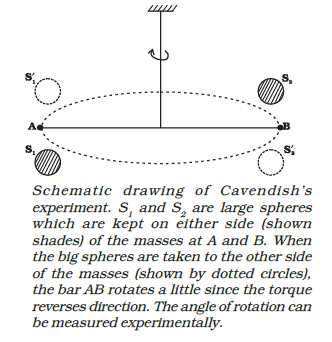
The bar AB has two small lead spheres attached at its ends. The bar is suspended from a rigid support by a fine wire. Two large lead spheres are brought close to the small ones but on opposite sides as shown. The big spheres attract the nearby small ones by equal and opposite force as shown. There is no net force on the bar but only a torque which is clearly equal to F times the length of the bar,where F is the force of attraction between a big sphere and its neighbouring small sphere. Due to this torque, the suspended wire gets twisted till such time as the restoring torque of the wire equals the gravitational torque. If \(\theta\) is the angle of twist of the suspended wire, the restoring torque is proportional to \(\theta\), equal to \(\tau \theta\). Where \(\tau\) is the restoring couple per unit angle of twist. \(\tau\) can be measured independently e.g. by applying a known torque and measuring the angle of twist. The gravitational force between the spherical balls is the same as if their masses are concentrated at their centres. Thus if \(d\) is the separation between the centres of the big and its neighbouring small ball, \(M\) and \(m\) their masses, the gravitational force between the big sphere and its neighouring small ball is.
\(
F=G \frac{M m}{d^2}
\)
If \(L\) is the length of the bar \(A B\), then the torque arising out of \(F\) is \(F\) multiplied by \(L\). At equilibrium, this is equal to the restoring torque and hence
\(
G \frac{M m}{d^2} L=\tau \theta
\)
Observation of \(\theta\) thus enables one to calculate \(G\) from this equation.
Since Cavendish’s experiment, the measurement of \(G\) has been refined and the currently accepted value is
\(
G=6.67 \times 10^{-11} \mathrm{~N} \mathrm{~m}^2 / \mathrm{kg}^2
\)
Example 1: Three equal masses of \(m \mathrm{~kg}\) each are fixed at the vertices of an equilateral triangle ABC.
(a) What is the force acting on a mass \(2 m\) placed at the centroid G of the triangle?
(b) What is the force if the mass at the vertex A is doubled ?
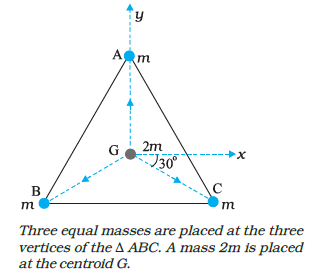
Take \(\mathrm{AG}=\mathrm{BG}=\mathrm{CG}=1 \mathrm{~m}\) (see Figure below)
Solution: (a) The angle between GC and the positive \(x\)-axis is \(30^{\circ}\) and so is the angle between GB and the negative \(x\)-axis. The individual forces in vector notation are
\(
\begin{aligned}
& \mathbf{F}_{\mathrm{GA}}=\frac{G m(2 m)}{1} \hat{\mathbf{j}} \\
& \mathbf{F}_{\mathrm{GB}}=\frac{G m(2 m)}{1}\left(-\hat{\mathbf{i}} \cos 30^{\circ}-\hat{\mathbf{j}} \sin 30^{\circ}\right) \\
& \mathbf{F}_{\mathrm{GC}}=\frac{G m(2 m)}{1}\left(+\hat{\mathbf{i}} \cos 30^{\circ}-\hat{\mathbf{j}} \sin 30^{\circ}\right)
\end{aligned}
\)
From the principle of superposition and the law of vector addition, the resultant gravitational force \(\mathbf{F}_{\mathrm{R}}\) on ( \(2 m\) ) is
\(
\begin{aligned}
\mathbf{F}_{\mathrm{R}}= & \mathbf{F}_{\mathrm{GA}}+\mathbf{F}_{\mathrm{GB}}+\mathbf{F}_{\mathrm{GC}} \\
\mathbf{F}_{\mathrm{R}}=2 G & m^2 \hat{\mathbf{j}}+2 G m^2\left(-\hat{\mathbf{i}} \cos 30^{\circ}-\hat{\mathbf{j}} \sin 30^{\circ}\right) \\
& +2 G m^2\left(\hat{\mathbf{i}} \cos 30^{\circ}-\hat{\mathbf{j}} \sin 30^{\circ}\right)=0
\end{aligned}
\)
Alternatively, one expects on the basis of symmetry that the resultant force ought to be zero.
(b) Now if the mass at vertex \(A\) is doubled then
\(
\begin{aligned}
& \mathrm{F}_{G A}^{\prime}=\frac{\mathrm{G} 2 m \cdot 2 m}{1} \hat{\mathrm{j}}=4 \mathrm{Gm}^2 \hat{\mathrm{j}} \\
& \mathrm{~F}_{G B}^{\prime}=\mathrm{F}_{G B} \text { and } \mathrm{F}_{G C}^{\prime}=\mathrm{F}_{G C} \\
& \mathrm{~F}_R^{\prime}=\mathrm{F}_{G A}^{\prime}+\mathrm{F}_{G B}^{\prime}+\mathrm{F}_{G C}^{\prime} \\
& \mathrm{F}_{\mathrm{R}}^{\prime}=2 G m^2 \hat{\mathrm{j}}
\end{aligned}
\)
Example 2: Two particles of masses 1.0 kg and 2.0 kg are placed at a separation of 50 cm. Assuming that the only forces acting on the particles are their mutual gravitation, find the initial accelerations of the two particles.
Solution: The force of gravitation exerted by one particle on another is
\(
\begin{aligned}
F & =\frac{G m_1 m_2}{r^2} \\
& =\frac{6.67 \times 10^{-11} \frac{\mathrm{~N}-\mathrm{m}^2}{\mathrm{~kg}^2} \times(1.0 \mathrm{~kg}) \times(2.0 \mathrm{~kg})}{(0.5 \mathrm{~m})^2} \\
& =5.3 \times 10^{-10} \mathrm{~N}
\end{aligned}
\)
The acceleration of 1.0 kg particle is
\(
\begin{aligned}
a_1 & =\frac{F}{m_1}=\frac{5.3 \times 10^{-10} \mathrm{~N}}{1.0 \mathrm{~kg}} \\
& =5.3 \times 10^{-10} \mathrm{~m} \mathrm{~s}^{-2}
\end{aligned}
\)
This acceleration is towards the 2.0 kg particle. The apceleration of the 2.0 kg particle is
\(
\begin{aligned}
a_2 & =\frac{F}{m_2}=\frac{5.3 \times 10^{-10} \mathrm{~N}}{2.0 \mathrm{~kg}} \\
& =2.65 \times 10^{-10} \mathrm{~m} \mathrm{~s}^{-2}
\end{aligned}
\)
This acceleration is towards the 1.0 kg particle.