JEE PYQs MCQs
SUMMARY
- The basic property of a fluid is that it can flow. The fluid does not have any resistance to change of its shape. Thus, the shape of a fluid is governed by the shape of its container.
- A liquid is incompressible and has a free surface of its own. A gas is compressible and it expands to occupy all the space available to it.
- If \(F\) is the normal force exerted by a fluid on an area \(A\) then the average pressure \(P_{\mathrm{av}}\) is defined as the ratio of the force to area
\(
P_{a v}=\frac{F}{A}
\) - The unit of the pressure is the pascal (Pa). It is the same as \(\mathrm{N} \mathrm{m}^{-2}\). Other common units of pressure are
\(
\begin{aligned}
& 1 \mathrm{~atm}=1.01 \times 10^5 \mathrm{~Pa} \\
& 1 \mathrm{bar}=10^5 \mathrm{~Pa} \\
& 1 \mathrm{torr}=133 \mathrm{~Pa}=0.133 \mathrm{kPa} \\
& 1 \mathrm{~mm} \text { of } \mathrm{Hg}=1 \text { torr }=133 \mathrm{~Pa}
\end{aligned}
\) - Pascal’s law states that: Pressure in a fluid at rest is same at all points which are at the same height. A change in pressure applied to an enclosed fluid is transmitted undiminished to every point of the fluid and the walls of the containing vessel.
- The pressure in a fluid varies with depth h according to the expression
\(
P=P_{\mathrm{a}}+\rho g h
\)
where \(\rho\) is the density of the fluid, assumed uniform. - The volume of an incompressible fluid passing any point every second in a pipe of non uniform cross section is the same in the steady flow.
\(v A=\) constant (\(v\) is the velocity and \(A\) is the area of cross section)
The equation is due to mass conservation in incompressible fluid flow. - Bernoulli’s principle states that as we move along a streamline, the sum of the pressure (\(P\)), the kinetic energy per unit volume (\(\rho v^2 / 2\)) and the potential energy per unit volume (\(\rho g y\)) remains a constant.
\(P+\rho v^2 / 2+\rho g y=\) constant
The equation is basically the conservation of energy applied to non viscuss fluid motion in steady state. There is no fluid which have zero viscosity, so the above statement is true only approximately. The viscosity is like friction and converts the kinetic energy to heat energy. - Though shear strain in a fluid does not require shear stress, when a shear stress is applied to a fluid, the motion is generated which causes a shear strain growing with time. The ratio of the shear stress to the time rate of shearing strain is known as coefficient of viscosity, \(\eta\). \(\eta=\frac{\text { shearing stress }}{\text { strain rate }}=\frac{F / A}{v / l}=\frac{F l}{v A}\)
where symbols have their usual meaning and are defined in the text. - Stokes’ law states that the viscous drag force \(\mathbf{F}\) on a sphere of radius a moving with velocity \(\mathbf{v}\) through a fluid of viscosity is, \(\mathbf{F}=6 \pi \eta a \mathbf{v}\).
- Surface tension is a force per unit length (or surface energy per unit area) acting in the plane of interface between the liquid and the bounding surface. It is the extra energy that the molecules at the interface have as compared to the interior.
- Terminal Velocity \(v_t=\frac{2}{9} \frac{r^2(\rho-\sigma) g}{\eta}\)
Quiz Summary
0 of 93 Questions completed
Questions:
Information
You have already completed the quiz before. Hence you can not start it again.
Quiz is loading…
You must sign in or sign up to start the quiz.
You must first complete the following:
Results
Results
0 of 93 Questions answered correctly
Your time:
Time has elapsed
You have reached 0 of 0 point(s), (0)
Earned Point(s): 0 of 0, (0)
0 Essay(s) Pending (Possible Point(s): 0)
Categories
- Not categorized 0%
- 1
- 2
- 3
- 4
- 5
- 6
- 7
- 8
- 9
- 10
- 11
- 12
- 13
- 14
- 15
- 16
- 17
- 18
- 19
- 20
- 21
- 22
- 23
- 24
- 25
- 26
- 27
- 28
- 29
- 30
- 31
- 32
- 33
- 34
- 35
- 36
- 37
- 38
- 39
- 40
- 41
- 42
- 43
- 44
- 45
- 46
- 47
- 48
- 49
- 50
- 51
- 52
- 53
- 54
- 55
- 56
- 57
- 58
- 59
- 60
- 61
- 62
- 63
- 64
- 65
- 66
- 67
- 68
- 69
- 70
- 71
- 72
- 73
- 74
- 75
- 76
- 77
- 78
- 79
- 80
- 81
- 82
- 83
- 84
- 85
- 86
- 87
- 88
- 89
- 90
- 91
- 92
- 93
- Current
- Review
- Answered
- Correct
- Incorrect
- Question 1 of 93
1. Question
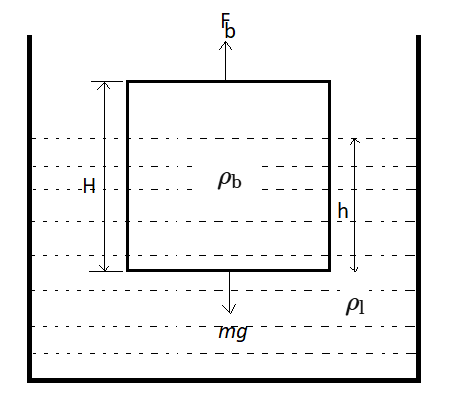
A cubical block of density \(\rho_b=600 \mathrm{~kg} / \mathrm{m}^3\) floats in a liquid of density \(\rho_{\mathrm{e}}=900 \mathrm{~kg} / \mathrm{m}^3\). If the height of block is \(H=8.0 \mathrm{~cm}\) then height of the submerged part is ____ cm. [JEE Main 2026 (Online) 24th January Evening Shift]
CorrectIncorrectHint
(c)

Step 1: Identify the Equilibrium Condition
When an object floats, it is in a state of equilibrium. According to Archimedes’ Principle, the upward buoyant force must exactly balance the downward weight of the block.
Weight of Block = Buoyant Force (Weight of Displaced Liquid)
Step 2: Set up the Density-Volume Relationship
We can rewrite weights in terms of density (\(\rho\)), volume (\(V\)), and gravity (\(g\)):
\(
\rho_b \cdot V_{\text {total }} \cdot g=\rho_l \cdot V_{\text {submerged }} \cdot g
\)
The gravity constant (\(g\)) cancels out from both sides.
Step 3: Relate Volume to Height
For a cubical block with a constant cross-sectional area (A):
Total Volume (\(V_{\text {total }}\)): \(A \times H\) (where \(H\) is the total height)
Submerged Volume (\(V_{\text {submerged }}\)): \(A \times h\) (where \(h\) is the submerged depth)
Substituting these into our equation:
\(
\rho_b \cdot(A \cdot H)=\rho_l \cdot(A \cdot h)
\)
Step 4: Simplify and Calculate
The area (\(\boldsymbol{A}\)) cancels out, leaving a direct ratio between density and height:
\(
h=\left(\frac{\rho_b}{\rho_l}\right) \cdot H
\)
Now, plug in the values provided in your problem:
\(\rho_b=600 \mathrm{~kg} / \mathrm{m}^3\)
\(\rho_l=900 \mathrm{~kg} / \mathrm{m}^3\)
\(H=8.0 \mathrm{~cm}\)
\(
h=\left(\frac{600}{900}\right) \cdot 8.0
\)
\(
h=\frac{2}{3} \cdot 8.0=5.33 \mathrm{~cm}
\)
Final Answer: The height of the submerged part is \(\mathbf{5 . 3 3 ~ c m}\). - Question 2 of 93
2. Question
A small metallic sphere of diameter 2 mm and density \(10.5 \mathrm{~g} / \mathrm{cm}^3\) is dropped in glycerine having viscosity 10 Poise and density \(1.5 \mathrm{~g} / \mathrm{cm}^3\) respectively. The terminal velocity attained by the sphere is ____ cm/s. [JEE Main 2026 (Online) 23rd January Evening Shift]
\(\left(\pi=\frac{22}{7} \text { and } g=10 \mathrm{~m} / \mathrm{s}^2\right)\)CorrectIncorrectHint
(d) Step 1: Identify Given Parameters
Convert all physical quantities into CGS units for consistency:
Radius of the sphere \((r): \frac{2 \mathrm{~mm}}{2}=1 \mathrm{~mm}=0.1 \mathrm{~cm}\)
Density of the sphere \((\rho)\) : \(10.5 \mathrm{~g} / \mathrm{cm}^3\)
Density of glycerine \((\sigma): 1.5 \mathrm{~g} / \mathrm{cm}^3\)
Viscosity of glycerine (\(\eta\)): 10 Poise
Acceleration due to gravity \((\mathrm{g}): 10 \mathrm{~m} / \mathrm{s}^2=1000 \mathrm{~cm} / \mathrm{s}^2\)
Step 2: Apply Stokes’ Law Formula
The terminal velocity \(\left(v_t\right)\) of a spherical body falling through a viscous medium is given by:
\(
v_t=\frac{2 r^2(\rho-\sigma) g}{9 \eta}
\)
Step 3: Numerical Calculation
Substitute the values into the equation:
\(
\begin{gathered}
v_t=\frac{2 \times(0.1)^2 \times(10.5-1.5) \times 1000}{9 \times 10} \\
v_t=\frac{2 \times 0.01 \times 9 \times 1000}{90} \\
v_t=\frac{180}{90} \\
v_t=2 \mathrm{~cm} / \mathrm{s}
\end{gathered}
\)
The terminal velocity of the sphere is \(\mathbf{2 ~ c m} / \mathbf{s}\). - Question 3 of 93
3. Question
When a part of a straight capillary tube is placed vertically in a liquid, the liquid raises upto certain height \(h\). If the inner radius of the capillary tube, density of the liquid and surface tension of the liquid decrease by \(1 \%\) each, then the height of the liquid in the tube will change by _____ \(\%\). [JEE Main 2026 (Online) 22nd January Evening Shift]
CorrectIncorrectHint
(b) Step 1: Identify the Formula for Capillary Rise
The height \(h\) to which a liquid rises in a capillary tube is given by the formula:
\(
h=\frac{2 T \cos \theta}{r \rho g}
\)
Where:
\(T\): Surface tension of the liquid.
\(\theta\): Angle of contact (assumed constant unless stated otherwise).
\(r\) : Inner radius of the capillary tube.
\(\rho\) : Density of the liquid.
\(g\): Acceleration due to gravity.
Step 2: Establish the Proportionality
Since we are looking for the percentage change, we focus on the variables that are changing: \(T, r\), and \(\rho\). Gravity (\(g\)) and \(\cos \theta\) are constants in this scenario.
\(
h \propto \frac{T}{r \rho}
\)
Taking the natural logarithm (ln) on both sides and differentiating (or using the error/percentage change approximation for small changes):
\(
\frac{\Delta h}{h}=\frac{\Delta T}{T}-\frac{\Delta r}{r}-\frac{\Delta \rho}{\rho}
\)
Step 3: Substitute the Given Percentage Changes
The problem states that each of the three variables decreases by \(1 \%\). Therefore:
\(\frac{\Delta T}{T}=-1 \%\)
\(\frac{\Delta r}{r}=-1 \%\)
\(\frac{\Delta \rho}{\rho}=-1 \%\)
Substitute these values into the equation:
\(
\begin{gathered}
\% \text { change in } h=(-1 \%)-(-1 \%)-(-1 \%) \\
\text { % change in } h=-1 \%+1 \%+1 \% \\
\text { % change in } h=+1 \%
\end{gathered}
\)
Step 4: Interpret the Result
The positive sign indicates an increase. Since the decrease in the denominator (radius and density) outweighs the decrease in the numerator (surface tension), the liquid height actually rises further.
The height of the liquid in the tube will increase by \(1 \%\). - Question 4 of 93
4. Question
Given below are two statements :
Statement I : Pressure of a fluid is exerted only on a solid surface in contact as the fluid-pressure does not exist everywhere in a still fluid.
Statement II : Excess potential energy of the molecules on the surface of a liquid, when compared to interior, results in surface tension.
In the light of the above statements, choose the correct answer from the options given below [JEE Main 2026 (Online) 22nd January Morning Shift]CorrectIncorrectHint
(a) Step 1: Analyze Statement I
Statement I: “Pressure of a fluid is exerted only on a solid surface in contact as the fluidpressure does not exist everywhere in a still fluid.”
The Fact: According to Pascal’s Law, pressure in a static fluid exists at every point within the fluid, not just at the boundaries. If you were to place an imaginary surface anywhere inside the liquid, the fluid on one side would exert a force on the fluid on the other side.
Conclusion: This statement is False. Pressure is a scalar field that exists throughout the entire volume of the fluid.
Step 2: Analyze Statement II
Statement II: “Excess potential energy of the molecules on the surface of a liquid, when compared to interior, results in surface tension.”
The Fact: Molecules in the interior of a liquid are surrounded by other molecules and experience attractive forces from all sides (net force is zero). However, molecules at the surface have no liquid molecules above them. They experience a net inward cohesive force.
Work and Energy: To move a molecule from the interior to the surface, work must be done against these inward forces. This work is stored as surface potential energy. Surface tension is the physical manifestation of the liquid’s tendency to minimize this area (and thus minimize its potential energy).
Conclusion: This statement is True.
Step 3: Choose the Correct Option
Statement I is False.
Statement II is True.Comparing this to the provided options:
Correct Answer: (a) Statement I is false but Statement II is true. - Question 5 of 93
5. Question
Surface tension of two liquids (having same densities), \(T_1\) and \(T_2\), are measured using capillary rise method utilizing two tubes with inner radii of \(r_1\) and \(r_2\) where \(r_1>r_2\). The measured liquid heights in these tubes are \(h_1\) and \(h_2\) respectively. [Ignore the weight of the liquid above the lowest point of miniscus]. The heights \(h_1\) and \(h_2\) and surface tensions \(T_1\) and \(T_2\) satisfy the relation: [JEE Main 2026 (Online) 21st January Evening Shift]
CorrectIncorrectHint
(b) Step 1: Identify the Governing Formula
The height \(h\) to which a liquid rises in a capillary tube is given by Jurin’s Law:
\(
h=\frac{2 T \cos \theta}{r \rho g}
\)
Where:
\(T\) is the surface tension.
\(\theta\) is the angle of contact.
\(r\) is the inner radius of the tube.
\(\rho\) is the density of the liquid.
\(g\) is the acceleration due to gravity.
Step 2: Analyze the Surface Tension (\(T_1\) and \(T_2\))
Surface tension is an intensive property of a liquid, meaning it depends on the nature of the liquid and its temperature, not on the size of the container or the tube used to measure it.
Since we are comparing two liquids (and the context of such problems usually implies the same liquid or comparing the physical constants), if we assume the same liquid is used in both tubes, then:
\(
T_1=T_2
\)
Step 3: Analyze the Heights (\(h_1\) and \(h_2\))
From the formula in Step 1, we can see that for the same liquid (\(\rho, T\), and \(\theta\) are constant), the height is inversely proportional to the radius:
\(
h \propto \frac{1}{r}
\)
The problem states that \(r_1>r_2\). Because the radius is in the denominator:
As the radius increases, the height decreases.
Therefore, since \(r_1>r_2\), it must follow that \(h_1<h_2\).
Step 4: Conclusion
Combining our findings:
\(T_1=T_2\) (Surface tension remains constant for the liquid).
\(h_1<h_2\) (The thinner tube \(r_2\) results in a higher capillary rise).
Comparing this to the options:
Correct Answer: (b) \(h_1<h_2\) and \(T_1=T_2\) - Question 6 of 93
6. Question
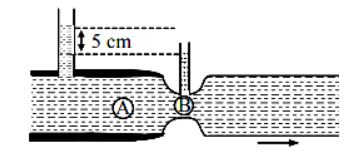
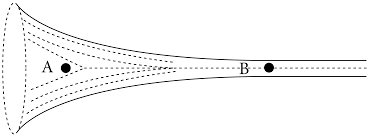
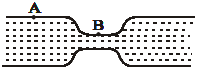
Water flows through a horizontal tube as shown in the figure. The difference in height between the water columns in vertical tubes is 5 cm and the area of cross-sections at \(A\) and \(B\) are \(6 \mathrm{~cm}^2\) and \(3 \mathrm{~cm}^2\) respectively. The rate of flow will be ____ \(\mathrm{cm}^3 / \mathrm{s}\). (take \(g=10 \mathrm{~m} / \mathrm{s}^2\)) [JEE Main 2026 (Online) 21st January Morning Shift]
 CorrectIncorrect
Hint
(d) Step 1: Apply Bernoulli’s Principle
For a horizontal tube, the relationship between pressure \(P\) and velocity \(v\) at points \(A\) and \(\boldsymbol{B}\) is given by Bernoulli’s equation:
\(
P_A+\frac{1}{2} \rho v_A^2=P_B+\frac{1}{2} \rho v_B^2
\)
The pressure difference between the two points is equivalent to the hydrostatic pressure head \(\boldsymbol{\Delta} \boldsymbol{h}\) :
\(
P_A-P_B=\rho g \Delta h
\)
Substituting this into Bernoulli’s equation:
\(
\rho g \Delta h=\frac{1}{2} \rho\left(v_B^2-v_A^2\right) \Longrightarrow g \Delta h=\frac{1}{2}\left(v_B^2-v_A^2\right)
\)
Step 2: Use the Equation of Continuity
The flow rate \(Q\) is constant through the tube:
\(
Q=A_A v_A=A_B v_B
\)
Given \(\boldsymbol{A}_{\boldsymbol{A}}=6 \mathrm{~cm}^2\) and \(\boldsymbol{A}_{\boldsymbol{B}}=3 \mathrm{~cm}^2\), we have:
\(
6 v_A=3 v_B \Longrightarrow v_B=2 v_A
\)
Step 3: Solve for Velocity and Flow Rate
Substitute \(v_B=2 v_A\) into the equation from Step 1:
\(
g \Delta h=\frac{1}{2}\left(\left(2 v_A\right)^2-v_A^2\right)=\frac{1}{2}\left(3 v_A^2\right)=\frac{3}{2} v_A^2
\)
Given \(g=10 \mathrm{~m} / \mathrm{s}^2=1000 \mathrm{~cm} / \mathrm{s}^2\) and \(\Delta h=5 \mathrm{~cm}\) :
\(
\begin{gathered}
1000 \times 5=\frac{3}{2} v_A^2 \Longrightarrow 5000=1.5 v_A^2 \Longrightarrow v_A^2=\frac{10000}{3} \\
v_A=\frac{100}{\sqrt{3}} \mathrm{~cm} / \mathrm{s}
\end{gathered}
\)
Calculate the flow rate \(Q\) :
\(
Q=A_A v_A=6 \times \frac{100}{\sqrt{3}}=\frac{600}{\sqrt{3}}=200 \sqrt{3} \mathrm{~cm}^3 / \mathrm{s}
\) - Question 7 of 93
7. Question
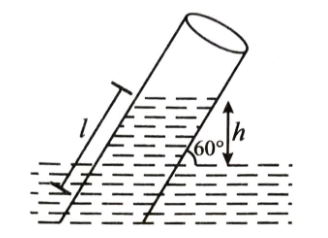
A capillary tube of radius 0.1 mm is partly dipped in water (surface tension \(70 \mathrm{dyn} / \mathrm{cm}\) and glass water contact angle \(\approx 0^{\circ}\)) with \(30^{\circ}\) inclined with the vertical. The length of water risen in the capillary is ____ cm. (Take \(g=9.8 \mathrm{~m} / \mathrm{s}^2\)) [JEE Main 2025 (Online) 7th April Evening Shift]
CorrectIncorrectHint
(a)

\(
\begin{aligned}
& h=\frac{2 T \cos \theta}{\rho g r}=\frac{2 \times 70 \times 1}{1 \times 980 \times 10^{-2}}=\frac{100}{7} \mathrm{~cm} \\
& \sin 60^{\circ}=\frac{h}{l} \Rightarrow l=\frac{h \times 2}{\sqrt{3}} \\
& l=\frac{100}{7} \times \frac{2}{\sqrt{3}}=\frac{200}{7 \times \sqrt{3}}=16.49 \mathrm{~cm}
\end{aligned}
\)Explanation: To find the length of the water column in an inclined capillary tube, we first determine the vertical height and then account for the geometry of the tilt.
Step 1: Calculate the Vertical Height (\(h\))
The vertical height to which a liquid rises is independent of the inclination of the tube and is given by the standard capillary rise formula:
\(
h=\frac{2 T \cos \theta}{r \rho g}
\)
Given Data (converting to CGS units):
Surface tension \((T)=70 \mathrm{dyn} / \mathrm{cm}\)
Contact angle \((\theta) \approx 0^{\circ}(\) so \(\cos \theta=1)\)
Radius \((r)=0.1 \mathrm{~mm}=0.01 \mathrm{~cm}\)
Density of water \((\rho)=1 \mathrm{~g} / \mathrm{cm}^3\)
Gravity \((g)=9.8 \mathrm{~m} / \mathrm{s}^2=980 \mathrm{~cm} / \mathrm{s}^2\)
Substitution:
\(
\begin{aligned}
h & =\frac{2 \times 70 \times 1}{0.01 \times 1 \times 980} \\
h & =\frac{140}{9.8}=\frac{1400}{98}
\end{aligned}
\)
\(
h=\frac{100}{7} \mathrm{~cm}
\)
Step 2: Relate Vertical Height to Inclined Length (\(l\))
When the tube is inclined at an angle \(\alpha\) with the vertical, the length of the liquid column \(l\) increases so that the vertical height \(h\) remains constant.
From the geometry of a right-angled triangle:
\(
\begin{aligned}
& h=l \cos \alpha \\
& l=\frac{h}{\cos \alpha}
\end{aligned}
\)
Given:
\(\alpha=30^{\circ}\) (inclination with the vertical)
\(\cos 30^{\circ}=\frac{\sqrt{3}}{2}\)
Step 3: Calculate the Length (\(l\))
\(
l=\frac{100 / 7}{\sqrt{3} / 2}=\frac{200}{7 \sqrt{3}} = \frac{82}{5}
\) - Question 8 of 93
8. Question
Two liquids \(A\) and \(B\) have \(\theta_A\) and \(\theta_B\) as contact angles in a capillary tube. If \(K=\cos \theta_A / \cos \theta_B\), then identify the correct statement: [JEE Main 2025 (Online) 4th April Morning Shift]
CorrectIncorrectHint
(d) To identify the correct statement, we must look at the relationship between the contact angle \(\theta\) , the shape of the meniscus, and the resulting sign of \(\cos \theta\).
Step 1: The Relationship between Contact Angle and Meniscus
The shape of a liquid’s meniscus in a capillary tube is determined by its contact angle \(\theta\) :
Concave Meniscus: Occurs when \(0^{\circ} \leq \theta<90^{\circ}\) (acute angle). In this range, \(\cos \theta\) is positive.
Convex Meniscus: Occurs when \(90^{\circ}<\theta \leq 180^{\circ}\) (obtuse angle). In this range, \(\cos \theta\) is negative.
Flat Meniscus: Occurs when \(\theta=90^{\circ}\). In this case, \(\cos \theta=0\).
Step 2: Analyzing the Ratio \(K\)
The problem defines the ratio \(K\) as:
\(
K=\frac{\cos \theta_A}{\cos \theta_B}
\)
For \(K\) to be negative, the numerator \(\left(\cos \theta_A\right)\) and the denominator \(\left(\cos \theta_B\right)\) must have opposite signs. This leads to two possible scenarios:
Case-1: \(\cos \theta_A\) is positive and \(\cos \theta_B\) is negative: Liquid \(A\) has an acute angle → Concave meniscus.
Liquid \(B\) has an obtuse angle → Convex meniscus.
Case-2: \(\cos \theta_A\) is negative and \(\cos \theta_B\) is positive:
Liquid \(A\) has an obtuse angle ⟶ Convex meniscus.
Liquid \(B\) has an acute angle → Concave meniscus.
Evaluating the Options
(A) and (B): Incorrect. If \(K\) is negative, the liquids cannot have the same type of meniscus (both concave or both convex), as their \(\cos \theta\) signs must differ.
(C): Incorrect. If \(K=0\), then \(\cos \theta_A=0\) (meaning liquid \(A\) has a flat meniscus), regardless of liquid \(B\).
(D): Correct. This describes one of the necessary conditions for \(K\) to be negative-one liquid having a concave meniscus (positive cosine) and the other having a convex meniscus (negative cosine). - Question 9 of 93
9. Question
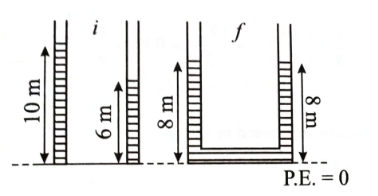
Two cylindrical vessels of equal cross sectional area of \(2 \mathrm{~m}^2\) contain water upto heights 10 m and 6 m, respectively. If the vessels are connected at their bottom then the work done by the force of gravity is (Density of water is \(10^3 \mathrm{~kg} / \mathrm{m}^3\) and \(\mathrm{g}=10 \mathrm{~m} / \mathrm{s}^2\)) [JEE Main 2025 (Online) 3rd April Evening Shift]
CorrectIncorrectHint
(c)

\(
\begin{aligned}
& U_{\text {initial }}=(\rho A \times 10) g \times 5+(\rho A 6) g \times 3 \\
& U_{\text {initial }}=\rho A g(50+18)=68 \rho A g \\
& U_{\text {final }}=(\rho A \times 16) g \times 4=(\rho A g) \times 64 \\
& W=\triangle U=68 \rho A g-64 \rho A g=4 \rho A g \\
& W=4 \times 1000 \times 2 \times 10=8 \times 10^4 \mathrm{~J}
\end{aligned}
\)Explanation: To find the work done by gravity when the two vessels are connected, we calculate the change in the total gravitational potential energy of the system.
Step 1: Find the Final Common Height
When the vessels are connected, water flows from the higher level to the lower level until both reach a common height \(h_f\). Since the cross-sectional areas (\(\boldsymbol{A}\)) are equal:
\(
\begin{gathered}
A \cdot h_1+A \cdot h_2=(A+A) \cdot h_f \\
10+6=2 h_f \\
h_f=8 \mathrm{~m}
\end{gathered}
\)
Step 2: Formula for Potential Energy of a Liquid Column
The potential energy (\(U\)) of a liquid column of height \(h\) is calculated using the center of mass, which is at \(h / 2\) :
\(
U=m \cdot g \cdot \frac{h}{2}=(\rho \cdot A \cdot h) \cdot g \cdot \frac{h}{2}=\frac{1}{2} \rho A g h^2
\)
Step 3: Calculate Initial Potential Energy (\(U_i\))
Initial energy is the sum of the energies of the two separate columns:
\(
\begin{gathered}
U_i=\frac{1}{2} \rho A g h_1^2+\frac{1}{2} \rho A g h_2^2 \\
U_i=\frac{1}{2} \rho A g\left(10^2+6^2\right) \\
U_i=\frac{1}{2}\left(10^3\right)(2)(10)(100+36) \\
U_i=10^4(136)=1,360,000 \mathrm{~J}
\end{gathered}
\)
Step 4: Calculate Final Potential Energy (\(U_f\))
Final energy is the energy of the two columns at the new common height:
\(
\begin{gathered}
U_f=\frac{1}{2} \rho(2 A) g h_f^2 \\
U_f=\frac{1}{2}\left(10^3\right)(2 \times 2)(10)\left(8^2\right) \\
U_f=2 \times 10^4(64)=1,280,000 \mathrm{~J}
\end{gathered}
\)
Step 5: Calculate Work Done by Gravity
Work done by gravity is equal to the negative change in potential energy, or simply the initial energy minus the final energy (since the energy decreases, gravity does positive work):
\(
W=U_i-U_f
\)
\(
W=1,360,000-1,280,000
\)
\(
W=80,000 \mathrm{~J}=80 \mathrm{~kJ}
\)
The work done by the force of gravity is \(8 \times 10^4 \mathrm{~J}\) - Question 10 of 93
10. Question
A solid steel ball of diameter 3.6 mm acquired terminal velocity \(2.45 \times 10^{-2} \mathrm{~m} / \mathrm{s}\) while falling under gravity through an oil of density \(925 \mathrm{~kg} \mathrm{~m}^{-3}\). Take density of steel as \(7825 \mathrm{~kg} \mathrm{~m}^{-3}\) and g as \(9.8 \mathrm{~m} / \mathrm{s}^2\). The viscosity of the oil in Sl unit is [JEE Main 2025 (Online) 3rd April Evening Shift]
CorrectIncorrectHint
(a) To find the viscosity of the oil, we use the formula for terminal velocity derived from Stokes’ Law.
Step 1: Identify the Formula
When a spherical object reaches terminal velocity (\(v_t\)) in a viscous fluid, the net force is zero. The viscosity \((\eta)\) is given by:
\(
v_t=\frac{2}{9} \frac{r^2\left(\rho_s-\rho_l\right) g}{\eta}
\)
Rearranging to solve for viscosity \((\eta)\) :
\(
\eta=\frac{2}{9} \frac{r^2\left(\rho_s-\rho_l\right) g}{v_t}
\)
Step 2: Convert and List Given Data (SI Units)
Radius (\(r\)): Diameter is 3.6 mm , so radius \(r=1.8 \mathrm{~mm}=1.8 \times 10^{-3} \mathrm{~m}\).
Density of Steel \(\left(\rho_s\right): 7825 \mathrm{~kg} / \mathrm{m}^3\).
Density of Oil \(\left(\rho_l\right): 925 \mathrm{~kg} / \mathrm{m}^3\).
Terminal Velocity \(\left(v_t\right)\) : \(2.45 \times 10^{-2} \mathrm{~m} / \mathrm{s}\).
Gravity \((g): 9.8 \mathrm{~m} / \mathrm{s}^2\).
Step 3: Calculate the Density Difference
\(
\begin{gathered}
\Delta \rho=\rho_s-\rho_l \\
\Delta \rho=7825-925=6900 \mathrm{~kg} / \mathrm{m}^3
\end{gathered}
\)
Step 4: Substitute Values into the Equation
\(
\eta=\frac{2}{9} \times \frac{\left(1.8 \times 10^{-3}\right)^2 \times 6900 \times 9.8}{2.45 \times 10^{-2}}
\)
First, calculate the square of the radius:
\(
\left(1.8 \times 10^{-3}\right)^2=3.24 \times 10^{-6} \mathrm{~m}^2
\)
Now, plug it into the expression:
\(
\eta=\frac{2 \times 3.24 \times 10^{-6} \times 6900 \times 9.8}{9 \times 2.45 \times 10^{-2}}\approx 1.99 \mathrm{~Pa} \cdot \mathrm{~s}\left(\text { or kg m }^{-1} \mathrm{~s}^{-1}\right)
\) - Question 11 of 93
11. Question
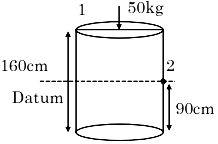
Consider a completely full cylindrical water tank of height 1.6 m and of cross-sectional area \(0.5 \mathrm{~m}^2\). It has a small hole in its side at a height 90 cm from the bottom. Assume, the crosssectional area of the hole to be negligibly small as compared to that of the water tank. If a load 50 kg is applied at the top surface of the water in the tank then the velocity of the water coming out at the instant when the hole is opened is: [JEE Main 2025 (Online) 3rd April Morning Shift]
\(
\left(\mathrm{g}=10 \mathrm{~m} / \mathrm{s}^2\right)
\)CorrectIncorrectHint
(d)

Apply Bernoulli equation between points 1 and 2
\(
\begin{aligned}
& P_1+\frac{1}{2} \rho v_1^2+\rho g h=P_2+\frac{1}{2} \rho v_2^2+0 \\
& P_0+\frac{m g}{A}+\rho g \frac{70}{100}=P_0+\frac{1}{2} \rho v_2^2
\end{aligned}
\)
As the tank area is large \(v_1\) is negligible compared to \(v_2\)
\(
\begin{aligned}
& \frac{5000}{5}+10^3 \times 10 \frac{70}{100}=\frac{1}{2} \times 10^3 v_2^2 \\
& 10^3+10^3 \times 7=\frac{10^3}{2} v_2^2 \Rightarrow v_2^2=16 \\
& \Rightarrow \quad v_2=4 \mathrm{~m} / \mathrm{s}
\end{aligned}
\)Explanation: Step 1: Identify the Pressure at the Top Surface
The pressure at the top of the water surface \(P_1\) consists of atmospheric pressure \(P_{\text {atm }}\) and the pressure exerted by the 50 kg load. Given the mass \(M=50 \mathrm{~kg}\) and the crosssectional area \(A=0.5 \mathrm{~m}^2\).
\(
\begin{gathered}
P_1=P_{a t m}+\frac{M g}{A} \\
P_1=P_{a t m}+\frac{50 \times 10}{0.5}=P_{a t m}+1000 \mathrm{~Pa}
\end{gathered}
\)
Step 2: Determine the Heights Relative to the Hole
The height of the top surface from the bottom is \(H=1.6 \mathrm{~m}\), and the height of the hole from the bottom is \(h_b=0.9 \mathrm{~m}\). The height of the water column above the hole is:
\(
h=H-h_b=1.6-0.9=0.7 \mathrm{~m}
\)
Step 3: Apply Bernoulli’s Principle
Applying Bernoulli’s equation between the top surface (point 1) and the hole (point 2). Since the area of the hole is negligible, the velocity of the water surface \(v_1 \approx 0\).
\(
P_1+\rho g y_1+\frac{1}{2} \rho v_1^2=P_2+\rho g y_2+\frac{1}{2} \rho v_2^2
\)
Substituting \(P_2=P_{a t m}\) and \(v_2=v\) :
\(
\begin{gathered}
\left(P_{a t m}+1000\right)+\rho g H=P_{a t m}+\rho g h_b+\frac{1}{2} \rho v^2 \\
1000+\rho g\left(H-h_b\right)=\frac{1}{2} \rho v^2
\end{gathered}
\)
Step 4: Calculate the Efflux Velocity
Using the density of water \(\rho=1000 \mathrm{~kg} / \mathrm{m}^3\) and the calculated height difference \(h=0.7 \mathrm{~m}\) :
\(
\begin{gathered}
1000+(1000 \times 10 \times 0.7)=\frac{1}{2} \times 1000 \times v^2 \\
1000+7000=500 v^2 \\
8000=500 v^2 \\
v^2=\frac{8000}{500}=16 \\
v=\sqrt{16}=4 \mathrm{~m} / \mathrm{s}
\end{gathered}
\) - Question 12 of 93
12. Question
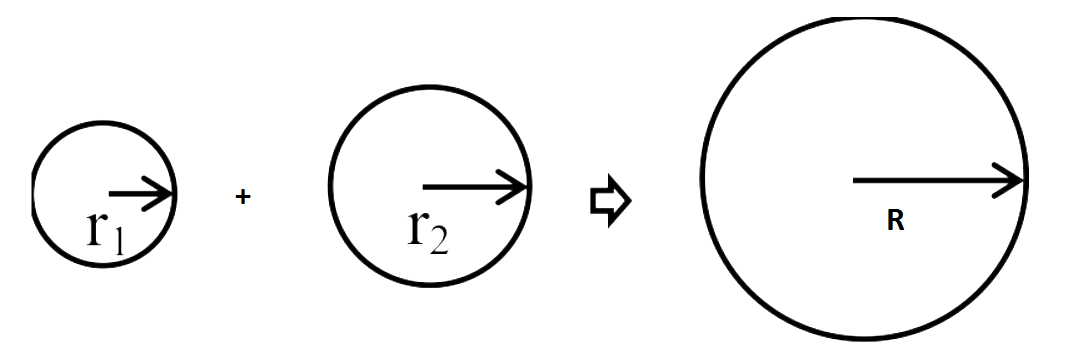
Two water drops each of radius ‘ \(r\) ‘ coalesce to form a bigger drop. If ‘ \(T\) ‘ is the surface tension, the surface energy released in this process is : [JEE Main 2025 (Online) 2nd April Evening Shift]
CorrectIncorrectHint
(c) To find the surface energy released when two drops coalesce, we calculate the change in surface area and multiply it by the surface tension.
Step 1: Volume Conservation
When two small drops of radius \(r\) merge to form one large drop of radius \(R\), the total volume remains constant.
\(
\begin{aligned}
& \text { Volume of large drop }=2 \times(\text { Volume of one small drop }) \\
& \qquad \begin{array}{c}
\frac{4}{3} \pi R^3=2 \times\left(\frac{4}{3} \pi r^3\right) \\
R^3=2 r^3 \Longrightarrow R=2^{1 / 3} r
\end{array}
\end{aligned}
\)
Step 2: Calculate Initial and Final Surface Areas
Surface energy is defined as \(E=T \times A\), where \(A\) is the surface area.
Initial Surface Area \(\left(\boldsymbol{A}_{\boldsymbol{i}}\right)\) :
\(
A_i=2 \times\left(4 \pi r^2\right)=8 \pi r^2
\)
Final Surface Area (\(\boldsymbol{A}_{\boldsymbol{f}}\)):
\(
A_f=4 \pi R^2
\)
Substitute \(R=2^{1 / 3} r\) :
\(
A_f=4 \pi\left(2^{1 / 3} r\right)^2=4 \pi r^2 \cdot 2^{2 / 3}
\)
Step 3: Calculate Energy Released (\(\Delta E\))
The energy released is the difference between the initial and final surface energies:
\(
\begin{gathered}
\Delta E=T\left(A_i-A_f\right) \\
\Delta E=T\left[8 \pi r^2-4 \pi r^2 \cdot 2^{2 / 3}\right]
\end{gathered}
\)
Factor out \(4 \pi r^2\) :
\(
\Delta E=4 \pi r^2 T\left[2-2^{2 / 3}\right]
\) - Question 13 of 93
13. Question
A 400 g solid cube having an edge of length 10 cm floats in water. How much volume of the cube is outside the water? [JEE Main 2025 (Online) 28th January Evening Shift]
(Given: density of water \(=1000 \mathrm{~kg} \mathrm{~m}^{-3}\))CorrectIncorrectHint
(b) To find the volume of the cube that remains outside the water, we can use the principle of floatation.
Step 1: Calculate the Total Volume of the Cube
The cube has an edge length \(a=10 \mathrm{~cm}\).
\(
\text { Total Volume }(V)=a^3=(10 \mathrm{~cm})^3=1000 \mathrm{~cm}^3
\)
Step 2: Determine the Submerged Volume (\(\boldsymbol{V}_{\text {in }}\))
According to the principle of floatation, the weight of the floating body is equal to the weight of the water displaced by the submerged part.
\(
\begin{aligned}
& \text { Mass of the cube }=\text { Mass of displaced water } \\
& \qquad 400 \mathrm{~g}=V_{i n} \times \rho_{\text {water }}
\end{aligned}
\)
Given the density of water is \(1000 \mathrm{~kg} / \mathrm{m}^3\), which is equivalent to \(1 \mathrm{~g} / \mathrm{cm}^3\) :
\(
\begin{gathered}
400 \mathrm{~g}=V_{i n} \times 1 \mathrm{~g} / \mathrm{cm}^3 \\
V_{i n}=400 \mathrm{~cm}^3
\end{gathered}
\)
Step 3: Calculate the Volume Outside the Water (\(V_{\text {out }}\))
The volume outside the water is the difference between the total volume and the submerged volume:
\(
\begin{gathered}
V_{\text {out }}=V_{\text {total }}-V_{\text {in }} \\
V_{\text {out }}=1000 \mathrm{~cm}^3-400 \mathrm{~cm}^3 \\
V_{\text {out }}=600 \mathrm{~cm}^3
\end{gathered}
\)
The volume of the cube outside the water is (b) \(600 \mathrm{~cm}^3\). - Question 14 of 93
14. Question
In the experiment for measurement of viscosity ‘ \(\eta\) ‘ of given liquid with a ball having radius \(R\), consider following statements.
A. Graph between terminal velocity \(V\) and \(R\) will be a parabola.
B. The terminal velocities of different diameter balls are constant for a given liquid.
C. Measurement of terminal velocity is dependent on the temperature.
D. This experiment can be utilized to assess the density of a given liquid.
E. If balls are dropped with some initial speed, the value of \(\eta\) will change.
Choose the correct answer from the options given below: [JEE Main 2025 (Online) 28th January Morning Shift]CorrectIncorrectHint
(c) Analysis of Statements:
Statement A: Graph between terminal velocity \(v\) and \(R\) will be a parabola. The formula for terminal velocity is \(v=\frac{2}{9} \frac{R^2\left(\rho_s-\rho_l\right) g}{\eta}\). Since \(v \propto R^2\), the relationship between \(v\) and \(R\) is quadratic. Therefore, the graph is indeed a parabola. (True)
Statement B: The terminal velocities of different diameter balls are constant for a given liquid.
As shown in the formula above, \(v\) depends on \(R^2[latex]. Larger balls (larger diameter) will have a higher terminal velocity than smaller ones. (False)
Statement C: Measurement of terminal velocity is dependent on the temperature. Viscosity [latex](\eta)\) is highly sensitive to temperature (for liquids, viscosity typically decreases as temperature increases). Since \(v\) is inversely proportional to \(\eta\), the terminal velocity will change with temperature. (True)
Statement D: This experiment can be utilized to assess the density of a given liquid. By rearranging the terminal velocity formula, if we know the density of the ball (\(\rho_s\)), the radius (\(R\)), the viscosity (\(\eta\)), and we measure \(v\), we can calculate the density of the liquid (\(\rho_l\)). (True)
Statement E: If balls are dropped with some initial speed, the value of \(\eta\) will change. Viscosity \((\eta)\) is a property of the fluid itself. While an initial speed might change how quickly the ball reaches terminal velocity, it does not change the physical property of the liquid’s viscosity. (False)Conclusion: The correct statements are A, C, and D.
- Question 15 of 93
15. Question
Consider following statements:
A. Surface tension arises due to extra energy of the molecules at the interior as compared to the molecules at the surface, of a liquid.
B. As the temperature of liquid rises, the coefficient of viscosity increases.
C. As the temperature of gas increases, the coefficient of viscosity increases
D. The onset of turbulence is determined by Reynold’s number.
E. In a steady flow two stream lines never intersect.
Choose the correct answer from the options given below: [JEE Main 2025 (Online) 28th January Morning Shift]CorrectIncorrectHint
(b) To find the correct answer, let’s evaluate each statement based on the principles of fluid mechanics and molecular theory.
Step 1: Analyze Statement A
Statement A: “Surface tension arises due to extra energy of the molecules at the interior as compared to the molecules at the surface.”
The Fact: Molecules at the surface of a liquid have higher potential energy because they have fewer neighboring molecules to interact with compared to molecules in the interior. Work must be done to bring a molecule from the interior to the surface.
Conclusion: This statement is False. Surface tension arises from extra energy at the surface, not the interior.
Step 2: Analyze Statements B and C (Temperature and Viscosity)
Statement B: “As the temperature of liquid rises, the coefficient of viscosity increases.”
The Fact: In liquids, viscosity is primarily due to cohesive forces. As temperature rises, these forces weaken, causing viscosity to decrease.
Conclusion: This statement is False.
Statement C: “As the temperature of gas increases, the coefficient of viscosity increases.”
The Fact: In gases, viscosity is due to the momentum transfer between molecules during collisions. As temperature rises, the average velocity of molecules increases, leading to more frequent collisions and higher momentum transfer.
Conclusion: This statement is True.
Step 3: Analyze Statements D and E (Fluid Flow)
Statement D: “The onset of turbulence is determined by Reynold’s number.”
The Fact: The Reynolds number (\(R e\)) is a dimensionless quantity that helps predict flow patterns. Low Re indicates laminar flow, while high Re (typically above 2000-3000 for pipe flow) indicates the onset of turbulence.
Conclusion: This statement is True.
Statement E: “In a steady flow two stream lines never intersect.”
The Fact: A streamline represents the path of a fluid particle, and the tangent at any point gives the direction of velocity. If two streamlines intersected, a particle at the intersection point would have two different velocity directions simultaneously, which is impossible in steady flow.
Conclusion: This statement is True.
Comparing this to the options provided:
Correct Answer: (B) C, D, E Only - Question 16 of 93
16. Question
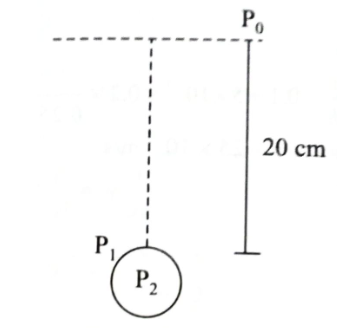
An air bubble of radius 0.1 cm lies at a depth of 20 cm below the free surface of a liquid of density \(1000 \mathrm{~kg} / \mathrm{m}^3\). If the pressure inside the bubble is \(2100 \mathrm{~N} / \mathrm{m}^2\) greater than the atmospheric pressure, then the surface tension of the liquid in Sl unit is (use \(g=10 \mathrm{~m} / \mathrm{s}^2\)) [JEE Main 2025 (Online) 24th January Morning Shift]
CorrectIncorrectHint
(b)

\(
\begin{aligned}
& P_1=P_0+p g h=P_0+1000 \times 10 \times \frac{20}{100} \\
& \Rightarrow \quad P_1=P_0+2000 \\
& \text { So, } P_2-P_1=\frac{2 T}{R}=\left(\frac{2 T}{1 \times 10^{-3}}\right) \\
& \Rightarrow \quad P_2=P_0+2100 \text { (given) } \\
& \text { So, } P_0+2100-P_0-2000=2 T \times 10^3 \\
& \Rightarrow 100=2 T \times 10^3 \\
& \Rightarrow T=\left(\frac{1}{20}\right)=0.05 \mathrm{~N} / \mathrm{m}
\end{aligned}
\)Explanation: To find the surface tension of the liquid, we need to analyze the pressure balance for an air bubble submerged in a liquid.
Step 1: Understand the Pressure Components
The pressure inside an air bubble (\(P_{\text {in }}=P_2\)) is greater than the pressure outside it (\(P_{\text {out }}=P_1\)) due to surface tension. The relationship is given by:
\(
P_{\text {in }}-P_{\text {out }}=\frac{2 T}{R}
\)
Where:
\(T\) is the surface tension.
\(R\) is the radius of the bubble.
Step 2: Determine the Pressure Outside the Bubble
The pressure outside the bubble (\(P_{\text {out }}\)) at a depth \(h\) below the free surface of a liquid is the sum of atmospheric pressure (\(P_0\)) and the hydrostatic pressure due to the liquid column:
\(
P_{\text {out }}=P_0+\rho g h
\)
Step 3: Use the Given Pressure Difference
The problem states that the pressure inside the bubble is \(2100 \mathrm{~N} / \mathrm{m}^2\) greater than the atmospheric pressure.
Given: \(P_{i n}-P_0=2100 \mathrm{~N} / \mathrm{m}^2\)
We can rewrite the internal pressure as:
\(
P_{\text {in }}=P_{\text {out }}+\frac{2 T}{R}
\)
Substituting the expression for \(P_{\text {out }}\) :
\(
P_{i n}=\left(P_0+\rho g h\right)+\frac{2 T}{R}
\)
Rearranging to match our given value \(\left(P_{i n}-P_0\right)\) :
\(
P_{i n}-P_0=\rho g h+\frac{2 T}{R}
\)
Step 4: Substitute the Known Values (SI Units)
\(P_{\text {in }}-P_0=2100 \mathrm{~Pa}\)
\(\rho=1000 \mathrm{~kg} / \mathrm{m}^3\)
\(g=10 \mathrm{~m} / \mathrm{s}^2\)
\(h=20 \mathrm{~cm}=0.2 \mathrm{~m}\)
\(R=0.1 \mathrm{~cm}=10^{-3} \mathrm{~m}\)
\(
\begin{gathered}
2100=(1000 \times 10 \times 0.2)+\frac{2 T}{10^{-3}} \\
2100=2000+2000 T
\end{gathered}
\)
Step 5: Solve for Surface Tension (\(T\))
\(
\begin{gathered}
2100-2000=2000 T \\
100=2000 T \\
T=\frac{100}{2000} \\
T=0.05 \mathrm{~N} / \mathrm{m}
\end{gathered}
\)
The surface tension of the liquid is \(0.05 \mathrm{~N} / \mathrm{m}\). - Question 17 of 93
17. Question
The amount of work done to break a big water drop of radius ‘ \(R\) ‘ into 27 small drops of equal radius is 10 J. The work done required to break the same big drop into 64 small drops of equal radius will be [JEE Main 2025 (Online) 24th January Morning Shift]
CorrectIncorrectHint
(d) To find the work required to break the water drop into 64 small drops, we use the principle of surface energy.
Step 1: Work Done and Surface Energy
The work done (\(W\)) to break a large drop into \(n\) smaller drops is equal to the increase in surface energy:
\(
W=T \cdot \Delta A=T\left(A_{\text {final }}-A_{\text {initial }}\right)
\)
Where \(T\) is the surface tension and \(A\) is the surface area.
Step 2: Relate Radius and Volume
When a big drop of radius \(R\) breaks into \(n\) small drops of radius \(r\), the total volume remains constant:
\(
\begin{gathered}
V_{\text {initial }}=V_{\text {final }} \\
\frac{4}{3} \pi R^3=n \times \frac{4}{3} \pi r^3 \\
R^3=n r^3 \Longrightarrow r=\frac{R}{n^{1 / 3}}
\end{gathered}
\)
Step 3: Express Work in terms of \(n\)
Initial Area \(\left(A_i\right): 4 \pi R^2\)
Final Area \(\left(A_f\right): n \times 4 \pi r^2=n \times 4 \pi\left(\frac{R}{n^{1 / 3}}\right)^2=4 \pi R^2 \cdot n^{1 / 3}\)
The work done is:
\(
\begin{gathered}
W=T\left(4 \pi R^2 \cdot n^{1 / 3}-4 \pi R^2\right) \\
W=4 \pi R^2 T\left(n^{1 / 3}-1\right)
\end{gathered}
\)
Step 4: Use the Given Data for \(n=27\)
Given that \(W_1=10 \mathrm{~J}\) when \(n_1=27\) :
\(
\begin{gathered}
10=4 \pi R^2 T\left(27^{1 / 3}-1\right) \\
10=4 \pi R^2 T(3-1) \\
10=4 \pi R^2 T(2) \\
4 \pi R^2 T=5 \mathrm{~J}
\end{gathered}
\)
Step 5: Calculate Work for \(n=64\)
Now, find the work \(W_2\) for \(n_2=64\) :
\(
\begin{gathered}
W_2=4 \pi R^2 T\left(64^{1 / 3}-1\right) \\
W_2=4 \pi R^2 T(4-1) \\
W_2=4 \pi R^2 T(3)
\end{gathered}
\)
Substitute the value of \(4 \pi R^2 T\) from Step 4:
\(
\begin{gathered}
W_2=5 \mathrm{~J} \times 3 \\
W_2=15 \mathrm{~J}
\end{gathered}
\)
The work required to break the drop into 64 small drops is 15 J. - Question 18 of 93
18. Question
Water flows in a horizontal pipe whose one end is closed with a valve. The reading of the pressure gauge attached to the pipe is \(P_1\). The reading of the pressure gauge falls to \(P_2\) when the valve is opened. The speed of water flowing in the pipe is proportional to [JEE Main 2025 (Online) 23rd January Evening Shift]
CorrectIncorrectHint
(b) Step 1: Analyze the Closed Valve Condition (Static)
When the valve is closed, the water is at rest \(\left(v_1=0\right)\). The pressure gauge measures the static pressure of the water.
Pressure \(=P_1\)
Velocity = 0
Step 2: Analyze the Open Valve Condition (Dynamic)
When the valve is opened, the water begins to flow with a speed \(v\). The pressure gauge now measures a lower pressure \(P_2\) because some of the pressure energy has been converted into kinetic energy.
Pressure \(=P_2\)
Velocity \(=v\)
Step 3: Apply Bernoulli’s Equation
For a horizontal pipe (where height \(h\) is constant), the sum of pressure energy and kinetic energy per unit volume is constant:
\(
P_1+\frac{1}{2} \rho(0)^2=P_2+\frac{1}{2} \rho v^2
\)
Rearranging the equation to solve for the pressure difference:
\(
P_1-P_2=\frac{1}{2} \rho v^2
\)
Step 4: Determine Proportionality
To find how the speed \(v\) relates to the pressure drop, we isolate \(v\) :
\(
\begin{gathered}
v^2=\frac{2\left(P_1-P_2\right)}{\rho} \\
v=\sqrt{\frac{2}{\rho}} \cdot \sqrt{P_1-P_2}
\end{gathered}
\)
Since the density \(\rho\) is constant, we find:
\(
v \propto \sqrt{P_1-P_2}
\)
Conclusion: The speed of the water is proportional to the square root of the pressure difference. - Question 19 of 93
19. Question
Given below are two statements:
Statement I: The hot water flows faster than cold water
Statement II: Soap water has higher surface tension as compared to fresh water. In the light above statements, choose the correct answer from the options given below [JEE Main 2025 (Online) 23rd January Morning Shift]CorrectIncorrectHint
(d) Step 1: Analyze Statement I
Statement I: “The hot water flows faster than cold water”
The Science: The “flow” of a liquid is governed by its viscosity (internal friction). As the temperature of a liquid increases, the kinetic energy of the molecules increases, which weakens the intermolecular cohesive forces.
The Result: Higher temperature leads to lower viscosity. Because hot water is less viscous than cold water, it encounters less resistance and flows more easily (faster).
Conclusion: Statement I is True.
Step 2: Analyze Statement II
Statement II: “Soap water has higher surface tension as compared to fresh water.”
The Science: Surface tension is caused by the cohesive forces between liquid molecules. Soap molecules are surfactants (surface-active agents). When soap is added to water, its molecules wedge themselves between the water molecules at the surface, significantly weakening the hydrogen bonds.
The Result: The addition of soap decreases the surface tension of water. This is why soapy water can “wet” surfaces better and form bubbles more easily than plain water.
Conclusion: Statement II is False.
Step 3: Choose the Correct Option
Statement I is True.
Statement II is False.
Comparing this to the given options:
Correct Answer: (d) Statement I is true but Statement II is false. - Question 20 of 93
20. Question
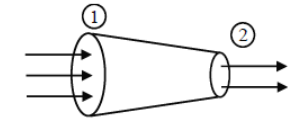
A tube of length \(L\) is shown in the figure. The radius of cross section at the point \((1)\) is 2 cm and at the point \((2)\) is 1 cm , respectively. If the velocity of water entering at point (1) is \(2 \mathrm{~m} / \mathrm{s}\), then velocity of water leaving the point (2) will be [JEE Main 2025 (Online) 22nd January Evening Shift]
 CorrectIncorrect
Hint
(d) To find the velocity of water at the exit of the tube, we use the Equation of Continuity for an incompressible fluid.
Step 1: State the Continuity Equation
The principle of conservation of mass states that the mass flow rate entering a tube must equal the mass flow rate leaving it. For a liquid with constant density, this simplifies to the volume flow rate \((Q)\) :
\(
A_1 v_1=A_2 v_2
\)
Where:
\(A_1, A_2\) are the cross-sectional areas at points 1 and 2.
\(v_1, v_2\) are the velocities of water at points 1 and 2.
Step 2: Relate Area to Radius
Since the tube has a circular cross-section, the area \(A\) is given by \(\pi r^2\). Substituting this into the continuity equation:
\(
\begin{aligned}
\pi r_1^2 v_1 & =\pi r_2^2 v_2 \\
r_1^2 v_1 & =r_2^2 v_2
\end{aligned}
\)
Step 3: Identify Given Values
Radius at point \(1\left(r_1\right)=2 \mathrm{~cm}\)
Radius at point \(2\left(r_2\right)=1 \mathrm{~cm}\)
Velocity at point \(1\left(v_1\right)=2 \mathrm{~m} / \mathrm{s}\)
Step 4: Calculate the Velocity (\(v_2\))
Rearrange the equation to solve for \(v_2\) :
\(
v_2=v_1\left(\frac{r_1}{r_2}\right)^2
\)
Substitute the values:
\(
\begin{gathered}
v_2=2 \cdot\left(\frac{2}{1}\right)^2 \\
v_2=2 \cdot(4) \\
v_2=8 \mathrm{~m} / \mathrm{s}
\end{gathered}
\)
The velocity of water leaving point (2) is \(8 \mathrm{~m} / \mathrm{s}\). - Question 21 of 93
21. Question
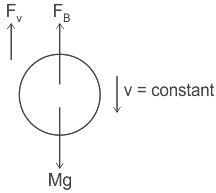
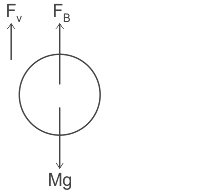
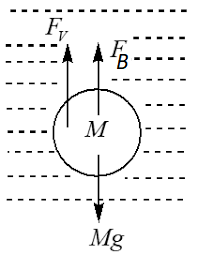
A small rigid spherical ball of mass M is dropped in a long vertical tube containing glycerine. The velocity of the ball becomes constant after some time. If the density of glycerine is half of the density of the ball, then the viscous force acting on the ball will be (consider g as acceleration due to gravity) [JEE Main 2025 (Online) 22nd January Evening Shift]
CorrectIncorrectHint
(c)

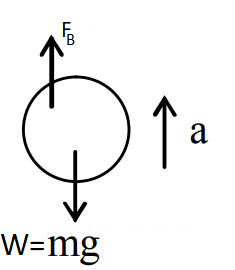
Step 1: Identify the forces acting on the ball
When the ball is dropped into the glycerine, it is subject to three vertical forces:
Weight (\(W\)): Acting vertically downwards, given by \(W=M g\).
Buoyant Force \(\left(F_B\right)\) : Acting vertically upwards, equal to the weight of the displaced glycerine.
Viscous Force (\(F_v\)): Acting vertically upwards, opposing the downward motion of the ball.
Step 2: Calculate the Buoyant Force
The mass of the ball \(M\) can be expressed in terms of its volume \(V\) and density \(\rho_b\) as \(M=V \rho_b\). Therefore, \(V=\frac{M}{\rho_b}\).
The buoyant force is defined by the volume of liquid displaced:
\(
F_B=V \rho_g g
\)
Given that the density of glycerine \(\rho_g\) is half the density of the ball \(\left(\rho_g=\frac{\rho_b}{2}\right)\), we substitute \(V\) and \(\rho_g\) into the equation:
\(
F_B=\left(\frac{M}{\rho_b}\right)\left(\frac{\rho_b}{2}\right) g=\frac{M g}{2}
\)
Step 3: Apply the condition for constant velocity
When the velocity of the ball becomes constant (terminal velocity), the net force acting on the ball is zero. This means the upward forces must balance the downward forces:
\(
F_v+F_B=W
\)
Substituting the known values:
\(
F_v+\frac{M g}{2}=M g
\)
Solving for the viscous force \(F_v\) :
\(
F_v=M g-\frac{M g}{2}=\frac{M g}{2}
\)
The viscous force acting on the ball is \(\frac{\mathbf{M g}}{\mathbf{2}}\) - Question 22 of 93
22. Question
The excess pressure inside a soap bubble is thrice the excess pressure inside a second soap bubble. The ratio between the volume of the first and the second bubble is: [JEE Main 2024 (Online) 9th April Evening Shift]
CorrectIncorrectHint
(b) To find the ratio of the volumes of the two soap bubbles, we need to look at the relationship between excess pressure, radius, and volume.
Step 1: Excess Pressure in a Soap Bubble
For a soap bubble (which has two surfaces, inner and outer), the excess pressure \(\Delta P\) is given by the formula:
\(
\Delta P=\frac{4 T}{R}
\)
Where:
\(T\) is the surface tension of the soap solution.
\(R\) is the radius of the bubble.
From this formula, we can see that excess pressure is inversely proportional to the radius:
\(
\Delta P \propto \frac{1}{R}
\)
Step 2: Establish the Ratio of Radii
Let the first bubble have radius \(R_1\) and excess pressure \(\Delta P_1\), and the second bubble have radius \(R_2\) and excess pressure \(\Delta P_2\).
The problem states that \(\Delta P_1=3 \Delta P_2\).
Using the inverse proportionality:
\(
\begin{gathered}
\frac{\Delta P_1}{\Delta P_2}=\frac{R_2}{R_1} \\
3=\frac{R_2}{R_1} \Longrightarrow \frac{R_1}{R_2}=\frac{1}{3}
\end{gathered}
\)
Step 3: Calculate the Ratio of Volumes
The volume \(V\) of a spherical bubble is given by \(V=\frac{4}{3} \pi R^3\).
Therefore, the volume is proportional to the cube of the radius:
\(
V \propto R^3
\)
Now, we find the ratio of the volumes \(\left(V_1: V_2\right)\) :
\(
\begin{gathered}
\frac{V_1}{V_2}=\left(\frac{R_1}{R_2}\right)^3 \\
\frac{V_1}{V_2}=\left(\frac{1}{3}\right)^3=\frac{1}{27}
\end{gathered}
\)
The ratio between the volume of the first and second bubble is \(1: 27\). - Question 23 of 93
23. Question
A spherical ball of radius \(1 \times 10^{-4} \mathrm{~m}\) and density \(10^5 \mathrm{~kg} / \mathrm{m}^3\) falls freely under gravity through a distance \(h\) before entering a tank of water, If after entering in water the velocity of the ball does not change, then the value of \(h\) is approximately: [JEE Main 2024 (Online) 9th April Evening Shift]
(The coefficient of viscosity of water is \(9.8 \times 10^{-6} \mathrm{~N} \mathrm{~s} / \mathrm{m}^2\))CorrectIncorrectHint
(a) To solve this, we must recognize that if the velocity of the ball does not change after entering the water, it must have entered the water already traveling at its terminal velocity \(\left(v_t\right)\).
Step 1: Calculate the Terminal Velocity \(\left(v_t\right)\)
The terminal velocity of a sphere in a viscous medium is given by:
\(
v_t=\frac{2}{9} \frac{r^2\left(\rho_s-\rho_l\right) g}{\eta}
\)
Given Data:
Radius \((r)=1 \times 10^{-4} \mathrm{~m}\)
Density of ball \(\left(\rho_s\right)=10^5 \mathrm{~kg} / \mathrm{m}^3[latex]
Density of water [latex]\left(\rho_l\right)=10^3 \mathrm{~kg} / \mathrm{m}^3\)
Viscosity \((\eta)=9.8 \times 10^{-6} \mathrm{~N} \mathrm{~s} / \mathrm{m}^2\)
Gravity \((g)=9.8 \mathrm{~m} / \mathrm{s}^2\)
Calculation:
First, find the density difference: \(\Delta \rho=10^5-10^3 \approx 10^5 \mathrm{~kg} / \mathrm{m}^3\) (since \(10^3\) is negligible compared to \(10^5\)).
\(
v_t=\frac{2}{9} \times \frac{\left(10^{-4}\right)^2 \times 10^5 \times 9.8}{9.8 \times 10^{-6}}
\)
\(
v_t=\frac{2}{9} \times \frac{10^{-3}}{10^{-6}}=\frac{2}{9} \times 10^3=\frac{2000}{9} \mathrm{~m} / \mathrm{s}
\)
Step 2: Calculate the Height (\(h\))
The ball falls freely under gravity for a distance \(h\) starting from rest (\(u=0\)). Using the equations of motion:
\(
v^2=u^2+2 g h
\)
Since \(v=v_t\) and \(u=0\) :
\(
v_t^2=2 g h \Longrightarrow h=\frac{v_t^2}{2 g}
\)
Substitution:
\(
\begin{aligned}
h & =\frac{(2000 / 9)^2}{2 \times 9.8} \\
h & =\frac{4,000,000 / 81}{19.6}\approx 2519.5 \mathrm{~m}
\end{aligned}
\) - Question 24 of 93
24. Question
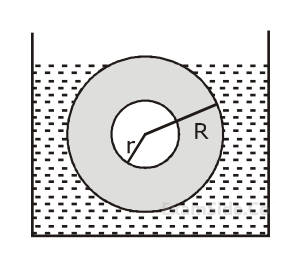
A sphere of relative density \(\sigma\) and diameter \(D\) has concentric cavity of diameter \(d\). The ratio of \(\frac{D}{d}\), if it just floats on water in a tank is: [JEE Main 2024 (Online) 9th April Morning Shift]
CorrectIncorrectHint
(d) To solve this, we use the principle of floatation, which states that for an object to “just float,” its total weight must equal the buoyant force exerted by the water it displaces.
Step 1: Define the Volumes
Total Volume of the sphere \(\left(V_{\text {total }}\right)\) : This is the volume enclosed by the outer diameter \(D\)
\(
V_{t o t a l}=\frac{4}{3} \pi\left(\frac{D}{2}\right)^3=\frac{\pi D^3}{6}
\)
Volume of the cavity (\(V_{\text {cavity }}\)): This is the volume of the hollow part with diameter \(d\).
\(
V_{\text {cavity }}=\frac{\pi d^3}{6}
\)
Volume of the material (\(V_{\text {material }}\)):
\(
V_{\text {material }}=V_{\text {total }}-V_{\text {cavity }}=\frac{\pi}{6}\left(D^3-d^3\right)
\)
Step 2: Establish the Equilibrium Condition
For the sphere to just float, it must be fully submerged, and its weight must equal the buoyant force.
\(
\begin{gathered}
\text { Weight of Sphere }=\text { Buoyant Force } \\
\left(V_{\text {material }} \cdot \rho_{\text {sphere }} \cdot g\right)=\left(V_{\text {total }} \cdot \rho_{\text {water }} \cdot g\right)
\end{gathered}
\)
Where \(\rho_{\text {sphere }}\) is the density of the material and \(\rho_{\text {water }}\) is the density of water.
Step 3: Use Relative Density
Relative density \((\sigma)\) is defined as \(\frac{\rho_{\text {sphere }}}{\rho_{\text {water }}}\). Therefore, \(\rho_{\text {sphere }}=\sigma \cdot \rho_{\text {water }}\).
Substituting this into the equilibrium equation:
\(
\frac{\pi}{6}\left(D^3-d^3\right) \cdot \sigma \cdot \rho_{\text {water }} \cdot g=\frac{\pi D^3}{6} \cdot \rho_{\text {water }} \cdot g
\)
Step 4: Simplify and Solve for the Ratio
Cancel the common terms \(\left(\frac{\pi}{6}, \rho_{\text {water }}\right.\), and \(\left.g\right)\) :
\(
\left(D^3-d^3\right) \sigma=D^3
\)
Divide both sides by \(D^3[latex] :
[latex]
\begin{gathered}
\sigma\left(1-\frac{d^3}{D^3}\right)=1 \\
1-\frac{d^3}{D^3}=\frac{1}{\sigma} \\
\frac{d^3}{D^3}=1-\frac{1}{\sigma}=\frac{\sigma-1}{\sigma}
\end{gathered}
\)
Inverting the fraction to find \(\frac{D^3}{d^3}\) :
\(
\frac{D^3}{d^3}=\frac{\sigma}{\sigma-1}
\)
Taking the cube root of both sides:
\(
\frac{D}{d}=\left(\frac{\sigma}{\sigma-1}\right)^{1 / 3}
\) - Question 25 of 93
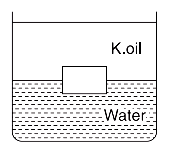
25. Question
A cube of ice floats partly in water and partly in kerosene oil. The ratio of volume of ice immersed in water to that in kerosene oil (specific gravity of Kerosene oil \(=0.8\), specific gravity of ice \(=0.9\)): [JEE Main 2024 (Online) 8th April Evening Shift]
 CorrectIncorrect
Hint
(d) To find the ratio of the volume of ice immersed in water to the volume immersed in kerosene, we use the principle of buoyancy.
Step 1: Identify the Equilibrium Condition
Since the ice cube is floating in equilibrium, the total upward buoyant force must equal the downward weight of the ice cube. In this case, the buoyant force is the sum of the forces exerted by both liquids:
Weight of Ice \(=\) Buoyant Force from Water + Buoyant Force from Kerosene
Step 2: Set up the Equation
Let:
\(V_w=\) Volume of ice in water
\(V_k=\) Volume of ice in kerosene
\(\rho_i=\) Density of ice \(\left(0.9 \mathrm{~g} / \mathrm{cm}^3\right.\), based on specific gravity)
\(\rho_w=\) Density of water \(\left(1.0 \mathrm{~g} / \mathrm{cm}^3\right)\)
\(\rho_k=\) Density of kerosene \(\left(0.8 \mathrm{~g} / \mathrm{cm}^3\right)\)
The weight of the ice depends on its total volume (\(V_w+V_k\)):
\(
\left(V_w+V_k\right) \rho_i g=\left(V_w \rho_w g\right)+\left(V_k \rho_k g\right)
\)
Step 3: Simplify and Rearrange
Cancel gravity (\(g\)) from all terms and substitute the specific gravity values:
\(
\begin{gathered}
\left(V_w+V_k\right) \times 0.9=\left(V_w \times 1.0\right)+\left(V_k \times 0.8\right) \\
0.9 V_w+0.9 V_k=1.0 V_w+0.8 V_k
\end{gathered}
\)
Now, group the \(V_w\) terms on one side and the \(V_k\) terms on the other:
\(
\begin{aligned}
0.9 V_k-0.8 V_k & =1.0 V_w-0.9 V_w \\
0.1 V_k & =0.1 V_w
\end{aligned}
\)
Step 4: Find the Ratio
\(
\frac{V_w}{V_k}=\frac{0.1}{0.1}=1
\)
The ratio of the volume of ice immersed in water to that in kerosene oil is \(1: 1\). - Question 26 of 93
26. Question
Correct Bernoulli’s equation is (symbols have their usual meaning) : [JEE Main 2024 (Online) 8th April Morning Shift]
CorrectIncorrectHint
(d) Understanding the Terms:
Bernoulli’s equation states that for a streamline flow, the sum of the pressure energy, potential energy, and kinetic energy per unit volume remains constant at every crosssection.
Pressure Energy per unit volume: \(P\)
Potential Energy per unit volume: \(\frac{m g h}{V}=\rho g h\) (since density \(\rho=\frac{m}{V}\))
Kinetic Energy per unit volume: \(\frac{\frac{1}{2} m v^2}{V}=\frac{1}{2} \rho v^2\)
The Equation:
Combining these terms, we get the standard form of Bernoulli’s equation:
\(
P+\rho g h+\frac{1}{2} \rho v^2=\text { constant }
\)
Evaluating the Options:
(A): Incorrect. It adds a \(1 / 2\) factor to the potential energy term (\(\rho g h\)).
(B): Incorrect. It uses mass (\(m\)) instead of density (\(\rho\)). These terms represent energy, not energy per unit volume.
(C): Incorrect. It misses the \(1 / 2\) coefficient for the kinetic energy term.
(D): Correct. This matches the derivation for energy per unit volume.
Correct Answer: (D) \(P+\rho g h+\frac{1}{2} \rho v^2=\) constant - Question 27 of 93
27. Question
Pressure inside a soap bubble is greater than the pressure outside by an amount : (given : \(R=\) Radius of bubble, \(S=\) Surface tension of bubble) [JEE Main 2024 (Online) 6th April Evening Shift]
CorrectIncorrectHint
(b) To find the excess pressure inside a soap bubble, we need to consider the number of surfaces in contact with air.
The Concept of Excess Pressure:
Surface tension acts to minimize the surface area of the bubble, creating an inward force. To keep the bubble inflated, the pressure inside must be higher than the pressure outside. The difference is called the excess pressure (\(\Delta P=P_{\text {in }}-P_{\text {out }}\)).
Soap Bubble vs. Liquid Drop:
Liquid Drop/Air Bubble in Liquid: Has only one surface (the interface between liquid and air). The excess pressure is \(\Delta P=\frac{2 S}{R}\).
Soap Bubble in Air: A soap bubble is a thin film of liquid with air on both the inside and the outside. This means it has two surfaces (inner and outer).
Calculation:
Because there are two surfaces, the force due to surface tension is doubled:
\(
\Delta P=2 \times\left(\frac{2 S}{R}\right)=\frac{4 S}{R}
\) - Question 28 of 93
28. Question
A small ball of mass \(m\) and density \(\rho\) is dropped in a viscous liquid of density \(\rho_0\). After sometime, the ball falls with constant velocity. The viscous force on the ball is : [JEE Main 2024 (Online) 6th April Morning Shift]
CorrectIncorrectHint
(a) To find the viscous force acting on the ball, we analyze the forces in play once the ball reaches its “constant velocity,” also known as terminal velocity.
Step 1: Analyze the Equilibrium Condition
When the ball falls with a constant velocity, the acceleration is zero. This means the downward forces are perfectly balanced by the upward forces.
Downward Force = Upward Forces
Step 2: Identify the Individual Forces
Weight (\(W\)): Acts downward.
\(
W=m g
\)
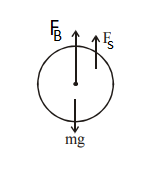
Buoyant Force (\(F_B\)): Acts upward. It is equal to the weight of the liquid displaced.
\(
F_B=V \cdot \rho_0 \cdot g
\)
(where \(V\) is the volume of the ball and \(\rho_0\) is the density of the liquid).
Viscous Force (\(F_v\)): Acts upward, opposing the motion.
Step 3: Express Buoyant Force in terms of Mass
We know that the mass of the ball is \(m=V \cdot \rho\), which means the volume is \(V=\frac{m}{\rho}\). Substituting this into the buoyant force equation:
\(
F_B=\left(\frac{m}{\rho}\right) \cdot \rho_0 \cdot g=m g\left(\frac{\rho_0}{\rho}\right)
\)
Step 4: Solve for Viscous Force (\(F_v\))
From the equilibrium condition:
\(
\begin{aligned}
& W=F_B+F_v \\
& F_v=W-F_B
\end{aligned}
\)
Substituting the expressions for \(W\) and \(F_B\) :
\(
F_v=m g-m g\left(\frac{\rho_0}{\rho}\right)
\)
Factor out \(m g\) :
\(
F_v=m g\left(1-\frac{\rho_0}{\rho}\right)
\)
The viscous force on the ball is \(m g\left(1-\frac{\rho_0}{\rho}\right)\). - Question 29 of 93
29. Question
Given below are two statements :
Statement I : When a capillary tube is dipped into a liquid, the liquid neither rises nor falls in the capillary. The contact angle may be \(0^{\circ}\).
Statement II : The contact angle between a solid and a liquid is a property of the material of the solid and liquid as well.
In the light of the above statement, choose the correct answer from the options given below. [JEE Main 2024 (Online) 5th April Morning Shift]CorrectIncorrectHint
(d) Step 1: Analyze Statement I
Statement I: “When a capillary tube is dipped into a liquid, the liquid neither rises nor falls in the capillary. The contact angle may be \(0^{\circ}\).”
The Science: The height \(h\) of liquid in a capillary tube is given by:
\(
h=\frac{2 T \cos \theta}{r \rho g}
[latex]
For the liquid to neither rise nor fall, [latex]h\) must be \(\mathbf{0}\). This happens when \(\cos \theta=0\), which corresponds to a contact angle of \(\theta=90^{\circ}\).
If the contact angle were \(0^{\circ}, \cos \left(0^{\circ}\right)=1\), which results in the maximum possible rise for that liquid and tube.
Conclusion: Statement I is False. A zero-degree contact angle leads to significant capillary rise, not a neutral state.
Step 2: Analyze Statement II
Statement II: “The contact angle between a solid and a liquid is a property of the material of the solid and liquid as well.”
The Science: The contact angle is determined by the balance of cohesive forces (between liquid molecules) and adhesive forces (between liquid and solid molecules).
Because it depends on the interface of the two substances, it is a characteristic property of the specific pair of materials (liquid and solid). For example, water has a different contact angle with clean glass than it does with silver or paraffin wax.
Conclusion: Statement II is True.
Step 3: Choose the Correct Option
Statement I is False.
Statement II is True.
Comparing this to the provided options:
Correct Answer: (b) Statement I is false but Statement II is true. - Question 30 of 93
30. Question
Given below are two statements :
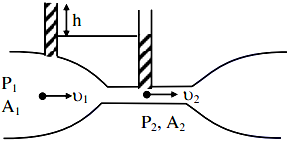
Statement I : When speed of liquid is zero everywhere, pressure difference at any two points depends on equation \(\mathrm{P}_1-\mathrm{P}_2=\rho g\left(\mathrm{~h}_2-\mathrm{h}_1\right)\).
Statement II: In ventury tube shown \(2 \mathrm{gh}=v_1^2-v_2^2\) [JEE Main 2024 (Online) 4th April Morning Shift]
In the light of the above statements, choose the most appropriate answer from the options given below.
CorrectIncorrectHint
(a) Step 1: Analyze Statement I
For a fluid at rest (hydrostatics), the pressure \(P\) at a height \(h\) from the bottom is given by \(P=P_0+\rho g(H-h)\), where \(H\) is the total height of the liquid and (\(H-h\)) represents the depth. Considering two points at heights \(h_1\) and \(h_2\) :
\(
\begin{aligned}
& P_1=P_0+\rho g\left(H-h_1\right) \\
& P_2=P_0+\rho g\left(H-h_2\right)
\end{aligned}
\)
Subtracting the two equations:
\(
P_1-P_2=\rho g\left(H-h_1\right)-\rho g\left(H-h_2\right)=\rho g\left(h_2-h_1\right)
\)
Thus, Statement I is correct.
Step 2: Analyze Statement II
A Venturi tube operates based on Bernoulli’s principle for horizontal flow:
\(
P_1+\frac{1}{2} \rho v_1^2=P_2+\frac{1}{2} \rho v_2^2
\)
The pressure difference between the inlet (wider part) and the throat (narrower part) is measured by a manometer height \(h\), where \(P_1-P_2=\rho g h\). Substituting this into Bernoulli’s equation:
\(
\begin{gathered}
\rho g h=\frac{1}{2} \rho v_2^2-\frac{1}{2} \rho v_1^2 \\
2 g h=v_2^2-v_1^2
\end{gathered}
\)
Since the velocity at the throat \(\left(v_2\right)\) is greater than the velocity at the inlet \(\left(v_1\right)\) due to the continuity equation, \(v_2^2-v_1^2\) is positive. Statement II claims \(2 g h=v_1^2-v_2^2\), which would result in a negative value for a positive height \(h\). Thus, Statement II is incorrect. - Question 31 of 93
31. Question
A big drop is formed by coalescing 1000 small droplets of water. The surface energy will become : [JEE Main 2024 (Online) 1st February Evening Shift]
CorrectIncorrectHint
(b) To determine how the surface energy changes, we need to compare the total surface area of the 1000 small droplets to the surface area of the single large drop formed after they coalesce.
Step 1: Conservation of Volume
When 1000 small droplets of radius \(r\) merge into one big drop of radius \(R\), the total volume remains the same:
\(
\begin{aligned}
& \text { Volume of big drop }=1000 \times \text { (Volume of one small droplet) } \\
& \qquad \begin{array}{c}
\frac{4}{3} \pi R^3=1000 \times\left(\frac{4}{3} \pi r^3\right) \\
R^3=1000 r^3
\end{array}
\end{aligned}
\)
Taking the cube root of both sides:
\(
R=10 r
\)
Step 2: Compare Surface Areas
Surface energy (\(E\)) is proportional to the surface area (\(A\)), given by \(E=T \times A\).
Initial Surface Energy (\(E_i\)):
\(
E_i=1000 \times\left(4 \pi r^2\right)=4000 \pi r^2
\)
Final Surface Energy (\(E_f\)):
\(
E_f=4 \pi R^2
\)
Substitute \(R=10 r\) :
\(
E_f=4 \pi(10 r)^2=4 \pi\left(100 r^2\right)=400 \pi r^2
\)
Step 3: Find the Ratio
To see what the surface energy “becomes,” we find the ratio of the final energy to the initial energy:
\(
\begin{gathered}
\frac{E_f}{E_i}=\frac{400 \pi r^2}{4000 \pi r^2} \\
\frac{E_f}{E_i}=\frac{400}{4000}=\frac{1}{10}
\end{gathered}
\)
The surface energy of the big drop is \(\frac{1}{10}\) th of the total surface energy of the initial 1000 droplets. - Question 32 of 93
32. Question
A small spherical ball of radius \(r\), falling through a viscous medium of negligible density has terminal velocity ‘ \(v\) ‘. Another ball of the same mass but of radius \(2 r\), falling through the same viscous medium will have terminal velocity: [JEE Main 2024 (Online) 31st January Evening Shift]
CorrectIncorrectHint
(d) The Terminal Velocity Formula
The terminal velocity (\(v\)) of a spherical ball in a viscous medium is given by:
\(
v=\frac{2}{9} \frac{r^2\left(\rho_s-\rho_l\right) g}{\eta}
\)
Since the density of the medium is negligible (\(\rho_l \approx 0\)), the formula simplifies to:
\(
v=\frac{2}{9} \frac{r^2 \rho_s g}{\eta}
\)
Relate Density to Mass:
We are told the two balls have the same mass \((M)\). Density \(\left(\rho_s\right)\) is mass divided by volume:
\(
\rho_s=\frac{M}{\frac{4}{3} \pi r^3}
\)
Substitute this density into the terminal velocity equation:
\(
\begin{aligned}
& v \propto r^2 \times \rho_s \\
& v \propto r^2 \times \frac{M}{r^3}
\end{aligned}
\)
\(
v \propto \frac{M}{r}
\)
Compare the Two Balls:
Since the mass \((M)\), gravity \((g)\), and viscosity \((\eta)\) are the same for both balls:
\(
v \propto \frac{1}{r}
\)
This means that for a constant mass, the terminal velocity is inversely proportional to the radius.
Ball 1: Radius \(=r\), Terminal Velocity \(=v\)
Ball 2: Radius \(=2 r\), Terminal Velocity \(=v^{\prime}\)
\(
\begin{aligned}
\frac{v^{\prime}}{v} & =\frac{r}{2 r} \\
\frac{v^{\prime}}{v} & =\frac{1}{2} \\
v^{\prime} & =\frac{v}{2}
\end{aligned}
\)
Conclusion: When the radius is doubled while keeping the mass constant, the terminal velocity is halved. This happens because a larger radius increases the surface area (and thus the viscous drag) more significantly than it affects the density-driven downward force for a fixed mass. - Question 33 of 93
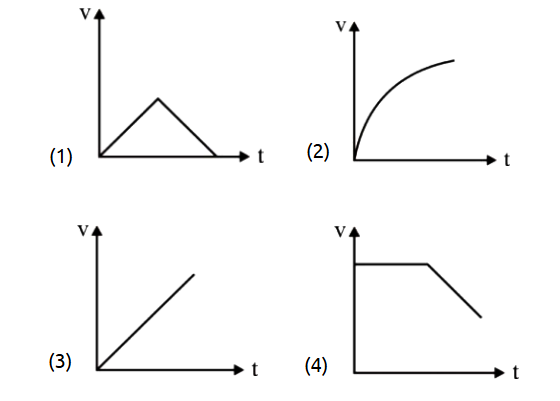
33. Question
A small steel ball is dropped into a long cylinder containing glycerine. Which one of the following is the correct representation of the velocity time graph for the transit of the ball? [JEE Main 2024 (Online) 31st January Morning Shift]
 CorrectIncorrect
Hint
(b) When a steel ball is dropped into a viscous liquid like glycerine, its motion is governed by three forces: gravity (\(m g\)), buoyancy (\(F_B\)), and viscous drag (\(F_v\)).
At \(t=0\) : The ball is dropped from rest, so its velocity \(v=0\). This matches the origin \((0,0)\) in the graph.
The Acceleration Phase: Initially, the downward force of gravity is much stronger than the upward forces (buoyancy and drag). The ball accelerates, but as its speed increases, the viscous drag-which is proportional to velocity ( \(F_v=6 \pi \eta r v\) )-also increases.
Decreasing Acceleration: Because the opposing drag force grows as the ball speeds up, the net force (\(F_{n e t}=m g-F_B-F_v\)) decreases. Consequently, the acceleration (the slope of the \(v-t\) graph) gradually decreases, which is shown by the curve bending toward the horizontal.
Terminal Velocity: Eventually, the upward forces perfectly balance the downward weight. The net force becomes zero, acceleration stops, and the ball continues at a constant speed known as terminal velocity. In Graph (2), this is represented by the curve flattening out into a horizontal asymptote. \(
\begin{aligned}
&\begin{aligned}
& \mathrm{mg}-\mathrm{F}_{\mathrm{B}}-\mathrm{F}_{\mathrm{v}}=\mathrm{ma} \\
& \left(\rho \frac{4}{3} \pi \mathrm{r}^3\right) g-\left(\rho_{\mathrm{L}} \frac{4}{3} \pi \mathrm{r}^3\right) g-6 \pi \eta r v=m \frac{d v}{d t}
\end{aligned}\\
&\text { Let } \frac{4}{3 m} \pi R^3 g\left(\rho-\rho_L\right)=K_1 \text { and } \frac{6 \pi \eta r}{m}=K_2\\
&\begin{aligned}
& \frac{\mathrm{dv}}{\mathrm{dt}}=\mathrm{K}_1-\mathrm{K}_2 \mathrm{~V} \\
& \int_0^v \frac{d v}{K_1-K_2 v}=\int_0^t d t \\
& -\frac{1}{K_2} \ln \left[K_1-K_2 v\right]_0^v=t \\
& \ln \left(\frac{K_1-K_2 v}{K_1}\right)=-K_2 t \\
& K_1-K_2 v=K_1 e^{-K_2 t} \\
& v=\frac{K_1}{K_2}\left[1-e^{-K_2 t}\right]
\end{aligned}
\end{aligned}
\) - Question 34 of 93
34. Question
A small liquid drop of radius \(R\) is divided into 27 identical liquid drops. If the surface tension is \(T\), then the work done in the process will be: [JEE Main 2024 (Online) 29th January Evening Shift]
CorrectIncorrectHint
(b) To find the work done in dividing a large drop into smaller droplets, we calculate the increase in total surface energy, which is the product of surface tension and the change in surface area.
Conservation of Volume:
When a large drop of radius \(R[latex] is divided into [latex]n=27\) small droplets of radius \(r\), the total volume remains constant:
Volume of large drop \(=n \times\) (Volume of one small drop)
\(
\begin{gathered}
\frac{4}{3} \pi R^3=27 \times\left(\frac{4}{3} \pi r^3\right) \\
R^3=27 r^3
\end{gathered}
\)
Taking the cube root of both sides:
\(
R=3 r \Longrightarrow r=\frac{R}{3}
\)
Calculate Surface Areas:
Initial Surface Area (\(A_i\)):
\(
A_i=4 \pi R^2
\)
Final Surface Area \(\left(\boldsymbol{A}_{\boldsymbol{f}}\right)\) :
\(
A_f=27 \times\left(4 \pi r^2\right)
\)
Substitute \(r=\frac{R}{3}\) :
\(
\begin{gathered}
A_f=27 \times 4 \pi\left(\frac{R}{3}\right)^2 \\
A_f=27 \times 4 \pi \frac{R^2}{9} \\
A_f=3 \times\left(4 \pi R^2\right)=12 \pi R^2
\end{gathered}
\)
Calculate Work Done (\(W\)):
The work done is equal to the increase in surface energy:
\(
\begin{gathered}
W=T \times\left(A_f-A_i\right) \\
W=T \times\left(12 \pi R^2-4 \pi R^2\right) \\
W=8 \pi R^2 T
\end{gathered}
\) - Question 35 of 93
35. Question
Given below are two statements:
Statement I : If a capillary tube is immersed first in cold water and then in hot water, the height of capillary rise will be smaller in hot water.
Statement II: If a capillary tube is immersed first in cold water and then in hot water, the height of capillary rise will be smaller in cold water.
In the light of the above statements, choose the most appropriate from the options given below [JEE Main 2024 (Online) 29th January Morning Shift]CorrectIncorrectHint
(c) The Physics of Capillary Rise
The height \(h\) to which a liquid rises in a capillary tube is given by the formula:
\(
h=\frac{2 T \cos \theta}{r \rho g}
\)
Temperature Dependence:
When the temperature of water increases (changing from cold to hot), several things happen:
Surface Tension (\(T\)): As temperature rises, the kinetic energy of the water molecules increases, which weakens the intermolecular cohesive forces. Consequently, the surface tension decreases.
Density (\(\rho\)): For water, as it heats up (above \(4^{\circ} \mathrm{C}\)), its density slightly decreases. However, the decrease in surface tension is much more significant than the change in density in this context.
Conclusion:
Since \(h\) is directly proportional to surface tension (\(h \propto T\)), a decrease in surface tension due to heating will result in a smaller height of capillary rise.
Statement I: Correctly identifies that the rise is smaller in hot water.
Statement II: Incorrectly claims the rise is smaller in cold water.
Correct Answer: (c) Statement I is true but Statement II is false. - Question 36 of 93
36. Question
Given below are two statements :
Statement (I) :Viscosity of gases is greater than that of liquids.
Statement (II) : Surface tension of a liquid decreases due to the presence of insoluble impurities.
In the light of the above statements, choose the most appropriate answer from the options given below: [JEE Main 2024 (Online) 27th January Morning Shift]CorrectIncorrectHint
(b) Step 1: Analyze Statement I
Statement I: “Viscosity of gases is greater than that of liquids.”
The Physics: Viscosity represents a fluid’s resistance to flow. In liquids, viscosity is primarily due to strong intermolecular cohesive forces. In gases, viscosity arises from the momentum transfer between molecules during collisions.
Comparison: Because the cohesive forces in liquids are significantly stronger than the molecular interactions in gases, liquids are much more “thick” or viscous than gases. For example, the viscosity of water at room temperature is approximately 50 times greater than that of air.
Conclusion: Statement I is incorrect.
Step 2: Analyze Statement II
Statement II: “Surface tension of a liquid decreases due to the presence of insoluble impurities.”
The Physics: Surface tension is the result of cohesive forces between liquid molecules at the surface.
Insoluble Impurities: When insoluble impurities (like oil or dust) are present on the surface of a liquid (like water), they get between the liquid molecules and weaken the strength of the hydrogen bonds or cohesive forces.
Conclusion: Statement II is correct. Insoluble impurities consistently reduce the surface tension of a liquid.
Final Evaluation
Statement I is incorrect.
Statement II is correct.
Comparing this to the provided options:
Correct Answer: (B) Statement I is incorrect but Statement II is correct - Question 37 of 93
37. Question
Given below are two statements: one is labelled as Assertion \(\mathbf{A}\) and the other is labelled as Reason \(\mathbf{R}\)
Assertion \(\mathbf{A}\) : A spherical body of radius \((5 \pm 0.1) \mathrm{mm}\) having a particular density is falling through a liquid of constant density. The percentage error in the calculation of its terminal velocity is \(4 \%\).
Reason \(\mathbf{R}\) : The terminal velocity of the spherical body falling through the liquid is inversely proportional to its radius.
In the light of the above statements, choose the correct answer from the options given below [JEE Main 2023 (Online) 13th April Evening Shift]CorrectIncorrectHint
(b) To determine the correct answer, we need to evaluate the physics of terminal velocity and the mathematics of error propagation.
Step 1: Analyze Reason (\(R\))
The terminal velocity \(\left(v_t\right)\) of a spherical body falling through a viscous liquid is given by the formula:
\(
v_t=\frac{2}{9} \frac{r^2\left(\rho_s-\rho_l\right) g}{\eta}
\)
From this equation, we can see that:
Terminal velocity is directly proportional to the square of the radius \(\left(v_t \propto r^2\right)\).
Reason R states that it is inversely proportional to the radius \(\left(v_t \propto 1 / r\right)\).
Conclusion: Reason R is False.
Step 2: Analyze Assertion (\(A\))
We need to calculate the percentage error in terminal velocity based on the error in the radius.
Given Data:
Radius \((r)=5 \mathrm{~mm}\)
Error in radius \((\Delta r)=0.1 \mathrm{~mm}\)
Error Propagation Formula:
Since \(v_t \propto r^2\), the relative error in \(v_t\) is related to the relative error in \(r\) as follows:
\(
\frac{\Delta v_t}{v_t}=2\left(\frac{\Delta r}{r}\right)
\)
Calculation:
Find the percentage error in the radius:
\(
\% \text { Error in } r=\frac{0.1}{5} \times 100=2 \%
\)
Find the percentage error in terminal velocity:
\(
\% \text { Error in } v_t=2 \times(2 \%)=4 \%
\)
Conclusion: Assertion A is True.
Final Evaluation:
Assertion A is true.
Reason R is false.
Comparing this to the provided options:
Correct Answer: (b) A is true but R is false - Question 38 of 93
38. Question
The figure shows a liquid of given density flowing steadily in horizontal tube of varying cross – section. Cross sectional areas at \(A\) is \(1.5 \mathrm{~cm}^2\), and \(B\) is \(25 \mathrm{~mm}^2\), if the speed of liquid at \(B\) is \(60 \mathrm{~cm} / \mathrm{s}\) then \(\left(P_A-P_B\right)\) is :
(Given \(\mathrm{P}_{\mathrm{A}}\) and \(\mathrm{P}_{\mathrm{B}}\) are liquid pressures at \(A\) and \(\mathrm{B} \%\) points.
density \(\rho=1000 \mathrm{~kg} \mathrm{~m}^{-3}\)
A and B are on the axis of tube [JEE Main 2023 (Online) 13th April Morning Shift] CorrectIncorrect
Hint
(b) To find the pressure difference \(\left(P_A-P_B\right)\), we need to use the Equation of Continuity to find the velocity at \(A\), followed by Bernoulli’s Equation for a horizontal flow.
Step 1: Convert Units to SI
First, ensure all measurements are in meters and kilograms to avoid calculation errors.
Area at \(A\left(a_A\right): 1.5 \mathrm{~cm}^2=1.5 \times 10^{-4} \mathrm{~m}^2\)
Area at \(B\left(a_B\right): 25 \mathrm{~mm}^2=25 \times 10^{-6} \mathrm{~m}^2\)
Velocity at \(B\left(v_B\right): 60 \mathrm{~cm} / \mathrm{s}=0.6 \mathrm{~m} / \mathrm{s}\)
Density (\(\rho\)): \(1000 \mathrm{~kg} / \mathrm{m}^3\)
Step 2: Find Velocity at \(\mathrm{A}\left(v_A\right)\)
According to the Equation of Continuity (\(a_1 v_1=a_2 v_2\)) for an incompressible fluid:
\(
\begin{gathered}
a_A v_A=a_B v_B \\
v_A=\frac{a_B v_B}{a_A} \\
v_A=\frac{\left(25 \times 10^{-6}\right) \times 0.6}{1.5 \times 10^{-4}} \\
v_A=\frac{15 \times 10^{-6}}{1.5 \times 10^{-4}}=10 \times 10^{-2}=0.1 \mathrm{~m} / \mathrm{s}
\end{gathered}
\)
Step 3: Apply Bernoulli’s Equation
For a horizontal tube, the height \(h\) is constant (\(h_A=h_B\)), so the potential energy terms cancel out:
\(
\begin{aligned}
& P_A+\frac{1}{2} \rho v_A^2=P_B+\frac{1}{2} \rho v_B^2 \\
& P_A-P_B=\frac{1}{2} \rho\left(v_B^2-v_A^2\right)
\end{aligned}
\)
Step 4: Calculate the Pressure Difference
Substitute the known values into the equation:
\(
\begin{gathered}
P_A-P_B=\frac{1}{2} \times 1000 \times\left[(0.6)^2-(0.1)^2\right] \\
P_A-P_B=500 \times[0.36-0.01] \\
P_A-P_B=500 \times 0.35 \\
P_A-P_B=175 \mathrm{~Pa}
\end{gathered}
\)
The pressure difference \(\left(P_A-P_B\right)\) is 175 Pa. - Question 39 of 93
39. Question
Eight equal drops of water are falling through air with a steady speed of \(10 \mathrm{~cm} / \mathrm{s}\). If the drops coalesce, the new velocity is: [JEE Main 2023 (Online) 11th April Evening Shift]
CorrectIncorrectHint
(a) To solve this, we need to look at how the terminal velocity of a falling drop changes when multiple drops merge (coalesce) into one.
Conservation of Volume:
When 8 identical small drops of radius \(r\) merge to form one large drop of radius \(R\), the total volume remains the same:
\(
\begin{aligned}
& \text { Volume of large drop }=8 \times \text { (Volume of one small drop) } \\
& \qquad \begin{aligned}
\frac{4}{3} \pi R^3 & =8 \times\left(\frac{4}{3} \pi r^3\right) \\
R^3 & =8 r^3
\end{aligned}
\end{aligned}
\)
Taking the cube root of both sides:
\(
R=2 r
[latex]
Terminal Velocity Relationship:
The terminal velocity [latex](v)\) of a spherical drop falling through a viscous medium (like air) is given by the formula:
\(
v=\frac{2}{9} \frac{r^2\left(\rho_s-\rho_l\right) g}{\eta}
\)
Since the density of the liquid, density of air, gravity, and viscosity remain constant, we can see that terminal velocity is directly proportional to the square of the radius:
\(
v \propto r^2
\)
Calculating the New Velocity:
Let \(v_1\) be the initial velocity of the small drops and \(v_2\) be the velocity of the new large drop. Using the proportionality:
\(
\frac{v_2}{v_1}=\left(\frac{R}{r}\right)^2
\)
Substitute \(R=2 r\) and \(v_1=10 \mathrm{~cm} / \mathrm{s}\) :
\(
\begin{gathered}
\frac{v_2}{10}=\left(\frac{2 r}{r}\right)^2 \\
\frac{v_2}{10}=2^2=4 \\
v_2=10 \times 4=40 \mathrm{~cm} / \mathrm{s}
\end{gathered}
\)
The new velocity is \(40 \mathrm{~cm} / \mathrm{s}\). - Question 40 of 93
40. Question
Given below are two statements:
Statement I : Pressure in a reservoir of water is same at all points at the same level of water.
Statement II : The pressure applied to enclosed water is transmitted in all directions equally.
In the light of the above statements, choose the correct answer from the options given below: [JEE Main 2023 (Online) 10th April Morning Shift]CorrectIncorrectHint
(d) To determine the correct answer, we need to evaluate the fundamental principles of fluid statics: Pascal’s Law and the Hydrostatic Pressure principle.
Step 1: Analyze Statement I
Statement I: “Pressure in a reservoir of water is same at all points at the same level of water.”
The Physics: In a static fluid of uniform density, the pressure \(P\) at a depth \(h\) is given by \(P=P_0+\rho g h\).
Since the density (\(\rho\)) and gravity (\(g\)) are constant, the pressure depends solely on the vertical depth (\(h\)).
Therefore, any two points at the same horizontal level (the same depth) within a continuous body of water will experience the exact same pressure.
Conclusion: Statement I is True.
Step 2: Analyze Statement II
Statement II: “The pressure applied to enclosed water is transmitted in all directions equally.”
The Physics: This is a literal definition of Pascal’s Law. It states that when pressure is applied to any part of an enclosed, incompressible fluid, that pressure change is transmitted undiminished to every portion of the fluid and to the walls of the container.
This principle is the foundation for hydraulic systems, such as car brakes and hydraulic lifts.
Conclusion: Statement II is True.
Final Evaluation
Statement I is True.
Statement II is True.
Correct Answer: (d) Both Statement I and Statement II are true - Question 41 of 93
41. Question
hydraulic automobile lift is designed to lift vehicles of mass 5000 kg. The area of cross section of the cylinder carrying the load is \(250 \mathrm{~cm}^2\). The maximum pressure the smaller piston would have to bear is [Assume \(g=10 \mathrm{~m} / \mathrm{s}^2\)] [JEE Main 2023 (Online) 8th April Evening Shift]
CorrectIncorrectHint
(d) To find the maximum pressure the smaller piston must bear, we can use Pascal’s Principle, which states that pressure applied to an enclosed fluid is transmitted undiminished to every portion of the fluid and to the walls of the containing vessel.
In a hydraulic lift, the pressure (\(P\)) is the same throughout the system at the same horizontal level. Therefore, the pressure on the smaller piston is equal to the pressure exerted by the load on the larger cylinder.
Step-by-Step Calculation
Identify the given values:
Mass of the vehicle \((m)=5000 \mathrm{~kg}\)
Area of the load cylinder \((A)=250 \mathrm{~cm}^2\)
Acceleration due to gravity \((g)=10 \mathrm{~m} / \mathrm{s}^2\)
Convert the area to SI units (square meters):
Since \(1 \mathrm{~cm}=10^{-2} \mathrm{~m}\), then \(1 \mathrm{~cm}^2=10^{-4} \mathrm{~m}^2\).
\(
A=250 \times 10^{-4} \mathrm{~m}^2=0.025 \mathrm{~m}^2
\)
Calculate the Force (Weight) of the vehicle:
\(
\begin{gathered}
F=m \times g \\
F=5000 \mathrm{~kg} \times 10 \mathrm{~m} / \mathrm{s}^2=50,000 \mathrm{~N}
\end{gathered}
\)
Calculate the Pressure (\(P\)):
Using the formula \(P=\frac{F}{A}\) :
\(
\begin{gathered}
P=\frac{50,000 \mathrm{~N}}{250 \times 10^{-4} \mathrm{~m}^2} \\
P=\frac{50,000}{0.025} \mathrm{~Pa} \\
P=2,000,000 \mathrm{~Pa}
\end{gathered}
\)
Express in scientific notation:
\(
P=2 \times 10^6 \mathrm{~Pa}
\)
Conclusion: The pressure throughout the hydraulic fluid is constant. Thus, the smaller piston must be able to bear this same pressure to lift the load. - Question 42 of 93
42. Question
An air bubble of volume \(1 \mathrm{~cm}^3\) rises from the bottom of a lake 40 m deep to the surface at a temperature of \(12^{\circ} \mathrm{C}\). The atmospheric pressure is \(1 \times 10^5 \mathrm{~Pa}\) the density of water is \(1000 \mathrm{~kg} / \mathrm{m}^3\) and \(\mathrm{g}=10 \mathrm{~m} / \mathrm{s}^2\). There is no difference of the temperature of water at the depth of 40 m and on the surface. The volume of air bubble when it reaches the surface will be: [JEE Main 2023 (Online) 8th April Morning Shift]
CorrectIncorrectHint
(d) To solve this problem, we use Boyle’s Law, which states that for a fixed amount of gas at a constant temperature, the pressure and volume are inversely proportional (\(P_1 V_1=P_2 V_2\)).
Since the temperature is the same at the bottom and the surface, we only need to account for the change in pressure.
Step 1: Find the pressure at the bottom (\(P_1\))
The total pressure at the bottom of the lake is the sum of the atmospheric pressure (\(P_0\)) and the hydrostatic pressure exerted by the column of water (\(\rho g h\)).
\(P_0=1 \times 10^5 \mathrm{~Pa}\)
\(\rho=1000 \mathrm{~kg} / \mathrm{m}^3\)
\(g=10 \mathrm{~m} / \mathrm{s}^2\)
\(h=40 \mathrm{~m}\)
\(
P_1=P_0+\rho g h
\)
\(
\begin{aligned}
& P_1=\left(1 \times 10^5\right)+(1000 \times 10 \times 40) \\
& P_1=1 \times 10^5+4 \times 10^5=5 \times 10^5 \mathrm{~Pa}
\end{aligned}
\)
Step 2: Identify the conditions at the surface (\(P_2\))
At the surface, the only pressure acting on the bubble is the atmospheric pressure.
\(P_2=1 \times 10^5 \mathrm{~Pa}\)
\(V_1=1 \mathrm{~cm}^3[latex]
Step 3: Apply Boyle’s Law to find the final volume ([latex]V_2\))
Using the formula \(P_1 V_1=P_2 V_2\) :
\(
\left(5 \times 10^5 \mathrm{~Pa}\right) \times\left(1 \mathrm{~cm}^3\right)=\left(1 \times 10^5 \mathrm{~Pa}\right) \times V_2
\)
Now, solve for \(V_2\) :
\(
\begin{gathered}
V_2=\frac{5 \times 10^5 \times 1}{1 \times 10^5} \\
V_2=5 \mathrm{~cm}^3
\end{gathered}
\)
The volume of the air bubble when it reaches the surface will be \(5 \mathrm{~cm}^3\). - Question 43 of 93
43. Question
Given below are two statements: one is labelled as Assertion A and the other is labelled as Reason R
Assertion A: When you squeeze one end of a tube to get toothpaste out from the other end, Pascal’s principle is observed.
Reason R: A change in the pressure applied to an enclosed incompressible fluid is transmitted undiminished to every portion of the fluid and to the walls of its container.
In the light of the above statements, choose the most appropriate answer from the options given below [JEE Main 2023 (Online) 6th April Evening Shift]CorrectIncorrectHint
(d) This problem tests your understanding of Pascal’s Principle and its real-world applications.
Step 1: Analyze Assertion A
When you squeeze a tube of toothpaste, you are applying pressure to an enclosed fluid (the toothpaste). Because the toothpaste is a thick fluid trapped inside the tube, that pressure is transmitted throughout the entire tube, eventually forcing the paste out of the open nozzle at the other end. This is a classic everyday demonstration of Pascal’s Principle.
Assertion A is correct.
Step 2: Analyze Reason R
Pascal’s Principle states that a pressure change applied to an enclosed, incompressible fluid is transmitted undiminished to every portion of the fluid and to the walls of its container. This is the formal scientific definition of the principle.
Reason R is correct.
Step 3: Evaluate the Relationship
The reason we can get toothpaste out of the far end of the tube by squeezing the bottom (Assertion A) is because the pressure we apply is transmitted undiminished through the fluid (Reason R). Therefore, the Reason directly explains why the Assertion is true.
Final Answer: Both \(\mathbf{A}\) and \(\mathbf{R}\) are correct, and \(\mathbf{R}\) is the correct explanation of \(\mathbf{A}\). - Question 44 of 93
44. Question
A small ball of mass M and density \(\rho\) is dropped in a viscous liquid of density \(\rho_0\). After some time, the ball falls with a constant velocity. What is the viscous force on the ball? [JEE Main 2023 (Online) 6th April Morning Shift]
CorrectIncorrectHint
(a)

To solve this, we need to analyze the forces acting on the ball when it reaches a constant velocity (also known as terminal velocity).
Step 1: Identify the forces acting on the ball
When a ball falls through a viscous liquid, three main forces are at play:
Weight (\(W\)): Acting downward.
Buoyant Force (\(F_B\)): Acting upward (due to the displaced liquid).
Viscous Force (\(F_v\)): Acting upward (opposing the motion).
Step 2: Apply the condition for constant velocity
According to Newton’s First Law, if the ball is moving at a constant velocity, the net force acting on it must be zero. This means the downward force equals the sum of the upward forces:
\(
W=F_B+F_v
\)
Rearranging to solve for the viscous force (\(F_v\)):
\(
F_v=W-F_B
\)
Step 3: Substitute the physical quantities
Weight (\(W\)): \(M g\)
Buoyant Force \(\left(F_B\right)\) : This is the weight of the displaced liquid.
Volume of the ball \((V)=\frac{M}{\rho}\)
Mass of displaced liquid \(=\) Volume × Density of liquid \(=V \times \rho_0=\left(\frac{M}{\rho}\right) \rho_0\)
\(F_B=\) (Mass of displaced liquid) \(\times g=\frac{M \rho_0 g}{\rho}\)
Step 4: Final Calculation
Substitute these into the equation for \(F_v\) :
\(
F_v=M g-\frac{M \rho_0 g}{\rho}
\)
Factor out \(M g\) :
\(
F_v=M g\left(1-\frac{\rho_0}{\rho}\right)
\)
The viscous force on the ball is \(M g\left(1-\frac{\rho_0}{\rho}\right)\). - Question 45 of 93
45. Question
A mercury drop of radius \(10^{-3} \mathrm{~m}\) is broken into 125 equal size droplets. Surface tension of mercury is \(0.45 \mathrm{Nm}^{-1}\). The gain in surface energy is : [JEE Main 2023 (Online) 1st February Morning Shift]
CorrectIncorrectHint
(d) To find the gain in surface energy, we need to calculate the change in the total surface area when one large drop breaks into many smaller ones. Since the surface tension \((T)\) is constant, the energy gain (\(\Delta E\)) is given by \(\Delta E=T \Delta A\).
Step 1: Calculate the radius of the small droplets
When a large drop of radius \(R\) is broken into \(n\) equal droplets of radius \(r\), the total volume remains constant:
\(
\begin{aligned}
\frac{4}{3} \pi R^3 & =n \times \frac{4}{3} \pi r^3 \\
r & =\frac{R}{n^{1 / 3}}
\end{aligned}
\)
Given \(R=10^{-3} \mathrm{~m}\) and \(n=125\) :
\(
r=\frac{10^{-3}}{125^{1 / 3}}=\frac{10^{-3}}{5}=2 \times 10^{-4} \mathrm{~m}
\)
Step 2: Calculate the change in surface area
The gain in surface energy \(\Delta E\) is equal to the surface tension \(T\) multiplied by the increase in surface area \(\triangle A\) :
\(
\begin{gathered}
\Delta E=T \times\left(A_{\text {final }}-A_{\text {initial }}\right) \\
\Delta E=T \times\left(n \cdot 4 \pi r^2-4 \pi R^2\right) \\
\Delta E=4 \pi T\left(n r^2-R^2\right)
\end{gathered}
\)
Step 3: Compute the numerical value
Substitute the known values \(T=0.45 \mathrm{Nm}^{-1}, n=125, R=10^{-3} \mathrm{~m}\), and \(r=2 \times 10^{-4} \mathrm{~m}\) :
\(
\begin{gathered}
\Delta E=4 \times \pi \times 0.45 \times\left(125 \times\left(2 \times 10^{-4}\right)^2-\left(10^{-3}\right)^2\right) \\
\Delta E=1.8 \pi \times\left(125 \times 4 \times 10^{-8}-10^{-6}\right) \\
\Delta E=1.8 \pi \times\left(5 \times 10^{-6}-10^{-6}\right) \\
\Delta E=1.8 \pi \times 4 \times 10^{-6} \\
\Delta E=7.2 \times 3.14159 \times 10^{-6} \approx 2.26 \times 10^{-5} \mathrm{~J}
\end{gathered}
\)
The gain in surface energy is \(2.26 \times 10^{-5} \mathrm{~J}\). - Question 46 of 93
46. Question
If 1000 droplets of water of surface tension \(0.07 \mathrm{~N} / \mathrm{m}\), having same radius 1 mm each, combine to from a single drop. In the process the released surface energy is : [JEE Main 2023 (Online) 31st January Morning Shift]
\(\left(\right.\) Take \(\left.\pi=\frac{22}{7}\right)\)CorrectIncorrectHint
(a) Step 1: Determine the radius of the large drop
When \(n\) small droplets of radius \(r\) coalesce into a single large drop of radius \(R\), the total volume remains constant.
\(
\begin{aligned}
\frac{4}{3} \pi R^3 & =n \cdot \frac{4}{3} \pi r^3 \\
R & =n^{1 / 3} r
\end{aligned}
\)
Given \(n=1000\) and \(r=1 \mathrm{~mm}=10^{-3} \mathrm{~m}\) :
\(
R=(1000)^{1 / 3} \cdot 10^{-3}=10 \cdot 10^{-3}=10^{-2} \mathrm{~m}
\)
Step 2: Calculate the change in surface area
The initial surface area \(A_i\) is the sum of the areas of all 1000 droplets, and the final surface area \(A_f\) is the area of the large drop.
\(
\begin{gathered}
\Delta A=A_i-A_f=n\left(4 \pi r^2\right)-4 \pi R^2 \\
\Delta A=4 \pi\left(n r^2-R^2\right)
\end{gathered}
\)
Substituting the values:
\(
\Delta A=4 \pi\left(1000 \cdot\left(10^{-3}\right)^2-\left(10^{-2}\right)^2\right)
\)
\(
\Delta A=4 \pi\left(1000 \cdot 10^{-6}-10^{-4}\right)=4 \pi\left(10 \cdot 10^{-4}-1 \cdot 10^{-4}\right)=4 \pi\left(9 \cdot 10^{-4}\right)=36 \pi \times 10^{-4} \mathrm{~m}^2
\)
Step 3: Calculate the released surface energy
The released energy \(\Delta E\) is the product of surface tension \(T\) and the decrease in surface area \(\triangle A\).
\(
\Delta E=T \cdot \Delta A
\)
Given \(T=0.07 \mathrm{~N} / \mathrm{m}\) and \(\pi=\frac{22}{7}\) :
\(
\begin{gathered}
\Delta E=0.07 \cdot 36 \cdot \frac{22}{7} \cdot 10^{-4} \\
\Delta E=0.01 \cdot 36 \cdot 22 \cdot 10^{-4} \\
\Delta E=0.36 \cdot 22 \cdot 10^{-4}=7.92 \times 10^{-4} \mathrm{~J}
\end{gathered}
\)
The released surface energy is \(7.92 \times 10^{-4} \mathrm{~J}\). - Question 47 of 93
47. Question
The height of liquid column raised in a capillary tube of certain radius when dipped in liquid A vertically is, 5 cm . If the tube is dipped in a similar manner in another liquid B of surface tension and density double the values of liquid A , the height of liquid column raised in liquid B would be ____ m. [JEE Main 2023 (Online) 30th January Morning Shift]
CorrectIncorrectHint
(a) Step 1: Identify the capillary rise formula
The height \(h\) to which a liquid rises in a capillary tube is determined by the formula:
\(
h=\frac{2 T \cos \theta}{r \rho g}
\)
where \(T\) is the surface tension, \(\theta\) is the angle of contact, \(r\) is the radius of the tube, \(\rho\) is the density of the liquid, and \(g\) is the acceleration due to gravity.
Step 2: Establish the relationship between heights
Given that the tube radius \(r\), gravity \(g\), and contact angle \(\theta\) (assumed constant for “similar manner”) remain the same, the height is proportional to the ratio of surface tension to density:
\(
h \propto \frac{T}{\rho}
\)
We can express the height of liquid \(\mathrm{B}\left(h_B\right)\) in terms of liquid \(\mathrm{A}\left(h_A\right)\) as:
\(
\frac{h_B}{h_A}=\frac{T_B}{T_A} \cdot \frac{\rho_A}{\rho_B}
\)
Step 3: Substitute the given values
We are given that \(T_B=2 T_A\) and \(\rho_B=2 \rho_A\). Substituting these into the ratio:
\(
\frac{h_B}{h_A}=\frac{2 T_A}{T_A} \cdot \frac{\rho_A}{2 \rho_A}=2 \cdot \frac{1}{2}=1
\)
This implies that \(h_B=h_A[latex]. Since [latex]h_A=5 \mathrm{~cm}\), then \(h_B=5 \mathrm{~cm}\).
Step 4: Convert to the required units
The question asks for the height in meters.
\(
h_B=5 \mathrm{~cm}=\frac{5}{100} \mathrm{~m}=0.05 \mathrm{~m}
\)
The height of the liquid column raised in liquid B is \(\mathbf{0 . 0 5 ~ m}\). - Question 48 of 93
48. Question
A fully loaded boeing aircraft has a mass of \(5.4 \times 10^5 \mathrm{~kg}\). Its total wing area is \(500 \mathrm{~m}^2\). It is in level flight with a speed of \(1080 \mathrm{~km} / \mathrm{h}\). If the density of air \(\rho\) is \(1.2 \mathrm{~kg} \mathrm{~m}^{-3}\), the fractional increase in the speed of the air on the upper surface of the wing relative to the lower surface in percentage will be. \(\left(\mathrm{g}=10 \mathrm{~m} / \mathrm{s}^2\right)\) [JEE Main 2023 (Online) 29th January Evening Shift]
CorrectIncorrectHint
(d) To solve for the fractional increase in air speed, we use Bernoulli’s Principle and the concept of Dynamic Lift. For an aircraft in level flight, the upward lift force must exactly balance the downward weight of the plane.
Step 1: Calculate the Pressure Difference (\(\triangle P\))
The lift force (\(F_L\)) is created by the pressure difference between the lower surface (\(P_1\)) and the upper surface \(\left(P_2\right)\) of the wings.
\(
\begin{aligned}
&\begin{gathered}
F_L=\Delta P \times A=M g \\
\Delta P=\frac{M g}{A}
\end{gathered}\\
&\text { Given } M=5.4 \times 10^5 \mathrm{~kg}, g=10 \mathrm{~m} / \mathrm{s}^2 \text {, and } A=500 \mathrm{~m}^2 \text { : }\\
&\Delta P=\frac{5.4 \times 10^5 \times 10}{500}=\frac{5.4 \times 10^6}{500}=1.08 \times 10^4 \mathrm{~Pa}
\end{aligned}
\)
Step 2: Relate Pressure to Velocity using Bernoulli’s Equation
For level flight, the height difference between the top and bottom of the wing is negligible.
Bernoulli’s equation simplifies to:
\(
\begin{gathered}
P_1+\frac{1}{2} \rho v_1^2=P_2+\frac{1}{2} \rho v_2^2 \\
\Delta P=P_1-P_2=\frac{1}{2} \rho\left(v_2^2-v_1^2\right)
\end{gathered}
\)
Using the identity \(\left(v_2^2-v_1^2\right)=\left(v_2-v_1\right)\left(v_2+v_1\right)\), we let:
\(v_{\text {avg }}=\frac{v_2+v_1}{2}\) (Average speed of the aircraft)
\(\Delta v=v_2-v_1\) (Difference in speeds)
Then, \(\Delta P=\rho \cdot v_{\text {avg }} \cdot \Delta v\).
Step 3: Convert Aircraft Speed to SI Units
The average speed \(v_{a v g}\) is given as \(1080 \mathrm{~km} / \mathrm{h}\).
\(
v_{a v g}=1080 \times \frac{5}{18} \mathrm{~m} / \mathrm{s}=60 \times 5=300 \mathrm{~m} / \mathrm{s}
\)
Step 4: Calculate the Fractional Increase (\(\frac{\Delta v}{v_{\text {avg }}}\))
Rearranging the equation from Step 2:
\(
\frac{\Delta v}{v_{a v g}}=\frac{\Delta P}{\rho v_{a v g}^2}
\)
Substitute the known values \(\left(\rho=1.2 \mathrm{~kg} / \mathrm{m}^3\right)\) :
\(
\begin{gathered}
\frac{\Delta v}{v_{a v g}}=\frac{1.08 \times 10^4}{1.2 \times(300)^2} \\
\frac{\Delta v}{v_{a v g}}=\frac{10800}{1.2 \times 90000}=\frac{10800}{108000}=0.1
\end{gathered}
\)
Step 5: Express as a Percentage
\(
\text { Percentage Increase }=0.1 \times 100=10 \%
\)
The fractional increase in the speed of the air on the upper surface relative to the lower surface is 10%. - Question 49 of 93
49. Question
Surface tension of a soap bubble is \(2.0 \times 10^{-2} \mathrm{Nm}^{-1}\). Work done to increase the radius of soap bubble from 3.5 cm to 7 cm will be: [JEE Main 2023 (Online) 29th January Morning Shift]
Take \(\left[\pi=\frac{22}{7}\right]\)CorrectIncorrectHint
(a) To calculate the work done in expanding a soap bubble, we must remember that a soap bubble has two surfaces (inner and outer) in contact with air. Therefore, the change in surface area must be doubled.
Step 1: Identify the given values
Surface tension \((T)=2.0 \times 10^{-2} \mathrm{~N} / \mathrm{m}\)
Initial radius \(\left(r_1\right)=3.5 \mathrm{~cm}=3.5 \times 10^{-2} \mathrm{~m}\)
Final radius \(\left(r_2\right)=7 \mathrm{~cm}=7 \times 10^{-2} \mathrm{~m}\)
Step 2: Calculate the change in surface area (\(\boldsymbol{\triangle} \boldsymbol{A}\))
For a soap bubble, the total surface area is \(2 \times\left(4 \pi r^2\right)\).
\(
\Delta A=8 \pi\left(r_2^2-r_1^2\right)
\)
Substituting the values:
\(
\begin{gathered}
\Delta A=8 \times \frac{22}{7} \times\left[\left(7 \times 10^{-2}\right)^2-\left(3.5 \times 10^{-2}\right)^2\right] \\
\Delta A=\frac{176}{7} \times 10^{-4} \times(49-12.25) \\
\Delta A=\frac{176}{7} \times 36.75 \times 10^{-4} \\
\Delta A=176 \times 5.25 \times 10^{-4}=924 \times 10^{-4} \mathrm{~m}^2
\end{gathered}
\)
Step 3: Calculate the Work Done (\(W\))
Work done is the product of surface tension and the increase in surface area:
\(
\begin{gathered}
W=T \times \Delta A \\
W=\left(2.0 \times 10^{-2}\right) \times\left(924 \times 10^{-4}\right) \\
W=1848 \times 10^{-6} \mathrm{~J} \\
W=18.48 \times 10^{-4} \mathrm{~J}
\end{gathered}
\)
The work done to increase the radius of the soap bubble is \(18.48 \times 10^{-4} \mathrm{~J}\). - Question 50 of 93
50. Question
A bicycle tyre is filled with air having pressure of 270 kPa at \(27^{\circ} \mathrm{C}\). The approximate pressure of the air in the tyre when the temperature increases to \(36^{\circ} \mathrm{C}\) is [JEE Main 2023 (Online) 29th January Morning Shift]
CorrectIncorrectHint
(d) To solve this, we use Gay-Lussac’s Law, which states that for a fixed volume of gas, the pressure is directly proportional to its absolute temperature (\(P \propto T\)).
Step 1: Convert temperatures to Kelvin
The most common mistake in gas law problems is using Celsius. We must convert to the Kelvin scale \(\left(K={ }^{\circ} C+273\right)\) :
Initial Temperature \(\left(T_1\right)\) : \(27+273=300 \mathrm{~K}\)
Final Temperature \(\left(T_2\right): 36+273=309 \mathrm{~K}\)
Step 2: Apply the Gas Law formula
Since the volume of a bicycle tyre remains approximately constant, we use:
\(
\frac{P_1}{T_1}=\frac{P_2}{T_2}
\)
Given:
\(P_1=270 \mathrm{kPa}\)
\(T_1=300 \mathrm{~K}\)
\(T_2=309 \mathrm{~K}\)
Step 3: Calculate the final pressure (\(P_2\))
Rearrange the formula to solve for \(P_2\) :
\(
\begin{gathered}
P_2=P_1 \times\left(\frac{T_2}{T_1}\right) \\
P_2=270 \times\left(\frac{309}{300}\right) \\
P_2=270 \times 1.03 \\
P_2=278.1 \mathrm{kPa}
\end{gathered}
\)
The approximate pressure of the air in the tyre at \(36^{\circ} \mathrm{C}\) is 278 kPa. - Question 51 of 93
51. Question
Match List-I with List-II
\(
\begin{array}{|l|l|l|l|}
\hline & \text { List I } & & \text { List II } \\
\hline \text { A. } & \text { Surface tension } & \text { I. } & \mathrm{kgm}^{-1} \mathrm{~s}^{-1} \\
\hline \text { B. } & \text { Pressure } & \text { II. } & \mathrm{kgms}^{-1} \\
\hline \text { C. } & \text { Viscosity } & \text { III. } & \mathrm{kgm}^{-1} \mathrm{~s}^{-2} \\
\hline \text { D. } & \text { Impulse } & \text { IV. } & \mathrm{kgs}^{-2} \\
\hline
\end{array}
\)
Choose the correct answer from the options given below : [JEE Main 2023 (Online) 25th January Morning Shift]CorrectIncorrectHint
(a) Step 1: Surface Tension (A)
Surface tension is defined as force per unit length:
\(
T=\frac{\text { Force }}{\text { Length }}
\)
In SI units: \(\frac{\mathrm{kg} \mathrm{m} / \mathrm{s}^2}{\mathrm{~m}}=\mathrm{kg} \cdot \mathrm{s}^{-2}\)
Match: A → IV
Step 2: Pressure (B)
Pressure is defined as force per unit area:
\(
P=\frac{\text { Force }}{\text { Area }}
\)
In SI units: \(\frac{\mathrm{kg} \mathrm{m} / \mathrm{s}^2}{\mathrm{~m}^2}=\mathrm{kg} \cdot \mathrm{m}^{-1} \cdot \mathrm{~s}^{-2}\)
Match: B → III
Step 3: Viscosity (C)
Coefficient of viscosity \((\eta)\) is derived from Newton’s Law of Viscosity \(\left(F=\eta A \frac{d v}{d x}\right)\) :
\(
\eta=\frac{\text { Force }}{\text { Area } \text { × } \text { Velocity Gradient }}
\)
In SI units: \(\frac{\mathrm{kg} \mathrm{m} / \mathrm{s}^2}{\mathrm{~m}^2 \times(\mathrm{m} / \mathrm{s} / \mathrm{m})}=\frac{\mathrm{kg} \mathrm{m} / \mathrm{s}^2}{\mathrm{~m}^2 \cdot \mathrm{~s}^{-1}}=\mathrm{kg} \cdot \mathrm{m}^{-1} \cdot \mathrm{~s}^{-1}\)
Match: C → II
Step 4: Impulse (D)
Impulse is defined as the change in momentum or force multiplied by time:
\(I=\) Force × Time
In SI units: \(\left(\mathbf{k g ~ m} / \mathbf{s}^2\right) \times \mathbf{s}=\mathbf{k g} \cdot \mathbf{m} \cdot \mathbf{s}^{-1}\)
Match: D → II - Question 52 of 93
52. Question
The frequency \((\nu)\) of an oscillating liquid drop may depend upon radius \((r)\) of the drop, density \((\rho)\) of liquid and the surface tension (s) of the liquid as \(\nu=r^a \rho^b s^c\). The values of \(\mathrm{a}, \mathrm{b}\) and c respectively are [JEE Main 2023 (Online) 24th January Evening Shift]
CorrectIncorrectHint
(b) To find the values of \(a, b\), and \(c\), we use dimensional analysis. We start by expressing the dimensions of each physical quantity involved in the equation \(\nu=r^a \rho^b s^c\).
Step 1: Write down the dimensions of each quantity
Frequency \((\nu):[\nu]=\left[T^{-1}\right]\)
Radius \((r):[r]=[L]\)
Density (\(\rho\)): \([\rho]=\frac{\text { Mass }}{\text { Volume }}=\left[M L^{-3}\right]\)
Surface Tension (\(s\)): \([s]=\frac{\text { Force }}{\text { Length }}=\frac{\left[M L T^{-2}\right]}{[L]}=\left[M T^{-2}\right]\)
Step 2: Set up the dimensional equation
Substitute the dimensions into the relation \(\nu=r^a \rho^b s^c\) :
\(
\begin{aligned}
{\left[M^0 L^0 T^{-1}\right] } & =[L]^a\left[M L^{-3}\right]^b\left[M T^{-2}\right]^c \\
{\left[M^0 L^0 T^{-1}\right] } & =M^{b+c} \cdot L^{a-3 b} \cdot T^{-2 c}
\end{aligned}
\)
Step 3: Solve for the exponents \(a, b\), and \(c\)
By comparing the powers of \(M, L\), and \(T\) on both sides:
For \(T\) :
\(
-2 c=-1 \Longrightarrow c=\frac{1}{2}
\)
For \(M\) :
\(
b+c=0 \Longrightarrow b=-c=-\frac{1}{2}
\)
For \(L\) :
\(
a-3 b=0 \Longrightarrow a=3 b=3\left(-\frac{1}{2}\right)=-\frac{3}{2}
\)
Step 4: Final comparison
The values are:
\(a=-\frac{3}{2}\)
\(b=-\frac{1}{2}\)
\(c=\frac{1}{2}\)
The values of \(a, b\), and \(c\) are (\(-\frac{3}{2},-\frac{1}{2}, \frac{1}{2}\)). - Question 53 of 93
53. Question
Given below are two statements: One is labelled as Assertion (A) and the other is labelled as Reason (R).
Assertion (A): Clothes containing oil or grease stains cannot be cleaned by water wash.
Reason (R): Because the angle of contact between the oil/grease and water is obtuse.
In the light of the above statements, choose the correct answer from the option given below. [JEE Main 2022 (Online) 29th July Morning Shift]CorrectIncorrectHint
(a) To solve this, we need to look at the relationship between surface tension, wetting, and the angle of contact.
Step 1: Analyze Assertion (A)
Water molecules have strong cohesive forces (hydrogen bonding). Oil and grease are nonpolar organic substances. Water does not naturally “wet” or spread over oil/grease; instead, it tends to form droplets on the surface of the stain rather than penetrating it. This is why plain water is ineffective at removing these stains without the help of detergents or soaps.
Assertion (A) is true.
Step 2: Analyze Reason (R)
The “wetting” of a surface depends on the angle of contact (\(\theta\)).
If the angle of contact is acute \(\left(\theta<90^{\circ}\right)\), the liquid wets the surface.
If the angle of contact is obtuse \(\left(\theta>90^{\circ}\right)\), the liquid does not wet the surface and tends to form drops.
Water does not wet oily surfaces because the adhesive force between water and oil is much weaker than the cohesive force of water. Consequently, the angle of contact between water and oil/grease is indeed obtuse.
Step 3: Evaluate the Relationship
The reason the clothes cannot be cleaned by a simple water wash is specifically because the water cannot spread over or penetrate the oil (due to the obtuse angle of contact). Since the water cannot wet the stain, it cannot lift it off the fabric. Therefore, the Reason (R) is the scientific explanation for Assertion (A).
Both (A) and (B) are true, and (R) is the correct explanation of (A). - Question 54 of 93
54. Question
A pressure-pump has a horizontal tube of cross sectional area \(10 \mathrm{~cm}^2\) for the outflow of water at a speed of \(20 \mathrm{~m} / \mathrm{s}\). The force exerted on the vertical wall just in front of the tube which stops water horizontally flowing out of the tube, is: [JEE Main 2022 (Online) 28th July Evening Shift]
[given: density of water \(=1000 \mathrm{~kg} / \mathrm{m}^3\)]CorrectIncorrectHint
(d) To find the force exerted by the water on the wall, we use the concept of the rate of change of momentum. According to Newton’s Second Law, the force exerted is equal to the momentum lost by the water per unit of time.
Step 1: Identify the given values and convert to SI units
Cross-sectional area \((A)=10 \mathrm{~cm}^2=10 \times 10^{-4} \mathrm{~m}^2=10^{-3} \mathrm{~m}^2\)
Speed of water \((v)=20 \mathrm{~m} / \mathrm{s}\)
Density of water \((\rho)=1000 \mathrm{~kg} / \mathrm{m}^3{ }^2\)
Final velocity \(\left(v_f\right)=0\) (since the water stops at the wall)
Step 2: Calculate the mass flow rate (\(\dot{m}\))
The mass of water flowing out of the tube and hitting the wall per second is given by the product of density, area, and velocity:
\(
\begin{gathered}
\dot{m}=\rho \times A \times v \\
\dot{m}=1000 \mathrm{~kg} / \mathrm{m}^3 \times 10^{-3} \mathrm{~m}^2 \times 20 \mathrm{~m} / \mathrm{s} \\
\dot{m}=20 \mathrm{~kg} / \mathrm{s}
\end{gathered}
\)
Step 3: Calculate the Force (\(F\))
The force exerted is the rate of change of momentum. Since the water comes to a complete stop horizontally:
\(
\begin{gathered}
F=\frac{\Delta p}{\Delta t}=\frac{\dot{m} \cdot \Delta v}{1} \\
F=\dot{m} \times\left(v_{\text {initial }}-v_{\text {final }}\right) \\
F=20 \mathrm{~kg} / \mathrm{s} \times(20 \mathrm{~m} / \mathrm{s}-0 \mathrm{~m} / \mathrm{s}) \\
F=400 \mathrm{~N}
\end{gathered}
\)
Alternatively, using the direct formula \(F=\rho A v^2\) :
\(
\begin{gathered}
F=1000 \times 10^{-3} \times(20)^2 \\
F=1 \times 400=400 \mathrm{~N}
\end{gathered}
\)
The force exerted on the vertical wall is 400 N. - Question 55 of 93
55. Question
Consider a cylindrical tank of radius 1 m is filled with water. The top surface of water is at 15 m from the bottom of the cylinder. There is a hole on the wall of cylinder at a height of 5 m from the bottom. A force of \(5 \times 10^5 \mathrm{~N}\) is applied an the top surface of water using a piston. The speed of ifflux from the hole will be :(given atmospheric pressure \(\mathrm{P}_{\mathrm{A}}=1.01 \times 10^5 \mathrm{~Pa}\), density of water \(\rho_{\mathrm{W}}=1000 \mathrm{~kg} / \mathrm{m}^3\) and gravitational acceleration \(\mathrm{g}=10 \mathrm{~m} / \mathrm{s}^2\)) [JEE Main 2022 (Online) 28th July Evening Shift]
 CorrectIncorrect
Hint
(c) Step 1: Identify Pressure and Height Conditions
The speed of efflux is determined using Bernoulli’s Principle. We consider two points: Point 1 at the top surface and Point 2 at the hole.
Height at top surface \(\left(h_1\right): 15 \mathrm{~m}\)
Height at hole \(\left(h_2\right): 5 \mathrm{~m}\)
Pressure at top \(\left(P_1\right)\) : Sum of atmospheric pressure \(P_A\) and pressure from the piston \(P_{\text {piston }}=\frac{F}{A}\), where \(A=\pi r^2=\pi(1)^2=\pi \mathrm{m}^2\).
\(
P_1=P_A+\frac{5 \times 10^5}{\pi}
\)
Pressure at hole \(\left(P_2\right)\) : Since the hole opens to the atmosphere, \(P_2=P_A\).
Step 2: Apply Bernoulli’s Equation
Assuming the tank is large (\(v_{\text {top }} \approx 0\)), Bernoulli’s equation is:
\(
P_1+\rho g h_1=P_2+\frac{1}{2} \rho v^2+\rho g h_2
\)
Substituting \(P_1[latex] and [latex]P_2[latex] :
[latex]
\left(P_A+\frac{F}{A}\right)+\rho g h_1=P_A+\frac{1}{2} \rho v^2+\rho g h_2
\)
The atmospheric pressure \(P_A\) cancels out:
\(
\frac{F}{A}+\rho g\left(h_1-h_2\right)=\frac{1}{2} \rho v^2
\)
Step 3: Calculate the Efflux Speed
Rearranging for \(v\) :
\(
v=\sqrt{\frac{2}{\rho}\left(\frac{F}{A}+\rho g \Delta h\right)}
\)
Using \(\rho=1000 \mathrm{~kg} / \mathrm{m}^3, g=10 \mathrm{~m} / \mathrm{s}^2, \Delta h=10 \mathrm{~m}\), and \(A=\pi \approx 3.14\) :
\(
\begin{aligned}
v & =\sqrt{\frac{2}{1000}\left(\frac{5 \times 10^5}{3.14}+1000 \times 10 \times 10\right)} \\
v & =\sqrt{2 \times(159.2+100)} \approx \sqrt{518.4} \approx 17.8 \mathrm{~m} / \mathrm{s}
\end{aligned}
\) - Question 56 of 93
56. Question
A balloon has mass of 10 g in air. The air escapes from the balloon at a uniform rate with velocity \(4.5 \mathrm{~cm} / \mathrm{s}\). If the balloon shrinks in 5 s completely. Then, the average force acting on that balloon will be (in dyne). [JEE Main 2022 (Online) 28th July Morning Shift]
CorrectIncorrectHint
(b) Step 1: Calculate the mass flow rate
The air escapes at a uniform rate, meaning the mass of the air is expelled linearly over time. Given the initial mass \(m=10 \mathrm{~g}\) and the time \(t=5 \mathrm{~s}\), the rate of change of mass \(\frac{d m}{d t}\) is:
\(
\begin{gathered}
\frac{d m}{d t}=\frac{m}{t} \\
\frac{d m}{d t}=\frac{10 \mathrm{~g}}{5 \mathrm{~s}}=2 \mathrm{~g} / \mathrm{s}
\end{gathered}
\)
Step 2: Apply the force formula for variable mass
According to Newton’s Second Law, the force exerted by a fluid escaping a system at a constant velocity \(v\) is proportional to the mass flow rate. The average force \(F\) is calculated as:
\(
F=v \cdot \frac{d m}{d t}
\)
Substituting the given velocity \(v=4.5 \mathrm{~cm} / \mathrm{s}\) and the calculated mass flow rate:
\(
\begin{gathered}
F=4.5 \mathrm{~cm} / \mathrm{s} \cdot 2 \mathrm{~g} / \mathrm{s} \\
F=9 \mathrm{~g} \cdot \mathrm{~cm} / \mathrm{s}^2
\end{gathered}
\)
Since 1 dyne \(=1 \mathrm{~g} \cdot \mathrm{~cm} / \mathrm{s}^2\), the average force acting on the balloon is 9 dyne. - Question 57 of 93
57. Question
Two cylindrical vessels of equal cross-sectional area \(16 \mathrm{~cm}^2\) contain water upto heights 100 cm and 150 cm respectively. The vessels are interconnected so that the water levels in them become equal. The work done by the force of gravity during the process, is [Take, density of water \(=10^3 \mathrm{~kg} / \mathrm{m}^3\) and \(\left.\mathrm{g}=10 \mathrm{~ms}^{-2}\right]:\) [JEE Main 2022 (Online) 27th July Morning Shift]
CorrectIncorrectHint
(b)

Step 1: Initial Energy (\(E_{\text {in }}\))
You correctly identified that for a uniform column of liquid, the potential energy is calculated using the height of the center of mass \(\left(\frac{H}{2}\right)\).
\(
E_{\text {in }}=\frac{1}{2} \rho A g\left(H_1^2+H_2^2\right)
\)
Using \(H_1=1.0\) and \(H_2=1.5\), the term in the parentheses is \(1+2.25=3.25\).
Step 2: Final Energy (\(E_{\text {fin }}\))
Since the cross-sectional areas are equal, the final height \(H\) is the arithmetic mean:
\(
H=\frac{1+1.5}{2}=1.25 \mathrm{~m}
\)
Formula \(E_{\text {fin }}=\rho g \frac{A}{2}\left(2 H^2\right)\) simplifies to \(\rho g A H^2\).
Plugging in \(1.25^2=1.5625\), then \(2 \times 1.5625=3.125\).
Step 3: Work Done (\(W\))
The work done by gravity is the decrease in potential energy (\(E_{\text {in }}-E_{\text {fin }}\)):
\(
W=\frac{\rho g A}{2}(3.25-3.125)=1 J
\)Explanation: To find the work done by gravity, we calculate the change in the total gravitational potential energy of the system. Since gravity is a conservative force, the work done by gravity is equal to the negative change in potential energy: \(W_g=-\Delta U=U_i-U_f\).
Step 1: Identify the Initial State
The potential energy of a liquid column of mass \(m\) and height \(h\) is calculated at its center of mass \((h / 2)\). Thus, \(U=m g \frac{h}{2}=(\rho A h) g \frac{h}{2}=\frac{1}{2} \rho A g h^2\).
Vessel 1: \(h_1=1.0 \mathrm{~m}\)
Vessel 2: \(h_2=1.5 \mathrm{~m}\)
Area (\(A\)): \(16 \mathrm{~cm}^2=16 \times 10^{-4} \mathrm{~m}^2\)
Density (\(\rho\)): \(10^3 \mathrm{~kg} / \mathrm{m}^3\)
\(
U_i=\frac{1}{2} \rho A g h_1^2+\frac{1}{2} \rho A g h_2^2=\frac{1}{2} \rho A g\left(h_1^2+h_2^2\right)
\)
Step 2: Identify the Final State
When interconnected, the water levels equalize. Since the vessels have equal cross-sectional areas, the final height \(h_f\) is the average of the initial heights:
\(
h_f=\frac{h_1+h_2}{2}=\frac{1.0+1.5}{2}=1.25 \mathrm{~m}
\)
The final potential energy for both vessels combined is:
\(
U_f=2 \times\left(\frac{1}{2} \rho A g h_f^2\right)=\rho A g h_f^2
\)
Step 3: Calculate Work Done
The work done by gravity is \(U_i-U_f\) :
\(
\begin{gathered}
W_g=\frac{1}{2} \rho A g\left(h_1^2+h_2^2\right)-\rho A g h_f^2 \\
W_g=\rho A g\left[\frac{h_1^2+h_2^2}{2}-h_f^2\right]
\end{gathered}
\)
Plugging in the values:
\(\rho A g=10^3 \times\left(16 \times 10^{-4}\right) \times 10=16 \mathrm{~N} / \mathrm{m}\)
\(h_1^2+h_2^2=1.0^2+1.5^2=1+2.25=3.25 \mathrm{~m}^2\)
\(h_f^2=(1.25)^2=1.5625 \mathrm{~m}^2\)
\(
\begin{aligned}
&\begin{gathered}
W_g=16\left[\frac{3.25}{2}-1.5625\right] \\
W_g=16[1.625-1.5625] \\
W_g=16[0.0625] \\
W_g=1.0 \mathrm{~J}
\end{gathered}\\
&\text { The work done by the force of gravity during the process is } \mathbf{1 . 0 ~ J} \text {. }
\end{aligned}
\) - Question 58 of 93
58. Question
The area of cross section of the rope used to lift a load by a crane is \(2.5 \times 10^{-4} \mathrm{~m}^2\). The maximum lifting capacity of the crane is 10 metric tons. To increase the lifting capacity of the crane to 25 metric tons, the required area of cross section of the rope should be :[JEE Main 2022 (Online) 26th July Evening Shift]
(take \(g=10 m s^{-2}\))CorrectIncorrectHint
(a) To solve this, we rely on the concept of breaking stress (or allowable stress). For a given material, the maximum stress it can withstand before failing remains constant.
Stress \((\sigma)\) is defined as:
\(
\sigma=\frac{F}{A}
\)
Where \(F\) is the force (weight of the load) and \(A\) is the cross-sectional area.
Step 1: Identify the relationship
Since the material of the rope remains the same, the maximum stress (\(\sigma_{\text {max }}\)) is constant for both scenarios:
\(
\frac{F_1}{A_1}=\frac{F_2}{A_2}
\)
Because \(F=m g\), and \(g\) is constant, we can simplify this to a direct proportion between mass \((m)\) and area (\(A\)):
\(
\frac{m_1}{A_1}=\frac{m_2}{A_2}
\)
Step 2: Plug in the values
Initial mass (\(m_1\)): 10 metric tons
Initial area \(\left(A_1\right): 2.5 \times 10^{-4} \mathrm{~m}^2\)
Target mass \(\left(m_2\right)\) : 25 metric tons
Required area \(\left(A_2\right)\) : ?
\(
\frac{10}{2.5 \times 10^{-4}}=\frac{25}{A_2}
\)
Step 3: Solve for \(\boldsymbol{A}_{\mathbf{2}}\)
Rearrange the equation to isolate \(\boldsymbol{A}_{\mathbf{2}}\) :
\(
\begin{aligned}
& A_2=\frac{25 \times 2.5 \times 10^{-4}}{10} \\
& A_2=2.5 \times 2.5 \times 10^{-4} \\
& A_2=6.25 \times 10^{-4} \mathrm{~m}^2
\end{aligned}
\)
Essentially, since you want to lift 2.5 times more weight (\(25 / 10\)), you need 2.5 times more cross-sectional area. - Question 59 of 93
59. Question
A water drop of radius 1 cm is broken into 729 equal droplets. If surface tension of water is \(75 \mathrm{dyne} / \mathrm{cm}\), then the gain in surface energy upto first decimal place will be : [JEE Main 2022 (Online) 26th July Morning Shift]
(Given \(\pi=3.14\))CorrectIncorrectHint
(c) Formula for the change in surface energy \((\triangle U):\)
\(
\Delta U=T \cdot 4 \pi R^2\left(n^{1 / 3}-1\right)
\)
Substituting your values:
\(
\begin{gathered}
\Delta U=\left(75 \times 10^{-3}\right) \cdot 4 \pi\left(10^{-2}\right)^2 \cdot\left(729^{1 / 3}-1\right) \\
\Delta U=\left(75 \times 10^{-3}\right) \cdot\left(12.56 \times 10^{-4}\right) \cdot(9-1) \\
\Delta U \approx 942 \times 10^{-7} \times 8=7536 \times 10^{-7} \mathrm{~J} \\
\Delta U=7.536 \times 10^{-4} \mathrm{~J}
\end{gathered}
\)
Explanation: Step 1: Find the radius of the smaller droplets
When a large drop of radius \(R\) breaks into \(n\) droplets of radius \(r\), the total volume remains constant.
\(
\begin{aligned}
\frac{4}{3} \pi R^3 & =n \times \frac{4}{3} \pi r^3 \\
r & =\frac{R}{n^{1 / 3}}
\end{aligned}
\)
Given \(R=1 \mathrm{~cm}\) and \(n=729\) :
\(
r=\frac{1}{729^{1 / 3}}=\frac{1}{9} \mathrm{~cm}
\)
Step 2: Calculate the change in surface area
The gain in surface area \(\Delta A\) is the difference between the total area of the small droplets and the area of the large drop.
\(
\Delta A=n\left(4 \pi r^2\right)-4 \pi R^2=4 \pi\left(n r^2-R^2\right)
\)
Substituting \(r=R / n^{1 / 3}\) :
\(
\begin{gathered}
\Delta A=4 \pi R^2\left(n^{1 / 3}-1\right) \\
\Delta A=4 \times 3.14 \times(1)^2 \times(9-1)=4 \times 3.14 \times 8=100.48 \mathrm{~cm}^2
\end{gathered}
\)
Step 3: Calculate the gain in surface energy
Surface energy gain \(\Delta U\) is given by \(T \times \Delta A\).
Convert units to SI ( 1 dyne \(/ \mathrm{cm}=10^{-3} \mathrm{~N} / \mathrm{m}\) and \(1 \mathrm{~cm}^2=10^{-4} \mathrm{~m}^2\)):
\(
\begin{aligned}
& T=75 \times 10^{-3} \mathrm{~N} / \mathrm{m} \\
& \Delta A=100.48 \times 10^{-4} \mathrm{~m}^2
\end{aligned}
\)
\(
\begin{aligned}
& \Delta U=\left(75 \times 10^{-3}\right) \times\left(100.48 \times 10^{-4}\right) \\
& \Delta U=7536 \times 10^{-7} \mathrm{~J}=7.536 \times 10^{-4} \mathrm{~J}
\end{aligned}
\)
Rounding to the first decimal place, the gain in surface energy is \(7.5 \times 10^{-4} \mathrm{~J}\). - Question 60 of 93
60. Question
A drop of liquid of density \(\rho\) is floating half immersed in a liquid of density \(\sigma\) and surface tension \(7.5 \times 10^{-4} \mathrm{Ncm}^{-1}\). The radius of drop in cm will be : \(\left(\mathrm{g}=10 \mathrm{~ms}^{-2}\right)\) [JEE Main 2022 (Online) 25th July Evening Shift]
CorrectIncorrectHint
(a)

Assuming the object is a sphere of radius \(R\) and is half-submerged:
Force Balance:
\(
\begin{gathered}
F_{\text {surface_tension }}+F_{\text {buoyancy }}=F_{\text {gravity }} \\
T(2 \pi R)+\sigma\left(\frac{1}{2} \cdot \frac{4}{3} \pi R^3\right) g=\rho\left(\frac{4}{3} \pi R^3\right) g
\end{gathered}
\)
Rearrange for \(T\) :
\(
2 \pi R T=\pi R^3 g\left(\frac{4}{3} \rho-\frac{2}{3} \sigma\right)
\)
Solve for R \(R\) :
Divide both sides by \(\pi R\) :
\(
\begin{gathered}
2 T=R^2 g\left(\frac{4 \rho-2 \sigma}{3}\right) \\
R^2=\frac{6 T}{(4 \rho-2 \sigma) g}=\frac{3 T}{(2 \rho-\sigma) g} \\
R=\sqrt{\frac{3 T}{(2 \rho-\sigma) g}}
\end{gathered}
\)
Given values in SI units:
\(T=7.5 \times 10^{-4} \mathrm{~N} / \mathrm{cm}=7.5 \times 10^{-2} \mathrm{~N} / \mathrm{m}\)
\(g=10 \mathrm{~m} / \mathrm{s}^2\)
Calculate the numerator constant in meters:
\(
\begin{gathered}
R=\sqrt{\frac{3 \times 0.075}{10(2 \rho-\sigma)}}=\sqrt{\frac{0.225}{10(2 \rho-\sigma)}}=\sqrt{\frac{0.0225}{2 \rho-\sigma}} \\
R=\frac{0.15}{\sqrt{2 \rho-\sigma}} \text { meters }
\end{gathered}
\)
To find the radius in cm, multiply by 100 :
\(
R_{\mathrm{cm}}=\frac{0.15 \times 100}{\sqrt{2 \rho-\sigma}}=\frac{15}{\sqrt{2 \rho-\sigma}}
\)Explanation: To find the radius of the drop, we must consider the equilibrium of forces acting on it. Since the drop is floating half-immersed, the downward force (weight) is balanced by two upward forces: buoyancy and the vertical component of surface tension.
Step 1: Identify the Forces
Weight (\(W\)): Acts downward through the center of the drop.
\(
W=m g=(\text { Volume } \times \text { density }) g=\frac{4}{3} \pi R^3 \rho g
\)
Buoyant Force \(\left(F_B\right)\) : Acts upward, equal to the weight of the displaced liquid (half the volume of the drop).
\(
F_B=V_{\text {submerged }} \sigma g=\left(\frac{1}{2} \cdot \frac{4}{3} \pi R^3\right) \sigma g=\frac{2}{3} \pi R^3 \sigma g
\)
Surface Tension Force (\(F_s\)): This force acts along the circumference of the drop at the liquid surface. For a half-immersed drop, the surface tension acts vertically upward along the contact line (circumference \(2 \pi R\)).
\(
F_s=T \times(2 \pi R)
\)
Step 2: Set up the Equilibrium Equation
For the drop to float in equilibrium:
\(
\begin{gathered}
W=F_B+F_s \\
\frac{4}{3} \pi R^3 \rho g=\frac{2}{3} \pi R^3 \sigma g+2 \pi R T
\end{gathered}
\)
Divide the entire equation by \(\pi R\) to simplify:
\(
\frac{4}{3} R^2 \rho g=\frac{2}{3} R^2 \sigma g+2 T
\)
\(
R=\sqrt{\frac{3 T}{g(2 \rho-\sigma)}}
\)
\(
\begin{aligned}
& T=7.5 \times 10^{-4} \mathrm{~N} / \mathrm{cm}=7.5 \times 10^{-2} \mathrm{~N} / \mathrm{m} \\
& g=10 \mathrm{~m} / \mathrm{s}^2 \\
& \qquad R=\sqrt{\frac{3 \times 7.5 \times 10^{-2}}{10(2 \rho-\sigma)}}=\sqrt{\frac{22.5 \times 10^{-2}}{10(2 \rho-\sigma)}}=\sqrt{\frac{0.0225}{2 \rho-\sigma}} \\
& \quad R=\frac{15}{\sqrt{2 \rho-\sigma}} \text { centimeters }
\end{aligned}
\) - Question 61 of 93
61. Question
An air bubble of negligible weight having radius \(r\) rises steadily through a solution of density \(\sigma\) at speed \(v\). The coefficient of viscosity of the solution is given by : [JEE Main 2022 (Online) 30th June Morning Shift]
CorrectIncorrectHint
(b) To find the coefficient of viscosity, we analyze the forces acting on the air bubble as it reaches its terminal velocity (\(v\)). Since the weight of the air bubble is negligible, we only need to balance the upward and downward fluid forces.
Step 1: Identify the Forces
As the bubble rises steadily, the net force on it is zero. Two main forces are at play:
Buoyant Force (\(F_B\)): Acts upward, equal to the weight of the displaced solution.
\(
F_B=\text { Volume } \times \sigma \times g=\frac{4}{3} \pi r^3 \sigma g
\)
Viscous Drag Force (\(F_v\)): Acts downward (opposite to the direction of motion) according to Stokes’ Law.
\(
F_v=6 \pi \eta r v
\)
Step 2: Set up the Equilibrium Equation
Since the bubble moves at a constant (steady) speed, the upward force equals the downward force:
\(
\begin{gathered}
F_B=F_v \\
\frac{4}{3} \pi r^3 \sigma g=6 \pi \eta r v
\end{gathered}
\)
Step 3: Solve for the Coefficient of Viscosity (\(\boldsymbol{\eta}\))
Rearrange the equation to isolate \(\eta\) :
\(
\eta=\frac{\frac{4}{3} \pi r^3 \sigma g}{6 \pi r v}=\frac{2 r^2 \sigma g}{9 v}
\) - Question 62 of 93
62. Question
A block of metal weighing 2 kg is resting on a frictionless plane (as shown in figure). It is struck by a jet releasing water at a rate of \(1 \mathrm{kgs}^{-1}\) and at a speed of \(10 \mathrm{~ms}^{-1}\). Then, the initial acceleration of the block, in \(\mathrm{ms}^{-2}\), will be : [JEE Main 2022 (Online) 29th June Morning Shift]
 CorrectIncorrect
Hint
(c) To find the initial acceleration of the block, we need to calculate the force exerted by the water jet on the block using Newton’s Second Law in terms of momentum.
Step 1: Calculate the Force exerted by the Jet
When a jet of water strikes a block and stops (or flows along the surface without rebounding), the force exerted is equal to the rate of change of momentum of the water.
The formula for the force \(F\) exerted by a fluid jet is:
\(
F=\frac{d p}{d t}=\frac{d(m v)}{d t}
\)
Since the velocity \(v\) is constant and the mass is changing at a rate \(\frac{d m}{d t}\) :
\(
F=v \frac{d m}{d t}
\)
Given values:
Rate of mass flow \(\left(\frac{d m}{d t}\right): 1 \mathrm{~kg} / \mathrm{s}\)
Speed of water \((v): 10 \mathrm{~m} / \mathrm{s}\)
\(
F=10 \times 1=10 \mathrm{~N}
\)
Step 2: Calculate the Acceleration of the Block
Now, we apply Newton’s Second Law (\(F=m a\)) to the metal block. We are looking for the initial acceleration, so we assume the block is starting from rest.
Given values:
Mass of the block (\(M\)): 2 kg
Force \((F): 10 \mathrm{~N}\)
\(
\begin{aligned}
a & =\frac{F}{M} \\
a & =\frac{10}{2} \\
a & =5 \mathrm{~m} / \mathrm{s}^2
\end{aligned}
\)
The initial acceleration of the block is \(5 \mathrm{~m} / \mathrm{s}^2\). - Question 63 of 93
63. Question
A water drop of radius \(1 \mu \mathrm{~m}\) falls in a situation where the effect of buoyant force is negligible. Co-efficient of viscosity of air is \(1.8 \times 10^{-5} \mathrm{Nsm}^{-2}\) and its density is negligible as compared to that of water \(10^6 \mathrm{gm}^{-3}\). Terminal velocity of the water drop is : [JEE Main 2022 (Online) 28th June Evening Shift]
(Take acceleration due to gravity \(=10 \mathrm{~ms}^{-2}\))CorrectIncorrectHint
(d) Step 1: Identify Given Values and Formula
The terminal velocity \(v_t\) of a spherical body falling through a viscous medium is given by Stokes’ Law:
\(
v_t=\frac{2 r^2(\rho-\sigma) g}{9 \eta}
\)
Where:
Radius \(r=1 \mu \mathrm{~m}=10^{-6} \mathrm{~m}\)
Density of water \(\rho=10^6 \mathrm{~g} / \mathrm{m}^3=10^3 \mathrm{~kg} / \mathrm{m}^3\)
Density of air \(\sigma \approx 0\) (as per the problem statement)
Viscosity of air \(\eta=1.8 \times 10^{-5} \mathrm{Nsm}^{-2}\)
Gravity \(g=10 \mathrm{~ms}^{-2}\)
Step 2: Substitute and Calculate
Substitute the values into the simplified formula \(v_t=\frac{2 r^2 \rho g}{9 \eta}\) :
\(
v_t=\frac{2 \times\left(10^{-6}\right)^2 \times 10^3 \times 10}{9 \times 1.8 \times 10^{-5}}
\)
\(
v_t=123.456 \times 10^{-6} \mathrm{~ms}^{-1}
\) - Question 64 of 93
64. Question
Given below are two statements: One is labelled as Assertion A and the other is labelled as Reason R.
Assertion A : Product of Pressure ( \(P\) ) and time ( \(t\) ) has the same dimension as that of coefficient of viscosity.
Reason R : Coefficient of viscosity \(=\frac{\text { Force }}{\text { Velocity gradient }}\)
Choose the correct answer from the options given below : [JEE Main 2022 (Online) 28th June Morning Shift]CorrectIncorrectHint
(c) Step 1: Analyze Assertion A
We need to find the dimensions of the product of Pressure (\(P\)) and time (\(t\)).
Pressure (\(P\)): Defined as Force/Area.
\(
\text { Dimension of } P=\frac{\left[M L T^{-2}\right]}{\left[L^2\right]}=\left[M L^{-1} T^{-2}\right]
\)
Time (\(t\)):
Dimension of \(t=[T]\)
Product \((P \times t)\) :
\(
\left[M L^{-1} T^{-2}\right] \times[T]=\left[M L^{-1} T^{-1}\right]
\)
Now, let’s find the dimensions of the coefficient of viscosity \((\eta)\) using Newton’s formula for viscous force: \(F=\eta A \frac{d v}{d x}\).
\(
\begin{gathered}
\eta=\frac{F}{A \cdot \frac{d v}{d x}} \\
\text { Dimension of } \eta=\frac{\left[M L T^{-2}\right]}{\left[L^2\right] \cdot\left[\frac{L T^{-1}}{L}\right]}=\frac{\left[M L T^{-2}\right]}{\left[L^2 T^{-1}\right]}=\left[M L^{-1} T^{-1}\right]
\end{gathered}
\)
Since both have the dimension \(\left[M L^{-1} T^{-1}\right]\), Assertion A is True.
Step 2: Analyze Reason R
Reason \(R\) defines the coefficient of viscosity as:
\(
\text { Coefficient of viscosity }=\frac{\text { Force }}{\text { Velocity gradient }}
\)
Let’s check the dimensions of this expression:
Force: \(\left[M L T^{-2}\right]\)
Velocity Gradient \(\left(\frac{d v}{d x}\right):\left[T^{-1}\right]\)
Ratio: \(\frac{\left[M L T^{-2}\right]}{\left[T^{-1}\right]}=\left[M L T^{-1}\right]\)
This dimension (\(\left[M L T^{-1}\right]\)) does not match the dimension of the coefficient of viscosity (\(\left[M L^{-1} T^{-1}\right]\)). The correct formula must include Area in the denominator:
\(
\eta=\frac{\text { Force }}{\text { Area × Velocity gradient }}
\)
Therefore, Reason R is False.
Correct Option: (C) A is true but R is false. - Question 65 of 93
65. Question
A water drop of diameter 2 cm is broken into 64 equal droplets. The surface tension of water is \(0.075 \mathrm{~N} / \mathrm{m}\). In this process the gain in surface energy will be : [JEE Main 2022 (Online) 28th June Morning Shift]
CorrectIncorrectHint
(a) Step 1: Calculate the radius of the smaller droplets
Since the total volume remains constant when the large drop is broken into \(n\) smaller droplets, we use the volume conservation formula:
\(
\frac{4}{3} \pi R^3=n \times \frac{4}{3} \pi r^3
\)
Given the initial diameter is 2 cm , the radius \(R=1 \mathrm{~cm}=10^{-2} \mathrm{~m}\) and \(n=64\).
\(
\begin{gathered}
R^3=64 r^3 \Longrightarrow r=\frac{R}{\sqrt[3]{64}}=\frac{R}{4} \\
r=\frac{10^{-2}}{4}=2.5 \times 10^{-3} \mathrm{~m}
\end{gathered}
\)
Step 2: Determine the change in surface area
The gain in surface energy is proportional to the increase in surface area \(\Delta A\).
\(
\Delta A=\text { Final Area }- \text { Initial Area }=n\left(4 \pi r^2\right)-4 \pi R^2
\)
Substitute \(r=\frac{R}{4}\) and \(n=64\) :
\(
\Delta A=4 \pi\left(64 \times\left(\frac{R}{4}\right)^2-R^2\right)=4 \pi\left(4 R^2-R^2\right)=4 \pi\left(3 R^2\right)=12 \pi R^2
\)
Substituting the value of \(R\) :
\(
\Delta A=12 \times \pi \times\left(10^{-2}\right)^2=12 \pi \times 10^{-4} \mathrm{~m}^2
\)
Step 3: Calculate the gain in surface energy
The work done or gain in surface energy \(W\) is given by the product of surface tension \(T\) and the change in area:
\(
W=T \times \Delta A
\)
Given \(T=0.075 \mathrm{~N} / \mathrm{m}\) :
\(
\begin{gathered}
W=0.075 \times 12 \pi \times 10^{-4} \\
W=0.9 \pi \times 10^{-4} \approx 0.9 \times 3.14 \times 10^{-4} \\
W \approx 2.826 \times 10^{-4} \mathrm{~J}
\end{gathered}
\)
The gain in surface energy is \(2.8 \times 10^{-4} \mathrm{~J}\). - Question 66 of 93
66. Question
When a ball is dropped into a lake from a height 4.9 m above the water level, it hits the water with a velocity v and then sinks to the bottom with the constant velocity v . It reaches the bottom of the lake 4.0 s after it is dropped. The approximate depth of the lake is : [JEE Main 2022 (Online) 27th June Evening Shift]
CorrectIncorrectHint
(b) Time to reach the surface \(\left(t_1\right)\) :
Using the formula for free fall \(h=\frac{1}{2} g t^2\), solving for \(t\) gives:
\(
t_1=\sqrt{\frac{2 h}{g}}=\sqrt{\frac{2 \times 4.9}{9.8}}=\sqrt{\frac{9.8}{9.8}}=1 \mathrm{~s}
\)
This is the time the ball spends in the air before hitting the water.
Time spent in the medium (\(\Delta t\)):
If the total time from release to reaching the bottom is \(\mathbf{4} \mathbf{~ s}\), then the time spent moving through the medium is:
\(
\Delta t=t_{\text {total }}-t_1=4-1=3 \mathrm{~s}
\)
Velocity at the surface (\(v\)):
Using the formula \(v^2=u^2+2 g h\) (where \(u=0\)):
\(
v=\sqrt{2 g h}=\sqrt{2 \times 9.8 \times 4.9}=\sqrt{96.04}=9.8 \mathrm{~m} / \mathrm{s}
\)
Alternatively, using \(v=g t=9.8 \times 1=9.8 \mathrm{~m} / \mathrm{s}\). Both yield the same result.
Depth of the medium:
Since the ball moves at a constant velocity \(v\) after hitting the surface, the distance it travels (the depth) is:
\(
\text { depth }=v \times \Delta t=9.8 \times 3=29.4 \mathrm{~m}
\) - Question 67 of 93
67. Question
The velocity of a small ball of mass ‘ \(m\) ‘ and density \(d_1\), when dropped in a container filled with glycerin, becomes constant after some time. If the density of glycerin is \(\mathrm{d}_2\), then the viscous force acting on the ball, will be : [JEE Main 2022 (Online) 27th June Morning Shift]
CorrectIncorrectHint
(b) To solve this, we need to look at the forces acting on the ball when it reaches its terminal velocity. When the velocity becomes constant, the net force acting on the ball is zero.
Step 1: Identify the Forces
There are three forces acting on the ball:
Weight (\(W\)): Acting downwards.
\(
W=m g
\)
Buoyant Force \(\left(F_B\right)\) : Acting upwards, equal to the weight of the displaced glycerin.
\(
F_B=V d_2 g
\)
Since the mass of the ball is \(m=V d_1\), we can write the volume as \(V=m / d_1\).
Substituting this:
\(
F_B=\left(\frac{m}{d_1}\right) d_2 g=m g\left(\frac{d_2}{d_1}\right)
\)
Viscous Force (\(F_v\)): Acting upwards (opposing the motion).
Step 2: Set up the Equilibrium Equation
At constant velocity (equilibrium), the downward force equals the sum of the upward forces:
\(
W=F_B+F_v
\)
\(
F_v=W-F_B
\)
Step 3: Substitute and Simplify
Substitute the expressions for \(W\) and \(F_B\) :
\(
F_v=m g-m g\left(\frac{d_2}{d_1}\right)
\)
Factor out \(m g\) :
\(
F_v=m g\left(1-\frac{d_2}{d_1}\right)
\) - Question 68 of 93
68. Question
The terminal velocity \(\left(v_t\right)\) of the spherical rain drop depends on the radius \((r)\) of the spherical rain drop as : [JEE Main 2022 (Online) 25th June Morning Shift]
CorrectIncorrectHint
(c) \(v_t=\frac{2 r^2\left(\rho_l-\rho_a\right) g}{9 \eta}\)
we can see that for a given liquid (water) and medium (air), the terms \(g, \rho_l, \rho_a\), and \(\eta\) are constants. Therefore:
\(
v_t \propto r^2
\) - Question 69 of 93
69. Question
Potential energy as a function of r is given by \(U=\frac{A}{r^{10}}-\frac{B}{r^5}\), where \(r\) is the interatomic distance, A and B are positive constants. The equilibrium distance between the two atoms will be : [JEE Main 2022 (Online) 24th June Evening Shift]
CorrectIncorrectHint
(c) To find the equilibrium distance between two atoms, we must look for the position where the net force acting on them is zero.
Step 1: Understand the Relationship between Force and Potential Energy
The force \(F\) is related to the potential energy \(U\) by the negative gradient:
\(
F=-\frac{d U}{d r}
\)
At equilibrium, the force is zero (\(F=0\)), which means the first derivative of the potential energy with respect to \(r\) must be zero:
\(
\frac{d U}{d r}=0
\)
Step 2: Differentiate the Potential Energy Function
Given the potential energy function:
\(
U=A r^{-10}-B r^{-5}
\)
Differentiate \(U\) with respect to \(r\) :
\(
\frac{d U}{d r}=A(-10) r^{-11}-B(-5) r^{-6}
\)
\(
\frac{d U}{d r}=-\frac{10 A}{r^{11}}+\frac{5 B}{r^6}
\)
Step 3: Solve for the Equilibrium Distance (\(r_0\))
Set the derivative to zero:
\(
-\frac{10 A}{r_0^{11}}+\frac{5 B}{r_0^6}=0
\)
Rearrange the equation:
\(
\frac{5 B}{r_0^6}=\frac{10 A}{r_0^{11}}
\)
Multiply both sides by \(r_0^{11}\) and divide by \(5 B\) :
\(
\begin{aligned}
\frac{r_0^{11}}{r_0^6} & =\frac{10 A}{5 B} \\
r_0^5 & =\frac{2 A}{B}
\end{aligned}
\)
Taking the fifth root of both sides:
\(
r_0=\left(\frac{2 A}{B}\right)^{\frac{1}{5}}
\) - Question 70 of 93
70. Question
In Millikan’s oil drop experiment, what is viscous force acting on an uncharged drop of radius \(2.0 \times 10^{-5} \mathrm{~m}\) and density \(1.2 \times 10^3 \mathrm{kgm}^{-3}\) ? Take viscosity of liquid \(=1.8 \times 10^{-5} \mathrm{Nsm}^{-2}\). (Neglect buoyancy due to air). [JEE Main 2021 (Online) 27th August Morning Shift]
CorrectIncorrectHint
(b) In Millikan’s oil drop experiment, when a drop reaches its terminal velocity, the upward viscous force exactly balances the downward force of gravity (since we are told to neglect buoyancy).
Step 1: Identify the Equilibrium Condition
For an uncharged drop falling at a constant speed, the net force is zero. Therefore, the Viscous
Force (\(F_v\)) is equal to the Weight (\(W\)) of the drop:
\(
F_v=W=m g
\)
Step 2: Calculate the Mass of the Drop
The mass \(m\) can be calculated using the density (\(\rho\)) and the volume (\(V\)) of the spherical drop:
\(
m=\rho V=\rho\left(\frac{4}{3} \pi r^3\right)
\)
Given values:
Radius \((r): 2.0 \times 10^{-5} \mathrm{~m}\)
Density (\(\rho[latex] ): [latex]1.2 \times 10^3 \mathrm{~kg} / \mathrm{m}^3\)
Gravity (\(g\)): \(9.8 \mathrm{~m} / \mathrm{s}^2\) (standard for Millikan’s calculations unless 10 is specified)
Step 3: Substitute and Solve
\(
\begin{gathered}
F_v=\rho\left(\frac{4}{3} \pi r^3\right) g \\
F_v=\left(1.2 \times 10^3\right) \times \frac{4}{3} \times 3.14 \times\left(2.0 \times 10^{-5}\right)^3 \times 9.8
\end{gathered}
\)
\(
F_v \approx 3.9 \times 10^{-10} \mathrm{~N}
\) - Question 71 of 93
71. Question
Two narrow bores of diameter 5.0 mm and 8.0 mm are joined together to form a U -shaped tube open at both ends. If this U-tube contains water, what is the difference in the level of two limbs of the tube. [Take surface tension of water \(\mathrm{T}=7.3 \times 10^{-2} \mathrm{Nm}^{-1}\), angle of contact \(=0, \mathrm{~g}=10 \mathrm{~ms}^2\) and density of water \(=1.0 \times 10^3 \mathrm{~kg} \mathrm{~m}^{-3}\)] [JEE Main 2021 (Online) 26th August Morning Shift]
CorrectIncorrectHint
(b)

To solve for the difference in water levels, we apply the concept of capillary rise. In a narrow bore, surface tension causes water to rise to a height \(h[latex] given by the formula:
[latex]
h=\frac{2 T \cos \theta}{r \rho g}
\)
Step 1: Identify the heights in each limb
Since the two limbs have different diameters, the water will rise to different heights (\(h_1\) and \(h_2\)) in each. The difference in levels (\(\Delta h\)) is simply the difference between these two heights.
Limb 1: Diameter \(d_1=5.0 \mathrm{~mm} \Longrightarrow r_1=2.5 \times 10^{-3} \mathrm{~m}\)
Limb 2: Diameter \(d_2=8.0 \mathrm{~mm} \Longrightarrow r_2=4.0 \times 10^{-3} \mathrm{~m}\)
Surface Tension (T): \(7.3 \times 10^{-2} \mathrm{~N} / \mathrm{m}\)
Angle of contact \((\theta): 0^{\circ} \Longrightarrow \cos \left(0^{\circ}\right)=1\)
Density (\(\rho[latex]) : [latex]1.0 \times 10^3 \mathrm{~kg} / \mathrm{m}^3\)
Gravity (\(g\)): \(10 \mathrm{~m} / \mathrm{s}^2\)
Step 2: Set up the calculation for \(\Delta h\)
\(
\Delta h=h_1-h_2=\frac{2 T \cos \theta}{\rho g}\left(\frac{1}{r_1}-\frac{1}{r_2}\right)
\)
Substituting the constant term values:
\(
\frac{2 T \cos \theta}{\rho g}=\frac{2 \times 7.3 \times 10^{-2} \times 1}{1000 \times 10}=\frac{14.6 \times 10^{-2}}{10^4}=1.46 \times 10^{-5} \mathrm{~m}^2
\)
Step 3: Calculate the final value
Now, calculate the difference in the reciprocal of the radii:
\(
\left(\frac{1}{2.5 \times 10^{-3}}-\frac{1}{4.0 \times 10^{-3}}\right)=10^3\left(\frac{1}{2.5}-\frac{1}{4.0}\right)=10^3(0.4-0.25)=150 \mathrm{~m}^{-1}
\)
Multiply the results:
\(
\Delta h=\left(1.46 \times 10^{-5}\right) \times 150
\)
\(
\Delta h=2.19 \mathrm{~mm}
\) - Question 72 of 93
72. Question
A raindrop with radius \(\mathrm{R}=0.2 \mathrm{~mm}\) falls from a cloud at a height \(\mathrm{h}=2000 \mathrm{~m}\) above the ground. Assume that the drop is spherical throughout its fall and the force of buoyance may be neglected, then the terminal speed attained by the raindrop is : [JEE Main 2021 (Online) 27th July Evening Shift]
[Density of water \(f_w=1000 \mathrm{~kg} \mathrm{~m}^{-3}\) and Density of air \(f_a=1.2 \mathrm{~kg} \mathrm{~m}^{-3}, \mathrm{~g}=10 \mathrm{~m} / \mathrm{s}^2\), Coefficient of viscosity of air \(=1.8 \times 10^{-5} \mathrm{Nsm}^{-2}\)]CorrectIncorrectHint
(c) To calculate the terminal speed of the raindrop, we use the balance of forces that occurs when the drop stops accelerating. Since the buoyancy force is neglected, the downward weight is balanced solely by the upward viscous drag.
Step 1: Identify the Equilibrium Condition
At terminal velocity \(\left(v_t\right)\), the net force is zero:
\(
\operatorname{Weight}(W)=\operatorname{ViscousDrag}\left(F_v\right)
\)
Weight (\(W\)): \(m g=\rho_w V g=\rho_w\left(\frac{4}{3} \pi R^3\right) g\)
Viscous Drag (\(F_v\)): \(6 \pi \eta R v_t\) (according to Stokes’ Law)
Step 2: Formulate the equation for \(v_t\)
Equating the two forces:
\(
\frac{4}{3} \pi R^3 \rho_w g=6 \pi \eta R v_t
\)
Rearranging to solve for \(v_t\) :
\(
v_t=\frac{2 R^2 \rho_w g}{9 \eta}
\)
Step 3: Substitute the Numerical Values
Radius \((R)[latex] : [latex]0.2 \mathrm{~mm}=2 \times 10^{-4} \mathrm{~m}\)
Density of water \(\left(\rho_w\right): 1000 \mathrm{~kg} / \mathrm{m}^3\)
Gravity (\(g\)): \(10 \mathrm{~m} / \mathrm{s}^2\)
Viscosity \((\eta): 1.8 \times 10^{-5} \mathrm{Nsm}^{-2}\)
\(
v_t=\frac{2 \times\left(2 \times 10^{-4}\right)^2 \times 1000 \times 10}{9 \times 1.8 \times 10^{-5}}
\)
\(
v_t \approx 4.94 \mathrm{~m} / \mathrm{s}
\) - Question 73 of 93
73. Question
A light cylindrical vessel is kept on a horizontal surface. Area of base is \(A\). A hole of cross-sectional area ‘\(a\)’ is made just at its bottom side. The minimum coefficient of friction necessary to prevent sliding the vessel due to the impact force of the emerging liquid is \((a \ll A)\) : [JEE Main 2021 (Online) 27th July Morning Shift]
 CorrectIncorrect
Hint
(b) To find the minimum coefficient of friction, we need to balance the horizontal thrust force (impact force) generated by the escaping fluid against the static friction between the vessel and the surface.
Step 1: Calculate the Thrust Force (\(F_t\))
When liquid of density \(\rho\) escapes through a hole of area \(a\) at a depth \(h\), it exits with a velocity \(v\) . According to Torricelli’s Law:
\(
v=\sqrt{2 g h}
\)
The thrust force (reaction force) is the rate of change of momentum of the escaping liquid:
\(
F_t=v \frac{d m}{d t}
\)
Since \(\frac{d m}{d t}=\rho a v\), we substitute to get:
\(
F_t=\rho a v^2
\)
Substituting \(v^2=2 g h\) :
\(
F_t=\rho a(2 g h)=2 \rho a g h
\)
Step 2: Calculate the Normal Force ( \(N\) )
The vessel is “light” (mass of vessel \(\approx 0\)), so the downward force is simply the weight of the liquid inside. Since the hole is at the bottom, the height of the liquid is \(h\) and the base area is \(A\)
\(
N=M g=(\rho A h) g=\rho A g h
\)
Step 3: Determine the Friction Requirement
To prevent sliding, the maximum static friction (\(f_s=\mu N\)) must be at least equal to the thrust force \(\left(F_t\right)\) :
\(
\begin{gathered}
f_s \geq F_t \\
\mu(\rho A g h) \geq 2 \rho a g h
\end{gathered}
\)
Step 4: Solve for \(\mu\)
Cancel out common terms \((\rho, g, h)\) from both sides:
\(
\begin{aligned}
\mu A & \geq 2 a \\
\mu & \geq \frac{2 a}{A}
\end{aligned}
\)
The minimum coefficient of friction necessary is:
\(
\mu=\frac{2 a}{A}
\) - Question 74 of 93
74. Question
Two spherical soap bubbles of radii \(r_1\) and \(r_2\) in vacuum combine under isothermal conditions. The resulting bubble has a radius equal to: [JEE Main 2021 (Online) 25th July Evening Shift]
CorrectIncorrectHint
(c) To find the radius of the resulting bubble, we look at the conservation of energy and the work done by surface tension. Since the process is isothermal (constant temperature) and occurs in a vacuum, the external pressure is zero.

The Physics Breakdown:
For a soap bubble of radius \(r\), the internal pressure due to surface tension \(S\) is given by:
\(
P=\frac{4 S}{r}
\)
However, in this specific scenario (isothermal combination in a vacuum), the total surface energy is conserved. The surface energy \(U\) of a soap bubble is proportional to its surface area. Since a soap bubble has two surfaces (inner and outer), the energy is:
\(
U=2 \times\left(4 \pi r^2 S\right)=8 \pi r^2 S
\)
According to the law of conservation of energy:
\(
\begin{gathered}
U_{\text {total }}=U_1+U_2 \\
8 \pi R^2 S=8 \pi r_1^2 S+8 \pi r_2^2 S
\end{gathered}
\)
\(
\begin{aligned}
&\text { Dividing both sides by the common factor } 8 \pi S \text { : }\\
&\begin{aligned}
& R^2=r_1^2+r_2^2 \\
& R=\sqrt{r_1^2+r_2^2}
\end{aligned}
\end{aligned}
\)Note: coalescence (a common assumption for merging bubbles)
\(
\begin{array}{|l|l|}
\hline \text { Condition } & \text { Resulting Radius }(R) \\
\hline \text { In a Vacuum (Isothermal) } & \sqrt{r_1^2+r_2^2} \\
\hline \text { In Air (Isothermal) } & \begin{array}{l}
\sqrt{r_1^2+r_2^2} \text { (Approximated if external pressure is } \\
\text { negligible) }
\end{array} \\
\hline \begin{array}{l}
\text { Bubbles Coalescing (Volume } \\
\text { Conserved) }
\end{array} & \sqrt[3]{r_1^3+r_2^3} \\
\hline
\end{array}
\) - Question 75 of 93
75. Question
Two small drops of mercury each of radius \(R\) coalesce to form a single large drop. The ratio of total surface energy before and after the change is : [JEE Main 2021 (Online) 20th July Evening Shift]
CorrectIncorrectHint
(a) Coalescing Mercury Drops:
When two liquid drops (like mercury) of radius \(R\) combine, we use the Conservation of Volume to find the new radius, then compare surface energies.
Step 1: Conservation of Volume.
The volume of the two small drops must equal the volume of the single large drop (\(R^{\prime}\)).
\(
\begin{gathered}
2 \times \frac{4}{3} \pi R^3=\frac{4}{3} \pi\left(R^{\prime}\right)^3 \\
2 R^3=\left(R^{\prime}\right)^3 \Longrightarrow R^{\prime}=2^{1 / 3} R
\end{gathered}
\)
Step 2: Calculate Initial Surface Energy (\(E_i\)).
Mercury drops have only one surface.
\(
E_i=2 \times\left(4 \pi R^2 T\right)=8 \pi R^2 T
\)
Step 3: Calculate Final Surface Energy (\(E_f\)).
Substitute the new radius \(R^{\prime}\) into the surface energy formula:
\(
\begin{gathered}
E_f=4 \pi\left(R^{\prime}\right)^2 T=4 \pi\left(2^{1 / 3} R\right)^2 T \\
E_f=4 \pi R^2 \cdot 2^{2 / 3} T
\end{gathered}
\)
Step 4: Determine the Ratio.
Divide the initial energy by the final energy:
\(
\frac{E_i}{E_f}=\frac{8 \pi R^2 T}{4 \pi R^2 \cdot 2^{2 / 3} T}=\frac{2}{2^{2 / 3}}
\)
Using exponent subtraction \(\left(2^1 / 2^{2 / 3}=2^{1-2 / 3}\right)\) :
\(
\frac{E_i}{E_f}=2^{1 / 3}: 1
\) - Question 76 of 93
76. Question
When two soap bubbles of radii a and \(\mathrm{b}(\mathrm{b}>\mathrm{a})\) coalesce, the radius of curvature of common surface is : [JEE Main 2021 (Online) 17th March Morning Shift]
CorrectIncorrectHint
(d)

When two soap bubbles of different radii \(a\) and \(b\) come into contact, they don’t merge into a single sphere immediately; they form a common interface (a curved film) between them. The shape of this interface is determined by the pressure difference between the two bubbles.
Step-by-Step Derivation:
Step 1: Identify the Internal Pressures.
The pressure inside a soap bubble is greater than the outside atmospheric pressure (\(P_0\)) due to surface tension \((S)\). For a bubble of radius \(r\), the excess pressure is \(\Delta P=\frac{4 S}{r}\).
Pressure in bubble A: \(P_a=P_0+\frac{4 S}{a}\)
Pressure in bubble B: \(P_b=P_0+\frac{4 S}{b}\)
Step 2: Determine the Pressure Difference.
Since \(b>a\), the smaller bubble (\(a\)) actually has a higher internal pressure. The pressure difference (\(\Delta P_{\text {net }}\)) across the common interface is:
\(
\begin{gathered}
\Delta P_{n e t}=P_a-P_b \\
\Delta P_{n e t}=\left(P_0+\frac{4 S}{a}\right)-\left(P_0+\frac{4 S}{b}\right) \\
\Delta P_{n e t}=4 S\left(\frac{1}{a}-\frac{1}{b}\right)
\end{gathered}
\)
Step 3: Relate to the Common Radius (\(r\)).
The common surface is also a part of a spherical shell governed by the same surface tension rules. If its radius of curvature is \(r\), the pressure difference across it must be:
\(
\Delta P_{n e t}=\frac{4 S}{r}
\)
Step 4: Solve for \(r\).
Equating the two expressions for \(\Delta P_{\text {net }}\) :
\(
\begin{gathered}
\frac{4 S}{r}=4 S\left(\frac{1}{a}-\frac{1}{b}\right) \\
\frac{1}{r}=\frac{1}{a}-\frac{1}{b} \\
\frac{1}{r}=\frac{b-a}{a b}
\end{gathered}
\)
Taking the reciprocal:
\(
r=\frac{a b}{b-a}
\)Key Summary:
\(
\begin{array}{ll}
\text { Feature } & \text { Formula } \\
\text { Smaller Bubble }(a) & \text { Higher Pressure } \\
\text { Larger Bubble }(b) & \text { Lower Pressure } \\
\text { Common Interface Radius }(r) & \frac{a b}{b-a}
\end{array}
\) - Question 77 of 93
77. Question
What will be the nature of flow of water from a circular tap, when its flow rate increased from \(0.18 \mathrm{~L} / \mathrm{min}\) to \(0.48 \mathrm{~L} / \mathrm{min}\)? The radius of the tap and viscosity of water are 0.5 cm and \(10^{-3} \mathrm{~Pa} \mathrm{~s}\), respectively. (Density of water : \(10^3 \mathrm{~kg} / \mathrm{m}^3\)) [JEE Main 2021 (Online) 16th March Evening Shift]
CorrectIncorrectHint
(a) To determine the nature of the water flow, we need to calculate the Reynolds number (\(R_e\)) for both flow rates. The Reynolds number is a dimensionless quantity used to predict flow patterns in a fluid.
Given Data:
Density of water (\(\rho\)): \(10^3 \mathrm{~kg} / \mathrm{m}^3\)
Viscosity of water \((\eta): 10^{-3} \mathrm{~Pa} \cdot \mathrm{~s}\)
Radius of the tap (\(r\)): \(0.5 \mathrm{~cm}=0.5 \times 10^{-2} \mathrm{~m} \theta\)
Diameter of the tap (\(D\)): \(1 \mathrm{~cm}=10^{-2} \mathrm{~m}\)
Initial flow rate \(\left(Q_1\right)\) : \(0.18 \mathrm{~L} / \mathrm{min}=\frac{0.18 \times 10^{-3} \mathrm{~m}^3}{60 \mathrm{~s}}=3 \times 10^{-6} \mathrm{~m}^3 / \mathrm{s}\)
Final flow rate \(\left(Q_2\right): 0.48 \mathrm{~L} / \mathrm{min}=\frac{0.48 \times 10^{-3} \mathrm{~m}^3}{60 \mathrm{~s}}=8 \times 10^{-6} \mathrm{~m}^3 / \mathrm{s}\)
Formula for Reynolds Number:
The Reynolds number is given by:
\(
R_e=\frac{\rho v D}{\eta}
\)
Since the flow rate \(Q=A \times v=\frac{\pi D^2}{4} \times v\), the velocity is \(v=\frac{4 Q}{\pi D^2}\). Substituting this into the Reynolds number formula:
\(
R_e=\frac{\rho\left(\frac{4 Q}{\pi D^2}\right) D}{\eta}=\frac{4 \rho Q}{\pi D \eta}
\)
Caiculations:
For the initial flow rate ( \(Q_1=3 \times 10^{-6} \mathrm{~m}^3 / \mathrm{s}\)):
\(
R_{e 1}=\frac{4 \times 10^3 \times 3 \times 10^{-6}}{\pi \times 10^{-2} \times 10^{-3}}=\frac{12 \times 10^{-3}}{\pi \times 10^{-5}}=\frac{1200}{\pi} \approx 381.97
\)
For the final flow rate (\(Q_2=8 \times 10^{-6} \mathrm{~m}^3 / \mathrm{s}\)):
\(
R_{e 2}=\frac{4 \times 10^3 \times 8 \times 10^{-6}}{\pi \times 10^{-2} \times 10^{-3}}=\frac{32 \times 10^{-3}}{\pi \times 10^{-5}}=\frac{3200}{\pi} \approx 1018.59
\)
Interpretation:
If \(R_e<1000\), the flow is steady (laminar).
If \(1000<R_e<2000\), the flow becomes unsteady (transitional).
If \(R_e>2000\), the flow is turbulent.
Comparing our results:
\(R_{e 1} \approx 382\) (which is \(<1000[latex] ), so the initial flow is steady.
[latex]R_{e 2} \approx 1019\) (which is > 1000), so the final flow is unsteady.
Conclusion: The nature of the flow changes from Steady flow to unsteady flow. - Question 78 of 93
78. Question
The pressure acting on a submarine is \(3 \times 10^5 \mathrm{~Pa}\) at a certain depth. If the depth is doubled, the percentage increase in the pressure acting on the submarine would be : [JEE Main 2021 (Online) 16th March Morning Shift]
(Assume that atmospheric pressure is \(1 \times 10^5 \mathrm{~Pa}\) density of water is \(10^3 \mathrm{~kg} \mathrm{~m}^{-3}, \mathrm{~g}=10 \mathrm{~ms}^{-2}\))CorrectIncorrectHint
(b) To find the percentage increase in the total pressure acting on the submarine when its depth is doubled, we follow these steps:
Step 1: Analyze the Initial State
The total pressure \(P_1\) at a depth \(h_1\) is given by the formula:
\(
P_1=P_a+\rho g h_1
\)
Where:
\(P_a=1 \times 10^5 \mathrm{~Pa}\) (Atmospheric pressure)
\(P_1=3 \times 10^5 \mathrm{~Pa}\) (Initial total pressure)
\(\rho=10^3 \mathrm{~kg} / \mathrm{m}^3\) (Density of water)
\(g=10 \mathrm{~m} / \mathrm{s}^2\) (Acceleration due to gravity)
First, calculate the pressure due to the water column alone \(\left(\rho g h_1\right)\) :
\(
\begin{gathered}
\rho g h_1=P_1-P_a \\
\rho g h_1=3 \times 10^5-1 \times 10^5=2 \times 10^5 \mathrm{~Pa}
\end{gathered}
\)
Step 2: Analyze the Final State
When the depth is doubled (\(h_2=2 h_1\)), the pressure due to the water column also doubles:
\(
\begin{gathered}
\text { New water pressure }=\rho g h_2=\rho g\left(2 h_1\right)=2\left(\rho g h_1\right) \\
\rho g h_2=2 \times\left(2 \times 10^5\right)=4 \times 10^5 \mathrm{~Pa}
\end{gathered}
\)
Now, calculate the new total pressure (\(P_2\)):
\(
\begin{gathered}
P_2=P_a+\rho g h_2 \\
P_2=\left(1 \times 10^5\right)+\left(4 \times 10^5\right)=5 \times 10^5 \mathrm{~Pa}
\end{gathered}
\)
Step 3: Calculate the Percentage Increase
The percentage increase in total pressure is calculated using:
\(
\begin{gathered}
\text { Percentage Increase }=\left(\frac{P_2-P_1}{P_1}\right) \times 100 \\
\text { Percentage Increase }=\left(\frac{5 \times 10^5-3 \times 10^5}{3 \times 10^5}\right) \times 100 \\
\text { Percentage Increase }=\left(\frac{2 \times 10^5}{3 \times 10^5}\right) \times 100=\frac{200}{3} \%
\end{gathered}
\)
Conclusion: The percentage increase in the pressure acting on the submarine is \(\frac{200}{3} \%\). - Question 79 of 93
79. Question
A large number of water drops, each of radius \(r\), combine to have a drop of radius \(R\). If the surface tension is \(T\) and mechanical equivalent of heat is \(J\), the rise in heat energy per unit volume will be : [JEE Main 2021 (Online) 26th February Morning Shift]
CorrectIncorrectHint
(b) To find the rise in heat energy per unit volume when small water drops combine to form a large drop, we use the concepts of surface energy and volume conservation.
Step 1: Volume Conservation
When \(n\) small drops of radius \(r\) combine to form a single large drop of radius \(R\), the total volume remains constant:
\(
n \times \frac{4}{3} \pi r^3=\frac{4}{3} \pi R^3
\)
From this, we can find the number of drops \(n\) :
\(
n=\frac{R^3}{r^3}
\)
Step 2: Change in Surface Area
The surface area decreases when drops combine, which releases energy.
Initial Surface Area \(\left(A_i\right): n \times 4 \pi r^2\)
Final Surface Area \(\left(A_f\right): 4 \pi R^2\)
The decrease in surface area (\({\triangle} {A}\)) is:
\(
\Delta A=A_i-A_f=4 \pi\left(n r^2-R^2\right)
\)
Substitute \(n=\frac{R^3}{r^3}\) :
\(
\begin{gathered}
\Delta A=4 \pi\left(\frac{R^3}{r^3} \cdot r^2-R^2\right)=4 \pi\left(\frac{R^3}{r}-R^2\right) \\
\Delta A=4 \pi R^3\left(\frac{1}{r}-\frac{1}{R}\right)
\end{gathered}
\)
Step 3: Energy Released and Heat Produced
The energy released (\(\Delta U\)) is the product of surface tension (\(T\)) and the change in area:
\(
\Delta U=T \cdot \Delta A=4 \pi R^3 T\left(\frac{1}{r}-\frac{1}{R}\right)
\)
This work is converted into heat energy (\(Q\)). Using the mechanical equivalent of heat (\(J\)): (If you apply a force to an object and move it, you are doing work (\(W\)). That work doesn’t just vanish; it is transferred to the object as energy (\(U\)).)
\(
Q=\frac{\Delta U}{J}=\frac{4 \pi R^3 T}{J}\left(\frac{1}{r}-\frac{1}{R}\right)
\)
Step 4: Heat Energy per Unit Volume
The total volume \(V\) of the water is \(\frac{4}{3} \pi R^3\). The heat energy per unit volume is:
Rise in heat energy per unit volume \(=\frac{Q}{V}\)
\(
\frac{Q}{V}=\frac{\frac{4 \pi R^3 T}{J}\left(\frac{1}{r}-\frac{1}{R}\right)}{\frac{4}{3} \pi R^3}
\)
Canceling \(4 \pi R^3\) :
\(
\frac{Q}{V}=\frac{3 T}{J}\left(\frac{1}{r}-\frac{1}{R}\right)
\)
Conclusion: The rise in heat energy per unit volume is \(\frac{3 T}{J}\left(\frac{1}{r}-\frac{1}{R}\right)\). - Question 80 of 93
80. Question
A fluid is flowing through a horizontal pipe of varying cross-section, with speed \(\mathrm{v~} \mathrm{ms}^{-1}\) at a point where the pressure is \(P\) pascal. At another point where pressure is \(\frac{P}{2}\) Pascal its speed is \(\mathrm{V~} \mathrm{ms}^{-1}\). If the density of the fluid is \(\rho \mathrm{~kg} \mathrm{m} \mathrm{m}^{-3}\) and the flow is streamline, then \(V\) is equal to : [JEE Main 2020 (Online) 6th September Evening Slot]
CorrectIncorrectHint
(b) To solve for the speed \(V\), we use Bernoulli’s Principle, which states that for a streamline flow of an incompressible, non-viscous fluid, the sum of pressure energy, kinetic energy, and potential energy per unit volume remains constant along a streamline.
Step 1: Bernoulli’s Equation
For a horizontal pipe, the height (potential energy) remains constant, so the equation simplifies to:
\(
P_1+\frac{1}{2} \rho v_1^2=P_2+\frac{1}{2} \rho v_2^2
\)
Step 2: Substitute the Given Values
Based on the problem description:
At Point 1: Pressure \(=P\), Speed \(=v\)
At Point 2: Pressure \(=\frac{P}{2}\), Speed \(=V\)
Plugging these into the equation:
\(
P+\frac{1}{2} \rho v^2=\frac{P}{2}+\frac{1}{2} \rho V^2
\)
Step 3: Rearrange to Solve for \(V\)
First, move the pressure terms to one side:
\(
\begin{gathered}
P-\frac{P}{2}+\frac{1}{2} \rho v^2=\frac{1}{2} \rho V^2 \\
\frac{P}{2}+\frac{1}{2} \rho v^2=\frac{1}{2} \rho V^2
\end{gathered}
\)
Now, multiply the entire equation by 2 to clear the fractions:
\(
P+\rho v^2=\rho V^2
\)
Divide by the density \(\rho\) :
\(
\frac{P}{\rho}+v^2=V^2
\)
Finally, take the square root of both sides:
\(
V=\sqrt{\frac{P}{\rho}+v^2}
\)
Conclusion: The speed \(V\) at the second point is \(\sqrt{\frac{P}{\rho}+v^2}\). - Question 81 of 93
81. Question
In an experiment to verify Stokes law, a small spherical ball of radius r and density \(\rho\) falls under gravity through a distance h in air before entering a tank of water. If the terminal velocity of the ball inside water is same as its velocity just before entering the water surface, then the value of \(h\) is proportional to : (ignore viscosity of air) [JEE Main 2020 (Online) 5th September Evening Slot]
CorrectIncorrectHint
(b)

To solve for the relationship between the height \(h\) and the radius \(r\), we need to equate the velocity gained during the free fall to the terminal velocity reached inside the water.
Step 1: Velocity Before Entering Water
The ball falls through a height \(h\) in air. Since we are ignoring the viscosity of air, this is a simple free-fall calculation. Using the third equation of motion \(\left(v^2=u^2+2 a s\right)\) :
\(
\begin{gathered}
v^2=0+2 g h \\
v=\sqrt{2 g h}
\end{gathered}
\)
Step 2: Terminal Velocity Inside Water
According to Stokes’ Law, when a spherical body falls through a viscous medium, it eventually reaches a constant speed called terminal velocity \(\left(v_T\right)\). The formula is:
\(
v_T=\frac{2}{9} \frac{r^2(\rho-\sigma) g}{\eta}
\)
Where:
\(r=\) radius of the ball
\(\rho=\) density of the ball
\(\sigma=\) density of the liquid (water)
\(\eta=\) coefficient of viscosity of the liquid
\(g\) = acceleration due to gravity
Step 3: Equating the Velocities
The problem states that the velocity just before entering the water \((v)\) is equal to the terminal velocity \(\left(v_T\right)\) :
\(
\sqrt{2 g h}=\frac{2}{9} \frac{r^2(\rho-\sigma) g}{\eta}
\)
To find the proportionality of \(h\), we square both sides:
\(
\begin{gathered}
2 g h=\left(\frac{2}{9} \frac{g(\rho-\sigma)}{\eta}\right)^2 \times\left(r^2\right)^2 \\
2 g h=\left(\frac{2}{9} \frac{g(\rho-\sigma)}{\eta}\right)^2 \times r^4
\end{gathered}
\)
Step 4: Proportionality Logic
In the equation above, \(g, \rho, \sigma\) and \(\eta\) are all constants for this specific experiment. Therefore, we can simplify the relationship to:
\(
h \propto r^4
\)
Conclusion: The value of \(h\) is proportional to the fourth power of the radius. - Question 82 of 93
82. Question
A hollow spherical shell at outer radius \(R\) floats just submerged under the water surface. The inner radius of the shell is \(r\). If the specific gravity of the shell material is \(\frac{27}{8}\) w.r.t water, the value of \(r\) is : [JEE Main 2020 (Online) 5th September Morning Slot]
CorrectIncorrectHint
(d)

To find the inner radius \(r\), we use the principle of floatation, which states that for an object to float (even if just submerged), its total weight must be equal to the buoyant force acting on it.
Step 1: Calculate the Weight of the Shell
The shell is hollow, so its volume is the difference between the outer and inner spheres.
Volume of shell material \(\left(V_{\text {mat }}\right): \frac{4}{3} \pi\left(R^3-r^3\right)\)
Density of shell material \(\left(\rho_s\right)\) : Specific Gravity \(\times \rho_w=\frac{27}{8} \rho_w\) (where \(\rho_w\) is the density of water)
The weight (\(W\)) of the shell is:
\(
W=V_{m a t} \cdot \rho_s \cdot g=\frac{4}{3} \pi\left(R^3-r^3\right) \cdot \frac{27}{8} \rho_w \cdot g
\)
Step 2: Calculate the Buoyant Force
The buoyant force (\(F_B\)) is equal to the weight of the water displaced. Since the shell is “just submerged,” the volume of water displaced is equal to the total outer volume of the sphere.
Total Volume \(\left(V_{\text {total }}\right): \frac{4}{3} \pi R^3\)
The buoyant force is:
\(
F_B=V_{\text {total }} \cdot \rho_w \cdot g=\frac{4}{3} \pi R^3 \cdot \rho_w \cdot g
\)
Step 3: Apply the Condition for Floating
For the shell to float just submerged, \(W=F_B\) :
\(
\frac{4}{3} \pi\left(R^3-r^3\right) \cdot \frac{27}{8} \rho_w g=\frac{4}{3} \pi R^3 \cdot \rho_w g
\)
Now, cancel the common terms \(\left(\frac{4}{3} \pi, \rho_w\right.\), and \(\left.g\right)\) :
\(
\left(R^3-r^3\right) \cdot \frac{27}{8}=R^3
\)
Step 4: Solve for \(r\)
Multiply both sides by \(\frac{8}{27}\) :
\(
R^3-r^3=\frac{8}{27} R^3
\)
Rearrange to isolate \(r^3\) :
\(
\begin{gathered}
r^3=R^3-\frac{8}{27} R^3 \\
r^3=\frac{19}{27} R^3
\end{gathered}
\)
Taking the cube root of both sides:
\(
r=\frac{\sqrt[3]{19}}{3} R
\)
Using an approximation for \(\sqrt[3]{19} \approx 2.668\) :
\(
r \approx \frac{2.668}{3} R \approx 0.889 R
\)
Comparing with the options, \(\frac{8}{9} \approx 0.888\).
The value of \(r\) is \(\frac{8}{9} R\). - Question 83 of 93
83. Question
Two identical cylindrical vessels are kept on the ground and each contain the same liquid of density \(d\). The area of the base of both vessels is \(S\) but the height of liquid in one vessel is \(\mathrm{x}_1\) and in the other, \(\mathrm{x}_2\). When both cylinders are connected through a pipe of negligible volume very close to the bottom, the liquid flows from one vessel to the other until it comes to equilibrium at a new height. The change in energy of the system in the process is: [JEE Main 2020 (Online) 4th September Evening Slot]
CorrectIncorrectHint
(c) To find the change in energy, we need to calculate the difference between the initial potential energy of the liquid in both vessels and the final potential energy once they reach equilibrium.
Step 1: Initial Potential Energy (\(U_i\))
The potential energy of a liquid column of mass \(m\) is \(m g h_{c m}\), where \(h_{c m}\) is the height of the center of mass. For a uniform cylinder of height \(x\), the center of mass is at \(\frac{x}{2}\).
Mass in vessel 1: \(m_1=d \cdot S \cdot x_1\)
Mass in vessel 2: \(m_2=d \cdot S \cdot x_2\)
\(
\begin{gathered}
U_i=\left(m_1 g \frac{x_1}{2}\right)+\left(m_2 g \frac{x_2}{2}\right) \\
U_i=\frac{d S g}{2}\left(x_1^2+x_2^2\right)
\end{gathered}
\)
Step 2: Final Potential Energy (\(U_f\))
When the vessels are connected, the liquid flows until the heights are equal. Since the vessels are identical, the final height (\(x_f\)) is the average of the two initial heights:
\(
x_f=\frac{x_1+x_2}{2}
\)
The total mass \(M=d S\left(x_1+x_2\right)\) is now distributed across two vessels, each with height \(x_f\) and base area \(S\).
\(
U_f=2 \times\left[\left(d \cdot S \cdot x_f\right) \cdot g \cdot \frac{x_f}{2}\right]=d S g \cdot x_f^2
\)
Substitute \(x_f\) :
\(
U_f=d S g\left(\frac{x_1+x_2}{2}\right)^2=\frac{d S g}{4}\left(x_1+x_2\right)^2
\)
Step 3: Change in Energy (\({\Delta} {U}\))
The change in energy is \(\Delta U=U_f-U_i\) :
\(
\begin{gathered}
\Delta U=\frac{d S g}{4}\left(x_1+x_2\right)^2-\frac{d S g}{2}\left(x_1^2+x_2^2\right) \\
\Delta U=\frac{d S g}{4}\left[\left(x_1^2+x_2^2+2 x_1 x_2\right)-2\left(x_1^2+x_2^2\right)\right] \\
\Delta U=\frac{d S g}{4}\left[2 x_1 x_2-x_1^2-x_2^2\right] \\
\Delta U=-\frac{d S g}{4}\left(x_1-x_2\right)^2 \\
\Delta U=-\frac{d S g}{4}\left(x_2-x_1\right)^2
\end{gathered}
\)
Conclusion:
The negative sign indicates that the potential energy of the system decreases (it is converted into heat due to the viscous flow of the liquid). The magnitude of the change in energy is:
\(
\Delta U=\frac{1}{4} d S g\left(x_1-x_2\right)^2
\) - Question 84 of 93
84. Question
A air bubble of radius 1 cm in water has an upward acceleration \(9.8 \mathrm{~cm} \mathrm{~s}^{-2}\). The density of water is \(1 \mathrm{gm} \mathrm{cm}^{-3}\) and water offers negligible drag force on the bubble. The mass of the bubble is \(\left(\mathrm{g}=980 \mathrm{~cm} / \mathrm{s}^2\right)\). [JEE Main 2020 (Online) 4th September Morning Slot]
CorrectIncorrectHint
(d)

To find the mass of the air bubble, we need to analyze the forces acting on it as it moves upward through the water.
Step 1: Identify the Forces
There are two primary forces acting on the bubble:
Buoyant Force \(\left(F_B\right)\) : Acting upward, equal to the weight of the displaced water.
Weight (\(W\)): Acting downward, equal to the mass of the bubble (\(m\)) times gravity (\(g\)).
Since the drag force is negligible, the net force (\(F_{n e t}\)) causes an upward acceleration (\(a\)).
Step 2: Set up the Equation of Motion
Using Newton’s Second Law \((F=m a)\) :
\(
\begin{gathered}
F_B-W=m a \\
V \rho_w g-m g=m a
\end{gathered}
\)
Where:
\(V\) is the volume of the bubble: \(\frac{4}{3} \pi r^3\)
\(\rho_w\) is the density of water \(\left(1 \mathrm{~g} / \mathrm{cm}^3\right)\)
\(r\) is the radius \((1 \mathrm{~cm})\)
\(g\) is gravity \(\left(980 \mathrm{~cm} / \mathrm{s}^2\right)\)
\(a\) is the acceleration \(\left(9.8 \mathrm{~cm} / \mathrm{s}^2\right)\)
Step 3: Solve for Mass (\(m\))
Rearrange the equation to isolate \(m\) :
\(
\begin{gathered}
V \rho_w g=m(g+a) \\
m=\frac{V \rho_w g}{g+a}
\end{gathered}
\)
First, calculate the volume \(V\) :
\(
V=\frac{4}{3} \pi(1)^3 \approx \frac{4}{3} \times 3.14159 \approx 4.188 \mathrm{~cm}^3
\)
Now, substitute the values into the mass equation:
\(
\begin{gathered}
m=\frac{4.188 \times 1 \times 980}{980+9.8} \\
m=\frac{4104.24}{989.8} \\
m \approx 4.146 \mathrm{gm}
\end{gathered}
\)
Conclusion: Rounding to two decimal places, the mass of the bubble is approximately \(\mathbf{4 . 1 5 ~ g m}\). - Question 85 of 93
85. Question
Pressure inside two soap bubbles are 1.01 and 1.02 atmosphere, respectively. The ratio of their volumes is : [JEE Main 2020 (Online) 3rd September Morning Slot]
CorrectIncorrectHint
(b) To find the ratio of the volumes of the two soap bubbles, we must first determine the ratio of their radii using the concept of excess pressure.
Step 1: Calculate Excess Pressure
The pressure inside a soap bubble (\(P_{\text {in }}\)) is the sum of the atmospheric pressure (\(P_0\)) and the excess pressure (\(\Delta P\)). For a soap bubble, the excess pressure is given by:
\(
\Delta P=\frac{4 T}{R}
\)
Where \(T\) is surface tension and \(R\) is the radius.
Assuming the atmospheric pressure \(P_0=1 \mathrm{~atm}\) :
For Bubble 1: \(\Delta P_1=1.01-1=0.01 \mathrm{~atm}\)
For Bubble 2: \(\Delta P_2=1.02-1=0.02 \mathrm{~atm}\)
Step 2: Find the Ratio of Radii
Since \(\Delta P=\frac{4 T}{R}\), we can see that \(\Delta P\) is inversely proportional to \(R\left(\Delta P \propto \frac{1}{R}\right)\). Therefore:
\(
\frac{R_1}{R_2}=\frac{\Delta P_2}{\Delta P_1}
\)
Substituting our values:
\(
\frac{R_1}{R_2}=\frac{0.02}{0.01}=\frac{2}{1}
\)
Step 3: Find the Ratio of Volumes
The volume (\(V\)) of a spherical bubble is proportional to the cube of its radius (\(V \propto R^3\)):
\(
\frac{V_1}{V_2}=\left(\frac{R_1}{R_2}\right)^3
\)
Substituting the radius ratio:
\(
\frac{V_1}{V_2}=\left(\frac{2}{1}\right)^3=\frac{8}{1}
\)
Conclusion: The ratio of their volumes is \(8: 1\). - Question 86 of 93
86. Question
A capillary tube made of glass of radius 0.15 mm is dipped vertically in a beaker filled with methylene iodide (surface tension \(=0.05 \mathrm{Nm}^{-1}\), density \(=667 \mathrm{~kg} \mathrm{~m}^{-3}\)) which rises to height \(h\) in the tube. It is observed that the two tangents drawn from liquid-glass interfaces (from opp. sides of the capillary) make an angle of \(60^{\circ}\) with one another. Then \(h\) is close to \(\left(\mathrm{g}=10 \mathrm{~ms}^{-2}\right)\) [JEE Main 2020 (Online) 2nd September Evening Slot]
CorrectIncorrectHint
(b)

To find the height \(h\) to which the methylene iodide rises in the capillary tube, we use the capillary rise formula. The key to this specific problem lies in correctly identifying the angle of contact from the geometry of the tangents.
Step 1: Determine the Angle of Contact (\(\boldsymbol{\theta}\))
The problem states that two tangents drawn from opposite sides of the liquid-glass interface make an angle of \(60^{\circ}\) with each other.
In a capillary tube, these tangents are drawn from the points where the meniscus meets the glass wall.
If the total angle between the two tangents is \(60^{\circ}\), the angle that one tangent makes with the vertical wall (which is the angle of contact \(\theta\)) is half of that value.
\(
\theta=\frac{60^{\circ}}{2}=30^{\circ}
\)
Step 2: Identify Given Values
Surface Tension (\(T\)): \(0.05 \mathrm{~N} / \mathrm{m}\)
Radius (\(r\)): \(0.15 \mathrm{~mm}=0.15 \times 10^{-3} \mathrm{~m}\)
Density (\(\rho\)): \(667 \mathrm{~kg} / \mathrm{m}^3\)
Gravity (\(g\)): \(10 \mathrm{~m} / \mathrm{s}^2\)
Angle \((\theta): 30^{\circ}\) (so \(\cos 30^{\circ}=\frac{\sqrt{3}}{2} \approx 0.866\))
Step 3: Use the Capillary Rise Formula
The height \(h\) is given by the formula:
\(
h=\frac{2 T \cos \theta}{r \rho g}
\)
Substituting the values:
\(
\begin{gathered}
h=\frac{2 \times 0.05 \times \cos 30^{\circ}}{\left(0.15 \times 10^{-3}\right) \times 667 \times 10} \\
h=\frac{0.1 \times 0.866}{0.15 \times 10^{-3} \times 6670} \\
h=\frac{0.0866}{1.0005} \approx 0.0865 \mathrm{~m}
\end{gathered}
\) - Question 87 of 93
87. Question
A cylindrical vessel containing a liquid is rotated about its axis so that the liquid rises at its sides as shown in the figure. The radius of vessel is 5 cm and the angular speed of rotation is \(\omega \mathrm{~rad} \mathrm{s}^{-1}\). The difference in the height, \({h}(\) in cm\()\) of liquid at the centre of vessel and at the side will be : [JEE Main 2020 (Online) 2nd September Morning Slot]
 CorrectIncorrect
Hint
(c)

Step 1: Analyze the Rotating Fluid Surface
When a cylindrical vessel containing a liquid rotates with a constant angular velocity \(\omega\) about its vertical axis, every particle of the liquid experiences a centrifugal force. This results in the free surface of the liquid taking the shape of a paraboloid. For a point at a radial distance \(\boldsymbol{r}\) from the axis, the pressure gradient in the radial direction is given by:
\(
\frac{d p}{d r}=\rho \omega^2 r
\)
Similarly, the pressure gradient in the vertical direction is:
\(
\frac{d p}{d z}=-\rho g
\)
Step 2: Determine the Surface Equation
The equation for the height z of the free surface at any radius \(r\) relative to the lowest point (the center, where \(r=0\)) is derived by integrating the pressure differential. The height difference \(h\) between the center (\(r=0\)) and the side (\(r=R\)) is:
\(
h=\frac{\omega^2 R^2}{2 g}
\)
Step 3: Substitute Given Values
Given the radius of the vessel \(R=5 \mathrm{~cm}\) and the angular speed is \(\omega\) rad \(\mathrm{s}^{-1}\). Substituting \(R=5\) into the height formula:
\(
\begin{aligned}
& h=\frac{\omega^2(5)^2}{2 g} \\
& h=\frac{25 \omega^2}{2 g}
\end{aligned}
\) - Question 88 of 93
88. Question
A small spherical droplet of density \(d\) is floating exactly half immersed in a liquid of density \(\rho\) and surface tension \(T\). The radius of the droplet is (take note that the surface tension applies an upward force on the droplet) : [JEE Main 2020 (Online) 9th January Evening Slot]
CorrectIncorrectHint
(d)

To find the radius of the droplet, we need to balance the downward force (gravity) against the upward forces (buoyancy and surface tension).
Step 1: Identify the Forces
Three primary forces are acting on the spherical droplet:
Weight (\(W\)): Acts downward.
\(
W=\text { Volume × density } \times g=\frac{4}{3} \pi r^3 d g
\)
Buoyant Force \(\left(F_B\right)\) : Acts upward. Since the droplet is exactly half-immersed, the volume of displaced liquid is half the volume of the sphere.
\(
F_B=\text { Displaced Volume × liquid density } \times g=\frac{2}{3} \pi r^3 \rho g
\)
Surface Tension Force (\(F_s\)): Acts upward. The surface tension acts along the circumference where the droplet meets the liquid surface (the “equator”).
\(
F_s=T \times \text { Circumference }=T(2 \pi r)
\)
STep 2: Establish Equilibrium
In equilibrium, the total upward force must equal the total downward force:
\(
\begin{aligned}
& \text { Upward Forces }=\text { Downward Force } \\
& \qquad F_B+F_s=W
\end{aligned}
\)
Substitute the expressions we identified:
\(
\frac{2}{3} \pi r^3 \rho g+2 \pi r T=\frac{4}{3} \pi r^3 d g
\)
Step 3: Solve for Radius (\(r\))
First, simplify the equation by dividing every term by \(\pi r\) :
\(
\frac{2}{3} r^2 \rho g+2 T=\frac{4}{3} r^2 d g
\)
Next, isolate the terms containing \(r^2\) on one side:
\(
\begin{gathered}
2 T=\frac{4}{3} r^2 d g-\frac{2}{3} r^2 \rho g \\
2 T=\frac{2}{3} r^2 g(2 d-\rho)
\end{gathered}
\)
Divide both sides by 2 to clean it up:
\(
T=\frac{1}{3} r^2 g(2 d-\rho)
\)
Now, solve for \(r^2\) :
\(
r^2=\frac{3 T}{(2 d-\rho) g}
\)
Taking the square root gives us the final expression:
\(
r=\sqrt{\frac{3 T}{(2 d-\rho) g}}
\) - Question 89 of 93
89. Question
Water flows in a horizontal tube (see figure). The pressure of water changes by \(700 \mathrm{Nm}^{-2}\) between \(A\) and \(B\) where the area of cross section are \(40 \mathrm{~cm}^2\) and \(20 \mathrm{~cm}^2\), respectively. Find the rate of flow of water through the tube. (density of water \(=1000 \mathrm{kgm}^{-3}\)) [JEE Main 2020 (Online) 9th January Morning Slot]
 CorrectIncorrect
Hint
(d) To find the rate of flow (discharge \(Q\)), we apply Bernoulli’s Principle and the Equation of Continuity for a horizontal pipe.
Identify the Given Parameters:
Area at \(A\left(A_1\right): 40 \mathrm{~cm}^2=40 \times 10^{-4} \mathrm{~m}^2\)
Area at \(B\left(A_2\right): 20 \mathrm{~cm}^2=20 \times 10^{-4} \mathrm{~m}^2\)
Pressure difference \((\Delta P): P_A-P_B=700 \mathrm{~N} / \mathrm{m}^2\)
Density of water \((\rho): 1000 \mathrm{~kg} / \mathrm{m}^3\)
Formulate the Equations:
Equation of Continuity:
The flow rate \(Q\) is constant throughout the tube:
\(
Q=A_1 v_1=A_2 v_2
\)
From this, we can express the velocities in terms of \(Q\) :
\(
v_1=\frac{Q}{A_1}, \quad v_2=\frac{Q}{A_2}
\)
Bernoulli’s Equation (Horizontal Flow):
Since the tube is horizontal, the potential energy terms (\(h\)) cancel out:
\(
P_1+\frac{1}{2} \rho v_1^2=P_2+\frac{1}{2} \rho v_2^2
\)
\(
P_1-P_2=\frac{1}{2} \rho\left(v_2^2-v_1^2\right)
\)
Solve for Flow Rate (\(Q\)):
Substitute the velocity expressions into the Bernoulli equation:
\(
\begin{gathered}
\Delta P=\frac{1}{2} \rho\left(\left(\frac{Q}{A_2}\right)^2-\left(\frac{Q}{A_1}\right)^2\right) \\
\Delta P=\frac{\rho Q^2}{2}\left(\frac{1}{A_2^2}-\frac{1}{A_1^2}\right)
\end{gathered}
\)
Plugging in the numerical values:
\(
\begin{gathered}
700=\frac{1000 \cdot Q^2}{2}\left(\frac{1}{\left(20 \times 10^{-4}\right)^2}-\frac{1}{\left(40 \times 10^{-4}\right)^2}\right) \\
1.4=Q^2\left(\frac{1}{4 \times 10^{-6}}-\frac{1}{16 \times 10^{-6}}\right) \\
1.4=\frac{Q^2}{10^{-6}}\left(\frac{4-1}{16}\right) \\
1.4=\frac{3 Q^2}{16 \times 10^{-6}}
\end{gathered}
\)
\(
Q=\sqrt{7.46} \times 10^{-3} \approx 2720 \mathrm{~cm}^3 / \mathrm{s}
\) - Question 90 of 93
90. Question
Two liquids of densities \(\rho_1\) an \(\rho_2\left(\rho_2=2 \rho_1\right)\) are filled up behind a square wall of side 10 m as shown in figure. Each liquid has a height of 5 m. The ratio of the forces due to these liquids exerted on upper part MN to that at the lower part NO is (Assume that the liquids are not mixing)
 CorrectIncorrect
Hint
(c) To solve for the ratio of the forces, we need to calculate the average pressure exerted on each section of the wall and multiply it by the corresponding area. Since the wall is a square of side 10 m and each liquid layer is 5 m high, the area for both the upper part ( MN ) and the lower part (NO) is the same (\(A=10 \mathrm{~m} \times 5 \mathrm{~m}=50 \mathrm{~m}^2\)).
Step 1: Force on the Upper Part (MN)
The upper part is in contact with only the first liquid of density \(\rho_1\). The pressure at the top is zero (atmospheric pressure is typically ignored in gauge force ratios), and the pressure at the bottom of this section (point N) is \(\rho_1 g(5)\).
Average Pressure \(\left(P_{M N}\right): \frac{0+\rho_1 g(5)}{2}=2.5 \rho_1 g\)
Force \(\left(F_1\right): P_{M N} \times A=\left(2.5 \rho_1 g\right) A\)
Step 2: Force on the Lower Part (NO)
The lower part is subject to the constant pressure from the entire upper liquid layer plus the increasing pressure from the second liquid of density \(\rho_2=2 \rho_1\).
Pressure at N (Top of NO): \(P_N=\rho_1 g(5)\)
Pressure at \(O\) (Bottom of NO): \(P_O=\rho_1 g(5)+\rho_2 g(5)\)
Substituting \(\rho_2=2 \rho_1\) :
\(
P_O=5 \rho_1 g+\left(2 \rho_1\right) g(5)=15 \rho_1 g
\)
Average Pressure \(\left(P_{N O}\right): \frac{P_N+P_O}{2}=\frac{5 \rho_1 g+15 \rho_1 g}{2}=10 \rho_1 g\)
Force \(\left(F_2\right): P_{N O} \times A=\left(10 \rho_1 g\right) A\)
Step 3: Calculate the Ratio
We want the ratio of the force on the upper part (\(F_1\)) to the force on the lower part (\(F_2\)):
\(
\begin{gathered}
\text { Ratio }=\frac{F_1}{F_2}=\frac{2.5 \rho_1 g A}{10 \rho_1 g A} \\
\text { Ratio }=\frac{2.5}{10}=\frac{1}{4}
\end{gathered}
\)
Final Answer: The ratio of the forces exerted on the upper part MN to the lower part NO is \(1: 4\). - Question 91 of 93
91. Question
Consider a solid sphere of radius \(R\) and mass density \(\rho(r)=\rho_0\left(1-\frac{r^2}{R^2}\right), 0<r \leq R\). The minimum density of a liquid in which it will float is : [JEE Main 2020 (Online) 8th January Morning Slot]
CorrectIncorrectHint
(b)

To find the minimum density of a liquid in which the sphere will float, we need to find the average density of the sphere. For an object to float (even if fully submerged), the density of the liquid must be at least equal to the average density of the object.
Step 1: Calculate the Total Mass (\(M\))
Since the density \(\rho(r)\) is non-uniform and depends on the radial distance \(r\), we must integrate over the entire volume of the sphere using spherical shells of volume \(d V=4 \pi r^2 d r\).
\(
\begin{gathered}
M=\int_0^R \rho(r) d V \\
M=\int_0^R \rho_0\left(1-\frac{r^2}{R^2}\right) 4 \pi r^2 d r
\end{gathered}
\)
Expand the expression inside the integral:
\(
M=4 \pi \rho_0 \int_0^R\left(r^2-\frac{r^4}{R^2}\right) d r
\)
Now, perform the integration:
\(
\begin{aligned}
& M=4 \pi \rho_0\left[\frac{r^3}{3}-\frac{r^5}{5 R^2}\right]_0^R \\
& M=4 \pi \rho_0\left(\frac{R^3}{3}-\frac{R^5}{5 R^2}\right)
\end{aligned}
\)
\(
\begin{gathered}
M=4 \pi \rho_0\left(\frac{R^3}{3}-\frac{R^3}{5}\right) \\
M=4 \pi \rho_0 R^3\left(\frac{5-3}{15}\right)=4 \pi \rho_0 R^3\left(\frac{2}{15}\right) \\
M=\frac{8 \pi \rho_0 R^3}{15}
\end{gathered}
\)
Step 2: Calculate the Average Density (\(\boldsymbol{\rho}_{\text {avg }}\))
The average density is the total mass divided by the total volume of the sphere \(\left(V=\frac{4}{3} \pi R^3\right)\) :
\(
\rho_{a v g}=\frac{M}{V}=\frac{\frac{8 \pi \rho_0 R^3}{15}}{\frac{4 \pi R^3}{3}}
\)
Simplify the expression:
\(
\begin{gathered}
\rho_{a v g}=\frac{8 \pi \rho_0 R^3}{15} \times \frac{3}{4 \pi R^3} \\
\rho_{a v g}=\frac{2 \rho_0}{5}
\end{gathered}
\)
For the sphere to float, the density of the liquid \(\left(\rho_L\right)\) must be greater than or equal to the average density of the sphere. Therefore, the minimum density required is:
\(
\rho_{\min }=\frac{2 \rho_0}{5}
\) - Question 92 of 93
92. Question
A leak proof cylinder of length 1 m, made of a metal which has very low coefficient of expansion is floating vertically in water at \(0^{\circ} \mathrm{C}\) such that its height above the water surface is 20 cm. When the temperature of water is increased to \(4^{\circ} \mathrm{C}\), the height of the cylinder above the water surface becomes 21 cm. The density of water at \(\mathrm{T}=4^{\circ} \mathrm{C}\), relative to the density at \(\mathrm{T}=0^{\circ} \mathrm{C}\) is close to : [JEE Main 2020 (Online) 8th January Morning Slot]
CorrectIncorrectHint
(c) To find the relative density of water, we use the principle of floatation, which states that for a floating object, the weight of the object equals the buoyant force (the weight of the displaced liquid).
Step 1: Identify the Equilibrium Conditions
Let:
\(L=100 \mathrm{~cm}\) (Total length of the cylinder)
\(A=\) Area of cross-section (Constant, as expansion is negligible)
\(\rho_0=\) Density of water at \(0^{\circ} \mathrm{C}\)
\(\rho_4=\) Density of water at \(4^{\circ} \mathrm{C}\)
\(M=\) Mass of the cylinder
Step 2: Formulate the Equations
At \(0^{\circ} \mathrm{C}\) :
The height above water is 20 cm , so the submerged length is \(100-20=80 \mathrm{~cm}\).
\(
M g=\text { Buoyant Force }=(A \cdot 80) \cdot \rho_0 \cdot g \dots(1)
\)
At \(4^{\circ} \mathrm{C}\) :
The height above water is 21 cm , so the submerged length is \(100-21=79 \mathrm{~cm}\).
\(
M g=\text { Buoyant Force }=(A \cdot 79) \cdot \rho_4 \cdot g \dots(2)
\)
Step 3: Calculate the Relative Density
Since the mass of the cylinder \(M\) hasn’t changed, we set the two expressions for the buoyant force equal to each other:
\(
(\boldsymbol{A} \cdot 80) \cdot \rho_0 \cdot g=(\boldsymbol{A} \cdot 79) \cdot \rho_4 \cdot g
\)
Cancel out the common terms ( \(A\) and \(g\)):
\(
80 \cdot \rho_0=79 \cdot \rho_4
\)
We are looking for the density at \(4^{\circ} \mathrm{C}\) relative to the density at \(0^{\circ} \mathrm{C}\), which is the ratio \(\frac{\rho_4}{\rho_0}\) :
\(
\frac{\rho_4}{\rho_0}=\frac{80}{79}
\)
Now, perform the division:
\(
\frac{80}{79} \approx 1.012658 \ldots
\)
The density of water at \(4^{\circ} \mathrm{C}\) relative to \(0^{\circ} \mathrm{C}\) is approximately 1.01. - Question 93 of 93
93. Question
An ideal fluid flows (laminar flow) through a pipe of non-uniform diameter. The maximum and minimum diameters of the pipes are 6.4 cm and 4.8 cm, respectively. The ratio of the minimum and the maximum velocities of fluid in this pipe is : [JEE Main 2020 (Online) 7th January Evening Slot]
CorrectIncorrectHint
(b) To find the ratio of the velocities, we use the Equation of Continuity for an incompressible, ideal fluid. This principle states that the mass flow rate remains constant throughout a pipe, meaning the product of the cross-sectional area and the velocity of the fluid is constant.
\(
\begin{aligned}
&\mathrm{A}_1 \mathrm{~V}_1=\mathrm{A}_2 \mathrm{~V}_2\\
&\Rightarrow \frac{V_1}{V_2}=\frac{A_2}{A_1}=\left(\frac{4.8}{6.4}\right)^2=\frac{9}{16}
\end{aligned}
\)Explanation:
Step 1: The Equation of Continuity
For two points in the pipe with different diameters:
\(
A_1 v_1=A_2 v_2
\)
Where:
\(A\) is the cross-sectional area \(\left(\pi r^2\right.\) or \(\left.\frac{\pi d^2}{4}\right)\)
\(v\) is the velocity of the fluid
Step 2: Relationship between Velocity and Diameter
Since \(A=\frac{\pi d^2}{4}\), we can rewrite the continuity equation as:
\(
\left(\frac{\pi d_1^2}{4}\right) v_1=\left(\frac{\pi d_2^2}{4}\right) v_2
\)
By canceling out the constants, we see that velocity is inversely proportional to the square of the diameter:
\(
\begin{aligned}
& d_1^2 v_1=d_2^2 v_2 \\
& \frac{v_1}{v_2}=\left(\frac{d_2}{d_1}\right)^2
\end{aligned}
\)
Step 3: Calculate the Ratio
In this problem, the velocity is minimum where the diameter is maximum, and the velocity is maximum where the diameter is minimum.
\(d_{\text {max }}=6.4 \mathrm{~cm}\) (corresponds to \(v_{\text {min }}\))
\(d_{\text {min }}=4.8 \mathrm{~cm}\) (corresponds to \(v_{\text {max }}\))
We need the ratio \(\frac{v_{\text {min }}}{v_{\text {max }}}\) :
\(
\frac{v_{\min }}{v_{\max }}=\left(\frac{d_{\min }}{d_{\max }}\right)^2
\)
Substitute the given diameters:
\(
\frac{v_{\min }}{v_{\max }}=\left(\frac{4.8}{6.4}\right)^2
\)
Simplify the fraction inside the parentheses by dividing both numbers by 1.6 :
\(
\frac{4.8}{6.4}=\frac{3}{4}
\)
Now, square the simplified ratio:
\(
\frac{v_{\min }}{v_{\max }}=\left(\frac{3}{4}\right)^2=\frac{9}{16}
\)
The ratio of the minimum to the maximum velocities is \(9 / 16\).