13. 1 Introduction
What is Oscillations?
Oscillations are repetitive back-and-forth motions (any repeating, periodic motion) around a central equilibrium position, such as a swing or pendulum.
In your childhood, you must have enjoyed rocking in a cradle or swinging on a swing. Both these motions are repetitive in nature but different from the periodic motion of a planet. Here, the object moves to and fro about a mean position. The pendulum of a wall clock executes a similar motion. Examples of such periodic to and fro motion abound: a boat tossing up and down in a river, the piston in a steam engine going back and forth, etc. Such a motion is termed as oscillatory motion. In this chapter we study this motion.
An oscillation is any motion that repeats itself over and over again about a central point (called the equilibrium position).
If you pluck a guitar string, push a child on a swing, or watch a buoy bobbing in the ocean, you are seeing oscillations. For an oscillation to occur, two things are needed:
- Restoring Force: A force that tries to pull the object back to the center whenever it moves away.
- Inertia: The property that keeps the object moving past the center once it gets there.
What is SHM?
Simple Harmonic Motion (SHM) is a special, “pure” type of oscillation where the restoring force is directly proportional to displacement and acts in the opposite direction, creating a sinusoidal pattern.
For example, take the motion of a simple pendulum as in the given image.
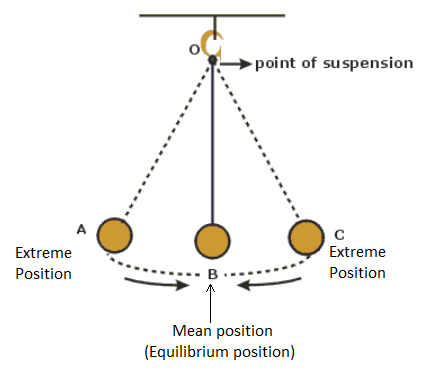
For simplicity, lets divide the motion into four parts, first one being the motion from the mean position \((\mathrm{B})\) to the right extreme position \((\mathrm{C})\), then back to B from \(\mathrm{C}\left(2^{\text {nd }}\right.\) part), then to A from \(\mathrm{B}(3\) rd part) an finally the motion to B from A.
The Physics Rule:
The mathematical backbone of SHM is described by Hooke’s Law:
\(
F=-k x
\)
\(F\) is the restoring force.
\(x\) is the displacement (how far it is from the center).
\(k\) is a constant (like the stiffness of a spring).
The negative sign is crucial-it means the force always points in the opposite direction of the movement (back toward the center).
Key Concepts:
Oscillations: Any repeating, periodic motion (e.g., vibrating strings, pendulums, swaying buildings).
Simple Harmonic Motion (SHM): A specific type of oscillation defined by:
Restoring Force: The force pushing the object back to the center is proportional to the displacement \((F=-k x)\).
Acceleration: Acceleration is proportional to displacement but in the opposite direction \((a \propto-x)\).
Sinusoidal Pattern: The displacement over time follows a sine or cosine wave.
Key Terms:
Equilibrium Position: The central, resting point (the “rest” position where the net force is zero).
Amplitude (\(A\)): Maximum displacement from the equilibrium (the maximum distance the object moves from the center).
Period (\(T\)): Time taken for one full cycle of motion (the time it takes to complete one full back-and-forth cycle).
Frequency (\(f\)): Number of oscillations per second (how many cycles happen in one second (measured in Hertz, Hz)).