1.12 Entrance Corner
Q1. Two particles of the same mass m are moving in circular orbits because of force, given by \(F(r)=\frac{-16}{r}-r^3\). The first particle is at a distance \(r=1\), and the second, at \(r=4\). The best estimate for the ratio of kinetic energies of the first and the second particle is closest to: [JEE 2018]
(a) \(6 \times 10^{-2}\)
(b) \(3 \times 10^{-3}\)
(c) \(10^{-1}\)
(d) \(6 \times 10^2\)
Solution: (a) Step 1: Relate force to kinetic energy
For a particle of mass \(\boldsymbol{m}\) in a circular orbit of radius \(\boldsymbol{r}\), the centripetal force is provided by the given force \(F(r)\). The magnitude of the attractive force is \(F(r)=\frac{16}{r}+r^3\). The equation of motion is:
\(
\frac{m v^2}{r}=\frac{16}{r}+r^3
\)
The kinetic energy is \(K=\frac{1}{2} m v^2\). Rearranging the force equation to solve for \(m v^2\) gives:
\(
m v^2=16+r^4
\)
Thus, the kinetic energy is:
\(
K(r)=\frac{1}{2}\left(16+r^4\right)
\)
Step 2: Calculate kinetic energies for the two particles
For the first particle with radius \(\boldsymbol{r}_1=1\) :
\(
K_1=\frac{1}{2}\left(16+1^4\right)=\frac{1}{2}(17)=8.5
\)
For the second particle with radius \(r_2=4\) :
\(
K_2=\frac{1}{2}\left(16+4^4\right)=\frac{1}{2}(16+256)=\frac{1}{2}(272)=136
\)
Step 3: Calculate the ratio of kinetic energies
The ratio of the kinetic energy of the first particle to the second particle is:
\(
\frac{K_1}{K_2}=\frac{8.5}{136}=0.0625
\)
This value is \(6.25 \times 10^{-2}\).
The value 0.0625 is closest to 0.06 which is \(6 \times 10^{-2}\).
Q2. A body of mass \(m\) starts moving from rest along \(x\)-axis so that its velocity varies as \(v=a \sqrt{s}\) where a is a constant and \(s\) is the distance covered by the body. The total work done by all the forces acting on the body in the first \(t\) seconds after the start of the motion is : [JEE 2018]
(a) \(\frac{1}{8} \mathrm{ma}^4 \mathrm{t}^2\)
(b) \(8 \mathrm{ma}^4 \mathrm{t}^2\)
(c) \(4 \mathrm{ma}^4 \mathrm{t}^2\)
(d) \(\frac{1}{4} \mathrm{ma}^4 \mathrm{t}^2\)
Solution: (a)
\(
\begin{aligned}
& v=\mathrm{a} \sqrt{s} \\
& \Rightarrow \frac{d s}{d t}=a \sqrt{s} \\
& \Rightarrow \int_0^t \frac{d s}{\sqrt{s}}=\int_0^z a d t \\
& \Rightarrow 2 \sqrt{s}=\mathrm{at} \\
& \Rightarrow \mathrm{~s}=\frac{a^2 t^2}{4}
\end{aligned}
\)
Work-Energy Theorem: The total work done equals the change in kinetic energy ( \(W=\Delta K E)\).
The initial velocity is zero, and the final velocity at time \(t\) is
\(
v(t)=a \sqrt{s(t)}=a \sqrt{\frac{a^2 t^2}{4}}=\frac{a^2 t}{2} .
\)
Final Work: \(W=\frac{1}{2} m v^2-0=\frac{1}{2} m\left(\frac{a^2 t}{2}\right)^2=\frac{m a^4 t^2}{8}\).
Q3. A particle is moving in a circular path of radius \(a\) under the action of an attractive potential \(U=-\frac{k}{2 r^2}\) Its total energy is: [JEE 2018]
(a) \(-\frac{3}{2} \frac{k}{a^2}\)
(b) Zero
(c) \(-\frac{k}{4 a^2}\)
(d) \(\frac{k}{2 a^2}\)
Solution: (b) Step 1: Calculate the force
The force is derived from the potential energy using the formula \(F=-\frac{d U}{d r}\). For the given potential \(U(r)=-\frac{k}{2 r^2}\), the force is calculated as:
\(
F=-\frac{d}{d r}\left(-\frac{k}{2} r^{-2}\right)=-\frac{k}{r^3}
\)
The negative sign indicates an attractive force acting towards the center.
Step 2: Apply circular motion condition
For a particle to move in a stable circular path of radius \(a\), the magnitude of the attractive force must provide the necessary centripetal force, \(F_c=\frac{m v^2}{a}\). Equating the force magnitude to the centripetal force at \(\boldsymbol{r}=\boldsymbol{a}\) :
\(
\frac{k}{a^3}=\frac{m v^2}{a}
\)
This gives an expression for \(m v^2\) :
\(
m v^2=\frac{k}{a^2}
\)
Step 3: Calculate kinetic energy
The kinetic energy (KE) of the particle is \(\mathrm{KE}=\frac{1}{2} m v^2\).
Substituting the expression for \(m v^2\) from the previous step:
\(
\mathrm{KE}=\frac{1}{2}\left(\frac{k}{a^2}\right)=\frac{k}{2 a^2}
\)
Step 4: Calculate total energy
The total energy ( \(E\) ) is the sum of the kinetic energy and potential energy at radius \(a\). The potential energy at \(r=a\) is \(U(a)=-\frac{k}{2 a^2}\).
\(
\begin{aligned}
E=\mathrm{KE}+U(a) & =\frac{k}{2 a^2}+\left(-\frac{k}{2 a^2}\right) \\
E & =0
\end{aligned}
\)
The total energy of the particle is Zero.
Q4. An object is dropped from a height \(h\) from the ground. Every time it hits the ground it looses \(50 \%\) of its kinetic energy. The total distance covered as \(t \rightarrow \infty\) is : [JEE 2017]
(a) \(3 h\)
(b) \(\infty\)
(c) \(\frac{5}{3} \mathrm{~h}\)
(d) \(\frac{8}{3} \mathrm{~h}\)
Solution: (a) Step 1: Calculate the height after each bounce
The object is dropped from height \(\boldsymbol{h}\). The initial kinetic energy (KE) just before hitting the ground is \(K E_1=m g h\). Upon impact, it loses \(50 \%\) of its kinetic energy, so the kinetic energy just after the bounce is \(K E_1^{\prime}=0.5 \times K E_1=0.5 m g h\). The object rises to a height \(h_1\) such that its potential energy at the peak is equal to this kinetic energy: \(m g h_1=0.5 m g h\), which gives \(h_1=0.5 h\).
Generally, after the \(n\)-th bounce, the object rises to a height \(h_n\) given by \(h_n=(0.5)^n h\)
Step 2: Formulate the total distance as a series
The total distance \(\boldsymbol{D}\) covered by the object includes the initial fall and the subsequent rises and falls. Each rise to height \(h_n\) is followed by a fall of the same height \(h_n\), both contributing to the total distance.
\(
D=h+2 h_1+2 h_2+2 h_3+\ldots
\)
Substituting the expressions for \(h_n\) :
\(
\begin{gathered}
D=h+2(0.5 h)+2\left(0.5^2 h\right)+2\left(0.5^3 h\right)+\ldots \\
D=h+2 h\left(0.5+0.5^2+0.5^3+\ldots\right)
\end{gathered}
\)
The series inside the parentheses is an infinite geometric series.
Step 3: Sum the infinite geometric series
The infinite geometric series has the first term \(\boldsymbol{a} \boldsymbol{=} \mathbf{0 . 5}\) and common ratio \(\boldsymbol{r}=\mathbf{0 . 5}\). The sum \(S\) of an infinite geometric series with \(|r|<1\) is given by the formula \(S=\frac{a}{1-r}\).
\(
S=\frac{0.5}{1-0.5}=\frac{0.5}{0.5}=1
\)
Substituting this sum back into the expression for the total distance \(\boldsymbol{D}\) :
\(
D=h+2 h(S)=h+2 h(1)=3 h
\)
The total distance covered as \(t \rightarrow \infty\) is \(\mathbf{3 h}\).
Q5. A body of mass \(\mathrm{m}=10^{-2} \mathrm{~kg}\) is moving in a medium and experiences a frictional force \(\mathrm{F}=-\mathrm{kv}^2\). Its initial speed is \(\mathrm{v}_0=10 \mathrm{~ms}^{-1}\). If, after 10 s, its energy is \(\frac{1}{8} m v_0^2\), the value of k will be: [JEE Main 2017 (Offline)]
(a) \(10^{-1} \mathrm{~kg} \mathrm{~m}^{-1} \mathrm{~s}^{-1}\)
(b) \(10^{-3} \mathrm{~kg} \mathrm{~m}^{-1}\)
(c) \(10^{-3} \mathrm{~kg} \mathrm{~s}^{-1}\)
(d) \(10^{-4} \mathrm{~kg} \mathrm{~m}^{-1}\)
Solution: Step 1: Determine the final velocity
The final energy ( \(E_f\) ) is given as \(\frac{1}{8} m v_0^2\). The kinetic energy is also defined as \(E_f=\frac{1}{2} m v_f^2\). By equating these two expressions, the final velocity ( \(v_f\) ) can be determined:
\(
\begin{gathered}
\frac{1}{2} m v_f^2=\frac{1}{8} m v_0^2 \\
v_f^2=\frac{1}{4} v_0^2 \\
v_f=\frac{v_0}{2}
\end{gathered}
\)
Given an initial speed of \(v_0=10 \mathrm{~ms}^{-1}\), the final velocity after 10 seconds is \(v_f=5 \mathrm{~ms}^{-1}\).
Step 2: Set up and solve the differential equation for motion
Newton’s second law \((F=m a)\) is applied using the given frictional force \(F=-k v^2\) and the definition of acceleration \(a=\frac{d v}{d t}\) :
\(
-k v^2=m \frac{d v}{d t}
\)
The variables are separated to prepare for integration:
\(
\frac{1}{v^2} d v=-\frac{k}{m} d t
\)
Integrate both sides from the initial conditions ( \(t=0, v=v_0\) ) to the final conditions ( \(t=T, v=v_f\) ):
\(
\int_{v_0}^{v_f} \frac{1}{v^2} d v=\int_0^T-\frac{k}{m} d t
\)
Evaluating the integrals yields:
\(
\begin{gathered}
{\left[-\frac{1}{v}\right]_{v_0}^{v_f}=-\frac{k}{m}[t]_0^T} \\
\frac{1}{v_0}-\frac{1}{v_f}=-\frac{k}{m} T
\end{gathered}
\)
Step 3: Substitute values and calculate \(k\)
Substitute the given values ( \(m=10^{-2} \mathrm{~kg}, v_0=10 \mathrm{~ms}^{-1}, v_f=5 \mathrm{~ms}^{-1}, T=10 \mathrm{~s}\) ) into the integrated equation:
\(
\begin{aligned}
\frac{1}{10 \mathrm{~m} / \mathrm{s}}-\frac{1}{5 \mathrm{~m} / \mathrm{s}} & =-\frac{k}{10^{-2} \mathrm{~kg}} \times 10 \mathrm{~s} \\
-\frac{1}{10} \mathrm{~s} / \mathrm{m} & =-\frac{10 k}{10^{-2}} \mathrm{~s} / \mathrm{kg} \\
-\frac{1}{10} & =-1000 k
\end{aligned}
\)
Solving for \(k\) :
\(
\begin{gathered}
k=\frac{1}{10 \times 1000} \mathrm{~kg} \mathrm{~m}^{-1} \\
k=10^{-4} \mathrm{~kg} \mathrm{~m}^{-1}
\end{gathered}
\)
The value of the constant \(k\) is \(10^{-4} \mathrm{~kg} \mathrm{~m}^{-1}\).
Q6. A time dependent force \(F=6 t\) acts on a particle of mass 1 kg. If the particle starts from rest, the work done by the force during the first 1 sec. will be: [JEE 2017]
(a) 18 J
(b) 4.5 J
(c) 22 J
(d) 9 J
Solution: According to Newton’s second law, \(F=m a\). Given \(F=6 t\) and mass \(m=1 \mathrm{~kg}\) :
\(
a=\frac{F}{m}=\frac{6 t}{1}=6 t
\)
The acceleration of the particle is \(a(t)=6 t \mathrm{~m} / \mathrm{s}^2\).
Acceleration is the rate of change of velocity, \(a=\frac{d v}{d t}\). Integrating the acceleration with respect to time to find the velocity \(v(t)\) :
\(
\begin{gathered}
\int_0^v d v=\int_0^t 6 \tau d \tau \\
v(t)=\left[3 \tau^2\right]_0^t \\
v(t)=3 t^2
\end{gathered}
\)
The velocity at \(t=1 \mathrm{~s}\) is \(v(1)=3(1)^2=3 \mathrm{~m} / \mathrm{s}\).
The particle starts from rest, so the initial kinetic energy \(K E_{\text {initial }}\) is 0 J. The final kinetic energy \(K E_{\text {final }}\) at \(t=1 \mathrm{~s}\) is:
\(
\begin{gathered}
K E_{\text {final }}=\frac{1}{2} m v^2=\frac{1}{2}(1 \mathrm{~kg})(3 \mathrm{~m} / \mathrm{s})^2 \\
K E_{\text {final }}=\frac{1}{2} \times 9=4.5 \mathrm{~J}
\end{gathered}
\)
According to the work-energy theorem, the net work done ( \(W\) ) by the force is equal to the change in kinetic energy:
\(
\begin{gathered}
W=\Delta K E=K E_{\text {final }}-K E_{\text {initial }} \\
W=4.5 \mathrm{~J}-0 \mathrm{~J}=4.5 \mathrm{~J}
\end{gathered}
\)
The work done by the force during the first 1 sec . will be 4.5 J.
Q7. A particle of mass \(M\) is moving in a circle of fixed radius \(R\) in such a way that its centripetal acceleration at time \(t\) is given by \(n^2 R t^2\) where \(n\) is a constant. The power delivered to the particle by the force acting on it, is : [JEE 2016]
(a) \(M n^2 R^2 t\)
(b) \(\mathrm{MnR}^2 \mathrm{t}\)
(c) \(\mathrm{MnR}^2 \mathrm{t}^2\)
(d) \(\frac{1}{2} \mathrm{Mn}^2 \mathrm{R}^2 \mathrm{t}^2\)
Solution: (a) Velocity: The centripetal acceleration is \(a_c=v^2 / R\). Given \(a_c=n^2 R t^2\), we find the tangential speed: \(v^2 / R=n^2 R t^2 \Longrightarrow v^2=n^2 R^2 t^2 \Longrightarrow v=n R t\).
Tangential Acceleration: The speed is changing with time, so there is a tangential acceleration \(a_t=d v / d t\).
\(a_t=d(n R t) / d t=n R\).
Force: The only force component that does work (delivers power) is the tangential force, \(\boldsymbol{F}_{\boldsymbol{t}}=\boldsymbol{M} \boldsymbol{a}_{\boldsymbol{t}}\). The centripetal force is perpendicular to the velocity and does no work.
\(F_t=M n R\).
Power: Power \((P)\) is the dot product of the force and velocity vectors, \(P=\vec{F} \cdot \vec{v}=F_t v\) (since the tangential force is in the direction of velocity).
\(P=(M n R)(n R t)=M n^2 R^2 t\).
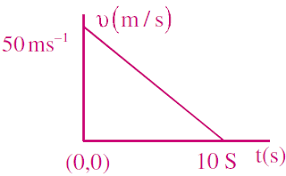
Q8. Velocity-time graph for a body of mass 10 kg is shown in figure. Work-done on the body in first two seconds of the motion is : [JEE 2016]
(a) 12000 J
(b) -12000 J
(c) -4500 J
(d) -9300 J
Solution: (c) Identify initial and final velocities: From the problem description, the velocitytime graph is a straight line. The initial velocity at \(t=0 \mathrm{~s}\) is \(u=50 \mathrm{~m} / \mathrm{s}\), and the final velocity at \(t=10 \mathrm{~s}\) is \(v=0 \mathrm{~m} / \mathrm{s}\) (implied by the line reaching the time axis, which is typical for this problem).
Determine the velocity at \(t=2 \mathrm{~s}\) : The graph is a straight line, so we can find the equation of the line or the constant acceleration.
The slope (acceleration) is \(a=\frac{\Delta v}{\Delta t}=\frac{0 \mathrm{~m} / \mathrm{s}-50 \mathrm{~m} / \mathrm{s}}{10 \mathrm{~s}-0 \mathrm{~s}}=-5 \mathrm{~m} / \mathrm{s}^2\).
Using the equation \(v=u+a t\), the velocity at \(t=2 \mathrm{~s}\) is:
\(
v_f=50 \mathrm{~m} / \mathrm{s}+\left(-5 \mathrm{~m} / \mathrm{s}^2\right)(2 \mathrm{~s})=50 \mathrm{~m} / \mathrm{s}-10 \mathrm{~m} / \mathrm{s}=40 \mathrm{~m} / \mathrm{s} .
\)
Calculate the change in kinetic energy: The change in kinetic energy is
\(
\Delta K E=K E_{\text {final }}-K E_{\text {initial }}=\frac{1}{2} m v_f^2-\frac{1}{2} m u^2 .
\)
Mass \(m=10 \mathrm{~kg}\).
\(\Delta K E=\frac{1}{2}(10 \mathrm{~kg})\left[(40 \mathrm{~m} / \mathrm{s})^2-(50 \mathrm{~m} / \mathrm{s})^2\right]\).
\(\triangle K E=5 \mathrm{~kg}\left[1600 \mathrm{~m}^2 / \mathrm{s}^2-2500 \mathrm{~m}^2 / \mathrm{s}^2\right]\).
\(\Delta K E=5 \mathrm{~kg}\left[-900 \mathrm{~m}^2 / \mathrm{s}^2\right]=-4500 \mathrm{~J}\).
According to the work-energy theorem, the work done is \(W=\Delta K E=-4500 \mathrm{~J}\).
Q9. A car of weight \(W\) is on an inclined road that rises by 100 m over a distance of 1 km and applies a constant frictional force \(\frac{W}{20}\) on the car. While moving uphill on the road at a speed of \(10 \mathrm{~ms}^{-1}\), the car needs power \(P\). If it needs power \(\frac{p}{2}\) while moving downhill at speed \(v\) then value of \(v\) is: [JEE 2016]
(a) \(20 \mathrm{~ms}^{-1}\)
(b) \(15 \mathrm{~ms}^{-1}\)
(c) \(10 \mathrm{~ms}^{-1}\)
(d) \(5 \mathrm{~ms}^{-1}\)
Solution: (b) Step 1: Determine the incline angle and uphill forces
The road rises by 100 m over a distance of 1 km (which is 1000 m ) along the incline. The sine of the angle of inclination \(\theta\) is:
\(
\sin (\theta)=\frac{\text { rise }}{\text { distance }}=\frac{100 \mathrm{~m}}{1000 \mathrm{~m}}=\frac{1}{10}
\)
The forces acting on the car while moving uphill at a constant speed include the engine force ( \(F_{u p}\) ), the component of gravity parallel to the incline ( \(W \sin (\theta)\) ), and the constant frictional force \(\left(F_f\right)\). For constant speed, the forces balance:
\(
F_{u p}=W \sin (\theta)+F_f=W\left(\frac{1}{10}\right)+\frac{W}{20}=\frac{2 W}{20}+\frac{W}{20}=\frac{3 W}{20}
\)
Step 2: Calculate the uphill power \(P\)
The power \(P\) needed while moving uphill at a constant speed \(v_{u p}=10 \mathrm{~ms}^{-1}\) is the product of the engine force and the speed:
\(
P=F_{u p} \cdot v_{u p}=\frac{3 W}{20} \cdot 10 \mathrm{~ms}^{-1}=\frac{3 W}{2} \mathrm{~W}
\)
Step 3: Determine the downhill forces
While moving downhill at a constant speed \(v\), the forces acting along the incline (downwards is positive) are the component of gravity ( \(W \sin (\theta)\) ) aiding motion, the friction force ( \(\boldsymbol{F}_f\) ) opposing motion (acting uphill), and the engine force ( \(\boldsymbol{F}_{\text {down }}\) ). The forces balance for constant speed:
\(
\begin{gathered}
W \sin (\theta)+F_{\text {down }}-F_f=0 \\
F_{\text {down }}=F_f-W \sin (\theta)=\frac{W}{20}-\frac{W}{10}=\frac{W}{20}-\frac{2 W}{20}=-\frac{W}{20}
\end{gathered}
\)
The negative sign indicates that a braking force is needed to maintain constant speed. The problem states the car “needs power \(P/2\)” while moving downhill, which is interpreted as the magnitude of the engine’s power output.
Step 4: Calculate the downhill speed v
The magnitude of the power needed is \(\frac{\boldsymbol{P}}{\mathbf{2}}\). Using the result from Step 2:
\(
\frac{P}{2}=\frac{1}{2}\left(\frac{3 W}{2}\right)=\frac{3 W}{4}
\)
The magnitude of the power is also \(\left|F_{\text {down }}\right| \cdot v\) :
\(
\frac{3 W}{4}=\left|-\frac{W}{20}\right| \cdot v=\frac{W}{20} v
\)
Solving for \(v\) :
\(
v=\frac{3 W}{4} \cdot \frac{20}{W}=\frac{60 W}{4 W}=15 \mathrm{~ms}^{-1}
\)
Q10. A person trying to lose weight by burning fat lifts a mass of 10 kg upto a height of \(1 m 1000\) times. Assume that the potential energy lost each time he lowers the mass is dissipated. How much fat will he use up considering the work done only when the weight is lifted up? Fat supplies \(3.8 \times 10^7 \mathrm{~J}\) of energy per kg which is converted to mechanical energy with a \(20 \%\) efficiency rate. Take \(g=9.8 \mathrm{~ms}^{-2}\) : [JEE 2016]
(a) \(9.89 \times 10^{-3} \mathrm{~kg}\)
(b) \(12.89 \times 10^{-3} \mathrm{~kg}\)
(c) \(2.45 \times 10^{-3} \mathrm{~kg}\)
(d) \(6.45 \times 10^{-3} \mathrm{~kg}\)
Solution: (b) Step 1: Calculate the work done in a single lift
The work done to lift the mass is equal to the potential energy gained.
We use the formula for potential energy: \(W_{\text {lift }}=m g h\).
Given \(m=10 \mathrm{~kg}, g=9.8 \mathrm{~ms}^{-2}\), and \(h=1 \mathrm{~m}\).
\(
W_{l i f t}=10 \mathrm{~kg} \times 9.8 \mathrm{~ms}^{-2} \times 1 \mathrm{~m}=98 \mathrm{~J}
\)
Step 2: Calculate the total work done
The person lifts the mass 1000 times. The total work done is the work per lift multiplied by the number of lifts:
\(
W_{\text {total }}=W_{\text {lift }} \times 1000=98 \mathrm{~J} \times 1000=98000 \mathrm{~J}
\)
Step 3: Calculate the total energy required from fat
The efficiency of converting fat energy to mechanical energy is 20% (or 0.2). The total energy required from the fat must account for this efficiency:
\(
E_{\text {required }}=\frac{W_{\text {total }}}{\eta}=\frac{98000 \mathrm{~J}}{0.2}=490000 \mathrm{~J}
\)
Step 4: Calculate the mass of fat used
Fat supplies \(3.8 \times 10^7 \mathrm{~J}\) of energy per kg. To find the mass of fat used, divide the required energy by the energy density:
\(
\begin{gathered}
M_{\text {fat }}=\frac{E_{\text {required }}}{E_{\text {fat }}}=\frac{490000 \mathrm{~J}}{3.8 \times 10^7 \mathrm{~J} / \mathrm{kg}} \\
M_{\text {fat }} \approx 0.01289 \mathrm{~kg} \approx 12.89 \times 10^{-3} \mathrm{~kg}
\end{gathered}
\)
The mass of fat used up is approximately \(\mathbf{1 2 . 8 9} \times \mathbf{1 0}^{-\mathbf{3}} \mathbf{~ k g}\).
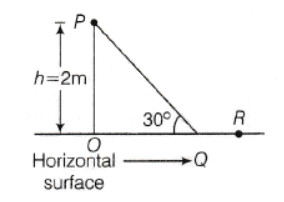
Q11. A point particle of mass \(m\), moves long the uniformly rough track \(P Q R\) as shown in the figure. The coefficient of friction, between the particle and the rough track equals \(\mu\). The particle is released, from rest from the point \(P\) and it comes to rest at point \(R\). The energies, lost by the ball, over the parts, \(P Q\) and \(Q R\), of the track, are equal to each other, and no energy is lost when particle changes direction from \(P Q\) to \(Q R\). The value of the coefficient of friction \(\mu\) and the distance \(x(=Q R)\), are, respectively close to: [JEE 2016]
(a) 0.29 and 3.5 m
(b) 0.29 and 6.5 m
(c) 0.2 and 6.5 m
(d) 0.2 and 3.5 m
Solution: (a) Step 1: Analyze the work-energy theorem
The vertical height of point P from the horizontal track QR is \(h=2 \mathrm{~m}\), the length of the inclined plane PQ is \(l=4 \mathrm{~m}\), and the angle of inclination is \(\theta=30^{\circ}\).
The particle starts from rest at P and comes to rest at R. The total work done by all forces (gravity and friction) equals the change in kinetic energy, which is zero.
\(
W_{\text {gravity }}+W_{\text {friction }}=\Delta K=0
\)
The work done by gravity is \(m g h\). The work done by friction is negative.
\(
m g h-\left|W_{\text {friction, } \mathrm{PQ}}\right|-\left|W_{\text {friction, } \mathrm{QR}}\right|=0
\)
Step 2: Calculate energy lost in each section
The energy lost to friction is the work done by the friction force: \(W_f=F_f \times d\). On the inclined part PQ, the normal force is \(\boldsymbol{N}_{\mathrm{PQ}}=\boldsymbol{m g} \cos \theta\). The friction force is \(F_f=\mu N=\mu m g \cos \theta\). The distance is \(l=4 \mathrm{~m}\).
The energy lost over PQ is \(E_{\mathrm{PQ}}=\mu m g \cos \theta \times l\).
Using \(\theta=30^{\circ}\) and \(l=4 \mathrm{~m}\) :
\(
E_{\mathrm{PQ}}=\mu m g \cos \left(30^{\circ}\right) \times 4=\mu m g \frac{\sqrt{3}}{2} \times 4=2 \sqrt{3} \mu m g
\)
On the horizontal part QR , the normal force is \(N_{\mathrm{QR}}=m g\). The friction force is \(F_f=\mu m g\). The distance is \(x\).
The energy lost over QR is \(E_{\mathrm{QR}}=\mu m g x\).
Step 3: Apply the condition of equal energy loss
Given that the energies lost over PQ and QR are equal:
\(
\begin{gathered}
E_{\mathrm{PQ}}=E_{\mathrm{QR}} \\
2 \sqrt{3} \mu m g=\mu m g x \\
x=2 \sqrt{3} \mathrm{~m}
\end{gathered}
\)
Using \(\sqrt{3} \approx 1.732, x \approx 2 \times 1.732 \approx 3.464 \mathrm{~m}\), which is close to 3.5 m.
Step 4: Use the total energy conservation to find \(\boldsymbol{\mu}\)
The total energy lost is \(E_{\text {total }}=E_{\mathrm{PQ}}+E_{\mathrm{QR}}=2 E_{\mathrm{QR}}\). This must equal the initial potential energy \(\boldsymbol{m} \boldsymbol{g} \boldsymbol{h}\).
\(
\begin{gathered}
2 E_{\mathrm{QR}}=m g h \\
2(\mu m g x)=m g h \\
2 \mu x=h
\end{gathered}
\)
Substitute \(x=2 \sqrt{3} \mathrm{~m}\) and \(h=2 \mathrm{~m}\) :
\(
2 \mu(2 \sqrt{3})=2
\)
\(
\begin{aligned}
&\mu=\frac{\sqrt{3}}{6} \approx \frac{1.732}{6} \approx 0.288\\
&\text { This value is close to } 0.29 \text {. }
\end{aligned}
\)
The values of the coefficient of friction \(\boldsymbol{\mu}\) and the distance \(\boldsymbol{x}\) are approximately \(\mathbf{0 . 2 9}\) and 3.5 m, respectively.
Q12. When a rubber-band is stretched by a distance \(x\), it exerts restoring force of magnitude \(F=a x+b x^2\) where \(a\) and \(b\) are constants. The work done in stretching the unstretched rubber-band by \(L\) is : [JEE 2014]
(a) \(a L^2+b L^3\)
(b) \(\frac{1}{2}\left(a L^2+b L^3\right)\)
(c) \(\frac{a L^2}{2}+\frac{b L^3}{3}\)
(d) \(\frac{1}{2}\left(\frac{a L^2}{2}+\frac{b L^3}{3}\right)\)
Solution: (c) Define the work done integral:
The work \(W\) done by a variable force \(F(x)\) over a distance from \(x_1\) to \(x_2\) is calculated using the integral formula \(W=\int_{x_1}^{x_2} F(x) d x\). The applied force has the same magnitude as the restoring force, \(F(x)=a x+b x^2\).
The work done in stretching from \(x_1=0\) to \(x_2=L\) is \(W=\int_0^L\left(a x+b x^2\right) d x\).
Evaluating the integral: \(W=\left[\frac{a x^2}{2}+\frac{b x^3}{3}\right]_0^L=\frac{a L^2}{2}+\frac{b L^3}{3}\)
The work done in stretching the unstretched rubber-band by \(L\) is \(\frac{\mathbf{a L}^{\mathbf{2}}}{\mathbf{2}}+\frac{\mathbf{b L}^{\mathbf{3}}}{\mathbf{3}}\).
Q13. This question has Statement 1 and Statement 2. Of the four choices given after the Statements, choose the one that best describes the two Statements.
If two springs \(S_1\) and \(S_2\) of force constants \(k_1\) and \(k_2\), respectively, are stretched by the same force, it is found that more work is done on spring \(S_1\) than on spring \(S_2\).
STATEMENT 1: If stretched by the same amount work done on \(S_1\), Work done on \(S_1\) is more than \(S_2\)
STATEMENT 2: \(k_1<k_2\) [JEE 2012]
(a) Statement 1 is false, Statement 2 is true
(b) Statement 1 is true, Statement 2 is false
(c) Statement 1 is true, Statement 2 is true, Statement 2 is the correct explanation for Statement 1
(d) Statement 1 is true, Statement 2 is true, Statement 2 is not the correct explanation for Statement 1
Solution: (a) The work done on a spring when stretched by a force \(F\) is given by \(W=\frac{F^2}{2 k}\) (since \(F=k x\), then \(x=F / k\), so \(\left.W=\frac{1}{2} k x^2=\frac{1}{2} k\left(\frac{F}{k}\right)^2=\frac{F^2}{2 k}\right)\).
Given \(W_1>W_2\) for the same force \(F\), it implies \(\frac{F^2}{2 k_1}>\frac{F^2}{2 k_2}\). This simplifies to \(\frac{1}{k_1}>\frac{1}{k_2}\), which means \(k_1<k_2\).
Therefore, Statement \(2\left(k_1<k_2\right)\) is true.
Now consider Statement 1: “If stretched by the same amount (same displacement \(x\) ), work done on \(S_1\) is more than \(S_2\) “.
The work done on a spring when stretched by the same amount \(x\) is given by
\(
W=\frac{1}{2} k x^2 .
\)
If \(x\) is the same for both springs, the work done depends linearly on the force constant \(k\).
Since we established \(k_1<k_2\), it follows that \(W_1<W_2\) for the same displacement \(x\) –
Therefore, Statement 1 (work done on \(S_1\) is more than \(S_2\) for the same displacement) is false.
Why other options are incorrect
(b) Statement 1 is true, Statement 2 is false: This is incorrect because Statement 1 is false, and Statement 2 is true.
(c) Statement 1 is true, Statement 2 is true, Statement 2 is the correct explanation for Statement 1: This is incorrect because Statement 1 is false.
(d) Statement 1 is true, Statement 2 is true, Statement 2 is not the correct explanation for Statement 1: This is incorrect because Statement 1 is false.
Q14. The potential energy function for the force between two atoms in a diatomic molecule is approximately given by \(U(x)=\frac{a}{x^{12}}-\frac{b}{x^6}\), where \(a\) and \(b\) are constants and \(x\) is the distance between the atoms. If the dissociation energy of the molecule is \(D=\left[U(x=\infty)-U_{\text {at equilibrium }}\right], D\) is [JEE 2010]
(a) \(\frac{b^2}{2 a}\)
(b) \(\frac{b^2}{12 a}\)
(c) \(\frac{b^2}{4 a}\)
(d) \(\frac{b^2}{6 a}\)
Solution: (c) Calculate potential energy at infinity: As \(x \rightarrow \infty\), both \(\frac{a}{x^{12}}\) and \(\frac{b}{x^6}\) approach zero, so \(U(x=\infty)=0\).
Calculate potential energy at equilibrium:
Find the equilibrium distance ( \(x_{e q}\) ) by setting the force \(F=-\frac{d U}{d x}\) to zero.
\(\frac{d U}{d x}=\frac{d}{d x}\left(a x^{-12}-b x^{-6}\right)=-12 a x^{-13}+6 b x^{-7}\).
Setting \(\frac{d U}{d x}=0: 12 a x^{-13}=6 b x^{-7}\), which simplifies to \(x^6=\frac{2 a}{b}\). The equilibrium distance is \(x_{e q}=\left(\frac{2 a}{b}\right)^{1 / 6}\).
Substitute \(x_{e q}\) back into the potential energy function:
\(
U_{\text {at equilibrium }}=\frac{a}{\left(x_{e q}\right)^{12}}-\frac{b}{\left(x_{e q}\right)^6}=\frac{a}{\left(\frac{2 a}{b}\right)^2}-\frac{b}{\frac{2 a}{b}}=\frac{a}{\frac{4 a^2}{b^2}}-\frac{b^2}{2 a}=\frac{b^2}{4 a}-\frac{b^2}{2 a}=-\frac{b^2}{4 a}
\)
Calculate dissociation energy:
\(
D=U(x=\infty)-U_{\text {at equilibrium }}=0-\left(-\frac{b^2}{4 a}\right)=\frac{b^2}{4 a} .
\)
Note: The dissociation energy of a molecule is the energy required to break a specific chemical bond between two atoms, separating them into individual, free atoms or radicals. This energy is a direct measure of the bond’s strength.
Q15. An athlete in the olympic games covers a distance of \(100 m\) in \(10 s\). His kinetic energy can be estimated to be in the range [JEE 2008]
(a) \(200 \mathrm{~J}-500 \mathrm{~J}\)
(b) \(2 \times 10^5 J-3 \times 10^5 J\)
(c) \(20,000 \mathrm{~J}-50,000 \mathrm{~J}\)
(d) \(2,000 \mathrm{~J}-5,000 \mathrm{~J}\)
Solution: (d) Step 1: Calculate the athlete’s average velocity
The average velocity ( \(v\) ) of the athlete can be calculated using the distance ( \(s\) ) and time ( \(t\) ) given.
\(
v=\frac{s}{t}=\frac{100 \mathrm{~m}}{10 \mathrm{~s}}=10 \mathrm{~m} / \mathrm{s}
\)
Step 2: Assume a typical mass for an athlete
The mass of the athlete is not provided, so a reasonable value must be assumed. For a problem of this nature, a typical mass for an adult athlete is assumed to be around 60 kg to 65 kg. We will use \(m=60 \mathrm{~kg}\) for calculation.
Step 3: Calculate the kinetic energy
Using the formula for kinetic energy, \(K E=\frac{1}{2} m v^2\), with the assumed mass and calculated velocity:
\(
\begin{gathered}
K E=\frac{1}{2} \times 60 \mathrm{~kg} \times(10 \mathrm{~m} / \mathrm{s})^2 \\
K E=30 \mathrm{~kg} \times 100 \mathrm{~m}^2 / \mathrm{s}^2 \\
K E=3000 \mathrm{~J}
\end{gathered}
\)
The calculated kinetic energy of 3000 J falls within the range of \(2,000 \mathrm{~J}\) to \(5,000 \mathrm{~J}\).
Q16. A particle is projected at \(60^{\circ}\) to the horizontal with a kinetic energy \(K\). The kinetic energy at the highest point is [JEE 2007]
(a) \(K / 2\)
(b) \(K\)
(c) Zero
(d) \(K / 4\)
Solution: (d) Step 1: Define initial kinetic energy
The initial kinetic energy (\(K\)) of the particle with mass \(m\) and initial velocity \(u\) is given by the formula \(K=\frac{1}{2} m u^2\).
Step 2: Determine velocity components
The particle is projected at an angle \(\theta=60^{\circ}\) to the horizontal. The initial velocity components are \(u_x=u \cos (\theta)\) and \(u_y=u \sin (\theta)\). At the highest point of the trajectory, the vertical component of velocity becomes zero ( \(v_y=0\) ), while the horizontal component remains constant due to the absence of air resistance:
\(
v_h=u_x=u \cos \left(60^{\circ}\right)=u \cdot \frac{1}{2}=\frac{u}{2} .
\)
Step 3: Calculate kinetic energy at highest point
The kinetic energy at the highest point ( \(\mathbf{K}_{\mathbf{h}}\) ) is calculated using the velocity at that point, \(v_h\) :
\(
K_h=\frac{1}{2} m v_h^2
\)
Substituting the expression for \(v_h\) :
\(
K_h=\frac{1}{2} m\left(\frac{u}{2}\right)^2=\frac{1}{2} m \frac{u^2}{4}=\frac{1}{4}\left(\frac{1}{2} m u^2\right)
\)
Recognizing the term in the parenthesis as the initial kinetic energy \(K\) :
\(
K_h=\frac{K}{4}
\)
The kinetic energy at the highest point is \(K/4\).
Q17. A 2 kg block slides on a horizontal floor with a speed of \(4 \mathrm{~m} / \mathrm{s}\). It strikes a uncompressed spring, and compress it till the block is motionless. The kinetic friction force is \(15 N\) and spring constant is \(10,000 N / m\). The spring compresses by [JEE 2007]
(a) 8.5 cm
(b) 5.5 cm
(c) 2.5 cm
(d) 11.0 cm
Solution: (b) The initial kinetic energy ( \(\mathrm{KE}_i\) ) of the block is converted into the potential energy ( \(\mathrm{PE}_f\) ) of the spring and the work done against friction ( \(\mathrm{W}_f\) ) as the block comes to rest (final kinetic energy \(\mathrm{KE}_f=0\) ).
The relevant formulas are:
Initial Kinetic Energy: \(\mathrm{KE}_i=\frac{1}{2} m v^2\)
Final Potential Energy: \(\mathrm{PE}_f=\frac{1}{2} k x^2\)
Work done by friction: \(\mathbf{W}_{\boldsymbol{f}}=\boldsymbol{F}_{\text {friction }} \times \boldsymbol{x}\)
According to the work-energy principle:
\(
\mathrm{KE}_i=\mathrm{PE}_f+\mathrm{W}_f
\)
Given values:
Mass \(m=2 \mathrm{~kg}\)
Initial speed \(v=4 \mathrm{~m} / \mathrm{s}\)
Friction force \(F_{\text {friction }}=15 \mathrm{~N}\)
Spring constant \(k=10,000 \mathrm{~N} / \mathrm{m}\)
Compression distance \(x\) (in meters)
Substituting the values into the equation from Step 1:
\(
\frac{1}{2}(2 \mathrm{~kg})(4 \mathrm{~m} / \mathrm{s})^2=\frac{1}{2}(10,000 \mathrm{~N} / \mathrm{m}) x^2+(15 \mathrm{~N}) x
\)
\(
16=5000 x^2+15 x
\)
Rearranging into a standard quadratic equation \(A x^2+B x+C=0\) :
\(
5000 x^2+15 x-16=0
\)
\(
x \approx \frac{-15 \pm 565.88}{10000}
\)
We get two possible values for \(x\) :
\(
\begin{aligned}
& x_1 \approx \frac{-15+565.88}{10000} \approx 0.055 \mathrm{~m} \\
& x_2 \approx \frac{-15-565.88}{10000} \approx-0.058 \mathrm{~m}
\end{aligned}
\)
Since compression distance must be positive, we take the positive root: \(x \approx 0.055 \mathrm{~m}\)
Convert the result to centimeters
To convert meters to centimeters, multiply by 100:
\(
x \approx 0.055 \mathrm{~m} \times 100=5.5 \mathrm{~cm}
\)
The spring compresses by approximately 5.5 cm.
Q18. A ball of mass 0.2 kg is thrown vertically upwards by applying a force by hand. If the hand moves \(0.2 m\) while applying the force and the ball goes upto \(2 m\) height further, find the magnitude of the force. (consider \(g=10 \mathrm{~m} / \mathrm{s}^2\) ). [JEE 2006]
(a) \(4 N\)
(b) \(16 N\)
(c) \(20 N\)
(d) \(22 N\)
Solution: (d) Step 1: Define variables and total height
The given values are:
Mass \(m=0.2 \mathrm{~kg}\)
Distance hand moves \(d_1=0.2 \mathrm{~m}\)
Additional height the ball goes \(d_2=2 \mathrm{~m}\)
Acceleration due to gravity \(g=10 \mathrm{~m} / \mathrm{s}^2\)
The total height the ball reaches from its initial position is \(h=d_1+d_2=0.2 \mathrm{~m}+2 \mathrm{~m}=2.2 \mathrm{~m}\).
Step 2: Apply the work-energy theorem
According to the work-energy theorem, the total work done on the ball is equal to its change in kinetic energy ( \(\triangle K E\) ). Since the ball starts from rest and momentarily stops at its maximum height, the total change in kinetic energy is zero:
\(
\Delta K E=K E_{\text {final }}-K E_{\text {initial }}=0-0=0
\)
The forces doing work are the applied force ( \(F\) ) by the hand (over distance \(d_1\) ) and gravity ( \(m g\) ) (over total height \(h\) ).
The total work done is the sum of work done by the hand ( \(W_F\) ) and work done by gravity ( \(W_g\) ):
\(
W_{\text {total }}=W_F+W_g=0
\)
The work done by the applied force is \(W_F=F \times d_1\) (upwards).
The work done by gravity is \(W_g=-m g \times h\) (downwards).
Step 3: Solve for the force
Substitute the work expressions into the work-energy equation:
\(
F \times d_1-m g \times h=0
\)
Rearrange to solve for \(F\) :
\(
F \times d_1=m g \times h
\)
\(
F=\frac{m g h}{d_1}
\)
Substitute the values:
\(
\begin{gathered}
F=\frac{0.2 \mathrm{~kg} \times 10 \mathrm{~m} / \mathrm{s}^2 \times 2.2 \mathrm{~m}}{0.2 \mathrm{~m}} \\
F=\frac{4.4 \mathrm{~J}}{0.2 \mathrm{~m}} \\
F=22 \mathrm{~N}
\end{gathered}
\)
The magnitude of the force applied by the hand is \(\mathbf{2 2 N}\).
Q19. A mass of \(M k g\) is suspended by a weightless string. The horizontal force that is required to displace it until the string makes an angle of \(45^{\circ}\) with the initial vertical direction is [JEE 2006]
(a) \(M g(\sqrt{2}+1)\)
(b) \(M g \sqrt{2}\)
(c) \(\frac{M g}{\sqrt{2}}\)
(d) \(M g(\sqrt{2}-1)\)
Solution: (d)
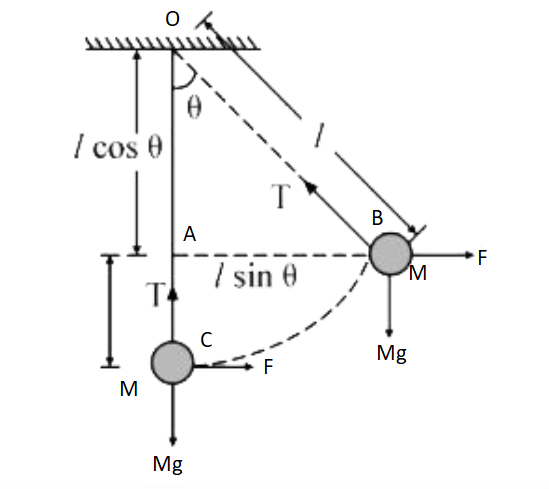
We will use the work energy theorem on analyzing the figure above.
Work energy theorem is,
Total work \(=\) Change in kinetic energy \(=\Delta \mathrm{K}\)
Here on the block at C three types of work done are taking place those are,
Work done by the wire OC, work done by gravity (Mg), work done by force F.
So, according to work energy theorem,
\(\mathrm{W}_{\text {Gravity }}+\mathrm{W}_{\mathrm{F}}+\mathrm{W}_{\text {Tension }}=\) Change in kinetic energy ….(1)
Now we can say that work done by tension is zero when the block moves from C to B since the same forces are applied at C and B both and displacement due to the tension is zero so work done is also zero.
Therefore \(\mathbf{W}_{\text {Tension }}=0\).
Also we can say that change in kinetic energy is zero since the velocity at C and B is zero because the block is at rest whatever may be the velocity in between we only need to consider the initial and final velocity.
So, we can do \(\Delta K=0\).
And work done by gravity is something because the block has movement in or opposite to the direction of gravity.
So, work done by gravity on the block is \(\mathrm{W}_{\text {Gravity }}=\mathrm{Mg}(\mathrm{AC})\).
Let \(A C=h\).
So, \(\mathrm{W}_{\text {Gravity }}=-\mathrm{Mgh}\).
Since, work done is force multiplied by the displacement of the body in the direction of force. We have taken here work done negatively because the displacement Is opposite to the direction of force.
Now work done by force F is \(\mathrm{W}_{\mathrm{F}}=\mathrm{F}(\mathrm{AB})\)
So, on putting these values in equation (1) we get,
\(0-\mathrm{Mgh}+\mathrm{F}(\mathrm{AB})=0\)
So, \(\mathrm{F}=\frac{\mathrm{Mgh}}{\mathrm{AB}} \dots(2)\)
Now we will calculate \(\frac{\mathrm{h}}{\mathrm{AB}}=\frac{\mathrm{AC}}{\mathrm{AB}}\)
Let us take the length of the wire be \(L\).
So, \(\mathrm{OC}=\mathrm{OB}=\mathrm{L}\)
And the angle COB is 45 degrees.
So, we get \(\mathrm{AB}=\mathrm{L} \sin 45=\frac{\mathrm{L}}{\sqrt{2}}\)
And \(\mathrm{AC}=\mathrm{OC}-\mathrm{OA}=\mathrm{L}-\frac{\mathrm{L}}{\sqrt{2}}\)
So, \(\frac{\mathrm{h}}{\mathrm{AB}}=\frac{\mathrm{AC}}{\mathrm{AB}}=\left(\frac{\mathrm{L}\left(1-\frac{1}{\sqrt{2}}\right)}{\frac{\mathrm{L}}{\sqrt{2}}}\right)=\sqrt{2}-1 \dots(3)\)
From equation (2) and (3) we can say \(F=M g(\sqrt{2}-1)\).
Q20. A particle of mass 100 g is thrown vertically upwards with a speed of \(5 \mathrm{~m} / \mathrm{s}\). The work done by the force of gravity during the time the particle goes up is [JEE 2006]
(a) \(-0.5 J\)
(b) \(-1.25 J\)
(c) 1.25 J
(d) 0.5 J
Solution: (b) The mass is converted to kilograms: \(m=100 \mathrm{~g}=0.1 \mathrm{~kg}\). The work-energy theorem states that the net work done on an object is equal to its change in kinetic energy: \(W_{\text {net }}=\Delta K\). In this case, the only force doing significant work is gravity.
The particle reaches its maximum height when its final velocity \(v_f\) becomes zero. The initial velocity is \(v_i=5 \mathrm{~m} / \mathrm{s}\). The work done by gravity ( \(W_g\) ) is:
\(
W_g=\frac{1}{2} m v_f^2-\frac{1}{2} m v_i^2
\)
Substituting the values:
\(
\begin{gathered}
W_g=\frac{1}{2}(0.1 \mathrm{~kg})(0 \mathrm{~m} / \mathrm{s})^2-\frac{1}{2}(0.1 \mathrm{~kg})(5 \mathrm{~m} / \mathrm{s})^2 \\
W_g=0-\frac{1}{2}(0.1)(25) \mathrm{J} \\
W_g=-1.25 \mathrm{~J}
\end{gathered}
\)
Q21. The potential energy of a 1 kg particle free to move along the \(x\)-axis is given by \(V(x)=\left(\frac{x^4}{4}-\frac{x^2}{2}\right) J\). The total mechanical energy of the particle is \(2 J\). Then, the maximum speed (in \(\mathrm{m} / \mathrm{s}\) ) is [JEE 2006]
(a) \(\frac{3}{\sqrt{2}}\)
(b) \(\sqrt{2}\)
(c) \(\frac{1}{\sqrt{2}}\)
(d) 2
Solution: Step 1: Relate total energy, potential energy, and kinetic energy
The total mechanical energy ( \(\boldsymbol{E}_{\text {total }}\) ) is the sum of kinetic energy ( \(\boldsymbol{K}\) ) and potential energy ( \(V(x)\) ). To achieve the maximum speed ( \(v_{\text {max }}\) ), the kinetic energy must be maximized, which occurs when the potential energy is minimized.
\(
K=E_{\text {total }}-V(x)
\)
Step 2: Find the minimum potential energy
The potential energy is given by \(V(x)=\left(\frac{x^4}{4}-\frac{x^2}{2}\right) \mathrm{J}\). To find its minimum value, we take the derivative with respect to \(x\) and set it to zero:
\(
\frac{d V}{d x}=x^3-x
\)
Solving for critical points: \(x\left(x^2-1\right)=0\), which yields \(x=0, x=1\), and \(x=-1\).
We use the second derivative test, \(\frac{d^2 V}{d x^2}=3 x^2-1\), to determine the nature of these points. The second derivative is positive (minimum) at \(x=1\) and \(x=-1\). The minimum potential energy \(V_{\text {min }}\) is:
\(
V_{\min }=V(1)=\frac{(1)^4}{4}-\frac{(1)^2}{2}=-\frac{1}{4} \mathrm{~J}
\)
Step 3: Calculate the maximum kinetic energy
The maximum kinetic energy ( \(K_{\text {max }}\) ) is the difference between the total energy and the minimum potential energy:
\(
K_{\max }=2 \mathrm{~J}-\left(-\frac{1}{4} \mathrm{~J}\right)=\frac{9}{4} \mathrm{~J}
\)
Step 4: Calculate the maximum speed
Using the kinetic energy formula \(K_{\max }=\frac{1}{2} m v_{\max }^2\) with mass \(m=1 \mathrm{~kg}\) :
\(
\frac{9}{4}=\frac{1}{2}(1) v_{\max }^2
\)
Solving for \(\boldsymbol{v}_{\text {max }}\) :
\(
\begin{gathered}
v_{\max }^2=\frac{9}{2} \\
v_{\max }=\sqrt{\frac{9}{2}}=\frac{3}{\sqrt{2}} \mathrm{~m} / \mathrm{s}
\end{gathered}
\)
The maximum speed of the particle is \(\frac{3}{\sqrt{2}} \mathrm{~m} / \mathrm{s}\).
Q22. A bullet fired into a fixed target loses half of its velocity after penetrating 3 cm. How much further it will penetrate before coming to rest assuming that it faces constant resistance to motion? [JEE 2005]
(a) 2.0 cm
(b) 3.0 cm
(c) 1.0 cm
(d) 1.5 cm
Solution: (c)
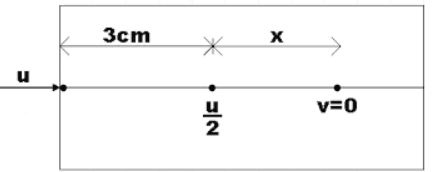
Let the initial and final velocities of the bullet be \(u\) and \(v\) respectively while penetrating the first 3 cm. Then, from Newton’s equations of motion, we have,
\(
v^2-u^2=2 a s
\)
Where, \(a\) is the constant acceleration of the bullet and \(s=3 \mathrm{~cm}\)
Also,
\(
v=\frac{u}{2}
\)
So,
\(
\begin{aligned}
& \left(\frac{u}{2}\right)^2-u^2=2 a(3) \\
& \Rightarrow a=-\frac{3 u^2}{24} \\
& \therefore a=-\frac{u^2}{8} \dots(1)
\end{aligned}
\)
Now for finding the distance penetrated by the bullet after this, let us use the same equation of motion again. But, the initial velocity now will be \(\frac{u}{2}\) and final velocity is zero. So,
\(
0-\left(\frac{u}{2}\right)^2=2 a x
\)
Substituting (1) we get,
\(
\begin{aligned}
& -\left(\frac{u}{2}\right)^2=2\left(-\frac{u^2}{8}\right) x \\
& \therefore x=1 \mathrm{~cm}
\end{aligned}
\)
Therefore, we found that the bullet will penetrate lcm more into the fixed target before coming to rest.
Q23. A body of mass \(m\) is accelerated uniformly from rest to a speed \(v\) in a time \(T\). The instantaneous power delivered to the body as a function of time is given by [JEE 2005]
(a) \(\frac{m v^2}{T^2} \cdot t^2\)
(b) \(\frac{m v^2}{T^2} \cdot t\)
(c) \(\frac{1}{2} \frac{m v^2}{T^2} \cdot t^2\)
(d) \(\frac{1}{2} \frac{m v^2}{T^2} \cdot t\)
Solution: (b) Step 1: Determine the acceleration
The body accelerates uniformly from rest ( \(u_0=0\) ) to a speed \(v\) in time \(T\). The uniform acceleration \(a\) is calculated using the first equation of motion, \(v=u_0+a T\) :
\(
a=\frac{v-u_0}{T}=\frac{v-0}{T}=\frac{v}{T}
\)
Step 2: Determine the instantaneous velocity
The velocity \(u(t)\) at any time \(t\) (where \(0 \leq t \leq T\) ) is given by:
\(
u(t)=u_0+a t=0+\left(\frac{v}{T}\right) t=\frac{v}{T} t
\)
Step 3: Calculate the instantaneous power
The force \(F\) acting on the body is constant (since acceleration is uniform) and given by Newton’s second law, \(F=m a\) :
\(
F=m\left(\frac{v}{T}\right)
\)
Instantaneous power \(P(t)\) is the product of the force and the instantaneous velocity:
\(
P(t)=F \cdot u(t)=\left(m \frac{v}{T}\right)\left(\frac{v}{T} t\right)=\frac{m v^2}{T^2} t
\)
The instantaneous power delivered to the body as a function of time is \((\mathbf{b}) \frac{\mathbf{m v}^{\mathbf{2}}}{\mathbf{T}^{\mathbf{2}}} \cdot \mathbf{t}\)
Q24. The upper half of an inclined plane with inclination \(\phi\) is perfectly smooth while the lower half is rough. A body starting from rest at the top will again come to rest at the bottom if the coefficient of friction for the lower half is given by [JEE 2005]
(a) \(2 \cos \phi\)
(b) \(2 \sin \phi\)
(c) \(\tan \phi\)
(d) \(2 \tan \phi\)
Solution: (d) Step 1: Define variables and principles
We use the work-energy theorem, which states that the total work done on the body equals the change in kinetic energy ( \(\boldsymbol{\Delta} \boldsymbol{K}\) ). The body starts from rest ( \(\boldsymbol{K}_{\boldsymbol{i}} \boldsymbol{=} \mathbf{0}\) ) and comes to rest again ( \(K_f=0\) ), so \(\Delta K=0\). The total work is the sum of work done by gravity ( \(W_g\) ) and work done by friction ( \(W_f\) ).
\(
W_{\text {total }}=W_g+W_f=0
\)
Step 2: Calculate work done by gravity
Let the total length of the incline be \(L\). The vertical height is \(h=L \sin (\phi)\). Gravity acts over the entire path.
\(
W_g=m g h=m g L \sin (\phi)
\)
Step 3: Calculate work done by friction
Friction only acts on the lower half (length \(L / 2\) ). The normal force is \(N=m g \cos (\phi)\). The friction force is \(f_k=\mu N=\mu m g \cos (\phi)\).
\(
W_f=-f_k(L / 2)=-\frac{\mu m g L \cos (\phi)}{2}
\)
Step 4: Solve for the coefficient of friction
Set the total work to zero and solve for \(\mu\).
\(
\begin{gathered}
m g L \sin (\phi)-\frac{\mu m g L \cos (\phi)}{2}=0 \\
\sin (\phi)=\frac{\mu \cos (\phi)}{2} \\
\mu=\frac{2 \sin (\phi)}{\cos (\phi)}=2 \tan (\phi)
\end{gathered}
\)
Q25. A particle is acted upon by a force of constant magnitude which is always perpendicular to the velocity of the particle, the motion of the particles takes place in a plane. It follows that [JEE 2004]
(a) its kinetic energy is constant
(b) is acceleration is constant
(c) its velocity is constant
(d) it moves in a straight line
Solution: (a) Kinetic energy is constant: A force always perpendicular to velocity does no work on the particle ( \(W=\vec{F} \cdot d \vec{s}=0\) ), so by the work-energy theorem, its kinetic energy remains constant.
Acceleration magnitude is constant, but direction changes: The direction of acceleration is constantly changing to remain perpendicular to the velocity, so the acceleration vector is not constant.
Velocity is not constant: The direction of the velocity vector is continuously changing as the particle follows a curved path (circular motion).
Motion is not in a straight line: Constant velocity requires no net force; since a force is present, the particle’s direction must change, resulting in a curved path, not a straight line.
Q26. A particle moves in a straight line with retardation proportional to its displacement. Its loss of kinetic energy for any displacement \(x\) is proportional to [JEE 2004]
(a) \(x\)
(b) \(e^x\)
(c) \(x^2\)
(d) \(\log _e x\)
Solution: (c) Step 1: Formulate the equation of motion
The problem states that the retardation (negative acceleration) is proportional to the displacement \(\boldsymbol{x}\). This can be expressed as:
\(
a=-k x
\)
where \(a\) is the acceleration, \(x\) is the displacement, and \(k\) is a positive constant of proportionality.
Step 2: Relate acceleration to velocity and displacement
Acceleration \(a\) can be expressed in terms of velocity \(v\) and displacement \(x\) using the chain rule:
\(
a=\frac{d v}{d t}=\frac{d v}{d x} \frac{d x}{d t}=v \frac{d v}{d x}
\)
Substituting this into the equation from Step 1 gives:
\(
v \frac{d v}{d x}=-k x
\)
Step 3: Integrate the equation
Rearranging the equation to separate the variables and integrating both sides:
\(
\begin{gathered}
\int v d v=-\int k x d x \\
\frac{v^2}{2}=-\frac{k x^2}{2}+C
\end{gathered}
\)
where \(C\) is the constant of integration. The change in \(\frac{v^2}{2}\) between an initial point ( \(x_1\), \(\left.v_1\right)\) and a final point \((x, v)\) is:
\(
\begin{gathered}
\frac{v^2}{2}-\frac{v_1^2}{2}=-\frac{k x^2}{2}+\frac{k x_1^2}{2} \\
\frac{1}{2}\left(v^2-v_1^2\right)=-\frac{k}{2}\left(x^2-x_1^2\right)
\end{gathered}
\)
Step 4: Determine the loss of kinetic energy
The kinetic energy (KE) of the particle is given by KE \(=\frac{1}{2} m v^2\), where \(m\) is the mass. Multiplying the integrated equation by the mass \(m\) gives the change in kinetic energy:
\(
\begin{aligned}
& \frac{1}{2} m\left(v^2-v_1^2\right)=-\frac{m k}{2}\left(x^2-x_1^2\right) \\
& \mathrm{KE}_f-\mathrm{KE}_i=-\frac{m k}{2}\left(x^2-x_1^2\right)
\end{aligned}
\)
The loss of kinetic energy is \(\Delta \mathrm{KE}=\mathrm{KE}_i-\mathrm{KE}_f=\frac{m k}{2}\left(x^2-x_1^2\right)\).
Since \(m\) and \(k\) are constants, the loss of kinetic energy is proportional to the change in \(x^2\), and thus proportional to \(x^2\) for any displacement \(x\) from the origin (assuming the initial position is at \(x_1=0\) ).
The loss of kinetic energy for any displacement \(x\) is proportional to \(x^2\).
Q27. A uniform chain of length \(2 m\) is kept on a table such that a length of \(60 c m\) hangs freely from the edge of the table. The total mass of the chain is \(4 k g\). What is the work done in pulling the entire chain on the table? [JEE 2004]
(a) 12 J
(b) 3.6 J
(c) 7.2 J
(d) 1200 J
Solution: (b) Step 1: Calculate mass per unit length and hanging mass
First, we determine the linear mass density \(\lambda\) of the uniform chain using its total mass \(\boldsymbol{M}\) and total length \(\boldsymbol{L}\) :
\(
\lambda=\frac{M}{L}
\)
Given \(M=4 \mathrm{~kg}\) and \(L=2 \mathrm{~m}, \lambda=\frac{4 \mathrm{~kg}}{2 \mathrm{~m}}=2 \mathrm{~kg} / \mathrm{m}\).
The length hanging is \(l=60 \mathrm{~cm}=0.6 \mathrm{~m}\). The mass of the hanging part \(m\) is:
\(
m=\lambda \times l=2 \mathrm{~kg} / \mathrm{m} \times 0.6 \mathrm{~m}=1.2 \mathrm{~kg}
\)
Step 2: Calculate work done using potential energy change
The work done in pulling the chain up is equal to the increase in its potential energy. The center of mass of the hanging part is at a distance of \(\frac{l}{2}\) below the table edge. The work done \(W\) is the force (weight of hanging mass \(m g\) ) times the distance the center of mass is raised:
\(
W=m \times g \times \frac{l}{2}
\)
Using \(g \approx 10 \mathrm{~m} / \mathrm{s}^2\) :
\(
\begin{gathered}
W=1.2 \mathrm{~kg} \times 10 \mathrm{~m} / \mathrm{s}^2 \times \frac{0.6 \mathrm{~m}}{2} \\
W=12 \mathrm{~N} \times 0.3 \mathrm{~m} \\
W=3.6 \mathrm{~J}
\end{gathered}
\)
The work done in pulling the entire chain onto the table is 3.6 J.
Q28. A force \(\vec{F}=(5 \hat{i}+3 \hat{j}+2 \widehat{k}) N\) is applied over a particle which displaces it from its origin to the point \(\vec{r}=(2 \hat{i}-\hat{j}) m\). The work done on the particle in joules is [JEE 2004]
(a) +10
(b) +7
(c) -7
(d) +13
Solution: (b) The work done by a force on a particle is given by the dot product of the force and the displacement vector of the particle: \(W=\vec{F} \cdot \vec{r}\)
We can substitute the given vectors into this expression:
\(
\begin{aligned}
& W=\vec{F} \cdot \vec{r} \\
& =(5 \hat{i}+3 \hat{j}+2 \widehat{k}) \cdot(2 \hat{i}-\hat{j}) \\
& =10-3=7 \mathrm{~J}
\end{aligned}
\)
Q29. A spring of spring constant \(5 \times 10^3 \mathrm{~N} / \mathrm{m}\) is stretched initially by 5 cm from the unstretched position. Then the work required to stretch it further by another 5 cm is [JEE 2003]
(a) \(12.50 N-m\)
(b) \(18.75 N-m\)
(c) \(25.00 N-m\)
(d) \(625 \mathrm{~N}-\mathrm{m}\)
Solution: (b) The given values are the spring constant \(k=5 \times 10^3 \mathrm{~N} / \mathrm{m}\), the initial displacement \(x_1=5 \mathrm{~cm}=0.05 \mathrm{~m}\), and the final displacement \(x_2=5 \mathrm{~cm}+5 \mathrm{~cm}=10 \mathrm{~cm}=0.10 \mathrm{~m}\). The work done \(W\) to stretch a spring from \(x_1\) to \(x_2\) is given by the change in potential energy: \(W=\frac{1}{2} k x_2^2-\frac{1}{2} k x_1^2=\frac{1}{2} k\left(x_2^2-x_1^2\right)\).
\(
\begin{gathered}
W=\frac{1}{2}\left(5 \times 10^3 \mathrm{~N} / \mathrm{m}\right)\left((0.10 \mathrm{~m})^2-(0.05 \mathrm{~m})^2\right) \\
W=(2500 \mathrm{~N} / \mathrm{m})\left(0.01 \mathrm{~m}^2-0.0025 \mathrm{~m}^2\right) \\
W=(2500 \mathrm{~N} / \mathrm{m})\left(0.0075 \mathrm{~m}^2\right) \\
W=18.75 \mathrm{~N}-\mathrm{m}
\end{gathered}
\)
The work required to stretch the spring further by another 5 cm is \(\mathbf{1 8 . 7 5 ~ N – m}\).
Q30. A wire suspended vertically from one of its ends is stretched by attaching a weight of 200 N to the lower end. The weight stretches the wire by 1 mm. Then the elastic energy stored in the wire is [JEE 2003]
(a) 0.2 J
(b) 10 J
(c) 20 J
(d) 0.1 J
Solution: (d) The force applied \((F)\) is 200 N. The extension produced \((\Delta L)\) is 1 mm. To use consistent SI units for energy calculation, the extension must be converted to meters:
\(
\Delta L=1 \mathrm{~mm}=1 \times 10^{-3} \mathrm{~m}
\)
Apply the Elastic Potential Energy Formula
The formula for the elastic potential energy ( \(U\) ) stored in a wire under stress is given by half the product of the force applied and the resulting extension:
\(
U=\frac{1}{2} F \Delta L
\)
Calculate the Energy
Substitute the known values into the formula to calculate the stored energy:
\(
\begin{gathered}
U=\frac{1}{2} \times 200 \mathrm{~N} \times 1 \times 10^{-3} \mathrm{~m} \\
U=100 \times 1 \times 10^{-3} \mathrm{~J} \\
U=0.1 \mathrm{~J}
\end{gathered}
\)
The elastic energy stored in the wire is \(\mathbf{0 . 1} \mathbf{J}\).
Q31. A body is moved along a straight line by a machine delivering a constant power. The distance moved by the body in time ‘ \(t\) ‘ is proportional to [JEE 2003]
(a) \(t^{3 / 4}\)
(b) \(t^{3 / 2}\)
(c) \(t^{1 / 4}\)
(d) \(t^{1 / 2}\)
Solution: (b) Step 1: Relate power, force, and velocity
The power \(\boldsymbol{P}\) delivered by the machine is constant. Power is related to force \(\boldsymbol{F}\) and velocity \(\boldsymbol{v}\) by the equation \(\boldsymbol{P}=\boldsymbol{F} \boldsymbol{v}\). Force is the product of mass \(\boldsymbol{m}\) and acceleration \(\boldsymbol{a}\), where acceleration is the rate of change of velocity with respect to time, \(a=\frac{d v}{d t}\).
We can write the power equation as:
\(
P=m \frac{d v}{d t} v
\)
Step 2: Integrate to find velocity as a function of time
Rearrange the equation from Step 1 to separate the variables \(v\) and \(t\) :
\(
P d t=m v d v
\)
Integrate both sides of the equation:
\(
\int P d t=\int m v d v
\)
Assuming the body starts from rest ( \(v=0\) at \(t=0\) ):
\(
P t=\frac{1}{2} m v^2
\)
Solving for velocity \(v\) :
\(
v=\sqrt{\frac{2 P}{m}} t^{1 / 2}
\)
This shows that velocity is proportional to \(t^{1 / 2}\), so \(v \propto t^{1 / 2}\).
Step 3: Integrate to find distance as a function of time
Velocity \(v\) is the rate of change of distance \(s\) with respect to time, \(v=\frac{d s}{d t}\). Substitute the expression for \(v\) from Step 2:
\(
\frac{d s}{d t}=\sqrt{\frac{2 P}{m}} t^{1 / 2}
\)
Rearrange and integrate both sides:
\(
\int d s=\int \sqrt{\frac{2 P}{m}} t^{1 / 2} d t
\)
Assuming the body starts at \(s=0\) at \(t=0\) :
\(
\begin{aligned}
& s=\sqrt{\frac{2 P}{m}} \frac{t^{3 / 2}}{3 / 2} \\
& s=\frac{2}{3} \sqrt{\frac{2 P}{m}} t^{3 / 2}
\end{aligned}
\)
Step 4: Determine the proportionality
From the final expression for distance \(s\), we can see that since \(\boldsymbol{P}\) and \(\boldsymbol{m}\) are constants, \(s\) is directly proportional to \(t^{3 / 2}\). The distance is proportional to \(t^{3 / 2}\).
The distance moved by the body in time \(t\) is proportional to \(t^{3 / 2}\).
Q32. A ball whose kinetic energy \(E\), is projected at an angle of \(45^{\circ}\) to the horizontal. The kinetic energy of the ball at the highest point of its height will be [JEE 2002]
(a) \(E\)
(b) \(\frac{E}{\sqrt{2}}\)
(c) \(\frac{E}{2}\)
(d) zero
Solution: (c) Step 1: Define Initial Kinetic Energy and Velocity Components
The initial kinetic energy ( \(E\) ) is related to the initial velocity ( \(v_0\) ) and mass ( \(m\) ) by the formula \(E=\frac{1}{2} m v_0^2\). The initial velocity components are \(v_{0 x}=v_0 \cos (\theta)\) and \(v_{0 y}=v_0 \sin (\theta)\).
Step 2: Determine Kinetic Energy at Highest Point
At the highest point of its trajectory, the vertical velocity is zero ( \(v_y=0\) ), but the horizontal velocity ( \(v_x\) ) remains constant (assuming negligible air resistance), so \(v_x=v_{0 x}=v_0 \cos (\theta)\). The kinetic energy at this point \(\left(E_h\right)\) depends solely on the horizontal velocity: \(E_h=\frac{1}{2} m v_x^2\).
Step 3: Calculate Final Energy with Given Angle
Substituting the expression for \(v_x\) into the equation for \(E_h\) :
\(
E_h=\frac{1}{2} m\left(v_0 \cos (\theta)\right)^2=\left(\frac{1}{2} m v_0^2\right) \cos ^2(\theta)
\)
Using the initial kinetic energy definition, we get \(E_h=E \cos ^2(\theta)\).
Given the angle \(\theta=45^{\circ}\), we substitute \(\cos \left(45^{\circ}\right)=\frac{1}{\sqrt{2}}\) :
\(
E_h=E \times\left(\frac{1}{\sqrt{2}}\right)^2=E \times \frac{1}{2}=\frac{E}{2} .
\)
The kinetic energy of the ball at the highest point of its height will be \(\frac{E}{2}\).
Q33. A spring of force constant \(800 \mathrm{~N} / \mathrm{m}\) has an extension of 5 cm. The work done in extending it from 5 cm to 15 cm is [JEE 2002]
(a) \(16 J\)
(b) \(8 J\)
(c) \(32 J\)
(d) \(24 J\)
Solution: (b) Step 1: Define variables and convert units
The force constant is given as \(k=800 \mathrm{~N} / \mathrm{m}\). The initial extension is \(x_1=5 \mathrm{~cm}=0.05 \mathrm{~m}\), and the final extension is \(x_2=15 \mathrm{~cm}=0.15 \mathrm{~m}\).
Step 2: Calculate work done
The work done in extending a spring from an initial extension \(x_1\) to a final extension \(x_2\) is given by the formula:
\(
W=\frac{1}{2} k\left(x_2^2-x_1^2\right)
\)
Substituting the values:
\(
\begin{gathered}
W=\frac{1}{2} \times 800 \mathrm{~N} / \mathrm{m} \times\left((0.15 \mathrm{~m})^2-(0.05 \mathrm{~m})^2\right) \\
W=400 \mathrm{~N} / \mathrm{m} \times\left(0.0225 \mathrm{~m}^2-0.0025 \mathrm{~m}^2\right) \\
W=400 \mathrm{~N} / \mathrm{m} \times 0.02 \mathrm{~m}^2 \\
W=8 \mathrm{~J}
\end{gathered}
\)
Q34. If a body looses half of its velocity on penetrating 3 cm in a wooden block, then how much will it penetrate more before coming to rest? [JEE 2002]
(a) 1 cm
(b) 2 cm
(c) 3 cm
(d) 4 cm
Solution: (a) We know the work energy theorem, \(W=\Delta K=F S\)
For first penetration, by applying work energy theorem we get,
\(
\frac{1}{2} m v^2-\frac{1}{2} m\left(\frac{v}{2}\right)^2=F \times 3 \ldots(i)
\)
For second penetration, by applying work energy theorem we get,
\(
\frac{1}{2} m\left(\frac{v}{2}\right)^2-0=F \times S \dots(ii)
\)
On dividing ( \(i i\) ) by ( \(i\) )
\(
\begin{aligned}
& \frac{1 / 4}{3 / 4}=S / 3 \\
& \therefore S=1 \mathrm{~cm}
\end{aligned}
\)
Q35. A porter lifts a suitcase weighing 20 kg from the platform and puts it on his head 2.0 m above the platform. Calculate the work done by the porter on the suitcase.
Solution: The kinetic energy of the suitcase was zero when it was at the platform and it again became zero when it was put on the head. The change in kinetic energy is zero and hence the total work done on the suitcase is zero. Two forces act on the suitcase, one due to gravity and the other due to the porter. Thus, the work done by the porter is negative of the work done by gravity. As the suitcase is lifted up, the work done by gravity is
\(
\begin{aligned}
W & =-m g h \\
& =-(20 \mathrm{~kg})\left(9 \cdot 8 \mathrm{~m} / \mathrm{s}^2\right)(2 \mathrm{~m})=-392 \mathrm{~J}
\end{aligned}
\)
The work done by the porter is \(392 \mathrm{~J} \approx 390 \mathrm{~J}\).
Q36. An elevator weighing 500 kg is to be lifted up at a constant velocity of \(0.20 \mathrm{~m} / \mathrm{s}\). What would be the minimum horsepower of the motor to be used?
Solution: Since the elevator is being lifted at a constant velocity, the motor must exert a force equal to the weight of the elevator to counteract gravity. The force ( \(F\) ) is calculated using the mass ( \(m\) ) and the acceleration due to gravity ( \(g \approx 9.8 \mathrm{~m} / \mathrm{s}^2\) ).
\(
\begin{gathered}
F=m \times g \\
F=500 \mathrm{~kg} \times 9.8 \mathrm{~m} / \mathrm{s}^2 \\
F=4900 \mathrm{~N}
\end{gathered}
\)
Power \((P)\) is the product of the force \((F)\) and the constant velocity \((v)\).
\(
\begin{gathered}
P=F \times v \\
P=4900 \mathrm{~N} \times 0.20 \mathrm{~m} / \mathrm{s} \\
P=980 \mathrm{~W}
\end{gathered}
\)
Using the standard conversion factor for electrical or mechanical horsepower, where \(1 \mathrm{hp} \approx 746 \mathrm{~W}\), the power in horsepower can be calculated.
\(
\begin{gathered}
P_{\mathrm{hp}}=\frac{P_{\mathrm{W}}}{746} \\
P_{\mathrm{hp}}=\frac{980 \mathrm{~W}}{746 \mathrm{~W} / \mathrm{hp}} \\
P_{\mathrm{hp}} \approx 1.31 \mathrm{hp}
\end{gathered}
\)
The minimum horsepower of the motor to be used would be approximately \(\mathbf{1 . 3 1 ~ h p}\).
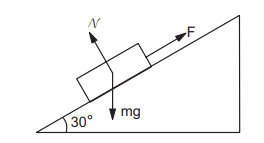
Q37. A block of mass 2.0 kg is pulled up on a smooth incline of angle \(30^{\circ}\) with the horizontal. If the block moves with an acceleration of \(1.0 \mathrm{~m} / \mathrm{s}^2\), find the power delivered by the pulling force at a time 4.0 s after the motion starts. What is the average power delivered during the 4.0 s after the motion starts?
Solution: The forces acting on the block are shown in figure (8-W1). Resolving the forces parallel to the incline, we get
\(
\text { or, } \begin{aligned}
F & -m g \sin \theta=m a \\
F & =m g \sin \theta+m a \\
& =(2.0 \mathrm{~kg})\left[\left(9.8 \mathrm{~m} / \mathrm{s}^2\right)(1 / 2)+1.0 \mathrm{~m} / \mathrm{s}^2\right]=11.8 \mathrm{~N}.
\end{aligned}
\)
The velocity at \(t=4.0 \mathrm{~s}\) is
\(
v=a t=\left(1 \cdot 0 \mathrm{~m} / \mathrm{s}^2\right)(4 \cdot 0 \mathrm{~s})=4 \cdot 0 \mathrm{~m} / \mathrm{s} .
\)
The power delivered by the force at \(t=4.0 \mathrm{~s}\) is
\(
P=\vec{F} \cdot \vec{v}=(11.8 \mathrm{~N})(4.0 \mathrm{~m} / \mathrm{s}) \approx 47 \mathrm{~W} .
\)
The displacement during the first four seconds is
\(
x=\frac{1}{2} a t^2=\frac{1}{2}\left(1.0 \mathrm{~m} / \mathrm{s}^2\right)\left(16 \mathrm{~s}^2\right)=8.0 \mathrm{~m} .
\)
The work done in these four seconds is, therefore,
\(
W=\vec{F} \cdot \vec{d}=(11 \cdot 8 \mathrm{~N})(8 \cdot 0 \mathrm{~m})=94 \cdot 4 \mathrm{~J} .
\)
The average power delivered \(=\frac{94 \cdot 4 \mathrm{~J}}{4 \cdot 0 \mathrm{~s}}\)
\(
=23 \cdot 6 \mathrm{~W} \approx 24 \mathrm{~W} .
\)
Q38. A body dropped from a height \(H\) reaches the ground with a speed of \(1 \cdot 2 \sqrt{g H}\). Calculate the work done by air-friction.
Solution: Step 1: Define Initial and Final Energies
The initial mechanical energy \(\left(E_i\right)\) of the body when dropped from height \(H\) with zero initial velocity ( \(v_i=0\) ) is purely potential energy ( \(P E_i\) ), where we set the ground as the zero potential energy level ( \(P E_f=0\) ).
\(
E_i=P E_i+K E_i=m g H+0=m g H
\)
Step 2: Calculate Final Kinetic Energy
The body reaches the ground with a final velocity \(v_f=1.2 \sqrt{g H}\). The final mechanical energy ( \(\boldsymbol{E}_{\boldsymbol{f}}\) ) at the ground is purely kinetic energy ( \(\boldsymbol{K E}_{\boldsymbol{f}}\) ).
We calculate \(\boldsymbol{v}_{\boldsymbol{f}}^2\) :
\(
v_f^2=(1.2 \sqrt{g H})^2=1.44 g H
\)
The final kinetic energy is:
\(
K E_f=\frac{1}{2} m v_f^2=\frac{1}{2} m(1.44 g H)=0.72 m g H
\)
The final energy is \(E_f=0.72 m g H\).
Step 3: Apply the Work-Energy Principle
The work done by the non-conservative force, air friction ( \(W_f\) ), is equal to the change in the body’s total mechanical energy ( \(\Delta E=E_f-E_i\) ).
\(
\begin{gathered}
W_f=E_f-E_i \\
W_f=0.72 m g H-m g H \\
W_f=-0.28 m g H
\end{gathered}
\)
The work done by air-friction is -0.28 mgH.
Q39. What minimum horizontal speed should be given to the bob of a simple pendulum of length \(l\) so that it describes a complete circle?
Solution: Step 1: Determine Minimum Speed at Top
At the top of the circle, the tension in the string must be at least zero for the bob to complete the circle. The minimum speed ( \(v\) ) at the top is found using the centripetal force equation when tension \(\boldsymbol{T} \boldsymbol{=} \mathbf{0}\) :
\(
m g=\frac{m v^2}{l}
\)
Solving for \(v\) gives the minimum speed at the top:
\(
v=\sqrt{g l}
\)
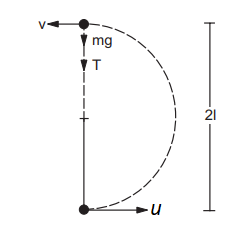
Step 2: Apply Conservation of Energy
Using the principle of conservation of energy between the bottom (initial speed \(u\) ) and the top (speed \(v\), height \(2 l\) above the bottom), where potential energy at the bottom is zero:
\(
\frac{1}{2} m u^2=\frac{1}{2} m v^2+m g(2 l)
\)
Substitute the minimum speed \(v=\sqrt{g l}\) into the energy equation:
\(
\begin{gathered}
\frac{1}{2} m u^2=\frac{1}{2} m(g l)+2 m g l \\
\frac{1}{2} m u^2=\frac{5}{2} m g l
\end{gathered}
\)
The mass \(m\) cancels out, allowing us to solve for the initial speed \(u\) :
\(
\begin{aligned}
& u^2=5 g l \\
& u=\sqrt{5 g l}
\end{aligned}
\)
The minimum horizontal speed required is \(\sqrt{5 \mathrm{gl}}\).
Q40. A uniform chain of length \(l\) and mass \(m\) overhangs a smooth table with its two third part lying on the table. Find the kinetic energy of the chain as it completely slips off the table.
Solution: Let us take the zero of potential energy at the table. Consider a part \(d x\) of the chain at a depth \(x\) below the surface of the table. The mass of this part is \(d m=m / l \quad d x\) and hence its potential energy is \(-(m / l d x) g x\).
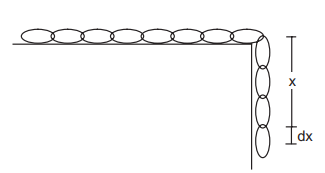
The potential energy of the \(l / 3\) of the chain that overhangs is \(U_1=\int_0^{l / 3}-\frac{m}{l} g x d x\)
\(
=-\left[\frac{m}{l} g\left(\frac{x^2}{2}\right)\right]_0^{l / 3}=-\frac{1}{18} m g l.
\)
This is also the potential energy of the full chain in the initial position because the part lying on the table has zero potential energy. The potential energy of the chain when it completely slips off the table is
\(
U_2=\int_0^l-\frac{m}{l} g x d x=-\frac{1}{2} m g l.
\)
The loss in potential energy \(=\left(-\frac{1}{18} m g l\right)-\left(-\frac{1}{2} m g l\right)\)
\(
=\frac{4}{9} m g l.
\)
This should be equal to the gain in the kinetic energy. But the initial kinetic enegry is zero. Hence, the kinetic energy of the chain as it completely slips off the table is \(\frac{4}{9} m g l\).
Q41. A block of mass \(m\) is pushed against a spring of spring constant \(k\) fixed at one end to a wall. The block can slide on a frictionless table as shown in figure below. The natural length of the spring is \(L_0\) and it is compressed to half its natural length when the block is released. Find the velocity of the block as a function of its distance \(x\) from the wall.
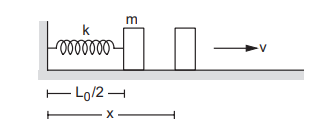
Solution: When the block is released, the spring pushes it towards right. The velocity of the block increases till the spring acquires its natural length. Thereafter, the block loses contact with the spring and moves with constant velocity.
Initially, the compression of the spring is \(L_0 / 2\). When the distance of the block from the wall becomes \(x\), where
\(x<L_0\), the compression is ( \(L_0-x\) ). Using the principle of conservation of energy,
\(
\frac{1}{2} k\left(\frac{L_0}{2}\right)^2=\frac{1}{2} k\left(L_0-x\right)^2+\frac{1}{2} m v^2 .
\)
Solving this,
\(
v=\sqrt{\frac{k}{m}}\left[\frac{L_0^2}{4}-\left(L_0-x\right)^2\right]^{1 / 2} .
\)
When the spring acquires its natural length, \(x=L_0\) and \(v=\sqrt{\frac{k}{m}} \frac{L_0}{2}\). Thereafter, the block continues with this velocity.
Q42. A particle is placed at the point \(A\) of a frictionless track \(A B C\) as shown in figure below. It is pushed slightly towards right. Find its speed when it reaches the point B. Take \(g=10 \mathrm{~m} / \mathrm{s}^2\).
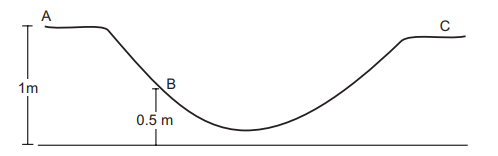
Solution: Let us take the gravitational potential energy to be zero at the horizontal surface shown in the figure. The potential energies of the particle at \(A\) and \(B\) are
\(
U_A=M g(1 \mathrm{~m})
\)
and
\(
U_B=M g(0.5 \mathrm{~m}) .
\)
The kinetic energy at the point \(A\) is zero. As the track is frictionless, no energy is lost. The normal force on the particle does no work. Applying the principle of conservation of energy,
\(
U_A+K_A=U_B+K_B
\)
\(
M g(1 \mathrm{~m})=M g(0.5 \mathrm{~m})+\frac{1}{2} M v_B^2
\)
\(
\begin{aligned}
\frac{1}{2} v_B^2 & =g(1 \mathrm{~m}-0.5 \mathrm{~m}) \\
& =\left(10 \mathrm{~m} / \mathrm{s}^2\right) \times 0.5 \mathrm{~m} \\
& =5 \mathrm{~m}^2 / \mathrm{s}^2
\end{aligned}
\)
\(
v_B=\sqrt{10} \mathrm{~m} / \mathrm{s} .
\)
Q43. Figure below shows a smooth curved track terminating in a smooth horizontal part. A spring of spring constant \(400 \mathrm{~N} / \mathrm{m}\) is attached at one end to a wedge fixed rigidly with the horizontal part. A 40 g mass is released from rest at a height of 4.9 m on the curved track. Find the maximum compression of the spring.
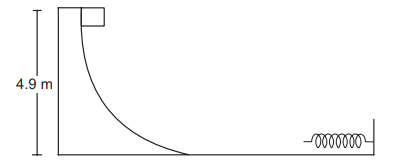
Solution: At the instant of maximum compression the speed of the 40 g mass reduces to zero. Taking the gravitational potential energy to be zero at the horizontal part, the conservation of energy shows,
\(
m g h=\frac{1}{2} k x^2
\)
where \(m=0.04 \mathrm{~kg}, h=4.9 \mathrm{~m}, k=400 \mathrm{~N} / \mathrm{m}\) and \(x\) is the maximum compression.
Thus, \(x=\sqrt{\frac{2 m g h}{k}}\)
\(
\begin{aligned}
& =\sqrt{\frac{2 \times(0.04 \mathrm{~kg}) \times\left(9.8 \mathrm{~m} / \mathrm{s}^2\right) \times(4.9 \mathrm{~m})}{(400 \mathrm{~N} / \mathrm{m})}} \\
& =9.8 \mathrm{~cm}
\end{aligned}
\)
Q44. Figure below shows a loop-the-loop track of radius \(R\). \(A\) car (without engine) starts from a platform at a distance \(h\) above the top of the loop and goes around the loop without falling off the track. Find the minimum value of \(h\) for a successful looping. Neglect friction.
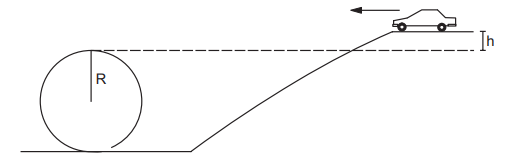
Solution: Suppose the speed of the car at the topmost point of the loop is \(v\). Taking the gravitational potential energy to be zero at the platform and assuming that the car starts with a negligible speed, the conservation of energy shows,
\(
0=-m g h+\frac{1}{2} m v^2
\)
\(
m v^2=2 m g h,
\)
where \(m\) is the mass of the car. The car moving in a circle must have radial acceleration \(v^2 / R\) at this instant. The forces on the car are, \(m g\) due to gravity and \(N\) due to the contact with the track. Both these forces are in radial direction at the top of the loop. Thus, from Newton’s Law
\(
m g+N=\frac{m v^2}{R}
\)
\(
m g+N=2 m g h / R .
\)
For \(h\) to be minimum, \(N\) should assume the minimum value which can be zero. Thus,
\(
2 m g \frac{h_{\min }}{R}=m g \quad \text { or, } \quad h_{\min }=R / 2
\)
Q45. Find the average frictional force needed to stop a car weighing 500 kg in a distance of 25 m if the initial speed is \(72 \mathrm{~km} / \mathrm{h}\).
Solution: The initial speed \(v_i\) must be converted from kilometers per hour (km/h) to meters per second (m/s):
\(
v_i=72 \mathrm{~km} / \mathrm{h} \times \frac{1000 \mathrm{~m}}{1 \mathrm{~km}} \times \frac{1 \mathrm{~h}}{3600 \mathrm{~s}}=20 \mathrm{~m} / \mathrm{s}
\)
Step 2: Apply the Work-Energy Theorem
The work done by the frictional force ( \(W_f\) ) equals the change in the car’s kinetic energy ( \(\Delta K\) ):
\(
W_f=\Delta K=K_f-K_i
\)
Since the car stops, the final kinetic energy \(\boldsymbol{K}_{\boldsymbol{f}}\) is zero. The work done by friction is \(F_f \times \Delta x \times \cos \left(180^{\circ}\right)=-F_f \Delta x\). The initial kinetic energy is \(K_i=\frac{1}{2} m v_i^2\).
\(
-F_f \Delta x=0-\frac{1}{2} m v_i^2
\)
We solve for the average frictional force \(F_f\) :
\(
F_f=\frac{m v_i^2}{2 \Delta x}
\)
Substituting the given values \(\left(m=500 \mathrm{~kg}, v_i=20 \mathrm{~m} / \mathrm{s}, \Delta x=25 \mathrm{~m}\right)\) :
\(
F_f=\frac{500 \mathrm{~kg} \times(20 \mathrm{~m} / \mathrm{s})^2}{2 \times 25 \mathrm{~m}}=\frac{500 \times 400}{50} \mathrm{~N}=4000 \mathrm{~N}
\)
The average frictional force required is \(\mathbf{4 0 0 0 ~ N}\).
Q46. Water falling from a 50 m high fall is to be used for generating electric energy. If \(1.8 \times 10^5 \mathrm{~kg}\) of water falls per hour and half the gravitational potential energy can be converted into electric energy, how many 100 W lamps can be lit?
Solution: Step 1: Calculate the mass flow rate in kilograms per second
The mass of water falling per hour is \(1.8 \times 10^5 \mathrm{~kg}\). To work in standard SI units (meters, kilograms, seconds), we convert the time to seconds:
\(
m_{\text {rate }}=\frac{1.8 \times 10^5 \mathrm{~kg}}{3600 \mathrm{~s}}
\)
Step 2: Calculate the total gravitational power (energy per second)
The gravitational potential energy (GPE) converted per second (power, \(\boldsymbol{P}_{\text {grav }}\) ) is given by the formula \(\boldsymbol{P}=m_{\text {rate }} g h\), where \(g\) is the acceleration due to gravity ( \(9.8 \mathrm{~m} / \mathrm{s}^2\) ) and \(h\) is the height.
\(
\begin{gathered}
\boldsymbol{P}_{\mathrm{grav}}=\frac{1.8 \times 10^5 \mathrm{~kg}}{3600 \mathrm{~s}} \times 9.8 \mathrm{~m} / \mathrm{s}^2 \times 50 \mathrm{~m} \\
\boldsymbol{P}_{\mathrm{grav}} \approx 24500 \mathrm{~W}
\end{gathered}
\)
Step 3: Calculate the usable electric power
Only half the gravitational potential energy can be converted into electric energy, so the usable power is 50\% of the total gravitational power.
\(
\begin{gathered}
P_{\text {electric }}=0.5 \times P_{\mathrm{grav}} \\
P_{\text {electric }}=0.5 \times 24500 \mathrm{~W} \\
P_{\text {electric }}=12250 \mathrm{~W}
\end{gathered}
\)
Step 4: Determine the number of lamps
To find the number of 100 W lamps that can be lit, we divide the total usable electric power by the power consumption of a single lamp.
\(
\begin{gathered}
\text { Number of lamps }=\frac{P_{\text {electric }}}{P_{\text {lamp }}} \\
\text { Number of lamps }=\frac{12250 \mathrm{~W}}{100 \mathrm{~W}} \\
\text { Number of lamps }=122.5
\end{gathered}
\)
Since you cannot light half a lamp, the number of fully lit lamps is 122.
Q47. A block of mass 1 kg is placed at the point \(A\) of a rough track shown in figure below. If slightly pushed towards right, it stops at the point \(B\) of the track. Calculate the work done by the frictional force on the block during its transit from \(A\) to \(B\).
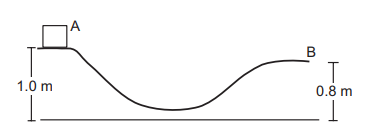
Solution: Step 1: Apply the Work-Energy Theorem
The work-energy theorem states that the net work done on an object is equal to its change in kinetic energy ( \(\Delta K\) ). In this case, the block starts from rest (or near rest, “slightly pushed”) at point A and stops at point B , so the initial and final kinetic energies are both zero ( \(\Delta K=0\) ).
\(
W_{\text {net }}=\Delta K=K_B-K_A=0-0=0
\)
The net work done is the sum of the work done by gravity \(\left(W_g\right)\) and the work done by friction ( \(W_f\) ).
\(
W_{\text {net }}=W_g+W_f=0
\)
Thus, the work done by friction is the negative of the work done by gravity:
\(
W_f=-W_g
\)
Step 2: Calculate the Work Done by Gravity
The work done by gravity depends only on the vertical displacement of the block, not the path taken.
The mass is \(m=1 \mathrm{~kg}\), the height at A is \(H=1 \mathrm{~m}\), the height at B is \(h=0.8 \mathrm{~m}\), and assuming \(g=10 \mathrm{~m} / \mathrm{s}^2\) as per common problem conventions.
The change in potential energy is \(\Delta U=U_B-U_A=m g h-m g H\). The work done by gravity is \(W_g=-\Delta U=m g H-m g h\).
\(
\begin{gathered}
W_g=m g(H-h) \\
W_g=1 \mathrm{~kg} \times 10 \mathrm{~m} / \mathrm{s}^2 \times(1 \mathrm{~m}-0.8 \mathrm{~m}) \\
W_g=10 \times 0.2 \mathrm{~J}=2 \mathrm{~J}
\end{gathered}
\)
Step 3: Calculate the Work Done by Friction
Using the result from Step 1, the work done by friction is the negative of the work done by gravity:
\(
\begin{gathered}
W_f=-W_g \\
W_f=-2 \mathrm{~J}
\end{gathered}
\)
The work done by the frictional force on the block during its transit from A to B is \(\mathbf{- 2}J.\)
Q48. A block of mass 250 g is kept on a vertical spring of spring constant \(100 \mathrm{~N} / \mathrm{m}\) fixed from below. The spring is now compressed to have a length 10 cm shorter than its natural length and the system is released from this position. How high does the block rise? Take \(g=10 \mathrm{~m} / \mathrm{s}^2\).
Solution: Step 1: Identify given variables and principle
We are given the mass \(m=250 \mathrm{~g}=0.25 \mathrm{~kg}\), spring constant \(k=100 \mathrm{~N} / \mathrm{m}\), compression distance \(x=10 \mathrm{~cm}=0.1 \mathrm{~m}\), and acceleration due to gravity \(g=10 \mathrm{~m} / \mathrm{s}^2\). The problem can be solved using the conservation of mechanical energy principle, assuming all initial elastic potential energy is converted into gravitational potential energy at the maximum height \(h\).
Step 2: Set up the energy conservation equation
The initial potential energy stored in the compressed spring is given by \(E_i=\frac{1}{2} k x^2\). The final gravitational potential energy at the maximum height is \(\boldsymbol{E}_{\boldsymbol{f}} \boldsymbol{=} \boldsymbol{m} \boldsymbol{g} \boldsymbol{h}\). By conservation of energy, we set these equal:
\(
E_i=E_f \Longrightarrow \frac{1}{2} k x^2=m g h
\)
Step 3: Solve for the height \(h\) and calculate the value
Rearranging the equation to solve for the height \(h\), we get:
\(
h=\frac{k x^2}{2 m g}
\)
Substitute the given numerical values into the formula:
\(
\begin{gathered}
h=\frac{(100 \mathrm{~N} / \mathrm{m})(0.1 \mathrm{~m})^2}{2(0.25 \mathrm{~kg})\left(10 \mathrm{~m} / \mathrm{s}^2\right)} \\
h=\frac{100 \times 0.01}{5}=\frac{1}{5} \mathrm{~m}=0.2 \mathrm{~m}
\end{gathered}
\)
The block rises to a height of 0.2 m.
Q49. Figure below shows a spring fixed at the bottom end of an incline of inclination \(37^{\circ}\). A small block of mass 2 kg starts slipping down the incline from a point 4.8 m away from the spring. The block compresses the spring by 20 cm, stops momentarily and then rebounds through a distance of 1 m up the incline. Find (a) the friction coefficient between the plane and the block and (b) the spring constant of the spring. Take \(g=10 \mathrm{~m} / \mathrm{s}^2\).
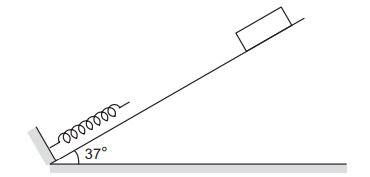
Solution: Step 1: Set up energy conservation equations
We apply the work-energy theorem ( \(\Delta E=W_{\text {friction }}\) ) to two distinct phases of motion: (1) the block sliding down and compressing the spring to maximum compression, and (2) the block rebounding. Let \(d\) be the initial distance, \(x_{\text {max }}\) be the maximum compression, and \(d_{\text {rebound }}\) be the rebound distance. The change in energy involves gravitational potential energy, spring potential energy, and work done by friction. For the first phase (downward):
\(
-\mu m g \cos (\theta)\left(d+x_{\max }\right)=\frac{1}{2} k x_{\max }^2-m g\left(d+x_{\max }\right) \sin (\theta)
\)
For the second phase (rebound):
\(
-\mu m g \cos (\theta) d_{\text {rebound }}=m g d_{\text {rebound }} \sin (\theta)-\frac{1}{2} k x_{\max }^2
\)
Step 2: Solve for friction coefficient
We use the second equation to express \(\frac{1}{2} k x_{\text {max }}^2\) and substitute it into the first equation to eliminate \(k\).
\(
\frac{1}{2} k x_{\max }^2=m g d_{\text {rebound }} \sin (\theta)+\mu m g \cos (\theta) d_{\text {rebound }}
\)
Substitution and algebraic manipulation leads to the equation for the friction coefficient \(\mu\) :
\(
\mu=\frac{\left(d+x_{\max }-d_{\text {rebound }}\right)}{\left(d+x_{\max }+d_{\text {rebound }}\right)} \tan (\theta)
\)
Using the given values \(d=4.8 \mathrm{~m}, x_{\text {max }}=0.2 \mathrm{~m}, d_{\text {rebound }}=1 \mathrm{~m}, \theta=37^{\circ}\), \(\sin \left(37^{\circ}\right) \approx 0.6, \cos \left(37^{\circ}\right) \approx 0.8\) :
\(
\mu=\frac{(4.8+0.2-1)}{(4.8+0.2+1)} \tan \left(37^{\circ}\right)=\frac{4.0}{6.0} \times \frac{0.6}{0.8}=\frac{2}{3} \times \frac{3}{4}=0.5
\)
Step 3: Solve for spring constant
Using the value of \(\mu\) in the rebound phase equation, we solve for the spring constant \(k\) :
\(
k=\frac{2 m g d_{\text {rebound }}(\sin (\theta)+\mu \cos (\theta))}{x_{\max }^2}
\)
Substituting the known values \(m=2 \mathrm{~kg}, g=10 \mathrm{~m} / \mathrm{s}^2, d_{\text {rebound }}=1 \mathrm{~m}, \sin \left(37^{\circ}\right) \approx 0.6\), \(\cos \left(37^{\circ}\right) \approx 0.8, \mu=0.5, x_{\text {max }}=0.2 \mathrm{~m}\) :
\(
k=\frac{2 \times 2 \times 10 \times 1 \times(0.6+0.5 \times 0.8)}{(0.2)^2}=\frac{40 \times(0.6+0.4)}{0.04}=\frac{40}{0.04}=1000 \mathrm{~N} / \mathrm{m}
\)
(a) The friction coefficient between the plane and the block is \(\mathbf{0 . 5}\).
(b) The spring constant of the spring is \(\mathbf{1 0 0 0 ~ N} / \mathbf{m}\).
Q50. Consider the situation shown in figure below. The system is released from rest and the block of mass 1.0 kg is found to have a speed \(0.3 \mathrm{~m} / \mathrm{s}\) after it has descended through a distance of 1 m. Find the coefficient of kinetic friction between the block and the table.
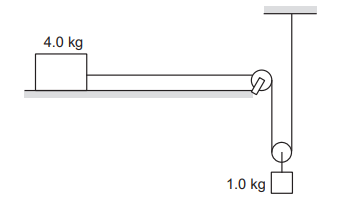
Solution: Because the \(1.0-\mathrm{kg}\) mass is attached to a movable pulley, the rope supports it with two segments. If the 1 -kg mass moves down by a distance \(y\), each rope segment lengthens by \(y\), so the block on the table must pull in \(2y\) of rope.
Thus:
\(
x_{4 \mathrm{~kg}}=2 x_{1 \mathrm{~kg}}
\)
Given the \(1-\mathrm{kg}\) block has descended 1 m , the \(4-\mathrm{kg}\) block has moved:
\(
x_4=2 \times 1=2 \mathrm{~m}
\)
The speeds also satisfy:
\(
v_4=2 v_1=2(0.3)=0.6 \mathrm{~m} / \mathrm{s}
\)
Kinetic energy gained
\(
\begin{gathered}
K E_4=\frac{1}{2}(4)\left(0.6^2\right)=0.72 \mathrm{~J} \\
K E_1=\frac{1}{2}(1)\left(0.3^2\right)=0.045 \mathrm{~J} \\
K E_{\text {total }}=0.72+0.045=0.765 \mathrm{~J}
\end{gathered}
\)
Work done by gravity
The 1-kg mass descends 1 m :
\(
W_g=(1)(9.8)(1)=9.8 \mathrm{~J}
\)
Work done against friction
Friction acts on the 4 -kg block only:
Normal force:
\(
N=4(9.8)=39.2 \mathrm{~N}
\)
Distance moved: 2 m
\(
W_f=-\mu_k(39.2)(2)=-78.4 \mu_k
\)
Energy equation
\(
\begin{gathered}
W_g+W_f=K E_{\text {total }} \\
9.8-78.4 \mu_k=0.765 \\
78.4 \mu_k=9.8-0.765=9.035
\end{gathered}
\)
\(
\mu_k \approx 0.12
\)