1.8 The conservation of mechanical energy
Law of Conservation of Energy
Energy can neither be created nor be destroyed, it can only be transformed from one form to another form.
The total mechanical energy of a system (sum of kinetic and potential energy) is conserved if all forces doing work on it are conservative forces. Conservative forces are path-independent, meaning the work they do depends only on the initial and final positions, not the path taken, and this work is completely recoverable as potential energy.
Examples:
- Free-falling object (negligible air resistance): As a ball falls, its potential energy (PE) is converted into kinetic energy (KE), but the total mechanical energy (KE + PE) remains constant. Gravity is the only force doing significant work and it is a conservative force.
- A swinging pendulum (ideal, no friction/air drag): Energy continuously transforms between maximum PE at its highest points (zero KE) and maximum KE at its lowest point (zero PE). The total mechanical energy stays the same.
- Mass-spring system (frictionless surface): When a mass oscillates on a spring, its energy alternates between elastic potential energy (stored in the spring) and kinetic energy. The total energy of the system remains constant because the spring force is conservative.
THE CONSERVATION OF MECHANICAL ENERGY
For simplicity, we demonstrate this important principle for one-dimensional motion. Assume that a body undergoes displacement \(\Delta x\) under the action of a conservative force \(F\). Then from the Work-Energy theorem, we have,
\(\Delta K=F(x) \Delta x\)
If the force is conservative, the potential energy function \(U(x)\) can be defined such that
\(-\Delta U=F(x) \Delta x\)
The above equations imply that
\(
\begin{array}{l}
\Delta K+\Delta U=0 \\
\Delta(K+U)=0 \dots(i)
\end{array}
\)
which means that \(K+U\), the sum of the kinetic and potential energies of the body is a constant. Over the whole path, \(x_{i}\) to \(x_{f}\), this means that
\(
K_{i}+U\left(x_{i}\right)=K_{f}+U\left(x_{f}\right) \dots (ii)
\)
The quantity \(K+U(x)\), is called the total mechanical energy of the system. Individually the kinetic energy \(K\) and the potential energy \(U(x)\) may vary from point to point, but the sum is a constant.
Let us consider some of the definitions of a conservative force.
- A force \(F(x)\) is conservative if it can be derived from a scalar quantity \(U(x)\) by the relation given by \(\Delta U=-F(x) \Delta x\).
- The work done by the conservative force depends only on the endpoints. This can be seen from the relation,
\(W=K_{f}-K_{i}=U\left(x_{i}\right)-U\left(x_{f}\right)\), which depends on the end points. - A third definition states that the work done by this force in a closed path is zero (since \(x_{i}=x_{f}\)).
Thus, the principle of conservation of total mechanical energy can be stated as, the total mechanical energy of a system is conserved if the forces, doing work on it, are conservative.
Important Points:
- The sum of the kinetic energy and the potential energy is called the total mechanical energy. The total mechanical energy of a system remains constant if the internal forces are conservative and the external forces do no work. This is called the principle of conservation of energy.
- If nonconservative internal forces operate within the system, or external forces do work on the system, the mechanical energy changes as the configuration changes. According to the work-energy theorem, the work done by all the forces equals the change in the kinetic energy.
The above discussion can be made more concrete by considering the example of the gravitational force once again and that of the spring force in the next section. Fig. 6.5 depicts a ball of mass \(m\) being dropped from a cliff of height \(H\).
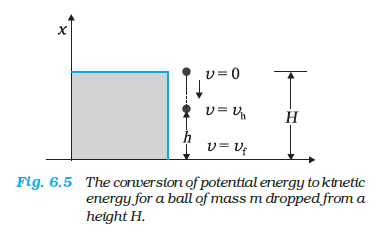
The total mechanical energies \(E_0, E_h\), and \(E_H\) of the ball at the indicated heights zero (ground level), \(h\) and \(H\), are
\(
\begin{aligned}
E_H & =m g H \dots(iii) \\
E_h & =m g h+\frac{1}{2} m v_h^2 \dots(iv) \\
E_0 & =(1 / 2) m v_f^2 \dots(v)
\end{aligned}
\)
The constant force is a special case of a spatially dependent force \(F(x)\). Hence, the mechanical energy is conserved. Thus
\(
E_H=E_0
\)
or, \(\quad m g H=\frac{1}{2} m v_f^2\)
\(
v_f=\sqrt{2 g H}
\)
a result that was obtained in section 3.7 for a freely falling body.
Further,
\(
E_H=E_h
\)
which implies,
\(
v_{\mathrm{h}}^2=2 g(H-h) \dots(vi)
\)
and is a familiar result from kinematics.
At the height \(H\), the energy is purely potential. It is partially converted to kinetic at height \(h\) and is fully kinetic at ground level. This illustrates the conservation of mechanical energy.
Example 1: A bob of mass \(m\) is suspended by a light string of length \(L\). It is imparted a horizontal velocity \(v_0\) at the lowest point A such that it completes a semi-circular trajectory in the vertical plane with the string becoming slack only on reaching the topmost point, C. This is shown in Fig. 6.6. Obtain an expression for (i) \(v_o\); (ii) the speeds at points \(\mathrm{B}\) and \(\mathrm{C}\); (iii) the ratio of the kinetic energies \(\left(K_B / K_C\right)\) at \(\mathrm{B}\) and \(\mathrm{C}\). Comment on the nature of the trajectory of the bob after it reaches the point \(C\).
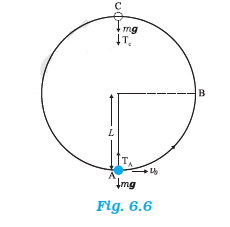
Solution: (i) There are two external forces on the bob: gravity and the tension \((T)\) in the string. The latter does no work since the displacement of the bob is always normal to the string. The potential energy of the bob is thus associated with the gravitational force only. The total mechanical energy \(E\) of the system is conserved. We take the potential energy of the system to be zero at the lowest point \(A\). Thus, at \(A\):
\(
E=\frac{1}{2} m v_0^2 \dots(1)
\)
\(
T_A-m g=\frac{m v_0^2}{L} \text { [Newton’s Second Law] }
\)
where \(T_A\) is the tension in the string at A. At the highest point \(C\), the string slackens, as the tension in the string \(\left(T_C\right)\) becomes zero.
Thus, at \(\mathrm{C}\)
\(
\begin{aligned}
& E=\frac{1}{2} m v_c^2+2 m g L \dots(2)\\
& m g=\frac{m v_c^2}{L} \quad \text { [Newton’s Second Law] } \dots(3)
\end{aligned}
\)
where \(v_C\) is the speed at C. From Eqs. (2) and (3)
\(
E=\frac{5}{2} m g L
\)
Equating this to the energy at A
\(
\begin{array}{ll}
& \frac{5}{2} m g L=\frac{m}{2} v_o^2 \\
\text { or, } & v_0=\sqrt{5 g L}
\end{array}
\)
(ii) It is clear from Eq. (3)
\(
v_C=\sqrt{g L}
\)
At \(B\), the energy is
\(
E=\frac{1}{2} m v_B^2+m g L
\)
Equating this to the energy at A and employing the result from (1), namely \(v_0^2=5 g L\),
\(
\begin{aligned}
& \frac{1}{2} m v_B^2+m g L=\frac{1}{2} m v_o^2 \\
& \quad=\frac{5}{2} m g L
\end{aligned}
\)
\(
\therefore v_B=\sqrt{3 g L}
\)
(iii) The ratio of the kinetic energies at B and C is :
\(
\frac{K_B}{K_C}=\frac{\frac{1}{2} m v_B^2}{\frac{1}{2} m v_C^2}=\frac{3}{1}
\)
At the point \(\mathrm{C}\), the string becomes slack and the velocity of the bob is horizontal and to the left. If the connecting string is cut at this instant, the bob will execute a projectile motion with horizontal projection akin to a rock kicked horizontally from the edge of a cliff. Otherwise, the bob will continue on its circular path and complete the revolution.
Example 2: Prove that the work done by the external forces equals the change in the mechanical energy of the system. \(W_{e x t}=E_f-E_i\)
Solution: According to the work-energy theorem, the work done by all the forces equals the change in the kinetic energy. Thus,
\(
W_c+W_{n c}+W_{e x t}=K_f-K_i
\)
where the three terms on the left denote the work done by the conservative internal forces, nonconservative internal forces and external forces.
As
\(
W_c=-\left(U_f-U_i\right)
\)
we get
\(
\begin{aligned}
W_{n c}+W_{e x t} & =\left(K_f+U_f\right)-\left(K_i+U_i\right) \\
& =E_f-E_i \dots(i)
\end{aligned}
\)
where \(E=K+U\) is the total mechanical energy.
If the internal forces are conservative but external forces also act on the system and they do work, \(W_{n c}=0\) and from (i),
\(
W_{e x t}=E_f-E_i \dots(ii)
\)
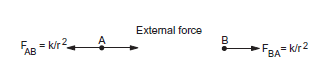
Example 3: Two charged particles \(A\) and \(B\) repel each other by a force \(k / r^2\), where \(k\) is a constant and \(r\) is the separation between them. The particle \(A\) is clamped to a fixed point in the lab and the particle B which has a mass \(m\), is released from rest with an initial separation \(r_0\) from \(\mathrm{A}\). Find the change in the potential energy of the two-particle system as the separation increases to a large value. What will be the speed of particle B in this situation?
Solution: The situation is shown in the figure below. Take \(A+B\) as the system. The only external force acting on the system is that needed to hold \(A\) fixed. (You can imagine the experiment being conducted in a gravity free region or the particles may be kept and allowed to move on a smooth horizontal surface, so that the normal force balances the force of gravity). This force does no work on the system because it acts on the charge \(A\) which does not move. Thus, the external forces do no work and internal forces are conservative. The total mechanical energy must, therefore, remain constant. There are two internal forces; \(F_{A B}\) acting on \(A\) and \(F_{B A}\) acting on \(B\). The force \(F_{A B}\) does no work because it acts on \(A\) which does not move. The work done by \(F_{A A}\) as the particle \(B\) is taken away is,
\(
W=\int \vec{F} \cdot d \vec{r}=\int_{r_0}^{\infty} \frac{k}{r^2} d r=\frac{k}{r_0} \dots(i)
\)
The change in the potential energy of the system is
\(
U_f-U_i=-W=-\frac{k}{r_0}
\)
As the total mechanical energy is conserved,
\(
\begin{aligned}
& K_f+U_f=K_i+U_i \\
& \text { or, } \\
& K_f=K_i-\left(U_f-U_i\right) \\
& \text { or, } \quad \frac{1}{2} m v^2=\frac{k}{r_0} \\
& \text { or, } \\
& v=\sqrt{\frac{2 k}{m r_0}} . \\
&
\end{aligned}
\)
Example 4: A body of mass 5 kg is thrown vertically up with a kinetic energy of 490 J. What will be height at which the kinetic energy of the body becomes half of the original value? \(\left(\right.\) Take, acceleration due to gravity \(\left.=9.8 m s^{-2}\right)\)
Solution: Given, \(m=5 \mathrm{~kg}\) and \(K_i=490 \mathrm{~J}, g=9.8 \mathrm{~ms}^{-2}\)
From the law of conservation of energy, \(K_i+U_i=K_f+U_f\)
\(
K_i+0=\frac{K_i}{2}+m g h \quad\left(\because K_f=\frac{K_i}{2}\right)
\)
\(
\begin{aligned}
490 & =245+5 \times 9.8 \times h \\
h & =\frac{490-245}{5 \times 9.8}=\frac{245}{49}=5 \mathrm{~m}
\end{aligned}
\)
Example 5: A bullet of mass \(m\) moving with velocity \(v\) strikes a suspended wooden block of mass \(M\) and remains embedded in it. If the block rises to a height \(h\), find the initial velocity of the bullet.
Solution: Initial kinetic energy of the block when the bullet strikes
\(
=\frac{1}{2}(m+M) v^2
\)
Due to this kinetic energy, the block will rise to a height \(h\). Its potential energy \(=(m+M) g h\)
So, from the law of conservation of energy,
\(
\frac{1}{2}(M+m) v^2=(M+m) g h \Rightarrow \frac{v^2}{2}=g h
\)
Initial velocity of the bullet, \(v=\sqrt{2 g h}\)
Example 6: A particle of mass \(m\) makes SHM in a smooth hemispherical bowl \(A B C\) and it moves from \(A\) to \(C\) and back to \(A\) via \(A B C\), so that \(P B=h\). Find the speed of the ball when it just crosses the point \(B\).
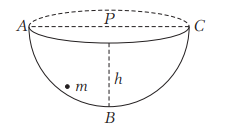
Solution: Step 1: Principle of Conservation of Energy
We assume that \(\mathbf{B}\) is the lowest point of the hemispherical bowl and \(\mathbf{A}\) and \(\mathbf{C}\) are the extreme points of the oscillation, both at a vertical height \(\boldsymbol{h}\) above \(\mathbf{B}\). Since the bowl is smooth, mechanical energy is conserved.
Step 2: Energy at Extreme Point and Lowest Point
At the extreme points (A or C), the ball momentarily stops, so its kinetic energy is zero, and its potential energy (relative to \(\mathbf{B}\) ) is \(\boldsymbol{m} \boldsymbol{g} \boldsymbol{h}\). At the lowest point ( \(\mathbf{B}\) ), the height is zero, so potential energy is zero, and the kinetic energy is maximum, given by \(\frac{1}{2} m v^2\), where \(\boldsymbol{v}\) is the speed at \(\mathbf{B}\).
Step 3: Solving for the Speed
By the conservation of energy, the total energy at \(\mathbf{A}\) equals the total energy at \(\mathbf{B}\) :
\(
m g h=\frac{1}{2} m v^2
\)
We can rearrange this equation to solve for \(v\) :
\(
\begin{aligned}
& v^2=2 g h \\
& v=\sqrt{2 g h}
\end{aligned}
\)
The speed of the ball when it just crosses the point \(B\) is \(\sqrt{2 g h}\).
Example 7: A child is swinging on a swing. Minimum and maximum heights of swing from the earth’s surface are \(0.75 m\) and \(2 m\), respectively. What will be the maximum velocity of this swing?
Solution: From energy conservation, gain in kinetic energy \(=\) loss in potential energy
\(
\Rightarrow \quad(1 / 2) m v_{\max }^2=m g\left(H_2-H_1\right)
\)
Here, \(H_1=\) minimum height of swing from earth’s surface \(=0.75 \mathrm{~m}\) and \(H_2=\) maximum height of swing from earth’s surface \(=2 \mathrm{~m}\)
\(
\begin{array}{ll}
\therefore & (1 / 2) m v_{\text {max }}^2=m g(2-0.75) \\
\text { or } & v_{\text {max }}=\sqrt{2 \times 10 \times 1.25}=\sqrt{25}=5 \mathrm{~ms}^{-1}
\end{array}
\)
Example 8: A machine which is 75% efficient, uses \(12 J\) of energy in lifting 1 kg mass through a certain height. The mass is then allowed to fall through the same height. Find the velocity at the end of its fall.
Solution: Potential energy of the mass at a height above the earth’s
\(
\text { surface }=\frac{75}{100} \times 12=9 \mathrm{~J} \dots(i)
\)
Now, kinetic energy of the mass at the end of fall \(=\frac{1}{2} m v^2 \dots(ii)\)
Applying law of conservation of energy,
\(
\frac{1}{2} m v^2=9 \Rightarrow v=\sqrt{\frac{2 \times 9}{m}}=\sqrt{\frac{18}{1}}=\sqrt{18} \mathrm{~ms}^{-1}
\)
Example 9: Auto manufactures study the collision of cars with mounted springs of different spring constants. Consider a car of mass 1500 kg moving with a speed of \(36 \mathrm{kmh}^{-1}\) on a smooth road and colliding with a horizontally mounted spring of spring constant \(7.5 \times 10^3 \mathrm{Nm}^{-1}\). Find the maximum compression of the spring.
Solution: At maximum compression, KE of car gets converted completely into PE of the spring.
\(
\begin{aligned}
& \text { KE of car, } K=\frac{1}{2} m v^2=\frac{1}{2} \times 1500 \times 10 \times 10 \\
& =7.5 \times 10^4 \mathrm{~J}\left(\because v=36 \times \frac{5}{18}=10 \mathrm{~ms}^{-1}\right) \\
& U=\frac{1}{2} k x_m^2=K=7.5 \times 10^4 \mathrm{~J} \\
& \Rightarrow \quad x_m=\sqrt{\frac{2 \times 7.5 \times 10^4}{7.5 \times 10^3}}=4.47 \mathrm{~m}
\end{aligned}
\)
Example 10: A spherical ball of mass 20 kg is stationary at the top of a hill of height 100 m. It rolls down a smooth surface to the ground, then climbs up another hill of height \(30 m\) and finally rolls down to a horizontal base at a height of \(20 m\) above the ground. Find the velocity attained by the ball, when moving at horizontal base.
Solution: The problem can be solved using the principle of conservation of mechanical energy, as the surface is smooth (meaning no energy loss due to friction). The total mechanical energy (potential energy + kinetic energy) at the initial position (top of the first hill) is equal to the total mechanical energy at the final position (horizontal base at 20 m height).
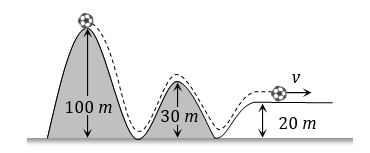
According to conservation of energy,
\(
m g H=\frac{1}{2} m v^2+m g h_2 \Rightarrow m g\left(H-h_2\right)=\frac{1}{2} m v^2
\)
where, \(H=\) height of the first hill,
\(h_1=\) height of the second hill,
\(h_2=\) height of the horizontal base
and \(\quad v=\) velocity attained by the ball.
\(
\Rightarrow \quad v=\sqrt{2 g(100-20)}=\sqrt{2 \times 10 \times 80}=40 \mathrm{~ms}^{-1}
\)
Example 11: A smooth narrow tube in the form of an arc \(A B\) of a circle of centre \(O\) and radius \(r\) is fixed, so that \(A\) is vertically above \(O\) and \(O B\) is horizontal. Particles \(P\) of mass \(m\) and \(Q\) of mass \(2 m\) with a light inextensible string of length \((\pi r / 2)\) connecting them are placed inside the tube with \(P\) at \(A\) and \(Q\) at \(B\) and released from rest. Assuming the string remains taut during motion, find the speed of particles when \(P\) reaches \(B\).
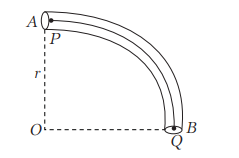
Solution: All surfaces are smooth. Therefore, mechanical energy of the system will remain conserved.
Mechanical energy is conserved when non-conservative forces, such as friction or air resistance, do no work on the system. A “smooth surface” in physics is defined as a surface where the force of friction is zero or negligible, allowing objects to slide without energy loss due to friction.
No Friction: Smooth surfaces lack friction, a non-conservative force.
No Energy Loss: In the absence of friction and other non-conservative forces, energy is not dissipated as heat or sound.
Conservation: Consequently, the total mechanical energy (potential + kinetic) remains constant throughout the motion.
∴ Decrease in PE of both the blocks = Increase in KE of both the blocks
\(
\therefore \quad(m g r)+(2 m g)\left(\frac{\pi r}{2}\right)=\frac{1}{2}(m+2 m) v^2 \text { or } v=\sqrt{\frac{2}{3}(1+\pi) g r}
\)
Example 12: In the arrangement shown in figure, string is light and inextensible and friction is absent everywhere.
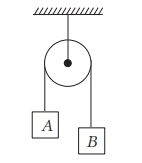
Find the speed of both the blocks after the block A has ascended a height of 1 m. Given that, \(m_A=1 \mathrm{~kg}\) and \(m_B=2 \mathrm{~kg}\left(\right.\) Take, \(\left.g=10 \mathrm{~ms}^{-2}\right)\).
Solution: Friction is absent. Therefore, mechanical energy of the system will remain conserved. From constraint relations, we see that speed of both the blocks will be same. Suppose it is \(v\). Here, gravitational potential energy of 2 kg block is decreasing while gravitational potential energy of 1 kg block is increasing.
Similarly, kinetic energy of both the blocks is also increasing.
\(
\begin{aligned}
& \therefore & m_B g h & =m_A g h+\frac{1}{2} m_A v^2+\frac{1}{2} m_B v^2 \\
& \text { or } & (2)(10)(1) & =(1)(10)(1)+\frac{1}{2}(1) v^2+\frac{1}{2}(2) v^2 \\
& \text { or } & 20 & =10+0.5 v^2+v^2 \text { or } 1.5 v^2=10 \\
& \therefore & v^2 & =6.67 \mathrm{~m}^2 \mathrm{~s}^{-2} \text { or } v=2.58 \mathrm{~ms}^{-1}
\end{aligned}
\)
Example 13: In the arrangement shown in figure, \(m_A=1 \mathrm{~kg}\), \(m_B=4 \mathrm{~kg}\). String is light and inextensible while pulley is smooth. Coefficient of friction between block \(A\) and the table is \(\mu=0.2\). Find the speed of both the blocks when block \(B\) has descended a height \(h=1 \mathrm{~m}\). (Take, \(g=10 \mathrm{~ms}^{-2}\) )
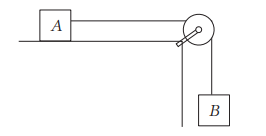
Solution: From constraint relation, we see that
\(
v_A=v_B=v \text { (say) }
\)
Force of friction between block \(A\) and table will be
\(
\begin{aligned}
& & f & =\mu m_A g=(0.2)(1)(10)=2 \mathrm{~N} \\
& \therefore & W_{n c} & =\Delta U+\Delta K \\
& \therefore & -f s & =-m_B g h+(1 / 2)\left(m_A+m_B\right) v^2 \\
& \text { or } & (-2)(1) & =-(4)(10)(1)+\frac{1}{2}(1+4) v^2 \\
& & -2 & =-40+2.5 v^2 \\
& \text { or } & 2.5 v^2 & =38 \\
& \text { or } & v^2 & =15.2 \mathrm{~m}^2 \mathrm{~s}^{-2} \text { or } v=3.9 \mathrm{~ms}^{-1}
\end{aligned}
\)
Example 14: In the arrangement shown in figure, \(m_A=4 \mathrm{~kg}\) and \(m_B=1 \mathrm{~kg}\). The system is released from rest and block \(B\) is found to have a speed \(0.3 \mathrm{~m} / \mathrm{s}\) after it has descended through a distance of 1 m. Find the coefficient of friction between the block and the table. Neglect friction elsewhere. (Take, \(g=10 \mathrm{~ms}^{-2}\) )
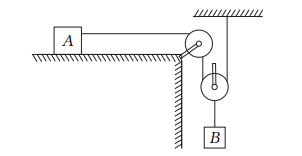
Solution: From constraint relations, we can see that \(v_A=2 v_B\)
Therefore,
\(
\begin{aligned}
v_A & =2(0.3) \quad\left(\text { Given, } v_B=0.3 \mathrm{~ms}^{-1}\right) \\
& =0.6 \mathrm{~ms}^{-1}
\end{aligned}
\)
Applying \(W_{n c}=\Delta U+\Delta K\), we get
\(
-\mu m_A g s_A=-m_B g s_B+\frac{1}{2} m_A v_A^2+\frac{1}{2} m_B v_B^2
\)
Here,
\(
\begin{aligned}
s_A & =2 s_B \\
& =2 \mathrm{~m}
\end{aligned} \quad\left(\text { Given }, s_B=1 \mathrm{~m}\right)
\)
\(
\begin{aligned}
& \therefore & -\mu(4.0)(10)(2) & =-(1)(10)(1)+\frac{1}{2}(4)(0.6)^2+\frac{1}{2}(1)(0.3)^2 \\
& \text { or } & -80 \mu & =-10+0.72+0.045 \\
& \text { or } & 80 \mu & =9.235 \text { or } \mu=0.115
\end{aligned}
\)
Example 15: A 20 kg body is released from rest, so as to slide in between vertical rails and compresses a vertical spring \(\left(k=1920 \mathrm{Nm}^{-1}\right)\) placed at a distance \(h=1 \mathrm{~m}\) from the starting position of the body. The rails offer a frictional force of \(40 N\) opposing the motion of body.
Find
(i) the velocity \(v\) of the body just before striking with the spring,
(ii) the maximum compression of the spring and
Solution: According to the question, we draw the following diagram.
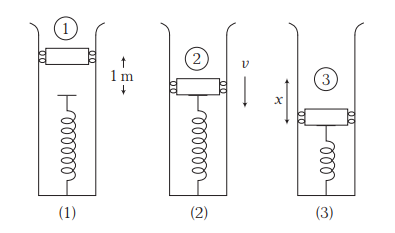
(i) Between diagrams (1) and (2),
Loss in \(\mathrm{PE}=\) Gain in \(\mathrm{KE}+\) Work done against friction
\(
\begin{aligned}
m g h & =\frac{1}{2} m v^2+f h \quad \quad(\because h=s) \\
20 \times 10 \times 1 & =\frac{1}{2} \times 20 v^2+40 \times 1 \Rightarrow v=4 \mathrm{~m} / \mathrm{s}
\end{aligned}
\)
(ii) Between diagrams (2) and (3),
Loss in PE + Loss in KE = Gain in spring energy + Work done against friction
\(
m g x+\frac{1}{2} \times m v^2=\frac{1}{2} k x^2+f x
\)
\(
\begin{aligned}
& 20 \times 10 \times x+\frac{1}{2} \times 20 \times 4^2=\frac{1}{2} \times 1920 x^2+40 x \\
& \quad 960 x^2-160 x-160=0 \\
& \Rightarrow \quad 6 x^2-x-1=0 \\
& \Rightarrow \quad x=\frac{1 \pm \sqrt{1+4 \times 6 \times 1}}{12}=\frac{1 \pm 5}{12}=\frac{1}{2} \mathrm{~m}
\end{aligned}
\)
CONVERSION OF MASS AND ENERGY
In 1905, Einstein discovered that mass can be converted into energy and vice-versa. He showed that mass and energy are equivalent and related by the relation
\(
E=m c^2
\)
where, \(m\) is mass that disappears, \(E\) is energy that appears and \(c\) is velocity of light in vacuum. Conversely, when energy \(E\) disappears, a mass \(m\left(=E / c^2\right)\) appears.
Thus, according to modern physics, mass and energy are not conserved separately, but are conserved as a single entity called mass energy.
So, the law of conservation of mass and law of conservation of energy have been unified by this relation into a single law of conservation of mass energy.
Nuclear energy
When \(\mathrm{U}^{235}\) nucleus breaks up into lighter nuclei on being bombarded by a slow neutron, a tremendous amount of energy is released. Thus, the energy so released is called nuclear energy and this phenomenon is known as nuclear fission. Nuclear reactors and nuclear bombs are the sources of nuclear energy.
Example 16: Calculate the energy in \(M e V\) equivalent to the rest mass of an electron. Given that the rest mass of an electron, \(m_0=9.1 \times 10^{-31} \mathrm{~kg}, 1 \mathrm{MeV}=1.6 \times 10^{-13} \mathrm{~J}\) and speed of light, \(c=3 \times 10^8 \mathrm{~ms}^{-1}\).
Solution: According to the conversion of mass and energy,
\(
\begin{aligned}
E & =m_0 c^2=9.1 \times 10^{-31} \times\left(3 \times 10^8\right)^2 \\
& =81.9 \times 10^{-15} \mathrm{~J} \\
& =\frac{81.9 \times 10^{-15}}{1.6 \times 10^{-13}} \\
& =0.512 \mathrm{MeV}
\end{aligned}
\)
Remarks
- Work done on a particle is equal to the change in its kinetic energy.
- Work done on a system by all the (external and internal) forces is equal to the change in its kinetic energy.
- A force is called conservative if the work done by it during a round trip of a system is always zero. The force of gravitation, Coulomb force, force by a spring, etc. are conservative. If the work done by it during a round trip is not zero, the force is nonconservative. Friction is an example of a nonconservative force.
- The change in the potential energy of a system corresponding to conservative internal forces is equal to the negative of the work done by these forces.
- If no external forces act (or the work done by them is zero) and the internal forces are conservative, the mechanical energy of the system remains constant. This is known as the principle of conservation of mechanical energy.
- If some of the internal forces are nonconservative, the mechanical energy of the system is not constant.
- If the internal forces are conservative, the work done by the external forces is equal to the change in mechanical energy.