JEE PYQs MCQs
- Scalar quantities are quantities with magnitudes only. Examples are distance, speed, mass and temperature.
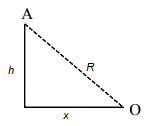
- Vector quantities are quantities with magnitude and direction both. Examples are displacement, velocity and acceleration. They obey special rules of vector algebra.
- A vector \(\mathbf{A}\) multiplied by a real number \(\lambda\) is also a vector, whose magnitude is \(\lambda\) times the magnitude of the vector \(\mathbf{A}\) and whose direction is the same or opposite depending upon whether \(\lambda\) is positive or negative.
- Two vectors \(\mathbf{A}\) and \(\mathbf{B}\) may be added graphically using head-to-tail method or parallelogram method.
- Vector addition is commutative :
\(
\mathbf{A}+\mathbf{B}=\mathbf{B}+\mathbf{A}
\)
It also obeys the associative law:
\(
(\mathbf{A}+\mathbf{B})+\mathbf{C}=\mathbf{A}+(\mathbf{B}+\mathbf{C})
\) - A null or zero vector is a vector with zero magnitude. Since the magnitude is zero, we don’t have to specify its direction. It has the properties :
\(
\begin{aligned}
\mathbf{A}+\mathbf{0} & =\mathbf{A} \\
\lambda \mathbf{~0} & =\mathbf{0} \\
0 \mathbf{~A} & =\mathbf{0}
\end{aligned}
\) - The subtraction of vector \(\mathbf{B}\) from \(\mathbf{A}\) is defined as the sum of \(\mathbf{A}\) and \(-\mathbf{B}\) :
\(
\mathbf{A}-\mathbf{B}=\mathbf{A}+(-\mathbf{B})
\) - A vector \(\mathbf{A}\) can be resolved into component along two given vectors \(\mathbf{a}\) and \(\mathbf{b}\) lying in the same plane :
\(
\mathbf{A}=\lambda \mathbf{a}+\mu \mathbf{b}
\)
where \(\lambda\) and \(\mu\) are real numbers. - A unit vector associated with a vector \(\mathbf{A}\) has magnitude 1 and is along the vector \(\mathbf{A}\) :
\(
\hat{\mathbf{n}}=\frac{\mathbf{A}}{|\mathbf{A}|}
\)
The unit vectors \(\hat{\mathbf{i}}, \hat{\mathbf{j}}, \hat{\mathbf{k}}\) are vectors of unit magnitude and point in the direction of - A vector A can be expressed as
\(
\mathbf{A}=A_x \hat{\mathbf{i}}+A_y \hat{\mathbf{j}}
\)
where \(A_x, A_y\) are its components along \(x\)-, and \(y\)-axes. If vector \(\mathbf{A}\) makes an angle \(\theta\) with the \(x\)-axis, then \(A_x=A \cos \theta, A_y=A \sin \theta\) and \(A=|\mathbf{A}|=\sqrt{A_x^2+A_y^2}, \tan \theta=\frac{A_y}{A_x}\). - Vectors can be conveniently added using analytical method. If sum of two vectors \(\mathbf{A}\) and \(\mathbf{B}\), that lie in \(x-y\) plane, is \(\mathbf{R}\), then :
\(\mathbf{R}=R_x \hat{\mathbf{i}}+R_y \hat{\mathbf{j}}\), where, \(R_x=A_x+B_x\), and \(R_y=A_y+B_y\) - The position vector of an object in \(x-y\) plane is given by \(\mathbf{r}=x \hat{\mathbf{i}}+y \hat{\mathbf{j}}\) and the displacement from position \(\mathbf{r}\) to position \(\mathbf{r}^{\prime}\) is given by
\(
\begin{aligned}
& \Delta \mathbf{r}=\mathbf{r}^{\prime}-\mathbf{r} \\
& =\left(x^{\prime}-x\right) \hat{\mathbf{i}}+\left(y^{\prime}-y\right) \hat{\mathbf{j}} \\
& =\Delta x \hat{\mathbf{i}}+\Delta y \hat{\mathbf{j}}
\end{aligned}
\) - If an object undergoes a displacement \(\Delta \mathbf{r}\) in time \(\Delta t\), its average velocity is given by \(\overline{\mathbf{v}}=\frac{\Delta \mathbf{r}}{\Delta t}\). The velocity of an object at time \(t\) is the limiting value of the average velocity as \(\Delta t\) tends to zero :
\(\mathbf{v}=\lim _{\Delta \mathrm{t} \rightarrow 0} \frac{\Delta \mathbf{r}}{\Delta t}=\frac{\mathrm{d} \mathbf{r}}{\mathrm{d} t}\). It can be written in unit vector notation as :
\(\mathbf{v}=v_x \hat{\mathbf{i}}+v_y \hat{\mathbf{j}}+v_z \hat{\mathbf{k}} \quad\) where \(\quad v_x=\frac{\mathrm{d} x}{\mathrm{~d} t}, v_y=\frac{\mathrm{d} y}{\mathrm{~d} t}, v_z=\frac{\mathrm{d} z}{\mathrm{~d} t}\)
When position of an object is plotted on a coordinate system, \(\mathbf{v}\) is always tangent to the curve representing the path of the object.
14. If the velocity of an object changes from \(\mathbf{v}\) to \(\mathbf{v}^{\prime}\) in time \(\Delta t\), then its average acceleration is given by: \(\overline{\mathbf{a}}=\frac{\mathbf{v}-\mathbf{v}^{\prime}}{\Delta t}=\frac{\Delta \mathbf{v}}{\Delta t}\)
The acceleration \(\mathbf{a}\) at any time \(t\) is the limiting value of \(\overline{\mathbf{a}}\) as \(\Delta t \rightarrow 0\) :
\(
\mathbf{a}=\lim _{\Delta t \rightarrow 0} \frac{\Delta \mathbf{v}}{\Delta t}=\frac{\mathrm{d} \mathbf{v}}{\mathrm{~d} t}
\)
In component form, we have : \(\mathbf{a}=a_x \hat{\mathbf{i}}+a_y \hat{\mathbf{j}}+a_z \hat{\mathbf{k}}\) where, \(a_x=\frac{d v_x}{d t}, a_y=\frac{d v_y}{d t}, a_z=\frac{d v_z}{d t}\) - If an object is moving in a plane with constant acceleration \(a=|\mathbf{a}|=\sqrt{a_x^2+a_y^2}\) and its position vector at time \(t=0\) is \(\mathbf{I}_{\mathrm{o}}\), then at any other time \(t\), it will be at a point given by:
\(
\mathbf{r}=\mathbf{r}_{\mathrm{o}}+\mathbf{v}_{\mathrm{o}} t+\frac{1}{2} \mathbf{a} t^2
\)
and its velocity is given by :
\(
\mathbf{v}=\mathbf{v}_0+\mathbf{a} t
\)
where \(\mathbf{v}_{\mathrm{o}}\) is the velocity at time \(t=0\)
In component form :
\(
\begin{aligned}
& x=x_o+v_{o x} t+\frac{1}{2} a_x t^2 \\
& y=y_o+v_{o y} t+\frac{1}{2} a_y t^2 \\
& v_x=v_{o x}+a_x t \\
& v_y=v_{o y}+a_y t
\end{aligned}
\)
Motion in a plane can be treated as superposition of two separate simultaneous onedimensional motions along two perpendicular directions - An object that is in flight after being projected is called a projectile. If an object is projected with initial velocity \(\mathbf{v}_{\mathrm{o}}\) making an angle \(\theta_{\mathrm{o}}\) with \(x\)-axis and if we assume its initial position to coincide with the origin of the coordinate system, then the position and velocity of the projectile at time \(t\) are given by :
\(
\begin{gathered}
\text { Horizontal displacement } x=\left(v_o \cos \theta_o\right) t \\
y=\left(v_o \sin \theta_o\right) t-(1 / 2) g t^2 \\
v_x=v_{o x}=v_o \cos \theta_o \\
v_y=v_o \sin \theta_o-g t
\end{gathered}
\)
The path of a projectile is parabolic and is given by (vertical displacement):
\(
y=\left(\tan \theta_0\right) x-\frac{g x^2}{2\left(v_o \cos \theta_o\right)^2}
\)
The maximum height that a projectile attains is :
\(
h_m=\frac{\left(v_o \sin \theta_o\right)^2}{2 g}
\)
The time taken to reach maximum height is :
\(
t_m=\frac{v_o \sin \theta_o}{g}
\)
Time of flight, \(T=\frac{2 v_0 \sin \theta_o}{g}\)
The horizontal distance travelled by a projectile from its initial position to the position it passes \(y=0\) during its fall is called the range, \(R\) of the projectile. It is :
\(
R=\frac{v_o^2}{g} \sin 2 \theta_o
\) - When an object follows a circular path at constant speed, the motion of the object is called uniform circular motion. The magnitude of its acceleration is \(a_c=v^2 / R\). The direction of \(a_c\) is always towards the centre of the circle.
The angular speed \(\omega\), is the rate of change of angular distance. It is related to velocity \(v\) by \(v=\omega R\). The acceleration is \(a_c=\omega^2 R\).
If \(T\) is the time period of revolution of the object in circular motion and \(f\) is its frequency, we have \(\omega=2 \pi f, v=2 \pi f R, a_c=4 \pi^2 f^2 R\)
Quiz Summary
0 of 57 Questions completed
Questions:
Information
You have already completed the quiz before. Hence you can not start it again.
Quiz is loading…
You must sign in or sign up to start the quiz.
You must first complete the following:
Results
Results
0 of 57 Questions answered correctly
Your time:
Time has elapsed
You have reached 0 of 0 point(s), (0)
Earned Point(s): 0 of 0, (0)
0 Essay(s) Pending (Possible Point(s): 0)
Categories
- Not categorized 0%
- 1
- 2
- 3
- 4
- 5
- 6
- 7
- 8
- 9
- 10
- 11
- 12
- 13
- 14
- 15
- 16
- 17
- 18
- 19
- 20
- 21
- 22
- 23
- 24
- 25
- 26
- 27
- 28
- 29
- 30
- 31
- 32
- 33
- 34
- 35
- 36
- 37
- 38
- 39
- 40
- 41
- 42
- 43
- 44
- 45
- 46
- 47
- 48
- 49
- 50
- 51
- 52
- 53
- 54
- 55
- 56
- 57
- Current
- Review
- Answered
- Correct
- Incorrect
- Question 1 of 57
1. Question
Two balls with same mass and initial velocity, are projected at different angles in such a way that maximum height reached by first ball is 8 times higher than that of the second ball. \(T_1\) and \(T_2\) are the total flying times of first and second ball, respectively, then the ratio of \(T_1\) and \(T_2\) is [JEE Main 2025 (Online) 8th April Evening Shift]
CorrectIncorrectHint
(c) Given that the maximum height reached by the first ball is 8 times that of the second ball:
\(
\left(H_{\max }\right)_1=8 \times\left(H_{\max }\right)_2
\)
We can relate this to the initial velocities and angles using the formula for maximum height:
\(
\frac{u^2 \sin ^2 \theta_1}{2 g}=8 \times \frac{u^2 \sin ^2 \theta_2}{2 g}
\)
Simplifying, we find:
\(
\sin \theta_1=2 \sqrt{2} \sin \theta_2
\)
Now, the ratio of the total flying times \(T_1\) and \(T_2\) is given by:
\(
\frac{T_1}{T_2}=\frac{2 u \sin \theta_1 / g}{2 u \sin \theta_2 / g}=\frac{\sin \theta_1}{\sin \theta_2}=2 \sqrt{2}
\)
Thus, the ratio of \(T_1\) to \(T_2\) is \(2 \sqrt{2}: 1\). - Question 2 of 57
2. Question
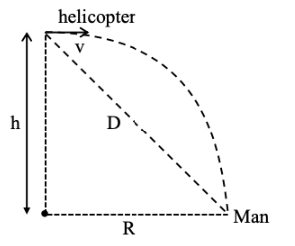
A helicopter flying horizontally with a speed of \(360 \mathrm{~km} / \mathrm{h}\) at an altitude of 2 km, drops an object at an instant. The object hits the ground at a point \(O,20 \mathrm{~s}\) after it is dropped. Displacement of ‘\(O\)’ from the position of helicopter where the object was released is : (use acceleration due to gravity \(\mathrm{g}=10 \mathrm{~m} / \mathrm{s}^2\) and neglect air resistance) [JEE Main 2025 (Online) 7th April Evening Shift]
CorrectIncorrectHint
(c)

Given data
Horizontal speed of helicopter:
\(
v_x=360 \mathrm{~km} / \mathrm{h}=\frac{360 \times 1000}{3600}=100 \mathrm{~m} / \mathrm{s}
\)
Altitude (height):
\(
h=2 \mathrm{~km}=2000 \mathrm{~m}
\)
Time of flight:
\(
t=20 \mathrm{~s}
\)
Acceleration due to gravity:
\(
g=10 \mathrm{~m} / \mathrm{s}^2
\)
The vertical displacement (downward) during 20 s should match the altitude of 2000 m.
\(
s_y=\frac{1}{2} g t^2=\frac{1}{2} \times 10 \times(20)^2=5 \times 400=2000 \mathrm{~m}
\)
Horizontal motion has constant velocity:
\(
\begin{gathered}
x=v_x \times t \\
x=100 \mathrm{~m} / \mathrm{s} \times 20 \mathrm{~s}=2000 \mathrm{~m}
\end{gathered}
\)
So, the horizontal displacement is 2000 m (or 2 km ).
The total displacement \((R)\) from the initial position of the helicopter to the point where the object hits the ground is found using Pythagoras theorem:
\(
\begin{gathered}
R=\sqrt{x^2+h^2} \\
R=\sqrt{(2000)^2+(2000)^2}=\sqrt{2} \times 2000 =2 \sqrt{2} \mathrm{~km}
\end{gathered}
\) - Question 3 of 57
3. Question
Two projectiles are fired from ground with same initial speeds from same point at angles ( \(45^{\circ}+ \alpha\) ) and ( \(45^{\circ}-\alpha\) ) with horizontal direction. The ratio of their times of flights is [JEE Main 2025 (Online) 7th April Morning Shift]
CorrectIncorrectHint
(a) Step 1: Write down the formulas for the time of flight of each projectile.
The formula for the time of flight ( \(\boldsymbol{T}\) ) of a projectile is given by \(\boldsymbol{T}=\frac{2 v_0 \sin \theta}{g}\), where \(v_0\) is the initial speed, \(\theta\) is the launch angle, and \(g\) is the acceleration due to gravity.
For the first projectile, with launch angle \(\boldsymbol{\theta}_1=45^{\circ}+\alpha\) and initial speed \(v_0\), the time of flight \(T_1\) is:
\(
T_1=\frac{2 v_0 \sin \left(45^{\circ}+\alpha\right)}{g}
\)
For the second projectile, with launch angle \(\theta_2=45^{\circ}-\alpha\) and initial speed \(v_0\), the time of flight \(\boldsymbol{T}_2\) is:
\(
T_2=\frac{2 v_0 \sin \left(45^{\circ}-\alpha\right)}{g}
\)
Step 2: Calculate the ratio of the times of flight.
The ratio of the times of flight is \(\frac{T_1}{T_2}\). We can set up the ratio and simplify by canceling out the common terms:
\(
\begin{aligned}
& \frac{T_1}{T_2}=\frac{\frac{2 v_0 \sin \left(45^{\circ}+\alpha\right)}{g}}{\frac{2 v_0 \sin \left(45^{\circ}-\alpha\right)}{g}} \\
& \frac{T_1}{T_2}=\frac{\sin \left(45^{\circ}+\alpha\right)}{\sin \left(45^{\circ}-\alpha\right)}
\end{aligned}
\)
The ratio of the times of flights is \(\frac{\sin \left(45^{\circ}+\alpha\right)}{\sin \left(45^{\circ}-\alpha\right)}\).
Applying Trigonometric Identities:
Use the sine addition and subtraction formulas:
\(
\begin{aligned}
& \sin \left(45^{\circ}+\alpha\right)=\frac{1}{\sqrt{2}}(\cos \alpha+\sin \alpha) \\
& \sin \left(45^{\circ}-\alpha\right)=\frac{1}{\sqrt{2}}(\cos \alpha-\sin \alpha)
\end{aligned}
\)
Simplifying the Ratio:
Substitute the expressions for \(\sin \left(45^{\circ}+\alpha\right)\) and \(\sin \left(45^{\circ}-\alpha\right)\) into the ratio:
\(
\frac{T_1}{T_2}=\frac{\frac{1}{\sqrt{2}}(\cos \alpha+\sin \alpha)}{\frac{1}{\sqrt{2}}(\cos \alpha-\sin \alpha)}=\frac{\cos \alpha+\sin \alpha}{\cos \alpha-\sin \alpha}
\)
Factor out the trigonometric functions to express in terms of tangent:
\(
\frac{T_1}{T_2}=\frac{1+\tan \alpha}{1-\tan \alpha}
\)
Therefore, the ratio of the times of flights for the two projectiles is \(\frac{1+\tan \alpha}{1-\tan \alpha}\). - Question 4 of 57
4. Question
A particle is projected with velocity \(u\) so that its horizontal range is three times the maximum height attained by it. The horizontal range of the projectile is given as \(\frac{n u^2}{25 g}\), where value of \(n\) is: (Given, ‘ \(g\) ‘ is the acceleration due to gravity.) [JEE Main 2025 (Online) 3rd April Evening Shift]
CorrectIncorrectHint
(d) Step 1: Set up the equation from the given conditions
The problem states that the horizontal range ( \(\boldsymbol{R}\) ) of the projectile is three times its maximum height \((\boldsymbol{H})\). The standard formulas for the range and maximum height are:
Horizontal Range: \(\boldsymbol{R}=\frac{u^2 \sin (2 \theta)}{g}\)
Maximum Height: \(\boldsymbol{H}=\frac{u^2 \sin ^2 \theta}{2 g}\)
Using the condition \(\boldsymbol{R}=\mathbf{3} \boldsymbol{H}\), we can write:
\(
\frac{u^2 \sin (2 \theta)}{g}=3\left(\frac{u^2 \sin ^2 \theta}{2 g}\right)
\)
Step 2: Solve for the launch angle \(\boldsymbol{\theta}\)
Substitute the trigonometric identity \(\sin (2 \theta)=2 \sin \theta \cos \theta\) into the equation from Step 1:
\(
\frac{u^2(2 \sin \theta \cos \theta)}{g}=\frac{3 u^2 \sin ^2 \theta}{2 g}
\)
Cancel the common terms \(u^2 / g\) and one \(\sin \theta\) term from both sides:
\(
2 \cos \theta=\frac{3 \sin \theta}{2}
\)
Rearranging the terms to find the value of \(\tan \theta\) :
\(
\frac{\sin \theta}{\cos \theta}=\frac{4}{3} \Longrightarrow \tan \theta=\frac{4}{3}
\)
From this value, we can construct a right-angled triangle with the opposite side as 4 and the adjacent side as 3. The hypotenuse will be 5. Therefore, we find the values of \(\sin \theta\) and \(\cos \theta\) :
\(
\sin \theta=\frac{4}{5} \quad \text { and } \quad \cos \theta=\frac{3}{5}
\)
Step 3: Calculate the horizontal range and determine the value of \(\boldsymbol{n}\)
Now, substitute the values of \(\sin \theta\) and \(\cos \theta\) back into the formula for horizontal range:
\(
\begin{gathered}
R=\frac{u^2 \sin (2 \theta)}{g}=\frac{u^2(2 \sin \theta \cos \theta)}{g} \\
R=\frac{u^2\left(2 \cdot \frac{4}{5} \cdot \frac{3}{5}\right)}{g}=\frac{u^2\left(\frac{24}{25}\right)}{g}=\frac{24 u^2}{25 g}
\end{gathered}
\)
The problem gives the horizontal range as \(R=\frac{n u^2}{25 g}\). By comparing the two expressions for the range, we can find the value of \(n\) :
\(
\frac{n u^2}{25 g}=\frac{24 u^2}{25 g}
\)
Therefore, the value of \(n\) is 24. - Question 5 of 57
5. Question
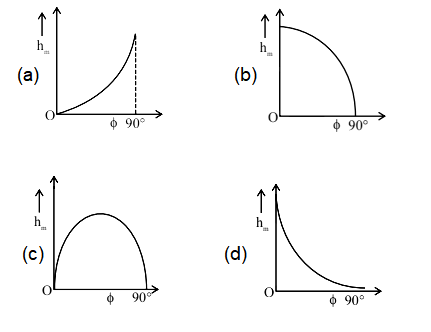
The angle of projection of a particle is measured from the vertical axis as \(\phi\) and the maximum height reached by the particle is \(\mathbf{h}_{\mathbf{m}}\). Here \(\mathbf{h}_{\mathbf{m}}\) as function of \(\phi\) can be presented as [JEE Main 2025 (Online) 3rd April Morning Shift]
 CorrectIncorrect
Hint
(b) Step 1: Relate the given angle to the standard projectile motion angle
The standard formula for the maximum height \(\left(h_m\right)\) of a projectile is based on the angle of projection ( \(\boldsymbol{\theta}\) ) measured from the horizontal axis. The user’s query defines the angle of projection as \(\phi\) measured from the vertical axis. Since the horizontal and vertical axes are perpendicular, the relationship between the two angles is \(\theta=90^{\circ}-\phi\).
Step 2: Substitute the new angle into the maximum height formula
The standard formula for maximum height is given by:
\(
h_m=\frac{u^2 \sin ^2 \theta}{2 g}
\)
where \(u\) is the initial velocity and \(g\) is the acceleration due to gravity.
Substitute \(\theta=90^{\circ}-\phi\) into this equation:
\(
h_m=\frac{u^2 \sin ^2\left(90^{\circ}-\phi\right)}{2 g}
\)
Using the trigonometric identity \(\sin \left(90^{\circ}-\phi\right)=\cos \phi\), the equation becomes:
\(
h_m=\frac{u^2 \cos ^2 \phi}{2 g}
\)
The maximum height \(h_m\) as a function of the angle \(\phi\) measured from the vertical axis is given by the formula:
\(
\mathbf{h}_{\mathbf{m}}=\frac{u^2 \cos ^2 \phi}{2 g}
\) - Question 6 of 57
6. Question
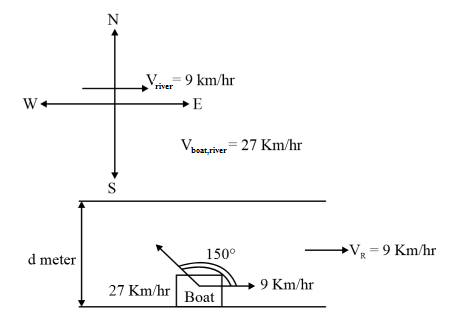
A river is flowing from west to east direction with speed of \(9 \mathrm{~km} \mathrm{~h}^{-1}\). If a boat capable of moving at a maximum speed of \(27 \mathrm{~km} \mathrm{~h}^{-1}\) in still water, crosses the river in half a minute, while moving with maximum speed at an angle of \(150^{\circ}\) to direction of river flow, then the width of the river is : [JEE Main 2025 (Online) 2nd April Morning Shift]
CorrectIncorrectHint
(d)

Step 1: Identify the boat’s velocity component perpendicular to the river flow
The boat’s velocity relative to the water, \(v_b\), is \(27 \mathrm{~km} \mathrm{~h}^{-1}\) at an angle of \(150^{\circ}\) to the river’s direction of flow. The component of this velocity that moves the boat across the river (perpendicular to the flow) is given by:
\(
v_{\perp}=v_b \sin (\theta)
\)
where \(\theta\) is the angle between the boat’s velocity and the river flow.
\(
v_{\perp}=27 \mathrm{~km} \mathrm{~h}^{-1} \times \sin \left(150^{\circ}\right)
\)
Since \(\sin \left(150^{\circ}\right)=\sin \left(180^{\circ}-30^{\circ}\right)=\sin \left(30^{\circ}\right)=0.5\), the perpendicular velocity is:
\(
v_{\perp}=27 \mathrm{~km} \mathrm{~h}^{-1} \times 0.5=13.5 \mathrm{~km} \mathrm{~h}^{-1}
\)
Step 2: Convert units to be consistent
The time to cross the river is given in minutes and the final answer options are in meters. It is necessary to convert the velocity from kilometers per hour to meters per second and the time from minutes to seconds.
\(
v_{\perp}=13.5 \mathrm{~km} \mathrm{~h}^{-1}=13.5 \times \frac{1000 \mathrm{~m}}{3600 \mathrm{~s}}=\frac{13500}{3600} \mathrm{~m} \mathrm{~s}^{-1}=3.75 \mathrm{~m} \mathrm{~s}^{-1}
\)
Time, \(t=0.5\) minutes \(=0.5 \times 60 \mathrm{~s}=30 \mathrm{~s}\)
Step 3: Calculate the width of the river
The width of the river is the distance traveled by the boat in the direction perpendicular to the flow. This can be calculated using the formula:
Width \(=v_{\perp} \times t\)
Width \(=3.75 \mathrm{~m} \mathrm{~s}^{-1} \times 30 \mathrm{~s}=112.5 \mathrm{~m}\) - Question 7 of 57
7. Question
Two projectiles are fired with same initial speed from same point on ground at angles of \(\left(45^{\circ}-\alpha\right)\) and \(\left(45^{\circ}+\alpha\right)\), respectively, with the horizontal direction. The ratio of their maximum heights attained is : [JEE Main 2025 (Online) 29th January Morning Shift]
CorrectIncorrectHint
(d) The maximum height \(\boldsymbol{H}\) attained by a projectile fired with initial speed \(v_0\) at an angle \(\boldsymbol{\theta}\) with the horizontal is given by the formula:
\(
H=\frac{v_0^2 \sin ^2 \theta}{2 g}
\)
where \(g\) is the acceleration due to gravity.
Step 1: Write the expressions for the maximum heights
For the first projectile fired at an angle of \(\theta_1=\left(45^{\circ}-\alpha\right)\), the maximum height \(H_1\) is:
\(
H_1=\frac{v_0^2 \sin ^2\left(45^{\circ}-\alpha\right)}{2 g}
\)
For the second projectile fired at an angle of \(\boldsymbol{\theta}_2=\left(45^{\circ}+\boldsymbol{\alpha}\right)\), the maximum height \(\boldsymbol{H}_2\) is:
\(
H_2=\frac{v_0^2 \sin ^2\left(45^{\circ}+\alpha\right)}{2 g}
\)
Step 2: Find the ratio of the heights
The ratio of the maximum heights is \(\frac{\boldsymbol{H}_1}{\boldsymbol{H}_2}\) :
\(
\frac{H_1}{H_2}=\frac{\frac{v_0^2 \sin ^2\left(45^{\circ}-\alpha\right)}{2 g}}{\frac{v_0^2 \sin ^2\left(45^{\circ}+\alpha\right)}{2 g}}=\frac{\sin ^2\left(45^{\circ}-\alpha\right)}{\sin ^2\left(45^{\circ}+\alpha\right)}
\)
Step 3: Use trigonometric identities to simplify the ratio
We can use the identity \(\sin (A \pm B)=\sin A \cos B \pm \cos A \sin B\).
\(
\begin{aligned}
& \sin \left(45^{\circ}-\alpha\right)=\sin 45^{\circ} \cos \alpha-\cos 45^{\circ} \sin \alpha=\frac{1}{\sqrt{2}}(\cos \alpha-\sin \alpha) \\
& \sin \left(45^{\circ}+\alpha\right)=\sin 45^{\circ} \cos \alpha+\cos 45^{\circ} \sin \alpha=\frac{1}{\sqrt{2}}(\cos \alpha+\sin \alpha)
\end{aligned}
\)
Now, substitute these into the ratio:
\(
\frac{H_1}{H_2}=\frac{\left[\frac{1}{\sqrt{2}}(\cos \alpha-\sin \alpha)\right]^2}{\left[\frac{1}{\sqrt{2}}(\cos \alpha+\sin \alpha)\right]^2}=\frac{(\cos \alpha-\sin \alpha)^2}{(\cos \alpha+\sin \alpha)^2}
\)
Expand the squares:
\(
\frac{H_1}{H_2}=\frac{\cos ^2 \alpha+\sin ^2 \alpha-2 \sin \alpha \cos \alpha}{\cos ^2 \alpha+\sin ^2 \alpha+2 \sin \alpha \cos \alpha}
\)
Using the identities \(\cos ^2 \alpha+\sin ^2 \alpha=1\) and \(2 \sin \alpha \cos \alpha=\sin 2 \alpha\), we get:
\(
\frac{H_1}{H_2}=\frac{1-\sin 2 \alpha}{1+\sin 2 \alpha}
\) - Question 8 of 57
8. Question
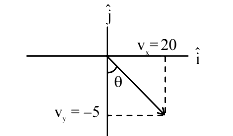
The position vector of a moving body at any instant of time is given as \(\overrightarrow{\mathrm{r}}=\left(5 \mathrm{t}^2 \hat{i}-5 \mathrm{t} \hat{j}\right) \mathrm{m}\). The magnitude and direction of velocity at \(t=2 s\) is [JEE Main 2025 (Online) 24th January Evening Shift]
CorrectIncorrectHint
(a)

Step 1: Differentiate the position vector to find the velocity vector
The velocity vector, \(\vec{v}\), is the derivative of the position vector, \(\vec{r}\), with respect to time, \(t\). Given the position vector \(\vec{r}=\left(5 t^2 \hat{i}-5 t \hat{j}\right) \mathrm{m}\), we can find the velocity vector by differentiating each component with respect to \(t\) :
\(
\begin{gathered}
\vec{v}=\frac{d \vec{r}}{d t}=\frac{d}{d t}\left(5 t^2 \hat{i}\right)-\frac{d}{d t}(5 t \hat{j}) \\
\vec{v}=(10 t \hat{i}-5 \hat{j}) \mathrm{m} / \mathrm{s}
\end{gathered}
\)
Step 2: Calculate the velocity vector at \(t=2 s\)
Substitute \(t=2\) into the velocity vector equation:
\(
\begin{gathered}
\vec{v}(t=2)=(10(2) \hat{i}-5 \hat{j}) \mathrm{m} / \mathrm{s} \\
\vec{v}(t=2)=(20 \hat{i}-5 \hat{j}) \mathrm{m} / \mathrm{s}
\end{gathered}
\)
The magnitude of the velocity vector, \(|\vec{v}|\), is calculated using the Pythagorean theorem:
\(
|\vec{v}|=\sqrt{v_x^2+v_y^2}
\)
For \(\vec{v}=(20 \hat{i}-5 \hat{j})\), the magnitude is:
\(
|\vec{v}|=\sqrt{(20)^2+(-5)^2}=\sqrt{400+25}=\sqrt{425}
\)
To simplify the radical, we can factor out 25 :
\(
|\vec{v}|=\sqrt{25 \cdot 17}=5 \sqrt{17} \mathrm{~m} / \mathrm{s}
\)
An alternative way to express the angle is to find the angle \(\theta\) it makes with the negative \(y\)-axis. The angle with the negative \(y\)-axis is given by:
\(
\tan (\theta)=\frac{|v_x|}{|v_y|}=\frac{20}{(5)}=4
\)
So, the angle with the negative \(y\) -axis is \(\theta=\tan ^{-1}(4)\).
The magnitude of the velocity is \(\mathbf{5} \sqrt{\mathbf{1 7}} \mathrm{m} / \mathrm{s}\), and the direction is making an angle of \(\tan ^{-1} 4\) with the -ve \(Y\) axis. - Question 9 of 57
9. Question
An object of mass ‘ \(m\) ‘ is projected from origin in a vertical \(x y\) plane at an angle \(45^{\circ}\) with the \(x\) – axis with an initial velocity \(\mathrm{v}_0\). The magnitude and direction of the angular momentum of the object with respect to origin, when it reaches at the maximum height, will be [ \(g\) is acceleration due to gravity] [JEE Main 2025 (Online) 24th January Morning Shift]
CorrectIncorrectHint
(d) Step 1: Determine the velocity and position of the object at maximum height
The initial velocity \(\vec{v}_0\) is at an angle of \(45^{\circ}\) with the \(x\)-axis. The components of the initial velocity are:
\(
\begin{aligned}
& v_{0 x}=v_0 \cos \left(45^{\circ}\right)=v_0 \frac{1}{\sqrt{2}} \\
& v_{0 y}=v_0 \sin \left(45^{\circ}\right)=v_0 \frac{1}{\sqrt{2}}
\end{aligned}
\)
At maximum height, the vertical component of the velocity \(\left(v_y\right)\) is zero, while the horizontal component \(\left(v_x\right)\) remains constant. Thus, the velocity of the object at maximum height is:
\(
\vec{v}=v_x \hat{i}=v_{0 x} \hat{i}=\frac{v_0}{\sqrt{2}} \hat{i}
\)
The maximum height \(\left(\boldsymbol{H}_{\text {max }}\right)\) is given by the formula:
\(
H_{\max }=\frac{v_{0 y}^2}{2 g}=\frac{\left(v_0 / \sqrt{2}\right)^2}{2 g}=\frac{v_0^2 / 2}{2 g}=\frac{v_0^2}{4 g}
\)
The horizontal position of the object at maximum height is half of the total range ( \(\boldsymbol{R}\) ). The range is given by:
\(
R=\frac{v_0^2 \sin (2 \theta)}{g}=\frac{v_0^2 \sin \left(2 \times 45^{\circ}\right)}{g}=\frac{v_0^2 \sin \left(90^{\circ}\right)}{g}=\frac{v_0^2}{g}
\)
The horizontal position at maximum height is:
\(
x=\frac{R}{2}=\frac{v_0^2}{2 g}
\)
The position vector \(\vec{r}\) at maximum height is:
\(
\vec{r}=x \hat{i}+H_{\max } \hat{j}=\frac{v_0^2}{2 g} \hat{i}+\frac{v_0^2}{4 g} \hat{j}
\)
Step 2: Calculate the angular momentum
The angular momentum \(\vec{L}\) is given by the cross product of the position vector \(\vec{r}\) and the linear momentum vector \(\vec{p}\). The linear momentum is \(\vec{p}=\boldsymbol{m} \vec{v}\).
\(
\begin{aligned}
\vec{L} & =\vec{r} \times \vec{p}=\vec{r} \times(m \vec{v})=m(\vec{r} \times \vec{v}) \\
\vec{L} & =m\left(\left(\frac{v_0^2}{2 g} \hat{i}+\frac{v_0^2}{4 g} \hat{j}\right) \times\left(\frac{v_0}{\sqrt{2}} \hat{i}\right)\right)
\end{aligned}
\)
Using the properties of the cross product \((\hat{i} \times \hat{i}=0\) and \(\hat{j} \times \hat{i}=-\hat{k})\) :
\(
\begin{gathered}
\vec{L}=m\left(\frac{v_0^2}{2 g}\left(\hat{i} \times \frac{v_0}{\sqrt{2}} \hat{i}\right)+\frac{v_0^2}{4 g}\left(\hat{j} \times \frac{v_0}{\sqrt{2}} \hat{i}\right)\right) \\
\vec{L}=m\left(0+\frac{v_0^2}{4 g} \frac{v_0}{\sqrt{2}}(-\hat{k})\right) \\
\vec{L}=m\left(-\frac{v_0^3}{4 \sqrt{2} g} \hat{k}\right) \\
\vec{L}=-\frac{m v_o^3}{4 \sqrt{2} g} \hat{k}
\end{gathered}
\)
The magnitude and direction of the angular momentum of the object with respect to the origin, when it reaches the maximum height, is \(\frac{m v_o^3}{4 \sqrt{2} g}\) along the negative \(z\)-axis. - Question 10 of 57
10. Question
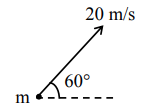
A ball of mass 100 g is projected with velocity \(20 \mathrm{~m} / \mathrm{s}\) at \(60^{\circ}\) with horizontal. The decrease in kinetic energy of the ball during the motion from point of projection to highest point is [JEE Main 2025 (Online) 22nd January Evening Shift]
CorrectIncorrectHint
(c)

The decrease in kinetic energy of the ball is due to the change in its velocity from the initial point to the highest point of the projectile trajectory. At the highest point, the vertical component of the velocity becomes zero, while the horizontal component remains constant throughout the motion (assuming no air resistance).
Step 1: Calculate the initial and final kinetic energies
The initial kinetic energy ( \(\boldsymbol{K} \boldsymbol{E}_{\text {initial }}\) ) is given by the formula \(\boldsymbol{K} \boldsymbol{E}=\frac{1}{2} \boldsymbol{m} \boldsymbol{v}^2\), where \(\boldsymbol{m}\) is the mass and \(v\) is the initial velocity. The final kinetic energy ( \(\boldsymbol{K} \boldsymbol{E}_{\text {final }}\) ) at the highest point is determined by the velocity at that point, which is only the horizontal component of the initial velocity.
Mass (m): \(100 \mathrm{~g}=0.1 \mathrm{~kg}\)
Initial velocity \((v): 20 \mathrm{~m} / \mathrm{s}\)
Angle ( \(\theta\) ): \(60^{\circ}\)
The initial kinetic energy is:
\(
K E_{\text {initial }}=\frac{1}{2} m v^2=\frac{1}{2}(0.1)(20)^2=\frac{1}{2}(0.1)(400)=20 \mathrm{~J}
\)
The velocity at the highest point ( \(v_{\text {top }}\) ) is the horizontal component of the initial velocity:
\(
v_{t o p}=v \cos (\theta)=20 \cos \left(60^{\circ}\right)=20\left(\frac{1}{2}\right)=10 \mathrm{~m} / \mathrm{s}
\)
The kinetic energy at the highest point is:
\(
K E_{\text {final }}=\frac{1}{2} m v_{\text {top }}^2=\frac{1}{2}(0.1)(10)^2=\frac{1}{2}(0.1)(100)=5 \mathrm{~J}
\)
Step 2: Calculate the decrease in kinetic energy
The decrease in kinetic energy ( \(\Delta K E\) ) is the difference between the initial and final kinetic energies.
\(
\Delta K E=K E_{\text {initial }}-K E_{\text {final }}=20 \mathrm{~J}-5 \mathrm{~J}=15 \mathrm{~J}
\)
The decrease in kinetic energy of the ball is \(\mathbf{1 5} \mathbf{~ J}\). - Question 11 of 57
11. Question
The angle of projection for a projectile to have same horizontal range and maximum height is : [JEE Main 2024 (Online) 8th April Evening Shift]
CorrectIncorrectHint
(d) Step 1: Set up the equation
The formula for the horizontal range \((R)\) of a projectile is \(R=\frac{u^2 \sin (2 \theta)}{g}\), and the formula for the maximum height \((H)\) is \(H=\frac{u^2 \sin ^2(\theta)}{2 g}\), where \(u\) is the initial velocity, \(\theta\) is the angle of projection, and \(g\) is the acceleration due to gravity. To find the angle of projection for which the horizontal range is equal to the maximum height, we set \(\boldsymbol{R}=\boldsymbol{H}\).
\(
\frac{u^2 \sin (2 \theta)}{g}=\frac{u^2 \sin ^2(\theta)}{2 g}
\)
Step 2: Solve for the angle
First, we can cancel out the common terms \(u^2\) and \(g\) from both sides of the equation.
\(
\sin (2 \theta)=\frac{\sin ^2(\theta)}{2}
\)
Using the double-angle identity for \(\sin , \sin (2 \theta)=2 \sin (\theta) \cos (\theta)\), we can substitute it into the equation:
\(
2 \sin (\theta) \cos (\theta)=\frac{\sin ^2(\theta)}{2}
\)
Assuming \(\sin (\theta) \neq 0\) (otherwise the projectile doesn’t leave the ground), we can divide both sides by \(\sin (\theta)\) :
\(
2 \cos (\theta)=\frac{\sin (\theta)}{2}
\)
Rearrange the terms to get \(\tan (\theta)\) :
\(
\begin{gathered}
4=\frac{\sin (\theta)}{\cos (\theta)} \\
4=\tan (\theta)
\end{gathered}
\)
Finally, solve for the angle \(\boldsymbol{\theta}\) :
\(
\theta=\tan ^{-1}(4)
\)
The angle of projection for a projectile to have the same horizontal range and maximum height is \(\tan ^{-1}(\mathbf{4})\). - Question 12 of 57
12. Question
The co-ordinates of a particle moving in \(x-y\) plane are given by : \(x=2+4 \mathrm{t}, y=3 \mathrm{t}+8 \mathrm{t}^2\). The motion of the particle is : [JEE Main 2024 (Online) 4th April Morning Shift]
CorrectIncorrectHint
(d) Step 1: Find the acceleration of the particle.
To determine the nature of the motion, we first find the acceleration of the particle. The acceleration is the second derivative of the position with respect to time.
The position coordinates are given by:
\(
\begin{gathered}
x(t)=2+4 t \\
y(t)=3 t+8 t^2
\end{gathered}
\)
The velocity components are the first derivatives of the position components:
\(
\begin{gathered}
v_x=\frac{d x}{d t}=\frac{d}{d t}(2+4 t)=4 \\
v_y=\frac{d y}{d t}=\frac{d}{d t}\left(3 t+8 t^2\right)=3+16 t
\end{gathered}
\)
The acceleration components are the derivatives of the velocity components:
\(
\begin{gathered}
a_x=\frac{d v_x}{d t}=\frac{d}{d t}(4)=0 \\
a_y=\frac{d v_y}{d t}=\frac{d}{d t}(3+16 t)=16
\end{gathered}
\)
Since both \(a_x\) and \(a_y\) are constant, the acceleration vector \(\vec{a}=16 \hat{j}\) is constant. This indicates the particle is undergoing uniformly accelerated motion.
Step 2: Determine the path of the particle.
To find the path of the particle, we eliminate time \((t)\) from the position equations to find the relationship between \(x\) and \(y\).
From the equation for the \(x\)-coordinate, we can express \(t\) in terms of \(x\) :
\(
\begin{aligned}
& x=2+4 t \\
& 4 t=x-2 \\
& t=\frac{x-2}{4}
\end{aligned}
\)
Now, substitute this expression for \(t\) into the equation for the \(y\)-coordinate:
\(
\begin{gathered}
y=3 t+8 t^2 \\
y=3\left(\frac{x-2}{4}\right)+8\left(\frac{x-2}{4}\right)^2 \\
y=\frac{3}{4}(x-2)+8 \frac{(x-2)^2}{16} \\
y=\frac{3}{4}(x-2)+\frac{1}{2}(x-2)^2
\end{gathered}
\)
This is a quadratic equation of the form \(\boldsymbol{y}=\boldsymbol{A} \boldsymbol{x}^2+\boldsymbol{B} \boldsymbol{x}+\boldsymbol{C}\), which is the equation of a parabola.
Based on the analysis, the acceleration of the particle is constant, and its path is a parabola. Therefore, the motion is (d) uniformly accelerated having motion along a parabolic path. - Question 13 of 57
13. Question
Projectiles A and B are thrown at angles of \(45^{\circ}\) and \(60^{\circ}\) with vertical respectively from top of a 400 m high tower. If their ranges and times of flight are same, the ratio of their speeds of projection \(v_A: v_B\) is [Take \(g=10 \mathrm{~ms}^{-2}\) ] : [JEE Main 2024 (Online) 30th January Evening Shift]
CorrectIncorrectHint
(c) Step 1: Determine the angles with the horizontal
The angles are given with respect to the vertical. We need to find the angles with the horizontal, \(\boldsymbol{\theta}\).
For projectile A: \(\theta_A=90^{\circ}-45^{\circ}=45^{\circ}\).
For projectile B: \(\theta_B=90^{\circ}-60^{\circ}=30^{\circ}\).
Step 2: Use the time of flight equation
The time of flight ( \(\boldsymbol{T}\) ) for a projectile launched from a height \(h\) with initial speed \(v\) at an angle \(\boldsymbol{\theta}\) with the horizontal is given by the vertical motion equation:
\(
-h=(v \sin \theta) T-\frac{1}{2} g T^2
\)
Rearranging this into a quadratic equation for \(\boldsymbol{T}\).
\(
\frac{1}{2} g T^2-(v \sin \theta) T-h=0
\)
Since the time of flight \(T_A\) and \(T_B\) are the same, we can write:
\(
\frac{1}{2} g T^2-\left(v_A \sin \theta_A\right) T-h=\frac{1}{2} g T^2-\left(v_B \sin \theta_B\right) T-h
\)
This simplifies to:
\(
v_A \sin \theta_A=v_B \sin \theta_B
\)
Substituting the angles:
\(
\begin{aligned}
& v_A \sin \left(45^{\circ}\right)=v_B \sin \left(30^{\circ}\right) \\
& v_A\left(\frac{1}{\sqrt{2}}\right)=v_B\left(\frac{1}{2}\right)
\end{aligned}
\)
From this, we can find the ratio of speeds:
\(
\frac{v_A}{v_B}=\frac{1 / 2}{1 / \sqrt{2}}=\frac{1}{2} \times \sqrt{2}=\frac{\sqrt{2}}{2}=\frac{1}{\sqrt{2}}
\)
The ratio of their speeds of projection \(v_A: v_B\) is \(1: \sqrt{2}\). - Question 14 of 57
14. Question
Position of an ant ( \(S\) in metres) moving in \(\mathrm{Y}-\mathrm{Z}\) plane is given by \(S=2 t^2 \hat{j}+5 \hat{k}\) (where \(t\) is in second). The magnitude and direction of velocity of the ant at \(\mathrm{t}=1 \mathrm{~s}\) will be : [JEE Main 2024 (Online) 27th January Morning Shift]
CorrectIncorrectHint
(d) Step 1: Find the velocity vector
The velocity vector, \(\vec{v}\), is the time derivative of the position vector, \(\vec{S}\).
Given the position vector:
\(
\vec{S}=2 t^2 \hat{j}+5 \hat{k}
\)
We take the derivative with respect to time, \(t\) :
\(
\begin{gathered}
\vec{v}=\frac{d \vec{S}}{d t}=\frac{d}{d t}\left(2 t^2 \hat{j}+5 \hat{k}\right) \\
\vec{v}=4 t \hat{j}+0 \hat{k} \\
\vec{v}=4 t \hat{j}
\end{gathered}
\)
Step 2: Evaluate velocity at \(t=1 \mathrm{~s}\)
Substitute \(t=1 \mathrm{~s}\) into the velocity equation:
\(
\vec{v}(t=1)=4(1) \hat{j}=4 \hat{j} \mathrm{~m} / \mathrm{s}
\)
Step 3: Find the magnitude and direction of the velocity
The velocity vector at \(t=1 \mathrm{~s}\) is \(\vec{v}=4 \hat{j} \mathrm{~m} / \mathrm{s}\).
The magnitude of this vector is the coefficient of the unit vector, which is \(\mathbf{4 ~ m} / \mathbf{s}\).
The direction is given by the unit vector \(\hat{j}\), which corresponds to the \(\mathbf{y}\)-direction.
The magnitude and direction of the ant’s velocity at \(t=1 \mathrm{~s}\) is \(4 \mathrm{~m} / \mathrm{s}\) in \(y\)-direction. - Question 15 of 57
15. Question
A projectile is projected at \(30^{\circ}\) from horizontal with initial velocity \(40 \mathrm{~ms}^{-1}\). The velocity of the projectile at \(\mathrm{t}=2 \mathrm{~s}\) from the start will be : (Given \(g=10 \mathrm{~m} / \mathrm{s}^2\) ) [JEE Main 2023 (Online) 11th April Evening Shift]
CorrectIncorrectHint
(a) Step 1: Calculate the initial velocity components
The initial velocity components can be found using the launch angle \(\boldsymbol{\theta}\) and initial velocity \(\boldsymbol{u}\). The horizontal component is \(\boldsymbol{u}_{\boldsymbol{x}}=\boldsymbol{u} \cos \boldsymbol{\theta}\) and the vertical component is \(u_y=u \sin \theta\).
Given:
\(
\begin{gathered}
u=40 \mathrm{~ms}^{-1} \\
\theta=30^{\circ}
\end{gathered}
\)
The initial horizontal velocity is:
\(
u_x=40 \cos \left(30^{\circ}\right)=40\left(\frac{\sqrt{3}}{2}\right)=20 \sqrt{3} \mathrm{~ms}^{-1}
\)
The initial vertical velocity is:
\(
u_y=40 \sin \left(30^{\circ}\right)=40\left(\frac{1}{2}\right)=20 \mathrm{~ms}^{-1}
\)
Step 2: Calculate the final velocity components at \(t=2 s\)
The horizontal velocity \(\left(v_x\right)\) of a projectile remains constant, so \(v_x=u_x\).
\(
v_x=20 \sqrt{3} \mathrm{~ms}^{-1}
\)
The vertical velocity ( \(v_y\) ) changes due to gravity. The equation for vertical velocity is \(v_y=u_y-g t\).
Given:
\(
\begin{gathered}
u_y=20 \mathrm{~ms}^{-1} \\
g=10 \mathrm{~m} / \mathrm{s}^2 \\
t=2 \mathrm{~s} \\
v_y=20-(10)(2)=20-20=0 \mathrm{~ms}^{-1}
\end{gathered}
\)
Step 3: Calculate the magnitude of the final velocity
The magnitude of the velocity at \(t=2 s\) is given by \(v=\sqrt{v_x^2+v_y^2}\).
\(
\begin{gathered}
v=\sqrt{(20 \sqrt{3})^2+(0)^2} \\
v=\sqrt{(400)(3)+0} \\
v=\sqrt{1200} \\
v=\sqrt{400 \times 3}=20 \sqrt{3} \mathrm{~ms}^{-1}
\end{gathered}
\)
The velocity of the projectile at \(t=2 s\) is \(20 \sqrt{3} \mathrm{~ms}^{-1}\). - Question 16 of 57
16. Question
Two projectiles are projected at \(30^{\circ}\) and \(60^{\circ}\) with the horizontal with the same speed. The ratio of the maximum height attained by the two projectiles respectively is: [JEE Main 2023 (Online) 10th April Evening Shift]
CorrectIncorrectHint
(c) Step 1: Write down the formula for maximum height
The maximum height \((\boldsymbol{H})\) of a projectile is given by the formula:
\(
H=\frac{v_0^2 \sin ^2(\theta)}{2 g}
\)
where \(v_0\) is the initial speed, \(\theta\) is the launch angle, and \(g\) is the acceleration due to gravity.
Step 2: Set up the equations for each projectile
For the first projectile with an angle of \(30^{\circ}\) :
\(
H_1=\frac{v_0^2 \sin ^2\left(30^{\circ}\right)}{2 g}
\)
For the second projectile with an angle of \(60^{\circ}\) :
\(
H_2=\frac{v_0^2 \sin ^2\left(60^{\circ}\right)}{2 g}
\)
Step 3: Calculate the ratio of the heights
To find the ratio \(\boldsymbol{H}_1: \boldsymbol{H}_2\), we divide the first equation by the second. The terms \(v_0^2\) and \(2 g\) cancel out, as they are the same for both projectiles.
\(
\frac{H_1}{H_2}=\frac{\sin ^2\left(30^{\circ}\right)}{\sin ^2\left(60^{\circ}\right)}
\)
Using the trigonometric values \(\sin \left(30^{\circ}\right)=\frac{1}{2}\) and \(\sin \left(60^{\circ}\right)=\frac{\sqrt{3}}{2}\) :
\(
\frac{\boldsymbol{H}_1}{\boldsymbol{H}_2}=\frac{\left(\frac{1}{2}\right)^2}{\left(\frac{\sqrt{3}}{2}\right)^2}=\frac{\frac{1}{4}}{\frac{3}{4}}=\frac{1}{3}
\)
The ratio of the maximum height attained by the two projectiles is \(\mathbf{1}: \mathbf{3}\). - Question 17 of 57
17. Question
The range of the projectile projected at an angle of \(15^{\circ}\) with horizontal is 50 m. If the projectile is projected with same velocity at an angle of \(45^{\circ}\) with horizontal, then its range will be [JEE Main 2023 (Online) 10th April Morning Shift]
CorrectIncorrectHint
(b) Step 1: Use the given information to find the constant term
The range of a projectile is given by the formula \(R=\frac{v_0^2 \sin (2 \theta)}{g}\), where \(v_0\) is the initial velocity, \(\theta\) is the projection angle, and \(g\) is the acceleration due to gravity.
For the first case, we are given:
\(R_1=50 \mathrm{~m}\)
\(\theta_1=15^{\circ}\)
Using the range formula:
\(
\begin{gathered}
50=\frac{v_0^2 \sin \left(2 \times 15^{\circ}\right)}{g} \\
50=\frac{v_0^2 \sin \left(30^{\circ}\right)}{g}
\end{gathered}
\)
Since \(\sin \left(30^{\circ}\right)=0.5\) :
\(
\begin{gathered}
50=\frac{v_0^2 \times 0.5}{g} \\
100=\frac{v_0^2}{g}
\end{gathered}
\)
Step 2: Calculate the range for the second scenario
For the second case, the projectile is launched with the same velocity, \(v_0\), and the new angle is \(\theta_2=45^{\circ}\). We need to find the new range, \(R_2\).
The range formula for this case is:
\(
\begin{aligned}
R_2 & =\frac{v_0^2 \sin \left(2 \times 45^{\circ}\right)}{g} \\
R_2 & =\frac{v_0^2 \sin \left(90^{\circ}\right)}{g}
\end{aligned}
\)
Step 3: Substitute the constant term and find the final answer
We know that \(\sin \left(90^{\circ}\right)=1\) and from Step 1 we found that \(\frac{v_0^2}{g}=100\).
Substitute these values into the equation for \(\boldsymbol{R}_2\) :
\(
R_2=(100) \times(1)
\)
\(
R_2=100 \mathrm{~m}
\)
The range of the projectile at an angle of \(45^{\circ}\) will be 100 m. - Question 18 of 57
18. Question
The trajectory of projectile, projected from the ground is given by \(y=x-\frac{x^2}{20}\). Where \(x\) and \(y\) are measured in meter. The maximum height attained by the projectile will be. [JEE Main 2023 (Online) 8th April Evening Shift]
CorrectIncorrectHint
(b) Step 1: Identify the coefficients of the parabolic equation
The trajectory of the projectile is given by the equation \(y=x-\frac{x^2}{20}\). This can be rewritten in the standard form of a parabola, \(y=a x^2+b x+c\), as \(y=-\frac{1}{20} x^2+1 x\).
The coefficients are:
\(
\begin{gathered}
a=-\frac{1}{20} \\
b=1
\end{gathered}
\)
Step 2: Find the x -coordinate for the maximum height
The maximum height of a downward-opening parabola occurs at its vertex. The \(\mathrm{x}-\) coordinate of the vertex is given by the formula \(x=-\frac{b}{2 a}\).
Substitute the values of \(a\) and \(b\) :
\(
\begin{gathered}
x=-\frac{1}{2\left(-\frac{1}{20}\right)} \\
x=-\frac{1}{-\frac{2}{20}} \\
x=-\frac{1}{-\frac{1}{10}}
\end{gathered}
\)
Step 3: Calculate the maximum height
To find the maximum height, substitute the value of \(x=10\) back into the trajectory equation:
\(
\begin{gathered}
y=x-\frac{x^2}{20} \\
y=10-\frac{(10)^2}{20} \\
y=10-\frac{100}{20} \\
y=10-5
\end{gathered}
\)
The maximum height attained by the projectile is 5 m. - Question 19 of 57
19. Question
Two projectiles \(A\) and \(B\) are thrown with initial velocities of \(40 \mathrm{~m} / \mathrm{s}\) and \(60 \mathrm{~m} / \mathrm{s}\) at angles \(30^{\circ}\) and \(60^{\circ}\) with the horizontal respectively. The ratio of their ranges respectively is \(\left(g=10 \mathrm{~m} / \mathrm{s}^2\right)\) [JEE Main 2023 (Online) 8th April Morning Shift]
CorrectIncorrectHint
(a) Step 1: Calculate the range of projectile \(A\)
The formula for the range \((R)\) of a projectile is given by \(R=\frac{u^2 \sin (2 \theta)}{g}\).
For projectile \(A\), the initial velocity is \(u_A=40 \mathrm{~m} / \mathrm{s}\) and the launch angle is \(\theta_A=30^{\circ}\)
The range of \(\mathrm{A}\left(\boldsymbol{R}_{\boldsymbol{A}}\right)\) is:
\(
\begin{gathered}
R_A=\frac{u_A^2 \sin \left(2 \theta_A\right)}{g}=\frac{(40)^2 \sin \left(2 \times 30^{\circ}\right)}{10}=\frac{1600 \sin \left(60^{\circ}\right)}{10} \\
R_A=160 \sin \left(60^{\circ}\right)=160\left(\frac{\sqrt{3}}{2}\right)=80 \sqrt{3} \mathrm{~m}
\end{gathered}
\)
Step 2: Calculate the range of projectile \(B\)
For projectile \(B\), the initial velocity is \(u_B=60 \mathrm{~m} / \mathrm{s}\) and the launch angle is \(\theta_B=60^{\circ}\)
The range of \(\mathrm{B}\left(\boldsymbol{R}_{\boldsymbol{B}}\right)\) is:
\(
\begin{gathered}
R_B=\frac{u_B^2 \sin \left(2 \theta_B\right)}{g}=\frac{(60)^2 \sin \left(2 \times 60^{\circ}\right)}{10}=\frac{3600 \sin \left(120^{\circ}\right)}{10} \\
R_B=360 \sin \left(120^{\circ}\right)=360\left(\frac{\sqrt{3}}{2}\right)=180 \sqrt{3} \mathrm{~m}
\end{gathered}
\)
Step 3: Find the ratio of the ranges
The ratio of the ranges, \(\boldsymbol{R}_A: \boldsymbol{R}_B\), is:
\(
\frac{R_A}{R_B}=\frac{80 \sqrt{3}}{180 \sqrt{3}}=\frac{80}{180}=\frac{8}{18}=\frac{4}{9}
\) - Question 20 of 57
20. Question
Given below are two statements : one is labelled as Assertion A and the other is labelled as Reason R
Assertion A: When a body is projected at an angle \(45^{\circ}\), it’s range is maximum.
Reason R : For maximum range, the value of \(\sin 2 \theta\) should be equal to one.
In the light of the above statements, choose the correct answer from the options given below: [JEE Main 2023 (Online) 6th April Morning Shift]CorrectIncorrectHint
(a) Both A and R are correct and R is the correct explanation of A . The range of a projectile is given by \(R=\frac{v^2 \sin (2 \theta)}{g}\), where \(v\) is the initial velocity, \(\theta\) is the projection angle, and \(g\) is the acceleration due to gravity. For the range to be maximum, \(\sin (2 \theta)\) must be at its maximum value of 1 , which occurs when \(2 \theta=90^{\circ}\), so \(\theta=45^{\circ}\).
Assertion (A): True. The maximum range for a projectile is achieved when it is launched at an angle of \(45^{\circ}\).
Reason (R): True. For the range to be maximum, the term \(\sin (2 \theta)\) must be equal to its maximum value, which is 1 . This condition directly leads to the conclusion in Assertion A. - Question 21 of 57
21. Question
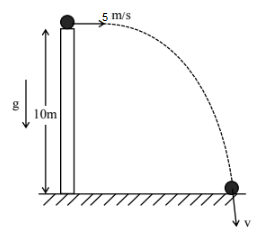
A child stands on the edge of the cliff 10 m above the ground and throws a stone horizontally with an initial speed of \(5 \mathrm{~ms}^{-1}\). Neglecting the air resistance, the speed with which the stone hits the ground will be \(\mathrm{ms}^{-1}\) (given, \(g=10 \mathrm{~ms}^{-2}\) ). [JEE Main 2023 (Online) 1st February Morning Shift]
CorrectIncorrectHint
(d)

To determine the speed with which the stone hits the ground, we need to consider both the horizontal and vertical components of the motion. The stone is thrown horizontally with an initial speed of \(5 \mathrm{~m} / \mathrm{s}\) from a height of 10 m . We will use the equations of motion to find the vertical component of the velocity when the stone hits the ground and then combine it with the horizontal component to find the resultant speed.
Step 1: Calculate the final vertical velocity
First, determine the final vertical velocity \(\left(v_y\right)\) of the stone just before it hits the ground. The initial vertical velocity is \(0 \mathrm{~ms}^{-1}\) since the stone is thrown horizontally. We can use the following kinematic equation:
\(
v_y^2=u_{y}^2+2 g y
\)
where:
\(u_{y}=0 \mathrm{~ms}^{-1}\)
\(g=10 \mathrm{~ms}^{-2}\)
\(y=10 \mathrm{~m}\)
Plugging in the values:
\(
\begin{gathered}
v_y^2=(0)^2+2(10)(10) \\
v_y^2=200 \\
v_y=\sqrt{200}=10 \sqrt{2} \mathrm{~ms}^{-1}
\end{gathered}
\)
Step 2: Calculate the final speed
The final speed \(\left(v_f\right)\) is the magnitude of the final velocity vector, which is composed of the constant horizontal velocity \(\left(v_x\right)\) and the final vertical velocity \(\left(v_y\right)\). We use the Pythagorean theorem:
\(
v_f=\sqrt{v_x^2+v_y^2}
\)
where:
\(v_x=5 \mathrm{~ms}^{-1}\) (the initial horizontal speed, which remains constant)
\(v_y=\sqrt{200} \mathrm{~ms}^{-1}\)
Plugging in the values:
\(
\begin{gathered}
v_f=\sqrt{(5)^2+(\sqrt{200})^2} \\
v_f=\sqrt{25+200} \\
v_f=\sqrt{225} \\
v_f=15 \mathrm{~ms}^{-1}
\end{gathered}
\)
The speed with which the stone hits the ground is \(\mathbf{1 5} \mathrm{ms}^{-1}\). - Question 22 of 57
22. Question
The initial speed of a projectile fired from ground is \({u}\). At the highest point during its motion, the speed of projectile is \(\frac{\sqrt{3}}{2} u\). The time of flight of the projectile is : [JEE Main 2023 (Online) 31st January Morning Shift]
CorrectIncorrectHint
(a) Step 1: Determine the launch angle
The speed of a projectile at its highest point is the horizontal component of its initial velocity, as the vertical component is zero. Let the initial velocity be \(\boldsymbol{u}\) at an angle \(\boldsymbol{\theta}\) to the horizontal.
Initial horizontal velocity component: \(u_x=u \cos \theta\)
Speed at the highest point: \(v_{\text {top }}=u_x=u \cos \theta\)
According to the problem, the speed at the highest point is \(\frac{\sqrt{3}}{2} u\). Therefore, we can set up the equation:
\(
u \cos \theta=\frac{\sqrt{3}}{2} u
\)
Dividing both sides by \(u\), we get:
\(
\cos \theta=\frac{\sqrt{3}}{2}
\)
This gives us the launch angle \(\theta=30^{\circ}\).
Step 2: Calculate the time of flight
The time of flight ( \(\boldsymbol{T}\) ) for a projectile is given by the formula:
\(
T=\frac{2 u_y}{g}
\)
where \(u_y\) is the initial vertical component of the velocity, which is \(u \sin \theta\).
Substituting \(u \sin \theta\) for \(u_y\) :
\(
T=\frac{2 u \sin \theta}{g}
\)
We found the launch angle \(\theta=30^{\circ}\), so \(\sin \theta=\sin \left(30^{\circ}\right)=\frac{1}{2}\).
Plugging this value into the equation for time of flight:
\(
T=\frac{2 u\left(\frac{1}{2}\right)}{g}=\frac{u}{g}
\)
The time of flight of the projectile is \(\frac{\boldsymbol{u}}{\boldsymbol{g}}\). - Question 23 of 57
23. Question
Two objects are projected with same velocity ‘\(u\)’ however at different angles \(\alpha\) and \(\beta\) with the horizontal. If \(\alpha+\beta=90^{\circ}\), the ratio of horizontal range of the first object to the 2nd object will be : [JEE Main 2023 (Online) 25th January Evening Shift]
CorrectIncorrectHint
(a) Step 1: Write down the formula for horizontal range
The horizontal range ( \(R\) ) of a projectile is given by the formula:
\(
R=\frac{u^2 \sin (2 \theta)}{g}
\)
where \(u\) is the initial velocity, \(\theta\) is the angle of projection, and \(g\) is the acceleration due to gravity.
Step 2: Express the ranges for both objects
For the first object, with angle \(\alpha\) :
\(
R_1=\frac{u^2 \sin (2 \alpha)}{g}
\)
For the second object, with angle \(\beta\).
\(
R_2=\frac{u^2 \sin (2 \beta)}{g}
\)
The problem states that the initial velocity ‘ \(u\) ‘ is the same for both objects.
Step 3: Use the given condition to simplify the expression for the second range
The problem gives the condition \(\alpha+\beta=90^{\circ}\). This means \(\beta=90^{\circ}-\alpha\).
Substitute this into the expression for \(\boldsymbol{R}_2\) :
\(
\begin{aligned}
& R_2=\frac{u^2 \sin \left(2\left(90^{\circ}-\alpha\right)\right)}{g} \\
& R_2=\frac{u^2 \sin \left(180^{\circ}-2 \alpha\right)}{g}
\end{aligned}
\)
Using the trigonometric identity \(\sin \left(180^{\circ}-x\right)=\sin (x)\), we get:
\(
\sin \left(180^{\circ}-2 \alpha\right)=\sin (2 \alpha)
\)
Therefore, the range of the second object is:
\(
R_2=\frac{u^2 \sin (2 \alpha)}{g}
\)
Step 4: Find the ratio of the ranges
The ratio of the horizontal range of the first object to the second object is \(\frac{R_1}{R_2}\).
\(
\begin{gathered}
\frac{R_1}{R_2}=\frac{\frac{u^2 \sin (2 \alpha)}{g}}{\frac{u^2 \sin (2 \alpha)}{g}} \\
\frac{R_1}{R_2}=1
\end{gathered}
\)
The ratio of the horizontal range of the first object to the second object will be \(1: 1\). - Question 24 of 57
24. Question
The maximum vertical height to which a man can throw a ball is 136 m. The maximum horizontal distance upto which he can throw the same ball is : [JEE Main 2023 (Online) 24th January Morning Shift]
CorrectIncorrectHint
(b) Vertical throw:
The maximum height ( \(h\) ) reached by an object thrown vertically upward is given by the formula \(h=\frac{v^2}{2 g}\), where \(v\) is the initial velocity and \(g\) is the acceleration due to gravity.
Rearranging this formula to solve for the square of the initial velocity gives \(v^2=2 g h\).
With the provided maximum height of 136 m , we have \(v^2=2 g \times 136\).
Maximum range:
The horizontal range \((R)\) of a projectile is given by the formula \(R=\frac{v^2 \sin (2 \theta)}{g}\), where \(\theta\) is the launch angle.
The maximum range ( \(\boldsymbol{R}_{\text {max }}\) ) occurs when the launch angle is \(45^{\circ}\), which makes \(\sin (2 \theta)=\sin \left(90^{\circ}\right)=1\).
Therefore, the formula for maximum range simplifies to \(\boldsymbol{R}_{\text {max }}=\frac{v^2}{g}\).
Combining the equations:
By substituting the expression for \(v^2\) from the vertical throw into the maximum range formula:
\(
R_{\max }=\frac{v^2}{g}=\frac{2 g \times 136}{g}
\)
The gravitational constant (\(g\)) cancels out, leaving:
\(
R_{\max }=2 \times 136=272 \mathrm{~m}
\) - Question 25 of 57
25. Question
At time \(t=0\) a particle starts travelling from a height \(7 \hat{z} \mathrm{~cm}\) in a plane keeping z coordinate constant. At any instant of time it’s position along the \(\hat{x}\) and \(\hat{y}\) directions are defined as \(3 t\) and \(5 \mathrm{t}^3\) respectively. At \(\mathrm{t}=1 \mathrm{~s}\) acceleration of the particle will be [JEE Main 2022 (Online) 28th July Evening Shift]
CorrectIncorrectHint
(b)
We have, \(\overrightarrow{\mathrm{r}}=3 \mathrm{t} \hat{\mathrm{i}}+5 \mathrm{t}^3 \hat{\mathrm{j}}+7 \hat{\mathrm{k}}\)
So, \(\frac{d^2 \vec{r}}{d t^2}=30 t \hat{j}\)
At \(\mathrm{t}=1 \Rightarrow\)
\(
\frac{\mathrm{d}^2 \overrightarrow{\mathrm{r}}}{\mathrm{dt}^2}=30 \hat{\mathrm{j}}
\)
\(
\Rightarrow \overrightarrow{\mathrm{a}}=30 \hat{\mathrm{j}}
\) - Question 26 of 57
26. Question
Two projectiles are thrown with same initial velocity making an angle of \(45^{\circ}\) and \(30^{\circ}\) with the horizontal respectively. The ratio of their respective ranges will be : [JEE Main 2022 (Online) 26th July Evening Shift]
CorrectIncorrectHint
(c) Step 1: Write down the formula for the range of a projectile
The range \((R)\) of a projectile is given by the formula:
\(
R=\frac{v_0^2 \sin (2 \theta)}{g}
\)
where \(v_0\) is the initial velocity, \(\theta\) is the launch angle, and \(g\) is the acceleration due to gravity.
Step 2: Calculate the range for each projectile
Let’s denote the range of the first projectile (launched at \(45^{\circ}\) ) as \(\boldsymbol{R}_1\) and the second projectile (launched at \(30^{\circ}\) ) as \(\boldsymbol{R}_2\). The initial velocity \(\left(v_0\right)\) and acceleration due to gravity (\(g\)) are the same for both.
For the first projectile \(\left(\boldsymbol{\theta}_1=45^{\circ}\right)\) :
\(
R_1=\frac{v_0^2 \sin \left(2 \times 45^{\circ}\right)}{g}=\frac{v_0^2 \sin \left(90^{\circ}\right)}{g}
\)
For the second projectile \(\left(\boldsymbol{\theta}_2=30^{\circ}\right)\) :
\(
R_2=\frac{v_0^2 \sin \left(2 \times 30^{\circ}\right)}{g}=\frac{v_0^2 \sin \left(60^{\circ}\right)}{g}
\)
Step 3: Find the ratio of the ranges
To find the ratio \(\boldsymbol{R}_1: \boldsymbol{R}_2\), we can divide the expression for \(\boldsymbol{R}_1\) by the expression for \(\boldsymbol{R}_2\)
\(
\frac{R_1}{R_2}=\frac{\frac{v_0^2 \sin \left(90^{\circ}\right)}{g}}{\frac{v_0^2 \sin \left(60^{\circ}\right)}{g}}
\)
The terms \(\frac{v_0^2}{g}\) cancel out, leaving:
\(
\frac{R_1}{R_2}=\frac{\sin \left(90^{\circ}\right)}{\sin \left(60^{\circ}\right)}
\)
Substitute the known values for the sine functions: \(\sin \left(90^{\circ}\right)=1\) and \(\sin \left(60^{\circ}\right)=\frac{\sqrt{3}}{2}\).
\(
\frac{R_1}{R_2}=\frac{1}{\frac{\sqrt{3}}{2}}=\frac{2}{\sqrt{3}}
\)
This gives the ratio as \(2: \sqrt{3}\). - Question 27 of 57
27. Question
Two projectiles thrown at \(30^{\circ}\) and \(45^{\circ}\) with the horizontal respectively, reach the maximum height in same time. The ratio of their initial velocities is : [JEE Main 2022 (Online) 26th July Morning Shift]
CorrectIncorrectHint
(c) Step 1: Write down the formula for time to reach maximum height
The time \(\boldsymbol{t}_{\text {max }}\) for a projectile to reach its maximum height is given by the formula:
\(
t_{\max }=\frac{v_0 \sin (\theta)}{g}
\)
where \(v_0\) is the initial velocity, \(\theta\) is the launch angle, and \(g\) is the acceleration due to gravity.
Step 2: Set up the equality based on the problem statement
The problem states that the two projectiles reach their maximum height in the same time. Let the initial velocities be \(v_1\) and \(v_2\), and the launch angles be \(\theta_1=30^{\circ}\) and \(\theta_2=45^{\circ}\). Since the times are equal, we can write:
\(
\begin{gathered}
t_{\max , 1}=t_{\max , 2} \\
\frac{v_1 \sin \left(\theta_1\right)}{g}=\frac{v_2 \sin \left(\theta_2\right)}{g}
\end{gathered}
\)
Step 3: Solve for the ratio of the initial velocities
We can cancel \(g\) from both sides of the equation:
\(
v_1 \sin \left(30^{\circ}\right)=v_2 \sin \left(45^{\circ}\right)
\)
To find the ratio of the velocities, \(\frac{v_1}{v_2}\), we rearrange the equation:
\(
\frac{v_1}{v_2}=\frac{\sin \left(45^{\circ}\right)}{\sin \left(30^{\circ}\right)}
\)
Step 4: Substitute the sine values and calculate the ratio
The values for \(\sin \left(45^{\circ}\right)\) and \(\sin \left(30^{\circ}\right)\) are \(\frac{1}{\sqrt{2}}\) and \(\frac{1}{2}\) respectively.
\(
\frac{v_1}{v_2}=\frac{1 / \sqrt{2}}{1 / 2}=\frac{1}{\sqrt{2}} \cdot 2=\frac{2}{\sqrt{2}}
\)
To simplify, multiply the numerator and denominator by \(\sqrt{2}\) :
\(
\frac{2}{\sqrt{2}}=\frac{2 \sqrt{2}}{\sqrt{2} \sqrt{2}}=\frac{2 \sqrt{2}}{2}=\sqrt{2}
\)
The ratio of their initial velocities is \(\sqrt{2}: 1\). - Question 28 of 57
28. Question
A ball is projected from the ground with a speed \(15 \mathrm{~ms}^{-1}\) at an angle \(\theta\) with horizontal so that its range and maximum height are equal, then ‘ \(\tan \theta\) ‘ will be equal to : [JEE Main 2022 (Online) 25th July Evening Shift]
CorrectIncorrectHint
(d) Step 1: Set up the equation using the formulas for range and maximum height
The range \((\boldsymbol{R})\) and maximum height \((\boldsymbol{H})\) of a projectile are given by the following formulas:
\(
\begin{aligned}
& R=\frac{v_0^2 \sin (2 \theta)}{g} \\
& H=\frac{v_0^2 \sin ^2(\theta)}{2 g}
\end{aligned}
\)
The problem states that the range and maximum height are equal, so we can set these two equations equal to each other.
\(
\begin{gathered}
R=H \\
\frac{v_0^2 \sin (2 \theta)}{g}=\frac{v_0^2 \sin ^2(\theta)}{2 g}
\end{gathered}
\)
Step 2: Simplify the equation and solve for \(\tan \theta\)
We can cancel the common terms, \(v_0^2\) and \(g\), from both sides of the equation.
\(
\sin (2 \theta)=\frac{\sin ^2(\theta)}{2}
\)
Using the double-angle identity for sine, \(\sin (2 \theta)=2 \sin \theta \cos \theta\), we substitute this into the equation.
\(
2 \sin \theta \cos \theta=\frac{\sin ^2(\theta)}{2}
\)
To solve for \(\tan \theta\), we can rearrange the terms. We can divide both sides by \(\cos \theta\) and \(\sin \theta\) (since the angle is not 0 or 90 degrees, these are non-zero).
\(
\begin{gathered}
2 \cos \theta=\frac{\sin \theta}{2} \\
4=\frac{\sin \theta}{\cos \theta}
\end{gathered}
\)
Since \(\tan \theta=\frac{\sin \theta}{\cos \theta}\), we get the final answer.
\(
\tan \theta=4
\) - Question 29 of 57
29. Question
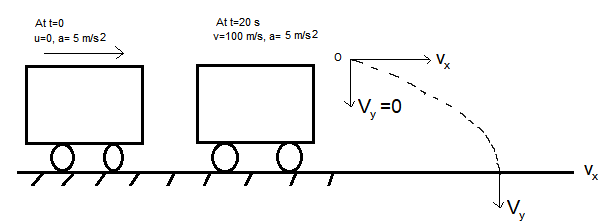
At \(t=0\), truck, starting from rest, moves in the positive \(x\)-direction at uniform acceleration of 5 ms^{-2}[/latex]. At \(t=20 \mathrm{~s}\), a ball is released from the top of the truck. The ball strikes the ground in 1 s after the release. The velocity of the ball, when it strikes the ground, will be : [JEE Main 2022 (Online) 30th June Morning Shift]
(Given \(\mathrm{g}=10 \mathrm{~ms}^{-2}\) )CorrectIncorrectHint
(a)

Step 1: Determine the ball’s initial velocity
The ball is released from the truck at \(t=20 \mathrm{~s}\). At this moment, the ball’s horizontal velocity will be the same as the truck’s velocity. The truck starts from rest and moves with a uniform acceleration of \(5 \mathrm{~ms}^{-2}\).
Using the kinematic equation \(v=u+a t\), the truck’s velocity at \(t=20 \mathrm{~s}\) is:
\(
v_{\text {truck }}=u_{\text {truck }}+a_{\text {truck }} t=0+\left(5 \mathrm{~ms}^{-2}\right)(20 \mathrm{~s})=100 \mathrm{~ms}^{-1}
\)Note: At 20 sec a ball is dropped from the truck, so velocity of ball will be same as truck.
Velocity of truck at \(x\)-direction \(=100 \mathrm{~m} / \mathrm{s}\) and in \(y\)-direction \(=0\).
\(\therefore\) Velocity of ball \({v}_{{x}}=100 \mathrm{~m} / \mathrm{s}, {v}_{{y}}=0\)Therefore, the ball’s initial velocity vector is \(\vec{v}_i=v_{i x} \hat{i}+v_{i y} \hat{j}=100 \hat{i}+0 \hat{j}\).
Step 2: Determine the ball’s final velocity
The ball’s motion can be analyzed independently in the horizontal and vertical directions. The horizontal velocity remains constant since there is no horizontal acceleration, and the vertical velocity changes due to gravity.
Horizontal velocity \(\left(v_x\right)\) :
The horizontal acceleration is zero ( \(a_x=0\) ). Thus, the final horizontal velocity of the ball as it strikes the ground is the same as its initial horizontal velocity.
\(
v_{x, \text { final }}=v_{x, \text { initial }}=100 \mathrm{~ms}^{-1}
\)
Vertical velocity ( \(v_y\) ):
The vertical acceleration is due to gravity, \(g=-10 \mathrm{~ms}^{-2}\) (taking the upward direction as positive). The time the ball is in the air is 1 s. Using the kinematic equation \(v=u+a t\) :
\(
v_{y, \text { final }}=v_{y, \text { initial }}+a_y t=0+\left(-10 \mathrm{~ms}^{-2}\right)(1 \mathrm{~s})=-10 \mathrm{~ms}^{-1}
\)
The velocity of the ball when it strikes the ground is the vector sum of its final horizontal and vertical velocities.
\(
\vec{v}_{\text {final }}=v_{x, \text { final }} \hat{i}+v_{y, \text { final }} \hat{j}=\left(100 \mathrm{~ms}^{-1}\right) \hat{i}+\left(-10 \mathrm{~ms}^{-1}\right) \hat{j}
\)
Therefore, the velocity is \(100 \hat{i}-10 \hat{j}\). - Question 30 of 57
30. Question
Two projectiles \(P_1\) and \(P_2\) thrown with speed in the ratio \(\sqrt{3}: \sqrt{2}\), attain the same height during their motion. If \(P_2\) is thrown at an angle of \(60^{\circ}\) with the horizontal, the angle of projection of \(P_1\) with horizontal will be : [JEE Main 2022 (Online) 30th June Morning Shift]
CorrectIncorrectHint
(c) Step 1: Set up the equation for maximum height
The maximum height \((\boldsymbol{H})\) of a projectile is given by the formula:
\(
H=\frac{u^2 \sin ^2 \theta}{2 g}
\)
where \(u\) is the initial speed, \(\theta\) is the angle of projection, and \(g\) is the acceleration due to gravity.
The problem states that both projectiles reach the same height ( \(\boldsymbol{H}_1=\boldsymbol{H}_2\) ), so we can set up the following equation:
\(
\frac{u_1^2 \sin ^2 \theta_1}{2 g}=\frac{u_2^2 \sin ^2 \theta_2}{2 g}
\)
Simplifying this equation, we get:
\(
u_1^2 \sin ^2 \theta_1=u_2^2 \sin ^2 \theta_2
\)
Step 2: Substitute the given values
We are given the following information:
The ratio of speeds is \(\frac{u_1}{u_2}=\frac{\sqrt{3}}{\sqrt{2}}\), which means \(\frac{u_1^2}{u_2^2}=\frac{3}{2}\).
The angle of projection for \(P_2\) is \(\theta_2=60^{\circ}\).
Substituting these values into the equation from Step 1:
\(
\begin{aligned}
\sin ^2 \theta_1 & =\frac{u_2^2}{u_1^2} \sin ^2 \theta_2 \\
\sin ^2 \theta_1 & =\frac{2}{3} \sin ^2\left(60^{\circ}\right)
\end{aligned}
\)
The value of \(\sin \left(60^{\circ}\right)\) is \(\frac{\sqrt{3}}{2}\).
\(
\begin{gathered}
\sin ^2 \theta_1=\frac{2}{3}\left(\frac{\sqrt{3}}{2}\right)^2 \\
\sin ^2 \theta_1=\frac{2}{3}\left(\frac{3}{4}\right) \\
\sin ^2 \theta_1=\frac{1}{2}
\end{gathered}
\)
Step 3: Solve for the angle of projection for \(\boldsymbol{P}_{\mathbf{1}}\)
Taking the square root of both sides of the equation from Step 2:
\(
\begin{aligned}
\sin \theta_1 & =\sqrt{\frac{1}{2}} \\
\sin \theta_1 & =\frac{1}{\sqrt{2}}
\end{aligned}
\)
The angle whose sine is \(\frac{1}{\sqrt{2}}\) is \(45^{\circ}\).
\(
\theta_1=45^{\circ}
\)
The angle of projection of \(\boldsymbol{P}_1\) with the horizontal will be \(\mathbf{4 5}^{\circ}\). - Question 31 of 57
31. Question
A person can throw a ball upto a maximum range of 100 m. How high above the ground he can throw the same ball? [JEE Main 2022 (Online) 29th June Evening Shift]
CorrectIncorrectHint
(b) Step 1: Analyze the given information and formulas
The maximum horizontal range of a projectile is given by the formula \(R_{\text {max }}=\frac{v_0^2}{g}\), which occurs at a launch angle of \(45^{\circ}\). The maximum vertical height for a projectile is achieved when the ball is thrown straight up \(\left(\theta=90^{\circ}\right)\), and the formula for this height is \(\boldsymbol{H}_{\text {max }}=\frac{v_0^2}{2 g}\).
Step 2: Use the maximum range to find the initial velocity squared
Given the maximum range \(\boldsymbol{R}_{\text {max }}=100 \mathrm{~m}\), we can use the range formula to express the term \(v_0^2\) :
\(
v_0^2=R_{\max } \cdot g=100 \cdot g
\)
Step 3: Substitute into the maximum height formula
Now, substitute the expression for \(v_0^2\) from Step 2 into the maximum height formula:
\(
H_{\max }=\frac{v_0^2}{2 g}=\frac{100 g}{2 g}=\frac{100}{2}=50 \mathrm{~m}
\)
The person can throw the same ball to a maximum height of \(\mathbf{5 0 ~ m}\). - Question 32 of 57
32. Question
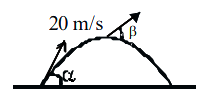
A projectile is launched at an angle ‘ \(\alpha\) ‘ with the horizontal with a velocity \(20 \mathrm{~ms}^{-1}\). After 10 s, its inclination with horizontal is ‘ \(\beta\) ‘. The value of \(\tan \beta\) will be : \(\left(\mathrm{g}=10 \mathrm{~ms}^{-2}\right)\). [JEE Main 2022 (Online) 27th June Morning Shift]
CorrectIncorrectHint
(b)

Step 1: Determine the velocity components
The initial velocity of the projectile is \(u=20 \mathrm{~ms}^{-1}\) at an angle \(\alpha\) with the horizontal. The velocity at any time \(\boldsymbol{t}\) has horizontal and vertical components.
The horizontal component of velocity ( \(v_x\) ) remains constant:
\(
v_x=u \cos \alpha=20 \cos \alpha
\)
The vertical component of velocity \(\left(v_y\right)\) changes due to gravity:
\(
v_y=u \sin \alpha-g t=20 \sin \alpha-(10)(10)=20 \sin \alpha-100
\)
Step 2: Calculate \(\tan \beta\)
The angle of inclination \(\beta\) at time \(t=10 \mathrm{~s}\) is the angle that the velocity vector makes with the horizontal. This can be found using the ratio of the vertical and horizontal components of the velocity.
\(
\tan \beta=\frac{v_y}{v_x}
\)
Substituting the expressions for \(v_x\) and \(v_y\) from Step 1:
\(
\tan \beta=\frac{20 \sin \alpha-100}{20 \cos \alpha}
\)
Step 3: Simplify the expression
Split the fraction into two parts to simplify the expression:
\(
\begin{gathered}
\tan \beta=\frac{20 \sin \alpha}{20 \cos \alpha}-\frac{100}{20 \cos \alpha} \\
\tan \beta=\frac{\sin \alpha}{\cos \alpha}-\frac{5}{\cos \alpha}
\end{gathered}
\)
Using the trigonometric identities \(\tan \alpha=\frac{\sin \alpha}{\cos \alpha}\) and \(\sec \alpha=\frac{1}{\cos \alpha}\), the expression becomes:
\(
\tan \beta=\tan \alpha-5 \sec \alpha
\) - Question 33 of 57
33. Question
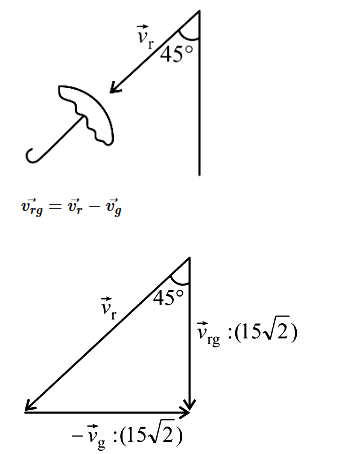
A girl standing on road holds her umbrella at \(45^{\circ}\) with the vertical to keep the rain away. If she starts running without umbrella with a speed of \(15 \sqrt{2} \mathrm{kmh}^{-1}\), the rain drops hit her head vertically. The speed of rain drops with respect to the moving girl is : [JEE Main 2022 (Online) 27th June Morning Shift]
CorrectIncorrectHint
(c)

From the above diagram, velocity of the raindrop wrt ground will be,
\(
\begin{aligned}
& \left|\vec{v}_r\right|=\sqrt{(15 \sqrt{2})^2+(15 \sqrt{2})^2} \\
& =30 \mathrm{kmh}^{-1}
\end{aligned}
\)
And velocity of the raindrop wrt the moving girl will be,
\(
\begin{aligned}
& \left|\vec{v}_{r g}\right|=15 \sqrt{2} \\
& =\frac{30}{\sqrt{2}} \mathrm{kmh}^{-1}
\end{aligned}
\)Explanation: Let \(\vec{v}_r\) be the velocity of the rain and \(\vec{v}_g\) be the velocity of the girl. The velocity of the rain with respect to the girl is \(\vec{v}_{r, g}=\vec{v}_r-\vec{v}_g\).
When the girl is standing, \(\vec{v}_g=0\). The rain’s velocity relative to her is \(\vec{v}_{r, g}=\vec{v}_r\). She holds the umbrella at \(45^{\circ}\) with the vertical, which means the rain’s velocity vector has equal horizontal and vertical components. Let’s denote the horizontal component of the rain’s velocity as \(v_{r x}\) and the vertical component as \(v_{r y}\).
\(
\frac{v_{r x}}{v_{r y}}=\tan \left(45^{\circ}\right)=1 \Longrightarrow v_{r x}=v_{r y}
\)
When the girl runs with a speed of \(v_g=15 \sqrt{2} \mathrm{kmh}^{-1}\), the rain drops hit her head vertically. This means the relative velocity of the rain with respect to her has no horizontal component.
\(
\begin{gathered}
v_{r x}-v_g=0 \\
v_{r x}=v_g=15 \sqrt{2} \mathrm{kmh}^{-1}
\end{gathered}
\)
Since \(v_{r x}=v_{r y}\), the vertical component of the rain’s velocity is also:
\(
v_{r y}=15 \sqrt{2} \mathrm{kmh}^{-1}
\)
The speed of the rain drops with respect to the moving girl is the magnitude of the relative velocity vector, which is purely vertical.
\(
\left|\vec{v}_{r, g}\right|=\left|v_{r y}\right|=15 \sqrt{2} \mathrm{kmh}^{-1}
\)
The value \(15 \sqrt{2}\) can be expressed as \(\frac{30}{\sqrt{2}}\).
\(
\frac{30}{\sqrt{2}}=\frac{30 \sqrt{2}}{2}=15 \sqrt{2}=\frac{30}{\sqrt{2}}
\)
The speed of the rain drops with respect to the moving girl is \(\mathbf{1 5} \sqrt{\mathbf{2}} \mathbf{k m h}^{-\mathbf{1}}\), which corresponds to option (c), \(\frac{30}{\sqrt{2}} \mathrm{kmh}^{-1}\). - Question 34 of 57
34. Question
Given below are two statements. One is labelled as Assertion A and the other is labelled as Reason R.
Assertion A : Two identical balls A and B thrown with same velocity ‘ \(u\) ‘ at two different angles with horizontal attained the same range R. IF A and B reached the maximum height \(\mathrm{h}_1\) and \(\mathrm{h}_2\) respectively, then \(R=4 \sqrt{h_1 h_2}\)
Reason R : Product of said heights.
\(
h_1 h_2=\left(\frac{u^2 \sin ^2 \theta}{2 g}\right) \cdot\left(\frac{u^2 \cos ^2 \theta}{2 g}\right)
\)
Choose the correct answer : [JEE Main 2022 (Online) 25th June Evening Shift]CorrectIncorrectHint
(a) Assertion A (Correct): For two angles of projection, \(\theta_1\) and \(\theta_2\), to have the same range, they must be complementary, i.e., \(\theta_1+\theta_2=90^{\circ}\). Let’s say \(\theta_1=\theta\) and \(\theta_2=90^{\circ}-\theta\).
The maximum height for ball A is \(h_1=\frac{u^2 \sin ^2 \theta}{2 g}\).
The maximum height for ball B is \(h_2=\frac{u^2 \sin ^2\left(90^{\circ}-\theta\right)}{2 g}=\frac{u^2 \cos ^2 \theta}{2 g}\).
The product of the heights is
\(
h_1 h_2=\left(\frac{u^2 \sin ^2 \theta}{2 g}\right)\left(\frac{u^2 \cos ^2 \theta}{2 g}\right)=\frac{u^4(\sin \theta \cos \theta)^2}{4 g^2}
\)
Using the identity \(2 \sin \theta \cos \theta=\sin (2 \theta)\), we get \(\sin \theta \cos \theta=\frac{1}{2} \sin (2 \theta)\).
Substituting this, we get \(h_1 h_2=\frac{u^4\left(\frac{1}{2} \sin (2 \theta)\right)^2}{4 g^2}=\frac{u^4 \sin ^2(2 \theta)}{16 g^2}\).
The range is \(R=\frac{u^2 \sin (2 \theta)}{g}\). Squaring both sides gives \(R^2=\frac{u^4 \sin ^2(2 \theta)}{g^2}\).
Comparing the expressions for \(h_1 h_2\) and \(R^2\), we find \(h_1 h_2=\frac{R^2}{16}\), which leads to \(R=4 \sqrt{h_1 h_2}\). This confirms the assertion is true.
Reason \(\mathbf{R}\) (Correct): The reason states that the product of the heights is \(h_1 h_2=\left(\frac{u^2 \sin ^2 \theta}{2 g}\right) \cdot\left(\frac{u^2 \cos ^2 \theta}{2 g}\right)\). This is correct, as derived in the explanation for the assertion, and directly establishes the relationship between the product of heights and the range.
Correct Explanation: Since the derivation in Reason R directly leads to the relationship in Assertion A, the reason is the correct explanation for the assertion. - Question 35 of 57
35. Question
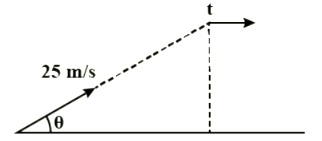
A projectile is projected with velocity of \(25 \mathrm{~m} / \mathrm{s}\) at an angle \(\theta\) with the horizontal. After t seconds its inclination with horizontal becomes zero. If R represents horizontal range of the projectile, the value of \(\theta\) will be : [JEE Main 2022 (Online) 24th June Morning Shift]
[use \(\mathrm{g}=10 \mathrm{~m} / \mathrm{s}^2\) ]CorrectIncorrectHint
(d)

Step 1: Initial Equations
The derivation starts with the standard equations for the time of flight ( \(t\) ) and the horizontal range \((R)\) of a projectile, with the initial velocity \(v_0=25\) :
Time of flight: \(t=\frac{25 \sin \theta}{g}\)
Horizontal range: \(\boldsymbol{R}=\frac{(25)^2(2 \sin \theta \cos \theta)}{g}\)
Step 2: Deriving \(R\) in terms of \(t\)
The next step rearranges the range equation by using the identity \(2 \sin \theta \cos \theta=\sin (2 \theta)\) and substituting the expression for \(t\). From the time of flight equation, we can write \(\sin \theta=\frac{g t}{25}\). This substitution leads to:
\(R=\frac{25 \times 25 \times 2}{g} \times \sin \theta \times \cos \theta\)
\(R=\frac{25 \times 25 \times 2}{g} \times \frac{g t}{25} \times \cos \theta\)
This simplifies to \(R=50 t \cos \theta\).
Step 3: Deriving an Expression for \(\tan \theta\)
Using the results from the previous steps, the derivation finds an expression for \(\tan \theta\).
From the time of flight equation, we have \(\frac{g t}{25}=\sin \theta\). From the simplified range equation, we can write \(\cos \theta=\frac{R}{50 t}\). Therefore, \(\tan \theta\) is derived as:
\(\tan \theta=\frac{\sin \theta}{\cos \theta}\)
\(\tan \theta=\frac{g t / 25}{R / 50 t}\)
\(\tan \theta=\frac{g t}{25} \times \frac{50 t}{R}\)
This simplifies to \(\tan \theta=\frac{20 t^2}{R}\).
\(
\theta=\cot ^{-1}\left(\frac{R}{20 t^2}\right)
\)Explanation: Step 1: Analyze the projectile motion
A projectile’s motion can be broken down into horizontal and vertical components. The initial velocity is given as \(u=25 \mathrm{~m} / \mathrm{s}\).
The horizontal component of the initial velocity is \(u_x=u \cos \theta=25 \cos \theta\).
The vertical component of the initial velocity is \(u_y=u \sin \theta=25 \sin \theta\).
The problem states that after time \(\boldsymbol{t}\), the projectile’s inclination with the horizontal becomes zero. This means it has reached its maximum height, where its vertical velocity component is zero. Using the first equation of motion for the vertical direction ( \(v_y=u_y-g t\) ), we get:
\(
\begin{gathered}
0=u \sin \theta-g t \\
0=25 \sin \theta-10 t
\end{gathered}
\)
From this, we can express \(\sin \theta\) in terms of \(t\) :
\(
\sin \theta=\frac{10 t}{25}=\frac{2 t}{5}
\)
Step 3: Combine the expressions to find \(\theta\)
We have two expressions, one for \(\sin \theta\) and one for \(\cos \theta\). We can use the trigonometric identity \(\sin ^2 \theta+\cos ^2 \theta=1\) to relate them:
\(
\begin{gathered}
\left(\frac{2 t}{5}\right)^2+\left(\frac{R}{50 t}\right)^2=1 \\
\frac{4 t^2}{25}+\frac{R^2}{2500 t^2}=1
\end{gathered}
\)
This is an equation relating \(\boldsymbol{R}\) and \(\boldsymbol{t}\), but the question asks for the value of \(\boldsymbol{\theta}\). Let’s try a different approach.
We can express \(\tan \theta\) by dividing the expression for \(\sin \theta\) by the expression for \(\cos \theta\) :
\(
\begin{gathered}
\tan \theta=\frac{\sin \theta}{\cos \theta}=\frac{2 t / 5}{R /(50 t)} \\
\tan \theta=\frac{2 t}{5} \times \frac{50 t}{R} \\
\tan \theta=\frac{100 t^2}{5 R}=\frac{20 t^2}{R}
\end{gathered}
\)
\(
\cot \theta=\frac{R}{20 t^2} .
\)
\(
\theta=\cot ^{-1}\left(\frac{R}{20 t^2}\right)
\) - Question 36 of 57
36. Question
The ranges and heights for two projectiles projected with the same initial velocity at angles \(42^{\circ}\) and \(48^{\circ}\) with the horizontal are \(\mathrm{R}_1, \mathrm{R}_2\) and \(\mathrm{H}_1, \mathrm{H}_2\) respectively. Choose the correct option : [JEE Main 2021 (Online) 1st September Evening Shift]
CorrectIncorrectHint
(b) Step 1: Analyze the range of the projectiles
The range \((\boldsymbol{R})\) of a projectile is given by the formula \(\boldsymbol{R}=\frac{v_0^2 \sin (2 \theta)}{g}\), where \(v_0\) is the initial velocity and \(\boldsymbol{\theta}\) is the launch angle.
For the first projectile, with \(\theta_1=42^{\circ}\), the range is \(R_1=\frac{v_0^2 \sin \left(2 \times 42^{\circ}\right)}{g}=\frac{v_0^2 \sin \left(84^{\circ}\right)}{g}\).
For the second projectile, with \(\theta_2=48^{\circ}\), the range is
\(
R_2=\frac{v_0^2 \sin \left(2 \times 48^{\circ}\right)}{g}=\frac{v_0^2 \sin \left(96^{\circ}\right)}{g} .
\)
The launch angles \(42^{\circ}\) and \(48^{\circ}\) are complementary angles because their sum is \(42^{\circ}+48^{\circ}=90^{\circ}\). A key property of projectile motion is that two projectiles launched with the same initial velocity at complementary angles will have the same range.
This is because \(\sin \left(2 \theta_1\right)=\sin \left(2\left(90^{\circ}-\theta_2\right)\right)=\sin \left(180^{\circ}-2 \theta_2\right)=\sin \left(2 \theta_2\right)\).
Therefore, \(\sin \left(84^{\circ}\right)=\sin \left(96^{\circ}\right)\), which means \(R_1=R_2\).
Step 2: Analyze the maximum height of the projectiles
The maximum height \((\boldsymbol{H})\) of a projectile is given by the formula \(\boldsymbol{H}=\frac{v_0^2 \sin ^2(\boldsymbol{\theta})}{2 g}\).
For the first projectile, with \(\theta_1=42^{\circ}\), the maximum height is \(H_1=\frac{v_0^2 \sin ^2\left(42^{\circ}\right)}{2 g}\).
For the second projectile, with \(\theta_2=48^{\circ}\), the maximum height is \(H_2=\frac{v_0^2 \sin ^2\left(48^{\circ}\right)}{2 g}\)Since the sine function increases from \(0^{\circ}\) to \(90^{\circ}\), and \(48^{\circ}>42^{\circ}\), it follows that \(\sin \left(48^{\circ}\right)>\sin \left(42^{\circ}\right)\).
Squaring both sides gives \(\sin ^2\left(48^{\circ}\right)>\sin ^2\left(42^{\circ}\right)\).
Therefore, \(\boldsymbol{H}_2>\boldsymbol{H}_1\), or \(\boldsymbol{H}_1<\boldsymbol{H}_2\).
Based on the analysis, the correct relationships are \(\mathrm{R}_1=\mathrm{R}_2\) and \(\mathrm{H}_1<\mathrm{H}_2\). - Question 37 of 57
37. Question
A helicopter is flying horizontally with a speed ‘ \(v\) ‘ at an altitude ‘ \(h\) ‘ has to drop a food packet for a man on the ground. What is the distance of helicopter from the man when the food packet is dropped? [JEE Main 2021 (Online) 31st August Morning Shift]
CorrectIncorrectHint
(c)

Step 1: Analyze the Problem
The user is asking for the distance between a helicopter and a man on the ground at the exact moment a food packet is dropped. The helicopter is flying horizontally at an altitude of \(h\) with a speed of \(v\). The man is on the ground, and the food packet is intended to land near him. The problem requires calculating the straight-line distance between the helicopter and the man at the point of release.
Step 2: Formulate the Geometric Relationship
At the moment the food packet is dropped, the helicopter is at a certain horizontal position and an altitude of \({h}\). The man is on the ground. The distance between the helicopter and the man at this instant can be visualized as the hypotenuse of a rightangled triangle.
One leg of the triangle is the vertical height, which is the altitude of the helicopter, \(h\).
The other leg is the horizontal distance between the helicopter’s position and the man’s position on the ground.
The question doesn’t state that the helicopter drops the packet directly over the man. The helicopter has to drop the packet at some horizontal distance away from the man so that the packet, traveling with the helicopter’s horizontal speed, lands on the man. This horizontal distance the helicopter is from the man when it drops the packet is the horizontal distance the packet will travel before it hits the ground.
To find the time it takes for the packet to fall, we can use the kinematic equation for vertical motion:
\(
h=\frac{1}{2} g t^2
\)
Solving for time \(t\) :
\(
t=\sqrt{\frac{2 h}{g}}
\)
The horizontal distance \(x\) the packet travels is given by:
\(
x=v t
\)
Substituting the expression for \(t\) :
\(
x=v \sqrt{\frac{2 h}{g}}
\)
The distance \(\boldsymbol{D}\) of the helicopter from the man at the moment of release is the hypotenuse of the right triangle formed by the vertical height \(h\) and the horizontal distance \(x\).
Using the Pythagorean theorem:
\(
D^2=x^2+h^2
\)
Substituting the expression for \(x\) :
\(
\begin{aligned}
D^2 & =\left(v \sqrt{\frac{2 h}{g}}\right)^2+h^2 \\
D^2 & =v^2\left(\frac{2 h}{g}\right)+h^2 \\
D & =\sqrt{\frac{2 v^2 h}{g}+h^2}
\end{aligned}
\)
The distance of the helicopter from the man when the food packet is dropped is given by the formula \(\sqrt{\frac{2 v^2 h}{g}+h^2}\). - Question 38 of 57
38. Question
A player kicks a football with an initial speed of \(25 \mathrm{~ms}^{-1}\) at an angle of \(45^{\circ}\) from the ground. What are the maximum height and the time taken by the football to reach at the highest point during motion? \(\left(\right.\) Take \(\left.\mathrm{g}=10 \mathrm{~ms}^{-2}\right)\) [JEE Main 2021 (Online) 27th August Evening Shift]
CorrectIncorrectHint
(c) Step 1: Calculate the time to reach the maximum height
The time taken by a projectile to reach its maximum height ( \(\boldsymbol{T}\) ) is given by the formula:
\(
T=\frac{v_0 \sin (\theta)}{g}
\)
Given values are:
Initial speed, \(v_0=25 \mathrm{~ms}^{-1}\)
Launch angle, \(\theta=45^{\circ}\)
Acceleration due to gravity, \(g=10 \mathrm{~ms}^{-2}\)
Substitute the values into the formula:
\(
T=\frac{25 \sin \left(45^{\circ}\right)}{10}
\)
Since \(\sin \left(45^{\circ}\right)=\frac{\sqrt{2}}{2} \approx 0.7071\) :
\(
\begin{gathered}
T=\frac{25 \times 0.7071}{10} \\
T=\frac{17.6775}{10} \approx 1.77 \mathrm{~s}
\end{gathered}
\)
Step 2: Calculate the maximum height
The maximum height \(\left(h_{\text {max }}\right)\) reached by the projectile is given by the formula:
\(
h_{\max }=\frac{v_0^2 \sin ^2(\theta)}{2 g}
\)
Substitute the given values:
\(
\begin{gathered}
h_{\max }=\frac{25^2 \sin ^2\left(45^{\circ}\right)}{2 \times 10} \\
h_{\max }=\frac{625 \times(0.7071)^2}{20} \\
h_{\max }=\frac{625 \times 0.5}{20} \\
h_{\max }=\frac{312.5}{20}=15.625 \mathrm{~m}
\end{gathered}
\)
The maximum height is 15.625 m and the time taken to reach the highest point is approximately 1.77 s. - Question 39 of 57
39. Question
A bomb is dropped by fighter plane flying horizontally. To an observer sitting in the plane, the trajectory of the bomb is a : [JEE Main 2021 (Online) 26th August Evening Shift]
CorrectIncorrectHint
(c)

The bomb is dropped from a fighter plane flying in horizontal direction only.
Let us assume the velocity of fighter plane, \(v_p=v_x \hat{i}\). As fighter plane is moving in horizontal direction only. Hence, it has only one component.
When fighter plane drops the bomb, the bomb will free fall from the fighter plane and have a horizontal velocity in the direction of plane and vertical velocity due to gravity.
Velocity of bomb can be given as, \(v_b=v_x \hat{i}-v_y \hat{j}\). Velocity in vertical direction will be negative as bomb is moving downwards.
Now, for the person sitting inside the plane, hence the relative velocity of bomb with respect to plane can be calculated as
\(
v_{b p}=v_b-v_p=v_x \hat{i}-v_y \hat{j}-v_x \hat{i}=-v_y \hat{j}
\)
The velocity of bomb with respect to person sitting in plane is only in vertical direction. Thus, the trajectory of bomb with respect to the person will be a straight line vertically down to the plane.Note: To an observer sitting in the plane, the trajectory of the bomb is a straight line vertically down the plane.
Explanation: When the bomb is dropped, it retains the same horizontal velocity as the plane, meaning it appears to fall straight down to the observer. - Question 40 of 57
40. Question
A butterfly is flying with a velocity \(4 \sqrt{2} \mathrm{~m} / \mathrm{s}\) in North-East direction. Wind is slowly blowing at 1 \(\mathrm{m} / \mathrm{s}\) from North to South. The resultant displacement of the butterfly in 3 seconds is : [JEE Main 2021 (Online) 20th July Morning Shift]
CorrectIncorrectHint
(d)

\(
\begin{aligned}
& \overrightarrow{\mathrm{V}}_{\mathrm{BW}}=4 \sqrt{2} \cos 45 \hat{\mathrm{i}}+4 \sqrt{2} \sin 45 \hat{\mathrm{j}} \\
& =4 \hat{\mathrm{i}}+4 \hat{\mathrm{j}} \\
& \overrightarrow{\mathrm{~V}}_{\mathrm{W}}=-\hat{\mathrm{j}} \\
& \overrightarrow{\mathrm{~V}}_{\mathrm{B}}=\overrightarrow{\mathrm{V}}_{\mathrm{BW}}+\overrightarrow{\mathrm{V}}_{\mathrm{W}}=4 \hat{\mathrm{i}}+3 \hat{\mathrm{j}} \\
& \overrightarrow{\mathrm{~S}}_{\mathrm{B}}=\overrightarrow{\mathrm{V}}_{\mathrm{B}} \times \mathrm{t}=(4 \hat{\mathrm{i}}+3 \hat{\mathrm{j}}) \times 3=12 \hat{\mathrm{i}}+9 \hat{\mathrm{j}} \\
& \left|\overrightarrow{\mathrm{~S}}_{\mathrm{B}}\right|=\sqrt{(12)^2+(9)^2}=15 \mathrm{~m}
\end{aligned}
\)Alternate: Step 1: Determine the components of the butterfly’s velocity and the wind’s velocity
The butterfly is flying at \(4 \sqrt{2} \mathrm{~m} / \mathrm{s}\) in the North-East direction, which is at an angle of \(45^{\circ}\) to the East and North axes.
The \(x\)-component (East) of the butterfly’s velocity is
\(
v_{b x}=4 \sqrt{2} \cos \left(45^{\circ}\right)=4 \sqrt{2}\left(\frac{1}{\sqrt{2}}\right)=4 \mathrm{~m} / \mathrm{s}
\)
The \(y\)-component (North) of the butterfly’s velocity is
\(
v_{b y}=4 \sqrt{2} \sin \left(45^{\circ}\right)=4 \sqrt{2}\left(\frac{1}{\sqrt{2}}\right)=4 \mathrm{~m} / \mathrm{s}
\)
The wind is blowing at \(1 \mathrm{~m} / \mathrm{s}\) from North to South.
The \(x\)-component of the wind’s velocity is \(v_{w x}=0 \mathrm{~m} / \mathrm{s}\).
The y -component of the wind’s velocity is \(v_{w y}=-1 \mathrm{~m} / \mathrm{s}\) (since South is the negative North direction).
Step 2: Calculate the resultant velocity of the butterfly
Add the components of the butterfly’s and the wind’s velocities to find the resultant velocity vector \(\vec{v}_{\text {res }}\).
\(v_{r e s, x}=v_{b x}+v_{w x}=4+0=4 \mathrm{~m} / \mathrm{s}\).
\(v_{\text {res }, y}=v_{b y}+v_{w y}=4+(-1)=3 \mathrm{~m} / \mathrm{s}\).
The magnitude of the resultant velocity is \(v_{\text {res }}=\sqrt{\left(v_{\text {res }, x}\right)^2+\left(v_{\text {res }, y}\right)^2}\).
\(
v_{r e s}=\sqrt{4^2+3^2}=\sqrt{16+9}=\sqrt{25}=5 \mathrm{~m} / \mathrm{s}
\)
Step 3: Calculate the resultant displacement
The displacement \(\vec{d}\) is the product of the resultant velocity and the time \(t\).
\(
d=v_{r e s} \times t=5 \mathrm{~m} / \mathrm{s} \times 3 \mathrm{~s}=15 \mathrm{~m}
\)
The resultant displacement of the butterfly in 3 seconds is 15 m. - Question 41 of 57
41. Question
A mosquito is moving with a velocity \(\vec{v}=0.5 t^2 \hat{i}+3 t \hat{j}+9 \hat{k} \mathrm{~m} / \mathrm{s}\) and accelerating in uniform conditions. What will be the direction of mosquito after \(2 s\) ? [JEE Main 2021 (Online) 16th March Evening Shift]
CorrectIncorrectHint
(a) The velocity vector is given by the equation \(\vec{v}(t)=0.5 t^2 \hat{i}+3 t \hat{j}+9 \hat{k}\). To find the velocity at \(t=2 \mathrm{~s}\), substitute \(t=2\) into the equation:
\(
\begin{gathered}
\vec{v}(2)=0.5(2)^2 \hat{i}+3(2) \hat{j}+9 \hat{k} \\
\vec{v}(2)=0.5(4) \hat{i}+6 \hat{j}+9 \hat{k} \\
\vec{v}(2)=2 \hat{i}+6 \hat{j}+9 \hat{k}
\end{gathered}
\)
Direction cosine along \(y\)-axis,
\(
\begin{gathered}
\cos \left(\theta_y\right)=\frac{\vec{v} \cdot \hat{j}}{|\vec{v}||\hat{j}|}=\frac{v_y}{|\vec{v}|}=\frac{6}{\sqrt{2^2+6^2+9^2}}=\frac{6}{\sqrt{4+36+81}}=\frac{6}{\sqrt{121}}=\frac{6}{11} \\
\theta_y=\cos ^{-1}\left(\frac{6}{11}\right)
\end{gathered}
\)
\(
\therefore \sin \theta=\frac{\sqrt{85}}{11}
\)
and \(\tan \theta=\frac{\sqrt{85}}{6}\)
\(\therefore\) Mosquito make angle \(\tan ^{-1}\left(\frac{\sqrt{85}}{6}\right)\) from \(y\)-axis. - Question 42 of 57
42. Question
The trajectory of a projectile in a vertical plane is \(\mathrm{y}=\alpha \mathrm{x}-\beta \mathrm{x}^2\), where \(\alpha\) and \(\beta\) are constants and \(\mathrm{x} \& \mathrm{y}\) are respectively the horizontal and vertical distances of the projectile from the point of projection. The angle of projection \(\theta\) and the maximum height attained \(H\) are respectively given by [JEE Main 2021 (Online) 26th February Evening Shift]
CorrectIncorrectHint
(a) Deriving the angle of projection
Compare the given equation with the standard equation of a projectile’s trajectory:
Given: \(y=\alpha x-\beta x^2\)
Standard: \(y=(\tan \theta) x-\frac{g}{2 u^2 \cos ^2 \theta} x^2\)
By comparing the coefficients of \(x\), we can see that \(\alpha=\tan \theta\).
Therefore, the angle of projection is \(\theta=\tan ^{-1} \alpha\).
Deriving the maximum height
By comparing the coefficients of \(x^2\), we have \(\beta=\frac{g}{2 u^2 \cos ^2 \theta}\).
Rearranging this gives us \(\frac{g}{2 u^2 \cos ^2 \theta}=\beta\).
From the angle of projection, we know that \(\tan \theta=\alpha\), so \(\sec ^2 \theta=1+\tan ^2 \theta=1+\alpha^2\).
Substitute this back into the equation for \(\beta\) : \(\beta=\frac{g}{2 u^2}\left(1+\alpha^2\right)\).
Now, we can rearrange this to find the value of \(\frac{g}{2 u^2 \cos ^2 \theta}\) in terms of \(\alpha\) and \(\beta\), which is \(\frac{g}{2 u^2 \cos ^2 \theta}=\frac{\beta}{1+\alpha^2}\).
The standard formula for maximum height is \(H=\frac{u^2 \sin ^2 \theta}{2 g}\).
We can rewrite this as \(\boldsymbol{H}=\frac{u^2}{2 g}\left(\frac{\tan ^2 \theta}{\sec ^2 \theta}\right)=\frac{u^2}{2 g}\left(\frac{\alpha^2}{1+\alpha^2}\right)\).
From our previous equation, we have \(\frac{g}{2 u^2}=\frac{\beta}{1+\alpha^2}\).
So, \(\frac{u^2}{2 g}=\frac{1+\alpha^2}{\beta}\).
Substituting this back into the maximum height formula:
\(
H=\frac{1+\alpha^2}{\beta}\left(\frac{\alpha^2}{1+\alpha^2}\right)=\frac{\alpha^2}{4 \beta}
\)
Therefore, the maximum height is \(H=\frac{\alpha^2}{4 \beta}\). - Question 43 of 57
43. Question
When a car is at rest, its driver sees rain drops falling on it vertically. When driving the car with speed \(v\), he sees that rain drops are coming at an angle \(60^{\circ}\) from the horizontal. On further increasing the speed of the car to \((1+\beta) \mathrm{v}\), this angle changes to \(45^{\circ}\). The value of \(\beta\) is close to : [JEE Main 2020 (Online) 6th September Evening Slot]
CorrectIncorrectHint
(b)

\(
\begin{aligned}
&\begin{aligned}
& \tan 60^{\circ}=\frac{V_r}{V} \dots(1) \\
& \tan 45^{\circ}=\frac{V_r}{(1+\beta) V} \dots(2)
\end{aligned}\\
&\text { From (i) and (ii), we get }\\
&\begin{aligned}
& \frac{\sqrt{3}}{1}=\frac{\frac{1}{V}}{\frac{1}{(1+\beta) V}} \\
& \Rightarrow \sqrt{3}=(1+\beta) \\
& \Rightarrow \beta=0.732
\end{aligned}
\end{aligned}
\) - Question 44 of 57
44. Question
\(A\) balloon is moving up in air vertically above a point \(A\) on the ground. When it is at a height \(h_1\), \(a\) girl standing at a distanced (point B ) from A (see figure) sees it at an angle \(45^{\circ}\) with respect to the vertical. When the balloon climbs up a further height \(h_2\), it is seen at an angle \(60^{\circ}\) with respect to the vertical if the girl moves further by a distance 2.464 d (point C ). Then the height \(\mathrm{h}_2\) is (given \(\left.\tan 30^{\circ}=0.5774\right)\) [JEE Main 2020 (Online) 5th September Morning Slot]
CorrectIncorrectHint
(b)

From \(\triangle A B D\)
\(
\begin{aligned}
& \tan 45=\frac{h_1}{d} \\
& \Rightarrow 1=\frac{h_1}{d} \\
& \Rightarrow h_1=d
\end{aligned}
\)
From \(\triangle A C E\)
\(
\begin{aligned}
& \tan 30=\frac{h_1+h_2}{d+2.464 d} \\
& \Rightarrow 0.5774=\frac{d+h_2}{3.464 d} \\
& \Rightarrow d+h_2=0.5774 \times 3.464 \times d \\
& \Rightarrow h_2=2.0001136 d-d \\
& \Rightarrow h_2=2.000 d-d=d
\end{aligned}
\) - Question 45 of 57
45. Question
Starting from the origin at time \(\mathrm{t}=0\), with initial velocity \(5 \hat{j} \mathrm{~ms}^{-1}\), a particle moves in the \(\mathrm{x}-\mathrm{y}\) plane with a constant acceleration of \((10 \hat{i}+4 \hat{j}) \mathrm{ms}^{-2}\). At time \(t\), its coordinates are \(\left(20 \mathrm{~m}, \mathrm{y}_0 \mathrm{~m}\right)\). The values of \(t\) and \(y_0\) are, respectively: [JEE Main 2020 (Online) 4th September Morning Slot]
CorrectIncorrectHint
(b) Step 1: Analyze the motion in the x -direction to find the time \(t\)
The kinematic equation for the position of a particle with constant acceleration is \(\vec{r}=\vec{r}_0+\vec{v}_0 t+\frac{1}{2} \vec{a} t^2\). We can separate this into components. For the \(x\)-direction:
\(
x=x_0+v_{0 x} t+\frac{1}{2} a_x t^2
\)
Given values:
Initial x-position \(x_0=0\) (from the origin)
Initial x -velocity \(v_{0 x}=0\) (initial velocity is \(5 \hat{j}\) )
x-component of acceleration \(a_x=10 \mathrm{~ms}^{-2}\)
Final x-position \(x=20 \mathrm{~m}\)
Substituting these values into the equation:
\(
\begin{gathered}
20=0+(0) t+\frac{1}{2}(10) t^2 \\
20=5 t^2 \\
t^2=\frac{20}{5} \\
t^2=4 \\
t= \pm \sqrt{4}
\end{gathered}
\)
Since time must be positive, the value of \(t\) is 2 s.
Step 2: Analyze the motion in the \(y\)-direction to find the coordinate \(y_0\)
Using the same kinematic equation, we focus on the \(y\)-direction:
\(
y=y_0+v_{0 y} t+\frac{1}{2} a_y t^2
\)
Given values:
Initial y-position \(y_0=0\) (from the origin)
Initial y -velocity \(v_{0 y}=5 \mathrm{~ms}^{-1}\)
y -component of acceleration \(a_y=4 \mathrm{~ms}^{-2}\)
Time \(\boldsymbol{t}=2 \mathrm{~s}\) (calculated in Step 1)
Substituting these values to find the final y -coordinate, which is denoted as \(y_0\) in the problem:
\(
\begin{gathered}
y_0=0+(5)(2)+\frac{1}{2}(4)(2)^2 \\
y_0=10+\frac{1}{2}(4)(4) \\
y_0=10+8 \\
y_0=18 \mathrm{~m}
\end{gathered}
\)
The values of \(t\) and \(y_0\) are, respectively, 2 s and 18 m. - Question 46 of 57
46. Question
A particle starts from the origin at \(t=0\) with an initial velocity of \(3.0 \hat{i} \mathrm{~m} / \mathrm{s}\) and moves in the x-y plane with a constant acceleration \((6 \hat{i}+4 \hat{j}) \mathrm{m} / \mathrm{s}^2\). The x -coordinate of the particle at the instant when its \(y\)-coordinate is \(32 m\) is \(D\) meters. The value of \(D\) is : [JEE Main 2020 (Online) 9th January Evening Slot]
CorrectIncorrectHint
(d) Step 1: Write the kinematic equations for position
The position of a particle moving with constant acceleration is given by the equation:
\(
\vec{r}(t)=\vec{r}_0+\vec{v}_0 t+\frac{1}{2} \vec{a} t^2
\)
Given the initial position \(\vec{r}_0=0\), initial velocity \(\vec{v}_0=3 \hat{i}\), and constant acceleration \(\vec{a}=(6 \hat{i}+4 \hat{j})\), the position vector becomes:
\(
\vec{r}(t)=(3 \hat{i}) t+\frac{1}{2}(6 \hat{i}+4 \hat{j}) t^2
\)
Separating this into its x and y components, we get:
\(
\begin{gathered}
x(t)=3 t+\frac{1}{2}(6) t^2=3 t+3 t^2 \\
y(t)=\frac{1}{2}(4) t^2=2 t^2
\end{gathered}
\)
Step 2: Calculate the time when the y -coordinate is 32 m
We are given that the y -coordinate is 32 m. Using the equation for \(y(t)\) :
\(
\begin{gathered}
32=2 t^2 \\
t^2=\frac{32}{2}=16 \\
t=\sqrt{16}=4 \mathrm{~s}
\end{gathered}
\)
We take the positive value for time as the particle starts at \(t=0\).
Step 3: Calculate the x -coordinate at this time
Now, we can find the x -coordinate at \(t=4 \mathrm{~s}\) using the equation for \(x(t)\) :
\(
\begin{gathered}
x(4)=3(4)+3(4)^2 \\
x(4)=12+3(16) \\
x(4)=12+48 \\
x(4)=60 \mathrm{~m}
\end{gathered}
\)
The problem states that the x-coordinate at this instant is \(\boldsymbol{D}\), so \(\boldsymbol{D}=60\).
The value of \(\boldsymbol{D}\) is \(\mathbf{6 0}\) meters. - Question 47 of 57
47. Question
A particle moves such that its position vector \(\vec{r}(t)=\cos \omega t \hat{i}+\sin \omega t \hat{j}\) where \(\omega\) is a constant and \(t\) is time. Then which of the following statements is true for the velocity \(\vec{v}(t)\) and acceleration \(\vec{a}(t)\) of the particle: [JEE Main 2020 (Online) 8th January Evening Slot]
CorrectIncorrectHint
(c) Step 1: Calculate the velocity vector \(\vec{v}(t)\)
The velocity vector is the first derivative of the position vector with respect to time.
Given: \(\vec{r}(t)=\cos \omega t \hat{i}+\sin \omega t \hat{j}\)
Using the chain rule for derivatives, we find:
\(
\begin{gathered}
\vec{v}(t)=\frac{d \vec{r}}{d t}=\frac{d}{d t}(\cos \omega t) \hat{i}+\frac{d}{d t}(\sin \omega t) \hat{j} \\
\vec{v}(t)=-\omega \sin \omega t \hat{i}+\omega \cos \omega t \hat{j}
\end{gathered}
\)
Step 2: Calculate the acceleration vector \(\overrightarrow{\boldsymbol{a}}(\boldsymbol{t})\)
The acceleration vector is the first derivative of the velocity vector (the second derivative of the position vector) with respect to time.
\(
\begin{gathered}
\vec{a}(t)=\frac{d \vec{v}}{d t}=\frac{d}{d t}(-\omega \sin \omega t) \hat{i}+\frac{d}{d t}(\omega \cos \omega t) \hat{j} \\
\vec{a}(t)=-\omega^2 \cos \omega t \hat{i}-\omega^2 \sin \omega t \hat{j}
\end{gathered}
\)
Step 3: Analyze the relationship between \(\vec{v}(t)\) and \(\vec{r}(t)\)
To check if the velocity is perpendicular to the position vector, we can compute their dot product. If the dot product is zero, the vectors are perpendicular.
\(
\begin{gathered}
\vec{r} \cdot \vec{v}=(\cos \omega t \hat{i}+\sin \omega t \hat{j}) \cdot(-\omega \sin \omega t \hat{i}+\omega \cos \omega t \hat{j}) \\
\vec{r} \cdot \vec{v}=(\cos \omega t)(-\omega \sin \omega t)+(\sin \omega t)(\omega \cos \omega t) \\
\vec{r} \cdot \vec{v}=-\omega \cos \omega t \sin \omega t+\omega \cos \omega t \sin \omega t=0
\end{gathered}
\)
Since the dot product is zero, \(\vec{v}\) is perpendicular to \(\vec{r}\). This is consistent with uniform circular motion, where the velocity is always tangential to the circular path.
Step 4: Analyze the relationship between \(\vec{a}(t)\) and \(\vec{r}(t)\)
We can factor \(-\omega^2\) out of the acceleration vector expression:
\(
\vec{a}(t)=-\omega^2(\cos \omega t \hat{i}+\sin \omega t \hat{j})
\)
Comparing this to the original position vector, \(\vec{r}(t)=\cos \omega t \hat{i}+\sin \omega t \hat{j}\), we see that:
\(
\vec{a}(t)=-\omega^2 \vec{r}(t)
\)
Since \(\omega^2\) is a positive constant, this equation shows that the acceleration vector is a negative multiple of the position vector. This means that the acceleration vector is always parallel to the position vector but points in the opposite direction. Since the position vector points from the origin to the particle, the acceleration vector must point from the particle towards the origin. This is the definition of centripetal (centerseeking) acceleration.
Conclusion:
\(\vec{v}\) is perpendicular to \(\vec{r}\).
\(\vec{a}\) is directed towards the origin.
Therefore, the correct statement is that the velocity is perpendicular to the position vector, and the acceleration is directed towards the origin. - Question 48 of 57
48. Question
Two particles are projected from the same point with the same speed \(u\) such that they have the same range \(R\) , but different maximum heights, \(\mathrm{h}_1\) and \(\mathrm{h}_2\). Which of the following is correct? [JEE Main 2019 (Online) 12th April Evening Slot]
CorrectIncorrectHint
(b) To derive the relationship between the range \(R\) and maximum heights \(h_1\) and \(h_2\) for two projectiles, we first need to understand the conditions required for two projectiles to have the same range with the same initial speed \(u\).
The horizontal range \(\boldsymbol{R}\) of a projectile is given by the formula:
\(
R=\frac{u^2 \sin (2 \theta)}{g}
\)
For two projectiles launched with the same initial speed \(u\) to have the same range \(\boldsymbol{R}\) but different maximum heights, their launch angles must be complementary. That is, if the first particle is launched at an angle \(\boldsymbol{\theta}_1=\boldsymbol{\theta}\), the second particle must be launched at an angle \(\theta_2=90^{\circ}-\theta\).
For the first particle, the range is:
\(
R=\frac{u^2 \sin (2 \theta)}{g}
\)
For the second particle, the range is:
\(
R=\frac{u^2 \sin \left(2\left(90^{\circ}-\theta\right)\right)}{g}=\frac{u^2 \sin \left(180^{\circ}-2 \theta\right)}{g}=\frac{u^2 \sin (2 \theta)}{g}
\)
This confirms that the range is the same for complementary angles.
The maximum height \(\boldsymbol{h}\) of a projectile is given by the formula:
\(
h=\frac{u^2 \sin ^2(\theta)}{2 g}
\)
For the first particle, the maximum height \(h_1\) is:
\(
h_1=\frac{u^2 \sin ^2(\theta)}{2 g}
\)
For the second particle, the maximum height \(h_2\) is:
\(
h_2=\frac{u^2 \sin ^2\left(90^{\circ}-\theta\right)}{2 g}=\frac{u^2 \cos ^2(\theta)}{2 g}
\)
Now, let’s find the product of the two maximum heights, \(h_1 h_2\) :
\(
h_1 h_2=\left(\frac{u^2 \sin ^2(\theta)}{2 g}\right)\left(\frac{u^2 \cos ^2(\theta)}{2 g}\right)=\frac{u^4 \sin ^2(\theta) \cos ^2(\theta)}{4 g^2}
\)
We can use the trigonometric identity \(\sin (2 \theta)=2 \sin (\theta) \cos (\theta)\), which gives \(\sin ^2(2 \theta)=4 \sin ^2(\theta) \cos ^2(\theta)\).
Substituting this into the expression for \(h_1 h_2\) :
\(
h_1 h_2=\frac{u^4}{4 g^2}\left(\frac{\sin ^2(2 \theta)}{4}\right)=\frac{u^4 \sin ^2(2 \theta)}{16 g^2}
\)
Finally, we can relate this to the range \(R\). Since \(R=\frac{u^2 \sin (2 \theta)}{g}\), we have
\(
R^2=\frac{u^4 \sin ^2(2 \theta)}{g^2} .
\)
Substituting \(R^2\) into the expression for \(h_1 h_2\) :
\(
h_1 h_2=\frac{R^2}{16}
\)
Rearranging the equation gives the final relation:
\(
R^2=16 h_1 h_2
\) - Question 49 of 57
49. Question
The trajectory of a projectile near the surface of the earth is given as \(y=2 x-9 x^2\). If it were launched at an angle \(\theta_0\) with speed \(\mathrm{v}_0\) then \(\left(\mathrm{g}=10 \mathrm{~ms}^{-2}\right)\) : [JEE Main 2019 (Online) 12th April Morning Slot]
CorrectIncorrectHint
(a) Step 1: Compare the given equation with the standard trajectory equation
The given trajectory equation is \(y=2 x-9 x^2\).
The standard equation for the trajectory of a projectile is
\(
y=\left(\tan \theta_0\right) x-\frac{g}{2 v_0^2 \cos ^2 \theta_0} x^2
\)
By comparing the coefficients of \(x\) and \(x^2\) from both equations, we get two relationships:
\(
\begin{gathered}
\tan \theta_0=2 \dots(1)\\
\frac{g}{2 v_0^2 \cos ^2 \theta_0}=9 \dots(2)
\end{gathered}
\)
Step 2: Solve for \(\theta_0\)
From Equation 1, we know \(\tan \theta_0=2\). We can visualize a right triangle with the opposite side equal to 2 and the adjacent side equal to 1. The hypotenuse would be \(\sqrt{1^2+2^2}=\sqrt{5}\).
Using this triangle, we can find \(\cos \theta_0\) :
\(
\cos \theta_0=\frac{\text { adjacent }}{\text { hypotenuse }}=\frac{1}{\sqrt{5}}
\)
Therefore, \(\theta_0=\cos ^{-1}\left(\frac{1}{\sqrt{5}}\right)\).
Step 3: Solve for \(v_0\)
Now, we can use Equation 2 to find the initial velocity \(v_0\). We are given \(g=10 \mathrm{~ms}^{-2}\) and we have found \(\cos \theta_0=\frac{1}{\sqrt{5}}\).
\(
\begin{gathered}
\frac{g}{2 v_0^2 \cos ^2 \theta_0}=9 \\
\frac{10}{2 v_0^2\left(\frac{1}{\sqrt{5}}\right)^2}=9 \\
\frac{10}{2 v_0^2\left(\frac{1}{5}\right)}=9 \\
\frac{10}{\frac{2}{5} v_0^2}=9 \\
\frac{50}{2 v_0^2}=9 \\
\frac{25}{v_0^2}=9 \\
v_0^2=\frac{25}{9} \\
v_0=\sqrt{\frac{25}{9}}=\frac{5}{3} \mathrm{~ms}^{-1}
\end{gathered}
\)
The values are \(\theta_0=\cos ^{-1}\left(\frac{1}{\sqrt{5}}\right)\) and \(v_0=\frac{5}{3} \mathrm{~ms}^{-1}\). - Question 50 of 57
50. Question
A shell is fired from a fixed artillery gun with an initial speed \(u\) such that it hits the target on the ground at a distance R from it. If \(\mathrm{t}_1\) and \(\mathrm{t}_2\) are the values of the time taken by it to hit the target in two possible ways, the product \(t_1 t_2\) is [JEE Main 2019 (Online) 12th April Morning Slot]
CorrectIncorrectHint
(a) Step 1: Find the time of flight for a given launch angle
For a projectile launched with initial speed \(\boldsymbol{u}\) at an angle \(\boldsymbol{\theta}\) with the horizontal, the time of flight \(t\) is determined by the vertical motion. The equation for vertical displacement is \(y=u_y t-\frac{1}{2} g t^2\), where \(u_y=u \sin (\theta)\). Since the shell lands on the ground, the final vertical displacement is \(y=0\).
\(
0=(u \sin \theta) t-\frac{1}{2} g t^2
\)
Factoring out \(t\), we get:
\(
t\left(u \sin \theta-\frac{1}{2} g t\right)=0
\)
The non-zero solution for time of flight is:
\(
t=\frac{2 u \sin \theta}{g}
\)
Step 2: Relate the time of flight to the range
The horizontal range \(\boldsymbol{R}\) is given by \(\boldsymbol{R}=\boldsymbol{u}_x \boldsymbol{t}\), where \(\boldsymbol{u}_x=\boldsymbol{u} \boldsymbol{\operatorname { c o s }}(\boldsymbol{\theta})\). Substituting the expression for time of flight from Step 1:
\(
R=(u \cos \theta)\left(\frac{2 u \sin \theta}{g}\right)=\frac{2 u^2 \sin \theta \cos \theta}{g}
\)
Using the double-angle identity for sine, \(2 \sin \theta \cos \theta=\sin (2 \theta)\), the range equation becomes:
\(
R=\frac{u^2 \sin (2 \theta)}{g}
\)
From this equation, we can see that for a fixed range \(\boldsymbol{R}\) and initial speed \(\boldsymbol{u}\), there are two possible launch angles, \(\theta_1\) and \(\theta_2\), that satisfy \(\sin \left(2 \theta_1\right)=\sin \left(2 \theta_2\right)\). These are the complementary angles \(\theta_1=\theta\) and \(\theta_2=90^{\circ}-\theta\).
Step 3: Calculate the product of the two times of flight
The two possible times of flight, \(t_1\) and \(t_2\), correspond to the two launch angles \(\boldsymbol{\theta}\) and \(90^{\circ}-\theta\).
Using the time of flight equation from Step 1:
\(
\begin{gathered}
t_1=\frac{2 u \sin (\theta)}{g} \\
t_2=\frac{2 u \sin \left(90^{\circ}-\theta\right)}{g}=\frac{2 u \cos (\theta)}{g}
\end{gathered}
\)
The product of these two times is:
\(
\begin{gathered}
t_1 t_2=\left(\frac{2 u \sin \theta}{g}\right)\left(\frac{2 u \cos \theta}{g}\right)=\frac{4 u^2 \sin \theta \cos \theta}{g^2} \\
t_1 t_2=\frac{2 u^2(2 \sin \theta \cos \theta)}{g^2}=\frac{2 u^2 \sin (2 \theta)}{g^2}
\end{gathered}
\)
Step 4: Express the product in terms of \(R\)
From Step 2, we have the range equation \(R=\frac{u^2 \sin (2 \theta)}{g}\). Substituting this into the expression for \(t_1 t_2\) from Step 3:
\(
t_1 t_2=\frac{2}{g}\left(\frac{u^2 \sin (2 \theta)}{g}\right)=\frac{2}{g} R
\) - Question 51 of 57
51. Question
A plane is inclined at an angle \(\alpha=30^{\circ}\) with respect to the horizontal. A particle is projected with a speed \(\mathrm{u}=2 \mathrm{~ms}^{-1}\), from the base of the plane, making an angle \(\theta=15^{\circ}\) with respect to the plane as shown in the figure. the distance from the base, at which the particle hits the plane is close to : [JEE Main 2019 (Online) 10th April Evening Slot]
\(\left(\right.\) Take \(\left.\mathrm{g}=10 \mathrm{~ms}^{-2}\right)\) CorrectIncorrect
Hint
(c)

The initial velocity components are:
\(u_x=u \cos \theta=2 \cos \left(15^{\circ}\right)\)
\(u_y=u \sin \theta=2 \sin \left(15^{\circ}\right)\)
The acceleration components are:
\(a_x=-g \sin \alpha=-10 \sin \left(30^{\circ}\right)=-10 \times \frac{1}{2}=-5 \mathrm{~ms}^{-2}\)
\(a_y=-g \cos \alpha=-10 \cos \left(30^{\circ}\right)=-10 \times \frac{\sqrt{3}}{2}=-5 \sqrt{3} \mathrm{~ms}^{-2}\)
The particle hits the plane when its y-displacement is zero. We use the kinematic equation for displacement in the \(y\)-direction:
\(
y=u_y t+\frac{1}{2} a_y t^2
\)
Setting \(y=0\) for the total time of flight \(T\) :
\(
\begin{gathered}
0=\left(2 \sin \left(15^{\circ}\right)\right) T+\frac{1}{2}(-5 \sqrt{3}) T^2 \\
0=T\left(2 \sin \left(15^{\circ}\right)-\frac{5 \sqrt{3}}{2} T\right)
\end{gathered}
\)
Since \(\boldsymbol{T} \neq 0\), we solve for \(T\) :
\(
T=\frac{2 \sin \left(15^{\circ}\right)}{\frac{5 \sqrt{3}}{2}}=\frac{4 \sin \left(15^{\circ}\right)}{5 \sqrt{3}}
\)
Using
\(
\sin \left(15^{\circ}\right)=\sin \left(45^{\circ}-30^{\circ}\right)=\sin \left(45^{\circ}\right) \cos \left(30^{\circ}\right)-\cos \left(45^{\circ}\right) \sin \left(30^{\circ}\right)=\frac{\sqrt{2}}{2} \frac{\sqrt{3}}{2}-\frac{\sqrt{2}}{2} \frac{1}{2}=\frac{\sqrt{6}-\sqrt{2}}{4}
\)
\(
T=\frac{4}{5 \sqrt{3}}\left(\frac{\sqrt{6}-\sqrt{2}}{4}\right)=\frac{\sqrt{6}-\sqrt{2}}{5 \sqrt{3}} \approx 0.1177 \mathrm{~s}
\)
Calculate the distance traveled along the plane
The distance from the base, \(\boldsymbol{R}\), is the x-displacement after time \(\boldsymbol{T}\). We use the kinematic equation for displacement in the x -direction:
\(
\begin{gathered}
x=u_x T+\frac{1}{2} a_x T^2 \\
R=\left(2 \cos \left(15^{\circ}\right)\right) T+\frac{1}{2}(-5) T^2=T\left(2 \cos \left(15^{\circ}\right)-\frac{5}{2} T\right)
\end{gathered}
\)
Using the value for \(T\) from the previous step:
\(
\begin{gathered}
R=\frac{4 \sin \left(15^{\circ}\right)}{5 \sqrt{3}}\left(2 \cos \left(15^{\circ}\right)-\frac{5}{2}\left(\frac{4 \sin \left(15^{\circ}\right)}{5 \sqrt{3}}\right)\right) \\
R=\frac{4 \sin \left(15^{\circ}\right)}{5 \sqrt{3}}\left(2 \cos \left(15^{\circ}\right)-\frac{2 \sin \left(15^{\circ}\right)}{\sqrt{3}}\right) \\
R=\frac{8 \sin \left(15^{\circ}\right) \cos \left(15^{\circ}\right)}{5 \sqrt{3}}-\frac{8 \sin ^2\left(15^{\circ}\right)}{15}
\end{gathered}
\)
Using the identity \(\sin (2 \theta)=2 \sin \theta \cos \theta\) :
\(
R=\frac{4\left(2 \sin \left(15^{\circ}\right) \cos \left(15^{\circ}\right)\right)}{5 \sqrt{3}}-\frac{8 \sin ^2\left(15^{\circ}\right)}{15}=\frac{4 \sin \left(30^{\circ}\right)}{5 \sqrt{3}}-\frac{8 \sin ^2\left(15^{\circ}\right)}{15}
\)
Substituting the values for \(\sin \left(30^{\circ}\right)\) and \(\sin \left(15^{\circ}\right)\) :
\(
\begin{gathered}
R=\frac{4(1 / 2)}{5 \sqrt{3}}-\frac{8}{15}\left(\frac{\sqrt{6}-\sqrt{2}}{4}\right)^2=\frac{2}{5 \sqrt{3}}-\frac{8}{15}\left(\frac{6+2-2 \sqrt{12}}{16}\right) \\
R=\frac{2}{5 \sqrt{3}}-\frac{8}{15}\left(\frac{8-4 \sqrt{3}}{16}\right)=\frac{2}{5 \sqrt{3}}-\frac{1}{15}(4-2 \sqrt{3})=\frac{2}{5 \sqrt{3}}-\frac{4}{15}+\frac{2 \sqrt{3}}{15} \\
R=\frac{2 \sqrt{3}}{15}-\frac{4}{15}+\frac{2 \sqrt{3}}{15}=\frac{4 \sqrt{3}-4}{15}=\frac{4}{15}(\sqrt{3}-1) \\
R \approx \frac{4}{15}(1.732-1)=\frac{4}{15}(0.732) \approx 20 \mathrm{~m}
\end{gathered}
\)
The distance from the base at which the particle hits the plane is close to 20 m. - Question 52 of 57
52. Question
The stream of a river is flowing with a speed of \(2 \mathrm{~km} / \mathrm{h}\). A swimmer can swim at a speed of \(4 \mathrm{~km} / \mathrm{h}\). What should be the direction of the swimmer with respect to the flow of the river to cross the river straight ? [JEE Main 2019 (Online) 9th April Morning Slot]
CorrectIncorrectHint
(b) Let the velocity of the swimmer is
\(
v_{sr}=4 \mathrm{~km} / \mathrm{h}
\)
and Velocity of water flowing in a river is \(v_r=2 \mathrm{~km} / \mathrm{h}\)
Also, angle of swimmer with the flow of the river (down stream) is \(\alpha\) as shown in the figure below
To cross the river straight by a swimmer, the horizontal component of their resultant velocity must be zero.
\(
\begin{aligned}
& \mathrm{V}_{\mathrm{sr}} \sin \theta=\mathrm{V}_{\mathrm{r}} \\
& \therefore \sin \theta=\frac{v_r}{v_{m r}}=\frac{2}{4}=\frac{1}{2} \\
& \theta=\sin ^{-1} \frac{1}{2} \\
& \therefore \theta=30^{\circ}
\end{aligned}
\)
Clearly, \(\quad \alpha=90^{\circ}+30^{\circ}=120^{\circ}\) - Question 53 of 57
53. Question
Ship A is sailing towards north-east with velocity \(\vec{v}=30 \hat{i}+50 \hat{j} \mathrm{~km} / \mathrm{hr}\) where \(\hat{i}\) points east and \(\hat{\mathrm{A}} j\), north. Ship B is at a distance of 80 km east and 150 km north of Ship A and is sailing towards west at \(10 \mathrm{~km} / \mathrm{hr}\). A will be at minimum distance from B in : [JEE Main 2019 (Online) 8th April Morning Slot]
CorrectIncorrectHint
(c)

Given that initial positions of ship \(A \& B\) is
\(
\begin{aligned}
& \vec{r}_A=0 \hat{i}+0 \hat{j} \ldots(1) \\
& \vec{r}_B=(80 \hat{i}+150 \hat{j}) \mathrm{km} \dots(2)
\end{aligned}
\)
So, the relative position of \(B\) with respect to \(A\)
\(
\vec{r}_{B A}=(80 \hat{i}+150 \hat{j}) \mathrm{km} \dots(3)
\)
Also, given that the velocity of ship \(\mathrm{A} \& \mathrm{~B}\) is
\(
\begin{aligned}
\vec{v}_A & =(30 \hat{i}+50 \hat{j}) \mathrm{km} / \mathrm{hr} \\
\vec{v}_B & =-10 \hat{i} \mathrm{~km} / \mathrm{hr}
\end{aligned}
\)
So, relative velocity of \(B\) with respect to \(A\) is
\(
\begin{aligned}
& \vec{v}_{B A}=-10 \hat{i}-(30 \hat{i}+50 \hat{j}) \\
& =-10 \hat{i}-30 \hat{i}-50 \hat{j} \\
& \vec{v}_{B A}=-40 \hat{i}-60 \hat{j} \ldots . .(4)
\end{aligned}
\)
And magnitude of \(\vec{v}_{A B}\) is given as
\(
\begin{aligned}
& \left|\vec{v}_{B A}\right|=\sqrt{(40)^2+(50)^2} \\
& \sqrt{1600+2500} \\
& \left|\vec{v}_{B A}\right|=\sqrt{4100 \ldots \ldots(5)}
\end{aligned}
\)
We know that
\(
\text { Time } \mathrm{t}=\frac{\operatorname{displacement}(\vec{r})}{\operatorname{velocity}(\vec{v})}
\)
In relative motion
\(
t=\frac{\vec{r}_{B A}}{\vec{v}_{B A}}
\)
On multiplying \(\vec{v}_{B A} \Rightarrow t=\frac{\vec{r}_{B A} \cdot \vec{v}_{B A}}{\vec{v}_{B A} \cdot \vec{v}_{B A}}\)
\(
t=\frac{\vec{r}_{B A} \cdot \vec{v}_{B A}}{\left|\vec{v}_{B A}\right|^2}
\)
So, from equation \(3,4 \& 5\)
\(
\begin{aligned}
& t=\frac{(80 \hat{i}+150 \hat{j}) \cdot(-40 \hat{i}-50 \hat{j})}{(\sqrt{4100})^2} \\
& t=\frac{[-(80 \times 40)]+[-(150 \times 50)]}{4100} \\
& t=\frac{-3200-7500}{4100}=\frac{-10700}{4100}
\end{aligned}
\)
Time never be -ve, hence
\(
t=\frac{10700}{4100}=\frac{107}{41}=2.6 \text { hours }
\)
\(t=2.6\) hours - Question 54 of 57
54. Question
A person standing on an open ground hears the sound of a jet aeroplane, coming from north at an angle \(60^{\circ}\) with ground level. But he finds the aeroplane right vertically above his position. If \(v\) is the speed of sound, speed of the plane is : [JEE Main 2019 (Online) 12th January Morning Slot]
CorrectIncorrectHint
(d) Let \(P_1\) be the position of plane at \(t=0\), when sound waves started towards person \(A\) and \(P_2\) is the position of plane observed at time instant \(t\) as shown in the figure below.

In triangle \(P_1 P_2 A\),
\(
\begin{aligned}
& P_1 P_2=\text { speed of plane } \times \text { time }=v_p \times t \\
& P_1 A=\text { speed of sound } \times \text { time }=v \times t
\end{aligned}
\)
Now, from \(\triangle P_1 P_2 A\)
\(
\begin{aligned}
& \cos \theta=\frac{\text { base }}{\text { hypotenuse }} \\
& \cos 60^{\circ}=\frac{P_1 P_2}{P_1 A}=\frac{v_p \times t}{v \times t} \\
& \frac{1}{2}=\frac{v_p}{v} \\
& v_p=\frac{v}{2}
\end{aligned}
\) - Question 55 of 57
55. Question
Two guns \(A\) and \(B\) can fire bullets at speeds \(1 \mathrm{~km} / \mathrm{s}\) and \(2 \mathrm{~km} / \mathrm{s}\) respectively. From a point on a horizontal ground, they are fired in all possible directions. The ratio of maximum areas covered by the bullets fired by the two guns, on the ground is [JEE Main 2019 (Online) 10th January Morning Slot]
CorrectIncorrectHint
(a) The maximum area covered by a bullet fired from a gun is determined by its maximum horizontal range. The maximum range ( \(\boldsymbol{R}_{\text {max }}\) ) of a projectile fired with an initial speed \(\boldsymbol{v}\) occurs at an angle of \(45^{\circ}\) and is given by the formula \(R_{\text {max }}=\frac{v^2}{g}\), where \(g\) is the acceleration due to gravity. The maximum area ( \(\boldsymbol{A}\) ) covered on the ground is a circle with a radius equal to the maximum range, so \(A=\pi\left(R_{\text {max }}\right)^2=\pi\left(\frac{v^2}{g}\right)^2=\frac{\pi v^4}{g^2}\)
Step 1: Calculate the maximum area for each gun.
For gun \(A\), with a firing speed \(v_A=1 \mathrm{~km} / \mathrm{s}\) :
The maximum area covered is \(A_A=\frac{\pi v_A^4}{g^2}=\frac{\pi(1)^4}{g^2}=\frac{\pi}{g^2}\).
For gun \(B\), with a firing speed \(v_B=2 \mathrm{~km} / \mathrm{s}\) :
The maximum area covered is \(A_B=\frac{\pi v_B^4}{g^2}=\frac{\pi(2)^4}{g^2}=\frac{16 \pi}{g^2}\).
Step 2: Determine the ratio of the maximum areas.
The ratio of the maximum areas covered by the bullets fired by gun \(A\) and gun \(B\) is:
\(
\frac{A_A}{A_B}=\frac{\frac{\pi}{g^2}}{\frac{16 \pi}{g^2}}=\frac{1}{16}
\)
The ratio is \(1: 16\).
The ratio of the maximum areas covered by the bullets fired by the two guns is \(1: 16\). - Question 56 of 57
56. Question
The position co-ordinates of a particle moving in a 3-D coordinate system is given by \(x=a \cos \omega t\)
\(y=a \sin \omega t\) and
\(z=a \omega t\)
The speed of the particle is : [JEE Main 2019 (Online) 9th January Evening Slot]CorrectIncorrectHint
(a) Step 1: Find the velocity vector by taking the derivative of the position coordinates
The position vector is given by \(\vec{r}(t)=x(t) \hat{i}+y(t) \hat{j}+z(t) \hat{k}\). To find the velocity vector, we differentiate each component with respect to time:
\(
\begin{gathered}
x(t)=a \cos (\omega t) \Longrightarrow v_x=\frac{d x}{d t}=-a \omega \sin (\omega t) \\
y(t)=a \sin (\omega t) \Longrightarrow v_y=\frac{d y}{d t}=a \omega \cos (\omega t) \\
z(t)=a \omega t \Longrightarrow v_z=\frac{d z}{d t}=a \omega
\end{gathered}
\)
The velocity vector is \(\vec{v}(t)=-a \omega \sin (\omega t) \hat{i}+a \omega \cos (\omega t) \hat{j}+a \omega \hat{k}\).
Step 2: Calculate the speed by finding the magnitude of the velocity vector
The speed of the particle is the magnitude of the velocity vector, which is given by \(|\vec{v}|=\sqrt{v_x^2+v_y^2+v_z^2}\).
\(
\begin{gathered}
|\vec{v}|=\sqrt{(-a \omega \sin (\omega t))^2+(a \omega \cos (\omega t))^2+(a \omega)^2} \\
|\vec{v}|=\sqrt{a^2 \omega^2 \sin ^2(\omega t)+a^2 \omega^2 \cos ^2(\omega t)+a^2 \omega^2} \\
|\vec{v}|=\sqrt{a^2 \omega^2\left(\sin ^2(\omega t)+\cos ^2(\omega t)\right)+a^2 \omega^2}
\end{gathered}
\)
Using the trigonometric identity \(\sin ^2(\theta)+\cos ^2(\theta)=1\) :
\(
|\vec{v}|=\sqrt{a^2 \omega^2(1)+a^2 \omega^2}=\sqrt{2 a^2 \omega^2}=\sqrt{2} a \omega
\)
The speed of the particle is \(\sqrt{2} a \omega\). - Question 57 of 57
57. Question
A particle is moving with a velocity \(\vec{v}=K(y \hat{i}+x \hat{j})\), where \(K\) is a constant. The general equation for its path is : [JEE Main 2019 (Online) 9th January Morning Slot]
CorrectIncorrectHint
(c) The given velocity vector is:
\(
\vec{v}=K(y \hat{i}+x \hat{j})
\)
From this, we can identify the velocity components in the x and y directions:
\(
\begin{aligned}
& v_x=\frac{d x}{d t}=K y \\
& v_y=\frac{d y}{d t}=K x
\end{aligned}
\)
To find the equation of the path, we need to eliminate the time variable \((t)\). We can do this by finding the ratio \(\frac{d y}{d x}\).
\(
\frac{d y}{d x}=\frac{v_y}{v_x}=\frac{K x}{K y}=\frac{x}{y}
\)
Now, we can rearrange the equation to separate the variables and integrate both sides:
\(
\begin{gathered}
y d y=x d x \\
\int y d y=\int x d x \\
\frac{y^2}{2}=\frac{x^2}{2}+C^{\prime} \\
y^2=x^2+2 C^{\prime}
\end{gathered}
\)
The constant \(2 \boldsymbol{C}^{\prime}\) can be represented as a new constant, \(\boldsymbol{C}\).
\(
y^2=x^2+C
\)
This can be rewritten as:
\(
y^2-x^2=C
\)
Therefore, the general equation for the path is \(y^2=x^2+\) constant.