Scalar quantities are quantities with magnitudes only. Examples are distance, speed, mass and temperature.
Vector quantities are quantities with magnitude and direction both. Examples are displacement, velocity and acceleration. They obey special rules of vector algebra.
A vector \(\mathbf{A}\) multiplied by a real number \(\lambda\) is also a vector, whose magnitude is \(\lambda\) times the magnitude of the vector \(\mathbf{A}\) and whose direction is the same or opposite depending upon whether \(\lambda\) is positive or negative.
Two vectors \(\mathbf{A}\) and \(\mathbf{B}\) may be added graphically using head-to-tail method or parallelogram method.
Vector addition is commutative : \( \mathbf{A}+\mathbf{B}=\mathbf{B}+\mathbf{A} \) It also obeys the associative law: \( (\mathbf{A}+\mathbf{B})+\mathbf{C}=\mathbf{A}+(\mathbf{B}+\mathbf{C}) \)
A null or zero vector is a vector with zero magnitude. Since the magnitude is zero, we don’t have to specify its direction. It has the properties : \( \begin{aligned} \mathbf{A}+\mathbf{0} & =\mathbf{A} \\ \lambda \mathbf{~0} & =\mathbf{0} \\ 0 \mathbf{~A} & =\mathbf{0} \end{aligned} \)
The subtraction of vector \(\mathbf{B}\) from \(\mathbf{A}\) is defined as the sum of \(\mathbf{A}\) and \(-\mathbf{B}\) : \( \mathbf{A}-\mathbf{B}=\mathbf{A}+(-\mathbf{B}) \)
A vector \(\mathbf{A}\) can be resolved into component along two given vectors \(\mathbf{a}\) and \(\mathbf{b}\) lying in the same plane : \( \mathbf{A}=\lambda \mathbf{a}+\mu \mathbf{b} \) where \(\lambda\) and \(\mu\) are real numbers.
A unit vector associated with a vector \(\mathbf{A}\) has magnitude 1 and is along the vector \(\mathbf{A}\) : \( \hat{\mathbf{n}}=\frac{\mathbf{A}}{|\mathbf{A}|} \) The unit vectors \(\hat{\mathbf{i}}, \hat{\mathbf{j}}, \hat{\mathbf{k}}\) are vectors of unit magnitude and point in the direction of
A vector A can be expressed as \( \mathbf{A}=A_x \hat{\mathbf{i}}+A_y \hat{\mathbf{j}} \) where \(A_x, A_y\) are its components along \(x\)-, and \(y\)-axes. If vector \(\mathbf{A}\) makes an angle \(\theta\) with the \(x\)-axis, then \(A_x=A \cos \theta, A_y=A \sin \theta\) and \(A=|\mathbf{A}|=\sqrt{A_x^2+A_y^2}, \tan \theta=\frac{A_y}{A_x}\).
Vectors can be conveniently added using analytical method. If sum of two vectors \(\mathbf{A}\) and \(\mathbf{B}\), that lie in \(x-y\) plane, is \(\mathbf{R}\), then : \(\mathbf{R}=R_x \hat{\mathbf{i}}+R_y \hat{\mathbf{j}}\), where, \(R_x=A_x+B_x\), and \(R_y=A_y+B_y\)
The position vector of an object in \(x-y\) plane is given by \(\mathbf{r}=x \hat{\mathbf{i}}+y \hat{\mathbf{j}}\) and the displacement from position \(\mathbf{r}\) to position \(\mathbf{r}^{\prime}\) is given by \( \begin{aligned} & \Delta \mathbf{r}=\mathbf{r}^{\prime}-\mathbf{r} \\ & =\left(x^{\prime}-x\right) \hat{\mathbf{i}}+\left(y^{\prime}-y\right) \hat{\mathbf{j}} \\ & =\Delta x \hat{\mathbf{i}}+\Delta y \hat{\mathbf{j}} \end{aligned} \)
If an object undergoes a displacement \(\Delta \mathbf{r}\) in time \(\Delta t\), its average velocity is given by \(\overline{\mathbf{v}}=\frac{\Delta \mathbf{r}}{\Delta t}\). The velocity of an object at time \(t\) is the limiting value of the average velocity as \(\Delta t\) tends to zero : \(\mathbf{v}=\lim _{\Delta \mathrm{t} \rightarrow 0} \frac{\Delta \mathbf{r}}{\Delta t}=\frac{\mathrm{d} \mathbf{r}}{\mathrm{d} t}\). It can be written in unit vector notation as : \(\mathbf{v}=v_x \hat{\mathbf{i}}+v_y \hat{\mathbf{j}}+v_z \hat{\mathbf{k}} \quad\) where \(\quad v_x=\frac{\mathrm{d} x}{\mathrm{~d} t}, v_y=\frac{\mathrm{d} y}{\mathrm{~d} t}, v_z=\frac{\mathrm{d} z}{\mathrm{~d} t}\) When position of an object is plotted on a coordinate system, \(\mathbf{v}\) is always tangent to the curve representing the path of the object. 14. If the velocity of an object changes from \(\mathbf{v}\) to \(\mathbf{v}^{\prime}\) in time \(\Delta t\), then its average acceleration is given by: \(\overline{\mathbf{a}}=\frac{\mathbf{v}-\mathbf{v}^{\prime}}{\Delta t}=\frac{\Delta \mathbf{v}}{\Delta t}\) The acceleration \(\mathbf{a}\) at any time \(t\) is the limiting value of \(\overline{\mathbf{a}}\) as \(\Delta t \rightarrow 0\) : \( \mathbf{a}=\lim _{\Delta t \rightarrow 0} \frac{\Delta \mathbf{v}}{\Delta t}=\frac{\mathrm{d} \mathbf{v}}{\mathrm{~d} t} \) In component form, we have : \(\mathbf{a}=a_x \hat{\mathbf{i}}+a_y \hat{\mathbf{j}}+a_z \hat{\mathbf{k}}\) where, \(a_x=\frac{d v_x}{d t}, a_y=\frac{d v_y}{d t}, a_z=\frac{d v_z}{d t}\)
If an object is moving in a plane with constant acceleration \(a=|\mathbf{a}|=\sqrt{a_x^2+a_y^2}\) and its position vector at time \(t=0\) is \(\mathbf{I}_{\mathrm{o}}\), then at any other time \(t\), it will be at a point given by: \( \mathbf{r}=\mathbf{r}_{\mathrm{o}}+\mathbf{v}_{\mathrm{o}} t+\frac{1}{2} \mathbf{a} t^2 \) and its velocity is given by : \( \mathbf{v}=\mathbf{v}_0+\mathbf{a} t \) where \(\mathbf{v}_{\mathrm{o}}\) is the velocity at time \(t=0\) In component form : \( \begin{aligned} & x=x_o+v_{o x} t+\frac{1}{2} a_x t^2 \\ & y=y_o+v_{o y} t+\frac{1}{2} a_y t^2 \\ & v_x=v_{o x}+a_x t \\ & v_y=v_{o y}+a_y t \end{aligned} \) Motion in a plane can be treated as superposition of two separate simultaneous onedimensional motions along two perpendicular directions
An object that is in flight after being projected is called a projectile. If an object is projected with initial velocity \(\mathbf{v}_{\mathrm{o}}\) making an angle \(\theta_{\mathrm{o}}\) with \(x\)-axis and if we assume its initial position to coincide with the origin of the coordinate system, then the position and velocity of the projectile at time \(t\) are given by : \( \begin{gathered} \text { Horizontal displacement } x=\left(v_o \cos \theta_o\right) t \\ y=\left(v_o \sin \theta_o\right) t-(1 / 2) g t^2 \\ v_x=v_{o x}=v_o \cos \theta_o \\ v_y=v_o \sin \theta_o-g t \end{gathered} \) The path of a projectile is parabolic and is given by (vertical displacement): \( y=\left(\tan \theta_0\right) x-\frac{g x^2}{2\left(v_o \cos \theta_o\right)^2} \) The maximum height that a projectile attains is : \( h_m=\frac{\left(v_o \sin \theta_o\right)^2}{2 g} \) The time taken to reach maximum height is : \( t_m=\frac{v_o \sin \theta_o}{g} \) Time of flight, \(T=\frac{2 v_0 \sin \theta_o}{g}\) The horizontal distance travelled by a projectile from its initial position to the position it passes \(y=0\) during its fall is called the range, \(R\) of the projectile. It is : \( R=\frac{v_o^2}{g} \sin 2 \theta_o \)
When an object follows a circular path at constant speed, the motion of the object is called uniform circular motion. The magnitude of its acceleration is \(a_c=v^2 / R\). The direction of \(a_c\) is always towards the centre of the circle. The angular speed \(\omega\), is the rate of change of angular distance. It is related to velocity \(v\) by \(v=\omega R\). The acceleration is \(a_c=\omega^2 R\). If \(T\) is the time period of revolution of the object in circular motion and \(f\) is its frequency, we have \(\omega=2 \pi f, v=2 \pi f R, a_c=4 \pi^2 f^2 R\)
Time limit: 0
Quiz Summary
0 of 18 Questions completed
Questions:
Information
You have already completed the quiz before. Hence you can not start it again.
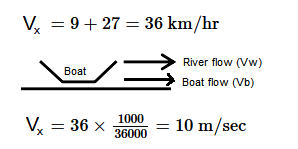
The maximum speed of a boat in still water is \(27 \mathrm{~km} / \mathrm{h}\). Now this boat is moving downstream in a river flowing at \(9 \mathrm{~km} / \mathrm{h}\). A man in the boat throws a ball vertically upwards with speed of 10 \(\mathrm{m} / \mathrm{s}\). Range of the ball as observed by an observer at rest on the bank is _____ cm. (Take \(\left.g=10 \mathrm{~m} / \mathrm{s}^2\right)\) [JEE Main 2025 (Online) 29th January Morning Shift]
Correct
Incorrect
Hint
(a)
Step 1: Determine the velocity of the boat and ball relative to the bank First, convert the speeds from kilometers per hour ( \(\mathrm{km} / \mathrm{h}\) ) to meters per second ( \(\mathrm{m} / \mathrm{s}\) ). The conversion factor is \(\frac{1000 \mathrm{~m}}{3600 \mathrm{~s}}=\frac{5}{18}\). Speed of the boat in still water \(\left(v_b\right)\) : \( v_b=27 \mathrm{~km} / \mathrm{h}=27 \times \frac{5}{18} \mathrm{~m} / \mathrm{s}=7.5 \mathrm{~m} / \mathrm{s} \) Speed of the river flow \(\left(v_w\right)\) : \( v_w=9 \mathrm{~km} / \mathrm{h}=9 \times \frac{5}{18} \mathrm{~m} / \mathrm{s}=2.5 \mathrm{~m} / \mathrm{s} \) Since the boat is moving downstream, its horizontal velocity relative to the bank is the sum of its speed in still water and the river’s speed. Horizontal velocity of the boat and ball ( \(v_x\) ): \( v_x=v_b+v_w=7.5 \mathrm{~m} / \mathrm{s}+2.5 \mathrm{~m} / \mathrm{s}=10 \mathrm{~m} / \mathrm{s} \) The man in the boat throws the ball vertically upwards with a speed of \(10 \mathrm{~m} / \mathrm{s}\) relative to the boat. This is the initial vertical velocity of the ball as seen by the observer on the bank. Vertical velocity of the ball ( \(v_y\) ): \( v_y=10 \mathrm{~m} / \mathrm{s} \) Step 2: Calculate the time of flight for the ball The time the ball is in the air is determined by its vertical motion. The time of flight ( \(\boldsymbol{T}\) ) for an object thrown vertically upwards is given by the formula: \( T=\frac{2 v_y}{g} \) where \(g\) is the acceleration due to gravity, which is given as \(10 \mathrm{~m} / \mathrm{s}^2\). Time of flight (T): \( T=\frac{2 \times 10 \mathrm{~m} / \mathrm{s}}{10 \mathrm{~m} / \mathrm{s}^2}=2 \mathrm{~s} \) Step 3: Calculate the horizontal range of the ball The range ( \(\boldsymbol{R}\) ) of the ball is the horizontal distance it travels during its time of flight. Since there is no acceleration in the horizontal direction, the range is calculated using the formula: \( R=v_x \times T \) Horizontal range ( \(\boldsymbol{R}\) ): \( R=(10 \mathrm{~m} / \mathrm{s}) \times(2 \mathrm{~s})=20 \mathrm{~m}=2000 \mathrm{~cm} \)
Question 2 of 18
2. Question
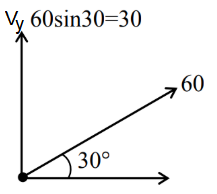
A particle is projected at an angle of \(30^{\circ}\) from horizontal at a speed of \(60 \mathrm{~m} / \mathrm{s}\). The height traversed by the particle in the first second is \(\mathrm{h}_0\) and height traversed in the last second, before it reaches the maximum height, is \(h_1\). The ratio \(h_0: h_1\) is _______. [JEE Main 2025 (Online) 22nd January Morning Shift] [Take, \(\mathrm{g}=10 \mathrm{~m} / \mathrm{s}^2\) ]
Correct
Incorrect
Hint
(a)
Step 1: Calculate the vertical component of initial velocity and the time to reach maximum height The initial vertical velocity ( \(u_y\) ) is given by \(u_y=u \sin (\theta)\), where \(u=60 \mathrm{~m} / \mathrm{s}\) and \(\theta=30^{\circ}\). \( u_y=60 \sin \left(30^{\circ}\right)=60 \times \frac{1}{2}=30 \mathrm{~m} / \mathrm{s} \) The time to reach the maximum height \(\left(t_{\text {max }}\right)\) is when the vertical velocity becomes zero. Using the equation \(v_y=u_y-g t\), we get: \( 0=30-10 t_{\max } \Longrightarrow t_{\max }=3 \mathrm{~s} \) The total time to reach the maximum height is 3 seconds. Step 2: Calculate the height traversed in the first second \(\left(h_0\right)\) The height traversed in the first second \(\left(h_0\right)\) can be calculated using the equation for displacement under constant acceleration, \(h=u_y t-\frac{1}{2} g t^2\). For the first second, \(t=1\) : \( h_0=(30)(1)-\frac{1}{2}(10)(1)^2=30-5=25 \mathrm{~m} \) Step 3: Calculate the height traversed in the last second before reaching maximum height ( \(h_1\) ) The last second before the particle reaches its maximum height is the time interval from \(t=2 \mathrm{~s}\) to \(t=3 \mathrm{~s}\). The height at \(t=2 \mathrm{~s}\left(h_2\right)\) is: \( h_2=(30)(2)-\frac{1}{2}(10)(2)^2=60-20=40 \mathrm{~m} \) The maximum height at \(t=3 \mathrm{~s}\left(h_{\text {max }}\right)\) is: \( h_{\max }=(30)(3)-\frac{1}{2}(10)(3)^2=90-45=45 \mathrm{~m} \) The height traversed in the last second \(\left(h_1\right)\) is the difference between these two heights: \( h_1=h_{\max }-h_2=45-40=5 \mathrm{~m} \) Alternatively, we can use the height traversed in the last second formula, \(h_n=u_y-g\left(n-\frac{1}{2}\right)\). For the last second \((n=3)\) : \( \begin{aligned} &h_3=30-10\left(3-\frac{1}{2}\right)=30-10(2.5)=30-25=5 \mathrm{~m}\\ &\text { Therefore, } h_1=5 \mathrm{~m} \text {. } \end{aligned} \) Step 4: Find the ratio \(h_0: h_1\) Now, we can find the ratio of the two heights: \( \frac{h_0}{h_1}=\frac{25}{5}=5 \) The ratio \(h_0: h_1\) is \(5: 1\).
Question 3 of 18
3. Question
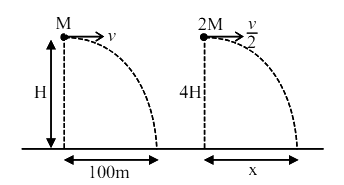
A body of mass \(M\) thrown horizontally with velocity \(v\) from the top of the tower of height \(H\) touches the ground at a distance of 100 m from the foot of the tower. A body of mass \(2 M\) thrown at a velocity \(\frac{v}{2}\) from the top of the tower of height \(4 H\) will touch the ground at a distance of ________ m. [JEE Main 2024 (Online) 8th April Evening Shift]
Alternate: Step 1: Analyze the first scenario to establish a relationship between variables. The motion can be broken down into independent horizontal and vertical components. The time it takes for the body to fall is determined by the vertical motion, and the horizontal distance (range) is determined by the horizontal velocity and the time of flight. For the first body: Initial horizontal velocity: \(v_1=v\) Height of tower: \(\boldsymbol{H}_{\mathbf{1}}=\boldsymbol{H}\) Range: \(R_1=100 \mathrm{~m}\) The time of flight, \(t_1\), is found from the vertical motion equation: \( \begin{gathered} H_1=\frac{1}{2} g t_1^2 \\ t_1=\sqrt{\frac{2 H_1}{g}}=\sqrt{\frac{2 H}{g}} \end{gathered} \) The range, \(\boldsymbol{R}_{\mathbf{1}}\), is found from the horizontal motion equation: \( \begin{gathered} R_1=v_1 t_1 \\ 100=v \cdot \sqrt{\frac{2 H}{g}} \end{gathered} \) This gives us the relationship \(100=v \sqrt{\frac{2 H}{g}}\), which we will use for the second scenario. Note that the mass \(\boldsymbol{M}\) does not affect the time of flight or range. Step 2: Calculate the range for the second scenario. For the second body: Initial horizontal velocity: \(v_2=\frac{v}{2}\) Height of tower: \(\boldsymbol{H}_2=\mathbf{4 H}\) Range: \(\boldsymbol{R}_2=\) ? First, find the new time of flight, \(t_2\) : \( \begin{gathered} H_2=\frac{1}{2} g t_2^2 \\ t_2=\sqrt{\frac{2 H_2}{g}}=\sqrt{\frac{2(4 H)}{g}}=\sqrt{4 \cdot \frac{2 H}{g}}=2 \sqrt{\frac{2 H}{g}} \end{gathered} \) Next, use the horizontal motion equation to find the new range, \(\boldsymbol{R}_2\) : \( \begin{gathered} R_2=v_2 t_2 \\ R_2=\left(\frac{v}{2}\right) \cdot\left(2 \sqrt{\frac{2 H}{g}}\right) \\ R_2=v \sqrt{\frac{2 H}{g}} \end{gathered} \) By comparing the result from Step 2 with the relationship found in Step 1, we can see that: \( R_2=v \sqrt{\frac{2 H}{g}}=100 \mathrm{~m} \)
Question 4 of 18
4. Question
The maximum height reached by a projectile is 64 m . If the initial velocity is halved, the new maximum height of the projectile is __________ m. [JEE Main 2024 (Online) 5th April Evening Shift]
Correct
Incorrect
Hint
(c) The maximum height \((\boldsymbol{H})\) reached by a projectile launched at an initial velocity \((\boldsymbol{u})\) with a launch angle \((\boldsymbol{\theta})\) is given by the formula: \( H=\frac{u^2 \sin ^2 \theta}{2 g} \) From this formula, we can see that the maximum height ( \(\boldsymbol{H}\) ) is directly proportional to the square of the initial velocity \((\boldsymbol{u})\). We can express this relationship as: \( H \propto u^2 \) For the initial scenario, with velocity \(\boldsymbol{u}_1\) and height \(\boldsymbol{H}_1\), the relationship is: \( H_1=\frac{u_1^2 \sin ^2 \theta}{2 g} \) For the new scenario, with velocity \(\boldsymbol{u}_2\) and height \(\boldsymbol{H}_2\), the relationship is: \( H_2=\frac{u_2^2 \sin ^2 \theta}{2 g} \) If we take the ratio of the new height to the old height, the constants ( \(\sin ^2 \theta\) and \(2 g\) ) cancel out, giving: \( \begin{gathered} \frac{H_2}{H_1}=\frac{u_2^2}{u_1^2} \\ \frac{H_2}{H_1}=\left(\frac{u_2}{u_1}\right)^2 \end{gathered} \) Given: The initial maximum height \(\left(\boldsymbol{H}_1\right)\) is 64 m. The initial velocity \(\left(u_1\right)\) is halved, so the new velocity \(\left(u_2\right)\) is \(\frac{u_1}{2}\). Now, substitute the values into the ratio equation: \( \begin{gathered} \frac{H_2}{64}=\left(\frac{u_1 / 2}{u_1}\right)^2 \\ \frac{H_2}{64}=\left(\frac{1}{2}\right)^2 \\ \frac{H_2}{64}=\frac{1}{4} \end{gathered} \) To find the new maximum height ( \(\boldsymbol{H}_2\) ), multiply both sides by 64 : \( \begin{gathered} H_2=\frac{64}{4} \\ H_2=16 \mathrm{~m} \end{gathered} \) The new maximum height of the projectile is 16 m.
Question 5 of 18
5. Question
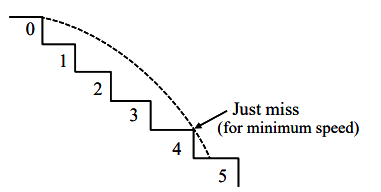
A ball rolls off the top of a stairway with horizontal velocity \(u\). The steps are 0.1 m high and 0.1 m wide. The minimum velocity \(u\) with which that ball just hits the step 5 of the stairway will be \(\sqrt{x} \mathrm{~ms}^{-1}\) where \(x=\) ______. [use \(\mathrm{g}=10 \mathrm{~m} / \mathrm{s}^2\) ]. [JEE Main 2024 (Online) 29th January Morning Shift]
Correct
Incorrect
Hint
(d)
To solve the problem, we need to determine the minimum horizontal velocity \(u\) with which a ball must roll off a stairway to just hit the 5th step. The height and width of each step are both 0.1 m. Understanding the Problem: Each step has a height of 0.1 m and a width of 0.1 m. The ball will fall vertically due to gravity while moving horizontally. Calculate the Total Height: To hit the 5th step, the ball must fall a total height of: \( h=0.1 \mathrm{~m} \times 4=0.4 \mathrm{~m} \) (Note: The ball falls from the top of the 1st step to the bottom of the 5th step, which is 4 steps down.) Calculate the Time of Fall: The time \(T\) taken to fall a height \(h\) under gravity \(g\) can be calculated using the formula: \( T=\sqrt{\frac{2 h}{g}} \) Substituting \(h=0.4 \mathrm{~m}\) and \(g=10 \mathrm{~m} / \mathrm{s}^2\) : \( T=\sqrt{\frac{2 \times 0.4}{10}}=\sqrt{\frac{0.8}{10}}=\sqrt{0.08}=\frac{2 \sqrt{2}}{10}=\frac{\sqrt{8}}{10} \) Calculate the Horizontal Distance: The horizontal distance \(R\) the ball travels while falling is equal to the width of 4 steps: \( R=0.1 \mathrm{~m} \times 4=0.4 \mathrm{~m} \) Relate Horizontal Velocity to Distance and Time: The horizontal velocity \(u\) can be related to the distance \(R\) and time \(T\) by: \( u=\frac{R}{T} \) Substituting \(R=0.4 \mathrm{~m}\) and \(T=\frac{\sqrt{8}}{10}\) : \( u=\frac{0.4}{\frac{\sqrt{8}}{10}}=0.4 \times \frac{10}{\sqrt{8}}=\frac{4}{\sqrt{8}}=\frac{4}{2 \sqrt{2}}=\frac{2}{\sqrt{2}}=\sqrt{2} \) Final Result: The minimum velocity \(u\) with which the ball must roll off is: \( u=\sqrt{2} \mathrm{~m} / \mathrm{s} \) According to the problem, this can be expressed as \(\sqrt{x} \mathrm{~m} / \mathrm{s}\), where \(x=2\). Thus, the value of \(x\) is 2.
Question 6 of 18
6. Question
A particle starts from origin at \(t=0\) with a velocity \(5 \hat{i} \mathrm{~m} / \mathrm{s}\) and moves in \(x-y\) plane under action of a force which produces a constant acceleration of \((3 \hat{i}+2 \hat{j}) \mathrm{m} / \mathrm{s}^2\). If the \(x\)-coordinate of the particle at that instant is 84 m, then the speed of the particle at this time is \(\sqrt{\alpha} \mathrm{~m} / \mathrm{s}\). The value of \(\alpha\) is ______. [JEE Main 2024 (Online) 27th January Morning Shift]
Correct
Incorrect
Hint
(c) Step 1: Find the time when the x -coordinate is 84 m The position of the particle at any time \(\boldsymbol{t}\) can be described by the kinematic equation: \( \vec{r}(t)=\vec{r}_0+\vec{v}_0 t+\frac{1}{2} \vec{a} t^2 \) Given: Initial position: \(\vec{r}_0=0\) (starts from origin) Initial velocity: \(\vec{v}_0=5 \hat{i}\) Acceleration: \(\vec{a}=3 \hat{i}+2 \hat{j}\) The position vector is: \( \begin{gathered} \vec{r}(t)=(5 \hat{i}) t+\frac{1}{2}(3 \hat{i}+2 \hat{j}) t^2 \\ \vec{r}(t)=\left(5 t+\frac{3}{2} t^2\right) \hat{i}+\left(\frac{1}{2}(2) t^2\right) \hat{j} \\ \vec{r}(t)=\left(5 t+\frac{3}{2} t^2\right) \hat{i}+\left(t^2\right) \hat{j} \end{gathered} \) The x -coordinate of the particle is given by the \(\hat{i}\) component: \( x(t)=5 t+\frac{3}{2} t^2 \) We are given that the x -coordinate is 84 m at a certain time \(\boldsymbol{t}\). \( 84=5 t+\frac{3}{2} t^2 \) Multiplying by 2 to clear the fraction gives: \( 168=10 t+3 t^2 \) Rearranging the terms into a standard quadratic equation form: \( 3 t^2+10 t-168=0 \) We can solve for \(t\) using the quadratic formula: \( \begin{gathered} t=\frac{-b \pm \sqrt{b^2-4 a c}}{2 a} \\ t=\frac{-10 \pm \sqrt{10^2-4(3)(-168)}}{2(3)} \\ t=\frac{-10 \pm \sqrt{100+2016}}{6} \\ t=\frac{-10 \pm \sqrt{2116}}{6} \\ t=\frac{-10 \pm 46}{6} \end{gathered} \) Since time cannot be negative, we use the positive root: \( t=\frac{-10+46}{6}=\frac{36}{6}=6 \mathrm{~s} \) Step 2: Find the velocity of the particle at this time The velocity of the particle at any time \(\boldsymbol{t}\) is given by: \( \vec{v}(t)=\vec{v}_0+\vec{a} t \) Substituting the given values and the time \(t=6 \mathrm{~s}\) : \( \begin{gathered} \vec{v}(6)=(5 \hat{i})+(3 \hat{i}+2 \hat{j})(6) \\ \vec{v}(6)=5 \hat{i}+18 \hat{i}+12 \hat{j} \\ \vec{v}(6)=(5+18) \hat{i}+12 \hat{j} \\ \vec{v}(6)=23 \hat{i}+12 \hat{j} \mathrm{~m} / \mathrm{s} \end{gathered} \) Step 3: Calculate the speed and the value of \(\alpha\) The speed of the particle is the magnitude of its velocity vector: Speed \(=|\vec{v}|=\sqrt{v_x^2+v_y^2}\) Substituting the components of the velocity vector at \(t=6 \mathrm{~s}\) : \( \begin{aligned} & \text { Speed }=\sqrt{(23)^2+(12)^2} \\ & \text { Speed }=\sqrt{529+144} \\ & \text { Speed }=\sqrt{673} \mathrm{~m} / \mathrm{s} \end{aligned} \) The problem states that the speed is \(\sqrt{\alpha} \mathrm{m} / \mathrm{s}\). By comparing the expressions, we find that \(\alpha=673\).
Question 7 of 18
7. Question
A projectile fired at \(30^{\circ}\) to the ground is observed to be at same height at time 3 s and 5 s after projection, during its flight. The speed of projection of the projectile is _____ \(\mathrm{m} \mathrm{s}^{-1}\). [JEE Main 2023 (Online) 11th April Morning Shift] (Given \(g=10 \mathrm{~ms}^{-2}\) )
Correct
Incorrect
Hint
(d) Step 1: Find the time to reach maximum height For a projectile, the time to reach the maximum height is the average of the two times when it is at the same height. The given times are \(\boldsymbol{t}_1=3 \mathrm{~s}\) and \(\boldsymbol{t}_2=5 \mathrm{~s}\). The time to reach maximum height, \(t_{\text {max }^{\prime}}\), is given by: \( \begin{gathered} t_{\max }=\frac{t_1+t_2}{2} \\ t_{\max }=\frac{3 \mathrm{~s}+5 \mathrm{~s}}{2}=\frac{8 \mathrm{~s}}{2}=4 \mathrm{~s} \end{gathered} \) Step 2: Calculate the initial speed of projection The formula for the time to reach maximum height is: \( t_{\max }=\frac{v_0 \sin \theta}{g} \) We can rearrange this formula to solve for the initial speed of projection, \(v_0\) : \( v_0=\frac{g t_{\max }}{\sin \theta} \) Given values: \(g=10 \mathrm{~m} \mathrm{~s}^{-2}\) \(t_{\text {max }}=4 \mathrm{~s}\) \(\theta=30^{\circ}\) \(\sin \left(30^{\circ}\right)=0.5\) Substitute the values into the equation: \( \begin{gathered} v_0=\frac{\left(10 \mathrm{~m} \mathrm{~s}^{-2}\right)(4 \mathrm{~s})}{\sin \left(30^{\circ}\right)} \\ v_0=\frac{40}{0.5} \\ v_0=80 \mathrm{~m} \mathrm{~s}^{-1} \end{gathered} \) The speed of projection of the projectile is \(80 \mathrm{~ms}^{-1}\).
Question 8 of 18
8. Question
Two bodies are projected from ground with same speeds \(40 \mathrm{~ms}^{-1}\) at two different angles with respect to horizontal. The bodies were found to have same range. If one of the body was projected at an angle of \(60^{\circ}\), with horizontal then sum of the maximum heights, attained by the two projectiles, is ____ m. (Given \(\mathrm{g}=10 \mathrm{~ms}^{-2}\) ) [JEE Main 2023 (Online) 31st January Evening Shift]
Correct
Incorrect
Hint
(a) Step 1: Find the second angle of projection For two projectiles launched with the same initial speed to have the same range, their angles of projection must be complementary. This means the sum of the two angles is \(90^{\circ}\). Given one angle is \(\theta_1=60^{\circ}\), the second angle \(\theta_2\) is: \( \theta_2=90^{\circ}-\theta_1=90^{\circ}-60^{\circ}=30^{\circ} \) Step 2: Calculate the maximum height for each projectile The formula for the maximum height \(\boldsymbol{H}\) of a projectile is given by \(\boldsymbol{H}=\frac{u^2 \sin ^2 \boldsymbol{\theta}}{2 g}\), where \(u\) is the initial speed, \(\theta\) is the angle of projection, and \(g\) is the acceleration due to gravity. Given \(u=40 \mathrm{~ms}^{-1}\) and \(g=10 \mathrm{~ms}^{-2}\). For the first projectile \(\left(\boldsymbol{\theta}_{\mathbf{1}}=\mathbf{6 0}\right)\) : \( H_1=\frac{(40)^2 \sin ^2\left(60^{\circ}\right)}{2(10)}=\frac{1600\left(\frac{\sqrt{3}}{2}\right)^2}{20}=\frac{1600 \cdot \frac{3}{4}}{20}=\frac{1200}{20}=60 \mathrm{~m} \) For the second projectile \(\left(\boldsymbol{\theta}_2=30^{\circ}\right)\) : \( H_2=\frac{(40)^2 \sin ^2\left(30^{\circ}\right)}{2(10)}=\frac{1600\left(\frac{1}{2}\right)^2}{20}=\frac{1600 \cdot \frac{1}{4}}{20}=\frac{400}{20}=20 \mathrm{~m} \) Step 3: Find the sum of the maximum heights The sum of the maximum heights is \(\boldsymbol{H}_{\text {sum }}=\boldsymbol{H}_1+\boldsymbol{H}_2\). \( H_{\text {sum }}=60 \mathrm{~m}+20 \mathrm{~m}=80 \mathrm{~m} \) The sum of the maximum heights, attained by the two projectiles, is \(\mathbf{8 0 ~ m}\).
Question 9 of 18
9. Question
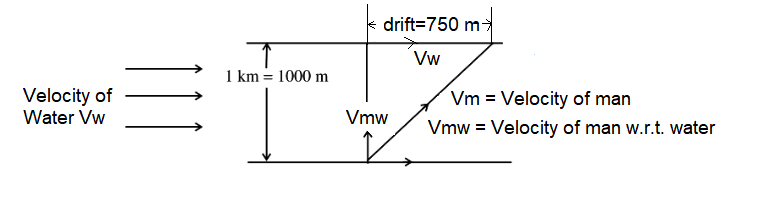
The speed of a swimmer is \(4 \mathrm{~km} \mathrm{~h}^{-1}\) in still water. If the swimmer makes his strokes normal to the flow of river of width 1 km, he reaches a point 750 m down the stream on the opposite bank. The speed of the river water is _______ \(\mathrm{km} \mathrm{h}^{-1}\) [JEE Main 2023 (Online) 31st January Morning Shift]
Correct
Incorrect
Hint
(c)
Step 1: Calculate the time to cross the river The time it takes for the swimmer to cross the river is determined by their speed relative to the water and the width of the river. The swimmer’s strokes are normal to the river’s flow, so the time to cross is: \( t=\frac{\text { river width }}{\text { swimmer’s speed in still water }} \) Given the river width is 1 km and the swimmer’s speed is \(4 \mathrm{~km} \mathrm{~h}^{-1}\), the time to cross is: \( t=\frac{1 \mathrm{~km}}{4 \mathrm{~km} \mathrm{~h}^{-1}}=\frac{1}{4} \mathrm{~h} \) Step 2: Calculate the speed of the river water The swimmer is carried downstream by the river’s current. This distance is known as the drift. The drift is the product of the river’s speed and the time the swimmer spends crossing the river. The drift is given as 750 m , which is equivalent to 0.75 km . \( \begin{aligned} \text { drift }= & (\text { speed of river water}) \times(\text { time to cross }) \\ & 0.75 \mathrm{~km}=v_{\text {w }} \times \frac{1}{4} \mathrm{~h} \end{aligned} \) Solving for the speed of the river ( \(v_{\text {w }}\) ): \( \begin{gathered} v_{\text {w }}=\frac{0.75 \mathrm{~km}}{\frac{1}{4} \mathrm{~h}}=0.75 \times 4 \mathrm{~km} \mathrm{~h}^{-1} \\ v_{\text {w }}=3 \mathrm{~km} \mathrm{~h}^{-1} \end{gathered} \)
Alternate: Step 1: Identify given variables and convert units The speed of the swimmer in still water, which is the speed of the swimmer relative to the river, is \(v_s=4 \mathrm{~km} \mathrm{~h}^{-1}\). The width of the river is \(W=1 \mathrm{~km}\). The downstream distance is \(d_{\text {down }}=750 \mathrm{~m}\). To maintain consistency in units, convert the downstream distance to kilometers: \( d_{\text {down }}=750 \mathrm{~m}=\frac{750}{1000} \mathrm{~km}=0.75 \mathrm{~km} \) Step 2: Calculate the time to cross the river The time it takes for the swimmer to cross the river is determined by his speed perpendicular to the river’s flow and the width of the river. Since the swimmer’s strokes are normal to the flow, his velocity component perpendicular to the flow is his speed in still water. The time to cross ( \(t\) ) is given by the formula: \( \begin{gathered} t=\frac{\text { width }}{\text { swimmer’s speed perpendicular to flow }} \\ t=\frac{W}{v_s}=\frac{1 \mathrm{~km}}{4 \mathrm{~km} \mathrm{~h}^{-1}}=0.25 \mathrm{~h} \end{gathered} \) Step 3: Calculate the speed of the river water The downstream distance the swimmer is carried is due to the river’s current. This distance is covered in the same amount of time it takes the swimmer to cross the river. The speed of the river water \(\left(v_r\right)\) is therefore the downstream distance divided by the time to cross. \( \begin{gathered} v_r=\frac{\text { downstream distance }}{\text { time to cross }} \\ v_r=\frac{d_{\text {down }}}{t}=\frac{0.75 \mathrm{~km}}{0.25 \mathrm{~h}}=3 \mathrm{~km} \mathrm{~h}^{-1} \end{gathered} \)
Question 10 of 18
10. Question
An object is projected in the air with initial velocity \(u\) at an angle \(\theta\). The projectile motion is such that the horizontal range \(R\), is maximum. Another object is projected in the air with a horizontal range half of the range of first object. The initial velocity remains same in both the case. The value of the angle of projection, at which the second object is projected, will be _____ degree. [JEE Main 2022 (Online) 29th July Morning Shift]
Correct
Incorrect
Hint
(c) Step 1: Determine the maximum horizontal range The horizontal range of a projectile is given by the formula \(R=\frac{u^2 \sin (2 \theta)}{g}\), where \(u\) is the initial velocity, \(\boldsymbol{\theta}\) is the angle of projection, and \(\boldsymbol{g}\) is the acceleration due to gravity. The maximum range \(\left(\boldsymbol{R}_{\text {max }}\right)\) occurs when \(\sin (2 \theta)\) is at its maximum value, which is 1. This happens when \(2 \theta=90^{\circ}\), or \(\theta=45^{\circ}\). Thus, the maximum range for the first object is \(R=R_{\max }=\frac{u^2}{g}\). Step 2: Set up the equation for the second object’s range The second object is projected with the same initial velocity \(\boldsymbol{u}\) and an unknown angle of projection, let’s call it \(\boldsymbol{\alpha}\). Its horizontal range, \(\boldsymbol{R}^{\prime}\), is half of the maximum range of the first object. \( R^{\prime}=\frac{R}{2}=\frac{1}{2}\left(\frac{u^2}{g}\right) \) Using the range formula for the second object: \( R^{\prime}=\frac{u^2 \sin (2 \alpha)}{g} \) Step 3: Solve for the angle of projection for the second object By equating the two expressions for \(\boldsymbol{R}^{\prime}\), we get: \( \frac{u^2 \sin (2 \alpha)}{g}=\frac{1}{2}\left(\frac{u^2}{g}\right) \) Canceling the common term \(\frac{u^2}{g}\) from both sides, we are left with: \( \sin (2 \alpha)=\frac{1}{2} \) The angles for which the sine is \(\frac{1}{2}\) are \(30^{\circ}\) and \(150^{\circ}\). Therefore, \(2 \alpha=30^{\circ}\) or \(2 \alpha=150^{\circ}\). Solving for \(\boldsymbol{\alpha}\), we get two possible values: \( \alpha=15^{\circ} \) \( \alpha=75^{\circ} \) Since a projectile can have two different projection angles to achieve the same range (symmetrical about \(45^{\circ}\) ), both \(15^{\circ}\) and \(75^{\circ}\) are valid answers. The value of the angle of projection for the second object will be \(\mathbf{1 5}\) or \(\mathbf{7 5}\) degrees.
Question 11 of 18
11. Question
A ball of mass \(m\) is thrown vertically upward. Another ball of mass \(2 m\) is thrown at an angle \(\theta\) with the vertical. Both the balls stay in air for the same period of time. The ratio of the heights attained by the two balls respectively is \(\frac{1}{x}\). The value of \(x\) is _______. [JEE Main 2022 (Online) 27th July Morning Shift]
Correct
Incorrect
Hint
(a) Time of flight: The time of flight for an object is given by \(T=\frac{2 u_y}{g}\), where \(u_y\) is the initial vertical velocity and \(g\) is the acceleration due to gravity. Ball 1 (vertically upward): The initial velocity is purely vertical, so \(u_{y 1}=u_1\). The time of flight is \(T_1=\frac{2 u_1}{g}\). Ball 2 (at an angle \(\theta\) with the vertical): Let the initial velocity be \(u_2\). The initial vertical velocity is \(u_{y 2}=u_2 \cos (\alpha)\), where \(\alpha\) is the angle with the horizontal. The problem states the angle is with the vertical, so the angle with the horizontal is \(\left(90^{\circ}-\theta\right)\). The vertical component is \(u_{y 2}=u_2 \sin \left(90^{\circ}-\theta\right)=u_2 \cos (\theta)\). The time of flight is \(T_2=\frac{2 u_2 \cos (\theta)}{g}\). Equating times: We are given that the time of flight is the same for both balls, so \(T_1=T_2\) : \(\frac{2 u_1}{g}=\frac{2 u_2 \cos (\theta)}{g}\) This simplifies to \(u_1=u_2 \cos (\theta)\). Height attained: The maximum height for a projectile is given by \(H=\frac{u_y^2}{2 g}\). Ball 1: \(H_1=\frac{u_{y 1}^2}{2 g}=\frac{u_1^2}{2 g}\). Ball 2: \(H_2=\frac{u_{y 2}^2}{2 g}=\frac{\left(u_2 \cos (\theta)\right)^2}{2 g}\). Ratio of heights: To find the ratio, we can use the relationship \(u_1=u_2 \cos (\theta)\). \(\boldsymbol{H}_2=\frac{\left(u_2 \cos (\theta)\right)^2}{2 g}=\frac{u_1^2}{2 g}=\boldsymbol{H}_1\). Therefore, the ratio \(\boldsymbol{H}_1: \boldsymbol{H}_2\) is \(1: 1\). Solving for \(x\) : The problem states the ratio of heights is \(\frac{1}{x}\). Since the ratio is \(1: 1\), we have: \(\frac{\boldsymbol{H}_1}{\boldsymbol{H}_2}=1\) \(\frac{1}{x}=1\) \(x=1\).
Question 12 of 18
12. Question
If the initial velocity in horizontal direction of a projectile is unit vector \(\hat{i}\) and the equation of trajectory is \(y=5 x(1-x)\). The \(y\) component vector of the initial velocity is _______ \(\hat{j}\). ( Take \(\mathrm{g}=10 \mathrm{~m} / \mathrm{s}^2\) ) [JEE Main 2022 (Online) 26th July Morning Shift]
Correct
Incorrect
Hint
(c) Step 1: Compare the given trajectory equation with the standard form The equation of the trajectory of a projectile is given by: \( y=\left(\frac{v_{i y}}{v_{i x}}\right) x-\left(\frac{g}{2 v_{i x}^2}\right) x^2 \) The given equation of the trajectory is: \( y=5 x(1-x)=5 x-5 x^2 \) By comparing the coefficients of \(x\) and \(x^2\) from both equations, we can solve for the unknown values. Step 2: Use the coefficients to solve for the initial vertical velocity We are given that the initial horizontal velocity is a unit vector \(\hat{\boldsymbol{i}}\), which means its magnitude is \(v_{i x}=1\). We are also given that \(g=10 \mathrm{~m} / \mathrm{s}^2\). By comparing the coefficient of the \(x\) term, we get: \( \frac{v_{i y}}{v_{i x}}=5 \) Since we know that \(v_{i x}=1\), we can solve for \(v_{i y}\) : \( \begin{aligned} & \frac{v_{i y}}{1}=5 \\ & v_{i y}=5 \end{aligned} \) The \(\boldsymbol{y}\) component vector of the initial velocity is \(\mathbf{5} \hat{\mathbf{j}}\).
Note: Comparing \(\tan \theta=5=\frac{u_y}{u_x}\)
Question 13 of 18
13. Question
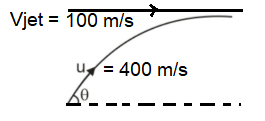
A fighter jet is flying horizontally at a certain altitude with a speed of \(200 \mathrm{~ms}^{-1}\). When it passes directly overhead an anti-aircraft gun, a bullet is fired from the gun, at an angle \(\theta\) with the horizontal, to hit the jet. If the bullet speed is \(400 \mathrm{~m} / \mathrm{s}\), the value of \(\theta\) will be _______ degree. [JEE Main 2022 (Online) 26th June Morning Shift]
Correct
Incorrect
Hint
(d)
Step 1: Analyze the relative motion For the bullet to hit the jet, the horizontal velocity of the bullet must be equal to the horizontal velocity of the jet. This is because the jet is flying horizontally, and the bullet must travel the same horizontal distance in the same amount of time to intercept it. Step 2: Set up the equations The horizontal velocity of the jet is given as \(v_{j e t}=200 \mathrm{~m} / \mathrm{s}\). The horizontal component of the bullet’s velocity is given by \(u_x=u \cos (\theta)\), where \(u=400 \mathrm{~m} / \mathrm{s}\) is the bullet’s speed and \(\boldsymbol{\theta}\) is the angle with the horizontal. For the bullet to hit the jet, their horizontal velocities must be equal: \( \begin{gathered} u_x=v_{j e t} \\ u \cos (\theta)=v_{j e t} \end{gathered} \) Step 3: Solve for the angle \(\theta\) Substitute the given values into the equation from Step 2: \( 400 \cos (\theta)=200 \) Now, solve for \(\cos (\theta)\) : \( \begin{aligned} & \cos (\theta)=\frac{200}{400} \\ & \cos (\theta)=0.5 \end{aligned} \) To find the angle \(\boldsymbol{\theta}\), take the inverse cosine: \( \begin{gathered} \theta=\cos ^{-1}(0.5) \\ \theta=60^{\circ} \end{gathered} \)
Question 14 of 18
14. Question
A body is projected from the ground at an angle of \(45^{\circ}\) with the horizontal. Its velocity after 2 s is 20 \(\mathrm{ms}^{-1}\). The maximum height reached by the body during its motion is ________ m. (use \(\mathrm{g}=10 \mathrm{~ms}^{-} { }^2\) ) [JEE Main 2022 (Online) 24th June Evening Shift]
Correct
Incorrect
Hint
(b) Step 1: Let the initial velocity be \(u\). The horizontal and vertical components of the initial velocity are \(u_x=u \cos 45^{\circ}\) and \(u_y=u \sin 45^{\circ}\) respectively. Step 2: Since \(\cos 45^{\circ}=\sin 45^{\circ}=\frac{1}{\sqrt{2}}\), we have \(u_x=u_y=\frac{u}{\sqrt{2}}\). Step 3: The horizontal component of the velocity remains constant: \(u_x=\frac{u}{\sqrt{2}}\). The vertical component of the velocity after 2 seconds is given by: \(v_y=u_y-g t=\frac{u}{\sqrt{2}}-10 \times 2\). Step 4: Given that the resultant velocity after 2 seconds is \(20 \mathrm{~m} / \mathrm{s}\), we use the Pythagorean theorem: \(\sqrt{u_x^2+v_y^2}=\) 20. Substituting the values, we get: \(\sqrt{\left(\frac{u}{\sqrt{2}}\right)^2+\left(\frac{u}{\sqrt{2}}-20\right)^2}=20\). Step 5: Solving this equation for \(u\), we get \(u=20 \sqrt{2} \mathrm{~m} / \mathrm{s}\). The maximum height is given by: \(H=\frac{u_y^2}{2 g}=\frac{\left(\frac{2 l \sqrt{2}}{\sqrt{2}}\right)^2}{2 \times 10}=\) 20 m.
Question 15 of 18
15. Question
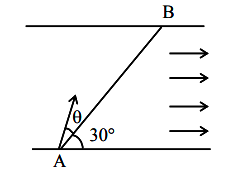
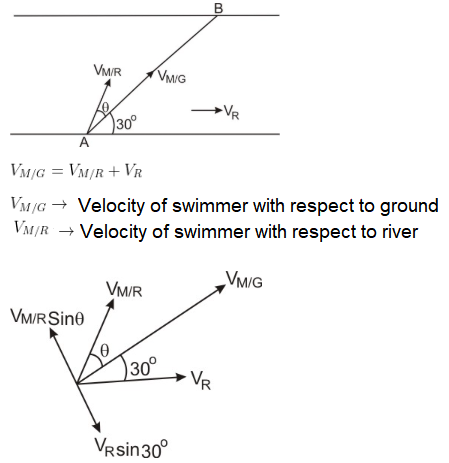
A swimmer wants to cross a river from point \(A\) to point \(B\). Line \(A B\) makes an angle of \(30^{\circ}\) with the flow of river. Magnitude of velocity of the swimmer is same as that of the river. The angle \(\theta\) with the line \(A B\) should be ____ degree, so that the swimmer reaches point B. [JEE Main 2021 (Online) 27th July Evening Shift]
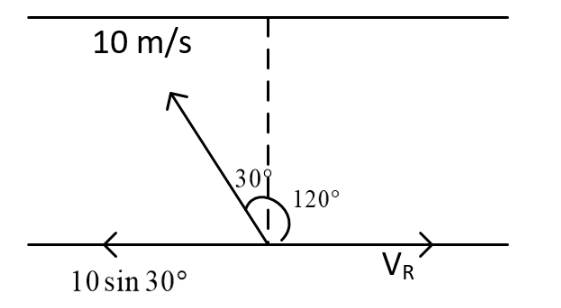
A person is swimming with a speed of \(10 \mathrm{~m} / \mathrm{s}\) at an angle of \(120^{\circ}\) with the flow and reaches to a point directly opposite on the other side of the river. The speed of the flow is ‘ \(x\) ‘ \(m / s\). The value of ‘ \(x\) ‘ to the nearest integer is _____. [JEE Main 2021 (Online) 18th March Morning Shift]
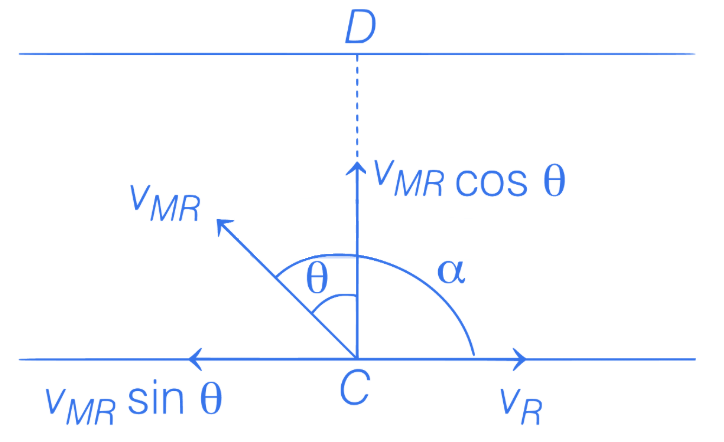
A swimmer can swim with velocity of \(12 \mathrm{~km} / \mathrm{h}\) in still water. Water flowing in a river has velocity 6 \(\mathrm{km} / \mathrm{h}\). The direction with respect to the direction of flow of river water he should swim in order to reach the point on the other bank just opposite to his starting point is _____ degree. (Round off to the Nearest Integer) (Find the angle in degrees) [JEE Main 2021 (Online) 16th March Evening Shift]
Correct
Incorrect
Hint
(c) The situation is depicted in the following figure.
where, \(\mathrm{V}_{\mathrm{MR}}=\) velocity of man \(=12 \mathrm{~km} / \mathrm{h}\) and \(v_R=\) velocity of water flow in river \(=6 \mathrm{~km} / \mathrm{h}\) As, \(\mathrm{v}_{\mathrm{MR}}\) should be along CD. \( \begin{aligned} & \Rightarrow v_R-v_{M R} \sin \theta=0 \\ & \Rightarrow 6-12 \sin \theta=0 \Rightarrow \sin \theta=\frac{6}{12} \\ & \Rightarrow \sin \theta=\frac{1}{2} \\ & \Rightarrow \theta=\sin ^{-1}\left(\frac{1}{2}\right)=\sin ^{-1}\left(\sin 30^{\circ}\right)\left[\because \sin 30^{\circ}=\frac{1}{2}\right] \\ & \Rightarrow \theta=30^{\circ} \\ & \therefore \alpha=90^{\circ}+\theta=90^{\circ}+30^{\circ}=120^{\circ} \\ & \Rightarrow \alpha=120^{\circ} \end{aligned} \)
Question 18 of 18
18. Question
A particle is moving along the \(x\)-axis with its coordinate with the time ‘ \(t\) ‘ given be \(x(t)=10+8 t-3 t^2\). Another particle is moving the \(y\)-axis with its coordinate as a function of time given by \(\mathrm{y}(\mathrm{t})=5-8 \mathrm{t}^3\). At \(t=1 s\), the speed of the second particle as measured in the frame of the first particle is given as \(\sqrt{v}\). Then v (in \(\mathrm{m} / \mathrm{s}\) ) is ____. [JEE Main 2020 (Online) 8th January Morning Slot]
Correct
Incorrect
Hint
(d) Step 1: Find the velocity vectors of the two particles The velocity is the time derivative of the position. For the first particle, which moves along the \(x\)-axis, the position is given by \(x(t)=10+8 t-3 t^2\). Its velocity component along the \(x\)-axis is: \( v_x(t)=\frac{d x}{d t}=\frac{d}{d t}\left(10+8 t-3 t^2\right)=8-6 t \) The velocity vector for the first particle is \(\vec{v}_1(t)=(8-6 t) \hat{i}\). For the second particle, which moves along the \(y\)-axis, the position is given by \(y(t)=5-8 t^3\). Its velocity component along the \(y\)-axis is: \( v_y(t)=\frac{d y}{d t}=\frac{d}{d t}\left(5-8 t^3\right)=-24 t^2 \) The velocity vector for the second particle is \(\vec{v}_2(t)=\left(-24 t^2\right) \hat{j}\). Step 2: Calculate the velocity of each particle at \(t=1 \mathrm{~s}\) Substitute \(t=1\) into the velocity equations found in Step 1. The velocity of the first particle at \(t=1 \mathrm{~s}\) is: \( \vec{v}_1(1)=(8-6(1)) \hat{i}=2 \hat{i} \mathrm{~m} / \mathrm{s} \) The velocity of the second particle at \(t=1 \mathrm{~s}\) is: \( \vec{v}_2(1)=\left(-24(1)^2\right) \hat{j}=-24 \hat{j} \mathrm{~m} / \mathrm{s} \) Step 3: Determine the relative velocity and relative speed The velocity of the second particle as measured from the frame of the first particle (the relative velocity) is given by: \( \begin{gathered} \vec{v}_{21}=\vec{v}_2-\vec{v}_1 \\ \vec{v}_{21}=(-24 \hat{j})-(2 \hat{i})=-2 \hat{i}-24 \hat{j} \mathrm{~m} / \mathrm{s} \end{gathered} \) The speed is the magnitude of the relative velocity vector: \( \begin{aligned} & \text { Speed }=\left|\vec{v}_{21}\right|=\sqrt{(-2)^2+(-24)^2} \\ & \text { Speed }=\sqrt{4+576}=\sqrt{580} \mathrm{~m} / \mathrm{s} \end{aligned} \) The problem states that the speed is \(\sqrt{v}\). Therefore, \( \begin{aligned} \sqrt{v} & =\sqrt{580} \\ v & =580 \end{aligned} \) The value of \(v\) is 580.