Conceptual PCQs
- An object is said to be in motion if its position changes with time. The position of the object can be specified with reference to a conveniently chosen origin. For motion in a straight line, position to the right of the origin is taken as positive and to the left as negative.
- Path length is defined as the total length of the path traversed by an object.
- Displacement is the change in position : \(\Delta x=x_2-x_1\). Path length is greater or equal to the magnitude of the displacement between the same points.
\(v-t\) curve area gives displacement: \(\left[\Delta {x}=\int {vdt}\right]\) - An object is said to be in uniform motion in a straight line if its displacement is equal in equal intervals of time. Otherwise, the motion is said to be non-uniform.
\(\text { Speed }(v)=\frac{\text { Distance travelled }}{\text { Time taken }}\)
\(\text { Average speed }=\frac{\text { Total distance travelled }}{\text { Total time taken }}\) - \(\text { Instantaneous speed }=\lim _{\Delta t \rightarrow 0} \frac{\Delta s}{\Delta t}=\frac{d x}{d t}\)
- \(\text { Velocity }=\frac{\text { Displacement }}{\text { Time }}\)
\(\text { Average velocity }=\frac{\text { Total displacement }(\Delta x)}{\text { Total time }(\Delta t)}\) - Instantaneous velocity =\(v=\lim _{\Delta t \rightarrow 0} \frac{\Delta x}{\Delta t}=\frac{d x}{d t}\) (Instantaneous velocity is the slope of position time curve)
- The time rate of change of velocity of a body is called acceleration.
\(
\therefore \quad \text { Acceleration }=\frac{\text { Change in velocity }(\Delta v)}{\text { Time interval }(\Delta t)}
\)
\(
\text { Average acceleration }=a_{avg}=\frac{\text { Total change in velocity }}{\text { Total time taken }}
\) - The acceleration of an object at a given instant of time or at a given point during the motion, is called its instantaneous acceleration. i.e.
\(
{a}=\lim _{\Delta t \rightarrow 0} \frac{\Delta {v}}{\Delta t}=\frac{d {v}}{d t}=\frac{d^2 {x}}{d t^2}
\)
\(a-t\) curve area gives change in velocity.
\(
\left[\Delta {v}=\int \text { adt }\right]
\) - The three equations of motion on a straight line are
(i) \(v=u+a t\)
(ii) \(s=u t+\frac{1}{2} a t^2\)
(iii) \(v^2-u^2=2 a s\) - The kinematic equation \(x(t)=x_0+v_0 t+\frac{1}{2} a t^2\)
\(x(t)\) : The final position of the object at a specific time \(t\).
\(x_0\) : The initial position of the object, or its starting point at time \(t=0\).
\(v_0\) : The initial velocity of the object, or its speed and direction at time \(t=0\).
\(a\) : The constant acceleration of the object. It can be positive, negative, or zero.
\(t\) : The time interval over which the motion occurs. - Distance travelled by a body in \(n\)th second,
\(
s_n=u+\frac{1}{2} a(2 n-1)
\) - Stopping distance \(s=\frac{u^2}{2 a}\)
- Equation for motion under gravity are given below
(i) If particle is thrown vertically upwards
\(
\begin{aligned}
v & =u-g t \\
h & =u t-\frac{1}{2} g t^2 \\
v^2 & =u^2-2 g h
\end{aligned}
\)
Time of ascent=\(t=\frac{u}{g}\)
Total flight time \((T)=\frac{2 u}{g}\)
(ii) If particle is thrown vertically downward with some velocity from some height.
\(
\begin{aligned}
v & =u+g t \\
h & =u t+\frac{1}{2} g t^2 \\
v^2 & =u^2+2 g h
\end{aligned}
\) - Maximum height attained by a particle, thrown upwards from ground: \(h_{max}=\frac{u^2}{2 g}\)
Velocity of particle at the time of striking the ground when released \((u=0)\) from a height \(h\) is
\(
v=\sqrt{2 g h}
\)
Time of collision of particle with ground,
\(
t=\sqrt{\frac{2 h}{g}}
\) - When acceleration of particle is not constant, motion is known as non-uniformly accelerated motion. In this case problems can be solved either by differentiation or integration (with some boundary conditions).
For one dimensional motion, above relations can be written as under
(i) \(v=\frac{d s}{d t}\)
(ii) \(a=\frac{d v}{d t}=v \frac{d v}{d s}\)
(iii) \(d s=v d t\) and
(iv) \(d v=a d t \quad\) or \(\quad v d v=a d s\) - The time rate of change of relative position of one object with respect to another is called relative velocity.
The displacement of \(B\) relative to \(A\),
\(
\mathbf{x}_{B A}=\mathbf{x}_B-\mathbf{x}_A
\)
Rate of change of relative displacement w.r.t. time is
\(
\begin{array}{ll}
& \frac{d\left(\mathbf{x}_{B A}\right)}{d t}=\frac{d}{d t}\left(\mathbf{x}_B-\mathbf{x}_A\right) \Rightarrow \frac{d \mathbf{x}_{B A}}{d t}=\frac{d \mathbf{x}_B}{d t}-\frac{d \mathbf{x}_A}{d t} \\
\therefore & \mathbf{v}_{B A}=\mathbf{v}_B-\mathbf{v}_A
\end{array}
\)
Similarly, relative acceleration of \(A\) with respect to \(B\) is
\(
\mathbf{a}_{A B}=\mathbf{a}_A-\mathbf{a}_B
\)
Further, we can see that \(\mathbf{v}_{A B}=-\mathbf{v}_{B A}\) or \(\mathbf{a}_{B A}=-\mathbf{a}_{A B}\) - So, in case of a one dimensional motion, the above equations can be written as
\(
\begin{aligned}
& v_{A B}=v_A-v_B \\
& a_{A B}=a_A-a_B
\end{aligned}
\)
Further, we can see that \({v}_{A B}=-{v}_{B A}\) or \({a}_{B A}=-{a}_{A B}\)
Quiz Summary
0 of 62 Questions completed
Questions:
Information
You have already completed the quiz before. Hence you can not start it again.
Quiz is loading…
You must sign in or sign up to start the quiz.
You must first complete the following:
Results
Results
0 of 62 Questions answered correctly
Your time:
Time has elapsed
You have reached 0 of 0 point(s), (0)
Earned Point(s): 0 of 0, (0)
0 Essay(s) Pending (Possible Point(s): 0)
Categories
- Not categorized 0%
- 1
- 2
- 3
- 4
- 5
- 6
- 7
- 8
- 9
- 10
- 11
- 12
- 13
- 14
- 15
- 16
- 17
- 18
- 19
- 20
- 21
- 22
- 23
- 24
- 25
- 26
- 27
- 28
- 29
- 30
- 31
- 32
- 33
- 34
- 35
- 36
- 37
- 38
- 39
- 40
- 41
- 42
- 43
- 44
- 45
- 46
- 47
- 48
- 49
- 50
- 51
- 52
- 53
- 54
- 55
- 56
- 57
- 58
- 59
- 60
- 61
- 62
- Current
- Review
- Answered
- Correct
- Incorrect
- Question 1 of 62
1. Question
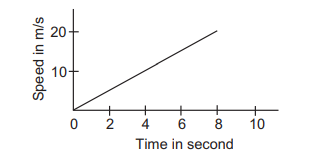
The speed of a car as a function of time is shown in figure below. Find the distance travelled by the car in 8 seconds and its acceleration.
 CorrectIncorrect
Hint
(a) Slope of the \(v-t\) graph gives the acceleration.
\(
\text { Slope }=\tan (\theta)=\frac{20}{8}=2.5 \mathrm{~m} / \mathrm{s}^2
\)
Area in the \(v-t\) graph gives the distance travelled.
\(
\begin{aligned}
\text { Distance travelled } & =\text { Area of } \triangle \mathrm{OAB} \\
& =\frac{1}{2} \times 20 \times 8=80 \mathrm{~m}
\end{aligned}
\) - Question 2 of 62
2. Question
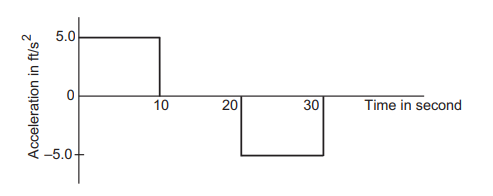
The acceleration of a cart started at \(t=0\), varies with time as shown in figure below. Find the distance travelled in 30 seconds.
 CorrectIncorrect
Hint
(b) In the first 10 seconds,
\(
\begin{aligned}
& S_1=u t+\frac{1}{2} a t^2 \\
& =0+\frac{1}{2} 5 \times 10^2=250 f t
\end{aligned}
\)
At \(\mathrm{t}=10 \mathrm{~s}\),
\(
\mathrm{v}=\mathrm{u}+\mathrm{at}=0+5 \times 10=50 \mathrm{ft} / \mathrm{s}
\)
\(\therefore\) From 10 to 20 seconds \((\Delta \mathrm{t}=20-10=10 \mathrm{~s})\), the particle moves with a uniform velocity of \(50 \mathrm{ft} / \mathrm{s}\).
Distance covered from \(\mathrm{t}=10 \mathrm{~s}\) to \(\mathrm{t}=20 \mathrm{~s}\) :
\(
\mathrm{S}_2=50 \times 10=500 \mathrm{ft}
\)
Between 20 s to 30 s , acceleration is constant, i.e., \(-5 \mathrm{ft} / \mathrm{s}^2\).
At 20 s , the velocity is \(50 \mathrm{ft} / \mathrm{s}\).
\(
\begin{aligned}
& \mathrm{t}=30-20=10 \mathrm{~s} \\
& S_3=u t+\frac{1}{2} a t^2=50 \times 10+\frac{1}{2}(-5) 10^2 \\
& \Rightarrow S_3=500-250=250 f t
\end{aligned}
\)
Total distance travelled is 30 s :
\(
\begin{aligned}
& S_1+S_2+S_3 \\
& =250+500+250 \\
& =1000 \mathrm{ft}
\end{aligned}
\) - Question 3 of 62
3. Question
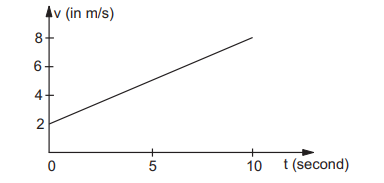
Figure below shows the graph of velocity versus time for a particle going along the \(X\)-axis. Find (i) the acceleration, (ii) the distance travelled in 0 to 10 s and (iii) the displacement in 0 to 10 s.
 CorrectIncorrect
Hint
(a)

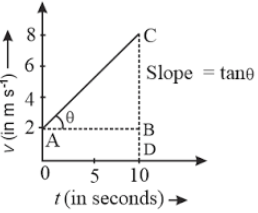
(a) Slope of the \(v-t\) graph gives the acceleration.
Acceleration \(=\frac{8-2}{10}=\frac{6}{10}=0.6 \mathrm{~m} / \mathrm{s}^2\)
(b) \(
\begin{aligned}
&\text { Area in the } v-t \text { graph gives the distance travelled. }\\
&\begin{aligned}
\text { Distance travelled } & =\text { Area of } \triangle \mathrm{ABC}+\text { Area of rectangle } \mathrm{OABD} \\
& =\frac{1}{2} \times 6 \times 10+10 \times 2=50 \mathrm{~m}
\end{aligned}
\end{aligned}
\)
(c) Displacement is the same as the distance travelled.
Displacement \(=50 \mathrm{~m}\) - Question 4 of 62
4. Question
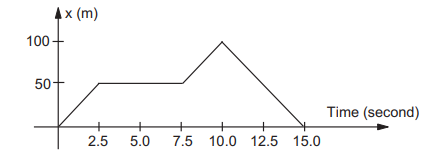
Figure below shows the graph of the \(x\)-coordinate of a particle going along the \(X\)-axis as a function of time. Find (i) the average velocity during 0 to 10 s , (ii) instantaneous velocity at \(2,5,8\) and 12 s.
 CorrectIncorrect
Hint
(b) (i) Displacement from \(t=0 \mathrm{~s}\) to \(t=10 \mathrm{~s}\) :
\(
\begin{aligned}
& x=100 \mathrm{~m} \\
& \text { Time }=10 \mathrm{~s}
\end{aligned}
\)
Average velocity from 0 to 10 seconds,
\(
v_{a v g}=\frac{x}{t}=\frac{100}{10}=10 \mathrm{~m} / \mathrm{s}
\)
(ii) Slope of the \(x-t\) graph gives the velocity.
At 2.5 s , slope \(=\frac{50-0}{2.5-0}=20\)
\(
\Rightarrow v_{\mathrm{inst}}=20 \mathrm{~m} / \mathrm{s}
\)
At \(2 \mathrm{~s}, v_{\text {inst }}=20 \mathrm{~m} / \mathrm{s}\).
At \(5 \mathrm{~s}, v_{\text {inst }}=0\).
At \(8 \mathrm{~s}, v_{\text {inst }}=20 \mathrm{~m} / \mathrm{s}\).
At \(12 \mathrm{~s}, v_{\text {inst }}=-20 \mathrm{~m} / \mathrm{s}\). - Question 5 of 62
5. Question
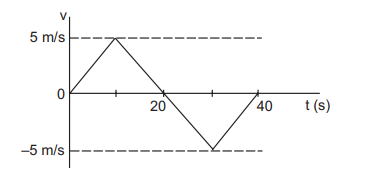
From the velocity-time plot shown in figure below, (i) find the distance travelled by the particle during the first 40 seconds. (ii) Also find the average velocity during this period.
 CorrectIncorrect
Hint
(d) (i) Area shown in the \(v-t\) graph gives the distance travelled.
\(\therefore\) Distance travelled in the first 40 seconds \(=\) Area of \(\triangle \mathrm{OAB}+\) Area of \(\triangle \mathrm{BCD}\)
\(
=\frac{1}{2} \times 5 \times 20+\frac{1}{2} \times 5 \times 20=100 \mathrm{~m}
\)
(ii) Displacement is algebraic sum of the areas
Since velocity is positive 50 m for first 20 s and negative 50 m for next 20 s
Displacement \(=50 \mathrm{~m}-50 \mathrm{~m}=0 \mathrm{~m}\)
As the displacement is zero, the average velocity is zero. - Question 6 of 62
6. Question
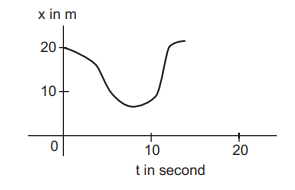
Figure below shows \(x-t\) graph of a particle. Find the time \(t\) such that the average velocity of the particle during the period 0 to \(t\) is zero.
 CorrectIncorrect
Hint
(c) At \(t=0 \mathrm{~s}, \mathrm{~S}=20 \mathrm{~m}\) and at \(t=12 \mathrm{~s}, \mathrm{~S}=20 \mathrm{~m}\).
For the time interval \(0-12\), change in the displacement is zero.
\(
\text { Average velocity }=\frac{\text { Displacement }}{\text { Time }}=0
\)
Hence, the time is 12 seconds. - Question 7 of 62
7. Question
An object having a velocity \(4.0 \mathrm{~m} / \mathrm{s}\) is accelerated at the rate of \(1.2 \mathrm{~m} / \mathrm{s}^2\) for 5.0 s. Find the distance travelled during the period of acceleration.
CorrectIncorrectHint
(c) Given:
Velocity, \(u=4.0 \mathrm{~m} / \mathrm{s}\)
Acceleration, \(a=1.2 \mathrm{~m} / \mathrm{s}^2\)
Time, \(t=5.0 \mathrm{~s}\)
Distance travelled :
\(
\begin{aligned}
& s=u t+\frac{1}{2} a t^2 \\
& =4.0 \times 5+\frac{1}{2} \times 1.2 \times 5^2 \\
& =20.0+\frac{1}{2} \times 1.2 \times 25 \\
& =35 \mathrm{~m}
\end{aligned}
\) - Question 8 of 62
8. Question
A person travelling at \(43 \cdot 2 \mathrm{~km} / \mathrm{h}\) applies the brake giving a deceleration of \(6.0 \mathrm{~m} / \mathrm{s}^2\) to his scooter. How far will it travel before stopping?
CorrectIncorrectHint
(a) Initial velocity, \(u=43.2 \mathrm{~km} / \mathrm{h}=12 \mathrm{~m} / \mathrm{s}\)
Final velocity, \(v=0\)
Acceleration, \(a=-6 \mathrm{~m} / \mathrm{s}^2\)
From \(v^2=u^2+2\) as , we get:
Distance,
\(
\begin{aligned}
& s=\frac{v^2-u^2}{2(a)} \\
& \Rightarrow s=\frac{0-(12)^2}{2(-6)}=\frac{(12)^2}{12}=12 \mathrm{~m}
\end{aligned}
\) - Question 9 of 62
9. Question
A train starts from rest and moves with a constant acceleration of \(2.0 \mathrm{~m} / \mathrm{s}^2\) for half a minute. The brakes are then applied and the train comes to rest in one minute. Find (i) the total distance moved by the train, (ii) the maximum speed attained by the train and (iii) the position(s) of the train at half the maximum speed.
CorrectIncorrectHint
(b)
(i) Initial velocity, \(\mathrm{u}=0\)
Acceleration, \(\mathrm{a}=2 \mathrm{~m} / \mathrm{s}^2\)
Let the final velocity be \(v\) before the brakes are applied.
Now,
\(
\begin{aligned}
& \mathrm{t}=30 \mathrm{~s} \\
& \mathrm{v}=\mathrm{u}+\mathrm{at} \\
& \mathrm{v}=0+2 \times 30 \\
& \Rightarrow \mathrm{v}=60 \mathrm{~m} / \mathrm{s} \\
& s_1=u t+\frac{1}{2} a t^2 \\
& \Rightarrow s_1=\frac{1}{2} \times 2 \times(30)^2=900 \mathrm{~m}
\end{aligned}
\)
When the brakes are applied:
\(
\begin{aligned}
& u^{\prime}=60 \mathrm{~m} / \mathrm{s} \\
& v^{\prime}=0 \\
& t=1 \mathrm{~min}=60 \mathrm{~s}
\end{aligned}
\)
Acceleration:
\(
\begin{aligned}
& a^{\prime}=\frac{(v-u)}{t}=\frac{(0-60)}{60}=-1 \mathrm{~m} / \mathrm{s}^2 \\
& s_2=\frac{v^2-u^2}{2 a^{\prime}}=\frac{0^2-60^2}{2(-1)}=1800 \mathrm{~m} \\
& \mathrm{~s}=\mathrm{s}_1+\mathrm{s}_2=1800+900=2700 \mathrm{~m} \\
& \Rightarrow \mathrm{~s}=2.7 \mathrm{~km}
\end{aligned}
\)
(ii) Initial velocity, \(u=0\)
Acceleration, \(a=2 \mathrm{~m} / \mathrm{s}^2\)
Let the final velocity be \(v\) before the brakes are applied.
Now,
\(
\begin{aligned}
& t=30 \mathrm{~s} \\
& v=u+a t \\
& v=0+2 \times 30 \\
& \Rightarrow v=60 \mathrm{~m} / \mathrm{s}
\end{aligned}
\)
Maximum speed attained by the train, \(v=60 \mathrm{~m} / \mathrm{s}\)
(iii) Initial velocity, \(u=0\)
Acceleration, \(a=2 \mathrm{~m} / \mathrm{s}^2\)
Let the final velocity be \(v\) before the brakes are applied.
Now,
\(
\begin{aligned}
& t=30 \mathrm{~s} \\
& v=u+a t \\
& v=0+2 \times 30 \\
& \Rightarrow v=60 \mathrm{~m} / \mathrm{s}
\end{aligned}
\)
Half the maximum speed \(=\frac{60}{2}=30 \mathrm{~m} / \mathrm{s}\)
When the train is accelerating with an acceleration of \(2 \mathrm{~m} / \mathrm{s}^2\) :
Distance,
\(
\begin{aligned}
& s=\frac{v^2-u^2}{2 a^{\prime}} \\
& =\frac{30^2-0^2}{2 \times 2} \\
& \Rightarrow s=225 \mathrm{~m}
\end{aligned}
\)
When the train is decelerating with an acceleration of \(-1 \mathrm{~m} / \mathrm{s}^2\) :
Distance,
\(
\begin{aligned}
& s=\frac{v^2-u^2}{2 a^{\prime}} \\
& =\frac{30^2-60^2}{2(-1)} \\
& \Rightarrow s=1350 \mathrm{~m}
\end{aligned}
\)
Position from the starting point \(=900+1350=2250\)
\(
=2.25 \mathrm{~km}
\) - Question 10 of 62
10. Question
A particle starting from rest moves with constant acceleration. If it takes 5.0 s to reach the speed 18.0 \(\mathrm{km} / \mathrm{h}\) find (i) the average velocity during this period, and (ii) the distance travelled by the particle during this period.
CorrectIncorrectHint
(d)
\(
\begin{aligned}
& \mathrm{u}=0, \mathrm{v}=18 \mathrm{~km} / \mathrm{hr}=5 \mathrm{~m} / \mathrm{s}, \mathrm{t}=5 \mathrm{sec} \\
& \mathrm{a}=\frac{\mathrm{v}-\mathrm{u}}{\mathrm{t}}=\frac{5-0}{5}=1 \mathrm{~m} / \mathrm{s}^2 \\
& \mathrm{~s}=u \mathrm{t}+\frac{1}{2} a \mathrm{t}^2=12.5 \mathrm{~m}
\end{aligned}
\)(i) Average velocity \(\mathrm{V}_{\text {ave }}=(12.5) / 5=2.5 \mathrm{~m} / \mathrm{s}\).
(ii) Distance travelled is 12.5 m. - Question 11 of 62
11. Question
A driver takes 0.20 s to apply the brakes after he sees a need for it. This is called the reaction time of the driver. If he is driving a car at a speed of \(54 \mathrm{~km} / \mathrm{h}\) and the brakes cause a deceleration of \(6.0 \mathrm{~m} / \mathrm{s}^2\), find the distance travelled by the car after he sees the need to put the brakes on.
CorrectIncorrectHint
(a) In the reaction time, the car moves with a constant speed of \(54 \mathrm{~km} / \mathrm{h}\), i.e., \(15 \mathrm{~m} / \mathrm{s}\).
Distance travelled in this time, \(s_1=15 \times 0.2=3 \mathrm{~m}\)
When the brakes are applied:
Initial velocity of the car, \(u=15 \mathrm{~m} / \mathrm{s}\)
Final velocity of the car, \(v=0\)
Acceleration, \(a=-6 \mathrm{~m} / \mathrm{s}^2\)
Distance,
\(
s_2=\frac{v^2-u^2}{2 a}=18.75 \mathrm{~m}
\)
Total distance, \(s=s_1+s_2\)
\(
\begin{aligned}
& \Rightarrow s=3+18.75=21.75 \mathrm{~m} \\
& \Rightarrow s \\
& \approx 22 \mathrm{~m}
\end{aligned}
\) - Question 12 of 62
12. Question
A police jeep is chasing a culprit going on a motorbike. The motorbike crosses a turning at a speed of \(72 \mathrm{~km} / \mathrm{h}\). The jeep follows it at a speed of \(90 \mathrm{~km} / \mathrm{h}\), crossing the turning ten seconds later than the bike. Assuming that they travel at constant speeds, how far from the turning will the jeep catch up with the bike?
CorrectIncorrectHint
(c) Velocity of the police jeep, \(v_p=90 \mathrm{~km} / \mathrm{h}=25 \mathrm{~m} / \mathrm{s}\)
Velocity of the culprit riding the motorbike, \(v_c=72 \mathrm{~km} / \mathrm{h}=20 \mathrm{~m} / \mathrm{s}\)
In 10 seconds, the culprit reaches point B from point A.
Distance covered by the culprit:
\(
s=v_c t=20 \times 10=200 \mathrm{~m}
\)
At time \(t=10 \mathrm{~s}\), the police jeep is 200 m behind the culprit.
Relative velocity between the police jeep and the culprit:
\(
25-20=5 \mathrm{~m} / \mathrm{s}
\)
\(
\text { Time }=\frac{\text { Distance to be covered }}{\text { Relative velocity }}=\frac{200}{5}=40 \mathrm{~s}
\)
In 40 seconds, the police jeep moves from point A to a distance \(s^{\prime}\) to catch the culprit.
Here,
\(
\begin{aligned}
& s^{\prime}=v_p t=25 \times 40 \\
& \Rightarrow s^{\prime}=1000 \mathrm{~m}=1.0 \mathrm{~km}
\end{aligned}
\)
Thus, the jeep will catch up with the bike 1.0 km away from the turning. - Question 13 of 62
13. Question
When a ball is thrown up vertically with velocity \(v_0\), it reaches a maximum height of \(h\). If one wishes to triple the maximum height, then the ball should be thrown with velocity,
CorrectIncorrectHint
(a) \(H_{\max } \propto v^2\)
\(
\Rightarrow \quad v \propto \sqrt{H_{\max }}
\)
i.e. To triple the maximum height, ball should be thrown with velocity \(\sqrt{3} v_0\). - Question 14 of 62
14. Question
A stone thrown upward with a speed \(u\) from the top of the tower reaches the ground with a speed \(3 u\). The height of the tower is
CorrectIncorrectHint
(b) Step 1: Apply the kinematic equation
We can use the kinematic equation that relates initial velocity, final velocity, acceleration, and displacement:
\(
v_f^2=v_i^2+2 a s
\)
where:
\(v_i\) is the initial velocity ( \(+u\), taking the upward direction as positive)
\(v_f\) is the final velocity ( \(-3 u\), taking the downward direction as negative)
\(a\) is the acceleration due to gravity ( \(-g\) )
\(s\) is the displacement, which is the negative of the tower’s height ( \(-h\) )
Substituting these values into the equation gives:
\(
(-3 u)^2=(u)^2+2(-g)(-h)
\)
Step 2: Solve for the height of the tower
Simplify the equation from Step 1:
\(
9 u^2=u^2+2 g h
\)
Now, rearrange the equation to solve for \(h\) :
\(
\begin{gathered}
9 u^2-u^2=2 g h \\
8 u^2=2 g h \\
h=\frac{8 u^2}{2 g} \\
h=\frac{4 u^2}{g}
\end{gathered}
\) - Question 15 of 62
15. Question
A body thrown vertically up from the ground passes the height of 10.2 m twice in an interval of 10 s. What was its initial velocity?
CorrectIncorrectHint
(a) It is provided to us in the question that \(g=10 \mathrm{~m} / \mathrm{s}^2\)
And when the body reaches the maximum height, that is \(H_{\text {max }}\), then the speed of the body will be zero. That is \(v=0 \mathrm{~m} / \mathrm{s}\)
Since we know that
\(
v=u-g t
\)
Now we will substitute all the known variables into this equation
\(
\begin{aligned}
& \Rightarrow 0=u-g t \\
& \therefore u=g t
\end{aligned}
\)
Now, let us suppose the distance between \(H_{\text {max }}\) and height \(10.2 m\) be \(x\) Then, we will use the formula \(s=u t-\frac{1}{2} g t^2\)
In the above equation, our assumed value \(x\) denotes the distance \(s\)
Substituting the known variables, we get
\(
\Rightarrow x=50 \times 5-\frac{1}{2} \times 10 \times 5^2
\)
On solving, we get
\(
\therefore x=125 m
\)
So, the maximum height \(H_{\text {max }}=125+10.2=135.2 m\)
According to our formula,
\(
H_{\max }=\frac{u^2}{2 g}
\)
Now we will substitute the known variables into the above formula to calculate the initial speed, \(u\)
\(
135.2=\frac{u^2}{2 \times 10}
\)
Therefore, upon further solving for \(u\), we get
\(
\therefore u=52 \mathrm{~m} / \mathrm{s}
\) - Question 16 of 62
16. Question
A body is projected with a velocity \(u\). It passes through a certain point above the ground after \(t_1\) second. The time interval after which the body passes through the same point during the return journey is
CorrectIncorrectHint
(b) Let the total time taken by the body projected be \(t\).
Since the initial velocity of the body is \(u\), then the final velocity, \(v=0\) as the body will come to stop.
Then, from \(v=u+a t\), we get
\(
v=u-g t
\)
Or \(u=g t\)
Or, \(t=\frac{u}{g}\)
Let the time taken by the body to pass the point is \(t_1\)
Then the time taken by the body after crossing the point will be \(t-t_1=\frac{u}{g}-t_1\)
Since the body crosses this point twice, once during the upward motion and the other during its downward motion, due to free fall of the body.
We can say that the time taken after which the body passes through the same point during the return journey is \(2\left[\frac{u}{g}-t_1\right]\) - Question 17 of 62
17. Question
A body is thrown vertically upwards from the top \(A\) of tower. It reaches the ground in \(t_1\) second. If it is thrown vertically downwards from \(A\) with the same speed, it reaches the ground in \(t_2\) second. If it is allowed to fall freely from \(A\), then the time it takes to reach the ground is given by
CorrectIncorrectHint
(c)
Step 1: Set up equations for each scenario
Let the height of the tower be \(h\) and the initial speed be \(u\). We will take the downward direction as positive. The equation of motion is given by \(s=u t+\frac{1}{2} a t^2\).
Case 1 (Thrown upwards): The initial velocity is \(-\boldsymbol{u}\). The displacement is \(\boldsymbol{h}\). The time taken is \(t_1\). The acceleration due to gravity is \(g\).
\(
h=-u t_1+\frac{1}{2} g t_1^2
\)
Note: Acceleration (\(g\)): Gravity always acts downwards. Since the downward direction is defined as positive in this coordinate system, the acceleration due to gravity is also positive, hence \(+g\).Case 2 (Thrown downwards): The initial velocity is \(u\). The displacement is \(h\). The time taken is \(t_2\).
\(
h=u t_2+\frac{1}{2} g t_2^2
\)
Case \(\mathbf{3}\) (Falling freely): The initial velocity is \(\mathbf{0}\). The displacement is \(\boldsymbol{h}\). The time taken is \(t\).
\(
h=\frac{1}{2} g t^2
\)
Step 2: Solve for \(u\) and \(h\)
From the equations for Case 1 and Case 2, we can eliminate \(\boldsymbol{u}\).
From the first equation, \(u=\frac{1}{2} g t_1-\frac{h}{t_1}\).
Substitute this into the second equation:
\(
\begin{gathered}
h=\left(\frac{1}{2} g t_1-\frac{h}{t_1}\right) t_2+\frac{1}{2} g t_2^2 \\
h=\frac{1}{2} g t_1 t_2-\frac{h t_2}{t_1}+\frac{1}{2} g t_2^2
\end{gathered}
\)
Multiply by \(t_1\) to clear the fraction:
\(
h t_1=\frac{1}{2} g t_1^2 t_2-h t_2+\frac{1}{2} g t_1 t_2^2
\)
Rearrange to solve for \(\boldsymbol{h}\) :
\(
\begin{aligned}
h\left(t_1+t_2\right) & =\frac{1}{2} g t_1 t_2\left(t_1+t_2\right) \\
h & =\frac{1}{2} g t_1 t_2
\end{aligned}
\)
Step 3: Find the time for free fall
From Case 3, we know that \(h=\frac{1}{2} g t^2\). We can now equate this with the expression for \(\boldsymbol{h}\) found in Step 2.
\(
\begin{gathered}
\frac{1}{2} g t^2=\frac{1}{2} g t_1 t_2 \\
t^2=t_1 t_2 \\
t=\sqrt{t_1 t_2}
\end{gathered}
\) - Question 18 of 62
18. Question
A man in a balloon rising vertically with an acceleration of \(4.9 \mathrm{~ms}^{-2}\) releases a ball 2 s after the balloon is let go from the ground. The greatest height above the ground reached by the ball is (Take, \(g=9.8 \mathrm{~ms}^{-2}\) )
CorrectIncorrectHint
(a) Step 1: Calculate the balloon’s velocity and height at the moment the ball is released.
The balloon starts from rest and accelerates upwards for 2 seconds. We can use the following kinematic equations:
Velocity: \(v=u+\) at
Displacement: \(s=u t+\frac{1}{2} a t^2\)
Given:
Initial velocity \(\boldsymbol{u}=\mathbf{0 ~ m s}^{-\mathbf{1}}\)
Acceleration \(a=4.9 \mathrm{~ms}^{-2}\)
Time \(t=2 \mathrm{~s}\)
The velocity of the balloon when the ball is released is:
\(
v_{\text {release }}=0+(4.9)(2)=9.8 \mathrm{~ms}^{-1}
\)
The height of the balloon when the ball is released is:
\(
h_{\text {release }}=(0)(2)+\frac{1}{2}(4.9)(2)^2=\frac{1}{2}(4.9)(4)=9.8 \mathrm{~m}
\)
At the moment of release, the ball has an initial upward velocity of \(9.8 \mathrm{~ms}^{-1}\) and is at a height of 9.8 m above the ground.
Step 2: Calculate the maximum height reached by the ball after release.
After the ball is released, its motion is governed by gravity. Its initial velocity is the upward velocity of the balloon at release, and its acceleration is due to gravity, acting downwards ( \(g=-9.8 \mathrm{~ms}^{-2}\) ). The ball reaches its maximum height when its final velocity is \(0 \mathrm{~ms}^{-1}\).
We can use the kinematic equation: \(v^2=u^2+2 a s\)
Given:
Initial velocity \(\boldsymbol{u}=9.8 \mathrm{~ms}^{-1}\)
Final velocity \(v=0 \mathrm{~ms}^{-1}\)
Acceleration \(a=-9.8 \mathrm{~ms}^{-2}\)
Let \(\boldsymbol{h}_{\text {additional }}\) be the additional height the ball travels upwards from the release point.
\(
\begin{gathered}
0^2=(9.8)^2+2(-9.8) h_{\text {additional }} \\
0=96.04-19.6 h_{\text {additional }} \\
19.6 h_{\text {additional }}=96.04 \\
h_{\text {additional }}=\frac{96.04}{19.6}=4.9 \mathrm{~m}
\end{gathered}
\)
Step 3: Calculate the greatest height above the ground.
The greatest height above the ground is the sum of the height of the balloon at release and the additional height the ball travels after being released.
\(
\begin{gathered}
h_{\text {total }}=h_{\text {release }}+h_{\text {additional }} \\
h_{\text {total }}=9.8 \mathrm{~m}+4.9 \mathrm{~m}=14.7 \mathrm{~m}
\end{gathered}
\) - Question 19 of 62
19. Question
A stone falls freely under gravity. The total distance covered by it in the last second of its journey equals the distance covered by it in first 3 s of its motion. The time for which stone remains in air, is
CorrectIncorrectHint
(a) Step 1: Formulate the equations for distance traveled
The motion is under free fall, so the initial velocity \(\boldsymbol{u}=\mathbf{0}\) and the acceleration is the acceleration due to gravity \(g\).
The distance covered in the first 3 seconds ( \(S_3\) ) can be found using the kinematic equation \(S=u t+\frac{1}{2} a t^2\). Since \(u=0\), this simplifies to \(S_3=\frac{1}{2} g(3)^2\).
\(
S_3=\frac{9 g}{2}
\)
The distance covered in the last second (the \(N\)-th second, where \(N\) is the total time in the air) can be found using the formula for distance in the \(n\)-th second: \(S_n=u+\frac{a}{2}(2 n-1)\). Since \(u=0\), this becomes:
\(
S_N=\frac{g}{2}(2 N-1)
\)
Step 2: Set up and solve the main equation
The problem states that the distance covered in the last second equals the distance covered in the first 3 seconds. Therefore, we can set the two equations equal to each other:
\(
\begin{gathered}
S_N=S_3 \\
\frac{g}{2}(2 N-1)=\frac{9 g}{2}
\end{gathered}
\)
Now, we can solve for \(N\). Divide both sides by \(\frac{g}{2}\) :
\(
2 N-1=9, N=5
\)
The time for which the stone remains in the air is 5 s. - Question 20 of 62
20. Question
A body falls from a height \(h=200 \mathrm{~m}\). The ratio of distance travelled in each 2 s, during \(t=0\) to \(t=6 \mathrm{~s}\) of the journey is
CorrectIncorrectHint
(c) Step 1: Calculate the distance traveled in successive time intervals.
For a freely falling body, the distance traveled ( \(s\) ) is given by the equation \(s=u t+\frac{1}{2} g t^2\), where the initial velocity ( \(u\) ) is 0. The equation simplifies to \(s=\frac{1}{2} g t^2\)
Distance traveled in the first \(\mathbf{2}\) seconds ( \(\boldsymbol{d}_{\mathbf{1}}\) ):
This is the total distance covered from \(t=0\) to \(t=2 \mathrm{~s}\).
\(
s_1=\frac{1}{2} g(2 s)^2=\frac{1}{2} g(4)=2 g
\)
Distance traveled in the next 2 seconds ( \(\boldsymbol{d}_{\mathbf{2}}\) ):
This is the total distance covered from \(t=2 \mathrm{~s}\) to \(t=4 \mathrm{~s}\). This can be found by subtracting the distance at \(t=2 \mathrm{~s}\) from the distance at \(t=4 \mathrm{~s}\).
Total distance at \(t=4 \mathrm{~s}: s_2=\frac{1}{2} g(4 \mathrm{~s})^2=\frac{1}{2} g(16)=8 g\)
\(
d_2=s_2-s_1=8 g-2 g=6 g
\)
Distance traveled in the next 2 seconds ( \(d_3\) ):
This is the total distance covered from \(t=4 \mathrm{~s}\) to \(t=6 \mathrm{~s}\). This can be found by subtracting the distance at \(t=4 \mathrm{~s}\) from the distance at \(t=6 \mathrm{~s}\).
Total distance at \(t=6 \mathrm{~s}: s_3=\frac{1}{2} g(6 \mathrm{~s})^2=\frac{1}{2} g(36)=18 g\)
\(
d_3=s_3-s_2=18 g-8 g=10 g
\)
Step 2: Determine the ratio.
Now, we can find the ratio of the distances travelled in each 2-second interval:
\(
\begin{gathered}
d_1: d_2: d_3 \\
2 g: 6 g: 10 g
\end{gathered}
\)
By dividing each term by the common factor \(2 g\), we get the simplest ratio:
\(
\begin{gathered}
\frac{2 g}{2 g}: \frac{6 g}{2 g}: \frac{10 g}{2 g} \\
1: 3: 5
\end{gathered}
\) - Question 21 of 62
21. Question
A ball is released from height \(h\) and another from \(2 h\). The ratio of time taken by the two balls to reach the ground is
CorrectIncorrectHint
\(
\text { (a) } t=\sqrt{\frac{2 h}{g}} \text { or } t \propto \sqrt{h} \Rightarrow \frac{t_1}{t_2}=\sqrt{\frac{h}{2 h}}=1: \sqrt{2}
\) - Question 22 of 62
22. Question
A particle is dropped under gravity from rest from a height \(h\left(g=9.8 \mathrm{~ms}^{-2}\right)\) and it travels a distance \(9 h / 25\) in the last second, the height \(h\) is
CorrectIncorrectHint
(d) Let \(h\) be the distance covered in \(t\) second, \(h=\frac{1}{2} g t^2 \dots(i)\)
Distance covered in \(t\) th second \(=\frac{1}{2} g(2 t-1)\)
\(
\Rightarrow \quad \frac{9 h}{25}=\frac{g}{2}(2 t-1) \dots(ii)
\)
From Eqs. (i) and (ii), we get
\(
h=122.5 \mathrm{~m}
\) - Question 23 of 62
23. Question
A body dropped from the top of a tower covers a distance \(7 x\) in the last second of its journey, where \(x\) is the distance covered in first second. How much time does it take to reach the ground?
CorrectIncorrectHint
(b) Step 1: Find the distance covered in the first second
The distance covered by a body dropped from rest under gravity is given by the equation \(s=u t+\frac{1}{2} g t^2\), where \(u=0\) is the initial velocity and \(g\) is the acceleration due to gravity.
For the first second ( \(t=1\) ), the distance \(x\) is:
\(
x=(0)(1)+\frac{1}{2} g(1)^2=\frac{1}{2} g
\)
Step 2: Find the distance covered in the last second
Let the total time of the journey be \(T\) seconds. The distance covered in the last second is the total distance covered in \(T\) seconds minus the distance covered in the first ( \(T-1\) ) seconds.
Distance covered in \(T\) seconds: \(s_T=\frac{1}{2} g T^2\)
Distance covered in \((T-1)\) seconds: \(s_{T-1}=\frac{1}{2} g(T-1)^2\)
Distance in the last second \(=s_T-s_{T-1}=\frac{1}{2} g T^2-\frac{1}{2} g(T-1)^2\)
\(
=\frac{1}{2} g\left[T^2-\left(T^2-2 T+1\right)\right]=\frac{1}{2} g(2 T-1)
\)
Step 3: Solve for the total time
The problem states that the distance covered in the last second is \(7 x\).
So, \(\frac{1}{2} g(2 T-1)=7 x\)
Substitute the value of \(x=\frac{1}{2} g\) from Step 1 into this equation:
\(
\frac{1}{2} g(2 T-1)=7\left(\frac{1}{2} g\right)
\)
\(
\begin{gathered}
2 T-1=7 \\
2 T=8 \\
T=4
\end{gathered}
\)
The body takes \(\mathbf{4} \mathbf{s}\) to reach the ground. - Question 24 of 62
24. Question
A particle is moving such that \(s=t^3-6 t^2+18 t+9\), where \(s\) is in metre and \(t\) is in second. The minimum velocity attained by the particle is
CorrectIncorrectHint
(c) \(s=t^3-6 t^2+18 t+9 \Rightarrow v=\frac{d s}{d t}=3 t^2-12 t+18\)
\(v\) is minimum or maximum at time \(t\), which can be calculated as
\(
\begin{aligned}
& a=\frac{d v}{d t}=6 t-12=0 \\
\Rightarrow \quad & t=2 \mathrm{~s}
\end{aligned}
\)
\(
\begin{aligned}
& \text { At } t=2 \mathrm{~s}, \\
& \qquad \begin{array}{l}
\frac{d^2 v}{d t^2}=6>0, \text { i.e. } v \text { is minimum at } t=2 \mathrm{~s} \\
v_{\min }=3(2)^2-12(2)+18=6 \mathrm{~m} / \mathrm{s}
\end{array}
\end{aligned}
\) - Question 25 of 62
25. Question
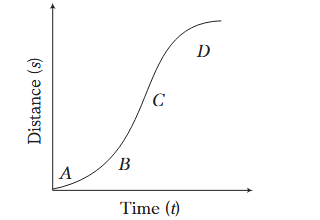
A particle shows distance-time curve as given in this figure. The maximum instantaneous velocity of the particle is around the point
 CorrectIncorrect
Hint
(c) The maximum instantaneous velocity of the particle occurs at the point where the slope of the distance-time curve is the steepest, which is point C . Instantaneous velocity is represented by the slope ( \(v=\frac{d s}{d t}\) ), so the highest velocity corresponds to the maximum slope.
- Question 26 of 62
26. Question
The distance-time graph of a particle at time \(t\) makes angle \(45^{\circ}\) with the time axis. After one second, it makes angle \(60^{\circ}\) with the time axis. What is the average acceleration of the particle?
CorrectIncorrectHint
\(
\begin{gathered}
\text { (a) } v_i=\text { slope of } s-t \text { graph }=\tan 45^{\circ}=1 \mathrm{~ms}^{-1} \\
v_f=\text { slope of } s-t \text { graph }=\tan 60^{\circ}=\sqrt{3} \mathrm{~ms}^{-1} \\
\text { Now, } a_{\mathrm{av}}=\frac{v_f-v_i}{\Delta t}=\frac{\sqrt{3}-1}{1}=(\sqrt{3}-1) \text { units }
\end{gathered}
\) - Question 27 of 62
27. Question
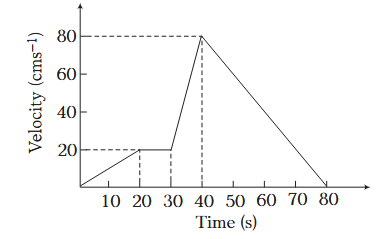
The \(v-t\) graph of a moving object is shown in the figure. The maximum acceleration is
 CorrectIncorrect
Hint
(d) Maximum acceleration means maximum change in velocity in minimum time interval.
In time interval, \(t=30 \mathrm{~s}\) to \(t=40 \mathrm{~s}\)
\(
\therefore \quad a=\frac{\Delta v}{\Delta t}=\frac{80-20}{40-30}=\frac{60}{10}=6 \mathrm{cms}^{-2}
\) - Question 28 of 62
28. Question
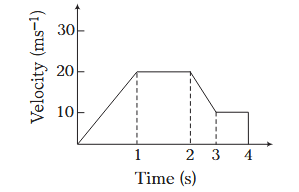
The variation of velocity of a particle with time moving along a straight line is illustrated in the adjoining figure. The distance travelled by the particle in 4 s is
 CorrectIncorrect
Hint
(d) Distance \(=\) Area under \(v-t\) graph
\(
\begin{aligned}
& =\frac{1}{2} \times 1 \times 20+(20 \times 1)+\frac{1}{2}(20+10) \times 1+(10 \times 1) \\
& =10+20+15+10=55 \mathrm{~m}
\end{aligned}
\) - Question 29 of 62
29. Question
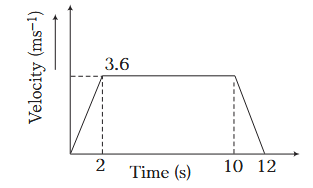
A lift is going up. The variation in the speed of the lift is as given in the graph. What is the height to which the lift takes the passengers?
 CorrectIncorrect
Hint
\(
\text { (c) } \text { Distance }=\text { Area of trapezium }=\frac{1}{2} \times 3.6 \times(12+8)=36 \mathrm{~m}
\) - Question 30 of 62
30. Question
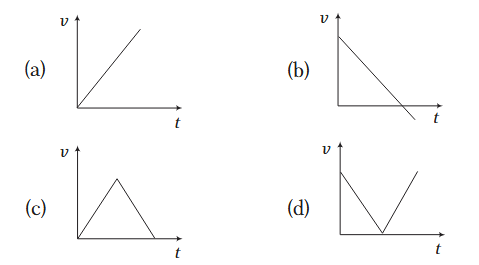
Which of the following graphs correctly represents velocity-time relationship for a particle released from rest to fall freely under gravity?
 CorrectIncorrect
Hint
(a) Velocity will continuously increase (starting from rest).
- Question 31 of 62
31. Question
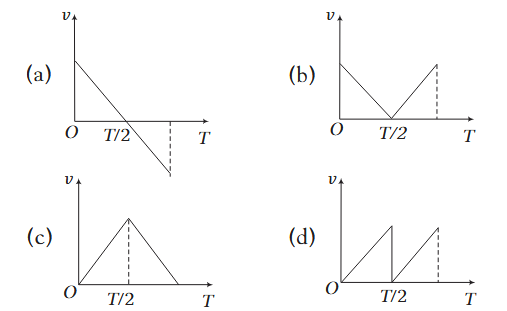
A particle projected vertically upwards returns to the ground in time \(T\). Which graph represents the correct variation of velocity \((v)\) against time \((t)\) ?
 CorrectIncorrect
Hint
(a) The correct graph is a straight line with a negative slope that starts at a positive initial velocity ( \(v_0\) ), crosses the time axis at \(t=T/2\), and continues to a negative velocity at time \(\boldsymbol{T}\). This represents the constant downward acceleration due to gravity, which causes the upward velocity to decrease linearly to zero at the peak height, and then increases linearly in the negative direction as the particle falls.
Initial point: At time \(\boldsymbol{t}=\mathbf{0}\), the velocity is maximum and positive ( \(v_0\) ), corresponding to the starting point of the graph on the positive \(y\)-axis.
Peak height: The velocity decreases linearly to zero at the highest point of the trajectory, which occurs at time \(t=T / 2\). This is where the line crosses the t-axis.
Downward motion: After reaching its peak, the velocity becomes negative, meaning it’s directed downwards. It continues to decrease linearly (become more negative) until it returns to the ground at time \(T\) with a velocity of \(-v_0\).
Slope: The slope of the line is constant and negative, representing the acceleration due to gravity (g). - Question 32 of 62
32. Question
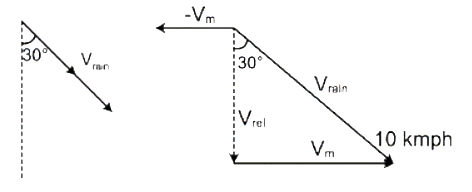
A man standing on a road has to hold his umbrella at \(30^{\circ}\) with the vertical to keep the rain away. He throws the umbrella and starts running at \(10 \mathrm{kmh}^{-1}\). He finds that raindrops are hitting his head vertically.
What is the speed of rain with respect to ground?CorrectIncorrectHint
(b) Velocity of rain is at \(30^{\circ}\) in vertical direction. So, its horizontal component is \(v_R \sin 30^{\circ}=\frac{v_R}{2}\). When man starts walking with \(10 \mathrm{kmh}^{-1}\) rain appears vertical. So, horizontal component \(\frac{v_R}{2}\) is balanced by his speed of \(10 \mathrm{kmh}^{-1}\). Thus, \(\frac{v_R}{2}=10\) or \(v_R=20 \mathrm{kmh}^{-1}\)
Alternate:

\(
\begin{gathered}
\frac{V_m}{V_{\text {rain }}}=\sin 30^{\circ} \\
\Rightarrow V_{\text {rain }}=2 V_m=2 \times 10 \\
=20 \mathrm{kmph}
\end{gathered}
\) - Question 33 of 62
33. Question
A stationary man observes that the rain is falling vertically downward. When he starts running with a velocity of \(12 \mathrm{kmh}^{-1}\), he observes that the rain is falling at an angle \(60^{\circ}\) with the vertical. The actual velocity of rain is
CorrectIncorrectHint
(c)
\(
\begin{gathered}
\tan 60^{\circ}=\frac{v_x}{v_y} \\
\sqrt{3}=\frac{12}{v_y} \\
\therefore v_y=4 \sqrt{3} \mathrm{~km} / \mathrm{h}
\end{gathered}
\) - Question 34 of 62
34. Question
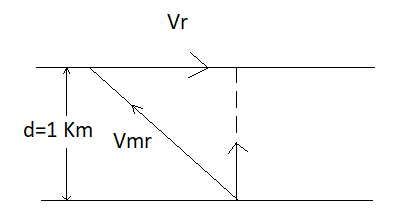
The speed of boat is \(5 \mathrm{kmh}^{-1}\) in still water. It crosses a river of width 1 km along the shortest possible path in 15 min . Then, velocity of river will be
CorrectIncorrectHint
(c)

\(
\begin{aligned}
\text { time } t & =\frac{d}{V_{m r} \cos \theta} \\
\frac{1}{4} & =\frac{1}{5 \times \cos \theta} \Rightarrow \cos \theta=\frac{4}{5} \Rightarrow \theta=37^{\circ} \\
& \Rightarrow \sin \theta=3 / 5=V_r/V_{m r}
\end{aligned}
\)
\(V_r=3 \mathrm{km} / \mathrm{h}\) - Question 35 of 62
35. Question
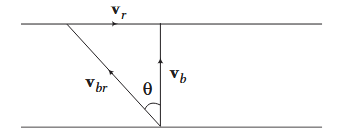
The rowing speed of a man relative to water is \(5 \mathrm{kmh}^{-1}\) and the speed of water flow is \(3 \mathrm{kmh}^{-1}\). At what angle to the river flow should he head, if he wants to reach a point on the other bank, directly opposite to starting point?
CorrectIncorrectHint

\(
\text { (a) } \sin \theta=\frac{v_r}{v_{b r}}=\frac{3}{5}
\)
\(
\begin{aligned}
&\therefore \quad \theta=37^{\circ}\\
&\text { The required angle is therefore }\\
&90^{\circ}+\theta=90^{\circ}+37^{\circ}=127^{\circ}
\end{aligned}
\) - Question 36 of 62
36. Question
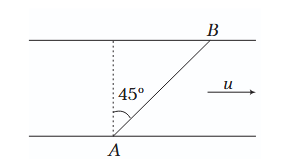
A man wants to reach point \(B\) on the opposite bank of a river flowing at a speed as shown in figure. With what minimum speed and in which direction should the man swim relative to water, so that he can reach point \(B\) ?
 CorrectIncorrect
Hint
(c)

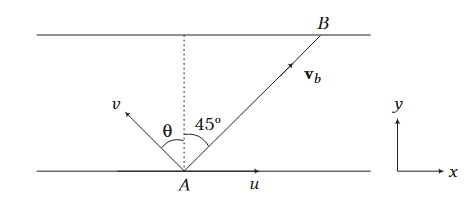
Let \(v\) be the speed of boatman in still water. Resultant of \(v\) and \(u\) should be along \(A B\). Components of \(\mathbf{v}_b\) (absolute velocity of boatman) along \(x\) and \(y\)-directions are,
\(
v_x=u-v \sin \theta \text { and } v_y=v \cos \theta
\)
Further, \(\tan 45^{\circ}=\frac{v_y}{v_x}\) or \(1=\frac{v \cos \theta}{u-v \sin \theta}\)
\(
\therefore \quad v=\frac{u}{\sin \theta+\cos \theta}=\frac{u}{\sqrt{2} \sin \left(\theta+45^{\circ}\right)}
\)
\(v\) is minimum at,
\(
\theta+45^{\circ}=90^{\circ} \text { or } \theta=45^{\circ} \text { and } v_{\min }=\frac{u}{\sqrt{2}}
\) - Question 37 of 62
37. Question
A ball is dropped from the top of a building 100 m high. At the same instant, another ball is thrown upwards with a velocity of \(40 \mathrm{~ms}^{-1}\) from the bottom of the building. The two balls will meet after
CorrectIncorrectHint
(b) Let balls meet after t s . The distance travelled by the ball coming down is
\(
s_1=\frac{1}{2} g t^2
\)
Distance travelled by the other ball
\(
\begin{aligned}
& s_2=40 t-\frac{1}{2} g t^2 \\
& \because s_1+s_2=100 \mathrm{~m} \\
& \therefore \frac{1}{2} g t^2+40 t-\frac{1}{2} g t^2=100 \mathrm{~m} \\
& t=\frac{100}{40}=2.5 \mathrm{~s}
\end{aligned}
\) - Question 38 of 62
38. Question
Two trains, each 50 m long moving parallel towards each other at speeds \(10 \mathrm{~ms}^{-1}\) and \(15 \mathrm{~ms}^{-1}\) respectively, at what time will they pass each other?
CorrectIncorrectHint
(c) Step 1: Determine the total distance to be covered
The time it takes for the two trains to pass each other is the time it takes for the front of the first train to meet the front of the second train, until the back of the first train passes the back of the second train. This means the total distance covered is the sum of the lengths of the two trains.
The length of each train is 50 m .
Total distance to cover, \(D=50 \mathrm{~m}+50 \mathrm{~m}=100 \mathrm{~m}\).
Step 2: Calculate the relative speed
Since the trains are moving towards each other, their speeds add up to give the relative speed.
Speed of train 1, \(v_1=10 \mathrm{~ms}^{-1}\).
Speed of train 2, \(v_2=15 \mathrm{~ms}^{-1}\).
Relative speed, \(v_{\text {rel }}=v_1+v_2=10 \mathrm{~ms}^{-1}+15 \mathrm{~ms}^{-1}=25 \mathrm{~ms}^{-1}\).
Step 3: Calculate the time to pass each other
Using the formula for time, distance, and speed, we can calculate the time it takes for the trains to pass each other.
\(
t=\frac{D}{v_{r e l}}
\)
\(
t=\frac{100 \mathrm{~m}}{25 \mathrm{~ms}^{-1}}=4 \mathrm{~s}
\)
The time it will take for the trains to pass each other is \(\mathbf{4} \mathbf{s}\). - Question 39 of 62
39. Question
The distance travelled by a particle starting from rest and moving with an acceleration \(\frac{4}{3} \mathrm{~ms}^{-2}\), in the third second is
CorrectIncorrectHint
\(
\begin{aligned}
& \text { (a) } s_n=u+\frac{a}{2}(2 n-1) \\
& \Rightarrow \quad s_3=0+\frac{4 / 3}{2}(2 \times 3-1) \Rightarrow s_3=\frac{10}{3} \mathrm{~m}
\end{aligned}
\) - Question 40 of 62
40. Question
A vehicle travels half the distance \(l\) with speed \(v_1\) and the other half with speed \(v_2\), then its average speed is
CorrectIncorrectHint
(c) Time taken to travel first half distance, \(t_1=\frac{l / 2}{v_1}=\frac{l}{2 v_1}\)
Time taken to travel second half distance, \(t_2=\frac{l}{2 v_2}\)
\(
\text { Total time }=t_1+t_2=\frac{l}{2 v_1}+\frac{l}{2 v_2}=\frac{l}{2}\left(\frac{1}{v_1}+\frac{1}{v_2}\right)
\)
We know that, \(v_{\mathrm{av}}=\) Average speed
\(
=\frac{\text { total distance }}{\text { total time }}=\frac{l}{\frac{l}{2}\left(\frac{1}{v_1}+\frac{1}{v_2}\right)}=\frac{2 v_1 v_2}{v_1+v_2}
\) - Question 41 of 62
41. Question
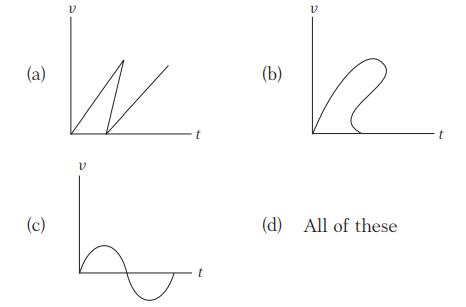
Which of the following speed-time \((v-t)\) graphs is physically not possible?
 CorrectIncorrect
Hint
(d) Understand the Concept of Speed:
Speed is a scalar quantity, meaning it only has magnitude and no direction. This means that speed cannot be negative; it can only be zero or positive.
(1) Analyze Option a:
In the first graph, if we draw a vertical line at a specific time \(t\), we observe that there are three different speeds at that instant. Since a single object cannot have multiple speeds at the same time, this graph is not physically possible.
(2) Analyze Option b:
Similarly, in the second graph, drawing a vertical line at a specific time \(t\) also reveals three different speeds for the same object. Again, this scenario is not possible, as an object cannot possess multiple speeds simultaneously.
(3) Analyze Option c:
In the third graph, we notice that the speed values drop below zero, indicating negative speed. Since speed cannot be negative (it is a scalar quantity), this graph is also not physically possible. - Question 42 of 62
42. Question
A car moving with a velocity of \(10 \mathrm{~ms}^{-1}\) can be stopped by the application of a constant force \(F\) in a distance of 20 m. If the velocity of the car is \(30 \mathrm{~ms}^{-1}\), it can be stopped by this force in
CorrectIncorrectHint
Concept: Stopping distance When brakes are applied to a moving vehicle, the distance it travels before stopping is called stopping distance. It is an important factor for road safety. It is given by
\(
s=\frac{u^2}{2 a}
\)
where, \(u\) is initial velocity and \(a\) is the retardation produced by brakes.(d) \(s \propto u^2\). If \(u\) becomes 3 times, then \(s\) will become 9 times, i.e. \(9 \times 20=180 \mathrm{~m}\)
- Question 43 of 62
43. Question
A body \(A\) starts from rest with an acceleration \(a_1\). After 2 seconds, another body \(B\) starts from rest with an acceleration \(a_2\). If they travel equal distance in the 5th second, after the start of \(A\), then the ratio \(a_1: a_2\) is equal to
CorrectIncorrectHint
(a) Distance travelled by body \(A\) in 5th second and distance travelled by body \(B\) in 3rd second of its motion are equal.
\(
\begin{aligned}
0+\frac{a_1}{2}(2 \times 5-1) & =0+\frac{a_2}{2}(2 \times 3-1) \\
9 a_1 & =5 a_2 \Rightarrow \frac{a_1}{a_2}=\frac{5}{9}
\end{aligned}
\) - Question 44 of 62
44. Question
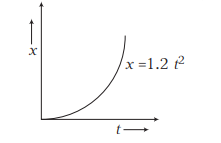
Figure given shows the distance-time graph of the motion of a car. It follows from the graph that the car is
 CorrectIncorrect
Hint
(d) Since \(x=1.2 t^2\), comparing it with equation of motion
\(
x=\frac{1}{2} a t^2 .
\)
\(
v=d x / d t=at
\)
\(
a=d v / d t=a
\)
Thus, the motion is uniformly accelerated. “Uniformly accelerated” means that an object’s velocity changes at a constant rate over time, so the acceleration is constant. - Question 45 of 62
45. Question
The velocity of a body depends on time according to the equation \(v=\frac{t^2}{10}+20\). The body is undergoing
CorrectIncorrectHint
(c) It is given that, \(v=\frac{t^2}{10}+20\)
Differentiating both sides w.r.t. time, we get
\(
\frac{d v}{d t}=\frac{2 t}{10}+0=\frac{t}{5}
\)
\(\therefore\) Acceleration, \(a=\frac{d v}{d t}=\frac{t}{5} \neq\) constant
Hence, it is a case of non-uniform acceleration. - Question 46 of 62
46. Question
A person walks up a stalled escalator in 90 s. When he is just standing on the same moving escalator, then he is carried for 60 s. The time it would take him to walk up the moving escalator will be
CorrectIncorrectHint
(d) \(v_1=\frac{s}{90}, v_2=\frac{s}{60}\)
Now, \(t=\frac{s}{v_1+v_2}=\frac{s}{\frac{s}{90}+\frac{s}{60}}\)
\(
=\frac{90 \times 60}{90+60}=36 \mathrm{~s}
\)Explanation: Step 1: Define variables and relationships
Let \(L\) be the length of the escalator.
Let \(v_p\) be the person’s walking speed.
Let \(v_e\) be the escalator’s speed.
Let \(t_p\) be the time to walk up the stalled escalator.
Let \(t_e\) be the time to be carried by the moving escalator.
Let \(t_{\text {total }}\) be the time to walk up the moving escalator.
Step 2: Formulate equations from the given information
The time to walk up the stalled escalator is given as \(t_p=90 \mathrm{~s}\). The relationship between distance, speed, and time is \(L=v \times t\).
\(
L=v_p \times t_p \Longrightarrow L=90 v_p \Longrightarrow v_p=\frac{L}{90}
\)
The time to be carried by the moving escalator is given as \(\boldsymbol{t}_{\boldsymbol{e}}=60 \mathrm{~s}\).
\(
L=v_e \times t_e \Longrightarrow L=60 v_e \Longrightarrow v_e=\frac{L}{60}
\)
Step 3: Calculate the combined speed and total time
When the person walks up the moving escalator, their combined speed, \(v_{\text {total }}\), is the sum of their walking speed and the escalator’s speed.
\(
v_{\text {total }}=v_p+v_e
\)
Substituting the expressions for \(v_p\) and \(v_e\) from the previous step:
\(
v_{\text {total }}=\frac{L}{90}+\frac{L}{60}
\)
To find the total time, \(t_{\text {total }}\), we use the same distance, speed, and time formula.
\(
L=v_{\text {total }} \times t_{\text {total }} \Longrightarrow t_{\text {total }}=\frac{L}{v_{\text {total }}}
\)
Substituting the expression for \(v_{\text {total }}\) :
\(
\begin{gathered}
t_{\text {total }}=\frac{L}{\frac{L}{90}+\frac{L}{60}} \\
t_{\text {total }}=\frac{L}{L\left(\frac{1}{90}+\frac{1}{60}\right)} \\
t_{\text {total }}=\frac{1}{\frac{1}{90}+\frac{1}{60}}
\end{gathered}
\)
To solve the denominator, find a common denominator, which is 180.
\(
\begin{gathered}
t_{\text {total }}=\frac{1}{\frac{2}{180}+\frac{3}{180}}=\frac{1}{\frac{5}{180}}=\frac{180}{5} \\
t_{\text {total }}=36 s
\end{gathered}
\) - Question 47 of 62
47. Question
A car starts moving along a line, first with acceleration \(a=5 \mathrm{~ms}^{-2}\) starting from rest, then uniformly and finally decelerating at the same rate \(a\) and comes to rest. The total time of motion is 25 s. The average speed during the time is \(20 \mathrm{~ms}^{-1}\). How long does particle move uniformly?
CorrectIncorrectHint
(d) Let \(t_1\) be the time for the acceleration and deceleration phases, and \(t_2\) be the time for the uniform motion phase. The total time is given as \(T=25 \mathrm{~s}\), so \(2 t_1+t_2=25\).
Step 1: Calculate the final velocity after acceleration
The car starts from rest, so its initial velocity is \(v_0=0\). After time \(t_1\) with acceleration \(a=5 \mathrm{~ms}^{-2}\), the final velocity \(v\) is given by:
\(
v=v_0+a t_1=0+5 t_1=5 t_1
\)
This is also the constant velocity during the uniform motion phase.
Step 2: Calculate the total distance traveled
The total distance \(d\) is the sum of the distances from the three phases:
Distance during acceleration \(\left(d_1\right): d_1=v_0 t_1+\frac{1}{2} a t_1^2=0+\frac{1}{2}(5) t_1^2=2.5 t_1^2\)
Distance during uniform motion \(\left(d_2\right): d_2=v t_2=\left(5 t_1\right) t_2=5 t_1 t_2\)
Distance during deceleration ( \(d_3\) ): This is the same as the acceleration phase, so \(d_3=d_1=2.5 t_1^2\)
The total distance is \(d=d_1+d_2+d_3=2.5 t_1^2+5 t_1 t_2+2.5 t_1^2=5 t_1^2+5 t_1 t_2\).
Step 3: Use the average speed to find \(t_1\) and \(t_2\)
The average speed is the total distance divided by the total time.
Average speed \(=\frac{d}{T}=\frac{5 t_1^2+5 t_1 t_2}{25}=20 \mathrm{~ms}^{-1}\)
\(
5 t_1^2+5 t_1 t_2=25 \times 20=500
\)
Dividing by 5 , we get:
\(
t_1^2+t_1 t_2=100
\)
\(
\begin{aligned}
&\text { We also know from the total time that } t_2=25-2 t_1 \text {. Substitute this into the equation: }\\
&\begin{gathered}
t_1^2+t_1\left(25-2 t_1\right)=100 \\
t_1^2+25 t_1-2 t_1^2=100 \\
-t_1^2+25 t_1-100=0 \\
t_1^2-25 t_1+100=0
\end{gathered}
\end{aligned}
\)
\(
\begin{aligned}
& t_1=\frac{25+15}{2}=\frac{40}{2}=20 \mathrm{~s} \\
& t_1=\frac{25-15}{2}=\frac{10}{2}=5 \mathrm{~s}
\end{aligned}
\)
Since \(t_1\) is the time for a single phase of acceleration/deceleration and the total time is 25 s, the case where \(t_1=20\) is not physically possible because \(2 t_1=40>25\). Therefore, the correct value is \(t_1=5 \mathrm{~s}\).
Step 4: Find the time for uniform motion
Now we can find \(t_2\) using the total time equation:
\(
t_2=25-2 t_1=25-2(5)=25-10=15 \mathrm{~s}
\)
The car moves uniformly for 15 s. - Question 48 of 62
48. Question
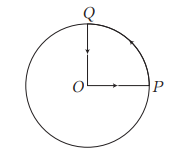
A cyclist starts from the centre \(O\) of a circular park of radius one kilometre, reaches the edge \(P\) of the park, then cycles along the circumference and returns to the centre along \(Q O\) as shown in the figure. If the round trip takes ten minutes, the net displacement and average speed of the cyclist (in metre and kilometre per hour) is
 CorrectIncorrect
Hint
(d) Net displacement \(=0\) and total distance \(=O P+P Q+Q O\)
\(
=1+\frac{2 \pi \times 1}{4}+1=\frac{14.28}{4} \mathrm{~km}
\)
Average speed \(=\frac{14.28}{4 \times 10 / 60}=\frac{6 \times 14.28}{4}=21.42 \mathrm{~km} / \mathrm{h}\) - Question 49 of 62
49. Question
A bullet emerges from a barrel of length 1.2 m with a speed of \(640 \mathrm{~ms}^{-1}\). Assuming constant acceleration, the approximate time that it spends in the barrel after the gun is fired, is
CorrectIncorrectHint
\(
\begin{aligned}
&\text { (b) Given, } s=1.2 \mathrm{~m}, v=640 \mathrm{~ms}^{-1} \text {, }\\
&\begin{aligned}
a=? ; & u=0 ; t=? \\
2 a s & =v^2-u^2
\end{aligned}
\end{aligned}
\)
\(
\begin{aligned}
2 a \times 1.2 & =640 \times 640 \\
a & =\frac{8 \times 64 \times 100}{3} \\
v & =u+a t \\
t & =\frac{v}{a}=\frac{640 \times 3}{8 \times 64 \times 100}=37.5 \times 10^{-3} \mathrm{~s} \approx 40 \mathrm{~ms}
\end{aligned}
\) - Question 50 of 62
50. Question
The ratios of the distance traversed, in successive intervals of time by a body, falling from rest, are
CorrectIncorrectHint
(a) Here, \(u=0, a=g\)
Distance travelled in \(n\)th second is given by
\(
\begin{aligned}
& D_n=u+\frac{a}{2}(2 n-1) \\
\therefore & D_n \propto(2 n-1) \\
\therefore & D_1: D_2: D_3: D_4: D_5 \ldots=1: 3: 5: 7: 9: \ldots
\end{aligned}
\) - Question 51 of 62
51. Question
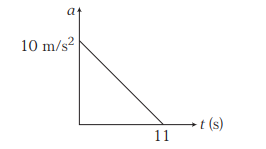
A particle starts from rest. Its acceleration (\(a\)) versus time \((t)\) graph as shown in the figure. The maximum speed of the particle will be
 CorrectIncorrect
Hint
(b) This is found by calculating the area under the acceleration ( \(a\) ) versus time ( \(t\) ) graph, which represents the change in velocity. Since the particle starts from rest, this area is equal to its maximum speed.
The graph shows a triangular shape with a base of 11 seconds and a height of 10 \(\mathrm{m} / \mathrm{s}^2\).
The area of the triangle is calculated using the formula: Area \(=\frac{1}{2} \times\) base \(\times\) height.
Plugging in the values: Area \(=\frac{1}{2} \times 11 \mathrm{~s} \times 10 \mathrm{~m} / \mathrm{s}^2=55 \mathrm{~m} / \mathrm{s}\).
Since the particle starts from rest, the maximum speed is equal to this area, which is \(55 \mathrm{~m} / \mathrm{s}\).
The maximum speed of the particle is \(55 \mathrm{~m} / \mathrm{s}\). - Question 52 of 62
52. Question
A ball is dropped onto the floor from a height of 10 m. It rebounds to a height of 5 m. If the ball was in contact with the floor for 0.01 s , what was its average acceleration during contact? (Take, \(g=10 \mathrm{~ms}^{-2}\) )
CorrectIncorrectHint
(a) Step 1: Calculate the velocity of the ball just before it hits the floor.
We can use the kinematic equation for an object in free fall: \(v_f^2=v_i^2+2 g h\). The initial velocity \(\left(v_i\right)\) is 0 since the ball is dropped. The final velocity \(\left(v_f\right)\) is the velocity just before impact.
\(
v_{\text {before }}=\sqrt{2 g h_1}
\)
Substituting the given values, we get:
\(
v_{\text {before }}=\sqrt{2 \times 10 \mathrm{~ms}^{-2} \times 10 \mathrm{~m}}=\sqrt{200 \mathrm{~m}^2 \mathrm{~s}^{-2}} \approx 14.14 \mathrm{~ms}^{-1}
\)
Step 2: Calculate the velocity of the ball just after it leaves the floor.
Similarly, we can use the same kinematic equation to find the initial velocity ( \(v_i\) ) for the rebound, which is the velocity just after impact. The final velocity \(\left(v_f\right)\) at the peak of the rebound height is 0.
\(
\begin{gathered}
0=v_{\text {after }}^2-2 g h_2 \\
v_{\text {after }}=\sqrt{2 g h_2}
\end{gathered}
\)
Substituting the given values, we get:
\(
v_{\text {after }}=\sqrt{2 \times 10 \mathrm{~ms}^{-2} \times 5 \mathrm{~m}}=\sqrt{100 \mathrm{~m}^2 \mathrm{~s}^{-2}}=10 \mathrm{~ms}^{-1}
\)
Step 3: Calculate the average acceleration during contact.
Average acceleration ( \(a_{\text {avg }}\) ) is defined as the change in velocity ( \(\Delta v\) ) divided by the time interval ( \(\Delta t\) ). It’s important to consider the direction of the velocities. Let’s define the upward direction as positive. The velocity before impact is downwards, so it’s negative. The velocity after impact is upwards, so it’s positive.
\(
\begin{gathered}
a_{\text {avg }}=\frac{\Delta v}{\Delta t}=\frac{v_{\text {after }}-v_{\text {before }}}{\Delta t} \\
v_{\text {after }}=10 \mathrm{~ms}^{-1} \\
v_{\text {before }}=-14.14 \mathrm{~ms}^{-1} \\
a_{\text {avg }}=\frac{10-(-14.14)}{0.01}=\frac{24.14}{0.01}=2414 \mathrm{~ms}^{-2}
\end{gathered}
\)
The average acceleration of the ball during contact with the floor is \(2414 \mathrm{~ms}^{-2}\). - Question 53 of 62
53. Question
A man is 45 m behind the bus when the bus start accelerating from rest with acceleration \(2.5 \mathrm{~ms}^{-2}\). With what minimum velocity should the man start running to catch the bus?
CorrectIncorrectHint
(c) Let the man will catch the bus after \(t\) second. So, he will cover distance \(ut\).
Similarly, distance travelled by the bus will be \(\frac{1}{2} a t^2\).
For the given condition,
\(
\begin{aligned}
& u t=45+\frac{1}{2} a t^2=45+1.25 t^2 \quad\left(\text { As, } a=2.5 \mathrm{~ms}^{-2}\right) \\
\Rightarrow \quad & u=\frac{45}{t}+1.25 t
\end{aligned}
\)
To find the minimum value of \(u\)
\(
\frac{d u}{d t}=0 \Rightarrow \frac{d u}{d t}=\frac{-45}{t^2}+1.25=0
\)
So, we get \(t=6 \mathrm{~s}\), then \(u=\frac{45}{6}+(1.25 \times 6)=15 \mathrm{~ms}^{-1}\) - Question 54 of 62
54. Question
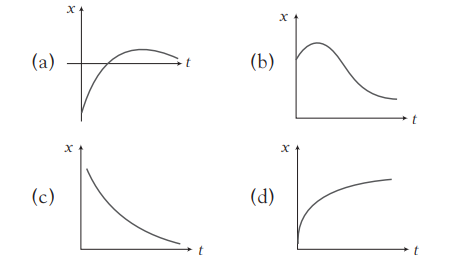
Among the four graph shown in the figure, there is only one graph for which average velocity over the time interval \((0, T)\) can vanish for a suitably chosen \(T\). Which one is it?
 CorrectIncorrect
Hint
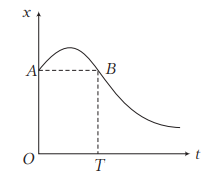
(b) In graph (b) for one value of displacement, there are two different points of time. Hence, for one time, the average velocity is positive and for other time is equivalent negative.
As there are opposite velocities in the interval 0 to \(T\), hence average velocity can vanish in (b). This can be seen in the figure alongside. Here, \(O A=B T\) (same displacement) for two different points of time.
- Question 55 of 62
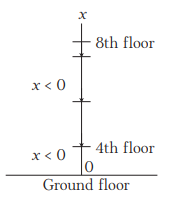
55. Question
A lift is coming from 8th floor and is just about to reach 4th floor. Taking ground floor as origin and positive direction upwards for all quantities, which one of the following is correct?
CorrectIncorrectHint
(a) As the lift is coming in downward directions, displacement will be negative. We have to see whether the motion is accelerating or retarding.
We know that due to downward motion, displacement will be negative. When the lift reaches 4th floor and is about to stop, hence motion is retarding in nature, hence \(x<0 ; a>0\). As displacement is in negative direction, velocity will also be negative, i.e. \(v<0\).
- Question 56 of 62
56. Question
The displacement of a particle is given by \(x=(t-2)^2\), where \(x\) is in metre and \(t\) in second. The distance covered by the particle in first 4 seconds is
CorrectIncorrectHint
(b) Step 1: Find the velocity and determine if the particle changes direction
To find the distance covered, we first need to determine if the particle changes direction. The velocity is the first derivative of the displacement with respect to time. The displacement is given by \(x=(t-2)^2\).
The velocity \(v\) is:
\(
v=\frac{d x}{d t}=\frac{d}{d t}(t-2)^2=2(t-2)
\)
The particle changes direction when its velocity is zero.
\(
\begin{gathered}
2(t-2)=0 \\
t=2 \mathrm{~s}
\end{gathered}
\)
Since the particle changes direction at \(t=2 \mathrm{~s}\), we need to calculate the distance for the two intervals, \(t=0\) to \(t=2\) and \(t=2\) to \(t=4\), and then sum them.
Step 2: Calculate the displacement at key times
We need to find the position of the particle at the beginning of the motion ( \(t=0\) ), at the point where it changes direction ( \(t=2\) ), and at the end of the specified time interval ( \(t=4\) ).
At \(t=0\) :
\(
x(0)=(0-2)^2=4 \mathrm{~m}
\)
At \(t=2\) :
\(
x(2)=(2-2)^2=0 \mathrm{~m}
\)
At \(t=4\) :
\(
x(4)=(4-2)^2=4 m
\)
Step 3: Calculate the total distance covered
The total distance is the sum of the absolute values of the displacements in each interval.
Distance for the first 2 seconds (from \(t=0\) to \(t=2\) ):
\(
d_1=|x(2)-x(0)|=|0-4|=4 m
\)
Distance for the next 2 seconds (from \(t=2\) to \(t=4\) ):
\(
d_2=|x(4)-x(2)|=|4-0|=4 m
\)
Total distance is the sum of \(d_1\) and \(d_2\) :
\(
\text { Total Distance }=d_1+d_2=4+4=8 \mathrm{~m}
\)
The distance covered by the particle in the first 4 seconds is 8 m. - Question 57 of 62
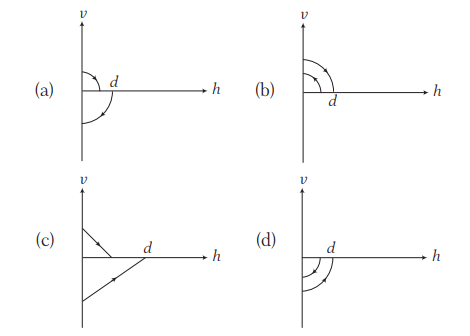
57. Question
A ball is dropped vertically from a height \(d\) above the ground. It hits the ground and bounces up vertically to a height \(d / 2\). Neglecting subsequent motion and air resistance, its velocity \(v\) varies with the height \(\)h\(\) above the ground can be plotted as
 CorrectIncorrect
Hint
(a) For the given condition, initial height \(h=d\) and velocity of the ball is zero. When the ball moves downward, its velocity increases and it will be maximum, when the ball hits the ground and just after the collision, it becomes half and in opposite direction. As the ball moves upwards, its velocity again decreases and becomes zero at height \(d / 2\). This explanation match with graph (a).
- Question 58 of 62
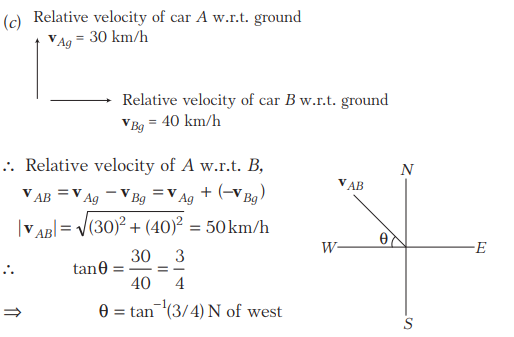
58. Question
A car \(A\) moves along north with velocity \(30 \mathrm{~km} / \mathrm{h}\) and another car \(B\) moves along east with velocity \(40 \mathrm{~km} / \mathrm{h}\). The relative velocity of \(A\) with respect to \(B\) is
CorrectIncorrectHint

- Question 59 of 62
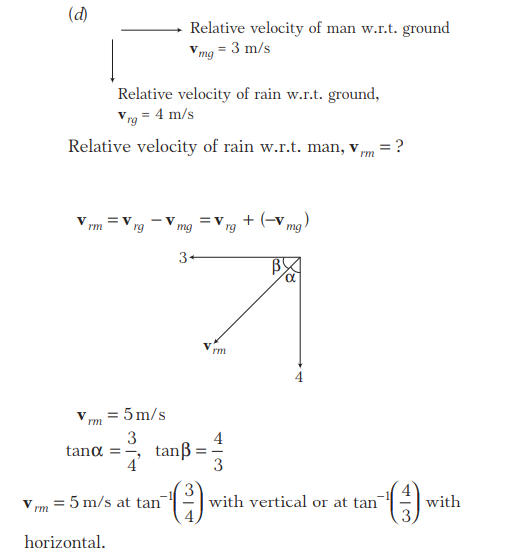
59. Question
Rain is falling vertically downward with velocity \(4 \mathrm{~m} / \mathrm{s}\). A man is moving horizontally with velocity \(3 \mathrm{~m} / \mathrm{s}\), the velocity of rain with respect to man is
CorrectIncorrectHint

- Question 60 of 62
60. Question
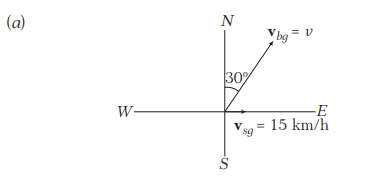
A ship is travelling due east at a speed of \(15 \mathrm{~km} / \mathrm{h}\). Find the speed of a boat heading \(30^{\circ}\) east of north, if it always appears due north from the ship.
CorrectIncorrectHint

where, \(\mathbf{v}_{b g}\) is the velocity of boat w.r.t. ground and \(\mathbf{v}_{s g}\) is the velocity of ship w.r.t. ground.
Relative velocity of boat w.r.t. ship \(\mathbf{v}_{b s}\) is along north.
\(\mathbf{v}_{b s}\) is resultant of \(\mathbf{v}_{b g}\) and \(\mathbf{v}_{s g}\) in opposite direction.
\(
\begin{aligned}
v \cos 30^{\circ} & =v_{b s} \\
v \sin 30^{\circ} & =15 \Rightarrow v=30 \mathrm{~km} / \mathrm{h}
\end{aligned}
\) - Question 61 of 62
61. Question
A man takes 3 h to cover a certain distance along the flow of river and takes 6 h to cover the same distance opposite to the flow of river. In how much time, he will cross this distance in still water?
CorrectIncorrectHint
(b) \(u: v_{r g}\) (velocity of river w.r.t. ground)
\(v: v_{m r}\) (velocity of man w.r.t. river)
Along the flow, \(\quad v_{m g}=v+u, 3=\frac{d}{v+u} \dots(1)\)
where, \(v_{m g}\) is velocity of man w.r.t. ground.
Opposite to the flow,
\(
\begin{aligned}
& & v_{m g} & =v-u, 6=\frac{d}{v-u} \dots(2)\\
\Rightarrow & & t_0 & =\frac{d}{v}=4 \mathrm{~h}
\end{aligned}
\) - Question 62 of 62
62. Question
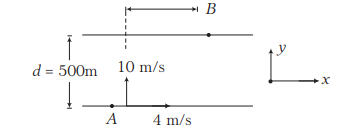
A river 500 m wide is flowing at a rate of \(4 \mathrm{~m} / \mathrm{s}\). A boat is sailing at a velocity of \(10 \mathrm{~m} / \mathrm{s}\) with respect to the water in a direction perpendicular to the river. The time taken by the boat to reach the opposite bank is
CorrectIncorrectHint
(c)

\(
\begin{aligned}
& y: \text { displacement }=\text { velocity } \times \text { time } \\
& \Rightarrow \quad 500=10 t \\
& \Rightarrow \quad t=50 \mathrm{~s}
\end{aligned}
\)