JEE PYQs Integer Type
- An object is said to be in motion if its position changes with time. The position of the object can be specified with reference to a conveniently chosen origin. For motion in a straight line, position to the right of the origin is taken as positive and to the left as negative.
- Path length is defined as the total length of the path traversed by an object.
- Displacement is the change in position : \(\Delta x=x_2-x_1\). Path length is greater or equal to the magnitude of the displacement between the same points.
\(v-t\) curve area gives displacement: \(\left[\Delta {x}=\int {vdt}\right]\) - An object is said to be in uniform motion in a straight line if its displacement is equal in equal intervals of time. Otherwise, the motion is said to be non-uniform.
\(\text { Speed }(v)=\frac{\text { Distance travelled }}{\text { Time taken }}\)
\(\text { Average speed }=\frac{\text { Total distance travelled }}{\text { Total time taken }}\) - \(\text { Instantaneous speed }=\lim _{\Delta t \rightarrow 0} \frac{\Delta s}{\Delta t}=\frac{d x}{d t}\)
- \(\text { Velocity }=\frac{\text { Displacement }}{\text { Time }}\)
\(\text { Average velocity }=\frac{\text { Total displacement }(\Delta x)}{\text { Total time }(\Delta t)}\) - Instantaneous velocity =\(v=\lim _{\Delta t \rightarrow 0} \frac{\Delta x}{\Delta t}=\frac{d x}{d t}\) (Instantaneous velocity is the slope of position time curve)
- The time rate of change of velocity of a body is called acceleration.
\(
\therefore \quad \text { Acceleration }=\frac{\text { Change in velocity }(\Delta v)}{\text { Time interval }(\Delta t)}
\)
\(
\text { Average acceleration }=a_{avg}=\frac{\text { Total change in velocity }}{\text { Total time taken }}
\) - The acceleration of an object at a given instant of time or at a given point during the motion, is called its instantaneous acceleration. i.e.
\(
{a}=\lim _{\Delta t \rightarrow 0} \frac{\Delta {v}}{\Delta t}=\frac{d {v}}{d t}=\frac{d^2 {x}}{d t^2}
\)
\(a-t\) curve area gives change in velocity.
\(
\left[\Delta {v}=\int \text { adt }\right]
\) - The three equations of motion on a straight line are
(i) \(v=u+a t\)
(ii) \(s=u t+\frac{1}{2} a t^2\)
(iii) \(v^2-u^2=2 a s\) - The kinematic equation \(x(t)=x_0+v_0 t+\frac{1}{2} a t^2\)
\(x(t)\) : The final position of the object at a specific time \(t\).
\(x_0\) : The initial position of the object, or its starting point at time \(t=0\).
\(v_0\) : The initial velocity of the object, or its speed and direction at time \(t=0\).
\(a\) : The constant acceleration of the object. It can be positive, negative, or zero.
\(t\) : The time interval over which the motion occurs. - Distance travelled by a body in \(n\)th second,
\(
s_n=u+\frac{1}{2} a(2 n-1)
\) - Stopping distance \(s=\frac{u^2}{2 a}\)
- Equation for motion under gravity are given below
(i) If particle is thrown vertically upwards
\(
\begin{aligned}
v & =u-g t \\
h & =u t-\frac{1}{2} g t^2 \\
v^2 & =u^2-2 g h
\end{aligned}
\)
Time of ascent=\(t=\frac{u}{g}\)
Total flight time \((T)=\frac{2 u}{g}\)
(ii) If particle is thrown vertically downward with some velocity from some height.
\(
\begin{aligned}
v & =u+g t \\
h & =u t+\frac{1}{2} g t^2 \\
v^2 & =u^2+2 g h
\end{aligned}
\) - Maximum height attained by a particle, thrown upwards from ground: \(h_{max}=\frac{u^2}{2 g}\)
Velocity of particle at the time of striking the ground when released \((u=0)\) from a height \(h\) is
\(
v=\sqrt{2 g h}
\)
Time of collision of particle with ground,
\(
t=\sqrt{\frac{2 h}{g}}
\) - When acceleration of particle is not constant, motion is known as non-uniformly accelerated motion. In this case problems can be solved either by differentiation or integration (with some boundary conditions).
For one dimensional motion, above relations can be written as under
(i) \(v=\frac{d s}{d t}\)
(ii) \(a=\frac{d v}{d t}=v \frac{d v}{d s}\)
(iii) \(d s=v d t\) and
(iv) \(d v=a d t \quad\) or \(\quad v d v=a d s\) - The time rate of change of relative position of one object with respect to another is called relative velocity.
The displacement of \(B\) relative to \(A\),
\(
\mathbf{x}_{B A}=\mathbf{x}_B-\mathbf{x}_A
\)
Rate of change of relative displacement w.r.t. time is
\(
\begin{array}{ll}
& \frac{d\left(\mathbf{x}_{B A}\right)}{d t}=\frac{d}{d t}\left(\mathbf{x}_B-\mathbf{x}_A\right) \Rightarrow \frac{d \mathbf{x}_{B A}}{d t}=\frac{d \mathbf{x}_B}{d t}-\frac{d \mathbf{x}_A}{d t} \\
\therefore & \mathbf{v}_{B A}=\mathbf{v}_B-\mathbf{v}_A
\end{array}
\)
Similarly, relative acceleration of \(A\) with respect to \(B\) is
\(
\mathbf{a}_{A B}=\mathbf{a}_A-\mathbf{a}_B
\)
Further, we can see that \(\mathbf{v}_{A B}=-\mathbf{v}_{B A}\) or \(\mathbf{a}_{B A}=-\mathbf{a}_{A B}\) - So, in case of a one dimensional motion, the above equations can be written as
\(
\begin{aligned}
& v_{A B}=v_A-v_B \\
& a_{A B}=a_A-a_B
\end{aligned}
\)
Further, we can see that \({v}_{A B}=-{v}_{B A}\) or \({a}_{B A}=-{a}_{A B}\)
Quiz Summary
0 of 25 Questions completed
Questions:
Information
You have already completed the quiz before. Hence you can not start it again.
Quiz is loading…
You must sign in or sign up to start the quiz.
You must first complete the following:
Results
Results
0 of 25 Questions answered correctly
Your time:
Time has elapsed
You have reached 0 of 0 point(s), (0)
Earned Point(s): 0 of 0, (0)
0 Essay(s) Pending (Possible Point(s): 0)
Categories
- Not categorized 0%
- 1
- 2
- 3
- 4
- 5
- 6
- 7
- 8
- 9
- 10
- 11
- 12
- 13
- 14
- 15
- 16
- 17
- 18
- 19
- 20
- 21
- 22
- 23
- 24
- 25
- Current
- Review
- Answered
- Correct
- Incorrect
- Question 1 of 25
1. Question
A person travelling on a straight line moves with a uniform velocity \(v_1\) for a distance \(x\) and with a uniform velocity \(v_2\) for the next \(\frac{3}{2} x\) distance. The average velocity in this motion is \(\frac{50}{7} \mathrm{~m} / \mathrm{s}\). If \(v_1\) is \(5 \mathrm{~m} / \mathrm{s}\) then \(v_2=\) ____. \(\mathrm{m} / \mathrm{s}\). [JEE Main 2025 (Online) 2nd April Morning Shift]
CorrectIncorrectHint
(a) Step 1: Write the average velocity formula
The average velocity is defined as the total distance traveled divided by the total time taken.
\(
v_{\text {avg }}=\frac{\text { Total Distance }}{\text { Total Time }}
\)
Step 2: Calculate the total distance and total time
The total distance is the sum of the two distances: \(x\) and \(\frac{3}{2} x\).
\(
d_{\text {total }}=x+\frac{3}{2} x=\frac{5}{2} x
\)
The time for each segment is calculated as time = distance/velocity.
Time for the first segment: \(t_1=\frac{x}{v_1}\)
Time for the second segment: \(t_2=\frac{\frac{3}{2} x}{v_2}=\frac{3 x}{2 v_2}\)
The total time is the sum of the times for each segment.
\(
t_{\text {total }}=t_1+t_2=\frac{x}{v_1}+\frac{3 x}{2 v_2}
\)
Step 3: Solve for \(v_2\)
Substitute the expressions for total distance and total time into the average velocity formula, and use the given values \(v_{\text {avg }}=\frac{50}{7} \mathrm{~m} / \mathrm{s}\) and \(v_1=5 \mathrm{~m} / \mathrm{s}\).
\(
\frac{50}{7}=\frac{\frac{5}{2} x}{\frac{x}{5}+\frac{3 x}{2 v_2}}
\)
\(
\begin{aligned}
&\text { Now, solve for } v_2 \text { : }\\
&\begin{aligned}
\frac{1}{5}+\frac{3}{2 v_2}=\frac{\frac{5}{2}}{\frac{50}{7}} & =\frac{5}{2} \cdot \frac{7}{50}=\frac{7}{20} \\
\frac{3}{2 v_2}=\frac{7}{20}-\frac{1}{5} & =\frac{7}{20}-\frac{4}{20}=\frac{3}{20} \\
\frac{1}{2 v_2} & =\frac{1}{20} \\
2 v_2 & =20 \\
v_2=\frac{20}{2} & =10 \mathrm{~m} / \mathrm{s}
\end{aligned}
\end{aligned}
\) - Question 2 of 25
2. Question
Two cars P and Q are moving on a road in the same direction. Acceleration of car P increases linearly with time whereas car Q moves with a constant acceleration. Both cars cross each other at time \(t=0\), for the first time. The maximum possible number of crossing(s) (including the crossing at \(t=0\) ) is ____. [JEE Main 2025 (Online) 29th January Evening Shift]
CorrectIncorrectHint
(b) To determine the maximum number of times the two cars can cross, we need to analyze their relative positions using the equations of motion.
Defining the Equations of Motion
Let the positions of cars \(P\) and \(Q\) be \(x_P(t)\) and \(x_Q(t)\). We are told they cross at \(t=0\), so we can set \(x_P(0)=x_Q(0)=0\).
For Car Q (Constant Acceleration):
The acceleration is \(a_Q=a\).
The position equation is a quadratic:
\(
x_Q(t)=v_Q t+\frac{1}{2} a t^2
\)
For Car P (Linear Acceleration):
The acceleration increases linearly: \(a_P=k t+c\).
To find the position, we integrate twice:
Velocity: \(v_P(t)=\int(k t+c) d t=\frac{1}{2} k t^2+c t+v_P\)
Position: \(x_P(t)=\int\left(\frac{1}{2} k t^2+c t+v_P\right) d t=\frac{1}{6} k t^3+\frac{1}{2} c t^2+v_P t\)
Finding the Number of Crossings
A crossing occurs when \(x_P(t)=x_Q(t)\). Setting the equations equal to each other:
\(
\frac{1}{6} k t^3+\frac{1}{2} c t^2+v_P t=v_Q t+\frac{1}{2} a t^2
\)
Rearrange the terms into a single polynomial equation:
\(
\frac{1}{6} k t^3+\left(\frac{1}{2} c-\frac{1}{2} a\right) t^2+\left(v_P-v_Q\right) t=0
\)
Factor out \(t\) :
\(
t\left[\frac{1}{6} k t^2+\left(\frac{1}{2} c-\frac{1}{2} a\right) t+\left(v_P-v_Q\right)\right]=0
\)
Conclusion:
The solutions for \(t\) represent the crossing points:
\(t=0\) : This is the first crossing mentioned in the problem.
The Quadratic Term: The expression inside the brackets is a quadratic equation of the form \(A t^2+B t+C=0\).
A quadratic equation can have a maximum of 2 real roots. Therefore, excluding \(t=0\), there can be at most 2 more crossings. Adding the initial crossing at \(t=0\), the total maximum number of crossings is:
Maximum number of crossings = 3 - Question 3 of 25
3. Question
The maximum speed of a boat in still water is \(27 \mathrm{~km} / \mathrm{h}\). Now this boat is moving downstream in a river flowing at \(9 \mathrm{~km} / \mathrm{h}\). A man in the boat throws a ball vertically upwards with speed of \(10 \mathrm{~m} / \mathrm{s}\). Range of the ball as observed by an observer at rest on the river bank, is _______ cm. (Take \(\mathrm{g}=10 \mathrm{~m} / \mathrm{s}^2\) ) [JEE Main 2025 January]
CorrectIncorrectHint
(a)
\(
\begin{aligned}
&\overrightarrow{\mathrm{v}}_{\mathrm{b}}=9+27=36 \mathrm{~km} / \mathrm{hr}\\
&\overrightarrow{\mathrm{v}}_{\mathrm{b}}=36 \times \frac{1000}{36000}=10 \mathrm{~m} / \mathrm{sec}\\
&\text { Time of flight }=\frac{2 \times 10}{10}=2 \mathrm{sec}\\
&\text { Range }=10 \times 2=20 \mathrm{~m}=2000 \mathrm{~cm}
\end{aligned}
\)Explanation:
Step 1: Analyze the vertical motion
The ball is thrown vertically upwards with an initial velocity of \(u_y=10 \mathrm{~m} / \mathrm{s}\).
The acceleration due to gravity is \(g=10 \mathrm{~m} / \mathrm{s}^2\) and acts downwards.
The time taken for the ball to reach its maximum height ( \(t_{u p}\) ) can be calculated using the formula \(v=u+a t\). At the maximum height, the final vertical velocity \(\left(v_y\right)\) is 0.
\(
\begin{gathered}
0=10-10 t_{u p} \\
t_{u p}=1 \mathrm{~s}
\end{gathered}
\)
The total time of flight ( \(\boldsymbol{T}\) ) is the time taken to go up and come back down, assuming it’s caught at the same level.
\(
T=2 \times t_{u p}=2 \times 1 \mathrm{~s}=2 \mathrm{~s}
\)
Step 2: Analyze the horizontal motion
The boat is moving downstream.
Speed of boat in still water \(=27 \mathrm{~km} / \mathrm{h}\).
Speed of river flow \(=9 \mathrm{~km} / \mathrm{h}\).
The horizontal velocity of the ball relative to the bank is the sum of the boat’s speed in still water and the river’s speed, as the ball’s horizontal velocity is the same as the boat’s when it is thrown.
First, convert the speeds from \(\mathrm{km} / \mathrm{h}\) to \(\mathrm{m} / \mathrm{s}\).
To convert \(\mathrm{km} / \mathrm{h}\) to \(\mathrm{m} / \mathrm{s}\), multiply by \(\frac{1000}{3600}=\frac{5}{18}\).
Total horizontal velocity \(\left(v_x\right)=(27+9) \mathrm{km} / \mathrm{h}=36 \mathrm{~km} / \mathrm{h}\).
\(
v_x=36 \times \frac{5}{18} \mathrm{~m} / \mathrm{s}=2 \times 5 \mathrm{~m} / \mathrm{s}=10 \mathrm{~m} / \mathrm{s}
\)
Step 3: Calculate the range
The range ( \(\boldsymbol{R}\) ) is the horizontal distance covered by the ball during its time of flight. Since there is no horizontal acceleration, the formula is:
\(
\begin{gathered}
R=v_x \times T \\
R=10 \mathrm{~m} / \mathrm{s} \times 2 \mathrm{~s}=20 \mathrm{~m}=2000 cm
\end{gathered}
\) - Question 4 of 25
4. Question
A particle moves in a straight line so that its displacement \(x\) at any time \(t\) is given by \(x^2=1+t^2\). Its acceleration at any time \(t\) is \(x^{-{n}}\) where \({n}=\)____. [JEE Main 2024 (Online) 6th April Evening Shift]
CorrectIncorrectHint
(c) Step 1: Find the velocity
The displacement is given by the equation \(x^2=1+t^2\).
To find the velocity, we differentiate this equation with respect to time, \(\boldsymbol{t}\).
\(
\begin{gathered}
\frac{d}{d t}\left(x^2\right)=\frac{d}{d t}\left(1+t^2\right) \\
2 x \frac{d x}{d t}=2 t
\end{gathered}
\)
Since velocity, \(v\), is \(\frac{d x}{d t}\), we have:
\(
\begin{aligned}
2 x v & =2 t \\
v & =\frac{t}{x}
\end{aligned}
\)
Step 2: Find the acceleration
To find the acceleration, we differentiate the velocity equation with respect to time, \(\boldsymbol{t}\).
\(
a=\frac{d v}{d t}=\frac{d}{d t}\left(\frac{t}{x}\right)
\)
Using the quotient rule, we get:
\(
\begin{gathered}
a=\frac{x \cdot \frac{d}{d t}(t)-t \cdot \frac{d}{d t}(x)}{x^2} \\
a=\frac{x(1)-t\left(\frac{d x}{d t}\right)}{x^2}=\frac{x-t v}{x^2}
\end{gathered}
\)
Now, substitute the expression for velocity, \(v=\frac{t}{x}\), into the acceleration equation.
\(
\begin{gathered}
a=\frac{x-t\left(\frac{t}{x}\right)}{x^2}=\frac{x-\frac{t^2}{x}}{x^2} \\
a=\frac{\frac{x^2-t^2}{x}}{x^2}=\frac{x^2-t^2}{x^3}
\end{gathered}
\)
Step 3: Express acceleration in terms of displacement \(x\)
From the original displacement equation, we know that \(x^2=1+t^2\).
We can rearrange this to find \(t^2=x^2-1\).
Substitute this expression for \(t^2\) into the acceleration equation:
\(
a=\frac{x^2-\left(x^2-1\right)}{x^3}=\frac{1}{x^3}
\)
This can be written as \(a=x^{-3}\).
By comparing the derived acceleration \(a=x^{-3}\) with the given form \(a=x^{-n}\), we find that \({n}=3\). - Question 5 of 25
5. Question
A body moves on a frictionless plane starting from rest. If \(S_n\) is distance moved between \(\mathrm{t}=\mathrm{n}-1\) and \(\mathrm{t}=\mathrm{n}\) and \(\mathrm{S}_{\mathrm{n}-1}\) is distance moved between \(\mathrm{t}=\mathrm{n}-2\) and \(\mathrm{t}=\mathrm{n}-1\), then the ratio \(\frac{\mathrm{S}_{\mathrm{n}-1}}{\mathrm{~S}_{\mathrm{n}}}\) is \(\left(1-\frac{2}{x}\right)\) for \(\mathrm{n}=10\). The value of \(x\) is ____. [JEE Main 2024 (Online) 5th April Morning Shift]
CorrectIncorrectHint
(d) Step 1: Find the general expression for the distance traveled in the n -th second
The body starts from rest, so its initial velocity is \(\boldsymbol{u}=\mathbf{0}\). The motion is on a frictionless plane, which implies a constant acceleration, let’s call it \(a\).
The displacement of the body after time \(\boldsymbol{t}\) is given by the kinematic equation:
\(
s=u t+\frac{1}{2} a t^2
\)
Since \(u=0\), this simplifies to:
\(
s=\frac{1}{2} a t^2
\)
The distance moved in the \(n\)-th second, \(S_n\), is the difference between the distance traveled in \(n\) seconds and the distance traveled in \(n-1\) seconds.
Distance traveled in \(n\) seconds: \(s(n)=\frac{1}{2} a n^2\)
Distance traveled in \(n-1\) seconds: \(s(n-1)=\frac{1}{2} a(n-1)^2\)
So, the distance moved in the \(n\)-th second is:
\(
\begin{gathered}
S_n=s(n)-s(n-1)=\frac{1}{2} a n^2-\frac{1}{2} a(n-1)^2 \\
S_n=\frac{1}{2} a\left[n^2-(n-1)^2\right]=\frac{1}{2} a\left[n^2-\left(n^2-2 n+1\right)\right]=\frac{1}{2} a(2 n-1)
\end{gathered}
\)
Step 2: Find the general expression for the distance traveled in the ( \(\mathrm{n}-1\) )-th second
Similarly, the distance moved in the ( \(n-1\) )-th second, \(S_{n-1}\), is the difference between the distance traveled in \(\boldsymbol{n}-1\) seconds and the distance traveled in \(\boldsymbol{n}-2\) seconds.
Distance traveled in \(n-1\) seconds: \(s(n-1)=\frac{1}{2} a(n-1)^2\)
Distance traveled in \(n-2\) seconds: \(s(n-2)=\frac{1}{2} a(n-2)^2\)
So, the distance moved in the ( \(n-1\) )-th second is:
\(
\begin{gathered}
S_{n-1}=s(n-1)-s(n-2)=\frac{1}{2} a(n-1)^2-\frac{1}{2} a(n-2)^2 \\
S_{n-1}=\frac{1}{2} a\left[(n-1)^2-(n-2)^2\right]=\frac{1}{2} a\left[\left(n^2-2 n+1\right)-\left(n^2-4 n+4\right)\right]=\frac{1}{2} a(2 n-3)
\end{gathered}
\)
Step 3: Calculate the ratio \(\frac{S_{n-1}}{S_n}\)
Now, we can find the ratio of the two distances:
\(
\frac{S_{n-1}}{S_n}=\frac{\frac{1}{2} a(2 n-3)}{\frac{1}{2} a(2 n-1)}=\frac{2 n-3}{2 n-1}
\)
Step 4: Solve for \(x\)
The problem states that for \(n=10\), the ratio \(\frac{S_{n-1}}{S_n}\) is equal to \(\left(1-\frac{2}{x}\right)\).
First, let’s calculate the ratio for \(n=10\) :
\(
\frac{S_9}{S_{10}}=\frac{2(10)-3}{2(10)-1}=\frac{20-3}{20-1}=\frac{17}{19}
\)
Now, we set this equal to the given expression:
\(
\frac{17}{19}=1-\frac{2}{x}
\)
To solve for \(x\), we can rearrange the equation:
\(
\begin{gathered}
\frac{2}{x}=1-\frac{17}{19} \\
\frac{2}{x}=\frac{19-17}{19} \\
\frac{2}{x}=\frac{2}{19}
\end{gathered}
\)
This implies that \(x=19\). - Question 6 of 25
6. Question
A bus moving along a straight highway with speed of \(72 \mathrm{~km} / \mathrm{h}\) is brought to halt within \(4 s\) after applying the brakes. The distance travelled by the bus during this time (Assume the retardation is uniform) is ______\(m\). [JEE Main 2024 (Online) 4th April Evening Shift]
CorrectIncorrectHint
(b) Step 1: Convert the initial velocity to SI units
The initial velocity is given as \(72 \mathrm{~km} / \mathrm{h}\). To use this value in the equations of motion, we need to convert it to meters per second (m/s).
To convert from \(\mathrm{km} / \mathrm{h}\) to \(\mathrm{m} / \mathrm{s}\), we multiply by \(\frac{1000 \mathrm{~m}}{3600 \mathrm{~s}}\) or \(\frac{5}{18}\).
\(
u=72 \mathrm{~km} / \mathrm{h} \times \frac{5}{18} \frac{\mathrm{~m} / \mathrm{s}}{\mathrm{~km} / \mathrm{h}}=4 \times 5 \mathrm{~m} / \mathrm{s}=20 \mathrm{~m} / \mathrm{s}
\)
So, the initial velocity is \(u=20 \mathrm{~m} / \mathrm{s}\).
Step 2: Calculate the uniform retardation
We can find the acceleration (a) using the first equation of motion, \(v=u+a t\), where the final velocity \((v)\) is 0 since the bus comes to a halt.
\(
\begin{gathered}
0=20+a(4) \\
-4 a=20 \\
a=-5 \mathrm{~m} / \mathrm{s}^2
\end{gathered}
\)
The negative sign indicates retardation.
Step 3: Calculate the distance travelled
We can use the second equation of motion, \(s=u t+\frac{1}{2} a t^2\), to find the distance ( \(s\) ).
\(
\begin{gathered}
s=(20)(4)+\frac{1}{2}(-5)(4)^2 \\
s=80+\frac{1}{2}(-5)(16) \\
s=80-40 \\
s=40 \mathrm{~m}
\end{gathered}
\)
Alternatively, we could use the formula \(s=\frac{u+v}{2} t\).
\(
s=\frac{20+0}{2} \times 4=10 \times 4=40 \mathrm{~m}
\) - Question 7 of 25
7. Question
A particle initially at rest starts moving from reference point \(x=0\) along \(x\)-axis, with velocity \(v\) that varies as \(v=4 \sqrt{x} \mathrm{~m} / \mathrm{s}\). The acceleration of the particle is _______ \(\mathrm{ms}^{-2}\). [JEE Main 2024 (Online) 1st February Evening Shift]
CorrectIncorrectHint
(d) Step 1: Use the chain rule to express acceleration
Acceleration ( \(a\) ) is the time derivative of velocity ( \(v\) ). Since velocity is given as a function of position (\(x\)), we can use the chain rule to find acceleration:
\(
a=\frac{d v}{d t}=\frac{d v}{d x} \cdot \frac{d x}{d t}
\)
Since \(\frac{d x}{d t}\) is velocity \((v)\), the equation for acceleration becomes:
\(
a=v \frac{d v}{d x}
\)
Step 2: Differentiate the velocity function with respect to position
The given velocity function is \(v=4 \sqrt{x}\). We need to find its derivative with respect to \(x\)
\(
\frac{d v}{d x}=\frac{d}{d x}\left(4 x^{1 / 2}\right)=4 \cdot \frac{1}{2} x^{-1 / 2}=\frac{2}{\sqrt{x}}
\)
Step 3: Calculate the acceleration
Substitute the expressions for \(v\) and \(\frac{d v}{d x}\) into the acceleration formula from Step 1:
\(
\begin{aligned}
a=v \frac{d v}{d x} & =(4 \sqrt{x})\left(\frac{2}{\sqrt{x}}\right) \\
a & =4 \cdot 2=8
\end{aligned}
\)
The acceleration of the particle is constant and equal to \(8 \mathrm{~ms}^{-2}\). - Question 8 of 25
8. Question
A particle is moving in one dimension (along \(x\) axis) under the action of a variable force. It’s initial position was 16 m right of origin. The variation of its position ( \(x\) ) with time ( \(t\) ) is given as \(x=-3 t^3+18 t^2+16 t\), where \(x\) is in \(m\) and \(t\) is in s. The velocity of the particle when its acceleration becomes zero is ______ \(\mathrm{m} / \mathrm{s}\). [JEE Main 2024 (Online) 1st February Morning Shift]
CorrectIncorrectHint
(c) Step 1: Find the velocity and acceleration functions
The position of the particle as a function of time is given by \(x(t)=-3 t^3+18 t^2+16 t\). To find the velocity, we differentiate the position function with respect to time:
\(
v(t)=\frac{d x}{d t}=\frac{d}{d t}\left(-3 t^3+18 t^2+16 t\right)=-9 t^2+36 t+16
\)
To find the acceleration, we differentiate the velocity function with respect to time:
\(
a(t)=\frac{d v}{d t}=\frac{d}{d t}\left(-9 t^2+36 t+16\right)=-18 t+36
\)
Step 2: Find the time when acceleration is zero
Set the acceleration function equal to zero and solve for \(t\) :
\(
\begin{gathered}
a(t)=-18 t+36=0 \\
-18 t=-36 \\
t=\frac{-36}{-18}=2 \mathrm{~s}
\end{gathered}
\)
The acceleration of the particle becomes zero at \(t=2 \mathrm{~s}\).
Step 3: Calculate the velocity at that time
Substitute \(t=2 \mathrm{~s}\) into the velocity function to find the velocity when the acceleration is zero:
\(
\begin{gathered}
v(2)=-9(2)^2+36(2)+16 \\
v(2)=-9(4)+72+16 \\
v(2)=-36+72+16 \\
v(2)=36+16 \\
v(2)=52
\end{gathered}
\)
The velocity of the particle when its acceleration becomes zero is \(\mathbf{5 2 ~ m} / \mathbf{s}\). - Question 9 of 25
9. Question
The displacement and the increase in the velocity of a moving particle in the time interval of \(t\) to \((t+1) \mathrm{s}\) are 125 m and \(50 \mathrm{~m} / \mathrm{s}\), respectively. The distance travelled by the particle in \((\mathrm{t}+2)^{\mathrm{th}} \mathrm{s}\) is _______ \(m\). [JEE Main 2024 (Online) 30th January Morning Shift]
CorrectIncorrectHint
(d) Step 1: Find the acceleration and initial velocity of the particle at time \(t\).
We are given that the displacement of the particle in the time interval of \(t\) to \((t+1) \mathrm{s}\) is 125 m , and the increase in velocity is \(50 \mathrm{~m} / \mathrm{s}\). The time duration of this interval is 1 s
Let \(u\) be the velocity at time \(t\) and \(v\) be the velocity at time \((t+1)\). The change in velocity is given by:
\(
v-u=50 \mathrm{~m} / \mathrm{s}
\)
The acceleration \(a\) can be found using the formula \(a=\frac{\Delta v}{\Delta t}\) :
\(
a=\frac{v-u}{(t+1)-t}=\frac{50 \mathrm{~m} / \mathrm{s}}{1 \mathrm{~s}}=50 \mathrm{~m} / \mathrm{s}^2
\)
Now, we can use the displacement formula for a constant acceleration:
\(
S=u t+\frac{1}{2} a t^2
\)
For the time interval of 1 s starting at time \(\boldsymbol{t}\), with an initial velocity of \(u\) :
\(
\begin{gathered}
125=u(1)+\frac{1}{2}(50)(1)^2 \\
125=u+25
\end{gathered}
\)
Solving for \(u\) :
\(
u=125-25=100 \mathrm{~m} / \mathrm{s}
\)
So, the acceleration of the particle is \(50 \mathrm{~m} / \mathrm{s}^2\) and its velocity at time \(t\) is \(100 \mathrm{~m} / \mathrm{s}\).
Step 2: Find the distance travelled by the particle in the \((t+2)^{\mathrm{th}} \mathrm{s}\)
The \((t+2)^{\mathrm{th}} \mathrm{s}\) is the time interval from \(t+1\) to \(t+2\). We need to find the distance traveled during this one-second interval.
First, let’s find the velocity of the particle at the beginning of this interval, which is at time \(t+1\). We can use the formula \(v=u+a t\) :
\(
v_{t+1}=u+a((t+1)-t)=u+a(1)=100+50(1)=150 \mathrm{~m} / \mathrm{s}
\)
The initial velocity for this interval ( 1 s duration) is \(v_{t+1}=150 \mathrm{~m} / \mathrm{s}\). Now, we can calculate the distance traveled using the displacement formula:
\(
S=u t+\frac{1}{2} a t^2
\)
For the interval \([t+1, t+2]\), the initial velocity is \(150 \mathrm{~m} / \mathrm{s}\), the time is 1 s , and the acceleration is \(50 \mathrm{~m} / \mathrm{s}^2\).
\(
\begin{gathered}
S_{t+2}=150(1)+\frac{1}{2}(50)(1)^2 \\
S_{t+2}=150+25=175 \mathrm{~m}
\end{gathered}
\) - Question 10 of 25
10. Question
A body falling under gravity covers two points \(A\) and \(B\) separated by 80 m in 2 s. The distance of upper point A from the starting point is ______ \(m\) (use \(\mathrm{g}=10 \mathrm{~ms}^{-2}\) ). [JEE Main 2024 (Online) 27th January Evening Shift]
CorrectIncorrectHint
(c) Step 1: Define variables and the equation of motion
Let \(h_A\) be the distance of point A from the starting point, and \(h_B\) be the distance of point B from the starting point. Let \(v_A\) be the velocity of the body at point A and \(v_B\) be the velocity at point B. The starting velocity is \(v_0=0\).The equation of motion for a body falling under constant acceleration \(\boldsymbol{g}\) is given by:
\(
h=v_0 t+\frac{1}{2} g t^2
\)
Since the body starts from rest ( \(v_0=0\) ), the equation simplifies to:
\(
h=\frac{1}{2} g t^2
\)
The distance between points A and \(\mathrm{B}, h_{A B}\), is \(h_B-h_A\). The time taken to travel this distance is \(t_{A B}=2 \mathrm{~s}\).
Step 2: Use the distance and time between points A and B
The distance covered between \(A\) and \(B\) can be expressed in terms of the initial velocity at \(\mathrm{A}\left(v_A\right)\), the time taken to travel from A to \(\mathrm{B}\left(t_{A B}\right)\), and the acceleration due to gravity \((g)\).
The equation of motion for this segment is:
\(
h_{A B}=v_A t_{A B}+\frac{1}{2} g\left(t_{A B}\right)^2
\)
\(
\begin{aligned}
&\text { We can substitute the given values: }\\
&80=v_A(2)+\frac{1}{2}(10)(2)^2
\end{aligned}
\)
\(
v_A=30 \mathrm{~m} / \mathrm{s}
\)
Step 3: Calculate the distance of point A from the starting point
Now we use the velocity at point A to find its distance from the starting point. We can use the equation:
\(
v_A^2=v_0^2+2 g h_A
\)
Since the starting velocity \(v_0=0\), the equation becomes:
\(
v_A^2=2 g h_A
\)
We can now solve for \(\boldsymbol{h}_{\boldsymbol{A}}\) :
\(
\begin{aligned}
h_A & =\frac{v_A^2}{2 g} \\
h_A & =\frac{(30)^2}{2(10)} \\
h_A & =\frac{900}{20} \\
h_A & =45 \mathrm{~m}
\end{aligned}
\)
The distance of upper point A from the starting point is \(\mathbf{4 5 ~ m}\). - Question 11 of 25
11. Question
For a train engine moving with speed of \(20 \mathrm{~ms}^{-1}\), the driver must apply brakes at a distance of 500 m before the station for the train to come to rest at the station. If the brakes were applied at half of this distance, the train engine would cross the station with speed \(\sqrt{x} \mathrm{~ms}^{-1}\). The value of \(x\) is _______. [JEE Main 2023 (Online) 1st February Evening Shift]
(Assuming same retardation is produced by brakes)CorrectIncorrectHint
(b) Step 1: Calculate the retardation of the train
We can use the kinematic equation \(v^2=u^2+2 a s\), where \(v\) is the final velocity, \(u\) is the initial velocity, \(a\) is the acceleration, and \(s\) is the distance.
In the first scenario, the train comes to rest, so the final velocity \(v=0\). The initial velocity \(u=20 \mathrm{~ms}^{-1}\) and the distance \(s=500 \mathrm{~m}\).
\(
\begin{gathered}
v^2=u^2+2 a s \\
0^2=(20)^2+2(a)(500) \\
0=400+1000 a \\
1000 a=-400 \\
a=-0.4 \mathrm{~ms}^{-2}
\end{gathered}
\)
Step 2: Calculate the final speed in the second scenario
In the second scenario, the brakes are applied at half the distance, so the distance \(s=250 \mathrm{~m}\). The initial velocity remains \(u=20 \mathrm{~ms}^{-1}\), and the retardation is the same, \(a=-0.4 \mathrm{~ms}^{-2}\). The final speed is given as \(\sqrt{x} \mathrm{~ms}^{-1}\).
Using the same kinematic equation:
\(
\begin{gathered}
v^2=u^2+2 a s \\
(\sqrt{x})^2=(20)^2+2(-0.4)(250) \\
x=400-200 \\
x=200
\end{gathered}
\) - Question 12 of 25
12. Question
A horse rider covers half the distance with \(5 \mathrm{~m} / \mathrm{s}\) speed. The remaining part of the distance was travelled with speed \(10 \mathrm{~m} / \mathrm{s}\) for half the time and with speed \(15 \mathrm{~m} / \mathrm{s}\) for other half of the time. The mean speed of the rider averaged over the whole time of motion is \(\frac{x}{7} \mathrm{~m} / \mathrm{s}\). The value of \(x\) is ______. [JEE Main 2023 (Online) 30th January Morning Shift]
CorrectIncorrectHint
(a)
\(
\begin{aligned}
& \Rightarrow t_1=\frac{\frac{S}{2}}{5} \ldots \ldots .(1) \\
& \text { Also, } \frac{S}{2}=\frac{10 t_2}{2}+\frac{15 t_2}{2} \\
& \Rightarrow t_2=\frac{S}{25} \ldots \ldots .(2) \\
& \Rightarrow \text { Mean speed }=\frac{S}{t_1+t_2} \\
& =\frac{S}{\frac{S}{10}+\frac{S}{25}}=\frac{250}{35} \mathrm{~m} / \mathrm{s}=\frac{50}{7} \mathrm{~m} / \mathrm{s}
\end{aligned}
\)Explanation:
Step 1: Calculate the time taken for the first half of the journey
Let the total distance be \(2 D\).
The first half of the journey covers a distance of \(D\) with a speed of \(v_1=5 \mathrm{~m} / \mathrm{s}\).
The time taken for this part of the journey is:
\(
t_1=\frac{\text { distance }}{\text { speed }}=\frac{D}{5}
\)
Step 2: Calculate the time taken for the second half of the journey
The remaining distance is also \(\boldsymbol{D}\). This distance is covered in two equal time intervals.
Let the total time for the second half be \(\boldsymbol{t}_2\). The two time intervals are each \(\frac{\boldsymbol{t}_2}{2}\).
The speeds for these intervals are \(v_2=10 \mathrm{~m} / \mathrm{s}\) and \(v_3=15 \mathrm{~m} / \mathrm{s}\).
The total distance \(\boldsymbol{D}\) for the second half is the sum of the distances covered in these two intervals:
\(
\begin{gathered}
D=v_2\left(\frac{t_2}{2}\right)+v_3\left(\frac{t_2}{2}\right) \\
D=10\left(\frac{t_2}{2}\right)+15\left(\frac{t_2}{2}\right) \\
D=5 t_2+7.5 t_2=12.5 t_2 \\
t_2=\frac{D}{12.5}=\frac{2 D}{25}
\end{gathered}
\)
Step 3: Calculate the mean speed over the whole journey
The mean speed is the total distance divided by the total time.
Total distance \(=2 D\)
Total time \(\boldsymbol{T}=t_1+t_2=\frac{\boldsymbol{D}}{5}+\frac{2 \boldsymbol{D}}{25}\)
To combine the fractions, we use a common denominator of 25 :
\(
T=\frac{5 D}{25}+\frac{2 D}{25}=\frac{7 D}{25}
\)
The mean speed ( \(\mathrm{v}_{\text {avg }}\) ) is:
\(
\mathrm{v}_{\text {avg }}=\frac{\text { Total distance }}{\text { Total time }}=\frac{2 D}{\frac{7 D}{25}}=\frac{2 D \times 25}{7 D}=\frac{50}{7} \mathrm{~m} / \mathrm{s}
\)
The mean speed is \(\frac{50}{7} \mathrm{~m} / \mathrm{s}\). The problem states that the mean speed is \(\frac{x}{7} \mathrm{~m} / \mathrm{s}\). By comparing the two expressions, we can find the value of \(x\).
\(
\begin{aligned}
& \frac{x}{7}=\frac{50}{7} \\
& x=\mathbf{5 0}
\end{aligned}
\) - Question 13 of 25
13. Question
A tennis ball is dropped on to the floor from a height of 9.8 m. It rebounds to a height 5.0 m. Ball comes in contact with the floor for 0.2 s. The average acceleration during contact is _______ \(\mathrm{ms}^{-2}\)[/latex]. [JEE Main 2023 (Online) 29th January Morning Shift]
(Given \(\mathrm{g}=10 \mathrm{~ms}^{-2}\) )CorrectIncorrectHint
(b)
\(
\begin{aligned}
& \mathrm{v}_{\mathrm{i}}=\sqrt{2 \mathrm{gh}_{\mathrm{i}}} \\
& =\sqrt{2 \times 10 \times 9.8} \downarrow \\
& =14 \mathrm{~m} / \mathrm{s} \downarrow \\
& \mathrm{v}_{\mathrm{f}}=\sqrt{2 \mathrm{gh}_{\mathrm{f}}} \\
& =\sqrt{2 \times 10 \times 5} \uparrow \\
& =\mathbf{1 0 ~ m} / \mathbf{s} \uparrow \\
& \left|\overrightarrow{\mathrm{a}}_{\text {avg }}\right|=\left|\frac{\Delta \overrightarrow{\mathrm{v}}}{\Delta \mathrm{t}}\right| \\
& =\frac{10+14}{0.2}=120 \mathrm{~m} / \mathrm{s}^2
\end{aligned}
\)Explanation: Step 1: We use the kinematic equation \(v^2=u^2+2 a s\) to find the velocity of the ball just before it hits the floor. The initial velocity is \(u=0\), acceleration is \(a=g=10 \mathrm{~ms}^{-2}\), and the distance is the initial height \(s=h_1=9.8 \mathrm{~m}\).
\(
\begin{gathered}
v_{\text {before }}^2=0^2+2(10)(9.8)=196 \\
v_{\text {before }}=\sqrt{196}=14 \mathrm{~ms}^{-1}
\end{gathered}
\)
By defining the upward direction as positive, the velocity before contact is
\(
v_1=-14 \mathrm{~ms}^{-1}
\)
Step 2: Calculate the velocity of the ball just after it leaves the floor
The ball rebounds to a height of \(h_2=5.0 \mathrm{~m}\). At the peak of its rebound, its velocity is 0. Using the same kinematic equation for the upward motion, with final velocity \(v=0\), acceleration \(a=-g=-10 \mathrm{~ms}^{-2}\), and distance \(s=h_2=5.0 \mathrm{~m}\), we find the velocity after contact, \(v_{\text {after }}\).
\(
\begin{gathered}
0^2=v_{a f t e r}^2+2(-10)(5.0) \\
v_{a f t e r}^2=100 \\
v_{a f t e r}=\sqrt{100}=10 \mathrm{~ms}^{-1}
\end{gathered}
\)
Since the ball is moving upwards, its velocity after contact is \(v_2=+10 \mathrm{~ms}^{-1}\).
Step 3: Calculate the average acceleration during contact
The average acceleration is the change in velocity divided by the time interval. The change in velocity, \(\Delta v\), is the final velocity minus the initial velocity \(\left(v_2-v_1\right)\). The time interval, \(\Delta t\), is the contact time.
\(
\begin{gathered}
\mathrm{a}_{a v g}=\frac{\Delta v}{\Delta t}=\frac{v_2-v_1}{\Delta t} \\
\mathrm{a}_{a v g}=\frac{10-(-14)}{0.2}=\frac{24}{0.2}=120 \mathrm{~ms}^{-2}
\end{gathered}
\) - Question 14 of 25
14. Question
A ball is thrown vertically upwards with a velocity of \(19.6 \mathrm{~ms}^{-1}\) from the top of a tower. The ball strikes the ground after 6 s. The height from the ground up to which the ball can rise will be \(\left(\frac{k}{5}\right) \mathrm{m}\). The value of \(k\) is _____. (use \(\left.\mathrm{g}=9.8 \mathrm{~m} / \mathrm{s}^2\right)\) [JEE Main 2022 (Online) 28th July Evening Shift]
CorrectIncorrectHint
(a)
\(
\begin{aligned}
& t_a=\frac{u}{g}=\frac{19.6}{9.8}=2 \mathrm{~s} \\
& t_d=6-2 \mathrm{~s}=\sqrt{\frac{2 h_{\max }}{g}} \\
& \Rightarrow h_{\max }=\frac{16 \times 9.8}{2}=\frac{392}{5}
\end{aligned}
\)Explanation: Step 1: Calculate the maximum height the ball rises above the tower
The ball’s upward motion stops when its velocity becomes 0. We can use the kinematic equation \(v^2=u^2+2 a s\) to find the maximum height above the tower.
Initial velocity \((u)=19.6 \mathrm{~m} / \mathrm{s}\)
Final velocity at the peak \((v)=0 \mathrm{~m} / \mathrm{s}\)
Acceleration \((a)=-9.8 \mathrm{~m} / \mathrm{s}^2\) (negative because gravity acts downwards)
Displacement \(\left(s_1\right)\) is the height above the tower.
\(
\begin{aligned}
0^2 & =(19.6)^2+2(-9.8) s_1 \\
0 & =384.16-19.6 s_1 \\
s_1 & =\frac{384.16}{19.6}=19.6 \mathrm{~m}
\end{aligned}
\)
Step 2: Calculate the height of the tower
Next, we can determine the height of the tower by considering the ball’s total displacement from its starting point to the ground. The total displacement \(\left(s_2\right)\) will be a negative value, equal to the negative of the tower’s height ( \(h\) ). We can use the kinematic equation \(s=u t+\frac{1}{2} a t^2\).
Initial velocity \((u)=19.6 \mathrm{~m} / \mathrm{s}\)
Total time \((t)=6 \mathrm{~s}\)
Acceleration \((a)=-9.8 \mathrm{~m} / \mathrm{s}^2\)
\(
\begin{gathered}
s_2=(19.6)(6)+\frac{1}{2}(-9.8)(6)^2 \\
s_2=117.6-4.9(36) \\
s_2=117.6-176.4 \\
s_2=-58.8 \mathrm{~m}
\end{gathered}
\)
The height of the tower is \(|-58.8|=58.8 \mathrm{~m}\).
Step 3: Calculate the total height from the ground
The total height the ball rises from the ground is the sum of the height of the tower and the maximum height the ball rose above the tower.
Total Height = Tower height + Max height above tower
Total Height \(=58.8 \mathrm{~m}+19.6 \mathrm{~m}=78.4 \mathrm{~m}\)
Step 4: Find the value of \(k\)
The problem states that the maximum height is \(\left(\frac{k}{5}\right) \mathrm{m}\). We can set our calculated total height equal to this expression to find the value of \(k\).
\(
\begin{gathered}
\frac{k}{5}=78.4 \\
k=78.4 \times 5 \\
k=392
\end{gathered}
\) - Question 15 of 25
15. Question
A particle is moving in a straight line such that its velocity is increasing at \(5 \mathrm{~ms}^{-1}\) per meter. The acceleration of the particle is _______ \(\mathrm{ms}^{-2}\) at a point where its velocity is \(20 \mathrm{~ms}^{-1}\). [JEE Main 2022 (Online) 25th July Evening Shift]
CorrectIncorrectHint
(d) Step 1: Understand the given information and the goal
The problem states that the velocity of a particle is increasing at a rate of \(5 \mathrm{~ms}^{-1}\) per meter. This gives us the rate of change of velocity with respect to position, which is \(\frac{d v}{d x}=5 \mathrm{~s}^{-1}\). We are also given the velocity of the particle at a specific point, \(v=20 \mathrm{~ms}^{-1}\). The goal is to find the acceleration (\(a\)) of the particle at this point.
Step 2: Use the relationship between acceleration, velocity, and position
The acceleration of a particle can be expressed in terms of its velocity and the rate of change of velocity with respect to position using the chain rule:
\(
a=\frac{d v}{d t}=\frac{d v}{d x} \cdot \frac{d x}{d t}
\)
Since the rate of change of position with respect to time, \(\frac{d x}{d t}\), is the velocity \((v)\), the equation for acceleration becomes:
\(
a=v \frac{d v}{d x}
\)
Step 3: Calculate the acceleration
Substitute the given values into the equation from Step 2:
\(
\begin{gathered}
a=\left(20 \mathrm{~ms}^{-1}\right)\left(5 \mathrm{~s}^{-1}\right) \\
a=100 \mathrm{~ms}^{-2}
\end{gathered}
\) - Question 16 of 25
16. Question
A car is moving with speed of \(150 \mathrm{~km} / \mathrm{h}\) and after applying the break it will move 27 m before it stops. If the same car is moving with a speed of one third the reported speed then it will stop after travelling ______ \(m\) distance. [JEE Main 2022 (Online) 25th July Morning Shift]
CorrectIncorrectHint
(c)
\(
\text { Stopping distance }=\frac{v^2}{2 a}=d
\)
If speed is made \(\frac{1}{3} \mathrm{rd}\)
\(
\mathrm{d}^{\prime}=\frac{1}{9} \mathrm{~d} . \quad \mathrm{d}^{\prime}=\frac{27}{9}=3
\)
Braking acceleration remains same.Explanation: Step 1: Establish the relationship between speed and stopping distance
We can use the kinematic equation \(v_f^2=v_i^2+2 a d\) to solve this problem, where \(v_f\) is the final velocity, \(v_i\) is the initial velocity, \(a\) is the constant deceleration, and \(d\) is the stopping distance. Since the car comes to a stop, the final velocity \(v_f=0\).
This simplifies the equation to:
\(
0=v_i^2+2 a d
\)
Rearranging the equation to solve for distance, we get:
\(
d=-\frac{v_i^2}{2 a}
\)
Here, the deceleration \(a\) is constant and negative. We can see that the stopping distance \(d\) is directly proportional to the square of the initial speed \(v_i\).
\(
d \propto v_i^2
\)
Step 2: Use the proportionality to find the new stopping distance
Let \(v_1\) be the initial speed and \(d_1\) be the stopping distance in the first case.
Let \(v_2\) be the new speed and \(d_2\) be the new stopping distance.
From the relationship established in Step 1, we can write a ratio:
\(
\frac{d_2}{d_1}=\frac{v_2^2}{v_1^2}=\left(\frac{v_2}{v_1}\right)^2
\)
The problem states that the new speed \(v_2\) is one-third of the original speed \(v_1\).
\(
v_2=\frac{1}{3} v_1
\)
Substituting this into the ratio equation:
\(
\frac{d_2}{d_1}=\left(\frac{\frac{1}{3} v_1}{v_1}\right)^2=\left(\frac{1}{3}\right)^2=\frac{1}{9}
\)
Solving for the new stopping distance \(d_2\) :
\(
d_2=\frac{1}{9} d_1
\)
Step 3: Calculate the final answer
Given that the original stopping distance \(d_1\) is 27 m :
\(
d_2=\frac{1}{9} \times 27 \mathrm{~m}=3 \mathrm{~m}
\)
The car will stop after traveling 3 m. - Question 17 of 25
17. Question
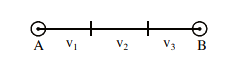
A car covers AB distance with first one-third at velocity \(\mathrm{v}_1 \mathrm{~ms}^{-1}\), second one-third at \(\mathrm{v}_2 \mathrm{~ms}^{-1}\) and last one-third at \(v_3 \mathrm{~ms}^{-1}\). If \(v_3=3 v_1, v_2=2 v_1\) and \(v_1=11 \mathrm{~ms}^{-1}\) then the average velocity of the car is ________ \(\mathrm{ms}^{-1}\). [JEE Main 2022 (Online) 28th June Evening Shift]
 CorrectIncorrect
Hint
(d)
Define Average Velocity:
The average velocity (\(v_{\text {avg }}\)) is given by the total distance traveled divided by the total time taken:
\(
v_{a v g}=\frac{\text { Total Distance }}{\text { Total Time }}
\)
Let the total distance \(A B\) be \(D\). The journey is divided into three equal parts, each of distance \(\frac{D}{3}\).
Calculate Time for Each Segment:
The time taken for each segment is distance divided by velocity:
First segment: \(t_1=\frac{D / 3}{v_1}=\frac{D}{3 v_1}\)
Second segment: \(t_2=\frac{D / 3}{v_2}=\frac{D}{3 v_2}\)
Third segment: \(t_3=\frac{D / 3}{v_3}=\frac{D}{3 v_3}\)
Deriving the Formula:
The total time \(T\) is:
\(
T=t_1+t_2+t_3=\frac{D}{3}\left(\frac{1}{v_1}+\frac{1}{v_2}+\frac{1}{v_3}\right)
\)
The average velocity is:
\(
v_{a v g}=\frac{D}{\frac{D}{3}\left(\frac{1}{v_1}+\frac{1}{v_2}+\frac{1}{v_3}\right)}=\frac{3}{\frac{1}{v_1}+\frac{1}{v_2}+\frac{1}{v_3}}
\)
Substitute the Given Values:
We are given:
\(v_1=11 \mathrm{~m} / \mathrm{s}\)
\(v_2=2 v_1=22 \mathrm{~m} / \mathrm{s}\)
\(v_3=3 v_1=33 \mathrm{~m} / \mathrm{s}\)
Substitute these into the formula:
\(
v_{a v g}=\frac{3}{\frac{1}{v_1}+\frac{1}{2 v_1}+\frac{1}{3 v_1}}
\)
Taking the common denominator \(\left(6 v_1\right)\) in the denominator:
\(
v_{a v g}=\frac{3}{\frac{6+3+2}{6 v_1}}=\frac{3 \times 6 v_1}{11}=\frac{18 v_1}{11}
\)
Final Calculation:
Substitute \(v_1=11 \mathrm{~m} / \mathrm{s}\) :
\(
v_{a v g}=\frac{18 \times 11}{11}=18 \mathrm{~m} / \mathrm{s}
\)
The average velocity of the car is \(18 \mathrm{~ms}^{-1}\). - Question 18 of 25
18. Question
A ball is projected vertically upward with an initial velocity of \(50 \mathrm{~ms}^{-1}\) at \(t=0 \mathrm{~s}\). At \(t=2 \mathrm{~s}\), another ball is projected vertically upward with same velocity. At \(t=\) _______ s , second ball will meet the first ball \(\left(\mathrm{g}=10 \mathrm{~ms}^{-2}\right)\). [JEE Main 2022 (Online) 26th June Evening Shift]
CorrectIncorrectHint
(a)
Let they meet at \(\mathrm{t}=\mathrm{t}\)
So first ball gets t sec. \(\& 2^{\text {nd }}\) gets \((\mathrm{t}-2)\) sec. \(\&\) they will meet at same height
\(
\begin{gathered}
\mathrm{h}_1=50 \mathrm{t}-\frac{1}{2} \mathrm{gt}^2 \\
\mathrm{~h}_2=50(\mathrm{t}-2)-\frac{1}{2} \mathrm{~g}(\mathrm{t}-2)^2 \\
\mathrm{~h}_1=\mathrm{h}_2 \\
50 \mathrm{t}-\frac{1}{2} \mathrm{gt}^2=50(\mathrm{t}-2)-\frac{1}{2} \mathrm{~g}(\mathrm{t}-2)^2 \\
100=\frac{1}{2} \mathrm{gt}^2-(\mathrm{t}-2)^2 \\
100=\frac{10}{2}[4 \mathrm{t}-4] \\
5=\mathrm{t}-1 \\
\mathrm{t}=6 \text { sec. }
\end{gathered}
\)Explanation: Step 1: Formulate the equations of motion for both balls
The height of a ball projected vertically upward can be described by the kinematic equation \(s=u t+\frac{1}{2} a t^2\), where \(s\) is the height, \(u\) is the initial velocity, \(a\) is the acceleration, and \(t\) is the time. Using \(g=10 \mathrm{~ms}^{-2}\) as the acceleration due to gravity (acting downward), the equation for height \(y\) is \(y=u t-\frac{1}{2} g t^2\).
For the first ball, which is launched at \(t=0 \mathrm{~s}\) with an initial velocity of \(u=50 \mathrm{~ms}^{-1}\) :
\(
\begin{gathered}
y_1=50 t-\frac{1}{2}(10) t^2 \\
y_1=50 t-5 t^2
\end{gathered}
\)
For the second ball, which is launched at \(t=2 \mathrm{~s}\) with the same initial velocity, its time in the air is \((t-2)\) seconds. Therefore, the equation for its height is:
\(
\begin{gathered}
y_2=50(t-2)-\frac{1}{2}(10)(t-2)^2 \\
y_2=50(t-2)-5(t-2)^2
\end{gathered}
\)
Step 2: Set the heights equal to find the meeting time
The two balls will meet when their heights are equal, so we set \(y_1=y_2\) :
\(
50 t-5 t^2=50(t-2)-5(t-2)^2
\)
Now, simplify the equation:
\(
\begin{aligned}
& 50 t-5 t^2=50 t-100-5\left(t^2-4 t+4\right) \\
& 50 t-5 t^2=50 t-100-5 t^2+20 t-20
\end{aligned}
\)
Cancel out the \(50 t\) and \(-5 t^2\) terms from both sides:
\(
\begin{gathered}
0=-100+20 t-20 \\
0=20 t-120
\end{gathered}
\)
Solve for \(t\) :
\(
\begin{aligned}
20 t & =120 \\
t & =\frac{120}{20} \\
t & =6
\end{aligned}
\)
The second ball will meet the first ball at \(\boldsymbol{t}=\mathbf{6} \mathrm{s}\). - Question 19 of 25
19. Question
A ball of mass 0.5 kg is dropped from the height of 10 m. The height, at which the magnitude of velocity becomes equal to the magnitude of acceleration due to gravity, is _____ m. [Use \(\mathrm{g}=10 \mathrm{~m} / \mathrm{s}^2\) ] [JEE Main 2022 (Online) 26th June Morning Shift]
CorrectIncorrectHint
(b)
\(
\begin{aligned}
&\begin{gathered}
v^2=u^2+2 a s \\
100=0+2(10) s \\
s=5 m
\end{gathered}\\
&\text { Height from ground }=10-5=5 \mathrm{~m}
\end{aligned}
\)Explanation: Step 1: Find the velocity at which its magnitude equals the magnitude of acceleration due to gravity
The problem states that the magnitude of the velocity \(|{v}|\) becomes equal to the magnitude of the acceleration due to gravity \(g\).
\(
|v|=g=10 \mathrm{~m} / \mathrm{s}
\)
Step 2: Use kinematics to find the distance fallen
We can use the kinematic equation \(v^2=u^2+2 a s\), where:
\(v\) is the final velocity.
\(u\) is the initial velocity.
\(a\) is the acceleration.
\(s\) is the distance traveled.
Since the ball is dropped, the initial velocity \(\boldsymbol{u}=0\). The acceleration is due to gravity, so \(a=g=10 \mathrm{~m} / \mathrm{s}^2\). The final velocity is \(v=10 \mathrm{~m} / \mathrm{s}\) (as per Step 1 ).
Substituting these values into the equation:
\(
\begin{gathered}
(10)^2=(0)^2+2(10) s \\
100=20 s \\
s=\frac{100}{20}=5 \mathrm{~m}
\end{gathered}
\)
This value, \(s\), represents the distance the ball has fallen from its initial height of 10 m.
Step 3: Calculate the height of the ball from the ground
The height of the ball from the ground, \(h_{\text {final }}\), is the initial height minus the distance it has fallen.
Initial height, \(h_{\text {initial }}=10 \mathrm{~m}\).
Distance fallen, \(s=5 \mathrm{~m}\).
\(
\begin{gathered}
h_{\text {final }}=h_{\text {initial }}-s \\
h_{\text {final }}=10 \mathrm{~m}-5 \mathrm{~m}=5 \mathrm{~m}
\end{gathered}
\)
The height, at which the magnitude of velocity becomes equal to the magnitude of acceleration due to gravity, is \(\mathbf{5 ~ m}\). - Question 20 of 25
20. Question
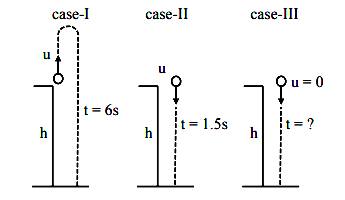
From the top of a tower, a ball is thrown vertically upward which reaches the ground in 6 s. A second ball thrown vertically downward from the same position with the same speed reaches the ground in 1.5 s. A third ball released, from the rest from the same location, will reach the ground in _______ s. [JEE Main 2022 (Online) 24th June Morning Shift]
CorrectIncorrectHint
(c) Let height of tower be \(h\) and speed of projection in first two cases be \(u\).

For case-I: \(2^{\text {nd kinematics}}\) equation \(s=u t+1 / 2 a t^2\)
\(
\begin{aligned}
& \mathrm{h}=-\mathrm{u}(6)+\frac{1}{2} \mathrm{~g}(6)^2 \\
& \mathrm{h}=-6 \mathrm{u}+18 \mathrm{~g} \dots(i)
\end{aligned}
\)
For case-II : \(\mathrm{h}=\mathrm{u}(1.5)+\frac{1}{2} \mathrm{~g}(1.5)^2\)
\(
\mathrm{h}=1.5 \mathrm{u}+\frac{2.25 \mathrm{~g}}{2} \ldots \text { (ii) }
\)
\(
\begin{aligned}
&\text { Multiplying equation (ii) by } 4 \text { we get }\\
&4 h=6 u+4.5 g \ldots . \text { (iii) }
\end{aligned}
\)
equation (i) + equation (iii) we get \(5 \mathrm{~h}=22.5 \mathrm{~g}\)
\(
\mathrm{h}=4.5 \mathrm{~g} \ldots \text { (iv) }
\)
For case-III:
\(
\mathrm{h}=0+\frac{1}{2} g \mathrm{t}^2 \dots(v)
\)
Using equation (iv) & equation (v)
\(
\begin{aligned}
& 4.5 g=\frac{1}{2} g t^2 \\
& t^2=9 \Rightarrow t=3 \mathrm{~s}
\end{aligned}
\) - Question 21 of 25
21. Question
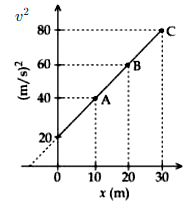
A particle is moving with constant acceleration ‘ \(a\) ‘. Following graph shows \(v^2\) versus \(x\) (displacement) plot. The acceleration of the particle is ______ \(\mathrm{m} / \mathrm{s}^2\). [JEE Main 2021 (Online) 31st August Evening Shift]
 CorrectIncorrect
Hint
(a)
\(
\begin{aligned}
& {y}={mx}+{C} \\
& {v}^2=\frac{20}{10} {x}+20 \\
& {v}^2=2 {x}+20 \\
& 2 {v} \frac{d v}{d x}=2 \\
& \therefore {a}={v} \frac{d v}{d x}=1
\end{aligned}
\) - Question 22 of 25
22. Question
If the velocity of a body related to displacement \(x\) is given by \(v=\sqrt{5000+24 x} \mathrm{~m} / \mathrm{s}\), then the acceleration of the body is ________ \(\mathrm{m} / \mathrm{s}^2\). [JEE Main 2021 (Online) 27th August Morning Shift]
CorrectIncorrectHint
(d) Step 1: Relate acceleration to velocity and displacement
The acceleration \(\boldsymbol{a}\) can be found from the velocity \(\boldsymbol{v}\) as a function of displacement \(\boldsymbol{x}\) by using the chain rule. The formula for acceleration is given by:
\(
a=\frac{d v}{d t}=\frac{d v}{d x} \cdot \frac{d x}{d t}
\)
Since \(\frac{d x}{d t}\) is the velocity \(v\), the formula simplifies to:
\(
a=v \frac{d v}{d x}
\)
Step 2: Differentiate the velocity function
The given velocity is \(v=\sqrt{5000+24 x}\). To find \(\frac{d v}{d x}\), we can rewrite the velocity as \(v=(5000+24 x)^{1 / 2}\). Differentiating with respect to \(x\) using the chain rule gives:
\(
\begin{gathered}
\frac{d v}{d x}=\frac{d}{d x}(5000+24 x)^{1 / 2}=\frac{1}{2}(5000+24 x)^{-1 / 2} \cdot \frac{d}{d x}(5000+24 x) \\
\frac{d v}{d x}=\frac{1}{2}(5000+24 x)^{-1 / 2} \cdot 24=\frac{12}{\sqrt{5000+24 x}}
\end{gathered}
\)
Step 3: Calculate the acceleration
Now, substitute the expressions for \(v\) and \(\frac{d v}{d x}\) into the acceleration formula \(a=v \frac{d v}{d x}\) :
\(
a=(\sqrt{5000+24 x}) \cdot\left(\frac{12}{\sqrt{5000+24 x}}\right)
\)
The term \(\sqrt{5000+24 x}\) cancels out from the numerator and denominator:
\(
a=12 \mathrm{~m} / \mathrm{s}^2
\) - Question 23 of 25
23. Question
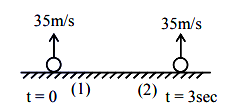
Two spherical balls having equal masses with radius of 5 cm each are thrown upwards along the same vertical direction at an interval of 3s with the same initial velocity of \(35 \mathrm{~m} / \mathrm{s}\), then these balls collide at a height of _____ \(\mathrm{m} \cdot\left(\right.\) Take \(\left.\mathrm{g}=10 \mathrm{~m} / \mathrm{s}^2\right)\) [JEE Main 2021 (Online) 26th August Morning Shift]
CorrectIncorrectHint
(d)

Step 1: Set up the equations for the height of each ball
Let \(y_1\) be the height of the first ball at time \(t\) and \(y_2\) be the height of the second ball at time \(\boldsymbol{t}\). The equation for the height of an object under constant acceleration is
\(
y=y_0+v_0 t+\frac{1}{2} a t^2
\)
For the first ball, with initial velocity \(v_{0,1}=35 \mathrm{~m} / \mathrm{s}\) and acceleration \(a=-10 \mathrm{~m} / \mathrm{s}^2\) (assuming upward is positive), the height is:
\(
y_1=35 t-\frac{1}{2}(10) t^2
\)
For the second ball, which is launched 3 seconds after the first, the time it has been in the air is \((t-3)\). Its initial velocity is \(v_{0,2}=35 \mathrm{~m} / \mathrm{s}\), and the acceleration is also \(a=-10 \mathrm{~m} / \mathrm{s}^2\). The height is:
\(
y_2=35(t-3)-\frac{1}{2}(10)(t-3)^2
\)
Step 3: Calculate the height of the collision
Substitute the time of collision, \(t=5 s\), into the equation for the height of the first ball \(\left(y_1\right)\) :
\(
\begin{gathered}
h=35 t-5 t^2 \\
h=35(5)-5(5)^2 \\
h=175-5(25) \\
h=175-125 \\
h=50 \mathrm{~m}
\end{gathered}
\)
The two balls will collide at a time of \(t=5 \mathrm{~s}\) after the first ball is launched, at a height of \(h=50 \mathrm{~m}\). - Question 24 of 25
24. Question
The speed verses time graph for a particle is shown in the figure. The distance travelled (in m ) by the particle during the time interval \(t=0\) to \(t=5 \mathrm{~s}\) will be _______. [JEE Main 2020 (Online) 4th September Evening Slot]
 CorrectIncorrect
Hint
(a) Step 1: Understand the Principle
The distance travelled by a particle can be determined by calculating the area under its speed-time graph.
Step 2: Calculate the Area under the Graph
According to the problem from JEE Main 2020, the speed-time graph is a triangle with a base from \(t=0\) to \(t=5 \mathrm{~s}\) and a height that reaches \(8 \mathrm{~m} / \mathrm{s}\) at \(t=5 \mathrm{~s}\).
The area of a triangle is given by the formula:
\(
\text { Area }=\frac{1}{2} \times \text { base } \times \text { height }
\)
Substituting the given values:
\(
\text { Distance }=\frac{1}{2} \times 5 \mathrm{~s} \times 8 \mathrm{~m} / \mathrm{s}=20 \mathrm{~m}
\)
The distance travelled by the particle is \(\mathbf{2 0 ~ m}\). - Question 25 of 25
25. Question
The distance \(x\) covered by a particle in one dimensional motion varies with time \(t\) as \(x^2=a t^2+2 b t+c\). If the acceleration of the particle depends on \(x\) as \(x^{-n}\), where \(n\) is an integer, the value of \(n\) is ____. [JEE Main 2020 (Online) 9th January Morning Slot]
CorrectIncorrectHint
(c)
To find the acceleration, we need to differentiate the given equation of motion with respect to time twice. The given equation is:
\(
x^2=a t^2+2 b t+c
\)
First, we differentiate both sides with respect to time \(t\) using the chain rule.
\(
\begin{gathered}
\frac{d}{d t}\left(x^2\right)=\frac{d}{d t}\left(a t^2+2 b t+c\right) \\
2 x \frac{d x}{d t}=2 a t+2 b
\end{gathered}
\)
We know that velocity \(v=\frac{d x}{d t}\). So, we get:
\(
\begin{gathered}
2 x v=2 a t+2 b \\
x v=a t+b
\end{gathered}
\)
This can also be written as \(v=\frac{a t+b}{x}\).
Next, we differentiate this new equation with respect to time \(t\) to find the acceleration, \(A=\frac{d v}{d t}\). We use the product rule on the left side and the chain rule for the derivative of \(\boldsymbol{x}\) :
\(
\begin{gathered}
\frac{d}{d t}(x v)=\frac{d}{d t}(a t+b) \\
\left(\frac{d x}{d t}\right) v+x\left(\frac{d v}{d t}\right)=a \\
v \cdot v+x \cdot A=a \\
v^2+x A=a
\end{gathered}
\)
Now, we can solve for the acceleration \(\boldsymbol{A}\) :
\(
\begin{aligned}
& x A=a-v^2 \\
& A=\frac{a-v^2}{x}
\end{aligned}
\)
Substitute the expression for \(v\) we found earlier, \(v=\frac{a t+b}{x}\) :
\(
\begin{aligned}
A & =\frac{a-\left(\frac{a t+b}{x}\right)^2}{x} \\
A & =\frac{a-\frac{(a t+b)^2}{x^2}}{x} \\
A & =\frac{a x^2-(a t+b)^2}{x^3}
\end{aligned}
\)
From the initial given equation, \(x^2=a t^2+2 b t+c\), so \(a x^2=a^2 t^2+2 a b t+a c\). And \((a t+b)^2=a^2 t^2+2 a b t+b^2\). Substituting these in the numerator, we get:
\(
\begin{gathered}
A=\frac{\left(a^2 t^2+2 a b t+a c\right)-\left(a^2 t^2+2 a b t+b^2\right)}{x^3} \\
A=\frac{a^2 t^2+2 a b t+a c-a^2 t^2-2 a b t-b^2}{x^3} \\
A=\frac{a c-b^2}{x^3}
\end{gathered}
\)
The acceleration can be written as a constant divided by \(x^3\) :
\(
A=\left(a c-b^2\right) x^{-3}
\)
The problem states that the acceleration depends on \(x\) as \(x^{-n}\), so:
\(
A \propto x^{-n}
\)
Comparing our result with the given form, we find that:
\(
n=3
\)