13. 5 Force law for simple harmonic motion
Force law for SHM
The acceleration of a particle undergoing SHM is
\(
a(t)=-\omega^2 x(t)
\)
From Newton’s second law of motion, force acting on the particle of mass \(m\) in SHM is \(F(t)=m a(t)\), we get
\(
F(t)=-m \omega^2 x(t)=-k x(t)
\)
where, \(k=m \omega^2\) or \(\omega=\sqrt{\frac{k}{m}}\)
Thus, in SHM, the force is directly proportional and opposite to the displacement and is always directed towards the mean position. This force is called restoring force.
Further, since \(\omega=\frac{2 \pi}{T}=\sqrt{\frac{k}{m}}\)
\(\therefore\) Time period, \(T=2 \pi \sqrt{\frac{m}{k}}\)
and frequency, \(f=\frac{1}{2 \pi} \sqrt{\frac{k}{m}}\)
The General Logic:
In different types of SHM, the quantities \(m\) and \(k\) will go on taking different forms and names. In general, \(m\) is called inertial factor and \(k\) is called spring factor.
In linear SHM, the general formula for time period is
\(
T=2 \pi \sqrt{\frac{\text { Inertial factor }}{\text { Spring factor }}}
\)
The time period \(T\) essentially tells us how long a cycle takes. This depends on a “tug-of-war” between two properties:
Inertial Factor: The system’s “laziness” or resistance to changing its motion.
Spring Factor: The system’s “stiffness” or how hard it pulls back toward the center.
Linear SHM (Mass on a Spring):
In a standard horizontal spring system:
Inertial Factor: Simply the mass \(m\).
Spring Factor: The spring constant \(k\) (Force per unit displacement).
\(
T=2 \pi \sqrt{\frac{m}{k}}
\)
Angular SHM (The Simple Pendulum):
If we look at the pendulum example you started with, the “Inertial Factor” isn’t just mass; it’s the Moment of Inertia \(\left(I=m L^2\right)\), and the “Spring Factor” relates to gravity trying to restore the bob to the center.
When we simplify the pendulum for small angles:
Inertial Factor: \(L\) (Length)
Spring Factor: \(g\) (Acceleration due to gravity)
\(
T=2 \pi \sqrt{\frac{L}{g}}
\)
Displacement over Acceleration:
Your note \(T=2 \pi \sqrt{\frac{\text { Displacement }}{\text { Acceleration }}}\) is arguably the most powerful version of the formula because it is independent of mass.
Recall the SHM definition: \(a=-\omega^2 x\).
If we take the magnitude:
\(
\omega^2=\frac{a}{x} \Longrightarrow \omega=\sqrt{\frac{a}{x}}
\)
Since \(T=\frac{2 \pi}{\omega}\), substituting \(\omega\) gives:
\(
T=2 \pi \sqrt{\frac{x}{a}}
\)
\begin{array}{|l|l|l|l|}
\hline \text { System } & \text { Inertial Factor } & \text { Spring Factor } & \text { Formula } \\
\hline \text { Spring } & \text { Mass (m) } & \text { Force constant (k) } & T=2 \pi \sqrt{m / k} \\
\hline \text { Pendulum } & \text { Length (L) } & \text { Gravity (g) } & T=2 \pi \sqrt{L / g} \\
\hline \text { Liquid in U-tube } & \text { Height of liquid column } & \text { Gravity (g) } & T=2 \pi \sqrt{h / g} \\
\hline
\end{array}
\)
Example 1: Frequency of oscillation of a body is 6 Hz when force \(F_1\) is applied and 8 Hz when \(F_2\) is applied. If both forces \(F_1\) and \(F_2\) are applied together, then find out the frequency of oscillation.
Solution: According to question, \(F_1=-k_1 x\) and \(F_2=-k_2 x\)
So, \(f_1=\frac{1}{2 \pi} \sqrt{\frac{k_1}{m}}=6 \mathrm{~Hz},\)
\(
f_2=\frac{1}{2 \pi} \sqrt{\frac{k_2}{m}}=8 \mathrm{~Hz}
\)
Now, \(F=F_1+F_2=-\left(k_1+k_2\right) x\)
Therefore, \(f=\frac{1}{2 \pi} \sqrt{\frac{k_1+k_2}{m}}\)
\(
f=\frac{1}{2 \pi} \sqrt{\frac{4 \pi^2 f_1^2 m+4 \pi^2 f_2^2 m}{m}} \left(\mathrm{As}, k=4 \pi^2 f^2 m\right)
\)
\(
=\sqrt{f_1^2+f_2^2}=\sqrt{8^2+6^2}=10 \mathrm{~Hz}
\)
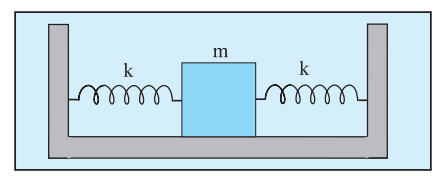
Example 2: Two identical springs of spring constant \(k\) are attached to a block of mass \(m\) and to fixed supports as shown in Figure below. Show that when the mass is displaced from its equilibrium position on either side, it executes a simple harmonic motion. Find the period of oscillations.
Solution:
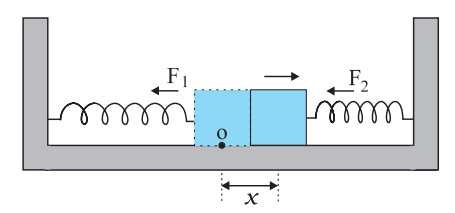
Let the mass be displaced by a small distance \(x\) to the right side of the equilibrium position, as shown in Figure below. Under this situation the spring on the left side gets elongated by a length equal to \(x\) and that on the right side gets compressed by the same length. The forces acting on the mass are then,
\(F_1=-k x\) (force exerted by the spring on the left side, trying to pull the mass towards the mean position)
\(F_2=-k x\) (force exerted by the spring on the right side, trying to push the mass towards the mean position)
The net force, \(F\), acting on the mass is then given by,
\(
F=-2 k x
\)
Hence the force acting on the mass is proportional to the displacement and is directed towards the mean position; therefore, the motion executed by the mass is simple harmonic. The time period of oscillations is,
\(
T=2 \pi \sqrt{\frac{m}{2 k}}
\)