JEE PYQs MCQs
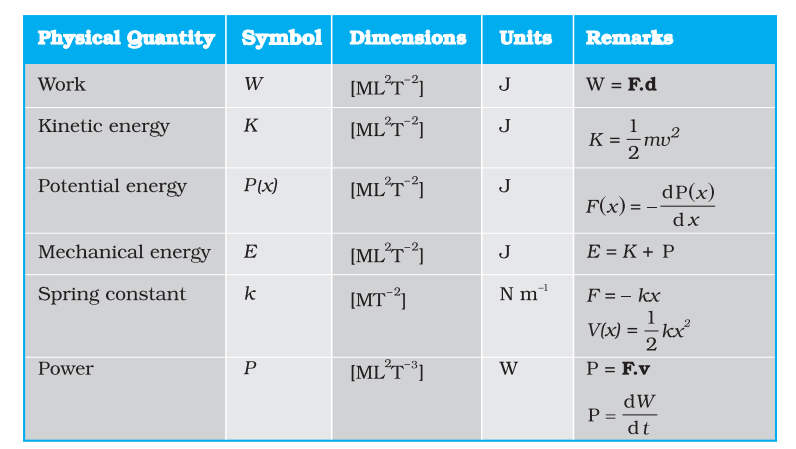
- Work done is a scalar or dot product of \(\mathbf{F}\) and \(\mathbf{s}\). \(W=(F \cos \theta)(s)\).
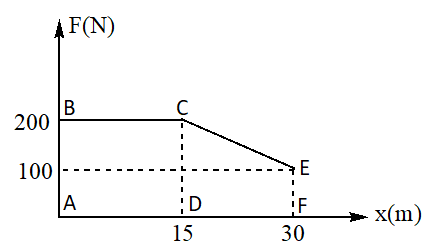
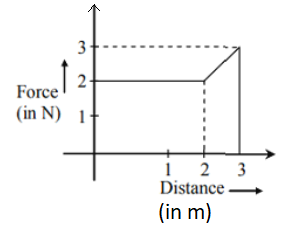
- The area under force-displacement curve gives work done.
- The work-energy theorem states that the change in kinetic energy of a body is the work done by the net force on the body.
\(
K_f-K_i=W_{n e t}
\) - A force is conservative if (i) work done by it on an object is path independent and depends only on the end points \(\left\{x_i, x_j\right\}\), or (ii) the work done by the force is zero for an arbitrary closed path taken by the object such that it returns to its initial position.
- For a conservative force in one dimension, we may define a potential energy function \(P(x)\) such that
\(
\begin{aligned}
& F(x)=-\frac{\mathrm{d} P(x)}{\mathrm{d} x} \\
& P_i-P_f=\int_{x_i}^{x_f} F(x) \mathrm{d} x
\end{aligned}
\) - The principle of conservation of mechanical energy states that the total mechanical energy of a body remains constant if the only forces that act on the body are conservative.
- The gravitational potential energy of a particle of mass \(m\) at a height \(x\) about the earth’s surface is
\(
P(x)=m g x
\)
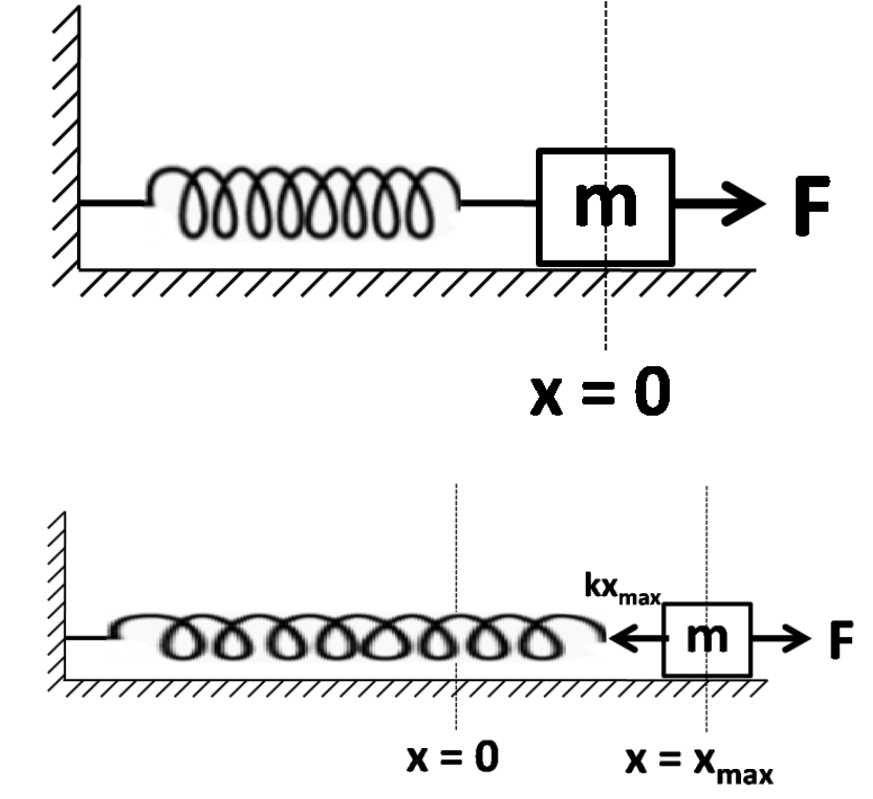
where the variation of \(g\) with height is ignored. - The elastic potential energy of a spring of force constant \(k\) and extension \(x\) is
\(
P(x)=U=\frac{1}{2} k x^2
\) - The work done in stretching the spring by external applied force, \(W=\frac{1}{2} k x^2\)
Work done by the spring, \(W=-\frac{1}{2} k x^2\) - The scalar or dot product of two vectors \(\mathbf{A}\) and \(\mathbf{B}\) is written as \(\mathbf{A} . \mathbf{B}\) and is a scalar quantity given by \(: \mathbf{A} \cdot \mathbf{B}=A B \cos \theta\), where \(\theta\) is the angle between \(\mathbf{A}\) and \(\mathbf{B}\). It can be positive, negative or zero depending upon the value of \(\theta\). The scalar product of two vectors can be interpreted as the product of magnitude of one vector and component of the other vector along the first vector. For unit vectors :
\(
\hat{\mathbf{i}} \cdot \hat{\mathbf{i}}=\hat{\mathbf{j}} \cdot \hat{\mathbf{j}}=\hat{\mathbf{k}} \cdot \hat{\mathbf{k}}=1 \text { and } \hat{\mathbf{i}} \cdot \hat{\mathbf{j}}=\hat{\mathbf{j}} \cdot \hat{\mathbf{k}}=\hat{\mathbf{k}} \cdot \hat{\mathbf{i}}=0
\)
Scalar products obey the commutative and the distributive laws. - The work done by a variable force
\(
W=\int_{r_1}^{r_2} \mathbf{F} \cdot d \mathbf{r}
\)
where, integration is performed along the path of particle and \(d \mathbf{r}\) is the position vector of the particle. - Work done by or against a conservative force in moving a body from one position to another depends only on the initial and final positions of the body. It does not depend upon the nature of the path followed by the body in going from initial position to the final position.
- Work done by or against a conservative force in moving a particle along a closed path (round trip) is zero.
- If the force is non-conservative, then \(W_1 \neq W_2 \neq W_3\).
Work done by a non-conservative force in a round trip is not zero. i.e. \(W_1+W_2 \neq 0\). - Linear momentum, \(p=\sqrt{2 m \mathrm{KE}}\).
- \(W_{\text {net }}=\Delta \mathrm{KE}=K_f-K_i\), \(W_{\mathrm{net}}=\frac{1}{2} m\left(v_f^2-v_i^2\right)\).
- Potential energy of a body or system is the negative of work done by the conservative forces in bringing it from infinity to the present position.
\(U=-\int_{\infty}^{\mathbf{r}} \mathbf{F} \cdot d \mathbf{r}=-W\). - If the forces acting on the object are conservative and it is in equilibrium, then \(F_{\text {net }}=0 \Rightarrow-\frac{d U}{d r}=0 \text { or } \frac{d U}{d r}=0\)
- Average power \(\left(P_{\mathrm{av}}\right)=\frac{\text { Work done }}{\text { Time taken }}=\frac{W}{t}\).
- The instantaneous power \(P=\mathbf{F} \cdot \frac{d \mathbf{r}}{d t}=\mathbf{F} \cdot \mathbf{v}=F v \cos \theta\).
POINTS TO PONDER
- The phrase ‘calculate the work done’ is incomplete. We should refer (or imply clearly by context) to the work done by a specific force or a group of forces on a given body over a certain displacement.
- Work done is a scalar quantity. It can be positive or negative unlike mass and kinetic energy which are positive scalar quantities. The work done by the friction or viscous force on a moving body is negative.
- For two bodies, the sum of the mutual forces exerted between them is zero from Newton’s Third Law,
\(
\mathbf{F}_{12}+\mathbf{F}_{21}=0
\)
But the sum of the work done by the two forces need not always cancel, i.e.
\(
W_{12}+W_{21} \neq 0
\)
However, it may sometimes be true.
- The work done by a force can be calculated sometimes even if the exact nature of the force is not known.
- The WE theorem is not independent of Newton’s Second Law. The WE theorem may be viewed as a scalar form of the Second Law. The principle of conservation of mechanical energy may be viewed as a consequence of the WE theorem for conservative forces.
- The WE theorem holds in all inertial frames. It can also be extended to noninertial frames provided we include the pseudoforces in the calculation of the net force acting on the body under consideration.
- The potential energy of a body subjected to a conservative force is always undetermined upto a constant. For example, the point where the potential energy is zero is a matter of choice. For the gravitational potential energy mgh, the zero of the potential energy is chosen to be the ground. For the spring potential energy \(k x^2 / 2\), the zero of the potential energy is the equilibrium position of the oscillating mass.
- Every force encountered in mechanics does not have an associated potential energy. For example, work done by friction over a closed path is not zero and no potential energy can be associated with friction.
- During a collision : (a) the total linear momentum is conserved at each instant of the collision ; (b) the kinetic energy conservation (even if the collision is elastic) applies after the collision is over and does not hold at every instant of the collision. In fact the two colliding objects are deformed and may be momentarily at rest with respect to each other.
Quiz Summary
0 of 64 Questions completed
Questions:
Information
You have already completed the quiz before. Hence you can not start it again.
Quiz is loading…
You must sign in or sign up to start the quiz.
You must first complete the following:
Results
Results
0 of 64 Questions answered correctly
Your time:
Time has elapsed
You have reached 0 of 0 point(s), (0)
Earned Point(s): 0 of 0, (0)
0 Essay(s) Pending (Possible Point(s): 0)
Categories
- Not categorized 0%
- 1
- 2
- 3
- 4
- 5
- 6
- 7
- 8
- 9
- 10
- 11
- 12
- 13
- 14
- 15
- 16
- 17
- 18
- 19
- 20
- 21
- 22
- 23
- 24
- 25
- 26
- 27
- 28
- 29
- 30
- 31
- 32
- 33
- 34
- 35
- 36
- 37
- 38
- 39
- 40
- 41
- 42
- 43
- 44
- 45
- 46
- 47
- 48
- 49
- 50
- 51
- 52
- 53
- 54
- 55
- 56
- 57
- 58
- 59
- 60
- 61
- 62
- 63
- 64
- Current
- Review
- Answered
- Correct
- Incorrect
- Question 1 of 64
1. Question
Which one of the following forces cannot be expressed in terms of potential energy? [JEE Main 2025 (Online) 7th April Evening Shift]
CorrectIncorrectHint
(a) Frictional force.
Explanation
Potential energy is defined only for conservative forces, where the work done by the force is independent of the path taken.
Frictional force is a non-conservative force. The work done by friction depends on the path length and dissipates energy as heat, so it cannot be expressed in terms of a potential energy function.Why other options are incorrect
(b) Coulomb’s force is a conservative force, and the electrostatic potential energy is a well-defined concept \((U=k Q q / r)\).
(c) Restoring force (such as the elastic spring force following Hooke’s law) is also a conservative force, associated with elastic potential energy ( \(P E=1 / 2 k x^2\) ).
(d) Gravitational force is a conservative force, and gravitational potential energy is a standard concept ( \(\boldsymbol{P E}=\boldsymbol{m} \boldsymbol{g} \boldsymbol{h}\) or \(\boldsymbol{U}=\boldsymbol{-} \boldsymbol{G M m} \boldsymbol{/} \boldsymbol{r}\) ).Note: Conservative Forces: These are forces for which the work done is independent of the path taken; they only depend on the initial and final positions. For conservative forces, you can define a potential energy function. Examples include Coulomb’s force, gravitational force, and the restoring force of a spring.
Non-Conservative Forces: These forces depend on the path taken and usually result in energy dissipation (often as heat). Friction is a typical example, and hence, it cannot be described solely by a potential energy function.
- Question 2 of 64
2. Question
An object of mass 1000 g experiences a time dependent force \(\vec{F}=\left(2 t \hat{i}+3 t^2 \hat{j}\right) N\). The power generated by the force at time \(t\) is: [JEE Main 2025 (Online) 7th April Morning Shift]
CorrectIncorrectHint
(c) The mass of the object is given as 1000 g. We convert this to kilograms (kg), the standard SI unit for mass, by dividing by 1000:
\(
m=1000 \mathrm{~g}=1 \mathrm{~kg}
\)
Determine acceleration
According to Newton’s second law, the force \(\vec{F}\) is equal to mass \(m\) times acceleration \(\vec{a} (\vec{F}=m \vec{a})\). The acceleration vector is found by dividing the force vector by the mass:
\(
\begin{gathered}
\vec{a}=\frac{\vec{F}}{m}=\frac{1}{1 \mathrm{~kg}}\left(2 t \hat{i}+3 t^2 \hat{j}\right) \mathrm{N} \\
\vec{a}=\left(2 t \hat{i}+3 t^2 \hat{j}\right) \mathrm{m} / \mathrm{s}^2
\end{gathered}
\)
Determine velocity
Velocity \(\vec{v}\) is the integral of acceleration \(\vec{a}\) with respect to time \(t\left(\vec{v}=\int \vec{a} d t\right)\).
Assuming the object starts from rest at \(t=0\), the constant of integration is zero:
\(
\begin{gathered}
\vec{v}=\int\left(2 t \hat{i}+3 t^2 \hat{j}\right) d t \\
\vec{v}=\left(\int 2 t d t\right) \hat{i}+\left(\int 3 t^2 d t\right) \hat{j} \\
\vec{v}=\left(t^2 \hat{i}+t^3 \hat{j}\right) \mathrm{m} / \mathrm{s}
\end{gathered}
\)
Power \(\boldsymbol{P}\) generated by a force is the dot product of the force vector \(\overrightarrow{\boldsymbol{F}}\) and the velocity vector \(\vec{v}(P=\vec{F} \cdot \vec{v})\) :
\(
\begin{gathered}
P=\left(2 t \hat{i}+3 t^2 \hat{j}\right) \cdot\left(t^2 \hat{i}+t^3 \hat{j}\right) \\
P=(2 t)\left(t^2\right)+\left(3 t^2\right)\left(t^3\right) \\
P=2 t^3+3 t^5
\end{gathered}
\)
The power generated by the force at time \(t\) is \(\left(2 t^3+3 t^5\right) \mathrm{W}\) - Question 3 of 64
3. Question
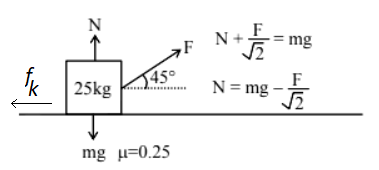
A block of mass 25 kg is pulled along a horizontal surface by a force at an angle \(45^{\circ}\) with the horizontal. The friction coefficient between the block and the surface is 0.25. The block travels at a uniform velocity. The work done by the applied force during a displacement of 5 m of the block is : [JEE Main 2025 (Online) 4th April Evening Shift]
CorrectIncorrectHint
(d)

The block moves at a uniform velocity, implying that the net force in both the horizontal ( \(x\) ) and vertical ( \(y\) ) directions is zero. The forces acting on the block are the applied force \(F\), gravity \(m g\), normal force \(N\), and kinetic friction \(f_k\).
The vertical force balance equation is:
\(
N+F \sin (\theta)-m g=0
\)
Thus, the normal force is \(N=m g-F \sin (\theta)\).
The horizontal force balance equation is:
\(
F \cos (\theta)-f_k=0
\)
The kinetic friction force is defined as \(f_k=\mu N\).
Substitute the expression for the normal force into the friction equation:
\(
F \cos (\theta)=\mu(m g-F \sin (\theta))
\)
Rearrange the equation to solve for the applied force \(F\) :
\(
F=\frac{\mu m g}{\cos (\theta)+\mu \sin (\theta)}
\)
Substitute the given values: \(m=25 \mathrm{~kg}, \mu=0.25, \theta=45^{\circ}, g=9.8 \mathrm{~m} / \mathrm{s}^2\), \(\cos \left(45^{\circ}\right)=\sin \left(45^{\circ}\right)=1 / \sqrt{2}\).
\(
\begin{gathered}
F=\frac{0.25 \times 25 \times 9.8}{\cos \left(45^{\circ}\right)+0.25 \sin \left(45^{\circ}\right)} \\
F=\frac{61.25}{1.25 \cos \left(45^{\circ}\right)}=\frac{49}{\cos \left(45^{\circ}\right)}=49 \sqrt{2} \mathrm{~N}
\end{gathered}
\)
The work \(W\) done by the applied force \(F\) over a displacement \(d\) is given by the formula \(W=F d \cos (\theta)\). The displacement \(d\) is 5 m.
\(
\begin{gathered}
W=(49 \sqrt{2} \mathrm{~N}) \times(5 \mathrm{~m}) \times \cos \left(45^{\circ}\right) \\
W=245 \sqrt{2} \mathrm{~J} \times \frac{1}{\sqrt{2}}=245 \mathrm{~J}
\end{gathered}
\) - Question 4 of 64
4. Question
A particle is released from height \(S\) above the surface of the earth. At certain height its kinetic energy is three times its potential energy. The height from the surface of the earth and the speed of the particle at that instant are respectively. [JEE Main 2025 (Online) 3rd April Morning Shift]
CorrectIncorrectHint
(c) Step 1: Define Energy and Apply Conservation
The particle starts from rest at height \(S\). Its initial total energy is purely potential energy, \(E_i=m g S\). At an arbitrary height \(h\) with speed \(v\), the total energy is \(E_f=m g h+\frac{1}{2} m v^2\). By the principle of conservation of energy, \(E_i=E_f\), leading to the equation \(m g S=m g h+\frac{1}{2} m v^2\).
Step 2: Use the Given Condition
The problem states that at height \(h\), the kinetic energy is three times the potential energy: \(K E_f=3 \times P E_f\), or \(\frac{1}{2} m v^2=3 m g h\). This can be simplified to \(\frac{1}{2} v^2=3 g h\)
Step 3: Solve for Height and Speed
Substitute the kinetic energy relation into the conservation of energy equation from Step 1:
\(
\begin{gathered}
m g S=m g h+3 m g h \\
m g S=4 m g h
\end{gathered}
\)
\(
S=4 h \Longrightarrow h=\frac{S}{4}
\)
Now, solve for the speed \(v\) using the condition from Step 2:
\(
\begin{gathered}
\frac{1}{2} v^2=3 g h \\
v^2=6 g h
\end{gathered}
\)
Substitute the value of \(h\) :
\(
\begin{gathered}
v^2=6 g\left(\frac{S}{4}\right)=\frac{3 g S}{2} \\
v=\sqrt{\frac{3 g S}{2}}
\end{gathered}
\)
The height from the surface of the earth is \(\frac{\mathrm{S}}{4}\), and the speed of the particle at that instant is \(\sqrt{\frac{3 \mathrm{gS}}{2}}\). - Question 5 of 64
5. Question
A sand dropper drops sand of mass \(\mathrm{m}(\mathrm{t})\) on a conveyer belt at a rate proportional to the square root of speed \((\mathrm{v})\) of the belt, i.e., \(\frac{d m}{d t} \propto \sqrt{v}\). If \(P\) is the power delivered to run the belt at constant speed then which of the following relationship is true? [JEE Main 2025 (Online) 29th January Evening Shift]
CorrectIncorrectHint
(d) Step 1: Define mass rate and force
The rate of mass added to the belt is proportional to the square root of speed, so we can write it as \(\frac{d m}{d t}=k \sqrt{v}\), where \(k\) is a constant of proportionality. The force required to accelerate the added mass horizontally to the belt’s constant speed \(v\) is given by the rate of change of momentum, \(F=\frac{d(m v)}{d t}\). Since the velocity \(v\) is constant, this simplifies to \(F=v \frac{d m}{d t}\).
Step 2: Calculate power
The power \(\boldsymbol{P}\) delivered to the belt is the force multiplied by the constant velocity of the belt, \(\boldsymbol{P}=\boldsymbol{F v}\). Substituting the expression for force from Step 1:
\(
P=\left(v \frac{d m}{d t}\right) v=v^2 \frac{d m}{d t}
\)
Step 3: Substitute the mass rate relationship and find proportionality
Substitute the given relationship for the mass rate \(\frac{d m}{d t}=k \sqrt{v}\) into the power equation:
\(
P=v^2(k \sqrt{v})=k v^2 v^{1 / 2}=k v^{5 / 2}
\)
Thus, \(P \propto v^{5 / 2}\). Squaring both sides of the proportionality gives: \(P^2 \propto\left(v^{5 / 2}\right)^2 \Longrightarrow P^2 \propto v^5\).
The relationship between the power \(P\) and the speed \(v\) is (d) \(P^2 \propto v^5\). - Question 6 of 64
6. Question
A body of mass 4 kg is placed on a plane at a point \(P\) having coordinate \((3,4) \mathrm{m}\). Under the action of force \(\overrightarrow{\mathrm{F}}=(2 \hat{i}+3 \hat{j}) \mathrm{N}\), it moves to a new point \(Q\) having coordinates \((6,10) \mathrm{m}\) in 4 sec. The average power and instanteous power at the end of 4 sec are in the ratio of : [JEE Main 2025 (Online) 28th January Evening Shift]
CorrectIncorrectHint
(d) Step 1: Calculate the displacement vector
The initial position vector is \(\vec{r}_1=(3 \hat{i}+4 \hat{j}) \mathrm{m}\), and the final position vector is \(\vec{r}_2=(6 \hat{i}+10 \hat{j}) \mathrm{m}\).
The displacement vector \(\vec{s}\) is the difference between the final and initial position vectors:
\(
\vec{s}=\vec{r}_2-\vec{r}_1=(6 \hat{i}+10 \hat{j}) \mathrm{m}-(3 \hat{i}+4 \hat{j}) \mathrm{m}=(3 \hat{i}+6 \hat{j}) \mathrm{m}
\)
Step 2: Calculate the work done by the force
The work done \(W\) by the constant force \(\vec{F}=(2 \hat{i}+3 \hat{j}) \mathrm{N}\) is the dot product of the force and displacement vectors:
\(
W=\vec{F} \cdot \vec{s}=(2 \hat{i}+3 \hat{j}) \cdot(3 \hat{i}+6 \hat{j})=(2 \times 3)+(3 \times 6)=6+18=24 \mathrm{~J}
\)
Step 3: Calculate the average power
Average power \(\boldsymbol{P}_{\text {avg }}\) is the total work done divided by the time taken, \(t=4 \mathrm{~s}\) :
\(
P_{\mathrm{avg}}=\frac{W}{t}=\frac{24 \mathrm{~J}}{4 \mathrm{~s}}=6 \mathrm{~W}
\)
Step 4: Calculate the acceleration and final velocity
The acceleration \(\vec{a}\) of the body is constant, given by Newton’s second law \(\vec{F}=m \vec{a}\), where \(m=4 \mathrm{~kg}\) :
\(
\vec{a}=\frac{\vec{F}}{m}=\frac{(2 \hat{i}+3 \hat{j}) \mathrm{N}}{4 \mathrm{~kg}}=\left(\frac{1}{2} \hat{i}+\frac{3}{4} \hat{j}\right) \mathrm{m} / \mathrm{s}^2
\)
Assuming the body starts from rest (initial velocity \(\vec{u}=0\) ), the final velocity \(\vec{v}\) at \(t=4 \mathrm{~s}\) is:
\(
\vec{v}=\vec{u}+\vec{a} t=0+\left(\frac{1}{2} \hat{i}+\frac{3}{4} \hat{j}\right) \mathrm{m} / \mathrm{s}^2 \times 4 \mathrm{~s}=(2 \hat{i}+3 \hat{j}) \mathrm{m} / \mathrm{s}
\)
Step 5: Calculate the instantaneous power at the end of \(\mathbf{4 ~ s e c}\)
Instantaneous power \(P_{\text {inst }}\) at \(t=4 \mathrm{~s}\) is the dot product of the force and the instantaneous velocity at that time:
\(
P_{\text {inst }}=\vec{F} \cdot \vec{v}=(2 \hat{i}+3 \hat{j}) \mathrm{N} \cdot(2 \hat{i}+3 \hat{j}) \mathrm{m} / \mathrm{s}=(2 \times 2)+(3 \times 3)=4+9=13 \mathrm{~W}
\)
Step 6: Determine the ratio
The ratio of average power to instantaneous power at the end of 4 sec is:
\(
\frac{\boldsymbol{P}_{\mathrm{avg}}}{\boldsymbol{P}_{\mathrm{inst}}}=\frac{6 \mathrm{~W}}{13 \mathrm{~W}}=\frac{6}{13}
\)
The ratio is 6:13. - Question 7 of 64
7. Question
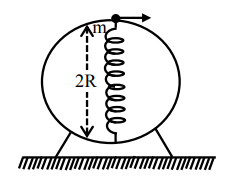
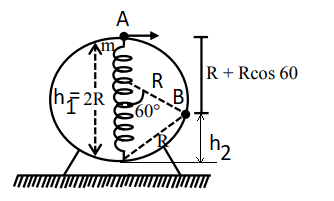
A bead of mass ‘ \(m\) ‘ slides without friction on the wall of a vertical circular hoop of radius ‘ \(R\) ‘ as shown in figure. The bead moves under the combined action of gravity and a massless spring \((\mathrm{k})\) attached to the bottom of the hoop. The equilibrium length of the spring is ‘ \(R^{\prime}\) ‘. If the bead is released from top of the hoop with (negligible) zero initial speed, velocity of bead, when the length of spring becomes ‘ \(R\) ‘, would be (spring constant is \(k g\) is acceleration due to gravity) [JEE Main 2025 (Online) 28th January Morning Shift]
 CorrectIncorrect
Hint
(b)

Step 1: Define initial conditions
Position A Elongation: The spring elongation is \(x_1=2 R-R=R\) because the equilibrium length of the spring is \(R\).
Position A Height: The height is \(\boldsymbol{h}_1 \boldsymbol{=} \mathbf{2 R}\).
Position A Velocity: The initial velocity is \(\boldsymbol{v}_1=0\), as the bead is released from rest.
Step 2: Define final conditions
Position B Elongation: The spring elongation is \(x_2=R-R=0\), as the length of the spring is \(R\).
Position B Height: The height is \(h_2=R / 2\).
Position B Velocity: The final velocity is \(v_2=v\).
Step 3: Apply energy conservation
Using the principle of conservation of energy, \(E_i=E_f\), we equate the initial and final mechanical energies of the system:
\(
\frac{1}{2} k x_1^2+\frac{1}{2} m v_1^2+m g h_1=\frac{1}{2} k x_2^2+\frac{1}{2} m v_2^2+m g h_2
\)
Substituting the defined values into the equation:
\(
\frac{1}{2} k R^2+m g(2 R)=\frac{1}{2} m v^2+m g \frac{R}{2}
\)
Step 4: Solve for \(v\)
Rearranging the equation to solve for the final velocity \(v\) :
\(
\begin{gathered}
\frac{1}{2} k R^2+2 m g R-\frac{m g R}{2}=\frac{1}{2} m v^2 \\
\frac{1}{2} m v^2=\frac{1}{2} k R^2+\frac{3 m g R}{2} \\
m v^2=k R^2+3 m g R \\
v^2=\frac{k R^2}{m}+3 g R
\end{gathered}
\) - Question 8 of 64
8. Question
Given below are two statements: one is labelled as Assertion A and the other is labelled as Reason \(\mathbf{R}\)
Assertion \(\mathbf{A}\): In a central force field, the work done is independent of the path chosen.
Reason \(\mathbf{R}\): Every force encountered in mechanics does not have an associated potential energy.
In the light of the above statements, choose the most appropriate answer from the options given below [JEE Main 2025 (Online) 28th January Morning Shift]CorrectIncorrectHint
(b) Assertion (A): In a central force field, the work done is independent of the path chosen.
A central force is a force that acts along the line joining a particle to a fixed center (e.g., gravitational and electrostatic forces).
Central forces are conservative, meaning the work done depends only on the initial and final positions, not the path taken.
Assertion is true.Reason (R): Every force encountered in mechanics does not have an associated potential energy.
Conservative forces (e.g., gravitational, electrostatic, and spring force) have associated potential energy.
Non-conservative forces (e.g., friction, air resistance) do not have potential energy because they dissipate energy.
Reason is also true.
However, the reason R does not directly explain why work done is path-independent in central forces.
Instead, R discusses all forces in mechanics, including non-conservative forces, which is not directly related to A. - Question 9 of 64
9. Question
A force \(\mathrm{F}=\alpha+\beta \mathrm{x}^2\) acts on an object in the x -direction. The work done by the force is 5 J when the object is displaced by 1 m. If the constant \(\alpha=1 \mathrm{~N}\) then \(\beta\) will be [JEE Main 2025 (Online) 24th January Morning Shift]
CorrectIncorrectHint
(c) Step 1: Define the work integral
The work done ( \(W\) ) by a variable force \(F(x)\) acting over a displacement from \(x_1\) to \(x_2\) is calculated using the integral:
\(
W=\int_{x_1}^{x_2} F(x) d x
\)
Step 2: Integrate the force expression
Substitute the given force expression \(F(x)=\alpha+\beta x^2\) and the displacement limits ( \(x_1=0 \mathrm{~m}, x_2=1 \mathrm{~m}\) ) into the work equation:
\(
W=\int_0^1\left(\alpha+\beta x^2\right) d x=\left[\alpha x+\frac{\beta x^3}{3}\right]_0^1
\)
Evaluating the definite integral gives:
\(
W=\left(\alpha(1)+\frac{\beta(1)^3}{3}\right)-\left(\alpha(0)+\frac{\beta(0)^3}{3}\right)=\alpha+\frac{\beta}{3}
\)
Step 3: Solve for \(\boldsymbol{\beta}\)
We are given \(W=5 \mathrm{~J}\) and \(\alpha=1 \mathrm{~N}\). Substitute these values into the resulting equation:
\(
\begin{gathered}
5=1+\frac{\beta}{3} \\
4=\frac{\beta}{3} \\
\beta=12 \mathrm{~N} / \mathrm{m}^2
\end{gathered}
\) - Question 10 of 64
10. Question
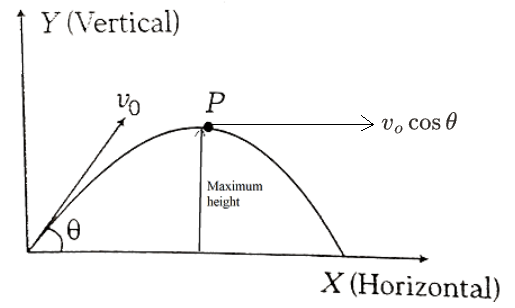
A ball having kinetic energy KE, is projected at an angle of \(60^{\circ}\) from the horizontal. What will be the kinetic energy of ball at the highest point of its flight? [JEE Main 2025 (Online) 23rd January Evening Shift]
CorrectIncorrectHint
(c) Step 1: Define initial kinetic energy and velocity components The initial kinetic energy ( \(K E\) ) of the ball is given by the formula \(K E=\frac{1}{2} m v^2\), where \(m\) is the mass and \(v\) is the initial velocity. The initial velocity can be broken down into horizontal ( \(v_x\) ) and vertical ( \(v_y\) ) components:
\(
\begin{aligned}
v_x & =v \cos (\theta) \\
v_y & =v \sin (\theta)
\end{aligned}
\)
where \(\theta=60^{\circ}\).
Step 2: Determine kinetic energy at the highest point
At the highest point of its flight, the vertical velocity component becomes zero ( \(v_y=0\) ), but the horizontal velocity component remains constant ( \(v_h=v_x\) ). The kinetic energy at the highest point ( \(K E_h\) ) is therefore:
\(
K E_h=\frac{1}{2} m\left(v_h\right)^2=\frac{1}{2} m\left(v_x\right)^2=\frac{1}{2} m(v \cos (\theta))^2
\)
Step 3: Express \(\mathbf{K E}_{\boldsymbol{h}}\) in terms of \(\mathbf{K E}\)
We substitute the initial angle \(\theta=60^{\circ}\) and use the value of \(\cos \left(60^{\circ}\right)=\frac{1}{2}\) to find the relationship between \(K E_h\) and \(K E\) :
\(
\begin{gathered}
K E_h=\frac{1}{2} m v^2\left(\cos \left(60^{\circ}\right)\right)^2 \\
K E_h=K E \times\left(\frac{1}{2}\right)^2 \\
K E_h=K E \times \frac{1}{4} \\
K E_h=\frac{K E}{4}
\end{gathered}
\) - Question 11 of 64
11. Question
A force \(\overrightarrow{\mathrm{F}}=2 \hat{i}+\mathrm{b} \hat{j}+\hat{k}\) is applied on a particle and it undergoes a displacement \(\hat{i}-2 \hat{j}-\hat{k}\) What will be the value of \(b\), if work done on the particle is zero. [JEE Main 2025 (Online) 22nd January Evening Shift]
CorrectIncorrectHint
(b) Step 1: Calculate the work done
The work done ( \(W\) ) by a constant force ( \(\vec{F}\) ) causing a displacement ( \(\vec{d}\) ) is defined by their dot product: \(W=\vec{F} \cdot \vec{d}\).
Given force \(\vec{F}=2 \hat{i}+b \hat{j}+\hat{k}\) and displacement \(\vec{d}=\hat{i}-2 \hat{j}-\hat{k}\), the work done is calculated as:
\(
\begin{gathered}
W=(2)(1)+(b)(-2)+(1)(-1) \\
W=2-2 b-1 \\
W=1-2 b
\end{gathered}
\)
Step 2: Set the work to zero to find \(b\)
We are given that the work done on the particle is zero, so we set the expression for \(W\) to zero:
\(
\begin{gathered}
1-2 b=0 \\
2 b=1 \\
b=\frac{1}{2}
\end{gathered}
\) - Question 12 of 64
12. Question
A particle of mass \(m\) moves on a straight line with its velocity increasing with distance according to the equation \(v=\alpha \sqrt{x}\), where \(\alpha\) is a constant. The total work done by all the forces applied on the particle during its displacement from \(x=0\) to \(x=\mathrm{d}\), will be : [JEE Main 2024 (Online) 9th April Morning Shift]
CorrectIncorrectHint
(c) Step 1: Apply the Work-Energy Theorem
The net work done by all forces on a particle is equal to the change in its kinetic energy \((\Delta K)\). The kinetic energy \((K)\) is given by \(K=\frac{1}{2} m v^2\), where \(m\) is the mass and \(v\) is the velocity. The work-energy theorem is expressed as:
\(
W_{\text {net }}=\Delta K=K_f-K_i
\)
Step 2: Calculate Initial Kinetic Energy
The particle starts at \(\boldsymbol{x} \boldsymbol{=} \mathbf{0}\). The velocity at this position is given by the equation \(v(x)=\alpha \sqrt{x}\).
\(
v_i=v(0)=\alpha \sqrt{0}=0
\)
The initial kinetic energy ( \(\boldsymbol{K}_{\boldsymbol{i}}\) ) is:
\(
K_i=\frac{1}{2} m v_i^2=\frac{1}{2} m(0)^2=0
\)
Step 3: Calculate Final Kinetic Energy
The particle moves to a final position \(x=d\). The velocity at this position is:
\(
v_f=v(d)=\alpha \sqrt{d}
\)
The final kinetic energy ( \(\boldsymbol{K}_{\boldsymbol{f}}\) ) is:
\(
K_f=\frac{1}{2} m v_f^2=\frac{1}{2} m(\alpha \sqrt{d})^2=\frac{1}{2} m \alpha^2 d
\)
Step 4: Determine the Total Work Done
The total work done is the difference between the final and initial kinetic energies:
\(
\begin{gathered}
W_{\text {net }}=K_f-K_i=\frac{1}{2} m \alpha^2 d-0 \\
W_{\text {net }}=\frac{m \alpha^2 d}{2}
\end{gathered}
\)
The total work done is \(\frac{\mathbf{m} \alpha^{\mathbf{2}} \mathbf{d}}{\mathbf{2}}\). - Question 13 of 64
13. Question
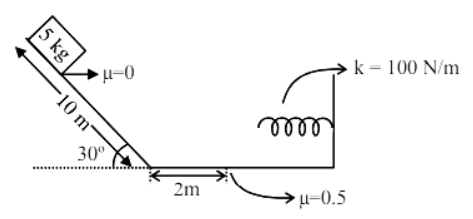
A block is simply released from the top of an inclined plane as shown in the figure above. The maximum compression in the spring when the block hits the spring is : [JEE Main 2024 (Online) 8th April Evening Shift]
 CorrectIncorrect
Hint
(d) Initially, the block is released from rest, meaning its initial kinetic energy is zero. It starts with gravitational potential energy at the incline’s top, given by: \(U_g=m g h\), where \(m=5 \mathrm{~kg}, g= 10 \mathrm{~m} / \mathrm{s}^2\) (assuming near the Earth’s surface), and \(h=10 \sin 30^{\circ} \mathrm{m}\).
Calculate the height: \(h=10 \times \frac{1}{2}=5 \mathrm{~m}\)
Substitute into the potential energy formula: \(U_g=5 \times 10 \times 5=250 \mathrm{~J}\)
The block slides down the incline and across a rough surface (friction coefficient \(\mu=0.5\) ) for 2 m. Calculate the work done by friction: \(W_f=\mu m g d=0.5 \times 5 \times 10 \times 2=50 \mathrm{~J}\)
By energy conservation, the gravitational potential energy is converted into spring potential energy and work done against friction: \(U_g=\frac{1}{2} k x^2+W_f\)
Substitute the known values: \(250=\frac{1}{2} \times 100 \times x^2+50\)
Solve for \(x\) :
First, simplify the equation: \(250=50+50 x^2\)
Re-arrange to solve for \(x^2: 200=50 x^2\)
Divide both sides by 50: \(x^2=4\)
Solve for \(x: x=2\)
Therefore, the maximum compression in the spring when the block hits the spring is 2 m. - Question 14 of 64
14. Question
Three bodies \(\mathrm{A}, \mathrm{B}\) and C have equal kinetic energies and their masses are \(400 \mathrm{~g}, 1.2 \mathrm{~kg}\) and 1.6 kg respectively. The ratio of their linear momenta is : [JEE Main 2024 (Online) 8th April Morning Shift]
CorrectIncorrectHint
(a) Step 1: Relate kinetic energy and momentum
The kinetic energy \(K\) of a body with mass \(m\) and linear momentum \(p\) is given by the formula \(K=\frac{p^2}{2 m}\). Rearranging this equation to express momentum in terms of kinetic energy and mass gives \(p=\sqrt{2 m K}\).
Step 2: Convert masses to consistent units
The given masses are:
\(
m_A=400 \mathrm{~g}=0.4 \mathrm{~kg}
\)
\(
\begin{aligned}
& m_B=1.2 \mathrm{~kg} \\
& m_C=1.6 \mathrm{~kg}
\end{aligned}
\)
Step 3: Determine the ratio of momenta
Since the kinetic energies \(K\) are equal for all three bodies, the ratio of their linear momenta \(p_A: p_B: p_C\) is proportional to the square root of their masses:
\(
p_A: p_B: p_C=\sqrt{2 m_A K}: \sqrt{2 m_B K}: \sqrt{2 m_C K}=\sqrt{m_A}: \sqrt{m_B}: \sqrt{m_C}
\)
Substituting the mass values into the ratio:
\(
p_A: p_B: p_C=\sqrt{0.4}: \sqrt{1.2}: \sqrt{1.6}
\)
Step 4: Simplify the ratio
To simplify the ratio to its lowest terms, we can multiply all terms by \(\sqrt{10}\) and then simplify the resulting square roots:
\(
\begin{gathered}
p_A: p_B: p_C=\sqrt{0.4 \times 10}: \sqrt{1.2 \times 10}: \sqrt{1.6 \times 10} \\
p_A: p_B: p_C=\sqrt{4}: \sqrt{12}: \sqrt{16} \\
p_A: p_B: p_C=2: \sqrt{4 \times 3}: 4 \\
p_A: p_B: p_C=2: 2 \sqrt{3}: 4
\end{gathered}
\)
Dividing all terms by the common factor of 2 yields the final simplified ratio:
\(
p_A: p_B: p_C=1: \sqrt{3}: 2
\)
The ratio of their linear momenta is \(1: \sqrt{3}: 2\) - Question 15 of 64
15. Question
When kinetic energy of a body becomes 36 times of its original value, the percentage increase in the momentum of the body will be : [JEE Main 2024 (Online) 6th April Evening Shift]
CorrectIncorrectHint
(b) Step 1: Relate Kinetic Energy and Momentum
The relationship between kinetic energy (KE) and momentum (P) for a body of mass ( \(m\) ) is given by the formula \(K E=\frac{P^2}{2 m}\) or, expressed in terms of momentum, \(P=\sqrt{2 m K E}\).
Step 2: Calculate Final Momentum
Let the initial kinetic energy and momentum be \(K E_i\) and \(P_i\) respectively. The final kinetic energy \(K E_f\) is 36 times the initial, so \(K E_f=36 \times K E_i\). The final momentum \(P_f\) is calculated using the formula:
\(
P_f=\sqrt{2 m K E_f}=\sqrt{2 m\left(36 \times K E_i\right)}=\sqrt{36} \times \sqrt{2 m K E_i}=6 P_i
\)
The final momentum is 6 times the initial momentum.
Step 3: Determine Percentage Increase
The increase in momentum is \(\Delta P=P_f-P_i=6 P_i-P_i=5 P_i\). The percentage increase is calculated as:
\(
\text { Percentage Increase }=\frac{\Delta P}{P_i} \times 100 \%=\frac{5 P_i}{P_i} \times 100 \%=500 \%
\)
The percentage increase in the momentum of the body will be \(\mathbf{5 0 0} \boldsymbol{\%}\). - Question 16 of 64
16. Question
A bullet of mass 50 g is fired with a speed \(100 \mathrm{~m} / \mathrm{s}\) on a plywood and emerges with \(40 \mathrm{~m} / \mathrm{s}\). The percentage loss of kinetic energy is : [JEE Main 2024 (Online) 6th April Morning Shift]
CorrectIncorrectHint
(c) Step 1: Calculate Initial Kinetic Energy
First, calculate the initial kinetic energy ( \(K E_i\) ) using the mass ( \(m\) ) and initial velocity ( \(v_i )\). Note that \(50 \mathrm{~g}=0.050 \mathrm{~kg}\).
\(
K E_i=\frac{1}{2} m v_i^2=\frac{1}{2}(0.050 \mathrm{~kg})(100 \mathrm{~m} / \mathrm{s})^2=250 \mathrm{~J}
\)
Step 2: Calculate Final Kinetic Energy
Next, calculate the final kinetic energy ( \(K E_f\) ) using the mass ( \(m\) ) and final velocity ( \(v_f\) ).
\(
K E_f=\frac{1}{2} m v_f^2=\frac{1}{2}(0.050 \mathrm{~kg})(40 \mathrm{~m} / \mathrm{s})^2=40 \mathrm{~J}
\)
Step 3: Determine the Percentage Loss
Calculate the percentage loss of kinetic energy relative to the initial kinetic energy using the formula:
\(
\begin{gathered}
\text { Percentage Loss }=\frac{K E_i-K E_f}{K E_i} \times 100 \% \\
\text { Percentage Loss }=\frac{250 \mathrm{~J}-40 \mathrm{~J}}{250 \mathrm{~J}} \times 100 \%=\frac{210 \mathrm{~J}}{250 \mathrm{~J}} \times 100 \%=84 \%
\end{gathered}
\)
The percentage loss of kinetic energy is \(\mathbf{8 4 \%}\). - Question 17 of 64
17. Question
Four particles \(A, B, C, D\) of mass \(\frac{m}{2}, m, 2 m, 4 m\), have same momentum, respectively. The particle with maximum kinetic energy is : [JEE Main 2024 (Online) 6th April Morning Shift]
CorrectIncorrectHint
(a) Step 1: Relate kinetic energy and momentum
The relationship between kinetic energy (\(K\)) and linear momentum (\(p\)) for a particle of mass \((\mathrm{m})\) is given by the formula:
\(
K=\frac{p^2}{2 m}
\)
This equation shows that for a constant momentum (\(p\)), the kinetic energy (\(K\)) is inversely proportional to the mass \((\mathrm{m}), K \propto \frac{1}{m}\).
Step 2: Determine the particle with minimum mass
To have the maximum kinetic energy when the momentum is the same for all particles, the particle must have the minimum mass. The masses of the four particles are given as:
Mass of particle A, \(m_A=\frac{m}{2}\)
Mass of particle \(\mathrm{B}, m_B=m\)
Mass of particle \(\mathrm{C}, m_C=2 m\)
Mass of particle \(\mathrm{D}, m_D=4 m\)
Comparing these values, \(m_A=\frac{m}{2}\) is the smallest mass.
The particle with the minimum mass is Particle A. Therefore, the particle with the maximum kinetic energy is Particle A. - Question 18 of 64
18. Question
A body is moving unidirectionally under the influence of a constant power source. Its displacement in time \(t\) is proportional to : [JEE Main 2024 (Online) 5th April Evening Shift]
CorrectIncorrectHint
(b) Step 1: Formulate the governing differential equation
The power \(\boldsymbol{P}\) is constant and related to force \(\boldsymbol{F}\) and velocity \(\boldsymbol{v}\) by \(\boldsymbol{P}=\boldsymbol{F} \boldsymbol{v}\). Using Newton’s second law \((F=m a)\) and the definition of acceleration \(\left(a=\frac{d v}{d t}\right)\), we can write the power equation as a differential equation relating velocity \(v\) and time \(t\) :
\(
P=m \frac{d v}{d t} v
\)
Rearranging the terms for integration gives \(\boldsymbol{P} \boldsymbol{d t} \boldsymbol{=} \boldsymbol{m v} \boldsymbol{d v}\).
Step 2: Integrate to find velocity as a function of time
We integrate both sides of the equation from \(t=0\) to \(t\) and from \(v=0\) to \(v\) (assuming the body starts from rest at the origin at \(t=0\) ):
\(
\begin{aligned}
\int_0^t P d t & =\int_0^v m v d v \\
P t & =\frac{1}{2} m v^2
\end{aligned}
\)
Solving for velocity \(v\) :
\(
v=\sqrt{\frac{2 P}{m}} t^{1 / 2}
\)
This shows that the velocity is proportional to \(t^{1 / 2}\), or \(v \propto t^{1 / 2}\).
Step 3: Integrate to find displacement as a function of time Velocity is the time derivative of displacement \(s\left(v=\frac{d s}{d t}\right)\). We substitute the expression for \(v\) and integrate again:
\(
\begin{aligned}
\frac{d s}{d t} & =\sqrt{\frac{2 P}{m}} t^{1 / 2} \\
\int_0^s d s & =\int_0^t \sqrt{\frac{2 P}{m}} t^{1 / 2} d t \\
s & =\sqrt{\frac{2 P}{m}}\left(\frac{t^{3 / 2}}{3 / 2}\right) \\
s & =\frac{2}{3} \sqrt{\frac{2 P}{m}} t^{3 / 2}
\end{aligned}
\)
Step 4: Determine the proportionality
From the final equation for displacement \(s\), we can see that \(s\) is directly proportional to \(t^{3 / 2}\), as the term \(\frac{2}{3} \sqrt{\frac{2 P}{m}}\) is a constant.
\(
s \propto t^{3 / 2}
\)
The displacement in time \(t\) is proportional to \(t^{3 / 2}\). - Question 19 of 64
19. Question
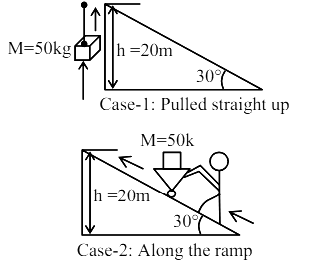
A body of mass 50 kg is lifted to a height of 20 m from the ground in the two different ways as shown in the figures. The ratio of work done against the gravity in both the respective cases, will be : [JEE Main 2024 (Online) 5th April Morning Shift]
 CorrectIncorrect
Hint
(b) Step 1: Work done by a conservative force like gravity depends only on the change in vertical height, not on the path taken. The work done against gravity is defined as the force of gravity multiplied by the vertical distance the object is lifted.
Step 2: Formulate the work equation
The work done ( \(\mathbf{W}\) ) against gravity to lift an object of mass \(\boldsymbol{m}\) to a height \(\boldsymbol{h}\) is given by the formula \(W=m g h\), where \(g\) is the acceleration due to gravity. The specific path or method used to lift the body does not affect this value, only the initial and final vertical positions matter.
\(
W=m g h
\)
Step 3: Calculate the ratio
In both cases described in the problem, the mass ( \(m=50 \mathrm{~kg}\) ) is lifted from the ground ( \(h_i=0 \mathrm{~m}\) ) to the same final height ( \(h_f=20 \mathrm{~m}\) ).
The work done in the first case is \(\mathbf{W}_{\mathbf{1}}=\boldsymbol{m} \boldsymbol{g} \boldsymbol{h}\).
The work done in the second case is \(\mathbf{W}_{\mathbf{2}}=\boldsymbol{m g h}\).
The ratio of the work done is \(\frac{W_1}{W_2}=\frac{m g h}{m g h}=1\).
The ratio of the work done against gravity in both the respective cases will be \(1: 1\). - Question 20 of 64
20. Question
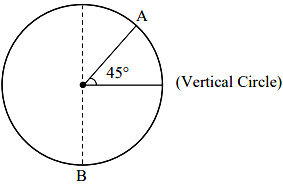
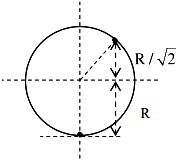
A body of \(m \mathrm{~kg}\) slides from rest along the curve of vertical circle from point \(A\) to \(B\) in friction less path. The velocity of the body at \(B\) is: [JEE Main 2024 (Online) 4th April Evening Shift]
(given, \(R=14 \mathrm{~m}, g=10 \mathrm{~m} / \mathrm{s}^2\) and \(\sqrt{2}=1.4\) ) CorrectIncorrect
Hint
(d)

\(
\begin{aligned}
&\text { Apply Work energy theorem from A to B }\\
&\begin{aligned}
& \Rightarrow W_{m g}=K_B-K_A \\
& \Rightarrow m g \times\left(\frac{R}{\sqrt{2}}+R\right)=\frac{1}{2} m v_B^2-0\left\{v_A=0 \text { (at rest) }\right\} \\
& \Rightarrow m g R \frac{(\sqrt{2}+1)}{\sqrt{2}}=\frac{1}{2} m v_B^2 \\
& \Rightarrow \sqrt{g R \frac{2(\sqrt{2}+1)}{\sqrt{2}}}=v_B \\
& \Rightarrow \sqrt{\frac{10 \times 14 \times 2(2.4)}{1.4}}=v_B \\
& \Rightarrow 21.9=v_B
\end{aligned}
\end{aligned}
\) - Question 21 of 64
21. Question
If a rubber ball falls from a height \(h\) and rebounds upto the height of \(h / 2\). The percentage loss of total energy of the initial system as well as velocity ball before it strikes the ground, respectively, are: [JEE Main 2024 (Online) 4th April Morning Shift]
CorrectIncorrectHint
(a) Step 1: Calculate Energy Loss
The initial total energy ( \(E_i\) ) of the ball when dropped from height \(h\) is entirely potential energy, given by \(E_i=m g h\). The final maximum potential energy ( \(E_f\) ) after the rebound to height \(h / 2\) is \(E_f=m g(h / 2)\).
The energy lost ( \(\Delta E\) ) during the impact is the difference between the initial and final maximum potential energies:
\(
\Delta E=E_i-E_f=m g h-m g \frac{h}{2}=m g \frac{h}{2}
\)
The percentage loss of energy is calculated as the ratio of energy lost to the initial energy, multiplied by 100%:
\(
\text { Percentage Loss }=\left(\frac{\Delta E}{E_i}\right) \times 100 \%=\left(\frac{m g \frac{h}{2}}{m g h}\right) \times 100 \%=\left(\frac{1}{2}\right) \times 100 \%=50 \%
\)
Step 2: Calculate Final Velocity
As the ball falls from rest at height \(h\) just before striking the ground, its potential energy is converted into kinetic energy. According to the principle of conservation of energy during the fall:
\(
m g h=\frac{1}{2} m v^2
\)
where \(v\) is the velocity of the ball just before impact.
Solving for \(v\) :
\(
\begin{aligned}
& v^2=2 g h \\
& v=\sqrt{2 g h}
\end{aligned}
\)
The percentage loss of total energy is \(50 \%\), and the velocity of the ball before it strikes the ground is \(\sqrt{2 g h}\). - Question 22 of 64
22. Question
A body of mass 2 kg begins to move under the action of a time dependent force given by \(\vec{F}=\left(6 t \hat{i}+6 t^2 \hat{j}\right) N\). The power developed by the force at the time \(t\) is given by: [JEE Main 2024 (Online) 31st January Evening Shift]
CorrectIncorrectHint
(d) Step 1: Calculate acceleration
The force \(\vec{F}=\left(6 t \hat{i}+6 t^2 \hat{j}\right) N\) acts on a mass \(m=2 \mathrm{~kg}\). The acceleration \(\vec{a}\) is given by Newton’s second law, \(\vec{F}=m \vec{a}\) :
\(
\vec{a}=\frac{\vec{F}}{m}=\frac{6 t \hat{i}+6 t^2 \hat{j}}{2}=\left(3 t \hat{i}+3 t^2 \hat{j}\right) \frac{m}{s^2}
\)
Step 2: Calculate velocity
Assuming the body starts from rest at \(t=0\), the velocity \(\vec{v}\) is the integral of the acceleration with respect to time:
\(
\vec{v}=\int \vec{a} d t=\int\left(3 t \hat{i}+3 t^2 \hat{j}\right) d t=\left(\frac{3 t^2}{2} \hat{i}+\frac{3 t^3}{3} \hat{j}\right)=\left(\frac{3}{2} t^2 \hat{i}+t^3 \hat{j}\right) \frac{m}{s}
\)
Step 3: Calculate power
Power \(\boldsymbol{P}\) is the dot product of the force vector and the velocity vector, \(\boldsymbol{P}=\overrightarrow{\boldsymbol{F}} \cdot \overrightarrow{\boldsymbol{v}}\) :
\(
\begin{gathered}
P=\left(6 t \hat{i}+6 t^2 \hat{j}\right) \cdot\left(\frac{3}{2} t^2 \hat{i}+t^3 \hat{j}\right) \\
P=(6 t)\left(\frac{3}{2} t^2\right)+\left(6 t^2\right)\left(t^3\right) \\
P=9 t^3+6 t^5
\end{gathered}
\)
The power developed at time \(\boldsymbol{t}\) is \(\boldsymbol{P}=\left(9 t^3+6 t^5\right) \mathrm{W}\).
The power developed by the force at time \(t\) is \(\left(9 t^3+6 t^5\right) \mathrm{W}\). - Question 23 of 64
23. Question
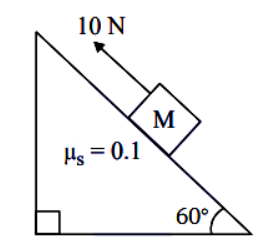
A block of mass 1 kg is pushed up a surface inclined to horizontal at an angle of \(60^{\circ}\) by a force of 10 N parallel to the inclined surface as shown in figure. When the block is pushed up by 10 m along inclined surface, the work done against frictional force is : \(\left[g=10 \mathrm{~m} / \mathrm{s}^2\right]\)
 CorrectIncorrect
Hint
(c) Step 1: Calculate the normal force
The normal force ( \(N\) ) on an inclined plane is given by the component of gravity perpendicular to the surface.
\(
N=m g \cos (\theta)
\)
Substituting the given values ( \(m=1 \mathrm{~kg}, g=10 \mathrm{~m} / \mathrm{s}^2, \theta=60^{\circ}\) ):
\(
N=1 \times 10 \times \cos \left(60^{\circ}\right)=10 \times 0.5=5 \mathrm{~N}
\)
Step 2: Calculate the frictional force
The kinetic frictional force ( \(f_k\) ) is calculated using the coefficient of kinetic friction ( \(\mu_k\) ) and the normal force ( \(N\) ):
\(
f_k=\mu_k N
\)
Assuming \(\mu_k=0.1\) :
\(
f_k=0.1 \times 5 \mathrm{~N}=0.5 \mathrm{~N}
\)
Step 3: Calculate the work done against friction
Work done against the frictional force ( \(W_{\text {against } f}\) ) over a distance ( \(d\) ) is the product of the frictional force and the distance moved along the incline:
\(
W_{\text {against } f}=f_k \times d
\)
Given \(d=10 \mathrm{~m}\) :
\(
W_{\text {against } f}=0.5 \mathrm{~N} \times 10 \mathrm{~m}=5 \mathrm{~J}
\)
The work done against the frictional force is 5 J. - Question 24 of 64
24. Question
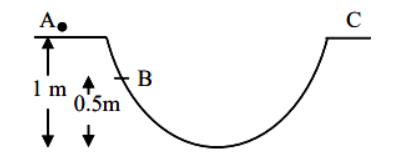
A particle is placed at the point \(A\) of a frictionless track \(A B C\) as shown in figure. It is gently pushed towards right. The speed of the particle when it reaches the point \(B\) is : [JEE Main 2024 (Online) 30th January Morning Shift]
(Take \(g=10 \mathrm{~m} / \mathrm{s}^2\) ). CorrectIncorrect
Hint
(c) Step 1: State the conservation of energy equation
According to the principle of conservation of mechanical energy, the total mechanical energy at point A equals the total mechanical energy at point B :
\(
E_A=E_B \Longrightarrow K_A+U_A=K_B+U_B
\)
where \(K\) is kinetic energy and \(U\) is potential energy. This can be expressed in terms of mass \((m)\), velocity \((v)\), gravitational acceleration \((g)\), and height \((h)\) as:
\(
\frac{1}{2} m v_A^2+m g h_A=\frac{1}{2} m v_B^2+m g h_B
\)
Step 2: Substitute known values and simplify
Given that the particle is gently pushed from rest, the initial velocity \(v_A=0 \mathrm{~m} / \mathrm{s}\). The equation simplifies to:
\(
m g h_A=\frac{1}{2} m v_B^2+m g h_B
\)
Dividing by mass \(m\) (since \(m \neq 0\) ):
\(
g h_A=\frac{1}{2} v_B^2+g h_B
\)
Step 3: Solve for the speed at point B
Rearrange the equation to solve for \(\boldsymbol{v}_{\boldsymbol{B}}\) :
\(
\begin{gathered}
\frac{1}{2} v_B^2=g h_A-g h_B \Longrightarrow v_B^2=2 g\left(h_A-h_B\right) \\
v_B=\sqrt{2 g\left(h_A-h_B\right)}
\end{gathered}
\)
Step 4: Calculate the final numerical value
Substitute the assumed values \(g=10 \mathrm{~m} / \mathrm{s}^2, h_A=1 \mathrm{~m}\), and \(h_B=0.5 \mathrm{~m}\) into the formula:
\(
\begin{gathered}
v_B=\sqrt{2 \times 10 \mathrm{~m} / \mathrm{s}^2 \times(1 \mathrm{~m}-0.5 \mathrm{~m})} \\
v_B=\sqrt{2 \times 10 \mathrm{~m} / \mathrm{s}^2 \times 0.5 \mathrm{~m}} \\
v_B=\sqrt{10} \mathrm{~m} / \mathrm{s}
\end{gathered}
\)
The speed of the particle when it reaches point \(B\) is \(\sqrt{\mathbf{1 0}} \mathrm{m} / \mathrm{s}\). - Question 25 of 64
25. Question
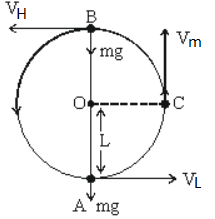
A bob of mass ‘ \(m\) ‘ is suspended by a light string of length ‘ \(L\) ‘. It is imparted a minimum horizontal velocity at the lowest point \(A\) such that it just completes half circle reaching the top most position B . The ratio of kinetic energies \(\frac{(K . E)_A}{(K . E)_B}\) is : [JEE Main 2024 (Online) 29th January Evening Shift]
 CorrectIncorrect
Hint
(a) Step 1: Minimum velocity at the top (B)
For the bob to just complete the half circle, the minimum velocity at the top most point (B) must ensure that the gravitational force provides the necessary centripetal force, meaning the tension in the string is zero.
The condition is \(\frac{m v_B^2}{L}=m g\), which gives the minimum velocity squared at B as \(v_B^2=g L\).
Step 2: Kinetic energy at the top (B)
The kinetic energy at point B is calculated using the minimum velocity \(\boldsymbol{v}_{\boldsymbol{B}}\) :
\(
(K . E)_B=\frac{1}{2} m v_B^2=\frac{1}{2} m g L
\)
Step 3: Conservation of energy
By the principle of conservation of mechanical energy between the lowest point (A) and the highest point (B), where the potential energy at A is defined as zero, we have:
\(
\begin{gathered}
(K . E)_A+(P . E)_A=(K . E)_B+(P . E)_B \\
(K . E)_A+0=\frac{1}{2} m g L+m g(2 L) \\
(K . E)_A=\frac{5}{2} m g L
\end{gathered}
\)
Step 4: Kinetic energy at the bottom (A)
The kinetic energy at the bottom \((A)\) is found to be \((K . E)_A=\frac{5}{2} m g L\)
The ratio of kinetic energies is:
\(
\frac{(K . E)_A}{(K . E)_B}=\frac{\frac{5}{2} m g L}{\frac{1}{2} m g L}=5
\) - Question 26 of 64
26. Question
A block of mass 100 kg slides over a distance of 10 m on a horizontal surface. If the co-efficient of friction between the surfaces is 0.4, then the work done against friction \((\operatorname{in} J)\) is : [JEE Main 2024 (Online) 29th January Morning Shift]
CorrectIncorrectHint
(d) Step 1: Calculate the normal force
The normal force ( \(N\) ) on a horizontal surface is equal to the weight of the block, which is the product of its mass \((m)\) and the acceleration due to gravity \((g)\).
We use \(g=9.8 \mathrm{~m} / \mathrm{s}^2\).
\(
\begin{gathered}
N=m \times g \\
N=100 \mathrm{~kg} \times 10 \mathrm{~m} / \mathrm{s}^2=1000 \mathrm{~N}
\end{gathered}
\)
Step 2: Calculate the frictional force
The force of kinetic friction \(\left(F_f\right)\) is calculated using the coefficient of friction \((\mu)\) and the normal force ( \(N\) ).
\(
\begin{gathered}
F_f=\mu \times N \\
F_f=0.4 \times 1000 \mathrm{~N}=400 \mathrm{~N}
\end{gathered}
\)
Step 3: Calculate the work done
The work done against friction ( \(W\) ) is the product of the frictional force ( \(F_f\) ) and the distance \((d)\) over which the block slides.
\(
\begin{gathered}
W=F_f \times d \\
W=400 \mathrm{~N} \times 10 \mathrm{~m}=4000 \mathrm{~J}
\end{gathered}
\)
The work done against friction is 4000 J. - Question 27 of 64
27. Question
The potential energy function (in \(J\) ) of a particle in a region of space is given as \(U=\left(2 x^2+3 y^3+2 z\right)\). Here \(x, y\) and \(z\) are in meter. The magnitude of \(x\) component of force (in \(N\) ) acting on the particle at point \(P(1,2,3) \mathrm{m}\) is : [JEE Main 2024 (Online) 29th January Morning Shift]
CorrectIncorrectHint
(a) Step 1: Determine the \(\mathbf{x}\)-component of the force
The force \(\overrightarrow{\boldsymbol{F}}\) is the negative gradient of the potential energy function \(U\). The xcomponent of the force \(\boldsymbol{F}_{\boldsymbol{x}}\) is given by the negative partial derivative of \(U\) with respect to \(\boldsymbol{x}\) :
\(
F_x=-\frac{\partial U}{\partial x}
\)
Given the potential energy function \(U=\left(2 x^2+3 y^3+2 z\right)\), we compute the partial derivative:
\(
\frac{\partial U}{\partial x}=4 x
\)
Therefore, the expression for the \(x\)-component of the force is \(F_x=-4 x\).
Step 2: Calculate the magnitude at the given point
The force component at point \(P(1,2,3)\) is found by substituting the value \(x=1 \mathrm{~m}\) into the expression for \(\boldsymbol{F}_{\boldsymbol{x}}\) :
\(
F_x=-4(1)=-4 \mathrm{~N}
\)
The magnitude of the x -component of the force is the absolute value of \(\boldsymbol{F}_{\boldsymbol{x}}\) :
\(
\left|F_x\right|=|-4 \mathrm{~N}|=4 \mathrm{~N}
\)
The magnitude of the \(x\)-component of the force acting on the particle is \(\mathbf{4} \mathbf{N}\). - Question 28 of 64
28. Question
A ball suspended by a thread swings in a vertical plane so that its magnitude of acceleration in the extreme position and lowest position are equal. The angle ( \(\theta\) ) of thread deflection in the extreme position will be : [JEE Main 2024 (Online) 27th January Evening Shift]
CorrectIncorrectHint
(b) Here, we will consider the lowest point of the motion as the reference
Now, when the ball reaches the maximum height, we can say it has the highest potential energy and as the motion stops there, the kinetic energy to be zero.
Similarly, when the ball reaches the lowest point, as it is a reference point, the potential energy can be said to be zero and as the ball tends to move towards height, kinetic energy is maximum. Now, from the law of conservation of energy, we can say that the total energy at the height is equal to the total energy at the base or reference.
\(
\begin{aligned}
& E_h=E_b \\
& \therefore K E_h+P E_h=K E_b+P E_b
\end{aligned}
\)
Substituting the known values,
\(
\begin{aligned}
& \therefore 0+P E_h=K E_b+0 \\
& \therefore P E_h=K E_b \ldots \ldots(1)
\end{aligned}
\)
Now, let us suppose the length of the thread as \(l\).
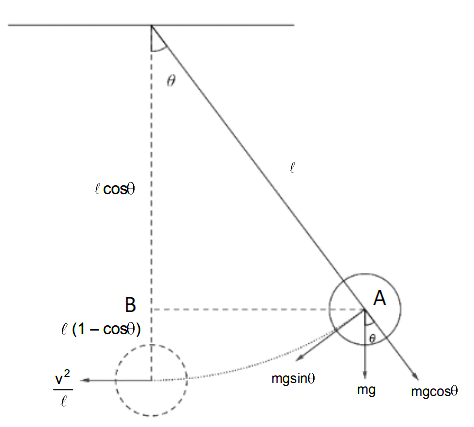
Now, for the acceleration at the highest position, we know at the extreme position, the force acting is only due to the gravitational force. But as the gravitational force acts in the downward direction, we need to consider the component of the force in the direction of the motion as shown in the figure below:
Hence, the force acting at the extreme position is
\(
F_h=m g \sin \theta
\)
Hence, the acceleration can be expressed as,
\(
a_h=g \sin \theta \dots(2)
\)
For the acceleration at the lowest position, we know that the acceleration to reach extreme height is provided by the centripetal force,
\(
F_b=\frac{m v^2}{l}
\)
Hence, the acceleration can be expressed as,
\(
a_b=\frac{v^2}{l} \ldots \ldots .(3)
\)
Now, for the equation (1), we can write
\(
\therefore m g h=\frac{1}{2} m v^2
\)
The height of the ball at the extreme position from the geometry of the figure can be expressed as
\(
h=l-l \cos \theta
\)
Substituting the value,
\(
\therefore m g(l-l \cos \theta)=\frac{1}{2} m v^2
\)
Canceling the common terms, and taking common terms out of parenthesis
\(
\therefore g l(1-\cos \theta)=\frac{1}{2} v^2
\)
Rearranging the equation,
\(
\therefore 2 g(1-\cos \theta)=\frac{v^2}{l}
\)
From the equation (3),
\(
\therefore 2 g(1-\cos \theta)=a_b
\)
But, we are given that the acceleration at the base is equal to acceleration at the extreme position.
\(
\therefore 2 g(1-\cos \theta)=a_h
\)
From the equation (2),
\(
\therefore 2 g(1-\cos \theta)=g \sin \theta
\)
Now, we know the expansions for the trigonometric terms as,
\(
\sin 2 \theta=2 \sin \theta \cos \theta \text { and } \cos 2 \theta=1-2 \sin ^2 \theta
\)
Applying the trigonometric expansions,
\(
\therefore 2 g \times 2 \sin ^2 \frac{\theta}{2}=g \times 2 \sin \frac{\theta}{2} \cos \frac{\theta}{2}
\)
Canceling the common terms,
\(
\begin{aligned}
& \therefore 2 \sin \frac{\theta}{2}=\cos \frac{\theta}{2} \\
& \therefore \tan \frac{\theta}{2}=\frac{1}{2}
\end{aligned}
\)
Applying the inverse functions,
\(
\begin{aligned}
& \therefore \frac{\theta}{2}=\tan ^{-1} \frac{1}{2} \\
& \therefore \theta=2 \tan ^{-1} \frac{1}{2}
\end{aligned}
\) - Question 29 of 64
29. Question
A bullet is fired into a fixed target looses one third of its velocity after travelling 4 cm. It penetrates further \(\mathrm{D} \times 10^{-3} \mathrm{~m}\) before coming to rest. The value of D is : [JEE Main 2024 (Online) 27th January Evening Shift]
CorrectIncorrectHint
(b) Step 1: Calculate the acceleration
Assuming the target provides constant resistance (constant deceleration, \(a\) ), we can apply the kinematic equation \(\boldsymbol{v}^{\mathbf{2}} \boldsymbol{=} \boldsymbol{u}^{\mathbf{2}} \boldsymbol{+} 2 \boldsymbol{a s}\). For the initial \(\mathbf{4 ~ c m}\) (or \(\mathbf{0 . 0 4 ~ m}\) ) of travel, the velocity changes from \(v_i\) to \(v_1=\frac{2}{3} v_i\).
\(
\begin{gathered}
\left(\frac{2}{3} v_i\right)^2=v_i^2+2 a(0.04) \\
\frac{4}{9} v_i^2=v_i^2+0.08 a \\
0.08 a=\left(\frac{4}{9}-1\right) v_i^2=-\frac{5}{9} v_i^2 \\
a=-\frac{5 v_i^2}{9 \times 0.08}=-\frac{5 v_i^2}{0.72}
\end{gathered}
\)
Step 2: Determine total penetration depth
The bullet comes to rest \(\left(v_f=0\right)\) after a total distance \(\boldsymbol{x}_{\text {total }}\). Using the same kinematic equation for the entire journey from the start:
\(
\begin{gathered}
v_f^2=v_i^2+2 a x_{\text {total }} \\
0^2=v_i^2+2 a x_{\text {total }} \\
x_{\text {total }}=-\frac{v_i^2}{2 a}
\end{gathered}
\)
Substitute the value of \(\boldsymbol{a}\) from Step 1:
\(
\begin{gathered}
x_{\text {total }}=-\frac{v_i^2}{2\left(-\frac{5 v_i^2}{0.72}\right)} \\
x_{\text {total }}=-\frac{v_i^2}{-\frac{10 v_i^2}{0.72}} \\
x_{\text {total }}=\frac{0.72}{10}=0.072 \mathrm{~m}
\end{gathered}
\)
Step 3: Calculate the value of D
The problem states the bullet penetrates further \(D \times 10^{-3} \mathrm{~m}\) after the initial 4 cm. The total distance is \(0.04 \mathrm{~m}+D \times 10^{-3} \mathrm{~m}\).
\(
\begin{gathered}
0.072=0.04+D \times 10^{-3} \\
0.032=D \times 10^{-3} \\
D=\frac{0.032}{10^{-3}}=32
\end{gathered}
\) - Question 30 of 64
30. Question
The ratio of powers of two motors is \(\frac{3 \sqrt{x}}{\sqrt{x}+1}\), that are capable of raising 300 kg water in 5 minutes and 50 kg water in 2 minutes respectively from a well of 100 m deep. The value of \(x\) will be [JEE Main 2023 (Online) 13th April Morning Shift]
CorrectIncorrectHint
(a) Step 1: Formulate the power ratio from given data
The power \(\boldsymbol{P}\) required to raise a mass \(\boldsymbol{m}\) to a height \(\boldsymbol{h}\) in time \(\boldsymbol{t}\) is given by \(\boldsymbol{P}=\frac{\boldsymbol{m} \boldsymbol{g} \boldsymbol{h}}{\boldsymbol{t}}\).
The ratio of powers for the two motors is \(\frac{P_1}{P_2}=\frac{m_1 t_2}{m_2 t_1}\). Substituting \(m_1=300 \mathrm{~kg}\), \(t_1=5 \mathrm{~min}, m_2=50 \mathrm{~kg}\), and \(t_2=2 \mathrm{~min}\), we get \(\frac{P_1}{P_2}=\frac{300 \times 2}{50 \times 5}=\frac{600}{250}=\frac{12}{5}\). The numerical ratio is 2.4.
Step 2: Set up and solve the equation for \(\mathbf{x}\)
Equate the calculated numerical ratio with the given expression:
\(
\frac{3 \sqrt{x}}{\sqrt{x}+1}=\frac{12}{5}
\)
Cross-multiplying yields \(5(3 \sqrt{x})=12(\sqrt{x}+1)\), which simplifies to \(15 \sqrt{x}=12 \sqrt{x}+12\). Rearranging for \(\sqrt{x}: 3 \sqrt{x}=12\), so \(\sqrt{x}=4\). Squaring both sides gives \(x=16\). - Question 31 of 64
31. Question
Two bodies are having kinetic energies in the ratio \(16: 9\). If they have same linear momentum, the ratio of their masses respectively is : [JEE Main 2023 (Online) 13th April Morning Shift]
CorrectIncorrectHint
(a) The relationship between kinetic energy (\(K\)), linear momentum (\(p\)), and mass (\(m\)) is given by the formula:
\(
K=\frac{p^2}{2 m}
\)
Step 1: Establish the relationship using the given information
We are given that the two bodies have the same linear momentum ( \(p_1=p_2=p\) ) and the ratio of their kinetic energies is \(K_1: K_2=16: 9\). We can express the kinetic energies of the two bodies as:
\(
\begin{aligned}
& K_1=\frac{p^2}{2 m_1} \\
& K_2=\frac{p^2}{2 m_2}
\end{aligned}
\)
Step 2: Determine the ratio of the masses
To find the ratio of their masses \(\left(m_1: m_2\right)\), we divide the expression for \(K_1\) by the expression for \(\boldsymbol{K}_{\mathbf{2}}\) :
\(
\frac{K_1}{K_2}=\frac{\frac{p^2}{2 m_1}}{\frac{p^2}{2 m_2}}=\frac{p^2}{2 m_1} \times \frac{2 m_2}{p^2}=\frac{m_2}{m_1}
\)
Substituting the given kinetic energy ratio \(\frac{K_1}{K_2}=\frac{16}{9}\) :
\(
\frac{m_2}{m_1}=\frac{16}{9}
\)
The ratio of the masses respectively ( \(m_1: m_2\) ) is the inverse:
\(
\frac{m_1}{m_2}=\frac{9}{16}
\) - Question 32 of 64
32. Question
Given below are two statements:
Statement I : A truck and a car moving with same kinetic energy are brought to rest by applying breaks which provide equal retarding forces. Both come to rest in equal distance.
Statement II : A car moving towards east takes a turn and moves towards north, the speed remains unchanged. The acceleration of the car is zero.
In the light of given statements, choose the most appropriate answer from the options given below [JEE Main 2023 (Online) 12th April Morning Shift]CorrectIncorrectHint
(b) Statement I is correct because the work-energy theorem states that the work done by the braking force ( \(W=F \times d\) ) equals the change in kinetic energy ( \(\Delta K E\) ). If \(F\) and \(\Delta K E\) are the same for both vehicles, they must travel the same distance ( \(d\) ).
Statement II is incorrect because a change in direction (velocity) while maintaining constant speed still involves acceleration, as acceleration is the rate of change of velocity (a vector quantity).
- Question 33 of 64
33. Question
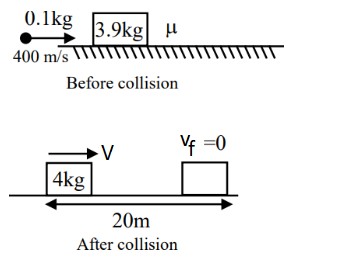
A bullet of mass 0.1 kg moving horizontally with speed \(400 \mathrm{~ms}^{-1}\) hits a wooden block of mass 3.9 kg kept on a horizontal rough surface. The bullet gets embedded into the block and moves 20 m before coming to rest. The coefficient of friction between the block and the surface is _____ [JEE Main 2023 (Online) 8th April Evening Shift]
(Given \(g=10 \mathrm{~m} / \mathrm{s}^2\) )CorrectIncorrectHint
(b)

Step 1: Apply Conservation of Momentum
First, we apply the principle of conservation of linear momentum to find the velocity of the combined bullet-block system immediately after the collision. The collision is an inelastic collision as the bullet gets embedded in the block.
The total initial momentum is equal to the total final momentum.
\(
\begin{aligned}
p_{\text {initial }} & =p_{\text {final }} \\
m_b v_b+m_k v_k & =\left(m_b+m_k\right) V
\end{aligned}
\)
where \(m_b\) is the mass of the bullet, \(v_b\) is the initial velocity of the bullet, \(m_k\) is the mass of the block, \(v_k\) is the initial velocity of the block (which is 0 ), and \(V\) is the combined velocity after the collision.
Given:
\(m_b=0.1 \mathrm{~kg}\)
\(v_b=400 \mathrm{~ms}^{-1}\)
\(m_k=3.9 \mathrm{~kg}\)
\(v_k=0 \mathrm{~ms}^{-1}\)
\(
\begin{aligned}
&\begin{gathered}
0.1 \mathrm{~kg} \times 400 \mathrm{~ms}^{-1}+3.9 \mathrm{~kg} \times 0 \mathrm{~ms}^{-1}=(0.1 \mathrm{~kg}+3.9 \mathrm{~kg}) V \\
40 \mathrm{~kg} \cdot \mathrm{~ms}^{-1}=4.0 \mathrm{~kg} \times V \\
V=\frac{40}{4.0} \mathrm{~ms}^{-1}=10 \mathrm{~ms}^{-1}
\end{gathered}\\
&\text { The combined velocity after the collision is } 10 \mathrm{~ms}^{-1} \text {. }
\end{aligned}
\)
Step 2: Calculate Deceleration due to Friction
Next, we use a kinematic equation to find the acceleration (deceleration) of the combined system as it moves a distance \(d=20 \mathrm{~m}\) before coming to rest ( \(v_f=0 \mathrm{~ms}^{-1}\) ).
We use the equation:
\(
v_f^2=V^2+2 a d
\)
where \(v_f\) is the final velocity, \(V\) is the initial velocity of this phase, \(a\) is the acceleration, and \(d\) is the distance.
Given:
\(v_f=0 \mathrm{~ms}^{-1}\)
\(V=10 \mathrm{~ms}^{-1}\)
\(d=20 \mathrm{~m}\)
Calculation:
\(
\begin{gathered}
0^2=\left(10 \mathrm{~ms}^{-1}\right)^2+2 \times a \times 20 \mathrm{~m} \\
0=100 \mathrm{~m}^2 / \mathrm{s}^2+40 a \mathrm{~m} \\
40 a=-100 \mathrm{~ms}^{-2} \\
a=-\frac{100}{40} \mathrm{~ms}^{-2}=-2.5 \mathrm{~ms}^{-2}
\end{gathered}
\)
The magnitude of deceleration is \(2.5 \mathrm{~ms}^{-2}\).
Step 3: Determine the Coefficient of Friction
The deceleration is caused by the force of kinetic friction, \(F_f\). The force of friction is also related to the coefficient of friction \(\mu\) and the normal force \(N\), which equals the combined weight \(\boldsymbol{M}\) g for a horizontal surface.
\(
F_f=\mu N=\mu M g
\)
According to Newton’s second law, the force of friction is also \(F_f=M|a|\).
\(
\begin{gathered}
M|a|=\mu M g \\
\mu=\frac{|a|}{g}
\end{gathered}
\)
Given:
\(|a|=2.5 \mathrm{~ms}^{-2}\)
\(g=10 \mathrm{~ms}^{-2}\)
Calculation:
\(
\begin{gathered}
\mu=\frac{2.5 \mathrm{~ms}^{-2}}{10 \mathrm{~ms}^{-2}} \\
\mu=0.25
\end{gathered}
\)
The coefficient of friction between the block and the surface is \(\mathbf{0 . 2 5}\). - Question 34 of 64
34. Question
Identify the correct statements from the following:
A. Work done by a man in lifting a bucket out of a well by means of a rope tied to the bucket is negative.
B. Work done by gravitational force in lifting a bucket out of a well by a rope tied to the bucket is negative.
C. Work done by friction on a body sliding down an inclined plane is positive.
D. Work done by an applied force on a body moving on a rough horizontal plane with uniform velocity is zero.
E. Work done by the air resistance on an oscillating pendulum is negative.
Choose the correct answer from the options given below : [JEE Main 2023 (Online) 29th January Evening Shift]CorrectIncorrectHint
(d) Statement B is correct because when lifting the bucket, the gravitational force acts downward, while the displacement is upward. Since the force and displacement are in opposite directions, the work done by gravity is negative.
Statement E is correct because air resistance (a form of friction) always opposes the motion of the pendulum. Since the force is always in the opposite direction to the instantaneous displacement, the work done by air resistance is negative, which causes the pendulum to slow down and eventually stop.
Vhy other options are incorrect
Statement A is incorrect. The man applies an upward force to lift the bucket, and the bucket’s displacement is also upward. Since the force and displacement are in the same direction, the work done by the man is positive.Statement C is incorrect. Friction always opposes motion. When a body slides down an inclined plane, the friction force acts upward along the plane (opposite to the downward motion), so the work done by friction is negative.
Statement D is incorrect. When a body moves at a uniform velocity on a rough horizontal plane, it means the net force is zero. The applied force is balanced by the force of friction. However, the applied force and the displacement are in the same direction, so the work done by the applied force is positive, not zero. The net work done is zero.
- Question 35 of 64
35. Question
A stone is projected at angle \(30^{\circ}\) to the horizontal. The ratio of kinetic energy of the stone at point of projection to its kinetic energy at the highest point of flight will be [JEE Main 2023 (Online) 29th January Morning Shift]
CorrectIncorrectHint
(c)
\(
\begin{aligned}
& \mathrm{KE}_{\text {in }}=\frac{1}{2} m v^2 \\
& \mathrm{KE}_{\text {final }}=\frac{1}{2} m v^2 \cos ^2 30^{\circ}=\frac{1}{2} m v^2\left(\frac{\sqrt{3}}{2}\right)^2 \\
& \frac{\mathrm{KE}_{\text {in }}}{\mathrm{KE}_{\mathrm{f}}}=\frac{\frac{1}{2} m v^2}{\frac{1}{2} m v^2\left(\frac{3}{4}\right)}=\frac{4}{3}
\end{aligned}
\)
Explanation: Step 1: Analyze Kinetic Energy at Projection
The initial kinetic energy ( \(\mathrm{KE}_{\text {initial }}\) ) of the stone with initial velocity \(v_0\) is given by the formula:
\(
\mathrm{KE}_{\text {initial }}=\frac{1}{2} m v_0^2
\)
where \(m\) is the mass of the stone and \(v_0\) is the initial speed.
Step 2: Analyze Kinetic Energy at Highest Point
At the highest point of flight, the vertical component of velocity is zero. The horizontal component of velocity \(\left(v_h\right)\) remains constant throughout the flight and is given by \(v_h=v_0 \cos (\theta)\), where \(\theta\) is the angle of projection \(\left(30^{\circ}\right)\).
The kinetic energy at the highest point ( \(\mathrm{KE}_{\text {highest }}\) ) is:
\(
\mathrm{KE}_{\text {highest }}=\frac{1}{2} m v_h^2=\frac{1}{2} m\left(v_0 \cos (\theta)\right)^2
\)
Step 3: Calculate the Ratio
The ratio of the kinetic energy at the point of projection to the kinetic energy at the highest point is:
\(
\frac{\mathrm{KE}_{\text {initial }}}{\mathrm{KE}_{\text {highest }}}=\frac{\frac{1}{2} m v_0^2}{\frac{1}{2} m v_0^2 \cos ^2(\theta)}=\frac{1}{\cos ^2(\theta)}
\)
Substituting the angle \(\theta=30^{\circ}\) :
\(
\frac{\mathrm{KE}_{\text {initial }}}{\mathrm{KE}_{\text {highest }}}=\frac{1}{\cos ^2\left(30^{\circ}\right)}=\frac{1}{\left(\frac{\sqrt{3}}{2}\right)^2}=\frac{1}{\frac{3}{4}}=\frac{4}{3}
\)
The ratio of kinetic energy of the stone at the point of projection to its kinetic energy at the highest point of flight is \(4: 3\). - Question 36 of 64
36. Question
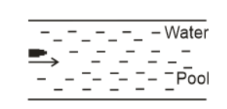
A bullet of mass 200 g having initial kinetic energy 90 J is shot inside a long swimming pool as shown in the figure. If it’s kinetic energy reduces to 40 J within 1 s, the minimum length of the pool, the bullet has to travel so that it completely comes to rest is [JEE Main 2022 (Online) 28th July Evening Shift]
 CorrectIncorrect
Hint
(a) Step 1: Calculate initial and final velocities
We calculate the initial velocity \(\left(v_i\right)\) and the velocity after 1 second \(\left(v_f\right)\) using the kinetic energy formula \(K E=\frac{1}{2} m v^2\), where \(m=0.2 \mathrm{~kg}\).
For the initial state \(\left(K E_i=90 \mathrm{~J}\right)\) :
\(
v_i=\sqrt{\frac{2 \times K E_i}{m}}=\sqrt{\frac{2 \times 90 \mathrm{~J}}{0.2 \mathrm{~kg}}}=\sqrt{900 \mathrm{~m}^2 / \mathrm{s}^2}=30 \mathrm{~m} / \mathrm{s}
\)
For the state after 1 second \(\left(\boldsymbol{K E}_{\boldsymbol{f}}=\mathbf{4 0 J}\right)\) :
\(
v_f=\sqrt{\frac{2 \times K E_f}{m}}=\sqrt{\frac{2 \times 40 \mathrm{~J}}{0.2 \mathrm{~kg}}}=\sqrt{400 \mathrm{~m}^2 / \mathrm{s}^2}=20 \mathrm{~m} / \mathrm{s}
\)
Step 2: Determine constant acceleration
Assuming a constant resistive force from the water results in constant acceleration (a). We use the kinematic equation \(v_f=v_i+at\) over the time interval \(t=1 \mathrm{~s}\) :
\(
a=\frac{v_f-v_i}{t}=\frac{20 \mathrm{~m} / \mathrm{s}-30 \mathrm{~m} / \mathrm{s}}{1 \mathrm{~s}}=-10 \mathrm{~m} / \mathrm{s}^2
\)
Step 3: Calculate total stopping distance
We find the total distance ( \(d\) ) the bullet travels until it comes completely to rest ( \(v_{\text {final }}=0 \mathrm{~m} / \mathrm{s}\) ), starting from the initial velocity \(v_i=30 \mathrm{~m} / \mathrm{s}\), using the constant acceleration \(a=-10 \mathrm{~m} / \mathrm{s}^2\). The kinematic equation \(v_{\text {final }}^2=v_i^2+2 a d\) is used:
\(
\begin{gathered}
0^2=(30 \mathrm{~m} / \mathrm{s})^2+2 \times\left(-10 \mathrm{~m} / \mathrm{s}^2\right) \times d \\
0=900 \mathrm{~m}^2 / \mathrm{s}^2-20 \mathrm{~m} / \mathrm{s}^2 \times d \\
20 \mathrm{~m} / \mathrm{s}^2 \times d=900 \mathrm{~m}^2 / \mathrm{s}^2 \\
d=\frac{900 \mathrm{~m}^2 / \mathrm{s}^2}{20 \mathrm{~m} / \mathrm{s}^2}=45 \mathrm{~m}
\end{gathered}
\)
The minimum length of the pool the bullet has to travel so that it completely comes to rest is \(\mathbf{4 5 ~ m}\). - Question 37 of 64
37. Question
Sand is being dropped from a stationary dropper at a rate of \(0.5 \mathrm{kgs}^{-1}\) on a conveyor belt moving with a velocity of \(5 \mathrm{~ms}^{-1}\). The power needed to keep the belt moving with the same velocity will be : [JEE Main 2022 (Online) 27th July Morning Shift]
CorrectIncorrectHint
(d) Step 1: Determine the force required
The force needed to maintain constant velocity in a variable mass system is given by the rate of change of momentum, \(F=\frac{d(m v)}{d t}\). Since the velocity \(v\) is constant, this simplifies to \(F=v \frac{d m}{d t}\).
We are given the mass flow rate \(\frac{d m}{d t}=0.5 \mathrm{kgs}^{-1}\) and velocity \(v=5 \mathrm{~ms}^{-1}\).
\(
F=\left(5 \mathrm{~ms}^{-1}\right) \times\left(0.5 \mathrm{kgs}^{-1}\right)=2.5 \mathrm{~N}
\)
Step 2: Calculate the power needed
Power \(\boldsymbol{P}\) is the product of the force applied and the velocity of the belt, \(\boldsymbol{P}=\boldsymbol{F v}\).
\(
\boldsymbol{P}=(2.5 \mathrm{~N}) \times\left(5 \mathrm{~ms}^{-1}\right)=12.5 \mathrm{~W}
\)
This value \((12.5 \mathrm{~W})\) is double the rate at which kinetic energy is imparted to the sand; the other half of the power is lost as heat due to friction.
The power needed to keep the belt moving with the same velocity is \(\mathbf{1 2 . 5 ~ W}\). - Question 38 of 64
38. Question
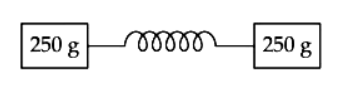
As per the given figure, two blocks each of mass 250 g are connected to a spring of spring constant \(2 \mathrm{Nm}^{-1}\). If both are given velocity \(v\) in opposite directions, then maximum elongation of the spring is : [JEE Main 2022 (Online) 26th July Morning Shift]
 CorrectIncorrect
Hint
(b) Step 1: Set up the energy conservation equation
The problem can be solved using the principle of conservation of energy. The initial state has only kinetic energy (KE), and the state of maximum elongation has only potential energy (PE) in the center of mass frame (or by considering total energy and the fact the center of mass velocity is zero). The total initial kinetic energy of the system is the sum of the kinetic energies of both blocks, where each block has mass \(m=250 \mathrm{~g}=0.25 \mathrm{~kg}\) and velocity \(v\) in opposite directions:
\(
K E_{\text {initial }}=\frac{1}{2} m v^2+\frac{1}{2} m v^2=m v^2
\)
The potential energy stored in the spring at maximum elongation \(x\) is given by:
\(
P E_{\text {spring }}=\frac{1}{2} k x^2
\)
where \(k=2 \mathrm{Nm}^{-1}\).
Step 2: Solve for the maximum elongation
By conservation of energy, the initial kinetic energy equals the maximum potential energy:
\(
\begin{aligned}
K E_{\text {initial }} & =P E_{\text {spring }} \\
m v^2 & =\frac{1}{2} k x^2
\end{aligned}
\)
Substitute the given values for \(m\) and \(k\) :
\(
0.25 \cdot v^2=\frac{1}{2} \cdot 2 \cdot x^2
\)
\(
0.25 v^2=x^2
\)
Solve for \(x\) :
\(
\begin{gathered}
x=\sqrt{0.25 v^2}=0.5 v \\
x=\frac{v}{2}
\end{gathered}
\)
The maximum elongation of the spring is \(\frac{\mathbf{v}}{\mathbf{2}}\). - Question 39 of 64
39. Question
A bag of sand of mass 9.8 kg is suspended by a rope. A bullet of 200 g travelling with speed \(10 \mathrm{~ms}^{-1}\) gets embedded in it, then loss of kinetic energy will be : [JEE Main 2022 (Online) 25th July Evening Shift]
CorrectIncorrectHint
(b) Step 1: Calculate the final velocity using conservation of momentum
The mass of the bullet is \(m=0.2 \mathrm{~kg}\) and the mass of the sandbag is \(M=9.8 \mathrm{~kg}\). The initial velocity of the bullet is \(v_i=10 \mathrm{~m} / \mathrm{s}\), and the sandbag is initially at rest ( \(V_i=0 \mathrm{~m} / \mathrm{s}\) ).
Using the conservation of linear momentum for a perfectly inelastic collision, the final velocity \(v_f\) of the combined system is calculated:
\(
\begin{aligned}
& m v_i+M V_i=(m+M) v_f \\
& 0.2 \times 10+9.8 \times 0=(0.2+9.8) v_f \\
& v_f=\frac{2}{10}=0.2 \mathrm{~m} / \mathrm{s}
\end{aligned}
\)
Step 2: Calculate initial and final kinetic energies
The initial kinetic energy \(K E_i\) is only due to the bullet:
\(
K E_i=\frac{1}{2} m v_i^2=\frac{1}{2} \times 0.2 \times 10^2=10 \mathrm{~J}
\)
The final kinetic energy \(\boldsymbol{K} \boldsymbol{E}_f\) of the combined system after the collision is:
\(
K E_f=\frac{1}{2}(m+M) v_f^2=\frac{1}{2} \times(0.2+9.8) \times(0.2)^2=0.2 \mathrm{~J}
\)
Step 3: Determine the loss of kinetic energy
The loss of kinetic energy \(\boldsymbol{\Delta} \boldsymbol{K} \boldsymbol{E}\) is the difference between the initial and final kinetic energies:
\(
\Delta K E=K E_i-K E_f=10 \mathrm{~J}-0.2 \mathrm{~J}=9.8 \mathrm{~J}
\)
The loss of kinetic energy will be 9.8 J. - Question 40 of 64
40. Question
A body of mass 0.5 kg travels on straight line path with velocity \(v=\left(3 x^2+4\right) \mathrm{m} / \mathrm{s}\). The net workdone by the force during its displacement from \(x=0\) to \(x=2 \mathrm{~m}\) is : [JEE Main 2022 (Online) 25th July Morning Shift]
CorrectIncorrectHint
(b)
\(
\begin{aligned}
&\text { By work-energy thorem }\\
&\begin{aligned}
& \mathrm{W}=\Delta \mathrm{K} \\
& \Rightarrow \mathrm{~W}=\frac{1}{2}\left(\mathrm{v}_{\mathrm{f}}^2-\mathrm{v}_{\mathrm{i}}^2\right) \\
& \Rightarrow \mathrm{W}=\frac{1}{2} \times 0.5 \times\left(16^2-4^2\right) \\
& \Rightarrow \mathrm{W}=\frac{1}{4} \times 240 \\
& \Rightarrow \mathrm{~W}=60 \mathrm{~J}
\end{aligned}
\end{aligned}
\)Explanation: Step 1: Calculate Initial and Final Velocities
The velocity of the body is given by \(v(x)=\left(3 x^2+4\right) \mathrm{m} / \mathrm{s}\). We calculate the initial velocity \(\left(v_i\right)\) at \(x=0 \mathrm{~m}\) and the final velocity \(\left(v_f\right)\) at \(x=2 \mathrm{~m}\).
At \(x=0 \mathrm{~m}\) :
\(
v_i=3(0)^2+4=4 \mathrm{~m} / \mathrm{s}
\)
At \(x=2 \mathrm{~m}\) :
\(
v_f=3(2)^2+4=16 \mathrm{~m} / \mathrm{s}
\)
Step 2: Apply the Work-Energy Theorem
According to the Work-Energy Theorem, the net work done ( \(W_{\text {net }}\) ) on an object is equal to the change in its kinetic energy \((\Delta K)\). The formula for net work is \(W_{\text {net }}=K_f-K_i=\frac{1}{2} m v_f^2-\frac{1}{2} m v_i^2\), where \(m\) is the mass, \(v_i\) is the initial velocity, and \(v_f\) is the final velocity. The mass \(m=0.5 \mathrm{~kg}\).
We calculate the initial and final kinetic energies:
Initial Kinetic Energy \(\boldsymbol{(} \boldsymbol{K}_{\boldsymbol{i}} \boldsymbol{)}\) :
\(
K_i=\frac{1}{2}(0.5 \mathrm{~kg})(4 \mathrm{~m} / \mathrm{s})^2=0.25 \times 16=4 \mathrm{~J}
\)
Final Kinetic Energy ( \(\boldsymbol{K}_{\boldsymbol{f}}\) ):
\(
K_f=\frac{1}{2}(0.5 \mathrm{~kg})(16 \mathrm{~m} / \mathrm{s})^2=0.25 \times 256=64 \mathrm{~J}
\)
The net work done is the difference:
\(
W_{\text {net }}=K_f-K_i=64 \mathrm{~J}-4 \mathrm{~J}=60 \mathrm{~J}
\)
The net work done by the force is 60 J. - Question 41 of 64
41. Question
In the given figure, the block of mass \(m\) is dropped from the point ‘ \(A\) ‘. The expression for kinetic energy of block when it reaches point ‘ \(B\) ‘ is [JEE Main 2022 (Online) 29th June Evening Shift]
 CorrectIncorrect
Hint
(d) From the figure:
The block of mass \(m\) is released from point \(\mathbf{A}\).
The vertical distance between \(\mathbf{A}\) and \(\mathbf{B}\) is \(\boldsymbol{y}_0\).
When the block reaches B, it has fallen through a height \(y_0\).
Since the block is simply dropped, gravity is the only force doing work (no springs, no friction in the diagram).
Using conservation of mechanical energy
Loss in potential energy from A to B:
\(
\Delta U=m g y_0
\)
This loss becomes kinetic energy at point B:
\(
K_B=m g y_0
\)
Final Answer:
\(
K_B=m g y_0
\)
If the question expected kinetic energy at a general point at depth \(y\), it would be:
\(
K=m g y
\)
But at point B, specifically:
\(
K_B=m g y_0
\)Alternate:
The block is dropped from point A, meaning its initial velocity is zero, so the initial kinetic energy \(\left(K E_A\right)\) is zero. The initial height is \(y_0\) and the final height at point B is \(y\) (relative to some reference point, typically the ground).
The principle of conservation of mechanical energy states that the total energy at point A equals the total energy at point B, assuming no friction or air resistance:
\(
P E_A+K E_A=P E_B+K E_B
\)
The potential energy (PE) is given by \(m g h\), where \(h\) is the height, \(m\) is the mass, and \(g\) is the acceleration due to gravity. The kinetic energy \((K E)\) is given by \(\frac{1}{2} m v^2\).
At point A: \(P E_A=m g y, K E_A=0\).
At point B: \(P E_B=m g (y-y_0), K E_B=\) ?
\(
K E_B=m g y-m g\left(y-y_0\right)
\)
\(
K E_B=m g y_0
\) - Question 42 of 64
42. Question
A particle of mass 500 gm is moving in a straight line with velocity \(\mathrm{v}=\mathrm{b} \mathrm{x}^{5 / 2}\). The work done by the net force during its displacement from \(\mathrm{x}=0\) to \(\mathrm{x}=4 \mathrm{~m}\) is : (Take \(\mathrm{b}=0.25 \mathrm{~m}^{-3 / 2} \mathrm{~s}^{-1}\) ). [JEE Main 2022 (Online) 29th June Morning Shift]
CorrectIncorrectHint
(d) Step 1: Convert units and determine initial conditions
First, convert the mass from grams to kilograms and identify the initial velocity.
The mass is \(m=500 \mathrm{gm}=0.5 \mathrm{~kg}\).
The initial position is \(x_i=0 \mathrm{~m}\), so the initial velocity is \(v_i=b(0)^{5 / 2}=0 \mathrm{~m} / \mathrm{s}\).
The initial kinetic energy is \(K_i=\frac{1}{2} m v_i^2=0 \mathrm{~J}\).
Step 2: Determine final velocity and kinetic energy
Next, calculate the final velocity at \(\boldsymbol{x}_{\boldsymbol{f}} \boldsymbol{=} \mathbf{4 ~ m}\) using the given value for \(b=0.25 \mathrm{~m}^{-3 / 2} \mathrm{~s}^{-1}\).
The final velocity is \(v_f=b x_f^{5 / 2}=0.25 \times(4)^{5 / 2}=0.25 \times 32=8 \mathrm{~m} / \mathrm{s}\).
The final kinetic energy is \(K_f=\frac{1}{2} m v_f^2\).
\(
K_f=\frac{1}{2} \times 0.5 \mathrm{~kg} \times(8 \mathrm{~m} / \mathrm{s})^2=0.25 \times 64 \mathrm{~J}=16 \mathrm{~J}
\)
Step 3: Apply the Work-Energy Theorem
According to the work-energy theorem, the work done by the net force ( \(W_{\text {net }}\) ) equals the change in kinetic energy ( \(\Delta K\) ).
\(
\begin{gathered}
W_{n e t}=K_f-K_i \\
W_{n e t}=16 \mathrm{~J}-0 \mathrm{~J}=16 \mathrm{~J}
\end{gathered}
\)
The work done by the net force is \(\mathbf{1 6 ~ J}\). - Question 43 of 64
43. Question
Arrange the four graphs in descending order of total work done; where \(\)W_1, W_2, W_3\(\) and \(\)W_4\(\) are the work done corresponding to figure \(\)a, b, c\(\) and \(\)d\(\) respectively. [JEE Main 2022 (Online) 26th June Evening Shift]
 CorrectIncorrect
Hint
(a) Step 1: Understand Work-Displacement Graphs
The work ( \(W\) ) done by a force ( \(F\) ) over a displacement ( \(x\) ) is given by the integral of force with respect to displacement, which corresponds to the area under the Force vs. Displacement (F-x) graph.
\(
W=\int F d x
\)
Areas above the displacement axis represent positive work, and areas below represent negative work.
Step 2: Compare the Areas
Figure c has the largest positive area, so \(W_3\) is the greatest.
Figure b has a smaller positive area than c , so \(W_2<W_3\).
Figure a involves some area cancellations, but the net work is less than \(W_2\).
Figure d has a very small, likely negative, net area due to low force or significant area below the axis, resulting in the least work done.
Step 3: Arrange in Descending Order
Comparing the net work from each graph, the descending order (from greatest work to least work) is determined to be \(W_3\), then \(W_2\), then \(W_1\), and finally \(W_4\).
The four graphs arranged in descending order of total work done are
\(
W_3>W_2>W_1>W_4
\) - Question 44 of 64
44. Question
A particle experiences a variable force \(\vec{F}=\left(4 x \hat{i}+3 y^2 \hat{j}\right)\) in a horizontal \(x -y\) plane. Assume distance in meters and force is newton. If the particle moves from point \((1,2)\) to point \((2,3)\) in the \(x-y\) plane, then Kinetic Energy changes by : [JEE Main 2022 (Online) 24th June Morning Shift]
CorrectIncorrectHint
(c) The work done ( \(W\) ) is the line integral of the force \(\vec{F}\) over the displacement
\(
\begin{aligned}
& d \vec{r}=d x \hat{i}+d y \hat{j}: \\
& W=\int_{(1,2)}^{(2,3)} \vec{F} \cdot d \vec{r}=\int_{(1,2)}^{(2,3)}\left(4 x \hat{i}+3 y^2 \hat{j}\right) \cdot(d x \hat{i}+d y \hat{j}) \\
& W=\int_1^2 4 x d x+\int_2^3 3 y^2 d y
\end{aligned}
\)
\(
W=6 \mathrm{~J}+19 \mathrm{~J}=25 \mathrm{~J}
\)
According to the work-energy theorem, the change in kinetic energy is equal to the total work done:
\(
\Delta K E=W=25.0 \mathrm{~J}
\) - Question 45 of 64
45. Question
A body of mass ‘ \(m\) ‘ dropped from a height ‘ \(h\) ‘ reaches the ground with a speed of \(0.8 \sqrt{g h}\). The value of workdone by the air-friction is : [JEE Main 2021 (Online) 1st September Evening Shift]
CorrectIncorrectHint
(a) Initial State: The body is dropped from rest at height \(h\).
Initial potential energy \(\left(P E_i\right)=m g h\)
Initial kinetic energy \(\left(K E_i\right)=0\) (since initial velocity is 0 )
Total initial energy \(\left(E_i\right)=m g h\)
Final State: The body reaches the ground (height 0 ) with speed \(v=0.8 \sqrt{g h}\).
Final potential energy \(\left(P E_f\right)=0\)
Final kinetic energy \(\left(K E_f\right)=\frac{1}{2} m v^2\)
Substitute the given velocity:
\(
K E_f=\frac{1}{2} m(0.8 \sqrt{g h})^2=\frac{1}{2} m(0.64 g h)=0.32 m g h
\)
Total final energy \(\left(E_f\right)=0.32 \mathrm{mgh}\)
Work Done by Air Friction: The work done by non-conservative forces ( \(W_{\text {friction }}\) ) is equal to the change in mechanical energy ( \(\Delta E=E_f-E_i\) ).
\(W_{\text {friction }}=E_f-E_i=K E_f+P E_f-\left(K E_i+P E_i\right)\)
\(W_{\text {friction }}=0.32 m g h+0-(0+m g h)\)
\(W_{\text {friction }}=0.32 m g h-m g h\)
\(W_{\text {friction }}=-0.68 m g h\)
The negative sign indicates that the air friction force opposes the downward motion, removing energy from the system and converting it to other forms (like heat). Among the given options, the magnitude of the work done is \(0.68 m g h\). - Question 46 of 64
46. Question
A block moving horizontally on a smooth surface with a speed of \(40 \mathrm{~m} / \mathrm{s}\) splits into two parts with masses in the ratio of \(1: 2\). If the smaller part moves at 60 \(\mathrm{m} / \mathrm{s}\) in the same direction, then the fractional change in kinetic energy is : [JEE Main 2021 (Online) 31st August Evening Shift]
CorrectIncorrectHint
(c)

\(
\begin{aligned}
&3 M V_0=2 M V_2+M V_1\\
&3 V_0=2 V_2+V_1\\
&120=2 V_2+60 \Rightarrow V_2=30 \mathrm{~m} / \mathrm{s}\\
&\frac{\Delta K . E .}{K . E .}=\frac{\frac{1}{2} M V_1^2+\frac{1}{2} 2 M V_2^2-\frac{1}{2} 3 M V_0^2}{\frac{1}{2} 3 M V_0^2}\\
&=\frac{V_1^2+2 V_2^2-3 V_0^2}{3 V_0^2}\\
&=\frac{3600+1800-4800}{4800}=\frac{1}{8}
\end{aligned}
\)Explanation: Step 1: Define Variables and Initial Kinetic Energy
Let the total mass of the block be \(M\) and its initial speed be \(v=40 \mathrm{~m} / \mathrm{s}\). The block splits into masses \(m_1\) and \(m_2\) such that \(m_1: m_2=1: 2\). Thus, the masses are \(m_1=\frac{M}{3}\) and \(m_2=\frac{2 M}{3}\). The initial kinetic energy \(K_i\) is calculated as:
\(
\begin{gathered}
K_i=\frac{1}{2} M v^2 \\
K_i=\frac{1}{2} M(40 \mathrm{~m} / \mathrm{s})^2=800 \mathrm{MJ}
\end{gathered}
\)
Step 2: Use Conservation of Momentum to Find the Second Velocity
The smaller part ( \(m_1\) ) moves at \(v_1=60 \mathrm{~m} / \mathrm{s}\) in the same direction. By the principle of conservation of linear momentum, the total initial momentum \(\boldsymbol{P}_{\boldsymbol{i}}\) equals the total final momentum \(P_f\) :
\(
P_i=P_f \Longrightarrow M v=m_1 v_1+m_2 v_2
\)
Substituting the known values and solving for the velocity of the larger part, \(v_2\) :
\(
\begin{gathered}
M(40 \mathrm{~m} / \mathrm{s})=\left(\frac{M}{3}\right)(60 \mathrm{~m} / \mathrm{s})+\left(\frac{2 M}{3}\right) v_2 \\
40=20+\frac{2}{3} v_2 \\
v_2=30 \mathrm{~m} / \mathrm{s}
\end{gathered}
\)
Step 3: Calculate Final Kinetic Energy
The final kinetic energy \(K_f\) is the sum of the kinetic energies of the two parts:
\(
\begin{gathered}
K_f=\frac{1}{2} m_1 v_1^2+\frac{1}{2} m_2 v_2^2 \\
K_f=\frac{1}{2}\left(\frac{M}{3}\right)(60 \mathrm{~m} / \mathrm{s})^2+\frac{1}{2}\left(\frac{2 M}{3}\right)(30 \mathrm{~m} / \mathrm{s})^2 \\
K_f=\frac{M}{6}\left(3600 \mathrm{~m}^2 / \mathrm{s}^2\right)+\frac{M}{3}\left(900 \mathrm{~m}^2 / \mathrm{s}^2\right) \\
K_f=600 M \mathrm{~J}+300 M \mathrm{~J}=900 M \mathrm{~J}
\end{gathered}
\)
Step 4: Determine the Fractional Change in Kinetic Energy
The fractional change is defined as the change in kinetic energy divided by the initial kinetic energy:
\(
\begin{gathered}
\text { Fractional Change }=\frac{K_f-K_i}{K_i} \\
\text { Fractional Change }=\frac{900 \mathrm{MJ}-800 \mathrm{MJ}}{800 \mathrm{MJ}} \\
\text { Fractional Change }=\frac{100 \mathrm{M}}{800 \mathrm{M}}=\frac{1}{8}
\end{gathered}
\) - Question 47 of 64
47. Question
Given below is the plot of a potential energy function \(U(x)\) for a system, in which a particle is in one dimensional motion, while a conservative force \(F(x)\) acts on it. Suppose that \(E_{\text {mech }}=8 \mathrm{~J}\), the incorrect statement for this system is : [JEE Main 2021 (Online) 27th July Evening Shift]

[ where K.E. = kinetic energy ]
CorrectIncorrectHint
(b) Step 1: Understand the principles of energy conservation
The total mechanical energy ( \(\mathrm{E}_{\text {mech }}\) ) of a particle under a conservative force is constant and is the sum of its potential energy (U(x)) and kinetic energy (K.E.). The relationship is given by:
\(
E_{\mathrm{mech}}=U(x)+K . E . \Longrightarrow K . E .=E_{\mathrm{mech}}-U(x)
\)
Given that \(E_{\text {mech }}=8 \mathrm{~J}\), we can find the kinetic energy at different points using the values from the potential energy plot (inferred from the problem context).
Step 2: Evaluate each statementStatement A: At \(\mathbf{x}>\mathbf{x}_4\), K.E. is constant throughout the region. From the context of the problem, \(\boldsymbol{U}=6 \mathrm{~J}\) for \(\boldsymbol{x}>\boldsymbol{x}_{\mathbf{4}}\). The kinetic energy is K.E. \(=8-6=2 \mathrm{~J}\), which is a constant value. This statement is correct.
Statement B: At \(\mathbf{x}<\mathbf{x}_{\mathbf{1}}\), K.E. is smallest and the particle is moving at the slowest speed.
From the context, \(U=8 \mathrm{~J}\) for \(x<x_1\). The kinetic energy is \(K . E .=8-8=0 \mathrm{~J}\). A kinetic energy of 0 J means the particle is momentarily at rest (slowest possible speed is zero). The statement claims K.E. is smallest and speed slowest, which is correct in the context of the region, but this is a turning point where the particle’s speed is zero. In the context of the provided options in the source exam, this is the incorrect statement because the particle cannot be “moving” at the slowest speed; it is at rest. The particle can only reach this region if it starts exactly at \(E_{\text {mech }}=8 \mathrm{~J}\) at this point.Statement C: At \(\mathbf{x}=\mathbf{x}_2\), K.E. is greatest and the particle is moving at the fastest speed.
From the context, \(\boldsymbol{U = 0 ~ J ~ a t ~} \boldsymbol{x}=\boldsymbol{x}_2\). The kinetic energy is K.E. \(=8-\mathbf{0}=8 \mathrm{~J}\). This is the minimum potential energy, so the kinetic energy is maximum, and thus the speed is fastest. This statement is correct.Statement D: At \(\mathrm{x}=\mathrm{x}_3, \mathrm{K.E} .=4 \mathrm{~J}\).
From the context, \(U=4 \mathrm{~J}\) at \(x=x_3\). The kinetic energy is K.E. \(=8-4=4 \mathrm{~J}\). This statement is correct. - Question 48 of 64
48. Question
An automobile of mass ‘ \(m\) ‘ accelerates starting from origin and initially at rest, while the engine supplies constant power \(P\). The position is given as a function of time by : [JEE Main 2021 (Online) 27th July Evening Shift]
CorrectIncorrectHint
(a) Step 1: Relate constant power to force and velocity
The problem states that the engine provides constant power \(\boldsymbol{P}\). Power is the product of force \((F)\) and velocity \((v)\) :
\(
P=F v
\)
Force is also defined by Newton’s second law as mass \((m)\) times acceleration ( \(a=\frac{d v}{d t}\) ):
\(
F=m \frac{d v}{d t}
\)
Substituting the expression for force into the power equation yields a differential equation relating power, mass, velocity, and time:
\(
P=m \frac{d v}{d t} v=m v \frac{d v}{d t}
\)
We rearrange the differential equation from Step 1 to separate variables and integrate both sides. The automobile starts from rest ( \(v=0\) at \(t=0\) ):
\(
\begin{aligned}
P d t & =m v d v \\
\int_0^t P d t & =\int_0^v m v d v \\
P t & =m \frac{v^2}{2}
\end{aligned}
\)
Solving for \(v(t)\), we get:
\(
\begin{gathered}
v^2=\frac{2 P t}{m} \\
v(t)=\sqrt{\frac{2 P}{m}} t^{\frac{1}{2}}
\end{gathered}
\)
Step 2: Solve for position as a function of time
Velocity is the time derivative of position \((x): v=\frac{d x}{d t}\). We substitute the expression for \(v(t)\) from Step 2 into this definition:
\(
\frac{d x}{d t}=\sqrt{\frac{2 P}{m}} t^{\frac{1}{2}}
\)
We separate variables again and integrate from the initial position \(x=0\) at \(t=0\) :
\(
\begin{aligned}
d x & =\sqrt{\frac{2 P}{m}} t^{\frac{1}{2}} d t \\
\int_0^x d x & =\int_0^t \sqrt{\frac{2 P}{m}} t^{\frac{1}{2}} d t \\
x(t) & =\sqrt{\frac{2 P}{m}}\left(\frac{t^{\frac{3}{2}}}{\frac{3}{2}}\right) \\
x(t) & =\frac{2}{3} \sqrt{\frac{2 P}{m}} t^{\frac{3}{2}}
\end{aligned}
\)
Step 3: Simplify the expression to match options
The expression can be simplified by moving the constant \(\frac{2}{3}\) inside the square root:
\(
\begin{gathered}
x(t)=\sqrt{\left(\frac{2}{3}\right)^2 \frac{2 P}{m}} t^{\frac{3}{2}} \\
x(t)=\sqrt{\frac{4}{9} \frac{2 P}{m}} t^{\frac{3}{2}} \\
x(t)=\sqrt{\frac{8 P}{9 m}} t^{\frac{3}{2}} \\
x(t)=\left(\frac{8 P}{9 m}\right)^{\frac{1}{2}} t^{\frac{3}{2}}
\end{gathered}
\)
The position is given as a function of time by \(\mathbf{x}(\mathbf{t})=\left(\frac{\mathbf{8 P}}{\mathbf{9 m}}\right)^{\frac{\mathbf{1}}{\mathbf{2}}} \mathbf{t}^{\frac{\mathbf{3}}{\mathbf{2}}}\). - Question 49 of 64
49. Question
A porter lifts a heavy suitcase of mass 80 kg and at the destination lowers it down by a distance of 80 cm with a constant velocity. Calculate the work done by the porter in lowering the suitcase. [JEE Main 2021 (Online) 22th July Evening Shift]
(take \(\mathrm{g}=9.8 \mathrm{~ms}^{-2}\) )CorrectIncorrectHint
(c) To calculate the work done by the porter, we use the formula:
\(
W=F \times d \times \cos (\theta)
\)
where \(W\) is the work done, \(F\) is the force applied by the porter, \(d\) is the distance the suitcase is displaced, and \(\theta\) is the angle between the force and displacement vectors.
Determine the force: Since the suitcase is lowered at a constant velocity, the net force is zero. The force exerted by the porter ( \(F\) ) must be equal in magnitude to the gravitational force (weight) acting on the suitcase, but in the opposite direction.
Mass \((m)=80 \mathrm{~kg}\)
Acceleration due to gravity \((g)=9.8 \mathrm{~m} / \mathrm{s}^2\)
Weight/Force \((F)=m \times g=80 \mathrm{~kg} \times 9.8 \mathrm{~m} / \mathrm{s}^2=784 \mathrm{~N}\).
Determine the distance: The distance must be in meters (SI units).
Distance \((d)=80 \mathrm{~cm}=0.8 \mathrm{~m}\).
Determine the angle: The suitcase is moving downwards, so its displacement vector is pointing down. The porter is exerting an upward force to control the descent. The angle ( \(\theta\) ) between the upward force and the downward displacement is \(180^{\circ}\).
\(\cos \left(180^{\circ}\right)=-1\).
Calculate the work done:
\(W=F \times d \times \cos (\theta)\)
\(W=784 \mathrm{~N} \times 0.8 \mathrm{~m} \times(-1)\)
\(W=-627.2 \mathrm{~J}\).
The negative sign indicates that the force exerted by the porter is in the opposite direction to the displacement of the suitcase, meaning the porter is doing negative work (or work against gravity). - Question 50 of 64
50. Question
A body at rest is moved along a horizontal straight line by a machine delivering a constant power. The distance moved by the body in time ‘ t ‘ is proportional to : [JEE Main 2021 (Online) 20th July Evening Shift]
CorrectIncorrectHint
(a) Step 1: Relate Power, Force, and Velocity
The constant power \((P)\) delivered to the body is related to the force \((F)\) and velocity ( \(v\) ) by the equation \(P=F v\). Force is defined as mass ( \(m\) ) times acceleration ( \(a\) ), where acceleration is the derivative of velocity with respect to time \(\left(a=\frac{d v}{d t}\right)\). Thus, the power equation can be written as \(P=m \frac{d v}{d t} v\).
Step 2: Integrate to find Velocity
Rearranging the equation to separate variables allows for integration: \(\boldsymbol{P} \boldsymbol{d} \boldsymbol{t} \boldsymbol{=} \boldsymbol{m v} \boldsymbol{d} \boldsymbol{v}\). Integrating both sides from time 0 (where velocity \(v=0\) ) to an arbitrary time \(t\) (velocity \(v\)) yields the relationship between velocity and time:
\(
\begin{aligned}
\int_0^t P d t & =\int_0^v m v d v \\
P t & =\frac{1}{2} m v^2
\end{aligned}
\)
Solving for velocity \(v\), we find \(v=\sqrt{\frac{2 P}{m}} t^{\frac{1}{2}}\). This shows that \(v \propto t^{\frac{1}{2}}\).
Step 3: Integrate to find Distance
Velocity is the derivative of distance \((s)\) with respect to time \(\left(v=\frac{d s}{d t}\right)\). Substituting the expression for \(v\) and integrating again from time 0 (distance \(s=0\) ) to time \(t\) gives the distance traveled:
\(
\begin{aligned}
\frac{d s}{d t} & =\sqrt{\frac{2 P}{m}} t^{\frac{1}{2}} \\
\int_0^s d s & =\int_0^t \sqrt{\frac{2 P}{m}} t^{\frac{1}{2}} d t \\
s & =\sqrt{\frac{2 P}{m}}\left(\frac{t^{\frac{3}{2}}}{\frac{3}{2}}\right) \\
s & =\frac{2}{3} \sqrt{\frac{2 P}{m}} t^{\frac{3}{2}}
\end{aligned}
\)
This result confirms that the distance \(s\) is proportional to \(t^{\frac{3}{2}}\).
The distance moved by the body in time ‘ \(t\) ‘ is proportional to \(t^{\frac{3}{2}}\). - Question 51 of 64
51. Question
A constant power delivering machine has towed a box, which was initially at rest, along a horizontal straight line. The distance moved by the box in time ‘ \(t\) ‘ is proportional to : [JEE Main 2021 (Online) 18th March Morning Shift]
CorrectIncorrectHint
(b) The constant power \(\boldsymbol{P}\) delivered by the machine is the product of the force \(\boldsymbol{F}\) applied to the box and its instantaneous velocity \(v\), given by \(P=F v\). The work \(W\) done on the box over a time \(t\) is \(W=P t\). According to the work-energy theorem, this work equals the change in kinetic energy \(\boldsymbol{\Delta} \boldsymbol{K}\).
\(
W=\Delta K=\frac{1}{2} m v^2-\frac{1}{2} m v_0^2
\)
Since the box starts from rest, \(v_0=0\), so \(P t=\frac{1}{2} m v^2\).
Step 1: Relate power to velocity
We rearrange the work-energy equation to express velocity \(v\) as a function of time \(t\) :
\(
\begin{gathered}
v^2=\frac{2 P t}{m} \\
v=\sqrt{\frac{2 P}{m}} t^{12}
\end{gathered}
\)
Velocity is also the derivative of distance \(s\) with respect to time, \(v=\frac{d s}{d t}\).
Step 2: Integrate to find distance
To find the distance \(s\), we integrate the velocity expression with respect to time:
\(
\begin{gathered}
\frac{d s}{d t}=\sqrt{\frac{2 P}{m}} t^{1 / 2} \\
s=\int \sqrt{\frac{2 P}{m}} t^{1 / 2} d t=\sqrt{\frac{2 P}{m}} \int t^{1 / 2} d t
\end{gathered}
\)
Integrating gives:
\(
s=\sqrt{\frac{2 P}{m}}\left(\frac{t^{3 / 2}}{3 / 2}\right)=\left(\frac{2}{3} \sqrt{\frac{2 P}{m}}\right) t^{3 / 2}
\)
The terms within the large parentheses are constants. Therefore, the distance \(s\) is directly proportional to \(t^{3 / 2}\).
The distance moved by the box in time ‘ \(t\) ‘ is proportional to \(t^{3 / 2}\). - Question 52 of 64
52. Question
A boy is rolling a 0.5 kg ball on the frictionless floor with the speed of \(20 \mathrm{~ms}^{-1}\). The ball gets deflected by an obstacle on the way. After deflection it moves with \(5 \%\) of its initial kinetic energy. What is the speed of the ball now? [JEE Main 2021 (Online) 17th March Morning Shift]
CorrectIncorrectHint
(c) Step 1: Calculate initial kinetic energy
The initial kinetic energy \(\left(\mathrm{KE}_i\right)\) of the ball is calculated using the formula \(\mathrm{KE}=\frac{1}{2} m v^2\).
Given mass \(m=0.5 \mathrm{~kg}\) and initial speed \(v_i=20 \mathrm{~ms}^{-1}\) :
\(
\begin{gathered}
\mathrm{KE}_i=\frac{1}{2} \times 0.5 \mathrm{~kg} \times\left(20 \mathrm{~ms}^{-1}\right)^2 \\
\mathrm{KE}_i=0.25 \times 400 \mathrm{~J} \\
\mathrm{KE}_i=100 \mathrm{~J}
\end{gathered}
\)
Step 2: Calculate final kinetic energy
The problem states that the ball moves with 5% of its initial kinetic energy after deflection.
\(
\begin{gathered}
\mathrm{KE}_f=5 \% \times \mathrm{KE}_i \\
\mathrm{KE}_f=\frac{5}{100} \times 100 \mathrm{~J} \\
\mathrm{KE}_f=5 \mathrm{~J}
\end{gathered}
\)
Step 3: Calculate final speed
Using the kinetic energy formula for the final state, we can find the final speed ( \(v_f\) ).
\(
\begin{gathered}
\mathrm{KE}_f=\frac{1}{2} m v_f^2 \\
5 \mathrm{~J}=\frac{1}{2} \times 0.5 \mathrm{~kg} \times v_f^2 \\
5=0.25 v_f^2 \\
v_f^2=\frac{5}{0.25} \\
v_f^2=20 \mathrm{~m}^2 \mathrm{~s}^{-2} \\
v_f=\sqrt{20 \mathrm{~m}^2 \mathrm{~s}^{-2}} \\
v_f \approx 4.47 \mathrm{~ms}^{-1}
\end{gathered}
\)
The speed of the ball now is approximately \(4.47 \mathrm{~ms}^{-1}\). - Question 53 of 64
53. Question
If the potential energy between two molecules is given by \(\mathrm{U}=-\frac{A}{r^6}+\frac{B}{r^{12}}\), then at equilibrium, separation between molecules, and the potential energy are: [JEE Main 2020 (Online) 6th September Morning Slot]
CorrectIncorrectHint
(a) Step 1: Differentiate the potential energy function
The potential energy function is given by \(U(r)=-A r^{-6}+B r^{-12}\). The force, \(F\), is the negative derivative of potential energy with respect to separation \(r, F=-\frac{d U}{d r}\).
Equilibrium occurs when the force is zero.
The derivative of the potential energy is:
\(
\frac{d U}{d r}=\frac{d}{d r}\left(-A r^{-6}+B r^{-12}\right)=6 A r^{-7}-12 B r^{-13}
\)
Step 2: Set the derivative to zero and solve for equilibrium separation
At equilibrium, \(\frac{d U}{d r}=0\) :
\(
6 A r^{-7}-12 B r^{-13}=0
\)
Rearranging the terms:
\(
\begin{aligned}
& 6 A r^{-7}=12 B r^{-13} \\
& r^6=\frac{12 B}{6 A}=\frac{2 B}{A}
\end{aligned}
\)
The equilibrium separation, \(\boldsymbol{r_0}\), is:
\(
r_0=\left(\frac{2 B}{A}\right)^{1 / 6}
\)
Step 3: Calculate the potential energy at equilibrium
Substitute the value of \(r_0\) back into the original potential energy equation:
\(
U\left(r_0\right)=-\frac{A}{r_0^6}+\frac{B}{r_0^{12}}
\)
Using \(r_0^6=\frac{2 B}{A}\) and \(r_0^{12}=\left(r_0^6\right)^2=\left(\frac{2 B}{A}\right)^2=\frac{4 B^2}{A^2}\) :
\(
U\left(r_0\right)=-\frac{A}{\left(\frac{2 B}{A}\right)}+\frac{B}{\left(\frac{4 B^2}{A^2}\right)}=-\frac{A^2}{2 B}+\frac{A^2 B}{4 B^2}=-\frac{A^2}{2 B}+\frac{A^2}{4 B}
\)
Combine the terms:
\(
U\left(r_0\right)=-\frac{2 A^2}{4 B}+\frac{A^2}{4 B}=-\frac{A^2}{4 B}
\)
The equilibrium separation is \(\left(\frac{\mathbf{2 B}}{\mathbf{A}}\right)^{\mathbf{1} / 6}\) and the potential energy at equilibrium is \(-\frac{\mathbf{A}^{\mathbf{2}}}{\mathbf{4 B}}\). - Question 54 of 64
54. Question
A person pushes a box on a rough horizontal platform surface. He applies a force of 200 N over a distance of 15 m. Thereafter, he gets progressively tired and his applied force reduces linearly with distance to 100 N . The total distance through which the box has been moved is 30 m. What is the work done by the person during the total movement of the box? [JEE Main 2020 (Online) 4th September Evening Slot]
CorrectIncorrectHint
(b)

Work done \(=\) Area under curve = Area of rectangle ABCD + area of trapezoid CDEF
\(
\begin{gathered}
=200 \times 15+\frac{200+100}{2} 15 \\
=3000+2250 \\
=5250 \mathrm{~J}
\end{gathered}
\)Note: The area of a trapezoid is calculated using the formula \(A=\frac{1}{2}\left(b_1+b_2\right) h\).
\(b_1\) and \(b_2\) are the lengths of the two parallel bases.
\(h\) is the height (perpendicular distance between the bases). - Question 55 of 64
55. Question
A particle is moving unidirectionally on a horizontal plane under the action of a constant power supplying energy source. The displacement (s) – time (t) graph that describes the motion of the particle is (graphs are drawn schematically and are not to scale) : [JEE Main 2020 (Online) 3rd September Evening Slot]
 CorrectIncorrect
Hint
(a) Consider a particle that is moving in one direction on a horizontal plane under the action of a constant power-supplying energy source. We need to find which of the following graphs accurately represents the motion of the particle in the displacement- time graph. We know that the power supplied to the particle is,
\(
P=F V
\)
We know that, \(F=m \frac{d V}{d t}\)
\(
\begin{aligned}
& P=m \frac{d V}{d t} \times V \\
& \Rightarrow V d V=\frac{P}{m} d t
\end{aligned}
\)
On integrating we get the expression for \(V\)
\(
\frac{V^2}{2}=\frac{P}{m} t
\)
This clearly says that,
\(
V^2 \propto t \text { or } V \propto t^{\frac{1}{2}}
\)
Here, velocity is,
\(
\begin{aligned}
& V=\frac{\text { displacement }}{\text { time }} \\
& \Rightarrow V=\frac{S}{t}
\end{aligned}
\)
Then,
\(
\begin{aligned}
& \frac{S}{t} \propto t^{\frac{1}{2}} \\
& \therefore S \propto t^{\frac{3}{2}}
\end{aligned}
\)
Therefore, we represent this equation in the displacement time graph as shown in option (2). - Question 56 of 64
56. Question
Consider a force \(\vec{F}=-x \hat{i}+y \hat{j}\). The work done by this force in moving a particle from point \(\mathrm{A}(1,0)\) to \(\mathrm{B}(0,1)\) along the line segment is : (all quantities are in SI units) [JEE Main 2020 (Online) 9th January Morning Slot]
 CorrectIncorrect
Hint
(c)
\(
\begin{aligned}
& \mathrm{W}=\int \vec{F} \cdot \overrightarrow{d r} \\
& =\int(-x \hat{i}+y \hat{j}) \cdot(d x \hat{i}+d y \hat{j}) \\
& =-\int_1^0 x d x+\int_0^1 y d y \\
& =\frac{1}{2}+\frac{1}{2}=1 \mathrm{~J}
\end{aligned}
\) - Question 57 of 64
57. Question
An elevator in a building can carry a maximum of 10 persons, with the average mass of each person being 68 kg, The mass of the elevator itself is 920 kg and it moves with a constant speed of \(3 \mathrm{~m} / \mathrm{s}\). The frictional force opposing the motion is 6000 N. If the elevator is moving up with its full capacity, the power delivered by the motor to the elevator \(\left(\mathrm{g}=10 \mathrm{~m} / \mathrm{s}^2\right)\) must be at least : [JEE Main 2020 (Online) 7th January Evening Slot]
CorrectIncorrectHint
(d) Step 1: Calculate the total mass
First, calculate the total mass of the elevator when it is at full capacity by adding the mass of the elevator itself to the combined mass of 10 persons:
\(
\begin{gathered}
M_{\text {total }}=M_{\text {elevator }}+\left(N_{\text {persons }} \times M_{\text {person }}\right) \\
M_{\text {total }}=920 \mathrm{~kg}+(10 \times 68 \mathrm{~kg}) \\
M_{\text {total }}=1600 \mathrm{~kg}
\end{gathered}
\)
Step 2: Calculate the total upward force required
Since the elevator moves at a constant velocity, the net force on it must be zero. The motor’s upward force ( \(\boldsymbol{F}_{\text {motor }}\) ) must balance the total downward gravitational force ( \(\boldsymbol{F}_{\boldsymbol{g}}\) ) and the opposing frictional force \(\left(F_f\right)\) :
\(
F_{\text {motor }}=F_g+F_f
\)
The gravitational force is calculated using \(F_g=M_{\text {total }} \times g\) :
\(
\begin{gathered}
F_{\text {motor }}=\left(M_{\text {total }} \times g\right)+F_f \\
F_{\text {motor }}=\left(1600 \mathrm{~kg} \times 10 \mathrm{~m} / \mathrm{s}^2\right)+6000 \mathrm{~N} \\
F_{\text {motor }}=16000 \mathrm{~N}+6000 \mathrm{~N} \\
F_{\text {motor }}=22000 \mathrm{~N}
\end{gathered}
\)
Step 3: Calculate the power delivered by the motor
The power ( \(P\) ) delivered by the motor is the product of the required force and the constant upward velocity ( \(v\) ):
\(
\begin{gathered}
P=F_{\text {motor }} \times v \\
P=22000 \mathrm{~N} \times 3 \mathrm{~m} / \mathrm{s} \\
P=66000 \mathrm{~W}
\end{gathered}
\)
The power delivered by the motor must be at least 66000 W. - Question 58 of 64
58. Question
A 60 HP electric motor lifts an elevator having a maximum total load capacity of 2000 kg. If the frictional force on the elevator is 4000 N, the speed of the elevator at full load is close to : [JEE Main 2020 (Online) 7th January Morning Slot]
\(\left(1 \mathrm{HP}=746 \mathrm{~W}, \mathrm{~g}=10 \mathrm{~ms}^{-2}\right)\)CorrectIncorrectHint
(d) Step 1: Convert Power to Watts
The motor’s power is given as 60 HP . Using the conversion factor \(1 \mathrm{HP}=746 \mathrm{~W}\), we calculate the power in Watts:
\(
P=60 \mathrm{HP} \times 746 \mathrm{~W} / \mathrm{HP}=44760 \mathrm{~W}
\)
Step 2: Calculate the Total Force Required
The total upward force ( \(F_{\text {total }}\) ) the motor must provide needs to overcome the weight of the maximum load and the opposing frictional force.
Weight \(\left(F_{\text {weight }}\right): F_{\text {weight }}=m \times g=2000 \mathrm{~kg} \times 10 \mathrm{~ms}^{-2}=20000 \mathrm{~N}\).
Total Force: \(F_{\text {total }}=F_{\text {weight }}+F_{\text {friction }}=20000 \mathrm{~N}+4000 \mathrm{~N}=24000 \mathrm{~N}\).
Step 3: Calculate the Speed
The relationship between power \((P)\), force \((F)\), and speed \((v)\) is given by \(P=F \times v\).
Rearranging to solve for speed:
\(
v=\frac{P}{F_{\text {total }}}=\frac{44760 \mathrm{~W}}{24000 \mathrm{~N}} \approx 1.865 \mathrm{~ms}^{-1}
\)
Rounding the result to one decimal place gives \(1.9 \mathrm{~ms}^{-1}\).
The speed of the elevator at full load is close to \(1.9 \mathrm{~ms}^{-1}\). - Question 59 of 64
59. Question
A uniform cable of mass ‘ \(M\) ‘ and length ‘ \(L\) ‘ is placed on a horizontal surface such that its \((1 / n)^{\text {th }}\) part is hanging below the edge of the surface. To lift the hanging part of the cable upto the surface, the work done should be : [JEE Main 2019 (Online) 9th April Morning Slot]
CorrectIncorrectHint
(c) In the above figure we can see that the a section of the cable of length \(L\) i.e. \(\mathrm{L} / \mathrm{n}\) part of the cable is hanging below the horizontal surface. In the question it is given to us that the cable has mass \(M\) with length \(L\) . Hence the mass per unit length of the cable is \(\mathrm{M} / \mathrm{L}\). The work done \((\mathrm{U})\) in taking a body of mass \(M\) to a height \(h\) under the action of gravitational pull with respect to its initial position is given by,
\(
U(h)=m g h
\)
Now in the above case we can consider this effect to occur about the center of mass of the cable of length \(\mathrm{L} / \mathrm{n}\). Since the mass is distributed uniformly in the cable we can say that the centre of mass of the cable of length \(\mathrm{L} / \mathrm{n}\) will lie in the middle i.e. at \(\mathrm{L} / 2 \mathrm{n}\). Hence we have the work done to bring up the cable to height of \(\mathrm{L} / 2 \mathrm{n}\) such that the entire cable lies within one line on the surface. The mass ( \(M_B\) )of the cable that lies below the edge is equal to,
\(
\begin{gathered}
M_B=\left(\frac{M}{L}\right) \frac{L}{n} \\
\Rightarrow M_B=\frac{M}{n}
\end{gathered}
\)
Hence the work done to bring the cable to the horizontal surface is,
\(
\begin{aligned}
& U(h)=m g h \\
& \Rightarrow U(L / 2 n)=\frac{M}{n} g \frac{L}{2 n} \\
& \Rightarrow U(L / 2 n)=\frac{M g L}{2 n^2}
\end{aligned}
\) - Question 60 of 64
60. Question
A particle moves in one dimension from rest under the influence of a force that varies with the distance travelled by the particle as shown in the figure. The kinetic energy of the particle after it has travelled \(3 m\) is : [JEE Main 2019 (Online) 8th April Morning Slot]
 CorrectIncorrect
Hint
(a) Step 1: Clarify the problem assumptions
The user did not provide the figure mentioned in the problem. Based on search results for the specific JEE Main 2019 question, the force ( \(F\) ) versus distance ( \(x\) ) graph typically involves a rectangle and a trapezium.
From \(x=0 \mathrm{~m}\) to \(x=2 \mathrm{~m}\), the force is constant at \(F=2 \mathrm{~N}\).
From \(x=2 \mathrm{~m}\) to \(x=3 \mathrm{~m}\), the force increases linearly from \(F=2 \mathrm{~N}\) to \(F=3 \mathrm{~N}\).
The particle starts from rest, so its initial kinetic energy \(\left(K E_i\right)\) is 0 J.
Step 2: Calculate the work done
The work done ( \(W\) ) by the force is equal to the area under the \(F-x\) graph from \(x=0 \mathrm{~m}\) to \(x=3 \mathrm{~m}\). This area can be divided into a rectangle and a trapezium:
Area of the rectangle (from \(x=0\) to \(x=2 \mathrm{~m}\) ):
\(W_1=\) Force × distance \(=2 \mathrm{~N} \times 2 \mathrm{~m}=4 \mathrm{~J}\).
Area of the trapezium (from \(x=2\) to \(x=3 \mathrm{~m}\) ):
\(W_2=\frac{1}{2} \times\) (sum of parallel sides) \(\times\) height \(=\frac{1}{2} \times(2 \mathrm{~N}+3 \mathrm{~N}) \times(3 \mathrm{~m}-2 \mathrm{~m})\).
\(W_2=\frac{1}{2} \times 5 \mathrm{~N} \times 1 \mathrm{~m}=2.5 \mathrm{~J}\).
Total work done:
\(W_{\text {total }}=W_1+W_2=4 \mathrm{~J}+2.5 \mathrm{~J}=6.5 \mathrm{~J}\).
Step 3: Apply the work-energy theorem
According to the work-energy theorem, the net work done on the particle equals the change in its kinetic energy ( \(\Delta K E\) ).
\(
W_{\text {total }}=\Delta K E=K E_f-K E_i
\)
Since the initial kinetic energy \(K E_i=0 \mathrm{~J}\) (starts from rest), the final kinetic energy ( \(K E_f\) ) is:
\(
K E_f=W_{\text {total }}=6.5 \mathrm{~J}
\)
The kinetic energy of the particle after it has travelled 3 m is 6.5 J. - Question 61 of 64
61. Question
A particle which is experiencing a force, given by \(\vec{F}=3 \hat{i}-12 \hat{j}\), undergoes a displacement of \(\vec{d}=\overrightarrow{4 i}\) particle had a kinetic energy of 3 J at the beginning of the displacement, what is its kinetic energy at the end of the displacement? [JEE Main 2019 (Online) 10th January Evening Slot]
CorrectIncorrectHint
(d) Step 1: Calculate the work done by the force
The work \(W\) done by a constant force \(\vec{F}\) over a displacement \(\vec{d}\) is given by the dot product:
\(
W=\vec{F} \cdot \vec{d}
\)
Given \(\vec{F}=3 \hat{i}-12 \hat{j}\) and \(\vec{d}=4 \hat{i}\), the calculation is:
\(
\begin{gathered}
W=(3 \hat{i}-12 \hat{j}) \cdot(4 \hat{i}) \\
W=(3)(4)+(-12)(0) \\
W=12 \mathrm{~J}
\end{gathered}
\)
Step 2: Apply the Work-Energy Theorem
The Work-Energy Theorem states that the net work done on a particle equals the change in its kinetic energy ( \(\Delta K E\) ):
\(
W=\Delta K E=K E_f-K E_i
\)
We can rearrange this to find the final kinetic energy \(\left(K E_f\right)\) :
\(
K E_f=K E_i+W
\)
Given the initial kinetic energy \(K E_i=3 \mathrm{~J}\) and the calculated work \(W=12 \mathrm{~J}\) :
\(
\begin{gathered}
K E_f=3 \mathrm{~J}+12 \mathrm{~J} \\
K E_f=15 \mathrm{~J}
\end{gathered}
\)
The kinetic energy of the particle at the end of the displacement is \(\mathbf{1 5 ~ J}\). - Question 62 of 64
62. Question
A block of mass \(m\) is kept on a platform which starts from rest with constant acceleration \(g / 2\) upward, as shown in figure. Work done by normal reaction on block in time is [JEE Main 2019 (Online) 10th January Morning Slot]
 CorrectIncorrect
Hint
(b) Step 1: Calculate the Normal Force
The forces acting on the block are the gravitational force \(m g\) downwards and the normal force \(N\) upwards. Applying Newton’s second law in the vertical direction: \(N-m g=m a\), where \(a=g / 2\) is the upward acceleration.
\(
N=m(a+g)=m\left(\frac{g}{2}+g\right)=\frac{3}{2} m g
\)
Step 2: Determine the Displacement
The platform starts from rest, so its initial velocity is \(\boldsymbol{u} \boldsymbol{=} \mathbf{0}\). The vertical displacement \(\boldsymbol{s}\) in time \(t\) with constant acceleration \(a=g / 2\) is calculated using the kinematic equation \(s=u t+\frac{1}{2} a t^2\).
\(
s=0 \cdot t+\frac{1}{2}\left(\frac{g}{2}\right) t^2=\frac{1}{4} g t^2
\)
Step 3: Calculate the Work Done
Work done \(W\) by the normal force is given by \(W=\vec{F} \cdot \vec{s}\). Since the normal force and displacement are both upwards, the angle between them is \(0^{\circ}\).
\(
W=N s \cos \left(0^{\circ}\right)=\left(\frac{3}{2} m g\right)\left(\frac{1}{4} g t^2\right)=\frac{3}{8} m g^2 t^2
\)
The work done by the normal reaction on the block in time \(t\) is \(\frac{\mathbf{3}}{\mathbf{8}} \mathbf{m g}^{\mathbf{2}} \mathbf{t}^{\mathbf{2}}\). - Question 63 of 64
63. Question
A force acts on a 2 kg object so that its position is given as a function of time as \(x=3 t^2+5\). What is the work done by this force in first 5 seconds? [JEE Main 2019 (Online) 9th January Evening Slot]
CorrectIncorrectHint
(d) Step 1: Determine Velocity Function
The position as a function of time is \(x(t)=3 t^2+5\). The velocity function \(v(t)\) is found by differentiating the position with respect to time:
\(
\begin{aligned}
v(t) & =\frac{d x}{d t} \\
v(t) & =6 t
\end{aligned}
\)
Step 2: Calculate Initial and Final Velocities
The initial velocity at \(t=0 \mathrm{~s}\) is \(v_i=6(0)=0 \mathrm{~m} / \mathrm{s}\).
The final velocity at \(t=5 \mathrm{~s}\) is \(v_f=6(5)=30 \mathrm{~m} / \mathrm{s}\).
Step 3: Calculate Kinetic Energies
Using the kinetic energy formula \(K=\frac{1}{2} m v^2\) with mass \(m=2 \mathrm{~kg}\), the initial and final kinetic energies are:
\(
\begin{aligned}
& K_i=\frac{1}{2}(2)(0)^2=0 \mathrm{~J} \\
& K_f=\frac{1}{2}(2)(30)^2=900 \mathrm{~J}
\end{aligned}
\)
Step 4: Apply Work-Energy Theorem
The work done \(W\) is equal to the change in kinetic energy \(\Delta K=K_f-K_i\) :
\(
W=K_f-K_i
\)
\(
W=900 \mathrm{~J}-0 \mathrm{~J}=900 \mathrm{~J} .
\) - Question 64 of 64
64. Question
A block of mass \(m\), lying on a smooth horizontal surface, is attached to a spring (of negligible mass) of spring constant \(k\) . The other end of the spring is fixed, as shown in the figure. The block is initially at rest in its equilibrium position. If now the block is pulled with a constant force \(F\), the maximum speed of the block is : [JEE Main 2019 (Online) 9th January Morning Slot]
 CorrectIncorrect
Hint
(d)

We fix the origin at the initial position of the block. Now, on the application of the force \(F\), we have the maximum extension \(x_{\text {max }}\), which can be found by putting net force equal to zero at the maximum extension.
So, we have from the equilibrium of the block
\(F=k x_{\text {max }}\)
Or, \(x_{\text {max }}=\frac{F}{k} \dots(1)\)
Now, we know that the potential energy of a stretched spring is given by
\(
\Rightarrow U=\frac{1}{2} k x^2
\)
So, the maximum potential energy of the stretched spring is equal to
\(
\Rightarrow U_{\max }=\frac{1}{2} k x_{\max }^2 \dots(2)
\)
We also know that the kinetic energy of an object is given by
\(
\Rightarrow K=\frac{1}{2} m v^2
\)
So, the maximum kinetic energy is
\(
\Rightarrow K_{\max }=\frac{1}{2} m v_{\max }^2 \dots(3)
\)
Since there is no friction, the total energy of the block remains constant. Also, we know that when the kinetic energy of the block is maximum, its potential energy is zero and vice-versa.
Therefore we can say that
\(
\Rightarrow K_{\max }=U_{\max }
\)
From (2) and (3) we have
\(
\Rightarrow \frac{1}{2} m v_{\max }^2=\frac{1}{2} k x_{\max }^2
\)
Multiplying both sides by \(\frac{2}{m}\)
\(
\begin{aligned}
& \Rightarrow v_{\max }^2=\frac{2}{m} \times \frac{1}{2} k x_{\max }^2 \\
& \Rightarrow v_{\max }^2=\frac{k}{m} x_{\max }^2
\end{aligned}
\)
Substituting the value of \(x_{\text {max }}\) from (1), we get
\(
\begin{aligned}
& \Rightarrow v_{\max }^2=\frac{k}{m}\left(\frac{F}{k}\right)^2 \\
& \Rightarrow v_{\max }^2=\frac{F}{m k}
\end{aligned}
\)
Finally, taking square root we get
\(
\Rightarrow v_{\max }=\frac{F}{\sqrt{m k}}
\)
Therefore, the maximum speed of the block is equal to \(\frac{F}{\sqrt{m k}}\)