JEE PYQs MCQs
Summary
- Mechanical waves can exist in material media and are governed by Newton’s Laws.
- Transverse waves are waves in which the particles of the medium oscillate perpendicular to the direction of wave propagation.
- Longitudinal waves are waves in which the particles of the medium oscillate along the direction of wave propagation.
- Progressive wave is a wave that moves from one point of medium to another.
- The displacement in a sinusoidal wave propagating in the positive \(x\) direction is given by
\(
y(x, t)=a \sin (k x-\omega t+\phi)
\)
where \(a\) is the amplitude of the wave, \(k\) is the angular wave number, \(\omega\) is the angular frequency, (\(k x-\omega t+\phi\)) is the phase, and \(\phi\) is the phase constant or phase angle. - Wavelength \(\lambda\) of a progressive wave is the distance between two consecutive points of the same phase at a given time. In a stationary wave, it is twice the distance between two consecutive nodes or antinodes.
- Period \(T\) of oscillation of a wave is defined as the time any element of the medium takes to move through one complete oscillation. It is related to the angular frequency \(\omega\) through the relation
\(
T=\frac{2 \pi}{\omega}
\) - Frequency \(\nu\) of a wave is defined as \(1 / T\) and is related to angular frequency by
\(
\nu=\frac{\omega}{2 \pi}
\) - Speed of a progressive wave is given by \(v=\frac{\omega}{\mathrm{k}}=\frac{\lambda}{\mathrm{T}}=\lambda \nu\)
- The speed of a transverse wave on a stretched string is set by the properties of the string. The speed on a string with tension \(T\) and linear mass density \(\mu\) is
\(
v=\sqrt{\frac{T}{\mu}}
\) - Sound waves are longitudinal mechanical waves that can travel through solids, liquids, or gases. The speed \(v\) of sound wave in a fluid having bulk modulus \(B\) and density \(\rho\) is
\(
v=\sqrt{\frac{B}{\rho}}
\)
The speed of longitudinal waves in a metallic bar is
\(
v=\sqrt{\frac{Y}{\rho}}
\)
For gases, since \(B=\gamma P\), the speed of sound is
\(
v=\sqrt{\frac{\gamma P}{\rho}}
\) - When two or more waves traverse simultaneously in the same medium, the displacement of any element of the medium is the algebraic sum of the displacements due to each wave. This is known as the principle of superposition of waves
\(
y=\sum_{i=1}^n f_i(x-v t)
\) - Two sinusoidal waves on the same string exhibit interference, adding or cancelling according to the principle of superposition. If the two are travelling in the same direction and have the same amplitude \(a\) and frequency but differ in phase by a phase constant \(\phi\), the result is a single wave with the same frequency \(\omega\) :
\(
y(x, t)=\left[2 a \cos \frac{1}{2} \phi\right] \sin \left(k x-\omega t+\frac{1}{2} \phi\right)
\)
If \(\phi=0\) or an integral multiple of \(2 \pi\), the waves are exactly in phase and the interference is constructive; if \(\phi=\pi\), they are exactly out of phase and the interference is destructive. - A travelling wave, at a rigid boundary or a closed end, is reflected with a phase reversal but the reflection at an open boundary takes place without any phase change. For an incident wave
\(
y_i(x, t)=a \sin (k x-\omega t)
\)
the reflected wave at a rigid boundary is
\(
y_r(x, t)=-a \sin (k x+\omega t)
\)
For reflection at an open boundary
\(
y_r(x, t)=a \sin (k x+\omega t)
\) - The interference of two identical waves moving in opposite directions produces standing waves. For a string with fixed ends, the standing wave is given by
\(
y(x, t)=[2 a \sin k x] \cos \omega t
\)
Standing waves are characterised by fixed locations of zero displacement called nodes and fixed locations of maximum displacements called antinodes. The separation between two consecutive nodes or antinodes is \(\lambda / 2\).
A stretched string of length \(L\) fixed at both the ends vibrates with frequencies given by
\(
\nu=\frac{n v}{2 L}, \quad n=1,2,3, \ldots
\)
The set of frequencies given by the above relation are called the normal modes of oscillation of the system. The oscillation mode with lowest frequency is called the fundamental mode or the first harmonic. The second harmonic is the oscillation mode with \(n=2\) and so on.
A pipe of length \(L\) with one end closed and other end open (such as air columns) vibrates with frequencies given by
\(
\nu=(\mathrm{n}+1 / 2) \frac{v}{2 \mathrm{~L}}, \quad n=0,1,2,3, \ldots
\)
The set of frequencies represented by the above relation are the normal modes of oscillation of such a system. The lowest frequency given by \(v / 4 L\) is the fundamental mode or the first harmonic. - A string of length \(L\) fixed at both ends or an air column closed at one end and open at the other end or open at both the ends, vibrates with certain frequencies called their normal modes. Each of these frequencies is a resonant frequency of the system.
- Beats arise when two waves having slightly different frequencies, \(\nu_1\) and \(\nu_2\) and comparable amplitudes, are superposed. The beat frequency is
\(
\nu_{\text {beat }}=\nu_1 \sim \nu_2
\)
Quiz Summary
0 of 49 Questions completed
Questions:
Information
You have already completed the quiz before. Hence you can not start it again.
Quiz is loading…
You must sign in or sign up to start the quiz.
You must first complete the following:
Results
Results
0 of 49 Questions answered correctly
Your time:
Time has elapsed
You have reached 0 of 0 point(s), (0)
Earned Point(s): 0 of 0, (0)
0 Essay(s) Pending (Possible Point(s): 0)
Categories
- Not categorized 0%
- 1
- 2
- 3
- 4
- 5
- 6
- 7
- 8
- 9
- 10
- 11
- 12
- 13
- 14
- 15
- 16
- 17
- 18
- 19
- 20
- 21
- 22
- 23
- 24
- 25
- 26
- 27
- 28
- 29
- 30
- 31
- 32
- 33
- 34
- 35
- 36
- 37
- 38
- 39
- 40
- 41
- 42
- 43
- 44
- 45
- 46
- 47
- 48
- 49
- Current
- Review
- Answered
- Correct
- Incorrect
- Question 1 of 49
1. Question
The fifth harmonic of a closed organ pipe is found to be in unison with the first harmonic of an open pipe. The ratio of lengths of closed pipe to that of the open pipe is \(5 / x\). The value of \(x\) is ____. [JEE Main 2026 (Online) 24th January Evening Shift]
CorrectIncorrectHint
(b) To find the value of \(x\), we compare the frequencies of the harmonics for the closed and open organ pipes.
Step 1: Determine the frequency of the closed pipe
For a pipe closed at one end, only odd harmonics are present. The frequency of the \(n^{\text {th }}\) harmonic is:
\(
f_c=\frac{(2 n-1) v}{4 L_c}
\)
The problem specifies the fifth harmonic, so we use the term \((2 n-1)=5\) :
\(
f_5=\frac{5 v}{4 L_c}
\)
Step 2: Determine the frequency of the open pipe
For a pipe open at both ends, all harmonics are present. The frequency is given by:
\(
f_o=\frac{n v}{2 L_o}
\)
The problem specifies the first harmonic (\(n=1\)):
\(
f_1=\frac{v}{2 L_o}
\)
Step 3: Set the frequencies equal (Unison)
Since the pipes are in unison, their frequencies are equal (\(f_5=f_1\)):
\(
\frac{5 v}{4 L_c}=\frac{v}{2 L_o}
\)
Step 4: Solve for the ratio of lengths
Cancel \(v\) from both sides and rearrange to find the ratio \(L_c / L_o\) :
\(
\begin{aligned}
& \frac{5}{4 L_c}=\frac{1}{2 L_o} \\
& \frac{L_c}{L_o}=\frac{5 \times 2}{4} \\
& \frac{L_c}{L_o}=\frac{10}{4}=\frac{5}{2}
\end{aligned}
\)
Step 5: Identify the value of \(x\)
The problem defines the ratio as \(5 / x\). By comparing:
\(
\frac{5}{2}=\frac{5}{x}
\)
The value of \(x\) is 2. - Question 2 of 49
2. Question
A point source is kept at the center of a spherically enclosed detector. If the volume of the detector increased by 8 times, the intensity will [JEE Main 2026 (Online) 24th January Evening Shift]
CorrectIncorrectHint
(b) The volume (\(V\)) of a sphere of radius \(R\) is given by the formula :
\(
V=\frac{4}{3} \pi R^3 \dots(i)
\)
According to the problem, the volume increases by 8 times \(\left(\mathrm{V}^{\prime}=8 \mathrm{~V}\right)\) :
\(
\begin{aligned}
& 8 V=\frac{4}{3} \pi\left(R^{\prime}\right)^3 \dots(ii) \\
& \Rightarrow 8 \times \frac{4}{3} \pi R^3=\frac{4}{3} \pi\left(R^{\prime}\right)^3 \Rightarrow R^{\prime}=2 R
\end{aligned}
\)
The intensity \((\mathrm{I})\) of a point source (of power P) is the power spread over the surface area of the sphere. The formula for intensity is :
\(
I=\frac{P}{A}=\frac{P}{4 \pi R^2} \Rightarrow I \propto \frac{1}{R^2}
\)
Using the new radius \(R^{\prime}=2 R\) :
\(
\begin{aligned}
& \frac{\mathrm{I}^{\prime}}{\mathrm{I}}=\frac{\left(1 / \mathrm{R}^{\prime 2}\right)}{\left(\frac{1}{\mathrm{R}^2}\right)}=\frac{\mathrm{R}^2}{\mathrm{R}^{\prime 2}}=\frac{\mathrm{R}^2}{4 \mathrm{R}^2}=\frac{1}{4} \\
& \Rightarrow \mathrm{I}^{\prime}=\frac{\mathrm{I}}{4}
\end{aligned}
\)
Therefore, when the volume of the spherical detector increases by 8 times, the intensity decreases by 4 times. - Question 3 of 49
3. Question
In an open organ pipe \(\nu_3\) and \(\nu_6\) are \(3^{\text {rd }}\) and \(6^{\text {th }}\) harmonic frequencies, respectively. If \(\nu_6-\nu_3=2200 \mathrm{~Hz}\) then length of the pipe is ____ mm. [JEE Main 2026 (Online) 22nd January Evening Shift]
(Take velocity of sound in air is \(330 \mathrm{~m} / \mathrm{s}\))CorrectIncorrectHint
(b) To find the length of the open organ pipe, we can use the general formula for the harmonics of a pipe open at both ends.
Step 1: Harmonic Frequency Formula
For an open organ pipe, the frequency of the \(n^{\text {th }}\) harmonic is given by:
\(
\nu_n=\frac{n v}{2 L}
\)
Where:
\(v=\) velocity of sound (\(330 \mathrm{~m} / \mathrm{s}\))
\(L=\) length of the pipe
\(n=\) harmonic number (\(1,2,3 . .\))
Step 2: Set up the Equation
The problem gives us the frequencies for the \(3^{\text {rd }}\) and \(6^{\text {th }}\) harmonics:
\(\nu_3=\frac{3 v}{2 L}\)
\(\nu_6=\frac{6 v}{2 L}\)
The difference between these frequencies is 2200 Hz :
\(
\nu_6-\nu_3=2200
\)
\(
\frac{6 v}{2 L}-\frac{3 v}{2 L}=2200
\)
Step 3: Solve for \(L\)
Combine the terms on the left side:
\(
\frac{3 v}{2 L}=2200
\)
Now, substitute the value of \(v=330 \mathrm{~m} / \mathrm{s}\) :
\(
\frac{3 \times 330}{2 L}=2200
\)
\(
L=\frac{990}{4400} \text { meters }
\)
Step 4: Convert to Millimeters
First, simplify the fraction:
\(
L=\frac{99}{440}=\frac{9}{40}=0.225 \mathrm{~m}
\)
To convert meters to millimeters, multiply by 1000 :
\(
L=0.225 \times 1000=225 \mathrm{~mm}
\)
The length of the pipe is 225 mm. - Question 4 of 49
4. Question
Two strings \((A, B)\) having linear densities \(\mu_A=2 \times 10^{-4} \mathrm{~kg} / \mathrm{m}\) and, \(\mu_B=4 \times 10^{-4} \mathrm{~kg} / \mathrm{m}\) and lengths \(L_A=2.5 \mathrm{~m}\) and \(L_B=1.5 \mathrm{~m}\) respectively are joined. Free ends of \(A\) and \(B\) are tied to two rigid supports \(C\) and \(D\), respectively creating a tension of 500 N in the wire. Two identical pulses, sent from \(C\) and \(D\) ends, take time \(t_1\) and \(t_2\), respectively, to reach the joint. The ratio \(t_1 / t_2\) is: [JEE Main 2026 (Online) 21st January Morning Shift]
CorrectIncorrectHint
(b) To find the ratio of the times \(t_1 / t_2\), we need to calculate the speed of the pulse in each string and then determine how long it takes for each pulse to reach the junction.
Step 1: Wave Speed Formula
The speed of a transverse wave in a stretched string is determined by the tension (\(T\)) and the linear mass density \((\mu)\) :
\(
v=\sqrt{\frac{T}{\mu}}
\)
Step 2: Calculate Speeds in String A and String B
Both strings are under the same tension, \(T=500 \mathrm{~N}\).
For String A:
\(
v_A=\sqrt{\frac{500}{2 \times 10^{-4}}}=\sqrt{250 \times 10^4}=\sqrt{25 \times 10^5}
\)
To make it easier, let’s keep it as:
\(
v_A=\sqrt{\frac{500}{2 \times 10^{-4}}}=\sqrt{2.5 \times 10^6}=1581.1 \mathrm{~m} / \mathrm{s}
\)
For String B:
\(
v_B=\sqrt{\frac{500}{4 \times 10^{-4}}}=\sqrt{125 \times 10^4}=\sqrt{1.25 \times 10^6}=1118 \mathrm{~m} / \mathrm{s}
\)
Step 3: Calculate Time to Reach the Joint
Time is defined as distance divided by speed (\(t=L / v\)).
Time for pulse from C (String A) to reach the joint:
\(
t_1=\frac{L_A}{v_A}=L_A \sqrt{\frac{\mu_A}{T}}
\)
Time for pulse from D (String B) to reach the joint:
\(
t_2=\frac{L_B}{v_B}=L_B \sqrt{\frac{\mu_B}{T}}
\)
Step 4: Calculate the Ratio \(t_1 / t_2\)
Divide the two expressions:
\(
\frac{t_1}{t_2}=\frac{L_A \sqrt{\frac{\mu_A}{T}}}{L_B \sqrt{\frac{\mu_B}{T}}}
\)
Since the tension \(T\) is the same for both, it cancels out:
\(
\frac{t_1}{t_2}=\frac{L_A}{L_B} \times \sqrt{\frac{\mu_A}{\mu_B}}
\)
Now, substitute the given values \(\left(L_A=2.5, L_B=1.5, \mu_A=2 \times 10^{-4}, \mu_B=4 \times 10^{-4}\right)\) :
\(
\begin{gathered}
\frac{t_1}{t_2}=\frac{2.5}{1.5} \times \sqrt{\frac{2 \times 10^{-4}}{4 \times 10^{-4}}} \\
\frac{t_1}{t_2}=\frac{5}{3} \times \sqrt{\frac{1}{2}} \\
\frac{t_1}{t_2}=\frac{5}{3 \sqrt{2}}
\end{gathered}
\)
If we rationalize the denominator or simplify:
\(
\frac{t_1}{t_2}=\frac{5}{3 \times 1.414} \approx 1.18
\) - Question 5 of 49
5. Question
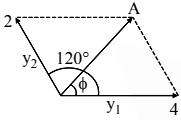
The amplitude and phase of a wave that is formed by the superposition of two harmonic travelling waves, \(y_1(x, t)=4 \sin (k x-\omega t)\) and \(y_2(x, t)=2 \sin \left(k x-\omega t+\frac{2 \pi}{3}\right)\), are: [JEE Main 2025 (Online) 8th April Evening Shift]
(Take the angular frequency of initial waves same as \(\omega\))CorrectIncorrectHint
(b)

\(
\begin{aligned}
& A=\sqrt{2^2+4^2+2 \times 2 \times 4 \times \cos 120^{\circ}} \\
& =\sqrt{12}=2 \sqrt{3} \\
& \tan \phi=\frac{2 \sin 120^{\circ}}{4+2 \cos 120^{\circ}}=\frac{\sqrt{3}}{3}=\frac{1}{\sqrt{3}} \\
& \phi=\frac{\pi}{6}
\end{aligned}
\)Explanation: To find the resultant amplitude and phase of the superposed waves, we can treat the amplitudes as vectors (phasors).
Step 1: Identify the individual wave parameters
From the given equations:
Wave 1: \({A}_1={4}\), Phase \(\phi_1={0}\)
Wave 2: \(A_2=2\), Phase \(\phi_2=\frac{2 \pi}{3}\left(120^{\circ}\right)\)
The phase difference between the two waves is \(\Delta \phi=\frac{2 \pi}{3}\).
Step 2: Calculate the Resultant Amplitude (\(\boldsymbol{A}\))
The formula for the resultant amplitude of two interfering waves is:
\(
A=\sqrt{A_1^2+A_2^2+2 A_1 A_2 \cos (\Delta \phi)}
\)
Substituting the values:
\(
A=\sqrt{4^2+2^2+2(4)(2) \cos \left(\frac{2 \pi}{3}\right)}
\)
\(
A=2 \sqrt{3}
\)
Step 3: Calculate the Resultant Phase (\(\boldsymbol{\theta}\))
The phase angle \(\theta\) of the resultant wave relative to the first wave is given by:
\(
\tan \theta=\frac{A_2 \sin (\Delta \phi)}{A_1+A_2 \cos (\Delta \phi)}
\)
Substituting the values:
\(
\begin{gathered}
\tan \theta=\frac{2 \sin \left(\frac{2 \pi}{3}\right)}{4+2 \cos \left(\frac{2 \pi}{3}\right)} \\
\tan \theta=\frac{2\left(\frac{\sqrt{3}}{2}\right)}{4+2\left(-\frac{1}{2}\right)} \\
\tan \theta=\frac{\sqrt{3}}{4-1}=\frac{\sqrt{3}}{3}=\frac{1}{\sqrt{3}}
\end{gathered}
\)
Since \(\tan \theta=\frac{1}{\sqrt{3}}\), the phase angle is:
\(
\theta=\frac{\pi}{6}\left(\text { or } 30^{\circ}\right)
\)
The resultant amplitude is \(2 \sqrt{3}\) and the resultant phase is \(\frac{\pi}{6}\). - Question 6 of 49
6. Question
Two strings with circular cross section and made of same material, are stretched to have same amount of tension. A transverse wave is then made to pass through both the strings. The velocity of the wave in the first string having the radius of cross section \(R\) is \(v_1\), and that in the other string having radius of cross section \(\mathrm{R} / 2\) is \(v_2\). Then \(\frac{v_2}{v_1}=\) [JEE Main 2025 (Online) 8th April Evening Shift]
CorrectIncorrectHint
(c) To find the ratio of the velocities, we need to look at how the physical dimensions of the string (radius and material) affect the wave speed.
Step 1: The Wave Speed Formula
The velocity of a transverse wave in a stretched string is:
\(
v=\sqrt{\frac{T}{\mu}}
\)
Where \(T\) is the tension and \(\mu\) is the linear mass density (mass per unit length).
Step 2: Express \(\boldsymbol{\mu}\) in terms of Radius
Since the strings have a circular cross-section and are made of the same material (meaning they have the same density \(\rho\)), we can rewrite \(\mu\) :
\(
\mu=\frac{\text { Mass }}{\text { Length }}=\frac{\text { Volume × } \rho}{L}=\frac{(A \times L) \times \rho}{L}=A \rho
\)
For a circular cross-section, the area \(A=\pi R^2\). Therefore:
\(
\mu=\pi R^2 \rho
\)
Step 3: Relate Velocity to Radius
Now, substitute \(\mu\) back into the velocity formula:
\(
v=\sqrt{\frac{T}{\pi R^2 \rho}}
\)
Since \(T, \pi\), and \(\rho\) are constant for both strings, we can see that:
\(
\begin{gathered}
v \propto \sqrt{\frac{1}{R^2}} \\
v \propto \frac{1}{R}
\end{gathered}
\)
This shows that the velocity is inversely proportional to the radius of the string.
Step 4: Calculate the Ratio
We are given:
String 1: Radius \(=R\), Velocity \(=\boldsymbol{v}_{\mathbf{1}}\)
String 2: Radius \(=R / 2\), Velocity \(=v_2\)
Using the proportionality \(v_2 / v_1=R_1 / R_2\) :
\(
\begin{gathered}
\frac{v_2}{v_1}=\frac{R}{R / 2} \\
\frac{v_2}{v_1}=2
\end{gathered}
\)
The velocity in the thinner string is twice as fast as in the thicker string. - Question 7 of 49
7. Question
The equation of a wave travelling on a string is \(y=\sin [20 \pi x+10 \pi t]\), where \(x\) and \(t\) are distance and time in SI units. The minimum distance between two points having the same oscillating speed is: [JEE Main 2025 (Online) 7th April Evening Shift]
CorrectIncorrectHint
(d) To find the minimum distance between two points having the same oscillating speed, we need to analyze the velocity of the particles in the string.
Step 1: Find the Particle Velocity
The particle velocity \(\left(v_p\right)\) is the rate of change of displacement \((y)\) with respect to time \((t)\) :
\(
v_p=\frac{\partial y}{\partial t}
\)
Given the wave equation:
\(
y=\sin (20 \pi x+10 \pi t)
\)
Differentiating with respect to \(t\) :
\(
v_p=10 \pi \cos (20 \pi x+10 \pi t)
\)
Step 2: Determine the Condition for Same Speed
“Speed” is the magnitude of velocity \(\left(\left|v_p\right|\right)\). For two points \(x_1\) and \(x_2\) to have the same speed at any time \(t\) :
\(
\left|10 \pi \cos \left(20 \pi x_1+10 \pi t\right)\right|=\left|10 \pi \cos \left(20 \pi x_2+10 \pi t\right)\right|
\)
This occurs when the arguments of the cosine function differ by a phase of \(\pi\) (since
\(
|\cos (\theta)|=|\cos (\theta+\pi)|) .
\)
Step 3: Find the Wavelength (\(\lambda\))
Compare the given equation with the standard wave equation \(y=A \sin (k x+\omega t)\) :
Wave number \(k=20 \pi\)
Angular frequency \(\omega=10 \pi\)
We know that \(k=\frac{2 \pi}{\lambda}\). Substituting the value of \(k\) :
\(
\begin{gathered}
20 \pi=\frac{2 \pi}{\lambda} \\
\lambda=\frac{2 \pi}{20 \pi}=0.1 \mathrm{~m}
\end{gathered}
\)
Step 4: Calculate the Minimum Distance
In a traveling wave, the particle speed \(\left|v_p\right|\) repeats every half-wavelength (\(\lambda / 2\)).
Think of it this way: the velocity involves a cos function. The magnitude of a cosine function repeats every \(180^{\circ}\) (or \(\pi\) radians). Since a full wavelength \(\lambda\) corresponds to a phase shift of \(2 \pi\) , a phase shift of \(\pi\) corresponds to:
\(
\text { Distance }=\frac{\lambda}{2}
\)
Substituting the value of \(\lambda\) :
\(
\text { Distance }=\frac{0.1 \mathrm{~m}}{2}=0.05 \mathrm{~m}
\)
The minimum distance is 0.05 m (or 5 cm ). - Question 8 of 49
8. Question
Two harmonic waves moving in the same direction superimpose to form a wave \(x=\mathrm{a} \cos (1.5 \mathrm{t}) \cos (50.5 \mathrm{t})\) where \(t\) is in seconds. Find the period with which they beat. (close to nearest integer) [JEE Main 2025 (Online) 7th April Morning Shift]
CorrectIncorrectHint
(c) To find the beat period of the superposed waves, we need to decompose the given product equation into its individual wave components using trigonometric identities.
Step 1: Use Trigonometric Identities
The given equation is in the form of a product:
\(
x=a \cos (1.5 t) \cos (50.5 t)
\)
We use the product-to-sum formula: \(\cos (A) \cos (B)=\frac{1}{2}[\cos (A+B)+\cos (A-B)]\).
Let \(A=50.5 t\) and \(B=1.5 t\).
\(
\begin{gathered}
x=\frac{a}{2}[\cos (50.5 t+1.5 t)+\cos (50.5 t-1.5 t)] \\
x=\frac{a}{2}[\cos (52 t)+\cos (49 t)]
\end{gathered}
\)
Step 2: Identify Individual Frequencies
The resulting expression shows two waves with angular frequencies \(\omega_1\) and \(\omega_2\) :
\(\omega_1=52 \mathrm{rad} / \mathrm{s}\)
\(\omega_2=49 \mathrm{rad} / \mathrm{s}\)
The frequencies in Hertz (\(f\)) are related to angular frequency by \(\omega=2 \pi f\), so:
\(
f_1=\frac{52}{2 \pi} \quad \text { and } \quad f_2=\frac{49}{2 \pi}
\)
Step 3: Calculate Beat Frequency (\(f_b\))
The beat frequency is the absolute difference between the frequencies of the two interfering waves:
\(
\begin{gathered}
f_b=\left|f_1-f_2\right| \\
f_b=\frac{52}{2 \pi}-\frac{49}{2 \pi}=\frac{3}{2 \pi} \mathrm{~Hz}
\end{gathered}
\)
Step 4: Find the Beat Period (\(T_b\))
The beat period is the reciprocal of the beat frequency:
\(
\begin{aligned}
& T_b=\frac{1}{f_b} \\
& T_b=\frac{2 \pi}{3}
\end{aligned}
\)
Now, substitute the approximate value of \(\pi \approx 3.14159\) :
\(
\begin{gathered}
T_b=\frac{2 \times 3.14159}{3} \\
T_b=\frac{6.283}{3} \approx 2.094 \text { seconds }
\end{gathered}
\)
Final Answer: Rounding to the nearest integer, the period with which they beat is 2 seconds. - Question 9 of 49
9. Question
Displacement of a wave is expressed as \(x(t)=5 \cos \left(628 t+\frac{\pi}{2}\right) \mathrm{m}\). The wavelength of the wave when its velocity is \(300 \mathrm{~m} / \mathrm{s}\) is : [JEE Main 2025 (Online) 4th April Evening Shift]
\((\pi=3.14)\)CorrectIncorrectHint
(c) To find the wavelength of the wave, we need to extract the frequency from the given displacement equation and use the relationship between wave speed, frequency, and wavelength.
Step 1: Identify Angular Frequency (\(\boldsymbol{\omega}\))
The given equation for displacement is:
\(
x(t)=5 \cos \left(628 t+\frac{\pi}{2}\right)
\)
This follows the standard form \(x(t)=A \cos (\omega t+\phi)\). By comparing the two, we find the angular frequency:
\(
\omega=628 \mathrm{rad} / \mathrm{s}
\)
Step 2: Calculate the Frequency (\(f\))
We know the relationship between angular frequency and linear frequency is:
\(
\omega=2 \pi f
\)
Substituting the values (using \(\pi=3.14\)):
\(
628=2 \times 3.14 \times f
\)
\(
\begin{gathered}
628=6.28 \times f \\
f=\frac{628}{6.28}=100 \mathrm{~Hz}
\end{gathered}
\)
Step 3: Calculate the Wavelength (\(\lambda\))
The velocity of a wave \((v)\) is related to its frequency \((f)\) and wavelength \((\lambda)\) by the formula:
\(
v=f \lambda \Longrightarrow \lambda=\frac{v}{f}
\)
Given the velocity \(v=300 \mathrm{~m} / \mathrm{s}\) and our calculated frequency \(f=100 \mathrm{~Hz}\) :
\(
\begin{aligned}
& \lambda=\frac{300}{100} \\
& \lambda=3 \mathrm{~m}
\end{aligned}
\)
Final Answer: The wavelength of the wave is 3 m. - Question 10 of 49
10. Question
In an experiment with a closed organ pipe, it is filled with water by \(\left(\frac{1}{5}\right)\) th of its volume. The frequency of the fundamental note will change by [JEE Main 2025 (Online) 4th April Morning Shift]
CorrectIncorrectHint
(b) To find how the frequency changes, we need to look at the relationship between the length of the air column and the fundamental frequency of a closed organ pipe.
Step 1: Fundamental Frequency of a Closed Pipe
The fundamental frequency (\(f\)) of a closed organ pipe of length \(L\) is given by:
\(
f=\frac{v}{4 L}
\)
where \(v\) is the speed of sound in air. This shows that frequency is inversely proportional to the length of the air column (\(f \propto \frac{1}{L}\)).
Step 2: Determine the New Length of the Air Column
When the pipe is filled with water, the “effective length” of the organ pipe is reduced because the air column only exists above the water level.
Initial Length: \(L_1=L\)
Water Level: \(\frac{1}{5} L\)
New Air Column Length \(\left(L_2\right): L-\frac{1}{5} L=\frac{4}{5} L\)
Step 3: Calculate the New Frequency (\(f_2\))
Using the inverse relationship:
\(
\begin{gathered}
\frac{f_2}{f_1}=\frac{L_1}{L_2} \\
\frac{f_2}{f_1}=\frac{L}{\frac{4}{5} L}=\frac{5}{4} \\
f_2=1.25 f_1
\end{gathered}
\)
Step 4: Find the Percentage Change
The fractional change in frequency is:
\(
\begin{gathered}
\text { Percentage Change }=\frac{f_2-f_1}{f_1} \times 100 \\
\text { Percentage Change }=\frac{1.25 f_1-f_1}{f_1} \times 100 \\
\text { Percentage Change }=0.25 \times 100=25 \%
\end{gathered}
\)
Since \(f_2>f_1\), the frequency increases.
Final Answer: The frequency of the fundamental note will change by \(25 \%\). - Question 11 of 49
11. Question
In the resonance experiment, two air columns (closed at one end) of 100 cm and 120 cm long, give 15 beats per second when each one is sounding in the respective fundamental modes. The velocity of sound in the air column is: [JEE Main 2025 (Online) 3rd April Evening Shift]
CorrectIncorrectHint
(d) To find the velocity of sound, we use the relationship between the length of a closed organ pipe and its fundamental frequency.
Step 1: Fundamental Frequency Formula
For a pipe closed at one end, the fundamental frequency \((f)\) is given by:
\(
f=\frac{v}{4 L}
\)
Where:
\(v=\) velocity of sound
\(L=\) length of the air column
Step 2: Set up the Frequencies
We have two pipes with lengths \(L_1\) and \(L_2\). Note that \(L_1<L_2\), which means \(f_1>f_2\).
\(L_1=100 \mathrm{~cm}=1.0 \mathrm{~m}\)
\(L_2=120 \mathrm{~cm}=1.2 \mathrm{~m}\)
The frequencies are:
\(
\begin{aligned}
& f_1=\frac{v}{4(1.0)}=\frac{v}{4} \\
& f_2=\frac{v}{4(1.2)}=\frac{v}{4.8}
\end{aligned}
\)
Step 3: Use the Beat Frequency
The beat frequency is the difference between the two frequencies \(\left(f_1-f_2=15\right)\) :
\(
\frac{v}{4}-\frac{v}{4.8}=15
\)
Step 4: Solve for \(v\)
Find a common denominator for the fractions:
\(
\begin{gathered}
\frac{4.8 v-4 v}{4 \times 4.8}=15 \\
\frac{0.8 v}{19.2}=15
\end{gathered}
\)
Multiply both sides by 19.2:
\(
\begin{gathered}
0.8 v=15 \times 19.2 \\
0.8 v=288
\end{gathered}
\)
Divide by 0.8 :
\(
v=\frac{288}{0.8}=360 \mathrm{~m} / \mathrm{s}
\)
Final Answer: The velocity of sound in the air column is \(360 \mathrm{~m} / \mathrm{s}\). - Question 12 of 49
12. Question
A sinusoidal wave of wavelength 7.5 cm travels a distance of 1.2 cm along the \(x\)-direction in 0.3 sec . The crest P is at \(x=0\) at \(\mathrm{t}=0 \mathrm{sec}\) and maximum displacement of the wave is 2 cm. Which equation correctly represents this wave? [JEE Main 2025 (Online) 2nd April Evening Shift]
CorrectIncorrectHint
(a) To find the correct wave equation, we need to determine the wave parameters (amplitude, wave number, and angular frequency) and ensure the initial conditions are met.
Step 1: Identify the Parameters
Amplitude (\(A\)): The maximum displacement is given as 2 cm.
Wavelength (\(\lambda\)): Given as 7.5 cm.
Wave Number (\(k\)):
\(
k=\frac{2 \pi}{\lambda}=\frac{2 \times 3.14159}{7.5} \approx 0.838 \mathrm{rad} / \mathrm{cm}
\)
Velocity (\(v\)): The wave travels 1.2 cm in 0.3 sec.
\(
v=\frac{\text { Distance }}{\text { Time }}=\frac{1.2}{0.3}=4 \mathrm{~cm} / \mathrm{s}
\)
Angular Frequency (\(\omega\)):
\(
\omega=k \times v=0.838 \times 4 \approx 3.35 \mathrm{rad} / \mathrm{s}
\)
Step 2: Formulate the General Equation
Since the wave travels along the \(+x\) direction, the general form is \(y=A \cos (k x-\omega t+\phi)\) or \(y=A \sin (k x-\omega t+\phi)\).
Substituting our calculated values:
\(
y=2 \cos (0.838 x-3.35 t+\phi)
\)
Step 3: Check Initial Conditions
The problem states that at \(t=0\) and \(x=0\), there is a crest (maximum positive displacement).
If we use the cosine function: \(\cos (0)=1\), which gives \(y=2(1)=2 \mathrm{~cm}\). This matches the “crest” condition with a phase \(\phi=0\).
If we used a sine function, we would need a phase shift of \(\pi / 2\) to start at a crest.
Step 4: Compare with Options
Looking at the choices:
A: \(y=2 \cos (0.83 x-3.35 t)\) – Matches our \(k \approx 0.83\) and \(\omega \approx 3.35\).
D: \(y=2 \cos (3.35 x-0.83 t)-\) Swaps \(k\) and \(\omega\). - Question 13 of 49
13. Question
Given below are two statements : one is labelled as Assertion \(\mathbf{A}\) and the other is labelled as Reason \(\mathbf{R}\)
Assertion \(\mathbf{A}\): A sound wave has higher speed in solids than gases.
Reason \(\mathbf{R}\): Gases have higher value of Bulk modulus than solids.
In the light of the above statements, choose the correct answer from the options given below [JEE Main 2025 (Online) 28th January Morning Shift]CorrectIncorrectHint
(c) Step 1: Analyze Assertion A (Speed of Sound)
The speed of sound in a medium depends on its elasticity and density. The general formula is:
\(
v=\sqrt{\frac{E}{\rho}}
\)
Where \(E\) is the modulus of elasticity and \(\rho\) is the density.
In solids, the atoms are more tightly packed and the intermolecular forces are much stronger than in gases. This high elasticity (stiffness) allows the sound energy to transfer much faster.
Speed of sound in Air: \(\approx 343 \mathrm{~m} / \mathrm{s}\)
Speed of sound in Steel: \(\approx 5960 \mathrm{~m} / \mathrm{s}\)
Assertion A is True.
Step 2: Analyze Reason R (Bulk Modulus)
The Bulk Modulus (\(B\)) measures a substance’s resistance to compression.
Solids are extremely difficult to compress because their molecules are already in close contact. Therefore, they have a very high Bulk Modulus.
Gases are easily compressed (think of squeezing a balloon). Therefore, they have a very low Bulk Modulus.
The logic in Reason R is backwards. Solids have a significantly higher Bulk Modulus than gases.
Reason R is False.
Step 3: Conclusion
Since Assertion A is a scientifically accurate statement and Reason R is a factually incorrect statement:
Assertion A: True
Reason R: False - Question 14 of 49
14. Question
The equation of a transverse wave travelling along a string is \(y(x, t)=4.0 \sin \left[20 \times 10^{-3} x+600 t\right] \mathrm{mm}\), where \(x\) is in mm and \(t\) is in second. The velocity of the wave is : [JEE Main 2025 (Online) 23rd January Evening Shift]
CorrectIncorrectHint
(d) To find the velocity of the wave, we need to compare the given equation with the standard wave equation and identify the wave parameters.
Step 1: Identify Wave Parameters
The standard equation for a travelling wave is:
\(
y(x, t)=A \sin (k x \pm \omega t)
\)
From your given equation, \(y(x, t)=4.0 \sin \left[20 \times 10^{-3} x+600 t\right]\), we can identify:
Wave number (\(k\)): \(20 \times 10^{-3} \mathrm{rad} / \mathrm{mm}\)
Angular frequency \((\omega): 600 \mathrm{rad} / \mathrm{s}\)
Step 2: Determine Direction
In a wave equation, look at the signs of the \(x\) and \(t\) terms:
If the signs are opposite (e.g., \(k x-\omega t\)), the wave travels in the positive \(x\)-direction.
If the signs are the same (e.g., \(k x+\omega t\)), the wave travels in the negative \(x\)-direction.
Since both terms in your equation are positive \(\left(20 \times 10^{-3} x+600 t\right)\), the wave is travelling in the negative \(x\)-direction. This means the velocity will be negative.
Step 3: Calculate the Magnitude of Velocity
The magnitude of wave velocity \((v)\) is given by the ratio of angular frequency to wave number:
\(
v=\frac{\omega}{k}
\)
Substitute the values:
\(
\begin{gathered}
v=\frac{600 \mathrm{rad} / \mathrm{s}}{20 \times 10^{-3} \mathrm{rad} / \mathrm{mm}} \\
v=\frac{600}{0.02} \mathrm{~mm} / \mathrm{s} \\
v=30,000 \mathrm{~mm} / \mathrm{s}
\end{gathered}
\)
Step 4: Convert to Meters per Second
To convert \(\mathrm{mm} / \mathrm{s}\) to \(\mathrm{m} / \mathrm{s}\), we divide by 1000 (since \(1000 \mathrm{~mm}=1 \mathrm{~m}\)):
\(
v=\frac{30,000}{1,000} \mathrm{~m} / \mathrm{s}=30 \mathrm{~m} / \mathrm{s}
\)
Combining the magnitude (\(30 \mathrm{~m} / \mathrm{s}\)) with the direction (negative), the velocity is \(-30 \mathrm{~m} / \mathrm{s}\). - Question 15 of 49
15. Question
A closed organ and an open organ tube are filled by two different gases having same bulk modulus but different densities \(\rho_1\) and \(\rho_2\), respectively. The frequency of \(9^{\text {th }}\) harmonic of closed tube is identical with \(4^{\text {th }}\) harmonic of open tube. If the length of the closed tube is 10 cm and the density ratio of the gases is \(\rho_1: \rho_2=1: 16\), then the length of the open tube is : [JEE Main 2025 (Online) 22nd January Morning Shift]
CorrectIncorrectHint
(b) To find the length of the open tube, we need to combine the formulas for harmonic frequencies with the relationship between gas density and the speed of sound.
Step 1: Speed of Sound in Different Gases
The speed of sound \((v)\) in a gas is given by the formula:
\(
v=\sqrt{\frac{B}{\rho}}
\)
Where \(B\) is the Bulk Modulus and \(\rho\) is the density. Since both gases have the same Bulk Modulus, the speeds in the two tubes are:
Closed Tube \(\left(v_1\right): v_1 \propto \frac{1}{\sqrt{\rho_1}}\)
Open Tube \(\left(v_2\right): v_2 \propto \frac{1}{\sqrt{\rho_2}}\)
The ratio of the speeds is:
\(
\frac{v_1}{v_2}=\sqrt{\frac{\rho_2}{\rho_1}}
\)
Given \(\rho_1: \rho_2=1: 16\), then \(\rho_2 / \rho_1=16\).
\(
\frac{v_1}{v_2}=\sqrt{16}=4 \Longrightarrow v_1=4 v_2
\)
Step 2: Frequency of Harmonics
Closed Organ Tube \(\left(f_c\right)\) : The frequency of the \(n^{\text {th }}\) harmonic (where \(n\) must be odd) is:
\(
f_c=\frac{n v_1}{4 L_c}
\)
For the \(9^{\text {th }}\) harmonic \((n=9)\) and \(L_c=10 \mathrm{~cm}\) :
\(
f_9=\frac{9 v_1}{4(10)}=\frac{9 v_1}{40}
\)
Open Organ Tube \(\left(f_o\right)\) : The frequency of the \(m^{\text {th }}\) harmonic is:
\(
f_o=\frac{m v_2}{2 L_o}
\)
For the \(4^{\text {th }}\) harmonic \((m=4)\) :
\(
f_4=\frac{4 v_2}{2 L_o}=\frac{2 v_2}{L_o}
\)
Step 3: Equating the Frequencies
The problem states that these frequencies are identical (\(f_9=f_4\)):
\(
\frac{9 v_1}{40}=\frac{2 v_2}{L_o}
\)
Substitute \(v_1=4 v_2\) into the equation:
\(
\frac{9\left(4 v_2\right)}{40}=\frac{2 v_2}{L_o}
\)
Cancel \(v_2\) and simplify:
\(
\begin{aligned}
& \frac{36}{40}=\frac{2}{L_o} \\
& \frac{9}{10}=\frac{2}{L_o}
\end{aligned}
\)
Step 4: Solve for \(L_o\)
\(
\begin{gathered}
9 L_o=20 \\
L_o=\frac{20}{9} \mathrm{~cm}
\end{gathered}
\)
Final Answer: The length of the open tube is \(\frac{20}{9} \mathrm{~cm}\). - Question 16 of 49
16. Question
A plane progressive wave is given by \(y=2 \cos 2 \pi(330 \mathrm{t}-x) \mathrm{m}\). The frequency of the wave is: [JEE Main 2024 (Online) 8th April Evening Shift]
CorrectIncorrectHint
(c) To find the frequency of the wave, we compare the given equation to the standard form of a plane progressive wave.
Step 1: Identify the Standard Wave Equation
The standard equation for a progressive wave is:
\(
y=A \cos \left(2 \pi f t-2 \pi \frac{x}{\lambda}\right)
\)
Or, more simply:
\(
y=A \cos \left(2 \pi\left(f t-\frac{x}{\lambda}\right)\right)
\)
Where:
\(A\) is the amplitude
\(f\) is the frequency
\(\lambda\) is the wavelength
\(t\) is time and \(x\) is distance
Step 2: Compare with the Given Equation
The equation provided is:
\(
y=2 \cos 2 \pi(330 t-x)
\)
By looking at the term inside the parentheses alongside \(t\) :
Standard form: \(f \cdot t\)
Given form: \(330 \cdot t\)
Step 3: Extract the Frequency
By direct comparison, we can see that:
\(
f=330
\)
Since the units are in SI (as implied by the ” \(m\) ” for displacement), the frequency is measured in Hertz (Hz).
Final Answer: The frequency of the wave is \(\mathbf{3 3 0 ~ H z}\). - Question 17 of 49
17. Question
The fundamental frequency of a closed organ pipe is equal to the first overtone frequency of an open organ pipe. If length of the open pipe is 60 cm , the length of the closed pipe will be: [JEE Main 2024 (Online) 31st January Morning Shift]
CorrectIncorrectHint
(a) To find the length of the closed organ pipe (\(L_c\)) based on the length of the open organ pipe (\(L_o\)), we can follow these steps:
Step 1: Identify the Frequency Formulas
Open Organ Pipe (\(L_o\)): The frequencies follow the series \(f, 2 f, 3 f \ldots\) where the fundamental is \(\frac{v}{2 L_o}\). The first overtone is the second harmonic \((n=2)\) :
\(
f_o=\frac{2 v}{2 L_o}=\frac{v}{L_o}
\)
Closed Organ Pipe (\(L_c\)): The frequencies follow the series \(f, 3 f, 5 f .\). where the fundamental is \(\frac{v}{4 L_c}\). The fundamental frequency (\(n=1\)) is:
\(
f_c=\frac{v}{4 L_c}
\)
Step 2: Set the Frequencies Equal and Solve
The problem states that the fundamental frequency of the closed pipe is equal to the first overtone of the open pipe (\(f_c=f_o\)):
\(
\frac{v}{4 L_c}=\frac{v}{L_o}
\)
Cancel the velocity (\(v\)):
\(
\frac{1}{4 L_c}=\frac{1}{L_o}
\)
Cross-multiply to isolate \(L_c\) :
\(
L_o=4 L_c \Longrightarrow L_c=\frac{L_o}{4}
\)
Plug in the value for \(L_o(60 \mathrm{~cm})\) :
\(
L_c=\frac{60 \mathrm{~cm}}{4}
\)
\(
L_c=15 \mathrm{~cm}
\) - Question 18 of 49
18. Question
A car P travelling at \(20 \mathrm{~ms}^{-1}\) sounds its horn at a frequency of 400 Hz. Another car Q is travelling behind the first car in the same direction with a velocity \(40 \mathrm{~ms}^{-1}\). The frequency heard by the passenger of the car Q is approximately [Take, velocity of sound \(=360 \mathrm{~ms}^{-1}\)] [JEE Main 2023 (Online) 11th April Evening Shift]
CorrectIncorrectHint
(c) To find the frequency heard by the passenger in car Q, we use the Doppler Effect formula for sound.
Step 1: Identify the Given Values
Frequency of source \(\left(f_s\right): 400 \mathrm{~Hz}\)
Velocity of sound (\(v\)): \(360 \mathrm{~m} / \mathrm{s}\)
Velocity of source (Car P, \(v_s\)): \(20 \mathrm{~m} / \mathrm{s}\) (moving away from Q)
Velocity of observer (Car Q, \(v_o\)): \(40 \mathrm{~m} / \mathrm{s}\) (moving toward P)
Step 2: Set up the Doppler Equation
The general formula for the observed frequency (\(f^{\prime}\)) is:
\(
f^{\prime}=f_s\left(\frac{v \pm v_o}{v \pm v_s}\right)
\)
Since Car Q (observer) is chasing Car P (source):
1. The observer is moving toward the source, which increases frequency (use + in numerator).
2. The source is moving away from the observer, which decreases frequency (use + in denominator).
The specific formula for this scenario is:
\(
f^{\prime}=f_s\left(\frac{v+v_o}{v+v_s}\right)
\)
Step 3: Calculate the Result
Plug in the values:
\(
f^{\prime}=400\left(\frac{360+40}{360+20}\right)
\)
Simplify the fraction:
\(
\begin{aligned}
& f^{\prime}=400\left(\frac{400}{380}\right) \\
& f^{\prime}=400\left(\frac{20}{19}\right)
\end{aligned}
\)
Perform the final division:
\(
f^{\prime}=\frac{8000}{19} \approx 421.05 \mathrm{~Hz}
\)
The frequency heard by the passenger in car Q is approximately \(\mathbf{4 2 1 ~ H z}\). - Question 19 of 49
19. Question
For a periodic motion represented by the equation \(y=\sin \omega \mathrm{t}+\cos \omega \mathrm{t}\), the amplitude of the motion is [JEE Main 2023 (Online) 10th April Evening Shift]
CorrectIncorrectHint
(d) We can also multiply and divide the original equation by \(\sqrt{2}\) :
\(
y=\sqrt{2}\left[\frac{1}{\sqrt{2}} \sin \omega t+\frac{1}{\sqrt{2}} \cos \omega t\right]
\)
Using \(\sin 45^{\circ}=\cos 45^{\circ}=\frac{1}{\sqrt{2}}\), we get:
\(
\begin{gathered}
y=\sqrt{2}\left[\cos \left(45^{\circ}\right) \sin \omega t+\sin \left(45^{\circ}\right) \cos \omega t\right] \\
y=\sqrt{2} \sin \left(\omega t+45^{\circ}\right)
\end{gathered}
\)
Comparing this to the standard SHM equation \(y=A \sin (\omega t+\phi)\), the amplitude is clearly \(\sqrt{2}\). - Question 20 of 49
20. Question
The engine of a train moving with speed \(10 \mathrm{~ms}^{-1}\) towards a platform sounds a whistle at frequency 400 Hz. The frequency heard by a passenger inside the train is: (neglect air speed. Speed of sound in air \(=330 \mathrm{~ms}^{-1}\)) [JEE Main 2023 (Online) 8th April Morning Shift]
CorrectIncorrectHint
(c) This is a classic conceptual “trap” in Doppler effect problems. Let’s break it down using the steps you requested.
Step 1: Identify the Given Values
Frequency of source \(\left(f_s\right): 400 \mathrm{~Hz}\)
Velocity of source (Train engine, \(v_s\)): \(10 \mathrm{~m} / \mathrm{s}\)
Velocity of observer (Passenger, \(v_o\)): \(10 \mathrm{~m} / \mathrm{s}\)
Velocity of sound (\(v\)): \(330 \mathrm{~m} / \mathrm{s}\)
Step 2: Analyze the Relative Motion
In the Doppler effect, the frequency change depends on the relative motion between the source and the observer.
1. Both the whistle (source) and the passenger (observer) are located on the same train.
2. Therefore, they are moving at the exact same velocity in the same direction.
3. The relative velocity between the source and the observer is zero.
Step 3: Calculate the Frequency
Using the Doppler Effect formula:
\(
f^{\prime}=f_s\left(\frac{v \pm v_o}{v \pm v_s}\right)
\)
Since they are moving in the same direction:
The observer is moving toward the sound source (whistle at the front) \(\Longrightarrow+v_o\)
The source is moving away from the observer \(\Longrightarrow+v_s\)
\(
\begin{gathered}
f^{\prime}=400\left(\frac{330+10}{330+10}\right) \\
f^{\prime}=400\left(\frac{340}{340}\right) \\
f^{\prime}=400 \mathrm{~Hz}
\end{gathered}
\)
The frequency heard by the passenger inside the train is \(400 \mathrm{~Hz}\)
Key takeaway: If there is no relative motion between the source and the observer (i.e., they are part of the same moving system), the observed frequency is always equal to the actual frequency. - Question 21 of 49
21. Question
A steel wire with mass per unit length \(7.0 \times 10^{-3} \mathrm{~kg} \mathrm{~m}^{-1}\) is under tension of 70 N. The speed of transverse waves in the wire will be: [JEE Main 2023 (Online) 1st February Morning Shift]
CorrectIncorrectHint
(c) To find the speed of transverse waves in a stretched wire, we use the relationship between the tension and the linear mass density.
Step 1: Identify the Given Values
Tension (\(T\)): 70 N
Mass per unit length \((\mu): 7.0 \times 10^{-3} \mathrm{~kg} \mathrm{~m}^{-1}\)
Step 2: Identify the Speed Formula
The speed \((v)\) of a transverse wave on a string or wire is given by the formula:
\(
v=\sqrt{\frac{T}{\mu}}
\)
Step 3: Calculate the Result
Substitute the values into the formula:
\(
v=\sqrt{\frac{70}{7.0 \times 10^{-3}}}
\)
Simplify the expression inside the square root:
\(
\begin{aligned}
& v=\sqrt{\frac{70}{0.007}} \\
& v=\sqrt{10,000}
\end{aligned}
\)
Solve for \(v\) :
\(
v=100 \mathrm{~m} / \mathrm{s}
\) - Question 22 of 49
22. Question
A person observes two moving trains, ‘A’ reaching the station and ‘B’ leaving the station with equal speed of \(30 \mathrm{~m} / \mathrm{s}\). If both trains emit sounds with frequency \(\mathbf{3 0 0 ~ H z}\), (Speed of sound: \(\mathbf{3 3 0 ~ m} / \mathrm{s}\)) approximate difference of frequencies heard by the person will be: [JEE Main 2023 (Online) 29th January Morning Shift]
CorrectIncorrectHint
(b) To find the difference in frequencies heard by the stationary observer, we calculate the apparent frequency for each train separately using the Doppler Effect.
Step 1: Identify the Given Values
Frequency of source \(\left(f_s\right): 300 \mathrm{~Hz}\)
Velocity of sound ( \(v\)): \(330 \mathrm{~m} / \mathrm{s}\)
Velocity of trains \(\left(v_s\right): 30 \mathrm{~m} / \mathrm{s}\)
Velocity of observer \(\left(v_o\right): 0 \mathrm{~m} / \mathrm{s}\) (stationary person)
Step 2: Calculate Apparent Frequencies
Train A (Moving towards the observer):
When the source moves towards a stationary observer, the frequency increases.
\(
\begin{gathered}
f_A=f_s\left(\frac{v}{v-v_s}\right) \\
f_A=300\left(\frac{330}{330-30}\right)=300\left(\frac{330}{300}\right) \\
f_A=330 \mathrm{~Hz}
\end{gathered}
\)
Train B (Moving away from the observer):
When the source moves away from a stationary observer, the frequency decreases.
\(
\begin{gathered}
f_B=f_s\left(\frac{v}{v+v_s}\right) \\
f_B=300\left(\frac{330}{330+30}\right)=300\left(\frac{330}{360}\right) \\
f_B=300\left(\frac{11}{12}\right)=275 \mathrm{~Hz}
\end{gathered}
\)
Step 3: Calculate the Difference
The difference in frequencies heard by the person is:
\(
\begin{gathered}
\Delta f=f_A-f_B \\
\Delta f=330 \mathrm{~Hz}-275 \mathrm{~Hz} \\
\Delta f=55 \mathrm{~Hz}
\end{gathered}
\)
The approximate difference of frequencies heard by the person is 55 Hz. - Question 23 of 49
23. Question
A travelling wave is described by the equation
\(
y(x, t)=[0.05 \sin (8 x-4 t)] \mathrm{m}
\)
The velocity of the wave is: [all the quantities are in Sl unit] [JEE Main 2023 (Online) 24th January Morning Shift]CorrectIncorrectHint
(d) To find the velocity of the travelling wave, we compare the given equation to the standard wave equation.
Step 1: Identify the Standard Wave Equation
A general harmonic travelling wave is represented by:
\(
y(x, t)=A \sin (k x-\omega t)
\)
Where:
\(k\) is the wave number.
\(\omega\) is the angular frequency.
Step 2: Extract the Coefficients
Comparing the standard equation to the given equation \(y(x, t)=[0.05 \sin (8 x-4 t)]\) :
Wave number \((k): 8 \mathrm{rad} / \mathrm{m}\)
Angular frequency \((\omega): 4 \mathrm{rad} / \mathrm{s}\)
Step 3: Calculate the Wave Velocity
The velocity \((v)\) of a travelling wave is the ratio of its angular frequency to its wave number:
\(
v=\frac{\omega}{k}
\)
Substitute the values:
\(
\begin{gathered}
v=\frac{4}{8} \\
v=0.5 \mathrm{~m} / \mathrm{s}
\end{gathered}
\) - Question 24 of 49
24. Question
In the wave equation \(y=0.5 \sin \frac{2 \pi}{\lambda}(400 \mathrm{t}-x) \mathrm{m}\) the velocity of the wave will be: [JEE Main 2022 (Online) 28th July Morning Shift]
CorrectIncorrectHint
(c)
\(
\begin{aligned}
& v_{\text {wave }}=\left|\frac{\text { coefficient of } t}{\text { coefficient of } x}\right| \\
& =\frac{400}{1}=400 \mathrm{~m} / \mathrm{s}
\end{aligned}
\)Explanation: To find the velocity of the wave, we compare the given equation to the standard form of a progressive wave equation.
Step 1: Identify the Standard Wave Equation
The standard equation for a travelling wave is:
\(
y=A \sin (\omega t-k x)
\)
Alternatively, it can be written by factoring out the wave number (\(k\)):
\(
y=A \sin k(v t-x)
\)
Where \(v\) is the wave velocity.
Step 2: Compare the Equations
The given equation is:
\(
y=0.5 \sin \frac{2 \pi}{\lambda}(400 t-x)
\)
By comparing this to the form \(y=A \sin k(v t-x)\), we can identify the following:
Wave number \((k): \frac{2 \pi}{\lambda}\)
Velocity (\(v\)): 400
Step 3: Verify using \(\omega\) and \(k\)
If we distribute the \(\frac{2 \pi}{\lambda}\) term inside the parentheses:
\(
y=0.5 \sin \left(\frac{2 \pi \cdot 400}{\lambda} t-\frac{2 \pi}{\lambda} x\right)
\)
Now, identifying \(\omega\) and \(k\) :
\(\omega=\frac{800 \pi}{\lambda}\)
\(k=\frac{2 \pi}{\lambda}\)
The wave velocity is calculated as:
\(
\begin{gathered}
v=\frac{\omega}{k}=\frac{\frac{800 \pi}{\lambda}}{\frac{2 \pi}{\lambda}} \\
v=\frac{800 \pi}{2 \pi}=400 \mathrm{~m} / \mathrm{s}
\end{gathered}
\) - Question 25 of 49
25. Question
A transverse wave is represented by \(y=2 \sin (\omega t-k x) \mathrm{cm}\). The value of wavelength (in cm) for which the wave velocity becomes equal to the maximum particle velocity, will be : [JEE Main 2022 (Online) 26th July Evening Shift]
CorrectIncorrectHint
(a) To find the wavelength for which the wave velocity equals the maximum particle velocity, we need to compare the expressions for both.
Step 1: Identify the Wave Velocity
For a wave represented by \(y=A \sin (\omega t-k x)\), the wave velocity \(\left(v_w\right)\) is the speed at which the wave profile moves through the medium:
\(
v_w=\frac{\omega}{k}
\)
Step 2: Identify the Maximum Particle Velocity
The particles of the medium oscillate in Simple Harmonic Motion (SHM). Their velocity \(\left(v_p\right)\) is found by taking the partial derivative of displacement with respect to time:
\(
v_p=\frac{\partial y}{\partial t}=A \omega \cos (\omega t-k x)
\)
The maximum particle velocity (\(v_{p, \max }\)) occurs when the cosine term is 1:
\(
v_{p, \max }=A \omega
\)
Step 3: Set the Velocities Equal
According to the problem, the wave velocity is equal to the maximum particle velocity:
\(
\begin{aligned}
v_w & =v_{p, \max } \\
\frac{\omega}{k} & =A \omega
\end{aligned}
\)
Cancel the angular frequency (\(\omega\)):
\(
\frac{1}{k}=A
\)
Substitute the formula for wave number \(\left(k=\frac{2 \pi}{\lambda}\right)\) :
\(
\begin{gathered}
\frac{1}{2 \pi / \lambda}=A \\
\frac{\lambda}{2 \pi}=A
\end{gathered}
\)
Step 4: Solve for Wavelength \((\lambda)\)
From the given equation \(y=2 \sin (\omega t-k x)\), we know the amplitude \(A=2 \mathrm{~cm}\).
\(
\begin{gathered}
\frac{\lambda}{2 \pi}=2 \\
\lambda=4 \pi \mathrm{~cm}
\end{gathered}
\) - Question 26 of 49
26. Question
Which of the following equations correctly represents a travelling wave having wavelength \(\lambda=4.0 \mathrm{~cm}\), frequency \(f=100 \mathrm{~Hz}\) and travelling in positive \(x\)-axis direction? [JEE Main 2022 (Online) 30th June Morning Shift]
CorrectIncorrectHint
(d) Step 1: General Wave Equation
A wave traveling in the positive \(\mathbf{x}\)-axis direction is represented by:
\(
y(x, t)=A \sin (k x-\omega t)
\)
Where:
\(k\) is the wave number
\(\omega\) is the angular frequency
Step 2: Calculate the Parameters
Given:
Wavelength \((\lambda)=4.0 \mathrm{~cm}\)
Frequency \((f\) or \(v)=100 \mathrm{~Hz}\)
Step A: Find the wave number (\(k\))
\(
k=\frac{2 \pi}{\lambda}=\frac{2 \pi}{4.0}=0.5 \pi \mathrm{~cm}^{-1}
\)
Step B: Find the angular frequency (\(\omega\))
\(
\omega=2 \pi f=2 \pi(100)=200 \pi \mathrm{~s}^{-1}
\)
Let’s plug our values into the general form:
\(
y=A \sin (0.5 \pi x-200 \pi t)
\)
Now, let’s look at Option D:
\(
y=A \sin \pi\left[\left(0.5 \mathrm{~cm}^{-1}\right) x-\left(200 \mathrm{~s}^{-1}\right) t\right]
\)
If we distribute the \(\pi\) inside the brackets:
\(
y=A \sin [0.5 \pi x-200 \pi t]
\) - Question 27 of 49
27. Question
A longitudinal wave is represented by \(x=10 \sin 2 \pi\left(n t-\frac{x}{\lambda}\right) \mathrm{cm}\). The maximum particle velocity will be four times the wave velocity if the determined value of wavelength is equal to: [JEE Main 2022 (Online) 29th June Morning Shift]
CorrectIncorrectHint
(b) To solve this, we need to find the expressions for both the maximum particle velocity and the wave velocity, then set up the ratio given in the problem.
Step 1: Identify the Wave Parameters
The given equation for a longitudinal wave is:
\(
x=10 \sin 2 \pi\left(n t-\frac{x}{\lambda}\right)
\)
From this equation, we can identify:
Amplitude (\(A\)): 10 cm
Angular frequency \((\omega): 2 \pi n\)
Wave number \((k): \frac{2 \pi}{\lambda}\)
Step 2: Determine Wave Velocity (\(v_w\))
The wave velocity is the speed at which the wave profile moves through the medium. It is defined as:
\(
v_w=\frac{\omega}{k}=\frac{2 \pi n}{2 \pi / \lambda}=n \lambda
\)
Step 3: Determine Maximum Particle Velocity (\(v_p\))
The particle velocity is the derivative of displacement (\(x\)) with respect to time (\(t\)). For a wave \(x=A \sin (\omega t-k x)\) :
\(
v_p=\frac{d x}{d t}=A \omega \cos (\omega t-k x)
\)
The maximum particle velocity occurs when the cosine term is 1 :
\(
\left(v_p\right)_{\max }=A \omega=10(2 \pi n)=20 \pi n
\)
Step 4: Apply the Given Condition
The problem states that the maximum particle velocity is four times the wave velocity:
\(
\left(v_p\right)_{\max }=4 \times v_w
\)
Substitute the expressions we found:
\(
20 \pi n=4 \times(n \lambda)
\)
Step 5: Solve for Wavelength (\({\lambda}\))
Now, we simplify the equation to find \(\lambda\) :
\(
20 \pi n=4 n \lambda
\)
Divide both sides by \({4} {n}\) (assuming \({n} \neq {0}\)):
\(
\begin{aligned}
& \lambda=\frac{20 \pi}{4} \\
& \lambda=5 \pi
\end{aligned}
\) - Question 28 of 49
28. Question
The velocity of sound in a gas, in which two wavelengths 4.08 m and 4.16 m produce 40 beats in 12 s, will be : [JEE Main 2022 (Online) 28th June Morning Shift]
CorrectIncorrectHint
(d) To find the velocity of sound, we need to relate the given wavelengths and the beat frequency to the standard wave speed formula.
Step 1: Calculate the Beat Frequency (\(f_b\))
Beats are produced by the difference in frequencies of two sound waves. We are told that 40 beats occur in 12 seconds.
\(
f_b=\frac{\text { Number of beats }}{\text { Time }}=\frac{40}{12}=\frac{10}{3} \mathrm{~Hz}
\)
Step 2: Relate Frequency to Velocity and Wavelength
The relationship between velocity \((v)\), frequency \((f)\), and wavelength \((\lambda)\) is:
\(
v=f \lambda \Rightarrow f=\frac{v}{\lambda}
\)
We have two wavelengths:
\(\lambda_1=4.08 \mathrm{~m}\)
\(\lambda_2=4.16 \mathrm{~m}\)
Since \(\lambda_1<\lambda_2\), the corresponding frequency \(f_1\) will be greater than \(f_2\).
Step 3: Set Up the Beat Frequency Equation
The beat frequency is the difference between the two individual frequencies:
\(
\begin{aligned}
f_b & =f_1-f_2 \\
\frac{10}{3} & =\frac{v}{\lambda_1}-\frac{v}{\lambda_2}
\end{aligned}
\)
Step 4: Substitute the Values and Solve for \(v\)
Factor out the velocity (\(v\)):
\(
\frac{10}{3}=v\left(\frac{1}{4.08}-\frac{1}{4.16}\right)
\)
\(
v=707.2 \mathrm{~m} / \mathrm{s}
\)
Conclusion: The velocity of sound in the gas is \(707.2 \mathrm{~ms}^{-1}\). - Question 29 of 49
29. Question
If a wave gets refracted into a denser medium, then which of the following is true? [JEE Main 2022 (Online) 27th June Evening Shift]
CorrectIncorrectHint
(c) To understand what happens when a wave moves from one medium to another, we need to look at the fundamental relationship between wave speed, frequency, and wavelength.
Step 1: Frequency remains constant
The frequency (\(f\)) of a wave is determined solely by the source that creates it. Once the wave is traveling, the number of oscillations per second does not change when crossing a boundary. Therefore, frequency remains constant.
Step 2: Speed decreases in a denser medium
By definition, a “denser” medium (in the context of optics or acoustics) is one where the wave encounters more resistance or a higher refractive index. This causes the speed (\(v\)) of the wave to decrease.
Step 3: Wavelength must decrease
We use the wave equation to see how the wavelength \((\lambda)\) reacts:
\(
v=f \lambda
\)
If the frequency \((f)\) is constant, then the velocity \((v)\) is directly proportional to the wavelength (\(\lambda\)).
Since the speed \((v)\) decreases upon entering the denser medium, the wavelength \((\lambda)\) must also decrease to maintain the mathematical balance of the equation.
Conclusion: When entering a denser medium:
Frequency: Constant
Speed: Decreases
Wavelength: Decreases - Question 30 of 49
30. Question
An observer moves towards a stationary source of sound with a velocity equal to one-fifth of the velocity of sound. The percentage change in the frequency will be : [JEE Main 2022 (Online) 27th June Morning Shift]
CorrectIncorrectHint
(a) To find the percentage change in frequency, we use the Doppler Effect formula for a moving observer and a stationary source.
Step 1: Identify the Doppler Formula
When an observer moves towards a stationary source, the apparent frequency (\(f^{\prime}\)) is higher than the actual frequency (\(f\)) and is calculated as:
\(
f^{\prime}=f\left(\frac{v+v_o}{v}\right)
\)
Where:
\(v=\) velocity of sound
\(v_o=\) velocity of the observer
\(f=\) original frequency
Step 2: Plug in the Given Values
The problem states that the observer’s velocity is one-fifth the velocity of sound:
\(
v_o=\frac{1}{5} v=0.2 v
\)
Substituting this into the formula:
\(
\begin{gathered}
f^{\prime}=f\left(\frac{v+0.2 v}{v}\right) \\
f^{\prime}=f\left(\frac{1.2 v}{v}\right) \\
f^{\prime}=1.2 f
\end{gathered}
\)
Step 3: Calculate the Change in Frequency
The change in frequency (\(\Delta f\)) is the difference between the apparent frequency and the original frequency:
\(
\begin{gathered}
\Delta f=f^{\prime}-f \\
\Delta f=1.2 f-f=0.2 f
\end{gathered}
\)
Step 4: Determine the Percentage Change
To find the percentage change, we divide the change by the original frequency and multiply by 100:
\(
\begin{gathered}
\text { Percentage Change }=\left(\frac{\Delta f}{f}\right) \times 100 \\
\text { Percentage Change }=\left(\frac{0.2 f}{f}\right) \times 100 \\
\text { Percentage Change }=0.2 \times 100=20 \%
\end{gathered}
\) - Question 31 of 49
31. Question
The equations of two waves are given by :
\(
\begin{aligned}
& y_1=5 \sin 2 \pi(x-v t) \mathrm{cm} \\
& y_2=3 \sin 2 \pi(x-v t+1.5) \mathrm{cm}
\end{aligned}
\)
These waves are simultaneously passing through a string. The amplitude of the resulting wave is : [JEE Main 2022 (Online) 24th June Morning Shift]CorrectIncorrectHint
(a)
\(
\begin{aligned}
& y_1=5 \sin (2 \pi x-2 \pi v t) \\
& y_2=3 \sin (2 \pi x-2 \pi v t+3 \pi) \\
& \Rightarrow \text { Phase difference }=3 \pi \\
& \Rightarrow A_{n e t}=\sqrt{A_1^2+A_2^2+2 A_1 A_2 \cos (3 \pi)} \\
& \Rightarrow A_{n e t}=2 \mathrm{~cm}
\end{aligned}
\)Explanation:
To find the amplitude of the resulting wave, we need to determine the phase difference between the two individual waves and then use the formula for the resultant amplitude of interfering waves.
Step 1: Identify the Phase of Each Wave
The general form of a wave is \(y=A \sin (\phi)\), where \(\phi\) is the phase. Let’s look at the phase terms for both given equations:
Wave 1: \(y_1=5 \sin [2 \pi(x-v t)]\)
The phase \(\phi_1=2 \pi(x-v t)\)
Wave \(2: y_2=3 \sin [2 \pi(x-v t+1.5)]\)
The phase \(\phi_2=2 \pi(x-v t)+2 \pi(1.5)\)
Step 2: Calculate the Phase Difference (\({\Delta} {\phi}\))
The phase difference is the difference between \(\phi_2\) and \(\phi_1\) :
\(
\Delta \phi=\phi_2-\phi_1
\)
\(
\Delta \phi=[2 \pi(x-v t)+3 \pi]-[2 \pi(x-v t)]
\)
\(
\Delta \phi=3 \pi \text { radians }
\)
Step 3: Interpret the Phase Difference
A phase difference of \(3 \pi\) is equivalent to \(\pi\) radians (or \(180^{\circ}\)) because:
\(
3 \pi=2 \pi+\pi
\)
Since \(2 \pi\) represents a full cycle, a phase difference of \(3 \pi\) results in destructive interference. The two waves are exactly out of phase.
Step 4: Calculate the Resultant Amplitude ( \({A}_R\))
The formula for the resultant amplitude of two interfering waves with amplitudes \(A_1\) and \(A_2\) is:
\(
A_R=\sqrt{A_1^2+A_2^2+2 A_1 A_2 \cos (\Delta \phi)}
\)
Given:
\(A_1=5 \mathrm{~cm}\)
\(A_2=3 \mathrm{~cm}\)
\(\Delta \phi=3 \pi \Rightarrow \cos (3 \pi)=-1\)
Substitute the values:
\(
A_R=\sqrt{5^2+3^2+2(5)(3)(-1)}
\)
\(
A_R=2 \mathrm{~cm}
\)Shortcut: For destructive interference where \(\Delta \phi=\pi, 3 \pi, 5 \pi \ldots\), the resultant amplitude is simply the difference between the two amplitudes: \(\left|A_1-A_2\right|=|5-3|=2 \mathrm{~cm}\).)
Conclusion: The amplitude of the resulting wave is 2 cm. - Question 32 of 49
32. Question
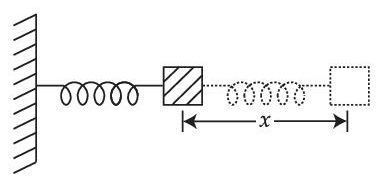
The motion of a mass on a spring, with spring constant \(K\) is as shown in figure. [JEE Main 2021 (Online) 22th July Evening Shift]

The equation of motion is given by
\(\mathrm{x}(\mathrm{t})=\mathrm{A} \sin \omega \mathrm{t}+\mathrm{B} \cos \omega \mathrm{t}\) with \(\omega=\sqrt{\frac{K}{m}}\)
Suppose that at time \(t=0\), the position of mass is \(x(0)\) and velocity \(v(0)\), then its displacement can also be represented as \(x(t)=C \cos (\omega t-\phi)\), where \(C\) and \(\phi\) are:CorrectIncorrectHint
(c) To find the values of the amplitude \(C\) and the phase constant \(\phi\), we need to match the general solution to the specific initial conditions provided.
Step 1: Use Initial Conditions on the First Equation
The given equation is \(x(t)=A \sin \omega t+B \cos \omega t\).
At \(t=0\), position is \(x(0)\) :
\(
x(0)=A \sin (0)+B \cos (0) \Longrightarrow x(0)=B
\)
At \(t=0\), velocity is \(v(0)\) :
First, find the velocity function \(v(t)=\frac{d x}{d t}=A \omega \cos \omega t-B \omega \sin \omega t\).
\(
v(0)=A \omega \cos (0)-B \omega \sin (0) \Longrightarrow v(0)=A \omega \Longrightarrow A=\frac{v(0)}{\omega}
\)
Step 2: Relate to the Cosine Form
The displacement is also represented as \(x(t)=C \cos (\omega t-\phi)\). Using the trigonometric identity \(\cos (\alpha-\beta)=\cos \alpha \cos \beta+\sin \alpha \sin \beta\) :
\(
\begin{gathered}
x(t)=C(\cos \omega t \cos \phi+\sin \omega t \sin \phi) \\
x(t)=(C \sin \phi) \sin \omega t+(C \cos \phi) \cos \omega t
\end{gathered}
\)
Comparing this to our initial equation \(x(t)=A \sin \omega t+B \cos \omega t\), we get:
1. \(A=C \sin \phi\)
2. \(B=C \cos \phi\)
Step 3: Calculate Amplitude \(C\)
To find \(C\), square and add the two equations above:
\(
\begin{gathered}
A^2+B^2=(C \sin \phi)^2+(C \cos \phi)^2 \\
A^2+B^2=C^2\left(\sin ^2 \phi+\cos ^2 \phi\right) \Longrightarrow C=\sqrt{A^2+B^2}
\end{gathered}
\)
Substitute the values of \(A\) and \(B\) from Step 1:
\(
C=\sqrt{\left(\frac{v(0)}{\omega}\right)^2+x(0)^2}
\)
Step 4: Calculate Phase \(\phi\)
To find \(\phi\), divide the expression for \(A\) by the expression for \(B\) :
\(
\begin{gathered}
\frac{A}{B}=\frac{C \sin \phi}{C \cos \phi}=\tan \phi \\
\tan \phi=\frac{A}{B}=\frac{v(0) / \omega}{x(0)}=\frac{v(0)}{\omega x(0)} \\
\phi=\tan ^{-1}\left(\frac{v(0)}{\omega x(0)}\right)
\end{gathered}
\)
Final Result: The parameters for the equation \(x(t)=C \cos (\omega t-\phi)\) are:
Amplitude: \(C=\sqrt{x(0)^2+\frac{v(0)^2}{\omega^2}}\)
Phase: \(\phi=\tan ^{-1}\left(\frac{v(0)}{\omega x(0)}\right)\) - Question 33 of 49
33. Question
A sound wave of frequency 245 Hz travels with the speed of \(300 \mathrm{~ms}^{-1}\) along the positive \(x\) -axis. Each point of the wave moves to and from through a total distance of 6 cm. What will be the mathematical expression of this travelling wave? [JEE Main 2021 (Online) 17th March Evening Shift]
CorrectIncorrectHint
(b) To find the correct mathematical expression for the wave, we need to calculate the amplitude, wave number, and angular frequency from the given data.
Step 1: Determine the Amplitude (\({A}\))
The problem states that each point moves “to and fro through a total distance of 6 cm .”
In a wave oscillation, the total distance from one extreme to the other is equal to \(2 A\).
Therefore, \(2 A=6 \mathrm{~cm} \Longrightarrow A=3 \mathrm{~cm}=0.03 \mathrm{~m}\).
Step 2: Calculate the Angular Frequency (\(\omega\))
The frequency (\(f\)) is given as 245 Hz .
\(
\begin{gathered}
\omega=2 \pi f \\
\omega=2 \pi \times 245 \approx 6.28 \times 245 \\
\omega \approx 1538.6 \mathrm{rad} / \mathrm{s} \approx 1.5 \times 10^3 \mathrm{rad} / \mathrm{s}
\end{gathered}
\)
Step 3: Calculate the Wave Number (\(k\))
The wave number is related to the velocity (\(v\)) and angular frequency (\(\omega\)) by the formula \(v= \omega / k\).
\(
\begin{gathered}
k=\frac{\omega}{v} \\
k=\frac{1538.6}{300} \approx 5.12 \mathrm{~m}^{-1}
\end{gathered}
\)
Step 4: Construct the Wave Equation
A wave traveling along the positive \(\mathbf{x}\)-axis has the form:
\(
y(x, t)=A \sin (k x-\omega t)
\)
Substituting our calculated values:
\(A=0.03\)
\(k \approx 5.1\)
\(\omega \approx 1.5 \times 10^3\)
The resulting equation is:
\(
Y(x, t)=0.03\left[\sin \left(5.1 x-1.5 \times 10^3 t\right)\right]
\) - Question 34 of 49
34. Question
A tuning fork A of unknown frequency produces 5 beats/s with a fork of known frequency 340 Hz. When fork A is filed, the beat frequency decreases to 2 beats/s. What is the frequency of fork \(A\) ? [JEE Main 2021 (Online) 26th February Evening Shift]
CorrectIncorrectHint
(a) The frequency of fork \(\boldsymbol{A}\) is \(\mathbf{3 3 5 ~ H z}\).
Explanation:
Step 1: Identify initial possibilities
The beat frequency is the absolute difference between two frequencies. Since fork \(A\) produces 5 beats/s with a 340 Hz fork, its initial frequency \(f_A\) can be:
\(
f_A=340 \pm 5 \Longrightarrow f_A=345 \mathrm{~Hz} \text { or } f_A=335 \mathrm{~Hz}
\)
Step 2: Analyze the effect of filing
Filing a tuning fork removes mass from its prongs, which increases its frequency (\(f_A^{\prime}>f_A\)).
Step 3: Evaluate the two cases
Case \(1\left(f_A=345 \mathrm{~Hz}\right)\) : If the frequency increases further (e.g., to 346 Hz), the difference from 340 Hz would increase \((346-340=6\) beats \(/ \mathrm{s})\). However, the problem states the beat frequency decreased to 2 beats/ s.
Case \(2\left({f}_{{A}}{=} \mathbf{3 3 5 ~ H z}\right)\) : If the frequency increases (e.g., to \(\mathbf{3 3 8 ~ H z}\)), the difference from 340 Hz decreases (\(|338-340|=2\) beats/s). This matches the given condition. - Question 35 of 49
35. Question
A student is performing the experiment of resonance column. The diameter of the column tube is 6 cm. The frequency of the tuning fork is 504 Hz . Speed of the sound at the given temperature is \(336 \mathrm{~m} / \mathrm{s}\). The zero of the metre scale coincides with the top end of the resonance column tube. The reading of the water level in the column when the first resonance occurs is: [JEE Main 2021 (Online) 25th February Morning Shift]
CorrectIncorrectHint
(d) To find the reading of the water level for the first resonance, we must account for the end correction of the tube. In a resonance column experiment, the antinode of the standing wave actually forms slightly above the open end of the tube.
Step 1: Calculate the Wavelength (\({\lambda}\))
Using the relationship between speed (\(v\)), frequency (\(f\)), and wavelength:
\(
v=f \lambda \Longrightarrow \lambda=\frac{v}{f}
\)
Given:
\(v=336 \mathrm{~m} / \mathrm{s}\)
\(f=504 \mathrm{~Hz}\)
\(
\lambda=\frac{336}{504}=\frac{2}{3} \mathrm{~m} \approx 0.6667 \mathrm{~m}
\)
In centimeters: \(\lambda=66.67 \mathrm{~cm}\)
Step 2: Calculate the End Correction (\(e\))
For a cylindrical tube, the end correction is approximately 0.6 times the radius \((r)\) of the tube.
Diameter \((D)=6 \mathrm{~cm} \Longrightarrow\) Radius \((r)=3 \mathrm{~cm}\)
\(
\begin{gathered}
e=0.6 \times r \\
e=0.6 \times 3 \mathrm{~cm}=1.8 \mathrm{~cm}
\end{gathered}
\)
Step 3: Determine the Resonance Condition
For the first resonance in a tube closed at one end (the water surface), the length of the air column plus the end correction is equal to one-quarter of the wavelength:
\(
L_1+e=\frac{\lambda}{4}
\)
Where \(L_1\) is the actual reading on the scale (the distance from the top of the tube to the water level).
Step 4: Solve for the Water Level Reading (\(L_1\))
Substitute the values into the equation:
\(
L_1+1.8 \mathrm{~cm}=\frac{66.66 \mathrm{~cm}}{4}
\)
\(
L_1=14.86 \mathrm{~cm}
\)
Conclusion: The reading of the water level in the column when the first resonance occurs is approximately 14.86 cm. - Question 36 of 49
36. Question
Which of the following equations represents a travelling wave? [JEE Main 2021 (Online) 24th February Evening Shift]
CorrectIncorrectHint
(c) To determine which equation represents a travelling (progressive) wave, we look for a specific mathematical form.
Step 1: The General Rule
For a function to represent a travelling wave, the variables \(x\) and \(t\) must appear in the combined form (\(a x \pm b t\)). Mathematically, a wave is expressed as:
\(
y=f(a x \pm b t)
\)
This ensures that the wave profile maintains its shape while shifting along the \(x\)-axis as time progresses.
Step 2: Evaluating the Options
Option A: \(y=A e^x \cos (\omega t-\theta)\)
This is a stationary distribution. The amplitude (\(A e^x\)) depends on position, but the \(x\) is not linked with \(t\) inside the oscillating function. This does not travel; it simply oscillates in place with varying intensity.
Option B: \(y=A e^{-x^2}(v t+\theta)\)
While this contains \(x\) and \(t\), they are not in the form (\(x \pm v t\)). This represents a pulse whose magnitude changes globally with time rather than shifting position.
Option C: \(y=A \sin (15 x-2 t)\)
This fits the form \(f(k x-\omega t)\), where \(k=15\) and \(\omega=2\). As \(t\) increases, the value of \(x\) must also change to keep the argument of the sine function constant, which is the definition of a travelling wave.
Option D: \(y=A \sin x \cos \omega t\)This is the standard equation for a standing wave (or stationary wave). It is a product of a function of space and a function of time, created by two travelling waves moving in opposite directions.
Option (c) is the correct representation of a travelling wave moving in the positive \(x\)-direction. - Question 37 of 49
37. Question
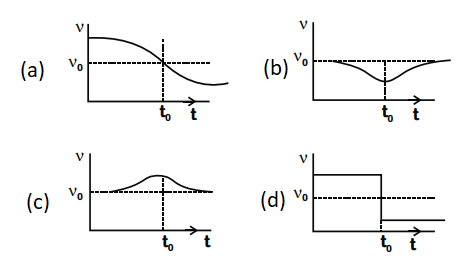
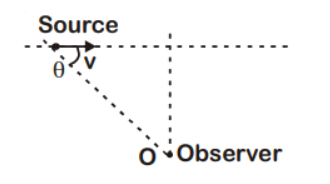
A sound source \(S\) is moving along a straight track with speed \(v\), and is emitting, sound of frequency \(v_0\) (see figure). An observer is standing at a finite distance, at the point 0, from the track. The time variation of frequency heard by the observer is best represented by: (\(t_0\) represents the instant when the distance between the source and observer is minimum) [JEE Main 2020 (Online) 6th September Morning Slot]
 CorrectIncorrect
Hint
(a) Based on the Doppler Effect analysis, we can determine which graph correctly represents the frequency \((\nu)\) heard by the observer over time.
Step 1: Approach Phase \(\left(t<t_0\right)\)
As the source moves toward the point of closest approach, the component of its velocity directed toward the observer is positive. This means the observed frequency is greater than \(\nu_0\).
As it gets closer to \(t_0\), the angle between the track and the observer increases, causing the radial velocity component to decrease. Consequently, the frequency remains above \(\nu_0\) but starts to drop.
Step 2: At Closest Approach (\(t=t_0\))
At the instant \(t_0\), the source is at the minimum distance from the observer. The velocity of the source is perpendicular to the line of sight (radial velocity is zero).
The apparent frequency is exactly equal to the actual frequency: \(\nu=\nu_0\).
Step 3: Recede Phase \(\left(t>t_0\right)\)
After passing \(t_0\), the source is moving away from the observer. The radial component of velocity is now directed away, meaning the observed frequency is lower than \(\nu_0\). As the source moves further away, the frequency continues to decrease toward a lower steady value.
Step 4: Evaluate the Graphs
(a) Correct: This graph shows the frequency starting above \(\nu_0\), decreasing smoothly, passing exactly through \(\nu_0\) at \(t_0\), and ending below \(\nu_0\). This perfectly matches the physics of the situation.
(b) Incorrect: This suggests the frequency is always at or below \(\nu_0\) and reaches a minimum at \(t_0\).
(c) Incorrect: This suggests the frequency is always at or above \(\nu_0\) and reaches a maximum at \(t_0\).
(d) Incorrect: This shows a “step” change. While a step change occurs if the source passes through the observer, a source moving along a track at a finite distance creates a smooth transition as the angle changes.Alternate:

While approaching
\(
\nu=\nu_0\left(\frac{c}{c-v \cos \theta}\right)
\)
While receding
\(
\nu=\nu_0\left(\frac{c}{c+v \cos \theta}\right)
\) - Question 38 of 49
38. Question
A driver in a car, approaching a vertical wall notices that the frequency of his car horn, has changed from 440 Hz to 480 Hz , when it gets reflected from the wall. If the speed of sound in air is \(345 \mathrm{~m} / \mathrm{s}\), then the speed of the car is : [JEE Main 2020 (Online) 5th September Evening Slot]
CorrectIncorrectHint
(b)

To find the speed of the car, we need to apply the Doppler Effect in two stages: first, as the sound travels from the car to the wall, and second, as the sound reflects from the wall back to the driver.
Step 1: Analyze the Two-Stage Doppler Shift
When a source is moving toward a stationary reflector and the observer is moving with the source, the situation can be broken down as follows:
Sound reaching the wall (\(f^{\prime}\)):
The wall acts as a stationary observer. The car is a source moving toward it.
\(
f^{\prime}=f_s\left(\frac{v}{v-v_c}\right)
\)
Reflected sound reaching the driver (\(f_{\text {heard }}\)):
The wall now acts as a stationary source emitting frequency \(f^{\prime}\). The driver is an observer moving toward this source.
\(
f_{\text {heard }}=f^{\prime}\left(\frac{v+v_c}{v}\right)
\)
Step 2: Combine the Equations
By substituting the expression for \(f^{\prime}\) into the second equation, we get the combined formula for a moving source and observer approaching a stationary reflector:
\(
\begin{gathered}
f_{\text {heard }}=f_s\left(\frac{v}{v-v_c}\right)\left(\frac{v+v_c}{v}\right) \\
f_{\text {heard }}=f_s\left(\frac{v+v_c}{v-v_c}\right)
\end{gathered}
\)
Where:
\(f_s=440 \mathrm{~Hz}\) (Source frequency)
\(f_{\text {heard }}=480 \mathrm{~Hz}\) (Apparent frequency)
\(v=345 \mathrm{~m} / \mathrm{s}\) (Speed of sound)
\(v_c=\)? (Speed of the car)
Step 3: Solve for the Velocity of the Car (\(v_c\))
Plug the values into the combined formula:
\(
480=440\left(\frac{345+v_c}{345-v_c}\right)
\)
\(
v_c=\frac{345}{23}=15 \mathrm{~m} / \mathrm{s}
\)
Step 4: Convert to km/hr
To convert from \(\mathrm{m} / \mathrm{s}\) to \(\mathrm{km} / \mathrm{hr}\), multiply by 3.6 (or \(\frac{18}{5}\)):
\(
v_c=15 \times \frac{18}{5}=3 \times 18=54 \mathrm{~km} / \mathrm{hr}
\)
Conclusion: The speed of the car is \(54 \mathrm{~km} / \mathrm{hr}\). - Question 39 of 49
39. Question
Assume that the displacement(\(s\)) of air is proportional to the pressure difference (\(\Delta p\)) created by a sound wave. Displacement (\(s\)) further depends on the speed of sound (\(v\)), density of air (\(\rho\)) and the frequency (\(f\)). If \(\Delta \mathrm{p} \sim 10 \mathrm{~Pa}, \mathrm{v} \sim 300 \mathrm{~m} / \mathrm{s}, \rho \sim 1 \mathrm{~kg} / \mathrm{m}^3\) and \(\mathrm{f} \sim 1000 \mathrm{~Hz}\), then s will be of the order of (take the multiplicative constant to be 1) : [JEE Main 2020 (Online) 5th September Morning Slot]
CorrectIncorrectHint
(b) To find the order of magnitude for the displacement \(s\) of air particles, we can use dimensional analysis based on the relationships provided in the problem.
Step 1: Establish the Relationship Using Dimensional Analysis
We are given that displacement (\(s\)) depends on the pressure difference (\(\Delta p\)), the density of air \((\rho)\), the speed of sound \((v)\), and the frequency \((f)\). Let’s assume the relation is:
\(
s=C \cdot \frac{\Delta p}{\rho^a v^b f^c}
\)
Since we are told to take the multiplicative constant as 1 , we set \(C=1\). Let’s check the dimensions of each variable:
\([s]=L\)
\([\Delta p]=M L^{-1} T^{-2}\)
\([\rho]=M L^{-3}\)
\([v]=L T^{-1}\)
\([f]=T^{-1}\)
By comparing the dimensions, we find the formula that balances is:
\(
s=\frac{\Delta p}{\rho v f}
\)
(Proof: \([s]=\frac{M L^{-1} T^{-2}}{\left(M L^{-3}\right)\left(L T^{-1}\right)\left(T^{-1}\right)}=\frac{M L^{-1} T^{-2}}{M L^{-2} T^{-2}}=L\). The dimensions match perfectly.)
Step 2: Plug in the Given Values
Substitute the provided values into the derived formula:
\(\Delta p \approx 10 \mathrm{~Pa}\)
\(\rho \approx 1 \mathrm{~kg} / \mathrm{m}^3\)
\(v \approx 300 \mathrm{~m} / \mathrm{s}\)
\(f \approx 1000 \mathrm{~Hz}\)
\(
s=\frac{10}{1 \times 300 \times 1000}
\)
Step 3: Calculate the Displacement (\(s\)) in Meters
\(
\begin{aligned}
& s=\frac{10}{300,000} \\
& s=\frac{1}{30,000} \mathrm{~m}
\end{aligned}
\)
Step 4: Convert to Millimeters and Compare Options
To compare with the options, convert the result from meters to millimeters (\(1 \mathrm{~m}=1000 \mathrm{~mm}\)):
\(
\begin{aligned}
& s=\frac{1}{30,000} \times 1000 \mathrm{~mm} \\
& s=\frac{1}{30} \mathrm{~mm} \approx 0.033 \mathrm{~mm}
\end{aligned}
\)
Now, evaluate the given options:
(a) 1 mm
(b) \(\frac{3}{100} \mathrm{~mm}=0.03 \mathrm{~mm}\) (Closest to 0.033 mm)
(c) 10 mm
(d) \(\frac{1}{10} \mathrm{~mm}=0.1 \mathrm{~mm}\)
Conclusion: The calculated displacement is of the order of \(\frac{3}{100} \mathrm{~mm}\). - Question 40 of 49
40. Question
In a resonance tube experiment when the tube is filled with water up to a height of 17.0 cm from bottom, it resonates with a given tuning fork. When the water level is raised the next resonance with the same tuning fork occurs at a height of 24.5 cm. If the velocity of sound in air is \(330 \mathrm{~m} / \mathrm{s}\), the tuning fork frequency is : [JEE Main 2020 (Online) 5th September Morning Slot]
CorrectIncorrectHint
(a) Analyzing the Wave Physics:
In a resonance tube closed at one end, resonance occurs when the length of the air column allows for a node at the water surface and an antinode at the open top. The difference between two consecutive resonance positions (\({h}_1\) and \({h}_2\)) represents exactly half a wavelength.
Using your values:
First resonance height \(\left({h}_{\mathbf{1}}\right): 17.0 \mathrm{~cm}\)
Second resonance height (\(h_2\)): 24.5 cm
Calculating Wavelength (\(\lambda\)):
The distance between two successive resonances is:
\(
\Delta h=h_2-h_1=\frac{\lambda}{2}
\)
Substituting your numbers:
\(
\begin{gathered}
7.5 \mathrm{~cm}=\frac{\lambda}{2} \\
\lambda=15 \mathrm{~cm}=0.15 \mathrm{~m}
\end{gathered}
\)
We know, \(f=\frac{v}{\lambda}\)
\(
\Rightarrow \mathrm{f}=\frac{330}{1510^{-2}}=2200 \mathrm{~Hz}
\) - Question 41 of 49
41. Question
The driver of a bus approaching a big wall notices that the frequency of his bus’s horn changes from 420 Hz to 490 Hz when he hears it after it gets reflected from the wall. Find the speed of the bus if speed of the sound is \(330 \mathrm{~ms}^{-1}\). [JEE Main 2020 (Online) 4th September Evening Slot]
CorrectIncorrectHint
(a) Step 1: Set up the Doppler Equation
For a source (the bus) moving toward a stationary reflector (the wall) and the observer (the driver) moving with that source, the relationship between the emitted frequency (\(f_s\)) and the reflected frequency (\(f_r\)) is:
\(
f_r=f_s\left(\frac{v+v_b}{v-v_b}\right)
\)
Step 2: Substitute the Given Values
\(f_s=420 \mathrm{~Hz}\)
\(f_r=490 \mathrm{~Hz}\)
\(v=330 \mathrm{~m} / \mathrm{s}\)
\(v_b=\) speed of the bus
\(
490=420\left(\frac{330+v_b}{330-v_b}\right)
\)
Step 3: Solve for \(v_b\) in \(\mathrm{m} / \mathrm{s}\)
Divide both sides by 70 to simplify:
\(
\frac{7}{6}=\frac{330+v_b}{330-v_b}
\)
Cross-multiply:
\(
\begin{gathered}
7\left(330-v_b\right)=6\left(330+v_b\right) \\
2310-7 v_b=1980+6 v_b \\
330=13 v_b \\
v_b=\frac{330}{13} \approx 25.38 \mathrm{~m} / \mathrm{s}
\end{gathered}
\)
Step 4: Convert to \(k m / h\)
To convert from \(\mathrm{m} / \mathrm{s}\) to \(\mathrm{km} / \mathrm{h}\), we multiply by 3.6 (or \(\frac{18}{5}\)):
\(
\begin{gathered}
v_b=\left(\frac{330}{13}\right) \times 3.6 \\
v_b=\frac{1188}{13} \approx 91.38 \mathrm{~km} / \mathrm{h}
\end{gathered}
\)
When rounded to the nearest whole number as per the options, we get \(91 \mathrm{~km} / \mathrm{h}\). - Question 42 of 49
42. Question
For a transverse wave travelling along a straight line, the distance between two peaks (crests) is 5 m, while the distance between one crest and one trough is 1.5 m. The possible wavelengths (in m ) of the are :
CorrectIncorrectHint
(b) To find the possible wavelengths, we need to translate the physical descriptions of the crests and troughs into mathematical conditions based on the wavelength \(\lambda\).
Step 1: Analyze the Distance Between Two Crests
In a transverse wave, crests are located at positions where the phase is an even multiple of \(\pi\) (specifically \(2 n \pi\)). The distance between any two crests must be an integer multiple of the wavelength.
\(
d_{\text {crest-crest }}=n \lambda=5 \mathrm{~m}
\)
where \(n=1,2,3, \ldots\)
Step 2: Analyze the Distance Between a Crest and a Trough
A trough is located exactly half a wavelength away from a crest (and then every full wavelength after that). Therefore, the distance between any crest and any trough is an odd multiple of half a wavelength:
\(
d_{\text {crest-trough }}=(2 m+1) \frac{\lambda}{2}=1.5 \mathrm{~m}
\)
where \(m=0,1,2, \ldots\)
This can be rewritten as:
\(
(2 m+1) \lambda=3 \mathrm{~m}
\)
Step 3: Solve the System of Equations
We now have two conditions that the wavelength \(\lambda\) must satisfy simultaneously:
\(\lambda=\frac{5}{n}\)
\(\lambda=\frac{3}{2 m+1}\)
By setting them equal to each other:
\(
\begin{gathered}
\frac{5}{n}=\frac{3}{2 m+1} \Longrightarrow 5(2 m+1)=3 n \\
10 m+5=3 n
\end{gathered}
\)
Step 4: Find Possible Values for \(n\) and \(m\)
Since \(n\) and \(m\) must be integers, we test values of \(m\) :
If \(m=1: 10(1)+5=15\). Then \(3 n=15 \Longrightarrow n=5\). Using \(n=5\) in condition 1: \(\lambda=\frac{5}{5}=1 \mathrm{~m}\).
If \(m=4: 10(4)+5=45\). Then \(3 n=45 \Longrightarrow n=15\). Using \(n=15\) in condition 1: \(\lambda=\frac{5}{15}=\frac{1}{3} \mathrm{~m}\).
If \(m=7: 10(7)+5=75\). Then \(3 n=75 \Longrightarrow n=25\). Using \(n=25\) in condition 1: \(\lambda=\frac{5}{25}=\frac{1}{5} \mathrm{~m}\).
Conclusion: The sequence of possible wavelengths follows the pattern \(1, \frac{1}{3}, \frac{1}{5}, \ldots\) - Question 43 of 49
43. Question
A uniform thin rope of length 12 m and mass 6 kg hangs vertically from a rigid support and a block of mass 2 kg is attached to its free end. A transverse short wavetrain of wavelength 6 cm is produced at the lower end of the rope. What is the wavelength of the wavetrain (in cm) when it reaches the top of the rope ? [JEE Main 2020 (Online) 3rd September Morning Slot]
CorrectIncorrectHint
(a)

To find the wavelength of the wave at the top of the rope, we need to understand how the tension in the rope changes, as tension directly affects wave speed and, consequently, wavelength.
Step 1: Identify the Relationship Between Wavelength and Tension
The frequency (\(f\)) of a wave remains constant as it travels through a medium. The relationship between velocity \((v)\), frequency \((f)\), and wavelength \((\lambda)\) is \(v=f \lambda\).
For a transverse wave on a string, the velocity is given by:
\(
v=\sqrt{\frac{T}{\mu}}
\)
Where \(T\) is the tension and \(\mu\) is the mass per unit length. Since \(f\) is constant, \(\lambda \propto v\), which means:
\(
\lambda \propto \sqrt{T}
\)
Step 2: Calculate Tension at the Bottom (\(T_1\))
At the lower end of the rope, the tension is created only by the attached block.
Mass of block \((m)=2 \mathrm{~kg}\)
\(T_1=m \times g=2 g\)
The initial wavelength at this point is \(\lambda_1=6 \mathrm{~cm}\).
Step 3: Calculate Tension at the Top (\(T_2\))
At the top of the rope, the tension must support both the block and the entire weight of the rope.
Mass of rope \((M)=6 \mathrm{~kg}\)
Mass of block \((m)=2 \mathrm{~kg}\)
\(T_2=(M+m) \times g=(6+2) g=8 g\)
Step 4: Use the Proportionality to Find \({\lambda}_{\mathbf{2}}\)
Since \(\lambda\) is proportional to the square root of the tension, we can set up a ratio:
\(
\frac{\lambda_2}{\lambda_1}=\sqrt{\frac{T_2}{T_1}}
\)
Substitute the values:
\(
\begin{gathered}
\frac{\lambda_2}{6 \mathrm{~cm}}=\sqrt{\frac{8 g}{2 g}} \\
\frac{\lambda_2}{6 \mathrm{~cm}}=\sqrt{4} \\
\frac{\lambda_2}{6 \mathrm{~cm}}=2
\end{gathered}
\)
Step 5: Solve for the Final Wavelength
\(
\lambda_2=6 \mathrm{~cm} \times 2=12 \mathrm{~cm}
\)
Conclusion: The wavelength of the wavetrain when it reaches the top of the rope is 12 cm. - Question 44 of 49
44. Question
Two identical strings \(X\) and \(Z\) made of same material have tension \(T_X\) and \(T_Z\) in them. If their fundamental frequencies are 450 Hz and 300 Hz, respectively, then the ratio \(T_X / T_Z\) is [JEE Main 2020 (Online) 2nd September Morning Slot]
CorrectIncorrectHint
(a) To find the ratio of the tensions, we need to use the relationship between the fundamental frequency of a vibrating string and its tension.
Step 1: Identify the Formula for Fundamental Frequency
The fundamental frequency (\(f\)) of a stretched string is given by the formula:
\(
f=\frac{1}{2 L} \sqrt{\frac{T}{\mu}}
\)
Where:
\(L\) is the length of the string.
\(T\) is the tension in the string.
\(\mu\) is the mass per unit length (linear density).
Step 2: Establish the Proportionality
The problem states that the strings are identical and made of the same material. This means:
The length \((L)\) is the same for both.
The linear density \((\mu)\) is the same for both.
Therefore, the frequency is directly proportional to the square root of the tension:
\(
f \propto \sqrt{T} \quad \Longrightarrow \quad f^2 \propto T
\)
Step 3: Set Up the Ratio
We can write the ratio of the tensions in terms of the frequencies:
\(
\frac{T_X}{T_Z}=\left(\frac{f_X}{f_Z}\right)^2
\)
Given:
\(f_X=450 \mathrm{~Hz}\)
\(f_Z=300 \mathrm{~Hz}\)
Step 4: Calculate the Result
Substitute the values into the ratio:
\(
\frac{T_X}{T_Z}=\left(\frac{450}{300}\right)^2=2.25
\) - Question 45 of 49
45. Question
A wire of length \(L\) and mass per unit length \(6.0 \times 10^{-3} \mathrm{kgm}^{-1}\) is put under tension of 540 N. Two consecutive frequencies that it resonates at are: 420 Hz and 490 Hz . Then \(L\) in meters is : [JEE Main 2020 (Online) 9th January Evening Slot]
CorrectIncorrectHint
(b) To find the length of the wire, we can use the relationship between consecutive resonant frequencies for a string fixed at both ends.
Step 1: Calculate the Fundamental Frequency (\(f_0\))
For a string fixed at both ends, the resonant frequencies are integer multiples of the fundamental frequency (\(f_0, 2 f_0, 3 f_0, \ldots\)). The difference between any two consecutive resonant frequencies is equal to the fundamental frequency itself.
Given consecutive frequencies:
\(f_n=420 \mathrm{~Hz}\)
\(f_{n+1}=490 \mathrm{~Hz}\)
\(
\Delta f=f_{n+1}-f_n=490-420=70 \mathrm{~Hz}
\)
So, the fundamental frequency \(f_0=70 \mathrm{~Hz}\).
Step 2: Identify the Wave Speed Formula
The fundamental frequency of a string of length \(L\) is given by:
\(
f_0=\frac{v}{2 L}
\)
Where \(v\) is the velocity of the transverse wave on the string:
\(
v=\sqrt{\frac{T}{\mu}}
\)
Step 3: Calculate the Wave Velocity (\(v\))
Given:
Tension \((T)=540 \mathrm{~N}\)
Mass per unit length \((\mu)=6.0 \times 10^{-3} \mathrm{~kg} / \mathrm{m}\)
\(
\begin{gathered}
v=\sqrt{\frac{540}{6.0 \times 10^{-3}}} \\
v=\sqrt{\frac{540}{0.006}}=\sqrt{90,000} \\
v=300 \mathrm{~m} / \mathrm{s}
\end{gathered}
\)
Step 4: Solve for Length \((L)\)
Now, substitute \(f_0\) and \(v\) back into the fundamental frequency formula:
\(
70=\frac{300}{2 L}
\)
\(
L \approx 2.14 \mathrm{~m}
\)
Conclusion: The length of the wire is approximately 2.14 meters. - Question 46 of 49
46. Question
Three harmonic waves having equal frequency \(\nu\) and same intensity \(I_0\), have phase angles \(0, \frac{\pi}{4}\) and \(-\frac{\pi}{4}\) respectively. When they are superimposed the intensity of the resultant wave is close to : [JEE Main 2020 (Online) 9th January Morning Slot]
CorrectIncorrectHint
(a) To find the resultant intensity, we can use the phasor addition method. Since intensity is proportional to the square of the amplitude \(\left(I \propto A^2\right)\), we first find the resultant amplitude \(A_R\).
Step 1: Identify Individual Amplitudes
Since all three waves have the same intensity \(I_0\), they all have the same amplitude \(A\). We can represent them as vectors (phasors) with magnitude \(A\) :
Wave 1: Phase \(\phi_1=0\)
Wave 2: Phase \(\phi_2=+\frac{\pi}{4}\)
Wave 3: Phase \(\phi_3=-\frac{\pi}{4}\)
Step 2: Sum the Phasors (Vector Addition)
We break each phasor into its \(x\) (horizontal) and \(y\) (vertical) components:
\(
\begin{array}{l|l|l|l}
\text { Wave } & \text { Phase } & \text { x- } \operatorname{component}(A \cos \phi) & y-\operatorname{component}(A \sin \phi) \\
\hline 1 & 0 & A \cos (0)=A & A \sin (0)=0 \\
2 & \pi / 4 & A \cos (\pi / 4)=2 A & A \sin (\pi / 4)=2 A \\
3 & -\pi / 4 & A \cos (-\pi / 4)=2 A & A \sin (-\pi / 4)=-2 A
\end{array}
\)
Total x-component (\({A}_{{x}}\)):
\(
A_x=A+\frac{A}{\sqrt{2}}+\frac{A}{\sqrt{2}}=A+\frac{2 A}{\sqrt{2}}=A+A \sqrt{2}=A(1+\sqrt{2})
\)
Total y-component (\({A}_{{y}}\)):
\(
A_y=0+\frac{A}{\sqrt{2}}-\frac{A}{\sqrt{2}}=0
\)
Step 3: Calculate Resultant Amplitude and Intensity
The resultant amplitude \(A_R\) is:
\(
A_R=\sqrt{A_x^2+A_y^2}=A(1+\sqrt{2})
\)
Since Intensity \(I \propto A^2\), the resultant intensity \(I_R\) is:
\(
I_R=I_0(1+\sqrt{2})^2
\)
Thus, \(I_R \approx 5.8 I_0\). - Question 47 of 49
47. Question
A transverse wave travels on a taut steel wire with a velocity of v when tension in it is \(2.06 \times 10^4 \mathrm{~N}\). When the tension is changed to \(T\), the velocity changed to \(\mathrm{v} / 2\). The value of \(T\) is close to : [JEE Main 2020 (Online) 8th January Evening Slot]
CorrectIncorrectHint
(d) To find the new tension \(T\), we use the physical relationship between the tension in a string and the velocity of a transverse wave traveling through it.
Step 1: Identify the Governing Formula
The velocity (\(v\)) of a transverse wave on a taut wire is given by the formula:
\(
v=\sqrt{\frac{\text { Tension }}{\text { Linear Mass Density }}}=\sqrt{\frac{T}{\mu}}
\)
Step 2: Establish the Proportionality
Since the wire remains the same, the mass per unit length \((\mu)\) is constant. Therefore, the velocity is directly proportional to the square root of the tension:
\(
v \propto \sqrt{T}
\)
This can be rewritten as:
\(
T \propto v^2
\)
Step 3: Set Up the Ratio
Let \(v_1\) and \(T_1\) be the initial velocity and tension, and \(v_2\) and \(T_2\) be the final velocity and tension.
\(
\frac{T_2}{T_1}=\left(\frac{v_2}{v_1}\right)^2
\)
Given:
\(T_1=2.06 \times 10^4 \mathrm{~N}\)
\(v_1=v\)
\(v_2=v / 2\)
\(T_2=T\)
Step 4: Solve for \(T\)
Substitute the values into the ratio:
\(
\frac{T}{2.06 \times 10^4}=\left(\frac{v / 2}{v}\right)^2
\)
\(
T=5.15 \times 10^3 \mathrm{~N}
\)
Conclusion: The value of the new tension \(T\) is \(5.15 \times 10^3 \mathrm{~N}\). - Question 48 of 49
48. Question
A stationary observer receives sound from two identical tuning forks, one of which approaches and the other one recedes with the same speed (much less than the speed of sound). The observer hears 2 beats/sec. The oscillation frequency of each tuning fork is \(\mathrm{v}_0=1400 \mathrm{~Hz}\) and the velocity of sound in air is \(350 \mathrm{~m} / \mathrm{s}\). The speed of each tuning fork is close to : [JEE Main 2020 (Online) 7th January Evening Slot]
CorrectIncorrectHint
(c) To find the speed of the tuning forks, we need to calculate the apparent frequencies heard by the stationary observer from both the approaching and receding sources, then use the beat frequency.
Step 1: Identify the Doppler Shift Formulas
Since the observer is stationary (\(v_o=0\)), the apparent frequency (\(f^{\prime}\)) depends on the speed of the source (\(v_s\)).
For the approaching fork \(\left(f_1\right)\) :
\(
f_1=f_0\left(\frac{v}{v-v_s}\right)
\)
For the receding fork (\(f_2\)):
\(
f_2=f_0\left(\frac{v}{v+v_s}\right)
\)
Step 2: Calculate the Beat Frequency (\(f_b\))
The beat frequency is the difference between these two frequencies:
\(
f_b=f_1-f_2
\)
\(
f_b=f_0\left(\frac{v}{v-v_s}-\frac{v}{v+v_s}\right)
\)
Simplify the term in the parentheses:
\(
\begin{gathered}
f_b=f_0 \cdot v\left(\frac{\left(v+v_s\right)-\left(v-v_s\right)}{\left(v-v_s\right)\left(v+v_s\right)}\right) \\
f_b=f_0 \cdot v\left(\frac{2 v_s}{v^2-v_s^2}\right)
\end{gathered}
\)
Step 3: Apply the Approximation
The problem states that \(v_s\) is much less than the speed of sound \(\left(v_s \ll v\right)\). Therefore, we can approximate \(v^2-v_s^2 \approx v^2\).
\(
\begin{gathered}
f_b \approx f_0 \cdot v\left(\frac{2 v_s}{v^2}\right) \\
f_b \approx \frac{2 f_0 v_s}{v}
\end{gathered}
\)
Step 4: Solve for the Speed of the Fork (\(v_s\))
Substitute the given values:
\(f_b=2 \mathrm{~Hz}\)
\(f_0=1400 \mathrm{~Hz}\)
\(v=350 \mathrm{~m} / \mathrm{s}\)
\(
2=\frac{2 \times 1400 \times v_s}{350}
\)
Simplify the right side:
\(
\begin{gathered}
2=\frac{2800}{350} \times v_s \\
2=8 \times v_s \\
v_s=\frac{2}{8}=\frac{1}{4} \mathrm{~m} / \mathrm{s}
\end{gathered}
\)
Conclusion: The speed of each tuning fork is \(1 / 4 \mathrm{~m} / \mathrm{s}\). - Question 49 of 49
49. Question
Speed of a transverse wave on a straight wire (mass 6.0 g, length 60 cm and area of cross-section \(1.0 \mathrm{~mm}^2\)) is \(90 \mathrm{~ms}^{-1}\). If the Young’s modulus of wire is \(16 \times 10^{11} \mathrm{Nm}^{-2}\), the extension of wire over its natural length is : [JEE Main 2020 (Online) 7th January Morning Slot]
CorrectIncorrectHint
(a) To find the extension of the wire, we need to bridge the gap between wave mechanics (to find the tension) and elasticity (to find the extension).
Step 1: Calculate the Mass per Unit Length \(\boldsymbol{(} \mu \boldsymbol{)}\)
First, we find the linear mass density of the wire:
Mass \((m)=6.0 \mathrm{~g}=6 \times 10^{-3} \mathrm{~kg}\)
Length \((L)=60 \mathrm{~cm}=0.6 \mathrm{~m}\)
\(
\mu=\frac{m}{L}=\frac{6 \times 10^{-3}}{0.6}=0.01 \mathrm{~kg} / \mathrm{m}
\)
Step 2: Calculate the Tension (\(T\))
The speed of a transverse wave is related to the tension by the formula \(v=\sqrt{T / \mu}\). We can rearrange this to solve for \(T\) :
\(
T=\mu v^2
\)
Given the speed \(v=90 \mathrm{~m} / \mathrm{s}\) :
\(
T=(0.01) \times(90)^2=0.01 \times 8100=81 \mathrm{~N}
\)
Step 3: Relate Tension to Young’s Modulus
Young’s Modulus (\(Y\)) relates the stress on a material to its strain:
\(
Y=\frac{\text { Stress }}{\text { Strain }}=\frac{T / A}{\Delta L / L}
\)
Rearranging to solve for the extension (\({\Delta} {L}\)):
\(
\Delta L=\frac{T \cdot L}{A \cdot Y}
\)
Step 4: Substitute the Values
Identify the remaining parameters in SI units:
Tension \((T)=81 \mathrm{~N}\)
Length \((L)=0.6 \mathrm{~m}\)
\(\operatorname{Area}(A)=1.0 \mathrm{~mm}^2=1.0 \times 10^{-6} \mathrm{~m}^2\)
Young’s Modulus \((Y)=16 \times 10^{11} \mathrm{~N} / \mathrm{m}^2\)
\(
\Delta L=\frac{81 \times 0.6}{\left(1.0 \times 10^{-6}\right) \times\left(16 \times 10^{11}\right)}
\)
\(
\begin{gathered}
\Delta L=\frac{48.6}{16 \times 10^5} \\
\Delta L=3.0375 \times 10^{-5} \mathrm{~m}
\end{gathered}
\)
Step 5: Final Result
Convert the result to a more readable unit (millimeters):
\(
\Delta L=0.030375 \mathrm{~mm}
\)
Conclusion: The extension of the wire over its natural length is approximately 0.03 mm.