7.3 Universal law of gravitation
Newton’s law of gravitation
According to this law, “every particle in the universe attracts every other particle with a force whose magnitude is directly proportional to the product of their masses and inversely proportional to the square of distances between their centres.” This tendency of particles (or bodies) to attract each other is called gravitation.
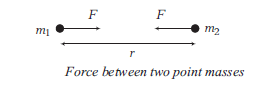
Thus, the magnitude of gravitational force \(F\) between the two particles of masses \(m_1\) and \(m_2\) placed at distance \(r\) can be given as
\(
F \propto \frac{m_1 m_2}{r^2} \text { or } F=\frac{G m_1 m_2}{r^2} \dots(i)
\)
where, \(G\) is the universal gravitational constant.
The magnitude of \(G\) in MKS or SI is \(6.67 \times 10^{-11} N- m ^2 kg^{-2}\) and in CGS, it is \(6.67 \times 10^{-8}\) dyne- \(cm ^2 g^{-2}\). The dimensional formula of \(G\) is \(\left[ M ^{-1} L^3 T^{-2}\right]\).
Important points about force of gravitation
- The gravitational constant \(G\) is called a universal constant because it has same value for any two bodies anywhere in the space.
- Gravitational force is always attractive in nature and is independent of the nature of medium between two masses and presence or absence of other bodies.
- Gravitational forces are central forces as they act along the line joining the centre of gravity of two bodies.
- Gravitational forces are conservative in nature, so work done by gravitational forces does not depend upon the path.
- For a body outside a spherically symmetric body, the entire mass is assumed to be concentrated at its centre due to Newton’s Shell Theorem. Because of the perfect symmetry, all tangential gravitational forces from different parts of the sphere cancel out, while radial components integrate to match the force of a point mass at the center.
- The gravitational force of attraction exerted by a uniform hollow spherical shell on a point mass inside it is zero because the opposing gravitational pulls from different parts of the shell cancel each other out. This result, known as Newton’s Shell Theorem, occurs because the further, larger surface area of the shell exerts a stronger force that exactly balances the closer, smaller surface area, regardless of the point’s position.
- In calculating the gravitational force between two non-spherical bodies, we cannot assume their masses to be concentrated at their centres of mass but if the separation between them is very large in comparison to their sizes, then the bodies may be considered as particles. That means if we have to find gravitational force between a sphere and a circular ring at infinite separation, then the mass of sphere can be assumed at its centre.
- In general, the gravitational force between non-spherical bodies is found by integration (summing the forces between all pairs of infinitesimal particles within the two bodies) because the mass distribution of each body is not uniform or spherically symmetric. The gravitational potential and resulting force depend on the precise geometry and density of the objects.
- Force developed between any two masses is called gravitational force and the force between earth and any other body is called force of gravity.
Example 1: Two heavy particles of masses 40 kg and 60 kg attracts each other with a force of \(4 \times 10^{-5} N\). If \(G\) is \(6 \times 10^{-11} N- m ^2 kg^{-2}\), calculate the distance between them.
Solution: Given, \(m_1=40 kg, m_2=60 kg, F=4 \times 10^{-5} N\),
\(
G=6 \times 10^{-11} N-m^2 kg^{-2}, g=10 ms^{-2}
\)
According to Newton’s law of gravitation, \(F=\frac{G m_1 m_2}{r^2}\)
\(
\begin{aligned}
\text { ∴ Distance, } r & =\sqrt{\frac{G m_1 m_2}{F}}=\sqrt{\frac{6 \times 10^{-11} \times 40 \times 60}{4 \times 10^{-5}}} \\
& =0.06 m=6 cm
\end{aligned}
\)
Example 2: If the distance between the two spherical bodies is increased to four times, then by how many times, the mass of one of the bodies is to be changed to maintain the same gravitational force?
Solution: Let \(F_1=\frac{G m_1 m_2}{r^2}\) and \(F_2=\frac{G M_1 M_2}{R^2}\)
Now, \(R=4 r\)
Also, let \(m_1\) remains unchanged, so \(m_1=M_1\)
\(
\begin{array}{ll}
\therefore & \frac{G m_1 m_2}{r^2}=\frac{G M_1 M_2}{R^2} \\
\Rightarrow & \frac{m_2}{r^2}=\frac{M_2}{(4 r)^2} \Rightarrow m_2=\frac{M_2}{16} \\
\therefore & M_2=16 m_2
\end{array}
\)
Hence, the mass of one body should be increased to 16 times to maintain the same gravitational force.
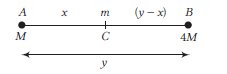
Example 3: Two particles \(A\) and \(B\) having masses \(M\) and \(4 M\) respectively are kept at a distance \(2.73 m\) apart. Another small particle of mass \(m\) is to be placed, so that the net gravitational force on it is zero. What will be its distance from body \(A\)?
Solution: Two particles \(A\) and \(B\) are placed as shown below and a third particle is placed at \(C\).
Now, according to the given conditions,
\(
\begin{array}{rlrl}
& & F_{C A} & =F_{C B} \\
\therefore & & \frac{G M m}{x^2} & =\frac{G 4 M m}{(y-x)^2} \\
\Rightarrow & \frac{1}{x^2} & =\frac{4}{(y-x)^2} \\
\Rightarrow & y-x & =2 x \\
\Rightarrow & y & =3 x \\
\because & x & =\frac{y}{3}=\frac{2.73}{3} \quad \Rightarrow x=0.91 m
\end{array}
\)
Hence, a particle of mass \(m\) should be placed at 0.91 m apart from body at \(A\).
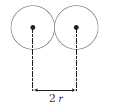
Example 4: Spheres of the same material and of same radius \(r\) are touching each other. Show that gravitational force between them is directly proportional to \(r^4\).
Solution: Two spheres are touching as shown below.
According to the question,
\(
m_1=m_2=(\text { volume })(\text { density })=\left(\frac{4}{3} \pi r^3\right) \rho
\)
∴ Gravitational force, \(F=\frac{G m_1 m_2}{r^2}=\frac{G\left(\frac{4}{3} \pi r^3\right)\left(\frac{4}{3} \pi r^3\right) \rho^2}{r^2}\)
\(\Rightarrow \quad F \propto r^4\)
Example 5: Force between two objects of equal masses is \(F\). If 25% mass of one object is transferred to the other object, then find the new force.
Solution: Suppose mass of one object, \(m=100 kg\)
∵ Masses of both objects are equal.
\(
\therefore \quad m_1=m_2=100 kg
\)
According to Newton’s law of gravitation,
\(
F=G \frac{m_1 m_2}{R^2}
\)
\(
\begin{array}{ll}
\therefore & F=\frac{G \times 100 \times 100}{R^2}=\frac{G \times 10000}{R^2} \\
\Rightarrow & \frac{G}{R^2}=\frac{F}{10000} \dots(i)
\end{array}
\)
If \(25 \%\) mass of one object is transferred to the other object, then
\(
\begin{aligned}
m_1 & =100-25=75 kg \\
m_2 & =100+25=125 kg \\
\therefore \quad \text { New force, } F^{\prime} & =\frac{G \times 75 \times 125}{R^2}=\frac{G \times 9375}{R^2}
\end{aligned}
\)
\(
\begin{aligned}
&\Rightarrow \quad \frac{G}{R^2}=\frac{F^{\prime}}{9375} \dots(ii) \\
&\text { From Eqs. (i) and (ii), we get }\\
&F^{\prime}=\frac{15}{16} F
\end{aligned}
\)
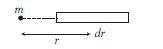
Example 6: A particle of mass \(m\) is placed at a distance \(d\) from one end of a uniform rod with length \(L\) and mass \(M\) as shown in the figure. Find the magnitude of the gravitational force on the particle due to the rod.
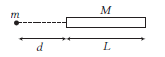
Solution: Let us consider an elementary mass \(d m\) of length \(d r\) at a distance \(r\) from the particle of mass \(m\). Here, \(d m=(M / L) d r\). The gravitational force \(d F\) on \(m\) due to this elementary mass \(d m\) is
\(
d F=\frac{G m}{r^2} d m=\frac{G m M}{L r^2} d r
\)
To find the total gravitational force \(F\), integrate \(d F\) over the entire length of the rod. The distance \({r}\) varies from \({d}\) (the nearest end) to \({d}+{L}\) (the farthest end):
\(
\begin{aligned}
F & =\frac{G m M}{L} \int_d^{L+d} \frac{d r}{r^2} \\
& =\frac{G m M}{L}\left[-\frac{1}{r}\right]_d^{L+d} \\
& =-\frac{G m M}{L}\left[\frac{1}{L+d}-\frac{1}{d}\right]=\frac{G m M}{d(L+d)}
\end{aligned}
\)
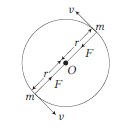
Example 7: Two particles of equal mass \(m\) are moving round a circle of radius \(r\) due to their mutual gravitational interaction. Find the time period of each particle.
Solution: Two particles will always remain on diametrically opposite points, so that the gravitational force is centripetal. Here, mutual gravitational force is
\(
F=\frac{G m m}{(2 r)^2}=\frac{G m^2}{4 r^2} \dots(i)
\)
If the speed of each particle is \(v\), then the centripetal force,
\(
F=\frac{m v^2}{r} \dots(ii)
\)
Equating Eqs. (i) and (ii), we get
\(
v=\sqrt{\frac{G m}{4 r}}
\)
∴ Time period, \(T=\frac{2 \pi r}{v}=\frac{2 \pi r}{\sqrt{\frac{G m}{4 r}}}=\frac{4 \pi}{\sqrt{G m}} r^{3 / 2}\)
Vector form of Newton’s law of gravitation
The vector form of Newton’s law of gravitation signifies that the gravitational forces acting between the two particles form action and reaction pair.
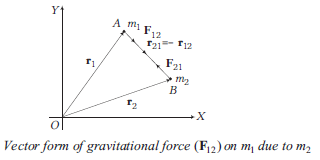
In figure, it can be seen that the two particles of masses \(m_1\) and \(m_2\) are placed at a distance \(r\), therefore according to Newton’s law of gravitation, force on \(m_1\) due to \(m_2\),
\(
\mathbf{F}_{12}=-\frac{G m_1 m_2}{\left|\mathbf{r}_{12}\right|^2} \cdot \hat{\mathbf{r}}_{12}=\frac{G m_1 m_2}{\left|\mathbf{r}_{12}\right|^2} \cdot \hat{\mathbf{r}}_{21} \dots(i)
\)
\(
\mathrm{F}_{12}=-G m_1 m_2 \frac{\mathbf{r}_1-\mathbf{r}_2}{\left|\mathbf{r}_1-\mathbf{r}_2\right|^3} \quad\left(\because \hat{\mathbf{r}}_{12}=\frac{\mathbf{r}_1-\mathbf{r}_2}{\left|\mathbf{r}_1-\mathbf{r}_2\right|}\right)
\)
where, \(\hat{\mathbf{r}}_{12}\) is a unit vector pointing from \(m_2\) to \(m_1\).
The negative sign in Eq.(i) indicates that the direction of force \(\mathbf{F}_{12}\) is opposite to that of \(\hat{\mathbf{r}}_{12}\).
Similarly, force on \(m_2\) due to \(m_1\),
\(
\mathbf{F}_{21}=-\frac{G m_1 m_2}{\left|\mathbf{r}_{21}\right|^2} \cdot \hat{\mathbf{r}}_{21}=\frac{G m_1 m_2}{\left|\mathbf{r}_{21}\right|^2} \cdot \hat{\mathbf{r}}_{12} \dots(ii)
\)
where, \(\hat{\mathbf{r}}_{21}\) is a unit vector pointing from \(m_1\) to \(m_2\). From Eqs. (i) and (ii), we get
\(
\Rightarrow \begin{aligned}
& & \mathrm{F}_{12} & =-\mathrm{F}_{21} \\
\Rightarrow & & \left|\mathrm{~F}_{12}\right| & =\left|\mathrm{F}_{21}\right| \dots(iii)
\end{aligned}
\)
As \(\mathrm{F}_{12}\) and \(\mathrm{F}_{21}\) are directed towards the centres of the two particles, so gravitational force is conservative in nature.
Principle of superposition of gravitational forces
Suppose \(\mathbf{F}_1, \mathbf{F}_2, \ldots, \mathbf{F}_n\) be the individual forces due to the masses \(m_1, m_2, m_3, \ldots, m_n\) which are given by the universal law of gravitation, then from the principle of superposition, each of these forces acts independently and uninfluenced by the other bodies as shown in figure.
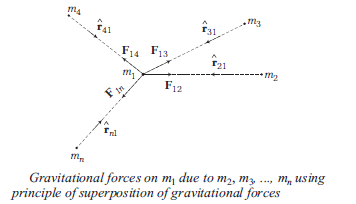
The principle of superposition states that the net force \(\mathbf{F}_{\text {net }}\) acting on the test mass is the vector sum of all the individual forces \(\mathbf{F}_{\boldsymbol{i}}\) :
\(
\mathrm{F}_{\mathrm{net}}=\sum_{i=1}^n \mathrm{~F}_i=\mathrm{F}_1+\mathrm{F}_2+\ldots+\mathrm{F}_n
\)
To perform the vector sum, break each force vector into its components (e.g., \(x\), \(y\) and \(z\) components).
Calculate net force components:
Sum the components in each direction:
\(
\begin{aligned}
& \mathrm{F}_{\mathrm{net}, x}=\sum_{i=1}^n \mathrm{~F}_{i, x} \\
& \mathrm{~F}_{\mathrm{net}, y}=\sum_{i=1}^n \mathrm{~F}_{i, y} \\
& \mathrm{~F}_{\mathrm{net}, z}=\sum_{i=1}^n \mathrm{~F}_{i, z}
\end{aligned}
\)
Determine magnitude and direction:
The magnitude of the net force is found using the Pythagorean theorem:
\(
\left|\mathrm{F}_{\mathrm{net}}\right|=\sqrt{F_{\mathrm{net}, x}^2+F_{\mathrm{net}, y}^2+F_{\mathrm{net}, z}^2}
\)
The direction can be found using trigonometric functions (like \(\mathbf{\theta}=\arctan \left(\mathrm{F}_{\text {net }, y} / \mathrm{F}_{\text {net, } x}\right)\)).
According to Newton’s Universal Law of Gravitation, the force exerted on \(m_1\) by another mass \(m_i\) is given by:
\(
\mathbf{F}_{1 i}=-G \frac{m_1 m_i}{r_{1 i}^2} \hat{\mathbf{r}}_{i 1}
\)
Where:
\(G\) is the gravitational constant.
\(r_{1 i}\) is the distance between \(m_1\) and \(m_i\).
\(\hat{\mathbf{r}}_{i 1}\) is the unit vector pointing from \(m_i\) toward \(m_1\).
So, from the above diagram we can write, the resultant force \(\mathbf{F_{net}}\) on mass \(m_1\) can be expressed in vector addition of various forces
\(
\mathbf{F_{net}}=\mathbf{F}_{12}+\mathbf{F}_{13}+\mathbf{F}_{14}+\ldots+\mathbf{F}_{1 n}
\)
It states that, the resultant gravitational force \(\mathbf{F_{net}}\) acting on a particle due to number of point masses is equal to the vector sum of forces exerted by the individual masses on the given particle.
Clearly, \(\mathbf{F_{net}}=-G \frac{m_1 m_2}{r_{12}^2} \hat{\mathbf{r}}_{21}-G \frac{m_1 m_3}{r_{13}^2} \hat{\mathbf{r}}_{31}-\ldots . .-G \frac{m_1 m_n}{r_{1 n}^2} \hat{\mathbf{r}}_{n 1}\)
Resultant force, \(\mathbf{F_{net}}=-G m_1\left[\frac{m_2}{r_{12}^2} \hat{\mathbf{r}}_{21}+\frac{m_3}{r_{13}^2} \hat{\mathbf{r}}_{31}+\ldots+\frac{m_n}{r_{1 n}^2} \hat{\mathbf{r}}_{n 1}\right]\)
Example 1: Three masses each equal to \(M\) are placed at the three corners of a square of side \(a\). Calculate the force of attraction on unit mass at the fourth corner.
Solution: Force on \(m\) due to masses at 1 and 3 are \(\mathrm{F}_1\) and \(\mathrm{F}_3\),
\(
F_1=F_3=\frac{G M}{a^2}(\because m=1)
\)
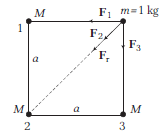
Resultant of \(\mathrm{F}_1\) and \(\mathrm{F}_3\) is \(F_r=\sqrt{2} \frac{G M}{a^2}\) and its direction is along the diagonal, i.e. towards 2.
Force on \(m\) due to mass \(M\) at corner 2, \(F_2=\frac{G M}{(\sqrt{2} a)^2}=\frac{G M}{2 a^2}\) and \(F_r\) and \(F_2\) act in the same direction.
Resultant of these two gives net force,
\(
\mathrm{F}_r=\frac{\sqrt{2} G M}{a^2}+\frac{G M}{2 a^2}=\frac{G M}{a^2}\left[\sqrt{2}+\frac{1}{2}\right]
\)
It is directed along the diagonal as shown in figure.
Example 2: Three equal masses of 1 kg each are placed at the vertices of an equilateral \(\triangle P Q R\) and a mass of 2 kg is placed at the centroid \(O\) of the triangle which is at \(a\) distance of \(\sqrt{2} m\) from each of the vertices of the triangle. Find the force (in newton) acting on the mass of 2 kg.
Solution: Given, \(O P=O Q=O R=\sqrt{2} \mathrm{~m}\)
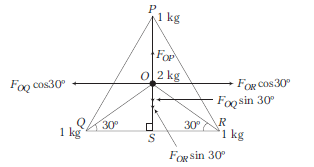
The gravitational force on mass 2 kg due to mass 1 kg at \(P\),
\(
F_{O P}=G \frac{2 \times 1}{(\sqrt{2})^2}=G \text { along } Q P
\)
Similarly,
\(
F_{O Q}=G \frac{2 \times 1}{(\sqrt{2})^2}=G \text { along } O Q
\)
and
\(
F_{O R}=G \frac{2 \times 1}{(\sqrt{2})^2}=G \text { along } O R
\)
\(F_{O Q} \cos 30^{\circ}\) and \(F_{O R} \cos 30^{\circ}\) are equal and acting in opposite directions, hence cancel out each other.
Force on mass 2 kg along \(O S\)
\(
\begin{array}{ll}
=F_{O Q} \sin 30^{\circ}+F_{O R} \sin 30^{\circ} & \\
=2 F_{O Q} \sin 30^{\circ} & \left(\because F_{O Q}=F_{O R}\right) \\
=F_{O Q} &
\end{array}
\)
The resultant force on the mass 2 kg at \(O\),
\(
\begin{aligned}
F & =F_{O P}-F_{O Q} \\
& =G-G=0 \text { (zero) }
\end{aligned}
\)
Note: Alternatively, one expects on the basis of symmetry that the resultant force ought to be zero.