7.9 Earth satellites
Motion of Satellite
Just as the planets revolve around the sun, in the same way few celestial bodies revolve around these planets. These bodies are called satellites. e.g. Moon is a natural satellite of earth. The paths of these satellites are elliptical with the centre of earth at a focus. The difference in major and minor axes is not large, so we can assume circular orbits.
Orbital velocity of satellites
The velocity with which a satellite moves in its closed orbit around the earth is known as orbital velocity.
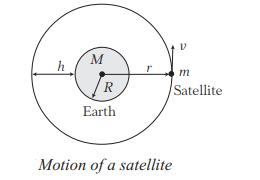
We will consider a satellite in a circular orbit of a distance \(\left(r=R+h\right)\) from the centre of the earth, where \(R=\) radius of the earth. If \(m\) is the mass of the satellite and \(V=v_o\) its speed, the centripetal force required for this orbit is
\(
\mathrm{F}(\text { centripetal })=\frac{m V^2}{\left(R+h\right)} \dots(i)
\)
directed towards the center. This centripetal force is provided by the gravitational force, which is
\(
\mathrm{F}(\text { gravitation })=\frac{G m M}{\left(R+h\right)^2} \dots(ii)
\)
Equating R.H.S of Eqs. (i) and (ii) and cancelling out \(m\) , we get
\(
V^2=\frac{G M}{\left(R+h\right)} \dots(iii)
\)
Thus \(V\) decreases as \(h\) increases. From equation (iii), the speed \(V\) for \(h=0\) is
\(
V^2 \quad(h=0)=G M / R=g R
\)
where we have used the relation \({g}=G M / R^2\).
\(
V=\sqrt{g R}=\sqrt{\frac{G M}{R}} \dots(iv)
\)
Substituting the values of \(g\) and \(R\), we get
\(
V=v_o=7.9 \mathrm{kms}^{-1} \approx 8 \mathrm{kms}^{-1}
\)
Note:
- Orbital velocity of a satellite is independent of mass of the satellite.
- It decreases with increase in the radius of the orbit and with increase in the height of the satellite.
- It depends on the mass and radius of the planet about which the satellite revolves.
- The angular momentum of a satellite of mass \(m\) moving with velocity \(V\) in an orbit of radius \(r(=R+h)\) is given by \(L=\sqrt{G M m^2 r}\).
Example 1: A satellite circled around the earth at a distance of 3400 km. Determine its orbital velocity, if the radius of the earth is 6400 km and \(g=9.8 \mathrm{~ms}^{-2}\).
Solution: Given, radius of earth, \(R=6400 \mathrm{~km}=64 \times 10^5 \mathrm{~m}\)
Distance of satellite from earth, \(h=3400 \mathrm{~km}=34 \times 10^5 \mathrm{~m}\)
∴ Orbital velocity of an artificial satellite can be given as (we know \(G M=g R^2\))
\(
\begin{aligned}
v_o & =R \sqrt{\frac{g}{R+h}}=64 \times 10^5 \sqrt{\frac{9.8}{(64+34) \times 10^5}} \\
\Rightarrow \quad v_o & =6400 \mathrm{~ms}^{-1}
\end{aligned}
\)
Relation between orbital velocity and escape velocity
The escape velocity of a body from the earth’s surface,
\(
v_e=\sqrt{2 g R}
\)
The orbital velocity of a satellite revolving close to earth’s surface,
\(
\begin{array}{ll}
& v_o=\sqrt{g R} \\
\therefore & \frac{v_e}{v_o}=\frac{\sqrt{2 g R}}{\sqrt{g R}}=\sqrt{2} \\
\Rightarrow & v_e=\sqrt{2} v_o \dots(i)
\end{array}
\)
So, Eq. (i) represents that the escape velocity of a body from the earth’s surface is \(\sqrt{2}\) times its orbital velocity in a circular orbit just above the earth’s surface.
Example 2: A satellite is launched into a circular orbit close to the earth’s surface. What additional velocity has now to be imparted to the satellite in the orbit to overcome the gravitational pull?
Solution: Since, orbital velocity near earth’s surface, \(v_o=\sqrt{g R_e}\)
Escape velocity, \(v_e=\sqrt{2 g R_e}=1.414 \sqrt{g R_e}\)
Therefore, additional velocity required
\(
\begin{aligned}
& =v_e-v_o=(1.414-1) \sqrt{g R_e} \\
& =0.414 \sqrt{9.8 \times 6400 \times 10^3} \\
& =3.278 \times 10^3 \mathrm{~ms}^{-1}=3.278 \mathrm{kms}^{-1}
\end{aligned}
\)
Time period of revolution of satellite
The time taken by a satellite to complete one revolution around the earth, is known as time period of revolution of satellite. In every orbit, the satellite traverses a distance \(2 \pi\left(R+h\right)\) with speed \(V\). It’s time period \(T\) therefore is
\(
T=\frac{2 \pi\left(R+h\right)}{V}=\frac{2 \pi\left(R+h\right)^{3 / 2}}{\sqrt{G M}} \dots(v)
\)
\(
T=2 \pi \sqrt{\frac{(R+h)^3}{g R^2}}=2 \pi \sqrt{\frac{(r)^3}{g R^2}} \quad\left(\because G M=g R^2 \text { and } r=R+h\right)
\)
From this expression of \(T\), we can make the following conclusions
- \(T \propto r^{3 / 2}\) or \(T^2 \propto r^3\)
which is also the Kepler’s third law. - Time period of a satellite very close to earth’s surface \((r \approx R)\) is,
\(
T=2 \pi \sqrt{\frac{R}{g}}
\)
Substituting the values, we get
\(
T \approx 84.6 \mathrm{~min} \approx 1.4 \mathrm{~h}
\) - Suppose the height of a satellite is such that the time period of the satellite is 24 h and it moves in the same sense as the earth. The satellite will always be overhead a particular place on the equator. As seen from the earth, this satellite will appear to be stationary. Such a satellite is called a geo-stationary satellite. Putting \(T=24 \mathrm{~h}\) in the expression of \(T\), the radius of geo-stationary satellite comes out to be \(r=4.2 \times 10^4 \mathrm{~km}\). The height above the surface of earth is about \(3.6 \times 10^4 \mathrm{~km}\).
Example 3: \(A\) satellite revolves around the earth at a height of 1000 km. The radius of the earth is \(6.38 \times 10^3 \mathrm{~km}\). Mass of the earth is \(6 \times 10^{24} \mathrm{~kg}\) and \(G=6.67 \times 10^{-11} \mathrm{~N}-\mathrm{m}^2 \mathrm{~kg}^{-2}\). Determine its orbital velocity and period of revolution.
Solution: Given, height of satellite from the earth, \(h=1000 \mathrm{~km}=10^6 \mathrm{~m}\),
\(
\begin{aligned}
R & =6.38 \times 10^3 \mathrm{~km}=6.38 \times 10^6 \mathrm{~m} \\
\Rightarrow \quad h+R & =7.38 \times 10^6 \mathrm{~m}, M=6 \times 10^{24} \mathrm{~kg}
\end{aligned}
\)
\(
\begin{aligned}
& \therefore \text { Orbital velocity, } v_o=\sqrt{\frac{G M}{R+h}} \\
& =\sqrt{\frac{6.67 \times 10^{-11} \times 6 \times 10^{24}}{7.38 \times 10^6}} \\
& =7364 \mathrm{~ms}^{-1} \\
& \begin{aligned}
\therefore \text { Period of revolution, } T & =\frac{2 \pi(R+h)}{v_o} \\
& =\frac{2 \pi \times 7.38 \times 10^6}{7364}
\end{aligned} \\
& \Rightarrow \quad T \approx 6297 \mathrm{~s} \approx 1.749 \mathrm{~h}
\end{aligned}
\)
Example 4: The planet Mars has two moons, phobos and delmos. (i) phobos has a period 7 hours, 39 minutes and an orbital radius of \(9.4 \times 10^3 \mathrm{~km}\). Calculate the mass of mars. (ii) Assume that earth and mars move in circular orbits around the sun, with the martian orbit being 1.52 times the orbital radius of the earth. What is the length of the martian year in days?
Solution: (i) We employ time period equation with the sun’s mass replaced by the martian mass \(M_m\)
\(
\begin{aligned}
& T^2=\frac{4 \pi^2}{G M_m} R^3 \\
& \mathrm{M}_m=\frac{4 \pi^2}{G} \frac{R^3}{T^2} \\
& =\frac{4 \times(3.14)^2 \times(9.4)^3 \times 10^{18}}{6.67 \times 10^{-11} \times(459 \times 60)^2} \\
& \mathrm{M}_m=\frac{4 \times(3.14)^2 \times(9.4)^3 \times 10^{18}}{6.67 \times(4.59 \times 6)^2 \times 10^{-5}} \\
& =6.48 \times 10^{23} \mathrm{~kg}
\end{aligned}
\)
(ii) Once again Kepler’s third law comes to our aid,
\(
\frac{T_M^2}{T_E^2}=\frac{R_{M S}^3}{R_{E S}^3}
\)
where \(R_{M S}\) is the mars -sun distance and \(R_{E S}\) is the earth-sun distance.
\(
\begin{aligned}
\therefore T_M & =(1.52)^{3 / 2} \times 365 \\
& =684 \text { days }
\end{aligned}
\)
We note that the orbits of all planets except Mercury, Mars and Pluto are very close to being circular. For example, the ratio of the semi-minor to semi-major axis for our Earth is, \(b / a =0.99986\).
Example 5: Weighing the Earth : You are given the following data: \(g=9.81 \mathrm{~ms}^{-2}\), \(R_E=6.37 \times 10^6 \mathrm{~m}\), the distance to the moon \(R=3.84 \times 10^8 \mathrm{~m}\) and the time period of the moon’s revolution is 27.3 days. Obtain the mass of the Earth \(M_E\) in two different ways.
Solution: We know, \(M_E=\frac{g R_E^2}{G}\)
\(
\begin{aligned}
& =\frac{9.81 \times\left(6.37 \times 10^6\right)^2}{6.67 \times 10^{-11}} \\
& =5.97 \times 10^{24} \mathrm{~kg} .
\end{aligned}
\)
The moon is a satellite of the Earth. From the derivation of Kepler’s third law
\(
\begin{aligned}
& T^2=\frac{4 \pi^2 R^3}{G M_E} \\
& M_E=\frac{4 \pi^2 R^3}{G T^2} \\
& =\frac{4 \times 3.14 \times 3.14 \times(3.84)^3 \times 10^{24}}{6.67 \times 10^{-11} \times(27.3 \times 24 \times 60 \times 60)^2} \\
& =6.02 \times 10^{24} \mathrm{~kg}
\end{aligned}
\)
Both methods yield almost the same answer, the difference between them being less than \(1 \%\).
Height of satellite
As it is known that the time period of satellite,
\(
T=2 \pi \sqrt{\frac{r^3}{G M}}=2 \pi \sqrt{\frac{(R+h)^3}{g R^2}} \dots(vi)
\)
By squaring both sides of Eq. (vi), we get
\(
T^2=4 \pi^2 \frac{(R+h)^3}{g R^2}
\)
\(
\begin{array}{ll}
\Rightarrow & \frac{g R^2 T^2}{4 \pi^2}=(R+h)^3 \\
\Rightarrow & h=\left(\frac{T^2 g R^2}{4 \pi^2}\right)^{1 / 3}-R
\end{array}
\)
By knowing the value of time period, the height of the satellite from the earth’s surface can be calculated.
Example 6: A satellite forms a circle around the earth in 90 min. Determine the height of the satellite above the earth’s surface.
Solution: Given, \(T=90 \mathrm{~min}=5400 \mathrm{~s}\),
\(
\begin{array}{ll}
& R=6400 \mathrm{~km}=6.4 \times 10^6 \mathrm{~m} \\
\because & \text { Time period, } T=2 \pi \sqrt{\frac{(R+h)^3}{g R^2}} \\
\Rightarrow & R+h=\left[\frac{g R^2 T^2}{4 \pi^2}\right]^{1 / 3} \\
\Rightarrow & R+h=6668.13 \mathrm{~km} \\
\Rightarrow & h=6668.13-R=6668.13-6400 \\
\Rightarrow & h=268.13 \mathrm{~km} \simeq 268 \mathrm{~km}
\end{array}
\)