2.3 Average velocity and average speed
Speed
The time rate of distance travelled by an object in any direction is called speed of the object.
\(
\text { Speed }(v)=\frac{\text { Distance travelled }}{\text { Time taken }}
\)
It is a scalar quantity.
The unit of speed in SI or MKS system is \(\mathrm{ms}^{-1}\) and in CGS system is \(\mathrm{cms}^{-1}\). Its dimensional formula is \(\left[\mathrm{M}^0 \mathrm{LT}^{-1}\right]\).
For a moving body, speed is always positive and can never be negative or zero.
Average speed
The ratio of the total distance travelled by the object to the total time taken is called average speed of the object.
i.e. \(\text { Average speed }=\frac{\text { Total distance travelled }}{\text { Total time taken }}\)
Average speed of particles in different cases
Case I: If a particle travels distance \(s_1, s_2, s_3, \ldots\), etc., with speeds \(v_1, v_2, v_3, \ldots\), etc., in same direction, then the distance travelled \(=s_1+s_2+s_3+\ldots\)
Total time taken \(=\frac{s_1}{v_1}+\frac{s_2}{v_2}+\frac{s_3}{v_3}+\ldots\)
Average speed, \(v_{\mathrm{av}}=\frac{s_1+s_2+\ldots}{\left(\frac{s_1}{v_1}+\frac{s_2}{v_2}+\ldots\right)}\)
If \(s_1=s_2=s\), i.e. the body covers equal distances with different speeds, then
\(
\begin{aligned}
& v_{\mathrm{av}}=\frac{2 s}{s\left(\frac{1}{v_1}+\frac{1}{v_2}\right)} \\
& v_{\mathrm{av}}=\frac{2 v_1 v_2}{v_1+v_2}
\end{aligned}
\)
Case II: If a particle travels with speeds \(v_1, v_2, v_3, \ldots\), etc., during time intervals \(t_1, t_2, t_3, \ldots\), etc., then total distance travelled, \(s=v_1 t_1+v_2 t_2+v_3 t_3+\ldots\) Total time taken \(=t_1+t_2+t_3+\ldots\)
So, average speed,
\(
v_{\mathrm{av}}=\frac{v_1 t_1+v_2 t_2+v_3 t_3+\ldots}{t_1+t_2+t_3+\ldots}
\)
Case III: If \(t_1=t_2=t_3=\ldots=t_n\), then we have
\(
\begin{aligned}
v_{\mathrm{av}} & =\frac{\left(v_1+v_2+\ldots+v_n\right) t}{n t} \\
v_{\mathrm{av}} & =\frac{v_1+v_2+\ldots+v_n}{n}
\end{aligned}
\)
Example 1: A car covers the first half of the distance between two places at a speed of \(40 \mathrm{kmh}^{-1}\) and second half at \(60 \mathrm{kmh}^{-1}\). Calculate the average speed of the car.
Solution: Given, speed in first half, \(v_1=40 \mathrm{kmh}^{-1}\)
Speed in second half, \(v_2=60 \mathrm{kmh}^{-1}\)
\(\because\) Car covers equal distance with different speeds.
\(\therefore\) Average speed of car,
\(
\begin{aligned}
& v_{\mathrm{av}}=\frac{2 v_1 v_2}{v_1+v_2} \\
\Rightarrow \quad & v_{\mathrm{av}}=\frac{2(40)(60)}{40+60}=48 \mathrm{kmh}^{-1}
\end{aligned}
\)
Example 2: The distance travelled by a particle in time \(t\) is given by \(s=\left(2.5 \mathrm{~m} / \mathrm{s}^2\right) t^2\). Find the average speed of the particle during the time 0 to 5.0 s.
Solution: The distance travelled during time 0 to 5.0 s is
\(
s=\left(2.5 \mathrm{~m} / \mathrm{s}^2\right)(5.0 \mathrm{~s})^2=62.5 \mathrm{~m}
\)
The average speed during this time is
\(
v_{a v}=\frac{62.5 \mathrm{~m}}{5 \mathrm{~s}}=12.5 \mathrm{~m} / \mathrm{s}
\)
Velocity
The rate of change of position or displacement of an object with time is called the velocity of that object.
i.e. \(\text { Velocity }=\frac{\text { Displacement }}{\text { Time }}\)
It is a vector quantity. The unit of velocity in SI or MKS system is \(\mathrm{ms}^{-1}\) and in CGS system is \(\mathrm{cms}^{-1}\). Its dimensional formula is \(\left[\mathrm{M}^0 \mathrm{LT}^{-1}\right]\). In 1-D motion, the velocity of an object is taken to be positive, if the object is moving towards the right of the origin and is taken to be negative, if the object is moving towards the left of the origin.
Average velocity
The ratio of the total displacement to the total time taken is called average velocity.
\(
\text { Average velocity }=\frac{\text { Total displacement }(\Delta x)}{\text { Total time }(\Delta t)}
\)
If velocity of the object changes at a uniform rate, then
\(
\text { Average velocity }=\frac{\text { Initial velocity }+ \text { Final velocity }}{2}
\)
Velocity versus Speed
- Velocity of an object can be changed by changing the object’s speed or direction of motion or both.
- For an object in a time interval \((t)\); \(\mid\) Velocity \(\mid \leq\) Speed i.e. The magnitude of velocity of an object is always equal to or less than its speed.
- If a body is moving in a straight line, then the magnitude of its speed and velocity will be equal.
- Average velocity could be zero or positive or negative but average speed is always positive for a moving body.
Example 3: A farmer has to go 500 m due north, 400 m due east and \(200 m\) due south to reach his field. If he takes 20 min to reach the field,
(i) what distance he has to walk to reach the field?
(ii) what is the displacement from his house to the field?
(iii) what is the average speed of farmer during the walk?
(iv) what is the average velocity of farmer during the walk?
Solution:
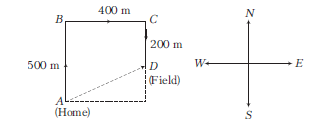
(i)
\(
\begin{aligned}
\text { Distance } & =A B+B C+C D \\
& =(500+400+200)=1100 \mathrm{~m}
\end{aligned}
\)
(ii)
\(
\begin{aligned}
\text { Displacement } & =A D=\sqrt{(A B-C D)^2+B C^2} \\
& =\sqrt{(500-200)^2+(400)^2}=500 \mathrm{~m}
\end{aligned}
\)
(iii) Average speed \(=\frac{\text { Total distance }}{\text { Total time }}=\frac{1100}{20}=55 \mathrm{~m} / \mathrm{min}\)
(iv) Average velocity \(=\frac{A D}{t}=\frac{500}{20}=25 \mathrm{~m} / \mathrm{min}\) (along \(A D\) )
Example 4: Figure below shows the speed versus time graph for a particle. Find the distance travelled by the particle during the time \(t=0\) to \(t=3 \mathrm{~s}\).
Solution: The distance travelled by the particle in the time 0 to 3 s is equal to the area shaded in the figure.
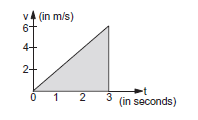
This is a right angled triangle with height \(=6 \mathrm{~m} / \mathrm{s}\) and the base \(=3 \mathrm{~s}\). The area is \(\frac{1}{2}\) (base) (height) \(=\frac{1}{2} \times(3 \mathrm{~s}) (6 \mathrm{~m} / \mathrm{s})=9 \mathrm{~m}\).
Thus, the particle covered a distance of 9 m during the time 0 to 3 s.
Uniform Velocity
An object is said to have uniform velocity, if the magnitude and direction of its velocity remains constant. This is only possible when the object moves along a straight line without reversing its direction. For example, a car traveling at exactly \(40 \mathrm{~km} / \mathrm{h}\) on a straight, flat highway without any stops or changes in direction is said to be in uniform velocity.
Non-uniform velocity
However, an object is said to have non-uniform velocity, if either magnitude or direction of velocity change w.r.t. time. For example, when a car starts from a standstill, its velocity is zero, and then it steadily increases. This changing velocity is a prime example of non-uniform motion. When a car comes to a stop, its velocity is decreasing. This deceleration is a form of non-uniform motion.
- Constant speed: The object’s speed does not increase or decrease.
- Constant direction: The object travels in a single, unchanging straight line.
- Equal displacement: The object covers the same amount of distance in every equal time interval.
Example 5: A table clock has its minute hand 4.0 cm long. Find the average velocity of the tip of the minute hand (a) between 6.00 a.m. to 6.30 a.m. and (b) between 6.00 a.m. to 6.30 p.m.
Solution: At 6.00 a.m. the tip of the minute hand is at 12 mark and at 6.30 a.m. or 6.30 p.m. it is \(180^{\circ}\) away. Thus, the straight line distance between the initial and final position of the tip is equal to the diameter of the clock.
Displacement \(=2 R=2 \times 4.0 \mathrm{~cm}=8.0 \mathrm{~cm}\).
The displacement is from the 12 mark to the 6 mark on the clock panel. This is also the direction of the average velocity in both cases.
(a) The time taken from 6.00 a.m. to 6.30 a.m. is 30 minutes \(=1800 \mathrm{~s}\). The average velocity is
\(
v_{a v}=\frac{\text { Displacement }}{\text { time }}=\frac{8.0 \mathrm{~cm}}{1800 \mathrm{~s}}=4.4 \times 10^{-3} \mathrm{~cm} / \mathrm{s} .
\)
(b) The time taken from 6.00 a.m. to 6.30 p.m. is 12 hours and 30 minutes \(=45000 \mathrm{~s}\). The average velocity is
\(
v_{a v}=\frac{\text { Displacement }}{\text { time }}=\frac{8.0 \mathrm{~cm}}{45000 \mathrm{~s}}=1.8 \times 10^{-4} \mathrm{~cm} / \mathrm{s} .
\)