1.9 The potential energy of a spring
Elastic potential energy of a spring
Potential energy of a spring is the energy associated with the state of compression or expansion of an elastic spring. When the spring is stretched or compressed by an amount \(x\) from its unstretched position, then elastic potential energy of spring,
\(
U=1 / 2 k x^2 \quad \text { (where, } k=\text { spring constant) }
\)
Note: that elastic potential energy is always positive.
Natural length of spring indicates reference point, where potential energy of spring is taken zero.
Example 1: Prove that elastic potential energy of spring \(U=1 / 2 k x^2 \quad \text { (where, } k=\text { spring constant) }\)
Solution: To stretch or compress a spring, an external applied force ( \(\boldsymbol{F}_{\text {app }}\) ) must counteract the spring’s restoring force. For a conservative system (no friction), the applied force is equal in magnitude but opposite in direction to the spring force: \(F_{a p p}=k x\)
Define Work Done: Work ( \(W\) ) is defined as the integral of force with respect to displacement ( \(\mathrm{d} x\) ). The total work done to move the spring from its equilibrium position ( \(x=0\) ) to a final displacement ( \(x=X\) ) is:
\(
W=\int_0^X F_{a p p} \mathrm{~d} x
\)
Substitute Hooke’s Law: Substitute the expression for the applied force ( \(F_{a p p}=k x\) ) into the work integral:
\(
W=\int_0^X k x d x
\)
Integrate: The spring constant ( \(k\) ) is a constant and can be moved outside the integral. The integral of \(x\) with respect to \(x\) is \(\frac{1}{2} x^2\) :
\(
W=k \int_0^X x \mathrm{~d} x=k\left[\frac{1}{2} x^2\right]_0^X
\)
Evaluate the Limits: Evaluate the definite integral from the initial position ( 0 ) to the final position \((X)\) :
\(
\begin{aligned}
& W=k\left(\frac{1}{2} X^2-\frac{1}{2}(0)^2\right) \\
& W=\frac{1}{2} k X^2
\end{aligned}
\)
Relate Work to Potential Energy: The work done by the external force is stored as elastic potential energy ( \(\boldsymbol{U}\) ) in the spring. Using a general variable \(\boldsymbol{x}\) for the final displacement:
\(
U=W=\frac{1}{2} k x^2
\)
Example 2: Two springs of spring constants \(1500 \mathrm{Nm}^{-1}\) and \(3000 \mathrm{Nm}^{-1}\) respectively are stretched with the same force, slowly. Compute the ratio of their potential energies.
Solution: The work done in pulling the string is stored as potential energy in the spring which is given by
\(
U=\frac{1}{2} k x^2 \dots(i)
\)
where, \(k\) is spring constant and \(x\) is distance through which it is pulled.
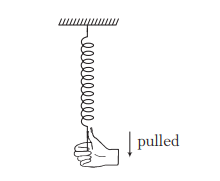
In case of spring, applied force is given by
\(
F=k x
\)
where, \(k\) is spring constant.
Putting \(x=\frac{F}{k}\) in Eq. (i), we get
\(
\begin{aligned}
U & =\frac{1}{2} k\left(\frac{F}{k}\right)^2=\frac{F^2}{2 k} \Rightarrow U \propto \frac{1}{k} \dots(ii) \\
\therefore & \frac{U_1}{U_2}=\frac{k_2}{k_1}=\frac{3000}{1500}=\frac{2}{1} \text { or } U_1: U_2=2: 1
\end{aligned}
\)
Example 3: A block of mass 8 kg is released from the top of an inclined smooth surface as shown in figure. If spring constant of spring is \(200 \mathrm{Nm}^{-1}\) and block comes to rest after compressing spring by \(1 m\), then find the distance travelled by block before it comes to rest.
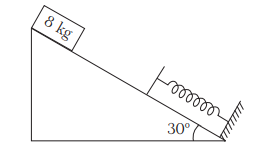
Solution: The total distance travelled by the block along the incline is \(d\). The spring is compressed by \(x=1 \mathrm{~m}\). The total vertical height descended is \(h=d \sin (\theta)\). The initial energy (gravitational potential energy) is converted entirely into the final energy (elastic potential energy in the spring).
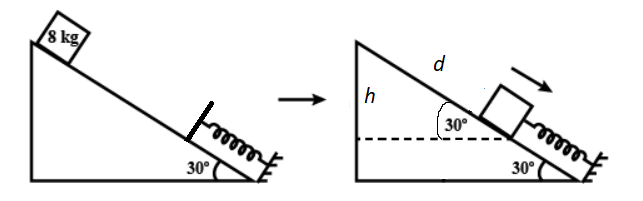
The conservation of energy equation is:
\(
m g h=\frac{1}{2} k x^2 \quad \text { ( } x \text { is compression in spring) }
\)
Substitute the given values \(m=8 \mathrm{~kg}, g=10 \mathrm{~m} / \mathrm{s}^2, k=200 \mathrm{Nm}^{-1}, x=1 \mathrm{~m}\), and \(\theta=30^{\circ}\) into the energy equation.
\(
\begin{gathered}
(8 \mathrm{~kg})\left(10 \mathrm{~m} / \mathrm{s}^2\right)\left(d \sin \left(30^{\circ}\right)\right)=\frac{1}{2}\left(200 \mathrm{Nm}^{-1}\right)(1 \mathrm{~m})^2 \\
(80 \mathrm{~N})(d \cdot 0.5)=100 \mathrm{~J} \\
40 d=100 \\
d=\frac{100}{40} \mathrm{~m} \\
d=2.5 \mathrm{~m}
\end{gathered}
\)
The distance travelled by the block before it comes to rest is \(\mathbf{d}=\mathbf{2 . 5 m}\).
Work done by the spring force, kinetic energy and Potential Energy
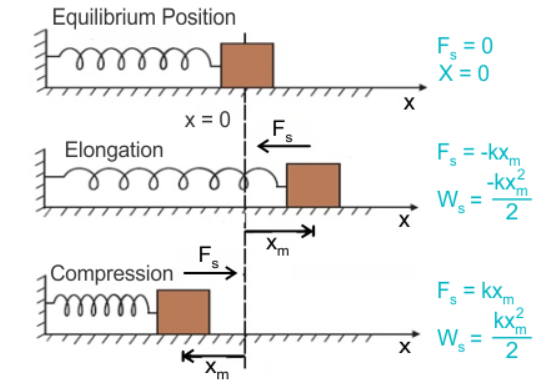
The work done by a spring force \(\left(F_s=-k x\right)\) as an object moves from an initial position \(x_i\) to a final position \(x_f\) is calculated using integration, because the force is not constant: The work done \(W_s\) is given by the integral of the spring force with respect to displacement:
\(
W_s=\int_{x_i}^{x_f} F_s \cdot d x=\int_{x_i}^{x_f}-k x d x
\)
Integrating the expression yields:
\(
W_s=-\left.\frac{1}{2} k x^2\right|_{x_i} ^{x_f}=-\frac{1}{2} k x_f^2-\left(-\frac{1}{2} k x_i^2\right)=\frac{1}{2} k x_i^2-\frac{1}{2} k x_f^2 \dots(i)
\)
If the block starts from its equilibrium position ( \(x_i=0\) ) and moves to a maximum displacement ( \(x_f=x_m\) ), the work done by the spring is:
\(
W_s=\frac{1}{2} k(0)^2-\frac{1}{2} k x_m^2=-\frac{k x_m^2}{2}
\)
This negative work indicates that the spring force opposes the displacement when the spring is being stretched or compressed from equilibrium.
Thus the work done by the spring force depends only on the end points.
Specifically, if the block is pulled from \(x_i\) and allowed to return to \(x_i\);
\(
\begin{aligned}
W_{\mathrm{s}} & =-\int_{x_i}^{x_i} k x \mathrm{~d} x=\frac{k x_i^2}{2}-\frac{k x_i^2}{2} \\
& =0
\end{aligned}
\)
The work done by the spring force in a cyclic process is zero. We have explicitly demonstrated that the spring force
(i) is position dependent only as first stated by Hooke, \(\left(F_s=-k x\right)\);
(ii) does work which only depends on the initial and final positions, e.g. Eq. (i). Thus, the spring force is a conservative force.
Maximum Speed and Kinetic Energy
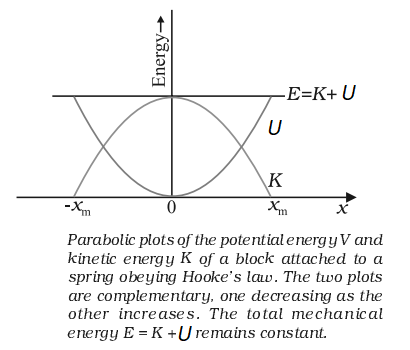
The speed and kinetic energy are maximum at the equilibrium position ( \(x=0\) ) due to the conservation of mechanical energy.
Energy Conservation: Total mechanical energy ( \(E\) ) is constant and is the sum of kinetic energy ( \(KE\) ) and potential energy ( \(U\) ):
\(
E=KE+U=\frac{1}{2} m v^2+\frac{1}{2} k x^2
\)
Maximum Kinetic Energy
The potential energy is maximum at maximum displacement (amplitude, \(x_m\) ), where velocity is zero, and zero at the equilibrium position \((x=0)\). At \(x=0\), all the total energy is kinetic energy (maximum \(KE\) ), and potential energy is zero.
\(
E=KE_{\max }+U_{\min }=KE_{\max }+0
\)
Maximum Potential Energy
At the maximum extension or compression ( \(x=x_m\) ), the kinetic energy is zero, and potential energy is maximum, which equals the total energy:
\(
E=KE_{\min }+U_{\max }=0+\frac{1}{2} k x_m^2
\)
Maximum Speed:
Equating Energies:
\(
\begin{aligned}
& KE_{\max }=\frac{1}{2} k x_m^2 \\
& \frac{1}{2} m v_m^2=\frac{1}{2} k x_m^2
\end{aligned}
\)
\(
\begin{aligned}
v_m^2 & =\frac{k}{m} x_m^2 \\
v_m & =\sqrt{\frac{k}{m}} x_m
\end{aligned}
\)
Total total mechanical energy
Energy Conservation: Total mechanical energy ( \(E\) ) is constant and is the sum of kinetic energy ( \(\boldsymbol{K}\) ) and potential energy ( \(U\) ):
\(
E=K+U=\frac{1}{2} m v^2+\frac{1}{2} k x^2
\)
This is graphically depicted in Figure below.
Example 4: To simulate car accidents, auto manufacturers study the collisions of moving cars with mounted springs of different spring constants. Consider a typical simulation with a car of mass 1000 kg moving with a speed \(18.0 \mathrm{~km} / \mathrm{h}\) on a smooth road and colliding with a horizontally mounted spring of spring constant \(6.25 \times 10^3 \mathrm{~N} \mathrm{~m}^{-1}\). What is the maximum compression of the spring?
Solution: At maximum compression the kinetic energy of the car is converted entirely into the potential energy of the spring.
The kinetic energy of the moving car is
\(
\begin{gathered}
K=\frac{1}{2} m v^2 \\
=\frac{1}{2} \times 10^3 \times 5 \times 5 \\
K=1.25 \times 10^4 \mathrm{~J}
\end{gathered}
\)
where we have converted \(18 \mathrm{~km} \mathrm{~h}^{-1}\) to \(5 \mathrm{~m} \mathrm{~s}^{-1}\) [It is useful to remember that \(36 \mathrm{~km} \mathrm{~h}^{-1}=10 \mathrm{~m} \mathrm{~s}^{-1}\) ]. At maximum compression \(x_m\), the potential energy \(U\) of the spring is equal to the kinetic energy \(K\) of the moving car from the principle of conservation of mechanical energy.
\(
U=\frac{1}{2} k x_m^2
\)
\(
\begin{aligned}
&=1.25 \times 10^4 \mathrm{~J}\\
&\text { We obtain }\\
&x_m=2.00 \mathrm{~m}
\end{aligned}
\)