Organisms and Populations NCERT
Quiz Summary
0 of 50 Questions completed
Questions:
Information
You have already completed the quiz before. Hence you can not start it again.
Quiz is loading…
You must sign in or sign up to start the quiz.
You must first complete the following:
Results
Results
0 of 50 Questions answered correctly
Your time:
Time has elapsed
You have reached 0 of 0 point(s), (0)
Earned Point(s): 0 of 0, (0)
0 Essay(s) Pending (Possible Point(s): 0)
Categories
- Not categorized 0%
- 1
- 2
- 3
- 4
- 5
- 6
- 7
- 8
- 9
- 10
- 11
- 12
- 13
- 14
- 15
- 16
- 17
- 18
- 19
- 20
- 21
- 22
- 23
- 24
- 25
- 26
- 27
- 28
- 29
- 30
- 31
- 32
- 33
- 34
- 35
- 36
- 37
- 38
- 39
- 40
- 41
- 42
- 43
- 44
- 45
- 46
- 47
- 48
- 49
- 50
- Current
- Review
- Answered
- Correct
- Incorrect
- Question 1 of 50
1. Question
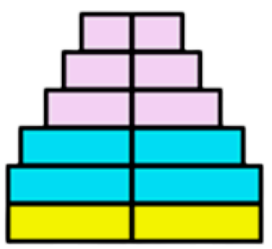
1 point(s)The given age pyramid represents a :
 CorrectIncorrect
 - Question 2 of 50
2. Question
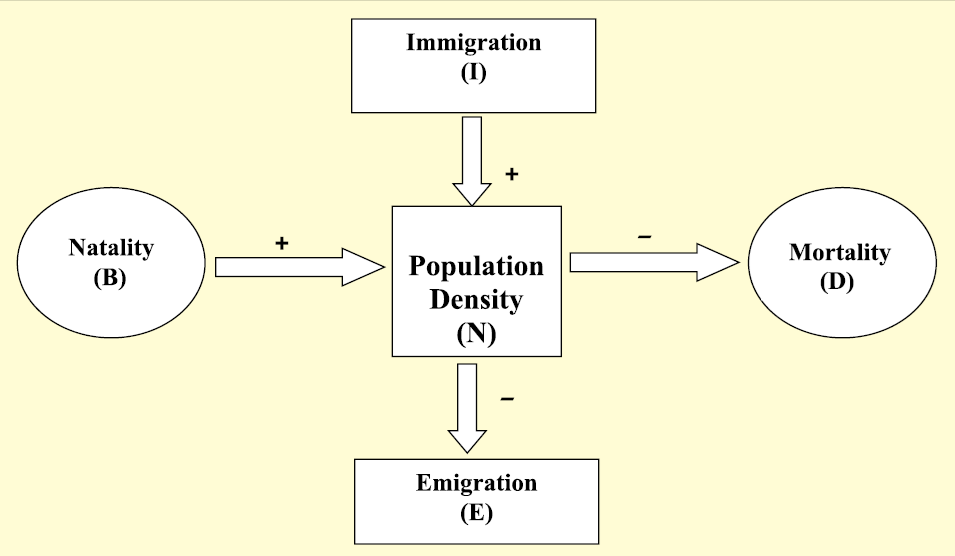
1 point(s)In the given figure, I, B, D and E stand for :-

\(
\begin{array}{|l|l|l|l|l|}
\hline & \text { I } & \text { B } & \text { D } & \text { E } \\
\hline \text { 1. } & \text { Emigration } & \text { Natality } & \text { Mortality } & \text { Immigration } \\
\hline \text { 2. } & \text { Emigration } & \text { Mortality } & \text { Natality } & \text { Immigration } \\
\hline \text { 3. } & \text { Immigration } & \text { Natality } & \text { Mortality } & \text { Emigration } \\
\hline \text { 4. } & \text { Immigration } & \text { Mortality } & \text { Natality } & \text { Emigration } \\
\hline
\end{array}
\)CorrectIncorrect - Question 3 of 50
3. Question
1 point(s)Identify the incorrectly matched pair :
\(
\begin{array}{|l|l|l|l|}
\hline & \text { Population interaction } & \text { Species A } & \text { Species B } \\
\hline \text { 1. } & \text { Mutualism } & + & + \\
\hline \text { 2. } & \text { Predation } & + & – \\
\hline \text { 3. } & \text { Parasitism } & – & – \\
\hline \text { 4. } & \text { Commensalism } & + & 0 \\
\hline
\end{array}
\)CorrectIncorrect - Question 4 of 50
4. Question
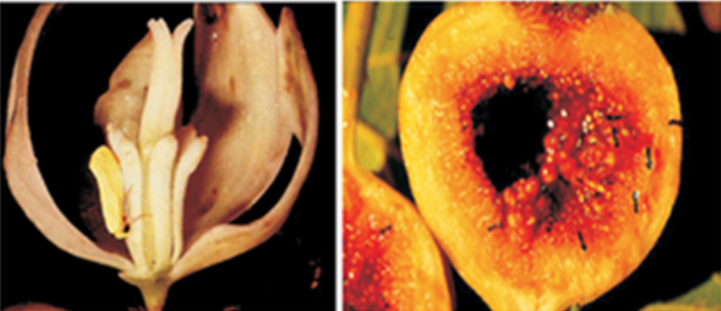
1 point(s)The picture shows mutual relationship between the fig tree and the wasp.

I: Many species of fig trees can only be pollinated by their ‘partner’ wasp species and no other species.
II: The female wasp does not derive any benefit from this relationship.CorrectIncorrect - Question 5 of 50
5. Question
1 point(s)Given below are two statements : one is labelled as Assertion (A) and the other is labelled as Reason (R).
\(
\begin{array}{|l|l|}
\hline \text { Assertion (A): } & \begin{array}{l}
\text { Population ecology links ecology to } \\
\text { population genetics and evolution. }
\end{array} \\
\hline \text { Reason (R): } & \begin{array}{l}
\text { It is at the population level that natural } \\
\text { selection operates to evolve the desired } \\
\text { traits. }
\end{array} \\
\hline
\end{array}
\)
In the light of the above statements, choose the most appropriate answer from the options given below :CorrectIncorrect - Question 6 of 50
6. Question
1 point(s)In a pond, there were 20 lotus plants last year. If through reproduction 4 new lotus plants are added, the number of offspring per lotus per year would be :
CorrectIncorrect - Question 7 of 50
7. Question
1 point(s)If ‘N‘ is the population density at time ‘t‘, then its density at time ‘t+1’ is:
\(
\begin{array}{|l|l|}
\hline \text { I. } & N_{t+1}=N_t+[(B+I)-(D+E)] \\
\hline \text { II. } & \begin{array}{l}
\text { B is a measure of Natality and D is a measure of } \\
\text { Mortality }
\end{array} \\
\hline \text { III. } & \begin{array}{l}
\text { If (B+I) is less than (D+E), the population density } \\
\text { will increase }
\end{array} \\
\hline
\end{array}
\)CorrectIncorrect - Question 8 of 50
8. Question
1 point(s)All the following are correct about the exponential growth of population except :
\(
\begin{array}{|l|l|l|}
\hline \text { 1. } & \text { It is represented by the equation } \mathrm{dt} / \mathrm{dN}=\mathrm{rN} \\
\hline \text { 2. } & \text { Resources in the habitat are unlimited } \\
\hline \text { 3. } & \text { The rate of natural increase is represented by ” } \mathrm{r} \text { ” } \\
\hline \text { 4. } & \text { In } 1981 \text {, the ‘ } \mathrm{r} \text { ‘ value for human population in India } \\
& \text { was } 0.0205 \\
\hline
\end{array}
\)CorrectIncorrect - Question 9 of 50
9. Question
1 point(s)In the logistic growth equation given below, the carrying capacity is represented by :
\(
\frac{\mathrm{dN}}{\mathrm{dt}}=\mathrm{rN}\left(\frac{\mathrm{~K}-\mathrm{N}}{\mathrm{~K}}\right)
\)CorrectIncorrect - Question 10 of 50
10. Question
1 point(s)In the formula for exponential growth \(
(\mathrm{dN} / \mathrm{dt}=\mathrm{rN}),
\) what does ‘ r ‘ stand for ?CorrectIncorrect - Question 11 of 50
11. Question
1 point(s)A population has more young individuals compared to older individuals. What would be the status of the population after some years ?
CorrectIncorrect - Question 12 of 50
12. Question
1 point(s)Which of the following is/are true for the given equation ?
\(
N_t=N_0 e^{r t}
\)
\(
\begin{array}{|l|l|}
\hline \text { I. } & \text { It is the integral form of exponential growth equation } \\
\hline \text { II. } & \text { The rate of natural increase is represented by “r” } \\
\hline \text { III. } & \text { “e” is the base of natural logarithm [2.71828] } \\
\hline
\end{array}
\)CorrectIncorrect - Question 13 of 50
13. Question
1 point(s)Darwinian fitness is represented by :
CorrectIncorrect - Question 14 of 50
14. Question
1 point(s)Which of the following organisms does not breed only once in their life time ?
CorrectIncorrect - Question 15 of 50
15. Question
1 point(s)Identify the correct statements :
\(
\begin{array}{|l|l|}
\hline \text { I. } & \begin{array}{l}
\text { Pacific salmon and bamboo breed many times during } \\
\text { their lifetimes. }
\end{array} \\
\hline \text { II. } & \begin{array}{l}
\text { Birds and mammals breed many times during their } \\
\text { lifetimes and produce a small number of large-sized } \\
\text { offspring. }
\end{array} \\
\hline \text { III. } & \begin{array}{l}
\text { Oysters and pelagic fishes produce a large number of } \\
\text { small-sized offspring. }
\end{array} \\
\hline
\end{array}
\)CorrectIncorrect - Question 16 of 50
16. Question
1 point(s)A population interaction that is detrimental to both species would be :
CorrectIncorrect - Question 17 of 50
17. Question
1 point(s)A population interaction where one species is harmed whereas the other is unaffected is called as :
CorrectIncorrect - Question 18 of 50
18. Question
1 point(s)In broad ecological context, all the following would be considered examples of predation except :
CorrectIncorrect - Question 19 of 50
19. Question
1 point(s)Predators do not :
CorrectIncorrect - Question 20 of 50
20. Question
1 point(s)When certain exotic species are introduced into a geographical area, they become invasive mainly because :
CorrectIncorrect - Question 21 of 50
21. Question
1 point(s)In a field experiment, when all Pisaster starfish were removed from an enclosed intertidal area, the result was :
CorrectIncorrect - Question 22 of 50
22. Question
1 point(s)The most common means of morphological defense in plants against herbivory are :
CorrectIncorrect - Question 23 of 50
23. Question
1 point(s)About what percent of all insects is phytophagus ?
CorrectIncorrect - Question 24 of 50
24. Question
1 point(s)Nicotine, caffeine, quinine and opium produced by plants are actually:
CorrectIncorrect - Question 25 of 50
25. Question
1 point(s)Consider the given statements regarding competition amongst organisms:
I. Only related species can compete for the same resource
II. Competition occurs only when the resources are limiting
The correct statement/s is/are:CorrectIncorrect - Question 26 of 50
26. Question
1 point(s)In some shallow American lakes, unrelated visiting Flamingoes and resident fishes compete for the common food which is :
CorrectIncorrect - Question 27 of 50
27. Question
1 point(s)A process in which the fitness of one species is significantly lower in the presence of another species, is termed as :
CorrectIncorrect - Question 28 of 50
28. Question
1 point(s)A female fig wasp enters the syconium of a fig, pollinates the flowers, and lays eggs in the ovaries of some of the flowers. The young larvae grow up, eat (and kill) some, but not all, of the seeds, and complete their life cycle. The fig is completely dependent on fig wasps to pollinate its flowers, and the fig wasp requires figs to complete its life cycle. The interaction between figs and fig wasps has aspects of :
CorrectIncorrectHint
- Question 29 of 50
29. Question
1 point(s)Abingdon tortoise in Galapagos islands became extinct within a decade after goats were introduced on the island due to:
CorrectIncorrect - Question 30 of 50
30. Question
1 point(s)The number of correct statements amongst the given is:
Statement I: Parasitism has evolved in many taxonomic groups from plants to higher vertebrates.
Statement II: Many parasites have evolved to be host-specific and both tend to co-evolve.
Statement III: All parasites have only one primary and one intermediate host.
Statement IV: Only a few of the parasites harm their hosts.CorrectIncorrect - Question 31 of 50
31. Question
1 point(s)Consider the two statements given below :
\(
\begin{array}{|l|l|}
\hline \text { Statement I: } & \begin{array}{l}
\text { The morphological and anatomical features } \\
\text { of endoparasites are greatly simplified but } \\
\text { their reproductive potential is very high. }
\end{array} \\
\hline \text { Statement II: } & \begin{array}{l}
\text { Unlike ectoparasites, endoparasites live } \\
\text { inside the host body at different sites and } \\
\text { their life cycles are more complex. }
\end{array} \\
\hline
\end{array}
\)CorrectIncorrect - Question 32 of 50
32. Question
1 point(s)A species whose distribution is restricted to a small geographical area because of the presence of a competitively superior species, is found to expand its distributional range dramatically when the competing species is experimentally removed. This is called:
CorrectIncorrect - Question 33 of 50
33. Question
1 point(s)“Competitive Exclusion Principle” may be true if :
CorrectIncorrect - Question 34 of 50
34. Question
1 point(s)One mechanism that promotes co-existence rather than exclusion amongst competing species is :
CorrectIncorrect - Question 35 of 50
35. Question
1 point(s)MacArthur showed that five closely related species of warblers living on the same tree were able to avoid competition and co-exist due to :
CorrectIncorrect - Question 36 of 50
36. Question
1 point(s)The human liver fluke depends on two intermediate hosts that are :
CorrectIncorrect - Question 37 of 50
37. Question
1 point(s)Cuckoos laying their eggs in the nests of crow is an example of :
CorrectIncorrect - Question 38 of 50
38. Question
1 point(s)An orchid growing as an epiphyte on a mango branch is an example of :
CorrectIncorrect - Question 39 of 50
39. Question
1 point(s)All the following relations are examples of commensalism except :
CorrectIncorrect - Question 40 of 50
40. Question
1 point(s)Lichens represent an intimate mutualistic relationship between a fungus and :
CorrectIncorrect - Question 41 of 50
41. Question
1 point(s)In mycorrhiza, the fungi help the plant in :
CorrectIncorrect - Question 42 of 50
42. Question
1 point(s)The fig tree is pollinated by a :
CorrectIncorrect - Question 43 of 50
43. Question
1 point(s)To get pollinated by a bee, the Mediterranean Orchid, Ophrys, employs :
CorrectIncorrect - Question 44 of 50
44. Question
1 point(s)Given below are two statements : one is labelled as Assertion (A) and the other is labelled as Reason (R).
\(
\begin{array}{|l|l|}
\hline \text { Assertion (A): } & \begin{array}{l}
\text { Plant-animal interactions often involve } \\
\text { co-evolution of the mutualists. }
\end{array} \\
\hline \text { Reason (R): } & \begin{array}{l}
\text { The mutually beneficial system should be } \\
\text { safeguarded against ‘cheaters’. }
\end{array} \\
\hline
\end{array}
\)
In the light of the above statements, choose the most appropriate answer from the options given below :CorrectIncorrect - Question 45 of 50
45. Question
1 point(s)Assertion (A): Population density may be measured in terms of biomass.
Reason (R): Biomass is the only accurate measure for all types of organisms.CorrectIncorrect - Question 46 of 50
46. Question
1 point(s)Cardiac glycosides in Calotropis :
CorrectIncorrect - Question 47 of 50
47. Question
1 point(s)Which one is NOT a predator in ecological sense ?
CorrectIncorrect - Question 48 of 50
48. Question
1 point(s)Which type of competition occurs when resources are abundant but one species reduces the feeding efficiency of another ?
CorrectIncorrect - Question 49 of 50
49. Question
1 point(s)What does competitive exclusion theory state ?
CorrectIncorrect - Question 50 of 50
50. Question
1 point(s)Which of the following was not usually observed by G.F. Gauss in his studies on interspecific competition ?
CorrectIncorrect