Human Health And Disease NCERT
Quiz Summary
0 of 50 Questions completed
Questions:
Information
You have already completed the quiz before. Hence you can not start it again.
Quiz is loading…
You must sign in or sign up to start the quiz.
You must first complete the following:
Results
Results
0 of 50 Questions answered correctly
Your time:
Time has elapsed
You have reached 0 of 0 point(s), (0)
Earned Point(s): 0 of 0, (0)
0 Essay(s) Pending (Possible Point(s): 0)
Categories
- Not categorized 0%
- 1
- 2
- 3
- 4
- 5
- 6
- 7
- 8
- 9
- 10
- 11
- 12
- 13
- 14
- 15
- 16
- 17
- 18
- 19
- 20
- 21
- 22
- 23
- 24
- 25
- 26
- 27
- 28
- 29
- 30
- 31
- 32
- 33
- 34
- 35
- 36
- 37
- 38
- 39
- 40
- 41
- 42
- 43
- 44
- 45
- 46
- 47
- 48
- 49
- 50
- Current
- Review
- Answered
- Correct
- Incorrect
- Question 1 of 50
1. Question
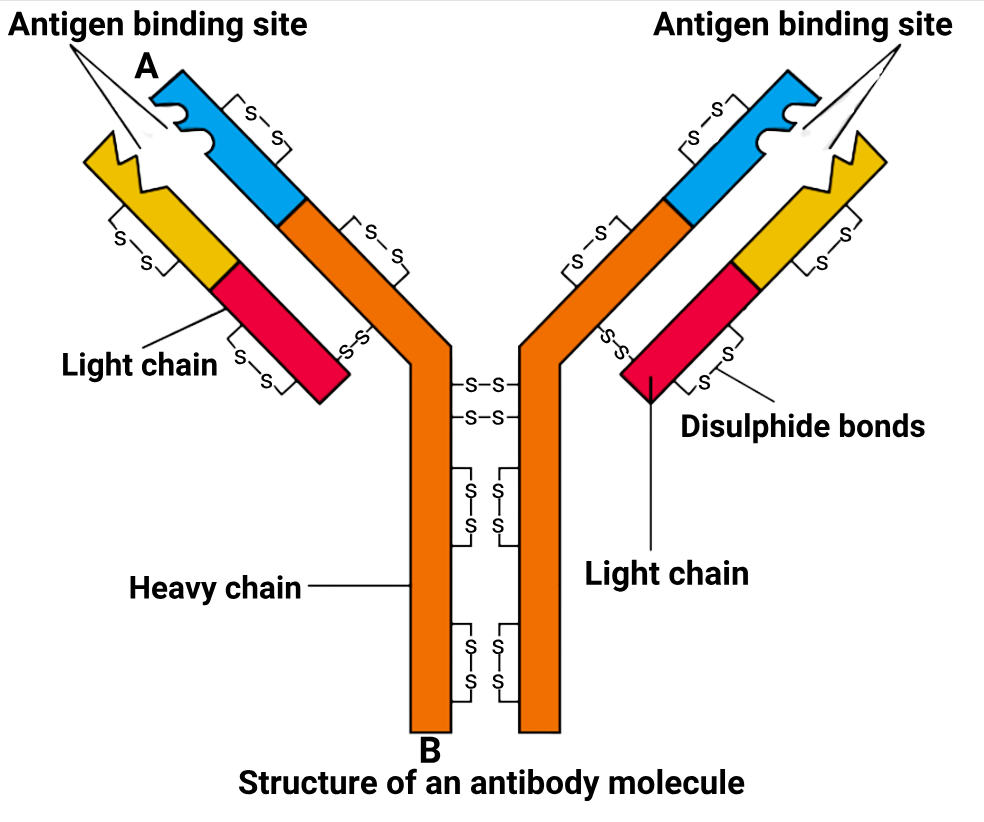
1 point(s)In the given diagram, A and B respectively represent :
 CorrectIncorrect
 - Question 2 of 50
2. Question
1 point(s)The term ‘Health‘ is defined in many ways. The most accurate definition of health would be:
CorrectIncorrect - Question 3 of 50
3. Question
1 point(s)It is important to differentiate between drug addiction and dependence. In drug dependence :
CorrectIncorrect - Question 4 of 50
4. Question
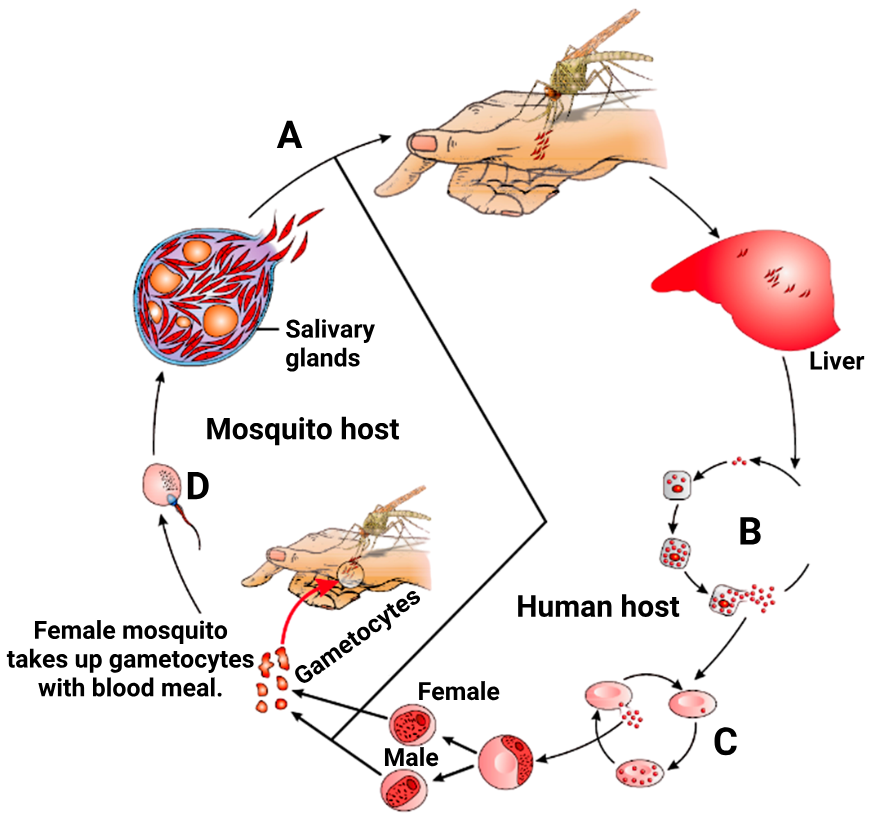
1 point(s)Consider the given stages in the life cycle of Plasmodium and choose the correctly matched pair :
 CorrectIncorrect
 - Question 5 of 50
5. Question
1 point(s)Diseases are broadly grouped into infectious and non-infectious diseases. In the list given below, identify the infectious diseases.
\(
\begin{array}{|l|l|l|l|}
\hline \text { i. } & \text { Cancer } & \text { ii. } & \text { Influenza } \\
\hline \text { iii. } & \text { Allergy } & \text { iv. } & \text { Smallpox } \\
\hline
\end{array}
\)CorrectIncorrect - Question 6 of 50
6. Question
1 point(s)Identify the correct statement regarding typhoid fever in human beings:
CorrectIncorrect - Question 7 of 50
7. Question
1 point(s)Many diseases can be diagnosed by observing the symptoms in the patient. Which group of symptoms are indicative of pneumonia ?
CorrectIncorrect - Question 8 of 50
8. Question
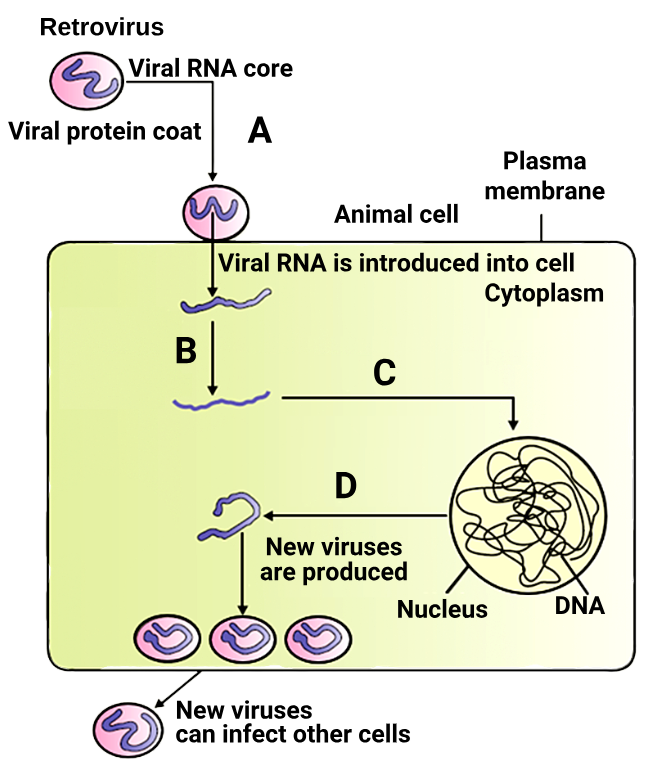
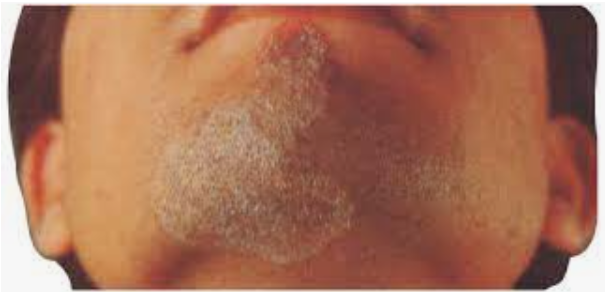
1 point(s)Study the diagram given and choose the correct statement :
 CorrectIncorrect
 - Question 9 of 50
9. Question
1 point(s)Consider the given two statements:
\(
\begin{array}{|l|l|}
\hline \text { I: } & \begin{array}{l}
\text { Rhinovirus, the most common virus causing common } \\
\text { cold has a tendency to affect the upper respiratory } \\
\text { tract. }
\end{array} \\
\hline \text { II: } & \begin{array}{l}
\text { The mucosa associated lymphoid tissue is not present } \\
\text { in the upper respiratory tract. }
\end{array} \\
\hline
\end{array}
\)CorrectIncorrect - Question 10 of 50
10. Question
1 point(s)In the human body, the malaria parasite first multiplies in :
CorrectIncorrect - Question 11 of 50
11. Question
1 point(s)The occurrence of chills and fever in malaria is associated with :
CorrectIncorrect - Question 12 of 50
12. Question
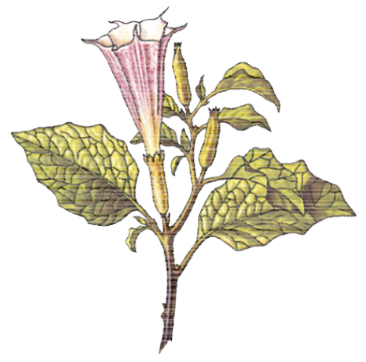
1 point(s)Which is the particular type of drug that is obtained from the plants whose one flowering branch is shown below ?
 CorrectIncorrect
 - Question 13 of 50
13. Question
1 point(s)Which of the following diseases is/are correctly matched with their modes of transmission?
\(
\begin{array}{|l|l|l|}
\hline & \text { Disease/Infection } & \text { Mode of transmission } \\
\hline \text { I. } & \text { Ascariasis } & \text { Contaminated food and water } \\
\hline \text { II. } & \text { Elephantiasis } & \text { Vector-borne } \\
\hline \text { III. } & \text { Ringworm } & \text { Direct contact } \\
\hline
\end{array}
\)
Options:-
\(
\begin{array}{|l|l|l|l|}
\hline \text { 1. } & \text { Only I and II } & \text { 2. } & \text { Only I and III } \\
\hline \text { 3. } & \text { Only II and III } & \text { 4. } & \text { I, II and III } \\
\hline
\end{array}
\)CorrectIncorrect - Question 14 of 50
14. Question
1 point(s)The micro-environment for the development and maturation of T lymphocytes is provided by:
I. Bone marrow
II. Thymus
III. SpleenCorrectIncorrect - Question 15 of 50
15. Question
1 point(s)Secondary lymphoid organs :
CorrectIncorrect - Question 16 of 50
16. Question
1 point(s)Refer to the given figure and choose the organism not related to the condition shown here :
 CorrectIncorrect
 - Question 17 of 50
17. Question
1 point(s)The sporozoites that cause infection when a female Anopheles mosquito bites a person, are found in:
CorrectIncorrect - Question 18 of 50
18. Question
1 point(s)Haemozoin is a :
CorrectIncorrect - Question 19 of 50
19. Question
1 point(s)All the following diseases or mankind are vector-borne except :
CorrectIncorrect - Question 20 of 50
20. Question
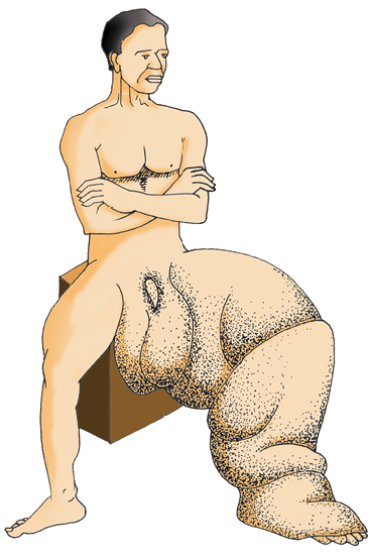
1 point(s)The diagram shows inflammation in one of the lower limbs due to an infection by a certain pathogen. Identify the correct statement :

Statement I: This is caused by the Annelid Wuchereria bancrofti.
Statement II: The condition is due to the blockage of deep veins by the adult worm.CorrectIncorrect - Question 21 of 50
21. Question
1 point(s)Ringworm is not caused by :
CorrectIncorrect - Question 22 of 50
22. Question
1 point(s)The disease chikungunya is transmitted by :
CorrectIncorrect - Question 23 of 50
23. Question
1 point(s)Given below are two statements : one is labelled as Assertion (A) and the other is labelled as Reason (R).
\(
\begin{array}{|l|l|}
\hline \text { Assertion (A): } & \begin{array}{l}
\text { In vaccination, a preparation of antigenic } \\
\text { proteins of pathogen or } \\
\text { inactivated/weakened pathogen (vaccine) } \\
\text { are introduced into the body. }
\end{array} \\
\hline \text { Reason (R): } & \begin{array}{l}
\text { The vaccines also generate memory – B } \\
\text { and T-cells that recognise the pathogen } \\
\text { quickly on subsequent exposure and } \\
\text { overwhelm the invaders with a massive } \\
\text { production of antibodies. }
\end{array} \\
\hline
\end{array}
\)
In the light of the above statements, choose the most appropriate answer from the options given below :CorrectIncorrect - Question 24 of 50
24. Question
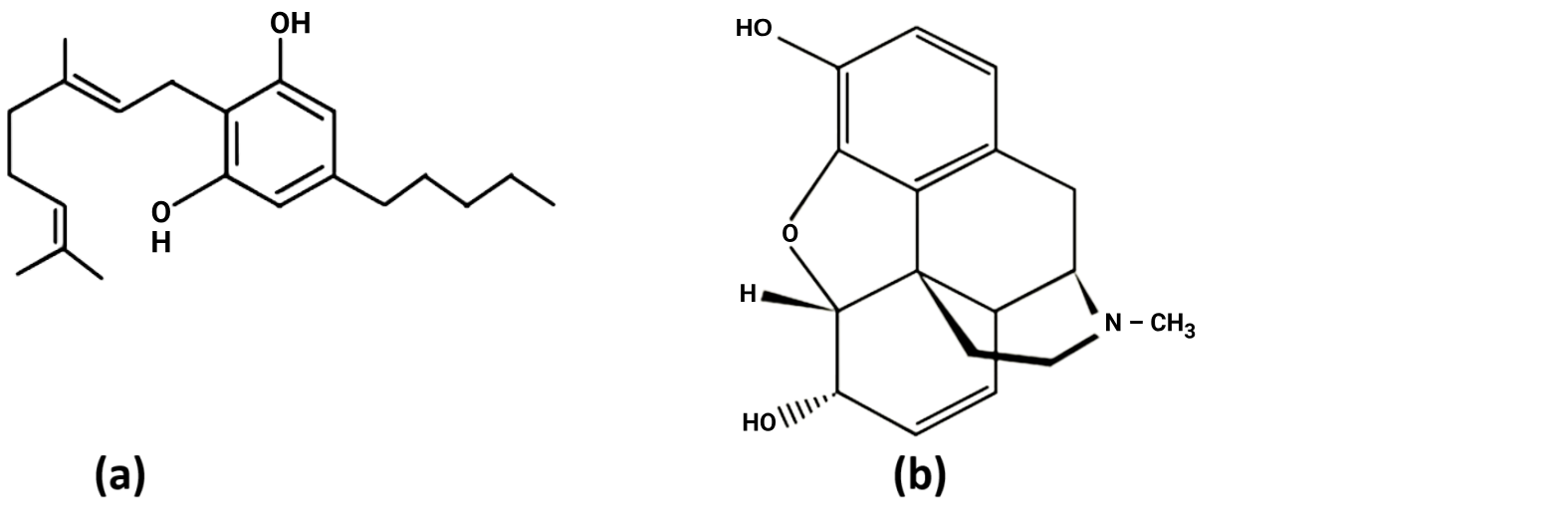
1 point(s)Identify the molecules (a) and (b) shown below and select the right option giving their source :

\(
\begin{array}{|l|l|l|l|}
\hline
& \text{Molecule} & \text{Source} & \text{Use} \\
\hline
1. & \text{Etropine} & \text{Atropa belladona} & \text{Accelerates the transport of dopamine} \\
\hline
2. & \text{Diacetylmorphine} & \text{Cannabis sativa} & \text{Depressant and slows down body functions} \\
\hline
3. & \text{Cannabinoid} & \text{Erythroxylum coca} & \text{Produces hallucinations} \\
\hline
4. & \text{Morphine} & \text{Papaver somniferum} & \text{Sedative and painkiller} \\
\hline
\end{array}
\)CorrectIncorrect - Question 25 of 50
25. Question
1 point(s)Which of the following is also sometimes called as mosquito fish ?
CorrectIncorrect - Question 26 of 50
26. Question
1 point(s)What is incorrect regarding innate immunity ?
CorrectIncorrect - Question 27 of 50
27. Question
1 point(s)Match each item in Column I [Barriers in innate immunity] with one in Column II [Example] and select your answer from the codes given:
\(
\begin{array}{|l|l|l|l|}
\hline & \text { COLUMN I } & & \text { COLUMN II } \\
\hline \text { A. } & \text { Physical } & \text { a. } & \text { Skin and mucus membranes } \\
\hline \text { B. } & \text { Physiological } & \text { b. } & \text { PMNL } \\
\hline \text { C. } & \text { Cellular } & \text { c. } & \text { Acid in stomach and saliva in mouth } \\
\hline \text { D. } & \text { Cytokine } & \text { d. } & \text { Interferon } \\
\hline
\end{array}
\)
Codes:
\(
\begin{array}{|l|l|l|l|l|}
\hline \text { Options: } & \text { A } & \text { B } & \text { C } & \text { D } \\
\hline 1 . & \text { a } & \text { b } & \text { c } & \text { d } \\
\hline 2 . & \text { d } & \text { b } & \text { c } & \text { a } \\
\hline 3 . & \text { a } & \text { c } & \text { b } & \text { d } \\
\hline 4 . & \text { d } & \text { c } & \text { b } & \text { a } \\
\hline
\end{array}
\)CorrectIncorrect - Question 28 of 50
28. Question
1 point(s)Which of the following cells can phagocytose microbes only in tissues ?
CorrectIncorrect - Question 29 of 50
29. Question
1 point(s)Anamnestic response in acquired immunity is due to the fact that it is
CorrectIncorrect - Question 30 of 50
30. Question
1 point(s)Consider the given two statements:
I: The acquired immune response is called “adaptive”.
II: In acquired immunity, pathogen-specific receptors are “acquired” during the lifetime of the organism.CorrectIncorrect - Question 31 of 50
31. Question
1 point(s)What word correctly denotes an enhanced reaction of the body’s immune system to an antigen which is related to one previously encountered ?
CorrectIncorrect - Question 32 of 50
32. Question
1 point(s)B cells:-
CorrectIncorrect - Question 33 of 50
33. Question
1 point(s)In an antibody molecule, an antigen binding site is located :
CorrectIncorrect - Question 34 of 50
34. Question
1 point(s)Non-specific response to microbes that enter the human body involves the response of all the following except :
CorrectIncorrect - Question 35 of 50
35. Question
1 point(s)Identify the incorrect statement regarding the cell mediated immune response :
CorrectIncorrect - Question 36 of 50
36. Question
1 point(s)Transplantation of tissues/organs to save certain patients often fails due to the rejection of such tissues/organs by the patient. Which type of immune response is responsible for such rejections?
CorrectIncorrect - Question 37 of 50
37. Question
1 point(s)Active immunity develops when :
CorrectIncorrect - Question 38 of 50
38. Question
1 point(s)The anti-viral proteins secreted by virus-infected cells to protect uninfected cells from further viral infection are called:
CorrectIncorrect - Question 39 of 50
39. Question
1 point(s)A fetus receiving some antibodies from mother through placenta is an example of :
CorrectIncorrect - Question 40 of 50
40. Question
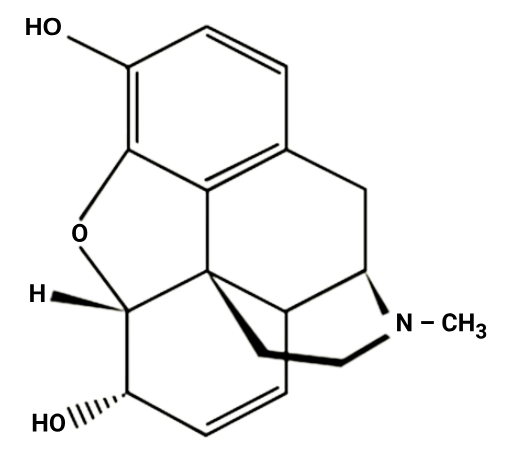
1 point(s)The given figure shows the chemical structure of a commonly abused drug. This drug :
 CorrectIncorrect
 - Question 41 of 50
41. Question
1 point(s)Antibodies present in colostrum protects the newborn from certain diseases which are of :
CorrectIncorrect - Question 42 of 50
42. Question
1 point(s)Given below are two statements : one is labelled as Assertion (A) and the other is labelled as Reason (R).
\(
\begin{array}{|l|l|}
\hline \text { Assertion (A): } & \begin{array}{l}
\text { If a person is infected with some deadly } \\
\text { microbes to which a quick immune } \\
\text { response is required as in tetanus, we } \\
\text { need to directly inject the preformed } \\
\text { antibodies or antitoxin. }
\end{array} \\
\hline \text { Reason (R): } & \begin{array}{l}
\text { This type of immunization is called } \\
\text { passive immunization. }
\end{array} \\
\hline
\end{array}
\)
In the light of the above statements, choose the most appropriate answer from the options given below:CorrectIncorrect - Question 43 of 50
43. Question
1 point(s)How many of the given statements regarding HIV/AIDS are true ?
\(
\begin{array}{|l|l|}
\hline \text { I. } & \text { AIDS is a congenital disease } \\
\hline \text { II. } & \text { Syndrome means a group of symptoms } \\
\hline \text { III. } & \text { HIV is a rotavirus } \\
\hline \text { IV. } & \text { HIV does not have an envelope } \\
\hline \text { V. } & \begin{array}{l}
\text { HIV can be transmitted by an infected mother to her } \\
\text { child through placenta }
\end{array} \\
\hline
\end{array}
\)CorrectIncorrect - Question 44 of 50
44. Question
1 point(s)Given below are two statements : one is labelled as Assertion (A) and the other is labelled as Reason (R).
\(
\begin{array}{|l|l|}
\hline \text { Assertion (A): } & \begin{array}{l}
\text { HIV/Aids infected persons should not be } \\
\text { isolated from family and society. }
\end{array} \\
\hline \text { Reason (R): } & \begin{array}{l}
\text { There is a time-lag of a few months to } \\
\text { many years [usually 5-10 years] between } \\
\text { infection and the appearance of AIDS } \\
\text { symptoms. }
\end{array} \\
\hline
\end{array}
\)
In the light of the above statements, choose the most appropriate answer from the options given below :CorrectIncorrect - Question 45 of 50
45. Question
1 point(s)What is not correct regarding the pathogenesis of AIDS in humans ?
\(
\begin{array}{|c|l|}
\hline \text { I. } & \text { HIV first enters into the macrophages. } \\
\hline \text { II. } & \begin{array}{l}
\text { Macrophages are used by HIV as a factory to } \\
\text { produce more virus particles. }
\end{array} \\
\hline \text { III. } & \begin{array}{l}
\text { The viral cDNA does not get integrated into any } \\
\text { cells in the human body. }
\end{array} \\
\hline \text { IV. } & \text { HIV also enters the Thelper cells and destroys them. } \\
\hline \text { V. } & \begin{array}{l}
\text { The anti-retroviral treatment for AIDS is completely } \\
\text { curative. }
\end{array} \\
\hline
\end{array}
\)CorrectIncorrect - Question 46 of 50
46. Question
1 point(s)Identify the incorrect statement regarding HIV :
CorrectIncorrect - Question 47 of 50
47. Question
1 point(s)Identify the incorrect statement :
CorrectIncorrect - Question 48 of 50
48. Question
1 point(s)Given below are two statements : one is labelled as Assertion (A) and the other is labelled as Reason (R).\(\begin{array}{|l|l|}\hline \text { Assertion (A): } & \begin{array}{l}\text { Biological response modifiers like alpha } \\\text { interferon can help detection and } \\\text { destruction of tumour cells by the } \\\text { immune system. }\end{array} \\\hline \text { Reason (R): } & \begin{array}{l}\text { Such biological response modifiers } \\\text { activate the immune system of the } \\\text { patient. }\end{array} \\\hline\end{array}\)In the light of the above statements, choose the most appropriate answer from the options given below :CorrectIncorrect - Question 49 of 50
49. Question
1 point(s)Match the drugs in Column I with their correct attributes given in Column II and select the correct answer from the codes given:
\(
\begin{array}{|l|l|l|l|}
\hline & \text { Drug } & & \text { Attribute } \\
\hline \text { A } & \text { Opioids } & \text { P } & \text { Hallucinogenic at high doses } \\
\hline \text { B } & \text { Cannabinoids } & \text { Q } & \text { Highly effective painkiller } \\
\hline \text { C } & \text { Cocaine } & \text { R } & \text { Can cause cardiovascular side effects } \\
\hline \text { D } & \text { Nicotine } & \text { S } & \text { Stimulates adrenal medulla } \\
\hline
\end{array}
\)
Codes:
\(
\begin{array}{|l|l|l|l|l|}
\hline & \text { A } & \text { B } & \text { C } & \text { D } \\
\hline 1 . & \text { Q } & \text { R } & \text { S } & \text { P } \\
\hline 2 . & \text { R } & \text { Q } & \text { P } & \text { S } \\
\hline 3 . & \text { Q } & \text { R } & \text { P } & \text { S } \\
\hline 4 . & \text { R } & \text { Q } & \text { S } & \text { P } \\
\hline
\end{array}
\)CorrectIncorrect - Question 50 of 50
50. Question
1 point(s)Given below are two statements : one is labelled as Assertion (A) and the other is labelled as Reason (R).
\(
\begin{array}{|l|l|}
\hline \text { Assertion (A): } & \begin{array}{l}
\text { Effects like euphoria and a temporary } \\
\text { feeling of well-being are frequent causes } \\
\text { of drug addiction. }
\end{array} \\
\hline \text { Reason (R): } & \begin{array}{l}
\text { Because of the perceived benefits, drugs } \\
\text { are frequently used repeatedly. }
\end{array} \\
\hline
\end{array}
\)
In the light of the above statements, choose the most appropriate answer from the options given below :CorrectIncorrect