Principles of Inheritance and Variation NCERT
Quiz Summary
0 of 50 Questions completed
Questions:
Information
You have already completed the quiz before. Hence you can not start it again.
Quiz is loading…
You must sign in or sign up to start the quiz.
You must first complete the following:
Results
Results
0 of 50 Questions answered correctly
Your time:
Time has elapsed
You have reached 0 of 0 point(s), (0)
Earned Point(s): 0 of 0, (0)
0 Essay(s) Pending (Possible Point(s): 0)
Categories
- Not categorized 0%
- 1
- 2
- 3
- 4
- 5
- 6
- 7
- 8
- 9
- 10
- 11
- 12
- 13
- 14
- 15
- 16
- 17
- 18
- 19
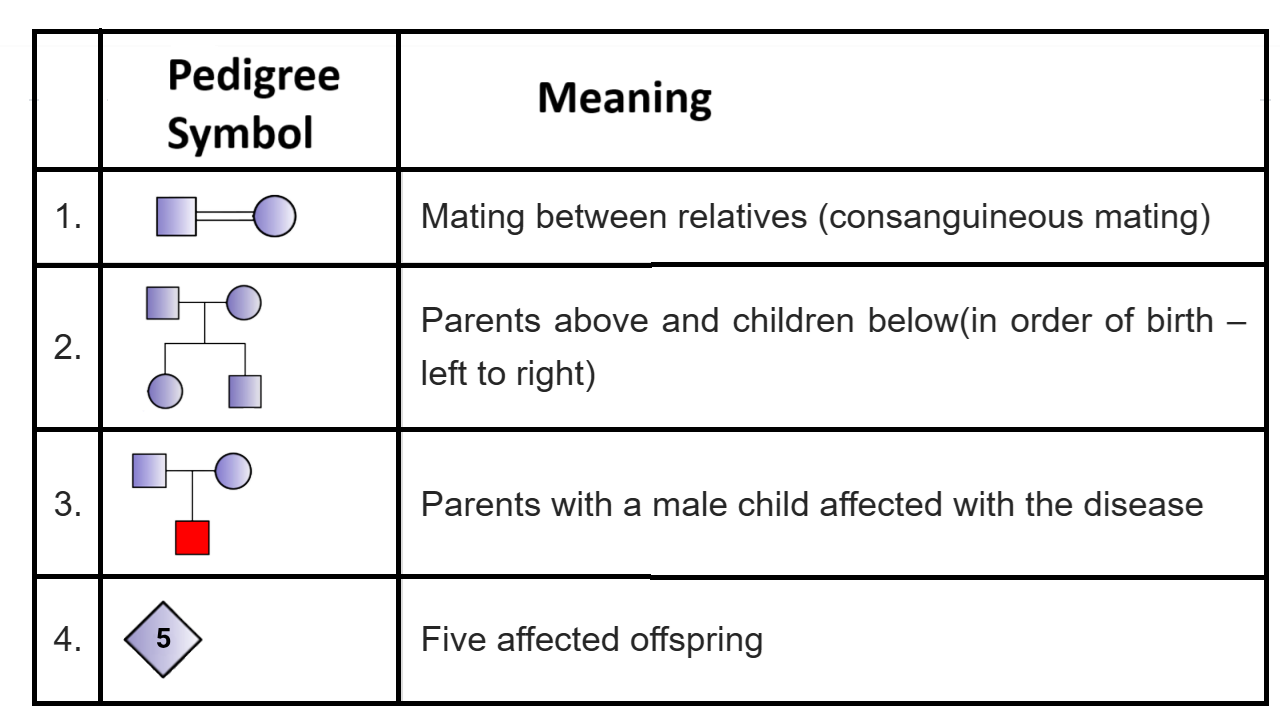
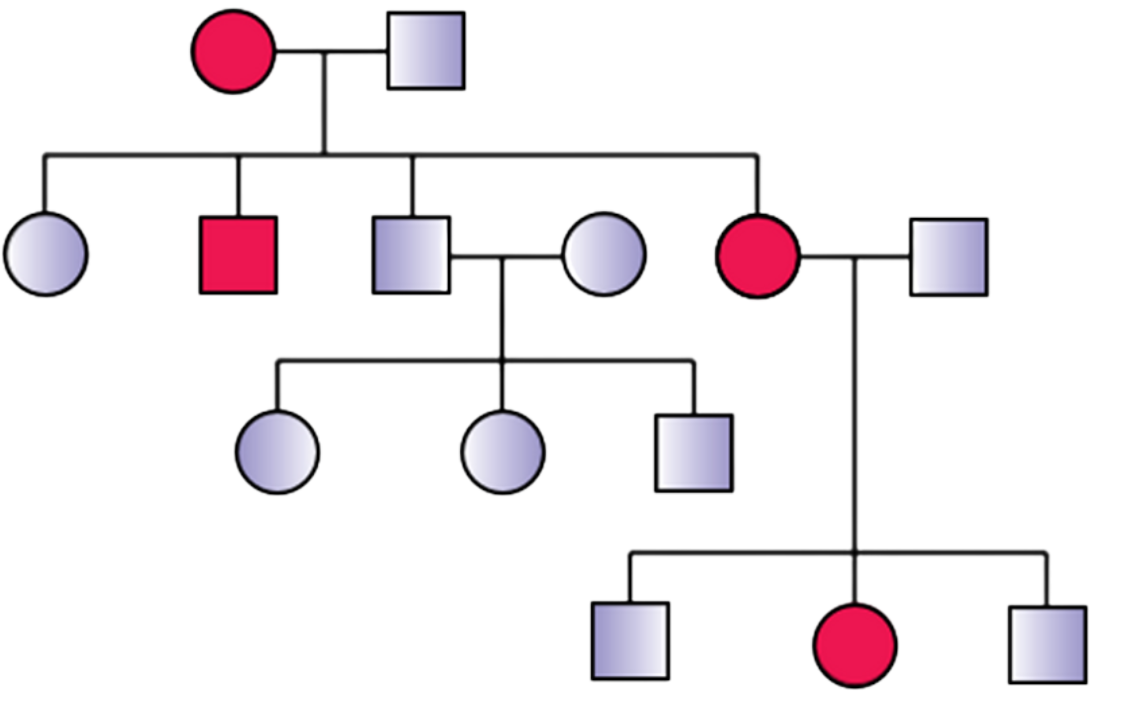
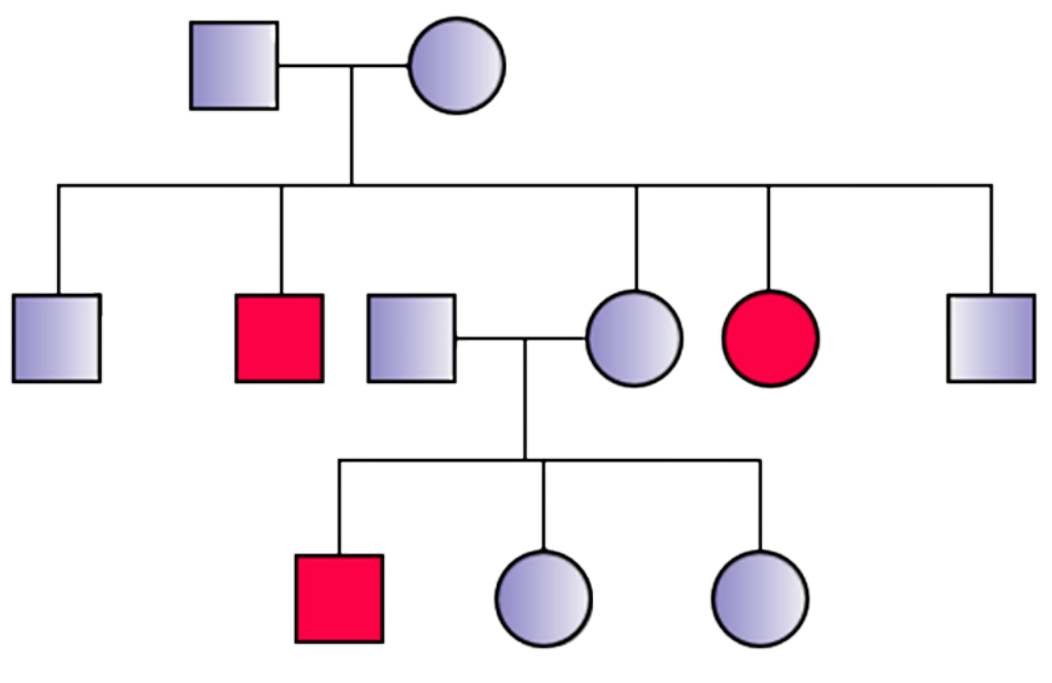
- 20
- 21
- 22
- 23
- 24
- 25
- 26
- 27
- 28
- 29
- 30
- 31
- 32
- 33
- 34
- 35
- 36
- 37
- 38
- 39
- 40
- 41
- 42
- 43
- 44
- 45
- 46
- 47
- 48
- 49
- 50
- Current
- Review
- Answered
- Correct
- Incorrect
- Question 1 of 50
1. Question
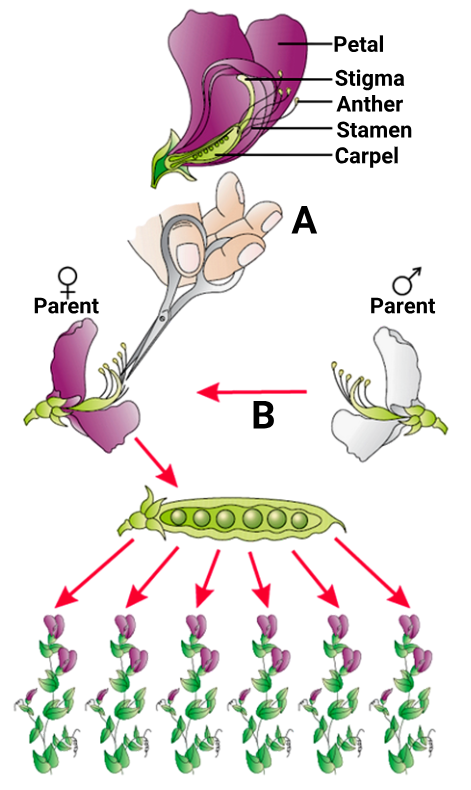
1 point(s)The given diagram shows the steps in making a cross in Pea.

Statement I: A is Emasculation where the anthers are removed only after maturity.
Statement II: B is Pollination and it should be followed by bagging the flowers in the female parent.CorrectIncorrect - Question 2 of 50
2. Question
1 point(s)A mother who is blood type AB has a child who is AB also. A potential father is blood type O. A well-informed
geneticist concludes that ______.CorrectIncorrect - Question 3 of 50
3. Question
1 point(s)Identify the incorrect statement regarding experiments on Pisum – sativum by Gregor Mendel.
CorrectIncorrect - Question 4 of 50
4. Question
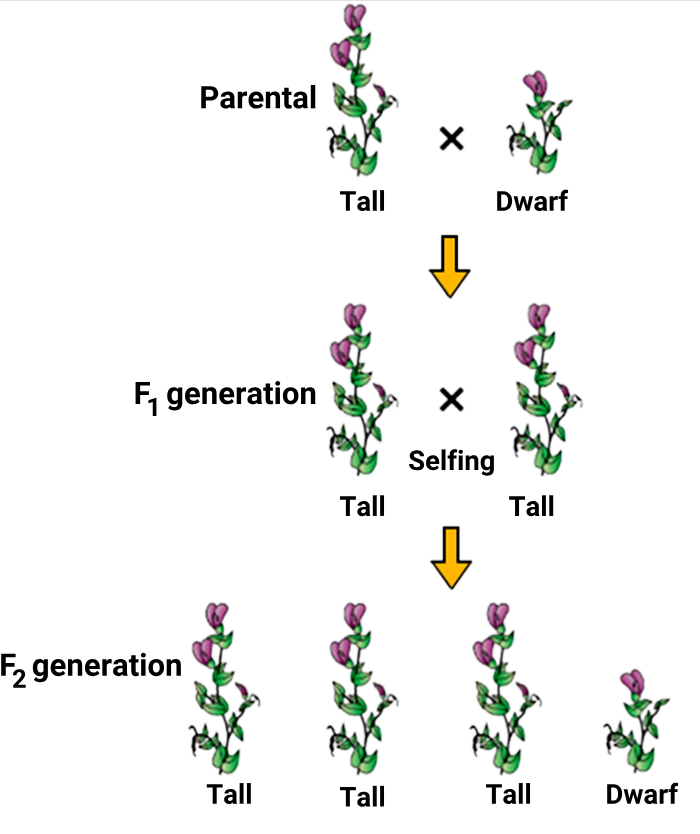
1 point(s)The figure shows a diagrammatic representation of a monohybrid cross.

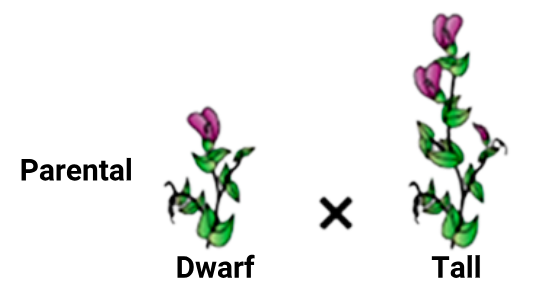
If the conditions of the parental were to be different as given below, what would be the expected result of the cross?
 CorrectIncorrect
 - Question 5 of 50
5. Question
1 point(s)In Mendel’s experiments, the contrasting traits did not show any blending in:
\(
\begin{array}{|l|l|}
\hline 1 . & F_1 \text { stage } \\
\hline 2 . & F_2 \text { stage } \\
\hline 3 . & \text { Both } F_1 \text { and } F_2 \text { stages } \\
\hline 4 . & \begin{array}{l}
\text { The statement is false as blending was seen at all } \\
\text { stages }
\end{array} \\
\hline
\end{array}
\)CorrectIncorrect - Question 6 of 50
6. Question
1 point(s)Identify the incorrect statement :
CorrectIncorrect - Question 7 of 50
7. Question
1 point(s)A test cross is done to find out:
CorrectIncorrect - Question 8 of 50
8. Question
1 point(s)In a test cross, the plant expressing the dominant phenotype is crossed with the plant:
CorrectIncorrect - Question 9 of 50
9. Question
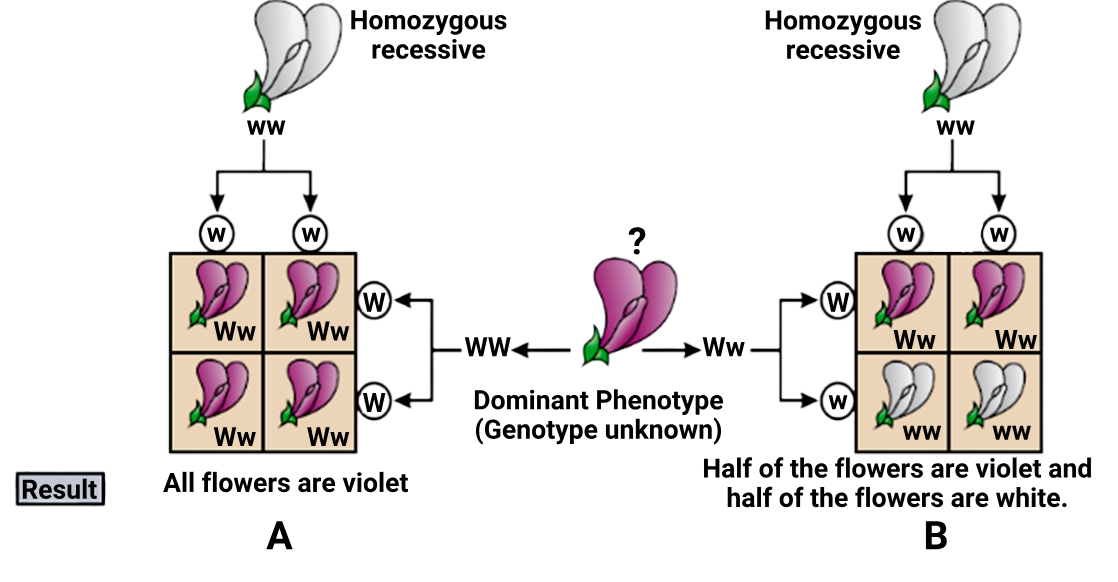
1 point(s)The figure shows the diagrammatic representation of a test cross. Based on the results shown, what would be true ?

\(
\begin{array}{|l|l|}
\hline \text { Statement I: } & \text { In situation A, the plant with the dominant phenotype [genotype unknown] must be homozygous dominant. } \\
\hline \text { Statement II: } & \text { In situation B, the plant with the dominant phenotype [genotype unknown] must be heterozygous. } \\
\hline
\end{array}
\)CorrectIncorrect - Question 10 of 50
10. Question
1 point(s)What is the ratio of a typical monohybrid test cross ?
\(
\begin{array}{|l|l|l|l|}
\hline 1 . & 2: 1 & 2 . & 3: 1 \\
\hline 3 . & 1: 2: 1 & 4 . & 1: 1 \\
\hline
\end{array}
\)CorrectIncorrect - Question 11 of 50
11. Question
1 point(s)Which of the following is not true for the Law of Dominance given by Mendel ?
CorrectIncorrect - Question 12 of 50
12. Question
1 point(s)The expression of only one of the parental characters in a monohybrid cross in the \( F_1 \), the expression of both in the \( F_2 \) and the proportion of \( 3: 1 \) obtained at the \( F_2 \) can be explained by:
CorrectIncorrect - Question 13 of 50
13. Question
1 point(s)The law of segregation is based on the fact that :
CorrectIncorrect - Question 14 of 50
14. Question
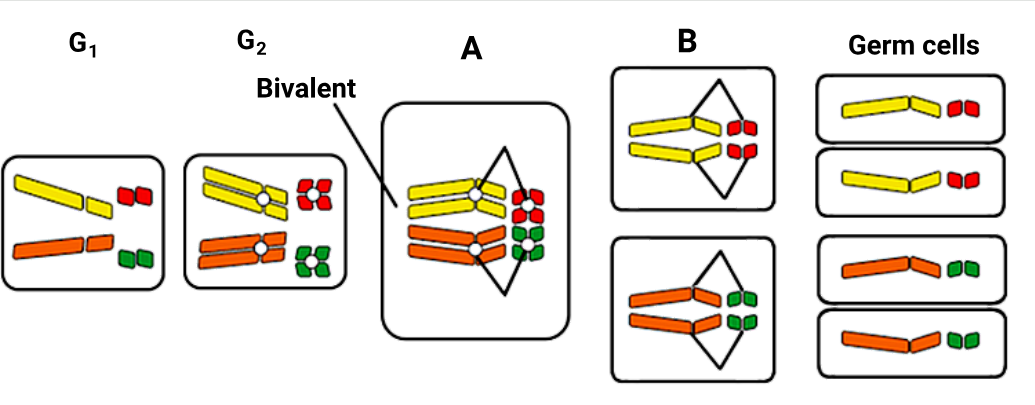
1 point(s)The given figure shows meiosis and germ cell formation in a cell with four chromosomes and segregation when germ cells are formed. A and B would, respectively, be :
 CorrectIncorrect
 - Question 15 of 50
15. Question
1 point(s)A heterozygous plant produces :
CorrectIncorrect - Question 16 of 50
16. Question
1 point(s)The inheritance of flower colour in dog flower and 4’O clock plant exhibits:
CorrectIncorrect - Question 17 of 50
17. Question
1 point(s)In the case of starch synthesis in pea seeds [controlled by the B gene], BB homozygotes produce large and round starch grains; bb homozygotes produce smaller and wrinkled starch grains and heterozygotes produce round seeds of intermediate size. What can be inferred from this observation ?
CorrectIncorrect - Question 18 of 50
18. Question
1 point(s)Given below are two statements : one is labelled as Assertion (A) and the other is labelled as Reason (R).
Assertion (A):
Dominance is not an autonomous feature of a gene or the product that it has information for.
Reason (R):
The frequency of a gene or an allele in a population is ultimately decided by
factors such as natural selection.
In the light of the above statements, choose the most appropriate answer from the options given below :CorrectIncorrect - Question 19 of 50
19. Question
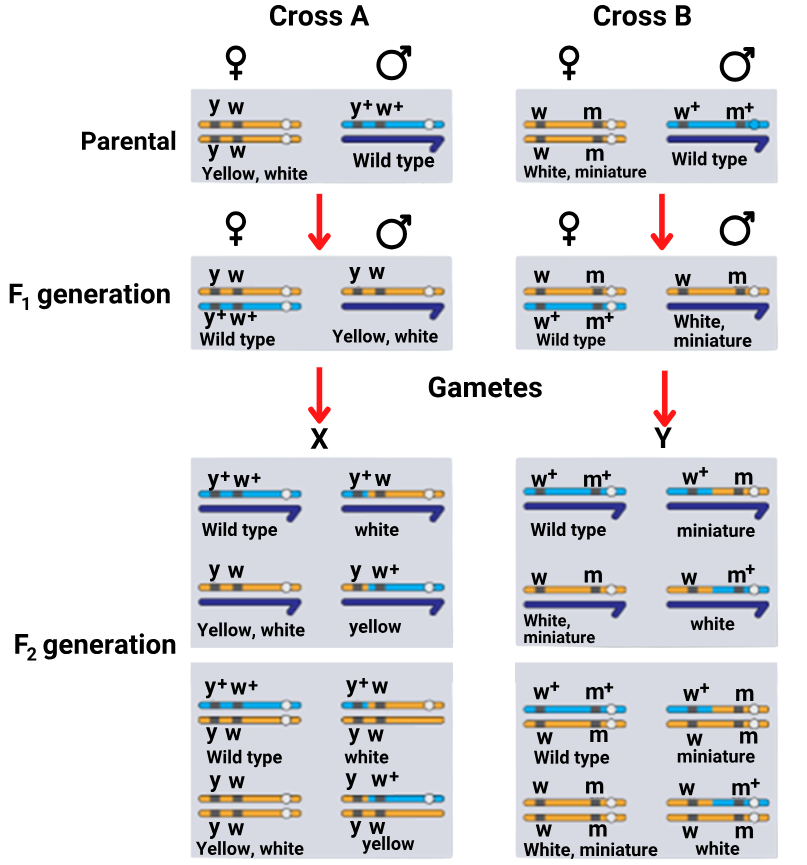
1 point(s)The figure shows the results of two dihybrid crosses conducted by Morgan where X and Y, respectively, are the percentages of parental and recombinants forms in Cross A and Cross B. Identify the correct statements :

Statement I: X will be parental types \( (98.7 \%) \) and recombinant types \( (1.3 \%) \); Y will be parental types \( (62.8 \%) \) and recombinant types (37.2%)
Statement II: The strength of linkage is inversely proportional to the distance between the genes located on the same chromosome.CorrectIncorrect - Question 20 of 50
20. Question
1 point(s)When Mendel self-hybridized \( F_1 \) progeny of a dihybrid cross between pure Yellow Round seeded plants and Green Wrinkled plants, he observed that yellow and green colour segregated in a ratio of:
\(
\begin{array}{|l|l|l|l|}
\hline 1 . & 1: 1 & 2 . & 3: 1 \\
\hline 3 . & 9: 3: 3: 1 & 4 . & 1: 2: 1 \\
\hline
\end{array}
\)CorrectIncorrect - Question 21 of 50
21. Question
1 point(s)What is \( \mathrm{F}_2 \) phenotypic ratio in a dihybrid cross ?
\(
\begin{array}{|l|l|l|l|}
\hline 1 . & 1: 1 & 2 . & 3: 1 \\
\hline 3 . & 9: 3: 3: 1 & 4 . & 1: 1: 1: 1 \\
\hline
\end{array}
\)CorrectIncorrect - Question 22 of 50
22. Question
1 point(s)When two pairs of traits are combined in a hybrid, segregation of one pair of characters is independent of the other pair of characters’. This is the statement of:
CorrectIncorrect - Question 23 of 50
23. Question
1 point(s)Mendel’s work remained unrecognised till 1900. Which of the following was not a reason for this ?
CorrectIncorrect - Question 24 of 50
24. Question
1 point(s)In 1900, Mendel’s work was rediscovered by :
CorrectIncorrect - Question 25 of 50
25. Question
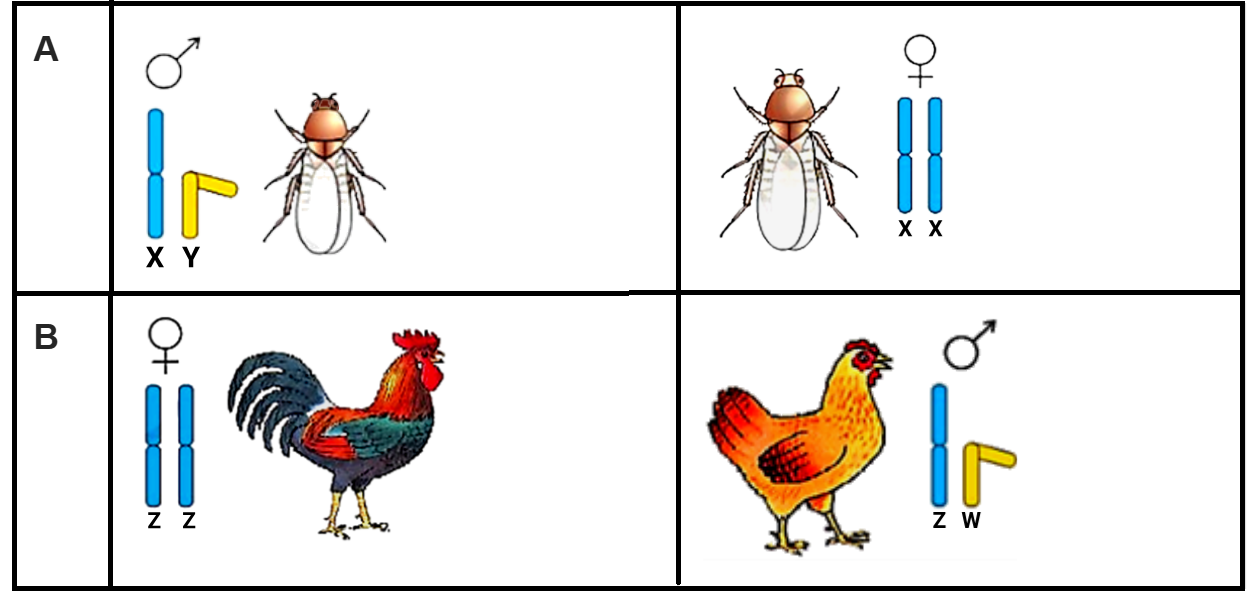
1 point(s)The following figure shows the determination of sex by chromosomal differences. Which of the following is/are correctly matched ?
 CorrectIncorrect
 - Question 26 of 50
26. Question
1 point(s)“Chromosomes, which are seen in all dividing cells and pass from one generation to the next, are the basis for all genetic inheritance”.
This statement is credited to:CorrectIncorrect - Question 27 of 50
27. Question
1 point(s)The two alleles of a gene pair are located on :
CorrectIncorrect - Question 28 of 50
28. Question
1 point(s)T. H. Morgan worked on the fruit fly, Drosophila melanogaster. Which of the following is not an advantage of this fly ?
CorrectIncorrect - Question 29 of 50
29. Question
1 point(s)Morgan coined the term ______ to describe this physical association of genes on a chromosome and the term _______ to describe the generation of nonparental gene combinations.
CorrectIncorrect - Question 30 of 50
30. Question
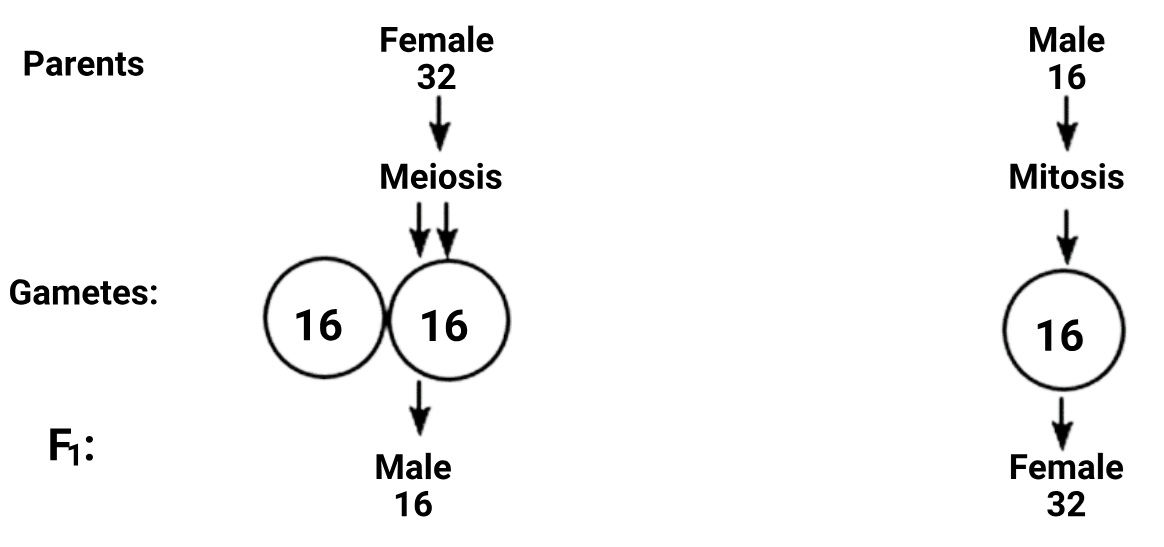
1 point(s)The figure shows the mechanism of sex determination in a honey bee. How many of the given statements will be true for the mechanism of sex determination in honey bees ?

I. The sex determination in honey bee is based on the number of sets of chromosomes an individual receives.
II. An offspring formed from the union of a sperm and an egg develops as a female (queen or worker), and an unfertilised egg develops as a male (drone) by means of parthenogenesis.
III. The males have double the number of chromosomes than that of a female, therefore, the females are haploid having 16 chromosomes and the males are diploid, i.e., having 32 chromosomes.
IV. This is called a haplodiploid sex-determination system.
V. The males produce sperms by mitosis, they do not have a father and thus cannot have sons, but have a grandfather and can have grandsons.CorrectIncorrect - Question 31 of 50
31. Question
1 point(s)Genes tightly linked on the same chromosome show:
CorrectIncorrect - Question 32 of 50
32. Question
1 point(s)Morgan, in his experiment on fruit flies, found that the genes white and yellow were very tightly linked and showed :
CorrectIncorrect - Question 33 of 50
33. Question
1 point(s)A dihybrid test cross results in a recombination frequency of \( 50 \% \). Most likely the two genes under consideration:
CorrectIncorrect - Question 34 of 50
34. Question
1 point(s)A trait displays continuous phenotypic variation and is spread across a gradient. Usually, the inheritance of this trait can be described as :
CorrectIncorrect - Question 35 of 50
35. Question
1 point(s)Identify Incorrectly Matched Pair:-
 CorrectIncorrect
 - Question 36 of 50
36. Question
1 point(s)Human skin colour is a polygenic trait controlled by :
CorrectIncorrect - Question 37 of 50
37. Question
1 point(s)Identify the number of correct statements:
I. Polygenic inheritance takes into account the influence of the environment
II. In a polygenic trait the phenotype reflects the contribution of each allele, i.e., the effect of each allele is additive.
III. The normal distribution curve is bell-shaped in polygenic inheritance.
IV. It is also known as quantitative inheritance.CorrectIncorrect - Question 38 of 50
38. Question
1 point(s)The mode of inheritance of the Mendelian disorder shown in the given pedigree chart is most likely:
 CorrectIncorrect
 - Question 39 of 50
39. Question
1 point(s)\(
\begin{array}{|c|l|l|}
\hline
\textbf{Column A} & \textbf{Column B} \\
\hline
\text{I. Chromosomal aberration} & \text{A. An additional sex chromosome} \\
\text{II. Down’s syndrome} & \text{B. Inversion} \\
\text{III. Klinefelter’s syndrome} & \text{C. Presence of an extra chromosome} \\
\text{IV. Turner’s syndrome} & \text{D. Absence of sex chromosome} \\
\hline
\end{array}
\)
The correct match is :-CorrectIncorrect - Question 40 of 50
40. Question
1 point(s)Occasionally, a single gene may express more than one effect. The phenomenon is called :
CorrectIncorrect - Question 41 of 50
41. Question
1 point(s)The mode of inheritance of the Mendelian disorder shown in the given pedigree chart is most likely :
 CorrectIncorrect
 - Question 42 of 50
42. Question
1 point(s)The physiological basis of pleiotropy is :
CorrectIncorrect - Question 43 of 50
43. Question
1 point(s)Consider the given statements :
I: Where a single gene can exhibit multiple phenotypic expressions, such a gene is called a pleiotropic gene.
II: The underlying mechanism of pleiotropy in most cases is the effect of a gene on metabolic pathways which contribute towards different phenotypes.
Phenylketonuria is caused by a defect in the gene that codes for the enzyme phenylalanine
III: hydroxylase and manifests itself through phenotypic expression characterised by mental retardation and a reduction in hair and skin pigmentation.CorrectIncorrect - Question 44 of 50
44. Question
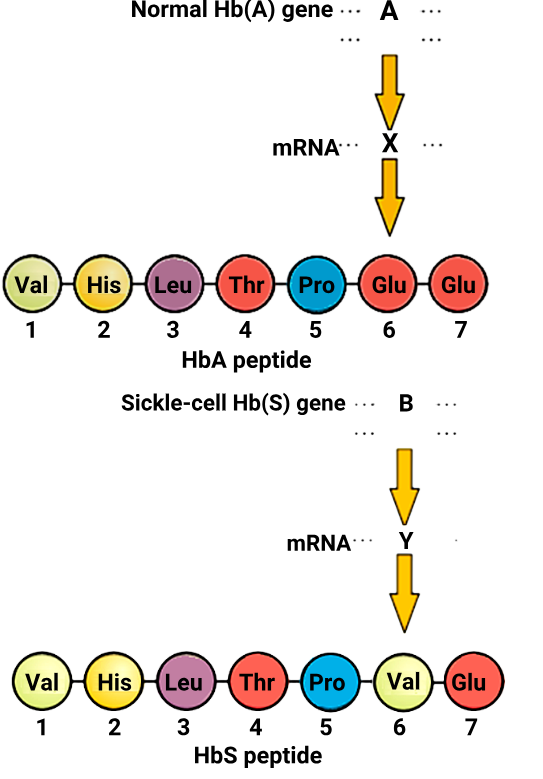
1 point(s)The figure shows the point mutation responsible for the pathogenesis of sickle cell anaemia. Identify the correct statements.

Statement I: The peptide chain of the haemoglobin molecule that gets mutated leading to the disease is the alpha chain.
Statement II: The mRNA codon X can be GAG and the mRNA codon Y can be GUG.CorrectIncorrect - Question 45 of 50
45. Question
1 point(s)A couple has a daughter. What is the probability that their next child will be a daughter ?
\(
\begin{array}{|l|l|l|l|}
\hline 1 . & 0 \% & 2 . & 25 \% \\
\hline 3 . & 50 \% & 4 . & 100 \% \\
\hline
\end{array}
\)CorrectIncorrect - Question 46 of 50
46. Question
1 point(s)It is unfortunate that in our society women are blamed for producing female children and have been ostracised and ill-treated because :
CorrectIncorrect - Question 47 of 50
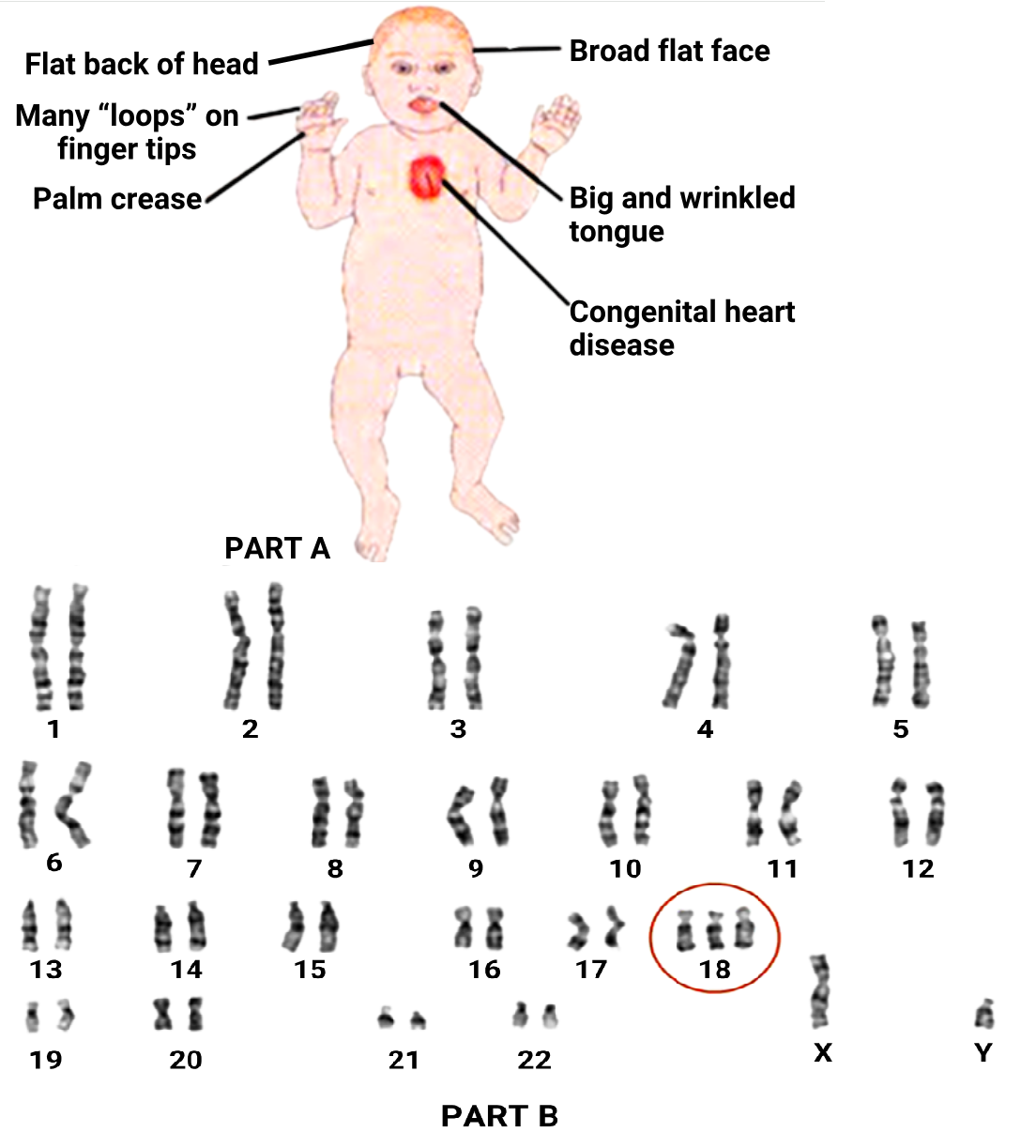
47. Question
1 point(s)Study the given figures and select the correct statements:-

\(
\begin{array}{|l|l|}
\hline \text { Statement I: } & \text { Part A shows the common clinical features of Down’s syndrome. } \\
\hline \text { Statement II: } & \text { Part B shows the characteristic karyotype of Down’s Syndrome. } \\
\hline
\end{array}
\)CorrectIncorrect - Question 48 of 50
48. Question
1 point(s)In birds, the mechanism of sex determination is :
CorrectIncorrect - Question 49 of 50
49. Question
1 point(s)Consider the following Statements :-
\(
\begin{array}{|l|l|}
\hline \text { I. } & \begin{array}{l}
\text { People affected by phenylketonuria are unable to } \\
\text { convert tyrosine to phenylalanine. }
\end{array} \\
\hline \text { II. } & \begin{array}{l}
\text { Alzheimer’s disease results from the accumulation of } \\
\text { amyloid protein plaques in the brain. }
\end{array} \\
\hline \text { III. } & \begin{array}{l}
\text { Klinefelter’s and Turner’s syndromes are the result of } \\
\text { nondisjunction of the sex chromosomes in either of } \\
\text { the sexes. }
\end{array} \\
\hline
\end{array}
\)
Which of the above statements are true ?CorrectIncorrect - Question 50 of 50
50. Question
1 point(s)During his observation of spermatogenesis in a few insects, Henking found that a nuclear structure was received by \( 50 \% \) of the sperms. He called this structure as:
CorrectIncorrect