Microbes in Human Welfare NCERT
Quiz Summary
0 of 45 Questions completed
Questions:
Information
You have already completed the quiz before. Hence you can not start it again.
Quiz is loading…
You must sign in or sign up to start the quiz.
You must first complete the following:
Results
Results
0 of 45 Questions answered correctly
Your time:
Time has elapsed
You have reached 0 of 0 point(s), (0)
Earned Point(s): 0 of 0, (0)
0 Essay(s) Pending (Possible Point(s): 0)
Categories
- Not categorized 0%
- 1
- 2
- 3
- 4
- 5
- 6
- 7
- 8
- 9
- 10
- 11
- 12
- 13
- 14
- 15
- 16
- 17
- 18
- 19
- 20
- 21
- 22
- 23
- 24
- 25
- 26
- 27
- 28
- 29
- 30
- 31
- 32
- 33
- 34
- 35
- 36
- 37
- 38
- 39
- 40
- 41
- 42
- 43
- 44
- 45
- Current
- Review
- Answered
- Correct
- Incorrect
- Question 1 of 45
1. Question
1 point(s)The virus shown here is a causative agent of :
 CorrectIncorrect
 - Question 2 of 45
2. Question
1 point(s)Lactic Acid Bacillus, while used for converting milk to curd, increases the nutritional value of curd by adding vitamin :
CorrectIncorrect - Question 3 of 45
3. Question
1 point(s)Consider the given two statements:
\(
\begin{array}{|l|l|}
\hline \text { Statement I: } & \begin{array}{l}
\text { During growth, the LAB produces acids } \\
\text { that coagulate and partially digest the milk } \\
\text { proteins. }
\end{array} \\
\hline \text { Statement II: } & \begin{array}{l}
\text { The dough, which is used for making foods } \\
\text { such as dosa and idli is fermented by fungi. }
\end{array} \\
\hline
\end{array}
\)CorrectIncorrect - Question 4 of 45
4. Question
1 point(s)The ‘Roquefort cheese’ is ripened by :
CorrectIncorrect - Question 5 of 45
5. Question
1 point(s)With reference to human beings, antibiotics are actually :
CorrectIncorrect - Question 6 of 45
6. Question
1 point(s)‘Toddy‘, a traditional drink of some parts in southern India, is made by fermenting sap from :
CorrectIncorrect - Question 7 of 45
7. Question
1 point(s)Large holes in Swiss cheese are the result of fermentation by :
CorrectIncorrect - Question 8 of 45
8. Question
1 point(s)Which of the following alcoholic drinks are produced without distillation ?
CorrectIncorrect - Question 9 of 45
9. Question
1 point(s)The rising of dough is due to :
CorrectIncorrect - Question 10 of 45
10. Question
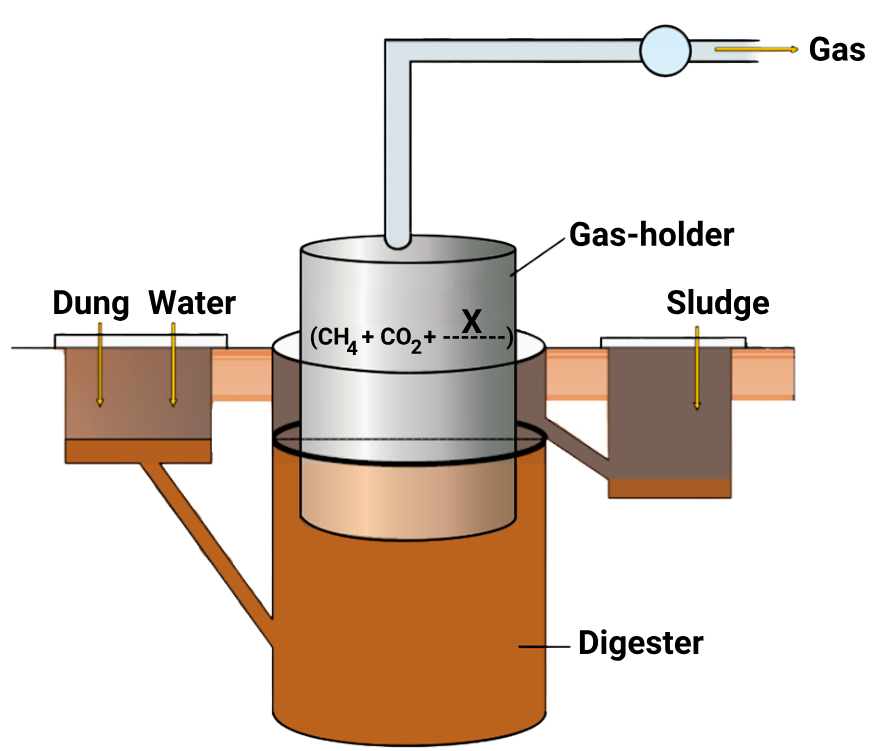
1 point(s)In the given diagram, the gas X can be :
 CorrectIncorrect
 - Question 11 of 45
11. Question
1 point(s)Consider the given statements regarding antibiotics:
\(
\begin{array}{|l|l|}
\hline \text { I: } & \begin{array}{l}
\text { An antibiotic is a type of antimicrobial substance } \\
\text { active against bacteria. }
\end{array} \\
\hline \text { II: } & \begin{array}{l}
\text { Antibiotics may either kill or inhibit the growth of } \\
\text { bacteria. }
\end{array} \\
\hline \text { III: } & \begin{array}{l}
\text { Antibiotics are highly effective against viruses such } \\
\text { as the common cold or influenza. }
\end{array} \\
\hline
\end{array}
\)CorrectIncorrect - Question 12 of 45
12. Question
1 point(s)“I did not invent penicillin. Nature did that. I only discovered it by accident.” Alexander Fleming describes the discovery as an ‘accident’ because he was actually trying to :
CorrectIncorrect - Question 13 of 45
13. Question
1 point(s)Aspergillus niger is used in the commercial production of :
CorrectIncorrect - Question 14 of 45
14. Question
1 point(s)Identify the incorrectly matched pair :
\(
\begin{array}{|l|l|l|}
\hline & \text { Organic acid } & \text { Microbial source } \\
\hline \text { 1. } & \text { Aspergillus niger } & \text { Citric acid } \\
\hline \text { 2. } & \text { Acetobacter aceti } & \text { Acetic acid } \\
\hline \text { 3. } & \text { Clostridium butylicum } & \text { Chorismic acid } \\
\hline \text { 4. } & \text { Lactobacillus } & \text { Lactic acid } \\
\hline
\end{array}
\)CorrectIncorrect - Question 15 of 45
15. Question
1 point(s)Fruit juices can be clarified with the use of :
CorrectIncorrect - Question 16 of 45
16. Question
1 point(s)A therapeutic product that is used to prevent the risk of coronary artery disease by its effect on one of the risk factors is obtained from the microbe :
CorrectIncorrect - Question 17 of 45
17. Question
1 point(s)Cyclosporin A is used as a/an :
CorrectIncorrect - Question 18 of 45
18. Question
1 point(s)Consider the given two statements:
\(
\begin{array}{|l|l|}
\hline \text { I. } & \begin{array}{l}
\text { Cyclosporin is used to treat and prevent graft-versus- } \\
\text { host disease in bone marrow transplantation and to } \\
\text { prevent rejection of kidney, heart, and liver } \\
\text { transplants. }
\end{array} \\
\hline \text { II. } & \begin{array}{l}
\text { It selectively inhibits the functions of B lymphocytes } \\
\text { acting as an immunosuppressant. }
\end{array} \\
\hline
\end{array}
\)CorrectIncorrect - Question 19 of 45
19. Question
1 point(s)Match each item in column I with one in Column II and select the correct answer from the codes given:
\(
\begin{array}{|l|l|l|l|}
\hline & \text { COLUMN I } & & \text { COLUMN II } \\
\hline \text { A } & \text { Monascus purpureus } & \text { P } & \text { Thrombolytic } \\
\hline \text { B } & \text { Trichoderma polysporum } & \text { Q } & \text { Immunosuppressant } \\
\hline \text { C } & \text { Streptococcus pyogenes } & \text { R } & \text { Antibiotics } \\
\hline \text { D } & \text { Streptomyces griseus } & \text { S } & \text { Statins } \\
\hline
\end{array}
\)
Codes :
\(
\begin{array}{|l|l|l|l|l|}
\hline & \text { A } & \text { B } & \text { C } & \text { D } \\
\hline 1 & \text { S } & \text { Q } & \text { R } & \text { P } \\
\hline 2 & \text { Q } & \text { S } & \text { P } & \text { R } \\
\hline 3 & \text { Q } & \text { S } & \text { R } & \text { P } \\
\hline 4 & \text { S } & \text { Q } & \text { P } & \text { R } \\
\hline
\end{array}
\)CorrectIncorrect - Question 20 of 45
20. Question
1 point(s)Given below are two statements : one is labelled as Assertion (A) and the other is labelled as Reason (R).
\(
\begin{array}{|l|l|}
\hline \text { Assertion (A): } & \begin{array}{l}
\text { Cyclosporin A is indicated to treat and } \\
\text { prevent graft-versus-host disease in bone } \\
\text { marrow transplantation and to prevent } \\
\text { rejection of kidney, heart, and liver } \\
\text { transplants. }
\end{array} \\
\hline \text { Reason (R): } & \begin{array}{l}
\text { Cyclosporin A lowers the activity of T- } \\
\text { cells. }
\end{array} \\
\hline
\end{array}
\)
In the light of the above statements, choose the most appropriate answer from the options given below :CorrectIncorrect - Question 21 of 45
21. Question
1 point(s)Given below are two statements : one is labelled as Assertion (A) and the other is labelled as Reason (R).\(
\begin{array}{|l|l|}
\hline \text { Assertion (A): } & \begin{array}{l}
\text { Statins produced by the yeast Monascus } \\
\text { purpureus have been commercialised as } \\
\text { blood-cholesterol lowering agents. }
\end{array} \\
\hline \text { Reason (R): } & \begin{array}{l}
\text { Statins act by decreasing the absorption } \\
\text { of end products of fat digestion in the } \\
\text { small intestine. }
\end{array} \\
\hline
\end{array}
\)
In the light of the above statements, choose the most appropriate answer from the options given below :CorrectIncorrect - Question 22 of 45
22. Question
1 point(s)Identify the incorrect statement regarding the primary treatment of sewage water in a sewage treatment plant :
CorrectIncorrect - Question 23 of 45
23. Question
1 point(s)Which one of the following impurities is easiest to remove from wastewater ?
CorrectIncorrect - Question 24 of 45
24. Question
1 point(s)The primary objective of the secondary treatment of wage water is :
CorrectIncorrect - Question 25 of 45
25. Question
1 point(s)In the secondary treatment or biological treatment of sewage water, the primary effluent is passed into large aeration tanks where it is constantly agitated mechanically and the air is pumped into it. This allows:
CorrectIncorrect - Question 26 of 45
26. Question
1 point(s)Consider the given two statements:
\(
\begin{array}{|l|l|}
\hline \text { I: } & \begin{array}{l}
\text { BOD is an indirect measure of the organic matter } \\
\text { present in the water. }
\end{array} \\
\hline \text { II: } & \begin{array}{l}
\text { The BOD test measures the rate of uptake of oxygen } \\
\text { by microorganisms in a sample of water. }
\end{array} \\
\hline
\end{array}
\)CorrectIncorrect - Question 27 of 45
27. Question
1 point(s)During the secondary or biological treatment of sewage water:
\(
\begin{array}{|l|l|}
\hline \text { I. } & \begin{array}{l}
\text { The BOD of the wastewater gets reduced } \\
\text { significantly. }
\end{array} \\
\hline \text { II. } & \begin{array}{l}
\text { The activated sludge contains aerobic micro- } \\
\text { organisms that can clump together. }
\end{array} \\
\hline \text { III. } & \begin{array}{l}
\text { The entire activated sludge is pumped into anaerobic } \\
\text { sludge digesters. }
\end{array} \\
\hline
\end{array}
\)CorrectIncorrect - Question 28 of 45
28. Question
1 point(s)What would happen if oxygen availability to activated sludge flocs is reduced ?
CorrectIncorrect - Question 29 of 45
29. Question
1 point(s)Given below are two statements : one is labelled as Assertion (A) and the other is labelled as Reason (R).
\(
\begin{array}{|l|l|}
\hline \text { Assertion (A): } & \begin{array}{l}
\text { Untreated sewage is often discharged } \\
\text { into rivers. }
\end{array} \\
\hline \text { Reason (R): } & \begin{array}{l}
\text { The sewage contains biodegradable } \\
\text { organic matter and does not require any } \\
\text { treatment before its release in natural } \\
\text { water bodies. }
\end{array} \\
\hline
\end{array}
\)
In the light of the above statements, choose the most appropriate answer from the options given below :CorrectIncorrect - Question 30 of 45
30. Question
1 point(s)Biogas is a mixture of :
CorrectIncorrect - Question 31 of 45
31. Question
1 point(s)Methanogenic bacteria are not found in :
CorrectIncorrect - Question 32 of 45
32. Question
1 point(s)The technology of biogas production from cow dung was developed in India largely due to the efforts of :
CorrectIncorrect - Question 33 of 45
33. Question
1 point(s)The major problem with the use of chemicals to control plant diseases and pests is :
CorrectIncorrect - Question 34 of 45
34. Question
1 point(s)Consider the following two statements:
\(
\begin{array}{|l|l|}
\hline \text { Statement I: } & \begin{array}{l}
\text { organic farming is a holistic approach that } \\
\text { seeks to develop an understanding of the } \\
\text { webs of interaction between the myriad of } \\
\text { organisms that constitute the field fauna } \\
\text { and flora. }
\end{array} \\
\hline \text { Statement II: } & \begin{array}{l}
\text { An important part of the biological farming } \\
\text { approach is to become familiar with the } \\
\text { various life forms that inhabit the field, } \\
\text { predators as well as pests. }
\end{array} \\
\hline
\end{array}
\)CorrectIncorrect - Question 35 of 45
35. Question
1 point(s)Match each item in column I with one in Column II and select the correct answer from the codes given:
\(
\begin{array}{|l|l|l|l|}
\hline & \text { COLUMN I } & & \text { COLUMN II } \\
\hline \text { A. } & \text { Ladybird } & \text { P. } & \text { Mosquitoes } \\
\hline \text { B. } & \text { Dragonflies } & \text { Q. } & \text { Aphids } \\
\hline \text { C. } & \text { Trichoderma } & \text { R. } & \text { Fungus } \\
\hline \text { D. } & \text { Baculoviruses } & \text { S. } & \text { Virus } \\
\hline
\end{array}
\)
Codes:
\(
\begin{array}{|l|l|l|l|l|}
\hline & \text { A } & \text { B } & \text { C } & \text { D } \\
\hline 1 . & \text { P } & \text { Q } & \text { R } & \text { S } \\
\hline 2 . & \text { Q } & \text { P } & \text { R } & \text { S } \\
\hline 3 . & \text { P } & \text { Q } & \text { S } & \text { R } \\
\hline 4 . & \text { Q } & \text { P } & \text { S } & \text { R } \\
\hline
\end{array}
\)CorrectIncorrect - Question 36 of 45
36. Question
1 point(s)The free-living fungus Trichoderma can be used for :
CorrectIncorrect - Question 37 of 45
37. Question
1 point(s)Baculoviruses are excellent candidates for :
CorrectIncorrect - Question 38 of 45
38. Question
1 point(s)Baculoviruses can play an important role in overall Integrated Pest Management in an ecologically sensitive area because :
CorrectIncorrect - Question 39 of 45
39. Question
1 point(s)Identify the incorrect statement :
\(
\begin{array}{|l|l|}
\hline \text { I. } & \begin{array}{l}
\text { Trichoderma species are free-living fungi that are } \\
\text { very common in root ecosystems. }
\end{array} \\
\hline \text { II. } & \begin{array}{l}
\text { Baculoviruses belong to the Genus } \\
\text { Nucleopolyhedrovirus. }
\end{array} \\
\hline
\end{array}
\)CorrectIncorrect - Question 40 of 45
40. Question
1 point(s)Which one of the following is not a nitrogen-fixing organism ?
CorrectIncorrect - Question 41 of 45
41. Question
1 point(s)Identify the correct statements :
\(
\begin{array}{|c|l|}
\hline \text { Statement I. } & \begin{array}{l}
\text { Rhizobium forms symbiotic associations } \\
\text { and forms nodules on the roots of non- } \\
\text { leguminous plants. }
\end{array} \\
\hline \text { Statement II. } & \begin{array}{l}
\text { Azotobacter and Azospirillum can fix } \\
\text { atmospheric nitrogen only as symbionts. }
\end{array} \\
\hline \text { Statement III. } & \begin{array}{l}
\text { Anabaena, Nostoc and Oscillatoria are } \\
\text { autotrophic microbes capable of fixing } \\
\text { atmospheric nitrogen. }
\end{array} \\
\hline
\end{array}
\)CorrectIncorrect - Question 42 of 45
42. Question
1 point(s)The diazotroph that serves as an important biofertilizer in paddy fields is:
CorrectIncorrect - Question 43 of 45
43. Question
1 point(s)What advantage does the mycobiont get in the mycorrhizal symbiotic relationship ?
CorrectIncorrect - Question 44 of 45
44. Question
1 point(s)Mycorrhiza does not help the host plant in :
CorrectIncorrect - Question 45 of 45
45. Question
1 point(s)Consider the two statements:
\(
\begin{array}{|l|l|}
\hline \text { I: } & \begin{array}{l}
\text { Indirectly, BOD is a measure of the organic matter } \\
\text { present in the water. }
\end{array} \\
\hline \text { II: } & \begin{array}{l}
\text { The greater the BOD of wastewater, the more its } \\
\text { polluting potential. }
\end{array} \\
\hline
\end{array}
\)CorrectIncorrect