Evolution NCERT
Quiz Summary
0 of 50 Questions completed
Questions:
Information
You have already completed the quiz before. Hence you can not start it again.
Quiz is loading…
You must sign in or sign up to start the quiz.
You must first complete the following:
Results
Results
0 of 50 Questions answered correctly
Your time:
Time has elapsed
You have reached 0 of 0 point(s), (0)
Earned Point(s): 0 of 0, (0)
0 Essay(s) Pending (Possible Point(s): 0)
Categories
- Not categorized 0%
- 1
- 2
- 3
- 4
- 5
- 6
- 7
- 8
- 9
- 10
- 11
- 12
- 13
- 14
- 15
- 16
- 17
- 18
- 19
- 20
- 21
- 22
- 23
- 24
- 25
- 26
- 27
- 28
- 29
- 30
- 31
- 32
- 33
- 34
- 35
- 36
- 37
- 38
- 39
- 40
- 41
- 42
- 43
- 44
- 45
- 46
- 47
- 48
- 49
- 50
- Current
- Review
- Answered
- Correct
- Incorrect
- Question 1 of 50
1. Question
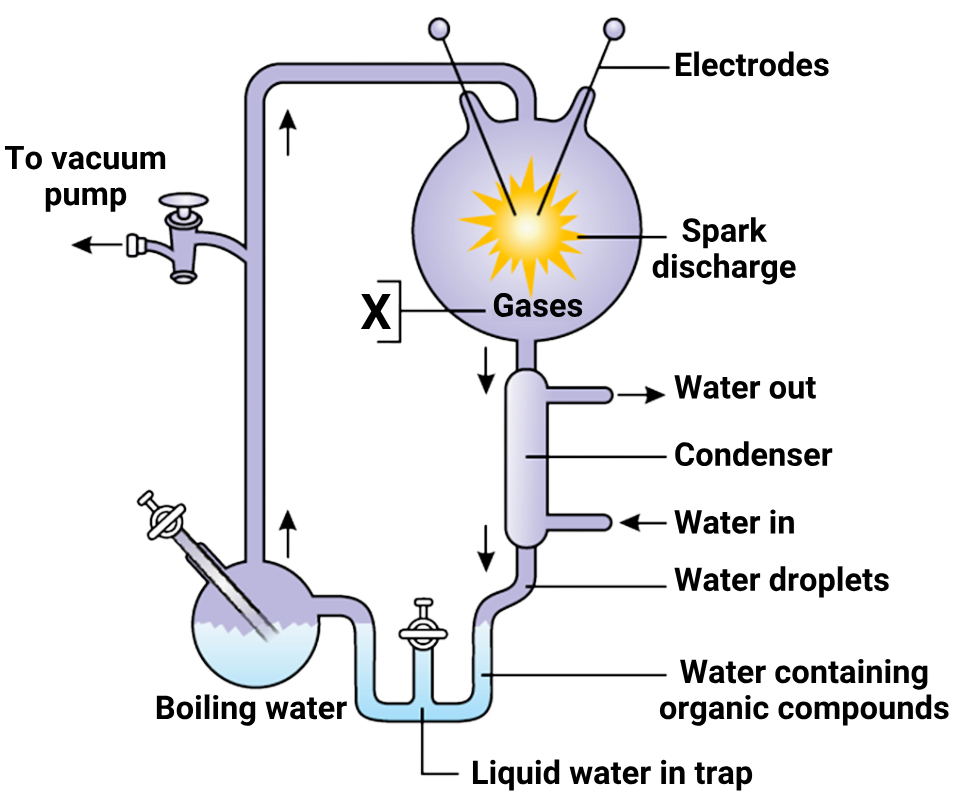
1 point(s)Given below is the diagrammatic representation of Miller’s experiment where ‘X‘ represents the gases used in the experiment. Identify the correct combination of the gases used by Miller in his experiment from the options given :
 CorrectIncorrect
Hint
(b)
- Question 2 of 50
2. Question
1 point(s)Evolutionary biology :
I: is the subfield of biology that studies the evolutionary processes (natural selection, common descent, speciation) that produced the diversity of life on Earth.
II: is also defined as the study of the history of life forms on Earth.CorrectIncorrectHint
(c)
- Question 3 of 50
3. Question
1 point(s)Given below are two statements : one is labelled as Assertion (A) and the other is labelled as Reason (R).
\(
\begin{array}{|l|l|}
\hline \text { Assertion (A): } & \begin{array}{l}
\text { When we look at stars on a clear night } \\
\text { sky we are, in a way, looking back in } \\
\text { time. }
\end{array} \\
\hline \text { Reason (R): } & \begin{array}{l}
\text { When we see objects in our immediate } \\
\text { surroundings we see them instantly and } \\
\text { hence in the present time. }
\end{array} \\
\hline
\end{array}
\)
In the light of the above statements, choose the most appropriate answer from the options given below :CorrectIncorrectHint
(b)
However, R does not explain A — the reason we see stars in the past is due to their vast distance and the finite speed of light, not because nearby objects are instant.
- Question 4 of 50
4. Question
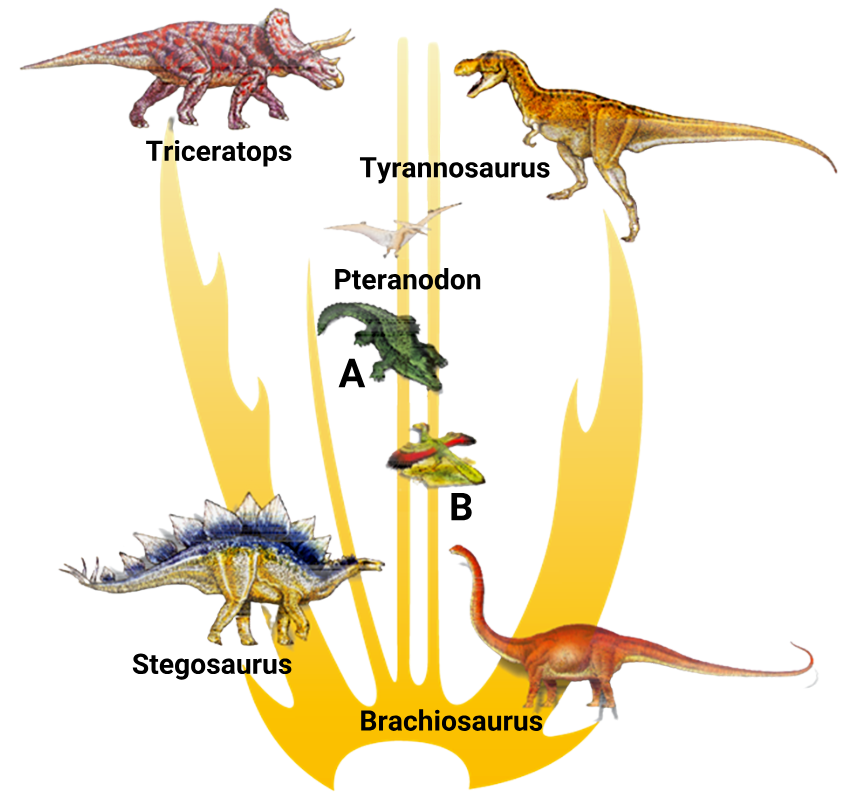
1 point(s)The figure shows a family tree of dinosaurs and their living modern-day counterpart organisms. Study the given two statements :

Statement I: ‘A‘ denotes ‘crocodilians‘ that have a four chambered heart and endothermy similar to the birds and the mammals.
Statement II: ‘B‘ denotes ‘Archaeopteryx‘, a connecting link between reptiles and birds and has been found as a complete specimen preserved as fossil.CorrectIncorrectHint
(c)
Why Statement I Fails
The first part — “have a four-chambered heart” — is correct.
The second part — “endothermy similar to birds and mammals” — is wrong according to NCERT, because crocodilians do not maintain constant body temperature.
Birds and mammals are endothermic (homeothermic), but crocodilians remain ectothermic despite the four chambers
- Question 5 of 50
5. Question
1 point(s)Oparin of Russia and Hardane of England propose that:
I: The first form of life could have come from preexisting non-living organic molecules (e.g. RNA, protein etc.)
II: The formation of life was preceded by chemical evolution, i.e., the formation of diverse organic molecules from inorganic constituents.CorrectIncorrectHint
(c)
- Question 6 of 50
6. Question
1 point(s)In 1953, S. L. Miller created primitive earth conditions in the laboratory and gave experimental evidence for the origin of the first form of life from preexisting non-living organic molecules. The primitive earth conditions created include :CorrectIncorrectHint
(d)
- Question 7 of 50
7. Question
1 point(s)The connotations about the theory of special creation include:
I: All living organisms (species or types) that we see today were created as such.
II: Diversity was always the same since creation and will be the same in the future also.
III: Earth is about 4 billion years old.CorrectIncorrectHint
(a)
This theory Believed that earth is about 4000 years old.
- Question 8 of 50
8. Question
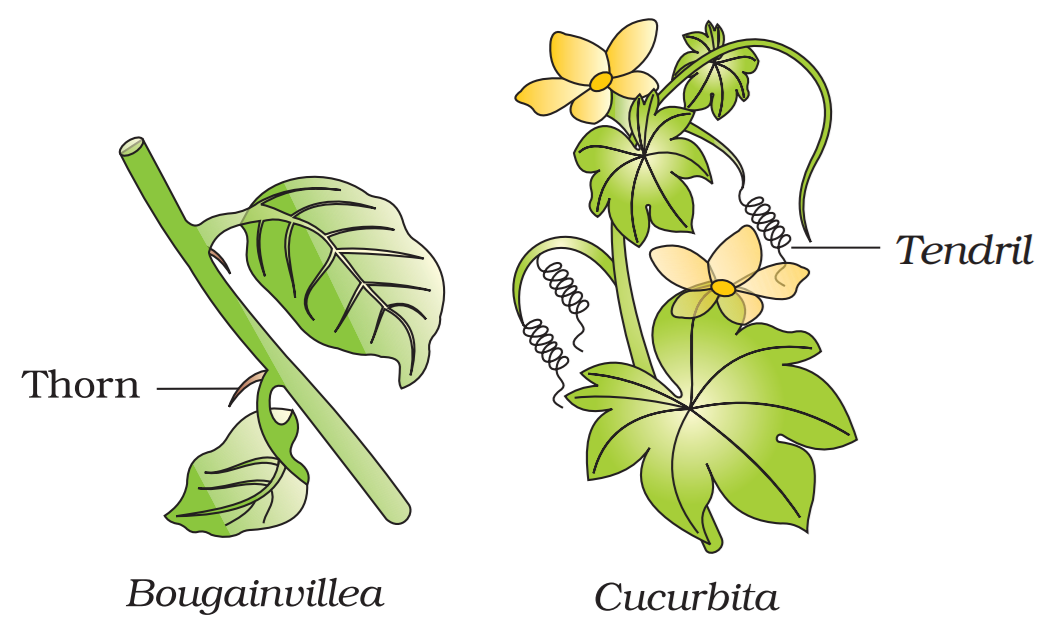
1 point(s)The thorn of Bougainvillea and the tendril of Cucurbita are shown in the figure: Identify the correct statement from the ones given below:

I: represent homology
II: are results of convergent evolutionCorrectIncorrectHint
(a)
II:- Result of Divergent Evolution not Convergent
- Question 9 of 50
9. Question
1 point(s)Which of the following was not a conclusion drawn by Charles Darwin based on observations made during a sea voyage in a sailing ship called H.M.S. Beagle around the world ?
CorrectIncorrectHint
(c)
- Question 10 of 50
10. Question
1 point(s)Consider the following Statements:-
I: Fitness, according to Darwin, refers ultimately and only to reproductive fitness.
II: Those who are a better fit in an environment, leave more progeny than others.CorrectIncorrectHint
(a)
- Question 11 of 50
11. Question
1 point(s)Name the naturalist who worked in the Malay Archipelago and had also come to conclusions similar to Darwin around the same time :
CorrectIncorrectHint
(b)
- Question 12 of 50
12. Question
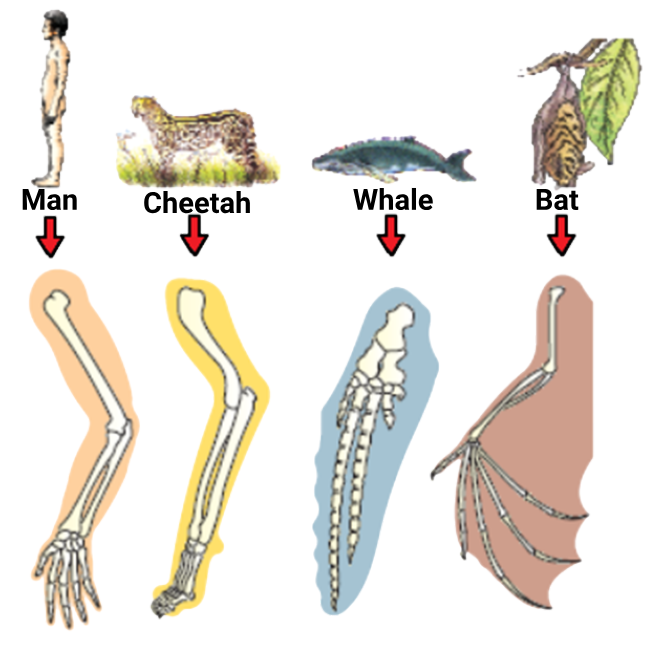
1 point(s)The biological relationship of the bones in the fore-limbs of mammals is an argument in favour of evolution. What will be true for the fore-limbs of the different mammals shown below ?

\(
\begin{array}{|l|l|}
\hline \text { Statement I: } & \begin{array}{l}
\text { They evolved in a similar environment, rather than } \\
\text { inherited from a recent common ancestor. }
\end{array} \\
\hline \text { Statement II: } & \begin{array}{l}
\text { They have a common descent and have evolved } \\
\text { from a shared ancestor. }
\end{array} \\
\hline
\end{array}
\)CorrectIncorrectHint
(c)
Statement I is wrong because similar environment → similar structures describes analogy (convergent evolution), not what we see here. These forelimbs are not analogous adaptations to the same environment; they are homologous modifications of an ancestral limb.
- Question 13 of 50
13. Question
1 point(s)Palaeontological evidence for evolution refers to the :
CorrectIncorrectHint
(c)
- Question 14 of 50
14. Question
1 point(s)Consider the given two statements :
Statement I: The embryos of all vertebrates including humans develop a row of vestigial gill slits just behind the head but it is a functional organ only in fish and not found in any other adult vertebrates.
Statement II: Karl Ernst von Baer noted that embryos never pass through the adult stages of other animals.CorrectIncorrectHint
(d)
NCERT does not use von Baer’s law to explain why gill slits appear — it treats gill slits as an example of embryonic similarity due to common ancestry, and von Baer’s law as a separate embryological principle.
- Question 15 of 50
15. Question
1 point(s)Evolution by natural selection, in a true sense, would have started when :
CorrectIncorrectHint
(c)
- Question 16 of 50
16. Question
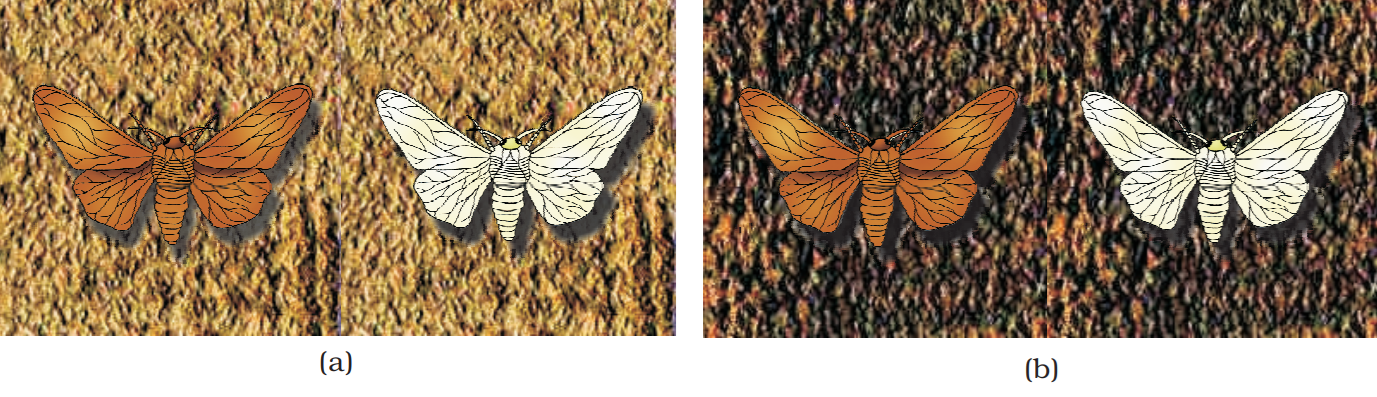
1 point(s)The given figure shows a white-winged moth and a dark-winged moth (melanised) moth [Biston betularia] associated with the phenomenon of ‘industrial melanism’. Identify the correct statements :

I: In (a) the frequency of dark melanic form is expected to be much higher than the white-winged moth due to its protective resemblance with the environment supporting luxuriant growth of lichens on tree trunks.
II: In (b) the frequency of white-winged moth is expected to be higher than the dark melanic form because the allele for white colour arises by a recurring mutation in the dark melanic form.CorrectIncorrectHint
(d)
In (a) tree trunks are light-coloured because of lichens, so the white (typica) moth is camouflaged and protected from predators. The dark melanic form would be conspicuous and selected against, so its frequency would be lower, not higher. Hence I is wrong.
In (b) (industrial, soot-darkened trunks) the dark melanic form has the camouflage advantage and increases in frequency by natural selection. Statement II wrongly claims the white form will be higher and attributes that to recurrent mutation from the dark form. Mutation is random and generally rare; it does not directionally produce the lighter form to maintain high frequency against strong selection for melanism. Thus II is also wrong.
- Question 17 of 50
17. Question
1 point(s)The essence of Darwinian theory about evolution is natural selection. What would be true ?
I: Nature selects for fitness.
II: Fitness is based on characteristics that are inherited.
III: Fitness is the end result of the ability to adapt and get selected by nature.CorrectIncorrectHint
(d)
- Question 18 of 50
18. Question
1 point(s)The two key concepts of the Darwinian Theory of Evolution are :
CorrectIncorrectHint
(a)
- Question 19 of 50
19. Question
1 point(s)Consider the given observation of Darwin and the inference drawn by him while developing his idea about the mechanism of evolution:
Observation: Natural resources are limited, populations are stable in size except for seasonal fluctuation, members of a population vary in characteristics even though they look superficially similar, and most variations are inherited.
Inference: There had been competition for resources and variations, which are heritable and which make resource utilisation better for few (adapted to habitat better) will enable only those to reproduce and leave more progeny.CorrectIncorrectHint
(d)
- Question 20 of 50
20. Question
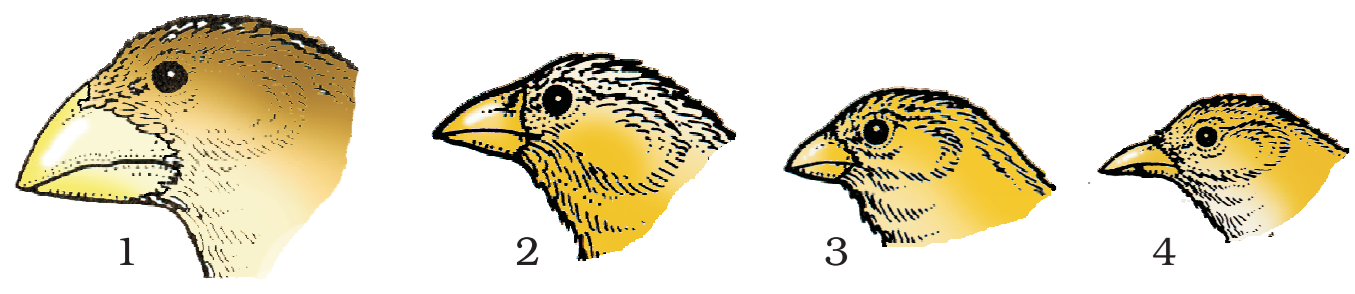
1 point(s)The figure shows a variety of beaks of finches that Darwin found in Galapagos Island. 1 is Geospiza magnirostris, 2 is Geospiza fortis, 3 is Geospiza parvula and 4 is Certhidea olivacea. What will be true regarding these birds ?

I: Darwin’s finches are an excellent example of adaptive radiation.
II: All the varieties, Darwin conjectured, evolved on the island itself.
III: From the original seed-eating features, many other forms with altered beaks arose, enabling them to become insectivorous and vegetarian finches.CorrectIncorrectHint
(d)
- Question 21 of 50
21. Question
1 point(s)Identify the correct statement :
CorrectIncorrectHint
(d)
- Question 22 of 50
22. Question
1 point(s)Gene flow is:
CorrectIncorrectHint
(d)
- Question 23 of 50
23. Question
1 point(s)The connecting link between the fishes and amphibians is the :
CorrectIncorrectHint
(d)
- Question 24 of 50
24. Question
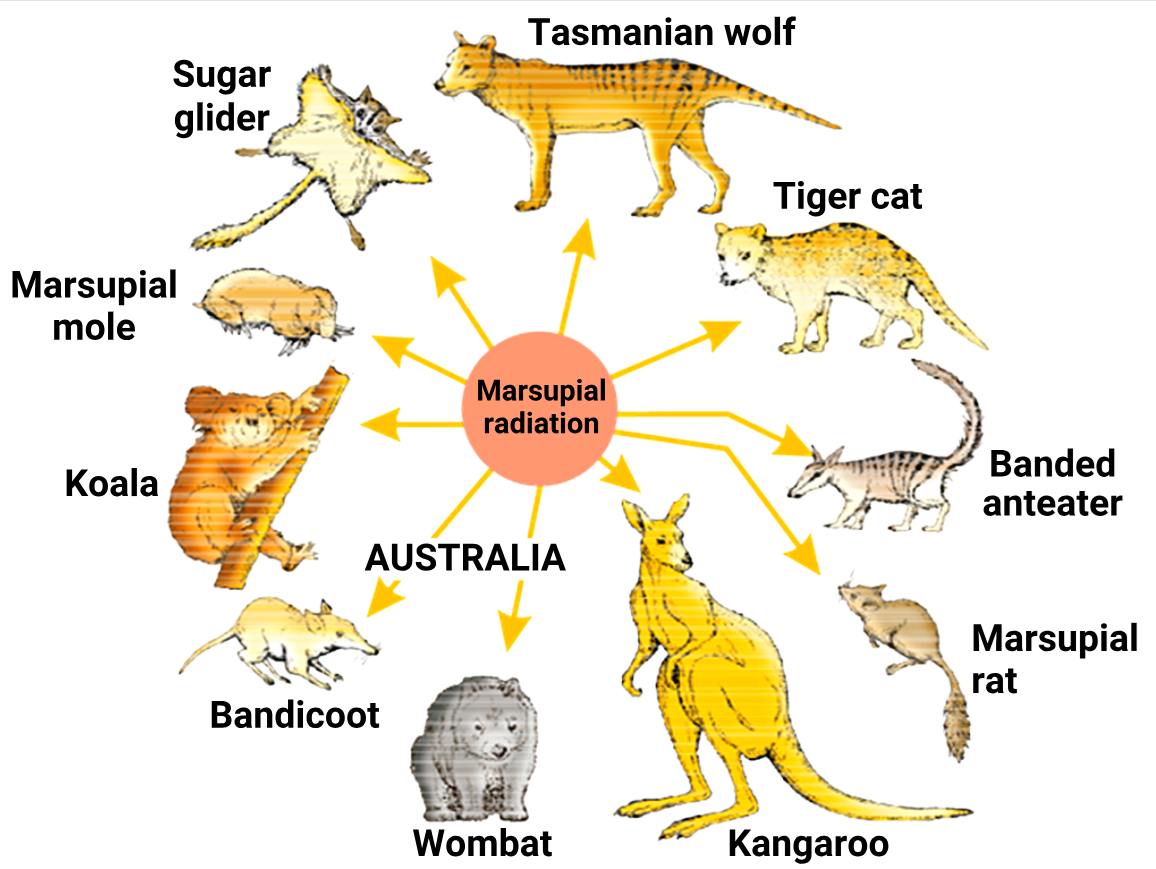
1 point(s)The given figure shows the adaptive radiation of marsupials of Australia. What is correct regarding adaptive radiation ?

I: It is the process of evolution of different species in a given geographical area starting from a point and literally radiating to other areas of geography (habitats).
II: When more than one adaptive radiation appeared to have occurred in an isolated geographical area (representing different habitats), one can call this divergent evolution.CorrectIncorrectHint
(a)
Statement II:
❌ Incorrect.When more than one adaptive radiation occurs in the same geographical area, it is called convergent evolution if unrelated groups evolve similar adaptations, not divergent evolution.
Divergent evolution refers to organisms from a common ancestor evolving differences, usually after geographical separation or niche differentiation (like Darwin’s finches), but statement II is mixing definitions.
- Question 25 of 50
25. Question
1 point(s)Similar biological structures or sequences in different taxa are homologous if they :
CorrectIncorrectHint
(d)
- Question 26 of 50
26. Question
1 point(s)A thorn of Bougainvillea and a tendril of Cucurbita
are an example of :CorrectIncorrectHint
(c)
Both are stem
- Question 27 of 50
27. Question
1 point(s)The wings of an insect and the wings of a bird are examples of :
CorrectIncorrectHint
(a)
- Question 28 of 50
28. Question
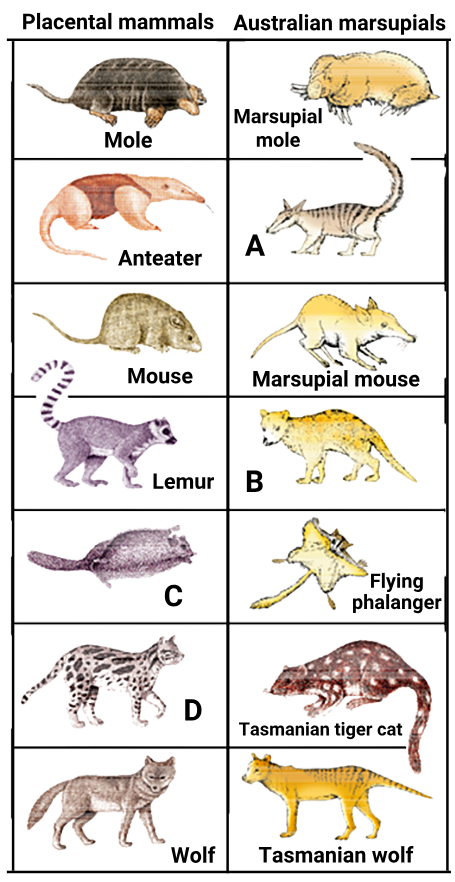
1 point(s)Identify A, B , C and D in the given figure showing the convergent evolution of Australian Marsupials and placental mammals:

\(
\begin{array}{|l|l|l|l|l|}
\hline & A & B & C & D \\
\hline 1. & \text{Numbat} & \text{Spotted Cuscus} & \text{Bobcat} & \text{Flying Squirrel} \\
\hline 2. & \text{Spotted Cuscus} & \text{Numbat} & \text{Flying Squirrel} & \text{Bobcat} \\
\hline 3. & \text{Numbat} & \text{Spotted Cuscus} & \text{Flying Squirrel} & \text{Bobcat} \\
\hline 4. & \text{Spotted Cuscus} & \text{Numbat} & \text{Bobcat} & \text{Flying Squirrel} \\
\hline
\end{array}
\)CorrectIncorrectHint
(c)
- Question 29 of 50
29. Question
1 point(s)All the following are examples of evolution by anthropogenic action except :
CorrectIncorrectHint
(d)
- Question 30 of 50
30. Question
1 point(s)Genetic drift is :
CorrectIncorrectHint
(a)
- Question 31 of 50
31. Question
1 point(s)During which period of the geological time scale did the first seed plants evolve ?
CorrectIncorrectHint
(a)
- Question 32 of 50
32. Question
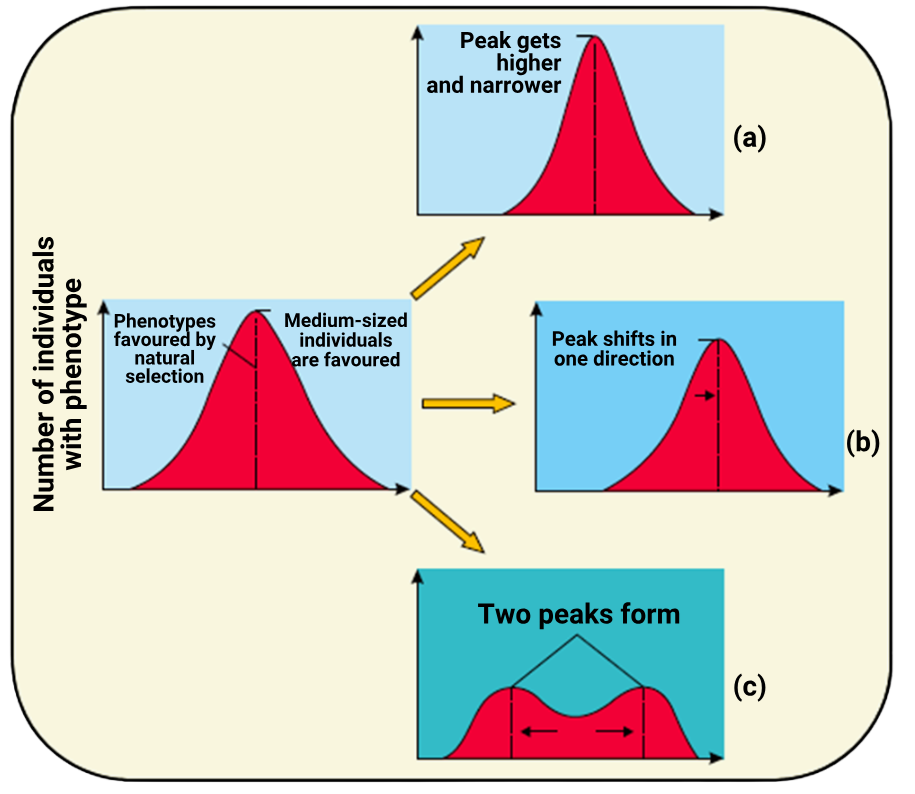
1 point(s)The figure shows a diagrammatic representation of the operation of natural selection on different traits. The types of natural selection as shown by (a), (b) and (c) in the figure are :

\(
\begin{array}{|l|l|l|l|}
\hline & \text { A } & \text { B } & \text { C } \\
\hline \text { 1. } & \text { Stabilising } & \text { Directional } & \text { Disruptive } \\
\hline \text { 2. } & \text { Directional } & \text { Stabilising } & \text { Disruptive } \\
\hline \text { 3. } & \text { Disruptive } & \text { Directional } & \text { Stabilising } \\
\hline \text { 4. } & \text { Stabilising } & \text { Disruptive } & \text { Directional } \\
\hline
\end{array}
\)CorrectIncorrectHint
(a)
- Question 33 of 50
33. Question
1 point(s)Given below are two statements : one is labelled as Assertion (A) and the other is labelled as Reason (R).
\(
\begin{array}{|l|l|}
\hline \text { Assertion (A): } & \begin{array}{l}
\text { Evolution is not a directed process in the } \\
\text { sense of determinism. }
\end{array} \\
\hline \text { Reason (R): } & \begin{array}{l}
\text { It is a stochastic process based on chance } \\
\text { events in nature and chance mutation in } \\
\text { the organisms. }
\end{array} \\
\hline
\end{array}
\)
In the light of the above statements, choose the most appropriate answer from the options given below :CorrectIncorrectHint
(a)
- Question 34 of 50
34. Question
1 point(s)The process of evolution of different species in a given geographical area starting from a point and literally radiating to other areas of geography [habitats] is known as:
CorrectIncorrectHint
(c)
- Question 35 of 50
35. Question
1 point(s)The dominant plants during the Jurassic period were:
CorrectIncorrectHint
(b)
- Question 36 of 50
36. Question
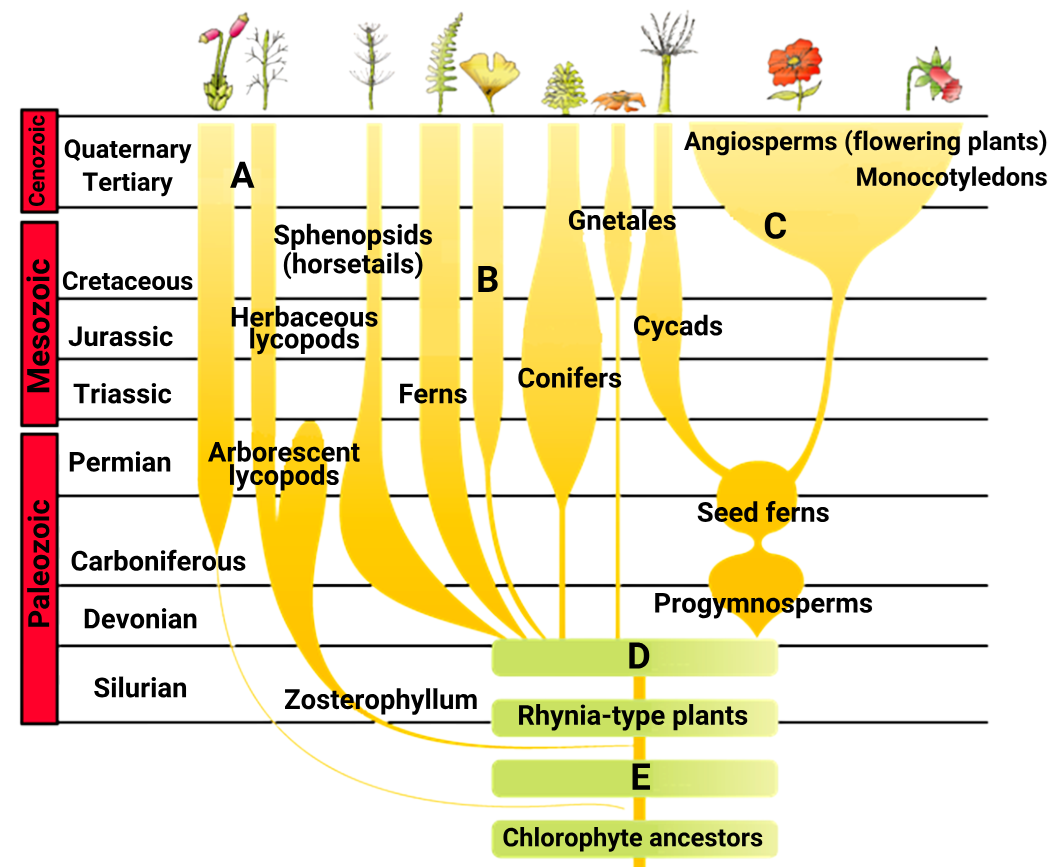
1 point(s)Identify A, B, C, D and E in the given sketch of the evolution of plant forms through geological periods :

\(
\begin{array}{|l|l|l|l|l|l|}
\hline & A & B & C & D & E \\
\hline 1. & \text{Green algae} & \text{Cycads} & \text{Dicotyledons} & \text{Psilophyton} & \text{Rhynia type plants} \\
\hline 2. & \text{Red algae} & \text{Ginkgos} & \text{Dicotyledons} & \text{Pines} & \text{Chlorophyte ancestors} \\
\hline 3. & \text{Bryophytes} & \text{Ginkgos} & \text{Pines} & \text{Psilophyton} & \text{Tracheophyte ancestors} \\
\hline 4. & \text{Bryophytes} & \text{Ginkgos} & \text{Dicotyledons} & \text{Psilophyton} & \text{Tracheophyte ancestors} \\
\hline
\end{array}
\)CorrectIncorrectHint
(d)
- Question 37 of 50
37. Question
1 point(s)During which period of the geological time scale did the angiosperms evolve ?
CorrectIncorrectHint
(c)
- Question 38 of 50
38. Question
1 point(s)Bryophytes evolved from :
CorrectIncorrectHint
(c)
- Question 39 of 50
39. Question
1 point(s)Invertebrates were formed and were active by the time of:
CorrectIncorrectHint
(d)
- Question 40 of 50
40. Question
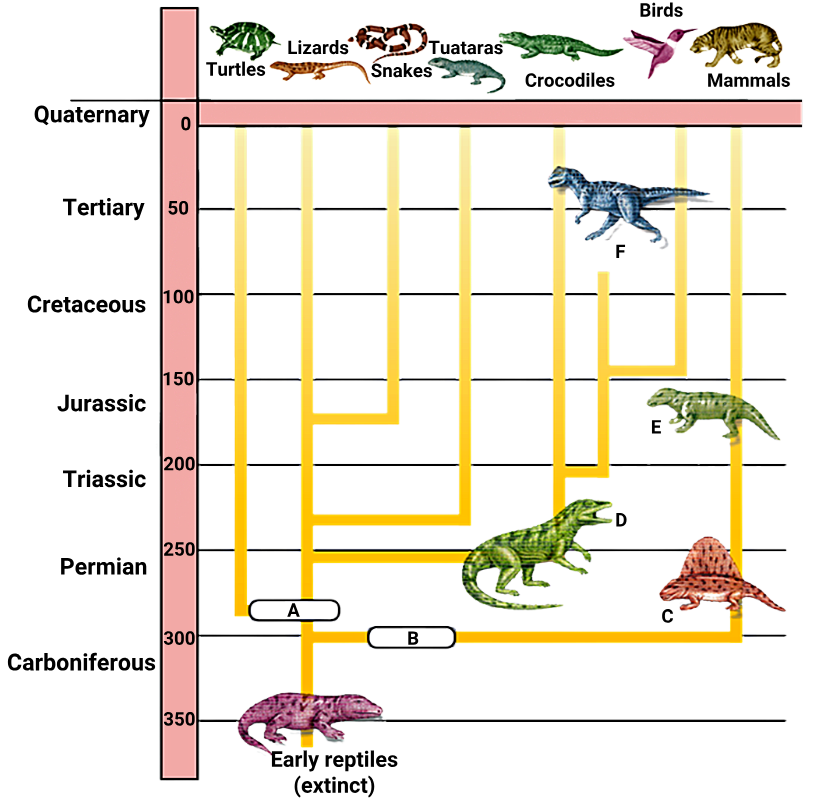
1 point(s)Identify A-F in the figure showing the representative evolutionary history of vertebrates through geological periods :

\(
\begin{array}{|c|l|l|l|l|l|l|}
\hline
& \text{A} & \text{B} & \text{C} & \text{D} & \text{E} & \text{F} \\
\hline
1. & \text{Thecodonts} & \text{Sauropsids} & \text{Therapsids} & \text{Synapsids} & \text{Pelycosaurs} & \text{Dinosaurs} \\
\hline
2. & \text{Synapsids} & \text{Pelycosaurs} & \text{Sauropsids} & \text{Dinosaurs} & \text{Therapsids} & \text{Thecodonts} \\
\hline
3. & \text{Sauropsids} & \text{Synapsids} & \text{Pelycosaurs} & \text{Thecodonts} & \text{Therapsids} & \text{Dinosaurs} \\
\hline
4. & \text{Therapsids} & \text{Synapsids} & \text{Pelycosaurs} & \text{Dinosaurs} & \text{Sauropsids} & \text{Thecodonts} \\
\hline
\end{array}
\)CorrectIncorrectHint
(c)
- Question 41 of 50
41. Question
1 point(s)Jawless fishes probably evolved around :
CorrectIncorrectHint
(b)
- Question 42 of 50
42. Question
1 point(s)The primates, Dryopithecus and Ramapithecus, existed around :
CorrectIncorrectHint
(a)
- Question 43 of 50
43. Question
1 point(s)Match List-I with List-II :
\(
\begin{array}{|c|l|}
\hline
\text{(a) Adaptive radiation} & \text{(i) Selection of resistant varieties} \\
& \text{due to excessive use of herbicides} \\
& \text{and pesticides} \\
\hline
\text{(b) Convergent evolution} & \text{(ii) Bones of forelimbs in Man and Whale} \\
\hline
\text{(c) Divergent evolution} & \text{(iii) Wings of Butterfly and Bird} \\
\hline
\text{(d) Evolution by anthropogenic action} & \text{(iv) Darwin Finches} \\
\hline
\end{array}
\)
Choose the correct answer from the options given below.
\(
\begin{array}{|c|c|c|c|c|}
\hline & \text { (a) } & \text { (b) } & \text { (c) } & \text { (d) } \\
\hline 1 . & \text { (ii) } & \text { (i) } & \text { (iv) } & \text { (iii) } \\
\hline 2 . & \text { (i) } & \text { (iv) } & \text { (iii) } & \text { (ii) } \\
\hline 3 . & \text { (iv) } & \text { (iii) } & \text { (ii) } & \text { (i) } \\
\hline 4 . & \text { (iii) } & \text { (ii) } & \text { (i) } & \text { (iv) } \\
\hline
\end{array}
\)CorrectIncorrectHint
(c)
- Question 44 of 50
44. Question
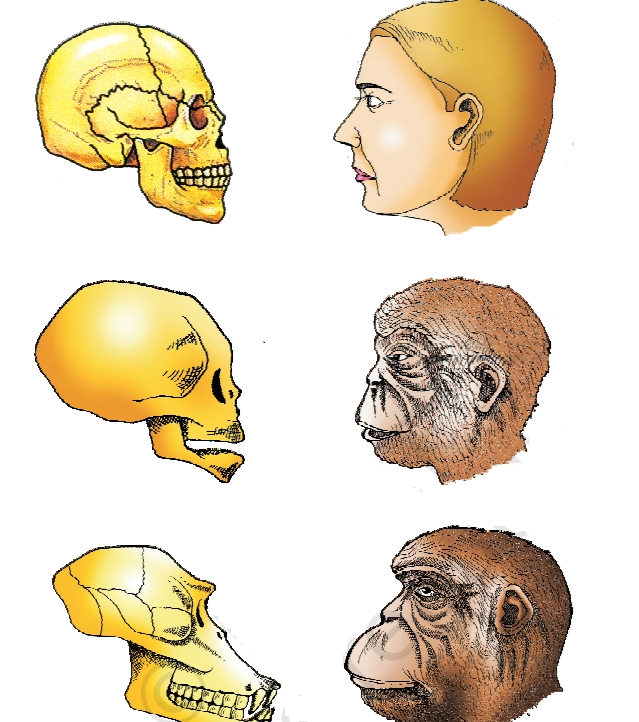
1 point(s)A comparison of the skulls of adult modern human beings, baby chimpanzees, and adult chimpanzees is shown.

\(
\begin{array}{|l|l|}
\hline \begin{array}{l}
\text { Statement } \\
\text { I: }
\end{array} & \begin{array}{l}
\text { The skull of the baby chimpanzee is more } \\
\text { like an adult human skull than an adult } \\
\text { chimpanzee skull. }
\end{array} \\
\hline \begin{array}{l}
\text { Statement } \\
\text { II: }
\end{array} & \begin{array}{l}
\text { Infants of both species have large craniums } \\
\text { and small faces. }
\end{array} \\
\hline
\end{array}
\)CorrectIncorrectHint
(b)
- Question 45 of 50
45. Question
1 point(s)The mammals evolved from :
CorrectIncorrectHint
(a)
- Question 46 of 50
46. Question
1 point(s)Identify the incorrect statement :
CorrectIncorrectHint
(a)
- Question 47 of 50
47. Question
1 point(s)The first human-like being, the hominid, was called :
CorrectIncorrectHint
(a)
- Question 48 of 50
48. Question
1 point(s)The fossils of Homo erectus were discovered in _________ and it existed about ________ mya.
CorrectIncorrectHint
(b)
- Question 49 of 50
49. Question
1 point(s)The cranial capacity of Homo erectus was around :
CorrectIncorrectHint
(c)
- Question 50 of 50
50. Question
1 point(s)Identify the incorrect fact regarding the Neanderthal man:
CorrectIncorrectHint
(b)