2.7 Significant figures
Significant Figures
Every measurement involves errors. Thus, the result of measurement should be reported in a way that indicates the precision of measurement. Normally, the reported result of measurement is a number that includes all digits in the
number that are known reliably plus the first digit that is uncertain. The reliable digits plus the first uncertain digit are known as significant digits or significant figures. If we say the period of oscillation of a simple pendulum is 1.62 s, the digits 1 and 6 are reliable and certain, while the digit 2 is uncertain. Thus, the measured value has three significant figures. The length of an object reported after measurement to be 287.5 cm has four significant figures, the digits 2, 8, and 7 are certain while the digit 5 is uncertain.
Example 1:
Each side of a cube is measured to be \(7.203 \mathrm{~m}\). What are the total surface area and the volume of the cube to appropriate significant figures?
Answer: The number of significant figures in the measured length is 4. The calculated area and the volume should therefore be rounded off to 4 significant figures.
Surface area of the cube \(=6(7.203)^{2} \mathrm{~m}^{2}\) \(=311.299254 \mathrm{~m}^{2}\) \(=311.3 \mathrm{~m}^{2}\)
Volume of the cube
\(=(7.203)^{3} \mathrm{~m}^{3}\)
\(=373.714754 \mathrm{~m}^{3}\)
\(=373.7 \mathrm{~m}^{3}\)
Example 2:
\(5.74 \mathrm{~g}\) of a substance occupies \(1.2 \mathrm{~cm}^{3}\). Express its density by keeping the significant figures in view.
Answer: There are 3 significant figures in the measured mass whereas there are only 2 significant figures in the measured volume. Hence the density should be expressed to only 2 significant figures.
\(
\begin{aligned}
\text { Density } &=\frac{5.74}{1.2} \mathrm{~g} \mathrm{~cm}^{-3} \\
&=4.8 \mathrm{~g} \mathrm{~cm}^{-3}
\end{aligned}
\)
Example 3: Round off the following numbers to three significant digits (a) 15462, (b) \(14 \cdot 745\), (c) \(14 \cdot 750\) and (d) \(14 \cdot 650\) \(\times 10^{12}\)
Answer: (a) The third significant digit is 4. This digit is to be rounded. The digit next to it is 6 which is greater than 5. The third digit should, therefore, be increased by 1. The digits to be dropped should be replaced by zeros because they appear to the left of the decimal. Thus, 15462 becomes 15500 on rounding to three significant digits.
(b) The third significant digit in \(14 \cdot 745\) is 7. The number next to it is less than 5. So \(14 \cdot 745\) becomes \(14 \cdot 7\) on rounding to three significant digits.
(c) 14.750 will become 14.8 because the digit to be rounded is odd and the digit next to it is 5.
(d) \(14.650 \times 10^{12}\) will become \(14.6 \times 10^{12}\) because the digit to be rounded is even and the digit next to it is 5.
Example 4: Evaluate \(\frac{25 \cdot 2 \times 1374}{33.3}\). All the digits in this expression are significant.
Answer: We have \(\frac{25 \cdot 2 \times 1374}{33 \cdot 3}=1039 \cdot 7838 \ldots\)
Out of the three numbers given in the expression \(25^{\circ} 2\) and 33.3 have 3 significant digits and 1374 has four. The answer should have three significant digits. Rounding \(1039 \cdot 7838 \ldots\) to three significant digits, it becomes 1040. Thus, we write
\(
\frac{25 \cdot 2 \times 1374}{33 \cdot 3}=1040 \text {. }
\)
Example 5: \(\text { Evaluate } \quad 24 \cdot 36+0 \cdot 0623+256 \cdot 2 \text {. }\)
Answer:
\(
\begin{gathered}
24 \cdot 36 \\
0.0623 \\
256 \cdot 2 \\
\hline
\end{gathered}
\)
Now the first column where a doubtful digit occurs is the one just next to the decimal point (2562). All digits right to this column must be dropped after proper rounding. The table is rewritten and added below
\(
\begin{array}{r}
24 \cdot 4 \\
0 \cdot 1 \\
256 \cdot 2 \\
\hline 280 \cdot 7
\end{array}
\)
The sum is \(280 \cdot 7\).
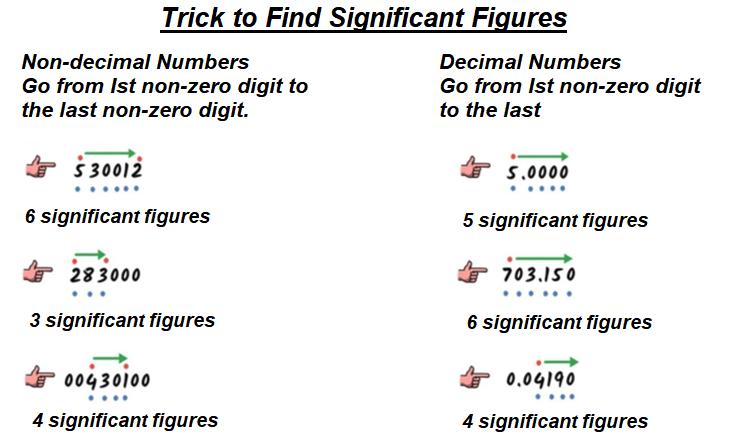
Trick to Find Significant Figures
Addition or subtraction
Suppose in the measured values to be added or subtracted, the least number of significant digits after the decimal is \(n\). Then, in the sum or difference also, the number of significant digits after the decimal should be \(n\). e.g. \(1.2+3.45+6.789=11.439 \approx 11.4\)
Here, the least number of significant digits after the decimal is one. Hence, the result will be 11.4 (when rounded off to smallest number of decimal places). Similarly, e.g. \(1263-10.2=2.43 \approx 2.4\)
Multiplication or division
Suppose in the measured values to be multiplied or divided, the least number of significant digits be \(n\), then in the product or quotient, the number of significant digits should also be \(n\).
e.g. \(1.2 \times 36.72=44.064 \approx 44\)
The least number of significant digits in the measured values are two. Hence, the result when rounded off to two significant digits becomes 44. Therefore, the answer is 44.
Similarly, e.g. \(\frac{1100}{10.2}=107.8431373 \approx 110\)
As 1100 has minimum number of significant figures (i.e. 2), therefore the result should also contain only two significant digits. Hence, the result when rounded off to two significant digits becomes 110.
Rules for rounding off a measurement
The following are the rules for rounding off a measurement:
Rule 1: If the number lying to the right of the cut-off digit is less than 5, then the cut-off digit is retained as such. However, if it is more than 5, then the cut-off digit is increased by 1 . e.g. \(x=6.24\) is rounded off to 6.2 to two significant digits and \(x=5.328\) is rounded off to 5.33 to three significant digits.
Rule 2: If the insignificant digit to be dropped is 5, then the rule is
(i) If the preceding digit is even, the insignificant digit is simply dropped.
(ii) If the preceding digit is odd, the preceding digit is raised by 1.
e.g. \(x=6.265\) is rounded off to \(x=6.26\) to three significant digits and \(x=6.275\) is rounded off to \(x=6.28\) to three significant digits.
Rule 3: The exact numbers like \(\pi, 2,3\) and 4, etc., that appear in formulae and are known to have infinite significant figures, can be rounded off to a limited number of significant figures as per the requirement.