NEET Practice Q & A
Quiz Summary
0 of 96 Questions completed
Questions:
Information
You have already completed the quiz before. Hence you can not start it again.
Quiz is loading…
You must sign in or sign up to start the quiz.
You must first complete the following:
Results
Results
0 of 96 Questions answered correctly
Your time:
Time has elapsed
You have reached 0 of 0 point(s), (0)
Earned Point(s): 0 of 0, (0)
0 Essay(s) Pending (Possible Point(s): 0)
Categories
- Not categorized 0%
- 1
- 2
- 3
- 4
- 5
- 6
- 7
- 8
- 9
- 10
- 11
- 12
- 13
- 14
- 15
- 16
- 17
- 18
- 19
- 20
- 21
- 22
- 23
- 24
- 25
- 26
- 27
- 28
- 29
- 30
- 31
- 32
- 33
- 34
- 35
- 36
- 37
- 38
- 39
- 40
- 41
- 42
- 43
- 44
- 45
- 46
- 47
- 48
- 49
- 50
- 51
- 52
- 53
- 54
- 55
- 56
- 57
- 58
- 59
- 60
- 61
- 62
- 63
- 64
- 65
- 66
- 67
- 68
- 69
- 70
- 71
- 72
- 73
- 74
- 75
- 76
- 77
- 78
- 79
- 80
- 81
- 82
- 83
- 84
- 85
- 86
- 87
- 88
- 89
- 90
- 91
- 92
- 93
- 94
- 95
- 96
- Current
- Review
- Answered
- Correct
- Incorrect
- Question 1 of 96
1. Question
Find the dimensions of
(a) linear momentum,
(b) frequency and
(c) pressure.CorrectIncorrectHint
a) Linear momentum \(\quad: \mathrm{mv} \quad=\left[M L T^{-1}\right]\)
b) Frequency : \(\frac{1}{T}=\left[M^{0} L^{0} T^{-1}\right]\)
c) Pressure: \(\frac{\text { Force }}{\text { Area }}=\frac{\left[\mathrm{MLT}^{-2}\right]}{\left[\mathrm{L}^{2}\right]}=\left[\mathrm{ML}^{-1} \mathrm{~T}^{-2}\right]\) - Question 2 of 96
2. Question
Find the dimensions of
(a) angular speed \(\omega\),
(b) angular acceleration \(\alpha\),
(c) torque \(\Gamma\) and
(d) moment of interia \(I\).
Some of the equations involving these quantities are\(\omega=\frac{\theta_{2}-\theta_{1}}{t_{2}-t_{1}}, \quad \alpha=\frac{\omega_{2}-\omega_{1}}{t_{2}-t_{1}}, \quad \Gamma=F . r\) and \(I=m r^{2} .\)
The symbols have standard meanings.CorrectIncorrectHint
a) Angular speed \(\omega=\theta / t=\left[M^{0} L^{0} T^{-1}\right]\)
b) Angular acceleration \(\alpha=\frac{\omega}{t}=\frac{M^{0} L^{0} T^{-2}}{T}=\left[M^{0} L^{0} T^{-2}\right]\)
c) Torque \(\tau=F r=\left[\mathrm{MLT}^{-2}\right][L]=\left[\mathrm{ML}^{2} \mathrm{~T}^{-2}\right]\)
d) Moment of inertia \(=\mathrm{Mr} r^{2}=[\mathrm{M}]\left[\mathrm{L}^{2}\right]=\left[\mathrm{ML}^{2} \mathrm{~T}^{0}\right]\) - Question 3 of 96
3. Question
Find the dimensions of
(a) electric field \(E\),
(b) magnetic field \(B\) and
(c) magnetic permeability \(\mu_{0}\).
The relevant equations are
\(F=q E, F=q v B\), and \(B=\frac{\mu_{0} I}{2 \pi a}\);
where F is force, q is charge, v is speed, I is current, and a is distance.CorrectIncorrectHint
a) Electric field \(E=F / q=\frac{M L T^{-2}}{[I T]}=\left[{M L T}^{-3} \mathrm{I}^{-1}\right]\)
b) Magnetic field \(B=\frac{F}{q v}=\frac{M L T^{-2}}{[I T]\left[L T^{-1}\right]}=\left[{M T}^{-2}\mathrm{I}^{-1}\right]\)
c) Magnetic permeability \(\mu_{0}=\frac{\mathrm{B} \times 2 \pi \mathrm{a}}{\mathrm{I}}=\frac{\left.\mathrm{MT}^{-2} \mathrm{I}^{-1}\right] \times[\mathrm{L}]}{[\mathrm{l}]}=\left[\mathrm{MLT}^{-2} \mathrm{I}^{-2}\right]\) - Question 4 of 96
4. Question
Find the dimensions of
(a) electric dipole moment \(p\) and
(b) magnetic dipole moment \(M\).
The defining equations are \(p=q . d\) and \(M=I A\); where \(d\) is distance, \(A\) is area, \(q\) is charge and \(I\) is current.CorrectIncorrect - Question 5 of 96
5. Question
Find the dimensions of Planck’s constant \(h\) from the equation \(E=h v\) where \(E\) is the energy and \(v\) is the frequency.
CorrectIncorrectHint
\(\mathrm{E}=\mathrm{h} v\) where \(\mathrm{E}=\) energy and \(v=\) frequency.
\(\mathrm{h}=\frac{\mathrm{E}}{v}=\frac{\left[\mathrm{ML}^{2} \mathrm{~T}^{-2}\right]}{\left[\mathrm{T}^{-1}\right]}\) \(=\left[\mathrm{M} \mathrm{~L}^{2} \mathrm{~T}^{-1}\right]\) - Question 6 of 96
6. Question
Find the dimensions of
(a) the specific heat capacity \(c\),
(b) the coefficient of linear expansion \(\alpha\) and
(c) the gas constant \(R\).
Some of the equations involving these quantities are \(Q=m c\left(T_{2}-T_{1}\right), l_{t}=l_{0}\left[1+\alpha\left(T_{2}-T_{1}\right)\right]\) and \(P V=n R T\)CorrectIncorrectHint
a) Specific heat capacity \(=C=\frac{Q}{m \Delta T}=\frac{\left[\mathrm{ML}^{2} \mathrm{~T}^{-2}\right]}{[\mathrm{M}][\mathrm{K}]}=\left[L^{2} \mathrm{~T}^{-2} \mathrm{~K}^{-1}\right]\)
b) Coefficient of linear expansion \(=\alpha=\frac{\mathrm{L}_{1}-\mathrm{L}_{2}}{\mathrm{~L}_{0} \Delta \mathrm{T}}=\frac{[\mathrm{L}]}{[\mathrm{L}][\mathrm{R}]}=\left[\mathrm{K}^{-1}\right]\)
c) Gas constant \(=\mathrm{R}=\frac{\mathrm{PV}}{\mathrm{nT}}=\frac{\left[\mathrm{ML}^{-1} \mathrm{~T}^{-2}\right]\left[\mathrm{L}^{3}\right]}{[(\mathrm{mol})][\mathrm{K}]}=\left[\mathrm{ML}^{2} \mathrm{~T}^{-2} \mathrm{~K}^{-1}(\mathrm{~mol})^{-1}\right]\) - Question 7 of 96
7. Question
Taking force, length, and time to be the fundamental quantities find the dimensions of
(a) density,
(b) pressure,
(c) momentum and
(d) energy.CorrectIncorrectHint
Taking force, length, and time as the fundamental quantity
a) Density \(=\frac{m}{V}=\frac{(\text { forcelacceleration })}{\text { Volume }}=\frac{\left[F / L T^{-2}\right]}{\left[L^{2}\right]}=\frac{F}{L^{4} T^{-2}}=\left[FL^{-4} T^{2}\right]\)
b) Pressure \(=F / A=F / L^{2}=\left[F L^{-2}\right]\)
c) Momentum \(=m v(Force / acceleration) \times Velocity =\left[\mathrm{F} / \mathrm{LT}^{-2}\right] \times\left[\mathrm{LT}^{-1}\right]=[\mathrm{FT}]\)
d) Energy \(=\frac{1}{2} m v^{2}=\frac{\text { Force }}{\text { acceleration }} \times(\text { velocity })^{2}\)
\(
=\left[\frac{F}{L T^{-2}}\right] \times\left[L T^{-1}\right]^{2}=\left[\frac{F}{\left.L T^{-2}\right]}\right] \times\left[L^{2} T^{-2}\right]=[F L]
\) - Question 8 of 96
8. Question
Suppose the acceleration due to gravity at a place is \(10 \mathrm{~m} / \mathrm{s}^{2}\). Find its value in \(\mathrm{cm} /(\text { minute })^{2}\).
CorrectIncorrect - Question 9 of 96
9. Question
The average speed of a snail is \(0.020 \mathrm{miles} /\) hour and that of a leopard is \(70 \mathrm{miles} /\) hour. Convert these speeds in SI units.
CorrectIncorrectHint
The average speed of a snail is \(0.02 \mathrm{mile} / \mathrm{hr}\)
Converting to S.I. units, \(\frac{0.02 \times 1.6 \times 1000}{3600} \mathrm{~m} / \mathrm{sec}[1 mile =1.6 \mathrm{~km}=1600 \mathrm{~m}]=0.0089 \mathrm{~ms}^{-1}\)
The average speed of leopard \(=70 \mathrm{miles} / \mathrm{hr}\)
In SI units \(=70\) miles \(/\) hour \(=\frac{70 \times 1.6 \times 1000}{3600}=31 \mathrm{~m} / \mathrm{s}\) - Question 10 of 96
10. Question
The height of mercury column in a barometer in a Calcutta laboratory was recorded to be \(75 \mathrm{~cm}\). Calculate this pressure in SI and CGS units using the following data : Specific gravity of mercury \(=13 \cdot 6\), Density of water \(=10^{3} \mathrm{~kg} / \mathrm{m}^{3}, g=9.8 \mathrm{~m} / \mathrm{s}^{2}\) at Calcutta. Pressure \(=h \rho g\) in usual symbols.
CorrectIncorrectHint
Height \(\mathrm{h}=75 \mathrm{~cm}\), Density of mercury \(=13600 \mathrm{~kg} / \mathrm{m}^{3}, \mathrm{~g}=9.8 \mathrm{~ms}^{-2}\) then
Pressure \(=h \rho g =10 \times 10^{4} \mathrm{~N} / \mathrm{m}^{2}\) (approximately)
In C.G.S. Units, \(P=10 \times 10^{5} dyne / \mathrm{cm}^{2}\) - Question 11 of 96
11. Question
Express the power of a 100 watt bulb in CGS unit.
CorrectIncorrectHint
In S.I. unit 100 watt \(=100\) Joule/sec and In C.G.S. Unit \(=10^{9} \mathrm{erg} / \mathrm{sec}\)
- Question 12 of 96
12. Question
The normal duration of I.Sc. Physics practical period in Indian colleges is 100 minutes. Express this period in microcenturies. 1 microcentury \(=10^{-6} \times 100\) years. How many microcenturies did you sleep yesterday?
CorrectIncorrectHint
1 micro century \(=10^{4} \times 100\) years \(=10^{-4} \times 365 \times 24 \times 60 \mathrm{~min}\); So, \(100 \min =10^{5} / 52560=1.9\) microcentury
- Question 13 of 96
13. Question
The surface tension of water is 72 dyne/cm. In SI unit its value is
CorrectIncorrectHint
Surface tension of water \(=72\) dyne/cm; In S.I. Unit, 72 dyne \(/ \mathrm{cm}=0.072 \mathrm{~N} / \mathrm{m}\)
- Question 14 of 96
14. Question
The kinetic energy \(K\) of a rotating body depends on its moment of inertia \(I\) and its angular speed \(\omega\). Assuming the relation to be \(K=k I^{a} \omega^{b}\) where \(k\) is a dimensionless constant, find \(a\) and \(b\). Moment of inertia of a sphere about its diameter is \(\frac{2}{5} M r^{2}\).
CorrectIncorrectHint
\(\mathrm{K}=\mathrm{kl}^{\mathrm{a}} \omega^{\mathrm{b}}\) where \(\mathrm{k}=\) Kinetic energy of rotating body and \(\mathrm{k}=\) dimensionless constant Dimensions of left side are,
\(
\mathrm{K}=\left[\mathrm{ML}^{2} \mathrm{~T}^{-2}\right]
\)
Dimensions of right side are,
\(
\mathrm{I}^{\mathrm{a}}=\left[\mathrm{ML}^{2}\right]^{\mathrm{a}}, \omega^{\mathrm{b}}=\left[\mathrm{T}^{-1}\right]^{\mathrm{b}}
\)
According to the principle of homogeneity of dimension,
\(
\left[\mathrm{ML}^{2} \mathrm{~T}^{-2}\right]=\left[\mathrm{ML}^{2}\right]^{\mathrm{a}} \left[\mathrm{T}^{-1}\right]^{\mathrm{b}}
\)
Equating the dimension of both sides,
\(
2=2 a \text { and }-2=-b \Rightarrow a=1 \text { and } b=2
\) - Question 15 of 96
15. Question
The theory of relativity reveals that mass can be converted into energy. The energy \(E\) so obtained is proportional to certain powers of mass \(m\) and the speed \(c\) of light. Guess a relation among the quantities using the method of dimensions.
CorrectIncorrectHint
Let energy \(E \propto M^{a} C^{b}\) where M=Mass, C= speed of light \(\Rightarrow E=K M^{a} C^{b}(K= proportionality constant )\)
Dimension of the left side
\(E=\left[\mathrm{ML}^{2} \mathrm{~T}^{-2}\right]\)
Dimension of right side
\(
\begin{aligned}
&M^{a}=[M]^{a},[C]^{b}=\left[L T^{-1}\right]^{b} \\
&\therefore\left[M L^{2} T^{-2}\right]=[M]^{a}\left[L T^{-1}\right]^{b} \\
&\Rightarrow a=1 ; b=2
\end{aligned}
\)
So, the relation is \(\mathrm{E}=\mathrm{KMC}^{2}\) - Question 16 of 96
16. Question
Let I= current through a conductor, R= its resistance and V= potential difference across its ends. According to Ohm’s law, product of two of these quantities equals the third. Obtain Ohm’s law from dimensional analysis. Dimensional formulae for R and V are \(\mathrm{ML}^{2} \mathrm{I}^{-2} \mathrm{~T}^{-3}\) and \(\mathrm{ML}^{2} \mathrm{~T}^{-3} \mathrm{I}^{-1}\) respectively.
CorrectIncorrectHint
Dimensional formulae of \(\mathrm{R}=\left[\mathrm{ML}^{2} \mathrm{~T}^{-3} \mathrm{I}^{-2}\right]\)
Dimensional formulae of \(\mathrm{V}=\left[\mathrm{ML}^{2} \mathrm{~T}^{3} \mathrm{I}^{-1}\right]\)
Dimensional formulae of \(I=[I]\)
\(
\begin{aligned}
&\therefore\left[\mathrm{ML}^{2} \mathrm{~T}^{3} \mathrm{I}^{-1}\right]=\left[\mathrm{ML}^{2} \mathrm{~T}^{-3} \mathrm{I}^{-2}\right][\mathrm{I}] \\
&\Rightarrow \mathrm{V}=\mathrm{IR}
\end{aligned}
\) - Question 17 of 96
17. Question
The frequency of vibration of a string depends on the length \(L\) between the nodes, the tension \(F\) in the string, and its mass per unit length \(m\). Find the expression for its frequency from dimensional analysis.
CorrectIncorrectHint
Frequency \(f=K L^{a} F^{b} M^{c}, M=\) Mass/unit length, \(L=\) length, \(F=\) tension (force)
Dimension of \(f=\left[\mathrm{T}^{-1}\right]\)
Dimension of right side,
\(
\begin{aligned}
&L^{a}=\left[L^{a}\right], F^{b}=\left[M L T^{-2}\right]^{b}, M^{c}=\left[M L^{-1}\right]^{c} \\
&\therefore\left[T^{-1}\right]=K[L]^{a}\left[M L T^{-2}\right]^{b}\left[M L^{-1}\right]^{c} \\
&M^{0} L^{0} T^{-1}=K M^{b+c} L^{a+b-c} T^{-2 b}
\end{aligned}
\)
Equating the dimensions of both sides,
\(
\begin{array}{ll}
\therefore b+c=0 & \ldots(1) \\
-c+a+b=0 & \ldots(2) \\
-2 b=-1 & \ldots(3)
\end{array}
\)
Solving the equations we get,
\(
a=-1, b=1 / 2 \text { and } c=-1 / 2
\)
\(\therefore\) So, frequency \(f=K^{-1} F^{1 / 2} M^{-1 / 2}=\frac{K}{L} F^{1 / 2} M^{-1 / 2}=\frac{K}{L}\times\sqrt{\frac{F}{M}}\) - Question 18 of 96
18. Question
Which of the following equations are dimensionally correct:
(a) \(h=\frac{2 S \cos \theta}{\rho r g}\),
(b) \(v=\sqrt{\frac{P}{\rho}}\),
(c) \(V=\frac{\pi P r^{4} t}{8 \eta l}\),
(d) \(v=\frac{1}{2 \pi} \sqrt{\frac{m g l}{I}}\);
where \(h=\) height, \(S=\) surface tension, \(\rho=\) density, \(P=\) pressure, \(V=\) volume, \(\eta=\) coefficient of viscosity, \(v=\) frequency and \(I=\) moment of inertia.CorrectIncorrectHint
a) \(h=\frac{2 s \cos \theta}{\rho r g}\)
\(\mathrm{LHS}=[\mathrm{L}]\)\(\text { Surface tension }=S=F / I =\frac{M L T^{-2}}{L}=\left[M T^{-2}\right]\)
Density \(=\rho=M/V=\left[\mathrm{ML}^{-3} \mathrm{~T}^{0}\right]\)
Radius \(=r=[\mathrm{L}], \mathrm{g}=\left[\mathrm{LT}{ }^{-2}\right]\)
\(\mathrm{RHS}=\frac{2 \mathrm{~S} \cos \theta}{\rho r g}=\frac{\left[\mathrm{MT}^{-2}\right]}{\left[\mathrm{ML}^{-3} \mathrm{~T}^{0}\right][\mathrm{L}]\left[\mathrm{LT}^{-2}\right]}=\left[\mathrm{M}^{0} \mathrm{~L}^{1} \mathrm{~T}^{0}\right]=[\mathrm{L}]\)
\(\mathrm{LHS}=\mathrm{RHS}\)
So, the relation is correct
b) \(v=\sqrt{\frac{p}{\rho}}\) where \(v=\) velocity
LHS = Dimension of \(\mathrm{V}=\left[L \mathrm{~T}^{-1}\right]\)
Dimension of \(p=F / A=\left[\mathrm{ML}^{-1} \mathrm{~T}^{-2}\right]\)
Dimension of \(\rho=\mathrm{m} / \mathrm{V}=\left[\mathrm{ML}^{-3}\right]\)
\(\mathrm{RHS}=\sqrt{\frac{\mathrm{p}}{\rho}}=\sqrt{\frac{\left[\mathrm{ML}^{-1} \mathrm{~T}^{-2}\right]}{\left[M L^{-3}\right]}}=\left[\mathrm{L}^{2} \mathrm{~T}^{-2}\right]^{1 / 2}=\left[L \mathrm{~T}^{-1}\right]\)
So, the relation is correct.
c) \(V=\left(\pi p r^{4} t\right) /(8 \eta l)\)
LHS = Dimension of \(\mathrm{V}=\left[\mathrm{L}^{3}\right]\)
Dimension of \(p=\left[\mathrm{ML}^{-1} \mathrm{~T}^{-2}\right], r^{4}=\left[L^{4}\right], t=[T]\)
Coefficient of viscosity \(=\left[\mathrm{ML}^{-1} \mathrm{~T}^{-1}\right]\)
RHS \(=\frac{\pi p r^{4} t}{8 \eta \mid}=\frac{\left[\mathrm{ML}^{-1} \mathrm{~T}^{-2}\right]\left[\mathrm{L}^{4}\right][\mathrm{T}]}{\left[\mathrm{ML}^{-1} \mathrm{~T}^{-1}\right][L]} = \left[\mathrm{L}^{3}\right]\)
So, the relation is correct.
d) \(v=\frac{1}{2 \pi} \sqrt{(\mathrm{mgl} / \mathrm{I})}\)
LHS = dimension of \(v=\left[T^{-1}\right]\)
\(R H S=\sqrt{(m g \mid / I)}=\sqrt{\frac{[M]\left[L T^{-2}\right][L]}{\left[M L^{2}\right]}}=\left[T^{-1}\right]\)
\(\mathrm{LHS}=\mathrm{RHS}\)
So, the relation is correct. - Question 19 of 96
19. Question
Let \(x\) and \(a\) stand for distance. Is \(\int \frac{d x}{\sqrt{a^{2}-x^{2}}}\) \(=\frac{1}{a} \sin ^{-1} \frac{a}{x}\) dimensionally correct?
CorrectIncorrectHint
Dimension of the left side \(=\int \frac{d x}{\sqrt{\left(a^{2}-x^{2}\right)}}=\int \frac{L}{\sqrt{\left(L^{2}-L^{2}\right)}}=\left[L^{0}\right]\)
Dimension of the right side \(=\frac{1}{a} \sin ^{-1}\left(\frac{a}{x}\right)=\left[L^{-1}\right]\)
So, the dimension of \(\int \frac{d x}{\sqrt{\left(a^{2}-x^{2}\right)}} \neq \frac{1}{a} \sin ^{-1}\left(\frac{a}{x}\right)\)
So, the equation is dimensionally incorrect. - Question 20 of 96
20. Question
A calorie is a unit of heat (energy in transit) and it equals about \(4.2 \mathrm{~J}\) where \(1 \mathrm{~J}=\) \(1 \mathrm{~kg} \mathrm{~m}^{2} \mathrm{~s}^{-2}\). Suppose we employ a system of units in which the unit of mass equals \(\alpha\) \(\mathrm{kg}\), the unit of length equals \(\beta \mathrm{m}\), the unit of time is \(\gamma \mathrm{s}\). Calculate that a calorie has a magnitude ______ in terms of the new units.
CorrectIncorrectHint
Dimensional formula of energy is \(\left[M^{1} L^{2} T^{-2}\right]\)
Comparing with \(\left[M^{a} L^{b} T^{c}\right]\), we get
\(
a=1, \quad b=2, \quad c=-2
\)
Now,
\(
\begin{aligned}
n_{2} &=n_{1}\left[\frac{M_{1}}{M_{2}}\right]^{a}\left[\frac{L_{1}}{L_{2}}\right]^{b}\left[\frac{T_{1}}{T_{2}}\right]^{c} \\
&=4.2\left[\frac{1 \mathrm{~kg}}{\alpha \mathrm{kg}}\right]^{1}\left[\frac{1 \mathrm{~m}}{\beta m}\right]^{2}\left[\frac{1 \mathrm{~s}}{\gamma \mathrm{s}}\right]^{-2}
\end{aligned}
\)
or, \(\quad n_{2}=4.2 \alpha^{-1} \beta^{-2} \gamma^{2}\) - Question 21 of 96
21. Question
What is the number of significant figures in the following?
(a) \(0.007 \mathrm{~m}^{2}\)
(b) \(2.64 \times 10^{24} \mathrm{~kg}\)
(c) \(0.2370 \mathrm{~g} \mathrm{~cm}^{-3}\)
(d) \(6.320 \mathrm{~J}\)
(e) \(6.032 \mathrm{~N} \mathrm{~m}^{-2}\)
(f) \(0.0006032 \mathrm{~m}^{2}\)CorrectIncorrect - Question 22 of 96
22. Question
The mass of a box measured by a grocer’s balance is \(2.30 \mathrm{~kg}\). Two gold pieces of masses \(20.15 \mathrm{~g}\) and \(20.17 \mathrm{~g}\) are added to the box. (a) What is the total mass of the box? (b) What is the difference in the masses of the pieces to correct significant figures?
CorrectIncorrectHint
(a) Total mass of the box \(=(2.3+0.0217+0.0215) \mathrm{kg}=2.3442 \mathrm{~kg}\)
Since the least number of decimal places is 1 , therefore, the total mass of the box \(=2.3 \mathrm{~kg}\).
(b) Difference of mass \(=2.17-2.15=0.02 \mathrm{~g}\)
Since the least number of decimal places is 2 so the difference in masses to the correct significant figures is \(0.02 \mathrm{~g}\) - Question 23 of 96
23. Question
A famous relation in physics relates ‘moving mass’ \(m\) to the ‘rest mass’ \(m_{0}\) of a particle in terms of its speed \(v\) and the speed of light, \(c\). (This relation first arose as a consequence of special relativity due to Albert Einstein). A boy recalls the relation almost correctly but forgets where to put the constant c.
\(
m=\frac{m_{0}}{\left(1-v^{2}\right)^{1 / 2}}
\). Identify the correct formula from the options.CorrectIncorrectHint
From the given equation, \(\frac{m_{0}}{m}=\sqrt{1-v^{2}}\)
Left hand side is dimensionless.
Therefore, the right-hand side should also be dimensionless.
It is possible only when \(\sqrt{1-v^{2}}\) should be \(\sqrt{1-\frac{v^{2}}{c^{2}}}\).
Thus, the correct formula is \(m=m_{0}\left(1-\frac{v^{2}}{c^{2}}\right)^{-1 / 2}\) - Question 24 of 96
24. Question
A LASER is a source of very intense, monochromatic, and a unidirectional beam of light. These properties of a laser light can be exploited to measure long distances. The distance of the Moon from the Earth has been already determined very precisely using a laser as a source of light. A laser light beamed at the Moon takes \(2.56 \mathrm{~s}\) to return after reflection at the Moon’s surface. How much is the radius of the lunar orbit around the Earth?
CorrectIncorrectHint
We known that speed of laser light \(=c=3 \times 10^{8} \mathrm{~m} / \mathrm{s}\). If \(\mathrm{d}\) be the distance of Moon from the earth, the time taken by laser signal to return after reflection at the Moon’s surface
\(
\begin{aligned}
t &=2.56 \mathrm{~s}=\frac{2 d}{c}=\frac{2 d}{3 \times 10^{8} \mathrm{~ms}^{-1}} \\
\Rightarrow \quad d &=\frac{1}{2} \times 2.56 \times 3 \times 10^{8} \mathrm{~m}=3.84 \times 10^{8} \mathrm{~m} .
\end{aligned}
\) - Question 25 of 96
25. Question
A SONAR (sound navigation and ranging) uses ultrasonic waves to detect and locate objects under water. In a submarine equipped with a SONAR, the time delay between the generation of a probe wave and the reception of its echo after reflection from an enemy submarine is found to be \(77.0 \mathrm{~s}\). What is the distance of the enemy submarine? (Speed of sound in water \(=1450 \mathrm{~m} \mathrm{~s}^{-1}\) ).
CorrectIncorrectHint
Here speed of sound in water \(\mathrm{v}=1450 \mathrm{~m} \mathrm{~s}^{-1}\) and time of echo \(t=77.0 \mathrm{~s}\). If distance of enemy submarine be \(d\), then \(t=2 d / v\)
\(
\therefore d=v t / 2=1450 \times 77.0 / 2=55825 \mathrm{~m}=55.8 \times 10^{3} \mathrm{~m} \text { or } 55.8 \mathrm{~km} \text {. }
\) - Question 26 of 96
26. Question
The farthest objects in our Universe discovered by modern astronomers are so distant that the light emitted by them takes billions of years to reach the Earth. These objects (known as quasars) have many puzzling features, which have not yet been satisfactorily explained. What is the distance in km of a quasar from which light takes \(3.0\) billion years to reach us?
CorrectIncorrectHint
The time taken by light from the quasar to the observer \(t=3.0\) billion years \(=3.0 \times 10^{9}\) years As \(1 \mathrm{ly}=9.46 \times 10^{15} \mathrm{~m}\)
\(\therefore\) Distance of quasar from the observer \(d=3.0 \times 10^{9} \times 9.46 \times 10^{15} \mathrm{~m}\) \(=28.38 \times 10^{24} \mathrm{~m}=2.8 \times 10^{25} \mathrm{~m}\) or \(2.8 \times 10^{22} \mathrm{~km}\). - Question 27 of 96
27. Question
The radius of a sphere is measured as \((2.1 \pm 0.5) \mathrm{cm}\). What is its surface area with error limits?
CorrectIncorrectHint
Radius of the sphere \(=(2.1 \pm 0.5) \mathrm{cm}\)
\(\therefore r=2.1\) and \(A r=\pm 0.5\)
\(
\begin{aligned}
&\text { S.A. }=4 \pi r 2 \\
&=4 \times 3.14 \times 2.1 \times 2.1 \\
&=55.4 \mathrm{~cm} 2
\end{aligned}
\)
As per the principle of error
\(\frac{\Delta s}{s}=\pm 2 \cdot \frac{\Delta r}{r}\)
\(\frac{\Delta s}{55.4}=\pm \frac{2 \times 0.5}{2.1}\)
\(\therefore \quad \Delta s=\pm 26.4 \mathrm{~cm}\)
\(\therefore\) Error limits are \(\pm 26.4 \mathrm{~cm}\)
\(\therefore\) Surface area of the sphere \(=(55.4 \pm 26.4) \mathrm{cm}^{2}\) - Question 28 of 96
28. Question
The voltage across a lamp is \((6.0 \pm 0.1)\) volt and the current passing through it is (4.0 \(\pm 0.2)\) ampere. What is the power consumed by the lamp?
CorrectIncorrectHint
Power \(P=V \times I\)
\(
P=6 \times 4=24 \text { watt }
\)
Here
\(
\Delta V=\pm 0.1 \text { volts }
\)
and
\(
\Delta I=\pm 0.2 \mathrm{~A}
\)
As per the principle of error;
\(
\begin{aligned}
\therefore \quad \frac{\Delta P}{P} &=\pm\left(\frac{\Delta V}{V}+\frac{\Delta I}{I}\right) \\
\frac{\Delta P}{24} &=\pm\left(\frac{0.1}{6}+\frac{0.2}{4}\right) \\
\frac{\Delta P}{24} &=\pm \frac{0.8}{12} \\
\therefore \quad \Delta P &=\pm 1.6 \text { watt }
\end{aligned}
\)
\(\therefore\) Power with error limit is \((24 \pm 1.6)\) watt - Question 29 of 96
29. Question
If the length and time period of an oscillating pendulum have errors of \(1 \%\) and \(2 \%\) respectively, what is the error in the estimate of \(g\)?
CorrectIncorrectHint
We know
\(
\begin{aligned}
&\quad g=4 \pi^{2} \frac{l}{T^{2}} \\
&\therefore \quad \frac{\Delta g}{g}=\frac{\Delta l}{l}+2 \frac{\Delta T}{T} \\
&\% \text { error in } g=1 \%+2 \times 2 \%=5 \%
\end{aligned}
\) - Question 30 of 96
30. Question
The parallactic angle subtended by a distant star is \(0.76\) on the earth’s orbital diameter ( \(1.5 \times\) \(10^{11} \mathrm{~m}\) ). What is the distance of the star from the earth?
CorrectIncorrectHint
The parallactic angle, \(\phi=0.76=\frac{0.76 \times \pi}{180 \times 60 \times 60}\) radians \(=\frac{19 \pi}{1.62 \times 10^{7}}\) radians
The orbital diameter, say \(D=1.5 \times 10^{11} \mathrm{~m}\)
\(\therefore\) The required distance, \(d=\frac{D}{\phi}\)
\(
\begin{aligned}
&=\frac{1.5 \times 10^{11} \times 1.62 \times 10^{7}}{19 \pi} \mathrm{m} \\
&=\frac{2.43 \times 10^{18}}{19 \times 3.14} \mathrm{~m} \\
&=\frac{243 \times 10^{16}}{59.66} \mathrm{~m} \\
&=4.073 \times 10^{16} \mathrm{~m}
\end{aligned}
\)
Since, 1 light year \(=9.5 \times 10^{15} \mathrm{~m}\)
\(
\begin{aligned}
d &=\frac{4.073 \times 10^{16}}{9.5 \times 10^{15}} \text { light year } \\
&=4.29 \text { light year. }
\end{aligned}
\) - Question 31 of 96
31. Question
The velocity of a body moving in viscous medium is given by \(v=\frac{A}{B}\left[1-e^{\frac{-t}{B}}\right].\) where \(t\) is time, \(A\) and \(B\) are constants. Then the dimensions of \(A\) are
CorrectIncorrect - Question 32 of 96
32. Question
The dimensions of entropy are
CorrectIncorrect - Question 33 of 96
33. Question
What is the dimensions of Permeability?
CorrectIncorrectHint
Permeability occurs in Ampere’s law of force
\(
\begin{aligned}
&\Delta F=\mu \frac{\left(i_{1} \Delta l_{1}\right)\left(i_{2} \Delta l_{2}\right) \sin \theta}{r^{2}} \\
&{[\mu]=\frac{[\Delta F]\left[r^{2}\right]}{\left[i_{1} \Delta l_{1}\right]\left[i_{2} \Delta l_{2}\right]}=\frac{M L T^{-2}}{A L \cdot A L}=M L T^{-2} A^{-2}}
\end{aligned}
\) - Question 34 of 96
34. Question
What is the dimension of the Gravitational constant?
CorrectIncorrectHint
Constant of gravitation occurs in Newton’s law of gravitation
\(
\begin{aligned}
F &=G \frac{m_{1} m_{2}}{d^{2}} \\
{[G] } &=\frac{[F]\left[d^{2}\right]}{\left[m_{1}\right]\left[m_{2}\right]}=\frac{M L T^{-2} L^{2}}{M M}=M^{-1} L^{3} T^{-2}
\end{aligned}
\) - Question 35 of 96
35. Question
The radius of curvature of a concave mirror measured by spherometer is given by \(R=l^{2} / 6 h+\) \(\mathrm{h} / 2\). The values of \(\mathrm{l}\) and \(\mathrm{h}\) are \(4 \mathrm{~cm}\) and \(0.065 \mathrm{~cm}\) respectively. Compute the error in measurement of radius of curvature.
CorrectIncorrectHint
We are given
\(
l=4 \mathrm{~cm}, \Delta l=0.1 \mathrm{~cm} \quad \text { (least count of the metre scale) }
\)
here \(l\) is the distance between the legs of the spherometer.
As
\(
\begin{aligned}
R &=\frac{l^{2}}{6 h}+\frac{h}{2} \\
\frac{\Delta R}{R} &=\frac{2 \Delta l}{l}+\left(-\frac{\Delta h}{h}\right)+\frac{\Delta h}{h}
\end{aligned}
\)
Considering the magnitudes only, we get
\(
\begin{aligned}
\frac{\Delta R}{R} &=2 \frac{\Delta l}{l}+\frac{\Delta h}{h}+\frac{\Delta h}{h} \\
&=2\left(\frac{\Delta l}{l}+\frac{\Delta h}{h}\right)
\end{aligned}
\)
\(
\begin{aligned}
&=2 \times \frac{0.1}{4}+\frac{2 \times 0.001}{0.065} \\
&=0.05+0.03=0.08
\end{aligned}
\) - Question 36 of 96
36. Question
Find the dimensional formulae of
(i) coefficient of viscosity, \(\eta\)
(ii) charge, \(q\)
(iii) potential, \(V\)
(iv) capacitance, \(C\) and
(v) resistance, \(R\)
Some of the equations containing above quantities are
\(
\begin{aligned}
F & =-\eta A\left(\frac{\Delta v}{\Delta l}\right), & & q=I t, \quad U=V I t \\
q & =C V & \text { and } & V=I R
\end{aligned}
\)
where, \(A\) is the area, \(v\) is the velocity, \(l\) is the length, \(I\) is the electric current, \(t\) is the time and \(U\) is the energy.CorrectIncorrectHint
(a)
(i)
\(
\begin{aligned}
\eta & =-\frac{F}{A} \frac{\Delta l}{\Delta v} \\
\therefore[\eta] & =\frac{[F][l]}{[A][v]}=\frac{\left[\mathrm{MLT}^{-2}\right][\mathrm{L}]}{\left[\mathrm{L}^2\right]\left[\mathrm{LT}^{-1}\right]}=\left[\mathrm{ML}^{-1} \mathrm{~T}^{-1}\right]
\end{aligned}
\)
(ii)
\(
\begin{aligned}
q & =I t \\
\therefore[q] & =[I][t]=[\mathrm{AT}]
\end{aligned}
\)
\(
\begin{aligned}
\text { (iii) } & U=V I t \\
\therefore & V=\frac{U}{I t} \\
\text { or } & {[V]=\frac{[U]}{[I][t]}=\frac{\left[\mathrm{ML}^2 \mathrm{~T}^{-2}\right]}{[\mathrm{A}][\mathrm{T}]}=\left[\mathrm{ML}^2 \mathrm{~T}^{-3} \mathrm{~A}^{-1}\right] }
\end{aligned}
\)
\(
\begin{aligned}
&\text { (iv) }\\
&\begin{aligned}
q & =C V \\
\therefore \quad C & =\frac{q}{V} \\
\text { or } \quad[C] & =\frac{[q]}{[V]}=\frac{[\mathrm{AT}]}{\left[\mathrm{ML}^2 \mathrm{~T}^{-3} \mathrm{~A}^{-1}\right]}=\left[\mathrm{M}^{-1} \mathrm{~L}^{-2} \mathrm{~T}^4 \mathrm{~A}^2\right]
\end{aligned}
\end{aligned}
\)
\(
\begin{aligned}
&\text { (v) }\\
&\begin{aligned}
V & =I R \\
\therefore \quad R & =\frac{V}{I} \\
\text { or } & {[R]=\frac{[V]}{[I]}=\frac{\left[\mathrm{ML}^2 \mathrm{~T}^{-3} \mathrm{~A}^{-1}\right]}{[\mathrm{A}]}=\left[\mathrm{ML}^2 \mathrm{~T}^{-3} \mathrm{~A}^{-2}\right] }
\end{aligned}
\end{aligned}
\) - Question 37 of 96
37. Question
If \(C\) and \(R\) denote capacitance and resistance, then find the dimensions of \(C R\).
CorrectIncorrectHint
(b) The capacitance of a conductor is defined as the ratio of the charge given to the rise in the potential of the conductor,
\(
\begin{aligned}
C & =\frac{q}{V}=\frac{q^2}{W} \left(\because V=\frac{W}{q}\right)\\
C & =\frac{\text { ampere }^2-\mathrm{s}^2}{\mathrm{~kg}-\text { metre }^2 / \mathrm{s}^2}
\end{aligned}
\)
Hence, dimensions of \(C\) are \(\left[\mathrm{M}^{-1} \mathrm{~L}^{-2} \mathrm{~T}^4 \mathrm{~A}^2\right]\).
From Ohm’s law, \(V=i R\), therefore dimensions of resistance,
\(
\begin{aligned}
R & =\frac{V}{i}=\frac{\text { Volt }}{\text { Ampere }} \\
& =\mathrm{kg}^{-} \text {metre }^2 \mathrm{~s}^{-3} \text { ampere }^{-2}
\end{aligned}
\)
Dimensions of \(R=\left[\mathrm{ML}^2 \mathrm{~T}^{-3} \mathrm{~A}^{-2}\right]\)
\(
\begin{aligned}
\therefore \text { Dimensions of } R C & =\left[\mathrm{ML}^2 \mathrm{~T}^{-3} \mathrm{~A}^{-2}\right]\left[\mathrm{M}^{-1} \mathrm{~L}^{-2} \mathrm{~T}^4 \mathrm{~A}^2\right] \\
& =\left[\mathrm{M}^0 \mathrm{~L}^0 \mathrm{TA}^0\right]
\end{aligned}
\) - Question 38 of 96
38. Question
Which amongst the following quantities is (are) dimensionless?
(i) \(\frac{\text { Work }}{\text { Energy }}\)
(ii) \(\sin \theta\)
(iii) \(\frac{\text { Momentum }}{\text { Time }}\)CorrectIncorrectHint
(c) (i) Since, work and energy both have the same dimensions \(\left[\mathrm{ML}^2 \mathrm{~T}^{-2}\right]\), therefore their ratio is a dimensionless quantity.
(ii) \(\sin \theta\), here \(\theta\) represents an angle. An angle is the ratio of two lengths, i.e. arc length and radius. Therefore, \(\theta\) is dimensionless, hence \(\sin \theta\) is dimensionless.
(iii) \(\left[\frac{\text { Momentum }}{\text { Time }}\right]=\left[\frac{\mathrm{MLT}^{-1}}{\mathrm{~T}}\right]=\left[\mathrm{MLT}^{-2}\right]\)
Hence, the given ratio is not dimensionless. - Question 39 of 96
39. Question
In the formula \(x=3 y z^2, x\) and \(y\) have dimensions of capacitance and magnetic induction respectively, then find the dimensions of \(y\).
CorrectIncorrectHint
(d) Given, \(x=3 y z^2\)
\(
\Rightarrow \quad \begin{aligned}
y & =\frac{x}{3 z^2}=\frac{\text { Capacitance }}{(\text { Magnetic induction })^2} \\
{[y] } & =\frac{\left[\mathrm{M}^{-1} \mathrm{~L}^{-2} \mathrm{~T}^4 \mathrm{~A}^2\right]}{\left[\mathrm{M} \mathrm{~T}^{-2} \mathrm{~A}^{-1}\right]^2} \\
& =\left[\mathrm{M}^{-3} \mathrm{~L}^{-2} \mathrm{~T}^8 \mathrm{~A}^4\right]
\end{aligned}
\) - Question 40 of 96
40. Question
What is the dimensions of \(a\) and \(b\) in the relation,
\(
P=\frac{b-x^2}{a t}
\)
where, \(P\) is power, \(x\) the distance and \(t\) the time.CorrectIncorrectHint
(a) The given equation can be written as Pat \(=b-x^2\)
Now, \([P a t]=[b]=\left[x^2\right]\) or \([b]=\left[x^2\right]=\left[\mathrm{M}^0 \mathrm{~L}^2 \mathrm{~T}^0\right]\)
\(
[a]=\frac{\left[x^2\right]}{[P t]}=\frac{\left[\mathrm{L}^2\right]}{\left[\mathrm{ML}^2 \mathrm{~T}^{-3}\right][\mathrm{T}]}=\left[\mathrm{M}^{-1} \mathrm{~L}^0 \mathrm{~T}^2\right]
\) - Question 41 of 96
41. Question
The velocity \(v\) of a particle depends upon the time \(t\) according to the equation \(v=a+b t+\frac{c}{d+t} \cdot\) what is the dimensions of \(a, b, c\) and \(d\)?
CorrectIncorrectHint
(a) From the principle of homogeneity,
\(
\begin{aligned}
{[a] } & =[v] \text { or }[a]=\left[\mathrm{LT}^{-1}\right] \\
{[b t] } & =[v] \\
{[b] } & =\frac{[v]}{[t]}=\frac{\left[\mathrm{LT}^{-1}\right]}{[\mathrm{T}]} \text { or }[b]=\left[\mathrm{LT}^{-2}\right]
\end{aligned}
\)
Similarly,
\(
\frac{[c]}{[d+t]}=[v] \text { or }[c]=[v][d+t]
\)
\(
[c]=\left[\mathrm{LT}^{-1}\right][\mathrm{T}]
\)
\(
[c]=[L]
\)
\(\therefore \quad\) Dimensions of \(a=\left[\mathrm{LT}^{-1}\right]\)
Dimensions of \(b=\left[\mathrm{LT}^{-2}\right]\)
Dimension of \(c=[\mathrm{L}]\)
Dimension of \(d=[\mathrm{T}]\) - Question 42 of 96
42. Question
The following equation gives a relation between the mass \(m_1\), kept on a surface of area \(A\) and the pressure \(p\) exerted on this area
\(
p=\frac{\left(m_1+m_2\right) x}{A}
\)
What must be the dimensions of the quantities \(x\) and \(m_2\)?CorrectIncorrectHint
(b) Since, all the terms of a mathematical equation should have the same dimensions.
Therefore,
\(
[p]=\left[\frac{\left(m_1+m_2\right) x}{A}\right] \dots(i)
\)
Only the quantities having same dimensions and nature can be added to each other.
Here, \(m_2\) is added to mass \(m_1\).
Hence, \(\left[m_2\right]=\left[m_1\right]=[\mathrm{M}]\)
Also, the quantity obtained by the addition of \(m_1\) and \(m_2\) would have the same dimensions as that of mass.
\(
\therefore \quad\left[m_1+m_2\right]=[\mathrm{M}]
\)
Now, going back to Eq. (i),
\(
\begin{array}{cl}
& {[p]=\frac{\left[m_1+m_2\right][x]}{[A]}} \\
\Rightarrow & {\left[\mathrm{ML}^{-1} \mathrm{~T}^{-2}\right]=\frac{[\mathrm{M}[x]}{\left[\mathrm{L}^2\right]}} \\
\Rightarrow & {\left[\mathrm{ML}^{-1} \mathrm{~T}^{-2}\right]=\left[\mathrm{ML}^{-2}\right][x]} \\
\Rightarrow & \frac{\left[\mathrm{ML}^{-1} \mathrm{~T}^{-2}\right]}{\left[\mathrm{ML}^{-2}\right]}=[x] \Rightarrow[x]=\left[\mathrm{LT}^{-2}\right]
\end{array}
\)
Hence, the quantity \(x\) represents acceleration. In this example, it is the acceleration due to gravity \(g \cdot\left(m_1+m_2\right) g\) represents the weight exerted by two masses \(m_1, m_2\) on the area \(A\). - Question 43 of 96
43. Question
Find the value of 100 J on a system which has \(20 \mathrm{~cm}, 250 \mathrm{~g}\) and half minute as fundamental units of length, mass and time.
CorrectIncorrectHint
(c) The dimensional formula of work is \(=\left[\mathrm{ML}^2 \mathrm{~T}^{-2}\right]\)
To convert a physical quantity from one system of units to other system of units, we use the following formula
\(
\begin{aligned}
n_2 & =n_1\left[\frac{\mathrm{M}_1}{\mathrm{M}_2}\right]^a\left[\frac{\mathrm{~L}_1}{\mathrm{~L}_2}\right]^b\left[\frac{\mathrm{~T}_1}{\mathrm{~T}_2}\right]^c \\
n_2 & =100\left[\frac{1 \mathrm{~kg}}{250 \mathrm{~g}}\right]^1\left[\frac{1 \mathrm{~m}}{20 \mathrm{~cm}}\right]^2\left[\frac{1 \mathrm{~s}}{0.5 \mathrm{~min}}\right]^{-2} \\
& =100\left[\frac{1000 \mathrm{~g}}{250 \mathrm{~g}}\right]^1\left[\frac{100 \mathrm{~cm}}{20 \mathrm{~cm}}\right]^2\left[\frac{1 \mathrm{~s}}{30 \mathrm{~s}}\right]^{-2} \\
& =100 \times 4 \times 25 \times 30 \times 30=9 \times 10^6 \text { new units }
\end{aligned}
\) - Question 44 of 96
44. Question
The value of gravitational constant is \(G=6.67 \times 10^{-11} \mathrm{~N}-\mathrm{m}^2 / \mathrm{kg}^2\) in SI units. Convert it into CGS system of units.
CorrectIncorrectHint
(a) The dimensional formula of \(G\) is \(\left[\mathrm{M}^{-1} \mathrm{~L}^3 \mathrm{~T}^{-2}\right]\).
To convert a physical quantity from one system of units to other system of units, we use the following formula
\(
\begin{aligned}
n_1\left[\mathrm{M}_1^{-1} \mathrm{~L}_1^3 \mathrm{~T}_1^{-2}\right] & =n_2\left[\mathrm{M}_2^{-1} \mathrm{~L}_2^3 \mathrm{~T}_2^{-2}\right] \\
n_2 & =n_1\left[\frac{\mathrm{M}_1}{\mathrm{M}_2}\right]^{-1}\left[\frac{\mathrm{~L}_1}{\mathrm{~L}_2}\right]^3\left[\frac{\mathrm{~T}_1}{\mathrm{~T}_2}\right]^{-2} \\
& =6.67 \times 10^{-11}\left[\frac{1 \mathrm{~kg}}{10^{-3} \mathrm{~kg}}\right]^{-1}\left[\frac{1 \mathrm{~m}}{10^{-2} \mathrm{~m}}\right]^3\left[\frac{1 \mathrm{~s}}{1 \mathrm{~s}}\right]^{-2} \\
\text { or } \quad n_2 & =6.67 \times 10^{-8}
\end{aligned}
\)
Thus, value of \(G\) in CGS system of units is \(6.67 \times 10^{-8}\) dyne \(\mathrm{cm}^2 / \mathrm{g}^2\). - Question 45 of 96
45. Question
The frequency \((f)\) of a stretched string depends upon the tension \(F\) (dimensions of force), length \(l\) of the string and the mass per unit length \(\mu\) of string. Derive the formula for frequency.
CorrectIncorrectHint
(d) Suppose, the frequency \(f\) depends on the tension raised to the power \(a\), length raised to the power \(b\) and mass per unit length raised to the power \(c\).
Then, \(f \propto(F)^a(l)^b(\mu)^c\)
\(
f=k(F)^a(l)^b(\mu)^c \dots(i)
\)
Here, \(k\) is a dimensionless constant of proportionality.
Thus,
\(\left[\mathrm{M}^0 \mathrm{~L}^0 \mathrm{~T}^{-1}\right]=\left[\mathrm{MLT}^{-2}\right]^a[\mathrm{~L}]^b\left[\mathrm{ML}^{-1}\right]^c\)
\(\left[\mathrm{M}^0 \mathrm{~L}^0 \mathrm{~T}^{-1}\right]=\left[\mathrm{M}^{a+c} \mathrm{~L}^{a+b-c} \mathrm{~T}^{-2 a}\right]\)
For dimensional balance, the dimensions on both sides should be same.
Thus,
\(
\begin{aligned}
a+c & =0 \dots(ii) \\
a+b-c & =0 \dots(iii) \\
-2 a & =-1 \dots(iv)
\end{aligned}
\)
Solving these three equations, we get
\(
\begin{aligned}
& a=\frac{1}{2}, \quad c=-\frac{1}{2} \\
& b=-1
\end{aligned}
\)
Substituting these values in Eq. (i), we get
\(
f=k(F)^{1 / 2}(l)^{-1}(\mu)^{-1 / 2} \text { or } \quad f=\frac{k}{l} \sqrt{\frac{F}{\mu}}
\)
Experimentally, the value of \(k\) is found to be \(\frac{1}{2}\).
Hence,
\(
f=\frac{1}{2 l} \sqrt{\frac{F}{\mu}}
\) - Question 46 of 96
46. Question
The centripetal force \(F\) acting on a particle moving uniformly in a circle may depend upon mass (m), velocity (v) and radius (r) of the circle. Derive the formula for \(F\) using the method of dimensions.
CorrectIncorrectHint
(a)
\(
\text { Let } F=k(m)^x(v)^y(r)^z \dots(i)
\)
Here, \(k\) is a dimensionless constant of proportionality. Writing the dimensions of RHS and LHS in Eq. (i), we have
\(
\begin{aligned}
{\left[\mathrm{MLT}^{-2}\right] } & =\left[\mathrm{M}^x\left[\mathrm{LT}^{-1}\right]^y[\mathrm{~L}]^z\right. \\
& =\left[\mathrm{M}^x \mathrm{~L}^{y+z} \mathrm{~T}^{-y}\right]
\end{aligned}
\)
Equating the powers of M, L and T on both sides, we have
\(
\begin{aligned}
& x=1, y=2 \text { and } y+z=1 \\
& z=1-y=-1
\end{aligned}
\)
Putting the values in Eq. (i), we get
\(
F=k m v^2 r^{-1}=k \frac{m v^2}{r}
\)
\(F=\frac{m v^2}{r}\)(where, \(k=1\) ) - Question 47 of 96
47. Question
The position of the particle moving along \(Y\)-axis is given as \(y=A t^2-B t^3\), where \(y\) is measured in metre and \(t\) in second. Then, the dimensions of \(B\) are
CorrectIncorrectHint
\(
\text { (c) As, }[y]=[\mathrm{B}]\left[\mathrm{T}^3\right] \Rightarrow[\mathrm{L}]=[\mathrm{B}]\left[\mathrm{T}^3\right] \Rightarrow[\mathrm{B}]=\left[\mathrm{LT}^{-3}\right]
\) - Question 48 of 96
48. Question
If the random error in the arithmetic means of 100 observations is \(x\), then the random error in the arithmetic mean of 400 observations would be
CorrectIncorrectHint
(b) When the number of observations is made \(n\) times, the random error reduces to \(\frac{1}{n}\) times.
Since error is measured for 400 observations instead of 100 observations. So error will reduce by \(1 / 4\) factor. - Question 49 of 96
49. Question
The damping force on an oscillator is directly proportional to the velocity. The unit of the constant of proportionality is
CorrectIncorrectHint
(c) Given, damping force \(\propto\) velocity
\(
\begin{aligned}
& F \propto v \Rightarrow F=k v \\
\Rightarrow \quad & k=\frac{F}{v}
\end{aligned}
\)
Unit of \(k=\frac{\text { Unit of } F}{\text { Unit of } v}=\frac{\mathrm{kgms}^{-2}}{\mathrm{~ms}^{-1}}=\mathrm{kgs}^{-1}\) - Question 50 of 96
50. Question
The frequency of vibration of string is given by \(f=\frac{p}{2 l}\left[\frac{F}{m}\right]^{1 / 2}\). Here, \(p\) is number of segments in the string and \(l\) is the length. The dimensional formula for \(m\) will be
CorrectIncorrectHint
(c) Given, \(\quad f=\frac{p}{2 l}\left[\frac{F}{m}\right]^{1 / 2}\)
Squaring the equation on either side, we have
\(
\begin{aligned}
& f^2=\frac{p^2}{4 l^2}\left(\frac{F}{m}\right) \Rightarrow m=\frac{p^2 F}{4 l^2 f^2} \\
& {[m]=\frac{\left[\mathrm{MLT}^{-2}\right]}{\left[\mathrm{L}^2\right]\left[\mathrm{T}^{-1}\right]^2}=\left[\mathrm{ML}^{-1} \mathrm{~T}^0\right]}
\end{aligned}
\) - Question 51 of 96
51. Question
If the energy \((E)\), velocity \((v)\) and force \((F)\) be taken as fundamental quantities, then the dimensions of mass will be
CorrectIncorrectHint
Let \(E^a v^b F^c=\mathrm{k \times m}\), where k is a constant.
Then, \(\left[\mathrm{ML}^2 \mathrm{~T}^{-2}\right]^a\left[\mathrm{LT}^{-1}\right]^b\left[\mathrm{MLT}^{-2}\right]^c=[\mathrm{M}]\)
Equating the powers, we get
\(
a=1, b=-2 \text { and } c=0
\) - Question 52 of 96
52. Question
The dimensional formula for molar thermal capacity is same as that of
CorrectIncorrectHint
(a) Gas constant. Both molar thermal capacity and the gas constant have the same dimensional formula, which is \(\left[\mathrm{M} \mathrm{L}^2 \mathrm{~T}^{-2} \mathrm{~K}^{-1}\right]\).
- Question 53 of 96
53. Question
The displacement of an oscillating particle is given by \(y=A \sin (B x+C t+D)\). The dimensional formula for \((A B C D)\) is
CorrectIncorrectHint
(b) Displacement,
\(
\begin{aligned}
& y=A \sin (B x+C t+D) \\
& A=y=[\mathrm{L}]
\end{aligned}
\)
As each term inside the brackets is dimensionless, so
\(
\begin{aligned}
& B=\frac{1}{x}=\left[\mathrm{L}^{-1}\right] \\
& C=\frac{1}{t}=\left[\mathrm{T}^{-1}\right]
\end{aligned}
\)
and \(D\) is dimensionless.
\(
\therefore \quad[A B C D]=[\mathrm{L}]\left[\mathrm{L}^{-1}\right]\left[\mathrm{T}^{-1}\right]=\left[\mathrm{M}^0 \mathrm{~L}^0 \mathrm{~T}^{-1}\right]
\) - Question 54 of 96
54. Question
A force \(F\) is given by \(F=a t+b t^2\), where \(t\) is time. The dimensions of \(a\) and \(b\) are
CorrectIncorrectHint
(a) Given that \(F=a t+b t^2\) where \(t\) is time.
For this equation to be dimensionally correct, the each term in the right hand side should have the dimensions of \(F\)
Dimensional formula of \(F=\left[M L T^{-2}\right]\)
\(
\Rightarrow a T=\left[M L T^{-2}\right]
\)
\(\Rightarrow\) Dimension of a is \(\left[M L T^{-3}\right]\)
\(
\text { and } \Rightarrow b T^2=\left[M L T^{-2}\right]
\)
\(\Rightarrow\) Dimension of \(b\) is \(\left[M L T^{-4}\right]\) - Question 55 of 96
55. Question
A physical quantity \(Q\) is calculated according to the expression
\(
Q=\frac{A^3 B^3}{C \sqrt{D}}
\)
If percentage errors in \(A, B, C, D\) are \(2 \%, 1 \%, 3 \%\) and \(4 \%\), respectively. What is the percentage error in \(Q\)?CorrectIncorrectHint
\(
\begin{aligned}
& \text { (c) Given, } Q=\frac{A^3 B^3}{C \sqrt{D}} \\
& \frac{\Delta Q}{Q}=3\left(\frac{\Delta A}{A}\right)+3\left(\frac{\Delta B}{B}\right)+\left(\frac{\Delta C}{C}\right)+\frac{1}{2}\left(\frac{\Delta D}{D}\right)
\end{aligned}
\)
\(
\begin{aligned}
& \text { Here, } \frac{\Delta A}{A} \times 100=2 \%, \frac{\Delta B}{B} \times 100=1 \% \\
& \frac{\Delta C}{C} \times 100=3 \%, \frac{\Delta D}{D} \times 100=4 \% \\
& \therefore \quad \frac{\Delta Q}{Q} \times 100=(3 \times 2 \%)+(3 \times 1 \%)+(3 \%)+\frac{1}{2} \times(4 \%)= \pm 14 \%
\end{aligned}
\) - Question 56 of 96
56. Question
With usual notation, the following equation said to give the distance covered in the \(n\)th second, i.e. \(s_n=u+a \frac{(2 n-1)}{2}\) is
CorrectIncorrectHint
(c) We can derive this equation from equations of motion.
So it is numerically correct.
\(S_n=\) Distance travelled in \(n^{\text {th }}\) second
\(=\frac{\text { Distance }}{\text { Time }}=\left[L T^{-1}\right]\)
\(u=\) Velocity \(=\left[L T^{-1}\right]\)
and \(\frac{1}{2} a(2 t-1)=\left[L T^{-1}\right]\)
As dimensions of each term in the given equation are same, hence equation is dimensionally correct also. - Question 57 of 96
57. Question
If voltage \(V=(100 \pm 5) \mathrm{V}\) and current \(I=(10 \pm 0.2) \mathrm{A}\), the percentage error in resistance \(R\) is
CorrectIncorrectHint
(c) Given, voltage, \(V=(100 \pm 5) \mathrm{V}\)
Current, \(I=(10 \pm 0.2) \mathrm{A}\)
From Ohm’s law, \(V=I R \Rightarrow\) Resistance, \(R=\frac{V}{I}\)
\(
\begin{aligned}
&\text { Maximum percentage error in resistance, }\\
&\begin{aligned}
\left(\frac{\Delta R}{R} \times 100\right) & =\left(\frac{\Delta V}{V} \times 100\right)+\left(\frac{\Delta I}{I} \times 100\right) \\
& =\left(\frac{5}{100} \times 100\right)+\left(\frac{0.2}{10} \times 100\right)=5+2=7 \%
\end{aligned}
\end{aligned}
\) - Question 58 of 96
58. Question
A wire has a mass \((0.3 \pm 0.003) \mathrm{g}\), radius \((0.5 \pm 0.005) \mathrm{cm}\) and length \((0.6 \pm 0.006) \mathrm{cm}\). The maximum percentage error in the measurement of its density is
CorrectIncorrectHint
\(
\begin{aligned}
& \text { (d) Density, } \quad \rho=\frac{m}{\pi r^2 L} \\
& \therefore \quad \frac{\Delta \rho}{\rho} \times 100=\left[\frac{\Delta m}{m}+\frac{2 \Delta r}{r}+\frac{\Delta L}{L}\right] \times 100
\end{aligned}
\)
After substituting the values, we get the maximum percentage error in density \(=4 \%\). - Question 59 of 96
59. Question
If \(x=10.0 \pm 0.1\) and \(y=10.0 \pm 0.1\), then \(2 x-2 y\) is equals to
CorrectIncorrectHint
(c) Thus, given \(x=(10.0 \pm 0.1), \quad 2 x=(20.0 \pm 0.2)\) \(y=(10.0 \pm 0.1), \quad 2 y=(20.0 \pm 0.2)\)
Thus \(2 x-2 y=(20.0-20.0) \pm(0.2+0.2)=(0 \pm 0.4)\) - Question 60 of 96
60. Question
Dimensions of Ohm are same as (where, \(h\) is Planck’s constant and \(e\) is charge)
CorrectIncorrectHint
\(
\begin{aligned}
&\begin{aligned}
& \text { (c) } \text { ‘Ohm’ is the unit of resistance and having dimension } \\
& =\left[\mathrm{ML}^2 \mathrm{~T}^{-3} \mathrm{~A}^{-2}\right]
\end{aligned}\\
&\text { From option (c), }\\
&\Rightarrow \frac{[h]}{[e]^2}=\frac{\left[\mathrm{ML}^2 \mathrm{~T}^{-1}\right]}{[\mathrm{AT}]^2}=\left[\mathrm{ML}^2 \mathrm{~T}^{-3} \mathrm{~A}^{-2}\right]=\text { Dimensions of resistance }(\Omega)
\end{aligned}
\) - Question 61 of 96
61. Question
The equation of state of some gases can be expressed as
\(
\left(p+\frac{a}{V^2}\right)(V-b)=R T
\)
where, \(p\) is the pressure, \(V\) is the volume, \(T\) is the absolute temperature and \(a, b\) and \(R\) are constants. The dimensions of \(a\) areCorrectIncorrectHint
(a) In the equation p, V and T are pressure, volume and temperature respectively.
\(
\left(p+\frac{a}{V^2}\right)(V-b)=R T
\)
Dimensions of \(\frac{a}{V^2}\) will be same as that of pressure.
\(\therefore\) Dimensions of \(\frac{a}{V^2}=\) dimensions of p
\(\Rightarrow\) Dimensions of \(a=\) dimensions of \(p \times\) dimensions of \(V^2=\left[M L^{-1} T^{-2}\right]\left[L^6\right]=\left[M L^5 T^{-2}\right]\) - Question 62 of 96
62. Question
Using mass \((M)\), length \((L)\), time \((T)\) and current \((A)\) as fundamental quantities, the dimensions of permeability are
CorrectIncorrectHint
(c) \(B=\mu N I \Rightarrow \mu=\frac{B}{N I}\)
As, \(\quad B q v=F\)
\(
\Rightarrow \quad B=\frac{F}{q v}
\)
So, \(\mu=\frac{F}{q v N I}\), where \(N\) is the number of turns per unit length
\(
[\mu]=\frac{\left[\mathrm{MLT}^{-2}\right]}{[\mathrm{AT}][\mathrm{A}]\left[\mathrm{L}^{-1}\right]}=\left[\mathrm{MLT}^{-2} \mathrm{~A}^{-2}\right]
\) - Question 63 of 96
63. Question
Given that \(\int \frac{d x}{\sqrt{2 a x-x^2}}=a^n \sin ^{-1}\left[\frac{x-a}{a}\right]\)
where, \(a=\) constant. Using dimensional analysis, the value of \(n\) isCorrectIncorrectHint
(b) The dimension of \(d x\) is L.
The dimension of \(2 a x-x^2\) is \(\mathrm{L}^2\) since \(a\) has dimension L.
The dimension of \(\sqrt{2 a x-x^2}\) is L.
The dimension of the LHS is \(\frac{\mathrm{L}}{\mathrm{L}}=\mathrm{L}^0=1\).
Determine the dimension of the right-hand side (RHS).
The term \(\sin ^{-1}\left[\frac{x-a}{a}\right]\) is dimensionless because the argument \(\frac{x-a}{a}\) is dimensionless.
The dimension of \(a^n\) is \(\mathrm{L}^n\).
The dimension of the RHS is \(\mathrm{L}^n \times 1=\mathrm{L}^n\).
Equate the dimensions of both sides.
Equating the dimensions: \(\mathrm{L}^0=\mathrm{L}^n\).
This implies \(n=0\). - Question 64 of 96
64. Question
The magnetic force on a point charge is
\(
\mathbf{F}=q(\mathbf{v} \times \mathbf{B})
\)
Here, \(q=\) electric charge,
\(\mathbf{v}=\) velocity of point charge
and \(\quad \mathbf{B}=\) magnetic field.
The dimensions of \(\mathbf{B}\) areCorrectIncorrectHint
\(
\begin{aligned}
&\text { (c) Magnetic force, } \mathbf{F}=q(\mathbf{v} \times \mathbf{B}) \text { or } F=q v B \sin \theta\\
&\therefore \quad[B]=\left[\frac{F}{q v}\right]=\frac{\left[\mathrm{MLT}^{-2}\right]}{[\mathrm{AT}]\left[\mathrm{LT}^{-1}\right]}=\left[\mathrm{MT}^{-2} \mathrm{~A}^{-1}\right]
\end{aligned}
\) - Question 65 of 96
65. Question
A quantity is given by \(X=\frac{\varepsilon_0 l V}{t}\), where \(V\) is the potential difference and \(l\) is the length. Then, \(X\) has dimensional formula same as that of
CorrectIncorrectHint
(d) From \(C=\frac{\varepsilon_0 A}{d}\), we get \(\varepsilon_0=\frac{C d}{A}\).
Here, \(A\) is area and \(d\) is distance.
Substitute \(\varepsilon_0\) into the expression for \(X\).
\(
\begin{aligned}
& X=\frac{\left(\frac{C d}{A}\right) l V}{t} \\
& X=\frac{C d l V}{A t}
\end{aligned}
\)
Substitute \(C=\frac{Q}{V}\) into the expression for \(X\).
\(
\begin{aligned}
& X=\frac{\left(\frac{Q}{V}\right) d l V}{A t} \\
& X=\frac{Q d l}{A t}
\end{aligned}
\)
Simplify the expression and identify the dimensions.
Since \(d\) and \(l\) are lengths, and \(A\) is area \(\left(L^2\right), \frac{d l}{A}\) is dimensionless.
\(
X=\frac{Q}{t}
\)
The dimensional formula of \(x\) is the same as that of current. - Question 66 of 96
66. Question
The length of a strip measured with a metre rod is 10.0 cm. Its width measured with a vernier callipers is 1.00 cm. The least count of the metre rod is 0.1 cm and that of vernier callipers is 0.01 cm. What will be error in its area?
CorrectIncorrectHint
\(
\begin{aligned}
&\text { (d) Area of strip }=l b\\
&\begin{aligned}
\therefore \quad\left(\frac{\Delta A}{A}\right) \times 100 & =\left(\frac{\Delta l}{l}\right) \times 100+\left(\frac{\Delta b}{b}\right) \times 100 \\
& =\frac{0.1}{10} \times 100+\frac{0.01}{1} \times 100= \pm 2 \%
\end{aligned}
\end{aligned}
\) - Question 67 of 96
67. Question
The length of cylinder is measured with a metre rod having least count 0.1 cm . Its diameter is measured with vernier callipers having least count 0.01 cm. Given that length is 5.0 cm and radius is 2.0 cm. The percentage error in the calculated value of the volume will be
CorrectIncorrectHint
\(
\begin{aligned}
&\text { (b) Volume of cylinder, } V=\pi r^2 L, r=\left(\frac{D}{2}\right)\\
&\begin{aligned}
\therefore\left(\frac{\Delta V}{V}\right) \times 100 & =2\left(\frac{\Delta D}{D}\right) \times 100+\left(\frac{\Delta L}{L}\right) \times 100 \\
& =2\left(\frac{0.01}{4.0}\right) \times 100+\left(\frac{0.1}{5}\right) \times 100=2.5 \%
\end{aligned}
\end{aligned}
\) - Question 68 of 96
68. Question
If \(E=\) energy, \(G=\) gravitational constant, \(I=\) impulse and \(M=\) mass, then dimensions of \(\frac{G I M^2}{E^2}\) are same as that of
CorrectIncorrectHint
(a)
\(
\begin{aligned}
&\text { Dimensions of } \frac{G I M^2}{E^2}\\
&\begin{aligned}
& =\frac{\left[M^{-1} L^3 T^{-2}\right]\left|M L T^{-1}\right[\left|M^2\right]}{\left[M L^2 T^{-2}\right]^2} \\
& =[\mathrm{T}]=\text { dimensions of time }
\end{aligned}
\end{aligned}
\) - Question 69 of 96
69. Question
The relation \(p=\frac{\alpha}{\beta} e^{\frac{-\alpha Z}{k \theta}}\), where \(p\) is pressure, \(Z\) is distance, \(k\) is Boltzmann constant and \(\boldsymbol{\theta}\) is temperature. The dimensional formula of \(\beta\) will be
CorrectIncorrectHint
\(
\begin{aligned}
&\text { (a) In the given equation, } \frac{\alpha Z}{k \theta} \text { should be dimensionless. }\\
&\begin{array}{ll}
\therefore & {[\alpha]=\left[\frac{k \theta}{Z}\right] \Rightarrow[\alpha]=\frac{\left[\mathrm{ML}^2 \mathrm{~T}^{-2} \mathrm{~K}^{-1}\right][\mathrm{K}]}{[\mathrm{L}]}=\left[\mathrm{MLT}^{-2}\right]} \\
\text { and } & p=\frac{\alpha}{\beta} \Rightarrow[\beta]=\left[\frac{\alpha}{p}\right]=\frac{\left[\mathrm{MLT}^{-2}\right]}{\left[\mathrm{ML}^{-1} \mathrm{~T}^{-2}\right]}=\left[\mathrm{M}^0 \mathrm{~L}^2 \mathrm{~T}^0\right]
\end{array}
\end{aligned}
\) - Question 70 of 96
70. Question
If \(E, M, L\) and \(G\) denote energy, mass, angular momentum and gravitational constant respectively, then the quantity ( \(E^2 L^2 / M^5 G^2\) ) has the dimensions of
CorrectIncorrectHint
(d) The dimensions of \(E=\left[\mathrm{ML}^2 \mathrm{~T}^{-2}\right]\)
Dimension of \(M=[\mathrm{M}]\)
Dimensions of \(L=\left[\mathrm{ML}^2 \mathrm{~T}^{-1}\right]\)
Dimensions of \(G=\left[\mathrm{M}^{-1} \mathrm{~L}^3 \mathrm{~T}^{-2}\right]\)
\(
\begin{aligned}
\therefore \text { Dimensions of }\left[\frac{E^2 L^2}{M^5 G^2}\right] & =\frac{\left[\mathrm{ML}^2 \mathrm{~T}^{-2}\right]^2\left[\mathrm{ML}^2 \mathrm{~T}^{-1}\right]^2}{[\mathrm{M}]^5\left[\mathrm{M}^{-1} \mathrm{~L}^3 \mathrm{~T}^{-2}\right]^2} \\
& =\left[\mathrm{ML}^2 \mathrm{~T}^{-2}\right]=\text { Energy }
\end{aligned}
\) - Question 71 of 96
71. Question
If the energy \(E=G^p h^q c^r\), where \(G\) is the universal gravitational constant, \(h\) is the Planck’s constant and \(c\) is the velocity of light, then the values of \(p, q\) and \(r\) are respectively
CorrectIncorrectHint
(a)
\(
\left[\mathrm{ML}^2 \mathrm{~T}^{-2}\right]=\left[\mathrm{M}^{-1} \mathrm{~L}^3 \mathrm{~T}^{-2}\right]^p\left[\mathrm{ML}^2 \mathrm{~T}^{-1}\right]^q\left[\mathrm{LT}^{-1}\right]^r
\)
For M: \(1=-p+q\)
For \(\mathrm{L}: 2=3 p+2 q+r\)
For \(\mathrm{T}:-2=-2 p-q-r\)
From the first equation, \(q=1+p\).
Substitute \(q\) into the third equation:
\(
-2=-2 p-(1+p)-r \Longrightarrow-2=-3 p-1-r \Longrightarrow r=-3 p+1
\)
Substitute \(q\) and \(r\) into the second equation: \(2=3 p+2(1+p)+(-3 p+1)\).
\(
\begin{aligned}
& 2=3 p+2+2 p-3 p+1 \\
& 2=2 p+3 \\
& 2 p=-1 \Longrightarrow p=-\frac{1}{2}
\end{aligned}
\)
\(
\begin{aligned}
& q=1+p=1+\left(-\frac{1}{2}\right)=\frac{1}{2} . \\
& r=-3 p+1=-3\left(-\frac{1}{2}\right)+1=\frac{3}{2}+1=\frac{5}{2} .
\end{aligned}
\)
\(
\text { The values of } p, q \text {, and } r \text { are respectively }-\frac{1}{2}, \frac{1}{2} \text {, and } \frac{5}{2} \text {. }
\) - Question 72 of 96
72. Question
A gas bubble formed from an explosion under water oscillates with a period \(T\) proportional to \(p^a d^b E^c\), where \(p\) is the pressure, \(d\) is the density of water and \(E\) is the total energy of explosion. The values of \(a, b\) and \(c\) are
CorrectIncorrectHint
(d) Given, \(T \propto p^a d^b E^c\)
We have, \(\left[\mathrm{M}^0 \mathrm{~L}^0 \mathrm{~T}\right]=k\left[\mathrm{ML}^{-1} \mathrm{~T}^{-2}\right]^a\left[\mathrm{ML}^{-3}\right]^b\left[\mathrm{ML}^2 \mathrm{~T}^{-2}\right]^c\) where, \(k\) is a constant.
\(
\Rightarrow \quad\left[\mathrm{M}^0 \mathrm{~L}^0 \mathrm{~T}\right]=k\left[\mathrm{M}^{a+b+c} \mathrm{~L}^{-a-3 b+2 c} \mathrm{~T}^{-2 a-2 c}\right]
\)
On comparing powers of \(M\), we have
\(
0=a+b+c \dots(i)
\)
On comparing powers of \(L\), we have
\(
0=-a-3 b+2 c \dots(ii)
\)
On comparing powers of \(T\), we have
\(
1=-2 a-2 c \dots(iii)
\)
On solving Eqs. (i), (ii) and (iii), we have
\(
a=-\frac{5}{6}, b=\frac{1}{2}, c=\frac{1}{3}
\) - Question 73 of 96
73. Question
Calculate the mean percentage error in five observations, \(80.0,80.5,81.0,81.5\) and 82. [AIIMS 2019]
CorrectIncorrectHint
\(
\begin{aligned}
&\text { (a) Mean of the five observations, }\\
&\mu=\frac{80.0+80.5+81.0+81.5+82}{5}=\frac{405.0}{5}=81
\end{aligned}
\)
\(
\therefore \text { Mean error }=\frac{\left[\begin{array}{c}
{[|80-\mu|+|80.5-\mu|+|810-\mu|} \\
+|815-\mu|+|82-\mu|
\end{array}\right]}{5}
\)
\(
\begin{aligned}
& =\frac{\left[\begin{array}{r}
|80-81|+|80.5-81|+|810-81| \\
+|815-81|+|82-81|
\end{array}\right]}{5} \\
& =\frac{1+0.5+0+0.5+1}{5}=\frac{3}{5}=0.6
\end{aligned}
\)
\(
\therefore \text { Mean } \% \text { error }=\frac{0.6}{81} \times 100 \%=0.74 \%
\) - Question 74 of 96
74. Question
What is the dimensions of energy in terms of linear momentum \([\mathrm{p}]\), area \([\mathrm{A}]\) and time \([\mathrm{T}]\)? [JIPMER 2019]
CorrectIncorrectHint
(c) Dimensions of energy in terms of linear momentum (p), area \((A)\) and time \((T)\), is related to
\(
E=p^a A^b T^c \dots(i)
\)
Writing dimensional formula of both sides, we get
\(
\begin{aligned}
& {\left[\mathrm{ML}^2 \mathrm{~T}^{-2}\right]=\left[\mathrm{MLT}^{-1}\right]^a\left[\mathrm{~L}^2\right]^b[\mathrm{~T}]^c} \\
& {\left[\mathrm{ML}^2 \mathrm{~T}^{-2]}\right]=\left[\mathrm{M}^a \mathrm{~L}^{a+2 b} \mathrm{~T}^{-a+c}\right]}
\end{aligned}
\)
Comparing the exponents,
\(
\begin{aligned}
a & =1, a+2 b=2 \\
2 b & =1
\end{aligned}
\)
\(
\begin{aligned}
&\begin{aligned}
\Rightarrow & & b=\frac{1}{2} \\
& & -a+c=-2 \\
\Rightarrow & & -1+c=-2 \\
\Rightarrow & & c=-1
\end{aligned}\\
&\therefore \text { From Eq. (i), we have }\\
&\Rightarrow \quad E=\left[\mathrm{pA}^{1 / 2} \mathrm{~T}^{-1}\right]
\end{aligned}
\) - Question 75 of 96
75. Question
In an experiment to measure the height of a bridge by dropping stone into water underneath. If the error in measurement of time is 0.2 s at the end of 4 s, then the error in estimation of height of bridge will be (neglect the water resistance, i.e. thrust) [AIIMS 2018]
 CorrectIncorrect
Hint
(c) We know that, \(s=u t+\frac{1}{2} a t^2\)
\(
h=(0) t+\frac{1}{2} \times 9.8 \times(4)^2 \quad\binom{\because a=g}{\text { and } u=0}
\)
\(
\begin{array}{rlrl}
& & =78.4 \mathrm{~m} \\
& \text { Given, } & \Delta t & =0.2 \mathrm{~s}, t=4 \mathrm{~s} \\
& \text { Now, for error, } & \frac{\Delta h}{h} & = \pm 2\left(\frac{\Delta t}{t}\right)= \pm 2\left(\frac{0.2}{4}\right)= \pm 0.1 \\
& & \Delta h & = \pm 0.1 \times h= \pm 0.1 \times 78.4= \pm 7.84 \mathrm{~m}
\end{array}
\) - Question 76 of 96
76. Question
\(R=(65 \pm 1) \Omega, l=(5 \pm 0.1) \mathrm{mm}\) and \(d=(10 \pm 0.5) \mathrm{mm}\). Find error in calculation of resistivity. [JIPMER 2018]
CorrectIncorrectHint
\(
\begin{aligned}
&\begin{aligned}
& \text { (b) Given, } R=65 \Omega, \Delta R=1 \Omega \text {, } \\
& l=5 \times 10^{-3} \mathrm{~m}, \Delta l=0.1 \times 10^{-3} \mathrm{~m}, \\
& d=10 \times 10^{-3} \mathrm{~m} \text { and } \Delta d=0.5 \times 10^{-3} \mathrm{~m} \\
& \because \text { Resistivity, } \rho=\frac{R A}{l} \text { or } \rho=\frac{R \pi(d / 2)^2}{l}=\frac{\pi R d^2}{4 l} \\
& \therefore \quad \frac{\Delta \rho}{\rho}=\frac{\Delta R}{R}+2 \frac{\Delta d}{d}+\frac{\Delta l}{l} \\
& \Rightarrow \quad \frac{\Delta \rho}{\rho}=\frac{1}{65}+2\left(\frac{0.5 \times 10^{-3}}{10 \times 10^{-3}}\right)+\frac{0.1 \times 10^{-3}}{5 \times 10^{-3}} \\
& \Rightarrow \quad \frac{\Delta \rho}{\rho}=0.0153+0.1+0.02 \Rightarrow \frac{\Delta \rho}{\rho} \approx 0.1353
\end{aligned}\\
&\text { So, error in calculation of resistivity is } 13.5 \% \approx 13 \% \text {. }
\end{aligned}
\) - Question 77 of 96
77. Question
In terms of basic units of mass \((M)\), length \((L)\), time \((T)\) and charge \((Q)\), the dimensions of magnetic permeability of vacuum ( \(\mu_0\) ) would be [AIIMS 2015]
CorrectIncorrectHint
(a) The force per unit length experienced due to two wires in which current is flowing in the same direction is given by
\(
\begin{aligned}
\frac{d F}{d l} & =\frac{\mu_0}{4 \pi} \frac{2 I_{\mathrm{I}} I_2}{d} \Rightarrow \frac{\left[\mathrm{ML} \mathrm{~T}^{-2}\right]}{[\mathrm{L}]}=\left[\mu_0\right] \frac{\left[\mathrm{A}^2\right]}{[\mathrm{L}]} \\
\Rightarrow \quad \frac{\left[\mathrm{MLT}^{-2}\right]}{[\mathrm{L}]} & =\left[\mu_0\right]\left[\frac{\mathrm{Q}^2}{\mathrm{~T}^2 \mathrm{~L}}\right] \Rightarrow\left[\mu_0\right]=\left[\mathrm{MLQ}^{-2}\right]
\end{aligned}
\) - Question 78 of 96
78. Question
The dimensional formula for electric flux is [AIIMS 2015]
CorrectIncorrectHint
(a) As electric flux is given by, \(\phi_E=E d S=\frac{F}{q} d S\)
\(\therefore\) Dimensions of \(\phi_E=\left[\frac{\mathrm{MLT}^{-2}}{\mathrm{IT}}\right]\left[\mathrm{L}^2\right]=\left[\mathrm{ML}^3 \Gamma^{-1} \mathrm{~T}^{-3}\right]\) - Question 79 of 96
79. Question
In terms of time \(t\) and distance \(x\), the force \(F\) is given by \(F=A \sin C t+B \cos D x\), then dimensions of \(\frac{A}{B}\) and \(\frac{C}{D}\) are given by [UK PMT 2015]
CorrectIncorrectHint
(a) Given, \(F=A \sin C t+B \cos D x \dots(i)\)
where, \(t=\) time and \(x=\) distance
As, we know that trigonometric ratios are dimensionless. This implies
\(
\sin C t=\text { dimensionless and } \cos D x=\text { dimensionless }
\)
Also, \([C]=\left[\frac{1}{t}\right]=\left[\mathrm{T}^{-1}\right]\) and \([D]=\left[\frac{1}{x}\right]=\left[\mathrm{L}^{-1}\right]\)
As, Eq. (i) represents the force. So, \(A\) and \(B\) both have the dimensions as that of force. So, \(A / B\) is dimensionless, i.e. \(\left[\mathrm{M}^0 \mathrm{~L}^0 \mathrm{~T}^0\right]\).
While \(\left[\frac{C}{D}\right]=\left[\frac{\mathrm{T}^{-1}}{\mathrm{~L}^{-1}}\right]=\left[\mathrm{M}^0 \mathrm{LT}^{-1}\right]\) - Question 80 of 96
80. Question
The wrong unit conversion among the following is [Kerala CEE 2015]
CorrectIncorrectHint
\(
\begin{aligned}
&\text { (d) Option (d) is wrong because } 1 \text { astronomical unit }\\
&=1.5 \times 10^{11} \mathrm{~m}
\end{aligned}
\) - Question 81 of 96
81. Question
The mass of the liquid flowing per second per unit area of cross-section of the tube is proportional to (pressure difference across the ends) \({ }^n\) and (average velocity) \({ }^m\) of the liquid. Which one of the following relation is correct? [CG PMT 2015]
CorrectIncorrectHint
(b) According to the question, we have
\(
\frac{m}{t \cdot A} \propto p^n \cdot v^m \text { or } m / t \cdot A=k p^n v^m
\)
where, \(k\) is proportionality constant.
Using principle of homogeneity, we get
\(
\begin{aligned}
{\left[\mathrm{ML}^{-2} \mathrm{~T}^{-1}\right] } & =k\left[\mathrm{ML}^{-1} \mathrm{~T}^{-2}\right]^n \cdot\left[\mathrm{LT}^{-1}\right]^m \\
{\left[\mathrm{ML}^{-2} \mathrm{~T}^{-1}\right] } & =k[\mathrm{M}]^n[\mathrm{~L}]^{-n+m}[\mathrm{~T}]^{-2 n-m}
\end{aligned}
\)
Equating both sides, we find \(n=-m\) or \(m=-n\) - Question 82 of 96
82. Question
The ratio of the dimensions of Planck’s constant and that of moment of inertia has the dimensions of
CorrectIncorrectHint
(d) We know that, energy of an emitted particle,
\(
E=h \nu \Rightarrow h=\frac{E}{\nu}
\)
Planck’s constant, \([h]=\frac{\left[\mathrm{ML}^2 \mathrm{~T}^{-2}\right]}{\left[\mathrm{T}^{-1}\right]}=\left[\mathrm{ML}^2 \mathrm{~T}^{-1}\right] \dots(i)\)
and moment of inertia, \(I=m r^2 \Rightarrow[I]=\left[\mathrm{ML}^2\right] \dots(ii)\)
On dividing Eq. (i) by Eq. (ii), we get
\(
\frac{[h]}{[I]}=\left[\frac{\mathrm{ML}^2 \mathrm{~T}^{-1}}{\mathrm{ML}^2}\right]=\left[\mathrm{T}^{-1}\right]=\frac{1}{\mathrm{~T}}
\)
i.e.\(\frac{[h]}{[I]}=\left[\mathrm{T}^{-1}\right]=\text { Dimensions of frequency of a particle }\) - Question 83 of 96
83. Question
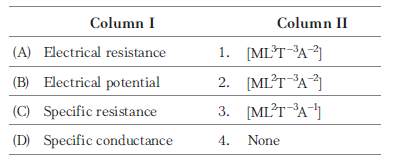
Match the column I with column II and mark the correct option from the codes given below. [Guj. CET 2015]
 CorrectIncorrect
Hint
\(
\begin{aligned}
&\text { (a) The dimensions of electrical resistance, }\\
&R=\frac{V}{I}=\frac{\left(\frac{W}{q}\right)}{I}=\frac{\frac{W}{I t}}{(I)}=\frac{W}{I^2 t}=\left[\mathrm{ML}^2 \mathrm{~T}^{-2} \mathrm{~T}^{-1} \mathrm{~A}^{-2}\right]=\left[\mathrm{ML}^2 \mathrm{~T}^{-3} \mathrm{~A}^{-2}\right]
\end{aligned}
\)
Then, \((\mathrm{A}) \rightarrow(2)\)
The dimensions of electrical potential,
\(
V=\frac{W}{q}=\frac{W}{I t}=\left[\mathrm{ML}^2 \mathrm{~T}^{-2} \mathrm{~A}^{-1} \mathrm{~T}^{-1}\right]=\left[\mathrm{ML}^2 \mathrm{~T}^{-3} \mathrm{~A}^{-1}\right]
\)
Then, (B) \(\rightarrow\) (3)
The dimensions of specific resistance,
\(
\rho=R \frac{A}{l}=\left[\mathrm{ML}^2 \mathrm{~T}^{-3} \mathrm{~A}^{-2}\right][\mathrm{L}]=\left[\mathrm{ML}^3 \mathrm{~T}^{-3} \mathrm{~A}^{-2}\right]
\)
Thus, (C) \(\rightarrow\) (1)
And the dimensions of specific conductance,
\(
\begin{aligned}
\sigma & =\frac{1}{\rho}=\frac{1}{\left[\mathrm{ML}^3 \mathrm{~T}^{-3} \mathrm{~A}^{-2}\right]}=\left[\mathrm{M}^{-1} \mathrm{~L}^{-3} \mathrm{~T}^3 \mathrm{~A}^2\right] \\
& =\text { not given in column }
\end{aligned}
\)
Thus, (D) \(\rightarrow\) (4) - Question 84 of 96
84. Question
The three physical quantities \(x, y\) and \(z\) have units \(\mathrm{g} \mathrm{cm}^2 \mathrm{~s}^{-5}, \mathrm{~g} \mathrm{~s}^{-1}\) and \(\mathrm{cms}^{-2}\), respectively. The relation between \(x, y\) and \(z\) is [AFMC 2015]
CorrectIncorrectHint
\(
\begin{array}{lrl}
\text { (a) Given, } & x & =\mathrm{g} \mathrm{~cm}^2 \mathrm{~s}^{-5}=\left[\mathrm{ML}^2 \mathrm{~T}^{-5}\right] \\
& y & =\mathrm{g} \mathrm{~s}^{-1}=\left[\mathrm{ML}^0 \mathrm{~T}^{-1}\right] \\
\text { and } & z & =\mathrm{cms}^{-2}=\left[\mathrm{M}^0 \mathrm{LT}^{-2}\right] \\
\text { Now, } & z^2 & =\left[\mathrm{M}^0 \mathrm{~L}^2 \mathrm{~T}^{-4}\right] \\
\text { and } & y z^2 & =\left[\mathrm{ML}^0 \mathrm{~T}^{-1}\right]\left[\mathrm{M}^0 \mathrm{~L}^2 \mathrm{~T}^{-4}\right]=\left[\mathrm{ML}^2 \mathrm{~T}^{-5}\right]=x \\
\text { i.e. } & x & =y z^2
\end{array}
\) - Question 85 of 96
85. Question
The dimensional formula for Reynold’s number is [MHT CET 2014]
CorrectIncorrectHint
(a) Reynold’s number describes the ratio of inertial force per unit area to viscous force per unit area for a flowing fluid. Thus, Reynold’s number is the ratio of two physical quantity of same dimension which cancel out each other. Hence, Reynold’s number is dimensionless \(\left[\mathrm{M}^0 \mathrm{~L}^0 \mathrm{~T}^0\right]\) quantity.
- Question 86 of 96
86. Question
The relation between force \(F\) and density \(d\) is \(F=\frac{x}{\sqrt{d}}\). The dimensions of \(x\) are [MHT CET 2014]
CorrectIncorrectHint
\(
\begin{aligned}
& \text { (a) Substituting dimensions, }\left[\mathrm{MLT}^{-2}\right]=\frac{x}{\sqrt{\left[\mathrm{ML}^{-3}\right]}} \\
& \Rightarrow \quad x=\left[\mathrm{M}^{3 / 2} \mathrm{~L}^{-1 / 2} \mathrm{~T}^{-2}\right]
\end{aligned}
\) - Question 87 of 96
87. Question
If the absolute errors in two physical quantities \(A\) and \(B\) are \(a\) and \(b\) respectively, then the absolute error in the value of \(A-B\) are [EAMCET 2014]
CorrectIncorrectHint
\(
\text { (c) The absolute error in the value } A-B \text { will be } a+b \text {. }
\) - Question 88 of 96
88. Question
If \(n\) denotes a positive integer, \(h\) the Planck’s constant, \(q\) the charge and \(B\) the magnetic field, then the quantity \(\left[\frac{n h}{2 \pi q B}\right]\) has the dimension of [WB JEE 2014]
CorrectIncorrectHint
(a) The quantity is given as \(\left[\frac{n h}{2 \pi q B}\right]\), where \(n\) and \(2 \pi\) are dimensionless quantities.
\(
\because \quad m v r=\frac{n h}{2 \pi} \dots(i)
\)
Also using, Bqr \(=m v\)
\(
\Rightarrow \quad B q=m v / r \dots(ii)
\)
Using Eqs. (i) and (ii), we get
\(
\left[\frac{n h}{2 \pi q B}\right]=\frac{m v r}{m v / r}=\left[\mathrm{r}^2\right]
\)
As, \(r\) has the dimension of length, thus the given quantity has the dimension of area. - Question 89 of 96
89. Question
In the equation \(\left(\frac{1}{p \beta}\right)=\frac{y}{k_B T}\), where \(p\) is the pressure, \(y\) is the distance, \(k_B\) is Boltzmann constant and \(T\) is the temperature. Dimensions of \(\beta\) are [EAMCET 2013]
CorrectIncorrectHint
(b) Given equation, \(\frac{1}{p \beta}=\frac{y}{k_B T}\)
where, \(p=\) pressure, \(y=\) distance,
\(k_B=\) Boltzmann constant and \(T=\) temperature.
\(
\begin{aligned}
\text { Dimensions of }[\beta] & =\frac{\left[\text { Dimensions of } k_B\right][\text { Dimensions of } T]}{[\text { Dimensions of } p][\text { Dimensions of } y]} \\
& =\frac{\left[\mathrm{ML}^2 \mathrm{~T}^{-2} \mathrm{~K}^{-1}\right][\mathrm{K}]}{\left[\mathrm{ML}^{-1} \mathrm{~T}^{-2}\right][\mathrm{L}]} \\
& =\left[\mathrm{M}^0 \mathrm{~L}^2 \mathrm{~T}^0\right]
\end{aligned}
\) - Question 90 of 96
90. Question
A physical quantity \(X\) is defined by the formula
\(
X=\frac{I F v^2}{W L^3}
\)
where, \(I\) is moment of inertia, \(F\) is force, \(v\) is velocity, \(W\) is work and \(L\) is length, the dimensions of \(X\) are [MP PMT 2013]CorrectIncorrectHint
\(
\begin{aligned}
&\text { (b) Dimensions of }\\
&\begin{aligned}
\mathrm{f}[X] & =\frac{\text { Dimensions of }\left[I F v^2\right]}{\text { Dimensions of }\left[W L^3\right]} \\
& =\frac{\left[\mathrm{ML}^2\right]\left[\mathrm{MLT}^{-2}\right]\left[\mathrm{LT}^{-1}\right]^2}{\left[\mathrm{ML}^2 \mathrm{~T}^{-2}\right]\left[\mathrm{L}^3\right]} \\
& =\frac{\left[\mathrm{M}^2 \mathrm{~L}^5 \mathrm{~T}^{-4}\right]}{\left[\mathrm{ML}^5 \mathrm{~T}^{-2}\right]}=\left[\mathrm{MT}^{-2}\right]
\end{aligned}
\end{aligned}
\) - Question 91 of 96
91. Question
A physical quantity \(X\) is given by
\(
X=\frac{2 k^3 l^2}{m \sqrt{n}}
\)
The percentage error in the measurements of \(k, l, m\) and \(n[latex] are [latex]1 \%, 2 \%, 3 \%\) and \(4 \%\), respectively. The value of \(X\) is uncertain by [AMU 2012]CorrectIncorrectHint
(c) Here, \(X=\frac{2 k^3 l^2}{m \sqrt{n}}\)
Percentage error in \(X\)
\(
\begin{aligned}
& =\frac{3 \times \Delta k}{k} \times 100+2 \times \frac{\Delta l}{l} \times 100+\frac{\Delta m}{m} \times 100+\frac{1}{2} \times \frac{\Delta n}{n} \times 100 \\
& =\left(3 \times 1 \%+2 \times 2 \%+3 \% \times 1+4 \% \times \frac{1}{2}\right)=12 \%
\end{aligned}
\) - Question 92 of 96
92. Question
The quantities \(A\) and \(B\) are related by the relation \(m=A / B\), where \(m\) is the linear density and \(A\) is the force. The dimensions of \(B\) are of [BCECE 2012]
CorrectIncorrectHint
(b) Given, \(m=\frac{A}{B}\)
\(\therefore\) Dimensions of \(B=[B]=\frac{[A]}{[m]}\)
Here, \(A=\) force \(=\left[\mathrm{MLT}^{-2}\right]\)
and \(m=\) linear density \(=\) mass per unit length \(=\frac{[\mathrm{M}]}{[\mathrm{L}]}\)
\(
\begin{aligned}
&\therefore \quad[B]=\frac{\left[\mathrm{MLT}^{-2}\right]}{\left[\mathrm{ML}^{-1}\right]}=\left[\mathrm{L}^2 \mathrm{~T}^{-2}\right]\\
&\text { These are same dimensions as that of latent heat. }
\end{aligned}
\) - Question 93 of 96
93. Question
A physical quantity is given by \(X=\left[\mathrm{M}^a \mathrm{~L}^b \mathrm{~T}^c\right]\). The percentage error in measurement of \(\mathrm{M}, \mathrm{L}\) and T are \(\alpha, \beta\) and \(\gamma\), respectively. Then, the maximum % error in the quantity \(X\) is [AFMC 2012]
CorrectIncorrectHint
(a) Given, \(X=\left[\mathrm{M}^a \mathrm{~L}^b \mathrm{~T}^c\right]\)
Maximum % error in \(X=a \alpha+b \beta+c \gamma\) - Question 94 of 96
94. Question
1 If \(p=\frac{R T}{V-b} e^{-\alpha V / R T}\), then dimensional formula of \(\alpha\) is [UP CPMT 2011]
CorrectIncorrectHint
(a) Given, \(p=\frac{R T}{V-b} e^{-\alpha V / R T}\)
So, \(\frac{\alpha V}{R T}\) is dimensionless.
Hence, \([\alpha]=\left[\frac{R T}{V}\right]=\frac{\left[\mathrm{ML}^2 \mathrm{~T}^{-2} \theta^{-1}\right][\theta]}{\left[\mathrm{L}^3\right]}=\left[\mathrm{ML}^{-1} \mathrm{~T}^{-2}\right]\)
This is the dimensional formula of pressure \((p)\). - Question 95 of 96
95. Question
Velocity \(v\) is given by \(v=a t^2+b t+c\), where \(t\) is time. What are the dimensions of \(a, b\) and \(c\), respectively? [UP CPMT 2011]
CorrectIncorrectHint
(a) Dimensions of velocity are \([v]=[\mathrm{L}]\left[\mathrm{T}^{-1}\right]\)
So, dimensions of \(\left[a t^2\right]=\left[\mathrm{LT}^{-1}\right]\)
\(
\Rightarrow \quad[a]\left[\mathrm{T}^2\right]=\left[\mathrm{LT}^{-1}\right]
\)
\(
\begin{aligned}
& \text { Dimensions of }[b t]=\left[\mathrm{LT}^{-1}\right] \Rightarrow[b][\mathrm{T}]=\left[\mathrm{LT}^{-1}\right] \\
& \Rightarrow \quad[b]=\left[\mathrm{LT}^{-2}\right]
\end{aligned}
\)
Dimensions of \([c]=\left[\mathrm{LT}^{-1}\right]\) - Question 96 of 96
96. Question
From the dimensional consideration, which of the following equations is correct? [Haryana PMT 2011]
CorrectIncorrectHint
(a) Taking, \(T=2 \pi \sqrt{\frac{R^3}{G M}}\)
Substituting the dimensions, LHS \(=T=[\mathrm{T}]\)
\(
\mathrm{RHS}=2 \pi \sqrt{\frac{R^3}{G M}}=\sqrt{\frac{[\mathrm{L}]^3}{\left[\mathrm{M}^{-1} \mathrm{~L}^3 \mathrm{~T}^{-2}\right][\mathrm{M}]}}=\sqrt{[\mathrm{T}]^2}=[\mathrm{T}]
\)
Thus, LHS \(=\) RHS for \(T=2 \pi \sqrt{\frac{R^3}{G M}}\).