NCERT Exemplar + Extra MCQs
Quiz Summary
0 of 84 Questions completed
Questions:
Information
You have already completed the quiz before. Hence you can not start it again.
Quiz is loading…
You must sign in or sign up to start the quiz.
You must first complete the following:
Results
Results
0 of 84 Questions answered correctly
Your time:
Time has elapsed
You have reached 0 of 0 point(s), (0)
Earned Point(s): 0 of 0, (0)
0 Essay(s) Pending (Possible Point(s): 0)
Categories
- Not categorized 0%
- 1
- 2
- 3
- 4
- 5
- 6
- 7
- 8
- 9
- 10
- 11
- 12
- 13
- 14
- 15
- 16
- 17
- 18
- 19
- 20
- 21
- 22
- 23
- 24
- 25
- 26
- 27
- 28
- 29
- 30
- 31
- 32
- 33
- 34
- 35
- 36
- 37
- 38
- 39
- 40
- 41
- 42
- 43
- 44
- 45
- 46
- 47
- 48
- 49
- 50
- 51
- 52
- 53
- 54
- 55
- 56
- 57
- 58
- 59
- 60
- 61
- 62
- 63
- 64
- 65
- 66
- 67
- 68
- 69
- 70
- 71
- 72
- 73
- 74
- 75
- 76
- 77
- 78
- 79
- 80
- 81
- 82
- 83
- 84
- Current
- Review
- Answered
- Correct
- Incorrect
- Question 1 of 84
1. Question
Which of the following sets cannot enter into the list of fundamental quantities in any system of units?
Hint
(b) length, time and velocity.
Explanation:
A fundamental quantity is a physical quantity that cannot be derived from other quantities. Velocity is defined as the distance traveled over time ( \(\mathrm{V}=\mathrm{L} / \mathrm{T}\) ), meaning it is derived from length and time. Since velocity can be calculated from other fundamental quantities, it cannot be considered a fundamental quantity itself. - Question 2 of 84
2. Question
A physical quantity is measured and the result is expressed as \(n u\) where \(u\) is the unit used and \(n\) is the numerical value. If the result is expressed in various units then
- Question 3 of 84
3. Question
Suppose a quantity \(x\) can be dimensionally represented in terms of \(\mathrm{M}, \mathrm{L}\) and \(\mathrm{T}\), that is, \([x]=\mathrm{M}^{a} \mathrm{~L}^{b} \mathrm{~T}^{c}\). The quantity mass
- Question 4 of 84
4. Question
A dimensionless quantity
- Question 5 of 84
5. Question
A unitless quantity
- Question 6 of 84
6. Question
\(
\int \frac{d x}{\sqrt{2 a x-x^{2}}}=a^{n} \sin ^{-1}\left[\frac{x}{a}-1\right] \text {. }
\)
The value of \(n\) is - Question 7 of 84
7. Question
The dimensions \(\mathrm{ML}^{-1} \mathrm{~T}^{-2}\) may correspond to
- Question 8 of 84
8. Question
Choose the correct statement(s):
- Question 9 of 84
9. Question
Choose the correct statement(s)
- Question 10 of 84
10. Question
\(\text { The volume of a cube of side } 1 \mathrm{~cm} \text { is equal to } \ldots . \mathrm{m}^{3}\)
- Question 11 of 84
11. Question
The surface area of a solid cylinder of radius \(2.0 \mathrm{~cm}\) and height \(10.0 \mathrm{~cm}\) is equal to … \((\mathrm{mm})^{2}\)
Hint
Surface area \(=2 \pi r h+2 \pi r^{2}=2 \pi r(h+r)\) \(=2 \times 22 / 7 \times 2 \times 10(10 \times 10+2 \times 10) \mathrm{mm}^{2}=1.5 \times 10^{4} \mathrm{~mm}^{2}\)
- Question 12 of 84
12. Question
\(\text { A vehicle moving with a speed of } 18 \mathrm{~km} \mathrm{~h}^{-1} \text { covers….m in } 1 \mathrm{~s}\)
- Question 13 of 84
13. Question
\(\text { The relative density of lead is } 11.3 \text {. Its density is } \ldots . g \mathrm{~cm}^{-3} \text { or } \ldots . \mathrm{kg} \mathrm{} \mathrm{m}^{-3} \text {. }\)
Hint
Density \(=11.3 \mathrm{~g} \mathrm{~cm}^{-3}\)
\(
\begin{aligned}
&=11.3 \times 10^{3} \mathrm{~kg} \mathrm{~m}^{-3}\left[1 \mathrm{~kg}=10^{3} \mathrm{~g}, 1 \mathrm{~m}=10^{2} \mathrm{~cm}\right] \\
&=11.3 \times 10^{3} \mathrm{~kg} \mathrm{~m}^{-4}
\end{aligned}
\) - Question 14 of 84
14. Question
\(1 \mathrm{~kg} \mathrm{~m}^{2} \mathrm{~s}^{-2}=\ldots \mathrm{~g} \mathrm{~cm}{ }^{2} \mathrm{~s}^{-2}\)
- Question 15 of 84
15. Question
\(1 \mathrm{~m}=\ldots \ldots \mathrm{ly}\)
Hint
\(1 \mathrm{~m} \quad=\frac{1}{9.46 \times 10^{5}} \mathrm{ly} \approx \frac{1}{10^{16}} \mathrm{ly}=10^{-16} \mathrm{ly}\)
- Question 16 of 84
16. Question
\(G=6.67 \times 10^{-11} \mathrm{~N} \mathrm{~m}^{2}(\mathrm{~kg})^{-2}=\ldots .(\mathrm{cm})^{3} \mathrm{~s}^{-2} \mathrm{~g}^{-1}\)
Hint
\(G\)
\(
\begin{aligned}
&=6.67 \times 10^{-11} \mathrm{Nm}^{2} \mathrm{~kg}^{-2}=6.67 \times 10^{-11} \frac{\mathrm{kg} \mathrm{m}}{\mathrm{s}^{2}} \mathrm{~m}^{2} \mathrm{~kg}^{-2} \\
&=6.67 \times 10^{-11} \mathrm{~kg}^{-1} \mathrm{~m}^{3} \mathrm{~s}^{-2} \\
&=6.67 \times 10^{-11} \frac{\mathrm{m}^{3}}{\mathrm{~kg} \mathrm{~s}^{2}}=\frac{6.67 \times 10^{-11} \times\left(10^{2}\right)^{3}}{\left(10^{3}\right)^{2}} \\
&=6.67 \times 10^{-8} \mathrm{~cm}^{-3} \mathrm{~s}^{-2} \mathrm{~g}^{-1} .
\end{aligned}
\) - Question 17 of 84
17. Question
A new unit of length is chosen such that the speed of light in vacuum is unity. What is the distance between the Sun and the Earth in terms of the new unit if light takes \(8 \mathrm{~min}\) and \(20 \mathrm{~s}\) to cover this distance?
Hint
Answer: Distance between Sun and Earth
= Speed of light in vacuum x time taken by light to travel from Sun to Earth \(=3 \times 10^{8} \mathrm{~m} / \mathrm{s} \times 8 \mathrm{~min} 20 \mathrm{~s}=3 \times\) \(10^{8} \mathrm{~m} / \mathrm{s} \times 500 \mathrm{~s}=500 \times 3 \times 10^{8} \mathrm{~m}\).
In the new system, the speed of light in vacuum is unity. So, the new unit of length is \(3 \times 10^{8} \mathrm{~m}\).
\(\therefore\) distance between Sun and Earth =500 new units. - Question 18 of 84
18. Question
Which of the following is the most precise device for measuring length:
Hint
(a) Least count of vernier callipers \(=1 / 20=0.05 \mathrm{~mm}=5 \times 10^{-5} \mathrm{~m}\)
(b) Least count of screw gauge =Pitch/No. of divisions on circular scale \(=1 \times 10^{-3} / 100=1 \times 10^{-5} \mathrm{~m}\)
(c) Least count of optical instrument \(=6000 \mathrm{~A}\) (average wavelength of visible light as \(6000 \mathrm{~A})=6 \times 10^{-7} \mathrm{~m}\). As the least count of optical instrument is least, it is the most precise device out of three instruments given to us. - Question 19 of 84
19. Question
A student measures the thickness of a human hair by looking at it through a microscope of magnification 100. He makes 20 observations and finds that the average width of the hair in the field of view of the microscope is \(3.5 \mathrm{~mm}\). What is the estimate of the thickness of the hair?
Hint
As magnification, \(m\) =thickness of image of hair/ real thickness of hair \(=100\) and average width of the image of hair as seen by microscope \(=3.5 \mathrm{~mm}\)
\(\therefore\) Thickness of hair \(=3.5 \mathrm{~mm} / 100=0.035 \mathrm{~mm}\) - Question 20 of 84
20. Question
The photograph of a house occupies an area of \(1.75 \mathrm{~cm}^{2}\) on a \(35 \mathrm{~mm}\) slide. The slide is projected onto a screen, and the area of the house on the screen is \(1.55 \mathrm{~m}^{2}\). What is the linear magnification of the projector-screen arrangement.
Hint
Answer: Here area of the house on slide \(=1.75 \mathrm{~cm}^{2}=1.75 \times 10^{-4} \mathrm{~m}^{2}\) and area of the house of projector-
screen \(=1.55 \mathrm{~m}^{2}\)
\(\therefore\) Areal magnification =Area on screen/Area on slide \(=1.55 \mathrm{~m}^{2} / 1.75 \times 10^{-4} \mathrm{~m}^{2}=8.857 \times 10^{3}\)
\(\therefore\) Linear magnification
\(=\sqrt{\text { Areal magnification }}\)
\(
=\sqrt{(8.857) \times 10^{3}}
\)
\(
=94.1 \text {. }
\) - Question 21 of 84
21. Question
A book with many printing errors contains four different formulas for the displacement \(y\) of a particle undergoing a certain periodic motion:
( \(a=\) maximum displacement of the particle, \(v=\) speed of the particle. \(T=\) time-period of motion). which formulas are wrong on dimensional grounds.
Hint
(a) \(y=a \sin \frac{2 \pi t}{T}\)
Here, \([L.H.S.]=[y]=[L]\)
and \([R.H.S.]=\left[a \sin \frac{2 \pi t}{T}\right]=\left[L \sin \frac{T}{T}\right]=[L]\)
So, it is correct.
(b) \(y=a \sin v t\)
Here, \([y]=[L]\) and \([a \sin v t]=\left[L \sin \left(L T^{-1} . T\right)\right]=[L \sin L]\) So, the equation is wrong.
(c) \(y=\left(\frac{a}{T}\right) \sin \frac{t}{a}\)
Here, \(\quad[y]=[L]\) and \(\left[\left(\frac{a}{T}\right) \sin \frac{t}{a}\right]=\left[\frac{L}{T} \sin \frac{T}{L}\right]=\left[L T^{-1} \sin T L^{-1}\right]\)
So, the equation is wrong.
(d) \(y=(a \sqrt{2})\left(\sin \frac{2 \pi t}{T}+\cos \frac{2 \pi t}{T}\right)\)
Here, \(\quad[y]=[L],[a \sqrt{2}]=[L]\)
and \(\left[\sin \frac{2 \pi t}{T}+\cos \frac{2 \pi t}{T}\right]=\left[\sin \frac{T}{T}+\cos \frac{T}{T}\right]=\) dimensionless. So, it is correct. - Question 22 of 84
22. Question
The unit of length convenient on the atomic scale is known as an angstrom and is denoted by \(Å: 1 Å =10^{-10} \mathrm{~m}\). The size of a hydrogen atom is about \(0.5 \). What is the total atomic volume in \(\mathrm{m}^{3}\) of a mole of hydrogen atoms?
Hint
Volume of one hydrogen atom = \(\frac{4}{3} \pi r^{3}\) (volume of a sphere)
\(
=4 / 3 \times 3.14 \times\left(0.5 \times 10^{-10}\right) \mathrm{m}^{3}=5.23 \times 10^{-31} \mathrm{~m}^{3}
\)
According to Avagadro’s hypothesis, one mole of hydrogen contains \(6.023 \times 10^{23}\) atoms.
The atomic volume of 1 mole of hydrogen atoms
\(
=6.023 \times 1023 \times 5.23 \times 10^{-31}=3.15 \times 10^{-7} \mathrm{~m}^{3} \text {. }
\) - Question 23 of 84
23. Question
The length, breadth, and thickness of a rectangular sheet of metal are \(4.234 \mathrm{~m}, 1.005 \mathrm{~m}\), and \(2.01 \mathrm{~cm}\) respectively. what is the area and volume of the sheet to correct significant figures?
Hint
As Area \(=(4.234 \times 1.005) \times 2=8.51034=8.5 \mathrm{~m}^{2}\)
\(
\text { Volume }=(4.234 \times 1.005) \times\left(2.01 \times 10^{-2}\right)=8.55289 \times 10^{-2}=0.0855 \mathrm{~m}^{3} \text {. }
\) - Question 24 of 84
24. Question
A physical quantity \(P\) is related to four observables \(a, b, c\) and \(d\) as follows :
\(
P=a^{3} b^{2} /(\sqrt{c} d)
\)
The percentage errors of measurement in \(a, b, c\) and d are \(1 \%, 3 \%, 4 \%\) and \(2 \%\), respectively. What is the percentage error in the quantity \(P\) ? If the value of \(P\) calculated using the above relation turns out to be \(3.763\), to what value should you round off the result?Hint
As \(P=\frac{a^{3} b^{2}}{(\sqrt{c} d)}=a^{3} b^{2} c^{-1 / 2} d^{-1}\)
\(\therefore\) Maximum fractional error in the measurement
\(
\frac{\Delta P}{P}=3 \frac{\Delta a}{a}+2 \frac{\Delta b}{b}+\frac{1}{2} \frac{\Delta c}{c}+\frac{\Delta d}{d}
\)
As \(\quad \frac{\Delta a}{a}=1 \%, \quad \frac{\Delta b}{b}=3 \%, \quad \frac{\Delta c}{c}=4 \%\) and \(\frac{\Delta d}{d}=2 \%\)
\(\therefore\) Maximum fractional error in the measurement
\(
\begin{aligned}
\frac{\Delta P}{P} &=3 \times 1 \%+2 \times 3 \%+\frac{1}{2} \times 4 \%+2 \% \\
&=3 \%+6 \%+2 \%+2 \%=13 \%
\end{aligned}
\)
If \(P=3.763\), then \(\Delta P=13 \%\) of \(P\)
\(
=\frac{13 P}{100}=\frac{13 \times 3.763}{100}=0.489
\)
As the error lies in the first decimal place, the answer should be rounded off to the first decimal place. Hence, we shall express the value of \(P\) after rounding it off as \(P=3.8\). - Question 25 of 84
25. Question
It is claimed that two cesium clocks if allowed to run for 100 years, free from any disturbance, may differ by only about \(0.02 \mathrm{~s}\). What does this imply for the accuracy of the standard cesium clock in measuring a time-interval of \(1 \mathrm{~s}\)?
Hint
Answer: Total time \(=100\) years \(=100 \times 365 \times 24 \times 60 \times 60 \mathrm{~s}\)
Error in 1 second \(=0.02 / 100 \times 365 \times 24 \times 60 \times 60\) \(=6.34 \times 10^{-12} \mathrm{~s}\)
\(\therefore\) Accuracy of 1 part in \(10^{11}\) to \(10^{12}\). - Question 26 of 84
26. Question
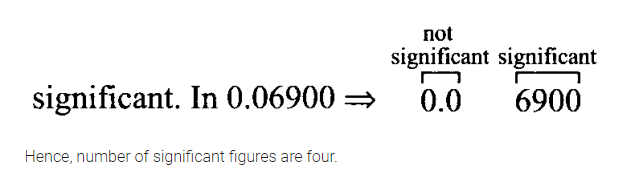
The number of significant figures in 0.06900 is
Hint
Key concept: Significant figures in the measured value of a physical quantity tell the number of digits in which we have confidence. Larger the number of significant figures obtained in a measurement, greater is the accuracy of the measurement. The reverse is also true.
The following rules are observed in counting the number of significant figures in a given measured quantity.
1. All non-zero digits are significant.
2. A zero becomes significant figure if it appears between two non-zero digits.
3. Leading zeros or the zeros placed to the left of the number are never significant.
4. Trailing zeros or the zeros placed to the right of the number are significant.
5. In exponential notation, the numerical portion gives the number of significant figures.
Leading zeros or the zeros placed to the left of the number are never
- Question 27 of 84
27. Question
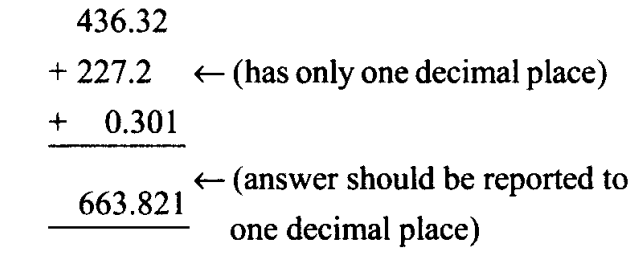
The sum of the numbers 436.32,227.2 and 0.301 in appropriate significant figures is
Hint
(b) The result of an addition or subtraction in the number having different precisions should be reported to the same number of decimal places as present in the number having the least number of decimal places.

The final result should, therefore, be rounded off to one decimal place, i.e. 664.
- Question 28 of 84
28. Question
The mass and volume of a body are \(4.237 \mathrm{~g}\) and \(2.5 \mathrm{~cm}^3\), respectively. The density of the material of the body in correct significant figures is
Hint
(c) The answer to a multiplication or division is rounded off to the same number of significant figures as possessed by the least precise term used in the calculation. The final result should retain as many significant figures as are there in the original number with the least significant figures. In the given question, density should be reported to two significant figures
\(
\text { Density }=\frac{4.237 \mathrm{~g}}{2.5 \mathrm{~cm}^3}=1.6948
\)
After rounding off the number, we get density \(=1.7\) - Question 29 of 84
29. Question
The numbers 2.745 and 2.735 on rounding off to 3 significant figures will give
Hint
Key concept: While rounding off measurements, we use the following rules by convention:
1. If the digit to be dropped is less than 5 , then the preceding digit is left unchanged.
2. If the digit to be dropped is more than 5, then the preceding digit is raised by one.
3. If the digit to be dropped is 5 followed by digits other than zero, then the preceding digit is raised by one.
4. If the digit to be dropped is 5 or 5 followed by zeros, then the preceding digit is left unchanged if it is even.
5. If the digit to be dropped is 5 or 5 followed by zeros, then the preceding digit is raised by one, if it is odd.
Units and Measurements
Let us round off 2.745 to 3 significant figures.
Here the digit to be dropped is 5 , then preceding digit is left unchanged, if it is even.
Hence on rounding off 2.745, it would be 2.74.
Now consider 2.737, here also the digit to be dropped is 5, then the preceding digit is raised by one, if it is odd. Hence on rounding off 2.735 to 3 significant figures, it would be 2.74. - Question 30 of 84
30. Question
The length and breadth of a rectangular sheet are \(16.2 \mathrm{~cm}\) and \(10.1 \mathrm{~cm}\), respectively. The area of the sheet in appropriate significant figures and error is
Hint
Key concept: Error in product of quantities: Suppose \(x=a \times b\)
Let \(\Delta a=\) absolute error in measurement of \(a\),
\(\Delta b=\) absolute error in measurement of \(b\),
\(\Delta x=\) absolute error in calculation of \(x\), i.e. product of \(a\) and \(b\).
The maximum fractional error in \(x\) is \(\frac{\Delta x}{x}= \pm\left(\frac{\Delta a}{a}+\frac{\Delta b}{b}\right)\)
Percentage error in the value of \(x=(\) Percentage error in value of \(a)+\)
(Percentage error in value of \(b\) )
According to the problem, length \(l=(16.2 \pm 0.1) \mathrm{cm}\)
Breadth \(b=(10.1 \pm 0.1) \mathrm{cm}\)
Area \(A=l \times b=(16.2 \mathrm{~cm}) \times(10.1 \mathrm{~cm})=163.62 \mathrm{~cm}^2\)
As per the rule area will have only three significant figures and error will have only one significant figure. Rounding off we get, area \(A=164 \mathrm{~cm}^2\)
If \(\Delta A\) is error in the area, then relative error is calculated as \(\frac{\Delta A}{A}\).
\(
\begin{aligned}
\frac{\Delta A}{A}=\frac{\Delta l}{l}+\frac{\Delta b}{b} & =\frac{0.1 \mathrm{~cm}}{16.2 \mathrm{~cm}}+\frac{0.1 \mathrm{~cm}}{10.1 \mathrm{~cm}} \\
& =\frac{1.01+1.62}{16.2 \times 10.1}=\frac{2.63}{163.62} \\
\Rightarrow \Delta A & =A \times \frac{2.63}{163.62} \mathrm{~cm}^2=163.62 \times \frac{2.63}{163.62}=2.63 \mathrm{~cm}^2
\end{aligned}
\)
\(\Delta A=3 \mathrm{~cm}^2\) (By rounding off to one significant figure)
Area, \(A=A \pm \Delta A=(164 \pm 3) \mathrm{cm}^2\) - Question 31 of 84
31. Question
Which of the following pairs of physical quantities does not have same dimensional formula?
Hint
\(
\begin{aligned}
& \text { Work }=F \times \Delta x=\left[M L T^{-2}\right][L]=\left[M L^2 T^{-2}\right] \\
& \text { Torque = force } \times \text { distance }=\left[M L^2 T^{-2}\right] \\
& \text { Angular momentum }=m v r=[M]\left[L T^1\right][L]=\left[M L^2 T^{-1}\right] \\
& \text { Planck’s constant }=\frac{E}{V}=\frac{\left[M L^2 T^{-2}\right]}{\left[T^{-1}\right]}=\left[M L^2 T^{-1}\right]
\end{aligned}
\)
(b) Angular momentum \(=\operatorname{mvr}=[M]\left[L T^1\right][L]=\left[M L^2 T^{-1}\right]\)
Planck’s constant \(=\frac{E}{V}=\frac{\left[M L^2 T^{-2}\right]}{\left[T^{-1}\right]}=\left[M L^2 T^{-1}\right]\)
(c) Tension (force) \(=\left[M L T^{-2}\right]\)
Surface tension \(=\frac{\text { force }}{\text { length }}=\frac{\left[M L T^{-2}\right]}{[L]}=\left[M L^0 T^{-2}\right]\)
(d) Impulse \(=F \times \Delta t=\left[M L T^{-2}\right][T]=\left[M L T^{-1}\right]\)
Momentum \(=\) mass \(\times\) velocity \(=[M]\left[L T^{-1}\right]=\left[M L T^{-1}\right]\)
So, among the above pairs only tension and surface tension does not have same dimensional formula. They both sound similar but they both have different meaning and different applications. - Question 32 of 84
32. Question
Measure of two quantitles along with the precision of respective measuring instrument is
\(
\begin{aligned}
& A=2.5 \mathrm{~m} \mathrm{~s}^{-1} \pm 0.5 \mathrm{~m} \mathrm{~s}^{-1} \\
& B=0.10 \mathrm{~s} \pm 0.01 \mathrm{~s}
\end{aligned}
\)
The value of \(A B\) will beHint
(a) According to the problem,
\(
\begin{aligned}
A & =2.5 \mathrm{~ms}^{-1} \pm 0.5 \mathrm{~ms}^{-1}, B=0.10 \mathrm{~s} \pm 0.01 \mathrm{~s} \\
Z & =A B=(2.5)(0.10)=0.25 \mathrm{~m} \\
\frac{\Delta Z}{Z} & =\frac{\Delta A}{A}+\frac{\Delta B}{B}, \Delta Z=Z\left(\frac{\Delta A}{A}+\frac{\Delta B}{B}\right) \\
& =0.25\left(\frac{0.5}{2.5}+\frac{0.01}{0.10}\right)=0.25(0.2+0.1)=0.075 \\
\Delta Z & =0.075=0.08 \mathrm{~m} \quad \text { (rounding off to two significant figures.) }
\end{aligned}
\)
Thus, measured value of \(A B\), i.e., \(=Z \pm \Delta Z=(0.25 \pm 0.08) \mathrm{m}\) - Question 33 of 84
33. Question
You measure two quanttles as \(A=1.0 \mathrm{~m} \pm 0.2 \mathrm{~m}, B=2.0 \mathrm{~m} \pm 0.2 \mathrm{~m}\). We should report correct value for \(\sqrt{\mathrm{AB}}\) as:
Hint
(d) According to the problem, \(A=1.0 \mathrm{~m} \pm 0.2 \mathrm{~m}, B=2.0 \mathrm{~m} \pm 0.2 \mathrm{~m}\)
Let, \(Z=\sqrt{A B}=\sqrt{(1.0)(2.0)}=1.414 \mathrm{~m}\)
Rounding off to two significant digits \(Z=1.4 \mathrm{~m}\)
As
\(
\begin{aligned}
\frac{\Delta Z}{Z} & =\frac{1}{2} \frac{\Delta A}{A}+\frac{1}{2} \frac{\Delta B}{B} \\
& =\frac{1}{2}\left(\frac{0.2 \mathrm{~m}}{1 \mathrm{~m}}\right)+\frac{1}{2}\left(\frac{0.2 \mathrm{~m}}{2 \mathrm{~m}}\right)=0.15
\end{aligned}
\)
\(
\Rightarrow \Delta Z=Z(0.15)=1.4 \mathrm{~m}(0.15)=0.212
\)
Rounding off to one significant digit, \(\Delta Z=0.2 \mathrm{~m}\)
The correct value for \(\sqrt{A B}=1.4 \pm 0.2 \mathrm{~m}\). - Question 34 of 84
34. Question
Which of the following measurements is most precise?
Hint
Key concept: Precision is the degree to which several measurements provide answers very close to each other. It is an indicator of the scatter in the data. The lesser the scatter, the higher the precision. Let us first check the units. In all the options magnitude is the same but the units of measurement are different. As here \(5.00 \mathrm{~mm}\) has the smallest unit. All given measurements are correct up to two decimal places. However, the absolute error in (a) is \(0.01 \mathrm{~mm}\) which is the least of all the four. So it is most precise.
- Question 35 of 84
35. Question
The mean length of an object is \(5 \mathrm{~cm}\). Which of the following measurements is most accurate?
Hint
Key concept: Accuracy describes the nearness of a measurement to the standard or true value, i.e. a highly accurate measuring device will provide measurements very close to the standard, true or known values. Example: In target shooting, a high score indicates the nearness to the bull’s eye and is a measure of the shooter’s accuracy.
According to the problem, length \(l=5 \mathrm{~cm}\)
Let us first check the errors in each values by picking options one by one, we get
\(
\begin{array}{ll}
\Delta l_1=5-4.9=0.1 \mathrm{~cm}, & \Delta l_2=5-4.805=0.195 \mathrm{~cm}, \\
\Delta l_3=5.25-5=0.25 \mathrm{~cm} \text { and } & \Delta l_4=5.4-5=0.4 \mathrm{~cm}
\end{array}
\)
Error \(\Delta l_1\) is the least.
Hence \(4.9 \mathrm{~cm}\) is most closer to true value. So, 4.9 is more accurate. - Question 36 of 84
36. Question
Youngs modulus of steel is \(1.9 \times 10^{11} \mathrm{~N} / \mathrm{m}^2\). When expressed in CGS units of dynes \(/ \mathrm{cm}^2\), it will be equal to \(\left(1 \mathrm{~N}=10^5\right.\) dyne, \(1 \mathrm{~m}^2=10^4 \mathrm{~cm}^2\) )
Hint
(c) According to the problem,
Young’s modulus, \(Y=1.9 \times 10^{11} \mathrm{~N} / \mathrm{m}^2\)
\(1 \mathrm{~N}\) in SI system of units \(=10^5\) dyne in C.G.S system.
Hence, \(\quad Y=1.9 \times 10^{11} \times 10^5\) dyne \(/ \mathrm{m}^2\)
In C.G.S. length is measured in unit ‘ \(\mathrm{cm}\) ‘, so we should also convert \(\mathrm{m}\) into \(\mathrm{cm}\).
\(
\begin{aligned}
\therefore \quad Y & =1.9 \times 10^{11}\left(\frac{10^5 \text { dyne }}{10^4 \mathrm{~cm}^2}\right) \quad[\because 1 \mathrm{~m}=100 \mathrm{~cm}] \\
& =1.9 \times 10^{12} \text { dyne } / \mathrm{cm}^2
\end{aligned}
\) - Question 37 of 84
37. Question
If momentum \((P)\), area \((A)\) and time \((T)\) are taken to be fundamental quantities, then energy has the dimensional formula
Hint
(d) According to the problem, fundamental quantities are momentum \((p)\), area \((A)\), and time \((T)\) and we have to express energy in these fundamental quantities.
Let energy \(E\),
\(
E \propto p^a A^A T^c \Rightarrow E=k p^a A^A T^c
\)
where, \(k\) is dimensionless constant of proportionality.
Dimensional formula of energy, \([E]=\left[M L^2 T^{-2}\right]\) and \([p]=\left[M L T^{-1}\right]\)
\(
[A]=\left[L^2\right],[T]=[T] \text { and }[E]=[K][p]^a[A]^b[T]^c
\)
Putting all the dimensions, we get
\(
\begin{aligned}
M L^2 T^{-2} & =\left[M L T^{-1}\right]^a\left[L^2\right]^b[T]^c \\
& =M^a L^{a+2 b} T^{-a+c}
\end{aligned}
\)
According to the principle of homogeneity of dimensions, we get
\(
\begin{aligned}
& a=1 \dots(i) \\
& a+2 b=2 \dots(ii) \\
& -a+c=-2 \dots(iii)
\end{aligned}
\)
By solving these equations (i), (ii) and (iii), we get
\(
a=1, b=\frac{1}{2}, c=-1
\)
Dimensional formula for \(E\) is \(\left[p^1 A^{1 / 2} t^{-1}\right]\). - Question 38 of 84
38. Question
On the basis of dimensions, decide which of the following relations for the displacement of a particle undergoing simple harmonic motion is not correct:
Hint
(b, c) The argument of trigonometric functions (sin, cos etc.) should be dimensionless. \(y\) is displacement and according to the principle of homogeneity of dimensions LHS and RHS.
\(
\begin{aligned}
& {[Y]=[L],[a]=[L]} \\
& {\left[\frac{2 \pi t}{T}\right]=\frac{[T]}{[T]}=\left[T^0\right]} \\
& {[v t]=[v][t]=\left[L T^{-1}\right][T]=[L]} \\
& {\left[\frac{a}{T}\right]=\frac{[a]}{[T]}=\frac{[L]}{[T]}=\left[L T^{-1}\right]} \\
& {\left[\frac{t}{a}\right]=\left[L^{-1} T\right]} \\
& {[\text { LHS }] \neq[\text { RHS }]}
\end{aligned}
\)
Hence, (c) is not the correct option. \(\Rightarrow\) LHS \(\neq\) RHS.
So, option (b) is also not correct. - Question 39 of 84
39. Question
If \(P, Q, R\) are physical quantities, having different dimensions, which of the following combinations can never be a meaningful quantity?
Hint
\((a, e)\)
Key concept: Principle of Homogeneity of dimensions: It states that in a correct equation, the dimensions of each term added or subtracted must be same. Every correct equation must have same dimensions on both sides of the equation.
According to the problem \(P, Q\) and \(R\) are having different dimensions, since, sum and difference of physical dimensions, are meaningless, i.e., \((P-Q)\) and \((R+Q)\) are not meaningful.
So in option (b) and (c), PQ may have the same dimensions as those of \(R\) and in option (d) \(P R\) and \(Q^2\) may have same dimensions as those of \(R\).
Hence, they cannot be added or subtracted, so we can say that (a) and (e) are not meaningful. - Question 40 of 84
40. Question
Photon is quantum of radiation with energy \(E=h v\) where \(v\) is frequency and \(h\) is Planck’s constant. The dimensions of \(h\) are the same as that of
Hint
(b, d) We know that energy of radiation, \(E=h v\). So, we have to compare \(h\) with dimensional formula of each option.
\(
\begin{aligned}
{[h] } & =\frac{[E]}{[v]}=\frac{\text { force } \times \text { displacement }}{\text { frequency }} \\
& =\frac{\left[M L^2 T^{-2}\right]}{\left[T^{-1}\right]}=\left[M L^2 T^{-1}\right]
\end{aligned}
\)
(a) Dimension of linear impulse
\(
[I]=[F t]=\left[M L T^{-2}\right][T]=\left[M L T^{-1}\right]
\)
where, \(t\) is the time interval.
(b) Dimension of angular impulse
\(
[J]=[I \omega]=\left[M L^2\right]\left[T^{-1}\right]=\left[M L^2 T^{-1}\right]
\)
(c) Dimensión of linear momentum
\(
[P]=[m v]=[M]\left[L T^{-1}\right]=\left[M L T^{-1}\right]
\)
(d) Dimension of angular momentum
\(
[L]=[m v r]=[M]\left[L T^{-1}\right][L]=\left[M L^2 T^{-1}\right]
\)
Hence, the dimension of angular impulse and angular momentum is the same as Planck’s constant \((h)\). - Question 41 of 84
41. Question
If Planck’s constant \((h)\) and speed of light in vacuum \((c)\) are taken as two fundamental quantities, which one of the following can, in addition, be taken to express length, mass and time in terms of the three chosen fundamental quantities?
Hint
(a, b, d) We know that dimension of \(h\)
\(
[h]=\frac{\left[M L^2 T^{-2}\right]}{\left[T^{-1}\right]}=\left[M L^2 T^{-1}\right],[G]=\left[M^{-1} L^3 T^{-2}\right],[c]=\left[L T^{-1}\right]
\)
For mass, let \(m=c^a h^b G^c\) where \(a, b\) and \(c\) are exponents of \(c, h\) and \(G\) respectively.
\(
\Rightarrow \quad\left[M L^0 T^0\right]=\left[L T^{-1}\right]^a\left[M L^2 T^{-1}\right]^b\left[M^{-1} L^3 T^{-2}\right]^c
\)
Using the principle of homogeneity of dimensions,
\(
\begin{aligned}
& b-c=1 \dots(i) \\
& a+2 b+3 c=0 \dots(ii) \\
& -a-b-2 c=0 \dots(iii)
\end{aligned}
\)
Adding eqns. (i), (ii) and (iii),
\(
2 b=1 \Rightarrow b=1 / 2
\)
From eqn. (i), \(a=b-1=\frac{1}{2}-1=-\frac{1}{2}\)
From eqn. (iii), \(a=-(b+2 c)=-\left(\frac{1}{2}-1\right)=\frac{1}{2}\)
Hence, \(m=c^{1 / 2} h^{1 / 2} G^{-1 / 2} \Rightarrow m=\sqrt{\frac{c h}{G}}\)
Similarly, for length, \(L=\sqrt{\frac{h G}{c^3}}\) and for time, \(T=\sqrt{\frac{h G}{c^5}}\)
\(\therefore\) Planck’s length \(=\sqrt{\frac{G h}{c^3}} ;\) Planck’s time \(=\sqrt{\frac{G h}{c^5}}\);
and Planck’s mass \(=\sqrt{\frac{c h}{G}}\)
Mass can be expressed by \(m_e\) and \(m_p\).
Hence, (a), (b) or (d) any can be used to express \(L, M\) and \(T\) in terms of three chosen fundamental quantities. - Question 42 of 84
42. Question
Which of the following ratios express pressure?
Hint
\((a, b)\) Let us first express the relation of pressure with other physical quantities one by one with the help of dimensional analysis.
We know that pressure
(a) \(\frac{\text { Force }}{\text { Area }}=\frac{\left[M L T^{-2}\right]}{\left[L^2\right]}=\left[M L^{-1} T^{-2}\right]\)
So, this ratio express pressure (In fact this ratio actually represents pressure).
(b) \(\frac{\text { Energy }}{\text { Area }}=\frac{\left[M L^2 T^{-2}\right]}{\left[L^2\right]}=\left[M T^{-2}\right]\)
Dimensions of this ratio are not same as pressure, so this ratio does not express pressure.
(c) \(\frac{\text { Energy }}{\text { Volume }}=\frac{\left[M L^2 T^{-2}\right]}{\left[L^3\right]}=\left[M L^{-1} T^{-2}\right]\)
Dimensions of this ratio is the same as pressure, so this ratio also express pressure.
(d) \(\frac{\text { Force }}{\text { Volume }}=\frac{\left[M L T^{-2}\right]}{\left[L^3\right]}=\left[M L^{-2} T^{-2}\right]\)
Dimensions of this ratio are not same as pressure, so this ratio does not express pressure. - Question 43 of 84
43. Question
Which of the following are not a unit of time?
Hint
(b, d) Parsec and light year are those practical units which are used to measure large distances. For example, the distance between sun and earth or other celestial bodies. So they are the units of length not time. Here, second and year represent time.
Important point: 1 light year (distance that light travels in 1 year with speed \(=3 \times 10^8 \mathrm{~m} / \mathrm{s}\).) \(=9.46 \times 10^{11} \mathrm{~m}\) And 1 par see \(=3.08 \times 10^{16} \mathrm{~m}\) - Question 44 of 84
44. Question
In the SI system, the unit of temperature is
Hint
(b) kelvin. In the International System of Units (SI), the standard unit of temperature is the kelvin (K). While Celsius and Fahrenheit are also used to measure temperature, they are not the SI base unit.
- Question 45 of 84
45. Question
Which amongst the following is not equal to watt?
Hint
(d)
\(
\begin{aligned}
& \text { watt }=\text { joule } / \text { second }=\text { ampere } \times \text { volt } \\
& =\text { ampere }^2 \times \text { ohm }
\end{aligned}
\) - Question 46 of 84
46. Question
Joule \(\times\) second is the unit of
Hint
(c) Since, \((m v r)=n \cdot \frac{h}{2 \pi}\) and \(E=h \nu\)
So, unit of \(h=\) joule second = angular momentum - Question 47 of 84
47. Question
Which amongst the following pairs has the same units?
Hint
(c) Thermal capacity and Boltzmann constant.
Explanation:
Thermal capacity: This is measured in units of energy per temperature (J/K).
Boltzmann constant: This is also measured in units of energy per temperature \((\mathrm{J} / \mathrm{K})\).
\(
\begin{aligned}
& \text { Thermal capacity }==\frac{\Delta Q}{\Delta t}=\frac{M L^2 T^{-2}}{K}=M L^2 T^{-2} K^{-1} \\
& \text { Boltzmaan constant }==\frac{P V}{N T}=\frac{M L^2 T^{-2}}{K}=M L^2 T^{-2} K^{-1}
\end{aligned}
\) - Question 48 of 84
48. Question
Dimensions of surface tension are
Hint
(c) Surface tension is force per unit length: Surface Tension \(=\frac{\text { Force }}{\text { Length }}\).
\(
[\text { Surface Tension }]=\frac{\left[\mathrm{MLT}^{-2}\right]}{[\mathrm{L}]} .
\)
Simplify the expression: \([\) Surface Tension \(]=\left[\mathrm{ML}^{1-1} \mathrm{~T}^{-2}\right]=\left[\mathrm{ML}^0 \mathrm{~T}^{-2}\right]\).
This simplifies to \(\left[\mathrm{MT}^{-2}\right]\). - Question 49 of 84
49. Question
The dimensions of impulse are equal to that of
Hint
(b) Impulse \(=\) Force \(\times\) Time.
Therefore, the dimensional formula of impulse
\(
\begin{aligned}
& =\text { Dimensional formula of force } \times \text { Dimensional formula of time } \\
& =\left[M L T^{-2}\right][T]=\left[M L T^{-1}\right]
\end{aligned}
\)
and dimensional formula of linear momentum \([p]=M L T^{-1}\). - Question 50 of 84
50. Question
Which of the following does not possess the same dimensions as that of pressure?
Hint
(c) The dimensional formula for pressure is \(\left[\mathrm{M} \mathrm{L}^{-1} \mathrm{~T}^{-2}\right]\).
Stress: is defined as force divided by area: Stress = Force / Area (\(\left[\mathrm{M}^1 \mathrm{~L}^{-1} \mathrm{~T}^{-2}\right]\)).
Bulk modulus \(=\) Bulk Stress \(\times[\text { Bulk strain }]^{-1}\)
(\(
\left[\mathrm{M}^1 \mathrm{~L}^{-1} \mathrm{~T}^{-2}\right] \times\left[\mathrm{M}^0 \mathrm{~L}^0 \mathrm{~T}^0\right]^{-1}=\left[\mathrm{M}^1 \mathrm{~L}^{-1} \mathrm{~T}^{-2}\right]
\))
\(
\begin{aligned}
& \text { Energy Density }=\text { Energy } \times[\text { Volume }]^{-1} \\
& =\left[\mathrm{M}^1 \mathrm{~L}^2 \mathrm{~T}^{-2}\right] \times\left[\mathrm{M}^0 \mathrm{~L}^3 \mathrm{~T}^0\right]^{-1}=\left[\mathrm{M}^1 \mathrm{~L}^{-1} \mathrm{~T}^{-2}\right]
\end{aligned}
\)
\(
\text { Thrust }=\text { Mass } \times \text { Acceleration }=[M] \times[L]\left[T^{-2}\right]=\left[M L T^{-2}\right]
\) - Question 51 of 84
51. Question
What is the dimensional formula of the gravitational constant?
Hint
(c)
\(
\begin{aligned}
& F=G \frac{m_1 m_2}{r^2} \\
& G=\frac{F r^2}{m_1 m_2}
\end{aligned}
\)
\(
\begin{aligned}
& G=\frac{\left[\mathrm{MLT}^{-2}\right][\mathrm{L}]^2}{[\mathrm{M}][\mathrm{M}]} \\
& G=\frac{\left[\mathrm{MLT}^{-2}\right]\left[\mathrm{L}^2\right]}{\left[\mathrm{M}^2\right]}
\end{aligned}
\)
\(
\begin{aligned}
& G=\left[\mathrm{M}^{1-2} \mathrm{~L}^{1+2} \mathrm{~T}^{-2}\right] \\
& G=\left[\mathrm{M}^{-1} \mathrm{~L}^3 \mathrm{~T}^{-2}\right]
\end{aligned}
\) - Question 52 of 84
52. Question
Which one of the following have the same dimensions?
Hint
(c)
\(
\text { Force }=\mathrm{MLT}^{-2}, \text { Linear momentum }=\mathrm{MLT}^{-1}, \text { Torque }=\mathrm{ML}^2 \mathrm{~T}^{-2}, \text { Potential energy }=\mathrm{ML}^2 \mathrm{~T}^{-2}
\) - Question 53 of 84
53. Question
The force \(F\) on a sphere of radius \(a\) moving in a medium with velocity \(v\) is given by \(F=6 \pi \eta a v\). The dimensions of \(\eta\) are
Hint
(d) (d) \(\eta=\frac{F}{6 \pi a v}\)
\(
\text { Substitute the dimensions: }[\eta]=\frac{\left[\mathrm{MLT}^{-2}\right]}{[\mathrm{L}]\left|\mathrm{LT}^{-1}\right|} \text {. }
\)
\(
[\eta]=\left[\mathrm{ML}^{-1} \mathrm{~T}^{-1}\right] .
\) - Question 54 of 84
54. Question
The dimensional representation of specific resistance in terms of charge \(Q\) is
Hint
\(
\begin{aligned}
&\text { (a) Since } R=\frac{\rho l}{A} \text {, where } \rho \text { is specific resistance. }\\
&\begin{array}{ll}
\therefore & {[\rho]=\left[\frac{R A}{l}\right], R=\frac{V}{i}, V=\frac{W}{Q}} \\
& {[\rho]=\left[\mathrm{ML}^3 \mathrm{~T}^{-1} \mathrm{Q}^{-2}\right]}
\end{array}
\end{aligned}
\) - Question 55 of 84
55. Question
The dimensional formula for Planck’s constant and angular momentum is
Hint
(b) Use the relation \(E=h \nu\).
Rearrange to find \(h=\frac{E}{\nu}\).
Substitute the dimensions: \(h=\frac{\left[\mathrm{ML}^2 \mathrm{~T}^{-2}\right]}{\left[\mathrm{T}^{-1}\right]}\).
Simplify: \(h=\left[\mathrm{ML}^2 \mathrm{~T}^{-1}\right]\).
Use the definition \(L=p r\), where \(p\) is linear momentum and \(r\) is distance.
Substitute the dimensions: \(L=\left[\mathrm{MLT}^{-1}\right] \times[\mathrm{L}]\).
Simplify: \(L=\left[\mathrm{ML}^2 \mathrm{~T}^{-1}\right]\). - Question 56 of 84
56. Question
The dimensions of \(\frac{1}{2} \varepsilon_0 E^2\left(\varepsilon_0\right.\) is the permittivity of the space and \(E\) is electric field), are
Hint
(b) The dimensions of electric field \(E\) are \(\left[\mathrm{MLT}^{-3} \mathrm{I}^{-1}\right]\).
The dimensions of permittivity of free space \(\varepsilon_0\) are \(\left[\mathrm{M}^{-1} \mathrm{~L}^{-3} \mathrm{~T}^4 \mathrm{I}^2\right]\).
\(
\left[\frac{1}{2} \varepsilon_0 E^2\right]=\left[\varepsilon_0\right]\left[E^2\right]
\)
\(
\left[\mathrm{M}^{-1} \mathrm{~L}^{-3} \mathrm{~T}^4 \mathrm{I}^2\right]\left[\mathrm{M}^2 \mathrm{~L}^2 \mathrm{~T}^{-6} \mathrm{I}^{-2}\right]
\)
\(
\left[\mathrm{M}^1 \mathrm{~L}^{-1} \mathrm{~T}^{-2} \mathrm{I}^0\right]
\)
\(
\text { The dimensions of } \frac{1}{2} \varepsilon_0 E^2 \text { are }\left[\mathrm{ML}^{-1} \mathrm{~T}^{-2}\right] \text {. }
\) - Question 57 of 84
57. Question
The units of length, velocity and force are doubled. Which of the following is the correct change in the other units?
Hint
(c) Since, units of length, velocity and force are doubled.
Hence, \([\mathrm{m}]=\frac{[\text { force }][\text { time }]}{[\text { velocity }]},[\) time \(]=\frac{[\text { length }]}{[\text { velocity }]}\)
Hence, unit of mass and time remains same.
Momentum is doubled. - Question 58 of 84
58. Question
Given that \(y=a \cos \left(\frac{t}{p}-q x\right)\), where \(t\) represents time and \(x\) represents distance; which amongst the following statements which is(are) true?
Hint
(d) The equation is \(y=a \cos \left(\frac{t}{p}-q x\right)\). \(t\) represents time. \(x\) represents distance.
The argument of a trigonometric function (like cosine) must be dimensionless.
The term \(\frac{t}{p}\) must be dimensionless.
This implies that the unit of \(t\) must be the same as the unit of \(p\). \(\operatorname{Unit}(t)=\operatorname{Unit}(p)\).
The statement that the unit of \(t\) is the same as that of \(p\) is true. - Question 59 of 84
59. Question
The dimensions of \(\frac{a}{b}\) in the equation \(p=\frac{a-t^2}{b x}\), where \(p\) is pressure, \(x\) is distance and \(t\) is time, are
Hint
(b) Given, \(p=\frac{a-t^2}{b x}\), where \(p\) is the pressure and \(t\) is the time
\(
[p b x]=[a]=\left[t^2\right]
\)
Hence, \([b]=\frac{\left[t^2\right]}{[p x]}\)
Dimensions of \(\frac{a}{b}=[p x]=\left[\mathrm{MT}^{-2}\right]\) - Question 60 of 84
60. Question
The equation of a wave is given by \(y=a \sin \omega\left(\frac{x}{v}-k\right)\) where, \(\omega\) is angular velocity and \(v\) is the linear velocity. The dimensions of \(k\) will be
Hint
(c) \(\frac{x}{v}\) have the same dimension as of \(k\).
\(\therefore\) Dimensional formula of \([k]=\frac{[x]}{[v]}=\frac{[\mathrm{L}]}{\left[\mathrm{LT}^{-1}\right]}=[\mathrm{T}]\) - Question 61 of 84
61. Question
If ‘muscle times speed equals power’, then what is the ratio of the SI unit and the CGS unit of muscle?
Hint
\(
\text { (a) Muscle } \times \text { Speed }=\text { Power }
\)
\(
\begin{aligned}
\text { Muscle }=\frac{\text { Power }}{\text { Speed }} & =\frac{\text { Work }}{\text { Time } \times \text { Speed }}=\frac{\left[\mathrm{ML}^2 \mathrm{~T}^{-2}\right]}{[\mathrm{T}]\left[\mathrm{LT}^{-1}\right]}=\left[\mathrm{MLT}^{-2}\right] \\
& =\text { Mass } \times \text { Acceleration }=\text { Force }
\end{aligned}
\)
\(
\text { Now, } \begin{aligned}
\frac{\text { SI unit of force }}{\text { CGS unit of force }} & =\frac{\mathrm{kg} \times \mathrm{m} \times \mathrm{s}^{-2}}{\mathrm{~g} \times \mathrm{cm} \times \mathrm{s}^{-2}} \\
& =10^3 \times 10^2=10^5
\end{aligned}
\) - Question 62 of 84
62. Question
If \(p\) represents radiation pressure, \(c\) represents speed of light and \(Q\) represents radiation energy striking a unit area per second, then for what values of non-zero integers \(x, y\) and \(z\), \(p^x Q^y c^z\) is dimensionless?
Hint
(b) Since, \(p^x Q^y c^z\) is dimensionless. Therefore,
\(
\left[\mathrm{ML}^{-1} \mathrm{~T}^{-2}\right]^x\left[\mathrm{MT}^{-3} y^y\left[\mathrm{LT}^{-1}\right]^z=\left[\mathrm{M}^0 \mathrm{~L}^0 \mathrm{~T}^0\right]\right.
\)
Only option (b) satisfies this expression.
So, \(\quad x=1, y=-1, z=1\) - Question 63 of 84
63. Question
Assuming that the mass \(m\) of the largest stone that can be moved by a flowing river depends upon the velocity \(v\) of the water, its density \(\rho\) and the acceleration due to gravity \(g\). Then, \(m\) is directly proportional to
Hint
(d) \(m \propto v^a \rho^b g^c\). Writing the dimensions on both sides,
\(
\begin{aligned}
{[\mathrm{M}] } & =\left[\mathrm{LT}^{-1}\right]^a\left[\mathrm{ML}^{-3}\right]^b\left[\mathrm{LT}^{-2}\right]^c \\
{[\mathrm{M}] } & =\left[\mathrm{M}^b \mathrm{~L}^{a-3 b+c} \mathrm{~T}^{-a-2 c}\right] \\
\therefore \quad b & =1 \\
a-3 b+c & =0 \\
-a-2 c & =0
\end{aligned}
\)
Solving these, we get
\(
a=6
\)
Hence,
\(
m \propto v^6
\) - Question 64 of 84
64. Question
What is the number of significant figures in \(0.0310 \times 10^3\) ?
Hint
(b) Determine the significant figures by analyzing the digits in the coefficient part of the number.
The coefficient of the number \(0.0310 \times 10^3\) is 0.0310 .
The leading zeros in 0.0310 (the first two zeros) are not significant.
The digits ‘ 3 ‘ and ‘ 1 ‘ are non-zero, so they are significant.
The trailing zero ‘ 0 ‘ after the decimal point and after a non-zero digit is significant.
Therefore, the significant figures are ‘ 3 ‘, ‘ 1 ‘, and ‘ 0 ‘.
The total number of significant figures is 3.Trick: For Decimal Numbers
Go from 1st non-zero digit to the last. Here first non-zero is 3 and last digit is 0 (So total is 3). - Question 65 of 84
65. Question
The number of significant figures in \(11.118 \times 10^{-6} \mathrm{~V}\) is
Hint
(c) Coefficient is 11.118. As it is a decimal number, count first non-zero digit to the last digit. Here first non-zero digit is 1 and the last digit is 8. Therefore total count is 5.
- Question 66 of 84
66. Question
In which of the following numerical values, all zeros are significant?
Hint
(b) Only in 20.2, all zeros are significant because in this, zero lies between two non-zero digits.
- Question 67 of 84
67. Question
What is the number of significant figures in \((3.20+4.80) \times 10^5\) ?
Hint
(c)
\(
\begin{aligned}
&\text { Add the numbers: } 3.20+4.80 \text {. }\\
&3.20+4.80=8.00
\end{aligned}
\)
The number 8.00 has three significant figures.
The trailing zeros after the decimal point are significant. - Question 68 of 84
68. Question
Subtract 0.2 J from 7.26 J and express the result with the correct number of significant figures.
Hint
(a) \(7.26-0.2=7.06 \mathrm{~J}\)
7.26 has 2 decimal places.
0.2 has 1 decimal place.
The result must be rounded to 1 decimal place, matching the least precise number (0.2).
Round 7.06 to 1 decimal place.
Since the second decimal digit (6) is greater than 5, round up the first decimal digit (0).
The rounded value is 7.1.Note:
Addition or subtraction rules:
Suppose in the measured values to be added or subtracted, the least number of significant digits after the decimal is \(n\). Then, in the sum or difference also, the number of significant digits after the decimal should be \(n\). e.g. \(1.2+3.45+6.789=11.439 \approx 11.4\)
Here, the least number of significant digits after the decimal is one. Hence, the result will be 11.4 (when rounded off to smallest number of decimal places).
Similarly, e.g. \(1263-10.2=2.43 \approx 2.4\) - Question 69 of 84
69. Question
Multiply 107.88 by 0.610 and express the result with correct number of significant figures.
Hint
(d) \(107.88 \times 0.610=65.8068\).
Out of 107.88 and 0.610, the least number of significant digits is 3, so the product must contain 3 significant digits. So, the right answer is 65.8 .
Explanation:
Multiplication or division
Suppose in the measured values to be multiplied or divided, the least number of significant digits be \(n\), then in the product or quotient, the number of significant digits should also be \(n\).
e.g. \(1.2 \times 36.72=44.064 \approx 44\)
The least number of significant digits in the measured values are two. Hence, the result when rounded off to two significant digits become 44. Therefore, the answer is 44.
Similarly, e.g. \(\frac{1100}{10.2}=107.8431373 \approx 110\)
As 1100 has minimum number of significant figures (i.e. 2), therefore the result should also contain only two significant digits. Hence, the result when rounded off to two significant digits becomes 110. - Question 70 of 84
70. Question
The length, breadth and thickness of rectangular sheet of metal are \(4.234 \mathrm{~m}, 1.005 \mathrm{~m}\) and 2.01 cm, respectively. The volume of the sheet upto correct significant figures is
Hint
(a)
\(
\begin{aligned}
&\text { Volume } V=\text { length } \times \text { breadth } \times \text { thickness. }\\
&\begin{aligned}
& V=4.234 \mathrm{~m} \times 1.005 \mathrm{~m} \times 0.0201 \mathrm{~m} \\
& V=0.085528917 \mathrm{~m}^3
\end{aligned}
\end{aligned}
\)
Length: 4.234 m has 4 significant figures.
Breadth: 1.005 m has 4 significant figures.
Thickness: 2.01 cm (or 0.0201 m ) has 3 significant figures.
The result should be rounded to 3 significant figures, as it is the least number of significant figures among the measurements.
The calculated volume is \(0.085528917 \mathrm{~m}^3\).
Rounding to 3 significant figures gives \(0.0855 \mathrm{~m}^3\).
The volume of the sheet up to the correct significant figures is \(0.0855 \mathrm{~m}^3\). - Question 71 of 84
71. Question
The radius of a thin wire is 0.16 mm. The area of cross-section of the wire (in \(\mathrm{mm}^2\) ) with correct number of significant figures is
Hint
(b) Given, \(R=0.16 \mathrm{~mm}\)
Hence, \(A=\pi R^2=\frac{22}{7} \times(0.16)^2=0.080457\)
Since, radius has two significant figures, so answer will also have two significant figures.
Round \(0.0804247 \mathrm{~mm}^2\) to two significant figures.
The first two significant figures are 8 and 0.
The next digit is 4 , which is less than 5 , so we round down.
The area is \(0.080 \mathrm{~mm}^2\). - Question 72 of 84
72. Question
When 97.52 is divided by 2.54 , the correct result (considering significant figures) is
Hint
(d)
\(
\frac{97.52}{2.54} \approx 38.3937
\)
The number with the least significant figures is 2.54 , which has 3 significant figures.
The final answer must be rounded to 3 significant figures.
Round 38.3937 to 3 significant figures.
The first three significant figures are 3,8 , and 3 .
The digit after the third significant figure is 9 , which is greater than or equal to 5.
Therefore, round up the third significant figure.
The rounded result is 38.4. - Question 73 of 84
73. Question
What is the order of magnitude of \(\left[\left(5.0 \times 10^{-6}\right)\left(5.0 \times 10^{-8}\right)\right]\) with due regards to significant digits?
Hint
(a) The product must have two significant digit as both the figures being multiplied have two significant digits, i.e. \(25 \times 10^{-14}\). So, the order of magnitude of result is -14.
- Question 74 of 84
74. Question
A spherometer has 100 equal divisions marked along the periphery of its disc and one full rotation of the disc advances on the main scale by 0.01 cm. The least count of this system is
Hint
(b) Given, number of divisions on circular scale \(=100\)
Pitch \(=0.01 \mathrm{~cm}\)
\(
\begin{aligned}
\therefore \text { Least count }(\mathrm{LC}) & =\frac{\text { Pitch }}{\text { Number of divisions on circular scale }} \\
& =\frac{0.01}{100}=10^{-4} \mathrm{~cm}
\end{aligned}
\) - Question 75 of 84
75. Question
Three measurements are made as \(18.425 \mathrm{~cm}, 7.21 \mathrm{~cm}\) and 5.0 cm. The mean of measurements should be written as
Hint
(d) Mean = Total/3=\(30.6 \mathrm{~cm} / 3=10.2 \mathrm{~cm}\)
- Question 76 of 84
76. Question
If error in measuring diameter of a circle is \(4 \%\), the error in measuring radius of the circle would be
Hint
(c) Since, \(D \propto r\)
where, \(D=\) diameter of a circle
and \(r=\) radius of the circle.
Therefore, there will be no change in error, it will remain \(4 \%\) for radius also. - Question 77 of 84
77. Question
The length of a rod is \((11.05 \pm 0.2) \mathrm{cm}\). What is the net length of the system of rods, when these two rods are joined side by side?
Hint
(d)
\(
\begin{aligned}
& l=l_1+l_2=11.05+11.05=22.10 \mathrm{~cm} \\
& \Delta l=\Delta_1 l_1+\Delta_2 l_2=0.2+0.2=0.4 \mathrm{~cm} \\
& \text { Hence, }(l \pm \Delta l)=(22.10 \pm 0.4 \mathrm{~cm})
\end{aligned}
\) - Question 78 of 84
78. Question
A body travels uniformly a distance of \((13.8 \pm 0.2) \mathrm{m}\) in a time \((4.0 \pm 0.3) \mathrm{s}\). The velocity of the body within error limit is
Hint
(d) The mean velocity is \(v=\frac{s}{t}\).
The relative error in velocity is \(\frac{\Delta v}{v}=\frac{\Delta s}{s}+\frac{\Delta t}{t}\).
\(
\begin{aligned}
& \frac{\Delta v}{v}=\frac{0.2}{13.8}+\frac{0.3}{4.0} \\
& \frac{\Delta v}{v} \approx 0.01449+0.075 \\
& \frac{\Delta v}{v} \approx 0.08949
\end{aligned}
\)
The absolute error is \(\Delta v=v \times \frac{\Delta v}{v}\).
\(
\begin{aligned}
& \Delta v=3.45 \mathrm{~ms}^{-1} \times 0.08949 \\
& \Delta v \approx 0.3087 \mathrm{~ms}^{-1}
\end{aligned}
\)
Rounding to one significant figure, \(\Delta v \approx 0.3 \mathrm{~ms}^{-1}\).
The velocity of the body within error limits is \((3.45 \pm 0.3) \mathrm{ms}^{-1}\). - Question 79 of 84
79. Question
A cuboid has volume \(V=l \times 2 l \times 3 l[latex], where [latex]l\) is the length of one side. If the relative percentage error in the measurement of \(l\) is \(1 \%\), then the relative percentage error in measurement of \(V\) is
Hint
(c) Volume of cuboid,
\(
V=l \times 2 l \times 3 l=6 l^3
\)
\(
\frac{\Delta V}{V} \times 100=3\left(\frac{\Delta l}{l}\right)=3 \% \quad\left(\because \frac{\Delta l}{l} \times 100=1 \%\right)
\) - Question 80 of 84
80. Question
A force \(F\) is applied on a square plate of side \(L\). If the percentage error in the determination of \(L\) is \(2 \%\) and that in \(F\) is \(4 \%\). What is the permissible error in pressure?
Hint
\(
\begin{aligned}
& \text { (a) } p=\frac{F}{A}=\frac{F}{L^2}=F L^{-2} \\
& \begin{aligned}
\% \text { error in pressure } & =(\% \text { error in } F)+2(\% \text { error in } L) \\
& =(4 \%)+2(2 \%)=8 \%
\end{aligned}
\end{aligned}
\) - Question 81 of 84
81. Question
The heat generated in a wire depends directly on the resistance, current and time. If the error in measuring the above are \(1 \%, 2 \%\) and \(1 \%\), respectively. The maximum error in measuring the heat is
Hint
\(
\begin{aligned}
&\text { (b) We know that, } H=i^2 R t\\
&\begin{gathered}
\therefore \% \text { error in } H=2(\% \text { error in } i)+(\% \text { error in } R)+(\% \text { error in } t) \\
=2(2 \%)+1 \%+1 \%=6 \%
\end{gathered}
\end{aligned}
\) - Question 82 of 84
82. Question
If the error in the measurement of momentum of a particle is ( \(+100 \%\) ), then the error in the measurement of kinetic energy is
Hint
(c) We know that, \(K=\frac{p^2}{2 m}\)
The error in measurement of momentum is \(+100 \%\).
Therefore, the actual momentum with error, \(p^{\prime}=p+p=2 p\)
\(\because\) Kinetic energy with error,
\(
K^{\prime}=\frac{\left(p^{\prime}\right)^2}{2 m}=\frac{(2 p)^2}{2 m}
\)
\(
\begin{aligned}
K^{\prime} & =\frac{4 p^2}{2 m} \\
K^{\prime} & =4 K
\end{aligned}
\)
So, percentage change in kinetic energy,
\(
\begin{aligned}
\mathrm{KE} & =\left(\frac{K^{\prime}-K}{K}\right) \times 100=\left(\frac{4 K-K}{K}\right) \times 100 \\
& =\left(\frac{4-1}{1}\right) \times 100=300 \%
\end{aligned}
\) - Question 83 of 84
83. Question
The radius of a ball is \((5.2 \pm 0.2) \mathrm{cm}\). The percentage error in the volume of the ball is (approximately)
Hint
(a) Radius of ball \(=5.2 \mathrm{~cm}\)
Volume,
\(
\begin{gathered}
V=\frac{4}{3} \pi R^3 \\
\frac{\Delta V}{V}=3\left(\frac{\Delta R}{R}\right)
\end{gathered}
\)
\(
\left(\frac{\Delta V}{V}\right) \times 100=3\left(\frac{0.2}{5.2}\right) \times 100 \simeq 11 \%
\) - Question 84 of 84
84. Question
The values of two resistors are \((5.0 \pm 0.2) \mathrm{k} \Omega\) and \((10.0 \pm 0.1) \mathrm{k} \Omega\). What is the percentage error in the equivalent resistance when they are connected in parallel?
Hint
(d)
\(
\begin{aligned}
&\frac{1}{R_p}=\frac{1}{R_1}+\frac{1}{R_2}\\
&\text { Differentiating both sides we get, }\\
&\begin{aligned}
& \Longrightarrow \frac{\Delta R_p}{R_p^2}=\frac{\Delta R_1}{R_1^2}+\frac{\Delta R_2}{R_2^2} \\
& \frac{\Delta R_p}{R_p}=\frac{50}{15}\left(\frac{0.2}{25}+\frac{0.1}{100}\right) \\
& \% \text { error }=\frac{50}{15}\left(\frac{0.8+0.1}{100}\right) \times 100=3 \%
\end{aligned}
\end{aligned}
\)