Biological Classification NCERT
Quiz Summary
0 of 45 Questions completed
Questions:
Information
You have already completed the quiz before. Hence you can not start it again.
Quiz is loading…
You must sign in or sign up to start the quiz.
You must first complete the following:
Results
Results
0 of 45 Questions answered correctly
Your time:
Time has elapsed
You have reached 0 of 0 point(s), (0)
Earned Point(s): 0 of 0, (0)
0 Essay(s) Pending (Possible Point(s): 0)
Categories
- Not categorized 0%
- 1
- 2
- 3
- 4
- 5
- 6
- 7
- 8
- 9
- 10
- 11
- 12
- 13
- 14
- 15
- 16
- 17
- 18
- 19
- 20
- 21
- 22
- 23
- 24
- 25
- 26
- 27
- 28
- 29
- 30
- 31
- 32
- 33
- 34
- 35
- 36
- 37
- 38
- 39
- 40
- 41
- 42
- 43
- 44
- 45
- Current
- Review
- Answered
- Correct
- Incorrect
- Question 1 of 45
1. Question
1 point(s)The five kingdom classification was proposed by
CorrectIncorrect - Question 2 of 45
2. Question
1 point(s)In Linnaeus’ time, the number of Kingdoms of living organisms was:
CorrectIncorrect - Question 3 of 45
3. Question
1 point(s)In the Two Kingdom classification, the Kingdom Plantae was erroneous with some major issues that include:
I. Placing bacteria and blue green algae with eukaryotic groups
II. Grouping together the unicellular organisms with multicellular ones
III. Placing heterotrophic fungi with autotrophic plantsCorrectIncorrect - Question 4 of 45
4. Question
1 point(s)Who, amongst the following, was the earliest to attempt a more scientific basis of classification?
CorrectIncorrect - Question 5 of 45
5. Question
1 point(s)Kingdom Monera in Whittaker’s Five Kingdom classification is not characterized by:
CorrectIncorrect - Question 6 of 45
6. Question
1 point(s)Phylogenetic classification is based on:
CorrectIncorrect - Question 7 of 45
7. Question
1 point(s)In Whittaker’s Five Kingdom classification, heterotrophic mode of nutrition is present in members of:
CorrectIncorrect - Question 8 of 45
8. Question
1 point(s)Which of the following organisms, earlier placed in Animal Kingdom, is placed under Kingdom Protista in Whittaker’s classification?
CorrectIncorrect - Question 9 of 45
9. Question
1 point(s)The main criteria for classification used by Whittaker included all the following, except:
CorrectIncorrect - Question 10 of 45
10. Question
1 point(s)Match the bacteria in Column I with its shape in Column II and select the correct option from the codes given below:
\(
\begin{array}{|c|l|c|l|}
\hline
& \textbf{COLUMN I} & & \textbf{COLUMN II} \\
\hline
\textbf{A} & \textit{Bacillus} & a & Rod \\
\hline
\textbf{B} & \textit{Coccus} & b & Spherical \\
\hline
\textbf{C} & \textit{Spirilla} & c & Spiral \\
\hline
\textbf{D} & \textit{Vibrio} & d & Comma \\
\hline
\end{array}
\)Codes:
\(
\begin{array}{|l|l|l|l|l|}
\hline & \text { A } & \text { B } & \text { C } & \text { D } \\
\hline 1 . & \text { a } & \text { b } & \text { c } & \text { d } \\
\hline 2 . & \text { b } & \text { a } & \text { c } & \text { d } \\
\hline 3 . & \text { a } & \text { d } & \text { c } & \text { b } \\
\hline 4 . & \text { b } & \text { a } & \text { d } & \text { c } \\
\hline
\end{array}
\)CorrectIncorrect - Question 11 of 45
11. Question
1 point(s)As a group the most extensive metabolic diversity is shown by:
CorrectIncorrect - Question 12 of 45
12. Question
1 point(s)The vast majority of bacteria are:
CorrectIncorrect - Question 13 of 45
13. Question
1 point(s)Methanogens are commonly present in:
CorrectIncorrect - Question 14 of 45
14. Question
1 point(s)Halophiles are archaebacteria adapted to extreme:
CorrectIncorrect - Question 15 of 45
15. Question
1 point(s)Both Archaebacteria and Eubacteria:
I. have a similar structure of cell wall.
II. are members of Kingdom Monera.CorrectIncorrect - Question 16 of 45
16. Question
1 point(s)Cyanobacteria:
I. are eubacteria.
II. have chlorophyll a similar to green plants.
III. can fix atmospheric nitrogen.CorrectIncorrect - Question 17 of 45
17. Question
1 point(s)Cyanobacteria:
I. are also referred to as ‘blue green algae’.
II. are photosynthetic autotrophs with chlorophyll a similar to green plants.
III. often form blooms in polluted water bodies.
IV. some of them can fix atmospheric nitrogen in specialised cells called hetrocysts.
In light of the above given statements:CorrectIncorrect - Question 18 of 45
18. Question
1 point(s)Chemosynthestic autotrophic bacteria:
I. Produce ATP by oxidizing inorganic substances.
II. Play a great role in recycling nutrients like nitrogen, phosphorus, iron and sulfur.CorrectIncorrect - Question 19 of 45
19. Question
1 point(s)Identify the incorrect statement regarding true bacteria?
CorrectIncorrect - Question 20 of 45
20. Question
1 point(s)Consider the given two statements:
I. Mycoplasma are naturally resistant to antibiotics that target cell wall synthesis
II. They are the smallest bacteria discovered yetCorrectIncorrect - Question 21 of 45
21. Question
1 point(s)In NCERT textbook which of the following are not included in Kingdom Protista?
CorrectIncorrect - Question 22 of 45
22. Question
1 point(s)Chrysophytes:
I. include diatoms and desmids
II. are found only in marine water
III. are planktonicCorrectIncorrect - Question 23 of 45
23. Question
1 point(s)Identify the names of the different bacteria according to the shapes:-
 CorrectIncorrect
 - Question 24 of 45
24. Question
1 point(s)Which of the following is not a characteristic of dinoflagellates?
CorrectIncorrect - Question 25 of 45
25. Question
1 point(s)Identify the incorrect statement regarding Euglenoids:
CorrectIncorrect - Question 26 of 45
26. Question
1 point(s)Identify the blanks in the following figures:-
 CorrectIncorrect
 - Question 27 of 45
27. Question
1 point(s)Consider the given statements regarding slime moulds:
Statement I: Under unfavourable conditions they form a plasmodium.
Statement II: During favourable conditions, the plasmodium differentiates and forms fruiting bodies bearing spores at their tips.
Statement III: The spores bear true walls.
Statement IV: The spores are dispersed by water.CorrectIncorrect - Question 28 of 45
28. Question
1 point(s)The major criteria used for classification of Protozoans is:
CorrectIncorrect - Question 29 of 45
29. Question
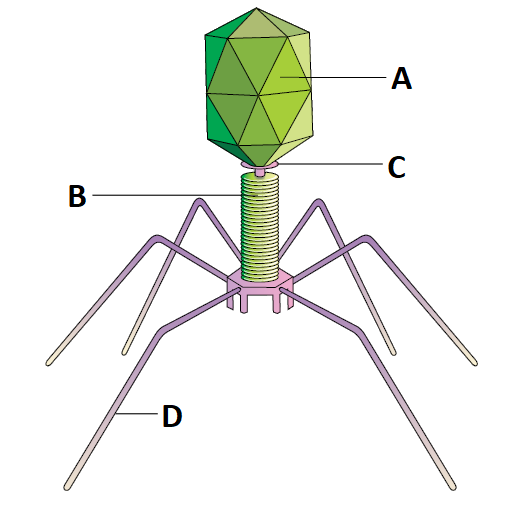
1 point(s)Given below is the diagram of a bacteriophage. In which one of the options all the four parts A, B, C and D are correct ?

\(
\begin{array}{l@{\quad}c c c c}
& \textbf{A} & \textbf{B} & \textbf{C} & \textbf{D} \\[0.6em]
\text{(1)} & \text{Tail fibres} & \text{Head} & \text{Sheath} & \text{Collar} \\
\text{(2)} & \text{Sheath} & \text{Collar} & \text{Head} & \text{Tail fibres} \\
\text{(3)} & \text{Head} & \text{Sheath} & \text{Collar} & \text{Tail fibres} \\
\text{(4)} & \text{Collar} & \text{Tail fibres} & \text{Head} & \text{Sheath}
\end{array}
\)CorrectIncorrect - Question 30 of 45
30. Question
1 point(s)Match each item in Column I with one in Column II and choose the correct answer from the codes given:
\(
\begin{array}{|l|l|l|l|}
\hline & \text { COLUMN I } & & \text { COLUMN II } \\
\hline \text { A } & \text { Entamoeba } & \text { a } & \text { Flagellated protozoan } \\
\hline \text { B } & \text { Trypanosoma } & \text { b } & \text { Amoeboid protozoan } \\
\hline \text { C } & \text { Paramecium } & \text { c } & \text { Non motile protozoan } \\
\hline \text { D } & \text { Plasmodium } & \text { d } & \text { Ciliated protozoan } \\
\hline
\end{array}
\)Codes:
\(
\begin{array}{|l|l|l|l|l|}
\hline & \text { A } & \text { B } & \text { C } & \text { D } \\
\hline 1 . & \text { a } & \text { b } & \text { c } & \text { d } \\
\hline 2 . & \text { b } & \text { a } & \text { c } & \text { d } \\
\hline 3 . & \text { a } & \text { b } & \text { d } & \text { c } \\
\hline 4 . & \text { b } & \text { a } & \text { d } & \text { c } \\
\hline
\end{array}
\)CorrectIncorrect - Question 31 of 45
31. Question
1 point(s)Identify the incorrect statement regarding body organization in fungi:
CorrectIncorrect - Question 32 of 45
32. Question
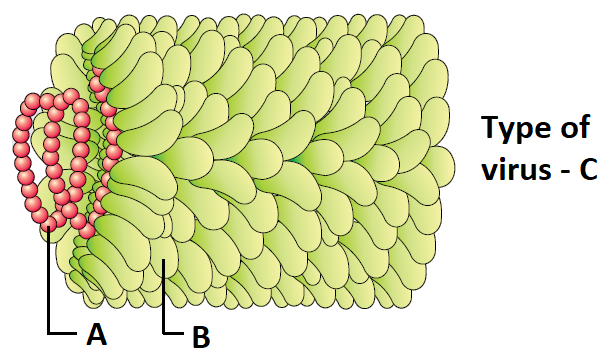
1 point(s)Given below is the diagram of a virus. In which one of the options A, B and C are correct

\(
\begin{array}{l@{\quad}c c c}
& \textbf{A} & \textbf{B} & \textbf{C} \\[0.6em]
\text{(a)} & \text{RNA} & \text{Capsid} & \text{Tobacco Mosaic Virus} \\
\text{(b)} & \text{DNA} & \text{Capsil} & \text{Tobacco Mosaic Virus} \\
\text{(c)} & \text{RNA} & \text{Lipid} & \text{Tobacco Mosaic Virus} \\
\text{(d)} & \text{RNA} & \text{Protein}& \text{HIV}
\end{array}
\)CorrectIncorrect - Question 33 of 45
33. Question
1 point(s)Protists that do not include any photosynthetic members are:
I. Euglenoids
II. Slime moulds
III. ProtozoansCorrectIncorrect - Question 34 of 45
34. Question
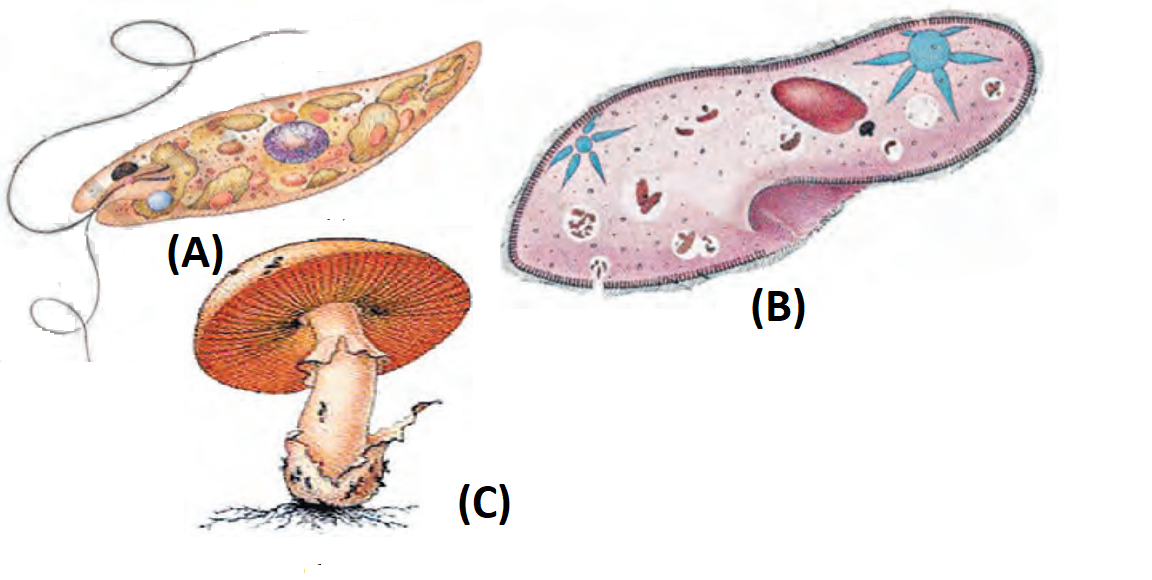
1 point(s)Observe the following figures and identify them:-
 CorrectIncorrect
 - Question 35 of 45
35. Question
1 point(s)With respect to fungal sexual cycle, choose the correct sequence of events:
CorrectIncorrect - Question 36 of 45
36. Question
1 point(s)A ‘dikaryon’ stage is seen in the members of:
CorrectIncorrect - Question 37 of 45
37. Question
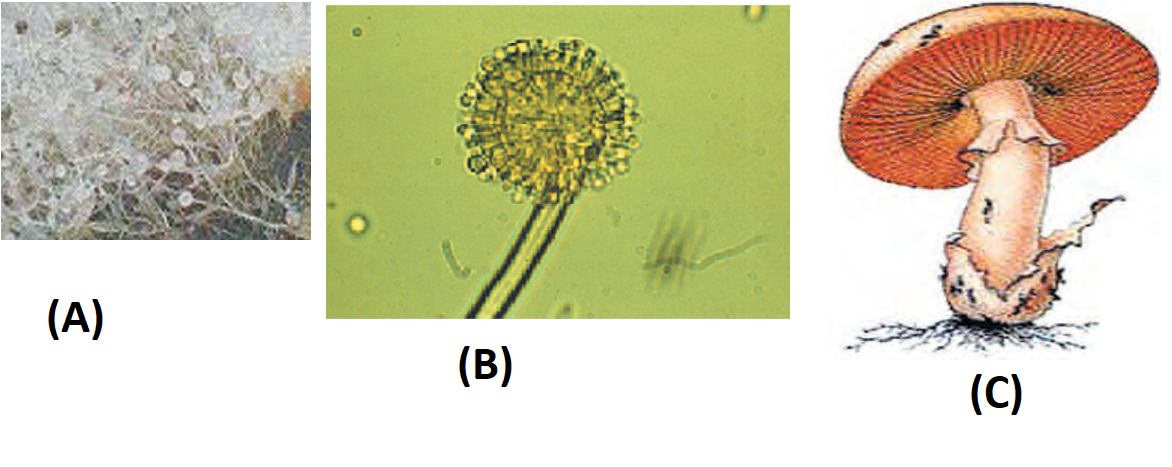
1 point(s)Identify A, B and C in given diagram.
 CorrectIncorrect
 - Question 38 of 45
38. Question
1 point(s)The basis of classification for the division of Kingdom Fungi into various classes includes all following except:
CorrectIncorrectHint
(c)
Why “types of pigments” is not a basis for fungal classification:
- Fungal pigments—such as carotenoids, melanins, polyketides, azaphilones—are secondary metabolites. These serve ecological or physiological roles but do not reflect core structural or reproductive traits used taxonomically.
- Pigments are not consistent or stable across phylogenetic lines; fungi from very different lineages may produce similar pigments.
- Question 39 of 45
39. Question
1 point(s)Members of phycomycetes are found
i. In aquatic habitats
ii. On decaying wood
iii. In moist and damp places
iv. As obligate parasites on plant
Choose from the following options:CorrectIncorrect - Question 40 of 45
40. Question
1 point(s)Which of the following is not true for fungi belonging to the class Phycomycetes?
CorrectIncorrect - Question 41 of 45
41. Question
1 point(s)Morels and truffles are edible fungi belonging to the class:
CorrectIncorrect - Question 42 of 45
42. Question
1 point(s)A fungus used extensively in biochemical and genetic work is:
CorrectIncorrect - Question 43 of 45
43. Question
1 point(s)Which of the following is not a character of Ascomycetes?
CorrectIncorrect - Question 44 of 45
44. Question
1 point(s)Which statement is wrong for viruses
CorrectIncorrect - Question 45 of 45
45. Question
1 point(s)Identify the incorrect statement regarding viroids:
CorrectIncorrect