\(
\begin{array}{ll}
\textbf{Options:} & \\
(1) A – (iii), B – (ii), C – (iv), D – (i) \\
(2) A – (ii), B – (iii), C – (iv), D – (i) \\
(3) A – (iii), B – (iv), C – (i), D – (ii) \\
(4) A – (iii), B – (ii), C – (i), D – (iv) \\
\end{array}
\)
Class-XI: UNIT I: DIVERSITY IN THE LIVING WORLD
CH2-Biological Classification
2 Quizzes
UNIT II: STRUCTURAL ORGANISATION IN PLANTS AND ANIMALS
CH5- Morphology of Flowering Plants
2 Quizzes
CH-6- Anatomy of Flowering Plants
2 Quizzes
CH7- Structural Organisation in Animals
2 Quizzes
UNIT III: CELL : STRUCTURE AND FUNCTIONS
CH10- Cell Cycle and Cell Division
2 Quizzes
UNIT IV: PLANT PHYSIOLOGY
CH11- Photosynthesis in Higher Plants
2 Quizzes
CH13- Plant Growth and Development
2 Quizzes
UNIT V: HUMAN PHYSIOLOGY
CH14- Breathing and Exchange of Gases
2 Quizzes
CH15- Body Fluids and Circulation
2 Quizzes
CH18- Neural Control and Coordination
2 Quizzes
Class-XII: UUNIT-I: REPRODUCTION
Biomolecules NCERT
Time limit: 0
Quiz Summary
0 of 45 Questions completed
Questions:
Information
You have already completed the quiz before. Hence you can not start it again.
Quiz is loading…
You must sign in or sign up to start the quiz.
You must first complete the following:
Results
Quiz complete. Results are being recorded.
Results
0 of 45 Questions answered correctly
Your time:
Time has elapsed
You have reached 0 of 0 point(s), (0)
Earned Point(s): 0 of 0, (0)
0 Essay(s) Pending (Possible Point(s): 0)
Categories
- Not categorized 0%
- 1
- 2
- 3
- 4
- 5
- 6
- 7
- 8
- 9
- 10
- 11
- 12
- 13
- 14
- 15
- 16
- 17
- 18
- 19
- 20
- 21
- 22
- 23
- 24
- 25
- 26
- 27
- 28
- 29
- 30
- 31
- 32
- 33
- 34
- 35
- 36
- 37
- 38
- 39
- 40
- 41
- 42
- 43
- 44
- 45
- Current
- Review
- Answered
- Correct
- Incorrect
- Question 1 of 45
1. Question
Match each item in Column I with only one item in Column II and select the correct match from the codes given:
\(
\begin{array}{|l|l|}
\hline \begin{array}{l}
\text { COLUMN I } \\
\text { [Component] }
\end{array} & \begin{array}{l}
\text { COLUMN II } \\
\text { [% of the total cellular mass] }
\end{array} \\
\hline \text { A. Protein } & \text { P. } 2 \\
\hline \text { B. Carbohydrates } & \text { Q. } 1 \\
\hline \text { C. Lipids } & \text { R. } 5-7 \\
\hline \text { D. Nucleic acids } & \text { S. } 3 \\
\hline & \text { T. } 10-15 \\
\hline & \text { U. } 70-90 \\
\hline
\end{array}
\)\(
\begin{array}{|l|l|l|l|l|}
\hline & \text { A } & \text { B } & \text { C } & \text { D } \\
\hline 1 . & \text { U } & \text { P } & \text { R } & \text { Q } \\
\hline 2 . & \text { T } & \text { S } & \text { P } & \text { R } \\
\hline 3 . & \text { T } & \text { P } & \text { S } & \text { R } \\
\hline 4 . & \text { P } & \text { Q } & \text { R } & \text { S } \\
\hline
\end{array}
\)CorrectIncorrect - Question 2 of 45
2. Question
Consider the given two statements:
I: Palmitic acid has 16 carbons including the carboxyl carbon.
II: Arachidonic acid has 20 carbons including the carboxyl carbon.CorrectIncorrect - Question 3 of 45
3. Question
Consider the given two statements:
I: Gingelly oil remains as oil in winters.
II: The fatty acid components of the oil are all saturated.CorrectIncorrect - Question 4 of 45
4. Question
Match each item in Column I with one item in Column II and chose your answer from the codes given below.
\(
\begin{array}{|l|l|}
\hline \begin{array}{l}
\text { Column I } \\
\text { (type of secondary metabolite) }
\end{array} & \begin{array}{l}
\text { Column II } \\
\text { (example) }
\end{array} \\
\hline \text { I. Alkaloid } & \text { 1. Abrin } \\
\text { II. Toxin } & \text { 2. Morphine } \\
\text { III. Lectin } & \text { 3. Vinblastin } \\
\text { IV. Drug } & \text { 4. Concanavalin A } \\
\hline
\end{array}
\)\(
\begin{aligned}
&\text { Codes: }\\
&\begin{array}{lllll}
&\text { I } & \text { II } & \text { III } & \text { IV } \\
\text { 1. } & 1 & 2 & 3 & 4 \\
\text { 2. } & 2 & 1 & 4 & 3 \\
\text { 3. } & 2 & 1 & 3 & 4 \\
\text { 4. } & 1 & 2 & 4 & 3
\end{array}
\end{aligned}
\)CorrectIncorrect - Question 5 of 45
5. Question
Consider the given statements regarding some important secondary metabolites:
I. Morphine is a strong opiate that is found naturally in opium and is mainly used as a pain medication.
II. Ricin is a toxin and a highly potent toxin produced in the seeds of the castor oil plant.
III. Concanavalin A is a lectin and is widely used in biology and biochemistry to characterize glycoproteins and other sugar-containing entities on the surface of various cells.
IV. Vinblastin is an anti-cancer drug typically used with other medications, to treat a number of types of cancer.CorrectIncorrect - Question 6 of 45
6. Question
Consider the given two statements:
Statement 1: Secondary metabolites derived from plant, fungal and microbial cells do not have a use in human welfare.
Statement 2: We do not, at the moment, understand the role or functions of all the secondary metabolites in host organisms.CorrectIncorrect - Question 7 of 45
7. Question
Consider the given two statements:
Statement 1: Lipids are a part of acid insoluble fraction or the macromolecular fraction during chemical analysis of a cell.
Statement 2:Lipids have a molecular weight running in thousands of Dalton.CorrectIncorrect - Question 8 of 45
8. Question
Consider the given two statements:
I. Arachidonic acid is a conditionally essential fatty acid.
II. It does become essential if a deficiency in linoleic acid exists.CorrectIncorrect - Question 9 of 45
9. Question
Consider the given two statements:
Statement 1: A protein is a heteropolymer.
Statement 2: There are 20 types of proteinogenic amino acids and they are linked by peptide bonds to form polypeptidesCorrectIncorrect - Question 10 of 45
10. Question
Consider the given two statements:
Statement 1: Certain amino acids are essential for our health.
Statement 2: Only such amino acids are used to make proteins in our body according to our own genetic code.CorrectIncorrect - Question 11 of 45
11. Question
Identify the correctly matched pair:
\(
\begin{array}{|l|l|l|}
\hline \text { I. } & \text { GLUT-4 } & \text { Enables glucose transport out of the cells } \\
\hline \text { II. } & \text { Collagen } & \text { Most abundant protein in animal world } \\
\hline \text { III. } & \text { RuBisCO } & \begin{array}{l}
\text { Most abundant protein in the whole of the } \\
\text { biosphere }
\end{array} \\
\hline
\end{array}
\)CorrectIncorrect - Question 12 of 45
12. Question
Change in an amino acid located distantly from the active site of an enzyme can affect the specificity of the enzyme towards its substrate by:
CorrectIncorrect - Question 13 of 45
13. Question
Consider the given two statements:
Statement 1: The right end of the glycogen molecule is called the reducing end and the left end is called the nonreducing end.
Statement 2: Glycogen is a homopolymer of alpha glucose.CorrectIncorrect - Question 14 of 45
14. Question
Consider the given two statements:
Statement 1: Iodine test can detect the presence of starch but not of cellulose in a given sample.
Statement 2: Starch forms helical secondary structure and can hold iodine molecules while cellulose does not contain complex helices and hence cannot hold iodine.CorrectIncorrect - Question 15 of 45
15. Question
Quaternary structure is seen in proteins that:
CorrectIncorrect - Question 16 of 45
16. Question
Identify the correct statements:
I. The level of protein structure organization that provides the positional information of amino acids in a protein is called as the primary structure.
II. Only right handed helices are observed in proteins seen in living organisms.
III. Tertiary structure is absolutely necessary for the many biological activities of proteins.\(
\begin{array}{|l|l|}
\hline \text { 1. Only I and II } & \text { 2. Only I and III } \\
\hline \text { 3. Only II and III } & \text { 4. I, II and III } \\
\hline
\end{array}
\)CorrectIncorrect - Question 17 of 45
17. Question
Consider the given two statements:
Statement 1: In a double stranded DNA molecule, the amount of Guanine should be equal to Cytosine and the amount of Adenine should be equal to Thymine.
Statement 2: There are two hydrogen bonds between Adenine and Thymine and three hydrogen bonds between Guanine and Cytosine.CorrectIncorrect - Question 18 of 45
18. Question
In a nucleic acid:
I: A phosphate moiety links the 5′ carbon of one sugar of one nucleotide to the 1′ carbon of the sugar of the succeeding nucleotide.
II: The backbone of the strand is made up of alternate sugar and nitrogenous bases.CorrectIncorrect - Question 19 of 45
19. Question
Consider the given two statements:
I. Any exposure to extreme stresses can disrupt a protein’s interaction and inevitably lead to denaturation.
II. Protein folding consists of a balance between a substantial amount of weak intra-molecular interactions within a proteinCorrectIncorrect - Question 20 of 45
20. Question
The metabolic pathways in a living system:
I. are linear or circular
II. are series of linked reactions
III. are characterized by a definite rate and direction of flow of metabolites through themCorrectIncorrect - Question 21 of 45
21. Question
The figure given below shows the conversions of a substrate into product by an enzyme. In which one of the four options (1-4), the components of reaction labelled as A , B , C and D are identified correctly:

\(
\begin{array}{|l|l|l|l|l|}
\hline
& A & B & C & D \\
\hline
1. & \text{Transition state} & \text{Potential energy} & \text{Activation energy without enzyme} & \text{Activation energy with enzyme} \\
\hline
2. & \text{Potential energy} & \text{Transition state} & \text{Activation energy with enzyme} & \text{Activation energy without enzyme} \\
\hline
3. & \text{Activation energy with enzyme} & \text{Transition state} & \text{Activation energy without enzyme} & \text{Potential energy} \\
\hline
4. & \text{Potential energy} & \text{Transition state} & \text{Activation energy without enzyme} & \text{Activation energy with enzyme} \\
\hline
\end{array}
\)CorrectIncorrect - Question 22 of 45
22. Question
Consider the following two statements regarding enzyme action:
I. Co-factors play a crucial role in the catalytic activity of the enzyme.
II. Catalytic activity is reduced when the co-factor is removed from the enzyme.CorrectIncorrect - Question 23 of 45
23. Question
The enzymes that catalyse removal of groups from substrates by mechanisms other than hydrolysis leaving double bonds are called as:
CorrectIncorrect - Question 24 of 45
24. Question
Which of the following categories of enzyme classification are correctly matched?
\(
\begin{array}{|l|l|}
\hline \text { EC 1 } & \begin{array}{l}
\text { Oxidoreductases: catalyze oxidation/reduction } \\
\text { reactions }
\end{array} \\
\hline \text { EC 2 } & \begin{array}{l}
\text { Hydrolases: catalyze the hydrolysis of various } \\
\text { bonds }
\end{array} \\
\hline \text { EC 3 } & \begin{array}{l}
\text { Transferases: transfer a functional group (e.g. a } \\
\text { methyl or phosphate group) }
\end{array} \\
\hline \text { EC 4 } & \begin{array}{l}
\text { Lyases: cleave various bonds by means other than } \\
\text { hydrolysis and oxidation }
\end{array} \\
\hline \text { EC 5 } & \begin{array}{l}
\text { Isomerases: catalyze isomerization changes within } \\
\text { a single molecule }
\end{array} \\
\hline \text { EC 6 } & \text { Ligases: join two molecules with covalent bonds. } \\
\hline
\end{array}
\)CorrectIncorrect - Question 25 of 45
25. Question
Consider the following enzymes:
I. Catalase
II. Peroxidase
III. Carboxypeptidase
Which of these enzymes require haem as a co-factor for their activity?CorrectIncorrect - Question 26 of 45
26. Question
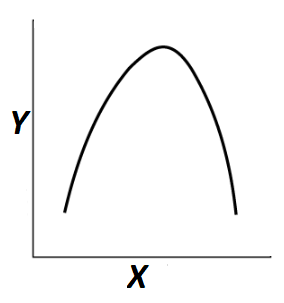
Select the right option regarding the given graph

\(
\begin{array}{ll}
\textbf{X-axis} & \textbf{Y-axis} \\
(1)\ \text{Rate of reaction} & \text{Enzymatic activity} \\
(2)\ \text{Enzymatic activity} & \text{Rate of reaction} \\
(3)\ \text{Temperature} & \text{Enzymatic activity} \\
(4)\ \text{Enzymatic activity} & \text{pH}
\end{array}
\)CorrectIncorrect - Question 27 of 45
27. Question
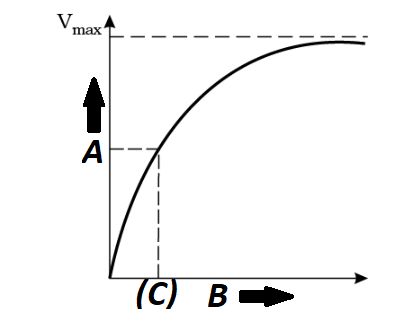
Identify A, B, C in the given graph for an enzyme mediated reaction:-

\(
\begin{array}{ll}
(1) \ A – \text{Velocity of reaction} & B – \text{Product concentration} \\
(2) \ \mathrm{C} – K_{\mathrm{m}} \ \text{value} & B – \text{Product concentration} \\
(3) \ \mathrm{C} – K_{\mathrm{m}} \ \text{value} & B – \frac{V_{\text{max}}}{2} \\
(4) \ A – \text{Velocity of reaction} & B – \text{Substrate concentration}
\end{array}
\)CorrectIncorrect - Question 28 of 45
28. Question
Read the following statements (A-F)
(A) Km value increases in presence of competitive inhibitor
(B) Km value of enzyme is substrate concentration at 1/2 Vmax
(C) The cofactors of many enzymes are proteins
(D) Most abundant protein in animal world is trypsin
(E) Lactose gives two molecules of glucose on hydrolysis
(F) Chitin is nitrogen containing polysaccharide
How many of the above statements are correct ?CorrectIncorrect - Question 29 of 45
29. Question
Identify the statements as True(T) or False(F)
I. In a protein the amino acids are linked by glycosidic bonds
II. Malonate is a competitive inhibitor of succinic dehydrogenase
III. Enzymes require optimum pH for maximal activity
IV. Zwitter ionic form of amino acid has only positive charge\(
\begin{array}{|c|c|c|c|c|}
\hline & \text { I } & \text { II } & \text { III } & \text { IV } \\
\hline(1) & \mathrm{T} & \mathrm{~F} & \mathrm{~T} & \mathrm{~F} \\
\hline(2) & \mathrm{F} & \mathrm{~T} & \mathrm{~F} & \mathrm{~T} \\
\hline(3) & \mathrm{T} & \mathrm{~T} & \mathrm{~F} & \mathrm{~F} \\
\hline(4) & \mathrm{F} & \mathrm{~T} & \mathrm{~T} & \mathrm{~F} \\
\hline
\end{array}
\)CorrectIncorrect - Question 30 of 45
30. Question
\[
\begin{array}{l}
\textbf{Statement A:} \ \text{A protein with } \alpha\text{-helix or } \beta\text{-pleated sheet represents a secondary protein structure} \\
\textbf{Statement B:} \ \text{The } \beta\text{-pleated protein structure is due to coiling of the polypeptide chains} \\
\\
\text{(1) Only statement A is correct} \\
\text{(2) Both statements A and B are correct} \\
\text{(3) Only statement B is correct} \\
\text{(4) Both statements A and B are incorrect}
\end{array}
\]CorrectIncorrect - Question 31 of 45
31. Question
\(
\begin{array}{|c|l|}
\hline
\textbf{Column A} & \textbf{Column B} \\
\hline
\text{(A) Basic amino acid} & (i) \ \text{Lysine} \\
\text{(B) Acidic amino acid} & (ii) \ \text{Aspartic acid}, \ (iii) \ \text{Glutamic acid} \\
\text{(C) Neutral amino acid} & (iv) \ \text{Alanine}, \ (v) \ \text{Glycine}, \ (vi) \ \text{Valine} \\
\hline
\end{array}
\)\(
\begin{array}{ll}
\textbf{Options:} & \\
(1) & A – v ; B – iii, vi ; C – i, ii, iv \\
(2) & A – iii, vi ; B – iv, v ; C – i, ii \\
(3) & A – i ; B – ii, iii ; C – iv, v, vi \\
(4) & A – v, i ; B – i, ii ; C – iii, iv \\
\end{array}
\)CorrectIncorrect - Question 32 of 45
32. Question
\(
\begin{array}{|c|l|}
\hline
\textbf{Column A} & \textbf{Column B} \\
\hline
\text{(A) Insulin} & \text{(iii) Protein} \\
\text{(B) Inulin} & \text{(ii) Fructose polymer} \\
\text{(C) Uridine} & \text{(iv) Nucleoside} \\
\text{(D) Glycine} & \text{(i) Simplest amino acid} \\
\hline
\end{array}
\)CorrectIncorrect - Question 33 of 45
33. Question
Which of the following statements is incorrect regarding action of an enzyme?
CorrectIncorrect - Question 34 of 45
34. Question
\(
\begin{array}{|c|l|}
\hline
\textbf{Column A} & \textbf{Column B} \\
\hline
\text{(A) Prosthetic group} & \text{(i) Starch} \\
\text{(B) Reducing sugar} & \text{(ii) Sucrose} \\
\text{(C) Storage product} & \text{(iii) Galactose} \\
\text{(D) Zn} & \text{(iv) Haem} \\
\text{} & \text{(v) Carboxypeptidase} \\
\hline
\end{array}
\)\(
\begin{array}{ll}
\textbf{Options:} & \\
(1) & A – (v), B – (iii), C – (i), D – (ii) \\
(2) & A – (iv), B – (iii), C – (i), D – (v) \\
(3) & A – (iii), B – (ii), C – (i), D – (v) \\
(4) & A – (iv), B – (ii), C – (i), D – (v) \\
\end{array}
\)CorrectIncorrect - Question 35 of 45
35. Question
Lower value of Michaelis constant (Km) shows
CorrectIncorrect - Question 36 of 45
36. Question
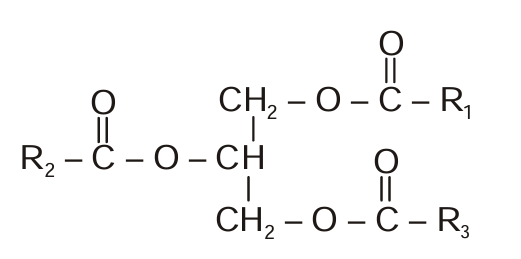
In the following structure, what does R1, R2 and R3 represent?
 CorrectIncorrect
 - Question 37 of 45
37. Question
Read the following statements (A–F)
(A) Carbohydrates, lipids and proteins are primary metabolites
(B) The relative abundance of carbon and hydrogen with respect to other elements is higher in any living
organisms than in earth crust
(C) Flavonoids and alkaloids are secondary metabolites
(D) Most of the elements present in a sample of earth’s crust are also present in a sample of living tissue
(E) The three essential fatty acids are linoleic acid, linolenic acid and palmitic acid
(F) The components common to nucleoside as well as nucleotides are sugar and nitrogenous base
How many of the following statements are true ?CorrectIncorrect - Question 38 of 45
38. Question
Identify the statements as true (T) or false (F)
I. In competitive inhibition, the inhibitor molecule is not chemically changed by the enzyme
II. The presence of a competitive inhibitor decreases the Km of the enzyme for the substrate
III. In proteins right handed helices are observed
IV. Proteins can not form quarternary structures\(
\begin{array}{|c|c|c|c|c|}
\hline & \text { I } & \text { II } & \text { III } & \text { IV } \\
\hline(1) & \mathrm{T} & \mathrm{~T} & \mathrm{~T} & \mathrm{~T} \\
\hline(2) & \mathrm{T} & \mathrm{~T} & \mathrm{~F} & \mathrm{~F} \\
\hline(3) & \mathrm{T} & \mathrm{~F} & \mathrm{~F} & \mathrm{~T} \\
\hline(4) & \mathrm{T} & \mathrm{~F} & \mathrm{~T} & \mathrm{~F} \\
\hline
\end{array}
\)CorrectIncorrect - Question 39 of 45
39. Question
\(
\begin{array}{|c|l|}
\hline
\textbf{Column A} & \textbf{Column B} \\
\hline
\text{(A) Glucose} & \text{(iv) Hexose sugar} \\
\text{(B) RuBisCO} & \text{(i) Protein} \\
\text{(C) Chitin} & \text{(ii) Arthropods} \\
\text{(D) NAD} & \text{(iii) Niacin} \\
\hline
\end{array}
\)CorrectIncorrect - Question 40 of 45
40. Question
In a DNA molecule, the phosphate group is attached to ___I___ carbon of the sugar residue of First
nucleotide and __II___ carbon of the sugar residue of the succeeding or next nucleotide by __III
bond\(
\begin{array}{|c|l|}
\hline
\textbf{Option} & \textbf{Statement} \\
\hline
\text{(1)} & \text{I – 5’, II – 3’, III – phosphodiester} \\
\text{(2)} & \text{I – 5’, II – 3’, III – glycosidic} \\
\text{(3)} & \text{I – 3’, II – 5’, III – phosphodiester} \\
\text{(4)} & \text{I – 3’, II – 5’, III – glycosidic} \\
\hline
\end{array}
\)CorrectIncorrect - Question 41 of 45
41. Question
When we homogenize any tissues in an acid the acid soluble pool represents
CorrectIncorrect - Question 42 of 45
42. Question
The given compound:-
 CorrectIncorrect
 - Question 43 of 45
43. Question
Why is cellulose so difficult for most animals to digest?
CorrectIncorrect - Question 44 of 45
44. Question
Identify the incorrect statement regarding enzyme action:
CorrectIncorrect - Question 45 of 45
45. Question
Statement I: To analyze organic compounds in living organisms, we first take living tissue and grind it with trichloroacetic acid using a mortar and pestle.
Statement II: Al the carbon compounds that we get from living tissues can be called ‘biomolecules’.CorrectIncorrect