Anatomy of Flowering Plants NCERT
Quiz Summary
0 of 45 Questions completed
Questions:
Information
You have already completed the quiz before. Hence you can not start it again.
Quiz is loading…
You must sign in or sign up to start the quiz.
You must first complete the following:
Results
Results
0 of 45 Questions answered correctly
Your time:
Time has elapsed
You have reached 0 of 0 point(s), (0)
Earned Point(s): 0 of 0, (0)
0 Essay(s) Pending (Possible Point(s): 0)
Categories
- Not categorized 0%
- 1
- 2
- 3
- 4
- 5
- 6
- 7
- 8
- 9
- 10
- 11
- 12
- 13
- 14
- 15
- 16
- 17
- 18
- 19
- 20
- 21
- 22
- 23
- 24
- 25
- 26
- 27
- 28
- 29
- 30
- 31
- 32
- 33
- 34
- 35
- 36
- 37
- 38
- 39
- 40
- 41
- 42
- 43
- 44
- 45
- Current
- Review
- Answered
- Correct
- Incorrect
- Question 1 of 45
1. Question
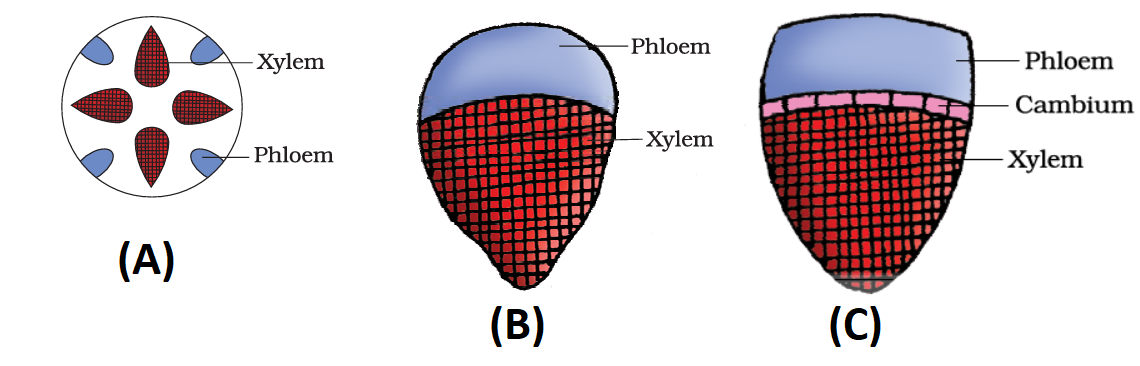
1 point(s)What type of vascular bundles are A, B and C?
 CorrectIncorrect
 - Question 2 of 45
2. Question
1 point(s)Consider the following two statements:
Statement I: ‘Tissue’ is a level of biological organization between cells and a complete organ.
Statement II: A tissue is a group of cells having a common origin and usually performing a common function.CorrectIncorrect - Question 3 of 45
3. Question
1 point(s)Root hairs are:
CorrectIncorrect - Question 4 of 45
4. Question
1 point(s)All the following are true for trichomes except:
CorrectIncorrect - Question 5 of 45
5. Question
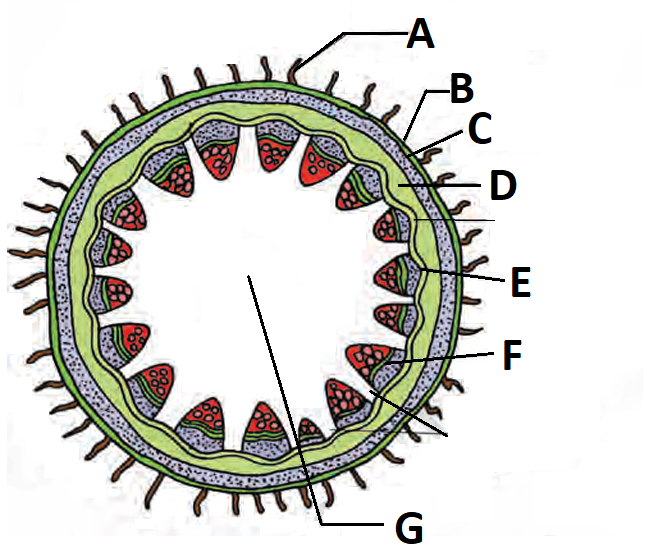
1 point(s)TS. of dicot stem is given below, certain parts have been indicated by alphabets. Choose the answer in which these
alphabets have been correctly matched with the parts which they indicate: CorrectIncorrect
 - Question 6 of 45
6. Question
1 point(s)Cuticle:
CorrectIncorrect - Question 7 of 45
7. Question
1 point(s)During the formation of primary plant body, dermal tissue, ground tissue and vascular tissue are produced by:
CorrectIncorrect - Question 8 of 45
8. Question
1 point(s)Regarding the epidermal tissue system of angiosperms:
I. Cuticle is absent in roots
II. Guard cells are dumb-bell shaped in grasses and possess chloroplasts
III. Root hairs are multicellular and the stem hairs are unicellularCorrectIncorrect - Question 9 of 45
9. Question
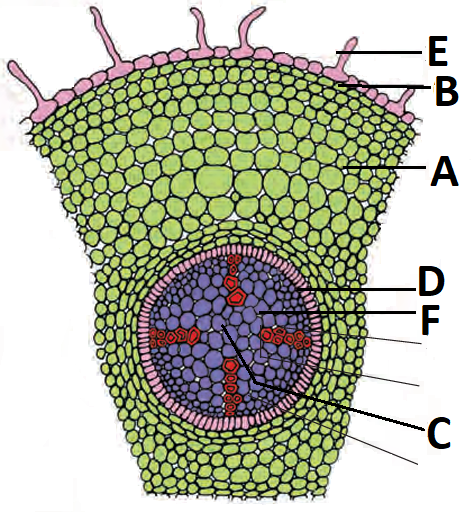
1 point(s)TS of dicot root is given below, certain parts have been indicated by alphabets, choose the answer in which these alphabets have been correctly matched with the parts which they indicate.
 CorrectIncorrect
 - Question 10 of 45
10. Question
1 point(s)The incorrect statement regarding epidermal tissue system in angiosperms would be:
CorrectIncorrect - Question 11 of 45
11. Question
1 point(s)Mesophyll cells present in the ground tissue of leaves are:
CorrectIncorrect - Question 12 of 45
12. Question
1 point(s)In a dicot stem, the pericycle is present on the inner side of the endodermis and:
CorrectIncorrect - Question 13 of 45
13. Question
1 point(s)In a dicot root, initiation of lateral roots and vascular cambium during the secondary growth takes place in the cells of:
CorrectIncorrect - Question 14 of 45
14. Question
1 point(s)In a dicot stem the term ‘starch sheath‘ is used for:
CorrectIncorrect - Question 15 of 45
15. Question
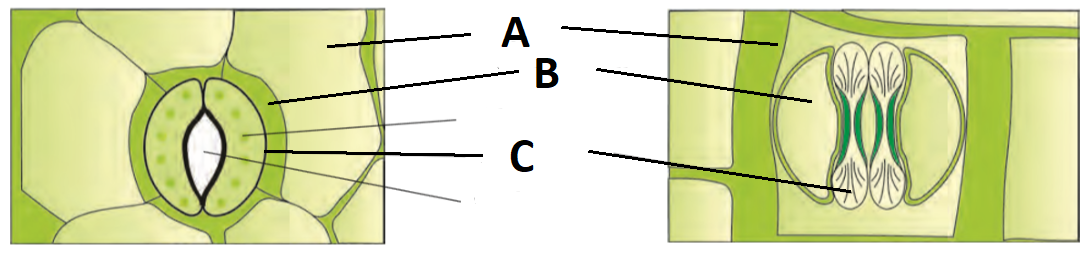
1 point(s)The given diagram represents stomatal apparatus in dicots and monocots. Identify A, B and C:
 CorrectIncorrect
 - Question 16 of 45
16. Question
1 point(s)All the following statements regarding the anatomy of a typical dicotyledonous root are correct except:
CorrectIncorrect - Question 17 of 45
17. Question
1 point(s)The vascular bundles in a dicot stem are:
CorrectIncorrect - Question 18 of 45
18. Question
1 point(s)Casparian strips are:
CorrectIncorrect - Question 19 of 45
19. Question
1 point(s)In a dicot root, the number of patches of xylem and phloem are usually:
CorrectIncorrect - Question 20 of 45
20. Question
1 point(s)The term ‘stele’ in a dicot root does not include:
CorrectIncorrect - Question 21 of 45
21. Question
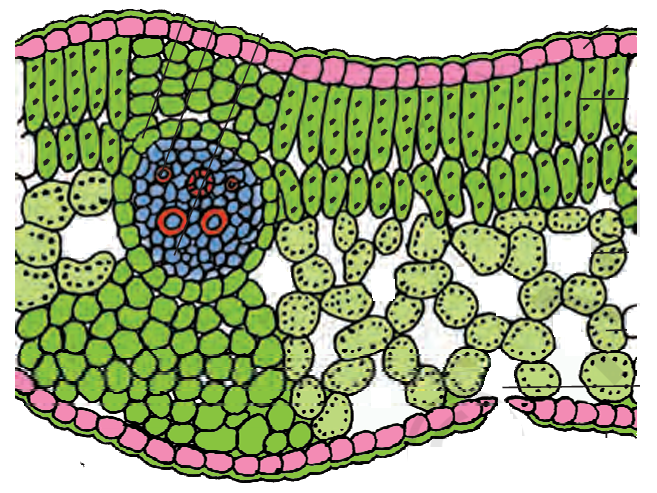
1 point(s)Refer to the given diagram showing a cross section of leaf:

Which of the following statements are not correct regarding this?
I. It is an isobilateral leaf.
II. The leaf shows reticulate venation.
III. The leaf may exhibit kranz anatomy.
IV. Such type of leaf may be present in plants undergoing \( C_4 \) pathway.
V. Mesophyll is differentiated into palisade and spongy parenchyma.
VI. Such type of leaf is found in hydrophytes.
VII. Such type of leaf is found in members of Family Poaceae.CorrectIncorrect - Question 22 of 45
22. Question
1 point(s)Monocot root anatomy is different from the anatomy of dicot root in all the following aspects except:
CorrectIncorrect - Question 23 of 45
23. Question
1 point(s)The hypodermis of a dicotyledonous stem:
CorrectIncorrect - Question 24 of 45
24. Question
1 point(s)Which of the following is a feature of the anatomy of a monocot stem?
I. Collenchymatous hypodermis
II. Scattered vascular bundlesCorrectIncorrect - Question 25 of 45
25. Question
1 point(s)Identify the incorrect matching with respect to anatomy of dicot and monocot leaves?
\(
\begin{array}{|l|l|l|l|}
\hline & \text { Character } & \text { Dicot[Dorsiventral] } & \begin{array}{l}
\text { Monocot } \\
\text { [Isobilateral] }
\end{array} \\
\hline \text { 1. } & \begin{array}{l}
\text { Presence } \\
\text { of stomata }
\end{array} & \begin{array}{l}
\text { More on adaxial } \\
\text { epidermis }
\end{array} & \begin{array}{l}
\text { More on abaxial } \\
\text { epidermis }
\end{array} \\
\hline \text { 2. } & \text { Mesophyll } & \begin{array}{l}
\text { Differentiated into } \\
\text { palisade and spongy } \\
\text { parenchyma }
\end{array} & \begin{array}{l}
\text { Not differentiated into } \\
\text { palisade and spongy } \\
\text { parenchyma }
\end{array} \\
\hline \text { 3. } & \text { Venation } & \text { Mostly reticulate } & \text { Mostly parallel } \\
\hline \text { 4. } & \begin{array}{l}
\text { Size of } \\
\text { vascular } \\
\text { bundle }
\end{array} & \begin{array}{l}
\text { Dependent on the } \\
\text { size of veins }
\end{array} & \begin{array}{l}
\text { Near similar size } \\
\text { except in main veins }
\end{array} \\
\hline
\end{array}
\)CorrectIncorrect - Question 26 of 45
26. Question
1 point(s)What is true regarding bulliform cells seen in grasses?
CorrectIncorrect - Question 27 of 45
27. Question
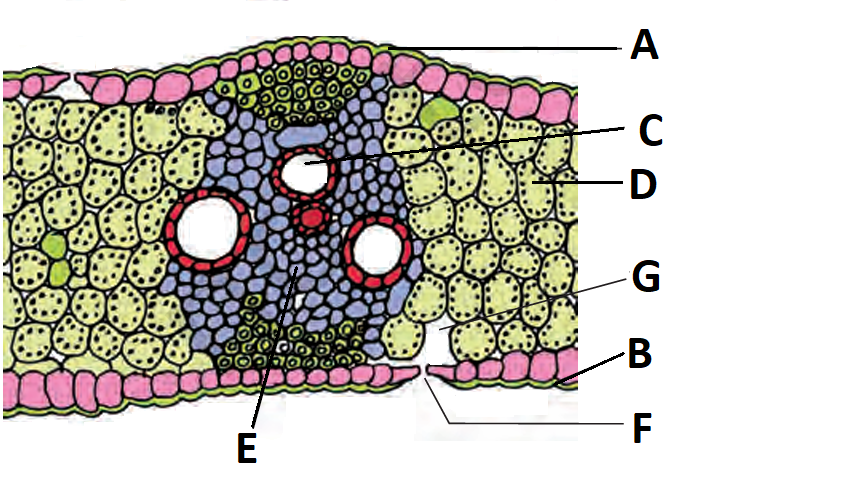
1 point(s)Identify the correct option regarding this Transverse section as shown in diagram:-
 CorrectIncorrect
 - Question 28 of 45
28. Question
1 point(s)While looking at a T.S. of a certain plant part you are convinced that it must be a monocot stem. Which of the following, if seen in the T.S. will give you confidence for your conclusion?
CorrectIncorrect - Question 29 of 45
29. Question
1 point(s)The parallel venation in monocot leaves is reflected in the:
CorrectIncorrect - Question 30 of 45
30. Question
1 point(s)Identify the incorrect statement regarding the anatomy of flowering plants:
CorrectIncorrect - Question 31 of 45
31. Question
1 point(s)Regarding the guard cells:
CorrectIncorrect - Question 32 of 45
32. Question
1 point(s)As compared to a dicot root, a monocot root has:
CorrectIncorrect - Question 33 of 45
33. Question
1 point(s)Cortex is the region found between
CorrectIncorrect - Question 34 of 45
34. Question
1 point(s)Grass leaves curl inwards during very dry weather.
Select the most appropriate reason from the following :CorrectIncorrect - Question 35 of 45
35. Question
1 point(s)Which of the following statements is false?
I. Epidermal cell has small amount of cytoplasm and a large vacuole.
II. Waxy layer cuticle is absent in roots.
III. Root hairs are unicellular, while stem hairs / trichomes are multicellular.
IV. Trichomes – branched /unbranched, soft /stiff and secretory or transpiration preventive.
V. Guard cells are dumbell-shaped in dicots, and bean-shaped in monocots (e.g. grass).CorrectIncorrect - Question 36 of 45
36. Question
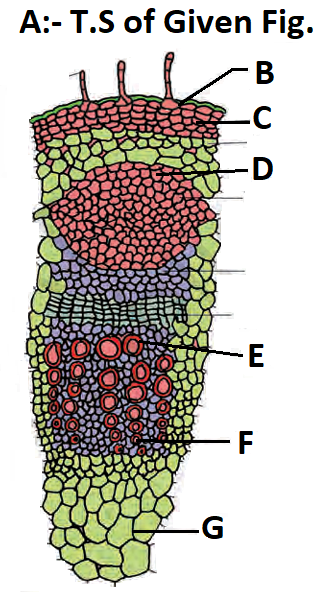
1 point(s)Identify T.S of this diagram ; Correct Identity is denoted by A and then identify other B to G ?
 CorrectIncorrect
 - Question 37 of 45
37. Question
1 point(s)The stomatal apparatus includes
CorrectIncorrect - Question 38 of 45
38. Question
1 point(s)Which one is correct about bulliform / motor cell?
CorrectIncorrect - Question 39 of 45
39. Question
1 point(s)Select the characters which are not applicable to the anatomy of dicot roots?
A. Conjunctive tissue present.
B. Presence of protein compounds in the casparian strips.
C. Polyarch xylem bundles.
D. Presence of pericycle.CorrectIncorrect - Question 40 of 45
40. Question
1 point(s)Select the incorrect statement w.r.t. endodermis?
CorrectIncorrect - Question 41 of 45
41. Question
1 point(s)Given two statements are Assertion (A) and Reason (R). In the light of given statements select the correct option.
Assertion (A) : Monocot stems do not show secondary growth
Reason (R) : Vascular bundles in monocot stem are closed.CorrectIncorrect - Question 42 of 45
42. Question
1 point(s)Which of the transverse sections of a plant part given as options shows the following anatomical features?
(a) Endodermis is comprised of a single layer of barrel-shaped cells without any intercellular spaces.
(b) Small or inconspicuous pith.
(c) Radial vascular bundles
(d) Two to four xylem bundlesCorrectIncorrect - Question 43 of 45
43. Question
1 point(s)In a monocot stem:
CorrectIncorrect - Question 44 of 45
44. Question
1 point(s)These three types of vascular bundles (A, B and C) are present in:-
CorrectIncorrect - Question 45 of 45
45. Question
1 point(s)The ring arrangement of vascular bundles is a characteristic feature of:
CorrectIncorrect